Category Archives: Grammar

454. David Crystal Interview (Part 1) Professor of Linguistics

Talking about language with one of the world’s top linguists, Professor David Crystal.

Small Donate Button[DOWNLOAD]

Introduction

Hello everyone, thank you for choosing to listen to this episode of my podcast. I am particularly pleased to be able to present this episode to you. It is, in fact, a privilege for me to say that today on the podcast I am talking to Professor David Crystal.

I’m now going to give a quick introduction just to make sure that you are all fully aware of the calibre of this guest and to emphasise to you just how lucky we are to have him on the podcast today.

According to The Guardian newspaper, David Crystal is the world’s foremost writer and lecturer on the English language.

He isn’t an English teacher, but he is an expert on linguistics. That’s the study of language and all the issues relating to it.

David Crystal

David Crystal has a worldwide reputation and has published something in the region of 120 books including numerous academic reference works and encyclopedias of language, and books for the general reader covering topics such as English grammar, spelling, punctuation, accents, connections to Shakespeare, the influence of technology and the development of language throughout history.

He is currently patron of the International Association of Teachers of English as a Foreign Language (IATEFL) and the Association for Language Learning (ALL), president of the Society for Editors and Proofreaders and the UK National Literacy Association, and honorary vice-president of both the Institute of Linguists and the Royal College of Speech and Language Therapists.

He is honorary professor of linguistics at the University of Wales and in 1995 he was on the Queen’s honours list when he was awarded the Order of the British Empire (the OBE) for services to the English language. The OBE is the second highest honour which you can receive from The Queen – the highest being the knighthood or damehood.

So he’s Britain’s favourite language expert and he regularly makes appearances at literary festivals and teaching conferences, appears on British radio and television, writes articles for newspapers and magazines and researches all kinds of language-related topics.

But the main thing he does is to write books…

David’s Books

Some of his most popular books include:

  • The Cambridge Encyclopedia of the English Language
  • The Oxford Illustrated Shakespeare Dictionary
  • The Story of English in 100 Words
  • You Say Potato: The Story of English Accents (written with his son Ben)
  • Wordsmiths and Warriors: The English-Language Tourist’s Guide to Britain (Written with his wife Hilary)
  • Txting: The Gr8 Db8
  • Pronouncing Shakespeare: The Globe Experiment – a fascinating project investigating how English was pronounced by the original actors in the Globe Theatre when Shakespeare was alive
  • Spell It Out: The Curious, Enthralling and Extraordinary Story of English Spelling
  • Just A Phrase I’m Going Through: My Life in Language (which is both his autobiography and a highly accessible introduction to the field of linguistics)
  • And from this year “Making Sense: The Glamorous Story of English Grammar”

Many of those titles can be purchased as ebooks from David Crystal’s website – www.davidcrystal.com or from any good bookseller. There are also audiobook versions which are read out by the man himself.

David Crystal’s writing is clear, entertaining, informative and simply a pleasure to experience. The same can be said about his public speaking. I’m always impressed by his ability to take a complex academic subject like linguistics and turn it into the sort of thing that anyone can understand and enjoy.

I met David once at a teaching conference where he presented Andy Johnson and me with an award for a presentation we did. I had a chat with him afterwards and was delighted to discover how down-to-earth and friendly he is and I’ve always wanted to interview him for this podcast, but it’s only recently that I actually plucked up the courage to ask him. Thankfully he agreed.

David Crystal is a nothing short of a national treasure and I can’t believe I’m talking to him on my podcast.

Right – I think you get the idea now – he’s kind of a big deal for anyone interested in language and language teaching and so without further introduction, here is my conversation about language with Professor David Crystal.


Questions for David Crystal

Grammar

Your recent book from this year is called Making sense: the glamorous story of English grammar.

Is grammar really ‘glamourous’?

In my experience, a lot of learners of English feel a bit bored or intimidated by grammar, leading some teachers out there to say that you can learn English without grammar – learn English without thinking, etc.

Do you think it’s possible to learn English as a second language without studying grammar?
I know you’re not actually an English teacher, but do you have any tips for learners of English who want to improve their grammar?

You recently wrote a political history of grammar in the UK as a supplement to your book “Making Sense”.

What relationship does the average Brit have with grammar today, in your experience?
Has this attitude changed over the years? How has it changed?

Language Decline

I was recently having a conversation about language with a couple of friends on this podcast and we arrived at several questions that we couldn’t really answer. I thought you might be able to help.

People often complain about the so-called decline of the English language – citing things like poor grammar, punctuation, spelling, acronyms or text-speak as evidence that standards of English are slipping. Do you agree with that? Are standards of English declining? How do we even measure that?

People seem to be afraid that what they see as falling standards will result in “the death of the English language”. Has a language ever completely “died out” due to declining standards? What causes languages to die?

Are we better or worse at communicating than we used to be? (answered later)

‘Right’ and ‘Wrong’

Are you bothered by those so-called ‘errors’ in English that make some people angry?

Non-native speakers influence on English

My mate Paul says (as a bit of a joke) that because there are more non-native speakers of English in the world than native speakers, we’re actually the ones who are using the language incorrectly. E.g. because more Chinese people pronounce some English words in a certain way, it’s the native speakers who are pronouncing those words wrong.
Does he have a point or is he talking nonsense like he usually does?

French Pronunciation example

My French students often feel bad about their pronunciation because it’s so ‘French’. We understand everything that they say, but they’re really hung up on the fact that they sound so French – e.g. they can’t pronounce TH sounds in words like strengths, clothes, thirty three etc and it seems to be impossible to fix it.
Do they need to feel so bad about it?

How should my listeners feel about their relationship with English, and the version of English that they speak?


End of part 1

That’s the end of part 1. The conversation will continue in part 2 where you’ll hear me asking some questions sent in by listeners, and there were some really great questions including predictions about English in the future, the role of AI in language learning, the impact of Brexit on English in the world, and the way Donald Trump and Barack Obama use English.

I hope you’re enjoying listening to this, and that you’re able to follow some of the slightly complex points being made.

David gave so many really interesting answers and made some very important and useful points, and he continues to do that in part 2.

I think David speaks very clearly, with that slightly Welsh or Scouse twang in his voice. He lives in Hollyhead, in Northern Wales, not far from Liverpool, and he lived in Liverpool for a while as a child, which accounts for the slight accent that he has, if you noticed that.

As he said, his accent is a mix of different things, caused by the time he has spent living in different places and interacting with different people – RP speakers in the south east, locals in Wales and Liverpool and so on. It all contributes to the way he speaks. He also happens to be very articulate and I really admire the way he expresses his thoughts so clearly.

I hope you agree that we really are rather lucky to have David Crystal on the podcast and I think it’s worth listening to this episode several times so you can really absorb everything he’s saying because he really does know what he’s talking about and there’s a lot of knowlege there.

I think I should do a follow-up episode to this in which I just restate the main points that he made, just to consolidate it all, and I plan to do that. I could also talk about some of the questions which I didn’t have a chance to ask David.

I also hope you noticed that David Crystal helped to clear up some of the things I was discussing with Amber and Paul in episode 452. I should go over those things again if I do a follow-up episode, just to make it “crystal clear” – pun intended. I totally intended to make that joke and I think you should know it’s a brilliant joke which nobody has ever made before and this is sarcasm but it also isn’t.

Don’t forget to check out www.davidcrystal.com for all his work, his blog, videos of him speaking publicly and more information, including the opportunity to send him a message if you want to.

I strongly recommend getting some of his books, which should be available from any good bookseller. You could try “Making Sense: The Glamorous Story of English Grammar” for example.

Also, don’t forget that you can get audiobook versions of his work.

For example, I listened to You Say Potato – the one about accents in the UK and I think the audiobook is better than the printed book because you can actually hear his son Ben doing all the accents. You could get that as part of a trial with Audible – and remember I have that deal with them – you can get a free audiobook if you go to www.audibletrial.com/teacherluke or click an audible logo on my site. They’ve got a lot of DC’s work there. Start a trial, download your audiobook, listen to it using the Audible app on your phone and you can cancel the membership and not pay anything, or continue your membership for about $15 dollars per month and get another free book next month and so on…

So, that’s the end of part 1. Part 2 should be available for you very soon and you can hear David answering questions from listeners, and that’s brilliant because the questions were very diverse and David Crystal answers them – what more do I need to say? I still can’t believe I spoke to him on the podcast. I need to contact other awesome people for interviews now I think.

Thank you very much for listening to this. Don’t forget to join the mailing list to keep up with every new episode and to get convenient access to the page for each one where you’ll find various bits of supporting information, transcriptions, links, videos and the comment section. Just visit teacherluke.co.uk and pop your email address in the subscription form and Bob’s your uncle.

I look forward to reading your comments in the comment section.

Reminders

LEPsters are still getting together and spending time socialising in English.
In Moscow there is a group that hangs out every Sunday. Their FB group is called “Conversational English for Free – Moscow LEP Club”. https://www.facebook.com/groups/734996946664425/

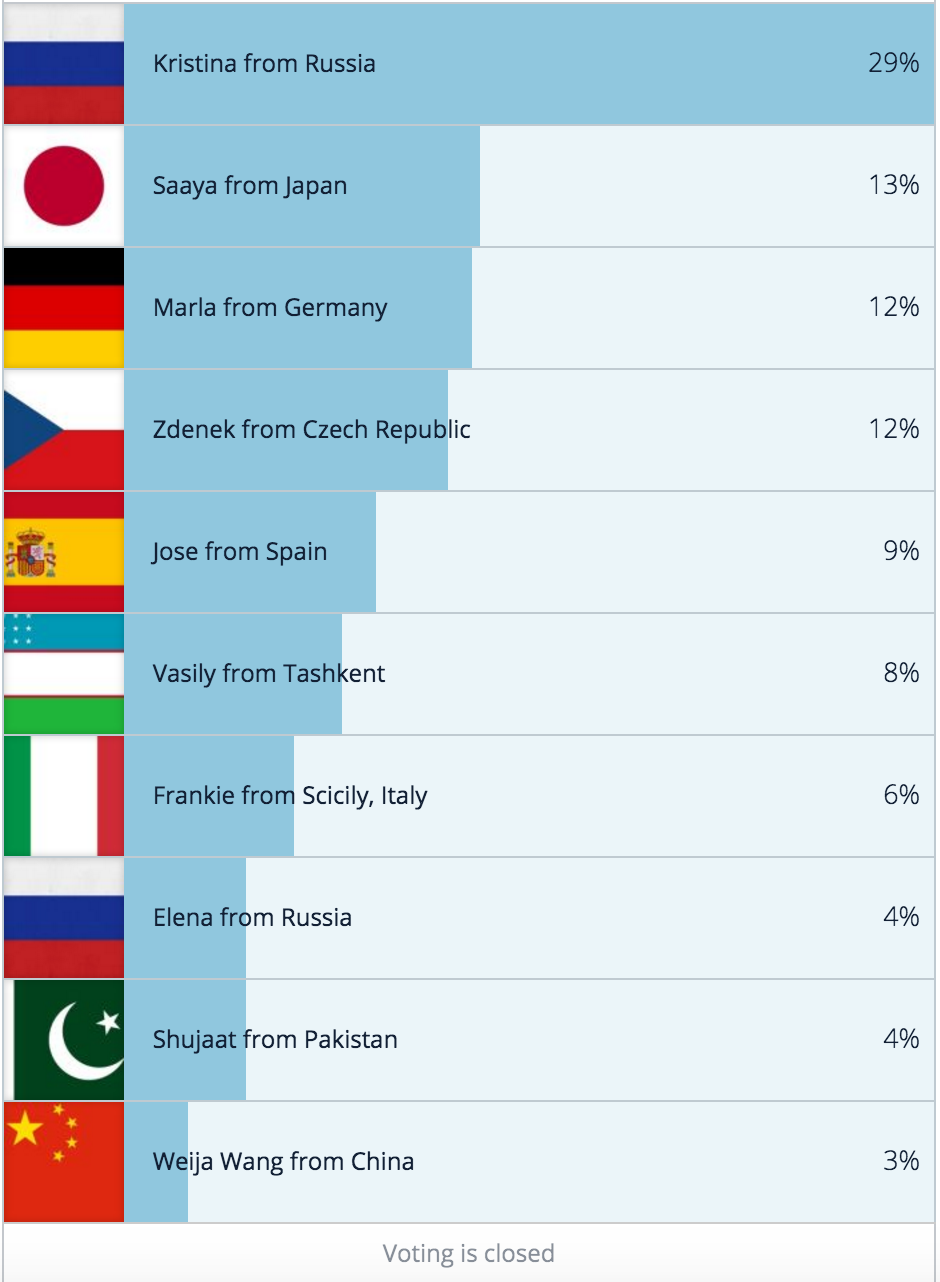
Also in St Petersburg there is a similar group which gets together on Sundays. You can find them on FB by searching for “SPB LEPsters Conversational Club” – I understand they have get togethers on Sundays. Kristina from Russia who won the LEP Anecdote Competition last year often takes part – friendly people, speaking English, playing games, hanging out. https://www.facebook.com/spbenglishLEPclub/

LEPsters in Tokyo have got together a number of times, and I attended one in April to do some stand up – you can hear all about that in my Trip to Japan episodes (part 2).

Also, recently a group got together in Prague in the Czech Republic – in fact you can hear their conversation because it was recorded and published on Zdenek’s English Podcast.

Again I’m flattered because they talked mainly about LEP – including, shock horror, their least favourite or “worst” episodes of the podcast.

Listen to both episodes below.

Also, if you’re in Spain I have heard rumour that there will be at least one meetup group getting together there, somewhere, sometime soon.

If you’re thinking of setting up something similar, let me know because I can publicise it on the podcast and get the word out.

Speak to you in the next episode!

Luke
452. A Conversation About Language (with Amber & Paul)

Discussing language with Amber & Paul, including issues such as errors made by native speakers, language change, whether language standards are declining, the effects of technology on language and how to cut an avocado without injuring yourself.

[DOWNLOAD]

Click here to check out italki and get your $10 voucher

Introduction

The other day Amber and Paul came over to my flat do a podcast. We were having tea, chatting and getting ready to record something, and we just started talking about language, I think because Paul said that he found it weird that even though he can speak 3 languages really well, he knows nothing about language – he doesn’t know the grammatical terms, the rules of what makes something right or wrong or somewhere in between, and we were talking about it, and I quickly managed to press the record button and ended up recording about 50 minutes of us rambling on about language – all totally unplanned and spontaneous.

You’re about to listen to it. This is an Amber & Paul episode so you’re going to hear an unscripted and natural chat between friends so there might be a bit of swearing.

Before you listen to us discussing language-related issues, consider these questions, which are at the heart of our conversation.

  • What are some common errors native English speakers make in English?
  • How do native English speakers feel about mistakes in English, particularly mistakes made by other native speakers?
  • Are some errors worse than others?
  • How does a language evolve? Are errors a part of that process?
  • Has your language, or English, changed much in the last 100, 200, 300 years?
  • Is your language, or English, getting worse than before? Are standards of language declining?
  • Has a language ever totally broken down and died due to falling standards?
  • Why did latin die out as a language?
  • On a slight tangent, what’s the safest way to cut an avocado?
  • Back on track, how does Charles Darwin relate to language development?
  • What effect is technology having on our language? Is it making us better or worse at communicating?
  • Are we better at communicating than we used to be? Are we getting better at communicating? How do you even measure that?
  • Do you know more about English grammar and so on than most native speakers of English?
  • Do you know more about English grammar and so on than Paul Taylor?
  • Are you better at cooking than Paul Taylor?

Watch out for answers, and general rambling on the subject of those questions as you now listen to our conversation about language.


That’s it! Leave your comments below.

So there you are, that was our conversation about language.

I invite you to take part in the conversation by getting into the comment section.

Let me remind you of those questions from the beginning. (see above)

There were a few unanswered questions in there, and I think I might be asking David Crystal about some of them.

Remember that? I’m going to interview the world’s leading voice on language – Professor David Crystal. It’ll be a chance to ask him various questions about language. I’ve already collected some questions from my listeners, and I have loads to ask him too, but feel free to offer up a question or two and if I get a chance I’ll ask him.

Actually, I’ve already interviewed David Crystal, so it’s too late to send me your questions! Episode coming soon.

450. Comments & Questions

In this episode I’m going to go through some questions from the comment section and give a bit of news. There will be some grammar, some vocab, some reactions to recent episodes and some bits relating to how you can continue to push your English with this podcast.

[DOWNLOAD]

Episode notes

The comment section is buzzing with chat. Photos are being shared of people’s running routes and shots of gorgeous spring flowers and blossoms in full bloom. A listener called Sylvia is doing an illustration for every single episode and posting it in the comment section. Regular commenters are having some long and funny conversations – they’re very friendly and like a laugh so get stuck into the comment section and see what all the fuss is about.

The usual commenters are: Cat, Nick, Jack, Agnes, Marta, Antonio, Eri, Hiro, Euoamo, Sylvia, Jilmani, Mayumi, Ethan, Syntropy and more people I have probably forgotten about!

Cat is the top commenter with a total of 2795 COMMENTS
Nick is in 2nd place with 1851 COMMENTS
Jack is in 3rd place with 963 COMMENTS

David Crystal

Bit of news: I’ll be interviewing Prof. David Crystal on the podcast soon.

David Crystal is the foremost writer and lecturer on the English language, with a worldwide reputation and over 100 books to his name. He is honorary professor of linguistics at the University of Wales, Bangor, and in 1995 was awarded the OBE for services to the English language.

I met him in 2012 when he gave me an award (with Andy Johnson). He’s really nice and I’ve always wanted to have him on the podcast.

And I am interviewing him soon, which is a serious treat.

This is the guy who knows everything there is to know about language and I’m going to interview him.

Honestly, I have millions of questions I could ask him, and I could easily fill up several episodes with him just asking all the questions in my head.

But I’d also like to give you a chance to ask a few questions. So leave your questions for David Crystal in the comment section. I can’t guarantee I’ll ask him all of them, but if there are some particularly good ones I’ll ask them.

Otherwise, I might be able to answer some of the questions myself.

Recent Comments on the Website

Here are some comments which arrived recently.

Cat – in reply to the British Humour episode
Hi Luke and Amber, thanks for your lovely chat! It was a most enjoyable and also educational episode.
I’ve got two questions:
1. You mentioned “NHS” (?) as something that each Brit is proud of. What is it exactly?
2. During the dissection of the Hugh Grant’s quote you said that he was “public school”. What does it mean?
Thanks for explanations!

IMG_4148Oil painting by Sasha Sokolova

Thanks for the oil painting! – www.sashasokolova.com


JAPANESE LEPSTER GIFT VIDEO ~ I need to do this!

Paul
Congratulations, teacher Luke, for the podium! Great job and another great podcast, thanks!
“It’s time for me to leave Audioboom.com” = LUKEXIT!!!!!

Amber’s podcast – Paname – it’s not available yet, but soon!

Orion Transcription Team

Just a reminder about the Orion transcription team – they continue to produce transcripts, mainly under the management of Antonio from Spain, and they are always on the lookout for new recruits. Antonio regularly posts messages in the comment section saying “Episode blah blah is now available for transcription” and with a google link. E.g. the latest one is episode 444. The Rick Thompson Report.

Remember, it can be really good for your English so check it out! Transcribe just 3 or 5 minutes. It doesn’t have to be a massive commitment. If you do it regularly you’ll see that it allows you to focus your attention on what you’re hearing and you’ll be surprised at how much that focus allows you to examine the language up close. You could also try repeating out loud some of the things you’re hearing as you transcribe, that could be a good way to convert the process into a speaking exercise.

Turning Input into Intake

Here’s some vaguely academic stuff about Turning input into intake to increase your language acquisition. There’s language input, and there’s language acquisition. Between those two things, there’s intake. Intake is the stuff we really learn from.

This from the University of Austin Texas
The term “input” referred to all the exposure to a foreign language that is around us. However, as years went on, researchers realized that input was not enough. If the learners were not noticing or concentrating on the incoming flow of language, comprehension would be limited. So today, researchers in second language acquisition commonly make a distinction between input and intake. Simply put, input is all the written and spoken target language that a learner encounters, whether it is fully comprehended or not. Intake is limited to the comprehended input that impacts the learner’s developing linguistic system. For our purposes, we suggest that technology provides ways to increase the foreign language input that learners are exposed to and enhances the process of how input is converted into intake.

Without getting too fancy, let’s say that to really learn from the things you hear you need to convert what you’re hearing from input into intake.

This means listening to content which is comprehensible – i.e. basically understandable even though there may be some things you don’t get. A mix of things you already know (this is your foundation that allows you to work out the bits you don’t know) and some things you don’t know or don’t understand.

It also means sometimes really focusing and giving all your attention to certain bits of what you’re hearing. Some things might kind of pass you by a bit, but it’s important while you listen to be sort of emotionally involved in it and to interact with it while listening – to really think and feel in response to what you’re hearing. Apparently this helps turn input into intake.

Transcribing pushes this to the max. It forces you to turn everything from mere input into intake – which is the good stuff. I think it’s backed up by not just academic research but by the experiences of transcribers. It helps push your English, and remember you can just do a short chunk, you don’t have to do a whole episode, that’s crazy!

In summary – focusing all your attention on 3-5 minutes of an episode can really help turn input into intake and can maximise your learning potential with this podcast, or any audio resource.

Yuko – language question “shall”
Dear Luke, my name is Yuko. I have been a ninja listener of your pod cast for a long time, and I am originally from Japan, which makes my ninja status more authentic, doesn’t it? I am living in New York, but really fond of British English.
I have a question. When it comes to the usage of ‘shall’, it is rarely used here except for those two occasions: to suggest something, for example, “shall I do this for you?”, and to use following “Let’s”‘ for example, “let’s go, shall we”. Back in Japan, I learned that shall is also used interchangeably with will for describing the things or action in the future, but, here, all American friends said that shall is never used in daily life except for the examples above, and that if I used shall instead will, it would sound quite archaic.
However, I have a sense that sometimes I catch “shall” as description of future in bbc or British dramas even in modern setting. Would you mind telling the use of “shall” in today’s British English? Thank you very much. I always enjoy and admire your witty, and sophisticated subjects, not to mention it was quite honoring that you chose my country as the destination of your latest trip. I hope all is well and both of you and your wife have enjoyed it.

Yuko, all the right info is in your question.
You’re just not sure about it and you need confirmation.
OK then!
Shall – for suggestions (shall I? Shall we?) – after Let’s…
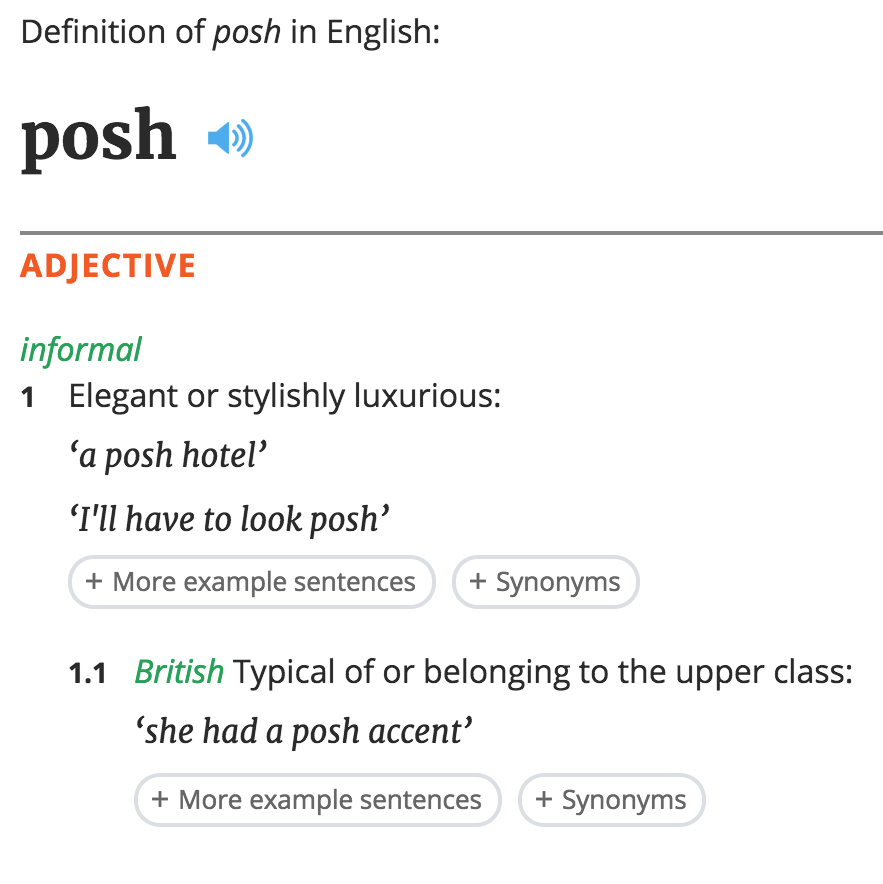
Shall for future (like ‘will’ – yes, old-fashioned and a bit posh, but some people still do it, like my Mum “I shan’t be coming to the cinema.” or “I expect I shall be exhausted by the end of the day!”
Also in contracts for obligations
That’s it!

Agnes – Sport
I’m just curious whether Luke is taking some exercise or not, he looks sporty and I suppose that he does some sport activities:-)) I usually jog before going work, early morning – the best time for burning calories.

Anna Mrozek
I had an English class today and my classmate asked me “how the hell do you know all these words?!”, so…
Thank you Luke, because you deserve the credit for that. :)

Leonid
Hi there everyone! Does someone know the accurate meaning of the phrase “to be on E”? Thanks in advance!

Great comment from Cat
Just keep listening to Luke’s English Podcast. And try to listen to episodes more than once. It is on the second listen that we start to notice the language consciously and start learning. After some time, you can listen to the episode for the third time. And there you will see how much you have learned in the meanwhile. Do it with your favourite episodes. And try to listen to OPPs as well. And use the same technique. It’s very effective. Also listening during a physical exercise speeds up the learning process. Because your brain is working at 5x of it’s performance capability. So use such shortcuts, especially if you are a bit lazy like I am! ;))

I would add that you can also do some transcribing, or check out previously written transcriptions – either the unproofread ones in google docs, or episodes with published scripts. That can help you notice language too.

Film Club: Touching the Void

Hope you enjoyed the “Touching the Void” episodes. I have had a few comments indicating that it moved a few people. but my stats show the episode hasn’t been listened to as much as normal episodes.

I often worry about uploading too much, but there’s always someone who says “we want more!”
I recorded an episode about Alien Covenant the other day. It’s about an hour of rambling about the Alien franchise. I’m a bit wary of uploading it straight away because it would be 3 film club episodes in a row and this isn’t strictly a film podcast. I probably shouldn’t think about it all that much.

But I’ve been quite productive lately and I have some episodes in the pipeline – Alien, 2 Amber & Paul episodes, one about music and culture with James.

Anyway, going back to Touching the Void, I’m glad to see those of you who have listened to it seemed to enjoy it.

Agnes
Have been listening to this story based on facts for the second time today I felt an incredible chill down my back and my hair stood up on both of my hands.
Luke, telling us this story, you made me be there, with them, I saw this horribly broken leg, I saw as Joe dropped down, I saw everything, even though I haven’t watched the documentary yet.
just thank you

Ethanwlee
One step at a time – this is my biggest takeaway from this episode. At the end of the day, that’s the mantra that keeps us going, staying focused. This story leaves me lots of food for thought. Thanks Luke!

Jilmani
Thank you so much Luke! It’s an amazing episode I can’t express how amazing it is. I want to tell you my personal story about climbing. My parents are both climbers and they had a club for climbers. They worked there a lot to train and coach also they took a lot of people in trips for camping. And I always went with them when I was a child. I liked climbing and adventurous trips more than anything else. I had always climbed and camped before I had an accident in 2014 in Lebanon. I was terribly injured and they expected that I’d die. Luckily I managed to survive. I needed a lot of eye surgeries because my cornea was damaged. Now I can’t climb at all not because I’m afraid of it, but my doctor prevented me. I got rid of all my pictures and anything that might remind me of climbing or my adventures. I haven’t climbed since that day, but I skydived a lot. Climbing always helped me to relax and forget about the troubles that we have in the Middle East. Also I’m a religious person it always made me feel happy and close to God. My doctor told me that I will be able to climb again when he removes the stitches. Thanks again Luke. I’ll watch the episode tonight luckily I have a Netflix subscription and I love documentaries a lot. Waiting for the next episode!

Luke: Be careful if you climb again! Be like me, just stay at home and watch other people do it on YouTube, it’s safer (except maybe I should do more exercise)

daav
Wow! Thank you, Luke! I really appreciate the topic you’ve chosen for a new episode. The film is pretty good and the book as well. I’ve got one in my bookcase. I have just little experience with high mountains because after my wedding I decided to bury my climbing gear to the very bottom of my wardrobe and since that day I’ve been “only” a hiker. But anyone, who has ever spent some time in the mountains without any support, just with a climbing mate on the other end of the rope, an ice axe in hands and a pair of crampons knows, that the fact Joe Simpson survived the Siula Grande ordeal is a …. real miracle, nothing else than a real miracle…
If someone wants to buy a book I recommend Bookdepository instead of Amazon. They offer free worldwide delivery which is a real bargain in my opinion. I buy books from them regularly (from The Czech Rep.) and it works well.

Cat
Daav, but why did you put away your climbing gear?! It’s like giving up on a part of your true self. Can you be happy with that for long?

daav
Hi Cat. At first I must admit I was never a climbing machine. I used to climb few times a year. Let’s say just few weekends and one or two trips to the Tatra Mountains or to the Alps. So it wasn’t so difficult to give up. In the Czech Rep. climbing is very popular and there are many people who spend every possible moment climbing a piece of rock in their surrounding area. So I can’t say I was a climber. I usually say that I have done some climbing :c) One day I considered that my wife meant a lot more to me than climbing. She had never asked me to stop climbing. She had even climbed with me once. But any time I had packed my climbing gear I had seen the same wish in her eyes – please, stay alive. During my last climbing trip I had a minor accident I have never told my wife about. Fortunately nothing comparable to Joe and Simon :c) But I realized that I was being very selfish. I enjoyed it, I liked it, but my parents and other people who truly love me were frightened to death every time I left them with a rope in my bag. Now I know that it wasn’t the climbing that I liked. It was mainly a peaceful and calm space around me. It was the fact I can leave all my daily routine behind me. Now i know it’s not adrenalin that I need. It’s just some kind of feeling I am alone, just on my own in some remote area. So today, long distance hiking is an activity that gives me everything I need. I just pack my rucksack, a tent, a fuel stove, some food, maps and a compass and I just walk. It’s different to climbing. It’s definitely not so dangerous. However it provides me the same pleasure. Unfortunately the Alps are full of people and there are so many huts. But some parts of the Pyrenees are amazing, the western part of Ukraine as well and the Andes are a dream for any hiker. I have many dreams, CDT in USA is one of them as well as many others around the world. The only disadvantage of long distance walking is that it’s very time-consuming compared to climbing. Are you a climber Cat?

Cat
Daav, if I were Luke, I would read your comment out in the next episode. It is deeply felt and full of love. :)

daav
Thank you Cat. But I’ve noticed that some people don’t like long episodes. And my comment is so long that Luke would have to record an extra episode just to read it out :c)

Success story from Erick in Brazil
Hello Luke,
This is Erick from Brazil.
Today when I was listening to your #429 podcast while running, I felt encouraged to share my listening experience with you.
I have been listening to you for about 1,5 years usually when I go running, so you have been my partner twice or three times a week. Strange, but I feel as if I have known you for a long time…
I actually think your podcast is more than just a teaching one, but it is more like a variety show with news, entertainment, fun stuff, etc. I really enjoy your ‘long talks’ which can be just some information, funny talk or more deep issues which are very good for getting immersed into the English language.
It is gratifying to hear other points of view of the various subjects on the media agenda especially when you bring guests to your show, like your Father, Amber and Paul, etc.
Sometimes it can be very hard for me to understand, but I took your advice, I keep going, listening to some episodes more than once, trying to get as much as I can.
Now I can say that I broke through the language barrier and I can really understand and talk in English because of you! So, I just have to thank you for all the material that you provide for free and especially for your success in making your podcast so popular and genuine!
Cheers from Brazil,
Erick Takada

I didn’t share that just to remind you of how wonderful I am, but also to just remind you that if you find it difficult to follow everything you hear on this podcast that you should keep going and battle through the moments of difficulty and you’ll find that bit by bit you build your understanding.
I can’t understand how anyone could expect to learn English properly without listening to a lot of it. I think it’s vital.

Do me a favour!

If you know someone who might like this podcast, share it with them! Recommend it to that person. It’s a good way to spread the word.

Another thing you could do is to write a nice review on iTunes – that’s really good for the podcast because it helps things like algorithms and getting my podcast featured in the ‘recommended’ section on iTunes. Also it looks good when new people check it on iTunes, and it would just make me feel good and put a smile on my face, which ultimately will feed back into the podcast.

Subscribe to the mailing list.

Watch this space for news of a potential LEP app for your phone or tablet which could include some bonus app-only content!

440. This Pile of Books on my Desk

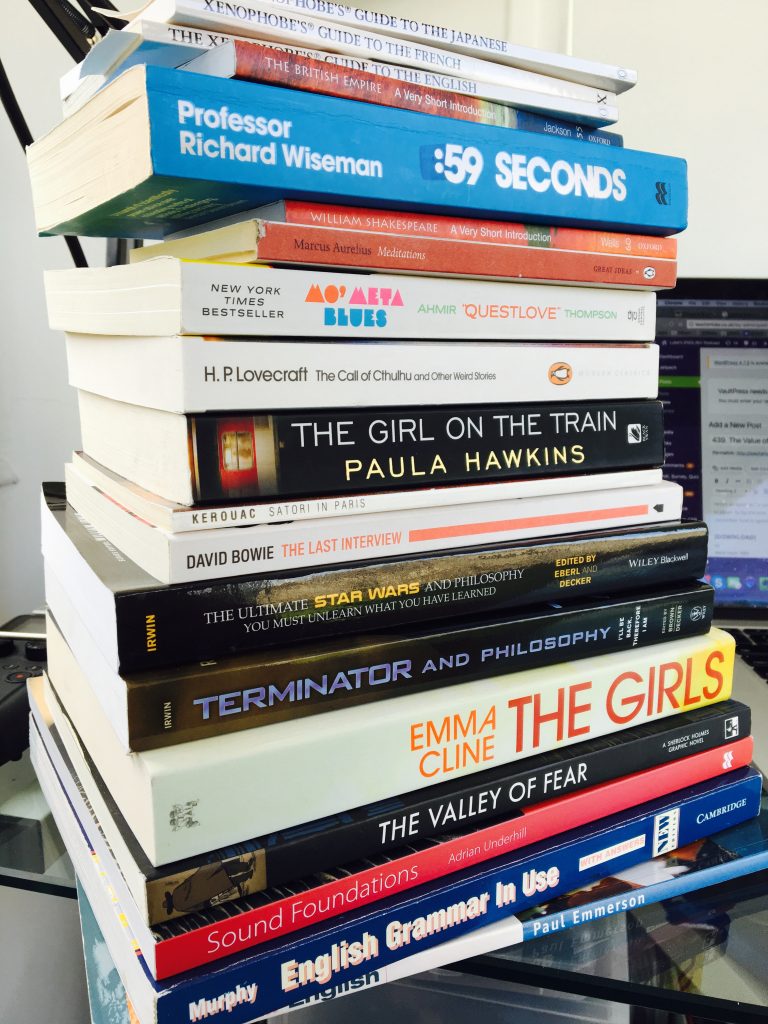
In this episode I just want to talk to you about this pile of 16 books I have on my desk. These are (mostly) books I haven’t read yet but which I picked up recently. I have lots of piles of books like this lying around and I must read them all but I can’t find the time! Anyway, I think they’re really interesting. I either received them as presents, was recommended them by friends and family or I bought them for myself when visiting book shops over the last year or two. I love books, and browsing bookshops is one of my favourite things. If only I was a faster reader!

Small Donate Button[DOWNLOAD]

Part of the reason I’m doing this is because I just want to encourage you to read more and I would like to arouse your interest in books. Perhaps I can give you some encouragement to read a copy of one of these books, or perhaps this will encourage you to pick up a book (in English) from the pile of books that you probably have in your home too, and start reading it.

In any case, I hope you join me on this little exploration through this pile of books I have on my desk.

Here’s the list of books I talk about in this episode (also in the picture)

The Xenephobe’s Guide to The English, The French, The Japanese
The British Empire: A Very Short Introduction by Ashley Jackson
:59 Seconds by Professor Richard Wiseman
William Shakespeare: A Very Short Introduction by Stanley Wells
Meditations by Marcus Aurelius
Mo Meta Blues by Ahmir “Questlove” Thompson
The Call of the Cthulu and Other Weird Stories by H.P. Lovecraft
The Girl on the Train by Paula Hawkins
Sartori in Paris by Jack Kerouac
David Bowie: The Last Interview Various journalists and publications
The Ultimate Star Wars and Philosophy: You Must Unleard What You Have Learned
Terminator and Philosophy: I’ll Be Back Therefore I Am
The Girls by Emma Cline
The Valley of Fear (Sherlock Holmes graphic novel)

books

439. Reading Books to Learn English

Here’s an episode for you to listen to while I’m on holiday. I’m recording this the day before I go to Japan. So by the time you’re listening to this I’ll be on the other side of the world, trying to remember how to speak Japanese.

Small Donate Button

[DOWNLOAD]

Introduction

This episode is all about reading books in English. I probably won’t upload another episode for a week or two. That little break will give my listeners a chance to catch up on the recent episodes. Also, there are loads of episodes in the archive that you might not have heard yet and you might want to listen to if you are suffering from LEPaholism and you can’t get enough.

Every episode of LEP is available in the archive on my website, even if you can’t see them all on iTunes. They’re all still here. Just go to teacherluke.co.uk and click “Episodes”.

Just before we get started let me just remind you of several things:

  • Please vote for Luke’s English Podcast in the British Podcast Awards. I need every single one of you to vote. If you are next to a computer or you have your phone just go to www.britishpodcastawards.com/vote and vote for LEP.
  • If you’re in Toyko on 13 April, come to Gamuso in Asagaya for my comedy show. I will be performing comedy there with a few other people. It’s free to get in. Doors open at 7. I expect the comedy will start at 8. No idea if it will be busy. You can’t book in advance, so just turn up and get a seat!

Books

This episode is all about books. I’m going to recommend some self-study books for learning English, talk about the value of reading books in English and then go through some of the books which I have in a pile on my desk and talk to you about them – just to inspire you to do some more reading this year, in English of course!

Hi Luke! My name’s Matias, I’m from Uruguay, South America. Also, I’m a British English lover haha. I’ve been studying the language on my own for 7 or 8 years maybe, and English culture as well.
I found your podcasts just a few months ago and you gave me a whole new perspective on the language and I really appreciate that.
I emailed you because I want you to recommend some self-study books. I’m already using English Grammar In Use and doing exercises almost every day. What other books could I use?
Thank you a lot for all of your work. Have a great day!

Some self-study books for pronunciation, vocabulary and grammar

You’ll find the names and authors of all these books on the page for this episode on my website.

Pronunciation
Ship or Sheep by Anne Baker (minimal pairs) CUP
English Pronunciation In Use series – CUP
Work on your Accent by Helen Ashton (Collins )
Sound Foundations by Adrian Underhill (Macmillan) – for the teachers

Vocabulary
The ‘In Use’ series is good – English Vocabulary in Use
They also have Professional English In Use – different titles.
Practical Everyday English by Steven Collins
Also Advanced Everyday English and High Level Everyday English

Grammar
Grammar for Business by McCarthy, McCarthy, Clarke & Clarke
Practical English Usage by Michael Swan (reference book)
English Grammar in Use by Raymond Murphy

Writing
Email English by Paul Emmerson

The value of reading books

I did an episode all about this a couple of years ago – you should listen to it. It includes a list of recommended books. Check it out here https://teacherluke.co.uk/2015/02/01/reading-books-in-english/

There’s also a reading list on my website which includes every single book I’ve recommended or mentioned on the podcast. Check it out here https://teacherluke.co.uk/useful-websites/the-uks-favourite-books/

  • Practice practice practice practice practice practice practice
  • You can go at your own pace
  • It’s seriously relaxing – certainly compared to staring at a screen. Try reading for 15 minutes before sleeping, it’s very good for you. Also you can take a book anywhere.
  • Vocabulary and grammar development
    Perhaps the best way to work on your grammar and vocabulary is to see it being used in context. Reading gives you access to the living language. Simply interacting with it by reading it is a great way to learn it. You can practise being mindful while you read, which is a question of noticing features of the language as you see it. This can be more efficient than reading grammar explanations.
  • Often the most useful parts of grammar study are the examples where they highlight certain bits of usage. Grammar is often unsatisfying because ultimately there aren’t always logical reasons why the language is the way it is.
  • Stop looking for explanations and just accept it. Let the language flow through you and get to know it. Don’t expect it to follow the same rules as your language or to be logical.
  • Grammar books are great for reference and self study. So, if you notice a pattern or a feature of the language you don’t understand – you can check it out in the grammar book, like “Practical English Usage”. The same goes for vocabulary and a dictionary. But by interacting with the written word you will find that the grammar goes in as a consequence.
  • Exposure = developing your instinct for the language. Reading an entire book is very good for your grammar. Imagine all those sentences that pass before your eyes and go through your brain. It’s a great way to study structure without even studying it really.
  • The importance of visualising the written word
    A word exists in many different dimensions – the way it sounds, the way it feels when you say it, all the meaning associations you have with it, the way it looks and the way it feels to write it by hand or on a computer. You should get to know every single side of a word and that means reading a lot in order to fix the visual side in your mind.
  • Educational value
    Learning about the culture of the language you’re learning is vital. It helps you get into the mindset of the language so you can get a sense of the rhythm, but also the humour and how certain things are suggested, hinted at, referred to and so on. Also you just learn some information that will help you. It’s not just a question of learning the words, but learning the whole culture within which those words exist.
  • Books can be a great way into a culture.

How to choose the right book for you

  • Not too old (think of the style of language – although old fashioned English is rather beautiful – watch out, anything written before about 1800 is going to sound pretty outdated and might be difficult to follow.
  • Not too long – obvs, you want to finish it
  • Something you’ve already read in your own language
  • Something that just appeals to you – it’s vital that you like the book, so go with your gut.
  • Something with fairly ‘normal’ English e.g. beware of something like The Martian – it contains loads of technical language – but then again it’s also quite a riveting page turner. But be aware of the type of English you’ll be getting.
  • Go for page turners – remember, your objective is to read as much as possible and to get the satisfaction and motivation of having finished the book. Don’t be afraid to read some trash. It doesn’t have to be the most high-class book.
  • Consider graded readers, like the Penguin Reader series – and choose the advanced level books. They’re shorter, easier versions of brilliant novels in English. There are various versions of readers – but check out https://readers.english.com/readers for more info.
  • Consider reading graphic novels. They’re easier to read and the visuals help to move the story along. It’s a bit like watching a movie but with all the advantages of a book.

How to learn English from reading books

Study
You read with a notebook and dictionary with you. When you come across a new word you check it and make a note of it. Remember to write more than the translation. Write an example sentence and a mnemonic if possible. You could highlight the word in the book too and come back to it later.

Enjoyment
Don’t bother checking words all the time. Just read the book because you’re interested in the story. Focus on getting through the story because you want to know what happens next. You will naturally start picking up new words as you encounter them. But try to be mindful when you read – every now and then you can just slow down a bit and focus on some language. Perhaps read a quick passage again and think about the grammar you can see. Why is it written that way? What kind of grammar is it? What’s the effect of writing it like that? What about these words? Do you know them? Could you use them yourself for something in your own life? Ask yourself these questions and then continue. Feel good when you’ve finished the book. Take time to reflect on it. Think in your head, speak aloud, talk to your language partner or write in a diary your thoughts about the book. Move onto the next one!

Next episode: This pile of books I have on my desk

Your comments: What books in English can you recommend?

438. Hi Luke, I have a question!

Here’s another episode done in a similar style to the last one, with some news, some rambling and some questions and comments from the website. Topics in this episode will include: My live comedy show in Tokyo on 13 April, Differences between Comedy & Humour in France and the UK, Understanding TV shows and movies in English, Talking about Breaking Bad, Logan (the latest Wolverine movie), some grammar teaching and more…

Small Donate Button[DOWNLOAD]

Japan show – 13 April

19.00-22.00
Gamuso in Asagaya
2 Chome-12-5 Asagayakita, Suginami, Tokyo 166-0001, Japan
There will be a few other comedians first, doing comedy in English, then I will take the stage and do a set of stand-up comedy for you to enjoy.
FB Event page: https://www.facebook.com/events/396651460705556/

I’m not sure I’ll be filming or recording it because it’s stand-up and I have to be careful about what stand-up material I film and make public on YouTube.

Sorry to people in Osaka – I can’t be there this time!

London LEPster meetup

Host: MO (in LEP t-shirt)
Hi Luke
I am happy to say that I have finally managed to organise a time and a place. The time is Saturday the 8th of April at 1300hrs I chose this time because it is in the Easter holiday and I am assuming that most of the people are going to be on a break. The place is Costa Coffee and the address is 33-34 Rathbone Place, Fitzrovia, London W1T 1JN. It’s just off Oxford Street. The nearest station is Tottenham court road station. For any enquiries they can send me an email on bayle2003@hotmail.com

Russian LEPsters in St Petersburg

Hi Luke! How are things, man? We have already organised the first Get Together in Saint Petersburg! It will be on 9 April. Will you help us with publicity once we announce this event? :))
The Facebook Group
The Facebook Event on 9 April

Don’t forget to check the ARCHIVE for my recent interviews on ZEP and MFP

Other Comments & Questions

Mattia Andrao

I write this comment just hoping to be mentioned in the next episode…….

Carine (a reference to a message in the last episode from Adam, whose family hates my podcast because Adam forces them to listen)
Hello Luke,
To make you feel better about being hated by Adam’s family, which you do not deserve, I want to let you know that my two 9 year old daughters like your podcast very much and they love to listen to it when we are travelling by car! Listening to your podcast is a family thing we sometimes do the 3 of us together. They particularly enjoyed episodes 425 and 426, the Victorian Detectives. They are also Paul Taylor’s fans now!
Thank you for your funny podcast,
Take care,
Carine from La Rochelle, France.

Hello Carine from La Rochelle and her two 9 year old daughters!
I learned French in school from a book called Tricolore and it was set in La Rochelle.
All the characters, everything, happened in La Rochelle.

Danil Zelichenko
Hi Luke! Thank you for you podcast! I’ve been listening to it since September 2016. It really helps me. I still make a lot of mistakes, but I feel more confident.
I have a few questions
1. Have you ever listened to comedy in other languages with subtitles?
What can you say about the sense of humor in different countries?
French comedy without subtitles. I don’t really understand it! I also feel like their comedy is a bit different to ours. Some differences.
Our humour is self-deprecating, theirs isn’t. French humour is quite combative and involves quite a lot of put downs. We do that too but we also put ourselves down a lot.
Ours involves a lot of understatement, theirs doesn’t.
Comedy – theirs is situational.
Theirs is very visual.
Theirs is quite traditional – it is linked to theatre traditions that go back years.
In the UK we have alternative comedy which is counter-culture and subversive (even though it’s mainstream now) whereas in France it’s still tied into the theatre tradition.
2. Do you listen to other podcasts about learning English? Maybe you can compare your one with others?
Ingles Podcast (mainly focuses on Spanish learners of English, a little slower than mine, they focus more on teaching specific language points and language related questions – I do that less these days, preferring instead to focus on topics)
All Ears English (They’re very bright and energetic, they focus on communication strategies, natural sounding language and everything is focused on learning to communicate like an American native speaker – my episodes are longer and a bit looser than theirs.)
3. I like to listen to your old episodes every now and then, but I found that in iPhone first episodes had disappeared. It starts only from 33 now. Can you do something about it?
Daniel from Moscow (I’m not ninja) :) you can notice (mention) my name if you want.
P.S. I’ve just voted for your podcast!

Ivan
I’d like to listen to you Luke, speaking more about Breaking Bad.

Can’t remember who wrote this!
I have a basic question to you, teacher Luke! Well… maybe most lepsters will laugh at this doubt, but I really can’t notice sometimes the difference between for example: “I did walk” versus “I walked”. I mean… when I should use did or the suffix “ed”. Maybe it’s a basic grammar issue but I hate studying grammar. Thanks!

Christopher
Hi Luke,
How do you do? As a start I want to say thank you for the great work you do. Besides your podcast, I also hear a lot of BBC Stuff. Most of them are political talks or documentaries. I find it very interesting to hear different opinions about a topic. But there is one thing I find really curious and I was hoping that you might be able to help me out of my confusion.
In every talk show the guest addresses the host with his forename. For example:
“Today we are talking with the new director of Strawberry Media, Jackie Smith. Welcome! Thanks Steve… nice to be here…”
In Germany we would find this very informal and it never would happen on a political talk show.
Why do you do that in GB?
Best wishes to France,

Dmitry from Russia
Luke, I really adore your podcasts. But I’ve got a question: When I listen to your podcasts I understand absolutely everything you say, no matter how quick you speak. But when I try to watch something that is made for natives and by natives (movies, also songs) it’s extremely difficult (or sometimes completely impossible) to get what they say. Could you, please, explain this in one of your episodes, why this happens, and also come up with some ideas how to cope with this problem. Thank you in advance. Your podcasts are amazing!!!

Reasons

  • Familiarity with my voice.
  • My clear way of speaking. I try not to speak too slowly but I do make an effort to be clear. I am talking to an audience, I am doing a show. In episodes with guests you hear a slightly more natural speech pattern as I’m in a real conversation, but when I’m talking to you I am making an effort to communicate to you – just like you’d expect from someone doing a presentation. In movies they’re not talking directly to you like that.
  • Films feature people talking to each other – not talking to you. THere’s a difference. It’s easier to understand it when the person is engaging you directly, rather than you listening to other people’s conversations.
  • It’s just me, so no distracting stuff, no interruptions, no sounds etc.
  • Films contain loads of sound effects, music and background noise.
  • It’s recorded to be listened to and for every word to be understood. Movies are not always supposed to be understood completely.
  • Films are realistic. The dialogue is not always audible – many films feature “naturalistic dialogue” – i.e. incomplete sentences mumbled under the breath. This is a totally intentional stylistic choice. It’s supposed to be natural and realistic.
  • Films are confusing. They often don’t make sense. My episodes have a pretty linear structure.
  • My podcast is recorded to be heard – i.e. I use microphones for clear voices. I reduce background noises. Movies aren’t like that. They add noise, they record voices to be blended with the rest of the soundscape.
  • Movies are a visual medium – so much of the message is in the visuals. The audio is an accompaniment to that, so it has secondary importance. Also, you get distracted by the visuals and you end up not concentrating on the audio. You could try just listening to some movies. This sounds a bit strange but try getting the audio from a movie and simply listen to it. Then watch the movie – you might find you understand more of the dialogue that way, because you’re allowing yourself to focus only on the speech.
  • Most films are in US English. I speak British English, although there aren’t that many differences really.
  • Movies also feature lots of different accents and characters who might speak in ways you’re not familiar with.
  • Songs don’t always make sense. There’s a lot of artistic licence. I often can’t catch the lyrics of songs (check out my misheard lyrics episodes). The English isn’t normal English.
  • Sometimes they’re just a stream of consciousness with no proper discourse like in spoken English.

Solutions

  • Watch more movies! Familiarity is important. Getting used to it.
  • It’s just a question of continuing to improve your English.
  • Subtitles sometimes, then no subtitles, then subtitles again.
  • Don’t worry about it too much. Sometimes I can’t catch the things they’re saying in movies either. Realise that there are times when you won’t understand. Realise that movies are hard to understand, and so don’t be shocked when you don’t understand them. Often they’re mysterious or simply don’t make sense. I often struggle. Don’t worry about it too much.
  • Try using headphones so you can hear more clearly.
  • Specific techniques: Practice shadowing specific scenes first without subtitles, then with, then without again. Do this with favourite scenes from films. I do it a lot too and it can be really fun. It will help train yourself to hear and understand movie dialogues more easily.

Jane
Hi Luke!

I really like those episodes you talked about superheroes.
Could you do an episode about the movie, “Logan”, please?
I would love to hear your thoughts!
Thank you soooo much!
Best regards,
Jane


LEP on ZEP – My recent interview on Zdenek’s English Podcast

Hello email subscribers and website users! This is not an episode of LEP but keep reading because I have 5 cool things to share with you (below).

In this post you will find 5 episodes of a podcast. It’s not my podcast but I am featured in the episodes.

It’s a 5-part series of interviews between English teacher Zdenek Lukas and me on his podcast, “Zdenek’s English Podcast”, including 2 episodes of language analysis. You’ll hear lots of conversation between us about teaching, learning and behind-the-scenes information about Luke’s English Podcast. Also in the language analysis episodes Zdenek will help you pick up 50 features of English grammar, vocabulary and pronunciation from the interview.

You can listen to and download the episodes below.

Part 1

We discuss our experiences of taking the Cambridge DELTA qualification (it’s seriously challenging!) and then we try to break the commonly-believed stereotype of a native speaker teacher of English being superior to a non-native one.

Part 2

In part 2 we talk about each other’s podcasts and I give some behind the scenes information about some popular episodes of LEP, including some stories about the episodes Sick in Japan, Travelling in Indonesia and California Road Trip. At the end, we also talk about our experiences of teaching English for specific purposes, namely business English and English for engineering.

Part 3

In this part you can hear us talk about what we both like teaching the most in classrooms, some of my favourite teaching techniques, what it was like recording Pink Gorilla Story 1 & 2, and also what episodes I enjoy doing the most on the podcast. Also, you can find out more about the secret of Paul Taylor’s success and what it would take to do a live LEP meet-up with listeners.

Part 4 – Language analysis

Zdenek picks out 25 features of grammar, vocabulary and pronunciation for analysis. He applies his knowledge of linguistic features of English to clarify meaning, highlight usefulness, correct some of his own errors and help you to avoid common mistakes.

Part 5 – Language analysis

Zdenek picks out 25 more features of grammar, vocabulary and pronunciation for analysis and gives them the teacher treatment.


[DOWNLOAD PART 5]

About Zdenek Lukas…

I’m really impressed by what Zdenek is achieving with his English as a second language.

He’s from Czech Republic and he has learned English as a second language in adulthood. He’s now a teacher of English, just like me and he does his own podcast, just like me.

He has a masters degree in English language teaching. He’s got a CELTA and DELTA (pending) in English teaching to adults. He’s really well qualified.

Also, he’s been doing Zdenek’s English Podcast for years and it’s still going. Admittedly he says the podcast is influenced by my podcast, and I’m ok with that. It’s his way of pushing his English and it seems to be working for him.

You’ll hear in our interview that Zdenek has just passed a significant part of his DELTA qualification with a really good grade. That is not easy to do. You need to be a good teacher to get a good result in your DELTA and you really need to know about grammar and linguistics.

So, don’t underestimate Zdenek. He’s achieved a hell of a lot, just like many of you have also achieved a lot in your language learning. Sometimes it’s worth taking a step back and realising how much you’ve achieved.

I was very happy to be interviewed by him and I really hope you listen to the episodes, and in fact check out his other episodes too. A lot of them contain interviews with other interesting people, many of them English people he knows. Other episodes cover Zdenek’s personal journey with English and also you can hear him interacting with his students too.

You’ll find links to Zdenek’s English Podcast here on this page. www.audioboom.com/channel/zdeneks-english-podcast

Zdenek has an FB group where he communicates with his listeners. Here’s the link www.facebook.com/groups/zdeneksenglishpodcast/

But you can also leave comments here and I’m sure that Zdenek will read them at some point.

Cheers,

Luke

429. RAMBLENEWS!

A video is available for this episode (see below). Here is an episode with some rambling about recent news, LEPster meetups, transcript project team, listener comments & questions, teaching phrasal verbs with ‘in on’ and some music. This episode is also on YouTube. See below for details.

Small Donate Button[DOWNLOAD]

Video (with some extra content)

Links

Moscow LEPster Conversation Club on Facebook https://www.facebook.com/groups/734996946664425/

Tokyo LEPsters 3rd Meetup https://www.facebook.com/events/1850850918464336/

A Phrasal Verb a Day https://teacherluke.co.uk/archive-of-episodes-1-149/phrasal-verb-a-day/

Introduction

I’m just checking in on you. How are you? I’m videoing this one. You can see it on the page for this episode, or on YouTube. I might do this more often if I can. (more about this later)

Are you growing a beard?
I’m not really doing anything! It’s just coming out of my face.
Someone in one of my classes said to me “Oh you’re wearing a beard!” – we don’t really saying this. You might say “Oh you’ve grown a beard!” or “Oh, you’ve got a beard”.

Here’s an overview of stuff I’m going to talk about in this episode

  • Some news, some admin, some language tips, some phrasal verbs and probably some rambling!
  • LEPster get togethers in Moscow and Tokyo
  • The pros and cons of uploading LEP videos onto YouTube
  • A quick reminder about The Transcript Collaboration
  • Playing the podcast at different speeds
  • Some recent comments from the website and other places
  • A question about phrasal verbs with ‘in’ and ‘on’
  • An update about a phrasal verb a day
  • A song on the guitar
  • Plus the usual rambling and stuff!

A lot of what I’m reading is written on the page for this episode, so check it out.
Also, if you’re transcribing – don’t forget to check the page for the episode because some content might already be written there and you can copy it into the transcript.

LEPster get togethers

Moscow

Moscow LEPsters – every weekend in cool anticafes where you pay a fixed price and then get as much tea, coffee and cake as you can stuff into your face. Sounds cool.

You can see from the FB pics that these spaces are interesting – one of them has a big lizard in a glass tank (like an aquarium, not a tank for war).

Click here for the FB page for the Moscow LEPsters Conversational Club

Alex (one of the Moscow LEPsters) sent me a message. It was his birthday and he asked me if I could talk to them for a few minutes. It looked like – or sounded like they were in a Russian sauna or something (!) but they were just crowded around the phone.

  • Alex said “You look good in the frame” – The phrases in English would be: ‘Photogenic’, ‘the camera loves you’, ‘you look good on camera’
  • I didn’t tell Alexander to say that thing about italki – but it’s true!
  • “Mafia” sounds like a fun game. They played the Lying Game the previous week.

Doing YouTube videos

Advantages

  • There’s a much bigger audience there. As Alexander said, many people don’t know what podcasts are (or how to spell or pronounce “podcast” either). He’s right, it’s still a bit of a niche, which I quite like in a way – if you’re taking the time to find this, get it on your phone and listen to it, it probably means you’re the sort of person who will like it, and YouTube is full of lots of general viewers who might discover my videos without really knowing what it’s all about, and they might not be the sorts of people who want to listen to me – but that’s a bit negative isn’t it. I’m sure there are plenty of people on YouTube who could like what I do, so I should try it more. Lots of YouTubers get high numbers of views. It could be successful for me. I could reach an even bigger audience.
  • Some people prefer to watch, like visual learners etc. You can see my mouth moving and my body language. We know that the majority of the message we communicate is visual, so it might be good to see the way I move, the expressions on my face and so on.

Disadvantages

  • Video is much more complex, inconvenient and time-consuming to produce. It takes up much more storage space and processing space on my computer. It slows down my computer a lot. I prefer audio for that reason – it cuts down the time I have to spend on this and allows me to produce more work.
  • It can actually be a distraction from the language. Ultimately, I want you to focus on the spoken language and not get too distracted by the things you can see.
  • But when possible I will try to video myself doing podcasts. Like Alex said, it shouldn’t require much extra effort to have the camera running while I’m talking and then upload the video straight onto YouTube, except that I won’t have the option to edit the video – as soon as I start trying to edit a 1hr video, everything takes absolutely ages.
  • Perhaps I should also do more short videos on YouTube, rather than just the . It’s something I am thinking about certainly.
  • Another thing I’ve been asked about is whether I’ve considered doing Facebook Live or Instagram Live videos. I keep thinking about doing that and I really should. I’m basically in the habit of doing the audio podcast and it’s working really well for me. BUt from time to time it would be cool to do FB live (I don’t have Instagram) and just hang out with some of my listeners. Some of you will be thinking – but I don’t have FB or Instagram! I’d have to video myself doing it on a separate camera and then upload that to YouTube. You wouldn’t be able to send comments and likes during the video, but you’d at least be able to watch it.

Facebook page for Moscow LEPsters: https://www.facebook.com/groups/734996946664425/

Tokyo!

Tokyo LEPsters are getting together on 3 March. Click here for the FB page!
https://www.facebook.com/events/1850850918464336/

We’re still coming to Tokyo in April – first and foremost it’s a holiday, because I’ve always wanted to show Japan to my wife who has never been, and I haven’t been back since 2005. But I am hoping to do a gig there, perhaps on the evening of Saturday 15th April.

Transcript collaboration

re-establish the rules and the benefits, and answer a few common questions.
How does it work
Rules on the page
Leave messages next to your chunks
Everyone has access to all the scripts, including the ones that are fully transcribed now.

Play the podcast at different speeds!

At 0.5x speed – I sound totally drunk.

Comments on the website

The comment section is alive with conversation these days in a way that’s never happened before. This is largely due to a few listeners like Cat, Nick, Eri, Antonio, Jack and Hiro who have been very chatty there recently – but also because of other listeners who drop in and leave comments – which is lovely to see and it’s adding some lively conversation and extra content under each episode because people are sharing videos, thoughts, pictures and other content.

Phrasal Verb Question

Frank asked me about the expression ‘in on’

Would you do me a favour? Can you sometime explain the usage of the expression “in on”? I don’t know in what cases it’s appropriate and why it is used in that way.
The last time I came across with it, was when I watched the first movie of Grey’s Anatomy. The young doctors, who came fresh from the university to the hospital in Seattle to work there, were welcomed by the director with the words: “Each of you comes here today hopeful, wanting in on the game.”

This expression is a little confusing to me. Usually, we use in or on in a sentence. Unfortunately, I can’t remember the other example I have seen it. I hope this makes more sense for you. Thank you for all your effort.

Have a great weekend!

Response

“In on” doesn’t mean anything really. It’s all about how that combines with other parts of the sentence.

At the beginning of this episode I said “I just want to check in on you and see how you’re doing”

Don’t focus on ‘in on’. You need to focus on “check in on you” or “check in on someone”.

So this is not about the meaning of the prepositions ‘in and on’ but the meaning and grammar of verbs, like “Check in on”.

Some people say this is a phrasal verb, or a multi-word verb, or an intransitive prepositional phrasal verb. To be honest we could spend ages trying to categorise this kind of grammar/vocabulary, to get exactly the correct term for these slightly different types of verbs – there are many different names in different books, and I guarantee that if we did spend loads of time defining what a phrasal verb is and what they should be called, it will just give you a headache. Phrasal verbs are notoriously difficult to understand from a grammatical point of view and as a result people don’t really agree on what to call them. Type 1 phrasal verbs, type 2 phrasal verbs, separable phrasal verbs, inseparable phrasal verbs, transitive or intransitive, prepositional verbs, intransitive non-separable idiomatic particalized verb phrases! Let’s just call them bastards, ok.

Because they are bastards, certainly when you first encounter them properly – I mean, they’re difficult and tricky, so they can seem like bastards if you’re learning the language or trying to teach it.

When you first encounter them, they can seem like bastards. Of course, once you get beyond that feeling and you learn a few phrasal verbs and get comfortable using them, they become less like bastards and more like slight bastards and then not bastards at all, and eventually you can call them your friends.

You’re already friends with some of them. E.g. “Take off” “Give up” “Shut up” “Carry on” “Find out” – you probably know all of those and you’ve discovered that they’re not really that bad. They’re pretty cool actually. And you have a sort of deep respect for them after a while, to the point at which you can call them bastards again, but in a good way. Like, “you cool bastard” or “Ah, you’old bastard you! Come here ya bastard! How have you been!?”

Anyway – ‘in on’. Let’s have a look.

The phrase you quoted from Grey’s Anatomy was “Each of you comes here today hopeful, wanting in on the game.” The director of the hospital is giving a speech to the new trainee doctors.

This phrase “To want in on something” means to want to be part of something, to want a piece of something, to want to be involved in something.”

E.g. “I’m putting together a team of people for a bank job. We’ve found out that 100 million dollars in diamonds is being delivered to the city bank next month, and we’re going to take it. We’ve got an inside man at the bank. Everything’s cleared. Security’s been paid off. We need a driver and some muscle to carry the bags and take the money to the safe house. Who wants in? Who wants in on this job?”

Some phrasal verbs have ‘in on’ as part of the phrase.

Copy me in on any correspondence (copy me in) – to be included in the email chain (to be CCd)
I want in on this job (to want in) – to want to be included in the job.
Are you in on the joke? (to be in on a joke) – to be included in the joke.
It took me ages to catch on to what he was talking about. (to catch on)
I’m just checking in on you. (to check in on someone) – suggests visiting a person to check how they are doing – also used for phone calls. Imagine popping into someone’s office and saying “How are you guys doing? I just thought I’d check in on you, see if you need anything.”

Mainly these are intransitive phrasal verbs with a dependent preposition.

Now, verbs in English aren’t always one word. Sometimes they’re two or even three words. We have a lot of verb phrases, also called phrasal verbs.

Just like normal verbs, some phrasal verbs are intransitive.

Intransitive means the verb doesn’t need an object.

Comment – would you like to comment?
Participate – I’ll participate.
Object – He strongly objected.
Complain – She didn’t like it. She complained.

But if you add an object you have to use a preposition.
Comment – would you like to comment? Would you like to comment on the game?
Participate – I’ll participate. I’ll participate in the workshop.
Object – She strongly objected. She strongly objected to the decision.
Complain – She didn’t like it. She complained. She complained about the changes.

This works with some phrasal verbs too.
E.g.
Copy in.
Catch on.
Drop in.
Talk back.

When you add an object, you need another preposition.
Could you copy me in on the email.
Did you catch on to the secret plan.
Shall we drop in on Jeff in his new flat?
What do I have to do to keep ahead of the competition?
The teachers hate it when Dave talks back to them.

So, in the end, I would suggest that you try to learn this kind of language as a chunk of vocabulary and choose not to be too distracted by the vocabulary.

So, try to notice all the phrasal verbs in this paragraph.

“I’m just checking in on you. Just thought I’d drop in on you, just to see how you’re getting on with the project. I’m really glad to see you working hard on this one. It’s exactly the sort of thing we need to do in order to keep ahead of the competition. Make sure you keep copying me in on all the email correspondence with the clients and suppliers so that I can keep up to date with all the work that you’re doing, while I sit in my office smoking a cigar and watching the cricket, ok?”

You’ll see that written on the page for this episode. Try to learn them and add them to your active vocabulary.

A Phrasal Verb a Day

I haven’t done one of those episodes for months. The reason is that it’s hard to get back into the habit, and because there isn’t enough incentive for me to keep doing them.

Hi I’ve started listening to your phrasal verb podcast. I found that It is the perfect content to study by myself since I can use phrasal verbs in my real life right after listening to it. I can rather easily find written version of phrasal verb list but actually listening to your explanation is better for me to understand and memorize it.
Though It’s a shame that you couldn’t reach your goal, which is making 365 list of it. but I also understand It will be very hard for you to carry on this without any sponsorship. I actually think this content is worth to pay, you might want to publish it through another platform.
Thank you again^^
DY from Korea.

Even though episodes are short, it does take quite a lot of time – I have to create lots of pages on my site, manage transcripts for each one, and it’s taking time and I have to wonder what’s in it for me?

Click here for A Phrasal Verb a Day – Episode Archive

Spotify playlist

Song

The Flaming Lips – Yoshimi Battles the Pink Robots (Part 1) – Lyrics

406. Grammar (Past Continuous Tense) / UK Media Bias / Brazil Football Tragedy

More responses to questions and comments from listeners, including a comparison of past continuous & past simple verb tenses, comments about bias in the UK’s media, the BBC, the newspapers, the Chapecoense Plane Crash in Colombia, and more.

[DOWNLOAD]
Small Donate ButtonIn this episode I’m going to continue going through a few more questions and comments I’ve received from listeners recently. I started this in episode 403 which covered a few things like a WW1 story from a listener, a language question about noun phrases, and some details about my Dad’s accent. I didn’t finish, because I’ve got a couple of questions left and that’s what I’m going to cover in this episode.

A lot of this is scripted because I wrote some notes in preparation, which I’m reading from. So check out the notes on the page for this episode. I expect I’ll go off script at times as well and I’ll try to keep it as natural sounding as possible. If you’re transcribing this, don’t forget to copy + paste these notes into your transcript and just add any other things I say.

Here’s an overview of what I’d like to achieve in this one.

  • A grammar question about the difference between past continuous and past simple tenses
  • A question about media bias in the UK
  • A comment about the Chapecoense Plane Crash (Monday 28 Nov)

There will be a couple of other bits and pieces too I expect.

GRAMMAR – Differences between past simple & past continuous

Vadim G.
Hello, Luke! I have a question. I hear people say:
a)’I worked all day yesterday’
and
b)’I was working all day yesterday’
c)’I waited for you for 3 hours yesterday’
and
d)’I was waiting for you for 3 hours yesterday’
And they say it without any further information. So I can’t see any real difference between those pairs. What’s the difference between a) and b), c) and d)?
I trawled through plenty and plenty of information on that matter, but I’m still confused. I’d appreciate your clearing this up.
Vadim G.

So, what do you think listeners? How would you answer this question? What’s the difference? Are they both correct? Is there a difference?

MY RESPONSE
WIthout more context, sometimes the same sentence in two different tenses can basically mean the same thing. It’s possible. There is a bit of crossover between tenses.

That is probably the simple answer to this question, that in the examples Vadim has given, there’s no difference.

The lack of bigger context and the fact that they both specify a duration “all day” and the time period “yesterday”. Those time expressions narrow down the meaning of the verbs to such an extent that they basically mean the same thing.

Time expressions are important for narrowing down the meaning of a sentence. It’s not all about the verbs, every time. You could even say “I work all day yesterday” and we would know exactly what that means, although it’s incorrect of course because we don’t use a present tense (work) to refer to yesterday.

“I worked all day yesterday” or “I was working all day yesterday”.

So, they do basically mean the same thing here.

But Vadim and indeed everyone else listening, might not be completely satisfied with that quick(ish) answer.

Because we all know that past simple and past continuous are different. So, let’s see if we can go deeper into the difference between these tenses.

Strap yourselves in. Brace yourselves, grammar is coming. Here comes the longer answer. I’ll try to make it easy to understand, without it getting too abstract. Wish me luck!

So – What are the differences between past simple tense and past continuous tense (sometimes called past progressive tense) using these sentences as a starting point?
“I worked all day yesterday” and “I was working all day yesterday”. (I’m exhausted already! But let’s keep going!)

There’s a slight difference in nuance, which would be much easier to establish with more context – understanding the pragmatic concerns of the speakers. Why did the person say these things? The intention of the speaker is massively important, because language is used to convey certain specific ideas at a certain moment, and sometimes the situation itself can lend meaning to an utterance. Language doesn’t exist in a vacuum.

Remember, context is everything.

Vadim says that the speaker doesn’t add any other information beyond the words “all day yesterday”, and we see there are no other accompanying clauses, a second verb or other supporting sentences. We don’t know how the sentences or the situation continues.

But Vadim, I doubt that these were the only utterances or messages that were communicated. These people didn’t just walk up to you out of nowhere, say the sentences and then disappear in a cloud of smoke.

“I was working all day yesterday” – who was that??

What’s the situation? Are these responses to questions? Why is the speaker saying these things? Without this context, the sentences on their own become pretty abstract. Language doesn’t exist in a vacuum. All utterances are given meaning by the context in which they are used.

It’s a bit like the way chords or notes in music only create emotions, they only have emotional resonance, when they are combined with other ones. It’s the same with language. Phrases are given meaning by the implicit meaning of the words but also the situation.

But anyway, without getting too pretentious or anything, let me try to answer the question.

On their own, basically these tenses are used like this:

  • Past simple – “I worked” – single, finished events in finished time periods. E.g. I worked yesterday. The work is considered to be a single, finished thing. It might have taken a long time, but we’re looking back on it now as a finished unit. “I worked yesterday”. Here we have no idea how long you worked, but adding ‘all day’ shows that it happened, from the beginning to the end.
  • Past continuous – “I was working” – emphasises that the action was in progress at a specific moment in the past. The moment could be a time – e.g. with a prepositional phrase like at 8AM, or a clause like when I heard the news.
    “I was working all day yesterday” Pick a moment in the day – I was working at that moment.

10Am? – I was working, just before lunch? – I was working. At 1pm? – I was working. When you called me? – yep, I was working then too.

Compare that with past simple “I worked all day yesterday” – this feels like the speaker is expressing the action as one single unit of activity.

e.g. What did you do last night? “Well, last night I just came home and I went straight to bed, because I worked all day yesterday and I was really tired.” (You might also say “I had worked all day so I was really tired” – past perfect)

Sounds abstract. Yes it is!

So, we need some examples. They’re coming in a moment.

But yes, this stuff does get pretty abstract and quite slippery. That’s quite normal, especially when you’re just looking at grammar on its own without a context.

To an extent we’re groping around in the dark looking for concrete meaning here. You’re looking for an equivalent in your language. Sometimes there is no equivalent.

Examples

Let’s use some examples to illustrate the way these verb tenses are used. This should make it much easier.

Put yourself in the shoes of the teacher. How would you explain this? Trying to teach something is often the best way of learning about it yourself. So, put yourself in the shoes of the teacher and you might learn it more effectively.

E.g. (past continuous) A girlfriend who is upset with her boyfriend.
Why didn’t you phone me? It would only have taken a second, just to let me know you were alright. “Sorry I was working all day yesterday. I didn’t get a single opportunity to use my phone.”

That would seem to be a more satisfying answer than “I worked all day yesterday… etc” It emphasises on a moment by moment basis that you were busy.

E.g. (Past simple) Two friends talking
I feel so tired today!
-why’s that?
I worked all day yesterday without a break. And then I had to drive my brother to the airport and it took ages.

This emphasises the complete nature of the action and therefore the result of it, rather than focusing on the moment-by-moment nature of it.

Past continuous isn’t usually used on its own. It’s usually combined with a time expression or another verb to express a moment.
E.g. He said they tried to deliver the package at 12.
– Ah sorry, I was talking to Jeff on Skype at 12. I must have missed them.
Yeah, well they said they tried to deliver the package every hour and nobody answered the door all day.
– I was working in my studio all afternoon. I must have missed them. When they arrived, I was working.

So, it’s accompanied by another clause – usually past simple. “I was working when Jeff called.” or a specific time “I was working at 12.”

There are other rules about continuous tenses, like the fact that we don’t use them with state verbs. E.g. I was knowing that you had the answer. (wrong) ‘know’ = a state verb.

A rule of thumb about state verbs and action verbs – if you can mime the verb, it’s probably an action verb. If you can’t mime it, it’s probably a state verb.

have (for posession) = a state verb. E.g. I’m having an iphone 5. (wrong) I have an iphone 5. (correct)

But sometimes ‘have’ is an action verb, e.g. when it means ‘eat’.

I’m having an iphone 5 for breakfast. (What??? – this is correct grammatically but obviously a bad idea!)

I’m having toast for breakfast. (correct, and a better idea, especially with strawberry jam – yum)

More examples

Which one do you think is right? Which one sounds more natural to you?

Criteria: Is the verb expressing an event or action as a single unit? (Past simple)
Or is it expressing it as a repeated action, long action, or action in progress at a point or a number of points in time? (Past continuous)

Bloody hell that sounds abstract!

Sometimes I think that way to describe language is far more complex than the actual target language itself!

I finished the book yesterday. (One single, finished action) [listen for examples]
I was finishing the book yesterday. (This sentence seems incomplete)

Sorry I’m late for the meeting. I got lost on the way here. I took a wrong turn and got stuck on the ring road. (normal)
Sorry I’m late for the meeting. I was getting lost on the way here. I was taking a wrong turn. (Strange. Either you’re lost or you’re not lost, so ‘getting lost’ doesn’t make a lot sense. To get lost is a short event – it happens when you realise you are lost – also “I was taking a wrong turn” – what again and again?)

Ronaldo scored a goal in the last 5 minutes. (Sounds normal)
Ronaldo was scoring a goal in the last 5 minutes. (What, was there a glitch in the matrix?)

Sorry I’m late. I found a parking space. (strange – surely that would mean that you shouldn’t be late) More information: “I found a parking space, but it took ages.” or “It took ages to find a parking space”.
Sorry I’m late. I was finding a parking space. (good – it seems like you tried again and again to find one – it was a long or repeated action)

OK! Grammar – DONE

Media Bias – Is the UK’s media biased?

Juliana from Brazil
Comment on the media bias of news outlets
Hey Luke, how r u? I’m a long time Lepster. Your job is amazing! Firstly, let me explain what I’m asking you about. I’m Brazilian and my particular opinion about the media here in Brazil is: it is not impartial, especially, about policy. I’m following the news about Brexit and I usually read the BBC and The Telegraph. I’d like to ask a question: Do you think that the BBC/Telegraph are impartial about policy? Thanks you for your attention! You’re great! (I’m sorry about my english, I’m learning). Best, Juliana

The newspapers aren’t completely neutral. More on that in a few minutes.

Is the BBC neutral?
This is the subject of some debate.
Officially the BBC is neutral. The government has no say over what they broadcast. The content is monitored by independent regulators. The BBC is funded mainly by the licence fee – and they have a duty to try and represent the diversity of licence fee payers in their programmes. BBC News has a network of reporters stationed around the world and tries to get the stories at the source.

Generally the BBC has a long tradition of independent coverage. But I think it’s almost impossible to be completely neutral about everything and the individual decision makers at the BBC have to make choices about what they think is more or less newsworthy – so there will be some value judgement in there when the editors decide to prioritise certain stories over others. But be sure that there are long, complex meetings and discussions between people in which they make these decisions. It’s not all decided by one person with a specific agenda. It’s also not directed by the government like some TV stations.

The BBC is sometimes attacked by critics who argue that it’s biased. But these critics come from various positions. Some people feel the BBC favours left-wing views, others believe it favours right-wing views.

Some think the BBC is too radical, others think it is too conservative. The fact is that they have a duty to present balanced opinions so you often hear both sides of the debate.

This means that if you want to prove that the BBC is biased you can probably find plenty of evidence of that bias in the BBC by just picking the bits that seem to support your case, and ignoring the other bits.

E.g. Let’s say… in a BBC debate about radical islam, the BBC chose to invite a few different people to represent different sides of the debate. This included a right-wing journalist who is a harsh opponent of what was described as radical islam, a moderate and liberal non-muslim guest, a moderate muslim guest and a radical muslim cleric. Now, anti-islamic right-wing groups argued that the BBC was sympathising with radical Islam by inviting the radical cleric onto the show. Equally, more liberal viewers got upset that the right-wing journalist was allowed to express his anti-Islamic views on the TV. So is the BBC a moderate liberal TV channel which somehow sympathises with extremists and apologises for them, or is it pushing a right-wing agenda? If you’re so inclined you can bash the BBC from pretty much any angle.

On balance, I think the BBC is known for trying to be impartial, even if this is almost impossible to achieve. The BBC is essentially a public service and has a certain duty to be neutral.
Other TV news channels have a worse reputation than the BBC. ITV is criticised for focusing more on commercialised output at the expense of standards. Channel 4 news seems pretty good. Sky News in my opinion is not that reliable because they’re owned by Rupert Murdoch who has displayed seriously questionable standards of practice as the owner of many media outlets, including FOX News in the USA and tabloid newspapers in the UK. Murdoch is criticised for putting personal gain, profit and corporate/political coonections ahead of balanced journalism. Of all the TV news outlets we have it seems the BBC is good.

But then again, I have no idea how much we can really believe what we see in the TV news and I wonder if it is just somehow intrinsically limited as an information medium. Is it possible to get a genuinely realistic and rounded view of what’s going on by watching coverage from news media? It’s extremely difficult to get the full picture so your view is always going to be mediated to an extent. That’s why it’s called the media. But on balance I think the BBC takes greater steps to be impartial than many of the newspapers, which proudly present their bias to the public.
Most newspapers have an editorial position. This means that the people who run the paper have pretty-much chosen their position on everything, and they run their stories and comments along those lines.

UK Newspapers
Two types of paper – broadsheets and tabloids.
Main differences & positions.
Another episode in the pipeline?

Talking of news, that brings us to a news story that a listener wrote to me about today.

Brazil’s Chapecoense football team plane crash in Colombia

Roberto Geronimo
Hi Luke, how are things? I do like your work and I believe your website is great not only to learn English but also to be involved in interesting topics. Thinking about that I would like to suggest a topic: As a very cosmopolitan person I guess you’re aware about the flight tragedy involving Chapecoense – a Brazlilian footbal team – It’s devasted people around the world, especially here in Brazil but also in Colombia. This week has been very sad and difficult. Talking with friends about how sports – especially football – can raise such good feelings in all of us and we can use our solidarity to bring some peace to people who are suffering such pain.
I know it’s a very complicated topic, but I also know that you’re a very sensitive person and like to contextualize football and cultural aspects in our modern society.
That’s my suggestion!
Keep doing this great work!
#ForçaChape – Vamo, Vamo, CHAPE!
Hugs, from Brazil!

It’s a terrible tragedy for sure. Apparently Chapecoense were having a great season. They got promoted to the top Brazilian league a couple of years ago and apparently were really on the up. Apparently when the accident happened they were on their way to play in the South American cup final against Athletico Nationale. Reports seem to show that the plane ran out of fuel and had electrical problems, and finally crashed near Medellin, Colombia. Almost everyone on board was killed except for a few survivors. At this stage we’re still not sure why the plane had problems and why it crashed.

This is an awful tragedy and I’m sure it has hit people pretty hard because these these players would have been real heroes and role models for so many people, especially young football fans who look up to football players so much. Football is a sport which unites people, gives them a passion, gives them something to believe in – gives young people a sense that they have opportunities for the future and that they can better themselves and their situations. The importance of a sport like football can’t be understated. It can be a great source of joy and strength for the fans, and also for the players it is a platform for them to achieve truly great things. This team will have been really important to a lot of people. Also, they had done so well to get promoted year after year, beating bigger teams. It’s an underdog story and that makes it even more tragic. For a whole team to be lost in one event is just terrible. I have listeners in Brazil and in Colombia – so, I just want to say on behalf of LEP – if you’re feeling upset by the event, wherever you are, then our thoughts are with you.

A similar thing happened to Manchester United in 1958 when a plane carrying the team crashed during a take-off in Munich and 23 people were killed, many of them young members of the team. It’s similar in that at the time M.U. were a young team full of promise. To the people of Manchester they represented hope and opportunity for the future. This was an amazing team and they could have achieved so much. I don’t know if it’s any consolation but Manchester United since became one of the most driven and successful teams in English football, going to dominate the football league years later.

Anyway, I just wanted to mention that because I got the message from Roberto. Best wishes to you, and I was very sorry to read about what happened.

Other bits and pieces

“Hello to Slava from Ukraine”

Hello to anyone else who has sent me a message recently.

Why don’t you post to VK more often?!
I’ve forgotten my password! Hootsuite doesn’t allow me to post to it automatically. Also, I’m just not on it generally – i.e. all my friends are on FB so I naturally go on there quite a lot, but I should post to VK. If you’re a user of VK there are several LEP pages there – search for Luke’s English Podcast. Feel free to update it for other members of the VK community!

Generally – spread the word about LEP. Word of mouth is always the best form of marketing.

Join the mailing list.

Take part in the transcript collaboration. There’s an email list for that. Go to the Transcript Collaboration page and email antonio, saying “I’d like to take part in the transcript collaboration” You can start by transcribing just 3 minutes of an episode. Then you can do more as you get better and better. Don’t forget to read the rules of the project. It’s all on the transcript collaboration page.

That’s it – thanks for listening! Bye!

papers

403. Competition Results / War Story / Grammar & Punctuation / My Dad’s Accent

The final results of the LEP Anecdote Competition, some podcast admin and responses to some comments & emails from listeners including a war story, some grammar & punctuation (noun phrases, possessives & apostrophes) and a question about my Dad’s accent.

[DOWNLOAD]

The LEP Anecdote Competition – Final Results

The voting closed at midnight last night. So, here are the results in reverse order.

  • 10th position: Weija Wang from China (talked about how his female friend embarrassed him by admitting that she had fallen in love with him, but he suspects it might have been a practical joke)
  • 9th position: Shujaat from Pakistan (told us the story of how he narrowly avoided a terrorist attack near his college)
  • 8th position: Elena from Russia (told us the nightmare story of how she went on a wild goose chase to find the daughter of one of her friends, who appeared to go missing one Saturday evening)
  • 7th position: Frankie from Sicily, Italy (talked about how he narrowly escaped death in a walk around a lake that turned into the day trip from hell)
  • 6th position: Vasily from Tashkent (told the sweet story of how he met his wife, accompanied by the lovely sound of the accordion – this story was a cult hit in the comment section, prompting lots of speculation about Vasily’s virtuoso accordion playing skills)
  • 5th position: Jose from Spain (told a creepy story about a suspicious character he used to know)
  • 4th position: Zdenek from Czech Republic (told an amusing anecdote about a lesson learned on the London Underground about how to say “please” to strangers)
  • 3rd position: Marla from Germany (in her lovely voice told us about how she found herself on the set of the brilliant BBC TV series “Sherlock”, and met one of the main cast members)
  • 2nd position: Saaya from Japan (Told us a story involving a pyjama-based family coincidence which proved to her that she’s truly is a chip off the old block)
  • 1st position! DRUM ROLL! … Kristina from Russia! (who told us about her nerve-wracking experience of doing a completely unprepared live simultaneous translation for a famous film director, on stage in front of a large audience of people)

CONGRATULATIONS KRISTINA!
Also, congratulations to everyone who took part. It was really great to listen to your stories.
You can still hear the anecdotes, by visiting the page for episode 387 (all anecdotes).
I hope you join me in congratulating the winner and the runners up.
screen-shot-2016-11-29-at-11-10-42

Adverts at the beginning of episodes

You might have heard some adverts being played at the beginning of episodes. For example, you play an episode on your podcasting app or on the website and before the episode begins you hear about 20-30 seconds of advertising. I’m not talking about the bit where I mention my sponsor for the podcast, but another ad – not featuring my voice. The ads are region specific. For example, here in France I hear adverts for Mini (coincidentally enough, voiced by my mate Tom Morton from episode 344). Some of you won’t be hearing these ads, but many of you will, and you might be wondering what they are. Let me explain. They’re not added by me. They’re added by Audioboom and I’m hoping that they’ll be a temporary thing. Audioboom, my audio host, are now inserting ads into podcast content which is hosted by them. I’m one of many podcasts which are hosted by Audioboom. They don’t just do podcasts. They do audio hosting service for lots of other purposes – e.g. for news websites that want to embed audio clips onto their websites, or journalists who want to publish pieces of audio. They’ve recently started featuring adverts on audio content in order to monetise their service. I’m in discussion with them about this. Personally, I don’t really want the ads. I have my own sponsors – italki & Audible and some others that I’m talking to. They’re working pretty well because I like their services, we have a good relationship and they’re services that reflect the aims of my podcast. I don’t really want other ads in addition to those. Some sponsorship is definitely necessary in order to keep this podcast free, and I want it to stay free. But too much advertising is definitely not a good thing. I want to make sure your listening experience is enjoyable, as much as possible. I personally find it annoying and a bit jarring to hear certain types of advertising at the beginning of episodes.

So, I’m in talks with Audioboom about how we can enter a new agreement in which those ads are not featured on my content. That new arrangement is now pending, meaning that we’re in the middle of sorting it out. I’m waiting for Audioboom to get back to me with some other options. Hopefully we’ll find a solution which is satisfying, or I might move to a new podcast host, which would be pretty inconvenient for me, but in the long run might be better for the podcast.

In the meantime, you might hear some ads inserted at the beginning and the end of my episodes, but I expect it won’t be a long-term thing. They’ll just be there until Audioboom and I have figured out a way to either remove them, or improve them to the point that I’m happy to keep them.

You might think – “you could earn money from them Luke, to help monetise your podcast”. Yes, that’s a good point, but as I said, I already have sponsors which I feel are working for me well enough, and allow me to cover costs like website services and just the time I devote to the preparation, recording and production of the podcast. The main thing for me at this stage is that the listening experience is good for you.
I need to balance all these things: the monetary support I might get from advertising or sponsorship, your experience of listening to my episodes, the workload that I have and the time I have to devote to the project.

So, in brief – if you’ve heard slightly intrusive sounding advertising at the beginning of episodes – I am aware of it, I didn’t insert those adverts myself and I expect it will only be a temporary thing until Audioboom and I have reached some kind of agreement.

A family story from WW1 – A Turkish POW in Russia

This is Deniz’s comment after my episodes about D-Day and in relation to the episode I did about my Grandfather, who died at the beginning of 2015.

Related episodes

183. Luke’s D-Day Diary (Part 1)

184. Luke’s D-Day Diary (Part 2)

259. Eulogy for Dennis

In episode 183/184 I went to the D-Day commemoration to remember what happened in Normandy in 1944. My Grandfather was an officer in charge of a group of men on that day. I asked listeners to share any stories they had about family members who got caught up in WW2.

Deniz’s comment

Hey Luke,
This was an intense episode, wasn’t it? I can understand what you feel about your grandpa. I listened this episode recently, and came here to check if any commentator mentions anything about World War 1 or 2, which is related with their family. As a reminder: you asked for it in the podcast.
As you probably know Turkey kept its neutral status during WW2. So as a Turkish person, my family do not have any WW2 memories (except how hard those state of emergency years were) on the other hand WW1 was a really intense chain of events in Turkish history, since so many Turkish people were killed during the battles and even infants had to fight for the very reason after a while it had became “defending the mainland” for Turks.
So here is the memory from the father of my grandfather (my grandfather): The Caucasus Campaign had been a real disaster for the Turks, since fighting with the Russians during winter conditions is always a bad idea and “the sick man of Europe” Ottoman army lacked equipment for such a formidable campaign. In a nutshell, so many Turks died because of the winter conditions and the situation became a piece of cake for the Tsardom of Russia.
The father of my grandfather (my great-grandfather) was really lucky to stay alive and became a POW after the Russians surrounded them. As a POW he had to do whatever the Russians decided for him and in the end he was sold to an aristocratic Russian family and became a stableman for them. After a while that Russian family let him marry since they thought there was no turning back for him anymore. So he married a low-class serf woman, and they even had two babies!
But then… the Tsardom of Russia also collapsed and the October Revolution stormed through all of Russia. This incident had serious effects on aristocratic families, which is not a surprise. So during all that mess, my great-grandpa managed to escape by boat and came back to Turkey again… Of course he had to leave his Russian wife and those 2 children there, because he had no any other choice.
After he came to Turkey, he fought in the Turkish War of Independence and after that finally married a Turkish woman, which led to me, in the long run. So Luke, isn’t it weird? There are some people in Russia, who are my distant relatives in a way, and there is almost no way for us to find each other. I just wanted to share that story here, since I know many Russians listen your podcast and who knows… It’s a small world with weird coincidences. :)
Thank you for all the podcasts!

Does that story sound familiar? If it does – get in touch!

Grammar: Nouns adjuncts, noun phrases, possessive ‘S’ and apostrophes – A question about the title of “An 80-Minute Ramble”

Yaron’s question about the title of episode 397 “An 80-minute ramble”
Hi Luke,
It’s been a while… good to have you back…
I haven’t listened to this episode yet (I probably will in the evening)
Anyhow…I have a small question:
Should it be “An 80 minute Ramble” or “An 80 minutes Ramble”?
I find that all the subjects with the “S” at the end of the word in English to be very confusing (You need to add “S”, with ‘ sign before/after the “S”, etc…. )
I would really appreciate ii if you could clarify it.
Thanks,
Yaron

My reply
Hi Yaron,
It’s ‘an 80 minute ramble’ not ‘an 80 minuteS ramble’.
As you know, plural nouns (unless irregular) do take an ‘S’ – e.g. “I’m going to talk for about 80 minutes” but not in the case of ‘an 80 minute ramble’ because ’80 minute’ here is like an adjective for the word ‘ramble’ and adjectives in English aren’t pluralised.
What kind of ramble? An 80-minute ramble. ’80 minute’ is performing the function of an adjective.
More information https://en.wikipedia.org/wiki/Noun_adjunct

That’s the theory, but it’s a bit abstract isn’t it? It might be easier to learn this when you consider all the common examples of this kind of structure, e.g.

  • a 5 star hotel
  • a 10 pound note
  • a 4 year old girl
  • a 5 minute walk
  • a 10 dollar fine
  • a 10,000 pound reward
  • a 9 hour flight
  • a 4 hour drive
  • 10-year cave-aged cheddar cheese

‘S
This is either: ‘is’, ‘has’, possessive

Check this page from Oxford Dictionaries Online for all the details about how to use ‘S

https://en.oxforddictionaries.com/punctuation/apostrophe

Rick Thompson’s accent

Sebastian
Hi Luke, I hope you’re all right. I’ve got a question: Where’s your Dad’s accent from or what kind is it? Is it posh? Thanks.

The ‘short’ answer:
My Dad speaks standard British RP (Received Pronunciation), also known as BBC English. This type of accent is generally associated with middle and upper-middle class people, probably university educated, from England, particularly the South East of England, but possibly from any other part of the UK too.

I think, by the standards of most Brits his accent is slightly posh because there aren’t many regional inflections in his voice, but I don’t think he is properly posh, like someone who went to Eton school for example.

What does ‘posh’ mean? (screenshot from Oxford Dictionaries Online – click it for more details)

From OxfordDictionaries.com

From OxfordDictionaries.com

https://en.oxforddictionaries.com/definition/posh

You could say there are slight regional variations of RP (e.g. in Scotland, the north of England or Wales) But it’s not a truly posh accent, like the way the royal family speaks, or David Cameron speaks, for example.

I reckon you could break it down like this (and this is making it really simple)

  • Regional dialects (strong accents, particular words and phrases used – all specific to certain areas)
  • Regional accents (strong accents specific to certain areas)
  • Standard RP with slight regional variations (e.g. the way some vowel sounds are produced)
  • Standard RP from the South East of England
  • Heightened RP (like David Cameron)
  • Very heightened RP (like The Queen)

Depending on your social background, you’ll consider some accents to be more posh than others. Generally, if the accent is associated with a higher social class (based on the old model) than yours, you’ll say it’s posh.

Posh can be either positive or negative. It depends on your view of the situation.

I guess by a lot of people’s standards, my Dad sounds quite posh. For me he isn’t that posh. He’s just really neutral and clear. I think a truly ‘posh’ accent has different qualities to it.

To do justice to this subject I’ll need to do full episodes on the way different people speak.

That’s it! Speak to you again soon. Bye!