Category Archives: language

541. What British People Say vs What They Mean

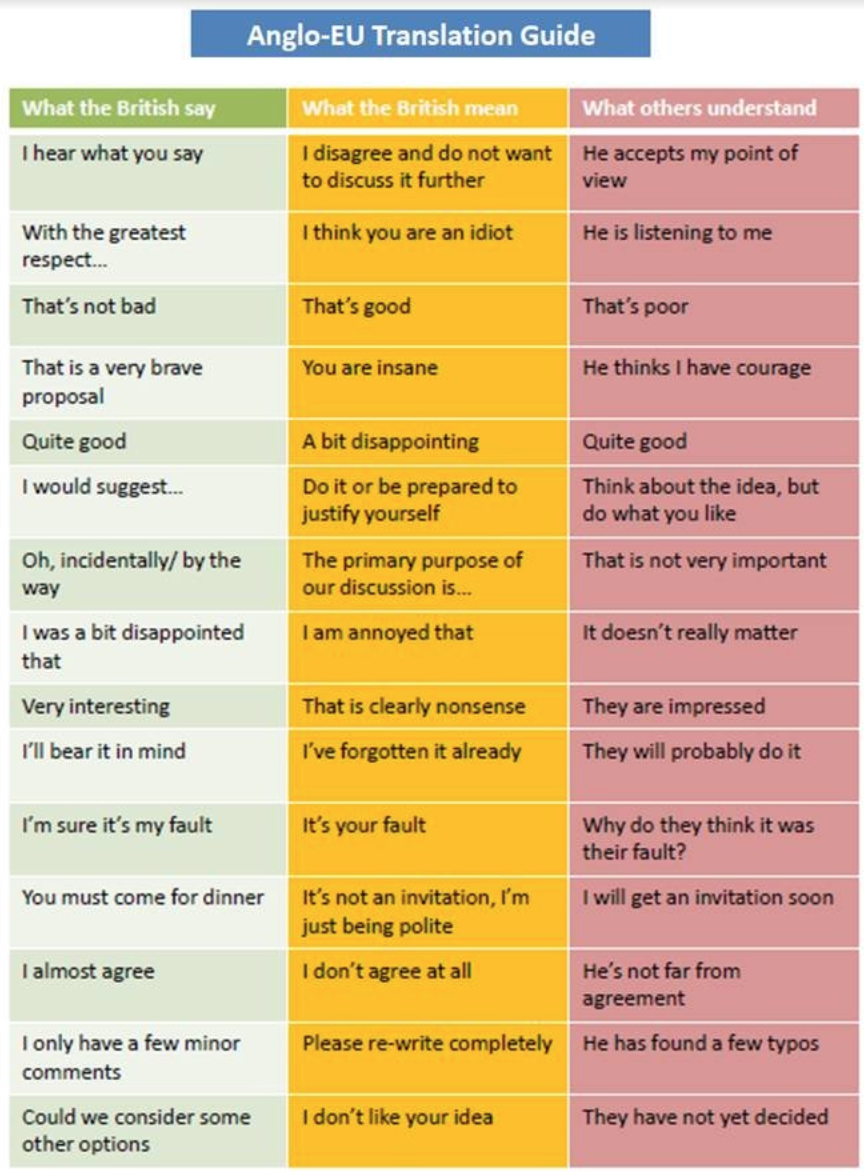
Examining British communication style and debunking a few myths about how British people communicate. This episode is based on a famous infographic called “What British People Say vs What They Really Mean” or “The Anglo-EU Translation Guide”. It contains lots of thoughts about how direct and indirect cultures communicate with each other, and some samples of business English, with a few improvised scenarios too! Transcript available.

Small Donate Button


[DOWNLOAD]

Transcript (below)

In this episode I’m talking about an infographic which is often shared online called “What British People Say vs What They Mean”. In the infographic there are three columns. One with sentences typically spoken by English people. The next column has what, apparently, British people really mean, and then the third column shows us the perceived meanings of those sentences by foreigners. It is supposed to highlight the indirectness of British English speakers and the how people from direct cultures often misunderstand us.


I’m going to go through the graphic line by line, discussing the language, talking about the indirect communication style of British people and discussing to what extent this infographic is true and how much is a stereotype.

This relates to several conversations I’ve had in episodes in the past, namely the ones about cultural differences with Amber & Paul, British humour with Amber and the one about language & culture with Alex van Walsum.

This chart often pops up online. You might have seen it. It’s shared on Facebook or Twitter, and people send it to me by email. People send this to me all the time, often accompanied with the question “Is this true?” It’s probably the infographic that I’ve seen more than any other. A while ago I shared it on my Facebook page and it got a big response with thousands of people seeing it and loads of comments.

The chart is anonymously written. It may have first appeared in an article on the Economist’s website. Apparently some people say it originated in a Dutch company that had dealings with the UK, which is interesting because the Dutch are known for being very direct in their communication, so through their eyes the Brits might seem excessively indirect. The infographic is sometimes entitled “What British People Say vs What They Mean” or the “Anglo-EU translation guide”.

Basically the chart presents a list of utterances, which it presents as typical things the British say in business situations, and then two other columns which represent what British people really mean when they say those things, and then how other people actually understand them to mean something quite different.

I think it’s based on communication and cultural differences between the UK and European neighbours. The underlying cultural difference is that in the UK we have an indirect communication culture, particularly with regard to saying negative things, and tend to signal their disapproval, disappointment, disagreement or offence in other ways – either by minimising the negative part, or using euphemism, which may be hard to understand to the untrained ear.

In my experience as an English person living in France, I find that it is definitely true that we have slightly different communication styles as a result of our cultural differences. But they’re just slightly different really.

One example of a difference between France and the UK is that generally in the UK our first interaction with people – especially people in service positions, e.g. if you’re going to the post office to collect a package which you’ve been told is there even though last time you went they claimed it definitely wasn’t there. So you have to go back and kind of complain and make them look again. In the UK my normal way of doing it would be to approach the situation in a nice way, using friendliness as a social lubricant to help things go more smoothly. Like “Sorry to bother you again! I went to the other post office and they told me the package is definitely here. Could you have another look for me? Thanks!” You kind of talk to that person like you understand how you’re personally putting them out, but between the two of you there is a friendly understanding. You’re nice to the person, even though technically they’re wrong and you’re sort of making a complaint. That’s how it goes much of the time – not every time of course. Often when Brits are unhappy with a service they will complain about it very directly. But many times you’ll see or hear Brits being pretty friendly when dealing with people in impersonal situations.

Now, that might actually be perceived not as a nice, informal gesture – but as fake, and two faced because in fact you’re actually not happy with the situation and you don’t know them personally, so why are you being all chummy?

In Paris, your first interaction would typically be a bit more formal and also a bit less friendly. If you’re all nice and friendly and you smile, you might be perceived as weak. That’s not to say that French people don’t smile – of course they do, but in that kind of service situation where you are making a complaint you’re likely to be serious and with a straight face. You can be completely straight about it and bring your unhappiness to the table. It’s normal to dig your heels in and argue a little bit before things then turn into a more amicable arrangement. It usually ends well, but there’s a bit of conflict at the start, for example saying “no” or “it’s not possible” at the beginning, before deciding later to ‘make an exception’.

I refer you to the episode with Alex Van Walsum who sums this up really well.

http://teacherluke.libsyn.com/391-discussing-language-culture-comedy-with-alexander-van-walsum

Episode 391 – play the bit

If you’re nice and you compromise from the start they’ll walk all over you without even realising it. So there’s conflict at the beginning until the thing finally gets resolved, and later on a relationship of trust might develop from the problem being fixed, but it comes after. I’m not saying in the UK we’re never direct or angry in that situation, or that in France people are never nice at first, I’m just saying in my experience it pays to be more formal and tough at the beginning or you’ll be taken for granted. Whereas in the UK my approach would be a bit different.

Sometimes this difference gets the better of me. I might go to a restaurant and say “Do you have a table for two at 8?” and the guy says “It’s complicated” or “No, it’s not possible” and I smile and say “OK, that’s a pity, thanks for your help!” and then leave. But what I often don’t realise is that “No, it’s not possible” is just the starting point. What you should do then is wait and just not take no for an answer. Wait and say “Is there anything you can do?” and dig your heels in a bit. Often, after a bit of digging, you might get a result. But you have to push through a little barrier first in many cases.

The point is that the words we use and the messages we convey are often quite different, and messages are often subject to various cultural codes which allow the people involved to truly understand what is being said vs what is the intended meaning, or illocutionary force of something.

Or more simply, in indirect cultures we don’t always say exactly what we mean, and it depends on the other person to decode the intended meaning of our messages. This is more common in some cultures than others, and this kind of indirectness does have a social function. If you’re from a direct culture, you’re less likely to be able to decode the messages and that’s where the misunderstandings happen.

That brings us to this chart of what British people say vs what they mean.

This chart essentially targets this cultural and linguistic point quite specifically, and while there is truth in it, I think the chart is not completely accurate.

Nevertheless, let’s go through what Brits say vs what they mean and see what we can learn.

One of the most important problems with this chart is the lack of context and the fact that these are spoken phrases written down, so none of the intonation is included. Intonation and context are vital in the way these messages are delivered and understood.

Without the context and intonation, this chart makes Brits look incredibly devious and two-faced. It also makes other people seem pretty dumb and naive.

On balance, what do I think of this?

It’s exaggerated. Brits are not as stuffy, awkward or unable to say what we mean as this seems to suggest. It’s slightly old fashioned too.

Also it’s not really fair on foreigners who aren’t that stupid.

I think it originally came from the Netherlands (who we do most of our business with in the EU) and they’re known for being a very plain talking, direct culture. So, this is perhaps from the dutch point of view, which exaggerates things further.

There is a point being made too, which is that the English say the opposite of what they mean, which is not true. Direct cultures tend to view indirect ones as being two-faced, hypocritical and even duplicitous. We do speak indirectly, perhaps downplaying negative things and attempting to use tact and diplomacy but it doesn’t stretch to being deceitful. For the English it’s a way to keep things nice and to sugarcoat our formal relationships. It’s a respectful distance which has been in the culture for a long time. We might be a bit indirect by dutch standards, but we know what we’re talking about. We understand what each other means, because we know the codes. So it’s a functional communication system, and just another way to share ideas while getting on at the same time.

Another point is that you could argue that it’s specifically English, rather than British because there is a slight cultural difference between the English and the Scottish, Irish, Welsh and even Cornish people, who might be more direct. Anyway, I know plenty of English people who are perfectly capable of being direct and saying exactly what they mean.

Also, there may be a class issue here. I think this relates to certain kinds of middle class or upper class English people, who tend to communicate like this, especially in a formal situation. There are certainly plenty of English people who are very direct in their communication style.
The situation is also important. Most of these phrases are used at work where diplomacy is important. In social situations these same people might be extremely direct, for example with friends who you make fun of and speak to without any kind of filter.

The sentences are out of context, so it’s not obvious how the phrase is intonated or what other phrases are used around it. Written down like that it has no nuance and can make the Brits look like pretty awful. So, this graph is designed to make people laugh and illustrate a tendency for Brits to be a bit indirect, but it is by no means a flawless guide to British communication style.
It’s a bit black and white. In fact there are plenty of UK individuals who are more direct than this, and EU individuals who are indirect. It’s a bit “them and us”, a bit ‘black and white’ and therefore a bit unfair.

It’s not just Brits. There are plenty of other cultures or individuals who also communicate like this. Canadians, for example, are well-known for having a polite and indirect communication style.

While there is definitely an underlying point being demonstrated by the chart, taking it on face value makes British people seem insincere and sneaky – which is a common criticism of us by European people with direct communication styles. Whereas us Brits see our communication style as diplomatic and avoiding conflict and essentially all about being nice, other people think we are not being honest, straight or sincere. We just don’t want to be too negative or nasty, but we come across as being unsure of ourselves, weak or untrustworthy. Equally, from the other side, Brits think the French can be wilfully difficult, stubborn and problematic because of how direct they are with negative comments. We also find the Germans – who tend to state things exactly as they are, to be cold and humourless with their ultra-pragmatic approach which doesn’t involve much small talk or ‘window dressing’. It’s tricky isn’t it!

In English we like to sugarcoat things. Not every culture does that. Some do it more than us.
Of course it doesn’t always go like that and most of the time communication happens without problems and it’s all fine. For example I have had many many exchanges with people from many different cultures including those from direct cultures and they’ve been absolutely lovely, but then again I am quite culturally aware and able to minimise this sort of thing by recognising the importance of saying exactly what you mean. I imagine that when people from other countries do business with Brits who are not used to cross cultural communication that sometimes there is friction and it’s often related to these cultural differences.

Also, it could be related to writing style in emails where this kind of thing becomes so much more obvious. I can imagine foreign people receiving English emails and wondering what exactly the person means – like the example of my wife and the castle.

For example, apparently when the German company BMW took over the British car manufacturer Rover, it took ages for BMW to fully understand the extent of the problems at Rover because all the British staff minimised the problems or spoke in slightly vague euphemisms. The Germans were not able to decode the embedded negatives within the Brits’ responses.

E.g. “We’ve had a few slight issues on the production line. Staff have expressed some preference for a longer break during the afternoon shift.” How big are those problems on the production line exactly? It would probably be worth investigating them further rather than assuming they are just “a few slight issues”.

Overall, I think there is truth in this chart, which is why it’s such an enduring success online, but it’s not totally true. The truth is that Brits put a positive shine on things as a social lubricant (sugarcoating) and it works within indirect cultures, whereas direct cultures say things as they are which can make them seem unfriendly or cold hearted yet ultimately more sincere. Neither approach is better than the other, they’re just alternatives.

Really, it’s about context. With indirect cultures, the indirect style probably feels more natural, with direct cultures it’s the other way around. The problems arise when the two cultures get together and then misunderstand each other. For the chart, more perspective and context is required to really understand what’s going on, and to avoid knee-jerk reactions. I say knee-jerk reactions – these are sort of quick, instant responses that happen without thoughtful consideration (like when a doctor taps your knee and it jerks forward without you thinking about it). Those things might be to conclude that Germans have no sense of humour, French people are willfully difficult and don’t want to work, English people are hypocrites who don’t say what they mean.

Simple binary comparisons of language without context like this can foster unbalanced opinions which can lead to or reinforce resentment and things like that. The final point is that despite our communication style, we’re still just as fair-minded, honest, trustworthy, narrow minded, dishonest and untrustworthy as anybody else! Don’t jump to conclusions and never let cultural differences cause you to make fast judgements about people without seeing the whole picture!

“The British are too polite to be honest, whereas the Germans are too honest to be polite.”
Source: http://www.bbc.com/news/world-europe-13545386 

Get the full word-for-word transcript here 👇
540. What’s Up? Post World Cup / News / LEP Meetup London / Super Mario Earworms

Giving some news, summing up the World Cup, England out, France win, and some chat about music that gets stuck in your head. Get some English stuck in your head with this episode. Transcript available!
Small Donate Button[DOWNLOAD]

Episode Transcript

Here it is, your regular dose of English listening practice.

The theory, the science, the method:
Listen regularly
Listen longer
Listen long term
Don’t stop! (e.g. when it gets difficult)
In time the results will be obvious to you.
Compound effect.
Time + practice + positivity = genuine progress in English
In a natural way.
All you need is the right resource to listen to.
Something personal.
Something designed for you as a learner of English not native to an English speaking country.
Something made by someone who *might* know what they’re doing!
Someone with the teaching qualifications, but also the experience of just talking to groups of people for the pure fun of it.
Something which has many episodes which you can use to get that English into your head.
Your mission is to get as much English into your head as you can – through your ears in this case, until you get to a point that you’ve heard so much that you start to get a feel for the language.
It’s like the force. You have to trust your feelings and do what you feel is right. The Jedi way – do or do not, there is no “try”.
When you do a grammar or vocabulary exercise you know the answer, by instinct, just because you feel that it’s the right answer. This feels right, that doesn’t. How can you possibly get that instinct without getting exposed to enough of the language in context?
Listen a lot, read a lot, regularly, for longer periods, long term, don’t stop and just enjoy the process.
These are the right conditions in which you can really learn English, and that’s what this podcast is all about.
Yep, this could be the resource for you.
Maybe I’m preaching to the converted, but if there are any new listeners listening to this – jump on board and get involved. Listen to the episodes, get the app, look through the archive list, star the episodes you think look interesting, listen to a bunch of them over the summer. Leave your comments in the comment section and introduce yourself to the friendly and funny people there.
This could be the thing that’s going to help you get the English that you want.
Check out my episode archive – I’ve got episodes about grammar, vocabulary, topics, conversations with guests, funny stuff, serious stuff.
And, I’ve got a premium subscription service where we take things further and really dig deep into the language, examining, uncovering, analysing, explaining, repeating the language which comes up naturally in episodes of this show made by me for you.
All the info you need is on the website of course – the episode archive, notes, transcriptions and the premium service. Teacherluke.co.uk

So, here’s your new dose of English.

What’s going on? What’s up?

LEP MEETUP LONDON
FRI 3 AUG from 2pm
Fitzroy Tavern,
16 Charlotte St,
Fitzrovia, London W1T 2LY
Email teacherzdenek@gmail.com

First thing – I need to tell you about a LEPster meetup happening in London. I’m pretty sure I won’t be able to make it myself although I would love to join in if I can. But there is a meetup happening with confirmed guests already.

So, attention LEPsters in London or nearby during the summer of 2018. There’s an LEP meetup happening on Friday 3 August from 2pm in the Fitzroy Tavern, 16 Charlotte St, Fitzrovia, London W1T 2LY. Fitzrovia is a cool place, just north of Soho near Oxford Street and Tottenham Court Road. I used to go drinking there when I lived in London with my old mates from college. So that’s our old stomping ground.

The meetup is being organised by Zdenek Lukas, the guy behind Zdenek’s English Podcast. Zdenek is a long term fan of LEP, and a well-qualified English teacher from the Czech Republic. Every summer he goes to London and teaches intensive courses in schools there.

Zdenek is a big fan of board games, especially for learning English – which is kind of a special area of interest for some people. There is a movement in English teaching which is all about using board games. It’s a brilliant idea. Board games are interactive, they create communicative situations, they’re fun, they involve communicative objectives and all sorts of cool things which are ideal for learning English. Plus they’re a really great way for people to get together, socialise and practice. These are board games for adults of course, not kids stuff.

So, Zdenek will be in the Fitzroy Tavern from 2, joined by an English teaching friend of his from the UK (I think she’s called Claire) and some other LEPsters who I think are already confirmed. You really should join them. You won’t regret it. You’ll make instant friends and you will have an afternoon in London that you won’t forget – if you do it right, and by “do it right” I mean – be sociable, have a couple of beers, relax, let go, enjoy meeting some like minded people and have some fun and play some board games in English!

Now, Zdenek needs to know how many people are coming so he can book some tables in the pub. So, shoot him an email at teacherzdenek@gmail.com.
Wondering what to write? Just write this – Hi Zdenek, I’d like to come to the LEP meetup on 3 August. Please count me in! My name’s _____. See you there!
If you can’t be there at 2, you could probably join them later. You could ask Zdenek how long he’ll be there.
Got it?
Friday 3 Aug, from 2pm, Fitzroy Tavern, 16 Charlotte St, Fitzrovia, London W1T 2LY. Email teacherzdenek@gmail.com to let him know you’re coming.

The World Cup

So I should probably wrap up the world cup commentary that I started in June. The WC is old news now isn’t it? It’s so last week!

Anyway, let me talk about:
England vs Croatia
France’s campaign (because I live here and it got crazy)

England vs Croatia

Perhaps England underestimated Croatia.
Maybe Croatia wanted it more.
Maybe England weren’t that good in the first place, and got lucky in the tournament.
England were outclassed.
Croatia were impressive. Incredibly determined and hard working.
We expected them to be tired. We expected to be able to beat them. But they’re made of tough stuff.
Croatia’s other games went to extra time and penalties. Denmark and Russia. They must have been knackered! But they soldiered on and ultimately overcame England.
Immediately the excitement and all the renditions of “It’s coming home” stopped and it was back to normal in England, and when I say “normal” I mean the general madness of the time – with the chaos of Brexit, our government imploding on itself, Trump visiting and being greeted by 250,000 people in the street protesting against his entire existence, he visited The Queen and arrived late, making her wait over 10 minutes.
What about France and the World Cup?

France vs Belgium (I somehow forgot to say all of this in the episode!)
1 – 0
Showed France could play a different type of football. Defensive, containing the danger of Belgium’s key players.
I saw a documentary about the French team. It was great.
Amazing team spirit. Pep talks in the dressing room. A positive atmosphere from the team in general. So much better than when the French team all threw their toys out of the pram and actually went on strike against the management team. This young team are really cool and get on well.
The crowds outside our flat went mad with a lot of noise.

France vs Croatia final

Don’t underestimate Croatia. Surely they must be tired by now, but they keep fighting. So much spirit in this team.
Some say France got lucky with an own goal and a debatable penalty.
The own goal was actually a great free kick by Griezmann. It did come off the Croatian defender, but it was right in the danger zone and if it had come off anyone’s head it would have gone in. A great free kick, a little bit lucky.
But Croatia came back, controlling the game in the first half an hour.
Then France won a debatable penalty. Griezmann crossed the ball in and the defender was coming down after jumping and appeared to move his hand to the ball in the penalty area. The ref couldn’t see it properly from that angle, so he went to VAR, and then called it a penalty.
Some people are saying the ref was biased but I can completely see how they gave the penalty, but I can also see why you’d be pissed off because it is really borderline. Is it intentional or not? The hand goes to the ball. It’s really hard to tell but the more you watch it on replay the more you think the ref can’t not give it.
France score.
2 – 1
I think at this point Croatia start to get tired.
It happened, eventually. This Terminator of a team, that wouldn’t stop coming no matter how hard you hit them. The comeback kings themselves, got a bit tired. Pogba started linking up with Mbappe and causing trouble for the Croatian goalkeeper. An amazing pass from Pogba to Mbappe led to an attack where the ball bounced around just outside the box and Pogba “got hold of it” and shot, the ball rebounded off the legs of a line of Croatian players and they didn’t know where the ball had gone and you see them looking around for a moment, but which time Pogba has stepped up and with the inside of his left foot has netted it from about 20 yards out.
3 – 1
At this point France show some class and generally have some great runs. Mbappe scores one of the goals of the tournament from further away than the Pogba goal hitting it hard with a bit of finesse, low into the bottom left corner leaving the keeper miles away. Amazing.
4 – 1
Croatia at this point must be feeling pretty crushed, having given it whatever they could for the last few weeks.
Then for some reason the French goalkeeper, Lloris makes a real sandwich of a backpass and cocks it right up by basically handing it on a plate to Mandžukić who was, as ever, pressing the goalkeeper and putting him under pressure. Mandžukić just knocked it in and then it was
4-2
And maybe there was a flicker of hope at that point for Croatia but it wasn’t to be and this French team really proved themselves, time and time again.
They had the more difficult route in the tournament, compared to England. Coming up against Argentina, Uruguay, Belgium and then Croatia, compared to England’s route of Colombia (where they were basically matched – just one pen between them) and then Sweden (who didn’t seem to put up much of a fight). Only when we met a real team like Croatia or Belgium, we didn’t quite cut the mustard.

But France, were brilliant and deserved to win. The thing is about France is that they can be a bit unpredictable and sometimes loose, they can win a game in 15 minutes, by just putting together 15 minutes of play they can handle most of the pitch, especially in that attacking midfield area. They showed that they had some depth and class and could really turn it on when necessary. And a fun, positive bunch of players who have a good future ahead of them.

England too might have a good future because the team is young.

Some people are saying this world cup represents the end of the Messi/Ronaldo era and the beginning of a new generation with guys like Mbappe.

I reckon this world cup has been one of the best in ages. It looks like Russia did a great job of hosting and this will be very good for Russia’s image I expect, with more people visiting and getting an idea of what it’s really like.

But generally the world cup was ace, with some amazing goals and some surprises with big teams getting knocked out early and some new talent coming through.

Next it’s the Euros in 2020 and apparently they’re being hosted all across Europe with the final in Wembley stadium which is brilliant.

By the way, that song “It’s coming home” was written when England were hosting the Euros in 1996 and so in a sense football was coming home in that we were hosting the tournament and it was 30 years since 1966 when England won the world cup. The song is actually about always being disappointed by England but still having hope that they can play well. It’s actually a really well written song with good chord changes and lyrics.

Earworm

I have a serious ear worm going around my head.
What’s an earworm?
It’s when you have music stuck in your head. Sometimes you just wake up in the morning with a song running vividly around your head. Different songs each time usually. Throughout the world cup it was “It’s coming home” for me.
But this week I’ve had a serious earworm going on and I can’t shift it. Sometimes this is annoying, but I’m actually enjoying it.
I’ve had this all week and I’m not sure where it came from.
It’s the Super Mario Kart soundtrack from the old SNES version of the game. The original and best. Pretty much the entire thing!
In the 80s and 90s Nintendo released a series of absolutely classic games. They were quality from top to bottom. Something about Nintendo in that period just oozed quality. There was also Sega and it’s character Sonic the Hedgehog, and he was popular. A very fast hedgehog, kind of a joke. He was popular – but he couldn’t hold a candle to Mario and all the Mario games.
They breathed quality and class. Zelda too.
Visually, in terms of gameplay and also the sounds and music.
Turning on your gameboy, NES or SNES you’d instantly be greeted by an unmistakable sound – a bleep or a ding, and the Nintendo logo. Something about that dinging sound. It was just right. It was cute, it was quick, it was satisfying somehow, it was even reassuring.
Then, all the Mario games – Super Mario Brothers, and Super Mario Kart, and The Legend of Zelda were blessed with really good music and I’m being serious.
I just googled this and it turns out that was all the work of pretty much one guy, who did the music for a stunning number of classic Nintendo titles. https://en.wikipedia.org/wiki/Koji_Kondo
I’m probably being influenced heavily by nostalgia here, but I love these tunes and despite the limitations of the technology and software of the time, they were very catchy indeed, and also very melodic and jazzy with touches of bossa nova.

I spent a lot of time playing Super Mario, Mario Kart, Zelda and now a lot of that music is permanently embedded in my brain, and it just comes back at times.

This week it’s been all about Super Mario Kart.

I’ve been teaching 6 hours a day all week, working very intensively, without a moment’s rest on most days, just teaching teaching teaching. The pace and rhythm has been high and I’ve had to be very upbeat for days. Somehow this just completely suits that Mario music.
Let’s hear some.

I actually searched Spotify for the music and found an album by a band called the One Ups. It’s a whole album of Mario Kart music, performed by this band.
Let’s hear some.
This might be a trip down memory lane for some of you.
For others, you might not know these games.
But these are pretty nice tunes anyway. Probably very cheesy and I’m certain it won’t be everyone’s cup of tea, but let’s just take a sort of trip down memory lane.
Perhaps we can hear some of the originals too.
I actually put this music on when I’m working sometimes.

So I’ve been busy working intensively and looking after my daughter. This is why I haven’t uploaded for a while. Nearly 2 weeks without a normal episode of the podcast.

It’s July and nearly August in Paris and this is when it becomes difficult to record and upload podcasts. I’m not complaining or anything. I’m very happy. But I do want to explain that the uploading of episodes might be a little bit inconsistent over the next couple of months.
There should be premium episodes – I have to provide you with regular premium content because you’re paying for that (well, just the price of a coffee or beer per month).

But anyway, things are hectic. I’m working intensive courses all day every day in July at the BC and then August is holiday season and we’re going away to a few destinations in France.

Usually we go abroad to some far away place but this year we’re staying in France, which I’m very happy about. I want to explore more of this country, which is beautiful by the way. There are plenty of beautiful places here and I want to get to know those places, sample the local food, enjoy the weather, relax by the pool and all that. So, French holidays, mostly in the south. Probably no big adventures this time, but who knows. If there are stories, I will tell them on the podcast.

So that’s it.

3 things

If you’re in London then hang out with Zdenek and other lepsters at the Fitzroy Tavern on Charlotte Street near Tottenham Court Road station. Let Zdenek know in advance that you’re coming with an email at teacherzdenek@gmail.com Board games, beer, pub food and good times to be had by all.
Get the LEP app for all the episodes on your phone and a whole bunch of bonus bits and pieces including grammar lessons, stories, vocabulary, jingles, phrasal verbs, videos and more.
If you want to take it to the next level and help me out with a contribution each month in return for a premium subscription you’ll get access to regular language-based episodes focusing on the things you’ve heard in conversations on this podcast. Sign up to LEP premium at www.teacherluke.co.uk/premium

This has been Luke’s English Podcast. Have yourselves a great night, regardless of what time of day it is now. I just hope you have a good night – either in the sense that the next night you have is a good one, or the more gothic sense that even during the daytime it’s night time and so you can have a good night at any time if you’re a goth.

But if you’re not a goth then have a good day either today or tomorrow.

For now,

Bye…

537. How Olly Richards Learns a Language (Part 2) Intermediate Plateau / The Magic of Story / Pronunciation & Personality / Classroom vs Self-Guided Learning

The rest of my conversation with polyglot Olly Richards, talking about how to overcome the intermediate plateau, the magic of story, pronunciation and identity issues, and self-guided learning.

Small Donate Button[DOWNLOAD]

Intro Transcript

Welcome back to this double episode in which I’m talking to language learner and polyglot Olly Richards all about how to learn languages as an adult.

Olly speaks 8 languages and spends a lot of time working on language courses, and giving advice on his podcast and blog, which are called “I will teach you a language”.

2 years after our last conversation it was interesting to catch up with Olly and see if his approach to language learning has developed.

In this episode I talk to Olly about how to overcome the intermediate plateau, we go into details about the magic of story and how important it is in language learning, we discuss the connection between pronunciation and personality and wonder if the main problem people have with pronunciation is actually an identity issue. There are also comments on learning in the classroom vs self-guided learning.

There’s loads of great advice in here. For premium subscribers I’m doing a video which will sum up the main points and clarify them a bit. That will be available shortly in the app and online for premium members.

But now let’s continue listening to Olly as we have the rest of our conversation about language.

—–

That’s it – I don’t need to say much more!

www.Iwillteachyoualanguage.com

Premium subscribers you’ll get a video summary from me soon.

Sign up for premium at teacherluke.co.uk/premium if you know what’s good for you!

Speak to you soon.

Bye.

536. How Olly Richards Learns a Language (Part 1) Compelling Material / Input-based Learning

Talking to polyglot Olly Richards about the benefits of listening, reading and using stories to learn English. Full of insights and strategies for effective language learning. Transcripts and notes available.


Small Donate Button[DOWNLOAD]

Introduction Transcript

This episode is packed full of language learning experience and wisdom, straight from the horse’s mouth.

Today I’m talking to Olly Richards, who has been on this podcast before, twice. Long term listeners will remember him. Some of you may also listen to his podcast, which is called I Will Teach You a Language. This is his third appearance on LEP, and I’m very happy to share this two-part episode with you here, today. I must say that I think this episode is full of really valuable insights about language learning and should be essential listening for anyone who is serious about learning a language to fluency.

The basics that you need to know about Olly.
He’s from England.
He speaks 8 languages. English is the only one he learned while growing up as a child. The rest of his languages were learned in adulthood.
I would say that he’s obsessed with language learning. He’s on a mission, basically, to learn languages but also to explore exactly how we learn languages, to find out the best methods, the most effective techniques, to discover the holy grail of language learning.

Olly spends so much time and effort learning languages, practising, reading academic studies, speaking to people about language in various languages, blogging about it, doing his podcast about it, producing books and courses all dedicated to the pursuit of language learning. He’s made language learning his career in fact.

Check out his website www.iwillteachyoualanguage.com to find out about all his projects, to read his blog articles and listen to his podcast.

As you’d expect, Olly really knows a thing or two about language learning. He’s got all the qualifications and has done all the academic work, but what I’m interested in is his own subjective experience of being a language learner himself, equipped with all the metacognitive strategies and accepted wisdom about the subject. This is where I think we can really get to the bottom of this topic. This is how we can get to the real truth about learning a language.

The first time Olly was on this podcast, we got to know the basics about how he applies himself to his language learning, but that was about 2 and a half years ago.

That episode was very revealing and still has so much to offer. I highly recommend you go into the archive and listen to that too. It’s episode 332, over 200 episodes ago! His second appearance on LEP was in episode 357.

So, in this conversation today we’re catching up with Olly after about 2 years of him working away on his language learning and teaching projects. So, what new insights does he have to share with us? Has his approach to learning languages changed? What does he now think is the most valuable way to spend your time in order to improve your acquisition of another language?

I think the results are really revealing.

I talked to Olly for nearly two hours – it was very easy and we could have gone on for longer. After having had this conversation I personally feel validated and reassured – why? Because Olly’s conclusions confirm what I’ve also discovered about language learning, and his conclusions confirm many of the principles behind my approach to doing Luke’s English Podcast. It’s a nice reminder that, in fact – yes, there is method to the madness.

Spending time talking to Olly and listening to him talk about learning languages is extremely motivating and I feel like this conversation, which will be presented to you in two parts, I feel like it’s a real shot in the arm for me personally, for the podcast generally, and for you too I hope. This should be a very healthy listening experience for all of you, in terms of your English.

Really – if you’re serious about learning English you will really pay attention. Absorb all of this, think about your own language learning experiences, apply Olly’s approaches to your situation, and see how you can continue to improve your learning of English to an advanced level.

There’s no need to say any more now in the introduction, let’s just hear what Olly Richards has to say about learning a language.


Ending Transcript

That’s where this part ends, but you’ll be able to continue listening in part 2. Well, I think this is a good one – absolutely chock a block with insights and advice for learning a language.

If you’re a premium subscriber you’ll soon be able to see a video of me reflecting on some of the things Olly said in this episode, summarising the main points and turning them into some bits of advice for those of you out there who are learning English with this podcast.

But for this audio episode, that’s it for part 1.

You’ll be able to hear the rest in part 2 as we discuss how to break the intermediate plateau and the connection between pronunciation and personality issues.

To get the full LEP experience and to get the full benefit of LEP on your English you should become a premium subscriber. For just the price of a coffee or beer per month you can access an ever growing library of lessons from me to you – covering language in more detail – usually explaining, clarifying and demonstrating real English – either because it has come up in specific episodes, or because it’s just stuff you should know and be able to do. I’ve been teaching for about 17 years and you can get the benefit of my particular set of skills by becoming a premium member – the perfect balance between getting loads of input and getting some advice, help, clarification and practice from me. All content in the app and online, .pdfs, full episodes, bonus episodes, videos, phrasal verbs, story lessons and more. teacherluke.co.uk/premium to get started. The app is the best way to get the premium content I expect.

OK that’s it for this episode. I’ll speak to you again in part 2. Thanks for listening.

Bye.

534. Sugar Sammy Interview (Part 2) Language & Comedy

Part 2 of my chat with Canadian stand-up comedian Sugar Sammy, talking about his 4 languages, TV shows from our childhood, copying Indian accents, language-related controversy in Quebec, Sammy’s crowd-work skills, stories of difficult gigs in the UK, and our thoughts on recent Star Wars films. At the end of the episode you can hear my spoiler-free review of “Solo: A Star Wars Story”. Transcriptions and notes available.

Small Donate Button[DOWNLOAD]

Sugarsammy.com – for news of Sammy’s live shows 

Introduction Transcript

Hello, welcome back to the podcast. Here is part 2 of my conversation with Canadian multilingual stand up comedy sensation Sugar Sammy.


In our conversation we’re talking mainly about language and comedy, and here’s an overview of the main points that come up in this episode:

  • First of all we talk about the 4 languages that Sammy speaks
    There’s a tangent about American TV shows that we both used to watch when we were children, and which actually helped Sammy to learn English when he was young.
  • Two of those American TV shows we mention include Knight Rider (the one in which David Hasselhoff drives around in a super cool black talking car) and The Dukes of Hazzard (the one about two brothers who live on a farm in Georgia who drive around Georgia in an orange Dodge Charger, being chased by stupid local police officers, doing lots of jumps and stunts in the car).
  • We talk about accents and copying accents: Specifically the question of whether I should do an impression of an Indian accent on stage, or if that would be inappropriate or unacceptable for some reason.
  • We discuss a language controversy that Sammy was involved in in Quebec, Canada – which included him receiving lots of criticism and even a death threat, essentially for performing a popular show in languages other than French – in Quebec (they are very protective of the French language there) It was quite scandal at the time.
  • We talk about what Sammy does on stage, especially his crowd-work, which is that skill of improvising moments of comedy by talking directly to members of the audience. This is something that Sammy is known for because he does it very well.
  • Sammy talks about some tough comedy gigs he has had in the UK over the years and tells us a story of how he once got heckled by an aggressive audience in Northern Ireland. Heckling is when audience members shout things at you while you’re performing. For a comedian it can be pretty difficult when you’re being heckled, but good comics are able to react and respond with funny “heckle put downs”, funny responses that turn an aggressive comment into a funny moment.
  • Then there’s a bit about Star Wars at the end – because like me, Sammy is a big fan.
    We talk briefly about Sammy’s favourite episode of Star Wars, what he thought of The Last Jedi and whether he is interested in seeing the new Han Solo film. When I recorded this interview I hadn’t seen Solo, but since recording it I have, so I will talk about the Han Solo movie briefly at the end of this episode, giving my non-spoiler review.

Don’t forget that Sammy will be touring parts of Asia soon – this year probably. He has gigs coming up in Malaysia and Singapore and will be organising dates in China and Japan. He also intends to visit Russia and South America to do shows at some point. So Sammy might be performing near you soon and you must go and see him. To get news of Sammy’s shows so you don’t miss him – visit sugarsammy.com and join his mailing list.

Now without any further ado, let’s continue listening to my conversation with the super cool multilingual comedian from Canada – Sugar Sammy.


Sugarsammy.com


Knight Rider

The Dukes of Hazzard

Peter Sellers in The Party (an English actor performing as an Indian character – it would be offensive but Seller’s impression is spot on according to Sammy)


Solo: A Star Wars Story (No-Spoiler Review)

Notes & Transcriptions

For those of you who are Star Wars fans – I’m now going to talk about the latest film, which in English is called “SOLO” – released last month.

This is a “star wars story” – not part of the Skywalker narrative.
It’s an origins story.
I was sceptical about the film.
Production for the film seemed troubled, which is usually not a good sign – but it’s not necessarily a guarantee of a bad film.
The original directors were fired by Kathleen Kennedy (head of Lucasfilm) because they took the film in a comedic direction and there was too much improvisation.
Ron Howard was brought in (a more conventional, reliable Hollywood guy) to fix it and bring it back in line.

Also there were doubts about the ability of Alden Ehrenreich to pull off the performance of a character who we loved so much, largely because of Harrison Ford’s star power.

I kept my expectations pretty low. I just thought – I’d like to see what happens, I just want to enter the world of Star Wars again and see what it’s like. I was ready to be disappointed though.

The film has underperformed at the box office. I’m not sure of the exact figures, but it’s taken less than it should have and might be considered as a financial failure, possibly even losing money for the studio in the short to medium term. It’s bound to make money eventually, long term, but the general feel is that it didn’t do as well as the studio hoped. Perhaps we’ve all had enough of Star Wars now. Star Wars fatigue, or maybe the fanbase has gone a bit weird. Star Wars has always been seen as an indestructible franchise. But the Last Jedi divided audiences, with quite a lot of fans absolutely hating it. Maybe Solo has suffered from the so-called Star Wars backlash.

But Solo isn’t really like The Last Jedi. It doesn’t have the same subtext of progressive politics, or themes that seem to subvert the core ideas of Star Wars. It’s pretty conventional and straightforward stuff.

What I liked

  • The performance by Alden Ehrenreich. He was charismatic, swashbuckling but also had a vulnerable side – the key things that Harrison Ford brought to the role originally. Han Solo has swagger and he’s really cool, but there’s something a bit vulnerable and loveable about him. He’s quite goofy and adorable, but also capable of being quite a ruthless fighter when necessary. It’s an interesting character and the actor did a good job of hitting those points. It’s not just a Harrison Ford impression. He seems to have got the spirit of Han Solo.
  • The dirty, gritty world.
  • Visual effects were incredible (although the whole film was very murky – intentional? Bad cinematography? I personally like that. I don’t need everything to be brightly lit like in the prequels. I like Clint Eastwood films that are full of shadow and darkness and you don’t see everything in bright contrast.)
  • The absence of Jedi and light sabres – it made a nice change. This was all about just having a good blaster at your side, knowing who to trust. It was like Rogue One in that sense. You got the idea that people could die – they weren’t immortal cartoon characters with superhuman abilities.
  • The train robbery scene was amazing, particularly the explosion at the end. I’m not sure why the empire needs to transport goods by train, considering they totally have spaceships, but it made for a good scene and made me think of old action movies and westerns that have action scenes on trains. The film was full of this kind of thing – standard movie tropes but in a Star Wars universe and I liked that. It was appealingly old school.
  • It was a slightly smaller story and that was appealing too. Sometimes you don’t want it to be about the huge Star Wars narrative about destiny and the force. Just a small, compact story about low-level gangsters is all you need.
  • Not too many geeky references to other films. There were some, but they were *fairly* subtle…
  • Nice chemistry between Solo and Chewbacca.
  • There are a couple of jokes which were not bad and pretty much in the spirit of the original films. They didn’t go overboard on the humour like in The Last Jedi, which a lot of the fans hated. I think the original directors probably had a lot more humour in it and after seeing the audience response to the humour in TLJ perhaps Kathleen Kennedy decided to replace them for a more serious director. There is a moment when Han Solo speaks Chewbacca’s language which was a bit over the top (if he speaks Wookie, why did he never do it in the other films – seems like a cheap trick, but it didn’t ruin the film for me.
  • Chewy has some badass moments.
  • Qu’ira’s character is interesting as a femme fatale. Emilia Clarke is very easy on the eye and I found her character to be interesting because I never knew where her loyalties were and there was always this sense that she was going to betray Han, and Han was sort of obsessed with her. It’s a bit like your first love – when, as a younger guy, you fall in love with a girl who might be slightly out of your league and you know she’s always going to break your heart.
  • Just really enjoyable. Woody Harrelson was a dependable screen presence as ever.

What I didn’t like

  • The cheesy musical score running through a lot of the scenes, as if we needed to be told how to feel and to make sure we didn’t get bored or anything
    Some cheesy clichés, which I can’t really remember now – but a lot of typical movie tropes and “yeah, right” moments.
  • There are probably some plot holes and things that didn’t make sense, but I can’t remember what they are. Well, there’s a moment when one character dies and I thought “why did that happen, it seemed completely unnecessary”
  • Some of the moments when they tried to link this film with the wider Star Wars universe – like linking it to some plot points in Rogue One – or just trying to include some of the large Star Wars themes – the birth of the rebellion. It seemed forced, and shoehorned – I mean, like they forced certain big themes into the film (no pun intended). It would have been better to make it a completely self-contained film without having to connect it to the broader world of Star Wars, the birth of the rebellion and all that.
  • Classic westerns like Sergio Leone’s dollar trilogy (spaghetti westerns) are just about those characters in an isolated story. It would have been good to do something like that. Let the audience use their imagination to fit it in with the larger universe.
  • Also, it feels a little bit like Star Wars is pushing an ideological position these days, and I’m not sure how I feel about it. I suppose it always was – the rebellion, the empire. It was basically about the struggle of local groups of freedom fighters against a vastly more powerful military dictatorship. But that message was usually delivered a bit more subtly in the original films. These days it’s like Star Wars needs to push this message a bit harder for some reason.

I can’t go into it in more detail without spoiling the film.

Anyway, those were my thoughts about Solo: A Star Wars Story. If you’ve seen it, let me know what you thought.

And I just talked about it there because it’s something Sammy and I discussed.

Let me remind you – sugarsammy.com to get news of his upcoming shows – possibly in a city near you soon.

Thanks for listening.

Other news

The World Cup is going on. I really want to talk about that a lot, like I did in 2014 – but I have so many episodes to upload! And I’m working on LEP Premium – basically making some episodes to upload soon and then I’ll launch it properly.

I usually worry when I have too much content to upload. I tend to think – if I upload too much (like loads of World Cup episodes) then people won’t be able to listen to it all and then they might just stop listening completely… they’ll think “Oh I can’t keep up and I don’t really like The World Cup so I’ll just move on to something else” and…

So, expect some WC episodes coming soon during the tournament, but if that’s not your cup of tea (or World Cup of Tea) then I suppose you can just skip them and know that it’s not all going to be about football forever.

Speak to you soon. Bye!

Luke

531. Crime Vocabulary Quiz (with Moz)

Test yourself and learn various verbs and nouns related to crime. Features some amusing chat and anecdotes with Moz from the Murder Mile True Crime Podcast. Transcripts and vocabulary available.

Small Donate Button[DOWNLOAD]

Introduction Transcript

This episode is a chance for you to test your knowledge and probably learn some new vocabulary relating to crime.

In the last episode I talked to my friend Moz who, as we know, does a true crime podcast and organises murder-themed walking tours in London.

I thought that since we’ve been talking about crime, that I’d prepare a crime vocabulary quiz and use it to test Moz’s knowledge of different types of crime.

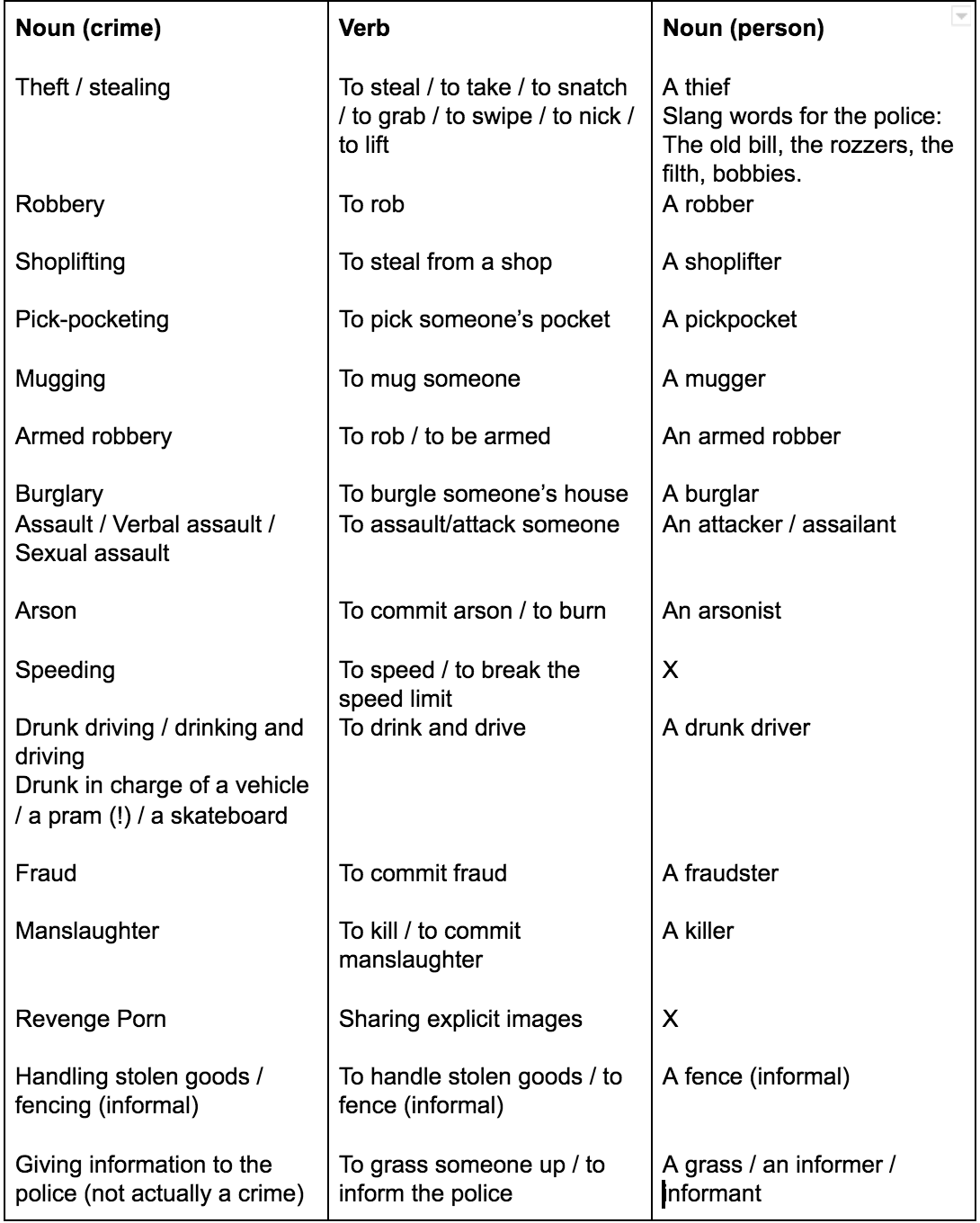
I’ve created a word list with nouns and verbs – names of crimes, the verbs associated with them and also what we call people who commit those crimes.

You can see the word list on the page for this episode if you want to have a look.

Otherwise, you can just listen on and see if you can guess the names of these crimes as well as their associated verbs and nouns.

This episode contains some swearing but none of the explicit imagery that we had in the last episode.

I’m focusing on general English here – the kinds of words that people generally use to talk about crimes. When talking about crime and crime there’s a wide range of vocabulary that exists. Some of it is the sort of official language used by the police or by the justice system, and some are slang words used by ordinary people.

The main aim here is to present the vocabulary that I think most people know and that most people use when talking about crime in general life. There is a lot more vocabulary on this topic of course, so there’s always more which I can cover in later episodes.

But let’s start now and you can see how many of these words you know, and don’t forget to check out the website if you want to see the list of crime words that come up in this episode. You can check their spelling, add them to your word lists and so on.

Right then – let’s get started!

Vocabulary List

Table

The words are also written in lists below so you can copy+paste.

Nouns (crime names)

  1. Theft / stealing
  2. Robbery
  3. Shoplifting
  4. Pick-pocketing
  5. Mugging
  6. Armed robbery
  7. Burglary
  8. Assault / Verbal assault / Sexual assault
  9. Arson
  10. Speeding
  11. Drunk driving / drinking and driving
    Drunk in charge of a vehicle / a pram (!) / a skateboard
  12. Fraud
  13. Manslaughter
  14. Revenge Porn
  15. Handling stolen goods / fencing (informal)
  16. Giving information to the police (not actually a crime)

VERBS

  1. To steal / to take / to snatch / to grab / to swipe / to nick / to lift
  2. To rob
  3. To steal from a shop
  4. To pick someone’s pocket
  5. To mug someone
  6. To rob / to be armed
  7. To burgle someone’s house
  8. To assault/attack someone
  9. To commit arson / to burn
  10. To speed / to break the speed limit
  11. To drink and drive
  12. To commit fraud
  13. To kill / to commit manslaughter
  14. Sharing explicit images
  15. To handle stolen goods / to fence (informal)
  16. To grass someone up / to inform the police

Noun (person)

  1. A thief
  2. A robber
  3. A shoplifter
  4. A pickpocket
  5. A mugger
  6. An armed robber
  7. A burglar
  8. An attacker / assailant
  9. An arsonist
  10. X
  11. A drunk driver
  12. A fraudster
  13. A killer
  14. X
  15. A fence (informal)
  16. A grass / an informer / an informant

Slang words for the police

The old bill, the rozzers, the filth, bobbies.

Useful links

Types of crime


https://www.met.police.uk/stats-and-data/crime-type-definitions/

524. Tricky Pronunciation Debates / “Either” “Neither” / Song + Comedy Sketch

Talking about words which can be pronounced several ways, words which are often pronounced incorrectly by native speakers and the debates, arguments and frustration that arises between native speakers as a result. Includes the “You Say Tomato…” song and the Grammar Nazi sketch, explained. Transcript & notes available.


Small Donate Button[DOWNLOAD]

Transcript

Welcome to episode 524 of this podcast for learners of English. You know what, I’m going to start this one with a poem that I’ve just written. Anyone who’s heard my so-called poetry before will know that I’m no Bill Shakespeare ok? Anyway, here is my work of genius to kick off this episode.

Here’s a new episode, 1, 2, 3
I’ve got no idea how long this will be
It could be one or two episodes. Let’s see.
I suggest you make a nice cup of tea
Put your feet up on the settee
Get your headphones on your head and when you’re ready
You can focus your attention like it’s a master’s degree
Or simply drift off and relax like you’re floating on the sea
The main thing, for me
Is that you listen carefully
And enjoy this episode of Luke’s English Podcast
Which is completely free.

Moving on…

Coming up in this episode

You can expect a rambling monologue from me which is recorded and presented for you to listen to as part of your ongoing mission to improve your English based on the principle that listening regularly, and for longer periods, is a good way to learn the language, pick up vocabulary, become more familiar with features of pronunciation, develop your instinct for correct grammar and natural English usage while maintaining a strong connection to English as a living and breathing communicative force which exists within us and without us, through us and between us, binding the galaxy together across borders, distinctions, barriers, obstacles and through various dimensions of time and space, leading to rising levels of value, status and quality in diverse and mutually beneficial ways. Basically, listening to this is good for your English, and that helps you to communicate with people from different countries, and that’s good.

Here’s an overview of the things I’d like to cover in this episode, which might become several episodes in fact…

Overview

  • Tricky Pronunciation Debates (arguments about words that people seem to pronounce differently, and also words that people pronounce wrong)
  • Podcast corrections (some comments from listeners with a few corrections)
  • A useful Japanese cat
  • The odd meaning of “Yeah, right”
  • How to actually answer the question “How are you?” or “How are you doing?”
  • Doing impressions of accents from different countries, and whether this is unacceptable or even considered racist in some cases – for example, I can copy the accent of a cockney, I can copy the accent of an American guy, but can I copy the accent of an Indian or Nigerian person? It’s a bit of a cultural minefield… let’s investigate.
  • The benefits of repeat listens – listening to episodes more than once
  • What does the word “podcast” actually mean?
  • Why you need to take extra care while listening to LEP.
  • The phrase, “Don’t be shy, give it a try”

And maybe some more comments about this and that, depending on the time available…

This is all based on comments and questions I’ve had from listeners through various channels…

Unexpected vocabulary question – among / between

What’s the difference between ‘between‘ and ‘among‘?https://dictionary.cambridge.org/grammar/british-grammar/between-or-among
Mingling among the people
Let’s mingle and socialise!
To mingle = to move around among a group of people in order to socialise and talk to everyone

British Podcast Awards

https://www.britishpodcastawards.com/vote/

Before we go any further, I need to tell you that I’m in the running for the British Podcast Awards Listener’s Choice Award this year. Someone informed me on Twitter that they found my podcast listed. OK then, so this is where I implore you to vote for me in the award.

Now, I have an army of Ninjas ready, primed to do my bidding. I have tens of thousands of you, by my reckoning, although I only ever hear from a tiny slice of that audience – a small percentage of you visit the website, leave messages, leave iTunes reviews, actually get in contact with me, download the app, join the mailing list etc… But if I could just mobilise you all and turn you into an international army or something, then I could take over the world!!! Assuming that you’re all capable people of course.

But the thing is, I don’t want to take over the world. What I want to do is to make podcasts, help you learn English, make you laugh on the bus sometimes, tell you stories, talk to guests, pay the bills, raise my family, put food on the table – AND WIN THE LISTENERS’ CHOICE AWARD AT THE BRITISH PODCAST AWARDS.

Last year, we got close. We got into the top 3. You did me proud. #TeamLEP got this podcast into 3rd place- the bronze medal position. Legions of LEpsters came out of the woodwork and voted for the podcast, and I actually got into the top 3. I know I was in bronze position because the BPA tweeted about it on the awards night and I have a screenshot of the tweet.

They have never since said it was a bronze medal. Ever since they’ve just put me in the runner’s up category with load of other podcasts. I don’t know why they dropped my bronze medal status – maybe they wanted to promote the other podcasts who they put in the runners up category, but anyway I was v proud to be a runner up, especially considering the other podcasts that were also runners up and especially the winning podcast, which is my fave podcast, Mark Kermode & Simon Mayo’s Film Review, produced by the BBC. #SoProud

Anyway, let’s see if we can do it again.

So, LEPsters of the world, unite and take to your computers and mobile devices – go to https://www.britishpodcastawards.com/vote/ and search for Luke’s English Podcast. Fill in the details and submit your vote. Voting closes on 17 May 2018. So we have 2 weeks to kick this into overdrive.

https://www.britishpodcastawards.com/vote/

Let’s make history people.

LEP Premium – Coming Soon

Still before we start, I just want to mention: Premium – coming soon.
LEP Premium is all about me making LEP work as a proper service beyond it being a free podcast.

You might be wondering when this is going to “drop”. I’ve had a couple of questions about it. App users might have noticed that a little “Premium Sign In” option has appeared in the settings menu.

I’m not going to talk about it at length now, but it’s in the pipeline like I said before.
Essentially, the premium subscription will be a way for you to support LEP with a monthly or annual subscription while allowing me to deliver more language and teaching-oriented content (episodes will be specifically about teaching you language, rather than the diverse topics, conversations and rambling that you get in normal episodes) direct to your phone or computer.
I’m doing this using a platform provided by my host – Libsyn, the biggest podcast host in the world. They’ve basically finished setting up my platform now and I am going to produce some premium content before launching it properly, probably later this month.

I’m calling it Premium content because that’s what Libsyn call it. Honestly, I’ve always tried to make all my content “premium” but there it is. In any case, I will as ever, try my best to make the content as good and useful as possible, but with these episodes the plan is to really get down to the business of language teaching. There will be fun and all that too – like in the examples I can improvise to demonstrate the language I’m teaching, but the focus will be on the language primarily – and I think that will go really well with the normal episodes. In many cases it will be a close-up look at the language that’s come up naturally in episodes.

Anyway, that’s enough about that for now. Let’s move on.

How do you pronounce “either”?

Language question – I’d normally leave this for a language episode, like the sort of thing you’ll get in LEPP episodes, but I’ll deal with it here anyway.

Benedikt from Austria, living in Switzerland

Either or either

How do you pronounce them?
Are they the same word?
Are there some times when you say it one way or the other way?
E.g. either we stay or we go (eye-thur) – two different options
I haven’t done it either (eee-thur) – other uses

Luke
They’re both correct.
Same word, same thing.
There’s no difference.
It doesn’t change depending on the situation. It’s exactly the same word with two possible pronunciations.
Everyone will understand you, however you say it.
Eye-thur or ee-thur
Some say that “eye-thur” is more British
And “eeee-thur” is more American.
I often say “eye-thur” but honestly I think I also say eeeethur too and I’m really British.
In fact, thinking about it I probably say eeether just as often as either. (often – that’s another one!)
I think it’s also possible for one person to say them both and there’s no rhyme or reason why it comes out one way or the other. (no rhyme or reason = with no obvious explanation)

Yes, this also applies to “neither”.

It’s a very common issue. English is a very diverse language, and there are some words that culturally we pronounce differently (e.g. American and British English or smaller regions like areas of the UK) and sometimes these are even at an individual level. Some people say “either” others say “either”. It’s no big deal actually.

More words with several pronunciations

Some more examples:
Neither and neither
Potato (US vs UK, but also around the UK)
Tomato (US vs UK)
I’ve chosen ‘tomato’ and ‘potato’ specifically, because they’re in a famous song about this subject.
Often (no difference – just two ways, “offen” is perhaps the original version but with a ‘t’ is fine too)
February
Loads of examples from UK & US English, e.g. “schedule” – another story for another time.
Situations where the word stress seems debatable or people get the word stress wrong (sometimes this is just Brits saying words with American word stress, and other Brits getting pissed off… e.g. my parents)
Harassment (first syllable UK, second syllable US)
Controversy (conTROversy in the UK, CONtroversy in the US – but the Cambridge Dictionary site lists both as being standard to the UK – and lots of Brits still get annoyed when they hear other brits say CONtroversy)
Vulnerable (my Mum insists that it’s only pronounced with the “l” but Cambridge Dictionary says it’s ok without too)
Mischievous (Correct = “mischivus”, not – “mischeevious”, although we do say the noun “mischief”)
**NOTE: “mischivus” is the only correct way to pronounce mischievous. **
**ALSO NOTE: I’m not using phonetic symbols on the website here because I don’t have time and this is an audio podcast not a blog, remember! Listen to the episode to hear how I am pronouncing the words
GIF (moving images which are easily shared on the internet)
Is it “gif” or “jif”?
www.11points.com says:
11 | GIF
Pronunciations: gif, jif
The Internet had come to a decent consensus on the pronunciation of GIF, which is remarkable, of course, since the Internet has never come to a consensus on anything. Everyone was cool with the hard G pronunciation. It sounded better, wouldn’t lead to confusion, and was logical, since GIF stands for Graphics Interchange Format. And that’s where the debate SHOULD have ended.
But earlier this year, Steve Wilhite, the man who invented the GIF format for CompuServe, talked. And he said, with conviction: “The Oxford English Dictionary accepts both pronunciations. They are wrong. It is a soft ‘G,’ pronounced ‘jif.’ End of story.”

You say tomato and I say tomato (song)

Going back to “either” “neither” “tomato” “potato” and this whole subject – there is a famous song about it, from back in the 1930s.

“Shall We Dance” (1937) with Fred Astaire and Ginger Rogers

https://www.youtube.com/watch?v=zZ3fjQa5Hls

00:44 seconds

Lyrics
Things have come to a pretty pass (come to a pass = happened, come to a certain situation)
Our romance is growing flat,
For you like this and the other
While I go for this and that,

Goodness knows what the end will be
Oh I don’t know where I’m at
It looks as if we two will never be one
Something must be done:

You say either and I say either,
You say neither and I say neither
Either, either Neither, neither
Let’s call the whole thing off. (call it off = cancel it)

You like potato and I like potahto
You like tomato and I like tomahto
Potato, potahto, Tomato, tomahto.
Let’s call the whole thing off

In most of those cases both words are probably right, but perhaps with some regional differences.

Then there are examples of words that some people say differently, but are generally considered wrong and are worth watching out for. These are the ones that will annoy people – but to be honest if you’re a non-native speaker you’ll probably be forgiven.

The biggest ‘crime’ is when a Brit says these and another Brit hears it, and their blood pressure rises.

Examples: (listen to the audio to hear the pronunciation)
Pronunciation
H
Nuclear” (new-cue-lur) should be new-clee-uh
ETC
Espresso
Prescription
Specific
Arctic
Ask” (this might have racial connotations but I’m not sure)

Some people (who are very particular about this kind of thing) get very upset about it, a bit too much probably…

The Grammar Nazi Sketch – from BBC comedy series “That Mitchell & Webb Look”

How do you say your acronym again? (H H H)

As you can see I didn’t talk about the other points in the overview at the beginning of the episode, but you’ll hear that stuff in forthcoming episodes of the podcast.

Thanks for listening!

Luke

523. Tips for Learning English with Films & TV Shows (with Cara Leopold)

Talking to a fellow English teacher about advice for using TV shows and films to learn English, both with and without subtitles.

Small Donate Button[DOWNLOAD]

Intro Transcript

Today on the podcast I’m talking to Cara Leopold who is an English teacher from the UK, living in France – like me.

Cara is an online teacher, who has her own podcast and other resources for learners of English on her website leo-listening.com.

One of the main things she focuses on is learning English through listening – especially using TV and films as a resource.

She’s got some tips to share on that subject – many of which come from her personal experiences of learning French, and so I’d like to talk to her about that,

But first I’d like to just get to know Cara a bit because we’ve never actually spoken before. So listeners, instead of hearing me talking to someone I already know (which is the way it normally goes on this podcast) you can now hear me having a conversation with someone I haven’t met before – so you can hear how that might happen in English.


Cara’s Website

www.leo-listening.com

Films and TV shows mentioned

Red Dwarf
BBC TV Comedy

The Orville
Seth MacFarlane
Based on Star Trek

Thor: Ragnarok
Directed by Taika Waititi, who also directed Flight of the Conchords.


Learning English with Films & TV – Summary of Advice Given

Here’s a summary of the main points made about using TV and films for learning English, with and without subtitles.

  • There are no hard and fast rules about using subtitles.
  • Using subtitles can help you understand what you’re hearing, especially when you realise that spoken English and written English can be very different. Subtitles can help bridge the gap between how words and sentences sound, and how they are written.
  • But be aware that only watching with subtitles might not help you develop real listening skills, because you’re basically just reading while you watch. Experiment with switching the subtitles on and off.
  • You can watch a film several times, especially if you enjoy it or already know it. Some films improve with multiple viewings. So, try watching certain films several times, perhaps first with subtitles in your language, then in English and then with no subtitles at all.
  • You can alternate between watching episodes of your TV show with and without subtitles.
  • Using TV and films for learning English is not just a simple or easy way to learn. In your first language you might just switch on a film or show and then kind of veg out while watching it – without really concentrating. This won’t work in English. Be prepared to focus and perhaps be more active while watching.
  • Watch certain scenes several times, with and without the subtitles.
  • Test yourself on what you heard and check with the subtitles.
  • Search for certain new bits of vocabulary when they come up.
  • Don’t worry too much about certain specific cultural details.
  • Try transcribing certain scenes – especially if you thought it contained really cool dialogue.
  • Then watch again with the subtitles to check your transcription.
  • Before you watch a film or TV show, check online reviews or summaries to help prepare yourself.
  • Be a little selective in your choice – pick stuff that you’d normally enjoy, and remember that films and TV shows can contain very “mumbly” dialogue, and even just “grunting” during long fight scenes. Try to pick films that are pretty simple and perhaps comedies that focus on the dialogue.
  • Don’t worry too much if you don’t understand 100%. Even in our first languages we don’t always understand what’s going on in films. So, don’t beat yourself up if you’re not able to understand it all.

522. Learning English at Summer School in the UK (A Rambling Chat with Raphael Miller)

Talking to my ex-colleague Raphael Miller about his new summer school for teenagers as well as many other topics, including British social and communication culture, growing up in Liverpool, studying at Oxford University, the famous Star Wars actor Raphael knows and remembering some of the old-fashioned ways we used to describe computers and the internet. Transcripts and links below. 👨‍🎓🌞🇬🇧

Small Donate Button

[DOWNLOAD]

Your English Summer – Links

Website www.yourenglishsummer.co.uk

Facebook www.facebook.com/yourenglishsummer/

Introduction Transcript

In this episode you can listen to a conversation I had with my friend Raphael Miller. Raph and I used to work together as teachers at the London School of English, along with Andy Johnson, Ben Butler and Carrick Cameron – all of whom have featured in episodes of this podcast.

Since those days, Raph has done lots of work at summer schools in the UK and has recently set up his own summer school project called Your English Summer. This is a school for teenagers from around the world who want to come to the UK to develop their English skills while having a really cool experience living away from home for a couple of weeks.

I thought I would ask Raph about his project, about the benefits of sending your teenagers to the UK for a summer school English experience and also about Raph’s own experiences of learning languages as a teenager and into adulthood.

I hadn’t spoken to Raph for a while – not since the last time he was on this podcast perhaps, and so it was really fun to catch up with him, find out about his project and also just ramble on about all kinds of other things, like his experiences at Oxford University, his childhood in Liverpool and a famous actor that he knows from university, who has had a big role in a Star Wars film. To find out all about that, just keep listening.

This might be a difficult conversation for you to follow, depending on your level. Reasons why it might be hard are:

  • The conversation was done over Skype, so the sound quality isn’t 100% perfect – but it’s good to get used to listening in less-than-perfect conditions, like when you have to do tele-conferences in English at work.
  • Raph has a slight Liverpool accent (but actually I think this isn’t really an issue because it’s really not that strong)
  • It’s all done at natural speed and there are quite a lot of idioms, jokey bits, specific phrases and fluent speech that might be hard to understand.

But the point here is that this is an authentic chat which ultimately is good practice for you.

If you are a parent of teenage kids and you’re thinking about sending them to a summer school in the UK to learn English, you should check out Raphael’s school, which is called Your English Summer – more details at yourEnglishsummer.co.uk

Now, let’s get stuck into the conversation.

Just before I hit the record button, Raph and I had been struggling to get connected on Skype. It wasn’t working properly on his computer, but to solve the problem he just turned it off and turned it back on again, which fixed it, of course – because that’s usually how you fix technical problems. What do you do when something doesn’t work? How do you fix it? Well, have you tried turning it on and turning it off again? There are other generic solutions to typical technical problems of course… can you think of any?

After that we talk a little bit about a recent episode of LEP that Raphael had been listening to – a recent one with Amber & Sarah called “Becoming Maman”… and the conversation just keeps on flowing from there, taking in some details about the social rules related to talking to new parents about their children (in fact, like me, Raph is also a new father – his son is just 6 months old now) British social etiquette in general, how we both know each other and how we first met, and then onto the details Raphael’s project, learning English at summer schools in the UK, Liverpool, Oxford University and various other things…

So, now that you’re ready, let’s dive into this chat with Raphael Miller … and here we go.


Raph also appears in…

Liverpool Accent Episodes

Your English Summer – Links

Website www.yourenglishsummer.co.uk

Facebook www.facebook.com/yourenglishsummer/

Ending Transcript

That was a rambling chat with Raphael Miller.

Don’t forget to visit www.yourenglishsummer.co.uk

and https://www.facebook.com/yourenglishsummer/

…for more details about his summer school in Liverpool. Could be a great thing for your teenage kids to do – or if you know any other parents who are looking for a small, friendly and genuinely fun English summer school experience – tell them about Your English Summer.

A note about LEP Premium

I’ve been mentioning this for a couple of weeks now. I expect it to arrive in May. Things slowed down a bit this week because I got really ill with a very nasty throat infection – tonsillitis to be exact. Tonsils are glands at the back of the throat. Mine got infected and all swollen, which was intensely painful for about 5 days. My whole head felt like it was going to explode, I felt like someone was stabbing me in the head and neck with needles, while also periodically stepping on my legs and back in a pair of Dr Marten’s boots. Swallowing was like torture. Not nice at all. It was a lot like when I was sick in Japan. Thankfully this time it was just the tonsilitis and not something more serious. Anyway, the French healthcare system and my wife, looked after me and I’m feeling a lot better. Also, for a week to 10 days this month we’re going to the UK on holiday, which means taking some more time out from podcasting duties. There should be another episode coming out while I’m away but the launch of LEP Premium is unlikely to happen until May. I’m also still working with Libsyn to actually do things like make additions to the app and some other things before LEPP can happen.

Anyway, it should come along in May and when it does you should find that one of the first Premium episodes is a language review of this episode, also there are some language features from the episode about pets I wanted to look at, so that’ll probably come up too.

Remember that one of the aims of LEP Premium is to make sure you really learn the English you’ve heard on the podcast – not just hear it but really learn it properly – the English you might not have even noticed but with which you need a guiding hand – in this case my guiding hand, with all those years of teaching experience, podcast experience – so I can help you with your English and have some fun while doing it.

So, a language review for this episode with LEP Premium coming up.

Remember too that LEP Premium will work like this:

  • You’ll create a profile with Libsyn, my host
  • You pay a small amount per month (e.g. the price of a coffee for me) to access the Premium content
  • You can get the content in the LEP app or via a webpage – same account login.
  • It’s a chance for you to get content that focuses specifically on language teaching, while also making a contribution to LEP.
  • You’ll get those LEP Premium episodes, and also new Phrasal Verb episodes + more bonus stuff just for premium subscribers. You’ll be my VIP club and I’ll be happy to reward you with exclusive content.

Coming soon in LEPland.

Right, time to go now – have a great day, night, morning, afternoon, evening, milkshake smoothie or tropical fruit juice or whatever you’re having. Cheers!

Luke

Full episode transcript available here 👇

520. Idioms Game & Chat Part 2 (with Andy Johnson) + 18 More Idioms & Vocab Items Explained

The second part of my chat with Andy Johnson. Listen out for 18 more idioms which will be explained later. Topics include: Twitter abuse, the other Andy Johnson, training for the London Marathon + more. Transcripts and vocabulary definitions below.


Small Donate Button[DOWNLOAD]

Introduction Transcript

In this episode you can continue to listen to a conversation I recorded with Andy Johnson just the other day. The language focus in this double episode is on idiomatic expressions.

In fact we’re playing a sort of idioms game. The rules of the game are that before having the conversation Andy & I had to prepare 3 idioms each. By prepare I mean to just think of 3 idioms, or flick through an idioms dictionary and pick 3 that you quite like. Then during the conversation we had to try and insert the idioms naturally, without drawing too much attention to them. Just to slip them in completely naturally. The challenge is that we both, at the end of the conversation, have to try and identify which expressions the other one had prepared in advance.

During the whole conversation lots of idioms just came up naturally. In part 1 I went through a lot of them – there were about 25 idioms in the first part. I explained them all at the end.

Do you remember them all? Here’s a quick reminder.

Idioms from last time:

  • to bring someone up to speed
  • to have beef with someone
  • to hold a grudge against someone
  • to have a score to settle with someone
  • to jump the gun
  • to be the butt of a joke
  • bad blood
  • to take something on face value
  • to be a piece of cake
  • not my cup of tea
  • to hit the nail on the head
  • to stick out like a sore thumb
  • to shoehorn something in
  • to do something on the spur of the moment
  • to be on the doorstep of
  • to be two/three sheets to the wind
  • to be half cut
  • to creep out of the woodwork
  • to feel peckish
  • to be jaw-dropping
  • to be eye-opening
  • to shine a spotlight on something/someone
  • to call someone out for doing something
  • to slag someone off

Again, I explained all of those at the end of part 1. Only 1 of those idioms was prepared in advance. All the others just came up on the spur of the moment.

So that means that in this episode there are still 5 more pre-prepared idioms left.

Having checked part 2, I can tell you that there are about 18 idioms in total. So, listen carefully to the rest of our conversation and try to spot expressions which you think might be the idioms I’ll be defining later. 5 of them were written down by us in advance and slipped into the conversation as part of the game, the others just happened naturally.

There’s also plenty more nice, useful vocabulary that you might not know coming up, so listen carefully – there’s a lot to learn from this episode.

In terms of the topics in the conversation, in this one you’ll hear us cover Andy’s experience of being abused or angrily criticised on Twitter, my experiences of facing audiences as a stand up comedian, how there is another Andy Johnson in London who also looks a little bit like Moby and who used to play football for England, Andy’s training for the upcoming London Marathon and then the results of the idioms game – with our comments about the idioms we noticed (or didn’t notice).

And as I said, I’ll also be explaining all the idioms and more vocabulary at the end of the conversation in the final part of this episode, so keep listening for some clarification of things you might not have understood or noticed.

But now, let’s carry on with the conversation and hear about Andy’s experience of facing criticism on Twitter because of a misunderstanding about his presentation about Millennials in the workplace. By the way, for more information about Andy’s talk on millennials and to find out what millennials are (if you don’t know) let me recommend that you listen to episode 424 in which I spoke to Andy and his colleague Ben about it in more detail.

424. With Andy & Ben from The London School of English (Part 2)

You can find the link on the page for this episode with all the other notes and stuff, or in the episode archive.


The conversation continues…

Luke & Andy’s Idioms Game – The Results

Ones Andy thought Luke had pre-planned: (actually, none of them were pre-planned)

  • Two sheets to the wind = drunk
  • To pull the rug from under you / to pull the rug from someone’s feet = to suddenly take away help or support from someone, or to suddenly do something that causes many problems for them

Luke’s pre-planned idioms

  • To get the wrong end of the stick = to misunderstand the situation
  • To be a dead ringer (for someone) = to look exactly like someone else
  • To keep the wolf from the door = to eat just enough food to prevent hunger

Ones Luke thought Andy had pre-planned

  • It’s the cross I bear = a burden that you have to carry or live with
  • to be half-cut = drunk
  • To slag someone off = to abuse or criticise someone in quite a rude way

Andy’s pre-planned Idioms

  • It’s the cross I bear
  • To stand on a pedestal = to put yourself in a position in front of everyone
    (Also – to put someone on a pedestal = to admire or respect someone so much that you think they’re perfect)
  • Jaw-dropping / to make your jaw drop = surprising, amazing, astonishing (in Part 1)

…the conversation ends.


Sponsor Andy & help support The Christie Foundation Trust

Click here for Andy’s JustGiving page for his sponsored Marathon https://www.justgiving.com/fundraising/andybjohnson

Also via PayPal https://www.paypal.me/andybjornjohnson


Vocabulary List – Idioms and Other Expressions You Heard in this Episode

At least 18 Idioms and some other nice bits of vocabulary to learn

  • You are a bit of a dead ringer for Moby (I forgot to mention this one in part 1)
    To be a dead ringer for someone = to look exactly like someone
  • They’d all got the wrong end of the stick, but they were all slagging you off.
    To get the wrong end of the stick = to misunderstand the situation
    To slag someone off = to criticise someone in a rude way
  • It was really eye-opening how quickly it can escalate and how people can latch onto something and they can completely turn it and twist it.
  • eye-opening = surprising and something you learn from (in part 1)
  • Jaw-dropping = amazing, astonishing (in part 1)
  • To latch onto something = to become firmly attached to something (physically), to strongly accept an idea with enthusiasm – just get fixed on one idea quickly and firmly
  • How did it feel to receive all that heavy-handed criticism?
    Heavy-handed (adj) = too strong, using much force than is necessary. E.g. heavy-handed policing.
  • I sent the guy a message, the guy whose tweet caused the kerfuffle
    A kerfuffle
    = A disturbance, a fuss, noise, a confusing and complex situation. E.g. She caused quite a kerfuffle when she sent out that letter accusing them of cheating.
  • I was thanking him for sticking up for me.
    To stick up for someone 
    = to defend someone, to back someone up.
  • If you stand on a pedestal and you give your opinion on things, you’re always setting yourself up for people to have a go at you.
    To stand on a pedestal = to put yourself in a position in front of everyone
    To set yourself up for something = put yourself in a position where something can happen. E.g. set yourself up for success, set yourself up for a fall, set yourself up for people to have a go at you.
    Heckling (see below)
  • Also – to put something on a pedestal = to admire or respect someone so much that you think they’re perfect, to idolise or idealise someone
  • People react quite strongly to that especially when it’s posing some kind of threat to the status quo of their work
    to pose a threat to something (not really an idiom) = to present a possible danger to something
    The status quo = the present situation
  • People might feel like these new things are, like, pulling the rug from under them.
  • It’s like pulling the rug from under their feet.
    To pull the rug from under someone = to suddenly take away help or support from someone, or to suddenly do something that causes many problems for them
  • Heckling – meaning someone in the audience shouting out when someone is speaking publicly
  • I got an injury and it got worse and worse and worse throughout the week. I couldn’t run for 5 weeks. I had physio, I had acupuncture, I had ultrasound. (not idioms)
    To have physio  = physiotherapy
    ultrasound, an ultrasound scan = a sort of scan that uses sound as a way of seeing inside your body, as an alternative to an x-ray, to check for injury or maybe a baby (but not a baby in Andy’s case. “What seems to be the problem Mr Johnson? Well, my knee is really playing up. It’s very stiff and painful when I walk. Let’s have a look, if you’d like to just lie down here we’ll start the ultrasound. Oh, oh… Mr Johnson, it appears that you’re pregnant. What?? Yes, that’s right, you have a baby in your knee. But how is this possible? I’ve been using contraception! hahaha, etc)
  • The physio used to be the physiotherapist for Fulham Football Club. (person)
    A physio = a physiotherapist (person)
  • When I walked in he did a double take (thinking that Andy might be the other Andy Johnson, who used to play for Fulham FC)
    To do a double take = to look at something briefly, then look away and look back again very quickly! It’s really funny and comical! Also you can do a triple take and a quadruple take for maximum comic effect.

  • A bit of a mover and shaker in the world of football, this Luke Thompson
    A mover and shaker (in the world of …) = a powerful person who influences people and initiates events.
  • Any little problem gets exacerbated when you’re running a marathon.
    To exacerbate something = to make something worse (not an idiom)
  • It seems to be, touch wood, it seems to be OK.
    People say “touch wood” as a superstition to wish themselves luck or for protection against bad luck. It’s like saying “fingers crossed”.
  • Do you have a full slap-up breakfast or is it just a banana to keep the wolf from the door?
    slap up (adjective) = excellent, first class – used with food. A slap up meal. A slap up breakfast. It’s usually used in an enthusiastic and informal way to talk about a full meal.
    To keep the wolf from the door = to eat just enough food to prevent hunger, to stave off hunger
  • You go out too fast so after 6 or 7 km you’re knackered!
    Knackered (adj) = extremely tired (British slang)
  • Everyone’s in the same boat. They’ve trained for ages. There’s the music and the camaraderie, they’re running together. Everybody just goes off far too quickly.
    To be in the same boat = to be in the same situation
  • The charity is something that’s very close to my heart.
    It’s very close to my heart = it means a lot to me, it’s important to me
  • When you’re wishing someone luck you say “break a leg”.
    Break a leg = good luck! Have a good show!
  • The leg refers to a limb – an arm or leg, but also a large piece of wood like a beam, or branches of a tree. A large piece of wood can be a limb.
  • In comedy, when you have a really good show, you raise the roof. (the roof comes off because the audience are laughing and applauding)
    So, break a leg means “I hope you have such a great show that the roof comes off the building!”
  • I was using it in a very irreverent way, a very light-hearted way. (talking about the phrase “the cross I bear”)
  • I’m all at sea = I’m confused and not sure what to do

Come on!!! That must be useful to you! A huge slice of English learning cake there for you to feast upon. You could feed a whole family on that for about a week in some places!

Again, what do you think of the idea of this paid premium membership system?

Sign up to be a premium member for a nominal amount per month, per 6 months or per year.

Get access to a certain number of language-related episodes of LEPP (LEP Premium) per month. The episodes would be available in the app or on a website. Episodes would mostly deal with language that has come up naturally in conversations on LEP – like what I’ve done here, or in the recent grammar episodes. Yep, language related but with the usual funny examples and explanations. Also there would be more phrasal verb episodes and probably other things because I would want to reward my premium lepsters or PLEPSTERS, so I’d probably offer little videos and other things too. All for the price of a beer or a sandwich for me per month.

That’s something in the pipeline at the moment.

Why aren’t you just doing it now Luke?

Yes, good question. I’ve been talking about this sort of thing for ages. It’s slightly harder than you might think actually. The thing is, I really want it to work. I want it to be worthwhile. That means finding a model that works. I think now I’ve got the app and I can offer paid content in the app, that is the right platform. Now it’s just a case of making it happen. Enthusiastic responses from you would certainly give me a boost. I think it would be really great. I just hope you realise that too.

Anyway, you can contact me about it if you like, using the usual methods.

Join the mailing list.

Download the app.

Nice one for getting to the end of this episode. Imagine all that English that has gone into your brain. That’s good! Nice one. Give yourself a pat on the back. I think you can agree that your English is better now than it was before you started listening to this, can’t you? I think you can agree with that statement.

Alright, time to go.

Speak to you soon! Bye!!!

Luke