Category Archives: Learning

244. Urban Myths

This episode is all about urban myths. Get your thinking hat on in this episode because it’s time to evaluate a few stories and beliefs and decide if they are based in reality or if they’re just the product of an overactive imagination, or rumours, or just plain old-fashioned bullcr*p! I will also teach you some very useful language connected to expressing if you think something is true or not. There are vocabulary notes, transcriptions and more details below. [Download]

Small Donate ButtonIn This Episode we will:
Consider what an urban myth actually is
Look at a news story about a commonly held belief from another country (and decide if it’s really true or not)
Look at some useful language – phrases and sentences we use to say “That’s true” or “That’s not true” – useful, natural vocabulary!
Consider some commonly told and surprising ‘facts’ and decide if they’re true
Talk about some of the UK’s favourite superstitions (if we have time – if not, that will be another episode in the future some time)

What’s an urban myth?
Essentially, this is a story or a fact which people spread around as if it is true, but in fact it is probably just made up. Often these urban myths or urban legends are personal stories or anecdotes, typically 2nd hand ones (like, “this happened to a friend of my brother’s girlfriend’s cousin and it’s absolutely true!”) and often involve something horrible, scary and shocking. Urban myths may also be just commonly held beliefs about something which are not based on any real evidence or fact, but are perpetuated out of misinformation, or as a hoax.

Superstitions on the other hand are similar but not the same. A superstition is the widely held belief that certain actions are lucky or unlucky, like the idea that the number 13 carries some magic power, or that not making eye contact when you take a drink and say “cheers” with someone, you’ll have 7 years of bad sex. Where’s the evidence that this is true? There is none, and yet many rational people still hold on to these ideas. In fact, many rational people still have that element of suspicion in the backs of their minds whenever they do some potentially unlucky behaviour, like walking under a ladder or opening an umbrella inside a house. Perhaps some of these superstitions are grounded in truth, but in many cases they’re just weird little glitches in our thinking. Every culture has its own unique urban myths and superstitions. In this episode we’re going to explore a few urban myths – one from Korea, some from The UK or America. I’ll tell you some things and you can use your critical thinking to decide if they’re really true or just a myth.

Then if we have time I’ll tell you about some of the most commonly held superstitions in the UK.

Examples of urban myths?
I’ll tell you a couple of stories that I remember being told by kids at school as if they were true.
The caller
The worm
The spider’s nest

All those stories are supposed to make you go “Oh my god!” and people make them true just to add some extra horror. None of them are true.

Discuss
1. Do you believe everything you read in the papers?
2. What about things you read on the internet?
3. How about things you hear by word of mouth?
4. Where does misinformation come from? Is it always shared by word of mouth or online?
5. How do you know if a story is true or just an urban myth?

Believe it or not? Truth or Urban Legend?
1. Look at the newspaper headline “The Cool Chill of Death” (The Metro, Monday 14th July) What is the article about? Make some predictions.

Vocabulary (before we read the article)
2. Match these words with their synonyms & definitions before you read the text.
Words & Expressions in the Article
1. on the loose (c)
2. humble (g)
3. rumble & grumble (b)
4. to be convinced that… (d)
5. a vacuum (e)
6. hypothermia (a)
7. an urban myth (f)

Synonyms & Definitions
a. a fatal condition caused by low body temperature
b. scary noises (e.g. made by thunder or a monster)
c. not in prison – free
d. be sure/certain that…
e. a space with no air in it
f. a story which is not true, but which people think is true
g. modest

3. Read the first paragraph & check your predictions.

Reading Comprehension Questions
4. Now read the rest of the article and find answers to these questions.
a. What is fan death?
b. What are two explanations of fan death?
c. Which of these is a realistic explanation?
d. According to Dr Yeon Dong-Su, what two factors could cause hypothermia to occur?
e. According to the article, why is fan death unlikely to be real?
f. What did Robin Prime do?
g. What two things shocked him?
h. How do tall stories become widely held beliefs?
i. Could a fan suck all the air out of a room? Why/why not?

The Metro, 14 July
THE COOL CHILL OF DEATH
Be afraid, be very afraid. For as summer continues, there’s a new killer on the loose. It rumbles and it grumbles and it is the humble electric fan. For in South Korea from Seoul to Seongnam, people are convinced you can die by leaving one turned on in your bedroom overnight.
Various explanations have been given for how the fans kill people – from their cooling effect resulting in hypothermia to the vacuum created around the victim’s face. These explanations fly in the face of medical opinion, yet Korean newspapers report an annual average of ten fan deaths and some Korean doctors are convinced of the hazards of sleeping with a fan switched on.
Clinical support
Dr Yeon Dong-su, dean of Kwandong University’s medical school, has investigated dozens of cases of fan death and insists they do occur. ‘Many people say these victims die from lack of oxygen but that is not true,’ he says. ‘Hypothermia does not only occur in the winter when it is cold. The symptoms can also take place if a person has been drinking and turns on a fan in a closed room. Most people wake up when they feel cold but if you are drunk, you will not wake up, even if your body temperature drops to below 35°C (95 °F), at which point you can die from hypothermia.’
It seems more likely than not that fan death is actually little more than an urban myth – most of the newspaper reports omit other causes of death from heart attack to gunshot wound – but it’s very hard to find a Korean who doesn’t believe in the phenomena – to the point where fans in Korea are fitted with timer switches to ensure their owners avoid certain death.
Possible ‘cot death’
A spokesperson for the Korean tourist board says: ‘This is certainly a serious and widely held belief in Korea. It appears to come from reports of people dying in the night and the common factor is the fan was running. The actual cause of death could have been something totally different, including cases of what people in the West would call cot death.’
Fan death has also become a cult internet phenomenon, thanks to message boards populated by English teachers in Korea who are baffled by their students’ belief in this notion. Robin Prime, who set up the website www.fandeath.net, says: ‘I was shocked at how powerful my Korean friends’ and students’ belief was and at the lack of critical thinking about the issue.’
Urban myth expert Dr Robert Matthews of Aston University explained how a shaggy dog story becomes a widely held belief across a country. ‘Urban myths often have a grain of truth in them that then suffers from the ‘Chinese whisper’ effect, with the facts being lost behind ever more embellishment,’ he says. ‘Clearly, it’s true that an extractor fan could suck all the air from an airtight box. And it’s also true that people sometimes die from inadequate ventilation. It’s a safe bet that many of those deaths will also have occurred in homes fitted with fans simply because many homes in South Korea have them. Hey, presto! You’ve a dodgy link, plus an irrelevant scientific fact to back it up. The truth is, of course, that buildings are notoriously leaky, and fans don’t have a hope of sucking out all the air.

To be clear: Some Koreans (not all) believe that if you go to sleep in a closed room with a fan blowing directly on you, that you can die.

I have spoken about it with numerous Korean students, and many of them were adamant that it is true. But is this true or just a myth? Is this something that happens everywhere, or just something that affects Koreans?

5. Discuss the Article
What do you think of the article?
Do you think the writer is being a bit snobbish about South Koreans?
Do you believe in fan-death?
Do you ever sleep with a fan on at night?
Fan death is said to be just an ‘urban myth’. Do you know any other urban myths like this?

Arguments For Fan Death (by people who say it really is real!)
It slices the oxygen molecules in half, you can’t breathe them and then you suffocate to death.
You can die of hypothermia because the fan prevents you from sweating and then you freeze to death.
It creates an air-sucking vortex, like the eye of a tornado, which creates a vortex/vacuum and then you can’t breathe.

More details & opinion on the Wikipedia page
http://en.wikipedia.org/wiki/Fan_death

Useful Language For Saying “It’s true” or “It’s not true”
Do we use these expressions to say we think something is true or not true?

That’s not true
There’s no way that’s true
That is so obviously made up
It can’t be true
It sounds pretty far-fetched to me
I think it’s not true
It smells a bit fishy to me
It’s possible, but unlikely

That’s true
I reckon that’s definitely true
There’s a good chance that’s true
That sounds pretty likely to me
I’d say that’s probably true
It sounds pretty convincing to me
That might/could be true

More Stories – Are they TRUE or just URBAN MYTHS? – You decide!
You are going to listen to descriptions of 6 stories which people talk about, but which may or may not be true.

Are the stories true, or just myths? You decide.

  1. Coca-Cola used to contain cocaine
  2. If you give alka seltzer to a seagull, it will explode
  3. Walt Disney’s body is cryogenically frozen
  4. There are albino crocodiles living in the New York sewer system
  5. Red Bull contains extracts from bull’s testicles
  6. Santa Claus was invented by Coca-Cola company

Remember the useful language above.

TRANSCRIPTS

Coke used to have cocaine in it
Luke: Hi Deb. Do you like coca-cola?
Deb: It’s ok, it’s very very sweet.
Luke: Yes, but it’s quite moreish don’t you think?
Deb: Yeah, well when I open a bottle I tend to drink most of it in a night.
Luke: Right, which is probably the caffeine.
Deb: Yeah
Luke: There is a lot of caffeine in Coca-Cola, which makes it quite addictive, but apparently there used to be more than just caffeine in it.
Deb: Well, like what?
Luke: Well, apparently in the early days it used to contain cocaine.
Deb: No!
Luke: Yep. Now, as we all known cocaine is a, kind of, an illegal drug, and actually you could find cocaine in Coca-Cola, right?
Deb: So is that, does that explain its name then, where it gets its name from?
Luke: Well, perhaps yeah. I mean, the… Cocaine comes from coca leaves. That’s where it’s derived from, and if you look at the ingredients on a can of Coca-Cola you’ll see coca leaves there, but these days they actually extract the cocaine from the coca leaves before they make the Coca-Cola.
Deb: So you’re not going to get high when you drink Coke nowadays.
Luke: Unfortunately not, but it used to contain cocaine. There you go. So…
Deb: I didn’t know that.

Feed Alka Seltzer to a seagull and it will explode
Luke: Right, Deb, you know Alka Seltzer, right?
Deb: Yeah, that’s the stuff you take if you’ve got a bit of a dodgy stomach, right? Dissolve it in water and it makes you feel better.
Luke: Yep, that’s it, exactly.
Deb: What about it?
Luke: Well, have you ever fed alka seltzer to a seagull?
Deb: No. Why, should I?
Luke: No you shouldn’t.
Deb: Why not?
Luke: Because it’ll, kind of, go off like a bomb. Now, apparently, right, the chemicals and stuff inside a seagull’s stomach react to the Alka Seltzer. There’s a strong reaction and it produces lots of carbon dioxide, and because seagulls can’t burp or fart there’s nowhere for the gas to go and it just builds up inside the seagull until eventually “boom” it just explodes everywhere.
Deb: So the seagull just gets bigger and bigger and bigger and then bang, gone…
Luke: Exploded, splat. Exactly.

Walt Disney is cryogenically frozen
Luke: OK Deb, right, here’s a good one.
Deb: OK
Luke: You know Walt Disney?
Deb: Yes, he created Disneyland, didn’t he?
Luke: That’s right. He was the founder of Disney, the very well-known film studio. Well, apparently, he used to be a very very rich man, you know, when he was alive, of course. He was a very private man, and quite a strange man, right? And actually when he died, yeah, people say that his body was frozen.
Deb: What do you mean, frozen?
Luke: Well, put into liquid nitrogen, in a cryogenic chamber.
Deb: Why would he do something like that?
Luke: Well, it’s that his body could be perfectly preserved in ice so that in the future when the technology is ready, scientists can bring him back to life. He thought when he died that in the future there would be the technology to allow him to be brought back to life.
Deb: It sounds like the kind of film that he would have created.
Luke: It does. It sounds like something out of a science fiction movie.
Deb: Yeah totally.
Luke: It’s pretty strange. If you can imagine Walt Disney frozen in a chamber somewhere in a big castle in Disneyland. It’s a bit like Dracula or something.
Deb: Or sleeping beauty, but you know, he’s not probably…
Luke: I don’t know whether he was good looking or not. Let’s stick with Dracula, it sounds cooler.

There are albino crocodiles living in the New York sewer system
Luke: Right, okay Deb, now, you know New York.
Deb: Yep, Big Apple, big city on the east coast of America.
Luke: That’s right, they call it The Big Apple. I don’t know why. Anyway…
Deb: Maybe they have big apples there.
Luke: Who knows. Apparently New York has a massive sewer system under the city. Huge underground tunnels with big reservoirs of water. There’s, like, lakes of drinking water and tunnel filled with water that run under the whole city.
Deb: It’s all connected to the Hudson isn’t it.
Luke: It’s connected to the Hudson River. It may also be connected to the sea as well in some way. Right, now according to this website that I was looking at, yeah? There are loads of things, like, living down there.
Deb: What, rats and stuff?
Luke: Yeah, but more than rats. I’m talking about alligators.
Deb: Rubbish!
Luke: Well, apparently there’s, like, quite a few down there, and they’ve been there since the 1930s. Originally what happened was, rich families from New York would go on holiday to Florida. There are loads of alligators in Florida, and they’d bring back tiny little baby alligators as pets for the kids, and then when the alligators got too big, yeah, this is like in New York… Once the alligators got too big…
Deb: And then became a bit dangerous I suppose.
Luke: Yeah!
Deb: They might eat the kids.
Luke: Exactly, yeah! Well, once the… even about a foot or two long they’re difficult to keep. They would flush them down the toilet.
Deb: Oh, that’s really mean!
Luke: It is mean, but what happened to those alligators is that they didn’t die. They just went into the sewer system and then survived down there, because apparently it’s quite warm, there’s lots of water, lots of food for them to eat like rats and things, and so they managed to survive, yeah. So, apparently there are reports of sightings of these things by sewer workers, but they’ve never been caught. But what’s interesting about these things is, because they’ve never actually seen the light
Deb: OK because it’s always dark down there
Luke: Because it’s always dark. They’ve gone blind, and the colour of their skin has changed. They’re actually albino.
Deb: So they’re white.
Luke: They’re white with red eyes, and they eat babies.

Red Bull contains extracts from bull’s testicles
Luke: Do you ever drink Red Bull?
Deb: No I can’t stand the stuff. I got drunk on it once, with vodka and it now makes me very ill.
Luke: OK, well apparently, it’s got loads of caffeine in it, which kind of gives you that energy.
Deb: It gives you a high doesn’t it?
Luke: It gives you wings. But apparently, caffeine is not the only thing in Red Bull.
Deb: Water?
Luke: There’s also, well, water and sugar and stuff, but also there’s another ingredient called taurine.
Deb: Taurine.
Luke: Well, taurine basically is extracted from bulls’ testicles. It’s like a magic ingredient which gives you energy and vitality and it comes from bulls’ balls, bulls’ testicles.
Deb: Don’t the bulls mind, people sneaking up on them and taking their taurine!?
Luke: Well, I expect so. I don’t know how they get the stuff out of the bulls’ testicles.
Deb: I wouldn’t want to do that job.
Luke: I wouldn’t want to do that job either! But apparently the taurine is extracted from the testicles, and this is one of the ingredients that gives you the energy. If you think about it, yeah, the word taurine comes from the latin word taurus, which actually means bull, and we know that bulls have a lot of energy and a high sex drive, and they get the taurine from the bull’s testicles and put it in the drink and the result is you get more energy and you become, sort of, more powerful and maybe a better lover.
Deb: GOh so it can affect your sex drive too.
Luke: Yeah, haven’t you ever…? Well,…
Deb: Well I might start drinking it again.

Santa Claus was invented by Coca-Cola
Luke: Ok, Deb, here’s a well-known one.
Deb: OK, go ahead
Luke: We all know the image of Santa Claus, right?
Deb: Yeah, big fat guy, red clothes, big beard.
Luke: White hair, yeah red clothes, very jolly.
Deb: Big rosy cheeks.
Luke: Says “ho ho ho” a lot. He’s the symbol of Christmas.
Deb: Yeah
Luke: Now, what’s the history of Santa?
Deb: It’s got something to do with Germany, hasn’t it? Something to do with Saint Nicholas?
Luke: Yeah, that’s what people say. Some connection to Christianity perhaps. Well, the fact is, it’s actually related to Coca-Cola. Apparently, the Santa that we know today was just created by Coca-Cola for their advertising campaigns.
Deb: Really?
Luke: Yep. It has nothing to do with old folklore or traditional stories or Christianity. It was actually just designed by an artist in the 1930s to sell Coca-Cola. Now, if you think about it, he’s wearing Coke’s corporate colours.
Deb: The red and white.
Luke: Red and white, and Coke have always done big advertising campaigns at Christmas.
Deb: Yeah
Luke: So he was just invented by Coca-Cola.
Deb: Oh that’s really sad. I thought it had a bit more history and tradition to it.
Luke: No, it’s just an advertising campaign.
Deb: Oh, that’s rubbish.

So, which ones do you think are true, and which are not true?
Leave your comments below this episode. Use some of the language in this episode.
I will post the answers here later.

That’s it, thanks for listening!

SHARE YOUR THOUGHTS
Share your thoughts by leaving comments below this episode, and by completing this massive poll!
[socialpoll id=”2233095″]

urbanmyths

URBAN MYTHS – THE ANSWERS

242. 11 Idioms Only Brits Understand (really?)

This is a slightly rambling and unprepared episode which I made up as I went along, and in the end I talked about a page I found on MatadorNetwork.com called “11 Idioms Only Brits Understand”. I don’t think that these are exclusively used by Brits, but nevertheless they are some pretty commonly used idioms, so I decided to talk to you about them in this episode. After that I ended up clicking on a few random YouTube videos, playing around with the cockney accent and listening to some music. Enjoy! [Download]

Small Donate ButtonHere’s the page from The Matador Network “11 Idioms That Only Brits Understand” (the idioms are also printed below)

The Idioms
1. Pop one’s clogs

You don’t get much more British than this. To pop one’s clogs is a euphemism for dying or death.

Example: “No one knew he was about to pop his clogs.”

2. That went down a treat

If something goes down a treat, then it was thoroughly enjoyed.

Example: “That cake went down a treat.”

3. Take the mickey

Us Brits love to make fun of and tease each other and that’s exactly what ‘taking the mickey’ means. You can also say ‘take the mick.’

Example: “Stop taking the mickey out of your brother.”

More like this 8 lies you tell yourself when you move to London
4. Itchy feet

This refers to when you want to try or do something new, such as travelling.

Example: “After two years in the job she’s got itchy feet, so she’s going to spend three months in Australia.”

5. At a loose end

If you’re at a loose end, it means you’re bored or you have nothing to do.

Example: “He’s been at a loose end ever since he retired.”

6. Another string to your bow

This means to have another skill that can help you in life, particularly with employment.

Example: “I’m learning French so I’ll have another string to my bow.”

7. As the actress said to the bishop

This is the British equivalent of ‘that’s what she said.’ It highlights a sexual reference whether it was deliberate or not.

Example: “Blimey, that’s a big one — as the actress said to the bishop.”

8. Bob’s your uncle (and fanny’s your aunt)

This phrase means that something will be successful. It is the equivalent of ‘and there you go,’ or as the French say ‘et voilà!’ Adding the ‘and fanny’s your aunt’ makes you that much more British.

Example:

A: “Where’s the Queen Elizabeth Pub?”
B: “You go down the road, take the first left and Bob’s your uncle — there it is on the corner!”
9. Cheap as chips

We love a good bargain, and when we find one we can’t help but exclaim that it’s ‘as cheap as chips.’

Example: “Only a fiver for a ticket — cheap as chips mate!”

10. Look after the pennies and the pounds will look after themselves

This is one that our grandparents have told us our whole lives. If you take care not to waste small amounts of money, then it will accumulate into something more substantial.

11. Nosy parker

This is for all the nosy people of the world. A ‘nosy parker’ is someone who is extremely interested in other people’s lives.

Example: “Stop being such a nosy parker! They’re having a private conversation!”

Gritty Brit Flick

Top Gear Parody

[socialpoll id=”2235978″]
11Idioms

239. Prepositions: Verb Collocations + Improvised Story

In the last episode I attempted to explain ways that prepositions are used in English, and I failed because I wasn’t prepared. I managed to get across the idea that prepositions are complicated because they’re used in combination with other words, and that you have to remember vocabulary in ‘chunks’ but the idea was also to present you with some useful lists of preposition collocations. This time around I’ve done some more preparation. I’ve spent a bit more time on it and so for round 2 I think we should get a proper grip on the subject, while also having some fun noticing prepositions in an improvised story. [Download]

Small Donate ButtonWe all know that prepositions are one of the most difficult aspects of English grammar and vocabulary. That’s also why they’re hard to teach. They don’t conform to easy-to-teach rules, like other aspects of grammar. Instead, it’s about patterns and collocations. So, often the best way to learn these collocations is to see them as chunks of vocabulary, and try to notice them as they are used naturally. In this episode the idea is to give you a chance to do that by listening to a made-up story which includes loads of verb + preposition collocations.

Some Facts
Let me break it down in a simple way. Here are some “facts” about prepositions.
1. A preposition is always followed by a noun or something like a noun (e.g. a gerund or a noun phrase).
2. We use prepositions to talk about time, position and movement – and these are the easy ones. For example, “The cat is on the chair, the mouse is under the table, the monkey is on the branch. I’ll see you on Sunday at 3 o’clock. The train went into the station. The monkey fell out of the tree. The cat jumped off the chair.” etc etc. These are ‘easy’ because the prepositions seem to have specific meanings of their own, and they don’t change depending on which noun or verb you’re using.
3. The more difficult part is the way we use prepositions to attach nouns to other parts of the sentence. Prepositions tend to collocate with different adjectives, verbs and nouns. For example we say “He’s been accused of murder” and “I’m accustomed to the smell from the restaurant downstairs” and “This flat has really good access to the underground station”. What does collocate mean? It means that these words ‘just go together’. They’re friends. They always hang out with each other. Why? That’s the difficult thing to explain. I’d say – don’t focus on the individual meanings of prepositions. Instead focus on the way they just collocate with other words, and then learn those words together. So, don’t just learn the word “accuse” but learn the phrase “to accuse someone of something”. Don’t just learn the word “doubtful” but learn the phrase “doubtful about”, don’t just learn the word “comply” but learn the phrase “to comply with” and also the noun “compliance” and “to be in compliance with”.
4. Prepositions can be hard to hear because of the way they’re pronounced. They’re not usually the ‘meaning words’ in sentences, and so they can be pronounced using ‘weak forms’ of pronunciation (schwa sounds). Pay attention to the way prepositions are pronounced by native speakers in fluent speech.

There are 4 key points about prepositions, and also reasons why they’re tricky for learners of English.

Sorry.

Really, I am sorry. This makes life much more difficult for you, but you must get used to it right here and now. Accept that you’re now learning phrases, and once you’ve accepted that, every step you’ll take from now on will be in the right direction.

So, it’s these preposition collocations which are the tricky things. Learners of English struggle to know which preposition to use in the right moments. Sometimes these are influenced by the first language. For example, many French people say “It depends of…” e.g. “It depends of the cost” and of course it should be “it depends on the cost”. Watch out for the L1 influence.

What can you do?
– When you’re learning words – don’t learn them in isolation. See how they connect with other words in a sentence. Remember the prepositions that go with them. This will actually help you to become more fluent as prepositions are good transition words. They help you turn individual words into phrases, and those phrases into full sentences.
– Notice when you listen. Just pay attention to the preposition collocations you hear.
– Listen a lot and read a lot. Eventually, a lot of the most common preposition collocations will just go into your subconscious after being exposed to them so many times. After a while you’ll develop an instinct for the right collocation.
– Check out some lists to help you. You could test yourself by looking at some collocation lists (e.g. on this page). Cover the preposition and then try to remember it. Say it out loud. Check your answer. Say the phrase (it’s important that it passes through your mouth, and across your lips). Make full sentences, in different tenses in order to practise.
– Listen to Luke’s English Podcast (of course!)

Let me explain my approach for this episode of the podcast.
In this episode I’m planning to do this:
– I’ve prepared fairly long lists of common collocations with prepositions. Verb + prep, adjective + prep and noun + prep lists. You can check them out on the webpage if you like. Those lists are really useful in themselves. So this is already a really useful resource.
– I’m not just going to read out the lists. That would be boring and not that useful.
– I’m going to try and just make up some kind of story – completely improvise it – and use as many of the preposition collocations as I can. Try to notice them. You could go through the list and kind of ‘tick’ them off as you hear them, or try to notice them without the list.
– Bear in mind that the story is completely made up. The main thing is I want to keep it fun and interesting, while also presenting some language to you.
– There are 3 lists. They’re all quite long. I don’t know how much I can achieve in one episode. I might end up dividing this into three stories. One for verb + prep collocations, one for adj + prep and one for noun + prep. We’ll see.
– When I’ve finished I’ll go through the lists, and I’ll give you a chance to test yourselves.
– Then you can revise by testing yourselves using the lists, you can write your own stories using the prepositions and vocabulary, or you could record yourself reading or improvising a story. Don’t worry if you can’t improvise. That’s a different thing altogether. You should try to produce meaningful sentences using these phrases though. It’ll help you to remember them. Try to make your sentences personalised and very vivid – that’ll help you remember them all.
– You’ll also be picking up vocabulary here from the verbs, adjectives and nouns that collocate with all these prepositions. Just google them or look them up in a dictionary if you don’t know what they mean. I’m not explaining word meanings here, just presenting language.

That’s it!

Verb + Preposition
Let’s go with the first story.oldbaileycourt-room
*Start by opening your eyes – you’re standing in a courtroom. You ask the lawyer what’s going on. You’ve been accused of stealing a biscuit. You’ve got no idea what happened. Then the judge comes in…*

accuse (someone) of ([doing] something)
add (something) to (something else)
admire (someone) for ([doing] something)
agree on (topic)
agree with (someone)
apologise to (someone) for ([doing] something)
apply to (a place) for (something)
approve of (something)
argue with (someone) about (topic)
arrive at (a building, room, site, event)
arrive in (a city, country)
ask (someone) about (someone/topic)
ask (someone) for (something)
believe in (something)
belong to (someone)
blame (someone) for ([doing] something)
borrow (something) from (someone)
care about (someone/something/topic)
comment on (topic)
compare (something) to/with (something else)
complain to (someone) about (something)
concentrate on ([doing] something)
congratulate (someone) for/on ([doing] something)
consist of (some things)
consent to ([doing] something)
contribute to (something)
count on (someone) to (do something)
cover (something) with (something else)
decide on (topic)
depend on (someone) for (something)
discuss (something) with (someone)
distinguish (something) from (something else)
dream about/of (someone/something)
escape from (somewhere)
explain (topic) to (someone)
excuse (someone) for ([doing] something)
forgive (someone for ([doing] something)
get rid of (something)
graduate from (a place)
happen to (someone)
help (someone) with (something)
hide (something) from (someone)
insist (up)on (something)
introduce (someone) to (someone else)
invite (someone) to (an event)
keep (something) for (someone)
matter to (someone)
object to (something)
participate in (something)
pay (price) for (something)
plan on ([doing] something)
pray for (someone/something)
prefer (something) to (something else)
prevent (someone) from ([doing] something)
prohibit (someone) from ([doing] something)
protect (someone) from (something)
provide (someone) with (something)
recover from (something)
rely (up)on (someone/something)
remind (someone) of (something)
rescue (someone) from (something)
respond to (someone/something)
save (someone) from (something)
search for (something)
separate (something) from (something else)
scold (someone) for ([doing] something)
smile at (someone) for ([doing] something)
speak to/with (someone) about (topic)
stare at (something/someone)
stop (someone) from ([doing] something)
subscribe to (something)
substitute (something) for (something else/someone)
subtract (something) from (something else)
succeed in ([doing] something)
suffer from (something)
take advantage of (someone/something/ situation)
take care of (something/someone)
talk to/with (someone) about (topic)
thank (someone) for ([doing] something)
travel to (somewhere)
vote for (someone)
vouch for (someone)
wait for (someone/something)
wish for (something)
work for (company/something/someone)

Screen Shot 2015-06-01 at 00.20.34

[socialpoll id=”2234099″]

238. Prepositions (Part 1) …a failed attempt?

In this episode I decided to teach you about prepositions! Yes! Everyone’s favourite words in English! OK, that’s sarcasm – most learners find prepositions to be confusing and frustrating. However, the episode didn’t quite go as planned and I didn’t manage to deal with the subject as I had intended. Nevertheless, this episode contains some comments and information about prepositions, which works as an introduction to other episodes on the subject. Listen to this one before you listen episode 240, which deals with the subject in more depth. [Download]

Small Donate ButtonI’ve been meaning to do this episode for ages and now finally I’ve managed to get round to it. Well, that was the plan anyway.

Following notes I made over a year ago (which weren’t actually finished) I thought I would be able to deal with this topic without much preparation, but prepositions tend to be complex little creatures to get a hold of, and the topic proved too slippery to deal with fully in this episode, so I have promised to continue the series in the next episode, when we will look at the way prepositions collocate with other words.

So for this episode, I didn’t manage to succeed in my overall mission, but you can see this as like ‘part 1’ in a series about prepositions.

What? Another series? Yes, that’s right! The next episode will focus on ways prepositions collocate with verbs, and will feature an improvised courtroom drama featuring a whole list of verb + preposition collocations. You’ll just have to wait for that one. But for now, join me as I begin to explain prepositions, and end up going on about poor sales techniques and why you shouldn’t buy an iPhone 3 from me. Enjoy!
Screen Shot 2014-11-24 at 23.39.11
[socialpoll id=”2233750″]

My Appearance on the Talk2Learn Chatcast

Today I was featured in a Skype conversation + podcast, known as a “Chatcast”. You can listen to it below, and take part in future chatcasts yourself in the future.

[Download]
logo150There’s a growing community of LEPpers who are practising their English by talking together on Skype. There’s a thread in the forum in which listeners are exchanging Skype details and then practising their English by chatting together. Click here to visit that forum thread. Also, some listeners are now uploading their own podcasts in which they practice their English. Most of these podcasts are collated on a website called Talk2Learn.ch – run by Guillaume from Switzerland. Guillaume organises a ‘Chatcast’ every Sunday in which people chat on Skype about various topics. The conversation is then uploaded to talk2learn.ch as a downloadable podcast. Today I joined their 2nd chatcast and I joined a group with 4 other people to talk about cultural understanding and stereotypes. It was a very pleasant experience. You can listen to it by clicking the player above.

Anyone can take part in future chatcasts. It’s a very friendly group and a great way to improve your English. Just click this link to find out more.

Thanks for listening!
Luke

230. Can You Learn a Language in 6 Months?

Small Donate ButtonThis episode is based on a TEDx presentation by Chris Lonsdale, who claims that any normal adult can learn a language within 6 months. Is that really possible? What method of learning does Chris propose? How does this relate to listening to Luke’s English Podcast? You can see the video of Chris Lonsdale’s talk, with a transcript below. [Download]

[socialpoll id=”2230442″]
Chris Lonsdale’s TEDx Talk (transcript below)

Transcript of Chris Lonsdale’s Presentation
How to learn any language in six months: Chris Lonsdale
Have you ever held a question in mind for so long that it becomes part of how you think? Maybe even part of who you are as a person? Well I’ve had a question in my mind for many, many years and that is: how can you speed up learning? Now, this is an interesting question because if you speed up learning you can spend less time at school. And if you learn really fast, you probably wouldn’t have to go to school at all. Now, when I was young, school was sort of okay but I found quite often that school got in the way of learning, so I had this question in mind: how do you learn faster? And this began when I was very, very young, when I was about eleven years old I wrote a letter to researchers in the Soviet Union, asking about hypnopaedia, this is sleep learning, where you get a tape recorder, you put it beside your bed and it turns on in the middle of the night when you’re sleeping, and you’re supposed to be learning from this. A good idea, unfortunately it doesn’t work. But, hypnopaedia did open the doors to research in other areas and we’ve had incredible discoveries about learning that began with that first question.
I went on from there to become passionate about psychology and I have been involved in psychology in many ways for the rest of my life up until this point. In 1981 I took myself to China and I decided that I was going to be native level in Chinese inside two years. Now, you need to understand that in 1981, everybody thought Chinese was really, really difficult and that a westerner could study for ten years or more and never really get very good at it. And I also went in with a different idea which was: taking all of the conclusions from psychological research up to that point and applying them to the learning process. What was really cool was that in six months I was fluent in Mandarin Chinese and took a little bit longer to get up to native. But I looked around and I saw all of these people from different countries struggling terribly with Chinese, I saw Chinese people struggling terribly to learn English and other languages, and so my question got refined down to: how can you help a normal adult learn a new language quickly, easily and effectively? Now this a really, really important question in today’s world. We have massive challenges with environment we have massive challenges with social dislocation, with wars, all sorts of things going on and if we can’t communicate we’re really going to have difficulty solving these problems. So we need to be able to speak each other’s languages, this is really, really important. The question then is how do you do that. Well, it’s actually really easy. You look around for people who can already do it, you look for situations where it’s already working and then you identify the principles and apply them. It’s called modelling and I’ve been looking at language learning and modelling language learning for about fifteen to twenty years now. And my conclusion, my observation from this is that any adult can learn a second language to fluency inside six months. Now when I say this, most people think I’m crazy, this is not possible. So let me remind everybody of the history of human progress, it’s all about expanding our limits.
In 1950 everybody believed that running one mile in four minutes was impossible and then Roger Bannister did it in 1956 and from there it’s got shorter and shorter. 100 years ago everybody believed that heavy stuff doesn’t fly. Except it does and we all know this. How does heavy stuff fly? We reorganise the material using principles that we have learned from observing nature, birds in this case. And today we’ve gone ever further, so you can fly a car. You can buy one of these for a couple hundred thousand US dollars. We now have cars in the world that can fly. And there’s a different way to fly that we’ve learned from squirrels. So all you need to do is copy what a flying squirrel does, build a suit called a wing suit and off you go, you can fly like a squirrel. Now, most people, a lot of people, I wouldn’t say everybody but a lot of people think they can’t draw. However there are some key principles, five principles that you can apply to learning to draw and you can
actually learn to draw in five days. So, if you draw like this, you learn these principles for five days and apply them and after five days you can draw something like this. Now I know this is true because that was my first drawing and after five days of applying these principles that was what I was able to do. And I looked at this and I went ‘wow,’ so that’s how I look like when I’m concentrating so intensely that my brain is exploding.
So, anybody can learn to draw in five days and in the same way, with the same logic, anybody can learn a second language in six months. How? There are five principles and seven actions. There may be a few more but these are absolutely core. And before I get into those I just want to talk about two myths, dispel two myths. The first is that you need talent. Let me tell you about Zoe. Zoe came from Australia, went to Holland, was trying to learn Dutch, struggling extremely … a great deal and finally people were saying: ‘you’re completely useless,’ ‘you’re not talented,’ ‘give up,’ ‘you’re a waste of time’ and she was very, very depressed. And then she came across these five principles, she moved to Brazil and she applied them and within six months she was fluent in Portuguese, so talent doesn’t matter. People also think that immersion in a new country is the way to learn a language. But look around Hong Kong, look at all the westerners who’ve been here for ten years, who don’t speak a word of Chinese. Look at all the Chinese living in America, Britain, Australia, Canada have been there ten, twenty year and they don’t speak any English. Immersion per se does not work. Why? Because a drowning man cannot learn to swim. When you don’t speak a language you’re like a baby and if you drop yourself into a context which is all adults talking about stuff over your head, you won’t learn.
So, what are the five principles that you need to pay attention to? First: four words, attention, meaning, relevance and memory, and these interconnect in very important ways. Especially when you’re talking about learning. Come with me on a journey through a forest. You go on a walk through a forest and you see something like this. Little marks on a tree, maybe you pay attention, maybe you don’t. You go another fifty metres and you see this. You should be paying attention. Another fifty metres, if you haven’t been paying attention, you see this. And at this point, you’re paying attention. And you’ve just learned that this is important, it’s relevant because it means this, and anything that is related, any information related to your survival is stuff that you’re going to pay attention to and therefore you’re going to remember it. If it’s related to your personal goals then you’re going to pay attention to it, if it’s relevant you’re going to remember it.
So, the first rule, the first principle for learning a language is focus on language content that is relevant to you. Which brings us to tools. We master tools by using tools and we learn tools the fastest when they are relevant to us. So let me share a story. A keyboard is a tool. Typing Chinese a certain way, there are methods for this. That’s a tool. I had a colleague many years ago who went to night school; Tuesday night, Thursday night, two hours each night, practicing at home, she spent nine months, and she did not learn to type Chinese. And one night we had a crisis. We had forty- eight hours to deliver a training manual in Chinese. And she got the job, and I can guarantee you in forty-eight hours, she learned to type Chinese because it was relevant, it was meaningful, it was important, she was using a tool to create value. So the second tool for learning a language is to use your language as a tool to communicate right from day one. As a kid does. When I first arrived in China I didn’t speak a word of Chinese, and on my second week I got to take a train ride overnight. I spent eight hours sitting in the dining care talking to one of the guards on the train, he took an interest in me for some reason, and we just chatted all night in Chinese and he was drawing pictures and making movements with his hands and facial expressions and piece by piece by piece I understood more and more. But what was really cool, was two weeks later, when people were talking Chinese around me, I was understanding some of this and I hadn’t even made any effort to learn that. What had happened, I’d absorbed it that night on the train, which brings us to the third principle. When you first understand the message, then you will acquire the language unconsciously. And this is really, really well documented now, it’s something called comprehensible input and there’s twenty or thirty years of research on this, Stephen Krashen, a leader in the field has published all sorts of these different studies and this is just from one of them. The purple bars show the scores on different tests for language. The purple people were people who had learned by grammar and formal study, the green ones are the ones who learned by comprehensible input. So, comprehension works. Comprehension is key and language learning is not about accumulating lots of knowledge. In many, many ways it’s about physiological training. A woman I know from Taiwan did great at English at school, she got A grades all the way through, went through college, A grades, went to the US and found she couldn’t understand what people were saying. And people started asking her: ‘Are you deaf?’ And she was. English deaf. Because we have filters in our brain that filter in the sounds that we are familiar with and they filter out the sounds of languages we’re not. And if you can’t hear it, you won’t understand it and if you can’t understand it, you’re not going to learn it. So you actually have to be able to hear these sounds. And there are ways to do that but it’s physiological training. Speaking takes muscle. You’ve got forty-three muscles in your face, you have to coordinate those in a way that you make sounds that other people will understand. If you’ve ever done a new sport for a couple of days, and you know how your body feels? It hurts. If your face is hurting you’re doing it right.
And the final principle is state. Psycho-physiological state. If you’re sad, angry, worried, upset, you’re not going to learn. Period. If you’re happy, relaxed, in an Alpha brain state, curious, you’re going to learn really quickly, and very specifically you need to be tolerant of ambiguity. If you’re one of those people who needs to understand 100% every word you’re hearing, you will go nuts, because you’ll be incredibly upset all the time, because you’re not perfect. If you’re comfortable with getting some, not getting some, just paying attention to what you do understand, you’re going to be fine, you’ll be relaxed and you’ll be learning quickly. So based on those five principles, what are the seven actions that you need to take?
Number one: listen a lot. I call it Brain Soaking. You put yourself in a context where you’re hearing tons and tons of a language and it doesn’t matter if you understand it or not. You’re listening to the rhythms, you’re listening to things that repeat, you’re listening to things that stand out. So, just soak your brain in this.
The second action: is that you get the meaning first, even before you get the words. You go “Well how do I do that, I don’t know the words?” Well, you understand what these different postures mean. Human communication is body language in many, many ways, so much body language. From body language you can understand a lot of communication, therefore, you’re understanding, you’re acquiring through comprehensible input. And you can also use patterns that you already know. If you’re a Chinese speaker of Mandarin and Cantonese and you go Vietnam, you will understand 60% of what they say to you in daily conversation, because Vietnamese is about 30% Mandarin, 30% Cantonese.
The third action: start mixing. You probably have never thought of this but if you’ve got ten verbs, ten nouns and ten adjectives you can say one thousand different things. Language is a creative process. What do babies do? Okay: Me. Bat(h). Now. Okay, that’s how they communicate. So start mixing, get creative, have fun with it, it doesn’t have to be perfect, it just has to work. And when you’re doing this you focus on the core. What does that mean? Well with every language there is high frequency content. In English, 1000 words covers 85% of anything you’re ever going to say in daily communication. 3000 words gives you 98% of anything you’re going to say in daily conversation. You got 3000 words, you’re speaking the language. The rest is icing on the cake. And when you’re just beginning with a new language start with the tool box. Week number one in your new language you say things like: ‘how do you say that?’ ‘I don’t understand,’ ‘repeat that please,’ ‘what does that mean,’ all in your target language. You’re using it as a tool, making it useful to you, it’s relevant to learn other things about the language. By week two that you should be saying things like: ‘me,’ ‘this,’ ‘you,’ ‘that,’ ‘give,’ you know, ‘hot,’ simple pronouns, simple nouns, simple verbs, simple adjectives, communicating like a baby. And by the third or fourth week, you’re getting into what I call glue words. ‘Although,’ ‘but,’ ‘therefore,’ these are logical transformers that tie bits of a language together, allowing you to make more complex meaning. At that point you’re talking. And when you’re doing that, you should get yourself a language parent. If you look at how children and parents interact, you’ll understand what this means. When a child is speaking, it’ll be using simple words, simple combinations, sometimes quite strange, sometimes very strange pronunciation and other people from outside the family don’t understand it. But the parents do. And so the kid has a safe environment, gets confidence. The parents talk to the children with body language and with simple language they know the child understands. So we have a comprehensible input environment that’s safe, we know it works otherwise none of you would speak your mother tongue. So you get yourself a language parent, who’s somebody interested in you as a person who will communicate with you essentially as an equal, but pay attention to help you understand the message. There are four rules of a language parent. Spouses by the way are not very good at this, okay? But the four rules are, first of all, they will work hard to understand what you mean even when you’re way off beat. Secondly, they will never correct your mistakes. Thirdly they will feedback their understanding of what you are saying so you can respond appropriately and get that feedback and then they will use words that you know.
The sixth thing you have to do, is copy the face. You got to get the muscles working right, so you can sound in a way that people will understand you. There’s a couple of things you do. One is that you hear how it feels, and feel how it sounds which means you have a feedback loop operating in your face, but ideally, if you can look at a native speaker and just observe how they use their face, let your unconscious mind absorb the rules, then you’re going to be able to pick it up. And if you can’t get a native speaker to look at, you can use stuff like this: [slides].
And the final idea here, the final action you need to take is something that I call “direct connect.” What does this mean? Well most people learning a second language sort of take the mother tongue words and take the target words and go over them again and again in their mind to try and remember them. Really inefficient. What you need to do is realise that everything you know is an image inside your mind, it’s feelings, if you talk about fire you can smell the smoke you can hear the crackling, you can see the flames. So what you do, is you go into that imagery and all of that memory and you come out with another pathway. So I call it ‘same box, different path.’ You come out of that pathway, you build it over time you become more and more skilled at just connecting the new sounds to those images that you already have, into that internal representation. And over time you even become naturally good at that process, that becomes unconscious.
So, there are five principles that you need to work with, seven actions, if you do any of them, you’re going to improve. And remember these are things under your control as the learner. Do them all and you’re going to be fluent in a second language in six months.
Thank you.

Comments Thread from YouTube

sorin86yt

Incredible stupid ideas. An incredible collection of sophisms. A stupid guy who has no idea about language learning. And it is supported by “studies”. Of course, you can “speak” Chinese in 10 days, but that will be “hello” and “thank you”. This video is a mockery. This moron cannot even understand the role of grammar. Grammar is not some torture that you sadistically apply to students. Grammar is the short(est)cut to make students understand how that language works: This moron doesn’t even know that there are a lot of people who can’t even speak their mother tongue properly. But “EVERYBODY” will learn a foreign language in 6 months. Will they go to their jobs in the mean time? Take care of their family matters? Sleep? Follow his advice and you’ll speak that language the way lowly-educated immigrants do.


Marcus T Anthony

Have you considered the possibility that you don’t understand the subject matter? What would happen if, instead of opposing ideas which contradict yours, you tried embracing them?


Radouane Rabei

I don’t know how or where you get the nerve to be able to say something like ‘Incredible stupid ideas’ and ‘A stupid guy who has no idea about language learning.’ when everything you say after that proves, you actually know absolutely nothing about language learning. How many languages did you have to learn other than English?


If it takes you 10 days to learn “hello” and “thank you” in Chinese, or any other language for that matter, that’s called a learning disability, you might wanna have that checked.


I learnt to speak English a while back in less than six months, but English is not the best example because it is such a practical language (you use 30% less words in general to say something in English than you would if you say it in French), I honestly think it is one of, if not the easiest language to pick up, I love it


Here is another genius statement


‘Grammar is the short(est)cut to make students understand how that language works’


I was perfectly fluent in French before I knew anything about French grammar, and in fact for French that would be the long(est)cut, French is a very impractical language, with ridiculous grammar rules.


This man in the video talks a lot of sense, if you really apply everything he says it would take the average person less than six months to speak any language pretty well, I have done it myself twice, and seen it done countless times with friends I grew up with .


Does this mean we should all start fires at our local libraries, and ban language classes, no of course not


Are you gonna be perfect in that language in six months, no, but it will be much easier for you to learn grammar after if you still really want to.


sorin86yt

+Marcus T Anthony Actually, no, I haven’t. I have 20+ years of experience in language tutoring. I tried some of the new stupid fast-food methods and they are what they are: deceptions. All these fast-food ways have appeared for commercial reasons. They fool potential clients that learning can be miraculously shortened, and also that any moron can learn a foreign language. This way language teaching businesses attract more clients willing to take short-cuts. There are also a lot morons exited by “revolutionary” ideas, like teenagers, and really believe that the man who will live 300 years is already born.


Jaime Benito de Valle Ruiz

For your information, Chris is almost native-like in Mandarin (I’ve heard him), so I am sure he knows a thing or two about learning a difficult foreign language well, regardless of what is trying to sell us. How about you? I guess you must have mastered dozens of languages to make your claims about how stupid these methods are, right? What he is saying overlaps a lot with the advice I’ve heard from others polyglots, so I don’t think it is as silly as you think… unless you are the indisputable king of languages, that is.


By the way, while I first had a placement in a language school, I saw a few students becoming reasonably fluent in other languages within 4 months, to my surprise, and a lot of them within 6 months, and I don’t mean saying hello and goodbye, but maintaining a fluent conversation for hours on topics as complex as politics or sociology, or discussing their cultural or banking problems, as well as being able to read a newspaper without effort and comfortably watching movies without subtitles. Granted, some occasional mistakes here and there sometimes, but good enough to function efficiently in a professional working environment (where they also say hello and goodbye too).


One last thing: almost no native speaker in any language has any conscious knowledge of their own grammar. Grammar is great for understanding how a language works, if that is what you want, but it won’t even guarantee that you’ll be able to speak or even understand the language. Grammar is to languages a bit like a book of human physiology is to playing a sport. And I know because I am a grammar freak.


Paul Coffey

+sorin86yt Given your 20+ years of tutoring experience, I’m curious to hear what alternative methods you would propose.  Like many of the people who have left comments here, my lived experience of getting to fluency in two new languages (Mandarin Chinese and Cantonese Chinese) matches very closely the methods that Chris is talking about.


For example, he talked about acquiring the language based on prior understanding (i.e. the comprehensible input approach).  Based on my experience in China, I found that watching movies in their original English, and then repeatedly watching them with the Chinese audio dubbing, was very useful to me.    Watching them in English allowed me to first understand the story, and then re-watching them in Chinese enabled me to take advantage of the comprehensible input environment.


Having said that, I’ve only got my own personal experience to go by.  Clearly, your own experience is somewhat at odds with what Chris is saying.  Could you share a little more about what has worked for you?


Truthseeker1961

People like ”sorin86yt” who have been deeply entrenched in their respective fields ALWAYS have knee-jerk reactions to new ideas and new methods because THEIR way is the ONLY way, and they don’t want to hear anything about it outside of their norm, and the 6 people who ”liked” his comment are staunch defenders of the status quo no matter what advances are introduced now, or anytime in the future.


sorin86yt

I kinda knew I was going to stir up such comments from delusional people. However, Youtube comments is not the right place for scientific debates.


Almost each minutes of this video contains something stupid. We can only try to point out some of the cheats. The most obvious one is the arbitrary duration: 6 months! Why 6 months and not 6m and 1w? Or 5m and 2w? What exactly does that person do during those 6 months? Only travelling by train in that country? Do they sleep? Do they have a job? Do they see after their family? Are they healthy?


Any competent language teacher will tell you that “6 months” is meaningless. The learning process is estimated by professionals in HOURS!!!! Take my intermediate-level English course. The “average” student (“average” – another approximation that kills the idea of a fixed time) will need about 80 hours of instruction with the teacher, and then about the double in individual study (homework, practice, listening etc). A rough total of 240 hours. What is that in calendar time? Nobody can foresee!! If the student happens to have a lot of time to dedicate to the foreign language, let’s say 6 hours/day, we calculate 40 days, which happens to be about 5 times faster that the moron in the video claims. :)  (Not mentioning that 240 hours mathematically equals 10 full days!). However, this doesn’t happen in real time. That “average” student has a job, a family, a hobby, (a disease maybe?), he has to sleep, to eat, to drive… Eventually, it comes down to about 6 hours/week (2 in class and 4 outside), which suggests 40 weeks (a little more than 9 months, not bad, huh?). However, that too rarely happens in real life. In a nine months’ time both the student and the teacher will have holidays, or business travels, or sick leaves… It may go up to 1 year and beyond. BUT the orientation line is always the number of hours. Not X months.

The next level of deception in this video is about the student. Who is that student? Whoever has ever taught anything knows students are of various “speeds” (because of talent (of course, talent matters hugely, morons!), previous knowledge, motivation, practice environment, how serious the student is about learning….). What is “6 months” for a student might be “3 months” for another one or “12 months” for another one (or even “never”!).


This video looks just like a stupid teleshopping presentation where they want to make us believe that the kitchen knife is the most spectacular invention of mankind.


224. Pronunciation: Verb Tenses & Connected Speech

This episode focuses on how sentences are pronounced quickly by native speakers. This is invaluable knowledge which will help you to take your listening and your pronunciation to the next level! Right-click here to download.

Small Donate ButtonThis is the episode I promised to record at the end of episode 176. In that episode I focused on the major verb tenses in English and I explained their meaning and uses. This episode is the sequel to that one, and it focuses specifically on the pronunciation of sentences containing a range of verb tenses.

You know when you hear a native speaker talking quite quickly? It sounds like all the words are joined together, or some of the words are being swallowed or something. It’s difficult to understand them, or to pick out every single word. Sometimes it’s hard to identify subtle differences between verb tenses. Well, just like in any language, English has features of connected speech which make it sound like whole sentences are just long words with all the sounds connected together. I want to help to demystify this for you. I want to help you to understand connected speech in English. It’ll help your listening comprehension, and it will improve your pronunciation too. So, let’s look at these features of fluent English pronunciation, focusing on sentences containing various verb tenses.

Here are the features of pronunciation I focus on in this episode
– Linking (consonant to consonant, consonant to vowel and vowel to vowel linking)
– Elision of sounds (some sounds are ‘elided’ or removed when consonants link together)
– Intrusive sounds (sometimes vowels are linked to other vowels with intrusive sounds like /j/ or /w/)
– Weak forms and ‘schwa’ sounds /ə/ (in unstressed syllables and unstressed words in sentences)
– Sentence stress (the rhythm of a sentence)

Here are the sentences I repeat in this episode
Listen carefully, and try to repeat them after me. Try to focus on the natural way I say the sentences, and try to notice the features of connected speech I’m highlighting. Don’t forget the meaning of the sentences. For an episode which deals with the meaning & use of these different tenses, click here to listen to episode 176.

Present simple
I teach English at a university, and I’m teaching first year students of law at the moment.

Present continuous
I’m from London, but at the moment I’m living in Paris.
I teach English at a university, and I’m teaching first year students of law at the moment.

Past simple
(for) I lived in West London for a long time.
(sequence of finished actions) My Dad was promoted and got a job in the midlands, so we moved there, and stayed for many years. I went to university in Liverpool and lived there for 4 years, and then I moved back to Warwickshire.

Past continuous
I’d finished uni and I was working in a pub, not really going anywhere.
It was while I was living in London that I came up with the idea of launching an amazing podcast for learners of English
.
I was walking down the street and this guy came up to me and started talking, but I couldn’t understand him

Used to do vs.
Get used to doing
– It used to be quite difficult, because I couldn’t speak the language but I’m getting used to it now.

Present perfect
I’ve been up the Eiffel Tower. I’ve visited Notre Dame. I’ve been to Shakespeare and Company. I’ve tried lots of delicious French wine, but I still haven’t done everything.
Today I’ve drunk a bit too much coffee so I’m pretty hyperactive. Normally I drink tea, but more recently I’ve been drinking coffee. I’ve had about 9,000 cups already today.

Present perfect continuous
I’ve been doing lots of comedy. I’ve been doing lots of gigs.
I’ve been working at the university.
I’ve been recording episodes of the podcast
I’ve hardly had time to sit down and just read my book in silence.

Past perfect
That’s when I decided to become an English teacher.
I’d finished uni and I was working in a pub, not really going anywhere.
When I first came here, I’d never visited Paris before, but my girlfriend had told me a lot about it, so I was kind of prepared.
Past perfect continuous
As well as studying at university and college, I’d also been playing in lots of bands over the past few years, but it hadn’t really worked out, so I needed to think of something else to do.

Going to / present continuous
We’re going to visit New York next month
– I might do a special report from New York
– We’re going to stay in an AirBnB apartment that we’ve found
– We’re planning the trip at the moment.
– We’re flying there in the middle of April. It’s going to be good.

Future with will (not plans, but judgements, opinions, predictions)
Who knows, maybe the LEPPERS will one day rise up.
Hopefully it’ll last. Hopefully they’ll take me on again.
England will probably win.
We probably won’t win. I imagine it will be someone like Spain or Brazil.
1st Conditional
We probably won’t get to the final, but if we do it’ll be amazing.
Who knows what I’ll be doing
Hopefully I’ll still be recording episodes of LEP

Future perfect
Hopefully, I will have done many more episodes of LEP and perhaps I will have expanded my work online in some way.
Future perfect continuous (in a 1st Conditional structure, no less!)
If I’m still doing Luke’s English Podcast , I will have been doing LEP for 15 years.

Future perfect continuous passive!
I will have been being listened to for 10 years (!!!)

221. A Cup of Tea with Corneliu Dragomirescu (Part 2)

Here’s the rest of my conversation with “The Son of the Dragon Tamer”. Right-click here to download this episode. Click here to listen to part 1.

In Part 2
– The difference “pleasshure” and “pleasure”, “bio” and “B.O.”
– The importance of ‘passion’ in France
– Jamie Oliver’s (fake?) cockney accent
– British & American English
– Corneliu’s experiences in America, his acting and his accent
– Corneliu’s learning experiences with a great teacher when he was a child
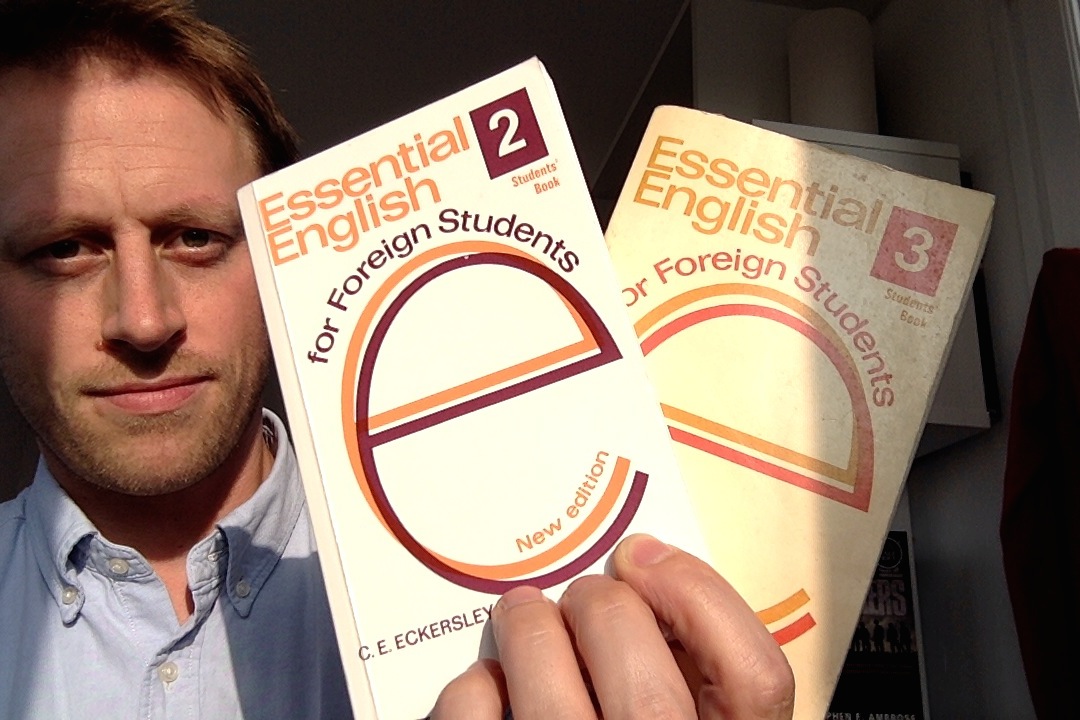
– The interesting course-book (Essential English for Foreign Students by C. E. Eckersley) which Corneliu used in his English lessons
– The myth of ‘the English gentleman’
– Depictions of Englishness in films
– Stereotypes of Romania
– Romania & Bulgaria’s entry into the EU and the media panic related to migrant workers
– Vampires, Dracula and Romania

Please leave your comments in response to this episode! We want to read your thoughts here. Thank you!
Essential English for Foreign Students by C. E. ECKERSLEY

210. A Cup of Tea with Noman Hosni

Conversation & language feedback with comedian Noman Hosni. Right-click here to download.

Small Donate ButtonHi everyone. Just before starting this episode, I would like to say a very special thank you to all of the people who have entered my competition, which is entitled “Your English Podcast”. I have received about 80 recordings in total, and very soon you’ll be able to listen to them all and then vote for your favourites. So, hold on because the special competition podcasts are coming soon. But now, let’s get started with this episode, which is number 210. Let’s go!

Hello, and welcome to LEP. How are you? I hope you’re well. Hello to all my long-term listeners, or LEPPERS as you are affectionately known. “Why is he calling them LEPPERS?” That’s “Luke’s English Podcasters” or “Luke’s English Podcast People”, or LEPPERS, if you were wondering. If you are new to this podcast, then welcome! This is a podcast specifically designed for learners of English. My name is Luke. It’s my podcast. That’s why it’s called Luke’s English Podcast. I am an English teacher & a comedian from London and with this podcast I aim to help you improve your English while also entertaining you and hopefully making you laugh a little bit in the process. I have loads of listeners from all around the world – so welcome to the community of Luke’s English Podcast people, or LEPPERS – welcome to the LEPPER community, welcome to the club! I sincerely hope you enjoy the podcast and that it helps you get a grip on your English by practising some proper authentic listening! Don’t forget to visit teacherluke.co.uk where you can get lots more information including how to download the podcast, how to find the archive of over 200 previous episodes, how to subscribe to the podcast on iTunes and how to find transcripts and notes for episodes of this magical, wonderful, fantastic, exceptional, modest, and unashamedly self-promoting FREE podcast!

Today’s Guest is Noman Hosni
Sometimes I have guests on the show, and we just have a free-flowing conversation in English for your enjoyment & listening practice. Today my guest is a very funny friend of mine called Noman Hosni. Let me tell you a little bit about him. Noman was born in France but he has a multinational background. His father is from Tunisia, his mum is from Iraq, he spent much of his childhood growing up in Switzerland and these days he is spending more and more time in London where he works as a professional stand-up comedian – a lot of my guests are comedians as you may have noticed – and Noman regularly entertains audiences in French in Paris and now in English in the UK too. I think he’s a very funny guy indeed, he always entertains me when I see him performing on stage and I’m very happy to have him on the podcast in this episode. The plan is just to have a bit of a chat with Noman Hosni, but also to find out about his background, his learning English experiences and some of the funny misunderstandings he’s had when trying to speak to people in English.

Noman’s English
Now, before we go any further. Let’s talk for a moment about English. Noman is a similar case to Yacine from episode 182, if you remember him. I’ve invited Noman on the podcast in this episode even though, admittedly, his English is not ‘perfect’ because I’m just impressed by him as a learner of English and I generally just enjoy his company. I think that’s enough as a justification. I don’t really need to justify having particular guests on the show do I? No I don’t, but nevertheless here are a few things that occur to me when I think about Noman and his approach to learning English, and these are a few things that you can consider while listening to this episode:
– Noman knows that he has to learn English by actively using it to achieve something. He does this by not only performing stand-up in English but also by going out of his way to have conversations in English, even if he gets into some slightly embarrassing situations and misunderstandings sometimes – you’ll have to listen to the rest of this podcast to find out more about that. So, the point is, he doesn’t mind making a fool of himself sometimes, because he realises that the reward is a more rapid improvement in his English. He’s prepared to go out of his comfort zone in order to develop his English skills.
– He is really serious about learning English, but he approaches it with a sense of play – I mean, he’s aware of the value of just playing around in English. Sometimes just fooling around and having fun in English is a great way to break down your lack of confidence. The point is – there’s nothing to be afraid of because we’re just having fun. That’s a good attitude that you can adopt when practising your speaking I think. It allows you to open up, improvise and enjoy expressing yourself with the language.
– He’s serious about learning English, but he doesn’t take himself too seriously, and I think that really helps with his confidence.
– I think he’s really funny (although that is subjective, but I’m not alone in finding him funny – he’s a pro) even if his English is not 100% perfect. So, what that means to me is that, he’s already achieving a lot in English and he doesn’t let his mistakes hold him back. His English may not be perfect, but he is communicating successfully.

Now, I’m not saying that you shouldn’t try to avoid making errors. Of course, you’ve got to try to iron out your mistakes to improve, and yes, Noman makes a few language errors in our conversation, as you might notice. That’s certainly not a crime or anything, and it’s all part of the learning process but I am going to correct his mistakes at the end of this podcast so that you can all learn from any errors he makes. I asked him if he minded that, and he said it was fine and that he thought it would be funny actually. Okay, so let’s embarrass Noman by correcting all his errors! No, he really doesn’t mind actually. So, if you do notice errors in Noman’s speech, don’t worry because you will hear error correction and language feedback after our conversation. Do keep listening all the way until the end because the language feedback will be really useful to listen to. You can learn from Noman’s errors. I’ll try to make sure the podcast doesn’t go on for too long so I’ll keep the language analysis brief yet insightful. So, hold tight, enjoy the interview, and stick around for the error correction, and Noman, if you’re listening – do pay attention at the end, you might learn to avoid a few common errors! And next time, you can help me with my French or even my Arabic pronunciation. OK? Alright, it’s a deal, and I’m assuming that you’ve said yes to that deal by the way. What I’m saying is, Noman, you owe me a French lesson, whether you like it or not.

So, enjoy the episode everyone – the interview, and then the language feedback afterwards. Cheers!

Noman Hosni Online
Click here for Noman’s website: http://www.noman.ch
Click here for Noman’s Instagram where he posts videos every day: http://instagram.com/nomanhosni
Click here for more of Noman’s content on Vine: https://vine.co/u/1053524188788891648

Error Correction & Language Feedback
With Noman’s permission, here are some language errors that he made in the interview, with corrections. Listen to the podcast to hear my more detailed corrections.

By the way, this might seem like a lot of errors, but if you compare it to the number of good things & correct things he said, it’s not much at all. Also, I know that many of these are just ‘slips’ rather than proper errors. I mean, Noman will kick himself when he hears some of this because he knows what’s right and wrong, but in the heat of the moment errors will just slip out. Anyway, let’s start.

1. I can smell the saliva of a lot of people. “Saliva” – sa-lee-va /sæli:væ/.
It should be sa-lai-va – /səlaɪvə/

2. What I said before is on the record. “record” – ree-cord – /ˈri:kɔ:d/.
It should be “on the re-cord” – /ˈrekɔ:d/.
/ˈrikɔ:d/ – that’s the verb. “I’m going to record another podcast”

3. He say… and I say…
He said… and I said…

4. From downstairs it don’t look so high. I see the balcony so high.
From downstairs it didn’t look so high. I saw (that) the balcony was really high.

5. You’re not in the good podcast right now.
You’re not listening to the right podcast right now. (Of course I disagree – you’re always listening to the right podcast, when you’re listening to Luke’s English Podcast)

6. “If you broke your leg, just stay down”
If you break your leg, just stay down.

7. It went good.
It went well. Although this is fine in American English (so is it wrong or right? – good question for a DEBATE)

8. One of my first gig.
One of my first gigs.

9. I was trying to put a lot of energy to remove my french accent.
I was trying to put a lot of energy into removing my french accent. To put a lot of energy into doing something.

10. I do a lot of mistakes.
I make a lot of mistakes. (That’s an ironic mistake to make)

11. I write everything and I’ve learn it to make sure there are no mistakes in my English.
I wrote everything (down) and I learned it to make sure (that) there were no mistakes in my English – That’s if he was talking about one instance in the past.

12. Don’t tell to the crowd that I’m French.
Don’t tell the crowd that I’m French.

13. He said me that, and I said, “I fail”.
He told me that and I said, “I failed”.

14. I was not raised by an English person who got an accent.
I was not raised by an English person who had an accent. “Have got” is the same as “have” but we don’t use it in the past. In the past, forget about ‘got’ for possession.

15. Some term are confusing.
Some terms are confusing.

16. There’s some term that doesn’t exist in the dictionary.
There are some terms that don’t exist in the dictionary.

17. You have to masterise all the tools.
You have to master all the tools.

18. It’s the first time I went in London to do a gig in English.
It was the first time I’d been to London to do a gig in English. (Providing background context for an event in the past – the event is the taxi conversation, the context is the line about his first time in London)

19. He seems to be not very agree with me.
He didn’t seem to agree with me. (Remember not to use ‘be’ with ‘agree’)

21. When I realise, I don’t want to correct him.
When I realised, I didn’t want to correct him. (Repeat it for muscle memory)

22. She thought I’m British. I don’t want to embarrass her.
She thought I was British. I didn’t want to embarrass her.

23. We are in Paris actually but maybe you’ll listen to this in 2 years and maybe we will not.
We’re in Paris at the moment (or currently) but maybe you’ll listen to this in 2 years and then maybe we won’t be.

24. Two years ago I can’t imagine that I have this conversation with you.
Two years ago I couldn’t have imagined that I would be having this conversation with you now.

25. I keep talking about another subject. (past)
I kept talking about another subject.
I kept changing the subject.

26. English crowd are more easy to laugh.
English audiences laugh more easily.
It’s easier to make English audiences laugh.

27. I’m agree, I’m impressed.
I agree.

28. Every time someone kill people…
Every time someone kills people…

29. I put energy on it.
I put energy into it.

30. When I speak to English person.
When I speak to English people.

31. I’m keeping push it on my accent.
I’m putting pressure on my accent.
I keep pushing my accent.

32. It was in purpose.
It was on purpose.

33. One of the only things I could remember was the warm.
One of the only things I could remember was the heat.

202. British Comedy: Monty Python & The Holy Grail

[The Constitutional Peasants Scene] Here’s another episode about Monty Python’s Flying Circus, and in this one we’re going to be covering some very interesting topics, such as medieval history, old myths legends & folklore, the British monarchy, marxism and radical politics. In terms of language we’re going to look at some old fashioned formal poetic language, some political vocabulary and also some intonation and sentence stress, and we’ll be doing all of that while understanding and hopefully enjoying a funny scene from a classic British comedy film. So, you really are getting everything in this episode (well, maybe not everything but you know what I mean). A lot of this is transcribed at teacherluke.co.uk. If you find this episode on the website you’ll also see a video, a script for that video and more information. So let’s get started. Right-click here to download this episode.

Small Donate Button
Last time I did an episode about Monty Python we had a look at a sketch from the TV show. There are many more sketches which I hope to come back to in the future, but in this episode I’m going to focus on a scene from their first feature film, which is called “Monty Python & The Holy Grail”.

As a reminder: Do consider purchasing MP DVDs, CDs, audio & video downloads and even tickets to see live a live broadcast of their stage show. Details here: http://www.montypythonlive.com

Please remember – this is not a blog post, but an audio podcast episode. To get the full explanations and detail of this episode, you should listen to the whole podcast episode!

Monty Python & The Holy Grail
When was it made, who directed it, and all that stuff?
In 1975. It was written by all the Monty Python team but was directed by Terry Gilliam and Terry Jones. The two Terries were quite controlling & ambitious and decided they wanted to be in charge of the film, and in fact, during the production I think they agreed that the film could be directed by anyone called ‘Terry’, as an effort to keep control of the film.

What’s it about?
It’s about King Arthur’s search for the Holy Grail. It’s set in the 10th century – the middle ages, or ‘dark ages’, a time of mystery and legend! King Arthur is a legendary King of Britain. The legend of Arthur dates back to the 5th & 6th centuries and the story of Arthur has been told many times since. Historians disagree about whether Arthur really existed or not. In the stories, Arthur is said to be the magical leader who defended Britain against real and supernatural enemies. He carried a magical sword called Excalibur, which was given to him by a mysterious spirit known as The Lady of the Lake. The Lady of the Lake is an important figure in the Arthurian legend – she’s a kind of magical woman who got her powers from the wizard Merlin. She’s a bit like Galadriel in the Lord of the Rings stories. In Arthur’s story, This lady emerges from a lake, holding Excalibur and then presents it to Arthur, and in so doing chooses him as the rightful leader of the Britons. It’s hardly a democratic way to choose the executive commander of Britain, but that’s how things were done back in the 5th century!

The Grail in this story is another aspect of Arthurian legend. Apparently, this grail once carried the blood of Jesus, and was sent by Joseph to Britain where it would be protected. Perhaps this is true, perhaps this is just a myth, but the grail is still a potent symbol in British folklore, either as a connection to Jesus, or as a magical cup which can give magical powers to whoever drinks from it (it’s the same cup in the Indiana Jones movie “Indiana Jones and The Last Crusade”)

What happens in the film?
Arthur is sent on a mission by God to find the Holy Grail.
He travels around Britain, visiting castles and collecting a group of knights to help him on his quest.
It’s just an excuse to visit lots of old castles and film a bunch of medieval themed sketches.
Most of it was filmed in Scotland, and the scenery is absolutely beautiful.
It was filmed on a budget of just $400,000, which is tiny in comparison to today’s standards. The Hangover 3, for example, had a budget of $103 million!
The film was financed partly by rock stars Pink Floyd, Led Zeppelin and Elton John.
It’s now considered one of the funniest British comedy films of all time, and in 2005 it was used by Eric Idle as the basis for the Monty Python musical “Spamalot” which you can see in theatres in London and around the world.
There are a few classic sketches in the film, and I’d like to play one of them for you.

“Constitutional Peasants” – King Arthur Has an Argument with Some Left-Wing Peasants
Arthur is travelling the land, trying to recruit knights to join him on his quest. He visits lots of castles. In this scene, he is approaching a castle, and meets some peasants working on the land. The peasants appear to just be collecting mud & filth from the floor in a field. They’re disgusting & dirty, and yet surprisingly articulate in the language of politics (which is part of the joke). King Arthur decides to ask them for information about the owner of the castle. The peasants don’t give him any useful information. Instead he gets into an argument with one of the peasants about the constitution, monarchy, democratic government and the oppression of the masses in an absolute monarchy.

Constitutional Peasants – Video (you’ll find a script below)

What’s So Funny About This?
One of the funny things about this scene is the anachronism (I mean, the fact that different time periods are mixed up). The king is from the medieval period, but the peasants are basically modern working class people. So it mixes up people from different time periods. The scene also mixes two different speech registers and two different political ideologies as the characters represent different political systems, and we see them argue. It’s unexpected because peasants in the middle ages were unaware of Marxist ideology, and certainly wouldn’t have been intelligent or educated enough to criticise the system in such an articulate way. Arthur speaks in a poetic & medieval way, and represents the system of absolute monarchy which was in place at the time. The peasant speaks like a modern left-wing radical using ideas founded by Karl Marx in the 19th century.

It’s also a joke about conventions of movies or stories set in medieval times in which peasants are always presented as old, dirty and inarticulate servants of the king. When these peasants speak like Marxists from the modern era, it’s quite a surprising & amusing shock.

I realise that now I’ve explained this scene, you probably won’t find it that funny, because explaining humour takes all the immediate fun out of it, but so be it. If you get the humour, good for you! The main thing is: We’re learning English aren’t we, so let’s focus on understanding the scene before trying to see the funny side. This scene is very rich in vocabulary, in either a poetic medieval register, or the language of left-wing politics. Listen to it once to see if you understand it all, and then I’ll explain it all to you afterwards. If you find any of it funny, then that’s a bonus as far as I’m concerned. :)

Vocabulary & Explanations
So, in a nutshell, King Arthur wants to know who lives in the castle, and he asks a couple of peasants, but they don’t help him. Instead he gets involved in an irritating argument about the exploitation of the working classes in this medieval monarchy.

Concepts
There are a few concepts which we need to study in order to fully appreciate this scene. Let’s look at some of those concepts before listening to the scene again. These concepts relate to different constitutional frameworks – I mean, different ways in which a country can be run. We’re talking about political systems like ‘absolute monarchy’, ‘democracy’, ‘Marxism’ and ‘anarchism’.

Absolute Monarchy – in this case a king (monarch) is not elected, but gets their supreme power by divine provenance. This means that the monarch has a special agreement with god. God has chosen the monarch to be the leader of these people. Usually, this is tied to old mythical stories which involve some supernatural intervention in which the king is chosen by god. In the case of King Arthur this was when he was given a holy sword (Excalibur) by a magical & mythical woman called The Lady of the Lake. The story goes that this lady is a kind of supernatural & mythical spirit who holds magical and religious authority. In the story she walks out of a lake and presents Arthur with his magical sword, which signifies that he is the divine ruler of Britain. Most monarchies justify their existence by suggesting they have some kind of special connection to god. In this sketch, Arthur believes he is the rightful ruler of the Britons because of his divine right given by god.

Democracy – in this case, the people give executive power (decision making power) to a representative by voting for him/her. The people give this leader a ‘mandate’ – which means a responsibility to run the country. It’s the government by the people, of the people and for the people. Churchill said that democracy is not perfect, but it’s better than the alternatives. In the UK today we have a democratic monarchy, which is basically a democracy (we vote for MPs in elections) but with a monarch as head of state with almost no executive power. The Queen has very minor powers, and she doesn’t exercise them. It’s like there is an understanding between parliament and the monarchy that the monarch just lets parliament run the country. The monarch doesn’t interfere. That’s the way our country works. Some people are concerned that Prince Charles might decide to exercise his power if/when he becomes king, which could cause a constitutional crisis, but that’s another story for another time.

Marxism – this isn’t really a constitutional system, but an political ideology, or a way of understanding the way in which most industrial/post-industrial capitalist systems work. Karl Marx was a German born philosopher, economist, sociologist and historian who basically stated that the ruling classes manage to maintain control of the system by owning the means of production, and that the working classes are therefore dominated and repressed. The only way in which true equality can exist is if the people own their own land, their own factories and the means of producing goods. His ideas formed the basis of many left-wing political models including communism, and also form the basis of many criticisms of the capitalist system in general. In the UK, we sometimes associate Marxist ideologies with certain types of people. Although their views may be valid, I think most ordinary people find Marxists to be a bit extreme and even boring – banging on about politics and the class system all the time, while not necessarily doing anything about it.

Anarchism – this is the idea that there should be no leaders at all, and in fact no formalised system of government or state at all. Instead, local communities should be run by free and open groups with no leader. The idea is, that formalised governments, or power structures are essentially corrupting – that when power is given to one or several representatives, elected or not, that this ultimately will corrupt them and that this leads to inequality. So, anarchists argue that there should be no system at all, and that people should be free to govern themselves in a completely open way – without adopting any kind of political ideology or dogma. For me, in principle this sounds great, but on a practical level it sounds chaotic, confusing and impractical. Ultimately, it would be great to remove the corrupting power of government, but are we ready for it? We’d need an intelligent and activated population. Education is key. The problem, to an extent, is that many people don’t really care about these issues and instead just find political discussion boring, therefore making it very hard for true anarchy to take effect. A bit like Marxism, many people find anarchists to be either boring, confusing or somehow threatening to normal life.

Vocabulary
OK, so we’ve looked at some ideological concepts at the heart of this sketch, but we’re not finished because there’s plenty of language to deal with too. It’s complex isn’t it!? You see – British comedy is intelligent and deep, particularly Monty Python. It’s not just weird.

Here’s some vocabulary that you should know in order to understand this sketch further. Remember that Arthur speaks in old fashioned language, and Dennis the peasant speaks like a modern man with radical political opinions. Listen to the episode to hear all the bold words defined.

What knight lives in that castle over there?
– a knight is (in the Middle Ages) a man who served his sovereign or lord as a mounted soldier in armour. In this context it means a leader.
you automatically treat me like an inferior

exploiting the workers!
– exploiting means to benefit unfairly from the work of (someone), typically by overworking or underpaying them: “women are exploited in the workplace”.

hanging on to outdated imperialist dogma which perpetuates the economic and social differences in our society
-dogma = a principle or set of principles laid down by an authority as incontrovertibly true: the dogmas of faith | [ mass noun ] : “the rejection of political dogma”.

Dennis, there’s some lovely filth down here.

I didn’t know we had a king. I thought we were an autonomous collective.
– autonomous = • having the freedom to act independently: “school governors are legally autonomous”.

You’re fooling yourself. We’re living in a dictatorship: a self-perpetuating autocracy in which the working classes–
– an autocracy = a system of government by one person with absolute power.

Oh, there you go bringing class into it again.

Please! Please, good people. I am in haste. Who lives in that castle?

Dennis: I told you. We’re an anarcho-syndicalist commune. We take it in turns to act as a sort of executive officer for the week,…
Arthur: Yes.
Dennis: …but all the decisions of that officer have to be ratified at a special bi-weekly meeting…
Arthur: Yes, I see.
Dennis: …by a simple majority in the case of purely internal affairs,…
Arthur: Be quiet!
Dennis: …but by a two-thirds majority in the case of more major–
– ratify = sign or give formal consent to (a treaty, contract, or agreement), making it officially valid. “both countries were due to ratify the treaty by the end of the year”.
– a simple majority = this candidate receives more votes than anyone else (but it doesn’t have to be more than 50% of all votes cast) e.g. if Obama, Bush & Clinton are in an election and Clinton gets 40% and Obama & Bush get 30% each, Clinton gets a simple majority. She just gets more votes than the others.
– a two-thirds majority = at least 66% of all the votes
– an absolute majority = at least 51% of all votes

Woman: Well, how did you become King, then?
Arthur: The Lady of the Lake,… [angels sing] …her arm clad in the purest shimmering samite, held aloft Excalibur from the bosom of the water signifying by Divine Providence that I, Arthur, was to carry Excalibur. [singing stops] That is why I am your king!
– samite = a rich silk fabric interwoven with gold and silver threads, used for dressmaking and decoration in the Middle Ages.

Dennis: Listen. Strange women lying in ponds distributing swords is no basis for a system of government. Supreme executive power derives from a mandate from the masses, not from some farcical aquatic ceremony.

I mean, if I went round saying I was an emperor just because some moistened bint had lobbed a scimitar at me, they’d put me away!

Dennis: Oh! Come and see the violence inherent in the system! Help! Help! I’m being repressed!
Arthur: Bloody peasant!
Dennis: Oh, what a give-away. Did you hear that? Did you hear that, eh? That’s what I’m on about. Did you see him repressing me? You saw it, didn’t you?

What I love about this is that it’s a well written script, with different types of English and it manages to mock both the idea of a medieval monarchy, and also the irritating verbosity of political radicals. Monty Python are making fun of history & taking the piss out of everyone, while at the same time celebrating the language. Complex language, delivered at speed by colourful characters is at the heart of the humour in this sketch.

Intonation & Sentence Stress
I really enjoy the performances in this scene – particularly Michael Palin who plays Dennis the peasant. The lines are delivered with quite exaggerated and characterful intonation and sentence stress. To highlight this, I’m going to read the script of this scene, just to make it a bit clearer. You could listen to the original version again in order to, hopefully, appreciate it a bit more.

Constitutional Peasants – Script
Arthur: Old woman!
Dennis: Man!
Arthur: Man. Sorry. What knight lives in that castle over there?
Dennis: I’m thirty-seven.
Arthur: I– what?
Dennis: I’m thirty-seven. I’m not old.
Arthur: Well, I can’t just call you ‘Man’.
Dennis: Well, you could say ‘Dennis’.
Arthur: Well, I didn’t know you were called ‘Dennis’.
Dennis: Well, you didn’t bother to find out, did you?
Arthur: I did say ‘sorry’ about the ‘old woman’, but from the behind you looked–
Dennis: What I object to is that you automatically treat me like an inferior!
Arthur: Well, I am King!
Dennis: Oh, King, eh, very nice. And how do you get that, eh? By exploiting the workers! By hanging on to outdated imperialist dogma which perpetuates the economic and social differences in our society. If there’s ever going to be any progress with the–
Woman: Dennis, there’s some lovely filth down here. Oh! How d’you do?
Arthur: How do you do, good lady? I am Arthur, King of the Britons. Whose castle is that?
Woman: King of the who?
Arthur: The Britons.
Woman: Who are the Britons?
Arthur: Well, we all are. We are all Britons, and I am your king.
Woman: I didn’t know we had a king. I thought we were an autonomous collective.
Dennis: You’re fooling yourself. We’re living in a dictatorship: a self-perpetuating autocracy in which the working classes–
Woman: Oh, there you go bringing class into it again.
Dennis: That’s what it’s all about. If only people were aware of–
Arthur: Please! Please, good people. I am in haste. Who lives in that castle?
Woman: No one lives there.
Arthur: Then who is your lord?
Woman: We don’t have a lord.
Arthur: What?
Dennis: I told you. We’re an anarcho-syndicalist commune. We take it in turns to act as a sort of executive officer for the week,…
Arthur: Yes.
Dennis: …but all the decisions of that officer have to be ratified at a special bi-weekly meeting…
Arthur: Yes, I see.
Dennis: …by a simple majority in the case of purely internal affairs,…
Arthur: Be quiet!
Dennis: …but by a two-thirds majority in the case of more major–
Arthur: Be quiet! I order you to be quiet!
Woman: Order, eh? Who does he think he is? Heh.
Arthur: I am your king!
Woman: Well, I didn’t vote for you.
Arthur: You don’t vote for kings.
Woman: Well, how did you become King, then?
Arthur: The Lady of the Lake,… [angels sing] …her arm clad in the purest shimmering samite, held aloft Excalibur from the bosom of the water signifying by Divine Providence that I, Arthur, was to carry Excalibur. [singing stops] That is why I am your king!
Dennis: Listen. Strange women lying in ponds distributing swords is no basis for a system of government. Supreme executive power derives from a mandate from the masses, not from some farcical aquatic ceremony.
Arthur: Be quiet!
Dennis: Well, but you can’t expect to wield supreme executive power just ’cause some watery tart threw a sword at you!
Arthur: Shut up!
Dennis: I mean, if I went round saying I was an emperor just because some moistened bint had lobbed a scimitar at me, they’d put me away!
Arthur: Shut up, will you? Shut up!
Dennis: Ah, now we see the violence inherent in the system.
Arthur: Shut up!
Dennis: Oh! Come and see the violence inherent in the system! Help! Help! I’m being repressed!
Arthur: Bloody peasant!
Dennis: Oh, what a give-away. Did you hear that? Did you hear that, eh? That’s what I’m on about. Did you see him repressing me? You saw it, didn’t you?