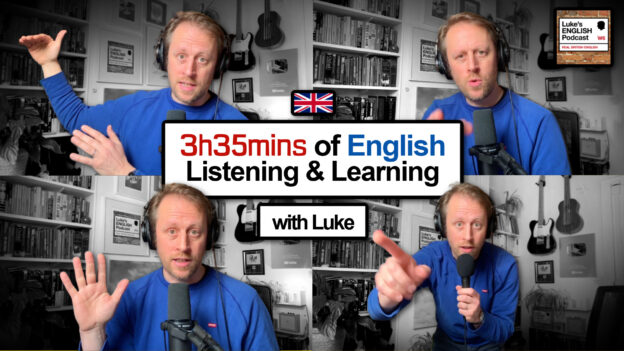
[976] Here’s an epic rambling episode in which I talk about learning English with BBC Radio and TV 📻 expressions with the word ‘thumb’ 👍 the story of how I became a taxi driver on the streets of Paris 🚖 the grammar of Yoda 🐸 fantastic haikus written by my listeners ✍️ and getting pecked in the face by a swan 🦢. 3h30min+ of English from me to you.
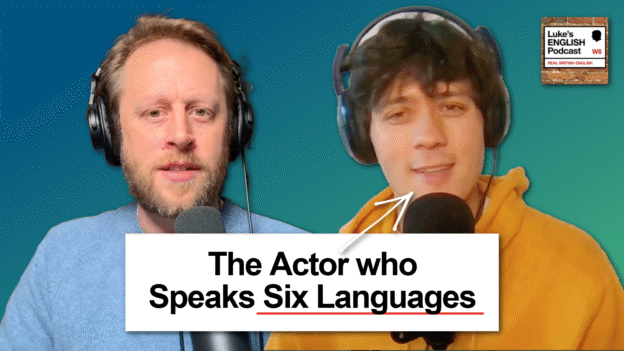
[972] I talk with multilingual actor Ivan Doan about his multicultural background, his learning of languages and his work as an actor. Ivan shares his insights and experiences of learning English, dealing with different accents in film & TV roles, and the importance of mindset and discipline in his life. There are plenty of language learning insights in this episode, which I summarise at the end. Full transcript available.
An 11-point list of practical advice for learning English inspired by this conversation.
1. Learning through doing, not just studying
Use English for real things. Ivan’s English really improved when he started making projects in English (web series, acting work, talking to people), not just studying grammar.
Make English the tool, not the subject. Start a small project: a vlog, a diary, an Instagram account, a DnD group, movie scene re-enactments – anything that requires English.
Theory helps, but it’s not the engine. Grammar explanations are useful, but they’re not what makes you fluent. Real communication is.
2. Multimodal learning: use your whole body & brain
Don’t reduce English to rules + word lists. When Ivan was with the Mormons or on set, he learned from body language, tone of voice, facial expressions, rhythm, context, not just words.
Watch people, not just subtitles. When you watch something in English, pay attention to:
how people look at each other
when they pause
what their hands/face are doing when they say something important
Combine skills. Listen + read + speak + move. For example, repeat a line while copying the actor’s body language and facial expression.
3. Listening & repetition are superpowers
Re-listen on purpose. Take a podcast episode or YouTube clip and:
Listen once for general meaning.
Listen again and note unknown words/phrases.
Look them up.
Listen a third time and catch those items in context.
Notice “repeat offenders”. If a word or chunk keeps appearing, it’s a sign: you probably need it. Put it on a list.
Make targeted vocab lists. Like Ivan did for filmmaking, you can make lists for your world: tech, business, medicine, design, gaming, etc.
4. Discipline beats talent
You don’t need to be “gifted at languages”. Ivan’s message is clear: people think he’s “special”, but in reality, discipline and repetition are doing most of the work.
Be stubborn. Let it bother you (in a good way) that you don’t understand a phrase yet. Go back to it. Again. And again.
Small, realistic goals. For example:
“I want to be able to have a 10-minute small-talk conversation without switching to my language.”
“I want to understand one specific podcast episode without subtitles.”
“I want to tell one story about my life in English clearly.”
Basic conversation – you can talk about everyday things.
More advanced conversation – opinions, stories, feelings, more nuance.
Improvisation – you can react in real time with no preparation.
6. Accents, rhythm & sounding natural
First: learn to hear the accent. You can’t produce what you can’t hear. Choose one accent (e.g. London, General American) and really listen to it.
Find your “accent twin”. Pick a native speaker:
similar age
same gender
whose voice feels close to your natural voice Use them as your model.
Create an “accent map”. Notice:
Which vowels are different from yours?
How do they stress words?
What is the rhythm (fast/slow, chunky/smooth)?
Rhythm & word stress are often more important than perfect vowels. BAna-na vs baNAna can be the difference between confusion and clarity.
Shadowing works. Play 1–2 sentences, then:
say them with the speaker,
match their timing, stress, and melody,
repeat several times until it feels comfortable.
7. It’s okay to exaggerate (caricature as a training tool)
Overdo it first, then calm it down. Like an actor, you can:
exaggerate the British or American intonation
really push the stress and melody Then slowly bring it back to something natural.
This is not “fake”; it’s training. As with acting, you push beyond your comfort zone, then refine.
8. Identity, culture & letting yourself change
To speak like an English speaker, you must allow yourself to “borrow” a new identity. That might feel weird: “This isn’t me.” But that flexibility is part of real fluency.
Different cultures, different communication rules. British politeness isn’t necessarily “fake”; Russian directness isn’t necessarily “rude”. They’re different systems.
Adapting ≠ betraying your culture. You can still be 100% you and also learn to play by local rules when you’re speaking English.
9. Talk to yourself – a lot
Self-talk is powerful, not crazy. Walk around your flat narrating what you’re doing in English, or:
rehearse future conversations,
re-tell a story you heard,
argue with yourself about something.
The goal is to stop translating. Like Ivan said, it’s like changing gears in a car: once you’re “in English gear”, you just drive.
10. Treat English like a role you inhabit
Think like an actor. When you speak English:
step into the “role” of an English-speaking version of you,
use your voice, but with English rhythm and intonation,
add the body language and facial expressions that match.
Use emotion. Don’t just say the words; feel them. This makes you remember the language and sound more authentic.
11. Inspiration: you can do this
Messages implied by Ivan’s story:
You can start with school English that isn’t great and end up working in English internationally.
You don’t need a perfect method; you need consistent action, curiosity, and the courage to interact.
Being “from somewhere else” is not a weakness; it’s often your superpower – a different perspective, more empathy, and a richer identity.
[971] Part 2 of 2. Here is the continuation of last week’s episode about changes you can make to your lifestyle, mindset and habits in order to become a better learner of English in 2026. Each of these tips is backed up by scientific research from the fields of psychology and psycholinguistics, with insights into human behaviour and thinking processes that result in better learning. Full PDF available.
[970] Part 1 of 2. This episode deals with some simple habits you can introduce in your life, to make sure you are in top condition for learning English all year long. It is all backed up by scientific research into how our brains work, and how little changes in our behaviour can help us perform better and achieve more in the time we are given. Includes top advice for preparing yourself to be a great learner of English in 2026. Part 2 will be available next week.
How many words are there in English? How many do you really need to know? And how many words have I spoken on this podcast? 🧐 Also, what is shadowing, and how should you do it? Can you do episodes about different English accents? What are your top 10 countries for this podcast? In this episode of Luke’s English Podcast, I answer listener questions about vocabulary size, English accents, the shadowing technique and more bits & bobs. PDF available with transcript and vocabulary list.
In this episode I take you on a big rambling journey through all sorts of English-learning goodness (and nonsense). We start by pondering what makes a good podcast title 👀 is it clever, clickbait, or just clear? I reveal a monumental tectonic shift in the way I am titling my episodes. Then it’s into the Grammar Zone 📘 with an in-depth look at English narrative tenses. Then I reveal LukeGlish.com 📺 a custom search tool that lets you explore my entire podcast content by words and phrases. And, there’s the Comedy Corner 😂 where I break down some English jokes and wordplay, dissecting the frog.
It’s my birthday 🥳 so join me for a relaxed and light-hearted ramble, first with some comments about recent episodes and other podcast housekeeping, and then a series of talking points with the Spinning Wheel of Random Questions ☸️ including bits about how being an English teacher affects my social interactions 💬, the infamous ice-cream wars of Ice-Cream Island 🏝️, leading an army of English learners into battle on the back of an Elephant 🐘, the title of my (hypothetical) autobiography 📖, and my age revealed at the end of the episode. Full transcript available 📄.
This episode features a conversation with Zdenek about fears and anxieties experienced in everyday life. We explore common fears such as driving, flying, culture shock, language learning and public speaking. Listen for stories of Luke’s fear of Paris cafes ☕️, airport anxiety ✈️, Luke’s dramatic scooter ride in Nha Trang 🛵, Zdenek’s fears of Vietnamese roads and driving 🛣️, Luke’s recent cycling accident in Paris 💥, Zdenek’s encounter with a London police officer 👮♂️, nerves about teaching 😳, and more.
The PDF worksheet offers a vocabulary list from the conversation, with definitions, examples, and quizzes and a full transcript to help you boost your English with the episode.
A rambling episode full of spontaneous speaking. Topics include an exercise for spoken fluency 🗣️, the benefits of listening to spontaneous speech 🎧, overcoming mental blocks 🌳, raising our kids to be bilingual 👨👩👧👦, reactions to recent episodes 🙉, thoughts about upcoming content 🔮, bird-related idioms 🐦, the phrasal verb “to follow through” including its rude meaning 💩 …and more! PDF transcript available.
This is a listener-generated episode, meaning that the content is mostly written by listeners of this podcast. In this one I read out various comments and messages from listeners who have improved their English with the podcast. They describe the progress they’ve made and how they did it. Expect lots of success stories and plenty of advice for improving your English in 2025.
This website uses cookies to improve your experience while you navigate through the website. Out of these, the cookies that are categorized as necessary are stored on your browser as they are essential for the working of basic functionalities of the website. We also use third-party cookies that help us analyze and understand how you use this website. These cookies will be stored in your browser only with your consent. You also have the option to opt-out of these cookies. But opting out of some of these cookies may affect your browsing experience.
Necessary cookies are absolutely essential for the website to function properly. These cookies ensure basic functionalities and security features of the website, anonymously.
Cookie
Duration
Description
cookielawinfo-checkbox-analytics
11 months
This cookie is set by GDPR Cookie Consent plugin. The cookie is used to store the user consent for the cookies in the category "Analytics".
cookielawinfo-checkbox-functional
11 months
The cookie is set by GDPR cookie consent to record the user consent for the cookies in the category "Functional".
cookielawinfo-checkbox-necessary
11 months
This cookie is set by GDPR Cookie Consent plugin. The cookies is used to store the user consent for the cookies in the category "Necessary".
cookielawinfo-checkbox-others
11 months
This cookie is set by GDPR Cookie Consent plugin. The cookie is used to store the user consent for the cookies in the category "Other.
cookielawinfo-checkbox-performance
11 months
This cookie is set by GDPR Cookie Consent plugin. The cookie is used to store the user consent for the cookies in the category "Performance".
viewed_cookie_policy
11 months
The cookie is set by the GDPR Cookie Consent plugin and is used to store whether or not user has consented to the use of cookies. It does not store any personal data.
Functional cookies help to perform certain functionalities like sharing the content of the website on social media platforms, collect feedbacks, and other third-party features.
Performance cookies are used to understand and analyze the key performance indexes of the website which helps in delivering a better user experience for the visitors.
Analytical cookies are used to understand how visitors interact with the website. These cookies help provide information on metrics the number of visitors, bounce rate, traffic source, etc.
Advertisement cookies are used to provide visitors with relevant ads and marketing campaigns. These cookies track visitors across websites and collect information to provide customized ads.