Join us on a trip to a virtual pub for a couple of pints, a packet of crisps and some advice about how to go to the pub in English, with plenty of funny tangents, with Charlie Baxter. Video version available.

[DOWNLOAD]

Join us on a trip to a virtual pub for a couple of pints, a packet of crisps and some advice about how to go to the pub in English, with plenty of funny tangents, with Charlie Baxter. Video version available.
[DOWNLOAD]

Comparing British and American English vocabulary with a fun online quiz. My guest today is American comedian Sarah Donnelly. Video version (of the conversation) available.
[DOWNLOAD]
Hello dear listeners,
Hello to all LEPsters in LEPland,
How’s your summer going? OK? I’m on holiday at the moment, but I recorded this earlier and I’ve managed to publish it now. That’s clever, isn’t it? Anyway, I hope your summer is going well and if it’s not summer where you are, I hope that your not-summer is also going well.
Welcome back to LEP.
In this episode, Sarah Donnelly is back on the podcast again.
You might remember Sarah from the other times she’s been on the show, if you are a long-term listener.
Sarah Donnelly is from the circle of friends I have here in Paris who all met each other doing stand up comedy, and that includes Amber and Paul, Sebastian Marx, Fred Eyangoh, Molly Martinez, Sarah Toporoff the Paris Quiz Mistress and plenty of others, many of whom have made appearances on this podcast over the years.
Sarah is originally from North Carolina in the USA. She’s been living in Paris exactly the same length of time as me. We both moved here in September 2012 – by coincidence I mean – we didn’t move here together. But when we did meet, we realised we had both moved here at exactly the same time, which is something we have in common.
The return of Sarah on this podcast is long overdue. As a theme for this episode I thought we could explore the topic of American and British English and so you’ll hear us discussing some of the vocabulary differences while doing a fun online quiz.
We start our conversation by referring to the fact that in my podcastle (the building here where I have my pod-room) there are lots of stairs, because I am on the top floor and also there is a shared toilet in the corridor, which is an old fashioned toilet, meaning it is basically a hole in the ground, rather than a thing you sit on. It’s not a sit down toilet, it’s more of a squatting toilet. That’s probably too much information for you, but there it is. I don’t know if it helps for you to know what kind of toilet we have here at the podcastle. Does that help, to know that? Does that help with your English? I’m telling you that to give you context at the start, so you don’t feel lost.
Anyway, it’s fine. The toilet, I mean. It works. It’s ok. But Sarah calls it a Turkish toilet for some reason (maybe that’s an American thing) whereas in the UK we’re more likely to call that kind of toilet a “French campsite toilet”. Anyway, I thought I’d just clarify that before you listen and wonder what’s going on.
After a bit of rambling about toilets, recording podcasts while sitting on the toilet, different types of toilet, old fashioned toilets and so on. After that toilet talk, Sarah and I get into that online quiz about British and American English.
So the main thing here is to compare some vocabulary differences between British and American English. You can learn some different vocab, and also just listen and compare these two varieties of English.
Listen carefully to hear our specific comments and to learn the subtleties of these differences. You’ll know some of them already, because some of these differences are very well known, but I bet there will also be some new things for you to pick up too.
I’ll sum up at the end of the conversation by the way – I’ll quickly summarise the vocab and the differences, and I will also give some comments about whether you should learn British or American English (which variety to choose). You will find notes and a transcript for the intro part and parts of the ending on the page for this episode on my website. You’re welcome.
I don’t need to say much more here, except that there is a video version of this on YouTube with the quiz questions shown on the screen. You could watch that too, but of course on YouTube you don’t get this wonderful introduction that you’re hearing now, or the bit where I ramble at the end. So there. That’s the advantage of being an audio LEPster in audioland (which is the most populated region of LEPland by the way). You get more.
Now, I will let you listen to my conversation with Sarah Donnelly, let you compare some American and British English and I will talk to you again a bit on the other side of this conversation, with a summary and some more comments.
But now, let’s get started…
“I’m 99% Positive We Can Guess If You’re American Or British Based On This Word Test”
https://www.buzzfeed.com/sarahaspler/american-or-british-vocabulary-quiz
Thank you to Sarah. Will it be 4 years until she’s back on the podcast again? No, I must invite her back sooner than that.
By the way, you can follow Sarah on Instagram where she posts various comedy video clips there and she is very funny. She’s a great improviser.
View this post on Instagram
But I think a cookie and a biscuit are slightly different. A cookie is bigger and often has chocolate chips in it. Typically American. A biscuit is often smaller and a bit harder or with more crunch to it, and they are usually sold in a tube. Biscuits like that are very popular in the UK and we like to eat them as a snack with a cup of tea or coffee. Popular biscuits are things like the digestive biscuit or rich tea biscuit. In some parts of the USA a biscuit is something else entirely, and is larger and more like a scone (or scone) and is a savoury food eaten with gravy. We don’t have those kinds of biscuit in the UK.
Basically – a cookie is larger and a bit softer and very common in the USA. We have cookies in the UK too, but biscuits are more common.
The fuel that we put in our cars. In the UK we call it petrol. In the USA they commonly call it gas or gasoline. They’re wrong. Haha.
Those snacks made from thin slices of potato which have been roasted and are sold in bags. Those are crisps in the UK and chips in the USA.
But, confusingly, chips in the UK are more like American french fries, but not the same because chips (like with fish and chips) are thicker and chunkier. We have fries in the UK too, but they are thin and the sort of thing you get with a burger at a McDonald’s or something.
Fun fact, french fries originally came from Belgium, so really we should all call them Belgian fries. As far as I know, that is true, but for some reason my spider sense is telling me that right at this moment Jean-Pierre is blowing the dust off his fingers in order to correct me. French people, if I’m wrong about that, feel free to correct me. I’m pretty sure it’s right though.
Generally speaking in the UK we do refer to a home which is part of a larger building, as a flat, although we often use the word apartment too.
The building itself might be a block of flats (especially if it is more modern and contains lots of flats) or a tenement (I think more common in American English and perhaps associated with poorer communities) a condominium is a fairly common word in American English and refers to a block of flats but probably a more expensive one. We also might just say an apartment building.
Of course a house is one single property which has one owner or tenant. A house in the UK can be detached (on its own) semi-detached (with another house attached to it) or terraced (part of a terrace of attached houses in one long row, sometimes the whole street).
The word “home” is just used to refer to a place where someone lives. Anything can be your home – an apartment, a house, a cave, a hole in the ground, a boat, etc…
One thing to note here is that the word “sweets” is plural and countable. So you can have a sweet or some sweets, or “how many sweets?” whereas candy is both countable and uncountable. So you can say “How much candy do you want?” and also “I want some candy” and “Do you want a candy?”.
Downtown can be an adjective “A downtown address” or “in downtown Los Angeles” or an adverb (so you can do something downtown) “I’m going downtown” “An incident happened downtown yesterday”.
Also, that TV show about posh people living in a big house in England with their servants 100 years ago – that’s Downton Abbey and not Downtown Abbey.
The greengrocers in the UK is a small shop that just sells fruit and vegetables.
For a generic shop that sells lots of things including some fruit and veg maybe, but certainly drinks, snacks, milk, beer, bread etc, a kind of convenience store, we might just call it “the shop” or “the corner shop” or “a convenience store” or a “newsagent” (although that mainly sells newspapers and magazines) or “the local shop”.
A supermarket is a place that sells all kinds of food, including fruit and veg.
The clothes you wear when you go swimming. I think British people might also say swimsuit.
Those things that float in the water, probably attached to a rope or cable under the water – perhaps a large plastic ball – that’s a buoy, pronounced “boy” in British English and just pronounced all wrong and weird in American English like “boooeeee”, like David Booooeeee or something.
It seems we use more or less the same words for this.
From floor to the top, here are the things on a bed:
A blanket might be made of thick wool and could be added on the top to give an extra layer of warmth in the winter or something.
According to Sarah, a comforter in the USA is a kind of duvet that doesn’t have a cover on it.
That’s all I’ll say for that.
In the UK the word fringe is singular. “I was thinking about getting a fringe. Shall I get a fringe? I think I’ll get a fringe.” In the USA “bangs” is a plural word. “I was thinking about getting bangs. Shall I get bangs? I think I’ll get bangs”.
Other vegetable names which are different:
UK: Courgette
USA: Zucchini
UK: Aubergine
USA: Egg plant (again they’re completely wrong on this. Eggs don’t have plants. What are they thinking? Egg plant. Eggs don’t grow on plants, they come out of chickens’ bums.)
This is a well-known one, and I’ve talked about it plenty of times before.
It’s hilarious, isn’t it, because in the UK pants are our underwear. So funny. 😐
This is the place next to the road where pedestrians walk, and where those people on electric scooters endanger everyone’s lives.
To be honest British and American English are not massively different. It’s mainly just little differences that might seem big when you get into very specific situations – especially if you are a British English speaker who goes to live in the USA or vice versa. So, first of all, don’t worry about it too much because the two versions of the language are mostly the same.
But there are differences – certain vocabulary (hopefully episodes like this can help), but also some spelling and grammar differences. There’s another episode for another time – although I did cover some of the pronunciation differences in an early episode 14. English Mania / British and American English
Also, pronunciation. The accents are fairly different and also certain words can be quite different (like buoy, aluminium, and so on).
The more you listen to spoken English from different places, the more you get a sense of the different sounds.
Feel free to choose whichever one that you like.
If you’re going to live in the USA, learning American English would make sense.
If you’re going to most other places where English is spoken including Canada, Australia, Ireland, New Zealand, South Africa, India and other places – British English spelling and grammar standards are used.
But, American English is probably more widespread than British English because there are just more American people in the world (300,000,000 of them) and because the popular culture is everywhere too – films, TV series, music etc.
So, I suppose it’s up to you.
But at the end of the day – the answer is. Learn British English, it’s just better.
I mean, who says “Booooeeeee” – it’s a buoy.
Paul McCartney turned 80 this year, so let’s talk about this legend of British music! In this one, I am joined by Sam Whiles, the host of the Paul or Nothing podcast. Listen to hear an overview of Paul’s career, and some Paul McCartney stories. Video version of the interview available on YouTube.
[DOWNLOAD]
Hello listeners,
Welcome back to my podcast. I hope you’re doing well. Here is another episode to give you some listening practice. This one features a conversation, at normal speed, about a specific topic relating to British culture.
If you’re looking for lessons from me specifically about language – English vocabulary, grammar and pronunciation practice then check out my premium episodes, and you can sign up to LEP Premium by going to www.teacherluke.co.uk/premium
The premium episodes always involve specific language teaching. These free episodes might have language teaching too, but also they often just feature more conversational content about topics which I hope will be interesting and motivating for you.
So what about this episode?
Paul McCartney – from The Beatles, and Wings – the rock star Paul McCartney (Sir Paul McCartney in fact) – he turned 80 this year and around the time of his birthday earlier this year I received a few messages from listeners asking me to record an episode about him and, of course, as a big Paul McCartney fan I am well up for this. I think it is a great idea.
I did a few episodes last year about John Lennon so it’s only right that I would also do something about Paul McCartney.
So let’s talk about this absolute legend of music, a British national treasure, an international star, one of the most well-known British people in the world with the Queen, and someone who we are lucky to have with us in the world, performing music, releasing new songs and generally entertaining and inspiring us. Let’s talk about Sir Paul McCartney and try to put into words why he is such a beloved and significant figure.
With the John Lennon episodes last year I spoke to Antony Rotunno who has a John Lennon podcast (Glass Onion: On John Lennon), and so for this one I thought I would do a similar thing and interview a Paul McCartney podcaster, and so my guest today is Sam Whiles who hosts the Paul or Nothing Podcast – a podcast dedicated to the life and work of Paul McCartney.
Actually, Sam and Antony already know each other. They did a couple of episodes together for their podcasts a while ago, which I heard and really enjoyed, and Antony said that Sam would be a great guest for my show, so here we go.
I have heard a few episodes of Sam’s podcast and I always enjoy listening to it. Sam is full of enthusiasm, knowledge and passion for his subject. He’s very articulate as you will hear. He uses a wide variety of vocabulary and he has the gift of the gab, which means he can certainly talk and talk, which is what you want from a podcast guest.
But, get ready -because I predict that this one could be a challenge for you (depending on your level of English). By the way, just in case you are listening to this and you’re not familiar with my podcast – my show is for learners of English. I like to present natural conversations and monologues as listening practice for learners of English around the world.
So, for some of my listeners, this episode could be a challenge. I say that because Sam speaks pretty quickly, he has a slight regional accent (and learners of English often find that more difficult) and in our conversation we make references to some things you might not know about – like Paul’s work – the names of albums, the names of songs, the names of projects, the names of other people in Paul’s life, etc. So this one might be a challenge for you for those reasons.
But as usual I really hope you stick with this as, hopefully there will be plenty to learn and enjoy from this chat.
The aims of this conversation are, on the one hand to explain the appeal of Paul McCartney and on the other hand to simply to present an enthusiastic conversation about him.
First you’ll hear me get to know Sam a little bit including where in England he comes from.
Then I ask Sam how he got into The Beatles and why he chose to focus on Paul McCartney in particular for his podcast.
I ask Sam to give us a short history of Paul’s life, which he does with amazing speed. He manages to cram a lot of important moments and events in Paul’s whole life into just a few minutes. It’s a bit of a whirlwind tour of Paul’s career.
We talk about how Paul’s image has changed over the years, why he is now (arguably) more celebrated than at any other time in his life and then we share a few stories and anecdotes about Paul – seeing him perform live, moments when people we know have met him and some of our favourite Paul McCartney stories.
And of course there are some Paul McCartney impressions or caricatures – where we copy Paul’s voice and mannerisms. Long term listeners will know that I just can’t help myself in that department.
There is a video version of this on YouTube as well – just the conversation part with Sam – this wonderful introduction is only available in the audio version, and that’s also true for the bit where I ramble at the end. Those bits are only in this audio version. The video is just the conversation with Sam, and have a look at that because the visual elements might help you and you really need to check out Sam’s shirt and his Zoom background too.
OK, that’s enough of an introduction from me.
Are you ready? Are you ready for some intense listening practice, to meet my wonderful guest Sam Whiles and to learn a thing or two about the living legend that is Paul McCartney? So, here we go!
Martin joins Luke to talk about moving back to the UK, his fundraiser for Ukrainian refugees and some funny stories about travelling experiences.
[DOWNLOAD]
Hello listeners,
In this episode I am talking to Martin Johnston from the Rock n Roll English Podcast. Do you know the Rock N Roll English Podcast? This is where Martin and his Rock N Roll friends and family do podcasts for learners of English that are unfiltered and frequently involve discussions of taboo subjects, but also plenty of other stuff as well. It’s very funny and bound to be good for your English and general cultural knowledge. Martin featured me in episode 250 of RnR English and we talked about what it’s really like being an English teacher with a podcast. That was a funny chat with lots of memories and funny moments. Episode 250.
In this episode though, we’re going to have a rambling chat about moving to different countries, Martin’s fundraiser for Ukrainian refugees and then some stories of travelling and getting stuck in tricky situations while abroad.
Martin has recently moved back to England after living in Italy for a number of years, so I thought I would ask him about his experiences of feeling like a foreigner in his own country, and some of his culture shock experiences both abroad and at home. Because this is a thing – reverse culture shock. When you feel like a foreigner in your own country after living abroad for a long time.
Martin has also recently launched a fundraiser for Ukrainian refugees. Basically it is a learning pack with 25 stories, and transcripts and exercises. All the proceeds go to help Ukrainian refugees. You can find out more at www.rocknrollenglish.com/stories
So this is a very good cause. We know that several millions of people have been forced to flee their homes as a result of this war, invasion, operation – whatever you want to call it. This violence and aggression has separated families and made civilians homeless as well as killing thousands. This is a horrendous thing to be happening on our doorstep and so the least we can do is try to provide support in some way, so I call upon all of you to go ahead and get that PDF with those 25 stories and all the money will go towards helping these refugees. Martin talks about it during the episode if you want more details. But let’s help out some fellow citizens of LEPland here. Plus, of course, you get tons of stories with audio versions and everything. It sounds like a win win to me.
So we chat about the project a bit, which is all about learning English with stories and this then leads us to have a story-off. This is a sort of battle of stories where Martin and I trade different anecdotes and we see who comes out on top. So there are 4 or 5 funny stories of travelling experiences we’ve had, in the second half of this episode. I hope you enjoy them.
That’s it for the introduction. There is a video version on YouTube. Don’t forget to smash that like button.
I should say there is some fairly explicit content in this episode, which means fairly graphic descriptions of things like nudity, sex and bodily functions, which is completely normal for an episode of Rock n Roll English to be honest.
I’ll speak to you again briefly at the end, but now, let’s get started.
So there you are, that was Martin Johnston. I hope you enjoyed our stories.
Don’t forget, if you want to get that pack of 25 stories by the RNR English family, go to www.rocknrollenglish.com/stories It costs just 10dollars or pounds, and all the proceeds go to help Ukrainian refugees.
This is obviously a very good cause as so many people have been displaced, made homeless and so on and these people need our help.
If you enjoyed our stories in this episode, you could check out some of the episodes with those stories told in full.
Check out 118 Sick in Japan (although I should be doing a live version of that next month) and also Holiday in Thailand
or A Rambling Chat with Moz for more of the spa story
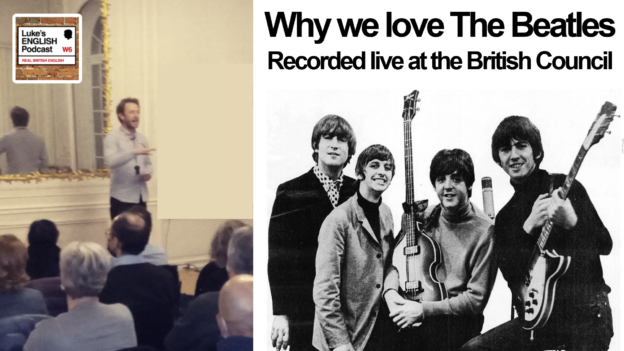
This is a presentation I did at the British Council in Paris recently, in front of a live audience. First I talk about public speaking and my approach to doing presentations and then you can hear the recording of my talk. The Beatles were a global phenomenon when they first appeared in the 1960s and their appeal continues to this day. The world still loves The Beatles. But why is this? Join me as I take a deeper look at the social, cultural and psychological factors that make The Beatles story so compelling even after all these years.
[DOWNLOAD]
Hello listeners,
Another day, another new podcast episode. Let’s keep calm and carry on, shall we?
This is episode 761 and most of this one was recorded live at the British Council in Paris in front of an audience of people. I think it is the first podcast I’ve ever recorded with a live audience there and it sounds a bit different because you can hear the audience reacting to things I’m saying and there are some moments of interaction with the crowd and some jokes and stuff. I hope you enjoy it.
As you may know, I teach English to classes of adults at the BC in Paris but also we have some extra events there in the evening. The talk you can hear me doing in this episode was one of those extra events. I’m hoping to do more of this kind of thing in the future – podcasting in front of a live audience.
Just before we start properly I want to tell you something about taking English lessons with the British Council, which is something that you can do online. Did you realise that?
Are you interested in having private English lessons online with a British Council teacher? Because you can.
Sometimes people ask me if I am available for private lessons, and unfortunately my answer to that question is usually no. I just spend my time making episodes of my podcast and teaching group classes in the real world so if you wanted lessons with me you’d need to be in Paris and you’d need to become a student at the BC there using the normal registration process and just hope that you end up in one of my classes.
But, other British Council teachers are available and they are online.
So if you are looking for an English teacher for private lessons, I just want to let you know that the British Council does offer this service now – personalised one to one lessons with a British Council teacher online
And this is great because you can do it anywhere in the world, you can choose the date and time for lessons, it’s totally flexible, you can choose the teacher and you can basically have classes which are designed around your needs completely, whenever and wherever you want, basically.
Want to practise your speaking and have your errors corrected – you can.
Want to work on your grammar and vocabulary. You can.
Want to develop your pronunciation to be a clearer speaker or to work on a more British-sounding accent if you like. You can do that too.
Also, you can have lessons for specific purposes such as for exams, for job interviews, for specific work arrangements, to prepare for IELTS. It’s all possible with these private online lessons because they’re all based around what you want to do and the British Council teachers will design the lessons based on your priorities.
I’ve always said that listening to my podcast regularly (or any podcast for that matter) is an important part of your learning process – the 5 Ls – listening, listening, listening, listening, listening but of course you need to be doing plenty of speaking too and to practise all the other things – the other language systems and skills.
One to one lessons are a really great way to achieve that and doing them online with an actual human teacher face to face is now a completely normal, tried and tested way to do this. All you need is just the right service.
And the British Council does offer that service.
It’s called British Council English Score Tutors. (Click the pic below for the details)
It’s the official 1 to 1 tutoring service from the British Council.
It’s quite new but they already have 12,500 learners of English using the platform.
There are currently over 150 teachers there.
The tutors on English Score have an average rating of 4.9 stars (out of 5), which is reassuring.
The teachers are all British Council approved and a lot of them are in the UK but there are also British Council teachers living in other countries all over the world so you can find teachers in most time zones, which means, basically, there are teachers available 24/7. So you’ll be able to find someone to match your timetable.
So, why not go ahead and find a teacher for you and book some lessons to really push your English further and gain more confidence. There’s an offer for you because you listen to this podcast by the way – I’ll tell you about it in a moment.
Maybe you listen to me regularly and you’re happy that you can understand me or that you’ve got to the stage where you’re understanding most of what I say, which is a very good sign – why not build on that and get your speaking up to a similar standard.
If you’re working on your listening and making progress, there’s a good chance you can convert that to speaking and make progress there too. Activate your English.
Work on your fluency and accuracy and clarity and general confidence.
The 5 Ss – speaking speaking speaking speaking speaking.
You’re asking – What about that special offer for us Luke?
Yes.
The BC is offering you a first introductory session for just $1, just so you can see if you like it.
So the first session is just $1.
You can try it and see if you like it.
There’s no pressure or obligation to continue after that.
But if you do choose to buy a pack of lessons (normally about 20 hours or something) the BC will throw in a free lesson for you because you’re a LEPster.
So, the first lesson is just $1.
If you like it you can buy a pack of lessons with a teacher, and get a free lesson included because you’re a LEPster.
Sounds pretty good right?
This could be your way to really work on your speaking as well as your listening.
Think about it. Could be a really good move.
Young learners – they do young learners too. There are classes available for 13-17 year olds and you get the same deal.
The link is also in the description of this episode.
You’ll only get that free lesson if you enter the website through my link though.
So, obviously, do that then.
All right then. Let’s begin the episode properly. Here’s the jingle.
Hello listeners! Welcome back to the podcast. Let’s get back to some normal podcasting, shall we? OK then.
This is #761 Why we love The Beatles (Recorded Live at The British Council).
As you can tell from the title, this episode was recorded live at The British Council in front of an actual audience of people, as I mentioned earlier.
I’ll play the recording to you in a few minutes. First I want to tell you about the talk I did and how I prepared for it in order to perhaps share some personal tips I have about public speaking. This might seem like another one of my epically long introductions, but it’s not. In fact, let’s imagine that the introduction is over now and here we are in the main body of the episode, and I’m giving you some comments and advice about how to speak to an audience of people – public speaking.
Public speaking is a slightly different skill to normal podcast recording and so it might be interesting for you to hear me doing it in this episode.
Here’s some context.
The British Council in Paris, where I work part-time, is essentially a language school in a nice building not far from the Eiffel Tower. We teach classes to adults and children and there’s also a exam centre for the IELTS test.
The BC in Paris also offers some special evening events including regular Talks In English. This is when a guest is invited to come and talk about a specific topic at the school in one of our nice big rooms on the 2nd floor.
Everyone is invited to attend at that means students at the school but anyone else too – friends, staff in the school, other teachers, just anyone who’s interested in attending.
The speaker does their talk and afterwards there’s a chance to socialise, drink some wine and talk in English together.
Our marketing manager Phil is always on the lookout for people to do one of these Talks in English, and a couple of months ago he asked me if I’d like to do a talk about anything. I immediately thought of The Beatles, because it’s one of my favourite topics and it’s a very British topic, relevant to British culture and it’s the sort of thing that would probably attract some people. Also the series produced by Peter Jackson called “Get Back” had just been released on Disney+. Phil happily agreed and we put it in the diary.
I decided the title of my talk would be Why We Love The Beatles and basically I wanted to try and explain why The Beatles were and still are so popular. What is the appeal of this group? Why are they so adored by people even 60 years after they first came onto the scene?
I also decided I’d try and record it as an episode of this podcast.
Now, I know this is another episode about The Beatles and some of you might not be that interested or keen. My talk is called Why We Love The Beatles – but some of you probably don’t Love The Beatles that much, or you just don’t know. That’s totally fine of course. I get it. I’m not here to convince you that they’re the best band. Music is subjective. It’s a question of personal taste.
But I still hope you listen to this, because I might be able to help you understand why people love them.
I’m now going to give some tips and comments about public speaking and how I prepared for my presentation but if you’d rather just skip straight to the recording of my Beatles talk, then you can move forward to 30:00 (the 30 minute mark).
Let’s think about public speaking then, and doing a presentation to an audience. I just want to mention a couple of things about how I prepared to do this talk.
Maybe this can help you learn a little bit about public speaking.
So I had to prepare to talk to a room full of people for about 45 minutes.
It was a fairly small audience to be fair – about 50 people.
Is that a small number or a big number? I don’t know. I’ll let you decide.
Imagine you had to do that.
I knew the audience would be a mix of adult learners of English (mostly French people and maybe some other nationalities) with an English level at intermediate and above and also some native English speakers.
I didn’t want to write a script, because I wanted to keep the presentation spontaneous. I find that if I write a script then I just get stressed during the talk because I’m trying to remember everything I’ve written and that’s impossible, and reading from a script can take the life out of a presentation. It can take away a certain spark, especially if the person is actually reading from the script on paper and they have to keep glancing up at the room but not really connecting with anyone.
It depends, of course. Sometimes you need a script because in some cases every single word is vital, and you might have a prompter or something (that’s a screen which shows you your script without the audience seeing it – like in those big political speeches) or maybe if you are doing a best man’s speech at a wedding it can help to have the script in your hand. It depends on the situation of course. But for me, I decided that I didn’t want a script.
Also I didn’t want to use presentation slides on a screen with lots of words or information on them. Slides can be good, but they can also be very distracting. It’s human nature for the audience to just stare at the slides and then you lose the connection with them, and an old rule from stand-up comedy is: if it’s not adding anything, then it’s taking something away.
Sometimes slides are not really adding anything to your talk, and so they just take away the focus from you and cause the audience to get distracted, especially when there’s lots of text and they end up reading rather than listening to you. No thanks.
Nothing is better than just trying to establish a good connection with the people in front of you. So I decided to do it without a script and without any slides, just like in a stand-up comedy who.
Doing it without a script can seem a bit daunting though, because you think “How can I get it right? How can I be sure that I’m going to say the right things?”
Basically, in my experience, you have to just try to get to know your subject really well, create a simple structure for your talk, practice a lot and then trust yourself to be able to do it. So that’s what I tried to do. (I’m talking like I’m some expert public speaker here – I’m not, but I do have some experience from teaching and from doing comedy, so I’m just trying to share my experience with you).
In the weeks leading up to the talk I just thought about it a lot, thought about the specific focus of the talk “Why do people love The Beatles?” wrote some ideas down when they came to me, asked friends and family for their advice, talked out loud to myself a bit, imagining I was doing the talk and eventually worked out a general plan for what the content and structure should be. I did write some things down as a script but then I boiled it all down to a list of simple one or two word prompts. I then printed those prompts on some cards which I held in my hands during the talk. The idea was that I could just glance at the card in my hand and then ramble on that topic, hopefully remembering the main things I wanted to say. I also wanted to leave myself room to improvise and respond to what was happening in the room because in my experience, that’s the best way to keep things entertaining and to stop the audience falling asleep at all.
I also wrote a few other things on the cards in pencil. Just some names, dates and quotes in case I forgot them while talking.
So that’s what I did as preparation and in a moment you can hear how it went.
Let me just say a couple of very basic facts about The Beatles for listeners who are new to the subject, just so you don’t get lost.
The people in the room for my talk were probably already fans of The Beatles, but you might be new to them.
They were a group of musicians (a band) from Liverpool in England who recorded and released music together from 1962 to 1970 more or less.
Members:
Pete Best and Stuart Sutcliffe were members of the band before they became really famous.
They formed in the late 1950s and played live concerts together from the early days in Liverpool and Hamburg until the year 1966 when they were playing stadiums and huge theatres around the world. Then they stopped performing live and concentrated on making music in the studio.
The band broke up officially in 1970 and went their separate ways.
John Lennon was killed in 1980 meaning that the four members could never reunite again as a band.
The Beatles were not just commercially successful. They represented a huge cultural shift and also were groundbreaking in many ways beyond just their influence on popular music. They were also just very funny, stylish and charming and their message was ultimately one of peace and love.
So, “Why we love The Beatles” that’s the title of my talk, that’s what I talked about a couple of weeks ago, and that’s what you can hear now in this first episode of LEP recorded in front of a live audience. I hope you enjoy it…
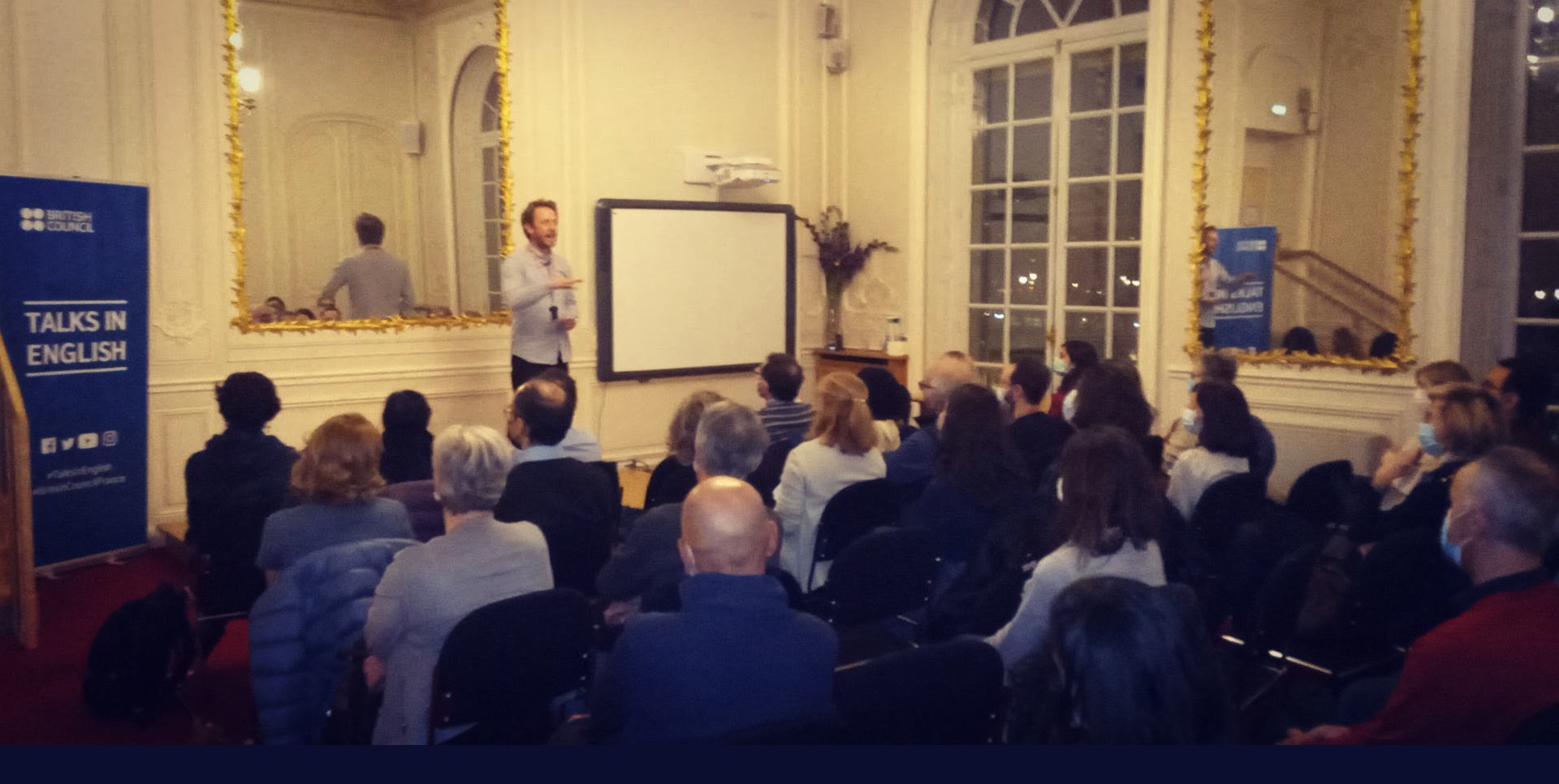
So, there you have it. That was my talk about The Beatles at The British Council.
I am not completely sure if I managed to answer the question of why people love them so much, but ultimately I think I managed to entertain my small audience and everyone seemed to enjoy themselves and maybe that’s the most important thing at the end of the day, and the beginning of the day, and the middle of the day…
I wonder how that was for you listening in podcastland.
A couple of questions for you.
Actually, I have sort of already decided that I would like to do more stuff like this in the future and I would like to do talks at the British Council that can also be published as podcasts.
One idea is that I re-record some old episodes but in front of an audience, especially episodes which are essentially stories. For example, I would love to do the Sick In Japan story because I think it’s long enough, has enough funny moments and drama in it and it’s been a long time since I published the episode (10 years in fact – omg).
So look out for more stuff like this in the future and maybe a live version of Sick In Japan or something like that. We will see.
Anyway, let me know how it was listening to this as a podcast episode.
Thank you for listening all the way until the end.
If you got this far, let’s think of a code word you could use to show that you’ve listened until the end. Let’s say that if you got this far, you have to use the word “LOVE” in your comment, especially in a Beatles lyric such as “Love is all you need” or “All you need is love” or “The love you take is equal to the love you make” – or in fact, quote ANY Beatles lyric in the comments to show that you have listened all the way until the end, and if you mention that a semolina pilchard was climbing up the Eiffel Tower during the episode, you will get bonus points. More than just 10.
Thank you for listening.
More podcast episodes will be coming towards your ears soon.
Just a reminder – Private Lessons with British Council English Score Tutors
If you’re looking for private one-to-one lessons online with a teacher, check out British Council English Score Tutors.
At least 150 BC Approved teachers to choose from.
Classes adapted to your needs.
All from the comfort of your own home.
$1 for the first lesson so you can check it out.
Then if you pay for a pack of lessons, you’ll get one lesson free because you’re a LEPster.
Link in the episode description.
Nice one.
Thank you for listening! I hope you loved this episode.
My pod room is nearly ready, for goodness sake. There’s still no electricity connection! A guy came to fit plugs around the room, and to connect it to the earth. He just needs to come back to do a bit of paperwork but of course he keeps texting saying it’s not possible today and then the next day, then he says he can come on Friday afternoon which is a full week after he actually did the main part of the job. Why does everything take so bloody long? Then it’s just a few clicks and switches and I need another hard working motivated guy to come and connect the room to the fibre optic internet and then I will be able to actually get installed and start working properly again. Damn, I can’t wait! I’m buying a second-hand desk from a local company tomorrow (it was supposed to be today but yep – she had to cancel and postpone). I’m looking for a decent office chair at a good price. I will podcast standing up if I have to!
Speak to you soon but for now it’s just time to say, good bye bye bye bye bye bye
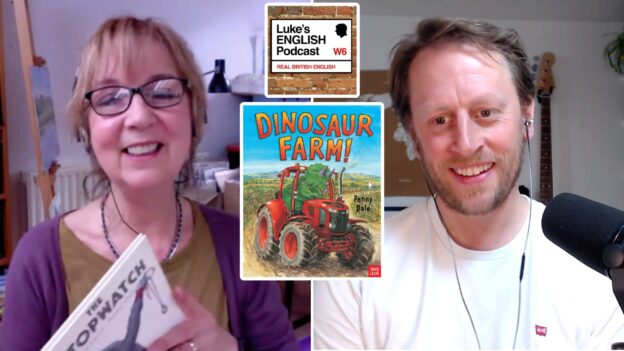
Author and illustrator Penny Dale talks about the process of creating successful books for children, including some of her most popular books such as Ten In The Bed and the Dinosaur series. Video version available. Audio version has 30mins extra rambling.
Hi listeners, welcome back to the podcast.
Just before I introduce the episode properly, I have some Amber & Paul news for you. First of all, Amber and Paul will be back on the podcast very soon. It’s been a while since they made an appearance, but probably the next episode will be with them, which is nice. But also, Amber and I will be on Paul’s YouTube live show on Monday 6 December at 8pm Paris time.
Every Monday Paul does a live show called Paul Taylor’s Happy Hour Live – you can find that by searching for it on YouTube. In the show he features guests and they respond to comments from the audience and generally talk and have fun. His next guests will be Amber and me (finally – we’re both going to be on it together) and that’s on Monday 6 December at 8pm Paris time. If you’re listening to this after that date and you’ve already missed it or if you can’t watch it live, you will be able to see the replay on Paul’s YouTube channel.
OK? So, if you’re keen for more Amber, Paul and Luke action – check out Paul Taylor’s Happy Hour Live on Monday 6 December at 8pm, either live or on replay.
Another thing – my merch stores are currently offering discounts, so if you’d like to get an LEP t-shirt or mug or hoodie or something – for yourself or as a Christmas present for another LEPster, now might be a good time because of discounts. Just go to www.teacherluke.co.uk/merch to find the merch stores.
Also, I hope you enjoyed the previous episode of this podcast – also with Penny Dale. I just wanted to let Premium LEPsters know that there is a premium episode in the pipeline, which will be called “What did Penny say?” and that’s going to cover vocabulary from our conversation about the Bath Arts Workshop. So, that’s coming. For all the info about LEP Premium, go to www.teacherluke.co.uk/premiuminfo
~ Jingle ~
Hello, so, let me tell you about his episode, briefly. In this one I am talking again to Penny Dale. This time we focus on her work as an author and illustrator of children’s books – and she’s had a very successful career doing that, which is quite rare.
I think this conversation is absolutely lovely – and I hope you agree. It’s just nice listening to Penny talking about her work, especially as the work itself is so thoughtful and done with a lot of care and attention, and it’s all for children.
Just to give you an overview, you are going to hear Penny talking about these things:
This conversation includes references to some of her most popular titles, including Ten In The Bed, Dinosaur Dig, Dinosaur Farm and Dinosaur Rocket.
The video version includes some pictures – that’s mostly Penny showing pages from her books, but she describes the images in some detail so even without the video version you should still get you a good idea of what her work actually looks like. But you can see the work in the video version. The audio version of this, which you listening to now, has more content in it – this introduction and there will an ending ramble from me of some kind too, so – take your pick. Video version on YouTube, audio podcast version, or both!
OK then, without any further ado, let’s find out about how Penny has created successful books for children.
Luke rambles about some upcoming content, the new Beatles documentary, and a few other things.
Amber & Paul on location in a famous museum – talking about some amazing works of art from various periods, including the Mona Lisa – that famous portrait by Leonardo da Vinci.
Don’t forget Paul Tayor’s Happy Hour Live (watch the replay if you missed the live stream) Monday 6 December at 8PM CET.
Andy Johnson will be back on the podcast soon (long term listeners might remember Andy)
I’m desperate to talk about the new Beatles documentary, and I think I will – when I get the chance!
Talks in English at the British Council in Paris – “Why we love The Beatles” <– my talk, which is scheduled for Thursday 27 January 2022 – 19.00
Link to reserve your seat https://www.britishcouncil.fr/en/events/talks-english-beatles or just go to britishcouncil.fr and then What’s On.
If you’re in Paris – come along to that. I’m going to record a podcast while doing it, I hope.
I’ve still got a lot on my plate! I will upload as regularly as possible, but we will see if the podcast gets disrupted by the move which is still yet to happen. New pod-room.
LEP Merch – Christmas present ideas? All the designs, including competition winners – they’re all there. Watch out for discounts in the merch stores.
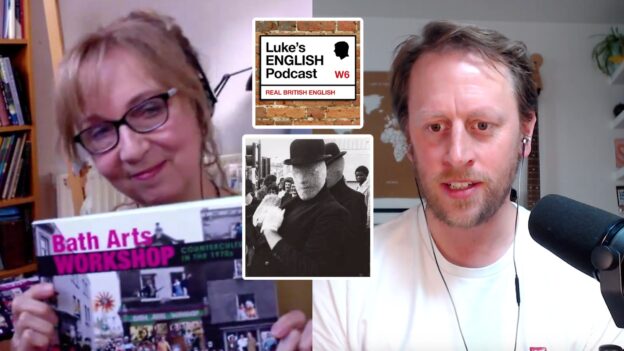
Chatting to English author & illustrator Penny Dale about her involvement in a counterculture arts movement from the 1970s, the Bath Arts Workshop. Video version and vocabulary list available.
Hello everyone and welcome back to Luke’s English Podcast – a podcast for people learning English. British English in this case. My name is Luke. Welcome.
Here is a brand new episode for you. I hope you enjoy it! There’s a video version too on YouTube.
Yes, hello listeners! You might be able to hear my computer’s fan. There’s hiss in the background because my computer is working hard to encode the video version of this. *Luke rambles for a few sentences*
“Luke you’re rambling again!”
This is an interview episode with a guest. I should say that this might be a difficult one, depending on your level of English of course! My guest and I are talking about a specific artistic and cultural movement that happened in England in the 1970s. I say specific, but it included many different types of art, theatre performance, music and community work – all packaged together in one movement, a movement which was quite revolutionary at the time, but revolutionary in the nicest possible way. That should become clear as you listen to this. Anyway – an alternative, subversive, counterculture arts movement.
The reasons I think this might be difficult for you to follow are: language (there’s a lot of vocabulary used to describe and discuss art & culture of various kinds) also the fact that there are references to things you might not know about already, including the names of artists, poets, musicians and specific locations in England (obviously, if you don’t know those reference points then things might get confusing), and simply the fact that this is quite a difficult arts movement to understand for anyone – native and non native speakers alike. Also, my guest and I aren’t really grading our English or slowing down a lot, and I’m aware of that. I am presenting this to you as a piece of authentic listening practise, which, can be really good for your English if you’re willing to tolerate the bits you don’t fully understand.
So it might be tricky to follow, but I do hope you persevere. I think that as you continue to listen, the concepts and events we are discussing will become clearer to you and really exploring things that you might not be familiar with can be a great way to pick up new language
So, this should be a chance to learn about culture and by extension the words we use to describe that culture.
The video version has some annotations on the screen (with vocabulary and pictures), and the notes on the website will also include a vocabulary list, which will help you if you check it.
Right, let’s get straight into it then. There will be another little introduction from me, but that’s what I do isn’t it? I’m only trying to help.
Leave your thoughts and responses in the comment section. I will chat to you again near the end of this conversation, but now it’s time for the jingle, and here it is.
Hello listeners, hello video viewers,
As you know, in episodes of my podcast I often talk about language learning, and I often I teach you specific things such as vocabulary, grammar or pronunciation (especially in Premium episodes), but also on this podcast I do episodes which are not specifically about the English language or about learning or teaching English. I also like to present you with things that I hope are simply interesting to listen to, or episodes which focus on culture rather than language, and this episode is one of those. This is a conversation which focuses on British culture and art and it is an interview about an artistic movement which took place in England in the 1970s. So, it’s not about English, but it is all in English of course and I’m presenting it to you as part of your regular English listening practice.
This is an interview with artist, illustrator and author Penny Dale, who was one of the members of the Bath Arts Workshop.
Let me give you some context to explain how this interview was set up. This will not take 15 minutes, I promise.
First of all, there is a new book available – it’s just been published. It’s called “Bath Arts Workshop – Counterculture in the 1970s” and as the title suggests it is all about a counterculture arts movement which took place in the South West of England in the 1970s. We’ll explain what a counterculture arts movement means in a few minutes.
One of the people involved in that artistic movement, and also involved in the publishing of this book is Penny Dale. Penny is an illustrator and also an author of children’s books – an award-winning author, I might add. She’s illustrated and written some very popular kids’ books in the UK and we have a lot of them at home – my daughter loves them, but back in the 1970s she hadn’t begun that part of her career yet and was involved in this conceptual and subversive arts movement – The Bath Arts Workshop.
Penny is a friend of the family. She is a very good friend of my mum and dad, and in fact it was my mum who suggested that Penny could be a good person for me to interview and that both the Bath Arts Workshop and her career as a childrens’ author would be interesting things to ask her about.
So that’s the plan. This will be two separate episodes I think – one about the arts movement, and another one about the writing of childrens’ books. Part 1 and part 2. This is part 1 of course, so let’s focus on the Bath Arts Workshop.
And by the way – Bath is a town in the South West of England – we’re not talking about bath tubs where you go to wash yourself and play with yellow rubber ducks and little boats. No, this isn’t an art movement that involved people sitting in bathtubs – but then again it was the 1970s so that isn’t completely far-fetched.
Ok that’s probably enough of an introduction from me. Let’s now meet Penny and start the interview properly.
[A premium episode about this language is in the pipeline]
[This is a transcript of some of the things I said, but there’s a lot of extra, spontaneous talking in the audio version.]
So that was Penny Dale talking about the Bath Arts Workshop. Thanks again to Penny for that. I found it very interesting and it makes me think about my parents’ generation and the approach many of them had to things. That whole baby boom generation and the counterculture movement in general which I suppose includes things like the beat poets, hippies and all that stuff. I especially think of the music and the general ethos, which was that they could change the world with love. Were they idealistic and naive? Or not? I don’t see what’s wrong with a bit of peace, love and understanding myself. Love is all you need, right? Yes, but a bit of cash, a nice car, a decent apartment and maybe a new computer, and to have someone fix our washing machine, oh and a pair of shoes that fit me just right and don’t squeeze the sides of my toes – all those things would definitely help. I don’t know really, but I do think that the Bath Arts Workshop sounds like quite a beautiful venture, if you ask me, and it sounds like they had some great fun while doing it, and so on and so forth. I could go on.
You can leave your comments in the comment section as usual, if you have them.
Hello there! You’re still listening to the podcast. Nice one! Did you manage to follow this conversation?
Remember I said at the beginning that I’d put a vocabulary list on the website page for this episode. Well, I’ve done that, with some words or phrases that I think might have been hard, or which are worth picking up from the conversation.
I’m planning to do a premium episode in which I fly though them, just clarifying them a bit.
Sometimes I think I might go into too much detail in those premium episodes, and it’s ok to just say a few things about each bit of target language each time. So I will aim to do a kind of express premium episode as a way to recap and highlight some nice language from this conversation.
Let’s have a mini ramble here – and this is one of those times when I’m doing a written ramble – writing things down which I will record when the time is right. I like to mix up spontaneous speech and pre-written speech on this podcast. There are good and bad points of both. Mainly – the advantage of spontaneous speech is that it’s more natural and authentic and therefore a bit more human and engaging, but the advantage of pre-written stuff is that I can get some more control over what I’m saying. Anyway, I am still rambling here – pre-written or not.
My computer has stopped making that loud noise – it failed to encode the video, because there wasn’t enough storage space left on the hard drive. I’m sure you know the problem. Hard drive storage just gets eaten up so easily. Not only do I have to keep my flat tidy and organised, I also have to keep my computer tidy and organised and free of clutter, and my phone too for that matter! This is the world we live in. I will try encoding the video again later, after throwing a load of unwanted files into the trash – or rubbish bin as it should be called, if computers were British.
What’s going on in podcastland? Well, I’m recording this late on a Friday evening – maybe because I’ve got nothing better to do! Well, I could be watching TV or reading a book, playing the guitar or something else, but my wife and daughter are both asleep downstairs and so I thought I’d take this opportunity to catch up on a bit of podcasting.
I’m recording this probably before recording episode 750. This is episode 751 I think, which I will upload after 750, because that’s how numbers work, but I haven’t recorded 750 yet.
Does that make sense? I have a vague plan for episode 750 – probably something about being busy.
I like to record and publish in the same order, so there’s at least some sense of continuity. I know some podcasters will record something and then leave it for ages and kind of publish things in a different order to how they recorded, but I prefer to just publish and record as soon as possible.
I don’t know what I will say in episode 750, which means I don’t know what you have already heard me say, because even though right now I haven’t recorded that episode yet, there’s a good chance you are listening to this later and in your world you might have listened to episode 750 – I wonder what I said in that episode, or should that be, I wonder what I will say, or even, I wonder what I will have said? I’m in that weird limbo land where all those different verb tenses are possible. (Some people are confused now – even more confused than they were earlier).
Anyway, I think I will call it a day here. In a moment. I said before that things are a bit intense in my life at the moment – I am certainly not complaining, not at all, but I have a lot on my plate which means I’ve got less time for recording, editing etc. This means that I have lots of ideas building up in my head – podcast ideas – they sort of come to me at various moments, like when I’m teaching or when I’m walking to work, but then I can’t really turn those ideas into podcasts because of time constraints, but I’m trying to note them down for later.
I expect I’m repeating myself here, because I have a vague idea that I’ll talk about being busy and having things on your plate in episode 750. So, no need to continue at the risk of repeating myself, which is obviously a shocking crime that must be met with the harshest of punishments.
OK, the next episode will also be with Penny and it’s all about how she creates books for children, and this is actually a bit of a scoop because Penny is a really successful author of children’s books. They have won awards. They are in all the bookshops. One of her books was read out on BBCTV by Rob Delaney – a popular comedian. And her work is really great. Her illustrations in particular are absolutely lovely – very cute and adorable. So in episode 752 we can hear her talk about her process of creating these books, and it’s a nice cosy topic and I think it should be of interest to most LEPsters. So that’s something to look forward to.
So, I think this is a good moment to stop. Thank you so much for listening!
In this unedited episode I share some of the thoughts that have been running through my head, talk about being busy and look at some vocabulary to describe busy times in your life. Video version available.
Pronunciation
/bɪzi/ “Bizzy” – like “business”
Not “Buzzy”
Collocations
A busy time