Hang out with me while the rain pours down outside 🌧️ and in this episode I’ll talk about the problem of “faffing around” 😵💫 , podcast news & updates 📲, some stand-up comedy dates 🎤, comments on recent episodes 💬, some common questions from listeners 🙋, a lot of rambling about how I learned to play music 🎵, a tour of all the guitars in my podcast room 🎸 and a song at the end 🎶, with lyrics explained 👨🏫.
A spontaneous monologue about being taken by surprise by public holidays in May (in France), a podcast recommendation, and seeing a hard-rocking and hilarious band perform live in a big arena last week. Includes a song at the end as a tribute.
Barbara Serra is an award-winning Italian journalist who has spent much of her career reading the news in the UK on various high-profile well-established English language news networks including the BBC, Channel 5, Al Jazeera English and Sky News. Barbara has quite a specific relationship with the English language. We talk about learning English, challenges in her career, and the relationship between accent and identity.
Hello listeners, today on the podcast I am talking to Barbara Serra, the Italian journalist who reads the news on television in the UK. She’s a very interesting guest and has lots of interesting things to say about the way her identity and career have been shaped by her relationship to the English language.
We’re going to talk about reading the news in the UK when you sound like a foreigner, lots of questions around identity and accent, and all sorts of other things that Barbara has experienced in her time as a broadcast journalist. I think you will find it very interesting as a learner of English looking to improve your English as much as possible in different contexts, both personal and professional.
LEPster meet-up in Da Nang Vietnam
Gordon’s Pizza (in An Thuong area) on Friday 17th May from 9pm.
Send Zdenek an email if you’re interested – teacherzdenek@gmail.com
Barbara Serra is an award-winning Italian journalist who has spent much of her career reading the news in the UK on various high-profile well-established English language news networks including the BBC, Channel 5, Al Jazeera English and Sky News.
Barbara has quite a specific relationship with English. It’s her dominant language but not her native language. She has a certain accent, which does place her outside the UK somehow. So how has this affected her career as a news reader and reporter?
Broadcast journalism is associated with a certain model of spoken English – in the UK that would be what is often called BBC English, and traditionally the role of newsreader has been synonymous with that kind of high-level, high-status form of spoken English.
So what has Barbara’s experience been?
What is the story of her English?
How did she get the point where she was ready to do this job? What kind of challenges has she faced while reading the news in the UK?
And what does this all tell us about learning English, what it means to improve your accent, the relationship between accent and identity, the definition of “native” and “non-native speaker”, the status of different English accents in the English speaking world?
Let’s get into it.
LINKS
👉 Barbara’s email newsletter “News with a foreign accent” https://barbaraserra.substack.com/
👉 Barbara’s website with course info https://www.barbaraserra.info/
I read an article about Paris’ preparations for the 2024 Olympic Games 🏊, discuss the issues, summarise the article and explain plenty of vocabulary. Is Paris ready for the games? What are the attitudes, complaints, expectations and fears ahead of this potentially controversial event.
The build-up to this summer’s Games is being ‘marred’ by rows over national identity, security and pollution
The lighting of the Olympic torch today comes amid a “dampening” of enthusiasm for the Paris Games in an increasingly “fractious” France, commentators warn.
Light – lit – lit To light something To light something up
Lighting Lightening (lighten) Lightning ⚡
“We’re ready for this final straight,” said Paris Olympics chief organiser Tony Estanguet
to mark the 100-daycountdown
With the clock tickingdown until the Games kick off on 26 July
France’s “bitter politics and gloomy mindset are dampening the mood” among a “fractious” public, said The Japan Times.
The build-up has been “marred by rows” that go to “the heart of a bitter national debate about identity and race”.
Herve Le Bras, a sociologist, told the paper that the Games threaten to “underline the major fractures in France – notably the fracture between Paris and the rest of the country”.
An Odoxa poll of more than 1,200 Paris region residents last November found that 44% thought the Games were a “bad thing”, and that 52% were planning to leave the city during the 16-day event.
One Parisian told the BBC that staying would be “unbearable“, with the Games making it “impossible to park, impossible to move around, impossible to do anything”.
Security fears are also growing amid mounting global tensions.
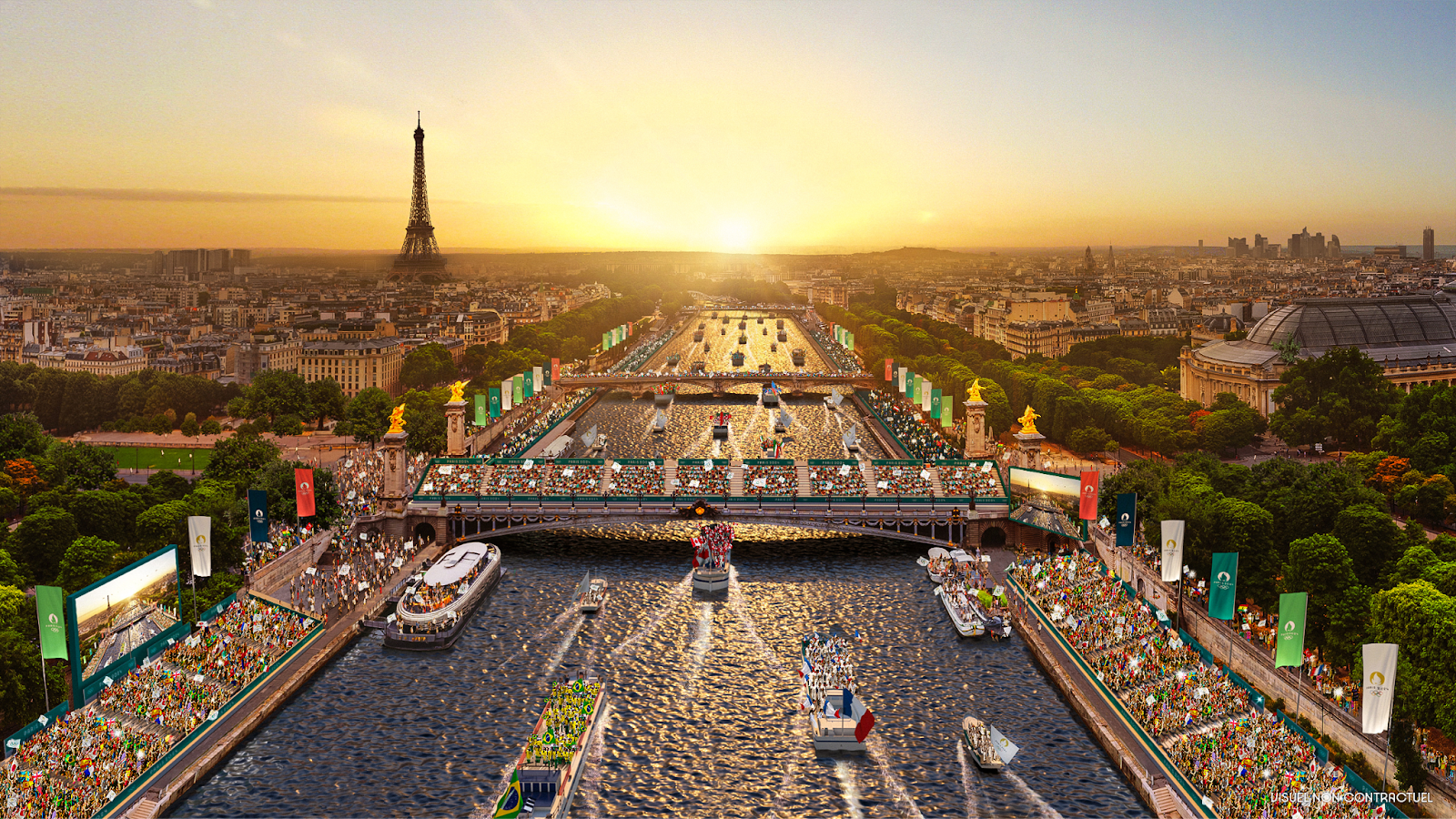
In a break from the tradition of opening the Games in the main stadium, the organisers have devised a “grandiose” ceremony centred around a parade of barges on the River Seine, said Le Monde.
The original plan was for as many as 600,000 spectators to watch from the riverbanks, but security and logistical concerns have led the government to “progressively scale back” the plan, with the spectator numbers reduced to 300,000.
And President Emmanuel Macron said yesterday that the ceremony might be moved to a new location if the authorities decide that the risk of an attack, potentially by drones, is too great.
“There are Plan Bs and Plan Cs”, including holding the opening at the city’s Stade de France, he told television interviewers. Asked if the Kremlin would seek to disrupt the Olympics, Macron said that he had “no doubt“.
Another potential threat is sewage pollution in the Seine, where swimming events are due to take place.
Bacteria, including “pollution of faecal origin”, remains dangerously high in the river.
Games boss Estanguet said last week that if water quality levels worsen, “there could be a final decision where we could not swim”.
The Switzerland-based International Olympic Committee has “mountains of scepticism to dispel” in France and beyond, said The Associated Press.
The $13 billion cost of the 2021 Tokyo Games and the “unfulfilled promises of beneficial change” for 2016 host Rio de Janeiro triggeredwidespread anger, and the 2014 Winter Games in Sochi were “tarnished by Russian doping“.
But some previous predictions of Olympics doom have proved incorrect.
In the run-up to the London 2012 Games, the Army was drafted in to bolster the security presence provided by private firm G4S, amid fears of a repeat of the riots that had broken out in the city in 2011.
Journalists emit “cyclical loud buzzingnoises before every set of Summer Games”, said George Vecsey in The New York Times in 2004.
Reporters will “continue to fret on schedule”, because it’s “in our job description“.
Estanguet acknowledged last week that “before this kind of big event, there are always many questions, many concerns“. But the Paris edition would make his nation “proud”, he said.
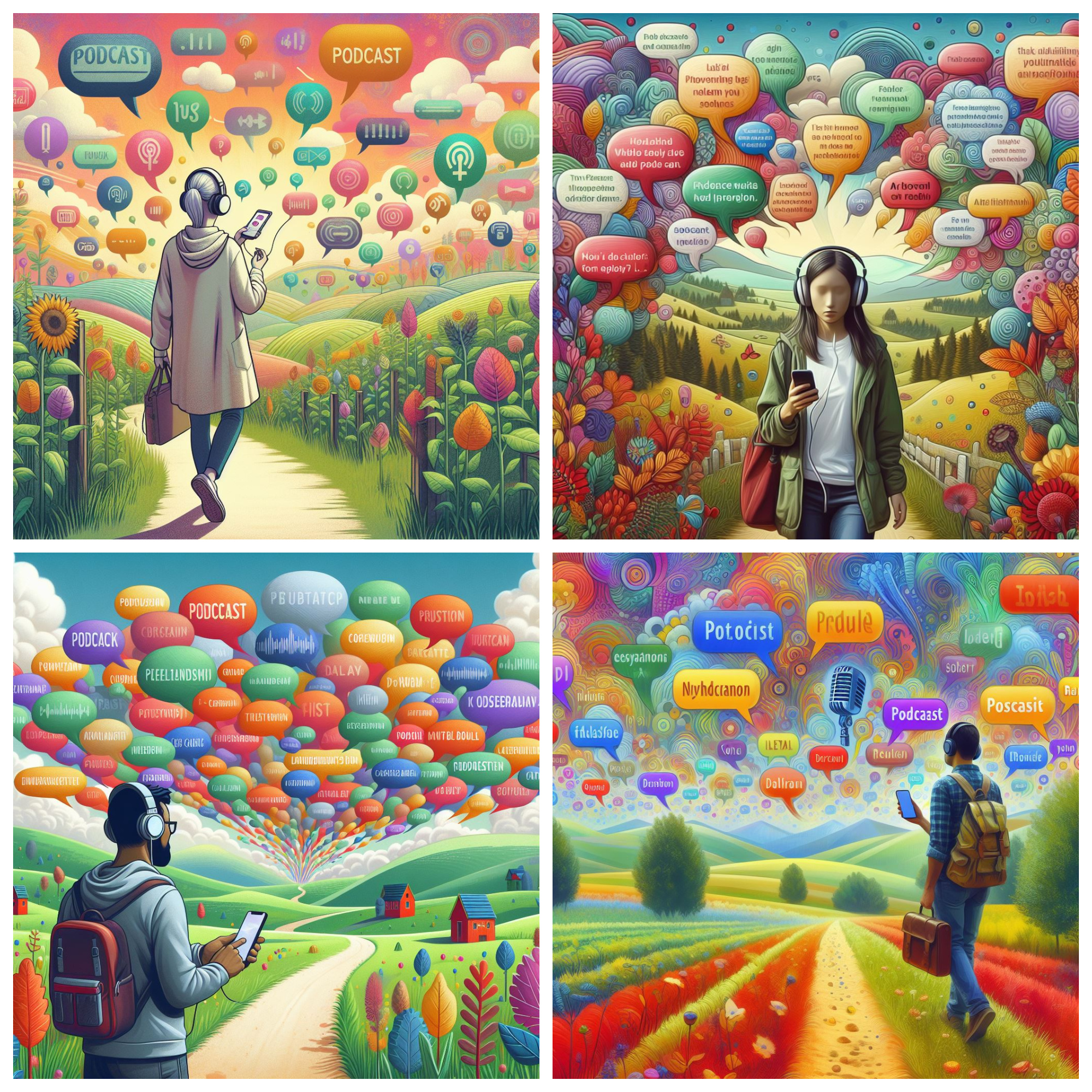
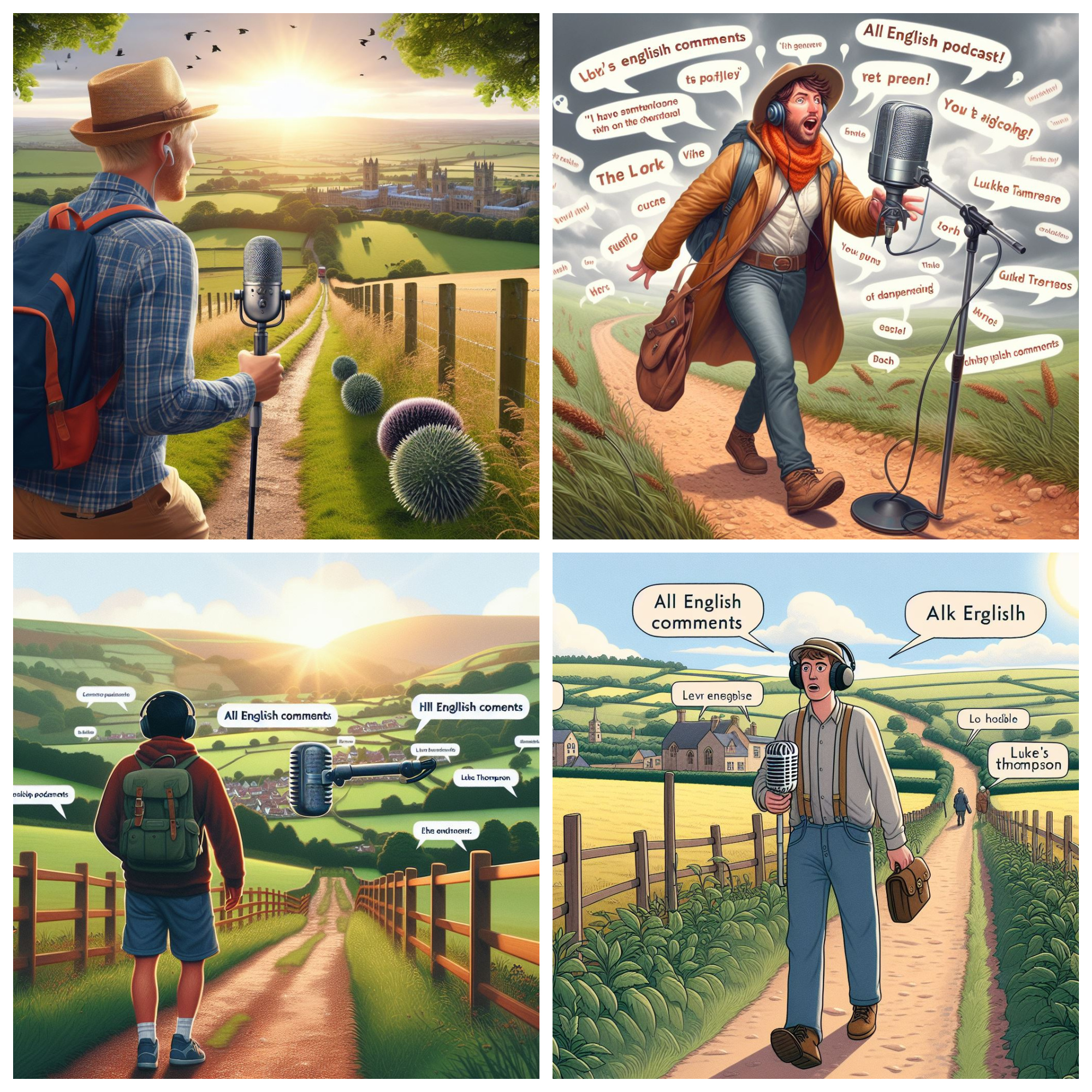
Listen to me rambling about Daylight Saving Time, weird AI generated images for Luke’s English Podcast, and lots of comments and responses to recent episodes including the Birthday Party story 🎂 , the MBTI Personality Test 🙇 and the Walk & Talk in Paris 📹🚶.
Here is an episode in which I walk through the streets of Paris, rambling about a particular subject. This time the subject is Paris itself. This summer Paris is hosting the Olympic Games. The city will be filled with visitors. I am very curious to see how the city will handle this moment. Will it be a huge success? What will visitors think of the city? Will anyone suffer from the mysterious “Paris Syndrome”? Join me on my walk, follow my words, look out for vocab and consider using my questions for your own speaking practice.
Feel free to use these questions for your own speaking practice.
Have you ever been to Paris? When did you come here? What did you do and see? What did you think of the place?
If you have never been to Paris, would you like to? Why?
What associations do you have with Paris? What do you imagine, when you think of this city?
Have you ever seen any films or TV series set in Paris? What image of the city do they present?
Have you ever been to London? Did it match your expectations?
Think of a city that you know well. Try to talk about it. What is it famous for? What can you see and do there? Does your city have a reputation? Does the reality match the reputation?
Has your city ever hosted the Olympic Games? What did residents think about it before, during and after the games took place?
OK, this is not actually the end of the episode, as you can probably see from the running time. There’s a lot more left in this episode.
I am now back in my podcastle, where I am much more comfortable recording and being on video.
Having reviewed the footage which you have just heard and seen I wanted to just reflect on it and give my thoughts on this experimental episode and how I might do more of these Walk & Talk episodes, and whether I will do more of them at all.
So here are my thoughts on this.
The footage looks fantastic. Good colours. Very clear. Smooth image stabilisation.
I didn’t show many landmarks in the video but I wanted to keep it natural and just show the places where I would typically go on my way home or on a trip into town to get lunch. You did see the Eiffel Tower (very briefly at the start), Les Invalides, Grand Palais, Assemble Nationale, Concorde, Louvre, La Seine, Les Tuileries, Place Vendome – so actually quite a lot of landmarks I suppose!
I’m slightly concerned that referring to all these visual things will make this less satisfying to listen to as an audio only episode, but I really hope not. It should be an immersive audio experience too.
The audio sounds good enough I think. It’s not as loud and rich as normal but that’s to be expected. It’s hard to get the mic in the right position and there’s lots of background noise, but it’s good enough.
I’m not overly happy about the way I look! You can see up my nose and there are not very flattering angles, but I should not be vain about this and you probably don’t care about it as much as me.
I was so self conscious about walking along with the cam in my face it makes me seriously doubt if I can do that regularly. It wasn’t as pleasant as I’d hoped. I felt very self-conscious and awkward and that prevented me from getting into my normal flow of speaking.
Putting the cam on my shirt is great – I can be completely hands free and continue to record, but the battery runs out quite fast. Also, you can’t see my face, which is reasonably important.
My original plan was to have a load of questions that I answer on a topic then see what topic vocab comes up in those questions and answers. You heard me mention that I’d used ChatGPT to help me write the questions quickly. In this episode about Paris I didn’t really answer many questions from my list. But you can still find some questions about cities on the episode page. Use them to practise talking about a city you know well.
I’ll have to review all those ChatGPT questions on other topics because the ones it came up with about Paris were actually very dry and not that fruitful. I didn’t fully answer the questions it gave me about Paris, but it’s ok. I think I still discussed the city enough.
It was a bit difficult to prioritise the speaking and expressing myself because I was multi tasking. Operating the camera, moving around and feeling self conscious. When I’m in the pod room I can focus more on what I’m saying.
I’ll try this again, and next time will focus on a specific topic with questions and vocab as I promised. Maybe I can sum up the vocab in a premium ep each time.
What do you think? I’m particularly interested in hearing from audio LEPsters. Audio listeners – how was it? Loud enough? Clear enough? Was there a lot of atmospheric noise? Did that make it hard to hear, or did it add to the atmosphere of the episode?
A very long rambling episode with a big mix of vocabulary, stories about my trip to Rome, comments from listeners, lots of thoughts about episodes I’ve published over the last 12 months, more advice about learning English, and a story about being Jackie Chan’s English teacher.
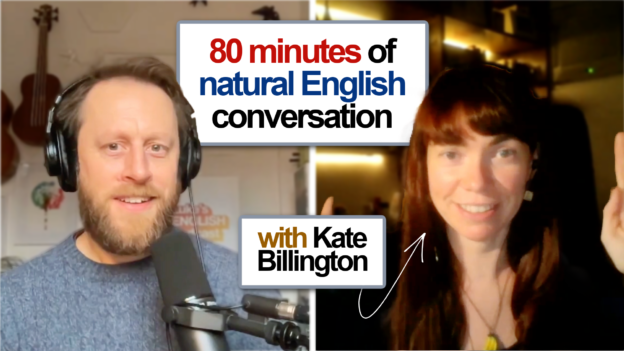
Returning guest Kate Billington suddenly decided to move to the other side of the world, to Taipei in beautiful Taiwan. In this episode we talk about meeting LEPsters in Taipei, her decision to move there, and how everything is going, with the usual conversational tangents along the way.
Here is another conversation episode, and it’ll be the last one I’m doing for a little while. You’ll get some more solo episodes from me over the next few weeks, including a short story episode and more.
But this is another conversation, and it’s with Kate Billington who is a returning guest and a popular guest – this is her 5th time on the show.
Over the last few episodes I’ve done fairly long introductions to explain certain things before the conversation begins, but I don’t think it’s necessary this time. I think the title of the episode explains what you’re going to get. Kate Billington moved to Taiwan. Yes, Kate just decided to move to the other side of the world, and then she did it! Why? How? What’s she doing? How’s it going? That’s what we’re going to talk about, and as you might expect there are a few conversational tangents along the way.
It’s great to have Kate back on the podcast, even if we were not in the same room as each other this time. I hope you enjoy it. I’ll come back and chat to you a little bit at the end (in the audio version), but for now, let’s get started and here we go.
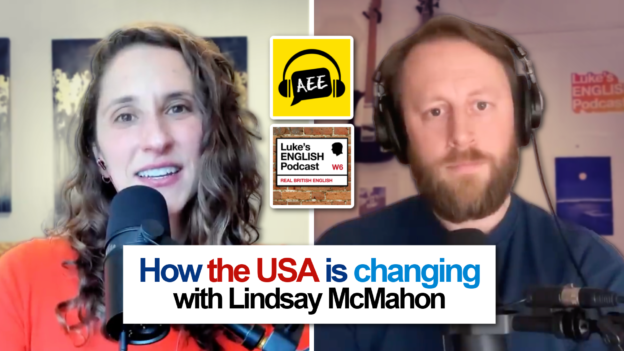
Today on the podcast I am talking to Lindsay from All Ears Engish.
Do you know the All Ears English podcast? If you don’t know it, then that is a surprise to me because All Ears English is an extremely popular, well-known and high ranking podcast for learners of English.
I’m sure you’ve come across it before. Yellow logo, Lindsay and her co-hosts Michelle, Jessica and Aubrey. American English. Their episodes are always full of positive energy. They promote personal growth through learning English and their mantra is “connection not perfection”. All Ears English. Over a million subscribers on Apple Podcasts and Spotify, ranked in Best of Apple Podcasts categories in 2018 and 2019, and #1 in US Education Language Courses category. Lindsay and her team have been featured in Podcast Magazine, Language Magazine, and Forbes. When your podcast is in a magazine, when you’ve crossed from one medium into another, you know you’re doing something right. You know, All Ears English! https://www.allearsenglish.com/
Lindsay is a returning guest on my podcast. She has been on this show a few times before. Long, long term listeners might remember her first appearance way back in episode 186 in 2014 talking about culture shock. So we’ve collaborated quite a few times. I have also been on All Ears English a number of times too, including recently.
Just a couple of months ago, Lindsay and I decided that it was about time we collaborated again on a couple of episodes so we invited each other onto our respective podcasts. I was on her show just a couple of weeks ago, in episode 2140 talking about differences between American and British English. We compared the vocabulary differences, communication style differences and more. If that sounds interesting, you could check it out. AEE 2140: The Subtle Differences Between American and British English with Luke’s English Podcast
And for Lindsay’s appearance on my show in this episode, we agreed that it could be really interesting to talk about Lindsay’s home country – the USA and what’s going on there at the moment in terms of economic, political and cultural changes.
You’re going to hear us talking about things like:
The actions of unions and how that has been affecting workers’ rights.
The way cities are evolving because of changes in people’s working lives especially since the COVID-19 pandemic.
Property prices, the energy crisis, American people’s attitudes about their government, trust in public institutions and other things of that nature.
Also, I couldn’t help adding my own comments about what’s been going on in the UK as well, in order to compare and find similarities between our two countries.
It’s a big year for both the UK and the USE – we have big elections coming up – a presidential election in the USA at the end of the year and a general election in the UK at some point.
There’s plenty to talk about. I hope you find it all interesting. I’ll talk to you again a little bit at the other end of this conversation, but now, without any further ado, let’s get started.
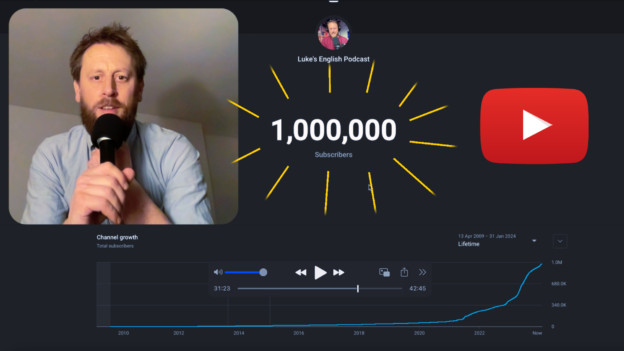
Here are my reactions to getting 1 million subscribers on YouTube, and probably 1 million+ on audio platforms too! Listen to me rambling on my own and with my daughter (6 years old now) while the subscriber number gradually goes up, and eventually reaches this big milestone.
This website uses cookies to improve your experience while you navigate through the website. Out of these, the cookies that are categorized as necessary are stored on your browser as they are essential for the working of basic functionalities of the website. We also use third-party cookies that help us analyze and understand how you use this website. These cookies will be stored in your browser only with your consent. You also have the option to opt-out of these cookies. But opting out of some of these cookies may affect your browsing experience.
Necessary cookies are absolutely essential for the website to function properly. These cookies ensure basic functionalities and security features of the website, anonymously.
Cookie
Duration
Description
cookielawinfo-checkbox-analytics
11 months
This cookie is set by GDPR Cookie Consent plugin. The cookie is used to store the user consent for the cookies in the category "Analytics".
cookielawinfo-checkbox-functional
11 months
The cookie is set by GDPR cookie consent to record the user consent for the cookies in the category "Functional".
cookielawinfo-checkbox-necessary
11 months
This cookie is set by GDPR Cookie Consent plugin. The cookies is used to store the user consent for the cookies in the category "Necessary".
cookielawinfo-checkbox-others
11 months
This cookie is set by GDPR Cookie Consent plugin. The cookie is used to store the user consent for the cookies in the category "Other.
cookielawinfo-checkbox-performance
11 months
This cookie is set by GDPR Cookie Consent plugin. The cookie is used to store the user consent for the cookies in the category "Performance".
viewed_cookie_policy
11 months
The cookie is set by the GDPR Cookie Consent plugin and is used to store whether or not user has consented to the use of cookies. It does not store any personal data.
Functional cookies help to perform certain functionalities like sharing the content of the website on social media platforms, collect feedbacks, and other third-party features.
Performance cookies are used to understand and analyze the key performance indexes of the website which helps in delivering a better user experience for the visitors.
Analytical cookies are used to understand how visitors interact with the website. These cookies help provide information on metrics the number of visitors, bounce rate, traffic source, etc.
Advertisement cookies are used to provide visitors with relevant ads and marketing campaigns. These cookies track visitors across websites and collect information to provide customized ads.