Category Archives: Personal

474. Holiday Diary (Part 1) New Arrival, New Destinations

Hi everyone, I’m back from my holiday so here’s a new episode of the podcast. In this one you’ll hear me talking about some recent news (including quite a big announcement) and then an account of what we did on holiday including some descriptions, opinions and stories. There’s talk of disturbing political events, dodgy car rental experiences, and a couple of beautiful cities where urban life meets wild nature. Enjoy!


[DOWNLOAD]

Notes & Transcript

Some of this text (below) is a full transcript of what I say in the episode, and other parts are just basic notes which I used while recording. So it’s not a 100% complete script.

Hello! I’m back from holiday!

How are you? Did you have a good August? Did you go anywhere?

Let us know in the comment section what you’ve been up to.

In this episode I want to just tell you about my holiday.

As you know, I’ve been away and it’s become sort of customary for me to give you a sort of holiday report whenever I come back from a trip away, so that’s what I’m going to do in this episode.

I’m going to describe places we visited, things we saw and I’ll tell a few little anecdotes along the way and give you my opinions on some things.

You will find some notes and transcriptions on the page for this episode if you want to read some of the words I’m saying, for example if you hear me say something in particular and you’re not sure what it is, check the episode page it will probably be there.

I don’t know how long this is going to be. I might divide it into a couple of episodes. It’ll be as long as it takes for me to just feel like I’ve told you the things that are on my mind and were on my mind while we were away.

Just before we start

  • Andy interview part 2 (Episode 472) – it seems a lot of people were quite moved by Andy’s story. It was an emotional one. Andy deserves some respect for sharing it with us and for managing to get through such a terrifying experience when he was relatively young. It’s also interesting to see in the comments that many of you have had similar experiences to Andy or your lives have been affected by cancer in some way, and you have used running as a way to deal with it and so you found his account to be particularly poignant. Unfortunately cancer touches many people’s lives in one way or another. But a story in which someone beats it is always a reassuring boost to anyone who knows about it.
  • Website only stuff – I hope you enjoyed some of the website only material I uploaded while I was away. There are three things in the episode archive that you won’t know about if you just subscribe to the audio podcast. One is an episode of Zdenek’s English Podcast in which he recorded us speaking in London when we met there and we had fun teaching some crime-related idioms and just making up some stuff about my supposed criminal past. The second thing is a DVD commentary track that I recorded with James for Star Wars Episode 4. We just sat down in his flat one evening, put on his Star Wars DVD and recorded our own commentary. That’s just for the Star Wars fans I suppose. You can just listen to it, or watch the film and listen at the same time and you’ll hear James and me discussing the various scenes, making fun of the film, doing some impressions of the characters and generally messing around over the top of the film. Then the third thing is a long musical mix that James and I did using his vinyl record collection. He has a lot of vinyl records, many of them original 7inch and 12inch singles from the 60s, 70s and 80s. We went through his records in a long mix and the plan was to go through a history of British music. THe mix has some speaking between the records and you’ll hear music all the way from 1961 to the mid 90s when we ran out of time. If you like music and you’d like to learn a bit about the UK’s musical history, check it out.
  • Transcript projects – The Orion Team and Andromeda Team have been busy producing more and more transcripts. You can now find over 250 finished scripts and also many scripts which are 100% proofread. Go to the transcripts page on my website for more info. I’ll be updating that page soon to make it easier for you to find the transcripts.

So, the holiday.

Where did we go? And why?

We wanted to have kind of a blowout – that’s a fairly big holiday as a celebration because my wife is pregnant. Yes, she’s pregnant, we’re going to have a baby so we wanted to go on another big trip while it’s just the two of us before the baby arrives.

That’s right – my wife is pregnant. We’re going to have a baby in December.
That’s kind of a big deal isn’t it?

If you are now thinking of writing to me by email or in the comment section to send me a message about this, and you’re wondering what to write exactly. Here are some things that would be appropriate.

Congratulations!
Very happy for you!
Fantastic news!
That’s great!
When is it due?
Do you know if it’s a boy or a girl?
Do you have any ideas for names?
Are you ready?

Those are some appropriate things.
Basically, congratulating us and wishing us well.

Needless to say, anything other than that would be inappropriate, right?

No doubt some of you will choose to think about the podcast and how that might be affected by this oncoming change in my life.

Don’t worry, I’m not going to stop doing the podcast because I’m having a baby (correction: my wife is actually the one who is going to have the baby, I’m just going stand there, let her dig her fingernails into the back of my hand and hope for the best.)

It’s true, things are bound to change in my life because of this and certainly at the beginning when the baby is newly born it might be hard to record and upload episodes as regularly as normal, but I definitely plan to carry on the podcast because honestly, this podcast is like my job these days – it is a job because I get income from sponsorship. It is a job I thoroughly enjoy and that I chose for myself.

Confucius: Choose a job you love and you’ll never work a day in your life.

Quotefancy-23697-3840x2160

But it is a job nonetheless.

So there are several reasons why I plan to continue doing it. I’m not about to just abandon it.

So we chose to have a big trip to celebrate our last summer holiday just the two of us.

This would be our last holiday just the two of us! We kept saying, “It’s our last summer together!”

We’ve always gone abroad for our recent holidays – it seems alternating between parts of Asia and North America. Indonesia, California, Thailand, Japan.

But we think that with kids it would be easier and also safer to go on holiday in France or the UK.

So, this year we wanted one more fairly big trip!

2 years ago we had our honeymoon in California – we had an amazing time and had a few mini adventures involving bears outside tents and injuries on hiking trails (I made something like 8 podcast episodes about it! Called California Road Trip)

But there were things we didn’t manage to do or see on that trip and we always said “We’ll come back and do it next time” – at the time it helped deal with the disappointment of knowing were missing something, like for example the Grand Canyon or something else we really wanted to experience. “We’ll get it next time” we would say.

You can’t always see everything you want.

So this time we decided to have what we’re calling a ‘babymoon’ by going back to that part of the world to do the things we missed out on last time, just as a big final holiday just the two of us.

So, we went back to the USA – to Southern California for some days and then quite a lot of time exploring the National Parks and areas within the Navajo Nation territories. Places like Zion National Park, Bryce Canyon National Park, Monument Valley, Lake Powell and The Grand Canyon. Incredible landscapes, natural scenery and wild beauty – but also the kind of infrastructure that would make it possible for my pregnant wife to see all that stuff without it being too inconvenient or risky.

So this is like the California Road Trip 2 but this time we went to lots of other states too, including Nevada, Arizona and Utah.

Back to the USA and for some reason I feel slightly sheepish about telling you that.

Feeling sheepish = slightly embarrassed, uncomfortable or unsure about something.

Why?

Politics

Maybe because of the political situation over there which is throwing a weird shadow on everything. It feels like a controversial time to go over there, as if you’re somehow taking part in it, validating it or making a statement about it.

There was nothing political about our trip so that has nothing to do with it.

It was hard to escape the politics there though, but only on the TV, mostly.

In our everyday experience we didn’t see any trouble, unrest, no anti-Trump rallies, no white nationalists marching around. We saw a couple of bumper stickers saying MAGA and also a poster that said “Hillary for Prison 2016” but that was it. A couple of people we met talked about how ashamed they were that Trump was their president and seemed surprised that we still wanted to visit the country.

But generally speaking, everyone we met – including people I imagine had voted for Trump and others who hadn’t – everyone was very polite and nice to us and apparently to each other too.

On the TV though, there were scenes of violence and chaos as fighting broke out between white supremacists and anti-facists in Charlottesville Virginia, on the other side of the country.

On TV it was fighting, chaos, debates, angry tweets, all kinds of drama. I took a look at Twitter a few times and there was a lot of quite angry debate on there with strong opinions on both sides – those who were clearly against the white supremacist groups and those who defended them. It felt at times like the country was in turmoil.

Then we looked out of the window and it was just silence, maybe a car driving by.

It just showed me the sharp contrast between the reality of TV and the internet (because I think the internet is the new mainstream media – despite what all the YouTubers think – it’s fast becoming the mainstream media, especially when they get more views than many TV shows). It showed the contrast between what you get in the media, and what you actually experience, but then again we were just tourists and were probably just scratching the surface.

Reminds me of Bill Hicks https://www.youtube.com/watch?v=tGjuPJskNRE

I could go into all the complicated politics of what happened in Charlottesville but I think I won’t, in this episode.

I could describe the reasons why white nationalists were marching through a town in Virginia (on the other side of the country to California), why they were waving confederate flags, why some of them had swastika flags, why they were shouting Trump Trump Trump and MAGA. I could go into how they fought with anti-facist protestors, and how we’re not sure who started the fighting. I could talk about how someone from the white supremacist side drove a car into the anti-facists, killing a woman and injuring 20 others, and I could go into why many people feel so upset and angry with their president for not taking a clear position on these people who some describe as fascists and neo-Nazis, and how lots of people believe Trump is somehow encouraging these people.

I could go into all of that, but this episode is supposed to be about a travelling experience, not about a fight in a town on the other side of the country.

I might come back to it in another episode. I’ll see how I feel.

The Holiday

Itinerary
Paris – Montreal (half a da) – L.A. (a few days) – Vegas (one evening is enough!) – National Parks & Canyons – Vegas (for about 2 hours) – L.A. (a few more days) – Paris – Bed!

Cities and national parks. Urban areas with metropolitan life and amazing geological features in desert canyons.

Montreal

One afternoon and an evening.

We hung out mainly in the Mont Royal area and the old town.

  • Reasons Montreal is an awesome place
    People are really friendly and polite.
    Everyone’s bilingual, which is amazing. It’s shows that it’s totally possible for a whole city to be bilingual. No need to panic and freak out about several languages being spoken in a city at the same time.
  • It’s really diverse and in a good way because everyone’s really chilled out and there seems to be a lot of mixing between ethnic groups and not a lot of tension or anything.
  • They have this food called “poutine” which is basically French fries covered in cheese and gravy – not that healthy but it is seriously tasty.
  • The city has this nice colonial vibe to it and there’s loads of greenery everywhere. In the streets we walked down there were leafy trees, big bushes outside people’s houses, just plants growing everywhere – some of them planted, some of them weeds, but it felt like there was lots of plant life almost taking over the city, which is great. In Paris, it’s all stone and as a result it can feel a bit brutal. The greenery adds some much-needed calm to the place and also oxygen.
  • The buildings are really cool-looking, with really interesting looking staircases outside them and awesome wrought iron balconies and verandas.
  • Montreal has access to some amazing wilderness areas like local mountains, lakes and forests so you can get into nature really quickly while also enjoying the benefits of living in a city.

We were walking around going, “oh my word this is the perfect city for us”.

But, the bad side is that in winter it’s totally freezing and everything gets covered in 4 feet of snow, which makes life really inconvenient.

I know some of you listening to this live in similar places. What’s that like? How bad is that really?

Anyway, I loved Montreal and would gladly return there one day.

I like all the space, the convenience, the feeling of being in the ‘new world’, the vast natural landscapes and all that, but it’s Canada so you don’t get the feeling you’re in a completely crazy country where people shoot each other and stuff like that. I’d love to go back to Canada again one day. I did travel there for a month when I was 19 with my cousin Oliver and we had an amazing time then too. We’d very much like to go back there. We were even talking of moving there, but we don’t want to leave our family and friends behind.

Left Montreal and Flew to Los Angeles

Nightmare rental car experience with “Right Cars”.

Arrive and the woman at the info desk doesn’t know the company. Not a good start.
We work out that we need to get a shuttle to a car park a couple of kilometres away from the airport. A car park.

Everyone else is getting out of the shuttle at the proper rental places, getting greeted with smiling service agents from Enterprise and Avis.

We’re the last ones on the bus. Dropped off and told to go around the corner. “Round the corner! Round the corner! Just go on round the corner sir.”

At least they called me sir.
Tried to call them. Call centre hell.
Now I’m on hold in blazing sunshine in a car park, or parking lot.

It’s even called the cell phone lot. There’s no chance of not standing there on your cell phone, that’s the name of the place.

Finally get through to someone. There’s a driver coming.
We’re expecting a shuttle.
Dude turns up in a rental car.

We get in, asking questions. He tells us the shuttles are in the garage. Both of them just broke down this week.

OK.

We pick up the car, they add some other charges we didn’t know about like a toll road charge. Never went through a toll road.

And the bill and the receipt didn’t match but we were told it would be sorted out because the guy wasn’t there.

Shady dealings.

I’d ordered a GPS with it too and he said “Do you still want the GPS?” after we’d already paid.

Nah, that’s fine I took a good look at the city from the plane window, I think I’ve got it all worked out. I’ve played a lot of GTA5 I think I know my way around this city.
I watch a lot of movies, I know LA like the back of my hand, I’ll be fine.
Of course we wanted the GPS. “Do you still want it?”
No it’s ok, I’ve decided to just use the force. Thanks.

What’s it like walking around in LA? (I talked about this a bit in previous episodes)
Like being in a movie
GTA5
Sunset Boulevard
Cool looking little shops and bars.
Hippie stuff everywhere.
Shops selling jewelry and cool clothes.
Constant smell of vaping, but not seeing where it came from.
Vegan coffee shops and stuff.
Amazing sunshine, lazy cars drifting past.
50s style burger joints and dudes on cool bicycles.
Tattoo’d people, bikers.
Stopped at a sports bar.
First hearing of Hotel California (this ubiquitous song that you hear everywhere)

Los Angeles is a big city with millions of people, an urban place where everyone drives, but there is a surprising amount of nature there with lots of wild plants, cactuses, trees, animal life, and hills with tree-filled canyons. You feel like it’s not difficult to get into nature quite easily. It’s not exactly like it is in the movies. In many ways, it’s better.

To be continued in Part 2 with some content about: Modern art, astronomy vs astrology, flat-earth conspiracy theories and more descriptions & stories!

Thanks for listening.

Luke

Oasis of calm - in the middle of Silverlake, Los Angeles.

Oasis of calm – in the middle of Silverlake, Los Angeles.

473. Explaining the Rules of Cricket (with Dad)

Everything you need to know about the world’s 2nd most popular spectator sport, cricket. I’m joined by my Dad, Rick Thompson and we describe the rules, the appeal of the game and also some expressions in English that come from cricket.


[DOWNLOAD]

It’s summer in the UK and at this time of year there are various sounds that you might hear in a typical English village, the sound of bees buzzing, kids playing in the playground, an ice-cream van and perhaps the smack of leather on willow (the sound of a cricket ball – a hard, heavy ball covered in leather, being hit by a wooden cricket bat made of willow) those sounds coming from a game of cricket on the local village green.

Also, the sounds of cricket make their way into your home during the summer months as people listen on the radio or watch the coverage on TV.

International test match cricket is a feature of the summertime in England and is somehow deeply rooted into English life. It’s one of those cliches of rural England – sandwiches, afternoon tea and cricket on the green.

But for many foreign people who don’t play cricket it can seem like a weird antiquated slow game with rules that nobody understands. People are surprised that a game of cricket can last several days. Americans are often horrified to discover that games often end in a draw with no winner at the end.

The fact is, cricket is a fantastic game which requires strategy but there are many moments of dramatic action and great skill and ability shown by the players.

My Dad is a big fan of cricket. He used to play it when he was younger and has always followed the matches on the radio. I’ve been threatening for a while to do an episode about cricket, to somehow achieve the impossible and explain cricket to the world, and my Dad is going to join me.

So sit back, have a cup of tea and some cake, and try to get your head around this wonderful game.

And stay tuned for some nice idiomatic expressions which we use in English and which originally came from the game of cricket.


Well, that was a valiant effort by us. I hope you agree! But I wonder if you managed to keep up with all of it! If you are listening all the way to the end and you’re still alive – well done!

You may have got lost at some point along the way, or did you follow all of it? Let me know.

In any case I hope you got something out of that conversation, even if it is a sense that cricket is worth getting enthusiastic about even if you don’t fully understand it, and that it’s a big thing in the UK and many other countries around the world.

I recommend that you have a look at some cricket being played. There are videos showing you different aspects of cricket on the page for this episode, so check them out.

Also, there was that vocabulary.

Let me just go through the vocabulary again here, just to make it clear.

Vocabulary

  • On a sticky wicket = in a difficult situation (We’re on a bit of a sticky wicket here because of the result of the EU referendum) (NYTimes “It’s a sticky wicket for Obama,” said Bruce Buchanan, a political science professor at the University of Texas at Austin, saying any aggressive move on such a high-profile question would be seen as “a slap in the face to his supporters right after they’ve just handed him a chance to realize his presidential dreams.”)
  • To have a good innings = to have a good long life (How old was he when he died? 94? Oh, so he had a good innings)
  • It’s just not cricket = it’s not fair! (Getting queue jumped, it’s just not cricket, is it?)
  • It hit me for six = it surprised, shocked and stunned you. (When my ex-girlfriend told me she was getting married to my best friend it really hit me for six)
  • I was absolutely bowled over = I was really surprised and amazed (“Bowled over” actually comes from bowling not cricket – when a pin is knocked over by the ball) (We were really bowled over by your presentation, you did a fantastic job!)
  • I’m completely stumped. You’ve stumped me there. = I’m unable to answer that question because it’s too complicated. (I did ok in the listening part, but I was completely stumped by the grammar questions)
  • You’ve caught me out there. = You’ve asked me a difficult question which has shown that I’ve made a mistake. (What about the outstanding tax payments on your public accounting report? There’s 300 pounds missing! – Oh, you’ve caught me out there, hah, yes I forgot to include them!)

Videos

Stephen Fry explains LBW in cricket

Shane Warne from Australia – the greatest spin bowler ever

Great bowling

Excellent batting

https://www.youtube.com/watch?v=4zAsa_HFkVw

Amazing catches

https://www.youtube.com/watch?v=TdOoiR_EDiE

Thanks for listening!

472. Andy Johnson at The London School (Part 2) Why Andy runs marathons

Talking to Andy about why he runs marathons, including vocabulary relating to doing exercise, health, fitness, technique, injuries and medical care.

[DOWNLOAD]

Intro Transcript

Here’s the next part of my conversation with Andy Johnson, recorded at The London School of English a few days ago.

Andy is an English teacher, a father of 2 kids, and also a regular runner. He’s done at least one marathon and a few half marathons, and I thought since many of you listening to this podcast will also be runners (in fact some people will be running right now while listening to this) that it might be interesting to hear Andy talking about his reasons for running, the way he does it, the benefits, the difficulties and all the rest of it. So here’s a conversation about running.

If you’re not into running I would still recommend that you listen to this. You might be surprised at how personal it gets when Andy explains his reasons for training for the London marathon 10 years ago. It turns out that running has special significance for Andy and that running the London marathon was a key moment in his life as it marked a significant milestone for him – and running acts as a regular reminder of a particularly difficult experience Andy had when he was younger.

So, this episode is about running, but it’s also about much more than that. I’d like to thank Andy again for taking part in another episode of the podcast and for sharing so much of his story.

Vocab hunters: Watch out for vocabulary relating to doing exercise, health, fitness, technique, injuries and medical care.

So, without further ado you can now listen to our conversation about running.


Outtro Transcript

I just want to thank Andy again for coming on the podcast and telling us about his story. It was a very interesting conversation and I think the closest we’ve come to having tears on the podcast – it was a moving story but no tears this time! I wonder if you held it together out there in podcast land, or did you start welling up at any moment?

Don’t forget that Andy would like you to take his survey about self-directed learning. You can find a link to that on the page for this episode. Andy just wants to know about how you learn English on your own, outside of the classroom environment, and that includes how you use LEP to help with your English.

TAKE ANDY’S SURVEY ABOUT LEARNING

Click the link, the questionnaire will take a couple of minutes and you’ll help Andy with research for his next IATEFL conference talk.

That’s it for this episode. Watch out for some website-only content coming soon. Subscribe to the mailing list to get informed when that is released.

I hope you are continuing to have a good August, if indeed it is August as you listen to this. I’m still on holiday, relaxing and having a lovely time, I hope – I’m actually recording this before I went on holiday, so this is a very weird time situation. Which tense should I be using here, because I’m actually recording right now, in the past, but as I’m talking it’s the future, so my present is your past and your present is my future, so that’s the present past perfect future continuous or something. I am will have been being having a great time and I will have been had been hoped that you will be being having a wonderful time too, in the future.

Thanks for listening to this episode and I’ll speak to you again soon. Bye!

468. Punk – Music & Culture (with James)

Talking about punk music and culture from the UK with James.


Small Donate Button
[DOWNLOAD]

A bit of pop culture history in this episode, talking about the musical movement of punk and the social situation in which it happened.

This year we have several anniversaries in British music.

50th anniversary of Sgt Pepper by The Beatles

40th anniversary of Never Mind the Bollocks by The Sex Pistols

A lot changed in British music between the release of those two albums. 1967 was the height of the peace and love movement but 10 years later music was much more gritty, cynical and realistic. In this episode we’re looking at the whole punk movement, understanding what it was all about, what the music was like, who was involved and how the whole thing has now become a sort of pop culture myth.

I’m joined by my brother James who has been a fan of punk music ever since he borrowed a tape of The Sex Pistols from a chef when he was a teenager (I don’t think the fact it was a chef has any significance to the story, but I just like saying he borrowed the tape from a chef. I can imagine a man in a chef’s hat giving James a tape. Just me? Ok) So he discovered punk music later, in the early 90s. He wasn’t actually there at the time the music was made in 1977, he was too young, but he’s collected a lot of records by punk bands, read all the books, seen all the documentaries and even played drums in a few punk bands himself. I think he knows more about punk than anyone else I know, so I think he’s a good person to talk to.

Check out the page for the episode where you’ll see video playlists chosen by James and also a musical punk mix that he did from his vinyl record collection.

But without any further ado, you can now listen to my conversation with James about punk rock music and culture.


Conversation Notes

  • 40 years since Never Mind the Bollocks by The Sex Pistols was released. Is that the seminal punk album?
  • Why are we talking about punk in this episode?
  • What gives you any authority on the subject? Why should we listen to you?
  • Importance of punk for understanding culture
  • What is punk?
  • Origins of U.K. Punk
  • Youth subculture
  • Musical context
  • Political context – state of the country
  • American punk
  • Main bands
    • The Damned
      The Slits
      X-Ray Specs
  • What was the era like / music scene of the time
  • Spirit of punk
  • Purpose of punk music
  • Reaction to punk – tabloids
  • Punk art / design / fashion
  • 2nd wave / post punk / punk influence
  • Reality vs legend / absorption into the culture / establishment

Some Words & Phrases

  • Subculture
  • Subversive
  • Anarchy
  • DIY – Do It Yourself
  • Back to basics

From the archives: Other episodes you might like

134. The Story of Salvo

115. A Chat About Music (with James)

234. Making “Choons” with My Brother

Leave us your thoughts

  • Is or was punk popular in your country?
  • Is or was there a punk movement where you come from?
  • When did it happen?
  • What was it all about?
  • What was the music like?
  • How did they dress?
  • Is it similar or different to British punk?
  • Are British punk bands popular where you’re from? Which ones?

End song clip: 17 by the Sex Pistols

Videos

Sex Pistols on Bill Grundy (the unedited version)

Sex Pistols Christmas 1977 – A must see to show what a weird time / place England was in 1977 – click the video, it should work.

The gig that changed the world (24 Hour Party People)

https://www.youtube.com/watch?v=1vvGp_VPeLI

Classic Albums – Never Mind The Bollocks

https://www.youtube.com/watch?v=Jf50NIjAcsQ&t=64s

The Filth and the Fury trailer

The Sex Pistols absorbed into the mainstream establishment

Brilliant documentary about Joy Division

Cliched memories of punk (parody)

The Damned – New Rose (typical punk song)

Jim’s punk mix

Jim’s Punk Mix

465. How I make episodes of the podcast (Part 2)

Talking about the technical side of making podcast episodes, including fascinating* insights about my recording equipment and an exciting** anecdote game. Includes upbeat music to absolutely guarantee*** that you will not be bored during the episode!

*insights may not actually be fascinating
**management holds no liability for any lack of excitement experienced
***not actually a legally binding guarantee


[DOWNLOAD]

Introduction

Here’s a new episode and I’m continuing to talk about how I make episodes of the podcast, and this whole thing is a response to a question sent to me by Carlos from Barcelona

In the last episode I was talking about the creative side of coming up with ideas and making them into podcast episodes. Not that I know what I’m doing really, but a few listeners have asked me about this over the years and I thought it might be interesting to answer those questions and just lift the lid on LEP and let you see how episodes are recorded.

In this one the plan is to talk about the technical side of doing the podcast.

Vocabulary

Watch out for vocabulary which will be explained in forthcoming episodes, including uses of get, technical language and other expressions.

Feedback

[socialpoll id=”2275035″]

Send me a private message with more details.

Please be constructive with your feedback! Thanks :)

← Back

Thank you for your response. ✨

463. News, Comments & Questions (A Rambling Episode)

Giving some news, responding to comments & questions, rambling about new shoes and getting lost in the jungle.


Small Donate Button
[DOWNLOAD]

JILMANI’S 15 DAY CHALLENGE

LEP MEETUP GROUPS

ALEXANDER GREK’S DETECTIVE NOVEL

SONG


460 Catching Up With Amber & Paul #6 (feat. Sarah Donnelly)

Conversation and language analysis with the podpals and guest Sarah. Hear some conversation about being married to a foreign person, bringing up kids to be bilingual, and learn some slang in Australian and Northern Irish English. Vocabulary is explained at the end.

Small Donate Button
[DOWNLOAD]

Introduction

This episode is choc-a-block with natural conversation and language.

Yesterday I had Amber and Paul over to the flat, and I also invited Sarah Donnelly, a friend of the podcast. Sarah also brought her baby who she had since she was last on the podcast. There’s no relation by the way between her being on the podcast and having a baby. Purely coincidental. Anyway, the four of us sat around the table yesterday in the blistering heat to record some podcast material and that’s what you’re going to hear.

Sometimes you can hear the baby screaming and gurgling in the background but I don’t think it spoils the recording really. She hasn’t learned to talk yet, but who knows being on the podcast might help a little bit in some way.

The conversation is a bit chaotic because there are 4 people, sometimes talking over each other. If you like you can imagine you’re in a business meeting. A business meeting in which no business actually takes place, nobody observes the rules of formality and where the participants just chat with each other. So, not much like a business meeting really, but anyway a meeting of sorts, and this is the kind of thing you might have to deal with in the future if you go to a meeting in English and there are a number of people discussing things and you have to keep up. It’s good practice to listen to this kind of thing to help you prepare for that kind of situation.

This recording was slightly shorter than the usual full-on ramble that we have together. But I’m going to do a bit of language analysis at the end. I’ll pick out a few words and phrases and will clarify them after the conversation has finished.

Also there’s another language-related episode coming soon with Amber, Paul and Sarah.

Here now is a discussion between podpals Amber and Paul, also featuring Sarah Donnelly the American with Irish roots who has been on this podcast before, most recently talking about the US Presidential Elections with Sebastian Marx.

Things we all have in common:

  • We’re all English speaking expats in France
  • We are all with French partners, either married or “paxed”
  • We’re all comedians on the stand up scene too

In this chat we discuss a few things, such as the complexities of being with a foreign partner, bringing up a child in a foreign country to be fully bilingual, getting married and what it feels like for the bride and groom on the big day, Amber’s podcast which was recently released online, Paul’s upcoming gig in Australia, Sarah’s Irish roots and some English slang from New Zealand, Australia and Northern Ireland.

Questions

Here are some questions for you to consider as you listen. This can help you to focus on the content.

  1. Are you or have you ever been with a foreign person in a relationship? What are the difficulties of that?
  2. What’s the best way to bring up a child to be bilingual? Is it possible to raise a bilingual child when only one of you speaks one of the target languages to the child?
  3. Are you married? How did it feel for you on the big day? Did you cry? Have you ever been a guest at a wedding, and did you cry?
  4. Have you heard Amber’s podcast, which is called Paname? It’s now available at panamepodcast.com
  5. Can you identify different English accents and dialects from around the world? How about American vs British, or different areas of the UK? How about Ireland and Northern Ireland? What about Australia and New Zealand? Do you know what their English sounds like?

Right. Consider those questions as you listen to this conversation and hold on until later when I’ll explain some of the vocabulary and some cultural stuff too, maybe touching on different accents, wedding vocabulary and more.

But now you can listen to Amber, Paul, Sarah and me, melting in my boiling hot apartment.


Vocabulary and other language points – Explained

It’s really hot
It’s hot as hell
It’s boiling
It’s sweltering
It’s baking
It’s blisteringly hot

Being partnered with a French person is hard work.
I have one hour’s worth of material on this.
One hour’s worth of something
5 minutes’ worth of something
We’ve got 3 days’ worth of food left
I’ve got about 10 minutes’ worth of battery left

Bringing Up Children
Bringing up
a baby in a foreign country with a foreign partner – will they speak English?
Bring up a baby
Raise a child
Be raised in / to
Grow up
Do you have experience of bringing up a baby to be bilingual? Let us know.
If just one parent speaks English, and the rest of the time it’s French with school, friends and everything else – will the kid be bilingual?
Anglophone
Francophone

Condone/Condemn
I don’t condone the hitting of a child (stupid thing to say actually – but that’s what happens when you joke – sometimes you go over the line a bit – obvs I didn’t mean it)
Condone / condemn

Paul’s Wedding
An out of body experience
We were so stressed out

Crying
To cry
To be in tears
To well up
To choke up

Neither of us cried
I thought everybody would be in tears
I welled up a bit
I was choking up

Walk down the aisle
The altar

Her parents aren’t with her any more. They passed away.
Paul’s dad gave her away. “It was so sweet that it was your dad that was giving her away.”
I’m left-handed
I can’t grip it like I like to grip it. (innuendo)
He’s jumped ahead. (he’s gone to the innuendo before we realised it)

Some ninjas came out of the woodwork. (to come out of the woodwork)
to appear after having been hidden or not active for a long time:
After you’ve been in a relationship for a while all sorts of little secrets start to come out of the woodwork.
Mildly disapproving.
From Cambridge Dictionary Online.

They feel like they’re going to do mistakes. Make mistakes.

Aussie slang http://mentalfloss.com/article/61847/25-awesome-australian-slang-terms
G’day mate, how are you going?
Arvo: afternoon
Barbie: barbeque
Bogan
Chockers
Fair Dinkum
Fuckin’ oath!
Sweet as
Strewth! (Cliche)

Kiwi slang
The slang is pretty similar to Aussie or UK slang, but the accent is different. For years I couldn’t differentiate it from Aussie, but the more you hear the more you realise how different it is. Watch Flight of the Conchords to hear lots of it. Episode in the pipeline.

I was on The Rock n’ Roll English Podcast and The Earful Tower Podcast this week

Some news of Other People’s Podcasts

This week I’m featured in episodes of The Rock N Roll English Podcast and The Earful Tower Podcast.

The Rock n’ Roll English Podcast


This one is presented by English teacher Martin Johnston, who lives in Italy. It’s a learning English podcast for intermediate students who want to listen to people talking about normal things like sex, drugs and rock and roll, all of which are completely normal things!

Martin makes an effort to teach the vocabulary that comes up in his conversations that cover fun and interesting topics. It should be easy to understand this one as Martin grades his English a bit so that intermediate students can understand him.

In this episode Martin presented me with some very awkward social situations and we discussed my choices for each one. Often the best option was to just jump into a lake. Listen to the episode above to find out more and visit Martin’s website here.

The Earful Tower


This one was recorded a few weeks ago and has been published now. The Earful Tower podcast is run by Oilver Gee and their goal is to figure out France with the help of a new guest each week – from cooks and comedians to TV hosts and tour guides.

In the past they’ve interviewed Paul Taylor and this week it was my turn. The topic was how French people learn English.

You’ll hear three voices. Oliver Gee the host, who is half Australian and speaks with a bit of an Aussie accent and James his co-host who is half French but speaks English like a native, and me.

This one might be a little difficult to follow as Oliver has a bit of an Australian accent and the three of us talk pretty quickly.

This was a fun discussion about the ways French people approach learning English. There’s one thing I regret saying here and that is that French teachers of English aren’t good at English. What I meant was that this is always what French people say as a kind of excuse for why their English “isn’t good enough”.

It was lots of fun being on The Earful Tower. You can listen to it above and check out their website here and Facebook page here.

Thanks for reading and listening! New episodes of the podcast will be available soon. Hope you’ve been enjoying the Rick Thompson report!

Bye bye bye bye bye

Luke

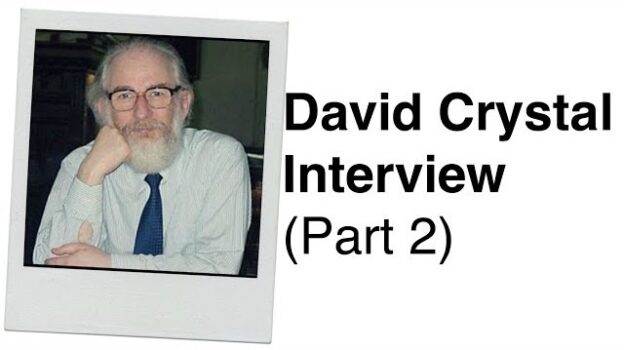
455. David Crystal Interview (Part 2) Questions from Listeners

Talking to the world’s top writer and lecturer on the English language, Professor David Crystal. In this episode, David answers questions from listeners.

[DOWNLOAD]

Episode Introduction

Here’s part two of my interview with the famous linguist Professor David Crystal.

In this one I asked him some questions from my listeners. I didn’t get a chance to ask all the questions I received, so if your question isn’t included then I do apologise. I left out some questions because I think he had already answered them in one way or another, or because we just didn’t have time.

But the questions I did ask him covered quite a wide range of different topics, including the way foreign words get absorbed into English, predictions for the future of English, how to deal with the workload of studying linguistics at university, the nature of English syntax, how languages affect the way we think and see the world, why British people use indirect and polite language, the influence of AI on language learning, the effects of Brexit on English in the world, whether it is appropriate to speak like Ali G, some study tips and some comments on the English of Donald Trump and Barack Obama.

Don’t forget to check out http://www.davidcrystal.com where you can see a reading list of David’s books, read his blog, see videos of him in action and even contact him by email.

I would just like to thank David for his time again, and I hope all of you out there in podcast land enjoy listening to our conversation.


QUESTIONS FROM LISTENERS

Influence of foreign languages on English

Hamid Naveed (Pakistan)
I’m an English language teacher. My question for David Crystal is: www.oald8.com (The Oxford Learners’ Dictionary) has a lot of new words from Urdu such as ‘ badam’ ‘ chai’ ‘ aloo’ ‘ bagh’ ‘ dharna’ and many more. If English keeps on taking words from Urdu or any other language, then what will be the future of English? I mean English will no longer be English. What is your take on this ? Thanks.

The Future

Jilmani
My question for David Crystal is what is the future of the English language? Will it be the same or will it be a little bit different since we know that english has changed over the decades?
How do you think English will develop over the next few years?
How will non-native speakers be part of this?

Tips for students of Linguistics

Jairo Trujillo García (from Tenerife)
I am studying an English and Spanish linguistics ( and philology ) degree , and even though I like it , it can be really hard at times ;
What recommendations would you give me to make the burden of vast information more manageable in the time allotted ?

English Syntax

Cat (Originally from Russia, moved to Germany)
I’m very confused about English syntax. I spent many years studying German grammar and syntax but it is of little use for learning English. German and English appear so similar (especially the words) and yet so different (for example, the sentence structure) at the same time. I just feel that something is completely different, but cannot point out the difference. Could you please tell us a little bit about the sentence structure and logic (the syntax) of English? (Perhaps you could compare it to the syntax of other languages)
As I don’t like doing grammar exercises at all (I’m sorry!), I was wondering, are there some more enjoyable and fun ways to learn English syntax? Maybe some shortcuts and mnemonics what you can offer us? Also what about the punctuation rules between the main and sub clauses? They can be a real pain in the neck for our transcribers. Thank you!
Cat

Language and Psychology

Wesley
I have several questions for Prof. David Crystal. The first is whether people who speak different languages think differently, I mean, if they understand and perceive the world in different ways. For example, I’ve heard that while in some places people perceive two colours and give each of them a name, somewhere else there might be others who perceive those same two colours as only one because they have only one name for them. Another example I have in mind is how we position adjectives in a sentence in English compared to in Romance languages. In English, adjectives usually come before the noun they describe. Romance languages, on the other hand, tend to place adjectives after the noun. So in English we first refer to the characteristics of something before we say what it is, and in Romance languages we start with a noun and then describe it. Does it affect, in any way, the way we think?
If we learn a second language, do we start to think more like the native speakers of that language?
Thank you very much!
Wesley

Language and culture

Mayumi (Japan)
Why do British people tend to use indirect language, hesitate to say “no” and also frequently say “sorry” in various situations? Is there any story from linguistic history?
In my Japanese culture, as far as I know we also find similar tendencies because we’ve lived in this tiny island and if people said whatever they wanted, behaved without caring about other people in this small area, or even argued with each other, they could possibly end up being expelled from this small society. This can be one of the reasons why we have these tendencies as well. This is something stuck in my mind for ages from the university class.
Did British people had similar experience when they established their culture or could it be an absolutely different story?
Cheers!

The Influence of Technology

Antonio (Spain)
My question for David Crystal: Apple, Google, Microsoft and other companies are working on translators in real time based on AI. So we can speak in Spanish with a French person and he will hear French while he speaks in French and we hear Spanish.
Skype has this option for 8 languages.
What do you think about about the AI related to language learning?
Will AI replace our need to learn other languages?

Advice for learners of English

Jack – Origin Unknown
(I don’t know why, but Jack always writes comments on my site in an Ali G dialect. I actually think it’s evidence of how good he is at English, because he can clearly write in normal style, but he chooses to adopt this specific form of English – if he can do that it shows great ability to shift between different registers and dialects – if he can break the rules I presume it means he knows that the rules are there in the first place – for some reason he chooses to write comments in this lingo – are you ready?)
I is not that learned but I also has got questions for Professor David Crystal.
Dear Sir,
Booyakasha, It is a well big honour to have you ere on da podcast, you is da only person me respects in the field of linguists after Norman Chomp The Sky and Stephen The Crasher (Naom Chomsky and Stephen Krashen).
What advice would you give to an English language learner to improve his / her language ability? Should the student focus on form (grammar, vocab etc) or should the student focus on meaning and let the subconscious do the rest?
Well that`s me questions there Big man. I has to say you is the shining crystal in the field of linguistics.
Big up yourself Prof Crystal
Respek, Westside.


Outtro

There was so much interesting content in what David Crystal said in this conversation and so much to take from it. These two episodes are really worth listening to several times so that you can really get a grip on what he said and really absorb it all.

If you sent in a question that I didn’t ask, then I’m sorry about that.
I should do follow-up episode in which I consolidate a lot of what DC said, and highlight various things that you can apply to your whole approach and attitude towards learning English.
Watch out for that.

Check out David’s work at http://www.davidcrystal.com
He’s got books about grammar, spelling, pronunciation, accents, Shakespeare – pretty much any aspect of English – he’s got it and he always writes in a clear and entertaining style.
I’m not selling his work or anything. It’s just genuinely good stuff that I’d like to share with you. This is why I’m so happy to have spoken to DC on the podcast – he’s ace and you should read his work.

Thanks for listening! I invite you to leave your comments below.

453. The 36 Questions that Lead to Love (with Amber & Paul)

Listen to Amber, Paul and me answering questions designed by psychologists to help couples or friends become closer and more intimate.

Small Donate Button
[DOWNLOAD]

Introduction

Hello, welcome back to Luke’s English Podcast, this podcast for learners of English hosted by me Luke Thompson. Hi.

The general idea of this podcast is to help you to improve your English by providing you with content to keep you listening regularly, for longer periods of time, to authentic English as it really is spoken. Sometimes I teach you things on the podcast and other times I play conversations for you to follow, like in this episode.

This episode is entitled 36 Questions that Lead to Love

In this one you’re going to hear the tangential trio of Amber, Paul and me talking about this set of 36 questions, which was compiled by a group of psychologists as part of a study into ‘interpersonal closeness’ or intimacy between people.

Amber first found out about it in a podcast published by the New York Times. Here’s what the NYTimes website says about this study, which is where the 36 questions come from.

The study by the psychologist Arthur Aron (and others) explores whether intimacy between two strangers can be accelerated by having them ask each other a specific series of personal questions. The 36 questions in the study are broken up into three sets, with each set intended to be more probing than the previous one.

The idea is that mutual vulnerability helps to create closeness and intimacy. To quote the study’s authors, “One key pattern associated with the development of a close relationship among peers is sustained, escalating, reciprocal and personal self-disclosure.” Allowing oneself to be vulnerable with another person can be exceedingly difficult, so this exercise forces the issue.

The questions are now used to help build intimacy or personal closeness typically between couples that want to fall in love, but also between anyone looking for ways of finding out more about each other and developing a closer or deeper relationship.

Amber’s going to tell you more about it in a moment.

These 36 questions are available for you to use or read online at NYTimes.com https://www.nytimes.com/interactive/projects/modern-love/36-questions/

In this episode you’ll hear Amber, Paul and me asking each other those questions.

Let’s see what happens.

  • Will the questions bring us closer together?
  • To what extent will the intimacy level rise?
  • Will they make us fall in love with each other?
  • Or will we just learn weird truths about each other that will disturb us, ultimately causing us to drift apart as friends, and then they’ll never appear on this podcast again?
  • Will these questions help you get to know us more?
  • What could be revealed by this set of questions designed by psychologists to become more and more intimate as they go?
  • Is it possible for 3 British friends to take the whole thing seriously enough for the questions to have the intended effect?

Listen on to find out more.

Here we go…


Outtro

OK so if you were counting the questions you’ll see that we skipped some but that’s our choice isn’t it!

I think, on balance, we probably did become slightly closer than before. There were some particularly revealing moments there where Paul was talking about his lack of confidence in social situations, which is a bit of a surprise considering how I often observe him showing no obvious signs of social awkwardness.

Of course, we didn’t take it all completely seriously. For example, you’re supposed to stare into each other’s eyes at the end of the questions, for four minutes, but that wouldn’t have been particularly interesting for you to listen to.

All the questions are available on the NY Times website – here https://www.nytimes.com/interactive/projects/modern-love/36-questions/

So check them out and use them yourselves – either on a date, with friends, or with your language partners or language groups.

They could provide a nice way for you to practise talking about feelings and personal thoughts in English.

And, if you fall in love with someone as a result, that’s a nice bonus isn’t it!?

If you’ve fallen in love with Amber’s voice and you’re wondering when Amber’s podcast is coming out – it’s not ready yet and I will announce it on the podcast as soon as it is online. It takes a long time to get these things ready – getting your head around the technology, writing, recording, working out how to publish, building a website, setting up your podcast feed, getting on the iTunes store and all of that stuff – it takes time and it’s not as easy as you might think, so just hold your horses for a bit, it’s on its way.