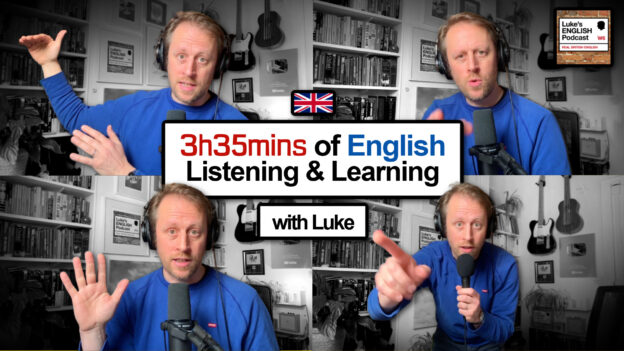
[976] Here’s an epic rambling episode in which I talk about learning English with BBC Radio and TV 📻 expressions with the word ‘thumb’ 👍 the story of how I became a taxi driver on the streets of Paris 🚖 the grammar of Yoda 🐸 fantastic haikus written by my listeners ✍️ and getting pecked in the face by a swan 🦢. 3h30min+ of English from me to you.
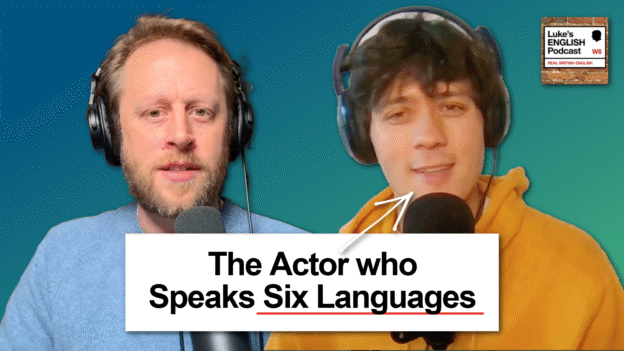
[972] I talk with multilingual actor Ivan Doan about his multicultural background, his learning of languages and his work as an actor. Ivan shares his insights and experiences of learning English, dealing with different accents in film & TV roles, and the importance of mindset and discipline in his life. There are plenty of language learning insights in this episode, which I summarise at the end. Full transcript available.
An 11-point list of practical advice for learning English inspired by this conversation.
1. Learning through doing, not just studying
Use English for real things. Ivan’s English really improved when he started making projects in English (web series, acting work, talking to people), not just studying grammar.
Make English the tool, not the subject. Start a small project: a vlog, a diary, an Instagram account, a DnD group, movie scene re-enactments – anything that requires English.
Theory helps, but it’s not the engine. Grammar explanations are useful, but they’re not what makes you fluent. Real communication is.
2. Multimodal learning: use your whole body & brain
Don’t reduce English to rules + word lists. When Ivan was with the Mormons or on set, he learned from body language, tone of voice, facial expressions, rhythm, context, not just words.
Watch people, not just subtitles. When you watch something in English, pay attention to:
how people look at each other
when they pause
what their hands/face are doing when they say something important
Combine skills. Listen + read + speak + move. For example, repeat a line while copying the actor’s body language and facial expression.
3. Listening & repetition are superpowers
Re-listen on purpose. Take a podcast episode or YouTube clip and:
Listen once for general meaning.
Listen again and note unknown words/phrases.
Look them up.
Listen a third time and catch those items in context.
Notice “repeat offenders”. If a word or chunk keeps appearing, it’s a sign: you probably need it. Put it on a list.
Make targeted vocab lists. Like Ivan did for filmmaking, you can make lists for your world: tech, business, medicine, design, gaming, etc.
4. Discipline beats talent
You don’t need to be “gifted at languages”. Ivan’s message is clear: people think he’s “special”, but in reality, discipline and repetition are doing most of the work.
Be stubborn. Let it bother you (in a good way) that you don’t understand a phrase yet. Go back to it. Again. And again.
Small, realistic goals. For example:
“I want to be able to have a 10-minute small-talk conversation without switching to my language.”
“I want to understand one specific podcast episode without subtitles.”
“I want to tell one story about my life in English clearly.”
Basic conversation – you can talk about everyday things.
More advanced conversation – opinions, stories, feelings, more nuance.
Improvisation – you can react in real time with no preparation.
6. Accents, rhythm & sounding natural
First: learn to hear the accent. You can’t produce what you can’t hear. Choose one accent (e.g. London, General American) and really listen to it.
Find your “accent twin”. Pick a native speaker:
similar age
same gender
whose voice feels close to your natural voice Use them as your model.
Create an “accent map”. Notice:
Which vowels are different from yours?
How do they stress words?
What is the rhythm (fast/slow, chunky/smooth)?
Rhythm & word stress are often more important than perfect vowels. BAna-na vs baNAna can be the difference between confusion and clarity.
Shadowing works. Play 1–2 sentences, then:
say them with the speaker,
match their timing, stress, and melody,
repeat several times until it feels comfortable.
7. It’s okay to exaggerate (caricature as a training tool)
Overdo it first, then calm it down. Like an actor, you can:
exaggerate the British or American intonation
really push the stress and melody Then slowly bring it back to something natural.
This is not “fake”; it’s training. As with acting, you push beyond your comfort zone, then refine.
8. Identity, culture & letting yourself change
To speak like an English speaker, you must allow yourself to “borrow” a new identity. That might feel weird: “This isn’t me.” But that flexibility is part of real fluency.
Different cultures, different communication rules. British politeness isn’t necessarily “fake”; Russian directness isn’t necessarily “rude”. They’re different systems.
Adapting ≠ betraying your culture. You can still be 100% you and also learn to play by local rules when you’re speaking English.
9. Talk to yourself – a lot
Self-talk is powerful, not crazy. Walk around your flat narrating what you’re doing in English, or:
rehearse future conversations,
re-tell a story you heard,
argue with yourself about something.
The goal is to stop translating. Like Ivan said, it’s like changing gears in a car: once you’re “in English gear”, you just drive.
10. Treat English like a role you inhabit
Think like an actor. When you speak English:
step into the “role” of an English-speaking version of you,
use your voice, but with English rhythm and intonation,
add the body language and facial expressions that match.
Use emotion. Don’t just say the words; feel them. This makes you remember the language and sound more authentic.
11. Inspiration: you can do this
Messages implied by Ivan’s story:
You can start with school English that isn’t great and end up working in English internationally.
You don’t need a perfect method; you need consistent action, curiosity, and the courage to interact.
Being “from somewhere else” is not a weakness; it’s often your superpower – a different perspective, more empathy, and a richer identity.
A return to Luke’s Film Club with a conversation about one of the funniest and most controversial films of all time, also voted one of the UK’s favourite films. Antony and I discuss the film’s writing, production, story, famous scenes, deeper meanings and acting by the various members of the Monty Python team. Transcript available.
Sarah Donnelly comes back onto LEP to catch up and to tell us about her stand-up special, now available to watch on YouTube, and to do a British English vs American English pronunciation quiz.
Sarah’s show is called The Only American in Paris and we discuss some of the themes of the show – the real experience of being a US citizen living in Paris, the Netflix show Emily in Paris, cultural differences, learning French, plus a pronunciation quiz to help you compare UK and US English.
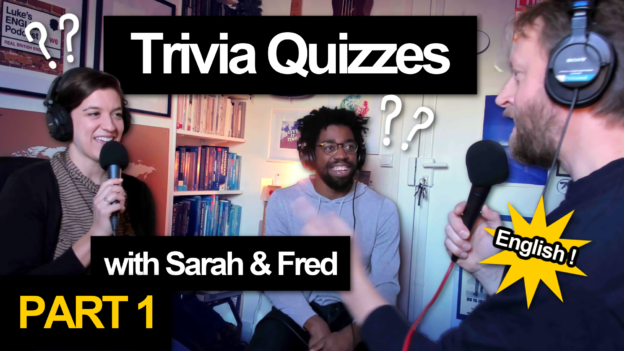
Sarah and Fred are trivia quiz nerds who have been doing trivia nights in Paris for years and now have a new trivia-themed podcast. In this episode we get together to discuss trivia quizzing, and to quiz each other with our own trivia questions. In this first part we get to know Sarah and Fred again, talk about their new podcast and then Sarah quizzes me with some cleverly-written questions. The quizzing continues in part 2.
In this episode you will be able to listen to a conversation with Cara Leopold all about films.
If you are a long-term listener to this podcast, then you will know Cara. She’s been on this show a few times before.
Just in case you need a reminder, Cara is an English teacher from the UK, currently living in France, and she loves films and uses them to help people learn English. In fact she is the creator of the Leo Listening Movie Club, where she helps advanced, film-loving English learners understand and discuss iconic movies together in order to master conversational English.
Cara Loves films. I love films too, who doesn’t? We all love films, don’t we? And it’s very common to talk about films we’ve seen.
Are you able to do that in English?
I want you to think about what is involved in having a conversation about films in English.
When we talk about films, we do a number of things, including:
Summarising the plot or story of the film
Describing the main characters
Talking about actors and their performances,
Talking about directors and they way films are directed, edited, locations, effects and music.
Giving our opinions about films, including the things we like and don’t like
Discussing the meaning of films, and any social, historical or personal issues which are connected to them.
How do we do those things in English? Are you familiar with the language of cinema and the language of talking about films?
What I want to do with this episode is let you listen to a natural conversation (one that isn’t scripted in advance) about films in order to let you hear all those things being done.
So that’s what this is!
You can use this episode in several ways.
1) Just listen for enjoyment, listen to what we have to say about various different films, and just try to follow the conversation, and practice your general listening skills in the process.
2) Focus on noticing the specific vocabulary or grammar that we use to do all the things I mentioned before. Listen out for the ways we describe, summarise, give opinions and generally share our thoughts about films.
We mention lots of different films in this conversation and one thing which I’m thinking about is that those films might have different titles in your language. I hope you are able to identify the films.
You can see a list of the names of the films we mention on the page for this episode on my website. If you want to check out those movie titles, and perhaps google them to find out what they are called in your language, just go to the episode page on my website and you’ll see all the titles listed there, plus various other links to things which we mention or which you might find useful.
Right then. It’s now time to listen to my conversation with Cara.
I will talk to you again briefly at the end of this but now, let’s get started.
Ending Transcript
Thanks again to Cara.
You can check out her work.
On her website you can see details of the different courses and resources I mentioned before, which involve improving your English with films.
Episode 129 (parts 1 & 2) of Daniel Goodson’s podcast “My Fluent Podcast” in which Daniel and Cara discuss Groundhog Day
And a list of all the names of the films Cara and I mentioned in this conversation, in case you wanted to google them to find out what they are called in your language.
Here are a few questions which you could answer in the comment section if you like:
Have you seen any good films recently?
Do you prefer films or TV series? Why?
What films have helped you learn English? How did they help you?
Films we mentioned in this conversation
Pétaouchnok (The French film starring Philippe Rebbot, who Cara saw at a cafe recently)
Films which Cara has watched in her film club recently
“The Glib Brothers” reunite on the podcast to discuss more music, films, books, scary AI and UFO sightings. James is my older brother and he’s probably been on this podcast more than any other guest. Listen for another deep and humorous conversation with lots of cultural reference points.
Some of the things we talked about in this episode 👇
Blow Up (1966 mystery thriller film set in London, directed by Michelangelo Antonioni)
The Bee Gees (Barry, Robin and Maurice Gibb – The Gibb Brothers)
Diary of a CEO (Stephen Bartlett’s podcast)
Record Play Pause by Stephen Morris (a book about Joy Division / New Order)
ChatGPT & AI (you know)
1984 by George Orwell (a famous book about living under a totalitarian regime)
Brave New World by Aldous Huxley (another famous book about living under a different kind of totalitarian regime)
This Is Spinal Tap (a cult classic comedy film about a fictional rock band)
Alan Partridge (a comedy character played by actor/comedian Steve Coogan)
Three Amigos (comedy film directed by John Landis, written by Lorne Michaels, Steve Martin and Randy Newman, starring Steve Martin, Chevy Chase and Martin Short – a Thompson family favourite)
Green Street (an unintentionally hilarious drama film about football hooligans in the UK, starring Elijah Wood)
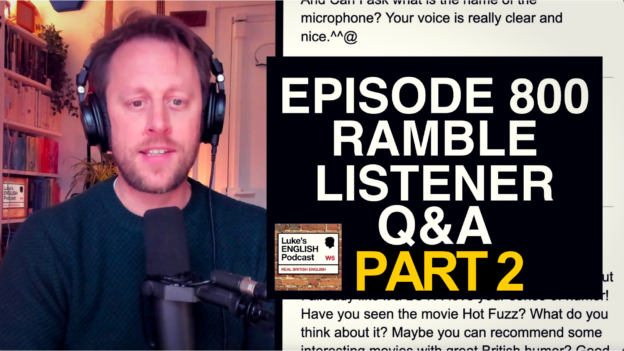
Celebrating episode 800 by answering a massive list of questions from listeners. This episode covers things like how to improve your speaking when you live in a non-English speaking country, the headphones and microphone I use, my current favourite episode, the afterlife and spirit world, my favourite brands of tea, my favourite video games, being a father and the recent Star Wars series Andor and plenty plenty more. Video version available.
I recorded parts 1 & 2 on Thursday 8 December. Since then England got knocked out of the World Cup by France (ouch!) and also I got ill with a horrible case of flu which put me in bed for 4 days. I’m still ill, but definitely starting to feel better. I’m going to record the rest of these episodes when I am well again, but time is running out fast before Christmas arrives. I am not sure I will have time to do a World Cup episode, but who cares now that England are out? 😂 (I’m joking – I’d love to talk about the football, but I don’t know if there will be time. We’ll see.) Anyway, enjoy the part 2 of this episode 800 mega-ramble! 🎆🎆🎆
QUESTIONS (Listen or watch the video to hear/see me correcting some errors)
I kicked off listening to your podcact because of your Mom. In one of your first episodes, you were talking about the Beatles. I so much liked her wise answers to your questions, her voice, accent, and most of all her straightforward way of speaking . She’s great!
My question Mr Thomson.
What are High Hopes in your mind ? I’m now referring to Pink Floyd’s song.
Hi,Luke.Please add some special videos for IELTS listening multiple questions.There are different sounds and also so fast for this reason it is hard to define.
Hi Luke ️I have a suggestion for creating a discord server in order to connect LEPsters around the world therefore they would be able to talk and have a chat with each other, what’s your take on this Luke? (anyway you can easily notify LEPsters through discord about contents too and it’s utterly free, that’s awesome isn’t it?) and thanks a lot for your awesome contents, have a blessed day
Hello Luke . Can you make a video about how to be confident on camera? Maybe you could interview some of your YouTuber friends or maybe Paul and Amber , they haven’t been on the podcast for a while have they ?
Hi Luke~How do we improve our speaking skills if we are not living abroad~I mean English language speaking country~ Do you have any practical suggestions? I feel like my listening is much better than speaking~Your podcast is awesome ~thanks~
4 ways of speaking to yourself
Repeat after me, shadowing
Just chatting to yourself “I’m going to do this, and that’s a bottle of shampoo with soap all over it’ etc
I was joking haha. A more real question: I am curious about if the podcast is your main job or do you teach in a real school? You are a great teacher and I wish you all the best with the podcast.
I have a suggestion for you to make your podcast greater. You should make more episodes about vocabulary, like topic vocabulary, everyday expressions and some difficult grammatical structures, for example:
I ate anything but an apple
which means I only ate an apple.
I ate nothing but an apple
[Luke: actually this isn’t correct – listen to the episode to hear my comments]
Hey teacher Luke’ How are you? My question is how many Languages do you speak? Second question Which club do you support in the premier league? Thanks an advance!!!
Teacher luke, good morning, greetings from a small country in the horn of Africa called SOMALIA. my question is, can you connect me to an online English Teacher or School where I can study English. Thank you so much.
Hello, Luke! I’m a new listener of your podcast, but I already like it a LOT! I love your sense of humor! Have you seen the movie Hot Fuzz? What do you think about it? Maybe you can recommend some interesting movies with great British humor? Good luck to you and thank you very much for your excellent job!
Hello, Luke! Could detective stories and poetry be more frequent or somehow regular in your podcast? Do you think they are like boosters for vocabulary, or they can make listeners feel a little bit passive? Do you have a special formulae for the balance between different types of lessons?
Hi, I’m new a subscriber! Great Podcasts! I’d like you to dedicate an episode to the MBTI personality test, which is very popular nowadays.Kind Regards! 🇨🇱🇬🇧
Could you please make a new episode about British English? like the tips of sounding more british and the things we have to mind if we wanna master British English. Thank you so much!
Hi Luke, What is your favourite dish? Do you prefer french or english cuisne?
Hi Luke, I like the podcasts with yout brother. Do you plan to organise the meeting with him on you tube? He has a very interesting voice. I’d like to see him :)
Hi Luke, Can you imagine that I need to have contact with your podcast every day? It is like an addiction:) Have you got some patent to be so good?
Hi Luke, What is in the picture on the left in your podroom?. I see a red geometric figure but what does it mean?
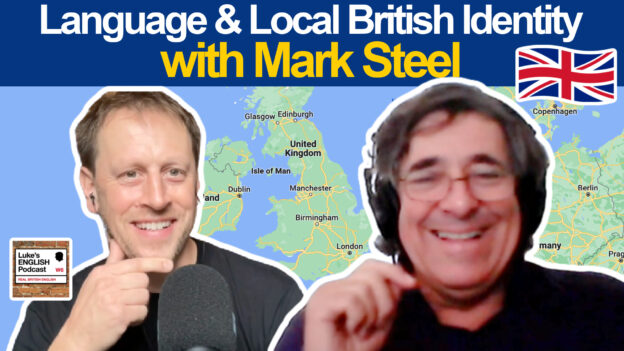
Special Guest Mark Steel joins me to discuss cultural and linguistic differences between the UK and France, plus accents in the UK and a little tour of some places in the UK that you don’t know about. Also includes a discussion of swearing and rude language in Britain. What is the R word which you should never say in a specific part of the UK? Listen on to find out. Video version available.
Last week a very special guest visited one of our comedy shows in Paris. I was given a ticket to the show, so I decided to record a podcast while riding through the streets on the way to the show, wondering if I might be able to interview this guest on LEP. Listen to find out what happened, and to hear some rambling and atmospheric sounds of Paris streets at night.
This website uses cookies to improve your experience while you navigate through the website. Out of these, the cookies that are categorized as necessary are stored on your browser as they are essential for the working of basic functionalities of the website. We also use third-party cookies that help us analyze and understand how you use this website. These cookies will be stored in your browser only with your consent. You also have the option to opt-out of these cookies. But opting out of some of these cookies may affect your browsing experience.
Necessary cookies are absolutely essential for the website to function properly. These cookies ensure basic functionalities and security features of the website, anonymously.
Cookie
Duration
Description
cookielawinfo-checkbox-analytics
11 months
This cookie is set by GDPR Cookie Consent plugin. The cookie is used to store the user consent for the cookies in the category "Analytics".
cookielawinfo-checkbox-functional
11 months
The cookie is set by GDPR cookie consent to record the user consent for the cookies in the category "Functional".
cookielawinfo-checkbox-necessary
11 months
This cookie is set by GDPR Cookie Consent plugin. The cookies is used to store the user consent for the cookies in the category "Necessary".
cookielawinfo-checkbox-others
11 months
This cookie is set by GDPR Cookie Consent plugin. The cookie is used to store the user consent for the cookies in the category "Other.
cookielawinfo-checkbox-performance
11 months
This cookie is set by GDPR Cookie Consent plugin. The cookie is used to store the user consent for the cookies in the category "Performance".
viewed_cookie_policy
11 months
The cookie is set by the GDPR Cookie Consent plugin and is used to store whether or not user has consented to the use of cookies. It does not store any personal data.
Functional cookies help to perform certain functionalities like sharing the content of the website on social media platforms, collect feedbacks, and other third-party features.
Performance cookies are used to understand and analyze the key performance indexes of the website which helps in delivering a better user experience for the visitors.
Analytical cookies are used to understand how visitors interact with the website. These cookies help provide information on metrics the number of visitors, bounce rate, traffic source, etc.
Advertisement cookies are used to provide visitors with relevant ads and marketing campaigns. These cookies track visitors across websites and collect information to provide customized ads.