🎧 Learn English with a short story. 🗣 Listen & repeat after me if you’d like to practise your pronunciation. 💬 Learn some vocabulary in the second half of the video. This is a story about people watching and what you can notice about people’s relationships if you are observant enough.
In your early / late twenties, thirties, forties, fifties, sixties, seventies, eighties
To look married (look good, look tired, look happy, look married, look bored)
Unmistakably married
They were married. It was unmistakable.
Mistakable = easily confused for something else
Unmistakable = not easily confused for something else – you can immediately identify it
The unmistakable smell of fresh bread in the air
They looked unmistakably French / unmistakably English / unmistakably yours/hers/his (this handwriting is unmistakably his)
Why are they unmistakably married? What does she mean? She’s alluding to subtle behaviour. When a couple are unmarried or perhaps in the early stages of a relationship they tend to give each other a lot more attention. They might be still trying to seduce each other somehow, or to attract each other. There’s still mystery and interest. Brand new couples can hardly take their eyes off each other. I imagine this couple is unmistakably married because they show signs of the relationship suffering from over familiarity. They mystery is gone, maybe. Perhaps they seem very familiar with each other, or very comfortable with each other. Marriage can make people feel stuck (not always!) especially if the marriage is based on the wrong things.
A banquette = a long, fitted seat or bench, typically found in restaurants
Narrow – opposite of wide – a long narrow corridor
We get the sense this is a small, intimate space. It’s also uncomfortable, painfully so.
The couple and other guests in the restaurant are all so close and this makes the man’s humiliation and the woman’s heartbreak even more painful.
The narrator is unable to stop “people watching” here – observing this couple opposite.
Also the couple sit side by side, not facing each other, which suggests that they’re not all that interested in each other.
You start to speculate – what does this woman mean to this man? Is she there just to sit by his side and look glamorous?
A round face
Self-satisfied (definitely a negative word) smug, arrogant, not charming
Fadingly pretty
Fading = gradually becoming less clear, less bright, less colourful. Her prettiness was fading.
A big hat – I imagine it was one of those hats with a big brim, which can be very glamorous but also hides the face.
Conspicuous = noticeable, easy to notice, eye-catching (apparently in those days big hats were not uncommon in New York restaurants)
Basically, they looked quite ordinary really, and weren’t trying to grab/attract everyone’s attention.
An occasion – a particular event, a birthday, an anniversary, something to celebrate
The wife had planned a surprise for him (past perfect because she planned this before any of the events in this story) without past perfect it could mean that the wife planned the surprise there at the table
A surprise in the form of a cake – “in the form of” here means that this is how the surprise was actually manifested. I mean, what was the surprise, how did this surprise take shape? The surprised arrived in the form of a cake.
The gift came in the form of a beautifully wrapped package.
Their support came in the form of encouraging words during a difficult time.
The solution to the problem arrived in the form of an innovative new technology.
Help arrived in the form of my wife who came to rescue me (from an awkward conversation for example)
A glossy birthday cake = shiny & smooth, so the light reflects off the top. It’s one of those smart, fancy cakes that you see in good quality cake shops.
One pink candle burning in the center (American English spelling) – this is a little bit sad, isn’t it? Also, if this guy takes himself quite seriously, he might find that a tiny bit embarrassing – bringing attention to him, and this little cake with a pink candle might make him feel a bit ridiculous, especially if he is full of himself and takes himself seriously. But it is a lovely, sweet gesture and we just want him to be embarrassed but also touched and it would be a great moment for him to blush and smile and kiss his wife and maybe acknowledge the other diners with a smile, but he doesn’t.
The head waiter – so the wife probably asked the restaurant to make a special effort here, which again shows how much care she put into this.
He placed it before the husband. This means he carefully put it down.
Meanwhile = at the same time
The wife beamed with shy pride over her little surprise
Beamed = her face glowed, she smiled, she seemed proud. To “beam” means that light comes out – like a torch, or a light house. In this case the woman’s face beamed with a certain emotion or an expression.
Pride – to feel proud = she’s happy and satisfied with what she has done. She’s put a lot of effort into this and expects it to go well. She’s trying.
It became clear (obvious) at once (immediately) that help was needed (passive voice – needed by who?) We feel that the narrator suddenly sees that this woman is helpless in this situation. She’s in trouble. But nobody can help her without making it worse.
The husband was not pleased.
He was hotly embarrassed. – not a common collocation but it tells us that his face probably went red and he was angry.
He was indignant = angry, annoyed, frustrated with his wife because of what she’s done.
Don’t belike that = don’t be that way
As soon as the little cake had been deposited on the table = quite formal and impersonal language, meaning put in a certain place. Money is deposited in an account. It’s quite cold, transactional language.
The birthday piece – a piece of music
The general attention had shifted = moved
I saw him say something to her under his breath = in a very quiet voice, in a whisper, so other people can’t hear
Some punishing thing = a comment which was designed to punish her, to make her feel bad
Quick (just a few words) and curt (rudely brief – rude because it is so short) and unkind (cruel).
I couldn’t bear to look
Can’t bear to do something
Can’t stand doing it
Can’t bring myself to do something
When I finally glanced over there = looked quickly
This is heartbreaking!
Adverbs
Crying quietly
Crying heartbrokenly
Crying hopelessly
All to herself (she was doing it all by herself, but also crying to herself – a very lonely feeling where you are the only one witnessing your crying – the husband doesn’t care it seems)
All to herself / all by herself
Under the big gay brim of her best hat. (Gay in it’s original meaning, “carefree” “happy”)
The brim of the hat = the wide edge
This is a particularly sad image because of the contrast between this lovely hat that should be worn on a happy and carefree occasion, but under it this poor woman is crying.
A very long rambling episode with a big mix of vocabulary, stories about my trip to Rome, comments from listeners, lots of thoughts about episodes I’ve published over the last 12 months, more advice about learning English, and a story about being Jackie Chan’s English teacher.
A new year episode to welcome you back to my podcast, to encourage you to reflect on your learning of English over the last 12 months, to consider your English learning in 2024 and how this podcast can help you. Includes plenty of ideas for how to improve your English, some reflections on my learning of French, and some ‘help’ from my baby son 👶.
Episode Text (This is the text on the PDF – but the vocabulary is not highlighted in green here)
Happy New Year everyone!
This is my first episode of 2024 and let’s get serious for a moment because actually the purpose of this one is to help you consider where you are with your English (because that’s what this is all about isn’t it?) to encourage you to reflect on your learning of English in 2023, to approach 2024 with the right mindset and also give you loads of advice and tips for how to keep improving your English with this podcast and in plenty of other ways.
This episode has mostly been written out in advance, so I’m reading from a script in this one.
You’ll find the PDF script on the page for this episode and there’s a link in the description wherever you are listening to this.
“Link in the description” – Do you know what that means?
You can just download it free and I’m not even going to ask for your email address and then send you loads of emails tempting you to buy my online course which is only available for a limited period of time for mysterious reasons that aren’t fully explained.
Don’t worry, I’m not going to do that. You can just download the PDF directly like in the old days of the internet.
By the way, if you prefer rambling episodes with no script, just hang on because I’ll be doing one of them after I’ve done this episode.
The plan is to do this one which is fully planned and scripted, and then just do something totally spontaneous in the next episode.
So, there is a New Year rambling episode coming soon. Also there will be a premium episode coming soon for premium subscribers focusing on some of the language I use in this episode.
Premium subscribers – watch out for some of the words and phrases which are highlighted in a lurid green colour on the PDF – those bits of vocabulary will come up in a premium episode soon.
If you’re not a premium subscriber, you can still notice those highlighted phrases and just consider how much you are missing out by not being a premium subscriber, and of course if you just can’t stand missing out on the magic, and you want to be a premium subscriber or you just want more information about it, then go to www.teacherluke.co.uk/premiuminfo
By the way, I chose that lurid green colour so that it will also show up if you print the PDF in black and white. Also, it’s a way of subtley reminding you to keep noticing vocabulary.
Also, I have various other episodes in the pipeline which I recorded late last year and they are coming too, over the next few weeks including a couple of Amber & Paul ones, an episode with Lindsay from All Ears English, one with my friend who works at UNESCO and some others, so just bear with me, they are coming as well!
As usual, I just have so many episodes to publish and things I want to say. I’d love to just publish new episodes every few days, to be honest, but I don’t want to overload you completely. I know some of you might be happy for me to do that, but really – podcasting wisdom says that I shouldn’t do that.
This episode
What’s this episode going to be? Let’s get started.
First of all, I want to welcome new listeners and remind old listeners who I am and what this is all about. A lot of people will be turning over a new leaf and trying to make a fresh start with their English. Is that you? Have you made a new year’s resolution to improve your English this year?
Maybe you’ve decided to listen to podcasts in English and here you are. Or maybe you’re already a regular listener and you’re happy to be back in LEPland with this new episode. In any case, welcome and welcome back. It’s good to doing the first episode of the show in 2024.
Some info about LEP for new listeners (and old listeners too, whose memory isn’t what it once was)
Hello. Forgive me for stating the obvious here but I’m Luke Thompson and I’m the host of this podcast that you are listening to right now, which is called Luke’s English Podcast. It’s a podcast for learners of English. I’m Luke, hence the title of the show – Luke’s English Podcast. Yes, I am very original and creative and I worked very hard to come up with that name.
In my episodes I talk about all kinds of stuff and help you learn English. All you have to do is listen, although if you want there are plenty of other ways you can use my episodes to work on your English. I’ll mention some of those things later.
I talk about different topics, chat with different guests, tell stories, just ramble about what’s on my mind, give advice for learning English, talk about British culture such as music, films and comedy, explain jokes and generally give you something to listen to in English on a regular basis. This is an award-winning podcast by the way and I have a very loyal, enthusiastic and lovely audience who are affectionately called the LEPsters.
I’m an English teacher from England (West London and the West Midlands). I’ve been teaching English for nearly 25 years now. I first taught in Japan many years ago (have I ever mentioned that I used to live in Japan? – you get a point every time I say that, remember) then I taught in London for a long time at various language schools in places like Oxford Street, Covent Garden, Waterloo, Holland Park and Hammersmith, and these days I live and work in Paris, yes the one in France.
I went to university in Liverpool a long long time ago and graduated with a degree in media and cultural studies which means I am very good at watching movies.
I have CELTA and DELTA qualifications in English language teaching to adults, so don’t worry, you are in safe hands, you can trust me I am fully qualified. I am a professional. I have a particular set of skills which I have developed over a very long career.
As well as being an English teacher, I am also a stand-up comedian, which you must have realised already because you can’t have failed to notice how funny and witty I am. I do stand-up which means I go on stage in front of audiences and make them laugh with hilarious jokes and stories and things and it always works really well and everyone in the room laughs so much, so hard that they die and then can never tell anyone else how funny I am, which is why I don’t have my own Netflix special.
I’ve been doing stand-up on a semi-professional basis for about 15 years – roughly the same length of time as this podcast, but not as consistently as this I have to say.
Most of the time these days I perform at comedy shows in Paris in the evenings sometimes, in English, to audiences of English-speaking ex-pats, tourists and local Parisians. If you want to hear me talking about my stand up comedy, check out my recent appearance on the Stolariod Stories podcast. The episode was called The Art of Making People Laugh with Luke Thompson from Luke’s English Podcast. The Art of Making People Laugh: with Luke Thompson from Luke’s English Podcast
I have been doing this podcast for about 15 years now. The show has had over 150 million downloads in total, which is mind-blowing. It is listened to by people all over the world. I am actually very famous but nobody knows who I am. Does that make sense? No, it doesn’t. But somehow it is still true.
If I got all my listeners together in one place I’d be able to fill a few football stadiums, but that’s never going to happen and I’m not even very good at football so it wouldn’t be a very good idea anyway.
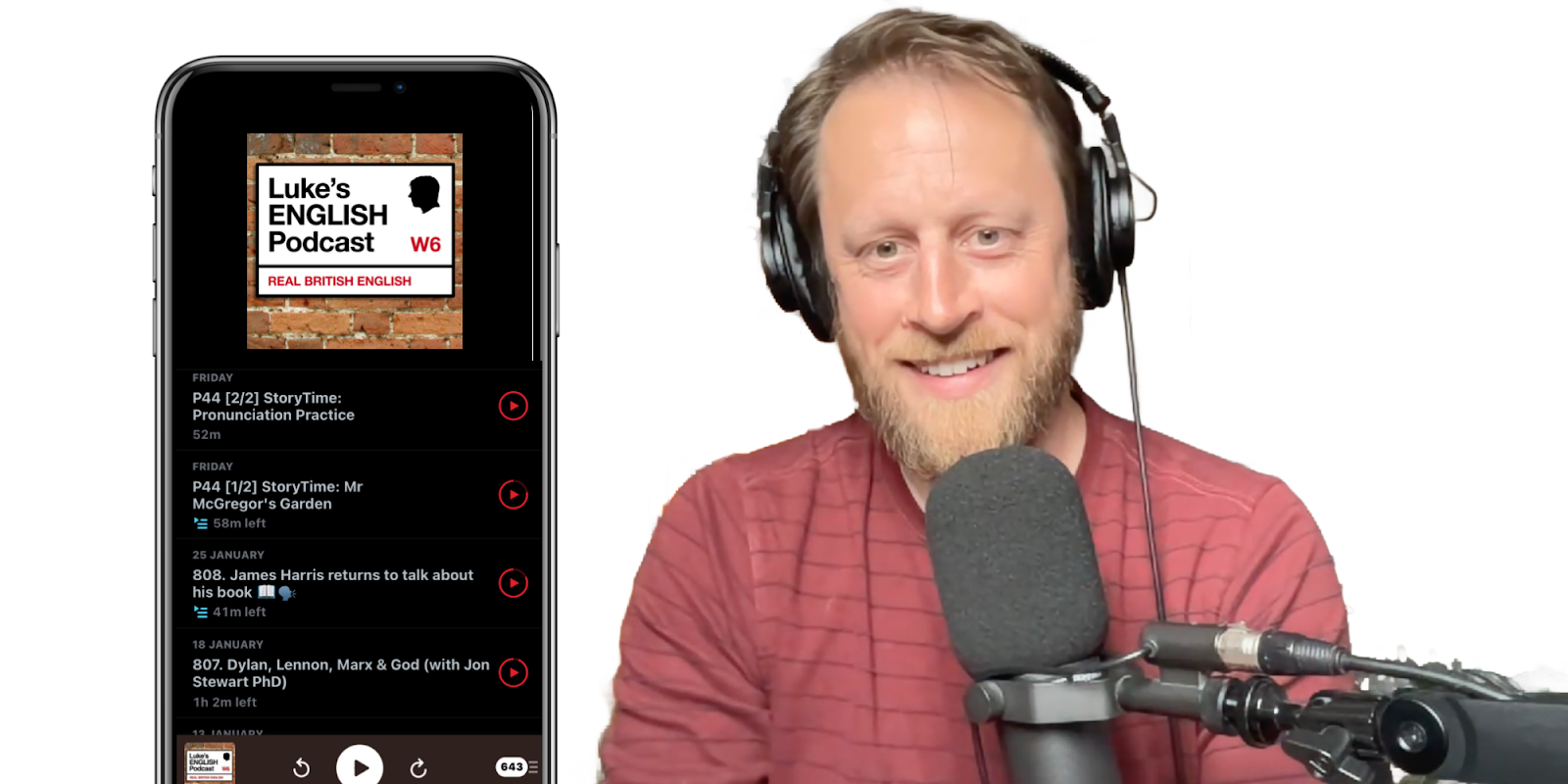
There are audio versions and video versions of this podcast.
Audio in podcast apps, video on YouTube. Let me explain that to the uninitiated. *
*Remember the words and phrases highlighted in green? That was one of them → “the unititiated”. Get the PDF from the episode page on my website and you can see those highlighted bits.
I’ll add them all in a list at the end of the episode as well because I’m nice. You’re welcome. I’ll explain them in a premium episode coming soon, to help you remember them and also use them.
You can listen to the audio podcast in any podcast app on your phone and this is the way that most people listen to my episodes, for example using Apple Podcasts, Spotify, PocketCasts and so on.
I imagine people do something like this. They get up in the morning, stretch, have a shower, question their life choices, eat breakfast, maybe get the kids ready for school, go to work, and at some point get their phone out, put their headphones in, open up their podcast app of choice, tap on “Luke’s English Podcast” and start listening to a new episode or continue listening to one they started the day before.
Other people might just stay at home (because what’s the point of leaving the house really?) and maybe get their phone out, connect it to their bluetooth speaker or something, then listen to my podcast and maybe do some really exciting housework or something like that.
So that’s how to listen to my episodes in a podcast app on your phone. If you’re already initiated into the world of podcasting, that all might strike you as being very obvious, but you’d be surprised at the number of people who don’t understand what podcasts are, how they work or even how the word podcast is spelled or indeed pronounced.
POD-CAST. POD-CAAAAST. /pɒdkɑ:st/ not postcard or pot-cat.
I understand. It can be a tricky word actually. It’s a relatively new word and in terms of pronunciation there are a couple of tricky consonant clusters in there.
The bit where the D and the C combine and the bit where the S and the T combine. Tricky stuff actually.
/pɒdkɑ:st/ POD – CAAST
Try it again.
Not POST KAAAAST
POD KAAAST
Not POK-KAAAST either
POD CAST
Podcast
Luke’s English Podcast
ok
The word podcast is actually a combination of the word broadcast and the word iPod.
It’s a broadcast on your iPod. A podcast.
It’s a kind of audio broadcast (like a radio show – radio is broadcasted through radio signals from a radio tower thing, right?
The radio waves are sent out into the air and picked up by your radio. But with a podcast, the audio is sent out via the internet and you get it and put it on your iPod, although nobody actually uses iPods any more, it’s all mobile phones now isn’t it?
So, it might as well be called a Phonecast – because I broadcast my show to your phone. Not a phone call, because that’s not how it works.
I don’t just call you and start talking. I could, but that would be a very inefficient way of doing this, if I had to call you all one by one and say this to each person I called, again and again. No, thank goodness, that’s now how it works. It’s not a phone call, and it’s not a phonecast, even though you listen on your phone (unless you listen on your computer on my website or something, or you actually do listen on an iPod because you’re still using one. So, it’s not a phonecast, it’s a podcast. That should be clear.
If you don’t know how to subscribe to the audio podcast, just download a podcast app on your phone. They’re completely free (podcast apps, not phones). I recommend PocketCasts. Go ahead and download PocketCasts free from the app store on your phone. Install it, then open it and search for Luke’s English Podcast, then tap “Subscribe” or “Add” (or whatever the equivalent is in your language) and my show will be saved in your list of subscriptions and you’ll always be able to go back to the app to listen to my latest episodes when they are published, and the entire back catalogue, and your life will improve just a little bit, certainly a step in the right direction. Switch on notifications and your phone will tell you when I’ve published a new episode. Happy days.
One of the advantages of listening to the audio podcast on your phone is that you can do other things while you listen, and people tell me that they listen while travelling, working out in the gym, doing housework, running or walking in the countryside, driving, and even at work or school while they should be doing something else.
I expect some people listen while doing incredible things, like flying planes, recovering from a general anaesthetic after having surgery or operating the safety systems of a nuclear power station.
I also publish video versions of these episodes on YouTube, and it’s usually the same content as the audio versions, but often the audio versions have even more content because sometimes I ramble a bit at the beginning and end of episodes (and in the middle), and those bits don’t always end up in the video versions.
My YouTube channel nearly has 1 million subscribers now, which I find incredible really. Not all my episodes get a million views of course, except the ones called “Learn English with a Short Story” which are particularly popular on the platform. The advantages of the video versions are that you can see me while I speak (do you consider that to be an advantage?)
You can see my body language, facial expressions and the movements of my mouth. For the more visually oriented people, that is a good thing. There are also automatic subtitles on YouTube which are getting better all the time, and I often show text on the screen while I record so you can read and listen at the same time (that text is usually also available on my website for the audio listeners). But, again, the video versions often have less content than the audio versions and you do have to basically stay looking at the screen the entire time, whereas with the audio episodes you can just put your headphones in, put your phone in your pocket and do something else, like fishing or taking your dog for a walk, or if you prefer dogging and taking your fish for a walk, I mean it’s your life, you can do what you want can’t you?
My episodes can be quite long, but this shouldn’t be a problem really (who said it was a problem?) Anyway, it shouldn’t be an issue, because you can just pause the episode whenever you want, do something else, and when you return to your podcast app and find that episode again, the app will remember where you stopped and you can continue from that point. YouTube does exactly the same thing if you are signed into it with your google account.
So, you can just chill out about the whole “Your episodes should be 28 minutes long, no more no less” thing. Just listen to 28 minutes, then stop, then listen to another 28 minutes the next time.
So, long episodes aren’t really an issue because you can listen to as much as you like, stop and do something else, then carry on where you stopped before.
Having said that, I do try to keep the length of my episodes under control. I don’t want them to be too long, but the fact is I just have stuff that I want to say and I find it hard to shut up, so I need all that time!
For me, these episodes are similar to English lessons I do at school.
Lessons are usually at least 90 minutes long, often more. English lessons in a language school are very rarely less than one hour long. So, it’s a similar story with my episodes.
Also, I also have a premium subscription (have I mentioned that before, I don’t think I have, have I? No, I definitely haven’t mentioned the premium subscription. Hey, I have a premium subscription. It’s called Luke’s English Podcast Premim. Forgive me for mentioning it again, it’s just that the modest amount of money that I make from it helps me to feed two starving children and one wife and to heat our home which otherwise would be cold, and allows me to buy microphones and guitars and things – all essential purchases of course. Anyway, LEP Premium costs just 4$ a month (and has the price gone up in line with inflation? No, it hasn’t. Starbucks have raised the price of their bizarrely-named coffees, the fuel you put in your car is more expensive, but LEP Premium remains the same despite all those things) and gives you access to extra episodes which focus on teaching you vocabulary, grammar and pronunciation.
So, my podcast has two branches → the free episodes and the premium episodes
The free episodes → this is what I described before – me talking alone or with guests about things which I hope you will just find interesting and entertaining to listen to as part of your effort to get plenty of English into your brain via your ears. The free episodes are the ones which are available free in audio podcast format, or YouTube video format.
The premium episodes → extra episodes published every month, and also available in a podcast app on your phone. When you sign up you can add the premium episodes to your podcast app.
Last year I published over 30 premium episodes, so that is 2 or 3 episodes per month. This is not just bonus content or out-takes or something. These are carefully prepared and thought-through lessons in which I help you build your English. All the info about the premium subscription is on my website at www.teacherluke.co.uk/premiuminfo
The main difference between the two branches is that the free episodes are all about input and the premium ones are much more about teaching you directly.
In the free episodes I want to give you something to listen to in English which is made for you, which is entertaining, interesting and authentic, to help you listen more, listen for longer periods, and listen long-term.
Sometimes I ramble and just share my thoughts with you in a kind of stream-of-consciousness way, sometimes I talk with guests including my friends & family and other people who I hope will have interesting things to say on the show, talk about a variety of topics, tell stories.
In the premium episodes I tend to focus on teaching you things, and this usually means vocabulary – explaining, highlighting, demonstrating, clarifying words and phrases, showing you how words and phrases are actually used with collocations, and other little important details. I also deal with grammar sometimes, and pronunciation every time – mainly giving you something to use for listen & repeat practice so you can regularly repeat after me, but also giving you insights into the pronunciation system in English in various ways. So, the focus is on teaching you language bit by bit.
Sometimes those two branches cross over, and I end up doing premium-type stuff on the free podcast (explaining vocabulary in short story episodes for example) or doing free-podcast type stuff in premium episodes (rambling episodes, short story episodes).
And, as a foundation, I want you to remember that I have been teaching English for most of my adult life now and so it is deeply ingrained in me, and in fact I couldn’t really stop teaching English even if I tried, and so even when I am just talking to you I am still teaching you. There is always that intention there to help you notice language, to engage with this language, to aid you somehow – so even when I’m just talking with seemingly no focus, there is a focus and a method in the background which is to help you connect with English as it is spoken, English as a living language, and English which is a medium for making connections with people and for expressing yourself.
I am always attempting to reach out to you through the things I say and sort of grab you and shove English straight into your ears, but in a nice way.
Also, I just love doing this podcast and hopefully my enthusiasm will rub off on you and will encourage you in your journey.
I could continue to ramble on for ages about the benefits of listening to English podcasts long term, but I have done that plenty of times before. Just have a look back at my episode archive and see what you can see.
By the way, I wrote most of this over the last few days of the school holidays whilesitting on my sofa in moments when my baby son was asleep or when my wife took the kids for a routine checkup at the doctor and I had some time to write down some thoughts which had been building up in my head during the Christmas holiday. I wrote these ideas down, and have edited them and added to them a bit since then.
You & Your English in 2023 and 2024 📈
Now I’m going to talk about you and your English over the last 12 months and into the forthcoming 12 months.
Usually in the New Year period I do some kind of New Year episode, and so I have been thinking “What can I say to my audience that will put them in the right mental space to help them learn English with my podcast in 2024? What inspiring words of wisdom can I impart? What sage-like advice can I give?”
And after I had lowered my expectations for myself and just started writing, this is what came out. Listen carefully and hopefully you will get swept up in what I’m saying and the outcome will be that you’ll get a renewed sense of positivity and possibilityfor your English this year. Or maybe you’ll just have a nice relaxing sleep. I don’t know. Hopefully it’ll be good for you, either way. Just please be careful if you are driving or operating heavy machinery whil listening to this.
Remember, there’s a PDF for all of this and you can download it from my website. Just click the link in the show notes to find the episode page – the PDF is there.
It’s the new year period. This is a time when we look back and survey the year we’ve just completed, then look forward to the forthcoming 12 months and consider how we’re going to spend that time. I invite you to do that with me here in this episode.
This is a podcast for learners of English. So, we’re going to focus on English of course. In this episode I want to encourage you and help you to take stock of your English learning at this moment in time.
First let’s look back and consider the last 12 months, and your English.
Over the last 12 months
What kind of progress have you made in your English?
What has worked for you?
What have you done that has had a positive impact on your English?
What were some positive experiences and moments you had?
What about negative experiences? What can you learn from them?
Grammar Pause
Note that I said “over the last 12 months” there and then used present perfect tense “What progress have you made?”. If I’d said “in 2023” then it would be past simple “What progress did you make?” “What worked for you?”.
This is because “Over the last 12 months is an unfinished time period. Basically – don’t use past simple with unfinished time periods.
For more details about present perfect (in fact, everything you ever wanted to know) then listen to premium series 12 – P12. That’s a premium episode. Did I mention my premium subscription? Again, get the details at www.teacherluke.co.uk/premiuminfo
So, those questions again.
Over the last 12 months
What kind of progress have you made in your English?
What has worked for you?
What have you done that has had a positive impact on your English?
What were some positive experiences and moments you had?
What about negative experiences? What can you learn from them?
Perhaps you have no clear sense of what you’ve done or whether it’s been positive or negative.
If that’s the case, if you’re thinking “errr, I dunno actually” it probably means that…
a) you haven’t really done much with English – and this doesn’t just mean “studying” in the traditional way, but just using English either in a productive way (speaking, writing) or receptive way (reading, listening). There hasn’t been much English in your life for the past 12 months,
or…
b) you’re just not being very mindful about your relationship with English or the things you do in relation to your English. Perhaps you’re not really that aware ofthe ways that you are learning this language. You listen to my episodes, do other things in English sometimes but you don’t reflect on it all in an objective way, or an academic way.
To be honest, I doubt that you fit the description I just mentioned. I think most of my audience are pretty aware of their English.
And in fact maybe you are very conscious of it, and take quite a metacognitive approach to it – maybe you are constantly analysing and strategising the way you learn English, and applying different methods.
In any case, this is a moment when I invite you to be mindful about your English.
Maybe you feel like you haven’t really noticed a significant improvement in your English recently, which is a very common feeling.
Is that you? Are you waiting for some kind of breakthrough moment? Do you feel like you’re on a long plateau? Do you feel like you made significant progress a while ago but nothing has happened more recently?
Or maybe not, maybe you’re currently really excited because you’ve discovered new abilities, like a superhero in the first half of their superhero origin movie or something.
But it is very common to get stuck in the so-called “intermediate plateau” and if that is the case for you, then I will say these things:
don’t give up, don’t stop, keep going. The progress might not be obvious to you, but it’s probably still happening and will be revealed later. You just have to be willing to stick with it.
Sometimes you get stuck in a rut, or stuck in a routine and it feels like you’re going over the same ground and you’re not climbing to the top of any mountains or getting any significant feelings of reward– moments of triumph or glory.
But that’s ok. You can’t have those moments all the time.
Sometimes they are few and far between. Sometimes those breakthrough moments in language learning, or those meaningful moments of magic are rare.
But keep going. Sometimes there is a lot of progress being made, but it’s under the surface and you don’t notice it.
Language learning can be a weird thing. It can be hard to see it happening. It can be invisible, but that doesn’t mean it isn’t happening.
With English you have to put in a lot of hours. You have to absorb a lot of language, and you have to do plenty of practice. Spending a lot of time on it is necessary, and so you have to see the bigger picture.
Imagine it like a long journey. There might be times on that journey where you climb to very high points, like the top of a hill or mountain and you get a clear, dramatic sense of achievement. But at other times you have to travel along a long flat plain and it can feel like you’re not even moving at all. But keep going. You’re making progress, but you might not be aware of it. It’s not all going to be moments of glory and sometimes your progress is not fully visible to you, but it is happening.
You also have to fail quite a lot – you’ve got to get things wrong a lot before you come back and get them right. This can make you feel disheartened, as if you just keep making mistakes.
But keep going. Don’t stop. This is all part of a process. People don’t improve in their language learning because they give up. So, keep listening, keep doing whatever you’re doing. Stay in the game. Keep your English alive in 2024, and there will come a time or a moment when the time you have spent with it will pay offsomehow.
At the very least, you’re understanding everything I’m saying, right? You’re understanding this. You understand me and you’re also noticing that I’m using certain phrases and expressions, aren’t you?
I’ll sum them up for you later. Not all of them, but a lot of them – I’m talking about some of the little phrases I have just used (the ones which are highlighted in that lurid green colour on the PDF), like “breakthrough moments” or “few and far between” or “disheartened”. I’ll sum them up later, help you properly understand them, remember them, and pronounce them too.
You’re noticing those things, you’re hearing them, aren’t you?
It’s all going in. That’s all fuel or food for your English, you know.
And the more you are exposed to English as a living thing like this, the better your position is, as a learner of English. The better prepared you will be for the moments when you have to open your mouth and produce the language, or when you’re on the spot and you’re in conversation with someone and you have to understand what’s coming out of their mouth and then you’re suddenly having to respond, and these bits of English come to you, seemingly from nowhere. That’s all thanks to the fact that you’ve been keeping your English alive and at the very least listening to this podcast and keeping your ears open.
If you feel stuck at the intermediate plateau, keep going, keep the faith, realise that there is progress being made but you might not notice it every day. Keep your chin up.
But also consider shaking things up a bit, adopting some new habits maybe, and perhaps give yourself a challenge – maybe some kind of speaking challenge, or change the kinds of practice you’re doing, or perhaps add a bit of discipline into your routines with some other little exercises you could do. I’ll mention some ideas for that later.
What have you been doing with your English?
Now, bear in mind that in language learning anything is probably better than nothing, so even if the only thing you’ve been doing in English is to listen to podcasts sometimes, watch some stuff in English or occasionally speak it when the need arises, then fine, that’s still good. It’s better than nothing.
Also, if you’ve been listening to all of my episodes I must say that puts you in a select group of extremely special people. Not everyone listens to podcasts in English. If you’re in public, have a look around. How many of these other people listen to Luke’s English Podcast, or any other podcast for that matter, in English?
Ah, yes, you are one of the special ones. You are part of that elite group of people who have access to this exclusive and slightly secret world. You’re one of the ones who not only knows what a podcast is, but also how to pronounce it, spell it and also listen to it regularly.
Anyway, listening to podcasts is definitely good for your English, even if it is the only thing you do. But I do recommend doing more than just listening. I’ve said it before, and I’ll say it again – this podcast is best consumed as part of a balanced diet.
Perhaps the worst things for your English are things like this…
a) doing absolutely nothing in English at all, and
b) getting into a negative mindset in which you tell yourself that your English is no good, that you just can’t do it, or you’re one of those people who simply doesn’t have what it takes to use this language effectively. Never mind those negative thoughts. They will not help, so try not to say those things to yourself. Give yourself a break in 2024!
Everyone is naturally able to learn a language, you just have to maintain some good habits, a positive mental attitude, a sense of enjoyment and perhaps a sense of drive to push things further.
So, what have you been doing in English? What has worked for you?
Can you recognise the things that have…
a) helped you to make progress
b) caused you to feel good about your English?
How can you put your best foot forwards and repeat some of the successes of the last year and build on them and generally move in the right direction, towards growth, progress and prosperity, in your English, but in your life?
Let’s try to maintain a positive cycle in 2024, where one good thing causes you to feel a bit more positive about your English, leading to a growing sense of confidence, which causes you to step outside your comfort zone a little bit more easily, and do something else with a bit more success, which again feeds into your positivity and sense of achievement, and this continues in a generally upwardtrajectory.
~ Let’s take a quick break here ~
To keep this simple, let’s consider these questions:
What have been the good moments in your English learning over the last 12 months?
What were those situations? What exactly did you do? What happened? What caused you to feel an improvement in your English and the way you feel about your English?
How can you repeat those successes and build on them in the coming months?
And, if there were negative things – experiences or feelings in relation to your English, how can you learn from them?
To demonstrate this a bit, let me reflect on my learning of French, which admittedly I have not been engaging with properly (and there you see my somewhat negative attitude towards my relationship with French, revealing the frankly unhealthy condition of my French language learning).
Let me just reflect on my French here and consider my answers to the questions I have above.
Here are some notes which I will expand on.
The cooking class
Tell the story – where, when, who, what why etc…
The good things – I listened to what the others said and I copied them. I prepared myself in advance, in my head. I decided to just enjoy the moment. I went out of my comfort zone. I will remember the little things that I noticed and used.
Reading graphic novels
I love graphic novels in French and there are so many. I finished the series called L’Arabe du Futur, I’ve been reading one about the story of the making of Star Wars, one about an Indonesian woman who lives in France and observes funny cultural differences, one about crime and police in Baltimore which I found really difficult to follow, one about a journalist’s trip to North Korea and more.
You can read direct speech.
There is awesome art work and the pictures definitely help to support my understanding.
I get a sense of achievement from actually finishing the books.
I have found something that I actually really enjoy doing in French. I don’t know why, but a lot of things turn me off. I find social interactions in French to be extremely painful.
I can go at my own speed (unlike TV shows which are harder to keep up with)
I tend to just read and read, and unfortunately I sort of skip over the phrases which I don’t understand or don’t know how to pronounce. I should actually stop and check those things, note them down, try to use them myself. (more comments on this kind of thing later)
There’s no audio though, so I can’t actually hear the pronunciation.
I should try reading other things like magazine articles or books. I did buy High Fidelity in French but just couldn’t get into the habit of reading it. I have quite bad reading habits actually, even in English.
Open my ears and just listen to people around me
This really just means getting out of my bubble and noticing the French which people are using around me.
Being part of conversations when lots of people are talking can be very overwhelming and exhausting. It’s all too much for me and I just become cut off from the French I’m hearing. As I’ve said before, I feel like I’m watching a game of tennis and after I while I just can’t see the ball any more.
Being a bit more gregariousandoutgoing – stop avoiding social interactions, take out my headphones and be a bit more present.
Don’t beat myself up
Don’t care so much
Just enjoy it!
Lower my expectations for myself – take the pressure off my shoulders a bit
There are millions of other things I could be doing to improve my French – perhaps I’ll mention some of those things later – but you know what, part of what holds me back with my French is this sense of pressure that I should be a master language learner because I am a professional language teacher. I put a lot of pressure on myself and as a result I have a bad relationship with French and I often avoid it and avoid learning it. You heard me talk about some of these things in the episode with Fabio from last year. Episode 850 “Any Language You Want”, also the one with Rhiannon Carter.
(This has become a therapy session now)
Because I make it my business to help other people learn a language, and I do know a lot of methods and have so much pedagogy spinning around inside my head, and that is connected to job-related and career-related pressure, I am extremely aware of all the things I am not doing in my learning of French. I carry all of that on my shoulders and it causes me to feel quite ashamed of my language learning, and shame doesn’t help. It just kills that outgoing, curious, risk-taking, adventurous side that you need to encourage in yourself because that is so important in language learning. It also kills the motivation you need to push through things like slightly boring or unexciting language practice exercises you can do, which require discipline.
There are also other reasons for my lack of progress including the fact that a lot of people just switch to English when they speak to me, I am actually more capable of having meaningful conversations in English than French, I can’t really speak French at home with my wife because our relationship is based in English and more. As I’ve said before, my French is not that great but my excuses are improving all the time.
Anyway, I would like to take all that pressure off my shoulders and just come at this a bit more fresh, as if I have no idea that I’m climbing a big mountain – I’m just going for a great walk in the countryside and I’m enjoying the view.
Things to improve
Attitude (I’ve just talked about that – just take it easy on myself, basically)
Keep a vocabulary/grammar note book → just a notebook, or perhaps notes on my phone, where I can note down or jot down any little things which I notice and would like to remember. Little phrases, little bits of grammar or structures that keep coming up, little reminders of pronunciation. I can check an online French dictionary or even ChatGPT or other online tools like DeepL translator. Online translators can be extremely useful tools – just don’t use them to cheat (to writing all your emails and stuff), use them to help you learn.
Check my note book later and remind myself of what I noted down.
Practise by testing myself – simply covering up some words with my thumb, reading things out loud and then running them through Google Translate to hear them said, in order to check my pronunciation (Not translating, just making Google Translate say the French I’m learning)
Devote just 10 minutes a day to doing some reading or listening in French and then investigating the language I notice with my note book.
Try to convert listening to speaking, and reading to writing. Repeat some of the things I’ve heard. Write down some of the things I’ve read. ChatGPT can help with the writing – just ask it to correct you and perhaps explain your errors. Other chatbots are available of course. And I only mention ChatGPT here in case you can’t find or can’t afford a human teacher.
Consider taking some one-to-one lessons with a human being perhaps on iTalki.
I have to sort out my time management for this. All my time is used up at the moment, but I should make time.
Questions for you
What do you think of the things I just said?
I mean, did it make you think of your situation at all?
Maybe it just made you think of me and my language learning. To be honest, I don’t really want you to analyse and diagnose my language learning situation. I’m not looking for advice or help with my French, I’m just using it as a little example.
Did it encourage you to reflect on your English?
I strongly suspect that your English is better than my French, so your concerns might be a bit different to mine. You’re probably looking for ways to get out of the intermediate plateau, or ways of progressing to a very proficient level of English. I have people with a pretty wide variety of English levels listening to this, from pretty low-level people who only just manage to follow what I am saying (you have my respect) to non-native speakers who are really advanced and even teach English as a living, and who just enjoy listening to another teacher do his thing, and want to maintain their level and keep their English alive and fresh (you have my respect too).
Anyway, with my own example as a case study, I gave some suggestions of little ways to work on your language there, beyond just listening to this podcast.
Maybe that can give you some inspiration or ideas.
But really, the main thing I want to get across to you hereis the importance of having a positive relationship with the language you are learning.
So, for me and my French, the things I will hold in my mind are
The positive experience I had at the cooking class
The comfort and enjoyment I experience from reading graphic novels in French
Hey! Leave a comment!
I have something to ask you. Please comment on this episode. Spread some positivity in the comment section. I want to encourage you to give any positive comment that you can right now. This will be good for you as it will help you realise something positive about your English and will give you a little bit of writing practice, but it will also be good for everyone else because it can help to create a good vibe and also can give people some inspiration and some general support in their English learning.
What positive experiences have you had with English?
What do you love about learning English?
What little methods, exercises or resources have helped with your English?
What have you enjoyed in English lately?
Leave your thoughts in the comment section.
Summary
Sometimes I worry that I am too wordy and the main core message of what I am saying gets watered down by the slightly long-winded way in which I put things. It’s probably fine and I just worry too much about these things, or something. Anyway, I want this episode to be clear, so I’ve asked ChatGPT to summarise the things I just said to you. I entered the text which I wrote on my sofa over the last few days and which I have read to you, and asked it to summarise it for me.
This is what it wrote.
Here’s what it said.
The text you provided is an extensive reflection on English language learning and personal experiences related to language acquisition. The author encourages listeners to assess their progress over the past year, emphasizing the importance of reflective practice and mindfulness in language learning. The piece delves into various aspects: 1. **Looking back:** Encouraging individuals to consider their progress in English over the past year. Reflecting on what has worked positively, identifying experiences that have impacted learning, and acknowledging both positive and negative moments. 2. **Acknowledging learning challenges:** Addressing the common feeling of being stuck in the “intermediate plateau” and offering encouragement to persist despite feeling stagnant. Emphasizing that progress may not always be immediately visible but is still happening. 3. **Adopting a positive attitude:** Encouraging a positive mindset, emphasizing that failures and setbacks are part of the learning process. Highlighting the importance of perseverance and staying committed to learning. 4. **Suggestions for improvement:** Offering personal experiences with learning French and outlining strategies for improvement, such as keeping a vocabulary/grammar notebook, practicing reading and listening, and exploring speaking opportunities. 5. **The importance of enjoying the learning process:** Stressing the significance of enjoying the journey of learning a language and removing self-imposed pressure to achieve perfection. 6. **Encouragement for sharing experiences:** Inviting listeners to share positive experiences, effective learning methods, and resources in English. 7. **Future goals:** Posing questions about how individuals want to spend the next 12 months, emphasizing the value of enjoying time spent learning English, and expressing enthusiasm for continuing the podcast journey. Overall, the text serves as a reflective guide, encouraging learners to consider their language learning journeys, embrace challenges, find joy in the process, and engage with the learning community by sharing experiences and positive energy.
A note about AI chatbots like ChatGPT
Sometimes listeners on YouTube post AI-written summaries of my episodes in the comment section and they’re usually a bit wrong, for example the AI seems confused by moments of humour or comedy in my episodes, or by funny little conversational tangents and doesn’t seem to be able to distinguish between those tangential moments and the main topic of the episode, and so its summaries are a bit off the mark. I’m talking about Tammy AI here. I don’t know if it uses the same engine as ChatGPT. Anyway, that summary which ChatGPT gave me for this episode is good and I’m happy with it.
By the way, I’m not relying on ChatGPT here, overusing it and becoming dependent on it. I say that because I think some people out there are wary of ChatGPT and see any use of it as being a slippery slope to over-reliance on it and therefore a sort of slipping of standards. But I think that AI can be used sparingly and to good effect, and that summary is an example of that. It came up with that summary in seconds. I read it, checked it and decided to use it.
Speaking challenges
I said before that I would give you some ideas for speaking and writing challenges. So here are some things you can do to work on your productive skills in English.
Working on your speaking
In a perfect world you will have people to talk to, and you can just have these long conversations, practise expressing yourself for long periods until you are really tired and that night you fall asleep with your mind whizzing and whirring with English words, structures and pronunciation. But, for so many of you out there, you don’t have this opportunity.
You could try joining a community of English speakers. For example, Zdenek has a Discord server called The Achievers Chamber which is a place where you can practise speaking with other learners of English who have a similar level to you. https://teacherzdenek.com/?page_id=2816
Or you can go to italki.com www.teacherluke.co.uk/talk and find a person there to talk to, or a teacher to have lessons with. There are teachers from all over the world including the UK, Ireland, Canada, Australia, USA etc.
You have to pay for this of course, and sometimes it can take time to find the right teacher or conversation partner for you, but it can be an effective way to find someone for speaking practice with feedback and also lessons for specific purposes. By the way, if you use my link you can get a $10 voucher when you buy some lessons on italki www.teacherluke.co.uk/talk
You could also enrol in language classes in a language school near you, like The British Council, and you’ll probably find that they offer courses which include lessons on vocabulary, grammar, pronunciation and all that stuff. You might not find specific classes only for speaking and feedback though. You’ll have to check the BC’s website for more information. See if they have a teaching centre near you, and what services they offer. They also have online courses. https://www.britishcouncil.org/english/adults
But even if you can’t access English speakers or teachers for conversations and language feedback, you can still find ways to practise your speaking on your own. You just have to think outside the box a little bit and be prepared to do something that seems a bit unconventional, like speaking to yourself. Don’t worry, it doesn’t mean you’re weird, and if someone overhears you and wonders what you’re doing, just say “it’s ok – there’s nothing to worry about – Luke told me to do it.” and they’ll say “Who is Luke?” and then you’ll have to just make them listen to LEP and then they’ll become LEPsters and my evil plan will finally come to fruition and I’ll take over the world.
Talk to yourself
Just try talking to yourself, out loud, in English. There are many things you can talk about or try to do (there are ideas coming).
Simply the act of attempting to express yourself out loud in English is good practice. When you get stuck and you realise you don’t know how to say something you want to say, you can just go to Google Translate (other translators are available – DeepL for example) and just write what you want to say in your language and translate it into English. You can also press the “audio” button to hear how to pronounce it.
This is not cheating. It’s using Google Translate as a tool.
You might think that Google Translate is a bad thing, it’s cheating, it’s lazy, it’s bad for your English or it’s unreliable. Well, it’s actually pretty good I find, as long as it’s not the only thing you are working with.
There’s also ChatGPT with the Google Chrome extention “Voice control for ChatGPT, which allows you to just ask questions to ChatGPT, get it to translate things for you, and listen to it say its responses. You can control things like speaking speed and different accents. It’s no replacement for speaking to an actual human, but if you see it as a tool for certain kinds of controlled practice, it can be pretty useful!
So, consider using things like Google Translate or ChatGPT as tools to help you practise speaking on your own.
If you don’t know what to talk about, here are some ideas.
Commentary Give a commentary of all the things you are doing while doing them.
Commentary in the past While you are doing things, talk about them as if they happened in the past. Imagine you’re in the future and you’re describing all the things you did.
Shadowing Listen to a short audio clip or video in English and try to imitate the speaker’s pronunciation, intonation, and rhythm. Repeat the sentences or phrases immediately after hearing them. There are specific episodes in the premium subscription designed to help you do this.
Record yourself Pick a topic or a short passage (maybe a topic from a podcast episode, or a passage from an episode with a transcript – like a story episode), read it aloud, and record your voice. Then, listen to the recording and analyse your pronunciation, intonation, and fluency. Take note of areas that you could improve.
Monologue or ramble challenge Choose a topic or an object around you and talk about it for a few minutes as if you’re giving a presentation. You can discuss its features, uses, history, or any related information.
Role play Act out conversations between different characters or personas. You can use scripts from movies, TV shows, or even create your own scenarios. This helps with practicing natural language flow and expressions. Also, you can just talk to yourself. Try it now! (I’ll demonstrate it if you like)
Describe and Explain Take an object, a picture, or a scene and describe it in as much detail as possible. This exercise helps in expanding vocabulary and enhancing descriptive skills.
Debate with yourself Choose a topic you’re interested in and argue both sides of the debate. Express your opinions, provide reasons, and counter-arguments as if you were having a real discussion.
Storytelling Create and narrate stories. It can be a personal experience, a fictional tale, or a summary of a book or movie. Just describe what happened. My StoryTime episodes in the premium subscription are specifically designed to help you do this.
Sing along and karaoke Practice singing along to English songs. It can help with pronunciation, rhythm, and intonation. You can also find karaoke versions of songs on YouTube with the lyrics on the screen and sing them as if you’re performing. Just remember that songs often break the rules of grammar and pop songs are usually sung in an American accent, not that there’s anything wrong with that of course.
Read Aloud Choose a book, article, or any text in English, and read it aloud. Focus on clear pronunciation, appropriate pauses, and intonation as if you’re narrating it for an audience. If you also have the audio version of that text, you can listen to it and compare it to your version. I talked about the benefits of doing this in episode 794.
If you have other cool ideas, feel free to share them in the comments section.
Remember, the key to improvement is regular practice. Mix and match these activities based on your preferences and gradually increase the difficulty level as you progress. But remember, self-assessment and feedback are really important for monitoring your improvement.
Again, consider recording yourself and listening back.
Also consider using Voice Control for ChatGPT and talking to it, and then ask it to give you feedback. You can say “I am going to speak English to you. Can you give me some feedback on my English, and correct some of my errors?” Then speak for a few minutes. It will focus on things like grammar and vocabulary, rather than pronunciation though. But if you notice that you’re saying certain words and ChatGPT is hearing other words, it might mean you are pronouncing those words wrong, and then it;’s time to use Google Translate to check the pronunciation of the word or words you’re having trouble with. Of course, good online dictionaries have phonetic translations and audio recordings too.
Write a diary or journal YOu can simply describe the things you did, or write about your feelings. Either way, it’s good to get into the habit of trying to express yourself in written English.
But it’s important to remember that we normally write certainkinds of text and so you should probably practise writing in these modes.
Here are the kinds of text you might have to write. This is the sort of thing that comes up in writing sections of Cambridge Exams
A for/against essay
A business report or academic report with an introduction, findings and conclusion
An informal letter to a friend or family member describing an event or planning something
A formal business letter to get or give information
A business proposal (similar to a report but with a recommendation at the end)
A short fiction story
A covering letter or personal statement for a job application
Again, I am going to refer to ChatGPT here, but there’s no denying how helpful it can be here, in lieu of a real human teacher.
Here’s a template for a ChatGPT prompt which you can use to create writing tasks.
Write this prompt. You can change the underlined part depending on what kind of writing you want to practise.
Can you give me a short writing task to help me practise my English? I’d like to write a business email. Can you give me some feedback on my writing, and also provide me with an example answer for your task?
ChatGPT will give you the task, then tell you to write your text as a reply and it will give you some feedback. It will also give you a sample answer to your task which you can use as a model to copy / get ideas from.
Here’s ChatGPT’s response to my prompt:
Absolutely! Here’s a scenario for your business email: **Scenario: You work for a software company and need to email a client regarding a delay in delivering a project. The client has been eagerly anticipating the completion of the project and is expecting it by the end of the month. Craft an email to notify the client about the delay, explain the reasons behind it, and reassure them about the revised timeline.** When you draft your email, make sure to maintain a professional tone, be transparent about the situation, offer apologies for the inconvenience caused by the delay, and propose a revised timeline or solution. For feedback and an example answer: When you’ve written your email, you can share it here for review and feedback. Additionally, I’ll provide an example email response for the scenario described above: Subject: Update on Project Delivery Timeline Dear [Client’s Name], I hope this message finds you well. I am writing to provide an update on the status of the project we’ve been working on. Regrettably, I must inform you that there has been a slight delay in the delivery of the project. We understand the importance of this project to your business objectives, and please accept our sincerest apologies for any inconvenience this delay may cause. The primary reason for the delay is a need for additional testing and refinement to ensure the final product meets the high-quality standards we’ve committed to delivering. Our team encountered unexpected technical issues during the final phase of development, which required more thorough testing and adjustments than initially anticipated. We are fully committed to delivering a flawless product that exceeds your expectations. To ensure the highest quality and functionality, we estimate that the project will be completed and ready for delivery by [Revised Date]. Rest assured, our team is actively addressing the challenges, and we are implementing strategies to expedite the process without compromising the quality of the final product. In the meantime, we will provide regular updates on the progress to keep you informed about the status of the project. Your satisfaction remains our top priority, and we appreciate your understanding and continued trust in our services. Should you have any questions or require further clarification, please do not hesitate to reach out to me directly. Thank you for your patience and understanding. Best regards, [Your Name][Your Position][Your Contact Information] Feel free to use this example as a reference while drafting your email. Once you’ve composed your message, share it here for feedback, and I’ll be glad to assist further!
So, you can use that prompt to ask ChatGPT to give you similar tasks, feedback and model.
By the way, I couldn’t help having a bit of fun with ChatGPT and I decided to write a really terrible response to the task it gave me. I just wanted to see what feedback it would give me.
Here’s my answer to your task. Sorry mate but I ain’t done that thing you wanted cos sh*t got intense and I had to stay at home. Sorry about that can you give me more time though and it’ll get done proper innit bruv. Alright boss.
Here’s the feedback ChatGPT gave me. It showed great restraint here. If one my my students had given me this work I would not have been quite so professional I think.
Your message has a casual tone, which may not be suitable for a professional business email. To maintain a more formal and professional approach, consider the following revised version: Subject: Extension Request for Project Delivery Dear [Client’s Name], I sincerely apologize for the delay in delivering the project as initially planned. Unfortunately, unforeseen circumstances arose, requiring my urgent attention and presence at home. I understand the importance of this project and the inconvenience caused by this delay. I assure you that I am fully committed to completing the project promptly and to the highest standard possible. Could I kindly request an extension of [X amount of time] to ensure the project is finalized thoroughly and accurately? This additional time will enable me to dedicate the necessary focus and effort to ensure a successful outcome. I appreciate your understanding and flexibility in this matter. Please be assured that I am prioritizing the completion of the project and will strive to exceed your expectations. Thank you for your patience and cooperation. Best regards, [Your Name][Your Position][Your Contact Information] This revised version maintains a polite and professional tone while effectively communicating the need for an extension. Feel free to incorporate this structure and tone into your future business emails for a more formal and appropriate approach.
OK, so that brings us to the end of this episode.
Well done for getting to the end. I trust you have not turned into a skeleton with headphones on. Do let me know that you are still breathing and that you found this episode to be useful.
What about that vocabulary highlighted in that lurid green colour on the PDF?
As I said before, I will devote a premium episode (maybe a series) to this vocabulary. So, you’ll need to be a premium subscriber to get that. Did I mention my premium subscription at all?
But here is a list of all those highlighted expressions for your reference.
DID YOU NOTICE THIS VOCABULARY IN THIS EPISODE?
I’ll be explaining all of this in an upcoming Premium episode.
watch out for some of the words and phrases highlighted in lurid green on the PDF
A lot of people will be turning over a new leaf and trying to make a fresh start with their English. Is that you?
It’s a podcast for learners of English. I’m Luke. Hence the title of the show – Luke’s English Podcast.
There are audio versions and video versions of this podcast. Let me explain that to the uninitiated.
If you’re already initiated into the world of podcasting, that all might strike you as being very obvious
I just love doing this podcast and hopefully my enthusiasm will rub off on you and will encourage you in your journey
What inspiring words of wisdom can I impart? What sage-like advice can I give?”
And after I had lowered my expectations for myself and just started writing, this is what came out.
Listen carefully and hopefully you will get swept up in what I’m saying and the outcome will be that you’ll get a renewed sense of positivity and possibilityfor your English this year.
This is a time when we look back and survey the year we’ve just completed, then look forward to the forthcoming 12 months and consider how we’re going to spend that time.
I want to encourage you and help you to take stock of your English learning at this moment in time.
“errr, I dunno actually”
you’re just not being very mindful about your relationship with English
you’re not really that aware ofthe ways that you are learning this language
ou listen to my episodes, do other things in English sometimes but you don’t reflect on it all in an objective way
To be honest, I doubt that you fit the description I just mentioned.
in fact maybe you are very conscious of it, and take quite a metacognitive approach to it – maybe you are constantly analysing and strategising the way you learn English
Are you waiting for some kind of breakthrough moment?
Do you feel like you’re on a long plateau?
You just have to be willing to stick with it.
Sometimes you get stuck in a rut, or stuck in a routine
it feels like you’re going over the same ground
getting any significant feelings of reward– moments of triumph or glory.
You can’t have those moments all the time. Sometimes they are few and far between.
With English you have to put in a lot of hours.
you have to see the bigger picture.
Imagine it like a long journey. (trip, journey, travel)
But at other times you have to travel along a long flat plain and it can feel like you’re not even moving at all.
This can make you feel disheartened
the time you have spent with it will pay offsomehow.
the more you are exposed to English as a living thing like this, the better your position is,
when you’re on the spot and you’re in conversation with someone
keep going, keep the faith,
Keep your chin up.
consider shaking things up a bit, adopting some new habits maybe
watch some stuff in English or occasionally speak it when the need arises
I must say that puts you in a select group of extremely special people.
this podcast is best consumed as part of a balanced diet.
getting into a negative mindset
one of those people who simply doesn’t have what it takes to use this language effectively
you just have to maintain some good habits, a positive mental attitude, a sense of enjoyment and perhaps a sense of drive to push things further.
How can you put your best foot forwards and repeat some of the successes of the last year and build on them
this continues in a generally upwardtrajectory.
To demonstrate this a bit, let me reflect on my learning of French
Here are some notes which I will expand on.
Reading graphic novels
This really just means getting out of my bubble
I just become cut off from the French I’m hearing
Being a bit more gregariousandoutgoing
Don’t beat myself up
part of what holds me back with my French is this sense of pressure that I should be a master language learner
you need to push through things like slightly boring or unexciting language practice exercises
just take it easy on myself, basically
notes on my phone, where I can note down or jot down any little things which I notice
I don’t really want you to analyse and diagnose my language learning situation
I strongly suspect that your English is better than my French
Sometimes I worry that I am too wordy and the main core message of what I am saying gets watered down by the slightly long-winded way in which I put things.
The piece delves into various aspects
its summaries are a bit off the mark
some people out there are wary of ChatGPT and see any use of it as being a slippery slope to over-reliance on it and therefore a sort of slipping of standards
AI can be used sparingly and to good effect
you are really tired and that night you fall asleep with your mind whizzing and whirring with English words
my evil plan will finally come to fruition and I’ll take over the world.
🎧 Learn English with a short story. 🗣 Listen & repeat after me if you’d like to practise your pronunciation. 💬 Learn some vocabulary in the second half of the video. 📄 I found this story in answer to a post on Quora.com asking about true scary stories. I thought I could use it to help you learn English. Can you understand the story, and predict the twist at the end?
About 7 years ago I got an invitation to attend a dinner party at my cousin’s house. I have a pretty large family and I had never actually seen this particular cousin before. I had only ever spoken to him on the phone. I was surprised that his family unexpectedly invited me over, but I was curious to finally meet them.
The invitation had an address that I didn’t know and the GPS was unfamiliar with it too. It was in one of those areas where Google Maps doesn’t work properly because of poor phone reception,
so I had to use an old fashioned paper map. I marked the location on the map, tried to get a sense of where I was headed, and set off in my car.
As I was driving I started to notice how far I’d travelled into the countryside, away from civilization. I saw trees, farms and fields passing by. Just trees, farms, and fields, and more trees, more farms and more fields.
“Where the hell am I going?” I thought to myself. I’d never ventured out so far in that direction before.
I drove for quite a long time, trying to locate the address I had marked on the map.
The thing is, in this area, a lot of the roads don’t have names, or the names aren’t clearly marked by road signs. I just had to try to match the layout of the streets, to the layout I could see on the map.
I finally found a place at a location that looked like the one I had noted on my map. I was pretty sure this was the right spot, so I parked and got out of the car.
Approaching the house I noticed how dull and dreary it looked. It was completely covered in leaves, branches and overgrown trees.
“This can’t be it.” I said to myself.
But as soon as I walked onto the rocky driveway my aunt and uncle came out to greet me. They seemed excited and welcoming.
“Hello! Hello! Come in! Come in!” they said, beckoning me inside.
Walking into the house, I asked where my cousin was. Answering immediately one of them said, “Oh, he just went to run a few errands. He should be back later.”
I waited in their kitchen and we spent a couple of hours talking about my mother and my family. My aunt made a delicious homemade pot roast that I finished off in minutes.
After dinner we played an enduring game of Uno. It was surprisingly fun and competitive. My aunt in particular seemed delighted to be playing.
When we finished the game of Uno it was almost dark and there was still no sign of my cousin. My aunt and uncle assured me that he’d be back any time soon. Despite what they said, I decided that I had to leave.
It was almost dark outside and I knew it would be a nightmare to find my way out of this dreadful place after sunset, with no streetlights or road signs. As my GPS just wasn’t working, I asked my aunt and uncle the most efficient way to get to the highway.
They gave me a puzzled look.
“But, we thought you were staying the night?” they said.
I told them I couldn’t because I had work the next day and couldn’t afford to miss another day. “It’s much better if you leave tomorrow morning. Trust us. You’ll get lost” they said.
I shrugged it off and told them not to worry,
“Don’t worry. I’ve got a pretty good sense of direction. I could find my way out of the Sahara desert.” I told them.
Looking aggravated, they strongly advised me to stay the night for my own sake. Their body language was weird too as they became more serious and insistent. My uncle stood shaking his head, and my aunt began to move about the place, picking up a set of keys to unlock what I assume was a spare bedroom.
At this point I was getting annoyed and irritable. I sighed, “Fine I’ll stay the night then, but I have to get up very early for work.” I said. Both of them seemed strangely ecstatic that I was staying the night.
As soon as they went out of the room to get bed sheets and pillows,
I ran out of the door, got in my car and hastily pulled away. I know it was rude, but I suddenly felt the urge to get out of there, quickly.
It seemed to take me ages, but I finally found my way back to the main highway and drove back through the night, wondering why my cousin had never turned up.
I got home several hours later than I expected. It was after midnight and I didn’t want to wake my parents up. Climbing over my fence and entering the back door, I noticed that the kitchen lights were on.
As soon as I took my first step through the door, I saw my mom sitting there looking impatient.
How does it feel to have a visual impairment? How do blind people navigate the world? How do other people treat you, if you are blind? And, how do we talk about blindness and other forms of disability in English? This episode is inspired by a listener called Hafid, who contacted me recently. I talk about the subject of blindness and disability in general, read an article written by a partially sighted person, and explain a list of words and phrases we should use when describing different forms of disability. Also includes various medical vocabulary such as the different parts of the eye and other related topics.
Fabio has written a book about language learning, based on his own personal experiences of learning English. Each chapter ends with the same sentence: “This is how to learn a language”. But each chapter disagrees with the next. There are many ways to learn a language, and none of them is the only right way to do it. In this episode, we talk all about this and Fabio shares some of his stories. Fabio is the host of “Stolariod Stories” a self-development podcast which includes lots of lessons about learning English, and learning about life in general.
Here is a list of curious mysteries, jokes and observations about the English language and life in general. I talk about each interesting point, give some funny comments and explain bits of English vocabulary in the process. Expect to learn a few things, and have a bit of a laugh in the process.
4. Who knew what time it was, when the first clock was made?
*Well, try this now*
Ambiguities of the English Language! Enjoy.!!!
😀
1. I wonder why the word “Funeral” starts with FUN?
Saderall would be better, because you’re all sad.
2. Why isn’t a Fireman called a Water-man?
3. How come Lipstick doesn’t do what it says?
Lipstick – it’s a stick for your lips
It’s not stuff that “sticks to your lips”.
Also, it isn’t a stick made of lips. That would be weird.
4. If money doesn’t grow on trees, how come Banks have Branches?
5. If a Vegetarian eats vegetables, what does a Humanitarian eat?
6. How do you get off a non-stop Flight?
7. Why are goods sent by *ship* called CARGO, and those sent by *truck* SHIPMENT?
ChatGPT has the answer (smartypants)
Goods that are shipped by boat are called cargo because the word “cargo” comes from the Spanish word “cargar,” which means “to load.” This makes sense because when goods are shipped by boat, they are loaded onto the vessel.
In contrast, goods that are shipped by truck are called a shipment because they are being shipped from one place to another. The word “shipment” comes from the Old French word “envoiement,” which means “the act of sending.” So, a shipment is a collection of goods that are being sent from one place to another, regardless of the mode of transportation.
8. Why do we put cups in the “Dishwasher” and the dishes in the “Cupboard“?
The word “cupboard” originated in the Middle English word “cubbert,” which came from the Old French word “couvert,” meaning “covered.” A cupboard is a type of cabinet or closet with shelves or drawers for storing household items.
The name “cupboard” likely comes from the fact that these types of storage units were originally used to store cups and other dishware. Over time, the meaning of the word “cupboard” has expanded to include any type of cabinet or closet used for storage. (yes, ChatGPTagain)
9. Why do doctors “practise” medicine?
I don’t want a doctor who practises medicine, I want one who has learned how to do it!
10. Why is it called “Rush Hour” when traffic moves at its slowest at that time?
11. How come noses run and feet smell?
Shouldn’t it be the other way around?
12. Why do they call it a TV ‘set’ when there is only one?
The know-it-all ChatGPT has the answer *yawn*
The word “set” in this context refers to a complete television system, not just the physical television itself. A television set includes the television, as well as any additional components or accessories that are required to receive and display television signals.
In the past, television sets often included components such as a VCR, DVD player, or cable box, and these additional components were often referred to as “attachments.” Even though most modern televisions are self-contained and do not require additional components, the term “television set” is still used to refer to the entire system.
13. What are you vacating when you go on a “vacation“?
We can never find the answers
Can we❓
If you have the *Spirit* of understanding everything in a positive manner – You’ll enjoy every moment in LIFE, whether it’s *PRESSURE or PLEASURE*
So just enjoy the PUN and FUN of the English language.
😂🤣😂
Enjoy and have fun.😘👍
Hana Fakhoury Hajeer, PhD.
A Note about the words “STUFF” and “THINGS”
Also, just at the end here I thought I could explain a couple of points about the words “stuff” and “thing(s)”.
So, here is a note about that.
Of course you are aware of these words. People use them all the time. They certainly came up in this episode.
For example, at the beginning of the episode I said “Let’s talk about some stuff. Here’s some more stuff to help you learn English” and I think the episode is in fact going to be called
“Things that make you go ‘Hmmm’.”
So what about these words? I often notice that my learners of English don’t use them very much, but I think they are very useful.
Of course you shouldn’t overdo it and use them all the time, when a more specific word is appropriate, but still, they are useful and very common.
The main thing here, the main point, is that the word thing is a countable noun, and the word stuff is uncountable.
That’s the only difference really.
In English, countable and uncountable nouns have different rules regarding their usage. Here’s a general overview.
Countable Nouns
1. Countable nouns refer to items that can be counted as individual units.
2. They can be used in both singular and plural forms.
3. Singular countable nouns are typically preceded by an article (a/an) or a specific determiner (e.g., this, that, my).
4. Plural countable nouns usually take an “s” at the end, but irregular plural forms exist as well.
5. Countable nouns can be quantified using numbers or words like “many,” “few,” “some,” etc.
6. They can be used with “a few,” “several,” or “many” to indicate a specific quantity.
Example sentences
– “I have two cats.”
– “She bought some books.”
– “He needs a new car.”
– “There are many students in the classroom.”
Uncountable Nouns
1. Uncountable nouns refer to substances, concepts, or ideas that cannot be counted as separate units.
2. They are typically singular and do not have a plural form.
3. Uncountable nouns do not usually take an indefinite article (a/an) but can take a definite article (the) when specified.
4. They cannot be quantified directly with numbers, but words like “some,” “a little,” “a lot of,” etc., can be used.
5. To express a specific quantity, you can use measurement words like “a cup of,” “a bottle of,” “a piece of,” etc.
Example sentences
– “I need to buy some milk.”
– “She has a lot of experience.”
– “Could you pass me the salt, please?”
– “He drank a glass of water.”
It’s important to note that some nouns can be both countable and uncountable, depending on the context. For example, “water” can be uncountable (as in “I need water”) or countable (as in “There are three waters on the table”).
Just as a quick test, which word would you use to complete these sentences?
Thing / things or stuff?
There is just one _______ I need to tell you before you go.
Can you pass me one of those _______ on that box over there?
Can I have some more of that _______? It was really good.
Ugh, what’s all that sticky _______ on the table?
I need to go into town to buy one or two _______ for dinner, would you like to come?
Your bag is so heavy. How many _______ do you have in here?
There’s too much _______ in the back of the car. I can’t see out of the window.
How much _______ did you bring with you? You don’t need all of those _______.
Sit down, we have some important _______/_______ to tell you.
Answers
There is just one thing I need to tell you before you go.
Can you pass me one of those things on that box over there?
Can I have some more of that stuff? It was really good.
Ugh, what’s all that sticky stuff on the table?
I need to go into town to buy one or two things for dinner, would you like to come?
Your bag is so heavy. How many things do you have in here?
There’s too much stuff in the back of the car. I can’t see out of the window.
How much stuff did you bring with you? You don’t need all of those things.
Sit down, we have some important things/stuff to tell you.
Errors
❌There are some amazing stuff in this shop. ✅There are some amazing things / There is some amazing stuff
❌Can you pass me that stuff on the table? (talking about one object) ✅Can you pass me that thing on the table?
❌We need to get some more stuffs from the shop. ✅We need to get some more stuff… ✅We need to get some more things…
How would the same car accident be described in over 15 completely different styles of English? What are the differences in vocabulary, grammar and organisational structure? How should I change my voice to read each description? Let’s see how English changes in different situations. Styles presented include: formal and informal English, news reports, an action movie screenplay, an Eminem rap, a romantic novel, a Shakespeare play, a politician making a speech, a stand-up comedian, Liam Neeson in the film Taken, and Luke in an episode of Luke’s English Podcast. PDF transcript available.
Reading an article by Gavin Lamb (PhD) about the conclusions of academic studies into language learning, and adding my own reflections and comments. What does research tell us about the best way to learn a language? What are the most important things to consider? What are the best methods? The article boils it all down to three main points.
A conversation with Hadar Shemesh, a non-native speaker who has improved her English to a very high level, and who now shares her knowledge and experience with the world through her podcast and YouTube channel. Hadar describes her own experiences of learning English and mastering pronunciation. This episode is all about the voyage of discovery that is learning a language.
This website uses cookies to improve your experience while you navigate through the website. Out of these, the cookies that are categorized as necessary are stored on your browser as they are essential for the working of basic functionalities of the website. We also use third-party cookies that help us analyze and understand how you use this website. These cookies will be stored in your browser only with your consent. You also have the option to opt-out of these cookies. But opting out of some of these cookies may affect your browsing experience.
Necessary cookies are absolutely essential for the website to function properly. These cookies ensure basic functionalities and security features of the website, anonymously.
Cookie
Duration
Description
cookielawinfo-checkbox-analytics
11 months
This cookie is set by GDPR Cookie Consent plugin. The cookie is used to store the user consent for the cookies in the category "Analytics".
cookielawinfo-checkbox-functional
11 months
The cookie is set by GDPR cookie consent to record the user consent for the cookies in the category "Functional".
cookielawinfo-checkbox-necessary
11 months
This cookie is set by GDPR Cookie Consent plugin. The cookies is used to store the user consent for the cookies in the category "Necessary".
cookielawinfo-checkbox-others
11 months
This cookie is set by GDPR Cookie Consent plugin. The cookie is used to store the user consent for the cookies in the category "Other.
cookielawinfo-checkbox-performance
11 months
This cookie is set by GDPR Cookie Consent plugin. The cookie is used to store the user consent for the cookies in the category "Performance".
viewed_cookie_policy
11 months
The cookie is set by the GDPR Cookie Consent plugin and is used to store whether or not user has consented to the use of cookies. It does not store any personal data.
Functional cookies help to perform certain functionalities like sharing the content of the website on social media platforms, collect feedbacks, and other third-party features.
Performance cookies are used to understand and analyze the key performance indexes of the website which helps in delivering a better user experience for the visitors.
Analytical cookies are used to understand how visitors interact with the website. These cookies help provide information on metrics the number of visitors, bounce rate, traffic source, etc.
Advertisement cookies are used to provide visitors with relevant ads and marketing campaigns. These cookies track visitors across websites and collect information to provide customized ads.