I've been teaching English for over 20 years in London, Japan and France. I also do an award-winning podcast for learners of English called "Luke's English Podcast". In my free time I'm a stand-up comedian who regularly performs shows in English in Paris and sometimes London.
Sean Connery died at the weekend. Sir Sean Connery as maybe I should call him. So here is an episode about Sean Connery, or at least an episode in which I ramble on about Sean Connery.
Just in case you don’t know – Sean Connery was an actor from Scotland who played James Bond (technically not the first, but he’s considered to be the first proper James Bond) and plenty of other roles in other films. Which ones?
Right, so hopefully you know now who I’m talking about.
Did you hear the news? Is this a big moment for you, or for people where you are? I don’t know how significant this is to you, although I know that some of you were definitely moved by the news and that you want me to talk about it.
I’ll tell you about how I learned about his death yesterday, and I’ll give some of my personal thoughts and stuff in a minute.
Of course, it’s sad because we loved him in films and he’s gone now and it’s also strange whenever anyone dies because we can’t quite come to terms with the fact that someone who we knew is no longer in the world, they’re just gone now. It’s difficult to come to terms with that.
At times like this, when a public figure dies, I think we want to hear or read tributes to them, to revisit some of their finer moments, to appreciate them, maybe to re-evaluate their significance in the world, which may be the case with Sean Connery because to some extent he was quite divisive.
I wasn’t planning to do this episode, because well, as you know, I’ve got my work cut out at the moment (I’ve got lots of work to do) with things like the WISBOLEP competition (still working on it), LEP Premium content (also working on it) and other upcoming episodes.
I have another interview/conversation episode with one of my friends who you haven’t heard before, coming soon – probably in the next couple of days – here I am again, probably uploading too many episodes too close together… I hope you listen to them all.
But I digress. The point I was making was that when I heard the news of Sean Connery’s death I did feel sad (as I’ll describe in a minute) but I didn’t immediately think “Oh I must do an episode about this” – the main reason being that although I used to enjoy watching Sean Connery in films, and I’ve always had fun imitating his voice, and people sometimes say my dad looks like him (my Japanese friend Moto was really struck by this when he met him once “Your dad looks like Sean Connery!” I think he was a bit intimidated) Despite those things, I don’t feel I really know enough to record a full episode on him – or at least I feel I don’t know enough about him to do the sort of tribute that you might expect. I mean, one filled with all the key facts about his life. A full retrospective of the man’s life and work. That kind of thing. I’m not really able to do that, in the time that I have. All I can do is just talk to you about what he meant to me personally.
As I said, I’ve always enjoyed watching him in films (and by the way the James Bond films are not my favourite Sean Connery films) and I’ve always enjoyed having fun with his very characteristic voice, I was never a massive Sean Connery fan.
Some of you out there listening are probably bigger fans of his than I am and you might know more details about his life than I do (and please feel free to add things in the comment section if you feel I have missed something significant) You may have read books about him and so on. I haven’t read those books, or seen all the documentaries about him, or watched all the interviews with him (but I have seen a few), but I will talk about him because he was a huge figure in popular culture, and he was British, of course. Although actually, I think he was Scottish, first and foremost. He was a very proud Scot and a vocal supporter of Scottish independence, so let’s say that while, technically, he was British (because Scotland is part of the UK) in his heart he considered himself to be Scottish first and foremost.
Also, another reason for me to do this episode is that I think quite a lot of you out there have been expecting me to talk about Sean Connery. I know this mainly from social media and comments on my website over the last 24 hours. I’ve had messages requesting an episode on Sean or messages from people saying that when they heard the news they immediately thought of me and expected an episode about him, which is interesting, because I suppose for many people I am your portal to British culture and you’ve heard me do my Sean Connery voice on this podcast quite a few times.
Anyway, I think that when I get a few comments from people it’s usually just the tip of the iceberg and those few comments probably reflect the thoughts of many more of my ninja listeners who don’t get in touch with me.
So, I’m mainly doing this episode in response to the desire of my listeners to hear me talking about this.
It’s going to go like this.
I’m going to give my personal thoughts about how I learned about his death and what went through my mind.
I’ll read from a BBC article about Sean Connery – just so I can cover some of the main facts about him, and perhaps read some quotes from public figures who have paid tribute to him in the last few days.
And finally I think it could be fun to consider his voice and do some impressions of him and tell a couple of jokes, because his voice was definitely one of the iconic things about him.
So, once again, I will probably explain to you how to do a Sean Connery impression. We might listen to some samples of him speaking too, if I can find something appropriate.
My personal thoughts
How did I hear about it?
What was my response?
I posted a picture on Twitter which probably just confused everyone, I think. Let me explain.
A rambling episode with some news about a problem I have with the WISBOLEP competition (ooh!), some tips on making polite requests, an inspiring email from a LEPster and a song on guitar at the end.
This is a weird period of history in which we are living? I hope you’re getting on ok. Here in France the government has just put some new lockdown restrictions in place and we’re all trying to work out what they really mean. I don’t want to go on about covid on this podcast too much, except to say “hang in there everyone” and keep calm and carry on. Check out my episode from earlier this year which is all about language for talking about lockdown and dealing with lockdown, including the word lockdown, if you’re wondering what that is.
Here’s an episode in which I’m on my own, doing a bit of housekeeping – general podcast admin. I’m mainly going to talk about the WISBOLEP competition (as you can see from the title of the episode), but also I’m going to ramble about a few other things too including teaching you a bit of English – just some simple advice about making polite requests, also an inspiring message from a listener and maybe a song on the guitar at the end, we will see.
I’m publishing this episode hot on the heels of the last episode, which was my conversation with Christian from Canguro English (LEP686). Have you heard that? I only published it a few days ago and conventional podcasting wisdom says that you shouldn’t publish another episode so quickly after the last one, because the last one will sort of get ignored, lost, forgotten or sidelined as people won’t notice it and it won’t get as many listens as it should.
I think it’s a good episode, so if you haven’t heard it – be sure to listen to episode 686 with Christian. There’s also a video version of it on YouTube. It’s had a great response with people saying generally positive things, which is nice. Some people are requesting more video content. My position on this is that most of my content will always be audio, because that’s what I do – I make audio content, but every now and then I’ll do video versions of episodes and stick them on YouTube as well. OK. So subscribe to LEP on YouTube to make sure you get notified when I publish a video episode. I’ll probably tell you on the podcast too.
Also the episode before last has had some really interesting comments on the website. That was the episode about bilingual children in which we heard Alex in Moscow and his daughter Alice. Very interesting to read the comments from LEPsters or LEPlanders who are also bringing up their kids to speak English. Go to the episode archive and find 685 and read the comments. It’s all interesting stuff. I will do more of those bilingual kids episodes at some point. It’s a bit hard to mentally keep track of everything. There are a lot of ins, a lot of outs, a lot of what-have-yous – a lot strands in this old dude’s head, man.
WISBOLEP Problem
The deadline for sending in your entries was 15 October, so that’s long gone. One person is now freaking out.
The results aren’t ready yet or anything. You still have to vote for your favourites and all that – “how can we vote?” Steady on, the voting’s not ready yet either. All in good time.
All the recordings are sitting there in my inbox and I haven’t had a proper chance to work on the next stage of the competition yet. Things take time around here, you know how it is.
First of all I should say that it was great to get all the entries. I’ve managed to listen to almost all of them. I should say that it’s amazing to hear the voices of some of my listeners (some of them – obviously only a tiny portion of you sent in recordings because the vast majority of you are ninjas as we know, and that’s fine). It’s inspiring to hear little snippets of people’s stories of learning English, with the help of this podcast in many cases. That’s also quite flattering – that’s not the point of it all of course – just to flatter me or something. The point was to encourage you to step out of your comfort zone a little bit and record something and send it in, to celebrate my audience a bit and also to just find a new guest with an interesting story to tell in an episode of the podcast. I want to say well done for everyone who plucked up the courage to record a sincere entry into the competition. Some of them are particularly inventive and… well, you will see.
It’s going to be very difficult to choose a winner, because there are quite a lot of really interesting people and I’m sure you are going to want to hear more from many of them.
But the thing is, I have a bit of a problem. We have a bit of a problem with this competition. It’s a logistical issue. Logistical refers to the organisation of something complicated.
It’s not a major problem. It’s not like a Tom Cruise jump out of a plane to save-the-world Mission Impossible to problem or anything – no explosions. It’s quite a good problem really, but still, I’ve been scratching my head and wondering what to do about it.
What’s the problem Luke?
The problem is… I’ve had 100 entries – each one 2 minutes in length – that’s about 200 minutes in total, and that’s about 3 and a half hours if I play all the entries back to back without any pause or comment from me between them and without any introduction from me, and I will have to do some kind of introduction at the start, and it will also be necessary for me to say the names of each person again plus maybe one or two other things to help you remember them.
So, 200 minutes or 3.5 hours, plus an introduction in which I explain the voting rules etc, and little comments from me – that’s at least 4 hours of audio.
It’s too much, isn’t it? It’s too much audio for me to expect everyone to listen to. And I need everyone to listen to it all because I want to do some kind of fair voting process for this. Hmmm.
I like doing long episodes, but this goes beyond that, especially since I would like every single two-minute entry to be heard and you’ll need to remember which one or ones are your favourites in order to vote for them on my website.
Imagine a presidential election with 100 candidates, all presenting themselves to you one after the other. You’d never remember who they were, even if they were all extraordinary.
So this is the issue. Too many entries. It’s become a bit of a logistical nightmare.
It’s my fault. I take full responsibility of course. I set the 2-minute time limit for each recording because I thought you’d need that long to say something meaningful.
What did I expect though? For some reason I thought not many people would enter, but I don’t know why I thought that. I should have known that I’d get at least 100 entries!
Anyway, what’s the problem? You might think.
Let’s go through the options I have ahead of me now and we’ll see.
Why am I telling you this?
Transparency – I want everyone to know what’s going on, so that I don’t get loads of messages from people asking my why I’m doing it this way, and not that way and why didn’t you do this, and I thought you would do that, and I’m disappointed with this and why didn’t you play my recording, and I thought you’d play them all, and I was disappointed by the last Star Wars film and English is too complicated because the spelling and pronunciation are weird and there are too many accents and why can I understand you Luke but I don’t understand other native speakers and can you explain the Russian Joke and why why why and all that kind of stuff.
To avoid confusion and questions, I want you to know the situation like I do.
Also I’m curious to see what you think and I would like you to tell me your thoughts because it can help me make the right decision. (although to be honest I think I’ve already made up my mind)
I’d like to have some input from you but ultimately, I do maintain supreme executive power, so I will still do what I personally think is best, but nevertheless, I am interested in your ideas and I want you to know my decision making process.
Some of you will think this is all unnecessary and that I’m overthinking it, but I disagree. I think it’s necessary and I’m applying the appropriate amount of thinking and talking time to this. So there.
The main things we need to do are:
I want you, the audience, to be able to hear all the entries that have been sent to me (because I think people sent them to me with the understanding that they would be published for public scrutiny) and I want you to be able to vote for your favourites, rather than it just being a solo decision from me.
I would like to give an introduction before playing all the entries, because there are things I need to say about the voting process and stuff like that. Also I would like to make one or two little comments after some or all of the entries, as well as repeating the names of the contestants. All those things will increase the time this will all take, of course – so we’re looking at 4hours plus in total.
Then, based on the voting by you the audience, I will interview the winner. There might be a couple of runners up too, we will see.
I want to do this in a way which is fair, and which gives everyone an equal chance (because I am committed to maintaining some democratic standards in this world!)
Options
Here are the different options which I’m considering. None of them are perfect, because of the whole “too many entries” issue. (by the way, saying “too many” does sound negative, but like I said before, this is quite a good problem in a sense. It’s a bit like having too much chocolate in your cupboard or something, or too much cake. Oh we’ve got too much cake! When and how will we eat it all? We can’t throw it away can we?) You see? Yes, you see. The cake metaphor is good.
So, the options I’m considering. And I’ll say right now that I think I’m going to choose option 4. Anyway, here we go.
Option 1
I play all the entries (in alphabetical order, or chronological order) in one single epically long episode – probably about 4 hours long or more.
Problem: This is obviously far too long and just not a practical length for one single episode of the podcast. The chances are, people will not listen to the whole thing and most of the entries will not be heard and so the voting will be unfair.
Option 2
I play all the entries, but in a series of episodes (that all get uploaded on the same day). It would probably be 5 or 6 episodes → Introduction, WISBOLEP 1, 2, 3, 4 & 5. 20 entries in each episode. Each episode is about 45 minutes long.
Problem: It’s more or less the same as option 1. Will people listen to all the entries? The people in parts 4 and 5 might not get as much attention as the ones in the first part.
Also, I have to say that I have to be a bit careful about what I publish to my podcast feed.
Dropping 5 episodes of only competition entries into my podcast feed is not the greatest idea – and I say that as a podcaster and podcasters must be fairly careful about what they publish. I have to be honest, I think that the majority of my audience aren’t that invested in the competition and the entries.
I have a survey on my website asking people to vote for their favourite types of episode (find it in the CONTANT section) and this kind of episode – competition entries from listeners – is actually the least popular type of episode that I do. I like doing them, but I have to make sure I do it right. I think the reason this type of episode got low votes in my survey is because the last time I did this (YEP competition) I published all the entries from round 1 (8 episodes in total, all in a row) and it probably wasn’t what a lot of people wanted in their podcast feed. I shouldn’t really do that again.
Option 3
I choose what I think are the best entries and create a shortlist of something like 20 entries, and play them in one episode, and let people vote on just those 20.
Problem: 80 people’s entries just get rejected and never get played or published in any way, which is a pity and I think that would disappoint about 80 people who took the time to record something thinking that it would appear on LEP. I don’t think I ever said that all the entries were guaranteed to be played on the podcast, but I may have given that impression.
This would essentially solve the main problem of there being too many entries, but I don’t really want to just just chuck 80 recordings in the bin. Those people recorded them expecting them to be heard by more than just me.
Option 4
I create two rounds of voting.
The first round is done on the website only, meaning that all the entries are posted on my website but not played in an episode of the podcast.
That way, the people who really want to listen to all the entries and vote for them, can do it by going to the website and listening there. I would probably post all the audio as an unlisted YouTube video because I can create time stamps for each entry, making it easier for you to find them and hear them.
So, the episodes would all be available for listening on the website (so they are made publically available) and people can vote for their favourites there. The winners of the first round could be decided by a combination of votes from listeners and my own choices.
Round 2 would be something like the most popular 20 entries from round 1 and all of them would be played in an episode of the podcast.
This would make it much easier for the whole audience to vote.
The winner of round 2 would be interviewed on the podcast.
It might be possible for some runners up to be featured too.
So, which option do you prefer?
To be honest, I’m leaning towards option 4. I think I’m going to choose option 4 but I’d also like to run it by you to see what you all think.
The chances are, you’ll all have different opinions and different advice, which is fine.
I get the final say and you’ll just have to trust me on that.
Let me just recap
Option 1 – one mammoth 4 hour episode with all the entries. No.
Option 2 – one mammoth 5-part WISBOLEP series. I don’t fancy it.
Option 3 – I choose the top 20 entries and publish them, and just bin the rest, never to be heard by the public.
Option 4 – Put all the entries on the website and those people who want to listen to every single one, can do it, and they can vote too.The most popular 20 (let’s say) will then be published in a single WISBOLEP episode for the second round of voting. The selection process will be based on a combination of the listener voting and my own judgement (which will probably be more or less the same I expect).
Again, some of you might say I’m overthinking this whole thing. But I’m just trying to do it properly and fairly.
I think I’m going to choose option 4, but as I said, let me know your thoughts.
You might have an idea for an option 5 for example, so feel free to share that.
But do bear in mind that I also have to limit the time and cost that is involved on my side for this.
For example, if your idea for Option 5 could be for me to do a YouTube live stream in which I play all the entries one by one, with some comments from me… well, that could be fun, but it would also mean me live streaming on YouTube for a lot more than 4 hours probably, and it’s rare that I ever get 4 free consecutive hours in my life these days! So, that would just not be practical from my side. [Do it at night!] No, sorry. I need my beauty sleep.
My name is Luke not Luck / look / Mr Luke / luke (lower case L) or Luke’s
I’ve been doing this for 11.5 years, nearly 700 episodes (a lot more in fact) and I’m still talking about how to spell my name (I remember saying this in episode 1 of the podcast).
People often spell my name Luck → but maybe it’s autocorrect!
Proofread your emails and comments before you send them! (advice for us all)
So this whole “Luck English Postcard” thing might just be a conspiracy by computers and phones that are “just trying to make the world a better place” by helping us with our spelling (and yes, “postcard” is often what people type when they mean podcast – maybe that’s because they think the word is postcard – it is the sort of word people learn in lower-level English classes, or it’s because your computer doesn’t have very good English and it’s “helpfully” autocorrecting podcast to postcard. I don’t know.)
Having said that, I remember many many times when I was actually called Luck, look, ruku or rook or whatever by learners from around the world that I have met, but again that’s probably because it’s hard to pronounce Luke, or people don’t realise that Luke is a name and they think my name is Luck.
For example, if I was learning Chinese or Russian or any other language with words that look different to English I am sure I would make similar errors and worse probably. I do it in French.
Basically, what I’m saying is I forgive you. But please do remember to proofread your emails and comments. ;)
Making Polite Requests
Another language point here with reference to people getting in touch with me: making requests.
People often request certain things from me. Like for example they’re very keen to hear me talk about a certain topic.
Luke, make an episode about Peaky Blinders.
Luke, do more videos.
Luke, publish an episode about Ricky Gervais.
Honestly, when I read that, probably in the queue at the supermarket or something, my first reaction is “no”. “No-one tells me what to do! … well, except maybe my daughter, and my wife, and my boss at work, and the government, and.. well ok fine, some people tell me what to do, but you get the point.”
Even though I would quite like to do an episode about Peaky Blinders, or Ricky Gervais and I like doing videos when I can.
My first, stressed out, overloaded mind, trying to not catch COVID reaction is “no – don’t tell me what to do!”
I think this is just because of the way the request has been presented to me.
In most cases, when people request things from me, I am sure they are being very well-meaning and there is no malice behind it at all, quite the opposite. They’re showing their enthusiasm and it’s motivated by positive feelings. They like the podcast and would love to hear something about Peaky Blinders or whatever it is.
What I’m saying is, think about how you word your requests.
Think of the difference between a request and an order (or an imperative).
Requests are polite (they should be), orders are not really polite. Orders are what the police do, for example. “Get in the back of the van!”
I could get into the fine details and all the linguistic specifics, but this is not LEP Premium, so let’s just keep it simple.
Order / imperative
Make an episode about Ricky Gervais.
Even your boss at work doesn’t use imperatives.
“Write this report and send it to me by 5pm Friday, and also come in to work on Sunday, we need you.” –> if you work in a horrible place with a boss who doesn’t care about your feelings even a little bit.
Usually bosses will at least sugarcoat their requests a little bit, to help the medicine go down.
“If you could wrap up this report and ping it to me by end of play on Friday, that would be great, and I’m afraid you’re going to have to come in on Sunday – there’s nothing we can do about it – I’ll see if I can get you a day off later in the year maybe.”
Request
Let’s consider how to turn an imperative into a simple and polite request.
Luke, make a new video with Amber and Paul.
You could add a “please” to that, because we all know that adding please makes it more polite, right?
Luke, please make a new video with Amber and Paul.
That’s better, but adding please to an order isn’t enough. It is still an order, and it just sounds like you are a rich person giving commands to a member of staff or something.
Also, adding thanks at the end makes it sound a bit dismissive and a little bit rude even.
Luke, please reunite the Beatles on the podcast. Thanks.
Saying thanks for something before it’s been done, I think, sounds a bit pushy. It’s like assuming it’s going to be done.
We sometimes write “Thanks in advance” at the end of an email with a request, but it can still come across as a bit pushy. [Thinks: I need to do an online course about writing emails…]
The issue is with the structure. Any imperative structure still sounds quite rude even if you add lots of stuff at the start or end, because it is still an imperative. It’s still an order.
Luke, please consider making an episode about James Bond. [good, you’ve added “please consider” – a nice bit of hedging but you’re still ordering me to do it.]
Luke, if you have time, please consider making an episode about James Bond. [“If you have time” is a thoughtful thing to add, but again this is still an order.]
Both those things are better, but this is still not what I’m looking for.
What are you looking for Luke?
You need to make your request into a question. To cut a long story short I just recommend that you add “Could you” at the start and “please” at the end. That’s it. That’s probably enough, probably. Don’t forget the question mark.
Luke, could you make an episode about Ricky Gervais please?
This is much better. It just comes across as much more polite and nice and I don’t feel like I’m being ordered to do something. I’m more willing to have an instantly positive response to that.
Even better would be a bit more hedging (adding things before or after the main statement), just to show more respect.
You don’t have to go too far.
Luke, your podcast is a work of genius unrivalled in all forms of art, culture and human endeavor, and I am certain that in your infinite wisdom have you have considered all possible topics for an episode of your esteemed podcast. Having said that, and I pose this most humble of requests to you with the deepest level of respect, sir, would it be at all possible if you could consider spending even a tiny speck of your most valuable time on the consideration of an episode devoted to the subject of Richard Gervais. I am certain that you would bring new insights and depth to this topic, and that all other commentary on it would pale in comparison to the profound work that you would undoubtedly produce.
That’s obviously too much.
But you could do this:
Hi Luke, thanks for your episodes. I particularly enjoy the ones about comedy, especially the one you did about Karl Pilkington. Could you do an episode about Ricky Gervais at some point, please? I’d really like to hear your thoughts on his stand up and TV shows. Don’t know if you’ve already considered that, but it would be really interesting to hear your thoughts.
Or, more simply – Luke, could you do an episode about Ricky Gervais please?
I know online culture is to just put things in the simplest and quickest way possible, but let’s not abandon the pragmatics of politeness in the process.
This is not just me by the way – I’m not just ultrasensitive or anything – this is a cultural thing and I think it’s true across the English speaking world.
Some of you might think that my comments here are waaaay too much and that it’s completely mad, unnecessary and over-sensitive to phrase your requests like this, but if you want my professional opinion I’d say → this is the right way to do it.
And that’s it.
Just to recap. If you are requesting something from me, just add “Could you…” at the start and “please?” at the end. Nice one.
Inspiring message from Daniel ER on Facebook
Dear luke, [actually it should be Luke with a captal L :) ]
I´m not sure whether you will have time to read this comment but here it goes anyway.
Three years ago, I got a ticket to Australia. With no English at all, I was determined to have an amazing adventure, live in another country, and obviously, learn English.
To be honest, it was really hard at the beginning. I had to play music in the street to earn some cash and I felt bad when I couldn´t say what I thought to the kind people of Australia.
Six months went by like nothing so I grabbed my backpack and accordion and took a road trip towards the north of Australia (Queensland).
I could [was able to] get a job in a resort as maintenance and although I [‘ve] gotta say that Australian English “is a thing”, all of them helped with my English, they were really patient with me.
Most of the time I was sad: People speak too fast, where is that accent from? What do you mean by “smoko” mate? It was then when I found your podcast. I had lots of time to listen to Spotify while I was fixing something at the resort so I took advantage of that. This really helped me a lot, I couldn´t be more grateful. I won´t forget episode 297 called “be positive” as I listened to it just on time, just when I was feeling that this fight wasn´t worth it.
Now, being fully aware that my English is not the best one, it is at least functional and that´s the point of all this, isn´t it? We must keep improving but at the end of the day you should be nicer to yourself, I mean that we have to recognize the achievements done so far.
I am back in my country (Chile) and I could [was able to] get an amazing job in which I speak English all day long, and you don´t know how awesome that is to me.
I honestly believe that maybe you are not fully aware of what do you actually do… you help people to achieve their dreams so be proud of all your efforts because we – your listeners- will be eternally grateful.
If someone out there is reading this comment and you are feeling frustrated and sad, just keep going! You can do this, it is not impossible and you have everything you need to learn this beautiful language. The key, in my opinion, you must be willing to go through the tough and uncomfortable moments that are on this path. You will remember them since they are the ones that teach us most. (quite sure I wrote that badly hahaha)
Thanks a lot for everything and I´ll certainly be listening to the podcast.
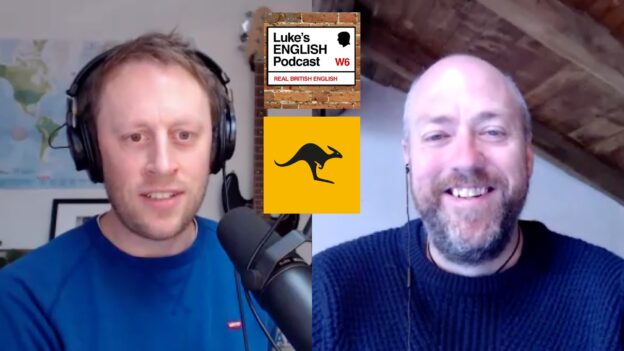
A conversation with YouTube English teacher Christian Saunders from Canguro English about the realities of learning and teaching English, motivation and goal-setting in language learning, Paul McCartney recording an album in his kitchen and plenty more. Video version also available on YouTube.
Hello folks, let me tell you about LEP Premium. There’s a thing called LEP Premium and it’s my paid subscription service. In premium episodes I do my best to help you expand your vocabulary, understand grammar and improve your pronunciation. I publish the episodes on my website and in the LEP App. If you’d like to sign up or just get more information go to www.teacherluke.co.uk/premiuminfo
Introduction Transcript
Hello listeners,
In this episode you can hear me having a conversation with Christian from Canguro English.
Do you know about Canguro English? Some of you will already be aware of it.
Canguro English is a YouTube channel, it’s an Instagram account, it’s a Facebook page, it’s a Twitter account and it’s also an audio podcast, and it’s all the work of Christian Saunders, an English teacher who originally comes from Australia but now lives and works in Spain.
By the way, the “Canguro” part is spelled c a n g u r o – and it’s spelled like that because it is pronounced exactly the same as the word kangaroo when pronounced in Christian’s Aussie accent, the kangaroo of course being one of the symbols of Australia (Do you know what a kangaroo is? It’s that animal that has a long tail, large hind legs and a pouch on its belly. They jump around the Australian outback and in fact can only be found in Australia). Say kangaroo in an Aussie accent and it sounds like it should be spelled c a n g u r o.
I’ve been aware of Christian and his work for a few years now as his videos often pop up in my suggested videos section on YouTube. Christian teaches English in his videos like many other YouTube English teachers, but over the last few years he has focused on delivering messages about changing the way we learn and teach languages, the importance of taking responsibility for your own language learning, and generally exploring the psychology and philosophy of learning other languages, especially English.
When I see Christian’s videos, I’m always struck by how passionate he is about his work, how he manages to communicate quite complex ideas using simple language in a clear and engaging manner, his use of metaphors and visual demonstrations and a generally thoughtful and generous approach to helping people not only learn English, but to think about how they approach the learning of English.
Then recently Christian did an event on social media in order to raise money for educational charity. Some of you might have seen it. The video involved him reading every single word from a copy of the Merriam-Webster dictionary, live on YouTube, which is actually much harder than it sounds.
He sat in front of the camera with the dictionary in front of him and proceeded to read each word one by one, and he continued doing it for 18 solid hours. You can find the video on YouTube.
I watched some of it and it was impressive – not just because it was for a good cause but because it seemed so tough!
After 10 hours or something he seemed to be totally exhausted! His eyes were hurting, his face was hurting, his brain was hurting! He must have been going mad sitting in front of that huge tome with so many thousands of words ahead of him, and the whole time there were people in the comment section encouraging him, cheering him on and donating money to the educational charity he was promoting – the aim being to raise $50,000 to go towards the building of a school for poor children.
After watching Christian for a whileI went to bed, and when I woke up early the next morning, he was still going!
I decided there and then that it was about time I talked to him on my podcast, just because I wanted to know what it was like for him, to let him explain why he was doing it, and also to get stuck into a wider conversation about lots of other things, and that’s what you’re going to hear. I sort of had a feeling that we’d get on quite well and that we’d have plenty to talk about, and I wasn’t wrong as you’ll hear in our chat.
This was a long conversation but it went by really quickly and it was really enjoyable to actually talk to Christian properly after having seen his thought provoking videos on YouTube.
Our conversation covers things like, catching COVID-19, the charity dictionary-reading marathon, Christian’s story of moving to Spain and renovating an old barn into a home for him and his family, what it’s like being an English teacher in classrooms and also a content creator for learners of English online, motivation in language learning, my personal situation learning French, Christian’s speaking style, how Barack Obama speaks, Paul McCartney recording an album in his kitchen and loads of other things too.
I’m very happy that I spoke to Christian because the conversation you’re about to hear does contain some really important principles about language learning – including many big conclusions that both Christian and I have reached after being involved in language teaching and learning for many years. Listen carefully – there is definitely some good wisdom to be picked up from this (I hope so anyway) and at the very least, it’s nice to just get to know Christian in a bit more detail.
You should know that there is a YouTube video version of this conversation in which you can see both Christian and me talking to each other, so head over to my YouTube channel “Luke’s English Podcast” on YouTube to find it, and don’t forget to like and subscribe when you do that (that’s right “smash that like button” guys). You will also find the YouTube video of this conversation embedded on the page for this episode on my website.
That’s it for my introduction. I’ll talk to you again briefly at the end of this episode. But now I will let you get stuck into this conversation with Christian from Canguro English, and here we go.
Ending Transcript
So, that was Christian from Canguro English. Come on, that was good wasn’t it? I hope you agree that there were plenty of solid bits of insight about language learning there, from two teachers who’ve been working for years to actually help people learn English.
Thank you again to Christian for talking to us and for giving his sincere and thoughtful comments on all the stuff that I asked him about.
Remember, there is a video version of this episode and you’ll find it on YouTube – Luke’s English Podcast is the channel name. Don’t forget to like and subscribe, ok guys. Smash that like button, etc. Seriously though, why not watch the video now that you’ve heard the audio. It could be a good way to reinforce what you’ve heard and there’s a good chance you’ll understand a lot more the second time round. My episodes are often long and have a lot in them, so listening or watching more than once is definitely worthwhile, if you can find the time to do it.
Also, check out Canguro English on YouTube. Have a look at his dictionary challenge if you want to see a man suffering! Otherwise, have a look at the various videos he has made about the psychology of learning English and more.
A quick note about WISBOLEP – I am working on the next part of that, so stay tuned and watch this space.
Also, I’m working on premium content which should be coming soon, but otherwise there’s a large library of episodes there for you to work with, including pronunciation drills which I think might be some of the most valuable of the premium episodes. Teacherluke.co.uk/premiuminfo
Finally, I feel inspired to sing a song with my guitar.
The tune I’m going to do is called Wonderful World – not the Louis Armstrong one, although that is lovely. This is the one by Sam Cooke and it is dedicated to my lovely wife who has more patience than I gave her credit for in this episode :)
You’ll find the chords and lyrics on the page for this episode if you’d like to sing along or learn it for yourself.
Wonderful World by Sam Cooke (Lyrics and guitar chords)
An episode exploring the subject of how to raise a child to speak English. I speak to Alex, an English teacher from Moscow about how he has been speaking exclusively in English to his 4-year-old daughter Alice since she was born. Let’s find out how it’s going.
Just in case you don’t know. My name is Luke and this is my podcast for learners of English all around the world. Welcome.
Just a reminder at the start here that this podcast is made possible thanks to donations from listeners and the paid premium subscription that you can sign up for in order to get access to over 100 episodes all devoted to helping you improve your grammar, vocabulary and pronunciation. The library is growing all the time as I publish new premium stuff, and I am currently working on some new episodes which I hope to record and publish soon. Being a Premium LEPster means you get access to all that content, as well as the free stuff, and it also means that you support this whole project too. To get all the information, including the very reasonable prices just go to teacherluke.co.uk/premiuminfo
One other thing – there’s a big vote coming up, a very important election in which one person is going to be chosen and it’s all very tense and historic – everyone’s talking about it – yes that’s right I’m referring to the WISBOLEP competition on LEP (what else?) I just wanted to mention this because people have been asking about it. The competition is closed now and I am working on the next stage of it, which will be to let you hear all the competition entries and then let you vote for your favourites, then based on the results of that vote, I’ll choose a LEPster to be interviewed on the podcast. I can tell you that there have been lots of strong entries so it will be difficult to choose just one person, but that’s what we have to do. So, stay tuned to LEP to hear an episode with everyone’s 2 minute speeches in which they try to convince you to pick them for LEP. That’s coming soon, when I’ve worked out how to manage it all. It’s coming in any case. Right, that’s that then, and now it’s time to start this episode properly, and here is the jingle!
Jingle – You’re listening to Luke’s English Podcast, for more information visit teacherluke.co.uk
Hello and welcome back to the podcast everyone.
This is the first in a series of episodes called Raising Bilingual Children, and it is about exactly that – the topic of bringing up children to speak several languages, or more specifically bringing up children who speak English as well as another language.
Ever since my daughter was born nearly 3 years ago I have been meaning to talk about the topic of raising bilingual children, or at least raising children who speak English fluently.
My podcast is mainly here to help my listeners improve their English, but a lot of you out there have kids and naturally your thoughts turn to them and their English.
I have had lots of requests from listeners asking me to talk about this topic, so that’s why this series exists, this being the first proper episode on the topic. I’m not sure how often I’ll be doing these, but it’s a topic I plan to return to in various ways in the future.
Maybe you have children and you want them to speak fluent English as well as another language. This is for you if that is the case. Maybe you don’t have children yet, but you might in the future, in which case you are thinking about how to help your future children learn English. We know that starting early is so important in language development. So, it’s certainly useful to have an awareness of this topic so you can do the right things when children come into your life.
Or maybe for you, having children is not a concern, because you’re not going to have children or you’ve already done it, but I still hope this will be interesting for you, because ultimately it is all about learning English and certain essential principles related to doing that.
The topic of raising bilingual children is massive. I am by no means an expert on this specifically, although it’s something I’ve been reading about, thinking about, talking about and also I’ve been doing it myself because I am raising a bilingual child, or hoping to, anyway.
As you may know, I live in France, and I have a young daughter – she’s nearly 3. My wife is French and and we are doing our best to make sure that our daughter learns to use both French and English with ease and confidence. So, I have experience in this area. But I haven’t done a masters degree in this topic or anything like that. My qualifications and experience are in teaching English to adults mainly. So I’m learning about it myself too.
It’s a complex topic.
There are big questions that come up when you start to talk about bilingualism in children, like “What is bilingualism exactly?”, “How do we define “bilingual?” “What is a native speaker?”, “How do children acquire languages? And is this different to the way adults do it?” and more… “What are the standards that we can realistically expect from children who aren’t living in an English speaking country and whose parents aren’t native English speakers?”
Also there are the many combinations of factors involved – many different situations that make it quite hard to get a proper grip on the topic.
For example, (and let’s just let’s use France as an example here, because that’s where I live, but you could replace France with any other country and this will still work)
Examples of Different situations
These different situations might require slightly different approaches or they might involve different challenges for parents.
One parent is French, the other is a native English speaker, they live in France. (like my situation)
One parent is French, the other is a native English speaker, they live in England.
Both parents are French, neither is a native speaker of English, but they live in England, the child is at school in English.
Both parents are English, both are native speakers, but they live in France and the child goes to school in French.
This is the holy grail: Both parents are French, neither is a native speaker of English, they live in France and the child is going to school in French.
Or similarly, one parent is French and let’s say the other is Korean, neither is a native speaker of English, and they live in Brazil and their child is going to school in Brazilian Portugese.
There are probably more possible combinations, and also there are other factors to take into account, like whether there is a wider community that exists in the target language (like grandparents who speak English that live nearby) or whether the child is going to a “bilingual school” (and there are various versions of that) or a monolingual school (only in English).
The more you think about the possible combinations, the more complex it gets! Especially from my point of view as I want to cover all the bases.
Also, there are different approaches you can take.
One parent, one language.
English in the home, another language outside.
English at the weekend and another language during the week.
Lots of combinations.
But, without getting too academic about it, I think one of the best ways to explore this subject is just to talk to people in various situations who are raising their children to speak English or who have done it, and just find out as much as possible about them.
Actually there are loads of people I can talk to about this, including my wife, our friends like Amber for example – who lives in France and has two children now, some of my colleagues at the British Council whose job it is to teach English to children and a lot of LEPsters who have success stories to share.
Alex Suvorov and his daughter Alice (4 years old)
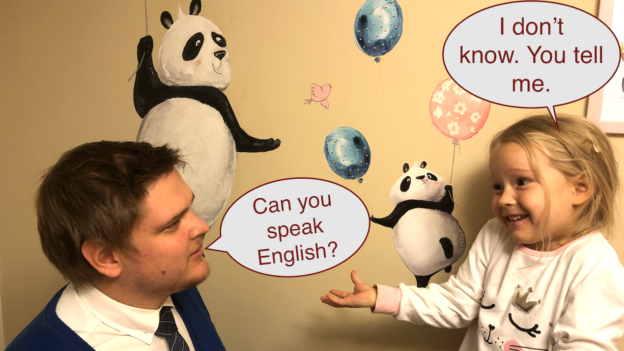
This brings me to this episode in which I am talking to a long-term LEPster Alex Suvorov, and his 4-year-old daughter Alice.
I have been meaning to talk to Alex on the podcast about this topic for quite a long time now.
As you’ll hear, Alex fits into the category of a non-native speaker in a non-English speaking country (I mean one where English is not the first language) who has been raising his child to speak English.
There’s a lot to unpack here, but basically I want to find out firstly how Alex got his English up to its current level, and then talk about his daughter’s English. That’s it, basically.
Hopefully we can shed some light on this whole subject and maybe give you some inspiration or food for thought.
At the beginning of the conversation Alex is joined by Alice, and you’ll be able to hear her speaking a little bit, but after a few minutes she goes into the other room and it’s just Alex and me, but at the end you will be able to hear a short recording that Alex made of him speaking to Alice, which will give you a little idea of what her English is really like.
So, without any further ado, let’s go.
Ending
So that was my conversation with Alex Suvorov, about his approach to giving his daughter a headstart in English. I’d like to say thanks to Alex and his daughter Alice.
Now, it would be interesting to hear a bit more from Alice so I’m now going to play a quick recording that Alex & his daughter made together, so you can hear her speaking in English.
This is about 5 minutes long and you’ll hear Alex basically trying to get Alice to show us her English, which is quite hard, because as you might know, it can be quite difficult to get little children to cooperate sometimes, but if you listen carefully you can hear Alice responding to Alex’s questions and prompts and saying little comments here and there.
Bear in mind that she is only 4 years old. So in terms of her English we’re not looking for Dame Judy Dench here – you’re never going to get spectacular and fully formed language from a child of that age, in any language. So don’t expect to hear Amber Minogue here. THat’s not what we’re looking for.
What we are looking for is the ease with which she speaks in English. Listen out for how comfortable she is speaking English. Actually, I don’t hear any grammar or vocabulary errors from Alice but she might be a bit hesitant or shy – because 4 year old children often are and Alice knew she was being recorded here. Her accent might sound a bit Russian, but as we said near the end of the conversation, for a 4 year old the main thing is that sense of confidence and comfort in English – and I think Alice has that. Specific points of pronunciation can be worked on later. But a foundation of comfort, confidence, fluency and the feeling that English is your own language combined with an instinctive sense of grammar and vocabulary are the most important things you can give a child. I think you can hear that from Alice.
Anyway, let’s listen…
Listen to Alex and Alice talking…
So that was Alex and Alice.
Some of you will be desperate to say that she has a Russian accent, and maybe she does a bit, but like we said before, that’s fine. We’re not looking for perfection here. We are looking for a baseline or foundation of comfort in English, and I think it’s fair to say that Alice has got that. You heard her producing correct grammar, fairly complex little chunks of English, decent and other things might come later, like her accent, especially if she continues to listen to English from things like cartoons, films, and also audiobooks and so on.
But the main advantage that little Alice has got is that English is part of her life.
Is Alice “bilingual” – well that depends on how you define bilingualism.
As Alex said, he estimates her vocabulary to be about 20% behind that of a native speaker of her age. That’s great. Remember: Connection, not perfection. For those of you who cannot get over the fact that Alice still sounds a bit Russian, I would ask you this – Is Alex wasting his time? Would it be better for Alice if her father only spoke Russian to her? Is it realistic to expect Alice to speak like a native speaker, like mini Amber Minogue? Is Alice’s English 20% worse than a native speaker, or is it perhaps 80% better than a child who only ever speaks Russian?
Food for thought there.
Of course it is about personal choice.
But still, it is worth thinking about.
If you are also raising your child in English to some extent, do get in touch and tell us about your experiences in the comment section of this episode. We’d like to know what you think and what you are doing, including your doubts too.
Thanks again to Alex for talking to us and sharing his story.
You can find Alex on Instagram by the way, and everything he posts is in English, so check it out.
The website’s test is fairly reliable I would say, if you answer it honestly. It’s all based on an academic research project and every time you take the test the data gets added to their database, and the database is there to help with the academic study. Anyway, to cut a long story short, it seems quite reliable, but that’s the best I can say.
I just took the test. It took about 5 minutes. Would you like to know how many words I know?
Well, apparently I know 31,200 words which is ever so slightly above average for a native speaker of English in my age group. So, this means I am entirely normal, or a tiny amount above normal, which is good to know. So, my English appears to be a very good sample of what the average British person knows, which is quite reassuring.
Do you have a story of raising a bilingual child that you’d like to share? Tell us about it in the comment section below!
A conversation with English-teaching stand-up comedian Elspeth Graty, which covers lots of different topics including Elspeth’s background in England, teaching English, cultural differences, “French-bashing”, old-fashioned telephones and The Tellytubbies. Enjoy!
This podcast is made possible thanks to donations from lovely listeners (click a yellow PayPal button on the website if you’re feeling generous) and also the premium subscription, which costs, per month, slightly less than a pack of 80 Yorkshire Gold Teabags from Sainsbury’s. So if you would like to make sure I never run out of tea, then consider signing up.
There are now well over 100 audio and video episodes in the premium archive and you can access them all, plus new ones that are coming. That’s what you get when you become a premium lepster. To get all the information, including how it works and exactly how wonderfully reasonable the prices are – go to www.teacherluke.co.uk/premiuminfo
Introduction Transcript
Hello listeners,
How are you today? Doing alright all things considered? I do hope you’re managing to keep calm and carry on during this weird and difficult period of history that we are all experiencing.
Shall we start the episode? OK.
Here’s the second in a series of interviews I’ve been doing lately featuring people I’ve been meaning to talk to on the podcast for quite a while (quite a while — is that a short time or a long time? Quick answer: It means a long time.)
I just wanted to record natural conversations with some new guests so you can hear their voices, their stories, their thoughts so you can notice bits of language and practise your English listening as usual.
The first of these recent interviews was with Marie Connolly from Australia, which was the last episode of course. I hope you all enjoyed it.
This conversation is with a friend of mine called Elspeth who is from England.
Elspeth is an English teacher and she also does stand-up comedy in the evenings, which is how we met each other. Yep, she’s another English-teaching comedian friend of mine.
Explaining this episode’s title
The title of this episode is “Chasing the Tangent Train with Elspeth”.
The title is just a metaphor – please don’t expect a conversation about train travel!
It’s just a metaphor to explain the fact that this conversation is full of tangents and I hope you can keep up with it. In fact, it’s mainly tangents.
What is “a tangent”? Long term listeners should know this, but plenty of people won’t know so let me explain.
In a conversation, a tangent is when the topic changes to something quite different and seemingly not related to the main point of that conversation.
It’s when you digress from the main point, go away from the main point or get sidetracked.
“To go off on a tangent”
There are lots of tangents in this conversation. So, for the title of the episode, I was trying to think of a way to describe the experience that you will have of just following the changes in direction in a conversation and seeing where it goes.
I ended up with “chasing the train”, which is not actually an expression you will find in the dictionary – I made it up.
Let’s imagine, then, that this conversation is a train and it’s going down the tracks and every now and then it switches to new tracks and continues for a while, then it switches to another new track and then does it again, and again and so on. Can you keep up with the train? I think you get the idea.
My overall aim for this interview was mainly to get to know Elspeth in more depth and to capture an authentic conversation to help you learn English. That is the destination for this train journey. But as I said, the topics move around a bit, which is totally normal in a conversation. Just ask David Crystal, he wrote a book all about it and he’s a professor and definitely knows what he’s talking about.
What I’m getting at is that this might be hard for you to follow – depending on your level of English.
So you’ll have to focus.
Nevertheless, I can help you keep up with this if I let you know what the main changes will be in advance.
So I’m now going to give you a quick overview of the main changes in topic in this chat.
The main points in this conversation are, thus: (these aren’t spoilers)
We talk about
Where Elspeth comes from originally, and how her family moved around parts of England
Being the daughter of a vicar (that’s her, not me obviously) A vicar is a priest in the Anglican church – the church of England. The cliche of the typical English vicar is that they wear black with a little white collar, they’re often softly-spoken grey haired men with glasses who ride bicycles around their parish and love drinking tea, eating cake and generally worshipping god.
Our accents, which are not strongly affected by the region where we grew up (we actually come from the same general area in England)
Having harvest festivals at church when we were children
Then there’s a big, random tangent → Remembering the old dial telephones we had in our houses when we were children. Remember them? You had to put your finger in and turn numbers around a dial, and it went went kkkkkkkkk. You don’t remember? That must be because you’re young, or you’re old and you’ve lost your memory.
Services you could get on the old analogue telephones, like the operator (a person who you could speak to and who would deal with your telephone-related enquiries) and the talking clock (a recorded voice that was constantly telling the time and you could call a number and listen to it)
Coventry Cathedral in Coventry, which was almost destroyed during World War 2 but was rebuilt and is now definitely worth a visit if you’re in the city
Elspeth’s life in France, her French, and whether or not she feels French or English after living here for quite a long time
Some of the cultural differences between England and France that frustrate us a bit, like the usual things – being punctual, walking down the street and in particular, queueing – standing in line to wait for things in public
Teaching English to young engineers, and the challenges that French students have when learning English
Some of Elspeth’s experiences of learning French
How Elspeth can behave slightly differently in English and in French, especially when doing stand-up comedy in the two languages
Elspeth’s thoughts on her own clothing choices and fashion sense, and how people react to it, especially the Nike Air Max trainers that she wears
Teaching English online using Zoom – and what that is like
Doing stand-up (going on stage and telling people jokes and stories to make them laugh) and Elspeth’s favourite and least favourite things about doing that Where her inspiration for comedy material comes from and “flow activities” or being in a “flow state”
If there is a connection between stand-up and English teaching
A little story about The Tellytubbies that Elspeth uses in her English lessons, which makes the students laugh (The Tellytubbies is a children’s TV show) The story involves The Tellytubbies, William Shakespeare, the county of Warwickshire in England and April Fool’s Day. Basically, the county council of Warwickshire played an April fool’s trick on the people of Warwickshire, and it involved The Tellytubbies and Shakespeare, and people didn’t like it.
Why English people get into rages – like road rage, or trolly rage in the supermarket
The concept of French-bashing (criticising or making fun of the French and French culture) and why Parisians seem to complain about each other’s behaviour quite a lot (Parisians are people living in Paris)
How people’s behaviour in public in Paris compares to behaviour in the UK and in Tokyo
Things we love about France – because there’s a lot to love about this country too
Finally, a bit at the end where we both conclude that Paul Taylor is basically a cake – a delicious British cake.
Actually, reading out that list – it doesn’t seem like there are that many tangents, but there are tangents ok? What I’ve just given you there is the main flow of the conversation.
Right. Now that you have an overview of the track layout, let’s get this train rolling.
Let’s just get started. Here is my conversation with Elspeth, and here we go.
Luke’s fuddy-duddy slippers (a Christmas present from a couple of years ago)
Ending Transcript
Right, so that was my conversation with Elspeth. I enjoyed it a lot, especially because we have quite a lot in common, not least because we are from the same neck of the woods (a local area where someone lives).
How did you get on? Did you manage to follow it ok? Well, you must have done, because you made it. You’ve caught up with the train. You can have a rest now. Well done for keeping up.
I expect you’re getting out your phone now. If that’s what you’re doing, open up Instagram on your phone and check out Elspeth’s page, which is @elslostinfrance which I now realise would have been the perfect name for this episode, right?
I could do a lot of rambling on now, about all sorts of things, like what’s been going on and the WISBOLEP competition (which is now closed by the way – no more entries please. The deadline has passed, unless maybe you’re in a part of the world where it is still the 15th October – in which case, you have until midnight).
I’ve received loads of entries and let me tell you – it is going to be difficult to choose just one winner. There are so many really interesting recordings and stories of how people learned English and all kids of other things. It will be hard to pick just one person. Also I’m now wondering how I’m going to manage the whole thing. I’ve had nearly 90 entries. I don’t know why I didn’t expect to get so many. Each entry is about two minutes long and so – 180 minutes, even without my comments (and I really want to make even very short comments).
Shall I play them all on the podcast? That’s a lot, isn’t it?
I think the best way to do it might be to make a YouTube video of all the audio (if that makes sense) and then I can add time stamps for each person, which will make it much easier for everyone to find each recording.
In any case, I will find a way to manage this. It could take a while though, so be patient.
I do want to re-state that it has been amazing listening to all the recording (I’ve had brief listens to most of the recordings sent). There are some awesome people in my audience. I just want to give a shout out to anyone who sent in a recording. Well done for plucking up the courage to do that. The competition is going to be a bit of a celebration of my audience from around the world.
Not much more to add here, except the usual mention of LEP Premium which you can find out more about by going to www.teacherluke.co.uk/premiuminfo I’ve been getting some very positive feedback about it. There are now over 100 episodes of LEPP now in audio and video form. Check it out to see what you’ve been missing.
I’ll be back again soon with another episode, perhaps one in which I just ramble on about all the stuff that I’ve been meaning to say on the podcast for a while, a few listener emails, some songs perhaps and more…
Let me say thank you again to Elspeth for her contribution to this episode. Thank you Elspeth.
Everyone: Hang in there. Keep your chin up.
Hey, do you want some anti-covid funk music to cheer you up? (Yeah)
OK. This is something that I recorded this morning. I probably should have been doing some work but after dropping off my daughter at school I suddenly felt compelled to play some bass, and one thing led to another and I ended up recording a little 2-minute funk groove. The drums are from a youtuber called Dimitri Fantini (link on the episode page). I needed a 90bpm 16-beat funk groove and he delivered. Credit to Dimitri for the drum track. I’ve added bass using my Mexican-made Fender P-Bass, some rhythm guitar with my Fender Stratocaster (also made in Mexico) as well as some string sounds which are from my Yamaha P-45 electric piano.
I called the track Funk in the Kitchen, because it’s supposed to make you dance in your kitchen, or indeed in any other location.
Brace yourselves – music is coming… In 5, 4, 3, 2, 1, let the funk commence…
Marie Connolly is an Australian stand-up comedian and TEFL teacher who has written a book of short stories about times when men (from various countries) have flirted with her. In this episode Marie shares some of those stories, tells us about English men vs French men vs Australian men and much more.
[DOWNLOAD]
Transcripts & Vocabulary Notes for this episode (promos, introduction, ending)⤵
LEP Premium Promo
Before we start – a quick mention about LEP Premium. Premium LEPsters, I just want to let you know that P24 is now finished and uploaded. It is an epic series – homophones, jokes, building your vocabulary (which is so important) and also working on your pronunciation. I’ve also uploaded P25 which contains pronunciation drills for the previous free episode (LEP682) which was all about English accents. I said I’d do a pronunciation episode for that, and I’ve done it. You can practise saying the sentences with my normal accent, and also with several regional accents too. The aim being to strengthen both your listening skills and your speaking skills.
WISBOLEP Competition
Second thing – the WISBOLEP competition deadline is 15 October. Is that clear? Originally I said 31 October but the date has changed! The deadline is now the 15 October 2020. If you don’t know what the competition is, check out episode 681.
But this is episode 683, and I’m keen to get started, so let’s go…
Introduction
Hello and welcome back to LEP. It’s new episode time again!
This is an episode with a guest. So you’re going to be listening to another authentic conversation at natural speed in English which can be difficult to follow but is good training for your English.
Before going any further, let me explain the title of this episode. “683. Feelgood Stories of Flirting with Marie Connolly”
Feelgood is an adjective (one word) which we use to describe anything that makes you feel good! For example we can say a feelgood film, feelgood food and or feelgood stories, which would be stories that will make you feel good.
Feelgood stories of flirtingFlirting means interacting with someone in a way that shows that you fancy them, find them attractive, and are probably interested in perhaps getting ‘romantically involved’ with them, let’s say. Synonyms include ‘chatting someone up’ , ‘hitting on someone’ or perhaps ‘trying to pick someone up’. A person can be a flirt, and the adjective is flirtatious.
Feelgood stories of flirting with Marie Connolly
And Marie Connolly is my guest in this episode.
Marie Connolly
Marie is a stand-up comedian, a ski-instructor, an English teacher and writer. Her latest book is full of short stories about flirting with the opposite sex.
Before we meet Marie, let me give you some context to help you understand this conversation, which can ultimately help you learn more English from it.
Marie is from Australia but she has lived in a few different countries. It’s a bit of a stereotype that Aussies like to travel away from Australia (this is called Going on Walkabout), but in this case it’s true. Marie has spent time in various places including Brisbane, Syndey, London, Liverpool, The French Alps and now Paris.
Marie was born in Australia but her dad was from Liverpool and her mum was from El Savlador in central America, which is quite an interesting combination.
For those of you who are interested in accents and pronunciation – Marie has a slight Australian accent because that’s where she grew up. It’s not super strong, but you should be able to notice it a bit.
Here are the main things you’re going to hear us talking about:
As you might expect we chat a bit about stand-up comedy, what it’s like dealing with tough moments on stage and reasons why it can be hard to do stand-up in front of audiences of non-native speakers.
I’m afraid to say that the infamous Russian Joke story makes yet another appearance, which is my fault because as you’ll hear, I’m the one who brings it up. I know, I know. I can’t believe I’m still talking about the Russian Joke, and some of you are now saying “Wait, what’s the Russian Joke?” Long-term listeners will know all about this. Clearly I have deep mental scars from this experience which still haven’t healed. Either that or I secretly love telling this story.
If you don’t know what I’m talking about, just keep listening because I am going to tell the story once more. Yes, I know.
Marie gives some thoughts on Liverpool where some of her cousins live, and her favourite English shops for buying clothes, which leads to some chat about Marks & Spencer – the quintessentially English clothing and food shop, which also has branches in Paris where you can buy proper tea. (not property, no – they don’t sell flats and houses, no I mean “proper tea” good quality tea)
….I’m now pausing for laughter…
Marie tells us about her time living and partying hard in London, and then her decision to move to France to work as a ski instructor at a ski resort in the Alps, while making trips to Paris to perform comedy gigs.
You’ll hear some details of Marie’s comedy shows in English and French in Paris.
At the moment she is doing her own one-woman show in English called “Sydney, London, Paris, Darling”. You can see it if you’re in town, COVID permitting of course. At the moment, in France, Theatres are still allowed to open and Marie’s show is in a theatre so it’s still on. If you’re in town why not come and check it out? She is very funny and has some great stories to share.
Then we move on to talk about the latest book that Marie has written, called “40 Frenchie Feelgood Flirts”. It contains 40 short stories. This is yet another book recommendation on the podcast. I think it could be a really good thing to read, if this is your cup of tea. Short stories are perfect for learners of English, because they’re short – do I need to say more?
It’s chick-lit, which means books primarily for women that usually include romantic themes.
The stories in Marie’s book are all cute anecdotes about times when men have flirted with her, hit on her, or chatted her up. There’s no explicit sexual stuff in Marie’s book. As Marie says it’s just innocent fun. So it’s less “40 Shades of Grey” and more “40 Shades of Hey, How are you doing?”
— I’m now pausing for more laughter and applause, thank you —
The rest of the episode is mainly Marie sharing some of her stories of flirty moments with men who she has encountered.
She also talks a bit about how French men are different to Australian or English men.
What do you think the differences might be? What do you think Marie is going to say about the way a French man will approach her, compared to an English or Australian man?
Hmmm, have I piqued your interest? I hope so. Listen on to find out the details.
VOCABULARY
Vocab hunters – Here is some language which you can simply notice as you listen. When you hear these things, take a mental note.
I know you are keen to get to the conversation, but bear with me. This will be useful for your English, and that’s what this is all about at the end of the day (and the beginning of the day, and the middle of the day, etc) Trust me, I am a professional.
I’m not explaining this all now, I’m just saying it so you can notice it yourself when it comes up naturally. If you don’t understand these phrases, don’t worry. I will explain it later in the episode. But you might be able to work it out from context as you listen.
*There is some swearing*
To backtrack – “You can’t backtrack” [this one comes up twice]
To stick in someone’s craw – “It stuck in my craw. It bothered me.”
To be over it – “Maybe I’m not over it”
Deep scars – “Maybe there are deep scars”
To wilt – “I wilted in front of them”
To be sick to your stomach – “I was sick to my stomach”
To be swallowed up – “Can I please be swallowed up?”
A halterneck top (an item of women’s clothing that is quite revealing) “I was wearing a halterneck top”
To snuggle under the duvet – “If I could have, I would have snuggled under the duvet and just stayed in bed for a year.”
______ by name, ______ by nature – “Alex Love, our mutual friend; lovely by name and lovely by nature.”
A coping strategy – “Every comedian has their own coping strategy”
To rectify – “Get back on stage as soon as possible and rectify”
Dainty / pastries – “I’m not used to French dainty pastries, I prefer the big fat Australian ones”
Self-soothing
To pay through the nose – “I will pay through the nose. I just want the best tea I can get.”
A hub / antipodeans – “It was a hub for antipodeans”
To be up shit creek (without a paddle) – “Because of Brexit I’m up shit creek.”
A snapshot of something – “It’s a snapshot of life in France”
To be hit on / to be picked up / to be complimented – “40 times I’ve been hit on, picked up or complimented by men”
Abs – “One was very white but he had super-fit abs”
White vs Pale (to describe a person)
Calf muscles
A sand castle
To blush – “He would blush and I would feel amazing.”
The contents (of a book) / to pique someone’s interest – “Can I read through the contents to pique people’s interest?”
To mime – “He started swimming with his hands. He was miming and I was laughing.”
A man bun – “He had long hair up in a man bun. I called him Mr Man bun.”
Chick-lit
Ok so try to notice those things, maybe try to guess what they mean and I’ll be explaining them on the other side of the conversation.
But mainly, I hope you just enjoy listening to this chat.
Now, get ready because things are going to speed up a bit, as we meet Marie Connolly…
Ending
Thank you again to Marie. After finishing the recording, we realised there were other stories we’d forgotten to tell, including the time Jerry Seinfeld turned up at one of our little comedy shows in Paris and performed in front of about 20 people including Marie and me, and how it was just a little bit awkward, but still amazing and quite surreal. Jerry Seinfeld at one of our shows? What are the odds? So Marie will have to come back for another episode in which we can describe that experience for you.
Just a reminder about Marie’s comedy show (if you’re in Paris) and her books (which you can get anywhere in both paperback and Kindle versions).
The One-Woman Comedy Show
“Sydney Paris London Darling” you need to check her Facebook page – Marie Connolly Comedy.
https://www.facebook.com/marieconnollycomedy/
Marie’s books, including “40 Frenchie Feelgood Flirts”
Marie’s page on Amazon where you can find her books. The main one we talked about is “40 Frenchie Feelgood Flirts”. She writes under the pseudonym Muddy Frank (read the titles of the books available)
Explaining the Vocabulary
Let’s go through that vocabulary again, from the beginning of the episode.
Did you notice any of the words and phrases I listed before? Did you get a sense of what they mean?
Let me go through them again, and I’m going to clarify them as quickly as possible. I’m not giving these phrases the full LEP Premium treatment (because I like to go into lots of detail in those episodes) I might put them into an upcoming episode of LEP Premium so I can make sure you learn the vocabulary properly and we can do the usual memory tests and pronunciation drills as well. But now, this is the sort of quick version. Let’s call it the 10 peso version.
The vocabulary is already listed above ⤴️
Still not sure about the meanings? Try using www.oxforddictionaries.com to check them out. Other online dictionaries are available.
And that is the end of this episode.
What’s coming up in the future? Who knows – nobody can predict the future, except weather forecasters.
As usual I have more episode ideas than time, but I do have a few interviews lined up, including some more friends you might not have heard on the podcast before, and some regular guests that you’re probably waiting to hear from too [yes episodes with Amber & Paul are in the pipeline, it’s just a bit tricky to find times when we are all free].
Basically – more conversations with guests are coming up as well as the usual episodes on my own on various topics. So, it’s going to be more of what you normally get with LEP!
Right, I will let you go now.
Thank you for listening.
Check the episode page on my website where you’ll find transcripts for 95% of what I’m saying in the introduction and ending parts of this episode, plus other things like a photo of Marie and me (oh Luke, a photo!?) plus the comment section and things like that. I often put other things on the website page for you to check out as well, including little YouTube videos relating to the episode or other bits and pieces.
I look forward to reading your comments on the website.
Follow me on Twitter @englishpodcast which is where I am also quite active.
Tweets by EnglishPodcast
Sign up to LEP Premium to access all the other episodes I make, all focused on helping you build your English in various ways. www.teacherluke.co.uk/premiuminfo
Have a good one. Be excellent to each other, and party on in your own sweet way.
Exploring the main differences between standard English pronunciation (RP) and non-standard regional or colloquial accents. How do people really speak in different parts of England, and how does this accent differ from the accent you probably hear in English language course books and dictionaries? Notes & videos available below.
Hello everyone, this episode is brought to you by LEP Premium which is my paid subscription service in which I focus on teaching you vocabulary, grammar and pronunciation to really boost your English. It includes a big library of audio episodes, video episodes and PDFs plus new content arriving all the time. You get episodes in the LEP App or online. To get started go to www.teacherluke.co.uk/premiuminfo
Hello and welcome to the podcast!
I hope you’re doing fine today. I’m alright thanks for asking. It’s a Thursday afternoon. I have finished my teaching for the day. I’m at home. I’ve had lunch. It’s now pouring with rain outside. The conditions are perfect for learning and teaching English in another new episode.
This one is going to be a deep dive into English accents and we’re going to look at some pronunciation features that are common in the non-standard forms of English accents, which basically means the regional accents that differ in various ways to standard English RP. This should help you identify key differences between RP and the other accents and remember – most people have a regional accent. RP isn’t actually that common. It’s only a small percentage of all the English speakers in the world, and yet the coursebooks, pronunciation guides, dictionaries and so on tend only to present RP as their model for learning English. As a result you might find it really hard to understand people speaking in the real world or in realistic TV shows and films. This episode is about helping you understand how non-standard English accents differ from RP.
Just before we start on that though, I just have three announcements and bits of podcast admin to make.
1. WISBOLEP – The New Deadline for the Competition is 15 October 2020.
The latest LEP competition is now open, since I launched it in the last episode. WISBOLEP. If you’re interested in taking part, just listen to the previous episode of this podcast to find out. I thought I wouldn’t get many entries, but of course I always underestimate this kind of thing.
Thank you for those of you who have entered the competition – I have already had more than I thought I would get. Now I’m worried that I’ll get too many entries. At this stage, the competition closes on 31 October but I have decided to bring forward the end date of the competition, otherwise I will get so many entries and I won’t be able to deal with them all.
So – is that clear? The new end date for WISBOLEP is midnight on 15 October 2020.
2. LEPster Meetup in Prague – Sat 17 October
I want to say “hello” to any LEPsters in Prague in the Czech Republic. Hello.
There is another LEPster meeting happening in Prague on Sat 17 Oct 2020, 5pm-10pm. I suggest you join in, speak English, meet some like-minded people and play some board games in English, which is a really great way to work on your communication skills because it’s fun and makes you use English in specific ways.
Details
Date & Time: Sat 17 Oct, 5-10pm.
Venue: Bohemia Boards and Brews
Host: Zdenek Lukas
It’s a board game cafe. A lot of expats go there and the owner is American.
Join a Facebook group called Prague Lepsters and sign in there because of the reservation and/or send me an email at teacherzdenek@gmail.com.
Prague Lepsters on Facebook https://www.facebook.com/groups/1317940114960070/
3. Listen to Luke on the IELTS Speaking for Success Podcast
Recently I was interviewed on the IELTS Speaking for Success podcast, which is co-hosted by Maria Molashenko. The podcast is all about succeeding in the IELTS test, but our episode was all about how to use podcasts to improve your speaking. We talked about approaches to using podcast episodes to learn English in various ways, including listening passively and actively and specific techniques you can use. Maria is a successful language learner herself (and she’s a LEPster) and she has loads of good input too. So, you could listen to that. It’s for everyone hoping to improve their English with podcasts. Also, there’s a PDF summary of all our advice, which you can download free. Find both the audio and the PDF linked on the page for this episode on my website, or search your generic podcast app for IELTS speaking for success. I was in Series 4 Episode 10 “Learning English Through Podcasts”.
This episode is all about English accents – the regional versions that exist all over the country, and how they generally differ from a standard English accent like mine for example.
We’ll be looking at some very common features of English that are very typical in England, and which generally mark someone out as being from a certain place and from a certain background.
We’re not going into all the differences between each regional accent, like “this is Liverpool, this is Manchester, etc”. I’ve done that before in previous episodes (search the archive for British accents and dialects). Rather we are just going to look at some features which are shared by lots of the different regional accents.
This feels like a premium episode because it’s all about language, but I’m keeping it free and what I’m going to do is record a follow up premium episode which will be full of pronunciation drills for you to practise saying things with these pronunciation features and without, like me.
That’s coming soon to https://www.teacherluke.co.uk/premium
Have you ever noticed any differences in the way I speak and the way that some other British people speak, like some of my guests, for example the way Paul Taylor speaks?
The difference is quite subtle.
Luke’s Accent vs Paul’s Accent
From episode 527 – Can Paul Taylor Pass the UK Citizenship Test (from 12:50)
There’s really only one main difference there in the way Paul and I speak, but it’s quite a big one in the world of English accents. Paul says things like “It’s really overly complicated and it’s not, it’s not complicated but it’s stuff that is irrelevant if you want to live and work in England” “He’s pretty decent. He knows a lot about history and stuff.”
The difference there is the way Paul pronounces certain T sounds with a glottal stop. I might do it occasionally, but I think generally I pronounce most of my Ts, certainly the ones in the middle of words, most of the time.
So Paul uses a glottal stop and I usually don’t – that’s the main difference, but it’s quite a big one.
What does this mean then? How does this distinguish Paul and me then?
The difference is just a subtle one in the way that we speak, which means that Paul’s accent is influenced a bit more by where he comes from, and maybe he’s from a slightly lower social class, but we’re splitting hairs really. It’s probably more of a cultural one in the households in which we grew up.
I grew up in what I often call a BBC household with a dad who went to Oxford and worked at the BBC for most of his career and in our house there wasn’t much of a trace of an accent. Maybe a bit of midlands, or Yorkshire but generally it was RP. Maybe this is because my dad studied English at university, and my mum studied history as well and then my dad went into broadcast journalism, so speaking in this standard way was just the norm. Also my grandparents spoke mostly in this way, with slight northern accents coming through sometimes in the way they said certain words.
I don’t know all about Paul’s background that much, but I guess his accent stems from the time he spent in Kent growing up, which is very similar to London really, and glottal stops are very common in that entire region. I don’t think Paul is from a hugely different social class to me, but if I had to call it, I’d say that I’m more on the side of upper-middle class and Paul is, I don’t know, middle middle class, not that it’s important. It’s more that I want you to be able to pick up on these little signifiers of people’s backgrounds, like English people do when they hear each other speak. I’m not inviting you to judge people, just to be aware of certain social clues that you might not otherwise notice.
I don’t want to get bogged down in class here. That’s another story for another time.
Let’s get back to talking about different types of English that you might hear, and their differences.
How about the way people speak on the BBC news and the way people speak in the street? [There are stylistic differences, but mainly the BBC news is spoken in standard RP]
Have you ever come to the UK after studying English in your home country for many years and then got into a taxi and found you have no idea what the taxi driver was saying?
It’s probably because his pronunciation didn’t follow the usual, standard conventions. It probably wasn’t something you were used to hearing if you’ve been studying from course books or other published materials.
What are some of the differences between my accent and so many regional accents in the UK?
Email of the Year
Every now and then I get an email which asks me lots of questions and also answers them at the same time, which is great. Here’s one which I received flippin ‘ages ago ( 5 years ago in fact – Email of the decade?) I’ve only managed to get round to it now but anyway, here we go.
Name: Koji Watanabe
Message: Hi Luke!
My name is Koji. I’m a big fan of your show.
First of all, congratulations on your marriage! I hope your honeymoon will be stunning and that you love it.
If I (can) introduce myself, I was born and raised in Japan and moved to Sydney 2 and a half years ago. However, I have been using various visual study materials (tv shows) from the UK and my English is British rather than Australian.
I started playing cricket and am deeply saddened by the defeat by England in the recent Ashes series. In one episode you said you and your father loved the game so I would love to hear you talking about it for the whole show.
I listened to your episodes about the cockney accent, (Northern) Irish accent, British accents and dialects, and they covered some of my questions I would like to ask you today.
I apologise in advance for asking you questions in the first communication. Only if you think it is something you might want to bring up in one of your podcast episodes, please read it through – otherwise, you can just disregard this email.
My questions are about accents and dialects.
Luke: What follows is a pretty detailed description of different pronunciation features in British English (TH sounds, T sounds and glottal stops, H sounds and more), with a few questions thrown in.
What I’ve done is taken Koji’s notes and worked on them, adding details, thoughts, ideas and so on, while also keeping Koji’s original text. Let’s go through that now then.
Before we go into this, I just want to make a point about accents and identity.
What kind of accent do you want?
When we’re talking about accent, we need to bear two things in mind.
One is intelligibility – can people understand you?
The other is identity – who are you? Who do you want to be? What do you want people to think of you? Who are you talking to?
Regarding the colloquial English we’re going to be looking at now, I think it is absolutely vital to know about these different varieties and how they affect pronunciation. But should you be speaking like this too? As I said, it’s totally up to you. I personally think being intelligible is the most important thing. You might also want to sound like a local, I suppose. In that case, go for it. But in the words of David Crystal, keep it natural. Don’t force an accent too much.
There’s also the rather sensitive subject of accentism or snobbishness in accents, and how people’s opinions of you are affected by the way you speak. The fact is, a colloquial accent can cause people to subconsciously judge you in certain ways. People might see you as being less educated or sophisticated if you drop all your Ts, pronounce TH sounds in certain ways, don’t pronounce H sounds and so on.
I’m not saying that colloquial English will make you stupid or anything. That’s obviously false, but colloquial English does carry with it certain associations such as a working class background.
What am I saying? Basically, you’re more likely to find colloquial English like this from a guy working on a building site than from a qualified lawyer working in a top London law firm. So, which one are you? If you’re working on the building site with the other lads, I expect the colloquial English would seem more appropriate. If you’re doing an internship in the law firm, the standard RP would probably be more appropriate – but please don’t assume that I mean that colloquial English sounds stupid or is only used by uneducated people. I’m just saying – be aware of the baggage that comes with this kind of accent.
For example, my dad tends not to like glottal stops. If I said “Can you pass the butter?” he’d probably correct me. “It makes you look bad” is what he might say. Certain linguists might find that to be snobbishness, but the fact is, it’s a common attitude.
Should you speak like this? It’s up to you! The main thing is: you need to understand the varieties of English.
This episode is as much about understanding natural English when you hear it, as it is about actually learning to speak like this. In my honest opinion, I reckon you should probably aim to produce standard English. Try to be clear and use pronunciation that most people understand and let your own identity give some colour to the language as you doubtless will be imprinting your English with influence from your first language anyway.
In all honesty, it is very hard for an adult learning a second language to lose all trace of their accent. There are almost always traces of your accent in your English. That’s not so bad. Your English is just one of the many varieties out there. We don’t all speak the same. That’s the cool thing about English. It’s quite adaptable. If you’re using it, communicating effectively with it, and yet you sound different to everyone else – welcome to the club. English is like a village.
So, as someone from Bristol has their own version of English, then why not someone from Barcelona?
My main advice is – understand this, absorb it all, notice it when people speak, but just try to be clear when you speak. Try to focus on being understood in your communication, rather than trying to sound like a certain type of person. Clearly communicate your own ideas and just be yourself.
[Koji’s words are presented in italics]
*th-fronting
This means that TH sounds become either F or V.
Thirty Three – “Firty Free”
Mother and Father – “muvver and favver”
It’s particularly common in the south of England, although apparently TH fronting has started to spread to areas in the north too.
Unvoiced TH /θ/
Those who speak with th-fronting use “f” if “th” is pronounced as “θ”.
“I was bowled over when I found out I was related to royalty on Who Do You Fink You Are.”
“Edward the Fird”
“My great-grandfaver “
And does this also apply to names as well? (Luke: Yes, of course)
Thor, Beth, Theodore, Thurgate, Matthew
Voiced TH /ð/
If “th” is pronounced as “ð”, the sound becomes “v” only when “th” is used in the middle or at the end of the word. Is this correct? [So, basically – not at the start of the word]
I would agree. Occasionally you hear TH at the start of the word becoming F or V but very rarely (it’s probably just a speech impediment that some people have).
It’s interesting that native speakers also seem to struggle with TH sounds, because learners often find this really really hard.
*t-glottalisation (the glottal stop)
A glottal stop in English is a replacement for a T sound in the middle or at the end of the word. It’s most typically associated with a cockney accent from London.
Interview with Adele (from 1:31)
“I got really excited as if it wasn’t me, and afterwards I tried to check Twitter but I didn’t have a Twitter account so I just saw what was on there if you’re not on there”
“Excited”
“Twitter”
Instead of making the T sound in your mouth, the glottal stop comes from closing and then opening the glottis, which is an opening between the vocal cords – basically it’s in your throat.
When we make a T sound, the tip of the tongue presses against your gum just behind your teeth and when the tongue is released, the air and sound that comes out is a T sound.
With a glottlal stop, we make that sound from the vocal chords rather than the tongue and the gums. When we open the glottis, air is released in a similar way to when we use our tongue on our gums.
Later
Started
Water
Bottle
Computer
But we don’t do this for every single T sound. It depends on certain things.
It’s interesting to know this but I would advise against doing it too much in your speech. I’ve heard learners of English who try to use glottal stops on purpose perhaps because they’ve discovered that it makes you sound authentically English, but used too much and in a slightly wrong way it can have a weird effect. So, know about the glottal stop, know how to use it, but use it all the time at your own risk.
Quick Test
Imagine you’re a native English speaker who uses glottal stops ( you could be Paul Taylor maybe).
Can you say these words with a glottal stop? Where does the glottal stop go? Which words have no glottal stop?
Better
British
Antique
Letter
Entitled
Security
Hotel
Restaurant
Lost
Sit
Return
That
Thirty
Twitter
Wants
Potato
When do we add a glottal stop and when not?
YES: At the end of words — not, hot, got, lot, start
YES: After a vowel sound (previous examples)
YES: In the weak/unstressed syllable
No: At the start of words
No: After a consonant sound
No: In the stressed syllable
Potato has two Ts in it. One is replaced with a glottal stop and other isn’t. Which T is glottalised, then?
Potato
Which T is in an unstressed (weak) syllable?
It’s the second one.
Letter
Better
But not in hotel, antique, return – because the t sound appears in the stressed syllable.
Entitled
Pronounce the first T because it’s in the stressed syllable.
The second T becomes a glottal stop because it’s in the unstressed syllable and follows a vowel sound.
Lost
Wants
No glottal stop after a consonant (it’s impossible anyway!)
Koji – I’m sure there are some words in which t’s should not be dropped if I’m not mistaken.
For example, we can say:
Water [wa’er], pathetic [pa-fe’ik]
But we cannot use a stop for words such as:
Fountain (?), maintain, hotel, hostel..
Yes – because of the reasons given above.
Water and pathetic – The Ts in these words follow vowel sounds and are not in the stressed syllable.
Fountain, maintain and hostel – follow a consonant sound /n/ /s/
Maintain and Hotel – the T is in the stressed syllable
If a word has two elements then we do not drop “t”:
re-trieve, pre-text..
[This is a bit like the T at the start of the word. The prefixes could be considered as separate words.]
Are there any patterns or rules in which ts can be omitted? (we’ve just been through them but let’s recap)
YES: At the end of words — not, hot, got, lot, start
YES: After a vowel sound (previous examples)
YES: In the weak/unstressed syllable
No: At the start of words
No: After a consonant sound
No: In the stressed syllable
Or do I just need to get the feel of it and remember which one can and cannot?
Get a feel for it is my advice, and like Koji mentioned before, the best way is not to do it too strongly. Don’t push it too much and try to use it everywhere. But try it out, test yourself, repeat after me. There will be a premium pronunciation episode for this, with drills for all the stuff in this episode. Both the colloquial version with things like glottal stops and also the standard version – how I would normally say it.
So, back to my advice for Koji.
Yes, on one hand, practise things like glottal stops – for fun mainly, but also to learn about how these sounds are made and how they feel, which will definitely help your listening, which in turn helps everything else. Helping your pronunciation can help your vocabulary, because it allows you to suddenly understand other people more, which then helps you identify what people are saying, allowing you to add those words and expressions to your active vocabulary.
So on the one hand, play with glottal stops and other things. But also consider to what extent you want to introduce these things into your normal speech, and in fact my advice would be to pronounce the Ts in your words when you are talking normally in your life. Pronouncing the Ts, especially at the ends of words, does tend to make you sound really clear and nice. It’s also probably a bit easier for you to do. As an example I am reminded of my friend Emina who was on the podcast a while ago, who has a great accent and I noticed she often makes a point of pronouncing the T sounds at the end and in the middle of words.
But’s that’s just what I think. It’s up to you really! You can choose who you want to sound like, I just also want you to know what all the accents mean in the UK.
Glottal stops are very natural, but you should know that some people don’t like them and find them to be a sign of a lack of education.
That’s not really true of course – you can be extremely well educated and still pronounce words with glottal stops, but there are plenty of people who don’t like glottal stops that much.
So, regardless of all the arguments about the equality of accents (which I believe in) I think there is nothing wrong with pronouncing your Ts. (listen to Luke pronounce all the words in the list again, with T sounds)
This is especially true at the end of words, where a nice crisp T sound can sound very clear and nice.
I think we should start.
What time would you like to eat?
He’s intent on completing this project on budget.
*h-dropping
This is pretty simple. It’s when h sounds aren’t pronounced.
It’s quite common in a cockney accent, but also plenty of others.
Here’s an example of Karl Pilkington who comes from Manchester, talking about getting his fridge fixed.
“He says ‘let’s ‘have a look then’. He opens it, sticks his hand in…”
But when does h-dropping happen?
I thought I would just add this from Wikipedia, largely because of the last line, as a way of saying “yep, what they said.”
“H-dropping is the deletion of the voiceless glottal fricative or “H sound”, [h]. The phenomenon is common in many dialects of English, and is also found in certain other languages, either as a purely historical development or as a contemporary difference between dialects. Although common in most regions of England and in some other English-speaking countries, H-dropping is often stigmatized and perceived as a sign of careless or uneducated speech.” Wikipedia
It’s worth noting that social stigma, related to this kind of speech. I think that you need to know that some people look down on those who speak English like this. For some, this kind of speech is a sign of a lack of education or class. There it is. Of course plenty of well known people, successful people, well educated people speak like this, but there is a bit of a stigma attached to all these pronunciation features, and that is probably related to a certain kind of class-based snobbishness.
But H-dropping is found in dialects all over England and Wales.
It’s more frequently found in working class accents in England (which are pretty much the same thing as regional accents anyway).
Examples
harm, heat, and behind
he, him, her, his, had, and have
Should have
Would have
Could have
The dropping of H in weak forms is normal in all accents, including RP.
We do pronounce H after saying “a”
A hundred
A house
A hotel
But you might just turn it into “an”, then drop the H
An ‘undred
An ‘house
An ‘otel
Koji: Are h-dropping accents applied to pronouns and names as well?
e.g. Heidi [eye-dee], Hugo [o0-go], Henry, Hamish.. (yes, they are)
For example
Hello Harry, How’s it going Harry? Here, have you been having a sneaky look at my house.
Sorry, what?
Have you been sneaking around my house.
Your what?
My house!
Oh your house!
Yeah, my house!
*”me” as a way to say “my” and “us” to say “me”
Hey, give us the remote control.
I’ve lost all me fags.
Michael The Geordie – “He’d eaten all me fags”
Michael the Geordie talking about throwing a monkey in the sea because he’d “Eaten all me fags”. (From 0:21 )
Koji: Where can this mainly be observed? Is this very common among Northerners? I think I heard this in London before but I’m not 100% sure.
Definitely common in the north.
Also in “Pirate” (the sort of English that pirates used, usually in films and things), so probably the south west.
Not so sure about London though. It’s common to reduce “my” to a weak form but is it a full-on “me”? I don’t think so.
And again, is this not applied to the beginning of the sentence?
Yes: Wait until I pop me shoes on.
No?: My date was cancelled. (Is “Me date” acceptable?)
Not true. You can use “me” at the start of the sentence.
In a Northern Accent
What’s the matter with you? Why have you go the hump?
Me bloody date cancelled on me didn’t she.
I think this is largely found in the northern part of UK, and I find it very interesting.
I wonder if hearing Tohoku accent is nearly the same experience for you hearing people from the north speak. What is your impression about the accent? [those accents]
What do I think when I hear a northern accent?
I like northern accents. I don’t feel there is anything particularly different about a person with a northern accent, although people in the north are often said to be more friendly, more open to visitors, more down to earth and proud of where they come from of course.
This is just an example of a pretty strong northern accent (Bolton, in Lancashire).
Peter Kay in The Ice-Cream Man Cometh
Or a more normal one…
Jarvis Cocker on the Johnathon Ross Show in 2001
I like hearing northern accents, like I enjoy all accents. There’s a certain lyrical quality to any northern accent, which is a pleasure to hear.
This is a pretty excellent tour of the north of England in accents, which was originally broadcast on BBC radio 4. It’s dialect coach Elspeth Morrison and she pretty much nails all the accents here.
See if you can follow each accent as she goes around the map. Imagine the north of England like a triangle leaning to the right. The top of the triangle is Northumberland (bordering Scotland) and below that on the north east are Newcastle and Middlesborough. From there go down the left side of the triangle to the north west (actually in the bottom left corner) and you get parts of Lancashire, Liverpool and moving inland a bit you get Manchester. There are some mountains called the pennines which run between Lancashire and Yorkshire. Over the pennines you get to places like Leeds and Wakefield. Keep going east and you get to East Yorkshire and cities like Hull. Then back up the right side of the triangle you get to Middlesbrough, Newcastle and Northumberland again.
So, for this clip all credit goes to dialect coach Elspeth Morrison and BBC Radio 4.
A Tour of English Accents by Elspeth Morrison
Koji: Like Tohoku people do not mix their dialect with Kansai dialect, you wouldn’t speak with your received accent with the ones above?
Nope, unless it’s for fun and I’m imitating different accents. Sometimes I slip into different accents when I speak or when I’m around the house. My accent might shift a little bit if I’m with mates who have Birmingham accents or London accents.
I know it is weird if I speak with an accent, but my workmates say I do not have Japanese accent…
ok
Please just ignore this message if you think it is inappropriate for me to ask you those questions.
One more thing (well, two actually)
Ain’t
This is more a dialect feature than a pronunciation feature, but it’s worth noting anyway.
You might have heard this in songs, films, TV series and lots of other places.
He ain’t coming
I ain’t got no money
Ain’t no mountain high enough
It either means “be not” or “have not”
Like all of these things:
Isn’t – This isn’t my car. This ain’t my car.
Aren’t – Those aren’t your keys. Those ain’t your keys.
Am not – I’m not lying. I ain’t lying.
Haven’t – They ain’t finished yet.
Hasn’t – Finished? She ain’t even started yet.
It’s considered to be an error in fact, but it’s very common.
Quick Task
Convert these lines into “correct” English
I ain’t finished yet –> I haven’t finished yet
He just ain’t smart enough –
You ain’t coming with us, you’re staying here
She ain’t got time to hang around with us
You know I ain’t lying
It’s quite common in double negatives.
I ain’t done nothing wrong.
She ain’t done nothing all day.
We ain’t said nothing to nobody/no-one.
And since we’ve had ain’t we might as well include innit.
Innit
This one mainly replaces “isn’t it” and that’s very common.
At a stretch it can replace all the different tag questions, but this is less common and more typical of a certain accent among young people in the London area. Ali G says it a lot, innit. (doesn’t he)
Isn’t it – “That’s the right answer, innit.”
Aren’t you – “You’re our new teacher innit miss”
Did he – “He went home innit”
Have – “We’ve gone the wrong way, innit”
So that’s it.
And Koji finishes his email…
Good luck with your honeymoon plan. I wish you a bright and the happiest married life together!
Best regards,
Koji
Well let’s all say thanks to Koji for providing what could be the email of the decade, forming the backbone of this episode, which looked at various features of colloquial accents common in regional accents all over England, including
TH sounds
Glottal stop
H drop
Me / my
Us / me
Ain’t
Innit
I hope you feel you have learned something from this.
My next plan is to prepare a pronunciation episode of LEP Premium in which we can practise some pronunciation with and without these colloquial features.
Thanks for listening.
Actually, before we go, I thought I would make this episode just that little bit longer by adding something at the end here.
Jack & Dean on BBC Radio 1 – reading out song lyrics as if they’re being spoken by an angry northern dad. I thought it might be fun to hear them saying these lines that you might know from pop songs, but in the voice of a northern man. There’s quite a lot of laughing in this, which might distract you a bit, and some things might be a bit unintelligible, but generally I hope you like it. All the videos from this episode are on the episode page on my website of course, including this one. Right.
The songs and lyrics
Uptown Funk by Bruno Mars
I’m too hot (hot damn)
Call the police and the fireman
I’m too hot (hot damn)
Make a dragon wanna retire man
I’m too hot (hot damn)
Say my name you know who I am
I’m too hot (hot damn)
And my band ’bout that money
Break it down
Meghan Trainor – All About That Bass
Yeah, it’s pretty clear, I ain’t no size two
But I can shake it, shake it, like I’m supposed to do
‘Cause I got that boom boom that all the boys chase
And all the right junk in all the right places
Hozier – Take me To church (weird lyrics?)
I was born sick, but I love it
Command me to be well
A-amen, amen, amen – Take me to church
I’ll worship like a dog at the shrine of your lies
I’ll tell you my sins, and you can sharpen your knife
Announcing a new LEP competition which everyone is welcome to enter, plus an anecdote about the first time I said a rude word in front of my parents. Send your competition entries to podcastcomp@gmail.com
LEP is brought to you by LEP Premium. This is how I pay for this podcast, along with donations from kind philanthropic listeners using the PAYPAL DONATE BUTTONS. LEP Premium though is my paid subscription service which includes loads of audio and video content to help develop your grammar, vocabulary and pronunciation. You can get episodes in the LEP App or online, with PDFs, tests and pronunciation drills. For all the information you need go to www.teacherluke.co.uk/premiuminfo
Notes & Transcriptions for #681
Hello everyone! In this episode I’m going to tell you about a new competition for LEP, which you can enter, and then I’m going to tell you a true story of something that happened to me when I was a child. In fact, the title of the story is “The First Time I Said F*ck”. I’m reluctant to blurt out the F word so early in the episode, but anyway, the story is about the first time I swore in front of my parents, and it’s a story I wrote for doing stand up comedy on stage, but I’m going to read it out on the podcast today.
But first, what about this new…
Competition
I’ve decided to launch a new competition and I’m going to tell you all about it in this episode.
I hope you feel welcome to take part. Everyone is invited to enter this competition, and that includes you, so I hope you consider taking part this time.
I mentioned this in the last episode and got a number of positive responses from people saying things like “I really hope you do the competition!” and so on.
Again, I want to say thanks to a listener called Vadim for prompting me to do this.
It’s been ages since the last competition (the last one concluded with episode 407 – the interview with Kristina from Russia) and I sort of wasn’t planning to do a new one, but then Vadim sent me this email and I just thought “OK, why not!?”
Here is Vadim’s message (with some error correction).
There are a few errors in here I’m afraid, Vadim. I’m going to correct those errors as I go along, hope you don’t mind.
New Competition?
Vadim
Hello, Luke!
I have an idea for new competition! It’s been awhile, since you have launched one.
I have an idea for a new competition. It’s been a while since you launched one.
So, an idea is very simple. It will be called WSIBOLEP, or Why Should I Be On Luke’s English Podcast [Actually, I’ll call it WISBOLEP – Why I should be on LEP].
So, the idea is very simple. It will be called WSIBOLEP
All you need, it’s just ask your listeners to record a little voice message, telling Why you MUST interview them on your Podcast.
All you need to do is just ask your listeners to record a little voice message saying why you must interview them on your podcast.
Because I believe that you have a lot of interesting people listening to you. Russian oligarchs, pornstars, ex-nazis hiding in Argentina, bobsleigh world champions, writers, celebrities, presidents, royal family members etc, etc.
And then your listeners will vote for the person who has a story that they want to listen to in more detail.
What do you think about it? I believe that it will be a good way to encourage people to do a bit of a practice and stop being a ninjas [being ninjas]. And those who don’t want to take part in this competition can just have a fun [just have fun], listening to exciting intriguing stories from all around the world.
Well, I actually think this is a fine idea and I’m curious to see what happens.
Let’s do another competition on LEP.
The prize this time – being interviewed in a full episode. I hope you consider that to be a prize!
WISBOLEP (Why I should be on LEP)
So let me summarise the plan for this competition.
You have to:
Record up to 2 minutes of audio explaining why you should be interviewed on LEP, then send it to me at podcastcomp@gmail.com (only)
Listeners will hear all of the clips and vote for the person they want to hear, then I’ll interview the winner.
Remember: You are talking to the listeners, not to me.
You can use a script, or no script, but I encourage you to not use a script, and instead make some notes and do some improvising too. If you do read from a script, make an effort to make it sound natural, rather than robotic.
Also, if you’re wondering how to record – it’s pretty easy these days. You could make a voice recording on your phone and send it to podcastcomp@gmail.com or you could use Quicktime on a Mac or the equivalent on a PC and then email it to podcastcomp@gmail.com or you could use SpeakPipe.com – just go to speakpipe, record a message, put your name on it, then send the link to podcastcomp@gmail.com
What am I going to say?
Now, you might be thinking, “what am I going to say?”
Well, first, remember that you’re trying to persuade the audience that you should be on the podcast, so think of some reasons you should be on, and not just because you really want to (although that’s ok too).
Basically, you’re saying “Hi listeners, Hi Luke. Thanks for this opportunity, and this is why I think I should be on LEP…”
Then you’d need to explain why you should be on LEP (obviously).
Remember, you have UP TO 2 minutes. This means that you don’t have to do 2 minutes. It could be 1 minute if you like, but no more than 2 minutes.
2 minutes is your maximum allotted time.
You might be thinking “Just two minutes?? That’s not very long.”
I’ve chosen 2 minutes because I need to keep this manageable! I have no idea how many people will send me entries to this competition, but since I’m going to be playing the audio recordings on the podcast, I need to limit how long they are, otherwise I’ll have too much audio. So, 2 minutes MAX, please. If your recording is over two minutes, it might not be entered into the competition.
Here are some ideas of why you should be on LEP.
Ideas
Maybe you have an interesting story to tell – either related to English, to the podcast, or to neither of these things! Do you have something interesting you could share with us? Some kind of story, perhaps related to you or someone else?
Maybe you want to talk about how you learn or have learned English, and give some advice.
Perhaps you’ve had some success with a particular technique that you could share with the listeners.
Perhaps you have experienced progress in some way, and you could share that.
Perhaps you discovered the podcast in a special way.
Perhaps the podcast has been a way for you to connect with other people.
Perhaps you met your partner because of LEP, or got a job because of LEP.
Maybe you have an interesting story or experience relating to English that you can share.
Perhaps you have a cross-cultural experience you could talk about.
Maybe you are involved in something interesting that you think people will want to know about.
Perhaps you are particularly funny, or have something to offer to the audience.
Or maybe you’re just up for a proper conversation with me, on the podcast!
And maybe you just have something original to say.
In any case, prepare two minutes – with or without a script – in which you convince the audience that you should be picked for a feature length episode of LEP.
Then record it and send it to me! And then maybe you will be on LEP.
This competition is open to everyone. Anyone and everyone can take part, regardless of your level of English.
This is Why I Should Be On LEP – WISBOLEP
I expect the rules this time might limit the number of participants, because some people will be too shy. But I still hope that people send me recordings!
I expect there will be fewer entries than before, but hopefully I’ll still get some people!
So, if you have something to offer the audience, get in touch and try to persuade everyone to pick you for LEP!!
In terms of level of English, as I said – there are no rules at all.
You can have a low level, you can have a high level.
It’s not about who has the best English.
It’s more about who would be the most interesting and engaging guest, not just because of their level of English.
DEADLINE
15 October. That’s your last chance. Midnight on 15 October 2020. [Previously the date was 31 October, but I have changed it]
As I said, I’ll probably get fewer people sending me recordings this time, but we’ll see – I often underestimate this kind of thing.
Last time I had over 100 recordings which was great, but obviously that was a ton of preparation work for me – downloading all the recordings, preparing them, balancing out the sound levels of each one, making them into podcast episodes, dealing with the voting and counting etc. Quite a lot of work as you can imagine! I don’t mind of course, I liked hearing from everyone, but it messed with my workflow quite a lot!
But do send me your recording, especially if you have something interesting to say to the audience.
When I’ve received all the recordings, I’ll edit them together, play them on the podcast and let you vote for the one you want.
Then I’ll arrange an interview with that person, and Bob’s your uncle.
So there you go! That is the new competition – WISBOLEP – Why I Should Be On LEP.
2 minutes max
Persuade the audience to choose you for a full-length interview
I hope you take part even if you’re not completely sure.
Go to the page for this episode on my website to read the rules and the details again if you like. Teacherluke.co.uk then click EPISODES and this is episode 681.
Feel free to ask questions in the comment section.
———
Premium LEPsters, I just wanted to remind you that P24 is drawing to a close. We’ve been through my massive list of homophones and expanded your vocab a bit in the process, now there are just two episodes left and they’re the ones that feature the jokes (not just crap ones made up by me). So P24 parts 11 and 12 are in the pipeline and will be coming to your Premium subscription soon.
To get the premium episodes, download the LEP App on your phone to listen to the episodes, or listen online. For all the info you need, go to www.teacherluke.co.uk/premiuminfo
My dad has written a book and it’s all about the wildlife you can find in an urban English park. He’s on the podcast to tell us all about it, and there are some collective nouns for animals too, plus some bonus stand up comedy at the end.
Hello listeners, this is a reminder about LEP Premium, which is my other podcast service. With episodes of LEP Premium I focus specifically on language, helping you understand, remember and pronounce target vocab and grammar. I’m currently still deep into premium series 24 which is about homophones, but also you can access an archive of over 80 episodes now both audio and video, all about teaching you the kind of English that I speak, and there are plenty of stupid improvisations and jokes and things too. Get started by going to www.teacherluke.co.uk/premiuminfo
Introduction Transcript
Welcome back to Luke’s English Podcast – this award-winning podcast for learners of English. Yes, the podcast has won a few awards over the years, but not lately. The last few years have been quiet, on the award front. If you see any competitions for best podcast for learners of English, or something, let me know!
Speaking of competitions, I’ve been thinking of launching another listener competition, and I’m wondering what you think. The competition would involve you recording yourself speaking and sending it into the podcast, then people would vote for their favourite and that person would then get interviewed in a full episode of the podcast. This idea was sent to me some time ago by a listener called Vadim. What do you think? I haven’t fully decided to do it yet, so let me know what you think of this new competition idea from Vadim.
But anyway, what about this episode then?
Park Life – A Year in the Wildlife of an Urban Park
As promised, this episode features my dad, which should be good news for all the Rick Thompson fans out there. As you might know we sometimes call my dad Rickipedia because he knows so much stuff about so many things, although it might be unreliable from time to time.
People often say that my dad should start his own podcast, as his episodes are so popular. He still hasn’t created a podcast of his own, but I am glad to say that he has written a book.
The book is called “Park Life – A year in the Wildlife of an Urban Park”
The book is available for you to read. You can find it on Amazon.com and also Bookdepository.com (free shipping).
In this episode I’m going to talk to my dad about the book he’s written including a broader discussion of urban parks in the UK – green public spaces which perform an increasingly important role in UK life.
We start by talking about the book, what it’s about, how he was inspired to write it and what style it’s written in. Then we move on to describe some of the wildlife you can find in a local English urban park. Then we discuss some history of urban parks and the health benefits of spending time in green spaces.
Also there are some collective nouns for different animals, including things like “a murder of crows” and “an unkindness of ravens”. Keep listening to hear some more.
I hope you enjoy the conversation. I’ll chat with you a bit afterwards, but now, here is Rick Thompson talking about his new book.
—–
Ending Transcript
Thanks again to Dad for being on the podcast today. Once again, check Amazon or BookDepository for Rick Thompson Park Life to pick up a copy of my dad’s book for yourself.
In fact the book has already picked up a 5 star rating on Amazon from someone called Princesslizzykins
I have no idea who she is, but this is her review.
5.0 out of 5 stars
A wonderful read.
Reviewed in the United Kingdom on 5 September 2020
What a beautifully and thoughtfully written book.
A super balance of content between wildlife and local history, with some lovely poetic references thrown in, this book shows how anyone can escape the haste of urban life and take a moment to look at and love the world around them.
I live in Warwick, so have the added benefit of knowing the localities mentioned, but would recommend this to absolutely anyone that has an urban park near them and enjoys a damn good read.
Thumbs up for Dad. Nice one.
We’re not done here yet, I have some more things to do in this episode.
First of all, you heard me mention the stand up comedy gig that I had on Sunday and I did the gig and it went fine. I recorded it so I’ll play a few minutes of that at the end of the episode.
But first, let me go through some more collective nouns for animals. This is a really interesting and curious aspect of English – the way we use different words to collectivise different animals.
You heard us mention some there, and I’ve included them in this list too. So here is a list of common collective nouns for animals.
As promised earlier, here are a few minutes from my stand up set on Sunday evening. There was one LEPster in the audience by the way, who had come because he’d seen the gig advertised on my facebook page https://www.facebook.com/lukecomedian So, shout out to that LEPster!
Anyway, this was my first gig since Christmas, but it was great to be back on stage again and I should be doing more gigs this year, lockdown permitting.
So this is me on stage at the New York Comedy Night in Paris last Sunday. Thanks for listening and speak to you again soon. Bye…
Talking to my mum again about her latest book recommendation. A Gentleman In Moscow is about a Russian Count who is put under house arrest in 1922 in the beautiful Metropol Hotel in Moscow.
This episode is sponsored by LEP Premium. With Luke’s English Podcast I have two podcasts in fact. There’s the free episodes, which feature monologues, conversations with guests or specific topics. That’s where you get to listen to natural English on a regular basis, presented to you, for you. Then the premium episodes are all about language. Often I take samples from free episodes, then break them down for target language which I teach to you, help you remember and pronounce correctly. So the double whammy is to listen to LEP and also be a premium subscriber, to get the maximum benefit from my work. To get started with LEPP go to www.teacherluke.co.uk/premiuminfo for more info.
Introduction Transcript
Welcome to Gill’s Book Club, on Luke’s English Podcast.
This is the second Gill’s Book Club episode and this is where I talk to my mum, Gill Thompson, about books that she’s enjoyed.
My mum loves books, she’s a voracious reader, a member of a book club with her friends and she works in a second hand bookshop.
She gets through loads of books, and so this is naturally a topic that we can explore together on the podcast.
How does this work?
We pick a book a few months in advance, give people a chance to read it, then talk about it on the podcast, including some of the main plot points (no spoilers) characters, context and details.
Do you have to read the book too?
No. We’ll explain the main plot points without giving away any spoilers. But you can read the book if you like, or get the audiobook version.
You could read the book first, then listen. Or listen first, then read the book, or just listen without reading the book at all, and enjoy hearing my mum talking about it, the characters, the story and so on. There might also be some nice vocabulary coming up which you can notice as we go along. As usual, check the episode page on my website to see some vocabulary notes and transcripts.
For other episodes I’ve done with advice on reading books to improve your English, check the episode archive.
I said earlier this year that the book we’d be talking about is A Gentleman In Moscow, by Amor Towles, and so that’s the main topic of conversation here.
A Gentleman in Moscow is a 2016 novel by Amor Towles. It is his second novel, following the release of the New York Times bestselling novel Rules of Civility. The novel concerns Count Alexander Ilyich Rostov, a man ordered by a Bolshevik tribunal to spend the rest of his life in a luxury hotel in the heart of Moscow. Wikipedia
There’s a bit of smalltalk at the beginning, and then we get stuck into the book.
I’ll talk to you again on the other side of this conversation, but now, let’s listen to my mum talking about her latest book recommendation.
——
Vocabulary Notes & Questions
Can you comment on these things with reference to the characters and events in the book? Manners Integrity Loyalty Vocabulary Class
Do these words apply to Count Alexander Rostov? Witty Likeable Standoffish Spoiled Privileged Glass half full / Glass half empty
Does he change during the book?
House arrest Did this book make you think of the lockdown? If you had to be on house arrest, but you can choose any building you like, which building would you choose? Which building would you choose to be locked inside? (not your own home)
Book club What did the women from the book club think of it?
Book recommendation The Year of Reading Dangerously by Andy Miller
Picture of Ivan the Terrible https://booksyo.files.wordpress.com/2015/01/repin_ivan_terribleivan.jpg
Ivan the Terrible and His Son Ivan on 16 November 1581 is a painting by Russian realist artist Ilya Repin made between 1883 and 1885.
Ivan the Terrible and His Son Ivan on 16 November 1581 is a painting by Russian realist artist Ilya Repin made between 1883 and 1885.
Ending Transcript
So there you are. That was my lovely mum talking about a lovely book and it was all lovely lovely lovely.
Again, check out the page for this episode on my website for vocabulary notes, and the names of the different books and things that we mentioned, plus the chance to see that painting of Ivan the Terrible and more.
I’m still deep inside P24, having published 9 out of 12 parts. More coming for premium subscribers soon…
Later today I’m interviewing my dad.
I don’t like to talk on the podcast about stuff I’m going to do, because I’ve learned that often things don’t go as you expect and it’s unwise to make the listeners think that something is coming when it actually can’t happen because of a technical issue or a scheduling problem or something.
So, who knows, we might not be able to actually do the recording, but the plan is to talk to my dad later today, also about a book. But this isn’t a book that he’s read, written by someone else, it’s actually a book he’s written himself. Yep, he wrote a book during the lockdown. What’s with all these books!? About 5 people I know have written books during the lockdown, including my dad. So stay tuned to LEP in order to (hopefully) listen to a conversation with Rick Thompson about his new book.
Thanks again to my mum for her contribution to this episode.
I hope you all enjoyed listening to it and as ever I look forward to reading your comments and responses to this episode in the comment section on my website, but also on YouTube where you can find all my episodes, and you can keep in touch on social media, my favourite being Twitter and my handle is @EnglishPodcast
Take care everyone. I’ll speak to you again soon, but for now, good bye…
Cookies on teacherluke.co.uk
Click “Accept All”, to consent to the use of all cookies on this website, or visit "Cookie Settings" to control your consent settings.
This website uses cookies to improve your experience while you navigate through the website. Out of these, the cookies that are categorized as necessary are stored on your browser as they are essential for the working of basic functionalities of the website. We also use third-party cookies that help us analyze and understand how you use this website. These cookies will be stored in your browser only with your consent. You also have the option to opt-out of these cookies. But opting out of some of these cookies may affect your browsing experience.
Necessary cookies are absolutely essential for the website to function properly. These cookies ensure basic functionalities and security features of the website, anonymously.
Cookie
Duration
Description
cookielawinfo-checkbox-analytics
11 months
This cookie is set by GDPR Cookie Consent plugin. The cookie is used to store the user consent for the cookies in the category "Analytics".
cookielawinfo-checkbox-functional
11 months
The cookie is set by GDPR cookie consent to record the user consent for the cookies in the category "Functional".
cookielawinfo-checkbox-necessary
11 months
This cookie is set by GDPR Cookie Consent plugin. The cookies is used to store the user consent for the cookies in the category "Necessary".
cookielawinfo-checkbox-others
11 months
This cookie is set by GDPR Cookie Consent plugin. The cookie is used to store the user consent for the cookies in the category "Other.
cookielawinfo-checkbox-performance
11 months
This cookie is set by GDPR Cookie Consent plugin. The cookie is used to store the user consent for the cookies in the category "Performance".
viewed_cookie_policy
11 months
The cookie is set by the GDPR Cookie Consent plugin and is used to store whether or not user has consented to the use of cookies. It does not store any personal data.
Functional cookies help to perform certain functionalities like sharing the content of the website on social media platforms, collect feedbacks, and other third-party features.
Performance cookies are used to understand and analyze the key performance indexes of the website which helps in delivering a better user experience for the visitors.
Analytical cookies are used to understand how visitors interact with the website. These cookies help provide information on metrics the number of visitors, bounce rate, traffic source, etc.
Advertisement cookies are used to provide visitors with relevant ads and marketing campaigns. These cookies track visitors across websites and collect information to provide customized ads.


 [DOWNLOAD]