A lengthy New Year’s message about how to improve your English through consistent podcast listening. This episode details how regular listening improves comprehension, pronunciation, vocabulary, and fluency, incorporating listener testimonials and tips, with some specific advice about how to push your English with this podcast.
An end-of-year rambling episode with some seasonal good wishes 🎄, comments on recent episodes 🎧, an update about upcoming content 📲, anecdotes about seeing Paul McCartney live in concert 🎸, playing music at the British Ambassador’s residence 🇬🇧 and visiting the British Library in London 📚, lots of library jokes (explained) 😂 and a vocabulary review at the end 🙇♂️. PDF available.
Part three of a series featuring collected bits & bobs for the podcast, with mini-lessons on vocabulary and grammar. Topics include listener comments on listening twice, a joke about double negatives & sarcasm, staying safe while listening to LEP in the car, the phrase “don’t be shy, give it a try,” fun facts about Paraguay, and a Quentin Tarantino eggcorn. Learn English with LEP!
Responding to comments from listeners on various episodes in the LEP archives, including how to get a TEFL certificate, linking /r/ sounds, being a fly on the wall, singular “they”, antique vs vintage, and when the verb “see” doesn’t mean “see”. PDF available.
This is the first part of a series in which I share various little things which I have collected over the years for this podcast, including questions about English, some interesting talking points and some general motivation and inspiration for your English learning journey.
In April I did a Zoom workshop about how to learn vocabulary. This is the audio version of the workshop, which I recorded more recently. Learn how to notice, understand, record, remember and use new words. Don’t just stare at word lists with translations. Instead, try to find some more effective ways to expand your vocabulary.
Join me on another rambling episode as I encourage ninjas to come out of the shadows 🥷, touch on some present perfect continuous verb forms 🔁, give some podcast updates, give a report about the stand-up comedy show 😂 & live podcast recording 🎤, teach some polite and diplomatic language with a dramatic bank robbery scenario 🔫, give a summary of the UK’s general election results 🗳️ & more…
Natasha V. Broodie returns to the podcast to talk about her new book, which is full of advice for success in job interviews. Natasha has a lot of job interview experience, and she has learned the importance of self-belief and preparation. In this conversation she talks about some experiences that led her to write the book, and gives advice on what you should do before, during and after job interviews.
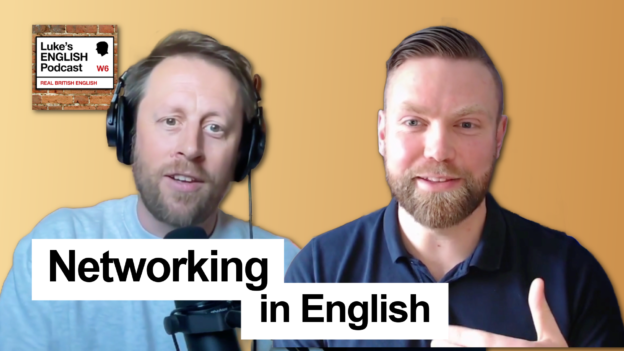
Talking with Rob from The Business English Podcast about networking in English. 🗣️ Networking is when you speak to other people, probably in a professional context, in order to build relationships, expand your social circle and make work contacts that can lead to business opportunities in the future. This is all about socialising, speaking spontaneously, active listening and being aware of cultural factors which can affect everything. Listen to the episode to hear plenty of comments, anecdotes, advice and language tips relating to networking in English in a professional context.
Barbara Serra is an award-winning Italian journalist who has spent much of her career reading the news in the UK on various high-profile well-established English language news networks including the BBC, Channel 5, Al Jazeera English and Sky News. Barbara has quite a specific relationship with the English language. We talk about learning English, challenges in her career, and the relationship between accent and identity.
Hello listeners, today on the podcast I am talking to Barbara Serra, the Italian journalist who reads the news on television in the UK. She’s a very interesting guest and has lots of interesting things to say about the way her identity and career have been shaped by her relationship to the English language.
We’re going to talk about reading the news in the UK when you sound like a foreigner, lots of questions around identity and accent, and all sorts of other things that Barbara has experienced in her time as a broadcast journalist. I think you will find it very interesting as a learner of English looking to improve your English as much as possible in different contexts, both personal and professional.
LEPster meet-up in Da Nang Vietnam
Gordon’s Pizza (in An Thuong area) on Friday 17th May from 9pm.
Send Zdenek an email if you’re interested – teacherzdenek@gmail.com
Barbara Serra is an award-winning Italian journalist who has spent much of her career reading the news in the UK on various high-profile well-established English language news networks including the BBC, Channel 5, Al Jazeera English and Sky News.
Barbara has quite a specific relationship with English. It’s her dominant language but not her native language. She has a certain accent, which does place her outside the UK somehow. So how has this affected her career as a news reader and reporter?
Broadcast journalism is associated with a certain model of spoken English – in the UK that would be what is often called BBC English, and traditionally the role of newsreader has been synonymous with that kind of high-level, high-status form of spoken English.
So what has Barbara’s experience been?
What is the story of her English?
How did she get the point where she was ready to do this job? What kind of challenges has she faced while reading the news in the UK?
And what does this all tell us about learning English, what it means to improve your accent, the relationship between accent and identity, the definition of “native” and “non-native speaker”, the status of different English accents in the English speaking world?
Let’s get into it.
LINKS
👉 Barbara’s email newsletter “News with a foreign accent” https://barbaraserra.substack.com/
👉 Barbara’s website with course info https://www.barbaraserra.info/
This website uses cookies to improve your experience while you navigate through the website. Out of these, the cookies that are categorized as necessary are stored on your browser as they are essential for the working of basic functionalities of the website. We also use third-party cookies that help us analyze and understand how you use this website. These cookies will be stored in your browser only with your consent. You also have the option to opt-out of these cookies. But opting out of some of these cookies may affect your browsing experience.
Necessary cookies are absolutely essential for the website to function properly. These cookies ensure basic functionalities and security features of the website, anonymously.
Cookie
Duration
Description
cookielawinfo-checkbox-analytics
11 months
This cookie is set by GDPR Cookie Consent plugin. The cookie is used to store the user consent for the cookies in the category "Analytics".
cookielawinfo-checkbox-functional
11 months
The cookie is set by GDPR cookie consent to record the user consent for the cookies in the category "Functional".
cookielawinfo-checkbox-necessary
11 months
This cookie is set by GDPR Cookie Consent plugin. The cookies is used to store the user consent for the cookies in the category "Necessary".
cookielawinfo-checkbox-others
11 months
This cookie is set by GDPR Cookie Consent plugin. The cookie is used to store the user consent for the cookies in the category "Other.
cookielawinfo-checkbox-performance
11 months
This cookie is set by GDPR Cookie Consent plugin. The cookie is used to store the user consent for the cookies in the category "Performance".
viewed_cookie_policy
11 months
The cookie is set by the GDPR Cookie Consent plugin and is used to store whether or not user has consented to the use of cookies. It does not store any personal data.
Functional cookies help to perform certain functionalities like sharing the content of the website on social media platforms, collect feedbacks, and other third-party features.
Performance cookies are used to understand and analyze the key performance indexes of the website which helps in delivering a better user experience for the visitors.
Analytical cookies are used to understand how visitors interact with the website. These cookies help provide information on metrics the number of visitors, bounce rate, traffic source, etc.
Advertisement cookies are used to provide visitors with relevant ads and marketing campaigns. These cookies track visitors across websites and collect information to provide customized ads.