Practise your listening in English with a fascinating conversation with a writer of haiku poetry in English. John Stevenson is one of the world’s leading English language haiku poets, and in this episode I had the pleasure of talking to him for an hour. John taught me more about haiku and senryu poetry, revealed how he first became interested in haiku, and then was willing to discuss various haiku poems he has written over the years, giving details of what real events inspired them, what they mean and more about his process of writing haiku in English. I hope this episode is fascinating and inspiring. Keep listening because it becomes more and more revealing as it continues. John was a pleasure to talk to and I think this is the perfect conclusion to the trilogy of episodes I have done on this subject on the podcast recently.
[976] Here’s an epic rambling episode in which I talk about learning English with BBC Radio and TV 📻 expressions with the word ‘thumb’ 👍 the story of how I became a taxi driver on the streets of Paris 🚖 the grammar of Yoda 🐸 fantastic haikus written by my listeners ✍️ and getting pecked in the face by a swan 🦢. 3h30min+ of English from me to you.
[974] In this episode I read out lots of haiku poems, explain their meaning, discuss what they make me think and feel, and use them to teach you some vocabulary. The haikus I read include some traditional Japanese ones translated into English, plus more modern ones written in English by writers from around the world. Some of these haikus are meditative, some are sad, some are funny and some find a way to capture feelings that are otherwise difficult to put into words.
[972] I talk with multilingual actor Ivan Doan about his multicultural background, his learning of languages and his work as an actor. Ivan shares his insights and experiences of learning English, dealing with different accents in film & TV roles, and the importance of mindset and discipline in his life. There are plenty of language learning insights in this episode, which I summarise at the end. Full transcript available.
An 11-point list of practical advice for learning English inspired by this conversation.
1. Learning through doing, not just studying
Use English for real things. Ivan’s English really improved when he started making projects in English (web series, acting work, talking to people), not just studying grammar.
Make English the tool, not the subject. Start a small project: a vlog, a diary, an Instagram account, a DnD group, movie scene re-enactments – anything that requires English.
Theory helps, but it’s not the engine. Grammar explanations are useful, but they’re not what makes you fluent. Real communication is.
2. Multimodal learning: use your whole body & brain
Don’t reduce English to rules + word lists. When Ivan was with the Mormons or on set, he learned from body language, tone of voice, facial expressions, rhythm, context, not just words.
Watch people, not just subtitles. When you watch something in English, pay attention to:
how people look at each other
when they pause
what their hands/face are doing when they say something important
Combine skills. Listen + read + speak + move. For example, repeat a line while copying the actor’s body language and facial expression.
3. Listening & repetition are superpowers
Re-listen on purpose. Take a podcast episode or YouTube clip and:
Listen once for general meaning.
Listen again and note unknown words/phrases.
Look them up.
Listen a third time and catch those items in context.
Notice “repeat offenders”. If a word or chunk keeps appearing, it’s a sign: you probably need it. Put it on a list.
Make targeted vocab lists. Like Ivan did for filmmaking, you can make lists for your world: tech, business, medicine, design, gaming, etc.
4. Discipline beats talent
You don’t need to be “gifted at languages”. Ivan’s message is clear: people think he’s “special”, but in reality, discipline and repetition are doing most of the work.
Be stubborn. Let it bother you (in a good way) that you don’t understand a phrase yet. Go back to it. Again. And again.
Small, realistic goals. For example:
“I want to be able to have a 10-minute small-talk conversation without switching to my language.”
“I want to understand one specific podcast episode without subtitles.”
“I want to tell one story about my life in English clearly.”
Basic conversation – you can talk about everyday things.
More advanced conversation – opinions, stories, feelings, more nuance.
Improvisation – you can react in real time with no preparation.
6. Accents, rhythm & sounding natural
First: learn to hear the accent. You can’t produce what you can’t hear. Choose one accent (e.g. London, General American) and really listen to it.
Find your “accent twin”. Pick a native speaker:
similar age
same gender
whose voice feels close to your natural voice Use them as your model.
Create an “accent map”. Notice:
Which vowels are different from yours?
How do they stress words?
What is the rhythm (fast/slow, chunky/smooth)?
Rhythm & word stress are often more important than perfect vowels. BAna-na vs baNAna can be the difference between confusion and clarity.
Shadowing works. Play 1–2 sentences, then:
say them with the speaker,
match their timing, stress, and melody,
repeat several times until it feels comfortable.
7. It’s okay to exaggerate (caricature as a training tool)
Overdo it first, then calm it down. Like an actor, you can:
exaggerate the British or American intonation
really push the stress and melody Then slowly bring it back to something natural.
This is not “fake”; it’s training. As with acting, you push beyond your comfort zone, then refine.
8. Identity, culture & letting yourself change
To speak like an English speaker, you must allow yourself to “borrow” a new identity. That might feel weird: “This isn’t me.” But that flexibility is part of real fluency.
Different cultures, different communication rules. British politeness isn’t necessarily “fake”; Russian directness isn’t necessarily “rude”. They’re different systems.
Adapting ≠ betraying your culture. You can still be 100% you and also learn to play by local rules when you’re speaking English.
9. Talk to yourself – a lot
Self-talk is powerful, not crazy. Walk around your flat narrating what you’re doing in English, or:
rehearse future conversations,
re-tell a story you heard,
argue with yourself about something.
The goal is to stop translating. Like Ivan said, it’s like changing gears in a car: once you’re “in English gear”, you just drive.
10. Treat English like a role you inhabit
Think like an actor. When you speak English:
step into the “role” of an English-speaking version of you,
use your voice, but with English rhythm and intonation,
add the body language and facial expressions that match.
Use emotion. Don’t just say the words; feel them. This makes you remember the language and sound more authentic.
11. Inspiration: you can do this
Messages implied by Ivan’s story:
You can start with school English that isn’t great and end up working in English internationally.
You don’t need a perfect method; you need consistent action, curiosity, and the courage to interact.
Being “from somewhere else” is not a weakness; it’s often your superpower – a different perspective, more empathy, and a richer identity.
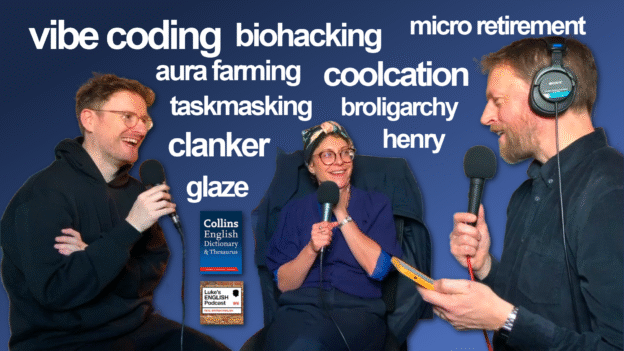
[968] The Collins Dictionary Words of the Year is a list of 10 words which capture the cultural zeitgeist – the spirit of the times that we are living in now. These new words, picked by Collins, reflect issues that people have been talking about over the last 12 months. In this conversation, Amber, Paul & I discuss the impact of AI, the ways social media is affecting people’s behaviour, how people are using technology to control their health, the strange habits of tech leaders, and more. Pick up words to describe new trends, and listen to conversation about big issues in society. Full transcript available.
A description of my recent family holiday to Norway 🇳🇴, including rambling about how I can’t stand beach holidays 🏖️, chasing my son around different international airports 🏃, visiting Oslo ⛴️, Bergen 🏠, fjords 🚤 and mountains 🏔️. Edward Munch’s The Scream 😱, staying in a cabin with no hot water, shower or washing machine, swimming in a freezing lake 🥶, catching a trout 🎣 and driving an electric Jaguar 🐆(that’s a car). Includes a PDF with vocabulary in context, definitions, full transcript, and vocabulary quiz.
In this episode I take you on a big rambling journey through all sorts of English-learning goodness (and nonsense). We start by pondering what makes a good podcast title 👀 is it clever, clickbait, or just clear? I reveal a monumental tectonic shift in the way I am titling my episodes. Then it’s into the Grammar Zone 📘 with an in-depth look at English narrative tenses. Then I reveal LukeGlish.com 📺 a custom search tool that lets you explore my entire podcast content by words and phrases. And, there’s the Comedy Corner 😂 where I break down some English jokes and wordplay, dissecting the frog.
Here is the second part of this double episode all about great things to see and do while in London 🇬🇧. Listen to my friends and family talking about the city 🏙️, learn some fascinating bits of history 🔥, get inside tips 🗺️ and learn some vocabulary in the process.
4. 📘 Vocabulary from “Favourite Things to Do in London” (Part 2)
bustling (adj.) Definition: full of activity and energy Example: He says it’s bustling with activity.
cantilevered (adj.) Definition: supported at only one end, allowing for extension Example: Tower Bridge with its cantilevered road.
derelict (adj.) Definition: in very poor condition Example: The bridge… got derelict and had to be replaced.
auction (noun) Definition: a public sale where items are sold to the highest bidder Example: He bought it in an auction for two and a half million dollars.
spire (noun) Definition: a pointed structure on top of a building, especially a church Example: The Shard with its great tall spire.
sneakily (adv.) Definition: in a secretive or clever way Example: I usually try and do it sneakily by going to the Leicester Square box office.
quirky (adj.) Definition: strange in an interesting or attractive way Example: It was great sitting at tables that are on gravestones. So just it was very quirky.
serendipitous (adj.) Definition: occurring by chance in a happy or beneficial way Example: You can do a bit of serendipitous show watching.
crypt (noun) Definition: an underground room beneath a church Example: They have a cafe in the crypt.
to get your bearings (phrase) Definition: to figure out where you are Example: You just don’t get your bearings.
fry-up (noun) Definition: a traditional English cooked breakfast Example: Maybe go for a cup of tea and a fry up somewhere.
to dig through (phrasal verb) Definition: to search through a pile or collection of items Example: Dig through some of the vinyl boxes there.
mooch about (phrasal verb) Definition: to wander about in a relaxed way Example: Have a mooch about, maybe go for a cup of tea.
to rifle through (phrasal verb) Definition: to search quickly through something Example: There are always interesting places to go and rifle through.
formative years (noun phrase) Definition: the years that shape one’s development Example: Something from your past, your formative teenage years.
venue (noun) Definition: a place where events are held Example: A small venue on Denmark Street.
cosy (adj.) Definition: warm, comfortable and inviting Example: They’re just cosy, you know, when it’s dark and rainy.
bland (adj.) Definition: lacking strong flavour or character Example: Maybe they’re a bit bland compared to what you can get.
nailed (verb, informal) Definition: done very well Example: We’ve got restaurants in London absolutely nailed.
foodie (noun, informal) Definition: a person who loves food Example: I’m a big foodie and I miss it a lot.
hard pushed (phrase) Definition: finding something difficult to do Example: You’d be hard pushed to find a place that had a better selection of food.
little one (noun, informal) Definition: a young child Example: When I can take the little one out with me…
walk of life (noun phrase) Definition: a person’s background or occupation Example: You will see every form and walk of life.
stop off (phrasal verb) Definition: to stop somewhere briefly during a journey Example: You can always stop off for a drink on the way.
invigorated (adj.) Definition: filled with energy Example: I felt really invigorated by the energy there.
popping up (phrasal verb) Definition: appearing or opening suddenly Example: There are always new ones popping up on the outskirts of London.
one of a kind (phrase) Definition: unique Example: The experience is one of a kind.
pub (noun) Definition: a traditional British bar serving drinks and often food Example: I just love the atmosphere of pubs in the UK.
Changing of the Guard (noun phrase) Definition: a traditional ceremony where the guards at Buckingham Palace are changed Example: You’ve got the Changing of the Guards, which is a sort of ceremony.
black pudding (noun) Definition: a type of blood sausage often part of a traditional English breakfast Example: Black pudding is from blood, a blood sausage.
builder’s tea (noun) Definition: a strong, traditional British tea with milk and sugar Example: A nice strong cup of builder’s tea.
to promote (verb) Definition: to make something more publicly visible or known Example: I did move one of her books out so that the cover was showing just to try and promote Anna’s work.
record shop (noun) Definition: a store that sells vinyl records and sometimes CDs or cassettes Example: I love spending an afternoon with friends, going around various record shops.
gig (noun) Definition: a live music performance Example: I love going to gigs in London.
venue (noun) Definition: a place where an event or performance happens Example: A small venue on Denmark Street.
dive bar (noun) Definition: a small, unpretentious, and often slightly run-down bar Example: It was probably a dive bar or pub that also puts on live music.
redeveloped (adj./verb) Definition: renovated or rebuilt for modern use Example: They kind of got rid of a lot of the authentic music shops as the place has been redeveloped.
emotional value (noun phrase) Definition: personal significance due to memories or associations Example: It also has some emotional value.
cosy atmosphere (noun phrase) Definition: a warm, comfortable and pleasant environment Example: I just love the cosy atmosphere of pubs.
backstabbing (noun) Definition: betrayal, especially from someone you trust Example: Stopping at rejection, disappointment, backstabbing central.
shattered dreams (noun phrase) Definition: hopes or goals that have been destroyed or failed Example: Stopping at rejection, disappointment… and shattered dreams parkway.
skeleton with headphones (humorous phrase) Definition: someone who has been waiting or listening for a very long time (an inside joke for LEPster) Example: You haven’t turned into a skeleton with a pair of headphones on.
Here is part 1 of a double episode about London 🇬🇧 and great things you can see and do there 🎡. Listen to my friends and family describing their favourite things to do in the city 🍻, get some travel tips 🏙️, get a mini history lesson 🏛️, and learn some vocabulary in the process.
Shoreditch Art Hotel – stylish family hotel with a splash-friendly indoor pool
🎭 James Simpson
Walk from Waterloo Station to South Bank – scenic and vibrant
National Theatre – top venue for live drama
Royal Festival Hall – great for classical concerts
Waterloo Bridge – beautiful panoramic views (Big Ben, St. Paul’s, London Eye)
Trafalgar Square – central landmark
Covent Garden – high-level street performers (buskers)
Pubs – especially for fish & chips and live music/comedy
🎨 Aaron
Tate Britain (Pimlico) – traditional British art
Clore Gallery – features works by J.M.W. Turner
Rowing on the Serpentine (Hyde Park) – romantic and relaxing
Boat trip on the Thames – great views, fun for parties or sightseeing
🍺 Moz (Murder Mile Podcast)
Coach & Horses Pub (Soho) – authentic old boozer with sticky floors and history
London Pubs in General – each one unique, steeped in character and tradition
Pub Navigation Tip – “navigate by pubs” instead of street names!
🚣 Luke – Canal & Hidden London Recommendations
Little Venice – peaceful canal basin with narrowboats and cafes
Regent’s Canal (via Regent’s Park) – walk/cycle past the zoo and elegant homes
Camden Lock / Camden Market – food, shops, live music, and bustling atmosphere
Granary Square (King’s Cross) – modern redevelopment, fountains, restaurants
🎭 Luke’s Mum
National Portrait Gallery – just reopened after refurbishment
National Theatre – excellent productions
Royal Court Theatre (Sloane Square) – cutting-edge theatre
Shakespeare’s Globe Theatre – historical open-air venue, great experience
4. 📚 Vocabulary from “Our Favourite Things to Do in London (Part 1)”
Here is a selection of vocabulary which I explained during the episode.
pop (in / next door / to) Definition: To go somewhere briefly or quickly. Example: Amber – “I couldn’t resist popping next door to the National Gallery.”
take the pressure off Definition: To reduce the feeling of obligation or stress. Example: Martin – “It takes the pressure off thinking you have to spend a decent amount of time if you’ve paid for a ticket.”
tucked away Definition: Located in a quiet or hidden place. Example: Martin – “The Seven Stars pub is tucked away down a little street.”
narrow Definition: Not wide. Example: Martin – “An extremely narrow, rickety mediaeval staircase.”
rickety Definition: Poorly made and likely to collapse. Example: Martin – “An extremely narrow, rickety mediaeval staircase.”
nooks and crannies Definition: Small, hidden or remote parts or corners. Example: Martin – “Lots of dark wood, little nooks and crannies.”
cellar Definition: A room below ground level, often used for storage. Example: Martin – “Two floors of cellar where the beer barrels used to be kept.”
busker Definition: A person who performs music or other entertainment in the street for money. Example: James Simpson – “See some buskers, like a live show that’s free.”
busking Definition: Performing in public places for money. Example: Luke – “Busking is the act of performing in the street.”
mushy peas Definition: Cooked peas that are mashed into a soft consistency. Example: Luke – “A plate of fish and chips with a little bowl of mushy peas.”
rowing boat Definition: A small boat propelled with oars. Example: Aaron – “We went on a rowing boat on the Serpentine.”
barely Definition: Only just; almost not. Example: Moz – “Tiny doors that you can barely get through.”
sticky Definition: Having a surface that things stick to. Example: Moz – “The floor is sticky because it’s had like hundreds of years of beer on it.”
tar Definition: A thick, dark substance found in cigarette smoke. Example: Moz – “The ceiling is thick with tar from 300 years of smoking.”
boozer Definition: (British slang) A pub. Example: Moz – “They sit in their regular seat. It’s their boozer.”
brewery Definition: A place where beer is made. Example: Luke – “Fuller’s, one of the big brewing brands.”
take over Definition: To assume control of something. Example: Luke – “Fuller’s had taken over the pub.”
gutted Definition: Very disappointed. Example: Moz – “We were absolutely gutted.”
incensed Definition: Very angry. Example: Moz – “We were incensed.”
gastropub Definition: A pub that serves high-quality food. Example: Moz – “They’ll turn it into a gastropub.”
poncy Definition: Pretentious or affected. Example: Moz – “Full of poncy, pretentious food.
cash register / till Definition: A machine for recording sales and holding money. Example: Moz – “They’d put in a proper cash register.”
cubicle Definition: A small enclosed space, typically for a toilet. Example: Luke – “Cubicles which are the little places with doors.”
urinal Definition: A toilet fixture used by men to urinate. Example: Luke – “Urinals, things on the wall… you can stand at.”
refurbished Definition: Renovated and redecorated. Example: Mum – “They recently reopened after a refurbishment.”
particularly Definition: Especially. Example: Mum – “Having particularly enjoyed productions at the National Theatre.”thatched roof Definition: A roof made with straw or reeds. Example: Luke – “The thatched roof caught fire.”
Hello! In this episode I focus on English expressions and idioms that originated in the works of William Shakespeare and are still used in modern everyday language. Notice the expressions in various contexts, fully understand their meanings and use, explore their origins in Shakespeare’s work, and gain valuable lessons about how to learn new vocabulary with real world examples. Also, learn about my short-lived career as a goalkeeper for the legendary football team “Chadwick FC”. Includes a PDF worksheet and transcript.
This website uses cookies to improve your experience while you navigate through the website. Out of these, the cookies that are categorized as necessary are stored on your browser as they are essential for the working of basic functionalities of the website. We also use third-party cookies that help us analyze and understand how you use this website. These cookies will be stored in your browser only with your consent. You also have the option to opt-out of these cookies. But opting out of some of these cookies may affect your browsing experience.
Necessary cookies are absolutely essential for the website to function properly. These cookies ensure basic functionalities and security features of the website, anonymously.
Cookie
Duration
Description
cookielawinfo-checkbox-analytics
11 months
This cookie is set by GDPR Cookie Consent plugin. The cookie is used to store the user consent for the cookies in the category "Analytics".
cookielawinfo-checkbox-functional
11 months
The cookie is set by GDPR cookie consent to record the user consent for the cookies in the category "Functional".
cookielawinfo-checkbox-necessary
11 months
This cookie is set by GDPR Cookie Consent plugin. The cookies is used to store the user consent for the cookies in the category "Necessary".
cookielawinfo-checkbox-others
11 months
This cookie is set by GDPR Cookie Consent plugin. The cookie is used to store the user consent for the cookies in the category "Other.
cookielawinfo-checkbox-performance
11 months
This cookie is set by GDPR Cookie Consent plugin. The cookie is used to store the user consent for the cookies in the category "Performance".
viewed_cookie_policy
11 months
The cookie is set by the GDPR Cookie Consent plugin and is used to store whether or not user has consented to the use of cookies. It does not store any personal data.
Functional cookies help to perform certain functionalities like sharing the content of the website on social media platforms, collect feedbacks, and other third-party features.
Performance cookies are used to understand and analyze the key performance indexes of the website which helps in delivering a better user experience for the visitors.
Analytical cookies are used to understand how visitors interact with the website. These cookies help provide information on metrics the number of visitors, bounce rate, traffic source, etc.
Advertisement cookies are used to provide visitors with relevant ads and marketing campaigns. These cookies track visitors across websites and collect information to provide customized ads.