My dad has written a book and it’s all about the wildlife you can find in an urban English park. He’s on the podcast to tell us all about it, and there are some collective nouns for animals too, plus some bonus stand up comedy at the end.
Hello listeners, this is a reminder about LEP Premium, which is my other podcast service. With episodes of LEP Premium I focus specifically on language, helping you understand, remember and pronounce target vocab and grammar. I’m currently still deep into premium series 24 which is about homophones, but also you can access an archive of over 80 episodes now both audio and video, all about teaching you the kind of English that I speak, and there are plenty of stupid improvisations and jokes and things too. Get started by going to www.teacherluke.co.uk/premiuminfo
Introduction Transcript
Welcome back to Luke’s English Podcast – this award-winning podcast for learners of English. Yes, the podcast has won a few awards over the years, but not lately. The last few years have been quiet, on the award front. If you see any competitions for best podcast for learners of English, or something, let me know!
Speaking of competitions, I’ve been thinking of launching another listener competition, and I’m wondering what you think. The competition would involve you recording yourself speaking and sending it into the podcast, then people would vote for their favourite and that person would then get interviewed in a full episode of the podcast. This idea was sent to me some time ago by a listener called Vadim. What do you think? I haven’t fully decided to do it yet, so let me know what you think of this new competition idea from Vadim.
But anyway, what about this episode then?
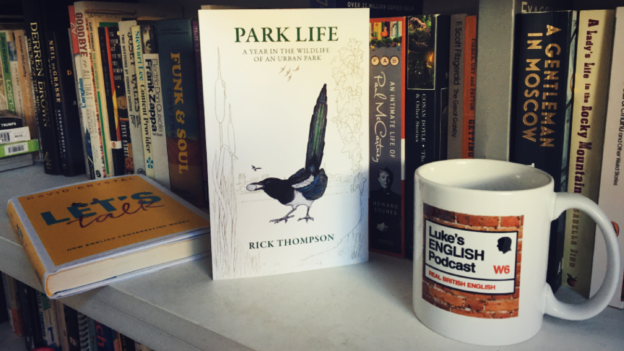
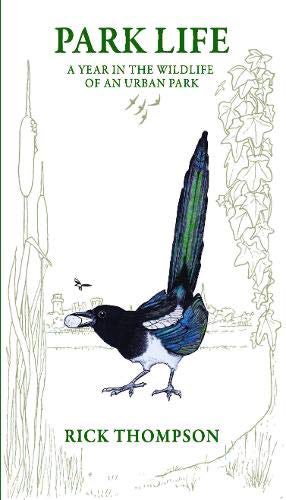
Park Life – A Year in the Wildlife of an Urban Park
As promised, this episode features my dad, which should be good news for all the Rick Thompson fans out there. As you might know we sometimes call my dad Rickipedia because he knows so much stuff about so many things, although it might be unreliable from time to time.
People often say that my dad should start his own podcast, as his episodes are so popular. He still hasn’t created a podcast of his own, but I am glad to say that he has written a book.
The book is called “Park Life – A year in the Wildlife of an Urban Park”
The book is available for you to read. You can find it on Amazon.com and also Bookdepository.com (free shipping).
In this episode I’m going to talk to my dad about the book he’s written including a broader discussion of urban parks in the UK – green public spaces which perform an increasingly important role in UK life.
We start by talking about the book, what it’s about, how he was inspired to write it and what style it’s written in. Then we move on to describe some of the wildlife you can find in a local English urban park. Then we discuss some history of urban parks and the health benefits of spending time in green spaces.
Also there are some collective nouns for different animals, including things like “a murder of crows” and “an unkindness of ravens”. Keep listening to hear some more.
I hope you enjoy the conversation. I’ll chat with you a bit afterwards, but now, here is Rick Thompson talking about his new book.
—–
Ending Transcript
Thanks again to Dad for being on the podcast today. Once again, check Amazon or BookDepository for Rick Thompson Park Life to pick up a copy of my dad’s book for yourself.
In fact the book has already picked up a 5 star rating on Amazon from someone called Princesslizzykins
I have no idea who she is, but this is her review.
5.0 out of 5 stars
A wonderful read.
Reviewed in the United Kingdom on 5 September 2020
What a beautifully and thoughtfully written book.
A super balance of content between wildlife and local history, with some lovely poetic references thrown in, this book shows how anyone can escape the haste of urban life and take a moment to look at and love the world around them.
I live in Warwick, so have the added benefit of knowing the localities mentioned, but would recommend this to absolutely anyone that has an urban park near them and enjoys a damn good read.
Thumbs up for Dad. Nice one.
We’re not done here yet, I have some more things to do in this episode.
First of all, you heard me mention the stand up comedy gig that I had on Sunday and I did the gig and it went fine. I recorded it so I’ll play a few minutes of that at the end of the episode.
But first, let me go through some more collective nouns for animals. This is a really interesting and curious aspect of English – the way we use different words to collectivise different animals.
You heard us mention some there, and I’ve included them in this list too. So here is a list of common collective nouns for animals.
As promised earlier, here are a few minutes from my stand up set on Sunday evening. There was one LEPster in the audience by the way, who had come because he’d seen the gig advertised on my facebook page https://www.facebook.com/lukecomedian So, shout out to that LEPster!
Anyway, this was my first gig since Christmas, but it was great to be back on stage again and I should be doing more gigs this year, lockdown permitting.
So this is me on stage at the New York Comedy Night in Paris last Sunday. Thanks for listening and speak to you again soon. Bye…
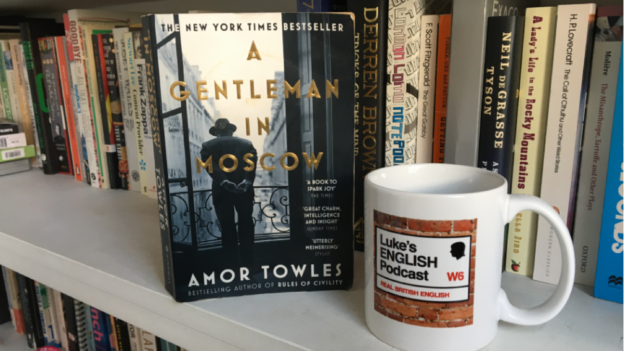
Talking to my mum again about her latest book recommendation. A Gentleman In Moscow is about a Russian Count who is put under house arrest in 1922 in the beautiful Metropol Hotel in Moscow.
This episode is sponsored by LEP Premium. With Luke’s English Podcast I have two podcasts in fact. There’s the free episodes, which feature monologues, conversations with guests or specific topics. That’s where you get to listen to natural English on a regular basis, presented to you, for you. Then the premium episodes are all about language. Often I take samples from free episodes, then break them down for target language which I teach to you, help you remember and pronounce correctly. So the double whammy is to listen to LEP and also be a premium subscriber, to get the maximum benefit from my work. To get started with LEPP go to www.teacherluke.co.uk/premiuminfo for more info.
Introduction Transcript
Welcome to Gill’s Book Club, on Luke’s English Podcast.
This is the second Gill’s Book Club episode and this is where I talk to my mum, Gill Thompson, about books that she’s enjoyed.
My mum loves books, she’s a voracious reader, a member of a book club with her friends and she works in a second hand bookshop.
She gets through loads of books, and so this is naturally a topic that we can explore together on the podcast.
How does this work?
We pick a book a few months in advance, give people a chance to read it, then talk about it on the podcast, including some of the main plot points (no spoilers) characters, context and details.
Do you have to read the book too?
No. We’ll explain the main plot points without giving away any spoilers. But you can read the book if you like, or get the audiobook version.
You could read the book first, then listen. Or listen first, then read the book, or just listen without reading the book at all, and enjoy hearing my mum talking about it, the characters, the story and so on. There might also be some nice vocabulary coming up which you can notice as we go along. As usual, check the episode page on my website to see some vocabulary notes and transcripts.
For other episodes I’ve done with advice on reading books to improve your English, check the episode archive.
I said earlier this year that the book we’d be talking about is A Gentleman In Moscow, by Amor Towles, and so that’s the main topic of conversation here.
A Gentleman in Moscow is a 2016 novel by Amor Towles. It is his second novel, following the release of the New York Times bestselling novel Rules of Civility. The novel concerns Count Alexander Ilyich Rostov, a man ordered by a Bolshevik tribunal to spend the rest of his life in a luxury hotel in the heart of Moscow. Wikipedia
There’s a bit of smalltalk at the beginning, and then we get stuck into the book.
I’ll talk to you again on the other side of this conversation, but now, let’s listen to my mum talking about her latest book recommendation.
——
Vocabulary Notes & Questions
Can you comment on these things with reference to the characters and events in the book? Manners Integrity Loyalty Vocabulary Class
Do these words apply to Count Alexander Rostov? Witty Likeable Standoffish Spoiled Privileged Glass half full / Glass half empty
Does he change during the book?
House arrest Did this book make you think of the lockdown? If you had to be on house arrest, but you can choose any building you like, which building would you choose? Which building would you choose to be locked inside? (not your own home)
Book club What did the women from the book club think of it?
Book recommendation The Year of Reading Dangerously by Andy Miller
Picture of Ivan the Terrible https://booksyo.files.wordpress.com/2015/01/repin_ivan_terribleivan.jpg
Ivan the Terrible and His Son Ivan on 16 November 1581 is a painting by Russian realist artist Ilya Repin made between 1883 and 1885.
Ivan the Terrible and His Son Ivan on 16 November 1581 is a painting by Russian realist artist Ilya Repin made between 1883 and 1885.
Ending Transcript
So there you are. That was my lovely mum talking about a lovely book and it was all lovely lovely lovely.
Again, check out the page for this episode on my website for vocabulary notes, and the names of the different books and things that we mentioned, plus the chance to see that painting of Ivan the Terrible and more.
I’m still deep inside P24, having published 9 out of 12 parts. More coming for premium subscribers soon…
Later today I’m interviewing my dad.
I don’t like to talk on the podcast about stuff I’m going to do, because I’ve learned that often things don’t go as you expect and it’s unwise to make the listeners think that something is coming when it actually can’t happen because of a technical issue or a scheduling problem or something.
So, who knows, we might not be able to actually do the recording, but the plan is to talk to my dad later today, also about a book. But this isn’t a book that he’s read, written by someone else, it’s actually a book he’s written himself. Yep, he wrote a book during the lockdown. What’s with all these books!? About 5 people I know have written books during the lockdown, including my dad. So stay tuned to LEP in order to (hopefully) listen to a conversation with Rick Thompson about his new book.
Thanks again to my mum for her contribution to this episode.
I hope you all enjoyed listening to it and as ever I look forward to reading your comments and responses to this episode in the comment section on my website, but also on YouTube where you can find all my episodes, and you can keep in touch on social media, my favourite being Twitter and my handle is @EnglishPodcast
Take care everyone. I’ll speak to you again soon, but for now, good bye…
I’ve come back from my holiday so it’s time to ramble on about some holiday stories, holiday vocabulary, podcast stats and other bits and pieces including an appearance by my daughter.
Talking to writer and comedian James Harris about life as a writer, going to Oxford Uni, being an international Brit and learning German, French and Chinese as an adult.
Hello folks and welcome to the podcast. I hope you are doing fine on this particular day. This episode features a conversation, recorded a couple of weeks ago now, with a comedian and writer from the UK about various things, as you’ll see. Your task is to follow along and see what you can pick up and what bits of language learning wisdom you can glean from this conversation.
I don’t really know James that well. I’ve only actually met him once in fact.
He’s a comedian and a writer, he speaks several languages and his twitter feed is good value. He tweets about politics, learning languages, the issues of the day, comedy and various other things. We share a mutual friend – that’s Dharmander Singh from Birmingham, who I used to be in a band with and who is now a stand up comedian in Berlin. The time I met James was in Berlin when I was there on holiday, and I did some stand up on the same show as him.
So why have I invited him on the podcast? Well, it’s mainly because of Twitter. As I said his Twitter feed is interesting. He takes a moderate and balanced view of things, and his interests are pretty wide-ranging, including the fact that he’s very international. He’s married to a Chinese girl, he’s lived abroad, he used to work as a tour guide in several countries, he used to be an English teacher like me, he speaks very good German and French, he’s working on his Chinese, he works as a translator and he’s generally an articulate and interesting guy and so I just thought that he could be worth talking on the podcast.
The language learning thing is obviously very appropriate and I’m always interested in finding out as much as possible about how someone has learned a second language to a very decent level in adulthood, and that is something that we talk about for at least 50% of this conversation. The first half of our chat is basically me getting to know James properly, talking about his work, his studies, his experiences of going to Oxford University, why he chose to move to Germany, being married to a Chinese girl. Then we get into the details of how he learned German mainly, but also French and now how he’s working on his Chinese.
No need to say much more except that I hope you manage to follow the conversation clearly all the way through. Let me know how it was for you and I will speak to you again on the other side of this conversation, probably with some background music going over the top.
Long thread about languages (1/24): One of the most frequent ambitions I've seen for people during the lockdown is to learn a foreign language. I'm something of an exception, an Anglophone person who's managed to do this as an adult, and I have some thoughts on the matter.
Thank you to James for being on the podcast today. Look him up online to read some of his stuff, follow him on social media and help him out by keeping him fuelled up on coffee.
Follow James on Twitter @JamesHarrisNow Writing, Mini Screenplays https://shoeleatherexpress.org/ BUY A COFFEE FOR JAMES HARRIS https://t.co/8AAQ6P33wJ?amp=1
So, how are you listeners?
Did you pick up any useful nuggets from that conversation? I think there was some pretty good advice there especially the stuff about reading and noting down certain words, being a bit rigorous about your studying and believing that you can do it, really helps.
Hello and welcome back to Episode 666 of LEP in which my brother James and I are talking about scary and evil things. In the first two parts we talked about the number 666, the devil in music, Black Sabbath, and then in part 2 we described some genuinely frightening experiences that we’ve had in our lives. I’m glad to say that more comments have arrived. It’s good to see that people have been enjoying this series.
In this third and final part the plan is to talk about scary films, including the first scary films we ever saw, why people enjoy watching scary films, and then some descriptions of our favourite scary films. I’m sure that not all of you are into films like this, but I hope you can still enjoy listening to us describing them and talking about the effect they had on us when we saw them.
I’ve been thinking. Will you be able to identify the films that we are talking about? I expect that some of these films have different titles in your language. It’s quite important that you know which films they are, even if you haven’t seen them.
You might want to check them out quickly before you listen in order to identify them. You don’t have to watch them all. I just want to be sure that you know which ones we’re actually talking about.
In fact, I’ll give you the English titles now and very brief one-line descriptions (and you’ll see all these titles listed on the page if you want to know the spelling or whatever) so you can hopefully work out which films these are, or you can google them yourself, see if you recognise them and see what they are called in your country.
So here are the films which we mention during this conversation.
Do you know which ones they are? Do they have different titles in your language?
The Texas Chainsaw Massacre One of the original horror/slasher films from 1974 about a group of hippies who go on a road trip that ends badly when they get attacked by a weird family of cannibals in Texas, one of whom wields a chainsaw.
Children of the Corn (1984) Not a very widely known film, to be honest. Adapted from a Stephen King short story of the same name. The plot of the film is described by IMDB as “A young couple is trapped in a remote town where a dangerous religious cult of children believes that everyone over the age of 18 must be killed.” It stars Linda Hamilton who plays Sarah Connor in The Terminator films.
Jaws The 1975 Stephen Spielberg film about a shark. It’s an absolute classic and the most famous film about a shark, ever.
The Thing 1982, John Carpenter director, Kurt Russel star. IMDB: A research team in Antarctica is hunted by a shape-shifting alien that assumes the appearance of its victims. It was pointlessly remade a few years ago. The 1982 version is definitely the best one. Amazing and disturbing visual effects.
Alien 1979, directed by Ridley Scott, starring Sigourney Weaver. The one with the xenomorphs, face huggers and stuff. It spawned a whole franchise with sequels including the more recent ones Prometheus and Alien: Something. (I did a whole podcast episode about that actually) Alien: Covenant (Alien: Covent Garden would have been a much better film).
Evil Dead 2 1987, directed by Sam Raimi, starring Bruce Campbell. IMBD: The lone survivor of an onslaught of flesh-possessing spirits hides in a cabin with a group of strangers while the demons continue their attack.
Ghostbusters 1984 Dir: Ivan Reitman, starring Bill Murray – Three former parapsychology professors set up shop as a unique ghost removal service.
Those are the main films we talk about then. I hope you know which ones we mean.
As well as the talk of films, there are a couple of other topics in this episode, including a story that James felt compelled to share with us, from the business world of skateboarding about a skateboard with a famously controversial illustration on it – a picture of satan in hell, being evil. A skateboard with a dangerous design, basically. The story is about the power of superstition, I think.
We also have a go at some armchair philosophy at the end as we consider the idea of whether humans have free will or not, and how this might affect the existence of evil in the world, and whether the existence of the devil can somehow confirm one’s faith in the existence of god. If humans do bad things, is that because they are evil, or is there a more rational explanation for why people do bad things? Big questions which we’re not really qualified to answer, but we have a stab at it.
Also there’s the legendary story of blues guitarist Robert Johnson from the 1930s who, legend has it, sold his soul to the devil at the crossroads in return for amazing guitar playing technique and a mastery of the blues. The question is: for what price would you sell your soul to the devil?
That’s an overview of what’s coming up.
I gave a warning at the start of part 1 of this that you would hear some weird and frightening sounds at some moments during the episode.
I’d like to say that again now “You will hear some weird and frightening sounds at some moments in this episode”, because we play some audio from some of those horror films, and of course they contain some frightening noises. So be ready to hear some banging or crashing sounds, some scratching and scraping sounds, ominous voices, the sound of a chainsaw, some screaming, and other disturbing noises. OK?
Apologies again for James’ microphone cutting out a bit during this episode. I hope it’s not too distracting for you.
So, if you are ready and prepared – mentally, physically and spiritually, and not feeling too sensitive, let’s continue with the final part of episode 666.
And here we go…
Ending
So there you are that is the end of part 3, the last part of this series. I hope you’re not too traumatised by all this!
There is also some bonus audio for this episode in the app. Open the app, find this episode, tap the episode in the list and then tap the little gift icon to access the bonus audio. You’ll hear me describing and reacting to a creepy scene from an old black and white film called The Innocents. James wanted to show me this scene and wanted me to react to it, describing what I was seeing. So if you like you can listen and hear my descriptions, and you can watch the scene for yourself too. I’ll put the video of that scene on the website, and I think I’ll also make that bonus audio available on the website too.
So, that’s the bonus audio in the app and also on the website.
Check out the page for this episode to see a few select film clips and other bits and pieces.
As ever, we look forward to reading your comments on the episode page. Perhaps you could tell us what you thought of this series. Are there any scary films you’d like to mention? What’s the first scary film you remember seeing? Why do people choose to watch scary films?
This really is the end now. Thank you for listening. Stay safe, stay healthy, stay happy and be excellent to each other.
Bye bye bye bye bye…
Video Clips
Quint describes the USS Indianapolis shark incident (Jaws)
Quint gets eaten by the shark (Jaws)
BONUS AUDIO
Luke sees a scene from The Innocents (1961) for the first time, and describes it. You can watch the scene below.
Lots of practical advice and comments about how you can use films and TV series to work on your English. This episode is a recap of some advice in episode 523 with Cara Leopold. Transcript available below.
Have you heard the last episode of this podcast (#659)? I spoke to Cara Leopold about being stuck indoors during the lockdown. Cara is an English teacher who likes to help her students to improve their English with TV series and films and we know that because of the lockdown, loads of people at the moment are watching more TV and films on platforms like Netflix and are probably thinking about how to use those things to learn English.
Cara and I talked about that a bit near the end of the last episode, and we also did a whole episode about it a couple of years ago. That was episode 523, called Tips for Learning English with Films & TV Shows.
I mentioned before that I would sum up the main bits of advice that Cara and I gave in that episode.
So here we are, that’s what I’m going to do now – I’m going to consolidate some advice for learning English with TV series and films.
Then, when I’ve done that I’ll give you some personal recommendations for British TV shows and films that you can watch on Netflix.
Learning English with Films & TV – Summary of Advice Given in Ep.523 + more comments
Time and time again we have heard this advice – “Want to improve your English? Just watch TV series and films in English with English subtitles!”
It seems that people assume that you should just watch TV series in English with English subtitles and you’ll learn English magically as a consequence. People say it all the time, and I do think there is some truth in this. Watching lots of content in English is definitely a good idea, although of course that might not be enough on its own. There are plenty of other things you need to do, including regular speaking practice, writing, plenty of reading, using a systematic approach to learning vocabulary, taking time to understand how grammar works.
I suppose the thing is, there are two approaches that seem to be important in learning a language. One approach involves absorbing loads of English just through reading and listening. This is exposure, or immersion or comprehensible input – whatever you want to call it. You have to see and hear the language a lot if you want to be able to use it properly.
This is input. It is really important to get loads of English into your everyday life. You must regularly connect with English, get exposure to English and immerse yourself in English and binging on TV series is probably a pretty good and usually fun way to do that.
Personally I would say that podcasts are the best way, but whatever floats your boat. Ultimately it’s about finding the thing you really want to do. Obviously if you are a regular listener to my podcast then you might agree with me. But if TV shows and films are your thing then go for it.
The point there is you can get loads of English input from TV series and films in English and there are so many amazing shows and films available to us now. It’s amazing. We are spoiled for choice. Anyway – input is important.
Added to that is the importance of using the language regularly in order to communicate. This is output. So this means doing loads of speaking practice and writing practice in order to develop your ability to express yourself, find your voice, develop genuine fluency without just translating everything in your head. So, plenty of input and output.
I’m being quite general here but anyway, the point is → you’ve got to spend lots of time with the language in both receptive and productive ways.
Then the other approach is to be more systematic and disciplined – examining the language in some way, understanding how the English language is structured both in terms of grammar but also in terms of pronunciation so that you know how English is not only written but also produced orally, how it sounds when people actually speak it which helps you understand native speakers and also how to speak fluently yourself. It also involves using monolingual dictionaries to expand your vocab and investigate words, doing controlled practice for grammar and pronunciation and finding ways to remember vocabulary.
And throughout all of that you need to maintain your motivation, because enjoying the whole process is vital. If you’re motivated, you’re likely to do more, spend more time on the language, remember more things and generally get into a more positive and confident frame of mind about your relationship with English.
Using TV and films seems to fulfil the first category to some extent (input) because it allows you to immerse yourself in English, spend lots of time absorbing the language and it should be motivating because watching TV and films should be enjoyable.
It’s also worth stating that learning English doesn’t have to be a chore. It doesn’t have to be a boring thing that you’re forced to do by other people, like teachers or parents. I suppose people often say “Just watch Netflix in English with English subtitles” and this feels like good news because it means “this doesn’t have to be boring homework! It can be enjoyable if you give it a chance”. So, getting addicted to a TV show in English is a good thing for your English.
But is it just a case of just sitting back and watching all the episodes of Peaky Blinders or any other show that you’re into? What about the other things I just mentioned like speaking practice, writing, pronunciation, studying grammar and vocabulary? Well, it is possible to use TV and films in a more active way in order to achieve some of those things too if you’re willing to do more than just sit back and watch.
So here are some bits of advice which did come up in my conversation with Cara in episode 529 but given again and with a few other comments from me.
Watching to learn English and watching just for pleasure are two different things. Watching in order to learn English might involve thinking outside the box and doing things a bit differently.
Using TV and films for learning English is not just a simple or easy way to learn, despite what people say “Just watch stuff in English and bingo you’ll be a native speaker!” It’s not that simple.
In your first language you might just switch on a film or show and then kind of veg out while watching it – without really concentrating. This probably won’t work in English. Be prepared to focus and perhaps be more active while watching, often that mainly involves using the English subtitles, which are a real advantage.
I do recommend choosing content that gives you the option to have English subtitles. Watching with subtitles in your language can be useful because you can see how things are being translated and you can compare your language with the English you’re hearing, but generally speaking it’s best to operate only in English so I’d recommend that you forget about subtitles in your language, or watching something in your language with English subtitles. Do everything in English. So, put the audio in English and the subtitles in English too.
“So, should I always watch with the English subtitles on?” There are no hard and fast rules about using subtitles. There are advantages and disadvantages to both options.
Using English subtitles can help you understand what you’re hearing, especially when you realise that spoken English and written English can be very different. Subtitles can help bridge the gap between how words and sentences sound, and how they are written. You might hear something and then read the subtitles and kind of go “Ooooh that’s what she said! Ahhhh! That’s it then!” which is a great moment in language learning → that kind of “Oh it’s THAT?” moment when you realise something. But watch out because sometimes the subtitles are slightly different to the speech you’re hearing, because they might have to use fewer words than were spoken in order to actually fit them on the screen. But that only happens occasionally. So, an advantage of subtitles is that they help you bridge the gap between what language sounds like and what it looks like. When you listen without subtitles, you will no-doubt miss a lot of what is being said, without realising you’re missing it.
But be aware that if you only ever watch with subtitles you might not develop real listening skills, because you’re basically just reading while you watch and as we know, in the real world, you don’t get subtitles appearing in the air when people speak, unfortunately (well, yet. I expect eventually you’ll be able to get augmented reality glasses or perhaps some kind of biotech which lets you see simultaneous automatic subtitles when people talk, but not yet… that does sound like something out of an episode of Black Mirror…) Anyway, the point is, there are pros and cons of subtitles and no subtitles so you should have both. Experiment with switching the subtitles on and off while you are watching in order to try to get the best of both worlds.
Watch stuff more than once. You can watch a film or show several times, especially if you enjoy it or already know it. Some films improve with multiple viewings. So, try watching certain films several times, perhaps first with subtitles in your language, then subtitles in English and then in English with no subtitles at all. You will be surprised at how much more you notice, understand and remember after watching things numerous times. You will probably appreciate the show or film on a new level too, if you do this. There’s nothing wrong or weird about watching more than once. Like I said – think outside the box a bit.
If you’re watching a TV show you can alternate between watching episodes with and without subtitles. Perhaps do one episode with subtitles, then the next one without. If you just can’t understand episodes without subtitles, try watching the episode with subtitles first then watch again without subtitles. Again, don’t worry, that’s not a weird thing to do, it’s fine – because I say so. And anyway, like I said before if it is a genuinely good show, you might appreciate it even more the second time you watch it and this can actually raise the quality of your listening practice. There are no rules here. Watching episodes several times is normal and useful.
So, we’ve talked about watching films several times, watching episodes several times, but you don’t have to watch the entire thing again from the start. You could just do it with certain scenes. Watch certain scenes several times, with and without the subtitles.
Test yourself on what you heard and check with the subtitles. You could try watching a scene, then trying to explain what just happened, and what people said. Then watch again with the subtitles in order to check. When you explain what you saw, you can do it out loud, with a friend, or just in writing.
You could keep a sort of viewing diary for films or series. Write down little summaries of scenes, episodes or perhaps whole films (although it’s probably best to do it in smaller chunks) then review the scene you’ve written about by checking with subtitles, and re-write your summary if necessary. This is a good way to flip listening practise into productive practise. Remember, it is worth writing in English even if nobody else reads it. It’s just a good idea to practise producing English regularly. Of course it would be better if you had a language partner, coach or teacher who could check your writing and correct errors. Consider finding one on italki – https://www.teacherluke.co.uk/talk – but doing it on your own is still a good idea.
Search for certain new bits of vocabulary when they come up– using monolingual dictionaries. I recommend using online dictionaries like collinsdictionary.com macmillandicionary.com dictionary.cambridge.org Longman Dictionary of Contemporary English Online https://www.ldoceonline.com/ or https://www.oxfordlearnersdictionaries.com/ They’re all decent dictionaries and you can check words and phrases, see examples and crucially hear how the words are pronounced. It’s worth taking a bit of time to get familiar with how these online dictionaries present information to you. It can pay off massively in your learning. Please resist the temptation to just use google translate to get quick translations into your language. It might be a super-fast solution, but it’s not a healthy thing to do for your English long term. Monolingual dictionaries are amazing and can really help you. So use them.
Don’t worry too much about certain specific cultural details. Sometimes characters will talk about stuff that you just don’t know about. For example when I watch some American shows they refer to places, people, sports or events which I don’t know about and it does mean I get a bit lost sometimes. It’s normal. You could google those things of course if you really need to and learn as you go, or just don’t worry about them too much. It’s worth remembering that it might not be your listening skills that prevent you from understanding. It could be your general knowledge too.
Try transcribing certain scenes – especially if you thought it contained really cool dialogue. Then watch again with the subtitles to check your transcription. (I made that suggestion earlier, but there it is again)
It’s not just a case of what you’re doing while you’re watching. Think about doing things both before and after you watch too. In fact, doing some preparation before you start watching can really help you.
Before you watch a film or TV show, check online reviews or summaries to help prepare yourself. Being prepared can help. If you know the general storyline or tone of the thing you’re watching, it can help to prevent you getting lost. Watch out for spoilers though. Maybe you can search for a spoiler-free review of the thing you’re going to see, this can really help put you in the right place before you actually click PLAY.
Similarly, after you’ve watched you can read online reviews of what you’ve watched. That way you can add some extra reading practice to your listening, and you will be a lot more engaged and invested in what you’re reading. Personally I like to read reviews or re-caps of episodes of shows I’ve watched. It helps me understand what I’ve seen and also I like to read other people’s opinions on episodes. Websites like Den of Geek, Vulture, The Independent or The Guardian often do episode recaps of the big TV shows. Read them! It can also help you to appreciate subtle details that you’ve missed and you’ll pick up bits of English from the articles you’ll read. Go the extra mile. It will pay off for your English later. If you find those online newspaper reviews to be a bit “wordy” and opinionated then consider reading IMDB or Wikipedia plot summaries instead as they are often written in slightly more plain English.
I’d also recommend finding YouTube reviews of the films or series you’ve watched. Just go to YouTube and search for the title of the episode or film you’ve seen plus the word review and see what you get. You’ll find this is a great way to get more effective listening input because you’ll be fully engaged in what you’re listening to. You’ll be on the same page as the person speaking because you will understand all their reference points and you’ll be interacting with their opinions and thoughts a lot more. This is an important part of turning listening input into intake → language that is more likely to stick with you.
Be a little selective in your viewing choices – pick stuff that you’d normally enjoy, and remember that films and TV shows can contain very “mumbly” dialogue, and even just “grunting” during long fight scenes. Try to pick films that are pretty simple and perhaps comedies that focus on the dialogue. Also, as Cara mentioned before, some content is in a certain kind of register that might not be applicable to the English you need to use. Documentaries, for example, feature a different style of English than conversational English that you might hear in content with natural dialogue between people.
Pronunciation & Speaking → There’s the concept of shadowing, which works for a lot of people. This involves basically repeating what you hear. It can be a good way to essentially transcribe orally. I mean, you’re attempting to identify word for word what is being said and to replicate speech patterns. You should also check those useful subtitles to help you identify what you’re getting right and wrong. When you come across words and phrases you don’t know, those are opportunities to expand your vocabulary.
It’s hard to practise your speaking on your own. You can essentially do what you’re doing with writing (like keep a diary, summarise things you’ve seen, give your opinions about what you’ve seen and so on) but just do it with your mouth rather than with your fingers, but speaking works best when you’re speaking to another person. So, you could talk to the person you’re living with if they’re up for it. Otherwise, consider italki again.
I want to mention motivation again, and the importance of enjoying what you’re watching or listening to. If you’re not enjoying something you’re watching you definitely have permission to stop and choose something else instead. It might take a little while to find the right show for you. But don’t force yourself to watch something you don’t like.
Also, I’ve mentioned various things in this episode, like watching scenes or episodes several times, writing things down and then comparing with subtitles, shadowing, writing reviews, and all that stuff. I do think it will help, but I know from experience that most people out there probably won’t bother to do it. That’s up to you. If you don’t take initiative and do some of those things, or at least try them a bit, I suppose you’ll never know how they can help you. If you don’t do anything more than just watch, then fine. Don’t feel bad about it.
Understanding films and TV can be really hard! Don’t worry too much if you don’t understand 100%. Even in our first languages we don’t always understand what’s going on in films. So, don’t beat yourself up if you’re not able to understand it all.
Of course you can always listen to LEP or whatever other listening resource you have that you can mostly understand, but it’s worth pushing yourself sometimes. Hopefully you get that from my episodes because they feature a mix of me speaking on my own which is probably easier to understand, with me speaking to guests which is harder. But hopefully you’ll find that you understand my content enough for language acquisition to happen. What’s my point here? I suppose it’s that you’ve always got episodes of my podcast to listen to, but you should also explore films and TV shows too, and try to do more than just sit back on the sofa in comfort while doing it. Try to be a bit more active if you can.
There is probably a lot of other advice that could be given. If you have other things to add, why not share them in the comment section.
Some Netflix Recommendations for British English
There are loads of great shows in American English of course, but I’m trying to narrow my focus to British English stuff here.
Here are some shows and films in British English which are on Netflix, which I have seen and can recommend.
I’ll mention the title, then talk about the show/film a little bit.
These things are all available on Netflix where I am (France) at the time of recording this (April 2020). You can probably find a lot of them elsewhere too, including on DVD.
Some of these shows you will have seen before, others will be new to you.
I’ll try to mention what kind of English you can hear in these shows, including accents.
TV Series
Black Mirror
Sherlock
The Crown
After Life
Bodyguard
Films
Shaun of the Dead
Hot Fuzz
Lock Stock & Two Smoking Barrels
Snatch
Remains of the Day
Monty Python and the Holy Grail
Monty Python’s “The Life of Brian”
Wallace & Gromit – The Curse of the Were-Rabbit
Stand up Comedy
James Acaster – Repertoire
Greg Davies – You Magnificent Beast
Jimmy Carr – The Best of Ultimate Gold Greatest Hits
Also, check out www.OpenCulture.com and spend some time looking through the long list of free documentaries, TV shows and films there. For example, I found a documentary about Pink Floyd which was really fascinating.
This is part 2 of a double episode exploring the question of why British people often change their accent when they sing. This episode contains more examples, including some (dodgy) singing from me in order to hear how it sounds when different songs are sung in different accents. Notes, lyrics and transcriptions available on the page below.
Hello, welcome back to the podcast. I hope you’re doing ok out there in podcastland during this difficult period.
It’s necessary to say that isn’t it these days. You have to acknowledge the fact that everyone’s struggling, or you have to explain that things are perhaps not happening normally because of the coronavirus and there are various ways of saying it – both informal and formal, perhaps in a work email or something. I saw something on Twitter which made me laugh and I retweeted it. If you follow me on Twitter you might have seen that. My Twitter handle is @EnglishPodcast by the way. So the thing I saw on Twitter was just a little meme about how in normal English we say “because of the coronavirus” but in formal writing (like in a work email) we have to dress that up in more fancy language, like “due to the ongoing situation regarding covid-19”.
So I hope that you are not having too much of a bad time because of the coronavirus, or perhaps I should say “I trust that you are managing to maintain your working routines effectively in the context of the current situation regarding covid-19.”
This is episode 658 and it’s part 2 of a double episode. This is part 2. Don’t listen to this, until you’ve heard part 1. Seems obvious, doesn’t it, but I just want to make it clear. Part 1 contains loads of context and details which I think you should hear before listening to this.
In part 1 I started answering a question from a listener, and the question is “Why do British people sound American when they sing?” It’s actually a bit complicated. It’s all about the conventions of modern pop music which has its roots in the USA. But there are also plenty of examples of British singers singing in British accents. It’s a mix of language, identity, music and phonology. In part 1 I answer the question in some detail and also point out some features of what I’m calling the American Singing Accent, including things like the way certain words which I pronounce with diphthongs (that’s double vowel sounds) become ‘flattened’ to single long vowel sounds, like in the words I, find, time, mine in the line “I need to find my time to get what’s mine”.
So let’s continue and in this part, which is part 2 I’m going to continue to explore this whole area by singing some songs in different accents and by listening to some samples of music. I hope you enjoy it and find it interesting. Feel free to add your thoughts in the comment section or perhaps links to YouTube videos with other examples that you can think of – examples of British artists singing with American accents, or perhaps British artists singing with British accents, or artists from anywhere else for that matter, singing in any other accent. It’s not just British and American of course, there are so many other accents that you might hear in English language songs. Reggae music from Jamaica for example is usually sung with a Jamaican accent of course.
Anyway, let’s carry on with part 2 and here we go…
Singing songs in different accents
I want to experiment with this by singing some well-known songs in either an American accent (The American Singing Accent as defined above) or a British accent (again, which one? Probably my own standard British RP but also I might try some cockney or maybe Liverpool or something).
Brits singing with American accents
What happens when you sing certain American songs in a British accent (let’s be more specific, let’s say my British RP)
If you sing some songs in a British accent they usually sound weird and wrong. You might disagree, because you might have a soft spot for British accents (and in fact more recently there have been some very successful artists who seem to sing in British RP as a stylistic choice) but I think overall, most people would think it sounded wrong, like my previous example with “Shallow”.
My Girl by The Temptations
Tell the story (briefly) of someone who sang “My girl” at a party once. It was ridiculous.
I’m now going to sing the songs in their normal American voice, then in a British accent.
Songs by British artists sung in an American accent
I could pick almost any song by a British pop artist and the chances are that it’ll be sung in an American singing accent.
Whole Lotta Love by Led Zeppelin
We Are the Champions by Queen
Weirdly, Freddie seems to drift from an English sounding voice in the verse to an American one in the chorus. Listen to how he sings “time” (Time after time) in the verse and then “time” in the chorus (No time for losers).
This is so tricky! The accents seem to drift around while people sing.
Ultimately, I think this shows that when people sing they change their voice to suit the music. Freddie Mercury wasn’t just a rock singer, he was also quite operatic and theatrical and I think he probably chose to sing in different ways depending on the feeling he was choosing, including some bits where he sings with a more English sounding voice and some bits where he’s in full-on rock mode and sounds American.
British bands/singers singing with British accents
Let’s consider some songs which are clearly sung in British accents, or moments where British accents are more obvious.
There will be billions of examples of great British bands who sing in British accents. Here are some ones which I can think of right now.
The Beatles
They’re a difficult case because it’s quite hard to tell when they’re singing with American accents, when they’re singing with Liverpool accents but there are definitely times when their Liverpool accents came through.
It seems to me that their accents became a bit more English as they went on because in the early days they were (to an extent) imitating American artists they loved like Elvis, Buddy Holly, Little Richard, Chuck Berry & so on (especially when doing cover versions like “Long Tall Sally” (“Oh baby, some fun tonight”) and “Twist & Shout” (“And let me know that you’re mine”).
But later as they wrote more of their own music and became more original, their own accents came in. They also used to make a point of singing in a Liverpool accent sometimes.
Penny Lane by The Beatles
“In Penny Lane the barber shaves another customer” 2:00
Lennon singing Polythene Pam (intentionally putting on a strong Scouse accent)
John Lennon – Norwegian Wood “I once had a girl” – the “I” is rounded like Lennon would say it.
Paul McCartney – I’m Looking Through You
Paul McCartney’s English accent is quite recognisable in “I’m Looking Through You” “I thought I knew you… what did I know?” “Why tell me why did you not treat me right?”
Although some bits still sound a bit American – “You’re naaat the same”
Steve Earle – I’m Looking Through You
But when US country singer Steve Earle did a cover version of it, he did it in a Southern sounding American accent.
“Aaah thought aaah knew yewwww whut did aaaaah know?” “Yurrr voice eis soootheuyin , but the wrrrrrds arrrrnt clearrrr” “Whaaaaa tell me whaaa did you naaat treat me right?”
The Smiths – Heaven Knows I’m Miserable Now
“Why do I give valuable time” –all with rounded diphthongs
The Undertones – My Perfect Cousin
The Undertones were from Northern Ireland and you could hear it in some of their songs, like this one.
“He’s sure to go to heaven” “He thinks that I’m a cabbage because I hate university challenge”
A lot of Britpop bands sang with British accents, because it was Britpop. BRITpop, you see.
Blur – Parklife (they were making a point of singing in a British accent)
There are billions of other examples, I’m sure.
But it’s weird and not black and white.
It’s not like all punk bands or all Britpop bands sang with their local accents. Sometimes they did, sometimes it was definitely American.
There’s no escaping that rock & roll is basically American.
Singing in an American accent when it should be British, and people get annoyed
Alesha Dixon sings the national anthem in a “soul” voice. Basically, she sang the word “god” in an American accent, which pissed off the Daily Mail readers.
She got quite harshly criticised for this. She said she did it on purpose because it was a “soul” version of the anthem. Naturally a lot of Brits were triggered by this.
What’s the conclusion?
Singing is different to speaking.
Accents change to suit the music and the social rules are a bit different when people sing.
Singing is a more open and free form of expression than speaking. Our accent when we speak is completely tied to our identity. But when we sing it’s more tied to the feeling we are trying to create or express.
Some types of music or some songs just have to be sung in an American accent and it’s usually not a big deal.
Some artists sing with British accents because they are expressing something uniquely British, like a folk singer such as Billy Bragg or a rapper like Stormzy.
It’s also interesting to note that a lot of non-native speakers of English can sing in a native-like accent, but when they speak English it’s not the same story.
For example: Paul Taylor’s bit about his wife saying “Hello how are you?” –> His wife can sing “Hello” when she’s singing along with Adele’s song but when she has to say it, she says “‘ello ‘ow ‘are you?”
Leave your comments, thoughts and video suggestions below
Have you ever wondered why British people sometimes change their accent when they sing? This episode explores the question of why this happens, with various examples and some (dodgy) singing by me. Notes, videos and transcripts available on the page below.
This is episode 657 and it’s called “Why do Brits sing with American accents?”
Essentially this episode is about accents in English, and how our accents sometimes change when we sing.
This is all based on an email I got from a listener recently. Here is that email. I’m curious to see if you have ever wondered the same thing.
An email from a listener, with a question about accents
Name: János Bernhardt /jænɒʃ bɜːnhɑːt//
Janos gave me the OK to read this out, and I’ll make some corrections as we go.
Message:
Dear Luke,
I have just watched this video (attached) and one question came to my mind about the british english accent.
A couple of corrections from Luke
“British English” should have a capital B and a capital E (British English) because we capitalise the first letters of nationality adjectives and the names of languages in English. Also, I’d avoid saying “The British accent” or “The British English accent” because there are lots of British accents, and this often annoys British people, who often get a bit offended by other people writing “the British accent” and they say “There’s no such thing as The British Accent!”. So, I suggest that instead you should say “British accents”, just “British English” or maybe “a British accent”.
Let’s rephrase Janos’s sentence like this:
I’ve just watched this video and one question came to my mind about British accents…
The video in question is of a British singer called Charlotte Awbery who became a sensation (in February) due to a viral Instagram and YouTube video in which she was randomly asked to sing in a Tube station in London.
In the video sent by Janos, we see that she sings Lady Gaga’s song “Shallow” from the film A Star Is Born really well, just like Lady Gaga, but when she speaks she does so in a completely different accent to the one she was singing in.
We’ll listen to the video in a moment, but let’s continue Janos’ email.
In the video Charlotte clearly loses her accent when she sings, but when she speaks I can hear her beautiful british accent. Is this a normal thing or she has to pay close attention to this during singing? Does she have to…
Sorry for disturbing you if it is a stupid question and also sorry for my bad english.
By the way I love your podcast. I just discovered it recently but I really try to relisten as much episodes as I can.
I am really trying to relisten to as many episodes as I can.
Thanks a lot Luke! Kind Regards, János Bernhardt
This is an example of an email from a listener which immediately sent me down a huge rabbit hole (a complicated journey in which you get lost looking for an answer).
That doesn’t always happen when listeners send me questions, but it did with this one. To be honest, I should have been working on other things but when I received this email it caught my attention and then I got sucked in! I thought it would make a perfect episode of the podcast because it’s about accents in English, it’s about American and British English, it’s about music, it’s about culture, it’s about identity and I am certain this is a question that a lot of you have thought of → Why is it that British singers often sing with American accents?
Brits don’t always sing with American accents (there are plenty of cases when this doesn’t happen, as we will see later in the episode), but they often do.
This is the stuff I’m interested in. Also it gives me a chance to play a bit of guitar and do some singing on the podcast too, which I will probably do a bit later when we get stuck into this properly.
God knows how long this episode will be, because there’s a lot to unpack here. It might be a double episode. We’ll see.
Before we go any further, we should check out that clip that Janos sent to me, so we know what he was talking about.
Let’s listen to the video that he mentioned.
Charlotte Awbrey on The Ellen Show
This is a clip from the Ellen show (an American chat show), and you’ll hear various people speaking including chat show host Ellen Degeneres, and also some other people. I won’t explain any more. Let’s just listen to the clip and your job is to work out what is going on, who is speaking and where they are from.
Comprehension Questions
What’s happening?
Who is talking?
Where are they from?
What accent does Charlotte have? Don’t just say “British”. Can you be more specific?
“Charlotte Awbery is an internet sensation after a video of her showcasing her incredible singing voice went viral on February 20. Just four days prior, a content creator named Kevin Freshwater shared a video of a segment he hosted called, “Finish the Lyrics.” In the video, Freshwater can be seen traveling through the streets and subways, asking random people to finish the lyrics of popular songs. And, that’s where he came across Charlotte, who was making her way to a train in the subway. [The Underground!]
Freshwater approached Charlotte who was visibly caught off guard, and began singing the lyrics to “Shallow” — Lady Gaga and Bradley Cooper‘s Oscar-winning hit from the film, A Star Is Born. Charlotte began singing the lyrics quietly, but just enough for Freshwater to recognize how talented she is. When he kept asking her to sing more, Charlotte went all out and it took the internet by storm.“
Then she was invited onto the Ellen show with Ellen Degeneres, to sing the song and then be interviewed.
The thing is, she sang with an American accent but then spoke with a really broad Estuary English accent (some call it cockney, some call it Essex – basically it’s a strong local accent from the area to the east of London.)
So, going back to Janos’ original question then:
Why did Charlotte Awbery switch from an American accent when singing, to a British accent when talking?
Is this normal? Do British people normally do that when they sing? Do they/we have to make special effort to do it? What’s going on?
Is this normal? Do Brits normally do this when they sing? Yes, lots of Brits suddenly change their accent and sound American when they sing. (Why? We’ll see). I’m talking about singing pop music, which sort of covers various forms of modern music that largely originate in the USA, like jazz, blues, soul, country, rock & roll, rock, gospel –> all the main ingredients of modern pop music.
It’s not just Brits. Irish people, Australian people, people from New Zealand, people from South Africa, any English speaker, including non-native speakers of English in France, Germany, Japan, wherever! Everyone does this.
I’m sticking with Brits though because that’s what I am and that’s what I know.
Yes it is very normal and very common. There are various degrees of it – sometimes it’s just a slight American accent, sometimes it’s really strong. We’ll be looking at some examples later.
But it doesn’t happen every time. There are plenty of examples of British singers singing in their own accent too (again, more on this later).
Do British people have to make a special effort to sing in an American accent? I would say “no”, it normally happens completely effortlessly but it does depend on the song, or the style of the song. In fact, in many cases it would take a lot of effort to sing some songs in a British accent even if that is your native accent. I’ll hopefully demonstrate this later when I try to sing some songs myself.
What’s going on? Various things! This is a complex question to answer and that’s what the rest of this episode is about. I’m going to explore the answer to the question, although I’m not a linguist or a sociologist or anything so I’m kind of working it out myself. One thing that can help is to listen to some samples of music and also it might help if I try and sing in different accents myself and we can see what happens.
Basically, singing and speaking are different. Let’s talk about why.
Social, linguistic and musical conventions
American accents are conventional in music which has its roots in the USA.
Certain genres of music were born in the USA, including most pop music, soul, rock, R&B, jazz, funk, hip hop → this goes back to the roots of modern pop music, American blues, gospel and country music.
Therefore, when singing pop songs an American accent is the standard and is therefore easier, more normal and more natural.
Singing those songs with an obvious RP accent (or other) just ends up being weird, unnatural and wrong sounding, mainly because it would be unconventional. It just doesn’t sound right to sing certain songs with a British accent like mine.
But there are plenty of exceptions to this too, and that’s songs, genres or bands that have something authentically British about them.
In the case of this song (Shallow) Charlotte is singing a Lady Gaga song, and Lady Gaga sings it with an American accent because she is American. It’s a cover version and it would be a bit weird if she made it sound different to the original. Also the song is in a country-rock style, and in country music it’s normal to sing with a really pronounced accent – probably a southern or mid-western drawl. “Shallow” is a song from the film “A Star is Born” which is about a country singer.
Singing “Shallow” in a British accent
Let’s play “Shallow” on the guitar and first sing it in an American accent and then in a British accent.
How does it sound in my accent?
What’s your accent Luke? Just a reminder (and because people often ask me questions about this) My accent is basically standard RP, which is said to be not specific to any region of the UK, but to be honest it’s usually associated with educated, middle-class people, probably from the South East of England. I’m not trying to say I’m educated (and of course you can be highly-educated and everything and have a regional accent), but I’m definitely middle class and from the south east of England, but I also spent time growing up in the midlands as well as west London, so you might hear a bit of west-midlands Brummie in my voice or a bit of a London accent – if you’re listening very carefully. But basically, I speak with standard British RP from the south east of England but I’m not posh.
I don’t know what you think. There’s bound to be some people who prefer my British version. It’s a question of taste, but I think overall my British RP version wouldn’t really be accepted by most audiences. It would be weird, different, unconventional. Most people in the USA would think it was weird and wrong, I reckon.
But some songs and genres are definitely British and British voices are more obvious → things like folk music, UK hip hop (does Rapping count? It’s basically talking), Britpop, merseybeat, punk – in fact any music which is uniquely or authentically British in some way, or in which the local identity is being emphasised.
Brits sing in a British accent when they’re really being themselves, when it’s traditional British folk music, or when they’re pushing the British identity in the music.
Some British musicians make an effort not to sound American. You can hear that in some of the Beatles’ output (although sometimes they’re a bit American sounding too) and definitely in punk bands, new wave bands, britpop bands and so on → any musical movements in which a British identity gets pushed to the forefront.
Some examples of British music sung in a British accent
Madness – My Girl
Original version
Me singing it with an American accent (sounds wrong!)
So, in summary, I’d say that although this seems a bit weird, it’s common for Brits to sing with American accents because of the conventions of pop music which has its roots in the USA, but there are also examples of Brits singing in their own accents.
There’s a lot more to talk about and to investigate here, so let’s go into a bit more detail.
This article from thrillist.com has some more comments (read some extracts)
I might be re-emphasising what I just said, but I think it’s worth reading these extracts from an article I found on a website called Thrillist.com
One of the most prominent academics on this case is Peter Trudgill. In 1983, the man published an oft-cited study that examined the disconnect between how so many British pop singers talk in real life and how they perform. He concluded that acts like The Beatles and The Rolling Stones incorporated American phonetics because they were so influenced by Yankee musicians — particularly blues acts. (Remember, the Stones got their name from a Muddy Waters track.) It was an attempt to ape their idols and break into the U.S. market.
Rolling Stones singing “Not Fade Away”
https://www.youtube.com/watch?v=sUNXQNkl_QI
Trudgill noted the American-ness got less aggressive as time wore on, and the British Invasion acts became more comfortable with their native speaking voices. By the time the ’70s arrived, punk bands like The Clash were turning away from American affectations.
So, basically –> In the beginning, UK singers were copying their American idols, but later this influence lessened.
Here are a couple of examples of UK punk bands singing in obvious British accents, to illustrate what Peter Tudgill said.
Sham 69 – Hurry Up Harry
Peter & The Test Tube Babies – Banned from the Pubs
That’s one explanation, but seeing as we still have modern fakers like Adele, it’s incomplete.
Adele speaks with a cockney accent like Charlotte Awbrey but sings in an American accent.
https://www.youtube.com/watch?v=oXe57uRRlPk
Some people argue that the phenomenon is more a matter of technique. Billy Bragg, who’s normally pretty cool with singing like a Brit, once said, “You can’t sing something like ‘Tracks of My Tears’ in a London accent… the cadences are all wrong.”
Billy Bragg singing normally
Billy Bragg singing Tracks of My Tears by Smokey and the Miracles.
So the point here is that it is just easier to sing in an American accent and sometimes an American accent is just appropriate for the song.
A recent study by Andy Gibson, a sociologist in New Zealand, would appear to back Bragg up. Gibson found that Kiwis defaulted to an American singing voice across the board, and it wasn’t a conscious choice. He surmised it was just easier to sing in that accent. That’s partially because of the way we round off certain words when we sing, and partially because the world is so used to hearing American accents in pop songs, it requires more effort and concentration to sing in a different accent. Even if that “different accent” is your default speaking voice.
Clearly, researchers are still working on a definitive answer. But people do “lose” their accents through song, and it’s not some weird conspiracy. It’s just linguistics! Or Mick Jagger’s fault. You decide.
What are the phonetic features of this “American Singing Accent”?
Let’s break down “the American singing accent” vs my British accent
I’ve decided called it “the American singing accent” because it might not match perfectly with General American or with all American accents.
America is a diverse place and there are many diverse accents there. But it seems that there is a certain kind of American accent that we can hear in a lot of music.
I get the feeling that this accent comes from the people who sang the blues and gospel (basically that means black communities in southern states) and from people who sang country (mostly white singers from southern or midwestern states) but I’m not a musicologist.
Features of The American Singing Accent (my own made-up term)
Diphthongs are flattened to long single vowel sounds. This can help in singing, because it allows you to hold one note for a long time.
Common examples: I (often) sounds like aaaa My (often) sounds like maaa Try sounds like traaaaa Life sounds like Laaaaaaaf Time “Out” sounds like “aaaat” “Sight” sounds like “saaaaat”
/r/ sounds are often more rounded “Now you’re out of sight here” “Now yurrrraaaaatu saaaaat heRe”
It’s generally a bit more nasal “Tell me something girl. Are you happy in this modern world? Or do you need more?” “Tell me something boy. Aren’t you tired tryin’ to fill that void?”
“Baby” sounds like “Baybeeee”
I’m sure there are other features. Let me know in the comment section if you can think of others.
To be honest, the best way I can demonstrate this is to try and sing some more songs in different accents and see what happens.
Ending
That’s where we’re going to pause. This is the end of part 1, and we will continue in part 2, which will be available soon, possibly already.
In part 2 the plan is to explore this question further by doing some more singing. I’m going to take some songs which are normally sung in that American singing voice, sing them normally and then sing them in my accent and we’ll see how it sounds.
We’ll also hear some more examples of British singers singing in American accents, and also British singers singing in British accents.
So, a lot more examples in part 2 to illustrate what I’ve been talking about in this episode.
As ever, I’m interested in your comments. Perhaps you have examples of British singers singing in American accents, or British singers singing in British accents.
Or maybe there’s a song which you like, but you don’t really know what the accent is?
In any case, you can share your thoughts and YouTube videos in the comment section.
I hope you’re keeping well, that you’re not climbing the walls or going stir crazy if you are currently in self-isolation at home. If you’re cooped up with members of your family I hope you’re managing to make it work and that you’re not at each other’s throats. Maybe you’re a lovely lovely time, in which case I am happy for you. If you’re struggling then hang in there, this won’t last forever. And if you or anyone else you know is currently unwell, then I wish you a speedy recovery and what else can I say –> may the force be with you? Actually, that’s when the lockdown is supposed to be lifted here. May the 4th (although I suspect it will be extended) but anyway, “May the 4th be with you”.
Alright, that’s enough. I hope you have found this interesting and part 2 should be available now or very soon, so you can get stuck into that.
So, speak to you again in part 2 but for now –> bye bye bye!
Listen to a funny story told in a Manchester accent, and learn various bits of English in the process including vocabulary and pronunciation. Improve your understanding of regional British accents. Story transcript & vocabulary notes available.
To understand a funny story in English to the same level as a native English speaker
To become more familiar with a Manchester accent (mancunian) and to practise listening to colloquial speech in English
To learn vocabulary relating to working on a building site, and more
Listen to the story – Monkey News / Builder
What are the main events in the story?
What’s going on?
What does the builder do?
What does he see?
A quick summary of the story
A man gets a new job on a building site. He’s just told to get to work and to not ask any questions. He sees another guy working at the top of the building who seems to work really well. He’s efficient, he doesn’t take breaks, he seems to take risks and be a hard worker. He asks the other builders and they say not to worry about it. Never mind. Don’t ask questions. He notices this guy at the top doesn’t have lunch, except for a bucket of nuts which is sent up to him. Peanuts. He gets v suspicious and asks the boss what’s going on. The boss just tells him to get back to work and not ask questions. Ultimately the guy clocks what’s going on and works out that it’s a chimpanzee working on the building and he complains, but the boss gives him the sack. So it turns out that a chimp was working on a building site and he was actually a more valuable worker than this experienced builder. Well, fancy that.
Vocabulary
Go through it quickly, just giving quick definitions and pronunciation pointers.
A bloke
A builder (person)
A building (noun)
To build / building (verb / -ing form of verb)
To get going on it = start doing something
To get on with it = hurry up, continue doing something
Bricks
Cement
Girders
The spire = the pointed top part of a building
The foundations
A fella
To take someone on
The work rate
Scared of heights (scared of the heights which are up there)
Riveting (verb)
Riveting (adjective) “This is really riveting stuff, Luke”
Nuts (that you eat)
Nuts and bolts
To hook something (on)
To check someone out
To stare
A tyre
To be wise to what’s going on
To clock something
It’s not on
Don’t get involved
Don’t interfere
You pay peanuts, you get monkeys.
A good grafter
To graft (verb)
Graft (noun)
To let someone go
To be made redundant
To be laid off
A chip off the old block
Monkey News – Transcript
Ricky: Ooh, chimpanzee that! Monkey news, you fff…
Karl: There was this bloke who was a builder, right?
Steve: Oh yeah
K: And, er, you know what builders are like. They sort of move about, don’t they, from, from sort of building to building just building.
R: Well yeah. Once they’ve built it, the building’s done and they move on to build some more.
K: So he goes to his next job and that, right?
S: Who does, the builder?
K: The builder
S: Yep.
K: He goes to, like, the boss of this building who’s building it.
S: OK, yeah. And he says what unto him?
K: Do you need anything building?
S: OK, yeah
K: So anyway, so he says, err, he says “Yeah yeah there’s plenty of work and that going about”. He says “We’re working on this one here”. He said, err, “Get going on it, like. There’s your bricks and your cement and stuff. Get on with it.”
R: Any plans? Nah, JUST BUILD.
S: Just start building.
R: GO UP
K: They’re getting on with it and stuff. It’s all going well. But he notices that there’s someone working high up, on the top bit.
S: Sure
K: Because you know how, like, there’s girders and stuff on these big buildings.
R: And he’s still building the bottom bit, which is weird.
K: And he’s still… Yeah well that’s, that’s the way they do it there apparently, just to sort of speed it up. Work from top to middle, from top to bottom.
S: Sure. And that’s where? That’s in imaginary land.
R: We put the spire on and then we’d better do the foundations, and then put some stuff in the middle to keep it up there.
K: So anyway, he’s saying to, like, the other workers, he’s going “What’s… Who’s that up there? …
S: Who’s that up there?
K: … He’s working on his own.
R: What? Little fella was he?
S: Little hairy fella up there.
R: The little hairy fella up there with the hard hat.
K: The other fellas are going “Look, you know, don’t ask questions, you know. The boss decides who he takes on. We’re happy to be getting paid here.”
R: [Laughing] DON’T ASK QUESTIONS?? Well I’ll see him when he comes down.
K: So he said, “Well he’s pretty impressive, you know. The work rate he’s doing, the way he’s getting from one girder to the other “
S: Haha, he’s swinging is he?
K: “He doesn’t seem to be scared of the heights of anything.” He said “no, we just let him get on with it, you know. We work well as a team.” Lunch time comes. They’re all sat there. Sat on a little wall having their sandwiches. He’s just thinking that he’ll come down in a bit. [But] He’s just carrying on.
S: Is he? He’s just still going.
K: He’s still going and that, right? So, the fella says to the boss man, he says “Isn’t that fella up there going to come down and join us for lunch?” He said, “Err, like I said mate, don’t worry about him, right?” So he said “Oh, anyway, you’ve reminded me that he’s up there. He’s doing a lot of riveting and stuff up there. He probably needs some more nuts, to err…
S: Right, sure, and what kind of nuts is that? Is that nuts the food, or…?
K: So he said “What? Nuts?” He says “Yeah, just… There’s a bag full of them there, just just put them on the hook. Send them up and he can get on with his job.” So, anyway, he picks these nuts up.
S: Nuts, yep.
K: Just hooks them on and thinks “They’re not that heavy, considering, you know, they’re normally pretty heavy aren’t they like nuts and bolts and stuff.”
S: A big bag of nuts, yeah.
K: Anyway, he has a little glance in.
S: Ah no, what’s in there?
K: Nuts
S: What, you mean nuts you can eat?
K: Nuts that you can eat.
S: Ah
K: So they send the bag up and he’s thinking “What’s all that about?” He checks him out. Starts to stare. Worked it out. He can see that… It’s a little chimp running about. So he goes, “I’m not happy with this.”
R: Why isn’t he? Is the boss sitting in a tyre?
K: He said “All them lot out there might not be wise to what’s going on here, but I’ve clocked it, and you’re sending nuts up to it. It’s a monkey, it’s not on.” So he goes, “Look, you know, we’re all just trying to earn a living here.” He said, err “Don’t get involved in it. I’m happy to pay you, but I’m paying him. Don’t interfere.”
R: He’s paying him?
K: He’s saying “Look, I’m just not happy with this. It’s not allowed.” So the boss was saying…
R: We pay peanuts, we get monkeys.
K: He said “To be honest mate, you know, err, he’s a great worker. He’s known for doing what he does. He’s a good grafter. If one of you is going to go, right, I’m afraid I’ll have to let you go because he’s been here longer and that.”
S: Blimey. He was made redundant.
R: None of that happened.
K: He was laid off.
R: None of that happened.
K: He’s laid off and that. And that’s where that saying, about, err, you know how there’s a lot of tower blocks and that in America, it’s not like, err… ‘a chimp off the old block’, is where…
R: [Laughs hysterically]
K: So that’s monkey news.
Can I still listen to the Ricky Gervais Podcast?
Yes, you can.
Some episodes are still available on
The Ricky Gervais Podcast (find it on iTunes and wherever you get your podcasts, and just scroll back through the archive to find some “best of” stuff)
The Ricky Gervais Show website https://www.therickygervaisshow.com/podcasts
YouTube (Search or Monkey News and you’ll find full compilations of them)
Another Monkey News – Chimp Goes Into Space
Links & More
A full page listing all instances of Monkey News, with summaries, and time codes for where they appear in episodes of the Ricky Gervais Podcast.
An in-depth episode all about an innovative British form of dance music from the 90s: Jungle (aka Drum & Bass). Includes discussion with James about the origins of the music, how it sounds, its position in UK culture and a few anecdotes too. Notes & music playlists available on the website.
Hello dear listeners, how are you today? I hope you are well. Here is another episode about British Music with James. This one is about jungle – a form of dance music.
We did this one in response to a request from a listener who wrote a comment on the website. While recording the episode we couldn’t remember the name of that listener but I have checked and found his name and his message and it goes like this.
Kirill Hannolainen • 2 months ago (January 2020) Dear Luke, I have already told you how amazing your podcast is in general and how particularly moving those episodes are in which you speak to James about music. They are just brilliant. That’s when the magic happens.
Is there any chance I could suggest a new topic for discussion with James – Electronic music developed in England. I mean your country brought the world irreplaceable genres of music, such as jungle, drum ‘n’ bass, big beat, ambient and stuff like that, and I think these ones are just a few examples. I grew up in the nineties in Saint Petersburg listening to jungle music made by DJ Aphrodite and drum ‘n’ bass provided by Goldie. We had some good times.
Now I’m really into ambient music from the early 1990s – artists such as the Orb, Aphex Twin and the KLF.
I would be over the moon if you could make an episode on this subject. I’m more than sure James and you know a thing or two to tell us about. Thank you in advance.
I’d also like to wish you and your beautiful family Happy New Year! Best wishes for peace and prosperity in 2020.
Thanks Kirill!
We’d been meaning to make an episode about jungle music for a while, even before we got this comment, and James has lots of the old tunes on vinyl. So here it is. This is our attempt to explain this music, where it comes from, what influenced it and more. You’ll also hear little bits of music during this episode, not just jungle music but also other types of music that have inspired it.
You’ll see that this episode is long, but it’s as long as it needed to be for us to cover the subject properly.
The music won’t be for everyone. It’s not to everybody’s taste. I know this is quite a specific topic, but hopefully you can learn things from it and even if you don’t like the music, I hope you can still enjoy listening to the two of us explaining and describing this subject.
This episode is accompanied by detailed notes, links and music on the page for this episode on teacherluke.co.uk, including YouTube videos for almost all the tunes that we talk about, a Spotify playlist and a special jungle mix done by James, especially for you, on his decks using vinyl records in his collection.
We hope you enjoy it. Here we go.
James & Luke start talking together (about 4m30seconds into the episode)
Episode notes used while recording this conversation
THE INTRODUCTION
Hello, we’re going to talk about a British genre of music called Jungle.
What follows is a music documentary of sorts. We will be dipping into James’ vinyl collection as we go through this in order to play you little samples of the music we’re talking about as we continue.
So this is a history of a certain musical genre from England in the 90s: Jungle. Both James and I were really into jungle at that time and it’s also a good example of a uniquely form of British music that doesn’t get talked about much.
The period of time we’re talking about is from around the mid to late eighties to the mid to late nineties, so while the Berlin wall was coming down and so many other changes were going on in the world, this is one of the things that was happening in the UK at the time.
It won’t be for everyone! But I have had requests for this I promise! UK jungle or drum & bass, like UK EDM is pretty big around the world. We usually talk about guitar music on this podcast but this is uniquely British music from a different genre and background.
What is jungle music?
Jungle is a form of dance music that evolved out of the rave scene in the UK (more in a bit) which is personified by fast, intense, looped breakbeats over the top of deep reggae style bass lines with atmospheric sound effects, some vocals (often sampled) and maybe MCing over the top.
Complex drum patterns, and sub bass.
It evolved in the UK in the early to mid 1990s.
It was a really interesting and original new kind of music that was exciting because it kept changing and became really sophisticated and original quite quickly, and went from being a form of music that was considered the lowest of the low to being much more critically accepted by the mainstream.
The music is really intense. We’ll play you some. Listen to this, it’ll blow your socks off.
An example of a jungle track from James’ collection
River Niger – Nookie
When did you get this record? How did it get that scratch? Why have we chosen this one? – Atmosphere – Nice stuff – Heavy stuff – Not an obvious anthem
Why do you want to talk about this on LEP? – Personal connection to it (LEP has always been personal) – Uniquely British (we always talk about British stuff)
It’s not the kind of thing that usually gets talked about and analysed – when you talk about British music from the 90s it’s always Britpop, Blur and Oasis but we weren’t really listening to that. Jungle gets overlooked.
Not understood by the music press originally, which was into guitar music.
They didn’t know how to review it.
Do all British people listen to jungle music? – No
Underground music Criminal music Black music (to an extent)
How did you first get into it? Can you tell the story?
Mystery track (1993/4)
Luke: I heard jungle or rave stuff and always thought it was not for me. It was overheard from cars driven by very dodgy geezers. The compilations were on sale in record shops. It was associated with the slightly scary underground rave scene.
But I was into electronic music like ambient and stuff.
We listened to guitar music and funk from the 70s and Stone Roses and some hip hop.
Matt and Eggy – our friends who were into heavy metal and stuff like that. They were in a car and listened to this tape for a laugh and decided it was amazing and played it to us.
How did we used to get jungle music? How did we have access to it?
Tapes found in small record shops or handed round and copied.
It was mysterious – it was word of mouth, or by discovering them on tapes. You didn’t know what they were called. They were anonymous. It wasn’t like in pop music where there was an image and press, there was really no information about it beyond maybe a weird name.
When/how do you listen to jungle music? – Clubs (although we never really went to the proper jungle and hardcore raves in the early to mid nineties) – Walkman – Travelling – Listening in different contexts (You’re listening to a big rave and you’re on the bus in the countryside, listening in a car with big bass speakers) – DJing – Mixing at home (You need speakers with good bass)
What is the origin of this music?
THE INGREDIENTS
American stuff – techno and hip hop (1980s)
Chicago and Detroit techno, based on Kraftwerk and other influences.
Can you feel it? – Mr Fingers (aka Larry Heard) – Chicago (86)
https://www.youtube.com/watch?v=UeiH9Mm0E5Y
Rhythim is Rhythim (the dance) – Derrick May – Detroit – 1987
NYC hip hop (samples) Run DMC 1990 House Euro techno
DJs in the UK were mixing up everything – techno, hip hop, breakbeats, other obscure stuff, diverse influences
UK hip hop / breaks
20 Seconds to Comply – Silver Bullet (1990) ~including samples from Robocop
Bring Forth The Guillotine – Silver Bullet (B side)
Breakbeats (what are they?) – Luke’s Breakbeat Lecture
A break in the music where the drummer plays alone for a bit – maybe does a solo but probably just keeps the music going. James Brown used them, lots of others too.
Also, musically they are dance beats played with some syncopation.
The drummer uses ghost notes to add extra little beats to help it skip along in a way that you can dance to. I suppose the origins of that skipping breakbeat in funk music goes back to things like jazz, latin influences, R&B and the general shift towards syncopated dance beats that have a pattern which starts and concludes on the first beat of the bar.
Apache – Incredible Bongo Band
Think About It – Lynn Collins
Amen Brother – The Winstons
Hip Hop DJs sampled these drum breaks, often looping them in crude ways with tape machines, or mixing them on decks.
Jungle DJs also created their own breakbeats by chopping them up, and often creating amazingly complex beats that sometimes sound like a jazz drummer chopping it up.
This was the great change that happened in hip hop – where anything and everything became fair game, as long as it had the kind of break that you could rap and dance to, it was ok, with weird stuff being sampled that you wouldn’t expect.
But new music was being made directly using old music. A weird post-modern form of inward cultural appropriation.
V cheap, naive, basic, simple, unsophisticated! (but also great in its own way)
Using samples, early computers like Ataris and Amigas, some hardware like bassline generators or drum machines.
Considered the nasties, lowest, crappiest, low class music listened to by criminals and low level scumbags in cars.
The breakbeat samples get all mixed up – several generations of people sampling and then being sampled.
The sound becomes more and more compressed, The texture changes from speeding it up and adding other drum samples on the top. This was heard in a lot of hip hop and dance music at the time. The same samples being used by everyone and often several samples at the same time.
So in the UK also had a sort of hip hop dance craze that involved sampling breakbeats.
There was also this very nasty music called acid house, rave or hardcore which was very electronic, fast, had some nasty synth sounds and bleepy squidgy noises and stuff. It had an awful reputation. More on that later.
Reggae influence
Also in the UK because of the carribean communities particularly around London and the West Midlands.
Reggae / Dub – deep sub bass, atmospheric sound effects, echo, delay, reverb.
King Tubby – Good Time Dub
https://www.youtube.com/watch?v=IOEcXyD967Y
White Rum – Sly & The Revolutionaries
https://www.youtube.com/watch?v=-ijxB9D0gTY
Scientist mix (1980)
https://www.youtube.com/watch?v=c4XHAZ9hPcs
Reggae sound systems, toasting, MCing, ragga
This was actually hip hop before hip hop. – Big sound systems – Sub bass – MCs toasting over the top of music – People dancing
2nd gen black/carribean kids
Not American – a uniquely UK thing (a multicultural mix)
Eclectic rather than purist
Led by DJs trying to get the right reaction on the dancefloor
Acid / Rave / Hardcore
Jungle came out of a scene called hardcore, which came from rave, which came from acid.
What were raves? Warehouse raves Moral panic Drugs
Generally it was seen as a lawless threat and a disturbance to public peace, and maybe they had a point to an extent.
Before it gained any acceptability it was on the fringes and underground.
Later the raves became legal and took place in clubs and this was all part of how the music became more accepted, ultimately.
1993/1994 – Jungle
Inner City Life – Goldie
This is when jungle started appearing in the mainstream and fully established itself as a genre of music in its own right.
Also there were other forms of music coming from the same origins. It wasn’t a single narrative. (Techno continued, happy hardcore, big beat, “trip hop”, ambient, etc)
Musical differences & features compared to acid, rave, hardcore…
DA FLAVA
What does jungle actually sound like?
What are the distinguishing features, musically?
– 150-170 BPM (James says 168BPM specifically!) – No 4×4 bass drum – Sampled drums from funk records looped and sped up, sometimes re-sequenced and chopped up – Multiple break beats from different samples layered over the top – Gives a sort of jungle feel because – Everything is v compressed, sped up which raises the tone of the drum track – this emphasises the higher frequencies and leaves the mid range quite open and empty and then there are deep sub basslines a bit like reggae basslines – This feeling of space and echo with a deep soft layer at the bottom and a canopy of sound at the top creates this feeling of being in a tropical jungle – quiet a deep and heated atmosphere – like in a rainforest. Sometimes there are the sounds of tropical birds or a drop of water. – Then spacey sounds like synth pads, possibly piano lines, some soulful vocals but plenty of space and sparseness – a bit like in dub reggae – Fast but slow – Fast upper rhythm in double time to a reggae bassline played at half speed – Things come in more slowly with slower patterns – Losing the beat – It can sound like a drum kit falling down the stairs – It might sound like total chaos
What would our Mum think if she listened to it?
Dead Dred – Dred Bass (1994)
Babylon – Splash (1994)
The Spectrum – Wax Doctor (1995)
The Lighter – Sound of the Future
LTJ BUKEM & MC CONRAD “Chrome” Live in Leamington Spa 1995 (this is the tape I used to listen to all the time)
Different types of Jungle
A lot of people disagree about the names etc
Luke: two types → Harder, darker stuff and then the lighter more atmospheric stuff.
Started appearing in adverts and other people’s music
Roni Size win the Mercury Music Prize in 1997 (but it should have been won by Goldie who wasn’t even nominated in 1994)
Heroes – Roni Size (1997)
Little Wonder – David Bowie (1997)
Big DJs and names
– Dillinga – Goldie (didn’t win the Mercury prize in 94) – Grooverider – LTJ Bukem & MC Conrad – Fabio – DJ Rap – Jumping Jack Frost – DJ Hype – DJ Randall – DJ SS – Kenny Ken – Aphrodite Tons of others
Source Direct interview
Ending
I won’t add anything else here really. I don’t want this to be ridiculously long.
All I’ll say is that I sincerely hope you enjoyed this episode. James and I put our heart and soul into this episode so I hope it comes across. It’s a bit ambitious because this music is never going to appeal to everyone, but I hope you’ve got something from this in any case.
If you like some of the things you’ve heard and you’d like to hear more, or if you’d just like to listen again to any of the stuff we’ve been talking about then you should head over to the page for this episode on teacherluke.co.uk where you will find a plethora of music for your ears, including…
YouTube videos or Soundcloud links for almost all the music in this episode – all the tracks, and even some full length mixes
A jungle mix by James, with actual vinyl records (scratches and all) made especially for listeners of this episode (includes some pirate radio MCing by James) uploaded to my Mixcloud page
A Spotify playlist that I’ve made featuring some of the tunes in this episode (it’s called LEP Jungle if you want to find it on Spotify on your phone)
All the notes we used while recording (so you can check some words that you might want to spell)
Thank you for listening, and I’ll speak to you again on the podcast soon.
Spotify playlist for this episode
James’ LEP Jungle mix
For more music mixes (various genres), check out James’ Mixcloud page here
…and my Mixcloud page here
Cookies on teacherluke.co.uk
Click “Accept All”, to consent to the use of all cookies on this website, or visit "Cookie Settings" to control your consent settings.
This website uses cookies to improve your experience while you navigate through the website. Out of these, the cookies that are categorized as necessary are stored on your browser as they are essential for the working of basic functionalities of the website. We also use third-party cookies that help us analyze and understand how you use this website. These cookies will be stored in your browser only with your consent. You also have the option to opt-out of these cookies. But opting out of some of these cookies may affect your browsing experience.
Necessary cookies are absolutely essential for the website to function properly. These cookies ensure basic functionalities and security features of the website, anonymously.
Cookie
Duration
Description
cookielawinfo-checkbox-analytics
11 months
This cookie is set by GDPR Cookie Consent plugin. The cookie is used to store the user consent for the cookies in the category "Analytics".
cookielawinfo-checkbox-functional
11 months
The cookie is set by GDPR cookie consent to record the user consent for the cookies in the category "Functional".
cookielawinfo-checkbox-necessary
11 months
This cookie is set by GDPR Cookie Consent plugin. The cookies is used to store the user consent for the cookies in the category "Necessary".
cookielawinfo-checkbox-others
11 months
This cookie is set by GDPR Cookie Consent plugin. The cookie is used to store the user consent for the cookies in the category "Other.
cookielawinfo-checkbox-performance
11 months
This cookie is set by GDPR Cookie Consent plugin. The cookie is used to store the user consent for the cookies in the category "Performance".
viewed_cookie_policy
11 months
The cookie is set by the GDPR Cookie Consent plugin and is used to store whether or not user has consented to the use of cookies. It does not store any personal data.
Functional cookies help to perform certain functionalities like sharing the content of the website on social media platforms, collect feedbacks, and other third-party features.
Performance cookies are used to understand and analyze the key performance indexes of the website which helps in delivering a better user experience for the visitors.
Analytical cookies are used to understand how visitors interact with the website. These cookies help provide information on metrics the number of visitors, bounce rate, traffic source, etc.
Advertisement cookies are used to provide visitors with relevant ads and marketing campaigns. These cookies track visitors across websites and collect information to provide customized ads.