Category Archives: History

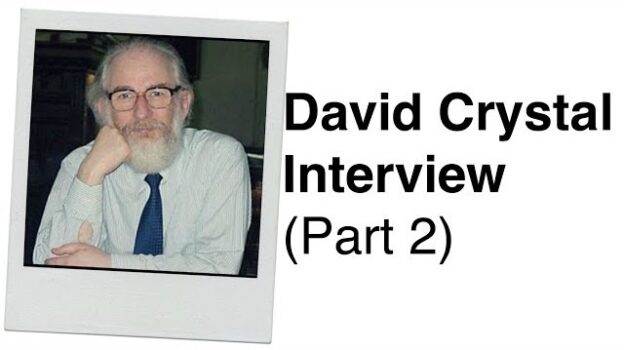
457. Conclusions about Language Learning from the David Crystal Interview (Part 2)

A follow-up to episode 455 consolidating the insights of Professor David Crystal including various pearls of wisdom about language learning.

[DOWNLOAD]

Notes & Transcriptions

Hamid
If English keeps taking on words from other languages, will it stop being English?
This is the story of English.
English is a vacuum cleaner of a language.
Something like 300-600 languages have influenced English with words. If you look at English today. Where are the germanic words? They’re only about 20%. The other 80% is from French, Spanish, latin and others.
There is no single dominating influence on English today.
How many Urdu words have gone into English? Maybe 100. But English has over 1,000,000 words. No new cluster of words coming in is going to come in all at once (tidal wave) they come in drip drip drip.
New words are assimilated to reflect a need – e.g. for new types of food.
This is no threat to English.
In fact it’s evidence of the power of English, that it absorbs so many other influences from other languages and cultures. It’s like the blob!

Jilmani
What’s the future of English?
Unpredictable! Absolutely an unanswerable question. You should never try to predict the future of a language. It’s all about events which just happen, e.g. the Norman invasion, Trump or Brexit.
Will Brexit reduce the influence of English in EU?
Not much. But it will change its character because it won’t be used by so many native speakers, so there will be more developments “Euro English” (I think it has emerged a bit).
But English will continue to change and diversify.

Jairo wants help managing the workload of studies.
Learning about language is a huge burden.
Learning about a language you have to learn about the history, society and events of the time to understand why people were using language in those particular ways.
What was it like to be an old norse speaker?
But most philologists don’t have a psycholinguistic background to their studies.
Philology can be a bit dry.
David prefers the socially aware approach to the history of language which doesn’t just ask “what happened and when” but “why?” – let’s explore the nature of the people who made it happen. This should ease the process.

Cat
English syntax – can you explain it?
Come on you’re asking for a book here!
English has a simple morphology compared with German (or French).
How many possible word endings are there for a verb in English?
The difference between English and German is morphological but also syntactic.
English and German are quite close. They only diverged 2000 years ago.
Word order is a bit different.
Everyone understood David when he went to Germany and spoke German with the wrong word order.
There aren’t that many differences, although the few differences are noticeable.
Cat, why are you worried about local areas of syntactic difference between English and German. Why has this become an issue?
It usually comes down to identity. German English (used by people who have learned it really well) still is distinctively German English.
The point is, don’t be too concerned about micro differences in syntax between your language and English. As long as we understand you that’s the main thing, although obviously style is important so I imagine you want to write in the style of a native speaker (but which one though!) You might have to accept that it’s important to find your own voice in English, which might be influenced a bit by who you are (it is your own voice after all) – which is someone who lives in Germany. That’s not to say your English can be totally different and like German with English words – that would probably be unintelligible and a bit ridiculous. But micro differences aren’t such a big deal.
Don’t sweat the small stuff, it’s just small stuff.

Wesley
Do people who speak different languages think differently?
It’s difficult to translate words sometimes because there are some words which don’t directly translate because there isn’t an equivalent word. 10-15% of the words might be untranslateable. But in Chinese it’s a lot more.
But when you do psycholinguistic experiments we discover that people can see the different concepts, but having those specific words makes it easier to talk about those things. You can see the colours but you might not have the language for describing it.
Different languages might not have the same word for something but it doesn’t mean they think about them any differently.
E.g. in English we don’t have a word for a certain thing in Japanese – natsukashii for example. But we find other ways of describing it. Ah, it takes me back or “good old” or “it feels nostalgic” or “it’s good to be back”.
So it doesn’t seem to be the case that languages affect or reflect different perception of the world.
*But I reckon there might be something to it Wesley. E.g. sense of humour, patterns of understatement, all contribute towards expressing a sardonic outlook on life (UK) rather than a direct attitude in the mediterranean for example.
The fallacy is that it’s words that translate, but it’s not it’s sentences. A group of words together are what hold meaning. So even if there’s no single word equivalent, you put some words together and make a sentence and that’s how the language transcribes.
“Snow that you use to build an igloo with” – he can still express that thing with a sentence and you can see that kind of snow.

Learn the vocabulary of a new language and you’ll see the cultural things that it reflects. It shows that to learn the language properly you should learn about the culture too – the mindset, the reference points and so on. You can see all those things too, but having certain words and expressions makes it easier to talk about them.
The result is that in languages it’s easier to talk about commonly occurring cultural phenomena because the language has the tools to do it, but people are all still basically the same, we might just take a bit longer to talk about a concept that in your language is very normal.

Mayumi
Why do Brits use indirect language?
It’s just a cultural difference. It’s the British temperament. The reason for that is hard to say. Maybe it’s because the UK is an island and the psychogeographic factors might affect that kind of language use.
Pragmatics – the study of why people are using specific bits of language.
Language norms reflect the cultural context – that’s the identity argument.
But why does the UK use this polite language? We don’t really know! You have to ask why British people want to be polite. (obviously it’s because we’re such nice people)
You just have to accept the cultural differences. Learn about them and accept them. “That’s who we are.” should be a good enough answer.
As ever, you must accept cultural differences. They’re not weird, they’re just different. It’s a good bit of advice for anyone coming into contact with another culture. You can speculate about why people behave the way they do, but ultimately you’ve just got to accept it and move on, like the way you often have to accept in English that “this is just what people say in this language” and that’s it.

Synchronic not diachronic method.

Wikipedia:
Synchrony and diachrony are two different and complementary viewpoints in linguistic analysis. A synchronic approach (from Greek συν- “together” and χρόνος “time”) considers a language at a moment in time without taking its history into account. Synchronic linguistics aims at describing a language at a specific point of time, usually the present. By contrast, a diachronic approach (from δια- “through” and χρόνος “time”) considers the development and evolution of a language through history. Historical linguistics is typically a diachronic study.

DC says we should use a synchronic approach to understanding these things – why is this particular person choosing to say it in this way, right now?
Some more modern dictionaries now contain essays about usage and pragmatics, which help us to identify how culture affects language. It’s worth reading the extra comments and information pages you find in many dictionaries.
Also, consider reading cultural guides as well as purely linguistic ones.

Antonio
Will AI replace the need for language learning?
Babel fish (Hitchhiker’s Guide)
In 100 years it’ll probably be perfect.
(I’ve seen auto subs have improved recently).
Imagine a situation where the babelfish is operating perfectly. It would solve lots of problems, but identity hasn’t been addressed. I still want to “be French” and the AI might not include those differences. People will still hold onto their languages in order to express their identity. It won’t affect language diversity.
But it might mean that AI might make the need for a global language redundant. Maybe AI will replace English. Why bother learning an international language?
But there are various answers to that – tech might let you down so people might not choose to constantly rely on it – some conditions in which there is no electricity.
Will AI manage to be perfect like a human, with the ability to translate with a view to expressing the culture?
Human translators choose between different competing nuances. I could say it this way, or this other way. We make those decisions based on complex social and psychological factors. A computer might not have that cultural sensitivity, maybe only in the long term.
The number of people learning languages might be reduced, but it’s also ignoring another factor in learning another language – the want to become aware of the culture, history and literature of the other language. There’s a personal satisfaction in learning another language and enjoy the pleasant things about it. People learn languages because they want to not because they need to. It’s a pleasure.
There are many reasons to want to continue to learn, it’s not just about intelligibility.
For the forseeable future he can’t see that it would be economically viable to create that technological solution for language when the traditional methods are the best way to foster relationships.

Jack – I don’t know where you come from.
First of all, David doesn’t mind being addressed in the Ali G dialect.
“Me” instead of “I”.
“Me wants to know…”
“I is well impressed…”
Subject verb agreement. “I is…”
“Booyakasha”
“It is a well big honour”
It’s quite a skill to be able to switch between registers. Sometimes we break the rules as a stylistic choice, like with the expression “If it ain’t broke, don’t fix it.”
It’s important to be able to switch between different styles and registers but you also have to know when it is appropriate to do it.
I’m not bothered by it in the comment section of my site, but you should be aware that some other people might find it weird or inappropriate, like for example if you write that in forums on other websites, in the comment section of Amber’s new podcast about Paris history, or in some business meeting. It’s going to seem really weird. So, you need to seriously think about the appropriacy of the things you’re doing and that means the style of English you’re using, or the decision to post dodgy pictures of cakes on my website.
Should the listeners learn the rules of grammar, or should they just focus on meaning, and let the rules look after themselves?
Both but in a structured sort of way.
In communicative teaching the structured side was a bit lost.
Just listening and working things out by being dropped in at the deep end is a bit of a big step – it takes a while.
It’s also important to do some structure work, but also to expose the learners to things that illustrate the language point being used in a functional way.
So it’s not just about form, but also about function and trying to balance the two.
So, as we’ve said before – do both. Some structured language work, combined with exposure in which you are really focused on following the meaning of what’s being communicated. Then probably some more reflection on the way it was done. Moving between grammar and pure meaning all the time. Juggling.

Back to the conversation with friends recently.

People get upset by failing standards in English.

Again, David doesn’t mind – as long as the language is intelligible then it’s a sign of changing identities – a sigh of the times.

Are we better at communicating than we used to be?

It is possible to measure, but not possible to give a simple answer. It depends on the situation.
Book: “The Gift of the Gab” How eloquence works.

Eloquence standards do vary from generation to generation, circumstances, individual to individual. E.g. Obama and Trump – differences in eloquence. Is Trump incoherent? Is Obama a better communicator? Some people say Trump is incoherent and inarticulate. But it’s not necessarily true considering Trump’s ability to communicate with his core voters.
People cite various things as examples of falling eloquence standards, e.g. using “like” but often these aren’t really examples of falling standards, it’s just a question of style.

How do we use “like”?
As long as it doesn’t get in the way, it’s just a question of style.
Again, people see language changes and they equate it with decline. It’s not.
Usually, people are giving examples of things that are just a different type of eloquence (again, change not death).

Trump’s English has a style with its own values. He avoids the rhetorical style of Obama with balanced, complex sentences. Trump uses everyday conversational strategies. “Look, believe me folks..” Every day conversational strategies. He doesn’t use carefully crafted sentences, he changes direction even mid sentence. These are all features of informal American speech.
Semantically it can be extremely difficult to understand what he really means. But adopting that style allows him to appeal to certain people.

These days he might have become a bit more formal, but during the campaign he was noticeably less formal and more colloquial than Clinton and the other candidates. As a result he clearly stood out from the crowd, during a climate of dissatisfaction with the traditional political class. People were fed up with the type of boring politician speaking in that boring old way. They thought they were out of touch with ordinary people, and part of a crooked system. Trump got in by presenting himself as an alternative to this established political system and the way he used English was a big part of that.
Thanks for listening! I hope that helps!

455. David Crystal Interview (Part 2) Questions from Listeners

Talking to the world’s top writer and lecturer on the English language, Professor David Crystal. In this episode, David answers questions from listeners.

[DOWNLOAD]

Episode Introduction

Here’s part two of my interview with the famous linguist Professor David Crystal.

In this one I asked him some questions from my listeners. I didn’t get a chance to ask all the questions I received, so if your question isn’t included then I do apologise. I left out some questions because I think he had already answered them in one way or another, or because we just didn’t have time.

But the questions I did ask him covered quite a wide range of different topics, including the way foreign words get absorbed into English, predictions for the future of English, how to deal with the workload of studying linguistics at university, the nature of English syntax, how languages affect the way we think and see the world, why British people use indirect and polite language, the influence of AI on language learning, the effects of Brexit on English in the world, whether it is appropriate to speak like Ali G, some study tips and some comments on the English of Donald Trump and Barack Obama.

Don’t forget to check out http://www.davidcrystal.com where you can see a reading list of David’s books, read his blog, see videos of him in action and even contact him by email.

I would just like to thank David for his time again, and I hope all of you out there in podcast land enjoy listening to our conversation.


QUESTIONS FROM LISTENERS

Influence of foreign languages on English

Hamid Naveed (Pakistan)
I’m an English language teacher. My question for David Crystal is: www.oald8.com (The Oxford Learners’ Dictionary) has a lot of new words from Urdu such as ‘ badam’ ‘ chai’ ‘ aloo’ ‘ bagh’ ‘ dharna’ and many more. If English keeps on taking words from Urdu or any other language, then what will be the future of English? I mean English will no longer be English. What is your take on this ? Thanks.

The Future

Jilmani
My question for David Crystal is what is the future of the English language? Will it be the same or will it be a little bit different since we know that english has changed over the decades?
How do you think English will develop over the next few years?
How will non-native speakers be part of this?

Tips for students of Linguistics

Jairo Trujillo García (from Tenerife)
I am studying an English and Spanish linguistics ( and philology ) degree , and even though I like it , it can be really hard at times ;
What recommendations would you give me to make the burden of vast information more manageable in the time allotted ?

English Syntax

Cat (Originally from Russia, moved to Germany)
I’m very confused about English syntax. I spent many years studying German grammar and syntax but it is of little use for learning English. German and English appear so similar (especially the words) and yet so different (for example, the sentence structure) at the same time. I just feel that something is completely different, but cannot point out the difference. Could you please tell us a little bit about the sentence structure and logic (the syntax) of English? (Perhaps you could compare it to the syntax of other languages)
As I don’t like doing grammar exercises at all (I’m sorry!), I was wondering, are there some more enjoyable and fun ways to learn English syntax? Maybe some shortcuts and mnemonics what you can offer us? Also what about the punctuation rules between the main and sub clauses? They can be a real pain in the neck for our transcribers. Thank you!
Cat

Language and Psychology

Wesley
I have several questions for Prof. David Crystal. The first is whether people who speak different languages think differently, I mean, if they understand and perceive the world in different ways. For example, I’ve heard that while in some places people perceive two colours and give each of them a name, somewhere else there might be others who perceive those same two colours as only one because they have only one name for them. Another example I have in mind is how we position adjectives in a sentence in English compared to in Romance languages. In English, adjectives usually come before the noun they describe. Romance languages, on the other hand, tend to place adjectives after the noun. So in English we first refer to the characteristics of something before we say what it is, and in Romance languages we start with a noun and then describe it. Does it affect, in any way, the way we think?
If we learn a second language, do we start to think more like the native speakers of that language?
Thank you very much!
Wesley

Language and culture

Mayumi (Japan)
Why do British people tend to use indirect language, hesitate to say “no” and also frequently say “sorry” in various situations? Is there any story from linguistic history?
In my Japanese culture, as far as I know we also find similar tendencies because we’ve lived in this tiny island and if people said whatever they wanted, behaved without caring about other people in this small area, or even argued with each other, they could possibly end up being expelled from this small society. This can be one of the reasons why we have these tendencies as well. This is something stuck in my mind for ages from the university class.
Did British people had similar experience when they established their culture or could it be an absolutely different story?
Cheers!

The Influence of Technology

Antonio (Spain)
My question for David Crystal: Apple, Google, Microsoft and other companies are working on translators in real time based on AI. So we can speak in Spanish with a French person and he will hear French while he speaks in French and we hear Spanish.
Skype has this option for 8 languages.
What do you think about about the AI related to language learning?
Will AI replace our need to learn other languages?

Advice for learners of English

Jack – Origin Unknown
(I don’t know why, but Jack always writes comments on my site in an Ali G dialect. I actually think it’s evidence of how good he is at English, because he can clearly write in normal style, but he chooses to adopt this specific form of English – if he can do that it shows great ability to shift between different registers and dialects – if he can break the rules I presume it means he knows that the rules are there in the first place – for some reason he chooses to write comments in this lingo – are you ready?)
I is not that learned but I also has got questions for Professor David Crystal.
Dear Sir,
Booyakasha, It is a well big honour to have you ere on da podcast, you is da only person me respects in the field of linguists after Norman Chomp The Sky and Stephen The Crasher (Naom Chomsky and Stephen Krashen).
What advice would you give to an English language learner to improve his / her language ability? Should the student focus on form (grammar, vocab etc) or should the student focus on meaning and let the subconscious do the rest?
Well that`s me questions there Big man. I has to say you is the shining crystal in the field of linguistics.
Big up yourself Prof Crystal
Respek, Westside.


Outtro

There was so much interesting content in what David Crystal said in this conversation and so much to take from it. These two episodes are really worth listening to several times so that you can really get a grip on what he said and really absorb it all.

If you sent in a question that I didn’t ask, then I’m sorry about that.
I should do follow-up episode in which I consolidate a lot of what DC said, and highlight various things that you can apply to your whole approach and attitude towards learning English.
Watch out for that.

Check out David’s work at http://www.davidcrystal.com
He’s got books about grammar, spelling, pronunciation, accents, Shakespeare – pretty much any aspect of English – he’s got it and he always writes in a clear and entertaining style.
I’m not selling his work or anything. It’s just genuinely good stuff that I’d like to share with you. This is why I’m so happy to have spoken to DC on the podcast – he’s ace and you should read his work.

Thanks for listening! I invite you to leave your comments below.

454. David Crystal Interview (Part 1) Professor of Linguistics

Talking about language with one of the world’s top linguists, Professor David Crystal.

Small Donate Button[DOWNLOAD]

Introduction

Hello everyone, thank you for choosing to listen to this episode of my podcast. I am particularly pleased to be able to present this episode to you. It is, in fact, a privilege for me to say that today on the podcast I am talking to Professor David Crystal.

I’m now going to give a quick introduction just to make sure that you are all fully aware of the calibre of this guest and to emphasise to you just how lucky we are to have him on the podcast today.

According to The Guardian newspaper, David Crystal is the world’s foremost writer and lecturer on the English language.

He isn’t an English teacher, but he is an expert on linguistics. That’s the study of language and all the issues relating to it.

David Crystal

David Crystal has a worldwide reputation and has published something in the region of 120 books including numerous academic reference works and encyclopedias of language, and books for the general reader covering topics such as English grammar, spelling, punctuation, accents, connections to Shakespeare, the influence of technology and the development of language throughout history.

He is currently patron of the International Association of Teachers of English as a Foreign Language (IATEFL) and the Association for Language Learning (ALL), president of the Society for Editors and Proofreaders and the UK National Literacy Association, and honorary vice-president of both the Institute of Linguists and the Royal College of Speech and Language Therapists.

He is honorary professor of linguistics at the University of Wales and in 1995 he was on the Queen’s honours list when he was awarded the Order of the British Empire (the OBE) for services to the English language. The OBE is the second highest honour which you can receive from The Queen – the highest being the knighthood or damehood.

So he’s Britain’s favourite language expert and he regularly makes appearances at literary festivals and teaching conferences, appears on British radio and television, writes articles for newspapers and magazines and researches all kinds of language-related topics.

But the main thing he does is to write books…

David’s Books

Some of his most popular books include:

  • The Cambridge Encyclopedia of the English Language
  • The Oxford Illustrated Shakespeare Dictionary
  • The Story of English in 100 Words
  • You Say Potato: The Story of English Accents (written with his son Ben)
  • Wordsmiths and Warriors: The English-Language Tourist’s Guide to Britain (Written with his wife Hilary)
  • Txting: The Gr8 Db8
  • Pronouncing Shakespeare: The Globe Experiment – a fascinating project investigating how English was pronounced by the original actors in the Globe Theatre when Shakespeare was alive
  • Spell It Out: The Curious, Enthralling and Extraordinary Story of English Spelling
  • Just A Phrase I’m Going Through: My Life in Language (which is both his autobiography and a highly accessible introduction to the field of linguistics)
  • And from this year “Making Sense: The Glamorous Story of English Grammar”

Many of those titles can be purchased as ebooks from David Crystal’s website – www.davidcrystal.com or from any good bookseller. There are also audiobook versions which are read out by the man himself.

David Crystal’s writing is clear, entertaining, informative and simply a pleasure to experience. The same can be said about his public speaking. I’m always impressed by his ability to take a complex academic subject like linguistics and turn it into the sort of thing that anyone can understand and enjoy.

I met David once at a teaching conference where he presented Andy Johnson and me with an award for a presentation we did. I had a chat with him afterwards and was delighted to discover how down-to-earth and friendly he is and I’ve always wanted to interview him for this podcast, but it’s only recently that I actually plucked up the courage to ask him. Thankfully he agreed.

David Crystal is a nothing short of a national treasure and I can’t believe I’m talking to him on my podcast.

Right – I think you get the idea now – he’s kind of a big deal for anyone interested in language and language teaching and so without further introduction, here is my conversation about language with Professor David Crystal.


Questions for David Crystal

Grammar

Your recent book from this year is called Making sense: the glamorous story of English grammar.

Is grammar really ‘glamourous’?

In my experience, a lot of learners of English feel a bit bored or intimidated by grammar, leading some teachers out there to say that you can learn English without grammar – learn English without thinking, etc.

Do you think it’s possible to learn English as a second language without studying grammar?
I know you’re not actually an English teacher, but do you have any tips for learners of English who want to improve their grammar?

You recently wrote a political history of grammar in the UK as a supplement to your book “Making Sense”.

What relationship does the average Brit have with grammar today, in your experience?
Has this attitude changed over the years? How has it changed?

Language Decline

I was recently having a conversation about language with a couple of friends on this podcast and we arrived at several questions that we couldn’t really answer. I thought you might be able to help.

People often complain about the so-called decline of the English language – citing things like poor grammar, punctuation, spelling, acronyms or text-speak as evidence that standards of English are slipping. Do you agree with that? Are standards of English declining? How do we even measure that?

People seem to be afraid that what they see as falling standards will result in “the death of the English language”. Has a language ever completely “died out” due to declining standards? What causes languages to die?

Are we better or worse at communicating than we used to be? (answered later)

‘Right’ and ‘Wrong’

Are you bothered by those so-called ‘errors’ in English that make some people angry?

Non-native speakers influence on English

My mate Paul says (as a bit of a joke) that because there are more non-native speakers of English in the world than native speakers, we’re actually the ones who are using the language incorrectly. E.g. because more Chinese people pronounce some English words in a certain way, it’s the native speakers who are pronouncing those words wrong.
Does he have a point or is he talking nonsense like he usually does?

French Pronunciation example

My French students often feel bad about their pronunciation because it’s so ‘French’. We understand everything that they say, but they’re really hung up on the fact that they sound so French – e.g. they can’t pronounce TH sounds in words like strengths, clothes, thirty three etc and it seems to be impossible to fix it.
Do they need to feel so bad about it?

How should my listeners feel about their relationship with English, and the version of English that they speak?


End of part 1

That’s the end of part 1. The conversation will continue in part 2 where you’ll hear me asking some questions sent in by listeners, and there were some really great questions including predictions about English in the future, the role of AI in language learning, the impact of Brexit on English in the world, and the way Donald Trump and Barack Obama use English.

I hope you’re enjoying listening to this, and that you’re able to follow some of the slightly complex points being made.

David gave so many really interesting answers and made some very important and useful points, and he continues to do that in part 2.

I think David speaks very clearly, with that slightly Welsh or Scouse twang in his voice. He lives in Hollyhead, in Northern Wales, not far from Liverpool, and he lived in Liverpool for a while as a child, which accounts for the slight accent that he has, if you noticed that.

As he said, his accent is a mix of different things, caused by the time he has spent living in different places and interacting with different people – RP speakers in the south east, locals in Wales and Liverpool and so on. It all contributes to the way he speaks. He also happens to be very articulate and I really admire the way he expresses his thoughts so clearly.

I hope you agree that we really are rather lucky to have David Crystal on the podcast and I think it’s worth listening to this episode several times so you can really absorb everything he’s saying because he really does know what he’s talking about and there’s a lot of knowlege there.

I think I should do a follow-up episode to this in which I just restate the main points that he made, just to consolidate it all, and I plan to do that. I could also talk about some of the questions which I didn’t have a chance to ask David.

I also hope you noticed that David Crystal helped to clear up some of the things I was discussing with Amber and Paul in episode 452. I should go over those things again if I do a follow-up episode, just to make it “crystal clear” – pun intended. I totally intended to make that joke and I think you should know it’s a brilliant joke which nobody has ever made before and this is sarcasm but it also isn’t.

Don’t forget to check out www.davidcrystal.com for all his work, his blog, videos of him speaking publicly and more information, including the opportunity to send him a message if you want to.

I strongly recommend getting some of his books, which should be available from any good bookseller. You could try “Making Sense: The Glamorous Story of English Grammar” for example.

Also, don’t forget that you can get audiobook versions of his work.

For example, I listened to You Say Potato – the one about accents in the UK and I think the audiobook is better than the printed book because you can actually hear his son Ben doing all the accents. You could get that as part of a trial with Audible – and remember I have that deal with them – you can get a free audiobook if you go to www.audibletrial.com/teacherluke or click an audible logo on my site. They’ve got a lot of DC’s work there. Start a trial, download your audiobook, listen to it using the Audible app on your phone and you can cancel the membership and not pay anything, or continue your membership for about $15 dollars per month and get another free book next month and so on…

So, that’s the end of part 1. Part 2 should be available for you very soon and you can hear David answering questions from listeners, and that’s brilliant because the questions were very diverse and David Crystal answers them – what more do I need to say? I still can’t believe I spoke to him on the podcast. I need to contact other awesome people for interviews now I think.

Thank you very much for listening to this. Don’t forget to join the mailing list to keep up with every new episode and to get convenient access to the page for each one where you’ll find various bits of supporting information, transcriptions, links, videos and the comment section. Just visit teacherluke.co.uk and pop your email address in the subscription form and Bob’s your uncle.

I look forward to reading your comments in the comment section.

Reminders

LEPsters are still getting together and spending time socialising in English.
In Moscow there is a group that hangs out every Sunday. Their FB group is called “Conversational English for Free – Moscow LEP Club”. https://www.facebook.com/groups/734996946664425/

Also in St Petersburg there is a similar group which gets together on Sundays. You can find them on FB by searching for “SPB LEPsters Conversational Club” – I understand they have get togethers on Sundays. Kristina from Russia who won the LEP Anecdote Competition last year often takes part – friendly people, speaking English, playing games, hanging out. https://www.facebook.com/spbenglishLEPclub/

LEPsters in Tokyo have got together a number of times, and I attended one in April to do some stand up – you can hear all about that in my Trip to Japan episodes (part 2).

Also, recently a group got together in Prague in the Czech Republic – in fact you can hear their conversation because it was recorded and published on Zdenek’s English Podcast.

Again I’m flattered because they talked mainly about LEP – including, shock horror, their least favourite or “worst” episodes of the podcast.

Listen to both episodes below.

Also, if you’re in Spain I have heard rumour that there will be at least one meetup group getting together there, somewhere, sometime soon.

If you’re thinking of setting up something similar, let me know because I can publicise it on the podcast and get the word out.

Speak to you in the next episode!

Luke

452. A Conversation About Language (with Amber & Paul)

Discussing language with Amber & Paul, including issues such as errors made by native speakers, language change, whether language standards are declining, the effects of technology on language and how to cut an avocado without injuring yourself.

[DOWNLOAD]

Click here to check out italki and get your $10 voucher

Introduction

The other day Amber and Paul came over to my flat do a podcast. We were having tea, chatting and getting ready to record something, and we just started talking about language, I think because Paul said that he found it weird that even though he can speak 3 languages really well, he knows nothing about language – he doesn’t know the grammatical terms, the rules of what makes something right or wrong or somewhere in between, and we were talking about it, and I quickly managed to press the record button and ended up recording about 50 minutes of us rambling on about language – all totally unplanned and spontaneous.

You’re about to listen to it. This is an Amber & Paul episode so you’re going to hear an unscripted and natural chat between friends so there might be a bit of swearing.

Before you listen to us discussing language-related issues, consider these questions, which are at the heart of our conversation.

  • What are some common errors native English speakers make in English?
  • How do native English speakers feel about mistakes in English, particularly mistakes made by other native speakers?
  • Are some errors worse than others?
  • How does a language evolve? Are errors a part of that process?
  • Has your language, or English, changed much in the last 100, 200, 300 years?
  • Is your language, or English, getting worse than before? Are standards of language declining?
  • Has a language ever totally broken down and died due to falling standards?
  • Why did latin die out as a language?
  • On a slight tangent, what’s the safest way to cut an avocado?
  • Back on track, how does Charles Darwin relate to language development?
  • What effect is technology having on our language? Is it making us better or worse at communicating?
  • Are we better at communicating than we used to be? Are we getting better at communicating? How do you even measure that?
  • Do you know more about English grammar and so on than most native speakers of English?
  • Do you know more about English grammar and so on than Paul Taylor?
  • Are you better at cooking than Paul Taylor?

Watch out for answers, and general rambling on the subject of those questions as you now listen to our conversation about language.


That’s it! Leave your comments below.

So there you are, that was our conversation about language.

I invite you to take part in the conversation by getting into the comment section.

Let me remind you of those questions from the beginning. (see above)

There were a few unanswered questions in there, and I think I might be asking David Crystal about some of them.

Remember that? I’m going to interview the world’s leading voice on language – Professor David Crystal. It’ll be a chance to ask him various questions about language. I’ve already collected some questions from my listeners, and I have loads to ask him too, but feel free to offer up a question or two and if I get a chance I’ll ask him.

Actually, I’ve already interviewed David Crystal, so it’s too late to send me your questions! Episode coming soon.

444. The Rick Thompson Report: Snap General Election 2017

Politics is back on LEP as I talk to my Dad about recent developments in the UK, specifically the General Election which is due to take place on 8 June.

Small Donate Button[DOWNLOAD]

Introduction & Summary Transcript

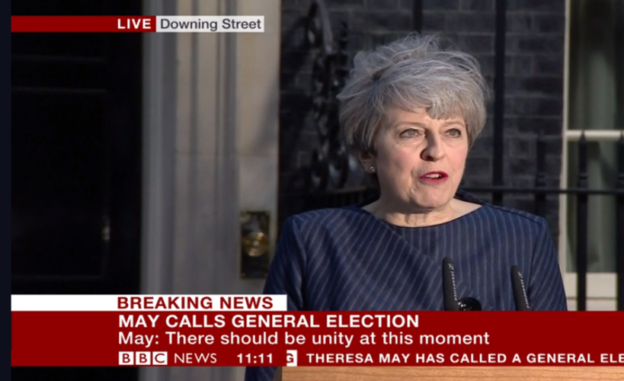
Last week something surprising happened. The British PM Theresa May announced a “snap general election” – meaning, she called an election earlier than expected and with a short time between the announcement and the date of the election. That’s what a ‘snap’ general election is. In this case the general election is going to happen on 8 June this year.

So this is a general election, which means that all the MPs in the UK’s House of Commons in Westminster, London could change. I don’t think they will all change but we will see a different arrangement for sure, with parties either losing or gaining seats, and the government could change as well. The House of Commons is where all the MPs sit. Each seat in commons represents a different part of the country – the different constituencies. People will go out to the polling stations, vote for an MP for their constituency and the one who wins the most votes in that constituency gets that seat. The party which gets the majority of seats in the House of Commons has the right to form a government. At the moment that’s the Conservatives since they won the majority of seats by a fairly small margin in the last general election we had, which was in 2015, i talked about it on this podcast. How is our parliament and our government going to change with this election? How’s that going to affect the direction the country goes in?

So, politics is in the news (as it always is) so I think it’s time to talk some more about this subject on this podcast, so let’s talk to my dad Rick Thompson again. My dad is a journalist who worked at the BBC for years and he’s also a visiting professor at the University of Central England. Generally he’s a well-informed and articulate person and certainly he’s the one I always ask when I want to know all about something that’s happening in the news. So, let’s talk to Rick Thompson about this snap election, what it all means, and how it relates to this ongoing story of Brexit and politics in the UK.

Before we do that I think it might be necessary to give you a bit of a summary of the story so far, in terms of British politics. This will take about 10 minutes but it’s important context.

I’ve been covering politics in the UK since the 2015 election, doing episodes every now and again about the political situation and events, attempting to talk about them in a balanced way while also giving my personal take on things. You can go back and listen to them – since summer 2015.

In any case, here’s a brief summary of British politics over the last couple of decades to just make it as clear as possible because context is everything. Without context it’s just a bunch of big sounding words and events that might not seem to have any significance. Also, it’s a good chance for you to hear some of the language of politics that you might have heard on this podcast before.

You can read this introduction and summary on the page for this episode. Watch out for certain terms and language relating to politics. There’s some nice vocabulary here and you can pick it up and use it when you discuss this subject too, because I’m sure many of you are discussing these things – politics in Europe but also politics in your countries. A lot of the language is basically the same.

A Summary of British Politics – The Main Parties

So we have two main parties in the UK and some other smaller ones which are still important, especially today.

The Conservatives – centre-right to right wing
They’re often described as the party of the rich. They tend to promote free market capitalism with the belief that allowing business to flourish benefits society as a whole because the money trickles down to everyone else through the creation of jobs etc. They believe in the private sector as the solution to society’s problems and that introducing competition in the marketplace between companies seeking profit will create the best conditions in all services, rather than the government stepping in and controlling things with regulation. So the Tories believe in small government. They’re the party that says they support hard work and dynamic entrepreneurialism – the idea that you can build a business yourself and if you work hard and have good ideas you can get rich and do great things and this benefits society in general. They’re criticised for not caring about ordinary working people, just supporting their friends at the top, being out of touch with ordinary life. They currently are the governing party.

Labour – centre-left to left wing.
Believe in supporting working people and creating conditions in which everyone can have a decent life. They believe that the government needs to support people in all areas by providing welfare, guidance and regulation to keep things balanced for all. The public sector has a responsibility to take part in many areas of life in order to constantly protect the interests of all people. More public spending, and re-distribution of wealth through higher taxation on the rich and higher public spending for services for the poor, equal opportunity programs etc. Criticised as being soft, idealistic, the ‘liberal left’, politically correct, tolerant of radical islam, incapable of managing the economy due to high levels of public spending and taxation which damages business. Being too controlling, too much influence in all areas of life like in people’s business concerns, the nanny state trying to control everything and stifling entrepreneurial instincts. They are the opposition party at the moment, struggling with their leader Jeremy Corbyn who is popular with Labour voters, but unpopular within the MPs themselves.

Liberal Democrats in the middle – they almost never get power and just sit in this kind of lukewarm water where they pick up voters who don’t really agree with the other two big parties. Considered a bit vague and untrustworthy considering they made U turns on many principles in their time in coalition govt with the tories and lost loads of seats in the last election. These days they are one of the the only major parties in England which is anti-Brexit.

Green party to the left of Labour – don’t get a lot of votes because they’re just too left wing even though their policies are about fairness and environmental protection. The left is criticised for being idealistic because they believe in high public spending, and “where’s the money going to come from?” Essentially they are a bit anti-capitalist because they’d make businesses pay for their programmes.

UKIP on the right of the tories – always focused on getting out of the EU and cutting immigration. Many members deny climate change, blame immigrants and the EU for all our problems and like to think they are the party for people who are sick of the political class.

SNP – the party for Scotland. Focused on protecting Scottish interests. Generally left wing policy for Scotland. They want independence.

Smaller parties include Plaid Cymru for Wales and several parties in Northern Ireland.

British Politics Since WW2

Over the years our country has generally swung between The Conservatives and Labour.
Following WW2 a Labour government set up the Welfare State – the state took control of the big institutions and utilities like the National Health Service, the railways, water, electricity, coal, steel etc that were like massive pillars of British economic and social life. This is what the country looked like in the decades after ww2.

In the late 70s and early 80s Thatcher (Conservative) totally changed the country by pushing liberal free market economics and beginning the dismantling of the welfare state. She oversaw the privatisation of state owned institutions, letting the markets and the private sector dominate our economy, making it very hard to go back.

The left wing was badly hurt. Partly due to failures in the pre-Thatcher era with the country being dominated by the labour unions and with a lack of growth in the economy. THatcher did revitalise things but she also damaged a lot of the working communities that relied on industries like coal mining. She pushed the country towards liberal economics like Reagan in the USA and we’ve been following that ever since.

Left wing was a bit stuck for a long time, nearly 20 years of Tories.
Tony Blair in the mid-nineties revitalised the Labour party by re-branding it “New Labour”. He took a centrist position, known as the ‘third way’ or Blairism.

Essentially this was the social position of the left with the economic position of the right.
Free-market capitalism was allowed to flourish, but with redistribution of wealth, high public spending on welfare services, progressive policies.

A lot of it was funded by the financial markets, banking ‘trickery’, credit, lending and so on.

It was like a Thatcherite economic model but with the heart of the left – he claimed to represent ordinary working people and wanted to create a level playing field in society to give everyone an equal chance. He was popular in the beginning and won a landslide victory in 1997. Generally he was quite good, but it all slipped when he took the country to war in Iraq and there were questions about the way he justified that.

Also the reckless manner in which the financial markets were allowed to play with our money led to a banking crisis as all the lending backfired when basically people couldn’t pay back all the debt and banks lost a lot of money.

It came from a culture of risky investment and frankly dodgy debt trading, which is kind of what happens when you let the markets just get away with anything.
Because our society is utterly dependent on credit, our economy took a big hit, just like it did all over the world.

Tony Blair handed over to his partner Gordon Brown who inherited this mess and tried to solve things with a mix of quantitative easing and other policies. Lacking the charisma of Blair and arriving at a time when everyone was a bit sick of Labour. Brown is remembered as a bit of an unpopular guy who also had to deal with the fallout of the Blair years.

Labour took a big hit in the 2010 election and lost.

Voter apathy and general distrust in politicians led to low voter turnout in 2010. The Conservatives got more votes than the other parties but not enough to form a government so they formed a coalition with Liberal Democrats who took the opportunity to play a role in government.

The government pushed an economic policy of austerity. The Liberal Democrats compromised a lot of their principles because the govt was basically led by the tories. They lost a lot of public support.

Scotland had a referendum to leave the UK but the vote ended up being to stay, but the SNP gained a lot of support and Scotland still might vote to leave the UK in order to remain in the EU.

The Tories continued to push austerity as their solution to the economic crisis.

The next election saw a surprising win for the Tories. They managed to win an outright majority. This is mainly because the SNP stole votes from Labour in the north. The Lib Dems lost loads of seats because people had lost faith in them. Labour’s leader Ed Miliband just wasn’t convincing enough. People probably felt that the Conservatives had a plan for the economy which they had to finish. Also the usual voter apathy meant that a lot of people didn’t vote and as a result only a portion of the population got what they wanted.
So the Tories carried on with their policy without the influence of the Lib Dems. No more coalition, just the tories.
Their policy: Cut public spending and yet relieve pressure on businesses to stimulate the economy. It also looked like they were making working people pay for the economic crisis caused by rich bankers who were also their friends.

Labour, in opposition, looked for a new leader. Surprisingly an old member of the party, Jeremy Corbyn, was chosen. He’s quite radically left wing. He’s popular with the grassroots voters, but not popular with the more centrist members of the party, including many Labour MPs and the party is quite split.

Meanwhile the economic crisis, unemployment and increasing immigration caused more competition in the job market and the cut in public services caused a lot of frustration among middle class and lower class people. UKIP gained more support by campaigning to reduce immigration and make Britain great again by getting out of Europe. They posed quite a big threat to the Conservatives both among voters and within the party. David Cameron the PM and Tory leader faced quite a lot of pressure from this growing Eurosceptic faction.

He came up with a plan to satisfy those Eurosceptic members of his party and prevent UKIP from stealing too much support from them. He had to be seen to be addressing the EU situation, taking a tough position.

He called a referendum on Europe while also planning to try and renegotiate Britain’s terms of membership. I think he believed he could use the referendum as a bargaining tool in Europe to get a better deal with more control of immigration and more control of business rules.

He thought the EU would say “ok you can have what you want, just don’t leave us!”

Dave imagined the referendum would be a choice between a better deal with EU or out.

He didn’t get the better deal he wanted, and you know how the anti-EU supporters campaigned hard for a leave vote by making lots of untrue claims, promises they couldn’t keep, presenting Brexit as the solution to all of the UK’s problems.

Surprise surprise, the country voted to leave the UK. 51.9% voted leave, 48.1% to remain.

Cameron, who had campaigned to remain promptly resigned, suggesting that he wasn’t the right man to lead the country into Brexit. There was a slightly messy leadership campaign, with Boris Johnson ultimately stepping down because he made a fool of himself with his leave campaign – too many promises he couldn’t keep and false claims. Theresa May was chosen by the Tories as the next leader. She was officially anti-Brexit during the referendum campaign, but she was chosen as the PM to lead the country through the Brexit negotiations. Crazy times.

A lot of people were angry with Jeremy Corbyn the Labour leader because he did not argue against Brexit strongly enough. As the leader of the left, he didn’t seem to care about Brexit that much and this probably damaged the remain campaign. It seems he doesn’t like Europe much. He lost a lot of support from shocked remain voters.

There was a high court claim by various people which argued that the government didn’t have the right to trigger article 50 (start Brexit process) without Parliament voting on it first. The claim was a success. Parliament voted to trigger article 50. In March Theresa May triggered Article 50. She also promised many times that she wouldn’t call a general election, and that “now wasn’t the time”.

Then, wow, she called a snap election and here we are. It was a surprise because we she didn’t need to do it until 2020.

Another general election on 8 June 2017.

Why has this happened? What’s the significance of this? What does it mean?

Let’s talk to my dad and see what he has to say.


What happened?
Theresa May has called a ‘snap’ General Election, to take place on 8 June 2017.

What does this mean?
That voters in the UK will be choosing new MPs in the house of commons.
We’ll get a new government, new arrangement in Parliament

Why did Theresa May call this election? She didn’t have to do it until 2020.
She says it’s because the country needs a united government. May needs a ‘mandate’ from the people to be able to oversee Brexit.
But really, this is just an opportunity for the Tories to grab more power because the opposition is a disaster.

How is this possible? How often do we have elections in the UK?
We have elections every 5 years more or less, but the government has the right to call elections whenever it wants. In the case of a ‘snap’ election like this, Parliament votes on it and it needs a ⅔ majority to go through. That’s going to happen because Corbyn has said Labour will back the snap election.

Why is Corbyn backing this election when it’s pretty certain that Labour will lose seats?
He’s in a Catch 22 situation. If he says no to the election it’s like admitting defeat.

What is going to happen?
Tories will gain a bigger majority, Labour will lose seats, Liberal Democrats will gain (because they’re the only ones fighting against Brexit so remainers will switch to them). But, anything can happen in politics, so let’s wait and see.

How is this related to Brexit?

What about the 48.1% that voted to remain?
Who do they have to vote for? Corbyn basically agrees with Brexit so the only party left is Lib Dem and they’re just not strong enough to win this. The Tories are bound to make big gains.

  • Some vocabulary
  • U turn
  • Voter turnout
  • Voter fatigue
  • Campaign
  • Televised debate
  • Polls
  • Brexit negotiations
  • Mandate


440. This Pile of Books on my Desk

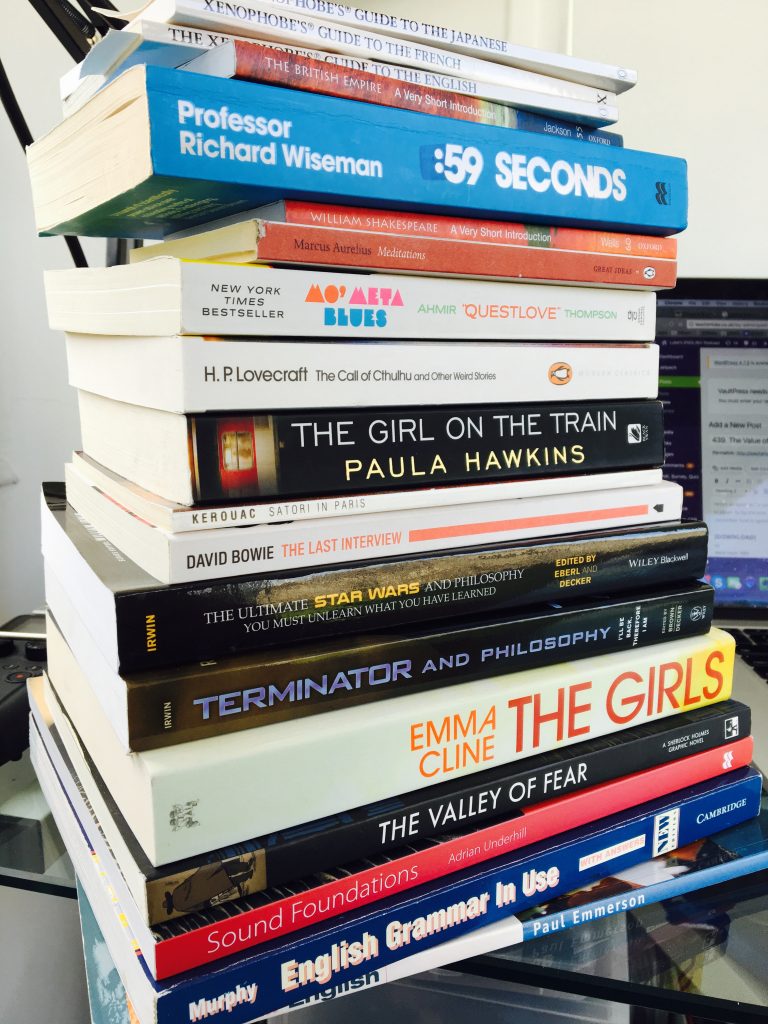
In this episode I just want to talk to you about this pile of 16 books I have on my desk. These are (mostly) books I haven’t read yet but which I picked up recently. I have lots of piles of books like this lying around and I must read them all but I can’t find the time! Anyway, I think they’re really interesting. I either received them as presents, was recommended them by friends and family or I bought them for myself when visiting book shops over the last year or two. I love books, and browsing bookshops is one of my favourite things. If only I was a faster reader!

Small Donate Button[DOWNLOAD]

Part of the reason I’m doing this is because I just want to encourage you to read more and I would like to arouse your interest in books. Perhaps I can give you some encouragement to read a copy of one of these books, or perhaps this will encourage you to pick up a book (in English) from the pile of books that you probably have in your home too, and start reading it.

In any case, I hope you join me on this little exploration through this pile of books I have on my desk.

Here’s the list of books I talk about in this episode (also in the picture)

The Xenephobe’s Guide to The English, The French, The Japanese
The British Empire: A Very Short Introduction by Ashley Jackson
:59 Seconds by Professor Richard Wiseman
William Shakespeare: A Very Short Introduction by Stanley Wells
Meditations by Marcus Aurelius
Mo Meta Blues by Ahmir “Questlove” Thompson
The Call of the Cthulu and Other Weird Stories by H.P. Lovecraft
The Girl on the Train by Paula Hawkins
Sartori in Paris by Jack Kerouac
David Bowie: The Last Interview Various journalists and publications
The Ultimate Star Wars and Philosophy: You Must Unleard What You Have Learned
Terminator and Philosophy: I’ll Be Back Therefore I Am
The Girls by Emma Cline
The Valley of Fear (Sherlock Holmes graphic novel)

books

430. Discussing Language Learning & Life with Fred Eyangoh

Talking to Fred about history, geography, comedy, learning English and cutlery.

Small Donate Button[DOWNLOAD]

Introduction

On the podcast today I am talking to a friend of mine called Fred Eyangoh. English is not Fred’s first language but he’s learned it to a proficient level – enough to complete a Master’s’ program in Business Management and Marketing in English and to do regular comedy shows in English too.

I’ve invited Fred onto the podcast because I want to talk to him about, how he develops and maintains his English, what life is like in the country that he originally comes from, and we do talk about those things – Fred says some interesting points about how he’s has pushed his English on his own, but also we ended up talking about lots of other things like history, geography and cutlery (that’s knives, forks and spoons).

You’ll hear that Fred speaks with an accent which is quite difficult to put your finger on – it’s hard to identify exactly where he comes from, and I’m not going to tell you right now, because I want you to guess, based on his voice. Where do you think he comes from?

You’ll see that although it’s his second language Fred’s English is precise and accurate in terms of grammar and he uses a wide range of vocabulary, and to a large extent that is down to the way he has applied himself to his acquisition of English.

We ended up talking for about an hour and fifteen minutes in this conversation, and I’ve decided to publish all of it in this one single episode, rather than dividing it into two episodes because I think it’s best enjoyed without interruption, as one continuous flowing conversation.

OK, let’s begin. The first thing you’ll hear us talking about is the First World War, because Fred has been listening to a podcast called Hardcore History, and he’s been listening to an episode of that podcast about the First World War. Click here to check out Hardcore History with Dan Carlin about World War I.

And that is the first thing that we talk about.


Recap – What Fred said about Learning English

Let’s recap some of the things Fred said about improving your English.

Now, I know some of you are thinking – but he had some English lessons when he was 4, that’s cheating! Sure, that must have helped, but I know people who had English lessons from childhood at school but they still don’t have a great level of English. It’s not just that, it’s also the other things you do in your life.

  • Immerse yourself in English content that you really like – in the case of Fred it’s comedy and films. We all know about this, but it’s worth repeating. Get some English into your everyday life and make it some content that you’re fascinated by.
  • Notice/Track vocabulary and go the extra mile. This doesn’t just mean watching films with subtitles on. That bit of advice has been said a million times, and it is true. But while you’re watching, listening or reading you should ‘track’ the language or ‘notice’ the language while you’re consuming it. Make a point of noticing specific bits of English, like vocabulary items and then research that language by investigating it online, reading around it, finding more active examples of it using google or wikipedia. As Paul Taylor has said “Just Wikipedia it!” and it’s good advice of course when you’re doing self study. Find examples of new words and expressions, not just definitions and read plenty of examples (e.g. by using the News tab in Google search results, or by exploring Wikipedia) until you’ve made plenty of connections and associations with that new word and you know it well enough to start using it.
  • Work with audio and transcripts. Listen and then check out some words that you don’t know by circling or highlighting them and then researching them as we just said. For example, most TED talks have transcripts on the TED.com website. Now, we all watch TED talks from time to time, but how often are you playing around with the interactive transcripts and really exploring the vocabulary that you can find there?
  • Broaden your range. Push yourself to use the language you’re picking up by finding new ways to say the same thing – e.g. avoid just using the simple verbs like ‘be’ or ‘have’.
  • Be creative – write down your ideas. You could write some comedy, some poetry, some stories and if you feel like it, find a place where you can share your work, like a spoken word open mic night or something like that.
  • Socialise and be outgoing. Go out and meet people who you can speak English to. Find your own peer group for socialising in English.

OK, that’s it! Go the extra mile and push your English, but do keep enjoying it – that’s one of the most important things.

Check the website for some videos of the comedians Fred mentioned.

Join the mailing list!

Speak soon, bye!

Comedians Fred Mentioned

Fred is a great fan of comedy, and I always think that stand-up must be a great source of English you can listen to, and there’s so much of it on YouTube, and if you have Netflix you can find lots of great stand up comedy shows and they all have subtitles, so switch them on and go for it!

Here are some of the comics Fred mentioned.

Maria Bamford
She’s one of the top comedians in the USA right now. She tells stories using different voices to let us understand (and laugh at) the problems she experiences in her everyday life. She has been diagnosed with bipolar disorder and obsessive compulsive disorder, and she deals with both of those subjects in the most adorable and hilarious way, changing her voice to represent the different people in her life, cleverly revealing their attitudes and treatment of Maria. This video is a good example of the way she changes her voice to become a different person in her routines.

Chris Rock
An absolute mega-legend in comedy. Brave, sharp, honest and one of the funniest stand-up comedians ever. *Warning: rude content*

Louis CK
He’s generally considered to be one of the hottest standups in the world at the moment. Comedy is a question of taste of course (and Louis talks about some quite dark, edgy and offensive subjects) but Louis is really great. *Warning: rude content 

https://www.youtube.com/watch?v=fOaIFgse4Hw

fred

421. Skateboarding – A New Olympic Sport (with James)

Here’s a new episode with James about Skateboarding, which will be a new event at the Tokyo 2020 Olympic Games, along with karate, surfing, baseball/softball, sport climbing and surfing. James has been a skater for most of his life and used to write articles for a skateboarding magazine, so he’s exactly the right person to talk to about this.

Small Donate Button[DOWNLOAD]

Introduction

Skateboarding might seem like an annoying antisocial hobby for children but for the first time it has been accepted by the Olympic Federation as a proper sport and is going to be one of the events at the next Olympic Games happening in Tokyo in 2020. So, skateboarding is now a mainstream sport. When the Olympics are shown on TV in a few years’ time, skateboarding might be one of the most popular events for audiences around the world, especially when you consider the popularity of snowboarding in the winter games. So, let’s find out about skating so we are ready to understand and appreciate it more.

Types of skateboarding

  • Ramp (vert or miniramp)
  • Street
  • Freestyle
  • Park

Parts of a skateboard

  • The Deck – the wooden board itself, made of maple plywood and covered in grip-tape and with the nose at the front and the tail at the back)
  • The Trucks (made of die-cast aluminium – they fix the wheels & axles onto the deck)
  • The Wheels (made of polyurethane or ‘urethane’ and available in different hardnesses)
  • The Bearings (the metal components that allow the wheels to spin on the axles)

Common tricks

  • Ollie (jumping with the board under you, still touching your feet)
  • Kickflip (an ollie in which you flip the board sideways under your feet by kicking it in the air)
  • Shove-it (spinning the board under your feet so the nose spins round from front to back, or back to front)
  • Different types of grab (doing an ollie then grabbing the board in the air)
  • Grind (sliding or scraping the trucks of the board along an object like a curb or rail)
  • Boardslide (sliding along an object on the underside of the board)
  • Blunt (balancing on an object on the back wheels and tail)
  • Nollie – doing an ollie but from the nose not the tail
  • and many more! Click here for a full glossary of skateboarding.

Videos

Here is James’ selection of videos to give you an idea of the different types of skating, and some of his favourite skaters and cool moments in skateboarding. Notes written by James.

Natas Kaupas, one of the first people to develop street skating.

Mark Gonzales skating vert and street and play fighting with Oscar-winning film director, Spike Jonze. From the Real skateboards video Non Fiction. (1997)

The legend of Tom Penny, a skater from Oxford, England: Zen master, legend, space cadet, enigma.

Lizzie Armanto, one of the best female US bowl / park skaters, in an ad for Bones bearings.

Women’s Highlights – Huntington Beach | 2016 Vans Pro Skate Park Series

The Flip skateboards video “Sorry” from 2002, presented by Johnny Rotten – probably the best skate video ever made… Madness. Good soundtrack too.

James describes his skateboarding injury on the podcast in episode 180.

180. How my Brother Dislocated his Shoulder (with James)

McVities Chocolate Digestives

Here’s that advert on the Paris metro “McVitie’s – It’s English, but it’s good!”

mcvities

Click here for the full list of ingredients!

Is skateboarding popular in your country? Share your thoughts in the comment section below.

420. Anyone fancy a brew? Let’s have a nice cup of tea!

Everything you need to know about the culture of tea-drinking in the UK, including a full guide to how to make a nice cup of tea, English style.

Small Donate Button[DOWNLOAD]
In episode 420 I have chosen to talk about my favourite herb, which like millions of other British people, and countless others around the world, I consume on a daily basis. It calms my nerves, it raises my morale, and it helps me to socialise. Queen Victoria famously used it, and the Beatles took it regularly during the recording of their most inspired music and even sang about it in a few of their songs. I’m talking of course, about tea.

As everyone knows, tea is very popular with people all over the UK, from all regions, backgrounds and social classes, whether you’re the Queen herself, or you’re the guy who cleans the road outside her massive house, everyone loves a brew. The British Empire was built on tea, wasn’t it? Goodness knows I’ve made enough references to it in my episodes – I’m even drinking a cup right now. Mmm.

Why an episode all about tea?

I just want to celebrate tea, but also I want to tell you everything I think you need to know about this subject including these things:
– Stereotypes about tea drinking in the UK
– Different ways to make and drink tea – Afternoon tea vs just having a cuppa
– My personal way to make a nice cup of tea
– The history of tea in the UK
– Facts about tea, including its health benefits
– George Orwell’s essay on tea – considered a kind of reliable guide to the ins and outs of the potentially controversial subject of how to make tea.
– References to tea in Beatle music

What are the stereotypes about drinking tea in the UK? Are they true?

Smashing a few stereotypes – let’s talk about how most people drink tea in the UK these days, not how people seem to think we do it (that’s quite hard because it depends who you are).

*Tea is for the upper classes and is a posh affair full of uptight rules – nope, all types of people drink tea and it’s often a very casual and informal moment.
*Drinking tea is a mystical, spiritual kind of experience that takes you on a journey into a colonial dreamland where you have a profound moment of higher understanding while visiting the distant lands full of oriental mystery – nope, we’re not that pretentious about it! It’s just a nice hot drink!

Here’s that annoying advert for Special T with Diane Kruger

https://www.youtube.com/watch?v=iOUh2V3Quvw

*Tea is only drunk at tea time – nope, people drink it at all hours of the day
*All British people like tea –  not everyone likes it, of course
*Tea contains more caffeine than coffee – see below

Does tea contain more caffeine than coffee?

Unmade tea contains more than unmade coffee – but when you brew the tea most of the caffeine is not transferred to the water – it’s discarded with the leaves. With coffee the caffeine is transferred to the water more, so the drink is more caffeinated. https://www.theguardian.com/notesandqueries/query/0,5753,-25502,00.html

What’s your specific method for making a good cup of tea, Luke?

I’ll tell you about 3 typical situations in which make tea, and the different ways I do it.

  1. A quick cuppa when I’m on my own.
  2. Making a pot of tea to share with a couple of friends.
  3. Preparing tea for a special occasion, like when grandparents come to visit.

What are your preferred tea brands?

PG Tips (pyramid bags), Yorkshire Tea (“like tea used to be”), M&S Gold, or fancy brands that you find in Wholefoods or little cafes – never Lipton and not Twinnings either.

Apparently it’s best to use loose leaf tea, but I usually just use tea bags. I use loose leaf tea for making sencha in a Japanese tea-pot.

Why do people drink tea so much in the UK? What’s the history of Britain and tea?

It’s all to do with our colonial past and the East India Trading Company! If you want to know more, just Wikipedia it! https://en.wikipedia.org/wiki/Tea_in_the_United_Kingdom

What do people eat with tea?

Biscuits or cake!

Click here to see pictures of popular biscuits in the UK.

Click here for typical cakes which we eat with tea. YUM YUM YUM

What are the health benefits of tea?

There are  loads of benefits, apparently. Have a look: The Evening Standard – “5 Reasons Why Drinking Breakfast Tea is Scientifically Good For You”

George Orwell – A Nice Cup of Tea

George Orwell’s well-known essay about how to make a good cup of tea, first published in the Evening Standard in 1946. It’s hard to argue with his approach and the clear and lucid way it is described. http://www.booksatoz.com/witsend/tea/orwell.htm

References to tea in songs by The Beatles

“Without doubt tea was the Beatles’ top tipple of choice! In one 3-month period in 1967 when they were ostensibly at the height of their drug period – they actually recorded no less than five songs referring to this most English of habits! (“Lovely Rita,” “Good Morning, Good Morning,” “A Day In The Life,” “All Together Now” and “It’s All Too Much.”) They actually recorded more overt references to tea than to drugs!” [Martin Lewis, Beatles scholar and humourist]

The Rutles – Wild Tea Parties

Talking with Richard McNeff about making a perfect cup of tea – recorded 6 years ago before I had a tea-pot!

Do you prefer tea or coffee? How do you like to make it?

beatles tea 10

412. British Festivals and Holidays (Part 2)

Here’s part 2 of this episode all about special days and celebrations in the UK throughout the year. Below you will find a transcript and videos.

Small Donate Button[DOWNLOAD]
May
1st and 29th – Bank holidays. There are two Mondays in May when people have the day off work or school and (if we’re lucky!) spend some time outdoors enjoying the spring sunshine. The first bank holiday in May is known as the May Day holiday and it is vaguely associated with workers rights (like Labour Day) although this is not expressly stated as the purpose of the day. As I said earlier – officially all bank holidays were set up to give workers some time off.

The second May bank Holiday is known as the Spring Bank Holiday or the Late May Bank Holiday and this one is associated with the beginning of Summer. It always lands on the last Monday of May and often there’s good weather. Typically what happens on this day is that people are surprised by the good weather which leads to a feeling of optimism about the coming summer. People say things like “Ah, summer’s going to be great – let’s have barbecues!” and then they wait for summer to arrive and they wait and wait, and it stays cloudy and rainy, and they wait and it rains and they wait all the way until late September before realising that Summer is over and the week of sunshine we had at the beginning was all we were going to get, and then suddenly at the end of September the sun comes back and we have what’s known as an Indian summer – that’s a late summer.

Usually at the end of May we have the F.A. Cup Final – that’s England’s most traditional football cup and it’s pretty special because all the teams in all the leagues get to play each other and the final happens at Wembley Stadium, and it’s usually pretty sunny when it happens.

Also throughout May you can check out the Brighton Fringe Festival. It’s a great time to visit Brighton, which is just one hour from London and is on the south coast of England – so you can enjoy the seaside (even though the beach is made of stones not sand) and all the attractions of an English seaside resort. In the festival there are comedy shows and other attractions and most of it is free. I did a few podcasts from the Brighton Fringe a few years ago when I was performing comedy there. You can check those episodes out here:
https://teacherluke.co.uk/2012/06/07/brighton-fringe-festival-1/
https://teacherluke.co.uk/2012/06/17/brighton-fringe-festival-2/
https://teacherluke.co.uk/2012/06/29/brighton-fringe-festival-3/

Cooper’s Hill Cheese-Rolling

June

13th – The Queen’s Official Birthday. Although the Queen’s real birthday is on the 21st of April, it has been a tradition since 1748 to celebrate the king or queen’s birthday in June.

A military parade known as Trooping the Colour is held in London, attended by the Royal Family. I think the reason the monarch’s official birthday is marked in June is simply because there’s a better chance of good weather for the military parade. It’s as simple as that.

19th – Father’s Day. Father’s Day is a day to show appreciation to fathers, grandfathers, stepfathers and fathers-in-law. Many people in the UK give their father a card or gift, have a meal together or go out for drinks. We don’t do it in my family! This is probably because of a feminist idea that men already have plenty of days and blah blah blah.

21st – Summer solstice – midsummer’s eve – the longest night of the year. The ancient monument of Stonehenge in Wiltshire has its true moment in the sun on this day as people celebrate the longest day and shortest night of the year. Stand inside the monument facing northeast, toward a stone outside the circle called the Heel Stone, and you’ll see the sun rise like a blazing fire – a sight that brings in pagans and sun-lovers of all beliefs! In fact, there’s usually some sort of pagan celebration at Stonehenge on this evening. Everywhere else we just enjoy a really long evening, with long shadows and light until about 11pm or more. Summers in the UK are fantastic for long days and despite what I said earlier about barbecues we do have some wonderful weather sometimes, and I have good memories of these never-ending summers with days that just went on forever. Sitting in a pub garden all evening on the 21st is a particular pleasure.

Wed 21st to Sun 25th – Glastonbury Festival
This is the biggest music festival in Europe and is now one of the most important music festivals in the world. Every year about 200,000 people travel to a farm in Glastonbury in the Somerset countryside not far from Stonehenge in the South West of England. It used to be a hippy music festival a bit like Woodstock. These days it’s a place to check out music and all kinds of other performance art, and all the biggest bands of the moment perform there. It tends to be headlined by the biggest names in music. Recently we’ve had groups like The Rolling Stones, Coldplay, Bruce Springsteen, Neil Young, Beyonce and Kanye West headlining the event. The BBC usually cover Glastonbury throughout the festival. In 2017 one of the headliners will be Radiohead. We don’t know who is going to headline on Saturday yet – it might be Guns & Roses, Rihanna, The Stone Roses, The Foo Fighters, Ed Sheeran – the list of speculations goes on.

I’ve never been to Glasto, but I almost always watch it on TV and I have to say it’s often a bit of a disappointing experience, probably due to the poor sound quality you get through recording a live concert and putting it on TV. It completely lacks the power and punch that you get from seeing someone live. It just sounds like you can’t hear the drums properly and it all sounds weak and clinical sounding. There’s nothing like seeing music live and I think to really enjoy Glasto you need to be there, soaking up the atmosphere, up to your knees in muck. I expect it’s not what it used to be.
Here’s a podcast episode about music festivals from the archives https://teacherluke.co.uk/2009/10/20/summer-music-festivals/

Link to the biggest music festivals https://www.festicket.com/magazine/top-20-music-festivals-in-the-uk/

26th – Eid. Marking the end of the month-long fast of Ramadan, Eid is widely celebrated by Muslim communities in the UK. Each community usually organises its own events, but there are some large celebrations and feasts in city centres, such as in London and Birmingham. I’ve never been part of an Eid celebration but I remember when I worked in London that a lot of my students fasted during Ramadan, and then disappeared completely during the Eid celebrations! I wonder what it is like to go without food during the daylight hours – it must be pretty hard. I know that fasting is an important part of Islam (one of the 5 pillars of Islam) and it’s all about abstaining from earthly and material pleasures and focusing on prayer and a sort of spiritual detox. It must be a big celebration when it’s over and you can eat during the day again!

July

Monday 3 July – Sunday 16 July – Wimbledon Tennis Championships. Wimbledon, the world’s oldest tennis tournament, is a summer highlight for sports fans. Held at the All England Club in London since 1877, Wimbledon is known for the tennis players’ white dress code and the tradition for spectators to eat strawberries and cream. For me this is usually something you watch in the evenings while eating summer food like a melon or something. It’s also another opportunity to be disappointed by British sportsmen, although Andy Murray did win in 2013 and this year too. Well done Andy.

Also during the summer we have cricket test matches going on. A test match is one game of cricket that happens as part of a test series. So, a series is 5 matches, and the series goes on throughout the summer – it can take a couple of months for a series to be completed. Each test match lasts up to 5 days. The biggest rivalry we have is with Australia and we regularly play a test match series against the Aussies called The Ashes – it’s been going for decades and it’s a big deal if you like cricket. You might think that 5 days is rather long for a game (and yes they pretty much play all day – from about 10AM until the light fails in the evening – they even stop for tea in the afternoon) but it’s really great when there’s a test match going on because you can keep up with it during the day (just quickly check the scores or listen to it on the radio here and there) and then watch the highlights of the day’s play on the telly in the evening. I should do a whole episode about cricket.

August

Edinburgh Festival Fringe. 4-26 August 2017 (5th–29th August 2016). The largest arts festival in the world, ‘the Fringe’ features over 40,000 performances and more than 2,500 shows at 250 venues. Any type of performance may participate, across theatre, comedy, music and dance, and many students visit Edinburgh to put on their own shows. For more, read our Edinburgh Festivals guide.

296. Learning Comedy is like Learning a Language

374. Alex’s Edinburgh Fringe Report

Notting Hill Carnival. August Bank Holiday Weekend – last weekend of August (27-28th August 2016) Held in west London over a bank holiday weekend, Notting Hill Carnival is Europe’s biggest street festival. Around 1 million people go to see colourful floats and dancers in flamboyant costumes, hear music from salsa to reggae, and taste Caribbean food from street stalls. Bring your party spirit, enough cash and a lot of patience – it can be very crowded.

Check it out – I did a video podcast about Notting Hill Carnival.

September

18-20th Sept 2017 (16th–20th 2016) London Fashion Week. London Fashion Week sets the global fashion agenda, alongside the other big shows in Paris, Milan and New York. These fashion shows during fashion week are mainly for industry insiders, but you can get tickets to London Fashion Weekend for a taste of the fashion show experience. There are two each year – the first London Fashion Week is in February (3rd weekend). Students get involved too, with events including student and graduate showcases and networking opportunities.

October

31st – Halloween. The modern way of celebrating Halloween is based on the Christian feast of All Hallows’ Eve and the Celtic festival of Samhain. Children go trick-or-treating (knocking on neighbours’ doors to ask for sweets) or carve pumpkins, while older students go to parties and Halloween events at pubs, clubs or Students’ Unions. The important thing is to dress up as gruesomely as you dare!

November

All month – Movember. If you’re seeing more moustaches than usual, you’re not imagining it – throughout November, the charity campaign of Movember invites men to grow a moustache and raise awareness of men’s health issues. It’s a bit annoying and I don’t really know why.

5th – Bonfire night. Historically, this marks the anniversary of Guy Fawkes’ plot to blow up the House of Lords and assassinate King James I in 1605 – the failed ‘gunpowder plot’ is remembered in the children’s rhyme ‘Remember, remember the 5th of November; gunpowder, treason and plot’. Today, it is commemorated with spectacular displays of fireworks.

There will be firework displays in most cities, but one of the best places to be is in the medieval town of Lewes, East Sussex – here, the fireworks are accompanied by colourful parades, music, costumes and the traditional ‘guy’, an effigy made of straw or paper to burn on the bonfire.

Find out more in my episode about Guy Fawkes Night. https://teacherluke.co.uk/2016/11/05/from-the-archives-halloween-guy-fawkes-night-5th-november/

11th – Remembrance Day. Each year in the UK, 11 November  is a memorial day to honour  those who lost their lives in battle – especially during World War 1, so many peace campaigners also support the event. The Royal British Legion charity sells paper poppy flowers to raise funds for veterans and their families (the poppy is a symbol of Remembrance Day), and it is customary to observe a two-minute silence at 11am. Around this time it’s common to see people wearing red poppies on their shirt or jacket. In TV studios they have boxes of poppies on hand so that nobody appears on TV without one, which would not be a good idea because it would make you look disrespectful.

30th – St Andrew’s Day (Scotland). Honouring its patron saint, St Andrew’s Day is Scotland’s national day. There are many events across Scotland, including traditional meals, poetry readings, bagpipe music and country dancing. This is a great opportunity to go to a ceilidh – a party with Gaelic folk music and dancing. Fortunately, there is usually a ‘dance caller’ to teach the steps! I’ve never done it, but apparently this is a thing in Scotland!

Thurs Oct 19 2017 – Diwali. Diwali (or Deepavali) is the Festival of Lights for Hindu, Sikh and Jain communities. Cities including Leicester (which hosts one of the biggest Diwali celebrations outside India), London and Nottingham have extravagant street parties with traditional food, music, crafts and dancing – and of course, displays of lights, lanterns, candles and fireworks.

December

Throughout December, there are loads of winter markets and festive visitor attractions across the UK. Look out for events advertised in local magazines like TimeOut!

Winter Wonderland in London’s Hyde Park. In addition to a traditional Christmas market, this huge site features carnival rides, two circuses, an ice skating rink, fake snow and an exhibition of ice sculptures… and enough hot chocolate and mulled wine to keep you warm.

Jamie Oliver’s Mulled Wine recipe http://www.jamieoliver.com/recipes/recipe/jamie-s-mulled-wine/

Hogwarts in the Snow, a wintry version of the Harry Potter tour at Warner Bros. Studios in Leavesden (near London). Watch snow fall over the original model of Hogwarts castle, and see the Great Hall set for Christmas dinner.

Birmingham’s Frankfurt Christmas Market, the largest German market outside Germany and Austria, complete with glühwein (mulled wine), wursts (sausages), pretzels and sweet treats. You can also shop for unique gifts from local artists at the Craft Fair.

The winter festival at the Eden Project in Cornwall. Usually an educational ecology park, in December the Eden Project is transformed with Christmas trees, a choir, real reindeer and an ice rink, with ice skating classes for all ages.

Belfast’s Christmas Market. If you’re studying in Northern Ireland, visit the multicultural market outside Belfast’s City Hall for festive food and drink from around the world, crafts, gifts and Christmas decorations.

Pantomimes. The traditional Christmas ‘panto’ is a mix of slapstick comedy and musical theatre, with silly costumes and audience participation. Pantomimes are usually for children, but it’s worth seeing one for a uniquely British experience.

24th–1st Jan – Hanukkah. Jewish communities across the UK will be celebrating Hanukkah (Chanukah), the Festival of Lights. In London, the Menorah in Trafalgar Square is the largest in Europe. It’s usually lit by the Mayor of London on the first day of Hanukkah, at an event with free doughnuts and live music.

25th – Christmas. Most people in the UK celebrate Christmas, even if they are not religious. There will be Christmas trees, presents, carol singing, mulled wine (warm, spiced red wine), mince pies (small pies with a sweet fruit filling) and if it snows, snowmen and snowball fights! The traditional Christmas dinner is a whole roast turkey with roast potatoes, vegetables, gravy and Christmas pudding for dessert.

26th – Boxing Day. The day after Christmas is called Boxing Day, and is a bank holiday in the UK. It’s believed to have been named after the ‘Christmas box’ of money or gifts which employers used to give to servants and tradesmen. Nowadays, there are no particular Boxing Day customs, but most people spend the day with their families, going for a walk, watching sports or eating the Christmas leftovers.

Other festivals

May 4th is unofficially Star Wars day, just because of the date “May the fourth be with you”. I think some Star Wars fans get together and there might be special screenings but as far as I can see it’s just a chance to post something on Facebook wishing everyone a happy Star Wars day.

A listener to this podcast wanted me to mention Sea Odyssey: Giant Spectacular – a kind of street theatre event that happens sometimes in Liverpool. That looks fantastic.

There are many arts festivals too, where you can sample literature, theatre, arts & craft, dance and poetry. Click here to read more about arts festivals http://www.artsfestivals.co.uk/festival-details