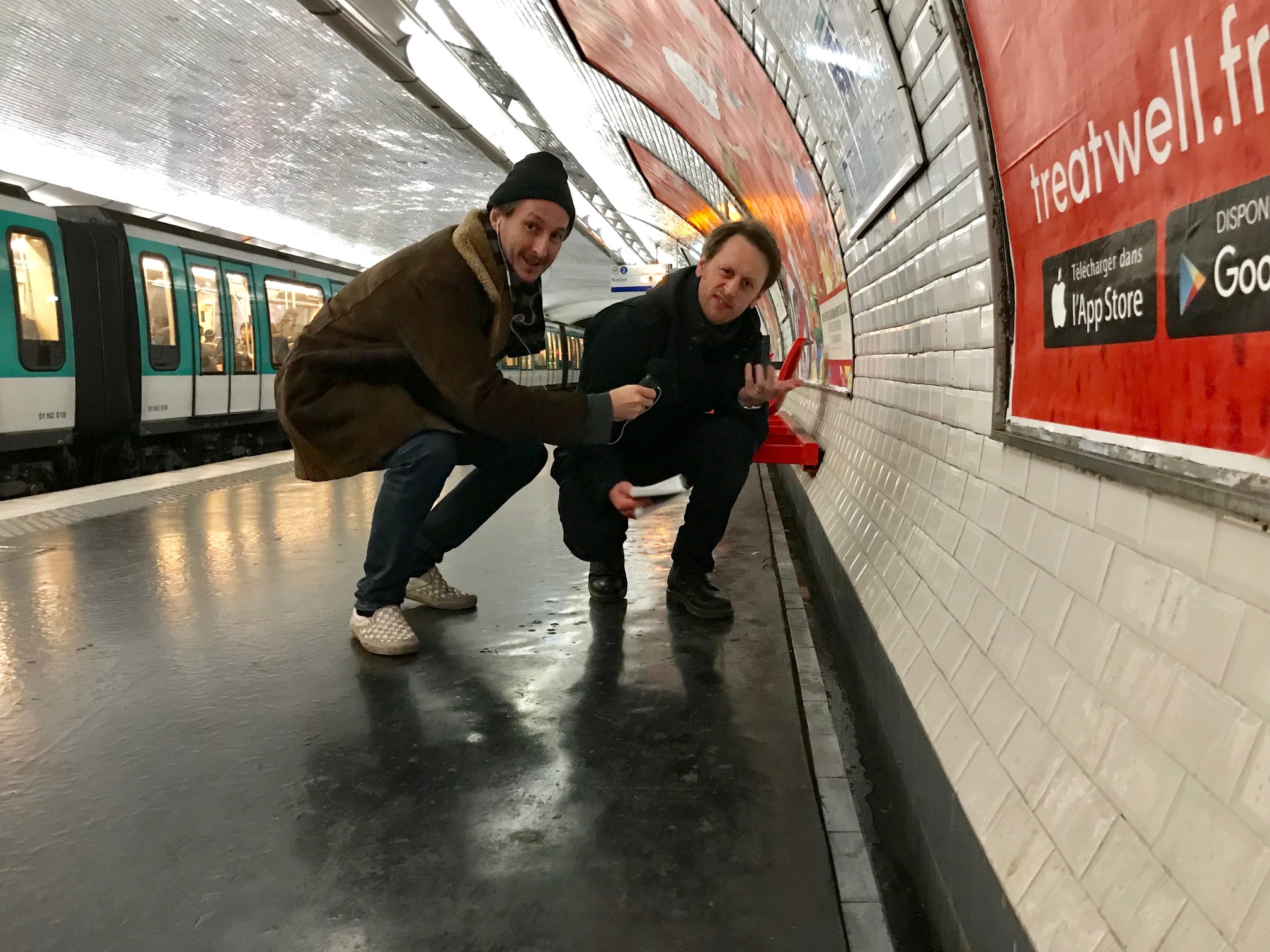
Hello! In this episode of the podcast I am talking to Martin Johnston and his mate Dan The Man from the Rock n Roll English Podcast and we’re going to teach you some phrasal verbs and other expressions relating to friendship, while also putting their friendship to the test. Martin and Dan are lifelong friends. They know each other very well but they spend a lot of their time bickering and getting at each other. What’s going on in this friendship? Do they really like each other or not? Let’s find out in this episode and you can learn lots of vocabulary while we’re doing it. Vocabulary list and explanations below.
Here is a selection of vocabulary, including a lot of phrasal verbs relating to friendship, with definitions and the questions I asked Martin and Dan.
To get on with someone = to have a good, friendly relationship with someone
You often bicker with each other, insult each other, tell each other that you’re stupid, boring, generally shit etc.
How well do you actually get on with each other?
To hang out with someone = to spend time with someone, socially
What’s the maximum amount of time you can actually stand to hang out with each other?
To hit it off = to get on with someone when you first meet them
When you met, did you hit it off straight away? (was it love at first sight)
To get to know someone = to learn about someone personally
How did you first get to know each other?
To go back years / a long time = to have a long relationship with someone
How far back do you go?
To fall out with someone = to stop being friends because of a disagreement or argument
Have you ever fallen out with each other?
What would it take to fall out with each other, do you think?
What would you do in these situations?
Dan, you both go to the pub – you buy a round, but when it’s Martin’s turn he doesn’t buy a round, he just gets himself a drink (it’s a half a lager shandy by the way) and then he leaves early
Martin, Dan suddenly one day starts saying nice things about you in public
Dan, you overhear Martin saying some shit about your nan (grandmother) – he said she was a ‘slag’. (a very rude thing to say about anyone, especially someone’s grandmother – a slag is a woman who has sex with lots of people 😱)
Martin, you get a new girlfriend and then when she meets Dan you realise that she actually prefers him
Dan, you learn that Martin has asked your sister out on a date
Martin, your Dad one day says “Why can’t you be more like Dan?”
Dan, you buy some biscuits and Martin eats them all, even the last one
To make up with each other = to become friends again after falling out
If you did ever fall out, what would be the best way to make up with each other?
Martin, how would you make up with Dan because of the biscuits?
To break up with someone = to end a relationship with your boyfriend or girlfriend, to dump someone
Do you think it’s possible to actually break up with a friend, in the same way you can break up with a girl. I’m not saying that you would, I’m just wondering.
Have you ever been in a situation where you’ve got a friend (probably quite a new friend – or maybe someone who you knew as a kid who has come back into your life) and you feel like it’s just not working and you feel like you have to break up with him? (it’s in an episode of Seinfeld)
Seinfeld (TV show) – Jerry Breaks Up with a friend (it’s funny because you don’t normally ‘break up with’ a friend, only with a ‘romantic partner’)
To drift apart / To lose touch with someone = when your lives just start going in different directions (drift apart) and you stop contacting the person regularly (lose touch with)
You don’t see each other so much any more because you’re in different countries. Are you ever worried that you might drift apart, or lose touch with each other completely? “How’s Martin?” “Oh, I don’t know we just kind of lost touch”
To enjoy someone’s company = to get on with someone, to enjoy spending time with someone
Honestly, how much do you enjoy each other’s company?
To have something in common with someone = to share something similar. E.g. you both like Star Wars.
Do you have a lot of things in common? What things do you have in common?
To be in a relationship with someone = to be dating someone, to be romantically involved with someone
Martin, how do you feel about the fact that Dan is in a relationship? (is there any jealousy there?)
Dan, imagine Martin is going on a date with a girl tonight – what could you say to him as a friend in this situation?
To be on the same wavelength as someone = to have a similar way of thinking as someone
Are you on the same wavelength as each other?
To see something in someone (often → …what someone sees in someone) = to like something about someone, to find a good quality in someone
What do you actually see in each other?
What does Dan’s girlfriend actually see in him?
Other vocabulary you heard (explained at the end of the episode)
Martin: That sounds like the most boring introduction in the world. Dan: Actually, I think it’s quite apt.
I’ve been trying to get rid of him as a friend for a long time now.
Treading in dogshit all day. There’s an abundance of it. I almost tripped up on one the other day.
When they hear my terrible French they gladly switch to English, just to rub it in a bit.
My Italian’s not bad but I can get by.
I did a gig once in London, a charity gig.
You’re an accomplice now, because you planted that idea. (murder)
I’d like to explore the dynamic between you, a dynamic that some might call a bromance.
Martin came here at the weekend and 15 hours later we were both sick to death of each other.
You fall out, you get over it, you bounce back and then move on.
Martin: Dan always says that I’m tight. (mean, tight-fisted, stingy)
Dan’s sister: We all know that Dan is a tight bastard.
In the UK if someone doesn’t buy a round they are ostracised.
Dan: I’m trying to keep you on your toes (by buying Martin Christmas presents)
You overhear Martin saying some shit about your nan. He’s saying that she’s a slag.
I’m digging myself into a hole here.
Those awkward conversations that I just can’thandle. I avoid them at all costs.
The cross-examination of your friendship is over and I have to say I’m none the wiser about the mysterious dynamic that you have.
A conversation with Paul Taylor involving several cups of tea, recipes for French crepes, our terrible rap skills, a funny old comedy song about English workmen drinking tea, some improvised comedy role plays and a very angry Paul ranting about bad customer service in France! Your challenge is to listen to this episode in public without laughing out loud, especially in the second half of the episode. Good luck, may the force be with you. Vocabulary list, song lyrics, definitions and a quiz available below.
I’m going to keep this intro as brief as possible so we can get straight into it!
This one is a conversation with friend of the podcast, Paul Taylor. It was lots of fun to record, I hope it’s also lots of fun to listen to.
There are links, videos, word lists and song lyrics with vocabulary and definitions on the episode page on the website that can help you to understand and learn more English from our conversation.
There is some swearing in this episode – some rude words and things. Just to let you know in advance.
Try not to laugh on the bus while listening to this. That might be embarrassing. That is a challenge from me to you. Try not to giggle – because everyone will look at you and will feel either jealous or confused at your public display of the joy which will be bursting forth from your heart as you listen to Paul’s infectious laughter. No giggling or cracking up in public please. Get a grip on yourself for goodness sake.
Where’s Amber? All will be revealed.
Keep listening until the end of the episode for more additional extra bonus fun.
Alrighty then, that’s all for the intro, let’s go!
Vocabulary List
A crepe = a thin french pancake made from flour, milk and egg – all whisked together and then cooked in a pan
To whisk = to mix ingredients quickly with a fork or a whisk
To kneaddough to make bread
To knead = to work/press/mix/fold dough with your hands when making bread
Dough = flour, water, yeast combined to make a soft paste, used for making bread
Cats go to the litter box, shit and then lick their paws
The litter box = the tray or box in your house that cats use as a toilet. It’s full of small stones, sand or something similar.
Paws = the hands and feet of a cat (or similar animals)
The Luke’s English Podcast Challenge – if you don’t know what a crepe is, leave a comment! You *might* get a picture of Paul as a prize.
Talking bollocks* = talking nonsense ( *bollocks is a rude word meaning testicles, or bullshit)
‘owzit gaan? = How’s it going?
It’s the first day back at school in France so everyone’s going mental
Going mental = going crazy, getting stressed
Anti-nuclear pens? = I suppose these are pens which somehow resist the effects of a nuclear attack. They don’t exist, I think.
https://www.youtube.com/watch?v=geEVwslL-YY
Losing your friends when they have kids – How having kids is like the zombie apocalypse (according to Paul)
“To put the kibosh on something” = phrase
If someone or something puts the kibosh on your plans or activities, they cause them to fail or prevent them from continuing.
[mainly US , informal]
E.g. “Rattray, however, personally showed up at the meeting to try and put the kibosh on their plans.” “…software that puts the kibosh on pop-up ads if a user doesn’t want them.”
I’ll be tutoring my child in the ways of righteousness
A voice-over = some recorded speech used in advertising, TV, radio etc.
“Right said Fred” by Bernard Cribbins
A 1960s comedy record featuring some cockney workmen moving a heavy object and drinking lots of tea.
Lyrics [vocab explained in brackets] “Right,” said Fred, “Both of us together One each end and steady as we go.” [be careful, do it steadily] Tried to shift it, couldn’t even lift it [move it] We was getting nowhere [yes, it’s grammatically incorrect] And so we had a cuppa tea and [ a cup of tea]
“Right,” said Fred, “Give a shout for Charlie.” Up comes Charlie from the floor below. After straining, heaving and complaining [making lots of physical effort] [complaining] We was getting nowhere [also grammatically incorrect] And so we had a cuppa tea.
And Charlie had a think, and he thought we ought to take off all the handles And the things what held the candles. But it did no good, well I never thought it would
“All right,” said Fred, “Have to take the feet off To get them feet off wouldn’t take a mo(ment).” [those] Took its feet off, even took the seat off Should have got us somewhere but no! So Fred said, “Let’s have another cuppa tea.” And we said, “right-o.”
“Right,” said Fred, “Have to take the door off Need more space to shift the so-and-so.” [the thing] Had bad twinges taking off the hinges [sharp pains] [metal parts that attach the door to the wall] And it got us nowhere And so we had a cuppa tea and
“Right,” said Fred, “Have to take the wall down, That there wall is gonna have to go.” Took the wall down, even with it all down We was getting nowhere And so we had a cuppa tea.
And Charlie had a think, and he said, “Look, Fred, I got a sort of feelin’ If we remove the ceiling With a rope or two we could drop the blighter through.” [an annoying person or thing]
“All right,” said Fred, climbing up a ladder With his crowbar gave a mighty blow. [a heavy metal tool] Was he in trouble, half a ton of rubble landed on the top of his dome. [broken pieces of rock] [head] So Charlie and me had another cuppa tea And then we went home.
(I said to Charlie, “We’ll just have to leave it Standing on the landing, that’s all [the hallway on an upper floor] You see the trouble with Fred is, he’s too hasty [in a hurry, rushing ;) ] You’ll never get nowhere if you’re too hasty.”)
Getting queue jumped and dealing with unhelpful staff = when people skip ahead of you in a queue [a line of people waiting]
Luke struggles to understand how to deal with waiters and shop assistants who say “c’est pas possible” (French = it’s not possible)
Listen to Alexander Van Walsum talk to Luke about how to deal with “c’est pas possible” in this episode from the archive
That’s nearly the end of the episode, I hope you enjoyed it and you managed not to laugh out loud on the bus.
Don’t forget, you can see a list of vocabulary and expressions from this episode all on the website, including the lyrics to that song that you heard. There’s also a YouTube video of the song if you want to hear it again and make sure you’ve understood all of it. So check that out.
By the way, the mobile version of my site has now been improved thanks to a helpful listener called Sergei who gave me some CSS coding advice. So if you check the site on your phone now it should look much better than it did before, which will make it easier for you to check vocab lists, transcriptions and other content from your mobile device. Try it now – teacherluke.co.uk. You will find the link for this episode and all the others in the episode archive – just click on the menu button and then EPISODE ARCHIVE.
Don’t forget to join the mailing list on the website so you can get a link to each new episode page in your inbox when it’s published.
As I said, it’s nearly the end of the episode – but it’s not actually the end yet. There’s more. In fact, I’ve decided to give you a bonus bit at the end here, because I’m nice.
So, what’s the bonus bit?
The Bonus Bit – “The Expat Sketch Show”
On the day that Paul and I recorded this episode (and in fact the next one too) we also recorded ourselves improvising a short comedy sketch. I’m now going to play you that sketch.
The idea of the sketch is that I work in an office in Paris and my job is to interview ex-pats (foreign people who have moved to Paris) – I interview ex-pats for a position on a kind of scholarship programme where we subsidise their living expenses and help them integrate into the Parisian community and in return they contribute something to community in terms of work, taking part in cultural events or making any contribution that will benefit the cultural mix of Paris.
Paul plays 3 different ex-pats who have come into my office for an interview, and let’s just say that they’re not exactly the ideal candidates.
The whole thing was completely improvised, it’s full of rude language and it’s all just a bit of a laugh so here is the Ex-pat Sketch show with Paul. Have fun!
Thanks for listening to the episode everyone.
Have a good day, night, morning, afternoon or evening!
The second part of my conversation with my friend Moz, this time covering subjects such as podcasting vs YouTube, bathing naked in a Japanese spa, sharing personal information online (like a story of bathing naked in a Japanese spa), the role of artificial intelligence & social media, murdering mosquitoes and meeting a crack addict on the streets of London. Vocabulary list and quiz available below.
Hi everyone, Here’s the second part of my conversation with my friend Moz that was recorded a few weeks ago.
After talking about murder in the last episode, Moz and I kept talking for about another 45 minutes, just rambling on and going off on a few tangents and you can listen to that conversation in this episode as part of your ongoing mission to improve your English by listening to real conversations that actually happened, between actual people who actually said some actual things and actually recorded them and uploaded them for you to actually listen to.
Things that we actually talked about (in the form of questions)
What goes into making and publishing a podcast?
Who is my audience and where are they (that’s you)?
What’s it like to meet members of my audience?
What’s the difference between doing audio podcasts and making videos for YouTube?
Should native speakers adapt their speech when talking to non-native speakers of English?
Does the word ‘cack’ in English relate to similar words in other languages?
What does ‘cack’ mean? (it means poo, by the way)
How much of our personal information should we be sharing online?
How much of my personal information should I be sharing in episodes of this podcast?
Should you post pictures of your children on social media?
What are the effects of social media and artificial intelligence on our lives? How might this change in the future?
How could you fight against a robot invasion using an umbrella and software updates?
How much do we hate mosquitoes and what happens when you kill them?
and
How can you identify different drug addicts that you might meet on the streets of London, just based on how they smell?
I think they all sound like perfectly good questions for discussion, don’t you? I can even imagine some of them cropping up in the speaking section of a Cambridge English exam. Some of them. Maybe not the one about cack, or the one about drug addicts, but who knows?
Listen on to find out how we talk about all of those points.
If you’re a vocabulary hunter, check the page for this episode on my website because there you’ll find a list of words and phrases that come up in this conversation.
That list is available in order to help you to use this episode to expand your vocabulary and to develop a more natural form of English.
There is a bit of rude language and some slightly graphic content in this conversation. Just to let you know…
But now it’s time for you to hear the rest of my chat with Moz.
And here we go.
Vocabulary List
These days I’m a lot more devoted to it than I used to be
When the inspiration struck me
I try to be a bit more organised and rigorous about it
There are some teachers on YouTube who are getting phenomenal views
There are also various young, hip, fresh-faced YouTubers
I’m sticking with podcasting because it works for me
Technology has moved on so fast that we can do these things ourselves
A digital SLR with a boom mic attached to it (or a shotgun mic)
Those are the ingredients for making a hit youtube channel
Libsyn is my hosting site and I’m about to sign up with iTunes
I had to replace all of the embedded players on my website
A ‘hell of a lot of stuff’ that had to be done
Libsyn have various different filters that they applyto the data
The internet is basically this huge network with all these different sub-stations
My podcast is big in Wisconsin. It is the home of Ed Gein, the murderer
A lot of internet servers are based in that part of America
There’s some sort of internet sub-station or routing station in Virginia
If people are using VPNs or proxy servers that counts as coming from the USA
I’m trying to use an element of scepticism when I’m reading my stats
Lots of people are getting my podcast from bit-torrenting sites
I tell you what, a good way of working out how many listeners you get…
Every now and then someone comes out of the woodwork
I used to have the word ‘whittle (down)’ in my tour
You get a piece of wood but you slowly etch away pieces of wood to make it into something else
People whittle a stick down to a spike or something
You whittle the evidence down until you get the bare bones of the case
It’s helped me work out the kind of phrases that only English people use
Some aspects of our pronunciation or idioms are a barrier to the global community
Communication is a two-way street
I’ve just come away from dog-sitting with my brother [your brother is a dog??]
They were brummie (from Birmingham)
Their brummie was so strong that I couldn’t understand my own language
It was only when she came nearer that I could grasp what she was talking about
Do you curb your language, or do you hone the way that you speak on this podcast?
If they’re not careful they swing too far in the other direction and it becomes unnatural
It’s a balancing act between trying to be understandable and trying to be natural
“Oui, oui” = “yes, yes” in French
Wee wee = unrine (pee pee in French)
Poo poo = excrement
“Caca” = “poo” in French
Cack (another English word for poo)
Input = just the language you hear when listening
Intake = the language you are really focusing on when listening
The more personal they (podcasts) are, the more I get engaged
Stiff upper lip and all that, hopefully the lip will be the only thing that’s stiff
The pianist stops playing
I felt like everyone broke off their conversations
Naked guys lounging around, chatting
The first guy who walks past me is a midget
It did occur to me to check him out and see if it was in proportion
I don’t necessarily want to open up the doors of my house
We don’t really want to post lots of pictures of the baby on Facebook
She has remained true to her word
…
How much of the vocabulary can you remember from the list?
Take the quiz below to find out. Not all the vocabulary is in the quiz, just a selection.
My friend Moz, who runs a murder-themed tour company in London, is back on the podcast to talk about some more creepy stories of crimes from London’s history and his new podcast. Vocabulary list and quiz available below.
Moz (aka Michael Buchanan-Dunne) has appeared on the podcast a number of times before, for example in the Brighton Fringe Festival episodes, the drunk episode, the episode recorded on Moz’s narrowboat and also the episode from last year called “Murder Mile Tours”.
If you haven’t heard those episodes, let me bring you up to speed as it might help you understand some of the things we talk about in this conversation.
I first met Moz and made friends with him about 8 years ago while doing stand-up comedy in London.
He used to work for the BBC, making comedy television programmes, but then a few years ago he decided to set up a tourism company and bought a narrowboat which he now lives on. Narrowboats are boats that can be used on the UK’s canal system. They’re long and narrow and they’re boats, hence the name “narrowboats”.
Moz now lives on his boat which he usually moors at different locations throughout London’s canal network (there are lots of canals running through London).
He also runs a successful tour company in London, called “Murder Mile Tours”.
His most popular tour is called the “Murder Mile Walk” which currently takes place in Soho in central London every week. The walk takes in various sites where murders have actually occurred. Some of those murders were the work of serial killers and they all have gruesome stories connected with them, stories which Moz has painstakingly researched by looking up lots of archived material including court records from courtrooms in London.
Last year I invited him onto the podcast to tell us some of those stories. That proved to be one of the most downloaded episodes of the podcast last year. Since then his tours have gone from strength to strength – not directly a result of being on this podcast of course, although that has helped because quite a lot of LEPsters have been on the murder mile walk with Moz, no, the tour seems to be going really well because it seems really fun, it’s original, the stories are fascinating, and the tour has had loads of 5 star reviews on Trip Advisor.
In fact just recently Murder Mile Tours received a TripAdvisor certificate of excellence, which is a really great achievement. TripAdvisor describe it as one of the 150 best things to do in London and Time Out Magazine described it as one of the top 3 themed tours in the city.
Now Moz has decided to start up his own podcast in which he will regularly share some of the stories he has discovered while doing his research. His podcast, called “The Murder Mile True Crime Podcast” will be available from 1 October (you’ll be able to find it on iTunes – or just check https://www.murdermiletours.com/podcast).
So, I’ve invited Moz to come back onto the podcast to talk about all of this.
Moz and I are friends, so this isn’t just an interview, it’s also a light-hearted informal conversation and a chance for the two of us to catch up on each other’s personal news and just have a bit of fun while we’re doing it, and you are invited to join us.
You should know that this episode contains some graphic content and explicit language
including some fairly detailed descriptions of violence and murder
and some other things that you might find disturbing or disgusting.
I feel I should let you know that in advance, just in case you’re squeamish and you don’t like that sort of thing – but to be honest the content of this episode is no worse than what you would see in the average episode of a TV show like CSI or Game of Thrones.
But still – there are some creepy and gruesome details in this episode, so – you have been warned.
By the way, if you’re interested in some of the items of vocabulary that you can hear in this conversation, you should check out the page for this episode on my website. You’ll see a list of words and phrases there which you learn in order to add real strength and depth to your English.
OK so here is part one of my conversation with Moz, the guy from Murder Mile Tours.
Vocabulary List
“Sacre bleu!” (French – used to express surprise or amazement)
“There’s lovely” (this is what Welsh people apparently say a lot – it means “that’s nice”)
“Zoot alors!” (an old-fashioned French phrase – it’s used to express surprise, shock etc)
More excuses for my lack of improvement in French. [absence of]
I’ve got to pull my socks up, pull my finger out and turn over a new leaf. [all these phrases are ways of saying “improve my attitude and approach”]
I don’t have long to get the French up to scratch. [improve it to an acceptable level]
Rutting [when animals, such as deer, have sex – but also when the male deer fight with each other during the mating season]
“During the ruttingseason the male boars have terrible mating battles”
It’s a scratchyhowl [a howl is the sound an animal makes – usually a dog or wolf at night, e.g. ‘to howl at the moon’. ‘Scratchy’ describes the rough sound of the howl]
Foxes, when they’re mating, make a high-pitched scream which sounds like someone being murdered
I’m not registered for council tax [tax you pay when you live in a house or flat]
I’ve got a P.O. Box [a post office box where you can have post delivered if you don’t have a fixed address]
I’m not condoning mass murder [promoting it, saying I agree with it]
The police had sectioned off the walkway [used plastic tape to prevent people from accessing that part of the walkway]
Someone may commit suicide and the body floats down (the canal) [commit suicide = kill yourself / float = not sink, but stay on the surface of the water]
Grisly details [unpleasant, involving death or violence]
People think that a canal is a good place to dispose of a body [to get rid of a dead person]
The canal has been used for dumping rubbish, but also corpses [dumping = throwing away, getting rid of, disposing / corpses = dead bodies]
They decided to take this guy’s card and start withdrawing money [taking money out of the bank]
The culprits were found guilty of ‘denial of a proper burial’ [culprits = people who committed a crime / ‘denial of a proper burial’ = a criminal charge which is given in a court – it means when someone didn’t bury a dead person properly, or perhaps didn’t dispose of the body in the legal way]
That was the main charge that they could definitely pin on them [a statement by prosecutors in court that someone committed a crime]
Eastenders is a soap opera that’s been on TV for years [a TV drama which is about ordinary people, shown on television on a regular basis]
“My auntie’s brother’s sister left me 10% of this pub in her will!” [a will = a document which explains who should receive someone’s property when they die]
He smoked skunk all the time [a strong and smelly form of marijuana]
He had an argument with her, killed her, chopped up the body [cut the body into pieces] and then wrapped up [put inside a sheet or some clothing] her limbs [arms and legs] and her torso [the body, but without the arms or legs], put them in a suitcase and dumped [threw away, disposed of] them in the canal
He bought loads of bin bags [bags for rubbish] and saws [tools for cutting something up]
Things got out of hand, they had an argument [things got out of control]
He dragged her down to the canal [pulled her along the ground]
The suitcase floated for about two miles [didn’t sink]
Poking out of the top of the suitcase was hair [you could see part of it coming out of the top of the suitcase]
I like having a good poke around [looking and investigating, perhaps by looking into something and moving things around] different streets and digging into [going deep into something] murders
Most murders are just men having fights, but occasionally you come across [find] a really good one
Don’t worry, we’re hung over! [feeling sick because they drank alcohol the night before]
I was a cannibal, [someone who eats human flesh] I’d eaten my girlfriend and her body was slowly working its way through my bowel (yuk!) [moving slowly through the lower part of the digestive system] yuk yuk!
It was one of the darkest jokes I’ve ever pulled off [managed to succeed bit it was difficult]
It didn’t get a laugh it just got a gasp [a shocked sound when people breathe in suddenly
😱] and for me that was enough
It certainly got the evening off to a different start [to get something off to a start = to make something start]
Often the murderers are like slapstick movie idiots [a form of comedy involving funny physical movements, like people falling over or hitting each other]
Can you remember the vocabulary in the list?
Were you listening carefully? Take the quiz to find out.
I was on the RealLife English Podcast and we talked about why I became an English teacher, doing James Bond impressions and also comedy & how to use humour in learning English. You can listen to it here. More details about Real Life English below. Enjoy!
Last week I was featured in an episode of the Real Life English podcast and I just wanted to share it with you here on my website.
RealLife English is an online community with a mission to inspire, empower, and connect the world through English, both online and in-person.
It’s run by three English teachers, Justin (USA), Ethan (USA) and Chad (Australia) and they do a podcast, write blog articles, create YouTube videos and also host an online community for social learning. A lot like LEP, they believe in teaching English to the world in a fun, personal and inspiring way.
Recently I spoke to Ethan on the Real Life English podcast (and also recorded an episode of LEP) and we talked about lots of things, including British & American comedy shows, and how to use humour (and alcohol) in learning English. Listen to it above, or on the Real Life English website. I’m sure they’d appreciate some comments from friendly LEPsters.
I’ll be speaking to Ethan in an episode of LEP soon. You can look forward to that in the next few weeks.
The holiday diary continues and in this chapter we visited Bel Air in L.A. and so here is an analysis of the lyrics to Will Smith’s rap from “The Fresh Prince of Bel Air”, a famous TV show (and a very serious piece of work, haha) from the 90s which was set in Bel Air itself. Topics covered: TV pop culture, racial politics, slang English.
By the way, these are flapjacks, just in case you were wondering. Yum.
Flapjacks (these ones are made with honey, oats and peanut butter) Click the pic for the recipe.
Did you get The Fresh Prince of Bel Air on TV in your country?
I used to watch the TV show a lot when I was younger (in the 90s).
Yes, the Fresh Prince is American English but I consider it also to be global English and you should too. Also, I think everyone should know or at least be able to repeat one or two of the lines from this rap, right?
So let’s listen to it and analyse some of the lyrics.
It’s not even a great rap, that’s the thing! It’s just a laugh! It’s not exactly the Wu Tang Clan or anything… Anyway…
The Fresh Prince of Bel Air – language analysis & cultural commentary
Summary of the story
This rap basically sets up the scenario of the show. Did you work out the details of the story?
Will Smith is an ordinary guy from a rough part of Philadelphia. The area where he lives is too rough and dangerous, so his mum decides he has to move in with his aunt and uncle, who happen to live in Bel Air, in Los Angeles. The aunt and uncle are rich and successful. The uncle (Uncle Phil) is a top lawyer. This is obviously possible, but quite rare.
Is it just a funny TV show, or is it about race relations and racial politics in the USA?
I’m not sure I am fully qualified to talk about racial politics in the USA. The fact is, despite the American dream which says anyone can make it, it appears to be much harder for a black guy to become a millionaire than for a white guy to do it. I’m not saying why that is, I’m just saying it. In fact, I’m reporting it as something I’ve heard Chris Rock say, so fine – not my words, the words of Chris Rock.
“Don’t hate the player, hate the game”.
“You don’t get plaques for getting rid of plaque.” (two meanings of the word ‘plaque’ – listen to hear the explanations)
“The black man gotta fly to get something the white man can walk to.”
“I had to host the Oscars to get that house.”
Lyrics
Listen to the episode to hear my language analysis and some comparisons with British English.
I’ll tell you which bits of vocab are “standard” (i.e. not specific slang – the stuff everyone should know) and “slang” (i.e. the stuff that’s more specific to the informal English you might hear from Will Smith or the social group of the time)
Fresh Prince of Bel Air – Rap, Long version Now, this is a story all about how My life got flipped, turned upside down And I’d like to take a minute So just sit right there I’ll tell you how I became the prince of a town called Bel Air
In west Philadelphia born and raised On theplayground was where I spent most of my days Chilling out, maxin‘ relaxin’ all cool And all shootin some b-ball outside of the school When a couple of guys who were up to no good Started making trouble in my neighborhood I got in one little fight and my mom got scared [UK – mum, USA – mom] She said ‘You’re movin’ with your auntie and uncle in Bel Air’
I begged and pleaded with her day after day But she packed my suit case and sent me on my way She gave me a kiss and then she gave me my ticket. I put my Walkman on and said, ‘I might as wellkick it‘.
First class, yo this is bad Drinking orange juice out of a champagne glass. Is this what the people of Bel-Air living like? Hmmmmm this might be alright.
But wait I hear they’re prissy, bourgeois, all that Is this the type of place that they just send this cool cat? I don’t think so I’ll see when I get there I hope they’re prepared for the prince of Bel-Air
Well, the plane landed and when I came out There was a dude who looked like a cop standing there with my name out I ain’t trying to get arrested yet I just got here I sprang with the quickness like lightning, disappeared
I whistled for a cab and when it came near The license plate said “FRESH” and it had dice in (on) the mirror If anything I could say that this cab was rare But I thought ‘Nah, forget it’ – ‘Yo, holmes to Bel Air’
I pulled up to the house about 7 or 8 And I yelled to the cabbie ‘Yo holmes, smell ya later‘ I looked at my kingdom I was finally there To sit on my throne as the Prince of Bel Air
We drove around in Bel Air for a bit looking at houses like weird stalkers.
They’re huge and ostentatious (displaying wealth, showing off).
You get the impression that these people live in a bubble.
We came across Beyoncé and Jay-Z’s house which is unfinished.
Apparently they’re having problems with their neighbours who claim the house is obstructing their view.
I am not surprised because it is a but of a monstrosity.
Apparently they are gettingsued by the neighbours or something. I think they’re claiming that it’s interfering with their enjoyment of their property.
Driving back down we went past another massive house and we could see helicopter rotor blades above the hedge. Someone’s got a helipad on their property. Mental.
Then we swung past the Scientology buildings again on the way home.
Learn some crime-related idioms and find out some things about Luke’s back-story that may or may not be true. This is an episode of Zdenek’s English Podcast, originally posted by Zdenek on 4 August. Download available below.
On 30 July I dropped in on the LEP meetup in London and spent an hour or two chatting to Zdenek Lukas, the English teacher from Czech Republic who is also the man behind Zdenek’s English Podcast.
Zdenek almost always has his voice recorder with him, and this was no exception. We ended up recording an episode of his podcast standing outside the pub together.
If you follow Zdenek’s podcast, you might have already heard it. In any case, I’m presenting it to you here as some extra website content that you might enjoy.
Crime Idioms
In this episode, Zdenek had prepared some crime-related idioms and decided to try and simulate some exchanges with me in order to use the idioms and present them to you. Can you notice the idioms? Do you know what they mean, and how to use them?
By the way, most of the time I was exaggerating, making up stories or playing along with Zdenek’s examples. I’m not really a murderer!
Thanks for listening. Watch out for more website content coming soon.
Today on the podcast I’m talking to Andy Johnson my friend and former colleague from the London School of English, who also looks a bit like Moby if you remember.
Andy has been on this podcast 4 or 5 times before so if you’re a regular listener you’ll know his voice already.
Andy is an English teacher, a marathon runner and a father of two children – in fact his second son was born very recently.
In this conversation you will hear us talking about:
The pain of stepping on Lego
Recording the podcast in what used to be the boss’s office at The London School of English
Developments in Andy’s job and his career
Andy’s next conference talk about self-directed learning
Where Andy comes from and his accent, including the ways we both say certain words like “Bath, grass, laugh, podcast, ask and after.”
The time when my Dad visited The London School of English
British and American people speaking English
This is part one of a two part conversation.
Without any further ado, here is part 1.
Andy’s survey
At the next IATEFL conference Andy is planning on doing a presentation about self-directed learning. You heard him talking about it in this episode.
Andy would like some help from you in preparing for the talk. He needs to do some research and he’d like to ask you a few questions about your English learning, particularly how you use this podcast, my website and any other resources for learning English.
He’s created a quick questionnaire and you can find it on the page for this episode. Click the link, answer the questions and you’ll help Andy a lot in his next presentation.
It basically asks how useful LEP / teacherluke.co.uk and other sites are for learning English and how you find these sites. Andy also asks whether you pay for – or would pay for – additional language tuition. He’s trying to investigate why people are choosing LEP over traditional language courses (if indeed they are).
Stay tuned for the next episode, coming soon, in which you will hear Andy talk about his very personal reasons for training to run the London marathon – and I have to say that the conversation was much more surprising than I had expected and was also quite moving for a few reasons, so check that one out when it arrives.
Don’t forget to join the mailing list so that you’ll get email notifications whenever new episodes are uploaded over the coming days and weeks, and don’t forget to watch out for some website-only content coming soon too.
Thanks for listening and have a great morning, afternoon, evening, night or day whichever part of the world you’re in and whatever you’re up to.
Helping you to understand and appreciate the Liverpool accent and Scouse English, featuring clips of comedy a short history of Liverpool and interviews with famous footballers, actors and musicians.
Hello listeners – how are you doing? In the last episode we listened to some comedy routines by Scouse comedian John Bishop and I said we’d take a closer look at the Liverpool accent, break it down, listen to some more samples and also learn some typical words you might hear being used in Liverpool. So that’s the plan in this episode. All about the Liverpool accent.
There’s nowhere in the UK quite like Liverpool. You probably know it as where The Beatles came from, or because of the football clubs LFC and EFC. Perhaps some of you have visited it or studied there are students, because it’s a big university town.
I lived there for 4 years as a student.
My feelings when I moved there:
It’s definitely in the north! Up north.
First time I lived in the north, and there is a north/south divide in the UK
Climate is different
People are different to the people anywhere else – they’re cheeky, chatty, tough, humourous, a bit tricky sometimes, proud and also quite sentimental and sensitive about the city.
The place has a particular history that isn’t shared by other towns in England. Its cultural mix is different to the rest of the country. The accent in particular is very distinctive, and it’s confined to just the local Liverpool area – a relatively small space when you consider the accent diversity in other larger countries where the same accent may be heard for many miles, like for example in Texas. In England our accents are very specific and very local. Travel 30 minutes by car from Liverpool to neighbouring Manchester and the accent is very different and this is largely because of the history of Liverpool as an international port and the rich diversity of influences.
This is a corner of the country with a strong character and a recognisable accent to go along with it.
Scousers, or people from Liverpool are instantly recognisable by their accent. The sound of a Liverpool accent instantly conjures up certain images, certain cliches, certain reference points and a certain history which is unique to that part of the country.
In this episode the plan is to investigate the Liverpool accent, and to some extent the dialect, listen to some samples, find out some of the pronunciation features, and consider a little bit of Liverpool’s history and culture. We’ll listen to a few different people speaking in a Liverpool accent and I’ll help you to understand it all, and I’m sure you’ll pick up some nice vocabulary on the way – and not just local slang words but words that everybody in the country uses but which the Scousers might just pronounce in their own way.
The aim is to broaden your horizons, broaden your exposure to different accents and to help you get a full appreciation of English in all its forms.
The Milk Advert on TV
Let’s start with an advert that used to be on the TV and which millions of British people watched many times – The famous milk advert.This is what the whole nation (of my generation) might think of as a sample of Scouse English. Many of us heard it lots of times growing up and a lot of us even learned it. I used to be able to recite it word for word when I was a kid.
Picture two children from Liverpool who have been playing football in the garden. They come into the house to get something refreshing to drink from the fridge (or should that be “fridge”). One asks for lemonade, the other one chooses to drink milk because it’s “what Ian Rush drinks”.
Ian Rush was a famous footballer in the 80s. He played for Liverpool for years and scored many goals for them. He was Welsh. By the way, you should also know that there is a place in England called “Accrington” (north of Manchester) and their football team (Accrington Stanley) aren’t very good – so Accrington Stanley is a reference for an unknown football team that nobody wants to play for.
Audio sample 1 – The Milk Advert
Lee Mack making fun of the Scouse accent
Features of the Liverpool Accent
Let’s now take a closer look at the Liverpool accent, considering some of the main features that make Scouse English different to the kind of RP that I speak. Then we’ll listen to some more samples of Scouse speech and you can see if you understand them.
Consonant sounds
/k/ can become /x/ like in “loch” “Accrington Stanley” “milk” “Lee Mack”
/r/ sounds – alveolar tap “accrington stanley” “I’m afraid I’m not from round here” “alright”
/t/ can sound like /s/ “butter” “I’m going to go into town later, do you want something” “Come on then mate, let’s start. Come ed, Let’s get started.”
/g/ is pronounced not just with the /ŋ/ but all the way to a /g/ sound “sing” “singer” “Ere mate are you a singer? You gonna sing us a song?”
And yet sometimes it’s completely dropped like in “Eh mate what are you doing?” – “what are yew dewin? What are youse doing coming over here like that?” “Milk, that’s disgusting”
/h/ sounds are often dropped “That has never happened to be honest”
/d/ sounds instead of /th/ sounds – “They do though don’t they though?”
Vowel sounds
/ɜː/ like “bird” becomes [ɛː] like “air” – “work”, “first”, “bird” “Are you always the first one to get to work in the morning”
/a:/ sounds in the south are like /æ/ in the north (normal in the north generally) “bath” “grass” “laugh”
But sometimes it goes wider like aaaa in “card” or “pokemon cards”
/ʊ/ in book sounds like /u:/ “book” (but not every time – sometimes they say it like me, and words like ‘took’ and ‘look’ are often pronounced. I don’t know why it’s “book”)
/-er/ sounds at the ends of words normally pronounced with schwa sound are pronounced with an /e/ sound “computer” “teacher” “fitter” “singer”
/ʌ/ becomes like /ʊ/ or /ɒ/ “but erm… shut up” “shut up will ya”
“Errrm“
/eə/ sometimes becomes /ɜː/ – “hair” “over there”
All those features are interesting, but there’s a good chance that all just went over your head. Really the best way to get used to hearing scouse English is just to listen to some people using it.
Audio Sample 2 – Jamie Carragher “Butchers” the English Language
Just listen and tell me these things:
Who is he?
What’s he talking about? (general subject)
https://www.youtube.com/watch?v=nDaTTVR2JXY
Audio sample 3 – Stephen Gerrard, former England captain
What is he looking forward to?
Is he worried about the regime change with Fabio Cappello (known for being a discipinarian)
Does he have a message of hope for England fans?
What would it mean to David Beckham to achieve 100 caps?
https://www.youtube.com/watch?v=6cph2TnHW4Y
Audio Sample 4 – Wayne Gerrard – a spoof of Scouse footballers by Paul Whitehouse
Wayne Gerrard (spoof)
Language:
Just get my head down
Let my feet do the talking
Very pleased for the fans
Very pleased for the manager
One game at a time
Keep my head down
Let my football do the talking
A short history of Liverpool
Liverpool is in the north west of England. It’s a port town on the river Mersey, just where the north coast of Wales meets the west coast of England.
Liverpool started as a small trading port probably in the 13th or 14th centuries.
By the 17th and 18th centuries it was the primary port for trade with Ireland. There was lots of trade with Ireland, and also ships coming from Norway and Sweden or other scandinavian countries.
The industrial revolution, globalisation and Britain’s colonialism meant that Liverpool became a hugely important port for British ships heading to the Americas in the 19th century.
As a result by the mid 19th century, Liverpool was a hugely important city for trading with the new world.
The population of the city grew quickly with amazing diversity – everyone from around the world was there, including large numbers of Irish and Welsh workers, scandinavian sailors but also Chinese workers, Caribbean workers associated with the slave trade.
Liverpool was one of the most important and most impressive cities in the world at this time.
It was sometimes called the New York of Europe, and you can see evidence of that in some of the buildings – parts of the city resemble some of the style of New York buildings, especially in the old part of town and by the docks.
The diverse history is still evident in the cultural make-up of the city. There is still a large Chinese community and also many families of Caribbean origin in parts of Liverpool.
The biggest influences though were the Welsh and certainly the Irish communities who moved in for the manual work that was available there in the 19th century. Liverpool is heavily influenced by the Irish, and it was described as the capital of Ireland just because so many Irish people lived there.
All of these influences can be heard in the Liverpool accent – some Irish, some features of Welsh (which is a totally different language to English) and also some scandinavian influences and many others that make Liverpool so different. That’s also combined with the local Lancashire accent too. All of it combines to create this particularly rich and vibrant form of English.
The city was very rich and very important during the industrial revolution, but conditions for many people were appalling – living squeezed into dirty and dangeous slums.
Gradually Britain’s position as the global industrial imperial power started slipping, and the two world wars sped up that process. Many young men were killed in World War 1, and between the two wars Liverpool was partly redesigned with many residential areas being built around the outskirts of the city, and lots of the people who previously lived in the slums being relocated there. This changed the nature of the city, with large outlying residential areas with row upon row of terraced houses.
World War 2 was devastating to Liverpool as it was the target of bombing raids by the Luftwaffe. Like many cities in the UK, Liverpool got pounded by bombs night after night and lots of buildings were destroyed, and they stayed destroyed for many years.
When the Beatles were growing up in Liverpool in the 1950s it was common for children to play in bombsites – in the remains of buildings destroyed by bombs, and even when I was living there in the 1990s I saw lots of empty spaces in residential streets where buildings used to exist but still hadn’t been replaced since the war.
With the end of the industrial revolution, Liverpool’s importance slipped and basically since WW2 Liverpool has been a rather tough place to live, with various social problems, unemployment, poverty, and perhaps the sense that the city has been somewhat ignored or forgotten by the country which used to rely on it so much.
These days the city is known for The Beatles, the football clubs and players, some cultural things such as the vibrant art scene and just the scouse people themselves who are known for their humour and their unique character.
Here’s a female voice – Jennifer Ellison, an actress from Liverpool.
Audio sample 5 – Jennifer Ellison “Mum of the Year Awards 2013”
Vocabulary
Here are some bits of the dialect or just typical sounding words.
To be honest, you hear most of these things in many parts of the country, but listen out for how scousers would say these things.
‘Me’ not ‘my’ – “You’ve broken all me biccies!”
‘You’ (plural) – ‘youse’ “Youse are all a bunch of bleedin eejits”
Adding “me” at the end of a sentence starting with ‘I’. “I’m dead hungry, me.”
“Boss” – That’s boss that. Have you played FIFA. It’s boss.”
“made up”
“Eeeerm”
“Eh!”
“Alright?”
“Laa”
“Ta-raa”
“See ye later”
“Come ed”
“Go ed” “g’wed”
“Alright! Calm daaaawn!” (cliche)
“Bevvies”
“Nice one son”
“Gutted”
“Scran”
“bevvie”
“Bacon barm” – “two bacon barms please”
“brekkie”
“Chocka block”
“Like” – “I was like, walking down the Scotty road and I seen these two like students.”
Lots of people in the UK got to know Scouse very well from watching Brookside, a soap opera that started in the 80s. It was about middle class and working class life in Liverpool and it often showed scenes of social problems including frequent arguments between the main characters. This helped to build the stereotype that Scousers are argumentative and prone to social problems.
Audio sample 6 – Brookside argument
Summary
3 people – Barry, Barry’s mum and Billy
Barry wants his money
But the account is £500 short
Because his Mum lent it to someone else (Billy)
So, let’s cut out the middle man, give us the money
He hasn’t got it – he needed it to pay the mortgage and the car
Barry gets angry with Billy saying “you’ve got it made here”
Barry is angry with Billy because he’s borrowing money from his Mum
“I’m going to have to go back to the car fella, tell him I can’t have the car”
You’ve screwed up our Christmas!
Then he pushes him.
Cliche
This cliche of argumentative Scousers was summed up in a series of sketches on a comedy TV show called Harry Enfield’s TV Programme.
This cemented the stereotype of Scousers as:
Argumentative & violent – often fighting and infighting
From large families with lots of brothers
Always wearing shellsuits
Unemployed – around the house all day
With mustaches and curly permed hair
Audio sample 7 – Harry Enfield – The Scousers (the cliched view)
https://www.youtube.com/watch?v=6k2YEc6dozA
Language:
Alright, calm down calm down.
Are you telling me to calm down?
Alright you two, break it up!
What’s going on here eh?
Friggin
Do you have to make such a friggin fuss about it?
Just keep out of it Barry.
Are you telling me to keep out of it?
The Beatles
The Beatles are also famously from Liverpool, but nobody seems to really speak like them any more. The accent has become more nazal and harsher. The Beatles spoke in this kind of “Beatle voice” which you don’t hear so much any more.
You can hear the scouse in their voices though if you listen carefully.
Audio sample 8 – Beatles
Audio Sample 9 – Local documentary on YouTube
Mini doc https://www.youtube.com/watch?v=yIcPTpWq5jY
There’s going to be a meetup of some London-based LEPsters this coming Sunday 30th July at 7pm at the Fitzroy Tavern on Charlotte Street. It’s just north of Soho and to the west of Tottenham Court Road. There should also be a Facebook link soon.
The Fitzroy Tavern
6 Charlotte St, Fitzrovia, London W1T 2LY, UK
Sunday 30th July 7pm Fitzroy Tavern on Charlotte Street.
Zdenek Lukas of Zdenek’s English podcast will be there with any other London-based LEPsters that choose to come out. The plan is to have conversation, a beer or two and perhaps play some board games, because Zdenek is bringing some board games too. So head on down to practise your English, meet some like-minded people in a cool part of central London.
Episode Notes & Transcripts
Introduction
Hello dear listeners, welcome to the podcast. This is one of those episodes in which I go through some British comedy and help you to understand it. We will cover some vocabulary and also some cultural stuff too.
This is also chance to for you to listen to some Scouse English – the kind of English you might hear in Liverpool.
Scouse – that means from Liverpool. A Scouser is a person from Liverpool, and in that area people speak with a Scouse accent. In fact you find that accent in many parts of Merseyside – which means, Liverpool and its surrounding areas.
I’m going to tell you briefly about a popular stand up comedian from Merseyside (the Liverpool area) called John Bishop, who is often on the TV and on stage across the UK. I think he’s probably one of the most famous scousers in the UK these days. We’re going to listen to one or two of his routines which you can find on YouTube, we’ll understand them and notice some features of his Liverpool accent.
By the end of this episode I expect that you’ll have broadened your vocabulary, you’ll have become more familiar with the way people speak English in Liverpool and you’ll have learned some cultural details about family life in the UK. Also, you’re going to be introduced to the comedy of John Bishop, who you might enjoy. There are various John Bishop videos on YouTube and you can can buy his comedy DVDs which are very popular in the UK. If you like what you hear in this episode, you could get one of those DVDs and use it for both learning English and for your own general amusement.
John Bishop – some info on him
To cut a long story short, he was born in Liverpool and has lived in the Merseyside area for most of his life.
Where is Liverpool? Why is it called Merseyside?
People in Liverpool – amongst other things they are known for having a particular accent which people say is a kind of mix between Irish, Welsh (a lot of Irish and Welsh workers moved into the city during it’s time as a major industrial port in the 19th century), Lancashire and even Scandinavian influences. The accent is instantly recognisable to anyone in the UK.
So, John Bishop was born in Liverpool and has lived in the area for most of his life.
In his 20s he had what seems to have been a fairly boring and ordinary career selling pharmaceuticals. By the age of 30 he was married and had a baby son but he wasn’t particularly happy. He ended up getting separated from his wife and they were going to get divorced. He started doing stand-up during this period because he says it stopped him staying at home on his own in the evenings and drinking. It got him out of the house. The thing is, he found that he was good at it and eventually he quit his job to do stand-up full-time. Basically stand-up saved him and it rescued his marriage too – because one day his wife (who was divorcing him at the time) happened to see him on stage during a show and she went up to him afterwards and said “that was the man I fell in love with years ago” and they got back together. Since then his stand-up comedy career has taken off, and how he’s one of the most popular and well-known comedians in the UK. He’s often on the TV and his stand-up comedy DVDs are very popular.
Now he’s got quite a big family with 3 kids – all of them boys. In his comedy he talks a lot about family life and being a father – the typical frustrations, difficulties and experiences that many parents go through.
He’s definitely a mainstream comedian. I mean, his routines are not political, they’re not particularly challenging or controversial. They’re not super intellectual. It’s just straight forward observational comedy and storytelling. He’s not my #1 favourite, but I just love stand-up and I definitely enjoy his work even if he’s not my absolute favourite. But he is very successful. I think his appeal is that he’s an ordinary guy and his stories and routines are very relatable – people enjoy them because they can relate to them.
Scousers have a reputation in the UK for a few things – one of them is for being funny. This maybe a cliché or a stereotype, but I do think it’s quite true, having lived in Liverpool for 4 years. I met lots of Scousers who were very funny – just characters with stories to tell and who had the gift of the gab and good comic timing.
John Bishop is a good example of that. Partly it’s to do with the Liverpool accent which has so much character and I think helps the delivery of his routines. He tells endearing stories in a relaxed way. He wears a suit and tie so he’s well-presented. He is quite handsome and charming, but in an average kind of way. He’s like the ‘boy next door’ kind of guy. Just a normal bloke. His delivery is quite casual and easy-going, he keeps it pretty short and simple with pauses in the right places which is always a good approach to storytelling.
His attitude on stage is quite dry or deadpan (Wikipedia defines “dry” or “deadpan” like this: Deadpan or dry humor/wit describes the deliberate display of a lack of or no emotion, commonly as a form of comedic delivery to contrast with the ridiculousness of the subject matter. The delivery is meant to be blunt, sarcastic or apparently unintentional).
~
Usually his stories allow us to see that his life is actually quite frustrating and ridiculous – just like normal life is for everyone from time to time. Watching observational comedy like this makes you feel good because you totally understand what he’s going through because in fact your life is quite frustrating and ridiculous too. So it’s therapeutic – that’s what’s great about comedy. It lets you laugh at life and realise that you’re not alone and that we all experience these frustrating things.
Let’s listen to John Bishop, with his Liverpool accent, telling a couple of stories of family life from some of the videos on YouTube and let’s pick up some English in the process.
I’m going to play the first clip to you in just a moment.
As you listen, I wonder what you will be thinking. We’ve done this before, listening to English with different regional accents. You might feel that you can’t understand him completely – I think he speaks pretty clearly, delivering stories in a slow but punctuated way, but the accent might be hard for you to understand. You might think “Oh his accent is too strong”. I wouldn’t be at all surprised. But remember, English is a very diverse language. You might not want to speak like John Bishop (or maybe you do I don’t know) but you certainly should try to understand him. English comes in many different forms – many different accents – and even if you’re not familiar with those accents, they are normal and perfectly valid forms of the language which everyone can not only understand but appreciate.
It would be a pity for you to only understand one standard form of English. It would mean your English was limited. Anyone with a decent sense of English should be exposed to different accents. David Crystal said it, we all know it’s true. So let’s listen to some Scouse English. And please, do not think “Oh god his English is bad”. That’s not fair and it’s simply not true. I understand all of it, so do his audiences. British people do not struggle to understand him at all, quite the opposite – he’s very understandable and relatable. He draws in very large crowds of people to his shows all across the country. All those people understand and enjoy the things he says. His Liverpool accent is a very important part of his charm. If it’s hard to understand him I think it would be wise to consider that maybe you’re just not familiar with his accent, and that you just need to broaden your exposure to English a bit, and that this is a chance for you to do that.
Anyway, maybe you won’t have trouble understanding him at all and you’ll just enjoy listening to his story. Let’s see.
Video
Here’s John talking about going on holiday with teenage kids (I wonder what teenagers are like in your country.)
You’re going to hear him say that he had a massive tour one year and he was away from home a lot so he wanted to spend some quality time with his kids – in a kind of nostalgic way – like he imagines it used to be when he was a kid – go somewhere in the countryside where there’s no internet so he can spend some quality time with his teenage sons, spending a sort of idyllic Christmas and New Year’s Eve sitting around the fireplace playing board games, like it was in the good old days. But, his kids are modern British teenage boys who are addicted to the internet – so that might make things difficult…
You’ll also hear a few sound effects from the video, which you can see on the page for this episode.
Holidays with the kids (video 1)
https://www.youtube.com/watch?v=HMHYtGPpyko
White trainers, growing up, puberty, hormones and getting your head kicked in by your own son. (video 2)
John Bishop gets a new fridge and takes his old one to the dump (video 3)
https://www.youtube.com/watch?v=N9yAJKcIVxk
Language Learned
Here is some of the vocabulary you could learn from this episode.
Going on holiday with the kids (video 1)
Scouse
Scouser
Nostalgic
Quality time
Idyllic christmas
Sitting around a log fire playing board games
Teenagers
Addicted to the internet
Sound effects
A reconstruction
A cottage
It’s on the border between Scotland, england and Narnia
Internet, it’s Berwick son, we haven’t even got ceefax
We turned up at the cottage
In the middle of nowhere
Youse three, go in the living room, put the telly on
Looking at the past through rose-tinted glasses
In the middle of nowhere
White trainers (video 2)
You don’t realise how much of a cock you are
They do your (bleedin) head in don’t they?
Going through puberty
You have a week off school for half term (holiday)
You do P.E. (physical education)
You walk into the showers all self-conscious
Some kid walks in with a beard and bollocks by his knees!
Your voice breaks and that’s when you don’t get control over your voice
The hormones just come flying in and you’ve got no control over them
It’s the funniest thing on the planet bar none
I’m not asking you, I’m telling you!
Get up them (those) stairs and take them off.
Make me
It’s like the little lion is taking on the big line and all the other lions are running around going “it’s kicking off here!”
We’re stood toe to toe
I can take you!
There’s a chance he can take me here.
Thinking you’re going to get your head kicked in with your shoes
Taking the fridge to the dump (video 3)
The fridge
The freezer
The dump
To get rid of some stuff
It’s health and safety gone mad
It’s political correctness gone mad
A silver fridge that’s the size of a bungalow
A bungalow
That hasn’t half changed our lives (that has changed our lives a lot)
Put it next to the sink
I’m saving meself (myself) a yard of walking
We had a spare fridge
I turned up at the dump
There’s a fella there with a yellow vest and a clipboard
He’s done an NVQ in clipboard management
You can’t just dump a fridge now
You’ll have to phone us up
Then we come and get it
Who do I ring?
The phone in his hut rang
A hut
I’m outside dickhead!
Cookies on teacherluke.co.uk
Click “Accept All”, to consent to the use of all cookies on this website, or visit "Cookie Settings" to control your consent settings.
This website uses cookies to improve your experience while you navigate through the website. Out of these, the cookies that are categorized as necessary are stored on your browser as they are essential for the working of basic functionalities of the website. We also use third-party cookies that help us analyze and understand how you use this website. These cookies will be stored in your browser only with your consent. You also have the option to opt-out of these cookies. But opting out of some of these cookies may affect your browsing experience.
Necessary cookies are absolutely essential for the website to function properly. These cookies ensure basic functionalities and security features of the website, anonymously.
Cookie
Duration
Description
cookielawinfo-checkbox-analytics
11 months
This cookie is set by GDPR Cookie Consent plugin. The cookie is used to store the user consent for the cookies in the category "Analytics".
cookielawinfo-checkbox-functional
11 months
The cookie is set by GDPR cookie consent to record the user consent for the cookies in the category "Functional".
cookielawinfo-checkbox-necessary
11 months
This cookie is set by GDPR Cookie Consent plugin. The cookies is used to store the user consent for the cookies in the category "Necessary".
cookielawinfo-checkbox-others
11 months
This cookie is set by GDPR Cookie Consent plugin. The cookie is used to store the user consent for the cookies in the category "Other.
cookielawinfo-checkbox-performance
11 months
This cookie is set by GDPR Cookie Consent plugin. The cookie is used to store the user consent for the cookies in the category "Performance".
viewed_cookie_policy
11 months
The cookie is set by the GDPR Cookie Consent plugin and is used to store whether or not user has consented to the use of cookies. It does not store any personal data.
Functional cookies help to perform certain functionalities like sharing the content of the website on social media platforms, collect feedbacks, and other third-party features.
Performance cookies are used to understand and analyze the key performance indexes of the website which helps in delivering a better user experience for the visitors.
Analytical cookies are used to understand how visitors interact with the website. These cookies help provide information on metrics the number of visitors, bounce rate, traffic source, etc.
Advertisement cookies are used to provide visitors with relevant ads and marketing campaigns. These cookies track visitors across websites and collect information to provide customized ads.