Welcome back to this landmark episode of the podcast. In this one we’re going to carry on listening to messages from guests I’ve featured on the podcast over the years, then we’ll hear messages from some extra-special celebrity fans, as well as some of imitations of me sent in by lepsters.
[DOWNLOAD] Messages from Former Guests (continued)
Ben Fisher – 136. Cycling from London to Paris, Cycling from Coast to Coast
Rob Hoehn – 143. A Cup of Tea with Robert Hoehn
Paul Taylor – 158. A Cup of Christmas Tea with Paul Taylor, Catching Up with Paul & Amber, The Bad Haircut Situation, Fixed Expressions, Vocab Battle, The Bank Robbery.
Amber – 161. She’s Having a Baby, Catching Up with Paul & Amber, The Bad Haircut Situation, Vocab Battle, The Bank Robbery.
James Simpson – 165. Premier League Football
Daniel Burt – 169. A Cup of Tea with Daniel Burt
Lindsay – 168. Culture Shock
Peter – 203. The Flatmate from Japan
Noman – 210. A Cup of Tea with Noman Hosni
Corneliu – 220. A Cup of Tea with Corneliu Dragomirescu
Edgar – 223. YEP Competition Winners
Mike – 243. A Life Changing Teaching Experience in Ghana
Jason Levine, aka Fluency MC – 253. Rapping With Fluency MC
Markus – 277. Markus Keeley/Northern Ireland
AJ – 292. California Road Trip (Part 5)
Jessica – 297. Using Humour in the IELTS Speaking Test
Messages from Special Celebrity Fans
David Beckham
Darth Vader
The Queen
Churchill
Elvis
Al Pacino
Robert DeNiro
Gandalf The Grey
Miles Davis
R2D2
Jeff
Gollum
George Harrison
Daniel Lazenby Smythe
Chewbacca
Michael Caine
Roger Moore
Obi Wan Kenobi
Batman
Liam Gallagher
Clint Eastwood
Paddy Considine
Paul McCartney
Yoda
Your impressions of me
A few episodes ago I invited you to send me your impressions of me. Here are the results!
Listen to the podcast to hear them, and my feedback.
Messages from listeners on Facebook Yury Morozov May the Force be with you, Luke.
Rajesh Vt Thank you so much , Master Luke for all the wonderful podcasts. You are and you will be a great teacher for all the learners of English around the world. I think many generations continue to reap the benefits of your hard work in the years to come. You are a unique teacher with full of kindness and passion for helping the learners and making them learn English effortlessly and joyfully. We thank your parents for giving this world an amazing teacher. May u continue this work for many more years with the support of LEPSTERS.
Freddy Luna Leon Uuuuuuur Ahhhrrr Uhrrrr Ahhhhrrr Arrghh- Chewbacca
Pyae Phyo Kyaw looking forward to hear it soon……keep on going teacher luke …………………….you`re a tremendous teacher for me ……………………………………………i always listening each and every one of your Podcast since you are uploaded in ……..may god bless you ……………………….
Vitaliy Hrechko I say it in Ukranian: “Vitayu!” (it means “Congratulations!” smile emoticon ) and add it in Russian “Pozdravlyayu!” smile emoticon
Vasile Şi Diana Vaganov Thanks Luke for the podcast. It’s unique and special for me. I am looking forward to the 3000 podcast. It’s only the beginning… smile emoticon
Yumiko Okada Congratulations for the 300th episode, Luke! My listening skill has been improved a lot since I took up your podcast. Thank you very much for that and keep going on for us English learners, until it gets 3000th! I really love your voice
Cristina Ricciardo Congratulations Luke, your Podcast makes the difference! Beware of imitations you out there smile emoticon
Jorge Henrique Congrats mate , I still do recall many of the old episodes as well , even your youtube videos asking people what are they thoughts about London, You have done so much towards us ,Incredible.
Jorge Henrique I wonder , How do all your people who have made episodes with you look like. For instance the guys who you have gone with To Brighton when you were performing your gigs, or that lady who made some episodes with you in the very begning , like in this Episode you talked about British expressions , and she talked about Paul mccarney that he had let himself go or something, hehe do you Recall this one Mr Thompson I wonder
Hien Nguyen Hi Luke. I am very happy to welcome episode 300. I recall the first time I have heard your voice, I didn’t understand even one word but I fancy the rhythm of your podcasts. Hope we can keep listening more and more your podcasts in the future and be one of your guests. Many thanks for what you have done, Luke. Congrats
Ivan Korjavin Message:
It’s Luke and there will be 300 more podcats soon.
Daulet Kunadilov Thank you very much teacher Luke for your an uniqiue podcasts!!!!!!!!!!
Aritz Jauregi Oh, 300 episodes!! I still can´t believe what are you doing for us Luke! I think we all should give you a donation the day you upload the 300th episode. That´s my message to all the listeners. And I wonder when I´m going to have the chance to come across with you here in London and get you a beer! tongue emoticon
مختار طلعت Hi Luke,
I am Mokhtar from Egypt. After this large number of episodes, did you achieve one of your goals, or do you want to move to another level in your career?. What are the principles of a happy marriage as you are a husband now?
Yuki Kozakai Dear Luke!
‘m Yuki from Japan. Congratulation for the 300 episodes on Luke’s English podcast. Before listening to your podcast, I have wanted to study abroad to the US. However, your brilliant accent has changed my life. I am actually studying at Keele University in England now because I fell in love with British accent and British culture that you have mentioned in your podcast. Your podcast is very informative, and your podcast is the best one in the entire world smile emoticon Thank you very much!
Hi from Keele Uni smile emoticon From Yuki
Mollie Tai 300 ! 300 ! 300 ! A BIG Milestone ! LEP IS KING !
Francesco Paolo Castiglione People of the world, surrender to the podcasting power of luke’s podcast
Crampo Crampo The best thing is that every time i listen to your new podcast it s like having a chat with an old friend!
Luke’s English Podcast I’m not that old!
Ana Lupan Hi Luke!you are the coolest podcaster on our planet and perhaps in the whole univers :)you are doing great job for us,your lepsters:)thanks a lot!
Petra Dvořáková I love Luke and Luke’s English podcast! Petra from the Czech Republic.
Kwan Kawasemi Luke’s English Podcast is my daily dose of joy. Without you, I can’t imagine how boring my life would be. Thank you teacher Luke. smile emoticon – paquan
Antoinette Santamaria Give thanks, men! To King LukeThompson, and the brave 300! To victory! smile emoticon
Francesco Allen Gaeta Just start randomly swearing out loud!
Mao Tsukeyanagi Hi Luke! I just want to say thank you for everything you’ve done for us and congratulations on your amazing podcast! I really like your style of podcasting:unscripted and rambling on…it’s actually a lot of fun to listen to you getting sidetracked.
Mao from Japan:)
Sergio Téllez I want to say Thank you!! for share with us all of your talent. I discovered this podcast first on you tube, with your videos about ‘what’s London really like?’ And the first episode I heard was ‘sick in Japan’ which is also my favorite. Your podcast is the best!!! it’s really ace!! thank you again.
Dentudix Estalrich The sound of your voice for me is like a good wine and a great meal with a good friend . Thank you so much for your company, it’s been 1 year since I’ve been listening to your podcast and everyday it’s better. Great job.XoXo
René Krsnadasa I can’t get enough of your podcast… Is a bit like Street Fighter 4 for you, do you remember? Hahaha. Have a nice day, mate.
Juan Andrés Congratulations and thankyou, Luke! Your podcast is all and more of what I expected to get. You diserve being well paid for doing it. Big hug!
Eje Carlos Navarro Congratulations! Thank you for sharing your knowledge with us. It is always a pleasure listening to your new stories! One of my favourite features is the length of the episodes because it fits perfectly with my running time!
Congratulation for the 300 episodes on Luke’s English podcast! Saludos desde Barcelona!
Fatoum Azri <3 ur podcasts
Yaron Aharonov My message to the world is that it doesn’t matter what is your first religion, you must acquire also “Lepotheism” as your second religion.
Christian Paga Hey Mr. Puke…erm Luck…erm Luke ;) Wow, 300 episodes!!! That’s a flippin’ lot of episodes! Thank you so much for all your efforts, your dedication, and for teaching us all that important stuff in your own special way. In a perfect world, you should be able to make a living from podcasting – but trust me, as long as you keep up the great work, payday will come. Stay ninja, mate *some random ninja sounds*
Venkatesh Venky Congratulations, master Luke. We love you and your podcasts so much. We wish you all the good luck, prosperity and joy. Your podcasts changed my English a lot and i thank you from the bottom of my heart for that. May you continue this good work for many more years to help learners like me. Once again , thank you so much for all the special podcasts you have made.
Hideki Kanazawa Hello, Luke. Congratulations for 300th episodes! Your podcast is very very interesting and fun, I love it. I was lucky to find your podcast.
Thank you very much for this wonderful podcast. Looking forward to listen 400th episodes!
Thank you to everyone for listening, commenting on the podcast and sharing these episodes. I have the best audience ever.
If you feel like donating, you can do it by clicking this little button. :)
On the podcast today I’m talking to Jessica Beck who has been working in English language teaching for over 10 years. She is an instructor, a teacher trainer and an author of 14 textbooks for learning English. You may also know Jessica from her work on the IELTS Energy Podcast (www.ielts.allearsenglish.com), which is part of the All Ears English. I talked to Gabby and Lindsay from AEE on LEP last year about culture shock, remember that? Well, Jessica is part of the All Ears English team, and is known there as the “Examiner of Excellence”. So, she knows a lot about the IELTS test, and he’s got some good advice for any of my listeners who plan to take the test, including how you can improve your speaking score if you have a good sense of humour. If you’re not planning to take the test, these skills can also be applied to your use of English in general life too.
[DOWNLOAD] Jessica has kindly written a blog post which includes the tips and useful language she mentions in this episode. You can read that blog post below.
I expect that most of you know what the IELTS test is, In fact, I have done an episode about IELTS before on LEP in which I went through every part of the test in one episode, dispensing various bits of Jedi wisdom to help you get a better score. That episode is called “Tips and Tricks for the IELTS Test”, and is episode number 254 of Luke’s English Podcast.
Check it out here www.teacherluke.co.uk/2015/01/22/254-ielts-tips-tricks/
For those that don’t know, IELTS stands for International English Language Testing System, and it’s now the world’s #1 test of English language level. The test measures your English in 4 areas: reading, writing, listening and speaking. The maximum score in each area is 9 (expert user) and the lowest is 1 (total beginner). Lots of universities, employers and other institutions around the world require an IELTS score as requirement for entry, and 7 is usually the target score, sometimes it’s higher, sometimes lower depending on the institution. Cambridge University in the UK for example requires a minimum of 7.5 overall, with no less than 7 in any of the categories. So, if you want that place at a great British or American university, the first challenge is often to get a really good IELTS score, and what you need is good advice and strategies to help you do your best.
So, in this episode we’re going to meet Jessica, and talk specifically about the IELTS speaking test, in which you have a 15 minute interview with an IELTS examiner and your spoken English is tested in a few ways. Jessica has loads of tips for the speaking exam, and I’m hoping that she can give us some advice on how having a sense of humour can get you a better score in the test. So listen for some more top tips for IELTS in this one.
Also, what do you think would happen if I took the IELTS speaking test? Well, listen to the whole episode and you’ll find out…
Now, let’s meet Jessica the “Examiner of Excellence”.
Many students, and teachers, for that matter, view all exams as formal and academic. Because of this, they believe that on these exams, test-takers must behave, speak, and write in an academic, formal style all the time.
While this may be true for some tests, there are many reasons why an IELTS candidate should not behave this way on the Speaking exam.
As we discussed on the podcast, a common mistake students make is not learning about what the IELTS examiner is looking for.
Students often look at example questions, memorize high-level words and phrases, and believe this is enough.
It’s not!
You must know what you are graded on, and where to use these words and phrases.
Your score, which can be from 0 to 9, is broken down into 4 aspects- Fluency and Coherence, Vocabulary, Grammar and Pronunciation.
What you must notice about the band score descriptors is that the examiner wants to hear a range from you- a range in vocabulary, in your ability to communicate about a variety of topics, and in your pronunciation.
The fact is that in Parts 1 and 2 on the IELTS Speaking exam, almost all of the questions are about you. They are personal and informal. Therefore, if you answer these questions in a formal way, you are showing that you do not have a range of communication ability and that you are unable to talk about personal, informal topics.
So, where does humor come in? How does it help you raise your score? Read on!
Humor helps you improve your pronunciation score. It helps you relax, allowing you to show your personality and use emotion in your voice. Showing relaxed and expressive pronunciation can push this score up to a 7 or higher!
It improves your fluency and coherence score. If you are able to answer some informal questions with a few informal anecdotes, or very short stories, about yourself, this will show that you can communicate appropriately and effectively in informal speaking situations.
It improves your vocabulary score, because you show you can use appropriate vocabulary to the question, and you have some knowledge of more interesting words and phrases. Showing the examiner a range of informal vocabulary in Parts 1 and 2, and formal vocabulary in Part 3, pushes your score up to a 7 or higher.
NOTE: Even though I’m encouraging you to communicate in a relaxed way, this doesn’t mean that you slump your shoulders and provide one word answers. You must always sit and behave respectfully, and ALWAYS answer in complete sentences.
We gave some examples of how to answer in a humorous manner on the podcast, and the phrase “self-deprecating” came up a few times.
Self-deprecation is the ability to make fun of yourself, or to share information about yourself that shows you make mistakes.
This is a humble way of communicating, and it can endear you to your listeners.
This is true on the exam and in real life!
For example, if the examiner asks, “Do you enjoy taking photographs?” A self-deprecating answer would be, “I’ll admit, I actually love taking selfies. I know this is a silly habit, and that is honestly a bit embarrassing, but I take selfies absolutely everywhere- at home, on the bus, walking up the stairs, waiting for my dry cleaning. However, I post almost none of them, so I guess it’s not that horrible of a habit!”
Other phrases you can use to introduce answers like this are: You won’t believe this, but…, This is crazy, but… and I’m a bit embarrassed to say this, but….
An excellent way to prepare to communicate in this way, on the exam and in real life, is to watch stand-up comedy, or see/listen to interviews with stand-up comedians.
Some podcasts that I recommend are Wait Wait Don’t Tell Me, a news quiz with three stand-ups, How Did This Get Made, a show with 3-4 stand-ups who talk about really bad (but sometimes popular!) movies, and Comedy Bang Bang, an interview show with hilarious skits.
If you challenge yourself to experience this type of Western, English humor, not only will this help you communicate impressively with the IELTS examiner, but it will also help you talk naturally with native speakers, and understand more jokes in movies and TV shows.
Jessica Beck is the IELTS professional at All Ears English IELTS. She has helped hundreds of students reach their target score through her simple, step-by-step systems and strategies.Learn more with Jessica on the IELTS Energy Podcast in iTunes.
This episode features a conversation with my friend Paul Taylor, who you already know from previous episodes of LEP. Paul is back from the Edinburgh fringe, where he was performing for the whole of August in a comedy show, and a couple of days ago he came over to the flat for a cup of tea and a bit of a chat. We started talking about the Edinburgh fringe and how it went for him. It was his first time and I think he found it very challenging because the audiences were hard to please, apparently they had some tough shows where nobody laughed, and he realised that the standard of stand-up comedy in the UK is much higher than he expected, but it was a learning experience. Then we ended up talking about the similarity between learning how to do stand-up comedy and learning a language. During the conversation I quickly decided to record our thoughts so that I could make it into an episode of my podcast. We wrote down a few brief ideas and then went upstairs to start recording. You can now listen to that conversation here in full. Also, listen to the end to hear some funny out-takes from this episode.
The conversation is a little bit rambling, but that is a good thing
It’s a slightly disorganised chat because we didn’t plan fully in advance, but that for me is a strength because it means that you can listen to some authentic English conversation, meaning that it is natural – not scripted. This is English conversation as it happens in the real world. We’re not acting out a dialogue, and this is exactly the sort of conversation that you should try to follow, because ultimately it’s better for your English. It might be harder to hear and understand everything we say, but that’s not a bad thing. It’s good to get used to following a conversation in which you don’t understand or hear every single word.
Conclusions about Language Learning
During our slightly rambling conversation, we do come to some very good conclusions about language learning, which are written below. So, pay attention to the conversation because I think it does contain some good advice. As ever, please add your thoughts to our conversation by leaving a comment below. What do you think about our conclusions for learning a language? Can you add and ideas of your own?
Also, listen carefully in this episode because I will share some of my experiences of learning French, which is something people have been asking me about recently. You’ll see I’m a bit shy about this subject, but I’ll let you listen to the episode to find out why.
Can You Copy The Way I Speak? – Send Me Your Recordings!
In this episode Paul and I ask you to send me recordings of you copying the way I speak. So, please send me about 1 minute of audio of you doing an impression of me.
You can download my jingle here: Download LEP Jingle
Send your 1 minute (or less) impression of Luke from Luke’s English Podcast here: podcastcomp@gmail.com
I can’t wait to hear you copy my voice and my typical introductions.
Also, if you listen all the way until the end of the episode, you’ll hear some fun extra content that I added. So, our conversation lasts about 1 hour, and then you’ll hear some fun extra stuff afterwards.
Conclusions about Learning Languages & Learning Comedy
It’s not what you know, it’s what you can do. You can know lots of vocabulary, you can know methods of learning – but you actually have to do it.
Surround yourself with people who are better than you.
Throw yourself in at the deep end.
Accept that you might have to be a slightly different person.
E.g. as a comedy performer you might need to exaggerate aspects of your person, or play a role.
When speaking English, it’s normal that you might feel like a different person with a different personality. Own the person you are in another language.
Learn from failure and don’t be afraid to fail.
Failure is not the problem. How you react to failure is more important. Don’t let failures bring you down. Learn from them. Embrace failure and don’t let the fear of failure hold you back.
Don’t take it too personally!
Be ready to take criticism, and try to look for critical feedback. It will help you to be better.
Cheat and cut corners!
In comedy it helps to arrange the situation to your advantage. For example, prepare some responses for audience interaction – these can make the audience think you’re better than you are.
Similarly in English, focus on having good pronunciation and people will think your English is great, even if your vocabulary or grammar are not perfect. If your voice sounds pretty good on the surface, this will impress people more than perfect accuracy or range of vocabulary.
Be confident, or at least be determined to fake it.
Welcome to episode 293, which is in fact part 6 in this mini series based around my recent trip to California. There’s still a lot to talk about, and in this episode I’ll tell you about our time spent in San Francisco and that’s going to include these things – my interview with AJ Hoge the well-known online English teacher, more British and American English, earthquakes, a short biography of Robin Williams, a history of the peace & love movement in San Francisco, more descriptions of our trip down the west coast of California, and some more tips about how to talk to waiters and customer service staff.
[DOWNLOAD]
It seems pretty obvious to me that this is too much for one episode, so I think there will probably be a part 7 to this series, and after that we’ll return to normal podcasting and English teaching, with perhaps some more UK oriented topics in future episodes, and more episodes featuring authentic unscripted conversations with my friends Amber and Paul.
Video
Here’s a video of the Periscope live feed I did while recording this episode. Watch the video for about 20 minutes of extra video content, and to watch me recording this episode.
AJ Hoge Interview
I think I should start this episode with my interview with AJ Hoge. This took place in San Francisco in the lobby of the hotel where we were staying.
Who is AJ? http://ajhoge.com and http://effortlessenglishclub.com
AJ is an American-born English teacher who started his career as a social worker (what’s a social worker?) before going into English language teaching. He taught English abroad in Thailand, Japan, Korea and other places, and at home in San Francisco before becoming an independent self-employed teacher on the internet. He has created his own online English teaching courses and has written a book about learning English, and he sells all those things on his websites (see links above). He’s also a public speaker who has been booked to do conferences, speeches and presentations about learning English, sometimes to thousands of people at a time. He’s probably the most well-known English teacher on the internet (yes – more well-known than me – he’s good at marketing himself!) and I’m sure that you’ve come across him. I’m very impressed by what he’s achieved as an independent teacher and it was really interesting to meet him and find out about his work. I recorded our conversation and I’m going to play it to you right now.
Unfortunately I had a bit of a technical problem during my meeting with AJ. I was using a new portable audio recorder and for some unknown reason it kept turning itself off during our conversation, which was very frustrating indeed. So unfortunately some parts of our conversation are lost. That explains why the conversation cuts out a couple of times, particularly at the end. Fortunately, the main part of our conversation was recorded, so let’s listen to it now!
Part 1 – You’ll hear an introduction, but then the recorder switched itself off after a couple of minutes, which is why the conversation stops abruptly.
Part 2 – I started again after discovering that the recorder in my hand had in fact switched itself off again. We spoke for another 20 minutes or so and then the recorder switched itself off again! This is why the conversation stops abruptly before I had the chance to say thanks and goodbye to AJ. We plan to stay in touch though, and we might talk again via Skype in a future episode of the podcast.
More British and American English Vocabulary (Part 3) – Clothing
Trousers – Pants Clothing
Nappy – Diaper Babycare
Jumper – Sweater Clothing
Tights – Pantyhose Clothing
Waistcoat – Vest Clothing
Trainers – Sneakers Footwear
Braces – Suspenders Clothing
Dinner Jacket – Tuxedo Clothing
Polo neck (sweater) – Turtleneck Clothing
Wellington Boots (Wellies) – Galoshes Footwear
August 14
Let’s go back to the day we left Yosemite, before I met AJ in San Fransisco. Remember that this is after we had our long hike in the mountains and my wife sprained her ankle and had to use crutches to walk down.
In the morning my wife tentatively tries walking a bit on her ankle and thankfully seems ok after all that rest, and because she managed to keep her weight off it during the rest of trek with the help of the crutches. She’ll be able to rest it even more in the car, and take it easy for the whole day as we won’t do much walking.
We drive out of Yosemite. It’s a bit of a pity to be leaving all these huge rock formations like El Capitan and the Half Dome. We’ve got to know them quite well, and it’s always an exciting surprise to see them through the gaps in the trees. They’re like the big celebrities in this park and whenever you see them they dazzle you with their charisma and charm. As we’re driving out of the valley we stop a few times to just stare up at them for a while, particularly El Capitan, which I think is one of the biggest vertical rock faces in the world. Rock climbers enjoy climbing it, but it can take 4-5 days to go up the whole thing. The climbers actually sleep on ledges on the rock face, or they set up beds which hang from hooks in the rock face. Imagine sleeping on a tiny camping bed, hanging from the cliff, with thousands of feet of air below you. I’d never be able to sleep in those conditions! But it must be an incredibly thrilling way to enjoy the place.
We’re going to miss these mountains and rock formations, but it’s time to drive to our next stop – a place we’re looking forward to very much. San Francisco.
As I outlined in the second part of this series when I talked about California’s history, SF was originally a Spanish settlement for missionaries, but then when gold was discovered at almost exactly the same time that California became part of the United States, the city grew really fast to be a gold rush town, with thousands and thousands of people moving into the area, including many Americans, but also Europeans and Asians. That multicultural mix is still evident today.
SF is also known for its earthquakes. There was a big one in 1906 that destroyed large parts of the city, but it rose again, like a phoenix from the ashes. In fact, the flag for San Francisco shows a picture of a rising phoenix to commemorate the city’s recovery. There have been a few big earthquakes here over the years, including another one in 1989. The city is still expecting another really big earthquake to hit at any time, which is a bit of a worrying thought, and one that I suppose the residents of the city don’t think about too much. Does that idea give San Francisco a kind of laid back and open-minded atmosphere? Possibly. I suppose if you know in the back of your mind that everything could be destroyed any minute by a big earthquake, it makes you a bit more philosophical, or it makes you enjoy every moment while it lasts. That feeling does pervade the place a bit. It’s got a peaceful, meditative and bohemian atmosphere which is really refreshing.
San Francisco is also known for being the focal point of the beatnik and hippie movements of the 1960s. Haight Ashbury in particular is the district that was associated with those movements. More on that later.
Long drive to SF.
First views, Bay Bridge.
Obligatory Wholefoods stop.
Our hotel and the area. Polk Street. Home for the next few days.
We’re staying near a place called “Nob Hill”. In fact our area is known as “tender nob”, which I found particularly funny, because ‘tender’ means soft, and a ‘nob’, well, it’s a bit rude – it’s a willy, a penis… So…
Being in SF was like being back to civilisation, and a really great kind of civilisation. A really bohemian and cool atmosphere, with interesting places, loads of originality, lots of good little shops, cafes and bars with long lists of local beers, coffees, wines and ciders. We pretty instantly fall in love with the whole Russian Hill/Polk Street area. We walk up the street looking for places to have dinner and breakfast the next day.
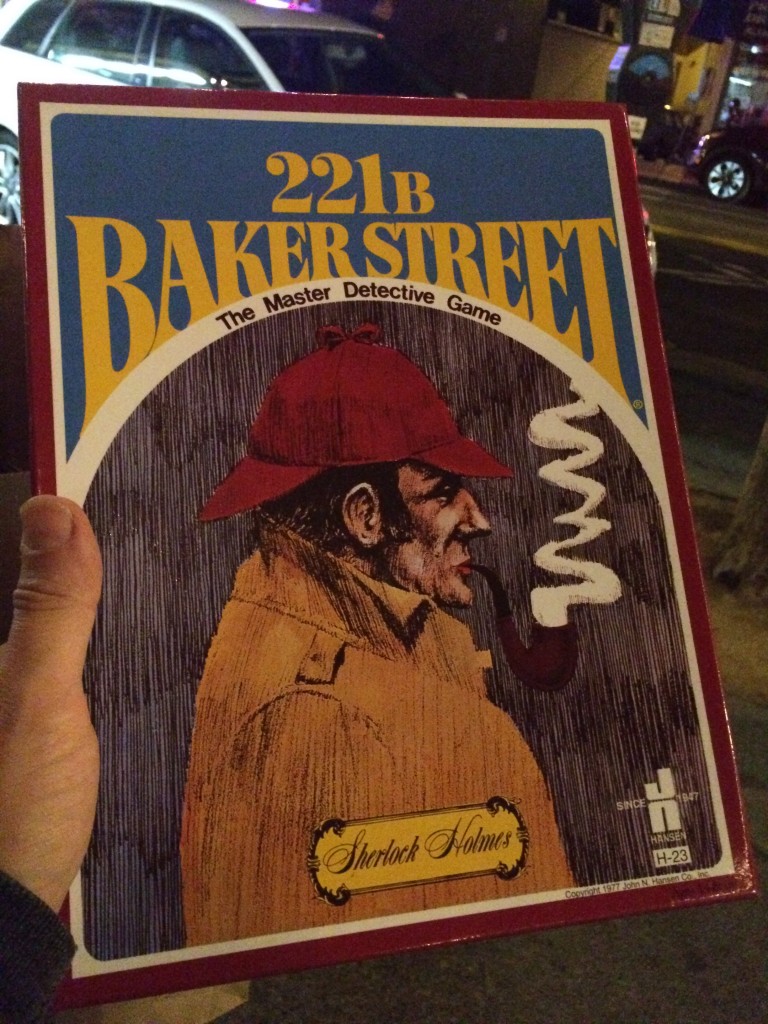
Bookshops, bars, cafes, the boardgames shop (Sherlock Holmes boardgame) and pizza & beer. Settle in nicely.
August 15
Next day, explore. Russian Hill, Pacific Heights. Those hilly streets and amazing views!
Have breakfast in a place called “Toast” which seems to me like the most American breakfast place ever, and I order a big American breakfast plate loaded with pancakes and fruit, with butter and maple syrup. It’s absolutely delicious, but later that day I feel like my blood-sugar levels are such a mess that I really shouldn’t eat more food like that and decide to try to be more healthy.
Again, I’m reminded of films which are set here, including Dirty Harry and Bullitt.
Beautiful multicolour houses and quirky doorways. Very expensive neighbourhood.
We come across a tribute to Robin Williams outside a house where they filmed Mrs Doubtfire. It’s exactly one year since he died. We hang around there, thinking about Robin Williams.
Who Was Robin Williams, and What Happened to Him?
Let me give you a brief history of the life and death of this great comedian.
Trained at Juilliard School.
Had a particular gift for improvisational comedy.
Became famous in Mork & Mindy.
Also did stand-up.
Had big problems with alcohol and substance addictions, particularly cocaine.
He managed to quit when his first child was born. Lived as a recovering alcoholic.
Went on to do some very popular movies, in both comic and straight roles.
Won an oscar for his role as a psychiatrist in Matt Damon and Ben Affleck’s film Good Will Hunting.
Apparently he was a very sweet, very generous and warm guy, but he was affected by bouts of depression.
As a performer I find him incredibly versatile and animated. His comedy seems almost to be compulsive in its nature. He’s a whirlwind when in front of an audience, full of impressions, different voices and many bizarre tangents which are often dialogues between different characters, all played by him at break-neck speed.
In interviews he seemed to occupy two modes – the first was the extrovert comedian, the other was the sweet and sincere actor. He seemed a bit bipolar. I guess part of his talent was that wildly free sense of instant creativity, but it might have been quite difficult for him to deal with on his own.
He fell off the wagon (began drinking again) in 2006 while filming in Alaska. It’s kind of understandable that he turned to alcohol again considering the circumstances – I mean, he was in Alaska. (just kidding)
He went into Rehab but I think the return to alcohol was a symptom of a difficult time in his life.
He later had heart surgery which involved part of his heart being replaced, and apparently this affected him quite badly as his physical and mental condition seemed to get worse and apparently from that time forwards he suffered from depression, anxiety and paranoia. He was wrongly diagnosed with Parkinson’s too, and given medication and treatment that didn’t help the real condition that he was experiencing, which is called Lewy Body Dementia, a degenerative condition in which nerves cells in the brain are blocked by protein clumps (bodies) that interfere with function. Apparently the Parkinson’s medication made the Lewy Body Dementia worse and may have exacerbated his low state of mind, pushing him to suicide.
He killed himself almost exactly a year ago to the day that we found ourselves at the shrine to his memory on this San Francisco street.
I couldn’t help feeling a bit sad about this because I really enjoyed Robin William’s comedy, but also it’s just such a pity that he had to go through such misery, and that anyone has to go through any kind of misery caused by physical and mental conditions. I hope with more research and the right kinds of treatment, this sort of thing can be prevented in the future.
Anyway, I just wanted to mention Robin Williams there, as a sort of tribute.
SF continued…
Korean Barbecue
End of Part 6 (Oh my goodness, will I ever finish this series!?) Part 7 coming soon…
Hello, welcome back to the podcast. This is part 3 in what could turn out to be quite a long series about my recent trip around California. Normally I tend to focus on British things in this podcast but every now and then I go travelling somewhere and report back on what happened. This time I went to California on my honeymoon. The itinerary for the trip was to fly to LA, then drive to Yosemite National Park, then across to San Francisco, then down the coast back to LA and then home again. In this series I’m telling you about the trip, but also I’m branching out in order to ramble on about the history and culture of California and some of the differences between British and American English, as well as some other subjects.
[DOWNLOAD]
At this point in the series I’m still just a few days into the holiday, and there’s plenty more stuff to cover. In this episode I’m hoping to talk about Venice Beach, Baywatch, Segways, the grammar of telling stories and anecdotes in English, some facts about the Hollywood sign, The Red Hot Chili Peppers, British and American English vocabulary related to driving, the dark side of Hollywood and celebrity culture, and an analysis of the lyrics to the song “Hotel California” by The Eagles. That’s a lot of subjects to cover, so I’d better get started right away!
Saturday 8 August
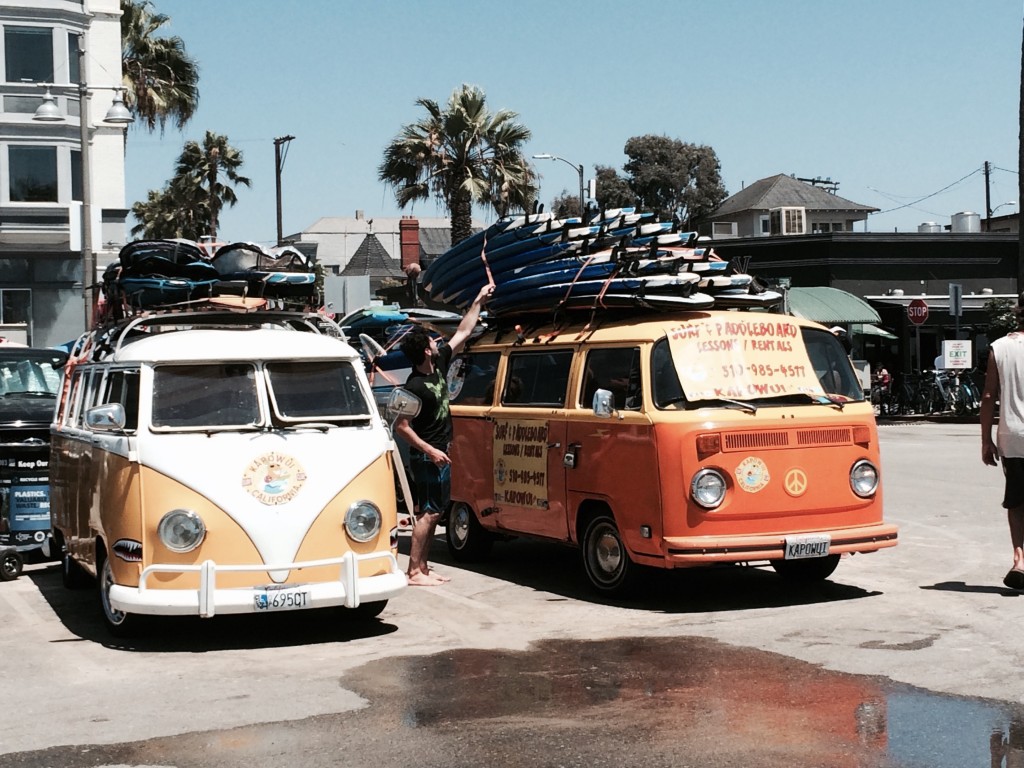
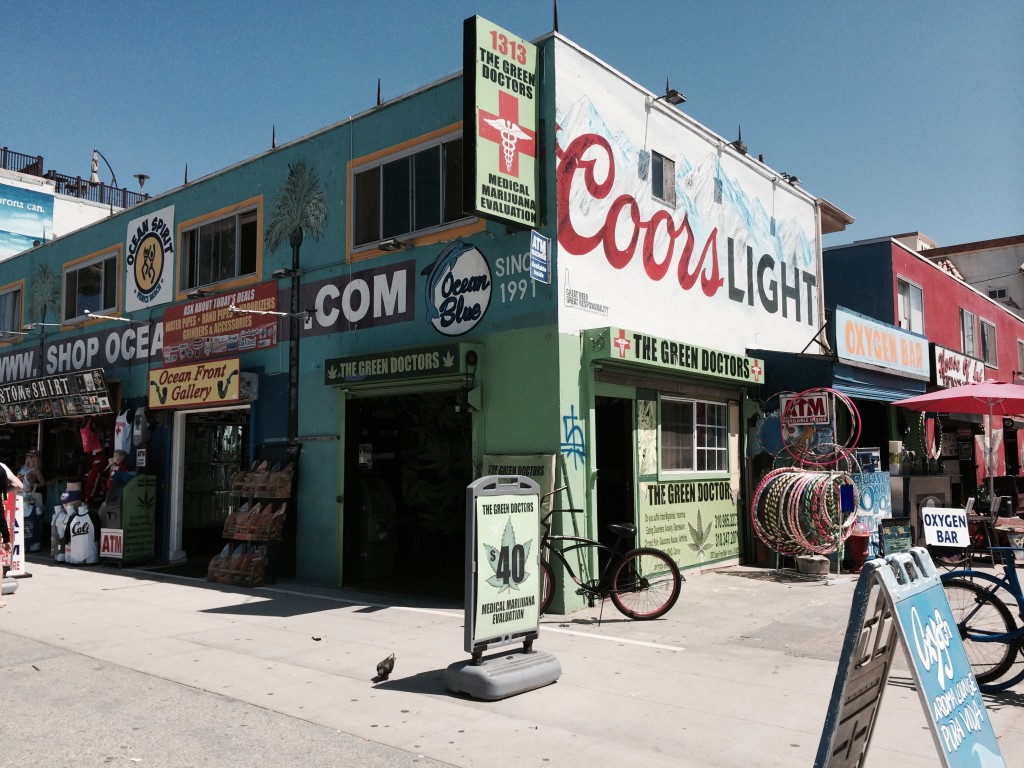
Drove to Venice Beach which is just along from the world famous Baywatch Beach (Santa Monica beach).
Long Boardwalk with lots of shops, cafes and bars.
People performing and busking.
Muscle beach.
Skate park.
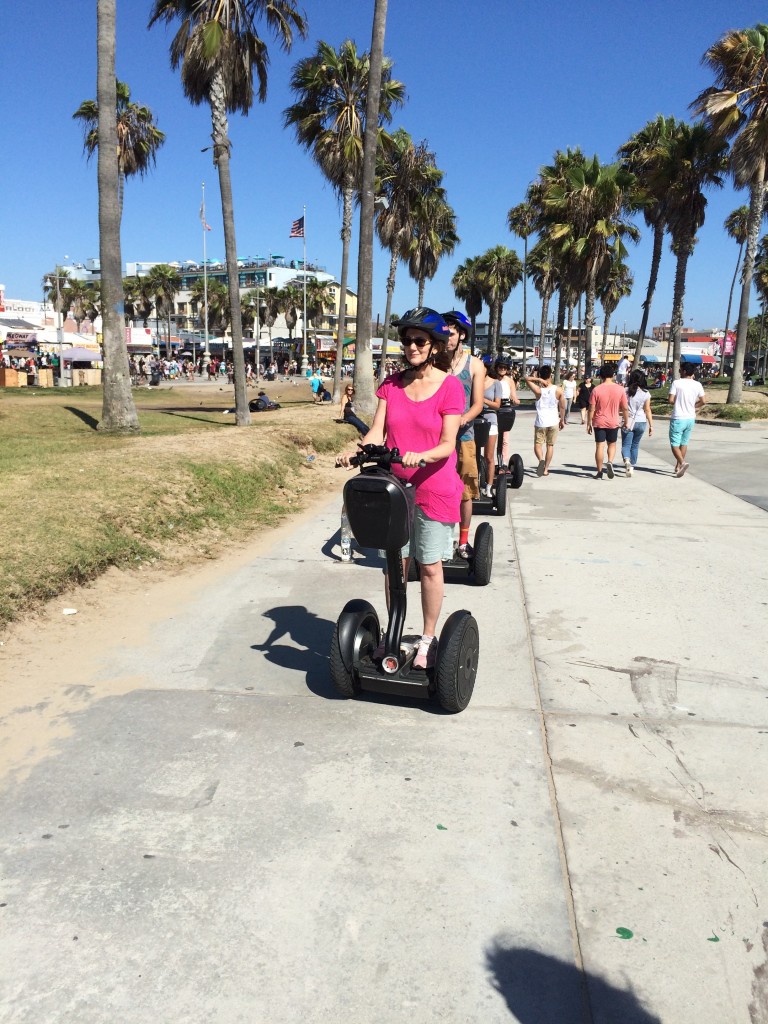
Bikes and segways.
The Segway – the most stupid invention of all time?
What we need is some way of propelling us forwards at just a few miles per hour (you mean like walking speed?), but with the ability to go slightly faster (what, like running speed?) facing forwards so we can see where we’re going, with our hands free so we can hold coffee or mobile phones. How on earth can we do it? (How about our legs sir? We could just walk, jog or run.) Don’t be ridiculous!
And the Segway was born – bringing human laziness to new levels. And you thought escalators and moving walkways were bad enough, now the Segway. It’s very hard to look cool or even dignified on one of these things. I imagine there are some people who cruise around on a Segway all day and then go to the gym to run on a treadmill in order to stay fit. Something doesn’t make sense here. OK, so it doesn’t produce harmful emissions, but neither do your legs. Sure, a person can fart – that’s an emission, but you can still fart on a Segway so it’s the same. Maybe it’s for people with mobility issues, but it seems that in order to use a segway you need the full use of your legs in order to stand on it the whole time, and balance properly. Well, I’m sure it must be useful for something – like maybe doing specific jobs, but it seems a bit silly to use one when you can just use your legs to do exactly the same job. It seems like reinventing the wheel to me. (This is a phrase which means doing something unnecessary – like working hard to do something which is already done by something else)
“Introducing a new innovation in green personal transport – legs!”
Went to the beach or sunbathing. Really huge beach covered in pristine bleached sand.
Swam in the sea. Big waves.
Surfers.
There are lifeguards, exactly like in Baywatch but somehow I expected (or hoped) that it would be more like Baywatch there.
Baywatch: A show which I think was ‘single handedly’ responsible for bringing a whole generation of boys into puberty – no pun intended.
But it was pretty normal, compared to the TV show. I mean, the people looked pretty normal. It wasn’t just hundreds of David Hasselhoffs and Pamela Andersons everywhere, except for me and my wife of course.
Shopping in the huge outlet mall. The place looked like Bowser’s castle from Super Mario Bros. Totally fake modern place that was vaguely like a castle and a huge castle courtyard.
Bargains on jeans. 4 items for the price of one pair of jeans back home.
Seemed incredibly luxurious. Big marble toilets with acres of space.
Yamashiro restaurant in the evening for a romantic candlelit dinner with a stunning view of the city. The restaurant was amazing, with Japanese gardens in the middle and lots of sliding doors – like the scenes from Kill Bill.
Amazing views of the city.
Delicious sushi.
STOP! Grammar Time – A Note on the Tenses Used in this Episode
Usually when you’re describing what happened in the past you use past tenses (past simple, past continuous, past perfect) and so on. So far I’ve been using past tenses in this series of episodes when talking about what we did, but as I’m now reading from the notes I made during the trip, I’ve noticed that I wrote it all in present tenses and it feels tempting to slip into the present tense while reading it. Why? This sometimes happens when we tell stories that we want to make engaging, captivating and in-the-moment. Past tenses accurately report past events, but past tenses can be quite remote. They place the action in a finished time period. When people tell long stories, they sometimes slip into present tenses in order to avoid this remoteness, and make the action and events seem more real and captivating.
Also, using present tenses to tell stories and anecdotes is more common in spoken English. In written English it can be frowned upon (some people don’t like it) but the main thing when writing is that you stick to one perspective (either past tenses or present tenses, throughout). For example, a person at a dinner party might begin telling a story about their holiday using past tenses but then might subconsciously switch to present tenses to make the events more immediate, and that’s considered ok. But if a novelist writes a story and some of it is in past tenses, and other bits are in present tenses, it’s usually considered to be sloppy writing unless it is obviously a stylistic choice. What I’m saying is: you might notice some moments where my tenses move from past tenses to present tenses and this is more acceptable in spoken English than in written English. As my podcast is presented to you as primarily a form of natural spoken English, that should account for this.
Past tense version: So we were sitting in the Japanese restaurant and eating sushi, having a lovely romantic evening, when suddenly loads of ninjas dropped down from the ceiling but I wasn’t worried because I’d spent 3 months in the mountains learning the ways of Chinese kung-fu and so I dealt with them all, and went back to the sushi.
Present tense version: So there we are eating our sushi, having a lovely romantic evening when suddenly loads of ninjas drop down from the ceiling but I’m not worried because I’ve spent 3 months in the mountains learning the ways of Chinese kung-fu, so I deal with them all and then go back to the sushi. (The present tense version is more immediate, and more common in spoken English, although it might sound a bit colloquial).
Slipping into present tenses when telling a story is usually a subconscious thing, rather than a planned thing. I think people just end up using present tenses when they’re recounting events as they actually happened. So, let’s see if it happens to me while I continue to tell you this story.
Another point: This habit of slipping into present tenses that I’m talking about… This doesn’t mean that you don’t need to use past tenses. It’s not a loophole which you can use to avoid making sentences with complex past tenses. This is not a way for you to completely avoid having to deal with irregular verbs and past participles and auxiliary verb conjugations and things. No. If you get a grammar test at school about narrative tenses and you use present tenses, you can’t justify it by saying “But sir I was just using present tenses to make the story more immediate!” Sorry, it doesn’t work like that. You still need to master past tenses before you can abandon them in certain cases. You need to know the rules before you can break them. You need to have full control of the language in order to make these subconscious shifts in tone. So, keep studying those past tenses, practising and being mindful of how you’re using them. If you want to listen to a podcast episode about using past tenses (simple, continuous & perfect) to tell stories, check out episode 29 which is called “Mystery Story / Narrative Tenses”. It’s one of the most commonly listened-to episodes of my podcast. It’s got a short story featuring The Doctor from Dr Who, and a full explanation of how to use narrative tenses properly, pronunciation drills and everything. Click here to check it out: www.teacherluke.co.uk/2009/11/12/mystery-story-narrative-tenses/
So, you can study the tenses directly. Alternatively, don’t worry about it too much and just let the words wash over you and focus on the general meaning of what I’m saying to you, and imagine yourself there and just focus on the meaningful content – the more natural and contextualised English you hear the better it is for your acquisition of grammar at an almost subconscious level, creating that sense of instinct for what is correct or incorrect usage.
Anyway, on with the story…
Sunday 9 August
Breakfast and then took a drive up into the hills for a trek. (Am I using present or past tenses? I’ve become self-conscious now, so I’ll probably stick to past tenses, but I’m sure that if I get carried away with the story I’ll end up using present tenses… we’ll see)
The whole time in LA I felt very bizarre deja vu. This was of course because of the films and movies I’d seen, but more specifically because of Grand Theft Auto 5, which is very accurately modelled on LA, down to lots of small details. I felt exactly like I was in GTA5 a lot of the time. It’s an amazing game.
Stopped off at a pharmacy on the way. Vast.
I think you get the idea – everything in the US is big. Big cars, big buildings, big beds, big meals, big people. Although we didn’t see many of these huge, fat Americans that we all hear about. I think that’s because in California people are generally a lot healthier. Still, people in general are larger than in the UK.
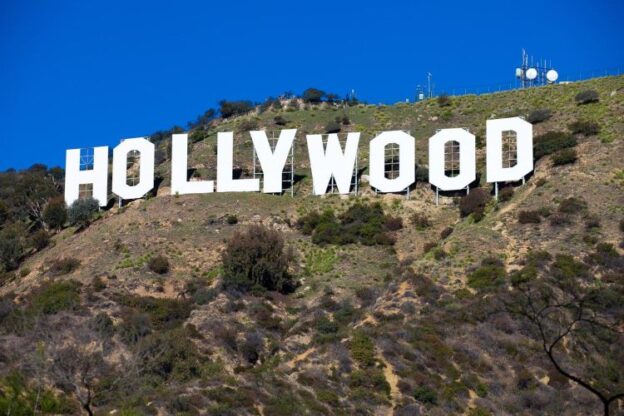
Park the car and begin a trek into the hills around the back of the Hollywood sign.
Very dry. In fact the whole state is on high alert for forest fires. There are fires burning in various parts of the state all the time. California has been experiencing a severe drought for years. In LA they redirect water from hundreds of miles away in the Colorado River Basin. The water then gets used by rich people in Beverley Hills to spray in their gardens to keep their lawns green. Again, pretty crazy right? Welcome to Los Angeles.
L.A. is a city with a little mountain range running through the middle of it (Ok they’re hills not mountains) and if you like hiking a bit then it’s worth going up these hills.
We do get amazing views of the city sprawling away on both sides.
Arranged in lines.
Mild hike behind the sign and then down the right hand side.
Views of the sign.
Here are a few quick facts about the Hollywood sign:
– The sign is about 45 feet high and was originally built in 1923 when it was originally put up as an advertisement for a huge real estate company selling top quality real estate in Hollywood. The company was called Hollywoodland. In fact the sign used to say Hollwyoodland, but the ‘land’ part was removed and the sign became an icon of the region of Hollywood, and everything that represents – glamour, movies, fame etc.
– In 1932 a young actress called Peg Entwhistle committed suicide by climbing up the sign and jumping from the letter ‘H’, falling to her death. Apparently she was depressed because she couldn’t make it as an actress in Hollywood. Ironically, her death made her quite famous.
– The sign used to be covered in lightbulbs, which must have looked pretty cool when it was turned on, but the bulbs didn’t last long as they were too expensive.
– The sign was repaired lots of times and almost completely rebuilt in the 40s, but in 1978 it was in such bad condition after the O fell off and tumbled down the hill and also some arsonists set fire to one of the letter Ls. The city decided to repair it and it cost over $250,000 to do that. Who came up with most of the money? Hollywood’s celebrity class. In fact PLayboy owner Hugh Hefner organised a big party at the Playboy Mansion in order to provide the money. Rock star Alice Cooper also provided money to help repair the letter O.
– It was replaced in 1978 and while the work was being done there was no sign there for 3 months.
– The sign is owned and protected by the city of L.A. and there’s quite an advanced security system which monitors the sign 24 hours a day.
In fact you can’t actually get that close to it. There’s a big fence surrounding it, and a big telegraph aerial. You can get around the back, like we did, but you can only really see the letters “HO”. But when you hike around to the front you can see it pretty well, and it looks cool. Again, it’s amazing to actually see something that you’ve seen so many times on television. But it’s not just the power of TV. It is a great location, with some attractive landscape and a really good view of the city below.
We ended up quite far from the car and got lost in the winding streets under the sign. Lots of properties nestled in to the hills. Attractive places and no doubt expensive but not as expensive as other places like Bel Air etx.
No phone reception so kept walking.
Then uber back to the car.
Life in LA is life in a car.
You never drive above about 60mph. I wonder why there are so many powerful sportscars. You never drive over about 50-60 mph. Sums up the place a lot. It’s more about show and image than about practical living – for some people. In fact there are plenty of ordinary people living in LA, who drive ordinary cars, and who do all the ordinary business of life. There also happen to be plenty of rich movie industry people here too, rock stars, and their children. In fact, one of those rock stars is Anthony Keidis from The Red Hot Chili Peppers. He used to live in the Hollywood Hills, and he sang about them too. In fact, I’d now like to recommend another audiobook download for you. So, here’s some more promotion for Audible – that company that provides loads of audiobooks, and they’re giving you the chance to sample their service for 30 days and that includes a free download of any book you like. Here’s another California related book you could get…
Audiobook Download Suggestions
“Scar Tissue” by Anthony Keidis
This is the autobiography of the lead singer of The Red Hot Chili Peppers. The Chili Peppers have an amazing story. They’re from L.A. originally, they’ve been going for about 3 decades, they’ve been through numerous guitarists, ups, downs, deaths and near deaths, epic highs and devastating lows, and yet they’re still going. Anthony himself was a heroin and cocaine addict during much of his career and in this book he tells his own very personal story of growing up in Los Angeles and his experiences of living with his Dad who was basically a drug dealer to the rich and famous. He talks about struggling for years with his experimental band the Chili Peppers – doing intense live performances, sometimes naked on stage, developing their funk-rock sound which ultimately catapulted them onto the world’s stage. You can hear exactly what was like and listen to descriptions of all the complicated things that went along with that stardom. It’s a powerful story, full of sex, drugs and rock and roll but also a genuinely moving and candid account of Anthony’s success, strengths, weaknesses, friendship, personal hardship, the music business, his addiction and his eventual recovery from addiction. The book is an international bestseller and you can download the audiobook version from Audible. Get it free by going to www.audibletrial.com/teacherluke, or click one of the Audible buttons on my website.
American & British English (Part 1) Vocabulary Related to Cars & Driving
*A note on British and American English*
As you are well aware, there are, broadly speaking, two types of English – American English, and good English, I mean British English. (Just joking – I’m not one of those Brits who has a problem with American English) There are other types of English too of course, like English in Australia, South Africa, Ireland, India and so on.
Can Brits and Americans understand each other? Yes, they can – except for some slight misunderstandings sometimes, there’s no problem in understanding each other.
Really the differences are in the accents, vocabulary, spelling, some grammar and the culture or communication style.
There are definitely some differences in vocabulary. Sometimes these cause misunderstandings. E.g. I said “Are you in the queue? ” and the woman just looked at me. Then I worked out the problem and sad “Are you in line?” and bob’s your uncle. The vast majority of the words we use are the same, but there are differences that are worth knowing. These differences may be more obvious when talking about different systems (e.g. our political and legal systems are a bit different so we’ve developed different terms to talk about them) but in general English there is a relatively small group of key words that are different and it’s worth knowing them all. I’m going to go through a lot of those words with you in this series of episodes.
In terms of culture, although we speak the same language, we don’t necessarily think in the same way and this can cause some problems in communication. For example, Brits tend to be more indirect in their use of language as a way of being polite, diplomatic, tactful etc. It can seem to be a more complicated message, but we see it as being more respectful and considerate. We don’t want to seem bossy or aggressive, but the Americans might take it as weak, unclear and even unsincere (not just the Americans) E.g. “I was wondering if you could…” or “I think there might be an issue…” instead of “Could you…?” or “There’s a problem”. I’m not saying all Americans are direct all the time, but in my experience I think there is truth in what I’m saying. If you want more evidence, read this article written by a Brit who’s done a lot of business communication in America http://www.forbes.com/sites/sungardas/2014/08/14/lost-in-translation-overcoming-the-language-barrier-as-a-brit-in-america/ So, there is a bit of a difference in communication style and culture, despite the fact that we speak the same language. The old saying goes “Britain and America are two nations separated by a common language” (which I think was said originally by George Bernard Shaw, an Irish playwright and one of the founders of the LSE – not the London School of English, but the London School of Economics).
Accent or dialect can cause problems, particularly stronger regional accents. To be honest I think this is more of a problem for Americans understanding Brits (and other forms of English like Australians, South Africans, Irish etc) I think the average Brit would probably understand most American dialects and accents, but the average American might have trouble with some local British dialects. For example, in the USA they often require subtitles on TV when someone with a strong non-American accent is speaking (e.g. a local Brit from Liverpool, Glasgow or Newcastle). I’ve seen interviews on US television with actor Colin Farrell that had subtitles to help the Americans to understand what he was saying. He’s Irish and has a fairly strong accent, but it’s not extraordinarily difficult to understand in my opinion but apparently it was necessary to provide subtitles for the American viewers, even though he was speaking English. However, I doubt that a UK audience would need subtitles for an American, even if they have a strong accent from pretty much anywhere in the country. I think this is because in the UK we are exposed to lots of American English from TV and films – even the really colloquial stuff, but British English is comparatively less known in the USA due to lack of exposure.
The Brits and Americans do spell some words differently as I’m sure you’re aware (famous differences are things like colour/color and theatre/theater) and there are some differences in grammatical usage, but that’s less obvious and as a result less problematic.
Anyway, the point is – there are differences between British and American English but the vast majority of the time we can understand each other without any problems at all. If you’re wondering what kind of English you should learn (which you’re probably not wondering to be honest, because if you’re listening to this then you’ve probably decided that you like British English, and you’re right of course – you are wise wise people indeed) But seriously, you can choose to learn British or American English, or a bit of both. In fact, I personally think it’s ok to mix it up a bit as long as people understand what you’re saying.
For your learning of English, I’d say the main things are that you’re able to identify the difference between a British and American accent, and that you know the main differences in vocabulary. For more information about the differences between UK and USA pronunciation, listen to a previous episode I did on this subject – Episode 14 “British and American Pronunciation” https://teacherluke.co.uk/2009/10/19/episode-10-british-and-american-pronunciation/.
The subject of British and American English is really interesting and very relevant so I’d love to come back to it in the future but for now, here are some different British and American words. I’ve chosen ones that are related to driving.
Let’s see how many you know. I’ll define the word first – try to guess it. Did you come up with the British or American version, or both? Let’s see…
British Word – American Word
Petrol – Gas (gasoline)
Petrol/fuel tank – gas tank
Caravan – Trailer
Lorry – Truck
Junction – Intersection
Tyre – Tire
High street – Main street
Windscreen – Windshield
Motorway – Freeway/Highway
Number plate – License plate
Bonnet – Hood
Pavement – Sidewalk
Boot – Trunk
aka “Vocabulary Game with Amber & Paul” or “Fifteen Fixed Expressions” (less exciting titles)
Learn more English expressions in this episode by listening to another vocabulary game with Amber Minogue and Paul Taylor.
The series of episodes featuring ‘fixed expressions’ and vocabulary games continues in this episode. The previous ones, entitled “Ten Fixed Expressions” (283) and “Ten More Fixed Expressions” (285) featured me testing Paul’s knowledge of multi-word expressions in English. He did better in the second episode than the first, although maybe that’s because of the way I explained the expressions rather than because of Paul’s lack of vocabulary. Nevertheless, the wider aim of these episodes is to teach you, my listeners, some vocabulary in the form of multi-word expressions.
[DOWNLOAD] [AUDIOBOOK OFFER] What is a ‘fixed expression’?
Essentially, a fixed expression (according to me) is a vocabulary item comprising of a few words that always go together. That includes idioms, sayings, phrasal verbs, well-known quotes and collocations. All these things are lexical items which are included in the catch-all title of ‘fixed expressions’. The words are fixed together. They’re not just individual words combined, but they are discrete items of vocabulary in their own right.
So, fixed expressions are essentially ‘lexical chunks’. They’re not types of shelf unit or ikea furniture or anything like that. They’re just phrases in English. That should be clear.
I realise that the more I explain, the more confusing it is, so I’ll stop explaining now and we can start playing the game.
Let’s Play the Game
This time Amber is involved.
All three of us have short lists of five expressions.
We’re going to do three rounds of this game.
Round 1: Amber vs Paul (Luke is the Question Master)
Round 2: Paul vs Luke (Amber is the Question Master)
Round 3: Luke vs Amber (Paul is the Question Master)
Rules of the Game
The Question Master defines an expression without using the words in the expression.
The QM can also give little hints if necessary.
The two competitors race to guess the expression.
A point is awarded to the one who guesses the question right. If both competitors guess the expression at the same time, they both get a point.
Listeners can try to guess the expressions too. Did you guess them? Did you beat us?
If you don’t know the expression, listen carefully because we will explain, repeat and give examples.
So, it’s a fun game and a learning opportunity too, in one Great British package.
The Expressions in the Game
Here you’ll find lists of the fixed expressions in this episode. Listen to the episode to get the full definitions and examples, or search for the definitions online.
Luke’s Expressions
1. to be hard up
2. to be in the loop / to stay in the loop / to keep someone in the loop
3. “been there, done that, got the t-shirt”
4. to bend over backwards (for someone) (to do something)
5. to give someone the benefit of the doubt
Amber’s Expressions
1. to get your foot in the door
2. to show your true colours
3. over my dead body
4. in mint condition
5. to bite the bullet
Paul’s Expressions – Theme: Body Parts
1. to have two left feet
2. to be/fall head over heels in love with someone
3. (to do something) by the skin of your teeth
4. (give it some) elbow grease / (put some) elbow grease (into it)
5. to put your foot in your mouth
There are plenty of other expressions in this episode, so if you notice any other good ones please add them in the comments section below.
Enjoy!
p.s. I’m going on my honeymoon in a couple of days so there will be no new episodes for a couple of weeks, but LEP will be back :)
It’s been about one month since I last uploaded an episode of the podcast, but now LEP is back! Where have I been? Well, I got married (expect a podcast about that soon) and took some time off after that, and then I had lots of work commitments, comedy commitments and honeymoon-organising commitments and I didn’t have enough time to record an episode, but of course I’ve been waiting for an opportunity to speak into the microphone, and that opportunity came today. So here it is.
[DOWNLOAD] [AUDIOBOOK OFFER] Introduction Paul Taylor is with me for this one and we’re going to do another round of our vocabulary game, just like we did in episode 283.
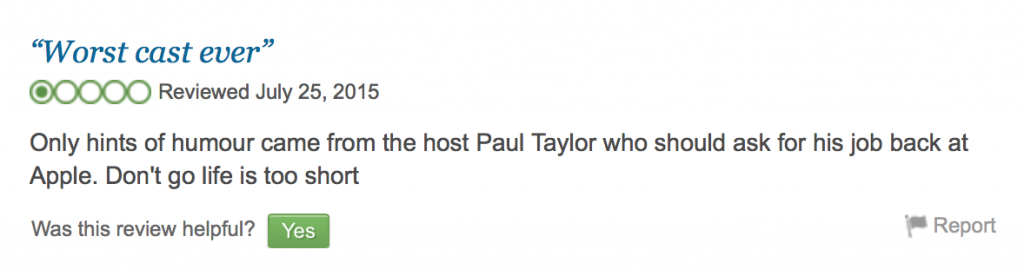
That episode was called “Ten Fixed Expressions” but that now seems to be quite a dull title. Certainly, we did teach 10 expressions but the title seems a bit boring don’t you think? I’m wondering what to call this episode and I still can’t decide as I’m writing this. I always think that titles of my episodes should describe what is in each episode, and should also be fun and interesting enough to catch your attention. In this case Paul and I teach you ten expressions again, but we also have a chat about our recent news, and get very sidetracked by a negative review on TripAdvisor of one of our recent comedy shows.
The main aim of the episode is to play the vocabulary game and let you understand the meaning of ten English expressions but it also is a chance for us to mess around a bit and talk about other things if we feel like it, especially if it is entertaining or interesting for you.
So, should I call this episode “Another Ten Natural Expressions” or “Ten More Natural Expressions” or “Ten Natural Expressions (Part 2)”? Maybe “Vocabulary Game with Paul Taylor (#2)” is a better title? I can’t decide. I’ll choose the title when I’ve finished writing this and editing the episode together, and whatever title you see at the top of this page is the one I finally went for. I suppose you’ll probably be thinking – “Luke, the title doesn’t really matter. It’s the content that counts.” That’s true of course, but I do think the title is quite important for attracting new listeners to the podcast, and because it helps you to identify the main content of the episode. Let me know what you think about the title of this episode by leaving a comment below.
In This Episode
Anyway, regardless of my indecisiveness about the episode title, here’s what you can expect in this episode.
1. Hi Paul, hi Luke, etc. :)
2. Conditions are almost exactly the same as in the recoding of episode 283. It’s boiling hot. I’m with Paul Taylor. We’re sitting in the shade, mostly, except for my leg which is in direct sunlight again. We’re going to play a vocabulary guessing game like last time we did this (episode 283).
3. What’s new Paul? He’s been doing more comedy gigs. We got a bad review for one of our comedy shows, and we talk about it a little bit. The wording of the review bothers us a bit (also the fact that it’s so negative of course). Here’s a picture of the review (below). What do you think of the description? Ignore the lack of a full-stop at the end of the second sentence. Is the comment slightly ambiguous? What does it really mean? Look at the review and then choose option a) or b).
[socialpoll id=”2286338″]
One thing’s for sure, this person did NOT enjoy our show! You can’t please all the people all the time, and bad reviews are just a part of putting on comedy shows. So, never mind!
Anyway, in our conversation we use the negative review as a chance to talk about the importance of being dedicated, motivated and positive as a way of pushing through a barrier of resistance that you might experience if you want to really achieve something in life, like becoming a really funny comedian or learning another language to an advanced level.
4. The Ten Fixed Expressions & Vocabulary Guessing Game
The rules of this game are the same as last time. I’ll explain an expression to Paul and he has to guess which one I’m talking about. Listen to my explanations – can you guess the expressions before Paul does?
Here are the ten expressions I explain in the episode. Listen to the episode to get definitions and examples, or just google them for online definitions.
1 all’s well that ends well
2 an eye for an eye (and a tooth for a tooth)
3 and Bob’s your uncle
4 and pigs will fly!
5 that’s another kettle of fish
6 as cheap as chips
7 to ask for trouble
8 to be away with the fairies
9 to be back to square one
10 to be all ears
That’s it!
Listen all the way to the end of the episode to hear some out-takes of my introduction to this episode. What are out-takes? They’re the mistakes that are edited out of the final version of a film, song recording, or in this case a podcast episode. Sometimes it takes me a few attempts to get the introduction right. I might do nearly 10 failed introductions before I finally get it right and continue with the rest of the recording. They’re not normally intended for publication, but sometimes they’re pretty funny so I shared them with you at the end of this episode.
Don’t forget to leave your comments below this episode! Thanks for being awesome listeners and LEPsters and all that. You’re the best. Look forward to more episodes coming soon…
Recently on FB I asked my followers to send me some fixed expressions (phrases, idioms or just individual words) that they like or think are worth learning. I ended up with about 200 phrases. The idea was that I’d do one episode with these phrases, but obviously I underestimated the number of responses that I’d get and now I have a huge database of nice, chunky and rather British fixed expressions which I can deal with in episodes of the podcast. I have vetted the list for any expressions that I don’t see myself using very much, so they’ve all been given the LEP seal of approval, meaning they’re all expressions which are perfectly valid and that you should know.
[DOWNLOAD]
What’s a fixed expression? It’s a collection of words (a phrase) which has one specific meaning. Those words are fixed together and it might have a particular idiomatic meaning, or at least a specific meaning which is
Episode 1 in the series – I’ve invited Paul Taylor to my place, and we’re going to do an exercise to help you to learn these phrases and give you some listening practice. What we’ll do is that I will explain the phrase to him and we’ll see if he can guess which phrase it is. Then we’ll give some examples and have a quick discussion based on the expression, before moving on to the next one.
What you can do is just try to guess the phrase I’m talking about, and then check out our discussion to hear the phrase being used naturally. All the phrases are listed on the page for this episode.
A bad egg
A person in a group who has a negative effect on the rest of that group. “He’s a bit of a bad egg”, or just simply a bad person.
Have you ever had a bad egg in a training group at work?
Were there any bad eggs in your group of friends as a child growing up?
A cash cow
An investment that brings in a reliable source of steady income. E.g. an apartment which you rent out, or shares that you purchased in a thriving business.
What’s the most common form of cash cow?
If you had 50,000 to invest, what would you invest it in?
a fine line between x & y
When there is a very subtle or small difference between two rather distinctly different things. E.g. “There’s a fine line between madness and genius”.
http://www.brainyquote.com/quotes/keywords/fine_line.html
Do you think there is a fine line between madness and genius?
Other fine lines?
Stand up comedy and … ?
a flash in the pan
Something that is a very quick and sudden success, but it’s a success that doesn’t last. Brief success.
Would you rather be a flash in the pan (make loads of money but then disappear from fame – become anonymous) or a long lasting success who is constantly in the public eye?
Can you think of anything that we thought would be a flash in the pan but wasn’t?
What do you think will be a flash in the pan now? Is the Apple Watch a flash in the pan?
a pain in the neck
Something really irritating or annoying. Something really inconvenient in your life.
a shoo-in
Someone who is certain to succeed, or certain to win a competition. Someone or something which we assume will be a success. For example, for an entrance exam to a university – we expect this girl to pass. In fact, it’s almost impossible to imagine that she won’t qualify for the course. She’s a shoo-in.
I always thought it was spelled ‘shoe’ – like somehow there’s a shoe in something, or it’s really easy to throw a shoe into something.
Where did you go to university? Were you a shoo-in for entrance? How about your exams?
Do you follow football? Who do you think will qualify/win the 2018 world cup?
A total cock up
A complete mess – when someone messes something up completely. They tried to rob the bank but they forgot to load their guns and one of them got trapped in the vault and the other didn’t know what to do. They both were recorded by CCTV cameras and got arrested.
Origin unknown (it doesn’t refer to a penis) – it’s more likely to refer to a bird, like perhaps the accidental startling of a woodcock during a hunt.
What’s the biggest cock up you’ve ever made?
Ace
Great, brilliant, fantastic. British slang. Also the name of one of the picture cards in a deck of playing cards.
When was the last time you said “That was ace!”
What was the last film you saw that you thought was ace?
All gone to pot
It’s all gone bad. It’s deteriorated. Like, “it’s all gone to the dogs”.
E.g. “My diet has gone to pot since coming home for Christmas.” or “London’s just gone to pot since Boris Johnson took over” or “The whole country is going to pot under this conservative government”.
Has its origins in the idea that farm animals would be eaten (cooked in a pot) when they were past their best (for producing eggs or whatever).
Do you think the world is going to pot?
All hell broke loose
When things suddenly become chaotic and out of control.
E.g. When they announced a flash sale of Louis Vuitton handbags, all hell broke loose in the department store.
Do you ever listen to songs and completely mishear the lyrics? I do it all the time. In fact, everybody does! Let’s listen to some song extracts in which the lyrics don’t quite sound as the singer intended.
[DOWNLOAD]
Jimi Hendrix – Purple Haze
Sounds like: “Excuse me, while I kiss this guy”
The real lyrics: “Excuse me while I kiss the sky”
The connection of ‘this’ and ‘guy’ makes the /g/ and /k/ sound almost exactly the same. In fact, I think “kiss this guy” and “kiss the sky” are identical.
Do you ever do Karaoke, see the song lyrics on the screen and realise you’ve been hearing all the words wrong, all these years? Or do you wonder if maybe the guy who did the karaoke subtitles didn’t have a perfect command of English and misheard all the lyrics?
Well, if you do often mishear lyrics, worry not – it’s really common and it happens to everyone! There are loads of songs like that for me. For years I thought Sting was singing about sausages in this song. Is it just me or is he singing about salami?
Of course, he’s actually singing “So lonely”.
So, let’s listen to some song extracts and try to understand exactly which words are being sung. Let’s see if you mishear them too, and we’ll consider why they might be easy to get wrong.
Misheard Lyrics
Jimi Hendrix – Purple Haze
Sounds like: “Excuse me, while I kiss this guy”
The real lyrics:
The connection of ‘this’ and ‘guy’ makes the /g/ and /k/ sound almost exactly the same. In fact, I think “kiss this guy” and “kiss the sky” are identical.
Nickleback – How You remind me
Sounds like: “cos little women must have damn near killed you”
The real lyrics: “because livin’ with me must have damn near killed you”
“With me” can sound like “women”. “wi’me”
“Living” can sound like “little” when you remember that the /t/ sounds are often softened in US English.
The Stone Roses – I Wanna Be Adored
Sounds like: “I wanna be a door”
Real lyrics: “I wanna be adored”
He’s really keen to be a door. Because the ending of the word trails off, it’s quite easy to imagine he’s not adding a /d/ sound at the end.
Leona Lewis: “Bleeding Love”. (1min)
Sounds like: “You call me your banana”
The real lyrics: ??
Duffy – Mercy
Sounds like: “You got me begging you for birdseed”
The real lyrics: “You got me begging you for mercy”
Eagles – Hotel California
“What a nice surprise, when your rabbit dies” (3.25)
The real lyrics:
Rolling Stones – Start Me Up
Sounds like: “In Yugoslavia you’ll never starve”
The real lyrics: “If you start me up I’ll never stop”
Sister Sledge – We Are Family
“Just let me staple the vicar”
?
“We’re giving love in a femidom”
?
Bon Jovi – Living on a Prayer
“It doesn’t make a difference if we’re naked or not”
“It doesn’t make a difference if we make it or not”
The /m/ in ‘make it’ can quite easily sound like an /n/ sound, and the /t/ in “make it” sounds like a /d/, so there you go…
Billy Ocean – When The Going Gets Tough
“You can go and get stuffed.”
“When the going gets tough.”
The beginning part of the phrase doesn’t work, but “and get stuffed” sounds pretty good!
“Gets tough” sounds almost exactly like “Get stuff”.
Miley Cyrus – Wrecking Ball
“I came in like a rainbow”
“I came in like a wrecking ball”
I think this is because she doesn’t sing it clearly, and the vowel sounds are the same. Also, when you stretch out a note, it’s usually a vowel sound and the consonant sounds might get shortened. Singing it with passion extends the vowels, and the consonants disappear into a slightly ambitious zone.
*Audible offer* www.audible.com/teacherluke
Creedence – Bad Moon Rising
“There’s a bathroom on the right.”
“There’s a bad moon on the rise.”
All the vowel sounds are the same. The rest is some imagination or perhaps some connected speech.
Deep Purple – Smoke on the water
“Small cousin Walter, is firing this guy.”
“Smoke on the water, fire in the sky”
There’s another example of “the sky” sounding like “this guy”.
“Fire in” sounds a lot like “firing”
“Smoke on the water” – you need a bit of imagination to hear “Small cousin Walter” but it’s there!
The Cars – Drive
“We can’t go on, thinking, nothing’s wrong – pork pie”
No idea what he’s actually singing…
Michael Jackson – You are not alone
“Your burgers are the best”
Again, I have no idea what he’s on about.
Celine Dion – My Heart does Go On
“I believe that the hot dogs go on”
“I believe that the heart does go on”
We use “does” for emphasis, or to insist something. In this case, it makes it sound like she’s singing about junk food.
Led Zep – Stairway to Heaven
“There’s a wino down the road”
“And as we wind on down the road”
The ‘d’ in “wind on” disappears as the /n/ sound and /d/ sounds fuse together with the same tongue movement.
Seal – A Kiss From A Rose
“and my eyes become lager…”
For me, it just sounds like he’s saying “lager”. I expect he wants to say “larger” but I think it’s definitely “lager”.
Air – All I Need
“Have a wank”
“How do I?”
Ok so she’s actually singing, “How do I?” but just a little bit of imagination for the /k/ at the end, and you’ll never be able to hear this song in the same way again.
Brian Adams – Summer of 69
“I got my first real sex dream”
“I got my first real six string”
Sometimes a /dr/ sound can be similar to a /tr/ sound, especially when they follow a /ks/ sound, like in “six”. So, “six string” can sound like “sex dream”.
Alicia Keys – New York
“New York – Concrete Jungle Wet Dream Tomato”
“Concrete jungle what dreams are made of”
It just sounds like “wet dream tomato” to me. Why is she singing that?
Ray Parker Junior
“Who you gonna call? Those bastards!”
“Ghostbusters”
The vowel sounds are pretty similar, and the emphatic way it is said. They all contribute to a funny misunderstanding!
Eiffel 65 – I’m Blue
“I’m blue I will pee on a guy, if I was green I would die.
I think they’re just singing nonsense and the human brain tends to impose order on nonsense, so your brain searches for meaning. This is the closest your brain can come up with. For me, it improves the song immeasurably.
Beastie Boys – Intergalactic
“I’m having a big shit, I’m having a big shit…”
“Another dimension”
The /th/ in “another” can sound like a /v/ sound, and the /shun/ sound in “dimension” can easily sound like “shit”.
Shania Twain – That don’t impress me much (2.20)
“I can’t believe you kiss your cock at night”
“I can’t believe you kiss your car goodnight”
“Car goodnight” can easily sound like “cock at night” because the /g/ of “goodnight” can sound like the /k/ in “cock”, and then “goodnight” sounds like “at night” because of the old /d/ /t/ thing between “good” and “at”.
Anyway, no need to explain it. Just enjoy it!
Welcome back to part 3 of this short series. In parts 1 and 2 we got to know my guest a bit, and talked about Northern Ireland. Now in part 3 we are going to have a good listen to Marcus’s Northern Irish accent, compare the way he and I speak, and also learn a few common phrases and slang from Northern Ireland. Enjoy!
[DOWNLOAD] [AUDIOBOOK OFFER] [PART 1] [PART 2]
3. Belfast accent (Check out this page on English in Northern Ireland from the fantastic British Library website)
I want my listeners to at least be aware of the accent(s) in Northern Ireland. Ideally they’ll be able to recognise it, or even copy it (just for fun). I also would like to find out about some of the specific phrases that are used in that part of the English speaking world.
– Is there a variety of accents in Northern Ireland?
– What is Ulster Scots?
– How would you describe your accent?
– Do people judge each other on their accents?
– What do you think of other accents from the UK? What do you assume about a person when you hear their accents? Is it fair to judge people by their accent?
Say some specific things: (These may be stereotypes)
“How now brown cow”
“Sit down”
“How are you?”
“I’m feeling a lot better now thank you”
“This is the first farm in the whole country to produce such excellent cheeses”
“She wanted to pull me into the pool”
“Can’t you see that the lift is completely full, you fool!”
“I can’t get this boot on my foot”
“I love coming to Paris because of the good food”
“I’m from Northern Ireland”
“I took the ferry to Derry and it just cost a penny”
How would you say these things, with specific phrases? (Check out this page with a list of common phrases spoken in Northern Ireland)
– Alright mate?
– I’m going to the shop, do you want anything.
– It’s a really hot day, isn’t it?
– I’m going to bed.
– Oh, go on!
– Look at her face! She’s got a weird looking face.
– Yes. (like, “yes, I’ll have a pint if you’re buying”)
– Come on, now.
– “Get a hold of yourself!”, “Wise up!”
– That film was really great. (or just, That was really great wasn’t it?)
– I agree, totally, good, etc. E.g. “Come on, this isn’t working. Let’s go to the pub” – “Yeah, totally”
– You stupid idiot!
– Could you give me a fag/cigarette?
– The police.
– Have you finished (your tea)?
– Are you mad?
– OK, I’m going home for dinner.
– Good, fine, great, etc. (dead on, cracker, sound)
– Alright, let’s have a little drink.
– Can you lot keep the noise down? I’m trying to sleep in here!
– She looks like your mum.
– What’s “spotty dog” (great) and “wind your neck in?”
Nadine from Girls Aloud “I’m going to give him a bath”
Frostbit Boy (The strongest Northern Irish accent I’ve ever heard!) Basically he’s talking about the difficulty of walking to school in the very cold weather.
Why are there so many accents in Northern Ireland?
Cookies on teacherluke.co.uk
Click “Accept All”, to consent to the use of all cookies on this website, or visit "Cookie Settings" to control your consent settings.
This website uses cookies to improve your experience while you navigate through the website. Out of these, the cookies that are categorized as necessary are stored on your browser as they are essential for the working of basic functionalities of the website. We also use third-party cookies that help us analyze and understand how you use this website. These cookies will be stored in your browser only with your consent. You also have the option to opt-out of these cookies. But opting out of some of these cookies may affect your browsing experience.
Necessary cookies are absolutely essential for the website to function properly. These cookies ensure basic functionalities and security features of the website, anonymously.
Cookie
Duration
Description
cookielawinfo-checkbox-analytics
11 months
This cookie is set by GDPR Cookie Consent plugin. The cookie is used to store the user consent for the cookies in the category "Analytics".
cookielawinfo-checkbox-functional
11 months
The cookie is set by GDPR cookie consent to record the user consent for the cookies in the category "Functional".
cookielawinfo-checkbox-necessary
11 months
This cookie is set by GDPR Cookie Consent plugin. The cookies is used to store the user consent for the cookies in the category "Necessary".
cookielawinfo-checkbox-others
11 months
This cookie is set by GDPR Cookie Consent plugin. The cookie is used to store the user consent for the cookies in the category "Other.
cookielawinfo-checkbox-performance
11 months
This cookie is set by GDPR Cookie Consent plugin. The cookie is used to store the user consent for the cookies in the category "Performance".
viewed_cookie_policy
11 months
The cookie is set by the GDPR Cookie Consent plugin and is used to store whether or not user has consented to the use of cookies. It does not store any personal data.
Functional cookies help to perform certain functionalities like sharing the content of the website on social media platforms, collect feedbacks, and other third-party features.
Performance cookies are used to understand and analyze the key performance indexes of the website which helps in delivering a better user experience for the visitors.
Analytical cookies are used to understand how visitors interact with the website. These cookies help provide information on metrics the number of visitors, bounce rate, traffic source, etc.
Advertisement cookies are used to provide visitors with relevant ads and marketing campaigns. These cookies track visitors across websites and collect information to provide customized ads.

 [DOWNLOAD]