Hello again, how are you? Welcome back to the podcast. Here’s a new episode for your listening pleasure. This one is a rambling conversation with my parents and my brother about everything and nothing.
Just before we get started – here are just three announcements or bits of news.
First: I’ve received loads of emails recently, especially over the Christmas holiday period. I managed to write back to quite a few of them, but unfortunately some of them go unanswered – so I would just like to say sorry if I didn’t get back to you. Even if I don’t reply, I love getting messages from listeners, and please know that I read everything that is sent to me.
Second: The LEP photo competition. I’ve received loads of photos and the competition ends soon. Then I’ll post all the pics and you can vote for your favourites, and the one that gets the most votes will get an LEP mug plus a t-shirt or bag. The runners up will get a mug each. Personally I love seeing the contexts in which you are listening to this podcast. It is really cool! I’m looking forward to sharing them on the site for all to see.
Since we’re talking about competitions, this is usually the time of year that I ask you to vote for me in the Macmillan Love Dictionary Awards, but it seems that they’re not running it this year. Perhaps they got fed up with me winning it every time! I don’t know. But anyway, that’s not happening, but I’d like to ask you a favour – if you know of any other awards at all for learning English websites or online services, please do consider nominating me and my podcast. Awards are a great way of bringing exposure to the podcast. The Macmillan Awards were really helpful for bringing new audience members to the show every year, and for giving the website a bit of kudos too. So, please do nominate LEP for any awards that you’re aware of, if you think I deserve it of course – I would really appreciate it.
Third: Disappearing Comments. *Actually, this is now resolved! I found a way to fix it and you can read comments on the homepage again :) * You might have noticed that comments have disappeared from the front page of my website. Normally I have a load of comments that show up under the text on the front page of my site. It’s important for me because new visitors to the site can see the positive comments and it’s a great endorsement of my podcast, but the comments are gone and I don’t know why. I find that quite annoying. I run my website myself and I’m no expert, as you may be able to tell. The site looks pretty basic but it does the job. I use WordPress to manage the site – so if any of you out there can explain to me why the comments on my front page have disappeared, I’d really appreciate it. The comments box is still there, and the comments are still visible in my admin dashboard, but they’re just not showing up on the front page. Comments are visible on all other pages and posts on my site. I think it may be something to do with the template, and .php files and stuff – but it all gives me a headache and I’m a bit cautious about messing with the template files of my website. So, if you know about this stuff then let me know if you have a solution to my missing comments section.
OK, that’s enough technical stuff – I don’t want to bore you! Let me hurry up and introduce this episode.
Introduction
As you know I was back at home in England this Christmas and while I was there I managed to record a few rambling conversations with various members of my family. You already heard the geeky conversation with James about Star Wars, but in this episode I’m speaking to my Mum and Dad too.
At Christmas time, or in fact whenever we’re together as a family, we like to sit around and talk rubbish for a while, often over a glass of wine or a meal or something. It’s sort of a family tradition – I’m sure it’s the same thing for many of you. I like talking rubbish with my parents, and as a family I think we’re quite good at wittering on about whatever comes into our heads. Usually there’s some disagreement, arguing and bickering involved, like you heard a few years ago in an episode of LEP called Family Arguments and Debates, in which I recorded arguments and discussions with my Mum, Dad and brother about various things. Well, here’s another one.
For this episode I decided I’d like to give you the chance to listen in on one of our family rambling sessions. You can imagine that for an hour you’ve joined us at my family’s home in Warwick, you’ve had a glass of wine or three, and now we’re all sitting around enjoying each others company and generally setting the world to rights.
In terms of language learning – there’s no target language which I’m teaching you in this episode. Instead I’m just letting you hear some natural conversation between native speakers. As usual I recommend that you just follow the conversation, try to understand it all, get carried away with it, think about your own responses to the questions I’m asking, try to notice certain bits of language and grammatical usage as it comes up naturally. My parents are both educated and well-spoken people. They have standard British accents – they speak RP, which is like BBC English. In fact, my Dad worked for the BBC as a news broadcaster for many years. My Mum works in a charity bookshop and also likes to study subjects like art and history in her free time. You’ll also hear my brother James who you already know. He’s a freelance designer who still likes skateboarding in his free time even though he’s getting on a bit now, and last year he fell of his board and dislocated his shoulder. You can hear all about that story in episode 180 “Dislocated Shoulder”. https://teacherluke.co.uk/2014/05/20/180-dislocated-shoulder/
In this episode I wanted to get my family talking a bit, so I prepared some random questions and posed them to the group. If you like you can write your answers to any of the questions in this episode as comments on the page for this episode. It’s a good way to interact and practise your English at the same time.
So now, just sit back, relax and enjoy this rambling conversation about everything and nothing, recorded in the company of the Thompsons at Christmas time.
Welcome back to Luke’s English Podcast. Happy New Year. This is an episode of Luke’s Film Club, and this time I’m joined by my brother James as we talk about the new Star Wars film in full detail including our thoughts, theories, favourite bits and memorable characters. This episode is full of SPOILERS, so be warned if you haven’t already seen the film.
Welcome back to LEP. Happy New Year! Did you have a good holiday? Did you have a nice Christmas?
Let me tell you about the social English New Year routine, including all the typical questions we ask each other on our first day back at work in the new year. “Hi, Happy New Year” etc… (Listen to the episode for all the details of this bit).
I was back in the UK with my family. We started at my parents’ house, then a few days in London, then in Bristol with my cousin Oli. I managed to record a few conversations with my family members, which will be uploaded in podcast episodes over the next few weeks.
The first one is this episode which is a conversation with my brother James who you already know from previous episodes of the podcast. We decided to do an episode of Luke’s Film Club about the new Star Wars film in order to discuss it in proper depth, including some spoilers. I’ve seen Star Wars a couple of times since it was released a few weeks ago, and so has James. So, in this episode we talk all about the film in full detail including our thoughts, theories, favourite bits and memorable characters. This episode is full of SPOILERS, so be warned if you haven’t already seen the film.
Also, this is an extremely geeky episode as you’ll hear my brother and me talk at some length about Star Wars. I don’t think there’s anything wrong with being a geek really, because ultimately – what’s wrong with being interested and enthusiastic about specialist subjects? As long as it doesn’t take over your life in an unhealthy way, then I think it’s ok – so I invite you to embrace your geekiness in this episode, along with us.
I understand that you may be sick of Star Wars by now as the media have been going crazy about it for the last month or so. If that’s the case, don’t worry – other new episodes about different things will arrive on teacherluke.co.uk very soon. But for now, I feel I had to cover this topic in more detail just because it’s so close to my heart (because I’m Luke Skywalker) and I know that many of you my listeners are interested in this too, not to mention the fact that this may be the biggest movie event in history so far. So, here it is… Luke’s Film Club: Star Wars Episode VII: The Force Awakens, with special guest James Thompson.
Before we get properly started, you might be interested to know that the audiobook version of The Force Awakens is now available on Audible.com. It’s the official audiobook novelisation of the film, it’s 10 hours long you get loads of extra detail, scenes and storyline that you don’t see in the film. SO, if you’re a fan of Star Wars, why not download and listen to it? And, remember you can get it free as part of a 30 day trial with Audible – the world’s top provider of audiobooks. To get started, just go to teacherluke.co.uk/audible and sign up to a 30 day trial, download any audiobook and if you don’t like it just cancel and keep the audiobook. The offer really is out of this world. Alright then, let’s get started with this new episode of the podcast.
Welcome back to The Lying Game 2: The Rematch (Part 2). In this episode you can hear Amber, Paul and me continue our competitive game. Who’s going to win this time? Will it be Paul, finally? Listen to find out what happens, and for details of the next version of the lying game which will be interactive.
Tie break round:
Luke: I have a large scar on my knee.
Paul: I once nearly stabbed myself in the eye with a kitchen knife.
Amber: I went for a job interview as a lapdancer.
Final scores
Luke – 1 / 0 / 1 / 1 / 0 / 0 Total = 3
Paul – 0 / 2 / 0 / 0 / 1 / 0 Total = 3
Amber – 1 / 0 / 1 / 1 / 1 / 2 Total = 6
Amber wins again!
Next Lying Game – The Interactive Version
Listen to Luke, Paul and Amber say statements.
You have to ask the questions.
So, read the statements below and think of some questions.
Write your questions in the comments section of this episode.
When we record again we’ll ask your questions.
Then, eventually, you can vote on whether you think the statements are true or lies.
Luke:I accidentally knocked down a wall in a friend’s house in Japan.
Paul: I used to get bullied by Guy Berryman, the bass player from Coldplay. Amber:I helped in the making of the film “Something’s Got To Give”.
Write your questions in the comments section for the next episode of The Lying Game!
Welcome to LEP. I hope you’re well, I hope you’re fine. This episode of the podcast is a rematch of the lying game with Amber, Paul and me. Check below for show notes and other links.
[DOWNLOAD] A couple of announcements before we go further.
Thanks for your photos for the LEP photo competition. This is a chance for you to send in your photos for a chance to win some LEP merchandise including mugs, t-shirts and bags. You can still send your photos to podcastcomp@gmail.com, until 15 January 2016. Your photo should show the environment in which you listen to LEP. Feel free to get creative. The only rule is that there has to be some evidence that you’re listening. E.g. a headphone in the photo somewhere. The idea is for us all to see the different situations that people are in while they listen. Once all the photos have been sent in I’ll display them in a mural on the website and you can pick the one you like the most.
Please do take my business English survey.
Just go to the menu and you’ll find it under the contacts button.
A note on subscribing by email.
On the right under the logo you’ll see a field that says SUBSCRIBE BY EMAIL. Put your email address in and click subscribe. Then check your inbox to confirm the subscription. Then you’ll receive an email every time I publish a new episode, and you’ll get direct access to the page for the episode, with all the show notes, videos, transcripts and other stuff.
Thanks also for different comments I’ve had recently. It’s awesome to hear from you all. You now have the option to send me voice messages. There’s a button on the side. Click it, get your mic ready and send me a message. It could be a comment or a question. I’ll receive it in my inbox and I might play it in an episode of the podcast, especially if you ask a good question.
OK, so now let’s get down to business.
This episode is called “The Rematch”.
It’s one of those episodes that involves a competitive game between Amber, Paul and me. In the last one of these, called The Lying Game, this happened:
The scores were level between Luke and Paul.
Even stevens.
They then played a tie-breaker.
Luke told a story about the tooth fairy.
Paul talked about burning down his house.
Luke identified it.
Since then, it has come to light that I may have cheated. I swear that I didn’t, but some clever listeners noted that a story Paul told in The Lying Game was one he’d already told on the podcast before. So, I admit that a rematch is necessary, and here it is. This is The Lying Game 2: The Rematch.
Do you remember the rules of The Lying Game? They go like this:
One person says a statement, it can be true or a lie. Then the others ask lots of questions to investigate the story. Then they decide if they think it’s a lie or the truth, justifying their responses. Then the truth is revealed. If a competitor gets it right, they get a point. If a competitor gets it wrong a point is awarded to the storyteller.
So, this is the rematch. We’re going to play another round of The Lying Game. Listen carefully to the stories and the questions and try to predict if they are lies or the truth.
Also, listen all the way to the end of the second episode to hear about a new interactive version of the lying game that we plan to play next time, and that will involve your input. We’ll tell you about that at the end of part 2.
At the beginning of this episode you’ll hear us chatting a bit about our recent news including a couple of stories about doing comedy shows, Amber shares something about an interesting podcast she listened to, and Paul tells a story about how a girl lost one of her teeth on stage during a comedy performance recently. After our little ramble chat we then get properly into the lying game, which will continue in part 2 of this episode.
So, yes I am glad to say that Amber and Paul are on another episode of the podcast, so let’s get started, here we go.
*Jingle*
Round 1: Statements
Luke: I once hit a teacher when I was at school.
Paul: I nearly died in a car accident.
Amber: (story in part 2)
Welcome to part two of this series about the Collins Dictionary Words of the year 2015. In this episode you’ll hear me discuss these words with Amber and Paul. I’ll also explain and clarify a lot of the things you’ll hear in our conversation. You can listen to the episode, download and also read vocabulary notes below.
[DOWNLOAD] ***This episode contains some rude language and explicit content.***
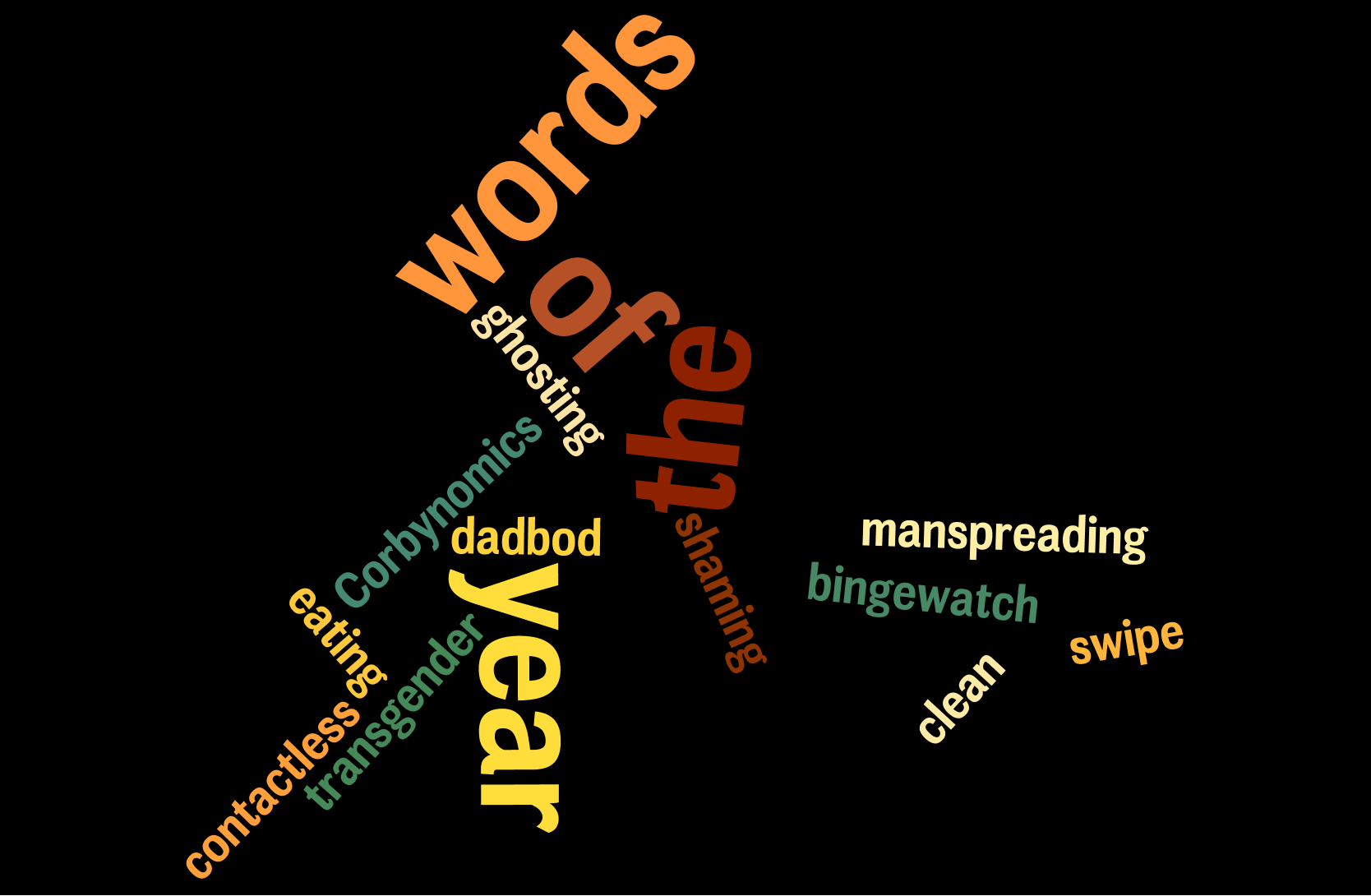
Recently I had Amber and Paul over to the flat and we talked about this list of new words that Collins are introducing into their online dictionary this year. These are all new words we’ve been using a lot this year. Collins have judged them to be worthy of recording in the dictionary. They all relate to new trends in our culture over the last year.
In this series I’m playing you chunks of the conversation with Amber and Paul, and then pausing that and clarifying some of the grammar, vocabulary and pronunciation that you heard.
So, you’re getting to hear some natural conversation, but also you’re getting some intensive language teaching too. Hopefully this is the best of both worlds for you as a listener.
Now, without any further ado, let’s carry on. Let me now play you the next conversation chunk. Here it is – this is word 10 in the list of 10 words. Here we go…
Word 10 – “transgender”
transgender (adjective): of or relating to a person whose gender identity does not fully correspond to the sex assigned to them at birth
He’s transgender.
She’s transgender.
Transgender issues.
He was held up as a great example of an American athlete. (to be held up as something)
He identified as female. (to identify as – this is the expression used to say that someone feels like they have a particular identity, particularly in relation to ethnicity, gender etc – e.g. the case of Rachel Dolezal, who worked as a civil rights leader in Washington. She was criticised in the media (shamed) for lying about her ethnicity – she basically tried to pass herself off as black while campaigning for equal rights issues – but she was actually white. Even her parents were in the media saying “yeah, she’s caucasian”. Pretty weird thing to do, and lots of people got angry saying “you can’t just say you’re black and pretend to be a victim of discrimination, when you’re blatantly white!” When criticised for this, she just said “I identify as black” – not “I am black”. This was also a trending story this year. http://www.buzzfeed.com/claudiakoerner/a-civil-rights-leader-has-disguised-herself-as-black-for-yea#.tiM247b0q
Transvestism / Transvestite (a transvestite is different to a transgender person. Transgender = a man who identifies as a woman even though physically he’s a man – or the other way around, and a transvestite is a person who enjoys dressing as a member of the opposite sex, for whatever reason – usually this is a man who likes dressing as a woman. For some reason this is far more shocking than a woman dressing in male clothes, which nobody seems bothered about)
3 positions (basically): 1. It’s a good thing 2. It’s a bad thing 3. I don’t really care either way.
She’s old school (Germaine Greer). She’s an old school feminist. (old fashioned)
Her position about what feminism should be and how we should address it was important but it has changed and I think she’s not changed with it.
(I talk over Paul quite a lot when he’s talking about same-sex marriage – sorry Paul)
Cisgender (adj)
To misgender someone (not some sort of transgender competition, it’s a verb which means ‘to wrongly gender someone’)
Mx (Mr, Mrs, Miss, Ms and now Mx)
Word 9 – “to swipe” (there’s some rude language and rude content here)
swipe (verb): to move a finger across a touchscreen on a mobile phone in order to approve (swipe right) or dismiss (swipe left) an image
Swipe was already a word, but this is the specific use of ’swipe right or swipe left’ to mean “accept or reject someone on a dating app”.
Tinder (app)
“Tinder” (“TINder??” pronunciation with surprise and disdain)
to sign up
The unwritten rule
To make a match
I will “do” anything (“do” here means “have sex with”)
Naughty pictures.
Dick-pics
Tit-pic?
‘Pussy’-pic?
Don’t go there.
You’re going there.
He’s dipping his toe in.
He’s taken pictures of his phallus. (other words for a penis. Medical/clinical words: penis, phallus. Informal but not rude: willy. Suggestive but not swear words: tadger, member, private part(s). Rude words: prick, cock, dick.)
Word 8 – “shaming”
shaming (noun): attempting to embarrass a person or group by drawing attention to their perceived offence, especially on social media
To be publicly shamed
She was trying to be funny by awkwardly implying that it’s very unfair.
There is this massive problem in Africa, and it’s less of a problem in Europe.
If you put that on Twitter the chances are people are going to misunderstand and they’re going to have a knee-jerk reaction, and they will respond in a very angry way.
An Über driver got beaten up by an executive of Taco Bell.
He was completely wasted and completely off his face.
He was slurring his words (remember that one?)
There’s something un-just about it.
You’re making a judgement call on the way someone looks, or what someone does.
You know there was that whole thing about slut shaming.
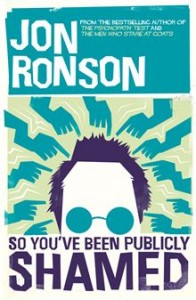
Book recommendation: Jon Ronson “So You’ve Been Publicly Shamed” www.audibletrial.com/teacherluke
His voice is a bit off-putting at the beginning but he really draws you into the story.
[socialpoll id=”2310152″]
End of Part 2
‘Peeling back the onion’ on management speak and corporate jargon.
This episode focuses on defining and explaining the examples of language you heard at the beginning of the last episode. You’ll hear Paul and me going through all the phrases and by the end you should be able to understand it all, and you could create your own version of bullsh*t bingo! See below for definitions and to print some bulls*t bingo cards.
[DOWNLOAD] The intro to part 1 – This contains all the language we define in this episode Hi Paul, thanks for taking time out to talk to me today. I just wanted to touch base with you in order to get all our ducks in a row, OK, so let’s peel back the onion and have a good look under the bonnet on this podcast situation here. At the end of the day, we’ve brought you on board here because we think you bring a lot to the table and I think that impacts favourably on our key market component players, and I think this is something we can leverage to bring about greater penetration, ultimately pushing our growth potential above and beyond just the low hanging fruit and into the stratosphere on this one. I’m talking streamlining, I’m talking synergy and with yourself on board we can push the strategic staircase all the way up to eleven. I’m talking 110% mate. After all, that’s part of our DNA here at LEP solutions isn’t it. We’re all about cascading relevant information and branching out across new frontiers and web 2.0 platforms and that’s why I thought I’d reach out to you, offline like this, just so we can have a bit of downtime to go over this, get a helicopter view to make sure nobody drops the ballgoing forward. I think you know what I’m talking about. Feedback says restructuring has been working very well, I mean, clearly this is not a come to Jesus moment, far from it and in fact I think there’s no need for much more of a drill down on this one or it’ll just turn into a case of paralysis by analysis, so let’s keep our eyes on the prize ok Paul? Wait, don’t say anything. I know what you’re thinking, you’re thinking, “but Luke, how can we truly push the envelope and come up with genuinely competitive deliverables across multiple platforms to upscale our market diversity moving forward” and that’s what I like about you Paul. You don’t beat around the bush, you just say it like it is. So, just to finish up here, I’d say – don’t let the grass grow too long on this one, okay, what I’m looking for is for you to have a get together with your team, unpack these issues, have an idea shower, really think outside the box – blue sky thinking, and then by end of play, shoot me over an exit strategy that will allow for true organic growth maximising our potential for upstream stratcom. So, if you could action that, then we’ll just run it up the flagpole, you know, put the record on and see who dances, and then ideally we can look to open the kimono and truly take it to the next level going forward, firing on all cylinders. OK?
List of Jargon & Definitions (Explained in this episode) Action = as a verb, to mean “do”. “Can you action that?” (Redundant – why say this when you just mean ‘do’? Sounds self important) At the end of the day = ultimately (why are things different at the end of the day? And anyway, it’s no the end of the day, it’s 11AM) (Cliche) Bring to the table = What table? This means to offer skills, services, ideas etc. “What are you bringing to the table?” = what are you bringing to the team in terms of skills, knowledge etc. Cascading relevant information – speaking to your colleagues. If anything, this is worse than touching base offline. From the flourish of cascading through to relevant, and onto information – this is complete nonsense. It sounds way more self-important than necessary. a Come-to-Jesus moment (A meeting in which one person has to be disciplined and brought back in line with the philosophy or ethos of the organisation, a meeting or situation in which a person/organisation comes back to core values, often admitting mistakes in the process) Sounds really pretentious. a Deliverable (a thing that has to be provided) – “the company’s primary method of measuring customer feedback on deliverables” Why not just products, services or information? It sounds annoying because it’s a noun which used to be an adjective. I think it’s not that bad. Don’t let the grass grow too long on this one = work fast. I’m looking for a polite way of suggesting that you get off your backside and get on with it. What grass anyway? This is just an annoying use of metaphor, obscuring the fact that you’re telling me to hurry up. Drill down = go into details, investigate the details. Seems unnecessarily aggressive and even overtly sexual? Drop the Ball = rugby based expression, meaning fail or make a mistake. End of play = This means by the end of the day, or by the end of the week. I guess it’s used to make it sound like sport or a game, but sorry – it’s work. Exit strategy = a planned way of exiting a situation (e.g. investors need an exit strategy) Get all your ducks in a row – be organised and in line with everyone else. You may think I’m disorganised, but there’s no need to talk to me like a five-year-old. Going forward / Moving forward = in the future Helicopter view – need a phrase that means broad overview of the business? Then why not say “a broad view of the business” or “an overview”? Idea shower – brainstorm Impact – instead of ‘effect’ as a noun. What will be the impact on our sales? How will this impact our sales? Issues (not problems) Leverage – used as verb to mean magnify, multiply, augment, or increase. Look under the bonnet – analyse a situation. Most people wouldn’t have a clue about a car engine. When I look under a car bonnet I scratch my head, try not to look like I haven’t got a clue, jiggle a few pipes and kick the tyres before handing the job over to a qualified professional. Low hanging fruit – easy win business Open the kimono = to be open and transparent, usually with external people Organic growth = naturally occurring development Outside the box = usually, “think outside the box” – this just means thinking without any restrictions, like ‘blue sky thinking’. But I didn’t realise we were in a box. Paradigm shift – just a big change in the way we do things. Paralysis by Analysis = thinking about things too much and not actually doing anything Part of our DNA = an intrinsic part of our nature, usually the DNA of a company. But companies don’t have DNA. Peel back the onion = analyse the situation in detail, going through numerous layers. Penetration = e.g. market penetration. This means going into something deeply. Again, it’s a bit sexual isn’t it. Push the envelope = make things better, challenge current standards, go further. Put a record on and see who dances – as above. Unfortunately the kind of person who says this is likely to put on Gangnam Style because they think that’s cool too. Think David Brent to the power 10. Reach out – as in “I’ll reach out to sales to get the latest figures”. Restructuring = usually this means firing people or making redundancies, or at least changing the structure of the company and moving people Run it up the flagpole – Try it and see what happens, or ask for the opinions of everyone, or show it to everyone to get their feedback. Square the circle – not entirely sure what this means! I think it means to standardise it, get it under control , solve a difficult problem. It comes from geometry – making a square with the same surface area as the circle. It’s difficult, basically. Strategic Communication (also known as “Stratcom“) = communicating with customers in a planned way. “stratcom” just doesn’t sound like English. The strategic staircase = a business plan. Thanks, but I’ll take the lift. to Streamline something / streamlining = like restructuring. A nice way of saying “getting rid of people we don’t need” Synergy = cooperation of different parts of a business. Different departments working together well. Touch Base = to talk to someone Touch base offline – meaning let’s meet and talk, in a more informal setting. Because, contrary to popular belief, it is possible to communicate without a Wi-Fi signal. No, really, it is. Fancy a coffee? Unpack (as in “Let me unpack that statement.”) = explain and go into details
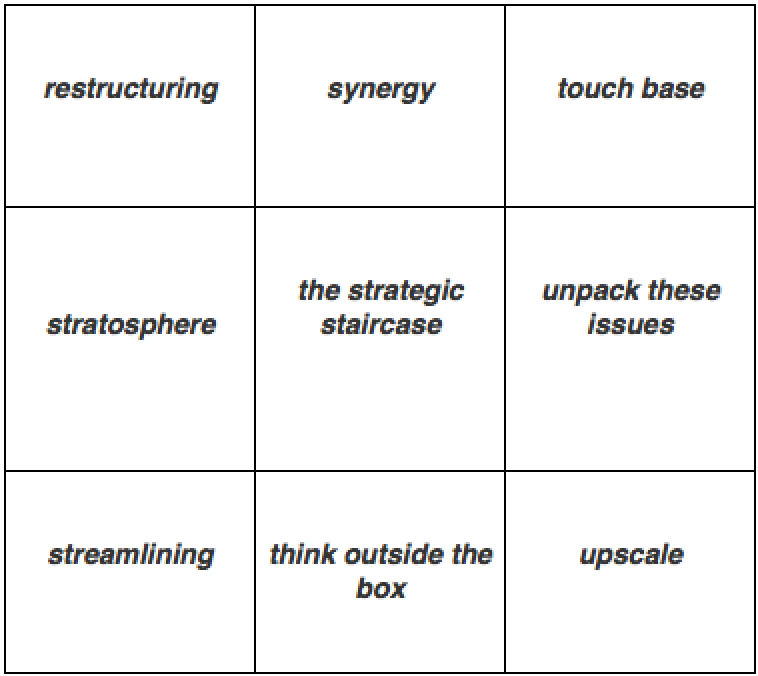
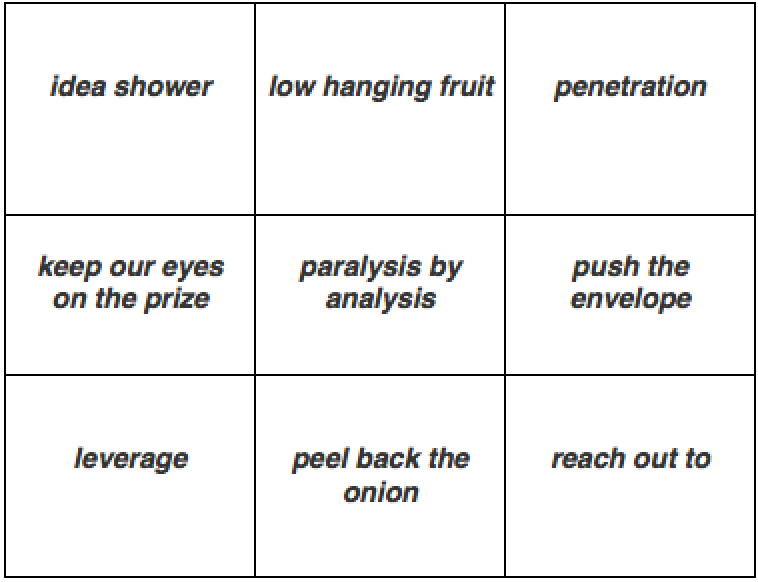
Bullsh*t Bingo
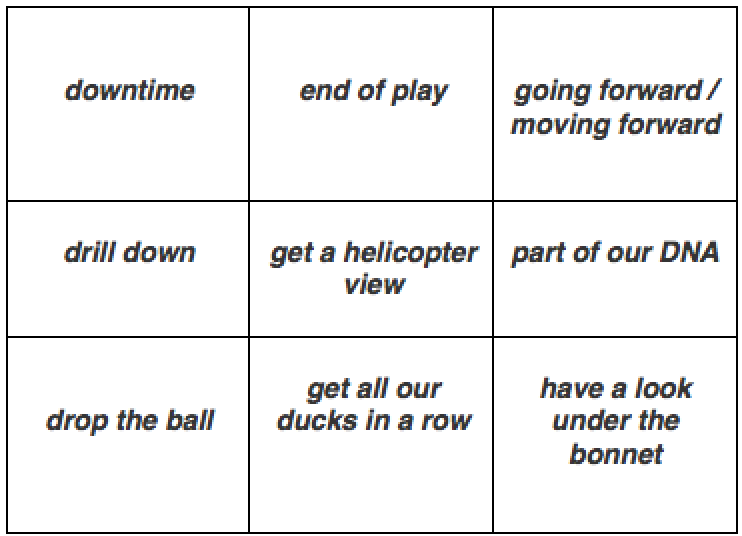
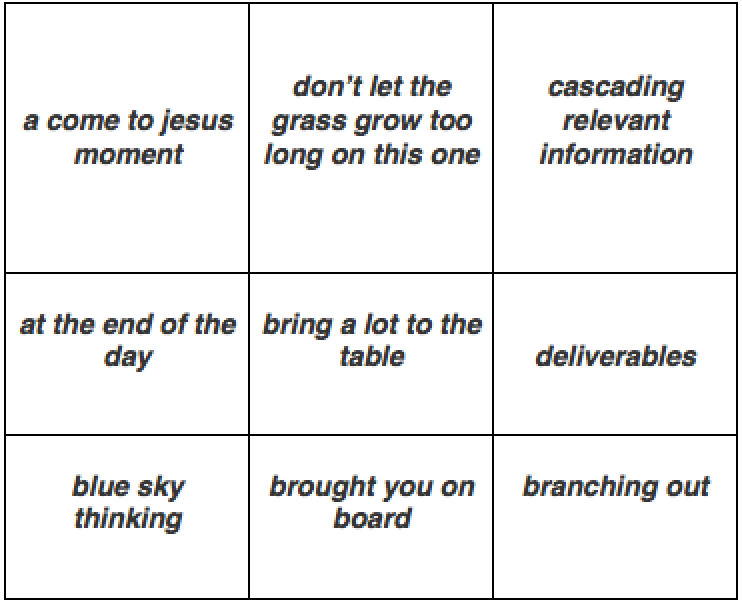
Use these cards to play your own version of bullsh*t bingo.
You can use the intro to episode 306 (in which I use a lot of management speak).
Play with 4 players.
Hand out the cards.
Listen to the intro to episode 306.
When you hear a phrase, cross it out.
The first person to cross out 3 phrases in a line shouts “BINGO” (or if you prefer: “BULLSH*T!”)
Bingo card 1
Links
13 most hated corporate jargon phrases http://www.theguardian.com/careers/careers-blog/worst-office-jargon-phrases-staff-love-hate-management-speak
Weird Al Yankovic – Mission Statement. Buy Weird Al’s Album on iTunes here https://itunes.apple.com/us/album/mandatory-fun/id891836396
UK career’s service career player. People talking about management speak.
Why do people in meetings at work keep talking about “thinking outside the box”? Why does my boss say we need to “get all our ducks in a row”? And why does my project manager want to “touch base with me offline”? If it’s all a mystery to you, don’t worry – LEP is here to decode all this weird language.
If you work in an office in an English-speaking country I’m sure you’ll have heard of ‘corporate jargon’ or ‘management speak’. This is one of the things that people complain about the most, in offices all around the UK. It seems that managers, bosses, project managers, corporate leaders all speak a strange version of English full of bizarre idioms, over-complicated metaphors and unnecessarily big words. But what is ‘management speak’, why do people use it, and why do people find it so annoying? In this episode I’m joined by former Apple employee Paul Taylor as we ‘peel back the onion’ and decode the phenomenon of management speak. Listen to find out all the details and to learn some management speak in the process.
[DOWNLOAD] Intro monologue featuring lots of ‘management speak’ (all explained in part 2) Hi Paul, thanks for taking time out to talk to me today. I just wanted to touch base with you in order to get all our ducks in a row, OK, so let’s peel back the onion and have a good look under the bonnet on this podcast situation here. At the end of the day, we’ve brought you on board here because we think you bring a lot to the table and I think that impacts favourably on our key market component players, and I think this is something we can leverage to bring about greater penetration, ultimately pushing our growth potential above and beyond just the low hanging fruit and into the stratosphere on this one. I’m talking streamlining, I’m talking synergy and with yourself on board we can push the strategic staircase all the way up to eleven. I’m talking 110% mate. After all, that’s part of our DNA here at LEP solutions isn’t it. We’re all about cascading relevant information and branching out across new frontiers and web 2.0 platforms and that’s why I thought I’d reach out to you, offline like this, just so we can have a bit of downtime to go over this, get a helicopter view to make sure nobody drops the ballgoing forward. I think you know what I’m talking about. Feedback says restructuring has been working very well, I mean, clearly this is not a come to Jesus moment, far from it and in fact I think there’s no need for much more of a drill down on this one or it’ll just turn into a case of paralysis by analysis, so let’s keep our eyes on the prize ok Paul? Wait, don’t say anything. I know what you’re thinking, you’re thinking, “but Luke, how can we truly push the envelope and come up with genuinely competitive deliverables across multiple platforms to upscale our market diversity moving forward” and that’s what I like about you Paul. You don’t beat around the bush, you just say it like it is. So, just to finish up here, I’d say – don’t let the grass grow too long on this one, okay, what I’m looking for is for you to have a get together with your team, unpack these issues, have an idea shower, really think outside the box – blue sky thinking, and then by end of play, shoot me over an exit strategy that will allow for true organic growth maximising our potential for upstream stratcom. So, if you could action that, then we’ll just run it up the flagpole, you know, put the record on and see who dances, and then ideally we can look to open the kimono and truly take it to the next level going forward, firing on all cylinders. OK?
Paul says “I have no idea what you’re talking about”
Just… it’s nice to have you on the podcast again.
So, what you all just heard there was me using a lot of what we call “corporate jargon” or “management speak”. If you didn’t understand it all, we plan to come back and explain it for you in this episode. Also, you can see it all written on the page for this episode at teacherluke.co.uk.
Management Speak / Corporate Jargon
We’re talking about management speak, or corporate jargon. That’s the focus of the episode – what is corporate jargon or management speak, how do people feel about it, what’s wrong with it (or not) and what are some of the most common examples of management speak that people don’t like?
Did you understand what I said Paul?
Have you heard that stuff before?
Paul talks about a couple of experiences at Apple.
CNN skit with loads of management speak
What is jargon?
Definition from the Cambridge Dictionary for Learners of English
jargon
noun [U] /ˈdʒɑːɡən/
› words and phrases used by particular groups of people that are difficult for other people to understand:
e.g. legal jargon, technical jargon, medical jargon, English teaching jargon (activate schemata, facilitate the non-deductive process of lexical acquisition, etc), also corporate jargon or just the jargon of managing people.
What is Corporate Jargon or Management Speak?
management speak (or corporate jargon)
noun [U] (also management-speak)
› WORKPLACE words and expressions that are used by managers and in management theory, but may not be understood by ordinary people: “Relationship marketing” is management speak for selling products by offering discounts and benefits to existing customers.
Corporate jargon is basically the same thing, and just refers to words and expressions used in the corporate world.
Why do people use management speak?
Info about Corporate Jargon from a Guardian article, which includes reference to the Plain English Campaign (a movement which has been going since 1979 to promote plain, simple and clear English free of jargon and misleading public information. It’s been supported by numerous well-known and respected public figures including heads of state such as Tony Blair and Margaret Thatcher, and the Prince of Wales – did I say respected public figures?) Anyway, here is what The Guardian wrote about the subject of management speak. The Plain English Campaign says that many staff working for big corporate organisations find themselves using management speak as a way of disguising the fact that they haven’t done their job properly. Some people think that it is easy to bluff their way through by using long, impressive-sounding words and phrases, even if they don’t know what they mean, which is telling in itself. (So, people use it to make themselves sound more important)
Furthermore, a recent survey by Institute of Leadership & Management, revealed that management speak is used in almost two thirds (64%) of offices, with nearly a quarter (23%) considering it to be a pointless irritation. “Thinking outside the box” (57%), “going forward” (55%) and “let’s touch base” (39%) were identified as the top three most overused pieces of jargon.
Why does Paul hate it?
Bullsh*t bingo?
Is there anything wrong with it?
Isn’t it just the language of work? People need to use complex language to talk about complex specialist things. But sometimes, it’s used to build power structures and not to achieve tasks. E.g. Legal English in contracts is so difficult to understand that it doesn’t help the parties to the contracts, only the lawyers who are needed to decide it all. So, arguably lawyers (even subconsciously) fill contracts with legalese to make sure they are indispensable to their clients, possibly justifying their very high fees. Similarly, managers might use this language to make themselves sound more important, confident, impressive or expert. This lack of sincerity is what irritates people. It just sounds like self-important BS, and that’s annoying when we’re just trying to get things done.
Arguments For and Against
For: Some phrases are actually pretty useful and accurate and there’s nothing wrong with them really, and it’s just pedantic and uptight to get so annoyed. E.g. “Going forward” is quite descriptive and positive, and is not grammatically incorrect.
Against: But sloppy cliches, impenetrable jargon and meaningless, redundant language does not help proper communication and can just be used to distract attention away from the real work that has to be done. Also, it irritates so many people, and that is a reason alone to look further.
Some comments from an article by Financial Times journalist Lucy Kellaway on management speak (this one http://news.bbc.co.uk/2/hi/uk_news/magazine/7453584.stm#)
Actually, this first one is from the Plain English Campaign Website www.plainenglish.co.uk
‘Human relationships depend on communication. Bad writing is a barrier to communication. When a large organisation such as the Government tries to communicate with the man and woman in the street the scope for misunderstanding is enormous. Too often clarity and simplicity are overwhelmed by pompous words, long sentences and endless paragraphs.
If we all wrote in plain English, how much easier – and efficient – life would be. It is no exaggeration to describe plain English as a fundamental tool of good Government.
Some people think that flowery language and complicated writing is a sign of intellectual strength. They are wrong. Some of our greatest communicators were – and are – passionate believers in the simplicity of the written word. As Winston Churchill described a particularly tortured piece of ‘officialese’: ‘This is the sort of English up with which I will not put.’
The Civil Service and public administration generally have made great strides in the use of plain English in recent years. Jargon and ‘officialese’, while far from extinct, are dying out. I would like to see them banished forever. Plain English must be the aim of all who work in government.’ Baroness Margaret Thatcher, former Prime Minister
No-one wishes to be reactionary and oppose all linguistic evolution; the efforts in France to “protect” their language are absurd and rightly the butt of much ridicule. However, Lucy Kellaway usefully points out how much of these recent changes are intended to deceive and mislead. Most of the phrases are merely empty, but some are deliberately dishonest and designed to distort meaning. (She takes her examples from the business world but this kind of malevolent misuse of language is at the heart of the “political correctness” fanaticism which can be seen in the political and social realms.) Douglas McCallum, Kingdom of Bahrain (temporary); otherwise, Bullwood, by Dunoon (Agyll)
Many people hate it, but here’s why you still need to know it
If you’re doing business with native speakers, and let’s face it you probably will, you’ll need to try and decode what the hell they’re talking about.
I’ve met many people from lots of countries who do business with the Brits and Americans and they often struggle to penetrate their idiomatic language.
Native speakers should really cut down on it, but it will be useful if you know some of it, or are at least aware that it exists.
So, should management speak and corporate language be banned or something? That would also be ridiculous. We don’t want a situation like in France, where a bunch of stuffy academics sit around deciding what we can and can’t say. But what we want is to cut out the bullshit factor – people just using language to lie, cover the truth, make themselves sound important or intelligent, to patronise, to be passive aggressive and all those other insincere and slightly dishonest things that people do, via language.
This episode is not just to moan about corporate jargon, but to decode it, help you learn some of it, and also to decide how bad it is really.
List of Jargon & Definitions (Explained in Part 2) Action = as a verb, to mean “do”. “Can you action that?” (Redundant – why say this when you just mean ‘do’? Sounds self important) At the end of the day = ultimately (why are things different at the end of the day? And anyway, it’s no the end of the day, it’s 11AM) (Cliche) Bring to the table = What table? This means to offer skills, services, ideas etc. “What are you bringing to the table?” = what are you bringing to the team in terms of skills, knowledge etc. Cascading relevant information – speaking to your colleagues. If anything, this is worse than touching base offline. From the flourish of cascading through to relevant, and onto information – this is complete nonsense. It sounds way more self-important than necessary. a Come-to-Jesus moment (A meeting in which one person has to be disciplined and brought back in line with the philosophy or ethos of the organisation, a meeting or situation in which a person/organisation comes back to core values, often admitting mistakes in the process) Sounds really pretentious. a Deliverable (a thing that has to be provided) – “the company’s primary method of measuring customer feedback on deliverables” Why not just products, services or information? It sounds annoying because it’s a noun which used to be an adjective. I think it’s not that bad. Don’t let the grass grow too long on this one = work fast. I’m looking for a polite way of suggesting that you get off your backside and get on with it. What grass anyway? This is just an annoying use of metaphor, obscuring the fact that you’re telling me to hurry up. Drill down = go into details, investigate the details. Seems unnecessarily aggressive and even overtly sexual? Drop the Ball = rugby based expression, meaning fail or make a mistake. End of play = This means by the end of the day, or by the end of the week. I guess it’s used to make it sound like sport or a game, but sorry – it’s work. Exit strategy = a planned way of exiting a situation (e.g. investors need an exit strategy) Get all your ducks in a row – be organised and in line with everyone else. You may think I’m disorganised, but there’s no need to talk to me like a five-year-old. Going forward / Moving forward = in the future Helicopter view – need a phrase that means broad overview of the business? Then why not say “a broad view of the business” or “an overview”? Idea shower – brainstorm Impact – instead of ‘effect’ as a noun. What will be the impact on our sales? How will this impact our sales? Issues (not problems) Leverage – used as verb to mean magnify, multiply, augment, or increase. Look under the bonnet – analyse a situation. Most people wouldn’t have a clue about a car engine. When I look under a car bonnet I scratch my head, try not to look like I haven’t got a clue, jiggle a few pipes and kick the tyres before handing the job over to a qualified professional. Low hanging fruit – easy win business Open the kimono = to be open and transparent, usually with external people Organic growth = naturally occurring development Outside the box = usually, “think outside the box” – this just means thinking without any restrictions, like ‘blue sky thinking’. But I didn’t realise we were in a box. Paradigm shift – just a big change in the way we do things. Paralysis by Analysis = thinking about things too much and not actually doing anything Part of our DNA = an intrinsic part of our nature, usually the DNA of a company. But companies don’t have DNA. Peel back the onion = analyse the situation in detail, going through numerous layers. Penetration = e.g. market penetration. This means going into something deeply. Again, it’s a bit sexual isn’t it. Push the envelope = make things better, challenge current standards, go further. Put a record on and see who dances – as above. Unfortunately the kind of person who says this is likely to put on Gangnam Style because they think that’s cool too. Think David Brent to the power 10. Reach out – as in “I’ll reach out to sales to get the latest figures”. Restructuring = usually this means firing people or making redundancies, or at least changing the structure of the company and moving people Run it up the flagpole – Try it and see what happens, or ask for the opinions of everyone, or show it to everyone to get their feedback. Square the circle – not entirely sure what this means! I think it means to standardise it, get it under control , solve a difficult problem. It comes from geometry – making a square with the same surface area as the circle. It’s difficult, basically. Strategic Communication (also known as “Stratcom“) = communicating with customers in a planned way. “stratcom” just doesn’t sound like English. The strategic staircase = a business plan. Thanks, but I’ll take the lift. to Streamline something / streamlining = like restructuring. A nice way of saying “getting rid of people we don’t need” Synergy = cooperation of different parts of a business. Different departments working together well. Touch Base = to talk to someone Touch base offline – meaning let’s meet and talk, in a more informal setting. Because, contrary to popular belief, it is possible to communicate without a Wi-Fi signal. No, really, it is. Fancy a coffee? Unpack (as in “Let me unpack that statement.”) = explain and go into details
On the podcast today I’m talking to Jessica Beck who has been working in English language teaching for over 10 years. She is an instructor, a teacher trainer and an author of 14 textbooks for learning English. You may also know Jessica from her work on the IELTS Energy Podcast (www.ielts.allearsenglish.com), which is part of the All Ears English. I talked to Gabby and Lindsay from AEE on LEP last year about culture shock, remember that? Well, Jessica is part of the All Ears English team, and is known there as the “Examiner of Excellence”. So, she knows a lot about the IELTS test, and he’s got some good advice for any of my listeners who plan to take the test, including how you can improve your speaking score if you have a good sense of humour. If you’re not planning to take the test, these skills can also be applied to your use of English in general life too.
[DOWNLOAD] Jessica has kindly written a blog post which includes the tips and useful language she mentions in this episode. You can read that blog post below.
I expect that most of you know what the IELTS test is, In fact, I have done an episode about IELTS before on LEP in which I went through every part of the test in one episode, dispensing various bits of Jedi wisdom to help you get a better score. That episode is called “Tips and Tricks for the IELTS Test”, and is episode number 254 of Luke’s English Podcast.
Check it out here www.teacherluke.co.uk/2015/01/22/254-ielts-tips-tricks/
For those that don’t know, IELTS stands for International English Language Testing System, and it’s now the world’s #1 test of English language level. The test measures your English in 4 areas: reading, writing, listening and speaking. The maximum score in each area is 9 (expert user) and the lowest is 1 (total beginner). Lots of universities, employers and other institutions around the world require an IELTS score as requirement for entry, and 7 is usually the target score, sometimes it’s higher, sometimes lower depending on the institution. Cambridge University in the UK for example requires a minimum of 7.5 overall, with no less than 7 in any of the categories. So, if you want that place at a great British or American university, the first challenge is often to get a really good IELTS score, and what you need is good advice and strategies to help you do your best.
So, in this episode we’re going to meet Jessica, and talk specifically about the IELTS speaking test, in which you have a 15 minute interview with an IELTS examiner and your spoken English is tested in a few ways. Jessica has loads of tips for the speaking exam, and I’m hoping that she can give us some advice on how having a sense of humour can get you a better score in the test. So listen for some more top tips for IELTS in this one.
Also, what do you think would happen if I took the IELTS speaking test? Well, listen to the whole episode and you’ll find out…
Now, let’s meet Jessica the “Examiner of Excellence”.
Many students, and teachers, for that matter, view all exams as formal and academic. Because of this, they believe that on these exams, test-takers must behave, speak, and write in an academic, formal style all the time.
While this may be true for some tests, there are many reasons why an IELTS candidate should not behave this way on the Speaking exam.
As we discussed on the podcast, a common mistake students make is not learning about what the IELTS examiner is looking for.
Students often look at example questions, memorize high-level words and phrases, and believe this is enough.
It’s not!
You must know what you are graded on, and where to use these words and phrases.
Your score, which can be from 0 to 9, is broken down into 4 aspects- Fluency and Coherence, Vocabulary, Grammar and Pronunciation.
What you must notice about the band score descriptors is that the examiner wants to hear a range from you- a range in vocabulary, in your ability to communicate about a variety of topics, and in your pronunciation.
The fact is that in Parts 1 and 2 on the IELTS Speaking exam, almost all of the questions are about you. They are personal and informal. Therefore, if you answer these questions in a formal way, you are showing that you do not have a range of communication ability and that you are unable to talk about personal, informal topics.
So, where does humor come in? How does it help you raise your score? Read on!
Humor helps you improve your pronunciation score. It helps you relax, allowing you to show your personality and use emotion in your voice. Showing relaxed and expressive pronunciation can push this score up to a 7 or higher!
It improves your fluency and coherence score. If you are able to answer some informal questions with a few informal anecdotes, or very short stories, about yourself, this will show that you can communicate appropriately and effectively in informal speaking situations.
It improves your vocabulary score, because you show you can use appropriate vocabulary to the question, and you have some knowledge of more interesting words and phrases. Showing the examiner a range of informal vocabulary in Parts 1 and 2, and formal vocabulary in Part 3, pushes your score up to a 7 or higher.
NOTE: Even though I’m encouraging you to communicate in a relaxed way, this doesn’t mean that you slump your shoulders and provide one word answers. You must always sit and behave respectfully, and ALWAYS answer in complete sentences.
We gave some examples of how to answer in a humorous manner on the podcast, and the phrase “self-deprecating” came up a few times.
Self-deprecation is the ability to make fun of yourself, or to share information about yourself that shows you make mistakes.
This is a humble way of communicating, and it can endear you to your listeners.
This is true on the exam and in real life!
For example, if the examiner asks, “Do you enjoy taking photographs?” A self-deprecating answer would be, “I’ll admit, I actually love taking selfies. I know this is a silly habit, and that is honestly a bit embarrassing, but I take selfies absolutely everywhere- at home, on the bus, walking up the stairs, waiting for my dry cleaning. However, I post almost none of them, so I guess it’s not that horrible of a habit!”
Other phrases you can use to introduce answers like this are: You won’t believe this, but…, This is crazy, but… and I’m a bit embarrassed to say this, but….
An excellent way to prepare to communicate in this way, on the exam and in real life, is to watch stand-up comedy, or see/listen to interviews with stand-up comedians.
Some podcasts that I recommend are Wait Wait Don’t Tell Me, a news quiz with three stand-ups, How Did This Get Made, a show with 3-4 stand-ups who talk about really bad (but sometimes popular!) movies, and Comedy Bang Bang, an interview show with hilarious skits.
If you challenge yourself to experience this type of Western, English humor, not only will this help you communicate impressively with the IELTS examiner, but it will also help you talk naturally with native speakers, and understand more jokes in movies and TV shows.
Jessica Beck is the IELTS professional at All Ears English IELTS. She has helped hundreds of students reach their target score through her simple, step-by-step systems and strategies.Learn more with Jessica on the IELTS Energy Podcast in iTunes.
This episode features a conversation with my friend Paul Taylor, who you already know from previous episodes of LEP. Paul is back from the Edinburgh fringe, where he was performing for the whole of August in a comedy show, and a couple of days ago he came over to the flat for a cup of tea and a bit of a chat. We started talking about the Edinburgh fringe and how it went for him. It was his first time and I think he found it very challenging because the audiences were hard to please, apparently they had some tough shows where nobody laughed, and he realised that the standard of stand-up comedy in the UK is much higher than he expected, but it was a learning experience. Then we ended up talking about the similarity between learning how to do stand-up comedy and learning a language. During the conversation I quickly decided to record our thoughts so that I could make it into an episode of my podcast. We wrote down a few brief ideas and then went upstairs to start recording. You can now listen to that conversation here in full. Also, listen to the end to hear some funny out-takes from this episode.
The conversation is a little bit rambling, but that is a good thing
It’s a slightly disorganised chat because we didn’t plan fully in advance, but that for me is a strength because it means that you can listen to some authentic English conversation, meaning that it is natural – not scripted. This is English conversation as it happens in the real world. We’re not acting out a dialogue, and this is exactly the sort of conversation that you should try to follow, because ultimately it’s better for your English. It might be harder to hear and understand everything we say, but that’s not a bad thing. It’s good to get used to following a conversation in which you don’t understand or hear every single word.
Conclusions about Language Learning
During our slightly rambling conversation, we do come to some very good conclusions about language learning, which are written below. So, pay attention to the conversation because I think it does contain some good advice. As ever, please add your thoughts to our conversation by leaving a comment below. What do you think about our conclusions for learning a language? Can you add and ideas of your own?
Also, listen carefully in this episode because I will share some of my experiences of learning French, which is something people have been asking me about recently. You’ll see I’m a bit shy about this subject, but I’ll let you listen to the episode to find out why.
Can You Copy The Way I Speak? – Send Me Your Recordings!
In this episode Paul and I ask you to send me recordings of you copying the way I speak. So, please send me about 1 minute of audio of you doing an impression of me.
You can download my jingle here: Download LEP Jingle
Send your 1 minute (or less) impression of Luke from Luke’s English Podcast here: podcastcomp@gmail.com
I can’t wait to hear you copy my voice and my typical introductions.
Also, if you listen all the way until the end of the episode, you’ll hear some fun extra content that I added. So, our conversation lasts about 1 hour, and then you’ll hear some fun extra stuff afterwards.
Conclusions about Learning Languages & Learning Comedy
It’s not what you know, it’s what you can do. You can know lots of vocabulary, you can know methods of learning – but you actually have to do it.
Surround yourself with people who are better than you.
Throw yourself in at the deep end.
Accept that you might have to be a slightly different person.
E.g. as a comedy performer you might need to exaggerate aspects of your person, or play a role.
When speaking English, it’s normal that you might feel like a different person with a different personality. Own the person you are in another language.
Learn from failure and don’t be afraid to fail.
Failure is not the problem. How you react to failure is more important. Don’t let failures bring you down. Learn from them. Embrace failure and don’t let the fear of failure hold you back.
Don’t take it too personally!
Be ready to take criticism, and try to look for critical feedback. It will help you to be better.
Cheat and cut corners!
In comedy it helps to arrange the situation to your advantage. For example, prepare some responses for audience interaction – these can make the audience think you’re better than you are.
Similarly in English, focus on having good pronunciation and people will think your English is great, even if your vocabulary or grammar are not perfect. If your voice sounds pretty good on the surface, this will impress people more than perfect accuracy or range of vocabulary.
Be confident, or at least be determined to fake it.
Welcome to episode 293, which is in fact part 6 in this mini series based around my recent trip to California. There’s still a lot to talk about, and in this episode I’ll tell you about our time spent in San Francisco and that’s going to include these things – my interview with AJ Hoge the well-known online English teacher, more British and American English, earthquakes, a short biography of Robin Williams, a history of the peace & love movement in San Francisco, more descriptions of our trip down the west coast of California, and some more tips about how to talk to waiters and customer service staff.
[DOWNLOAD]
It seems pretty obvious to me that this is too much for one episode, so I think there will probably be a part 7 to this series, and after that we’ll return to normal podcasting and English teaching, with perhaps some more UK oriented topics in future episodes, and more episodes featuring authentic unscripted conversations with my friends Amber and Paul.
Video
Here’s a video of the Periscope live feed I did while recording this episode. Watch the video for about 20 minutes of extra video content, and to watch me recording this episode.
AJ Hoge Interview
I think I should start this episode with my interview with AJ Hoge. This took place in San Francisco in the lobby of the hotel where we were staying.
Who is AJ? http://ajhoge.com and http://effortlessenglishclub.com
AJ is an American-born English teacher who started his career as a social worker (what’s a social worker?) before going into English language teaching. He taught English abroad in Thailand, Japan, Korea and other places, and at home in San Francisco before becoming an independent self-employed teacher on the internet. He has created his own online English teaching courses and has written a book about learning English, and he sells all those things on his websites (see links above). He’s also a public speaker who has been booked to do conferences, speeches and presentations about learning English, sometimes to thousands of people at a time. He’s probably the most well-known English teacher on the internet (yes – more well-known than me – he’s good at marketing himself!) and I’m sure that you’ve come across him. I’m very impressed by what he’s achieved as an independent teacher and it was really interesting to meet him and find out about his work. I recorded our conversation and I’m going to play it to you right now.
Unfortunately I had a bit of a technical problem during my meeting with AJ. I was using a new portable audio recorder and for some unknown reason it kept turning itself off during our conversation, which was very frustrating indeed. So unfortunately some parts of our conversation are lost. That explains why the conversation cuts out a couple of times, particularly at the end. Fortunately, the main part of our conversation was recorded, so let’s listen to it now!
Part 1 – You’ll hear an introduction, but then the recorder switched itself off after a couple of minutes, which is why the conversation stops abruptly.
Part 2 – I started again after discovering that the recorder in my hand had in fact switched itself off again. We spoke for another 20 minutes or so and then the recorder switched itself off again! This is why the conversation stops abruptly before I had the chance to say thanks and goodbye to AJ. We plan to stay in touch though, and we might talk again via Skype in a future episode of the podcast.
More British and American English Vocabulary (Part 3) – Clothing
Trousers – Pants Clothing
Nappy – Diaper Babycare
Jumper – Sweater Clothing
Tights – Pantyhose Clothing
Waistcoat – Vest Clothing
Trainers – Sneakers Footwear
Braces – Suspenders Clothing
Dinner Jacket – Tuxedo Clothing
Polo neck (sweater) – Turtleneck Clothing
Wellington Boots (Wellies) – Galoshes Footwear
August 14
Let’s go back to the day we left Yosemite, before I met AJ in San Fransisco. Remember that this is after we had our long hike in the mountains and my wife sprained her ankle and had to use crutches to walk down.
In the morning my wife tentatively tries walking a bit on her ankle and thankfully seems ok after all that rest, and because she managed to keep her weight off it during the rest of trek with the help of the crutches. She’ll be able to rest it even more in the car, and take it easy for the whole day as we won’t do much walking.
We drive out of Yosemite. It’s a bit of a pity to be leaving all these huge rock formations like El Capitan and the Half Dome. We’ve got to know them quite well, and it’s always an exciting surprise to see them through the gaps in the trees. They’re like the big celebrities in this park and whenever you see them they dazzle you with their charisma and charm. As we’re driving out of the valley we stop a few times to just stare up at them for a while, particularly El Capitan, which I think is one of the biggest vertical rock faces in the world. Rock climbers enjoy climbing it, but it can take 4-5 days to go up the whole thing. The climbers actually sleep on ledges on the rock face, or they set up beds which hang from hooks in the rock face. Imagine sleeping on a tiny camping bed, hanging from the cliff, with thousands of feet of air below you. I’d never be able to sleep in those conditions! But it must be an incredibly thrilling way to enjoy the place.
We’re going to miss these mountains and rock formations, but it’s time to drive to our next stop – a place we’re looking forward to very much. San Francisco.
As I outlined in the second part of this series when I talked about California’s history, SF was originally a Spanish settlement for missionaries, but then when gold was discovered at almost exactly the same time that California became part of the United States, the city grew really fast to be a gold rush town, with thousands and thousands of people moving into the area, including many Americans, but also Europeans and Asians. That multicultural mix is still evident today.
SF is also known for its earthquakes. There was a big one in 1906 that destroyed large parts of the city, but it rose again, like a phoenix from the ashes. In fact, the flag for San Francisco shows a picture of a rising phoenix to commemorate the city’s recovery. There have been a few big earthquakes here over the years, including another one in 1989. The city is still expecting another really big earthquake to hit at any time, which is a bit of a worrying thought, and one that I suppose the residents of the city don’t think about too much. Does that idea give San Francisco a kind of laid back and open-minded atmosphere? Possibly. I suppose if you know in the back of your mind that everything could be destroyed any minute by a big earthquake, it makes you a bit more philosophical, or it makes you enjoy every moment while it lasts. That feeling does pervade the place a bit. It’s got a peaceful, meditative and bohemian atmosphere which is really refreshing.
San Francisco is also known for being the focal point of the beatnik and hippie movements of the 1960s. Haight Ashbury in particular is the district that was associated with those movements. More on that later.
Long drive to SF.
First views, Bay Bridge.
Obligatory Wholefoods stop.
Our hotel and the area. Polk Street. Home for the next few days.
We’re staying near a place called “Nob Hill”. In fact our area is known as “tender nob”, which I found particularly funny, because ‘tender’ means soft, and a ‘nob’, well, it’s a bit rude – it’s a willy, a penis… So…
Being in SF was like being back to civilisation, and a really great kind of civilisation. A really bohemian and cool atmosphere, with interesting places, loads of originality, lots of good little shops, cafes and bars with long lists of local beers, coffees, wines and ciders. We pretty instantly fall in love with the whole Russian Hill/Polk Street area. We walk up the street looking for places to have dinner and breakfast the next day.
Bookshops, bars, cafes, the boardgames shop (Sherlock Holmes boardgame) and pizza & beer. Settle in nicely.
August 15
Next day, explore. Russian Hill, Pacific Heights. Those hilly streets and amazing views!
Have breakfast in a place called “Toast” which seems to me like the most American breakfast place ever, and I order a big American breakfast plate loaded with pancakes and fruit, with butter and maple syrup. It’s absolutely delicious, but later that day I feel like my blood-sugar levels are such a mess that I really shouldn’t eat more food like that and decide to try to be more healthy.
Again, I’m reminded of films which are set here, including Dirty Harry and Bullitt.
Beautiful multicolour houses and quirky doorways. Very expensive neighbourhood.
We come across a tribute to Robin Williams outside a house where they filmed Mrs Doubtfire. It’s exactly one year since he died. We hang around there, thinking about Robin Williams.
Who Was Robin Williams, and What Happened to Him?
Let me give you a brief history of the life and death of this great comedian.
Trained at Juilliard School.
Had a particular gift for improvisational comedy.
Became famous in Mork & Mindy.
Also did stand-up.
Had big problems with alcohol and substance addictions, particularly cocaine.
He managed to quit when his first child was born. Lived as a recovering alcoholic.
Went on to do some very popular movies, in both comic and straight roles.
Won an oscar for his role as a psychiatrist in Matt Damon and Ben Affleck’s film Good Will Hunting.
Apparently he was a very sweet, very generous and warm guy, but he was affected by bouts of depression.
As a performer I find him incredibly versatile and animated. His comedy seems almost to be compulsive in its nature. He’s a whirlwind when in front of an audience, full of impressions, different voices and many bizarre tangents which are often dialogues between different characters, all played by him at break-neck speed.
In interviews he seemed to occupy two modes – the first was the extrovert comedian, the other was the sweet and sincere actor. He seemed a bit bipolar. I guess part of his talent was that wildly free sense of instant creativity, but it might have been quite difficult for him to deal with on his own.
He fell off the wagon (began drinking again) in 2006 while filming in Alaska. It’s kind of understandable that he turned to alcohol again considering the circumstances – I mean, he was in Alaska. (just kidding)
He went into Rehab but I think the return to alcohol was a symptom of a difficult time in his life.
He later had heart surgery which involved part of his heart being replaced, and apparently this affected him quite badly as his physical and mental condition seemed to get worse and apparently from that time forwards he suffered from depression, anxiety and paranoia. He was wrongly diagnosed with Parkinson’s too, and given medication and treatment that didn’t help the real condition that he was experiencing, which is called Lewy Body Dementia, a degenerative condition in which nerves cells in the brain are blocked by protein clumps (bodies) that interfere with function. Apparently the Parkinson’s medication made the Lewy Body Dementia worse and may have exacerbated his low state of mind, pushing him to suicide.
He killed himself almost exactly a year ago to the day that we found ourselves at the shrine to his memory on this San Francisco street.
I couldn’t help feeling a bit sad about this because I really enjoyed Robin William’s comedy, but also it’s just such a pity that he had to go through such misery, and that anyone has to go through any kind of misery caused by physical and mental conditions. I hope with more research and the right kinds of treatment, this sort of thing can be prevented in the future.
Anyway, I just wanted to mention Robin Williams there, as a sort of tribute.
SF continued…
Korean Barbecue
End of Part 6 (Oh my goodness, will I ever finish this series!?) Part 7 coming soon…
Cookies on teacherluke.co.uk
Click “Accept All”, to consent to the use of all cookies on this website, or visit "Cookie Settings" to control your consent settings.
This website uses cookies to improve your experience while you navigate through the website. Out of these, the cookies that are categorized as necessary are stored on your browser as they are essential for the working of basic functionalities of the website. We also use third-party cookies that help us analyze and understand how you use this website. These cookies will be stored in your browser only with your consent. You also have the option to opt-out of these cookies. But opting out of some of these cookies may affect your browsing experience.
Necessary cookies are absolutely essential for the website to function properly. These cookies ensure basic functionalities and security features of the website, anonymously.
Cookie
Duration
Description
cookielawinfo-checkbox-analytics
11 months
This cookie is set by GDPR Cookie Consent plugin. The cookie is used to store the user consent for the cookies in the category "Analytics".
cookielawinfo-checkbox-functional
11 months
The cookie is set by GDPR cookie consent to record the user consent for the cookies in the category "Functional".
cookielawinfo-checkbox-necessary
11 months
This cookie is set by GDPR Cookie Consent plugin. The cookies is used to store the user consent for the cookies in the category "Necessary".
cookielawinfo-checkbox-others
11 months
This cookie is set by GDPR Cookie Consent plugin. The cookie is used to store the user consent for the cookies in the category "Other.
cookielawinfo-checkbox-performance
11 months
This cookie is set by GDPR Cookie Consent plugin. The cookie is used to store the user consent for the cookies in the category "Performance".
viewed_cookie_policy
11 months
The cookie is set by the GDPR Cookie Consent plugin and is used to store whether or not user has consented to the use of cookies. It does not store any personal data.
Functional cookies help to perform certain functionalities like sharing the content of the website on social media platforms, collect feedbacks, and other third-party features.
Performance cookies are used to understand and analyze the key performance indexes of the website which helps in delivering a better user experience for the visitors.
Analytical cookies are used to understand how visitors interact with the website. These cookies help provide information on metrics the number of visitors, bounce rate, traffic source, etc.
Advertisement cookies are used to provide visitors with relevant ads and marketing campaigns. These cookies track visitors across websites and collect information to provide customized ads.