Category Archives: Learning

372. The Importance of Anecdotes in English / Narrative Tenses / Four Anecdotes

This episode of the podcast is all about telling anecdotes in English. Anecdotes are little stories about our experiences that we share while socialising. It’s important to have a few anecdotes of your own and to know how to tell them properly. In this episode I’m going to give you some advice for how to tell an anecdote and then you’re going to listen to some true anecdotes told by members of my family that I recorded yesterday evening during dinner.

Small Donate Button[DOWNLOAD]

This episode is sponsored by italki. Speaking practice is very important in developing natural, fluent English and this is now really easy to achieve because with italki you can find plenty of native speakers and teachers to talk to, you can set your own schedule and you don’t even need to leave the house – you can do all of it from your own home. If you want to practise telling your anecdotes, do it in conversation on italki. They have lots of friendly and experienced teachers who are ready to help you to learn English your way. Go to http://www.teacherluke.co.uk/talk to get started and to get a voucher worth 100ITC when you get some lessons. OK, let’s get started!

I’m at my parents’ house for a few days. My brother and I are just taking a couple of days off and spending some time here doing the usual things like enjoying the fresh air, talking to my parents and taking advantage of our mum’s cooking.

Yesterday evening we were eating dessert at the end of dinner and we started talking about anecdotes. I think I asked everyone, “Do you have any anecdotes?” I asked them to think of an anecdote they’d told before. We were about to start when I realised that it might be a good idea to record the  talking, so I quickly got my audio recorder and then recorded them telling those anecdotes. Each one is about 5 minutes long.

Before we just listen to their little stories, let’s consider anecdotes and how important they are in English.

From the archives: Another episode about telling anecdotes (episode 44) https://teacherluke.co.uk/2011/10/11/telling-anecdotes/ 

By the way, listen to this episode from the archives about telling anecdotes. I gave some advice for anecdotes and then we listened to a couple of funny ones. This episode develops the ideas I talked about in episode 44.

What are anecdotes and why are they important?

The Collins Online Dictionary defines an anecdote as a short, usually amusing account of an incident, especially a personal or biographical one.

So, essentially anecdotes are little true stories about ourselves. We are usually the protagonists in our anecdotes, and they’re usually told in informal social situations. Sometimes there are moments in our social interactions when we just start sharing little stories about things that have happened to us in our lives. This might happen at a dinner, or when you’re generally spending some extended time with other people. Anecdotes are a really common part of the way we socialise in English. They allow us to entertain the people around us, while letting them know a bit more about us.

Both of those things are vital in my opinion. If you’re trying to build a relationship with people it’s important to both entertain them and also share some personal information with them. Entertaining the people around you is important because it just makes them feel good. If you can make people feel good, they’re much more likely to trust you, to give something to you in return and also, it’s just good to entertain people around you. It’s just fun and enjoyable to hear about people’s experiences. Also, giving away some personal information is a good way of encouraging other people to do the same thing. That’s how you build trust. For building a relationship you can do two things: ask questions and be prepared to give away details about yourself. Anecdotes help you achieve the second one in a fun way.

So, how do you tell an anecdote in English?

Tips for Telling Anecdotes

  1. Find the right moment. Usually they take place in informal anecdote sharing sessions. Don’t just jam your story into a conversation. It should add something to the subject of the conversation. E.g. you might be sharing travelling stories, or stories about weird people you’ve met, or university stories, or dangerous experiences. That’s when it’s appropriate to add your story too. Maybe you’re talking about a particular subject and your anecdote will add something to that conversation. E.g. you might be talking about the difficulty of finding accommodation in your town, and you could tell the story of the crazy landlord you used to have. Perhaps someone has just told a story, and you’ve got one that relates to it too. All of those are good moments to introduce your anecdote. Only tell your story if it relates to the conversation you’re already having.
  2. Keep it short! Don’t get stuck in the details too much. Focus on the impact of the story. What emotion are you attempting to elicit in people? What is the feeling you’re trying to get across? Is it frustration, fear, danger, humour? Focus on communicating a feeling and try not to let the details get in the way. You need to communicate that feeling by explaining the right events. The best anecdotes allow the listeners to discover the same feelings as you did when you felt them, so describe the events and aspects of the situation that made you feel that way. Don’t get caught up in the details. Keep it pretty short and simple. Say the word “anyway” when you get stuck in the details and want to move on to the main stuff.
  3. Use the right narrative tenses. Usually we tell anecdotes in the past. That means you’ll be using past simple, past continuous and past perfect. Here’s a really quick and simple explanation of how you use those tenses. Past simple – this is the tense you use to explain the main actions in the principle part of the story. E.g. I saw a spaceship, I stopped my car, the spaceship flew above me, all the objects in my car started floating, I saw a bright flash of light, then I woke up lying down in the forest with a pain in my backside.” Past simple is usually used for short actions that happen one after the other. Past continuous – we use this to explain the situation at the time the main events happened. It’s for context. It sets the scene. E.g. “I was driving in my car through the countryside late one night when I saw something strange”. Also, it’s for moment by moment action, and it’s when two things happen at the same time. Past continuous is for the longer action of the two. The action starts, is interrupted by a shorter past simple action, and then may or may not continue. E.g. “I was trying to remember where I was when these guys in black suits turned up and started asking me questions.” Past perfect – this is for giving back story. Use past perfect to talk about events that happened before the main events of the story. E.g. I told the guys that I’d just been camping in the forest and that I’d got up in the night to go to the toilet and I’d lost my tent, and that’s why I was sleeping outside like that. I told them I hadn’t seen any aliens or anything like that.” Past perfect is a difficult one to notice when listening. The “had” is often contracted and can be impossible to hear. It’s possible to identify past perfect because of the use of past participles, e.g. “I’d seen it before” and “I saw it before” but when regular verbs are used it can be almost invisible. Compare “I’d finished” and “I finished”. They sound very similar. Sometimes ‘had’ is not completely contracted but pronounced using a weak form, like ‘/həd/’ e.g. “He had been there before”. It might also be part of a continuous form, like “He had been talking to someone else”.
    So, there are the narrative tenses – past simple, past continuous, past perfect. Past simple is the most common one – you could probably just tell the story with that one on its own, but adding the other two will give your stories more depth and range. Think about how you use these three tenses when describing events in the past.
  4. Tell us how you felt. That’s pretty simple. Just give us some emotional content.
  5. Use direct speech. Don’t worry about using reported speech, just use direct quotes. E.g. “He said “What are you doing here?” and I said “I’m just camping!” and they both said “Where’s your tent?” and I said “It got stolen in the night, or I lost it, I can’t remember”. I don’t think they believed me but they told me to be careful and to go home.
  6. Introduce your story with a quick sentence, like “I got abducted by aliens once” or “I saw a weird thing once” or “That sounds like something that happened to me once”. That’s generally a sign that you’ve got a little story to tell. However, if people aren’t really listening, don’t worry about it, this might not be the moment for your story.
  7. When someone has just told a little story, ask a few questions or respond to it in some way. Show some appreciation of the anecdote – like, “Oh my god I can’t believe that!” or “Wow, I can’t believe that you got abducted by aliens!”
  8. Try to make it quite entertaining! If the story doesn’t have much entertainment value, keep it extra short. You can exaggerate the story a bit, but don’t lie, that’s just deceptive. For example, don’t just make up a clearly fictional story about being abducted by aliens. Obviously, it should be very much ‘based on a true story’. Repeating anecdotes a few times is quite common. In fact, people carry anecdotes with them through their lives and repeat them again and again. You probably have a few experiences that you’ve described a few times – they’re your anecdotes. Try converting them into English, and it’s ok to practise those anecdotes a few times because you’re learning the language. Think about experiences you’ve had in your life – how would you describe them fairly quickly in conversation, focusing on the main events and how they made you feel at the time?
  9. Show us when the story is finished. Typically we might say “That’s what happened.” or “And that’s it” or even “That’s my alien abduction story.” It’s nice if your anecdote can end with a funny line or a punchline, but that’s difficult. It might also be good to say what you learned from your experience.

Now, let’s hear my family’s anecdotes shall we? (yes)

By coincidence, all these anecdotes relate to meeting strange people and most of them involve some element of danger (in the case of the boys’ stories) or embarrassment in my Mum’s story.

Imagine you’re at the dinner table with my Mum, Dad and brother. As you listen, think about the things I’ve just mentioned, and try to notice them. You could listen to this episode a few times. Try to notice different things I mentioned about telling anecdotes. Which anecdote do you think is the best? Why is it a good one?

Here are some key points to watch out for.

  • Narrative tenses used – in particular, can you hear when past perfect is used? It’s only used in 3 out of the 4 stories. Watch out for past continuous to set the scene. Is that one used in every story?
  • When someone says “anyway” in order to avoid getting caught in the details
  • What is the main feeling that the person is trying to communicate? Is it danger, embarrassment, weirdness?
  • How does the anecdote end?
  • Any new vocabulary?

I’ll let you listen to the anecdotes, and then I’ll deal with some vocabulary and make any other points afterwards.

Mum’s Anecdote – Meeting the King of Tonga

(Tonga is a Polynesian kingdom of more than 170 islands, many uninhabited)

*some past perfect is used to explain what the king had been doing before mum arrived

It’s going to fall very flat = it’s going to fail to have the intended effect. E.g. if a joke falls flat, it doesn’t make anyone laugh. If a story falls flat, it is not impressive or amusing.

It’s been built up too much = We say this when people’s expectations have been raised. To ‘build something up’ means to raise people’s expectations of something. You’d say this before telling a joke if you feel like everyone’s expectations have been raised. E.g. “What’s this Russian joke? I’ve heard you talking about it a lot, so it must be amazing.” “Well, it’s been built up too much now, it’s just going to fall flat.” or “Have you seen the new Spielberg film Bridge of Spies, oh my god it is amazing!” “Don’t build it up too much!”

I was nothing to do with it = if you have nothing to do with something it means you are not involved or connected to anything at all. E.g. “Mr Thompson, I want to talk to you about the bank robbery that occurred in the town centre last year.” “Bank robbery? I had nothing to do with it officer, I promise!” or simply “There was a royal visit happening, but I had nothing to do with it. I was just there to pick up my husband.”

I was just a hanger-on = a hanger-on is someone who just hangs on. This is someone who is nothing to do with what’s happening but they just hang around. E.g. musicians often have hangers on. These are people that hang around the band even though they’re not contributing to the show at all. They’re just hanging on because it’s cool or fun to be with the band.

I was skulking in the corner = to skulk means to kind of hide or keep out of sight, often in a slightly cowardly way.

He beckoned to me = to beckon to someone is to wave someone over to you with your hand. It’s to do a motion with your hand which encourages someone to come to talk to you.

He was eyeing her up = this means to look at someone because you fancy them – to look at someone with sexual interest. E.g. the king of Tonga was eyeing up my Mum all evening.


James’ Anecdote – Hastings Story

a skate park = a place designed for skateboarding

the ramp’s in the church = a ramp is a thing for skateboarding on. It has sloped sides so skaters can go up and down on it

a hog on a spit = a hog is a pig, and a spit is a stick that goes through the pig, suspending it above a fire

we had too good a time = we had a good time – but if you want to add ‘too’ you need to say “we had too good a time” not “we had a too good time” – this works with the structure in general. “It was too big a pizza for me to eat” or “It was too long a journey to make at that time of night”

I was too drunk – not in a lairy way = to be lairy means to be aggressive and anti-social. It happens when some people get drunk. They get lairy.

I’m bigger than him, I can take him = to ‘take’ someone means beat them in a fight

We crashed out = to crash out means to fall asleep, usually quickly and often in a place where you don’t usually sleep.

I’ve painted everything in hammerite http://www.hammerite.co.uk/ = hammerite is a kind of metallic paint

He was coming round = to come round here means to wake up, or come back to consciousness

I didn’t get interfered with = to interfere with someone could mean to touch them in a sexual manner

*just past simple


Dad’s Anecdote – Hitchhiking in Italy

*all the narrative tenses used

We got a few good lifts = a lift is when someone takes you somewhere in a car. E.g. “Could you give me a lift to the station?”

This car pulled up = this is when a car stops by the side of the road (also – pull over)

He was a slightly dodgy character = dodgy means untrustworthy or suspicious

The car broke down = stopped working

They turned on him and said “What are you doing?” = to turn on someone (not turn someone on) means to suddenly start criticising or attacking someone. In this case, there were curious neighbours listening to the argument and after a while they turned on the guy – they decided that he was wrong and they started criticising him

I managed to jump in and grab the keys from the ignition = to manage to do something (this is an important verb structure) – also ‘the ignition’ is the part where you put the keys in order to start the car, e.g. “You left the keys in the ignition”

I dangled the keys over a grating / a drain = to dangle something over something is to hold something in the air so that it swings from side to side slightly. E.g. We sat on the edge of the bride with our legs dangling in the air.


Luke’s Anecdote – Liverpool StoryLEPcupPOLARIOD

*Includes quite a long passage with past perfect when I described what had happened to the man before he arrived at our front door.

There was some sort of commotion going on in the hallway = a commotion means a period of noise, confusion or excitement

He ran through all the alleyways = alleyways are passages between or behind houses

That’s it for vocabulary!

Which anecdote did you like the best, and why?

[socialpoll id=”2380425″]

364. TEN TOP TIPS for Learning English

LEP is back after a two-week absence. This episode is about top tips for learning English. Here are some ideas about learning English that have occurred to me in the last couple of weeks of teaching intensive general English classes at school.

Small Donate Button[DOWNLOAD]

So, how’s your English?

Remember to be responsible for your own learning. Nobody can learn for you.

It’s all about establishing habits for improving your English, and keeping up those habits.

TOP TIPS FOR LEARNING ENGLISH

  1. Watch movies and TV in English. This is what people always say, but it can work really well if you do it right. Here are some specific tips. Repeat watch a movie that you love in English. Watch it with subtitles in English. Then watch it again without the subtitles. Put your phone in front of the TV or computer and record the audio, then listen to it when you’re out and about. Quote some of the lines. Recreate parts of the film on your own. Go the extra distance and think outside the box.
  2. Find a book that you know quite well. Read it in English and also listen to the audiobook. You won’t mind repeating it because you love it. You already know the story, so now you can explore it in English. Imagine hearing all those lines in English again and again.
  3. Keep two notebooks. Go down to the stationery shop and buy two nice notebooks. The first one is for scribbling things down quickly and just keeping quick notes. The other one is where you keep an organised record of words and rules. Keep the first one with you when you’re watching, reading or listening to stuff in English, or when you’re in conversation on italki or something. The other one is going to be like your bible for English and you’re going to write it yourself.
  4. Use mnemonic devices to help you remember.
  5. Listen to my podcast! Listen to episodes more than once. You’ll find that specific things I say will stick in your mind. You’ll also find things funnier and funnier, I promise. Some of my episodes are designed mainly to make you laugh. You need rewards for understanding and learning a language, so let the funny moments be a reward in themselves. Enjoy the process of understanding what I’m saying, and getting the subtleties and nuances. Check out the page for each episode. You’ll often find words written there. Often the introduction or the whole episode is transcribed. You can use that to help you learn.
  6. Get a grammar book and do the exercises, then do them again a few months later. English Grammar in Use is still the best one. Even if you’re pretty good at English already, going through those pages systematically will iron out a lot of the fossilised errors you have. Then when you listen to English, read English or speak to people just try to notice some of the grammar you’ve been studying. Also, if you don’t understand some of the grammar – don’t worry about it, just carry on. The worst thing you can do is stop when you feel confused or frustrated. You don’t have to understand 100% of the grammar. Just understanding 70% is ok. Do your best to understand it all, but it gets pretty complex and abstract (not as much as most other languages). The main thing is: when you experience difficulty or resistance – the worst thing you can do is stop. Just keep going anyway! Work with what you have and make progress in little steps.
  7. Just keep yourself switched on at all times! Be mindful. Notice language and take opportunities to learn. Some learners of English are just not diligent enough. Every error is an opportunity to learn. Bit by bit, step by step.
  8. The pizza analogy.
  9. Enjoy the small victories. Every single positive moment in your learning should be celebrated. If you understand something fully – well done you. If you say exactly what you wanted to say – well done you. If you stopped making a fossilised error, well done you.
  10. Enjoy it! You only get one life. (deep and meaningful moment)


More episodes coming soon.

Thank you so much for your comments and messages. I’m sorry I can’t reply to them all.

Have a good day/night/evening/morning, wherever you are, whatever you’re doing!

:)

357. Learning Languages with Olly Richards

In this episode I’m talking to Olly Richards the polyglot from England. Our conversation covers points about what accent you should learn to speak with, the importance of developing clear pronunciation and effective communication in English, using Periscope to listen to native English speakers and the physical side of learning a language. See below for a transcript to the introduction, more information and links to Olly’s work.

Small Donate Button[DOWNLOAD]

Introduction Transcript

Olly Richards, the polyglot from England, is on the podcast again today. This is the second time I’ve spoken to him on this podcast. The first time was back in February I believe. [A bit about how to say “February”] That’s episode 332. If you haven’t heard that one, I recommend that you go into the archives, find it (or click here) and listen to it because it’ll give you some good context for this one and also it’s just really useful for English learning because it contains loads of good advice and lots of motivation.

Olly is a great guest for this podcast because he basically spends his time learning languages and helping other people to learn languages too. Olly has managed to learn lots of languages including French, Spanish, Portuguese, Japanese, Arabic and Cantonese and he learned them all in adulthood, not as a child. That’s quite an achievement and he’s managed to do it using some pretty clever strategies, techniques and routines which we can all apply to our language learning too.

Now, I’ve arranged to speak to Olly over Skype in just a few minutes so I’m just gearing myself up for the conversation now. I’m getting my Skype settings correct. Last week I saw him briefly on Periscope talking about a recent work-related trip to LA and how the trip had affected his language learning routine and it sounded very interesting so I sent him a message saying “Hi Olly, I saw you on Periscope the other day – Do you fancy coming on the podcast soon for a catch up?” and he quickly replied by saying “I’d LOVE to come back on the podcast. I could do podcasts all day long, and especially yours since it’s so much fun.” So that’s that. It’s all been set up.

We haven’t done much preparation for this beyond just setting a time for the conversation. The idea is that we’re going to just catch up on his recent news, see where the conversation takes us and ultimately share more conclusions and tips about language learning.

Oh, there’s just one last thing. Do you remember in our last conversation that Olly asked me to make a commitment about my French learning? I promised that I would practice for 10 minutes a day. Also, I seem to remember a number of you made commitments about your learning in the comments section and I wonder if you’ve kept up with them. Well, honestly – I haven’t been the greatest student because I haven’t kept my promise. Yeah, I know, I know. To be fair, I did go out and buy some self study materials which I chose very carefully and I started with the best of intentions, but I only did a few pages and then got out of the habit of doing it. So, I feel a bit bad about that and I wonder if he’s going to bring it up. I think he probably will, but let’s see. Now, my French has definitely improved recently but the rate of improvement is just not good enough and I need to pull my socks up and turn over a new leaf and adding some daily practice into my routine would definitely help. Anyway, let’s see if he brings it up.

Now though, it’s time to talk to Olly Richards the polyglot from England. Here we go.

*Conversation Starts*

We talk about…

  • His trip to the USA
  • How accents change when people travel to different places (e.g. when Brits go to the USA their accents ‘accommodate’ to the local accents a bit, and vice versa)
  • The relationship between accents and our identity
  • Accent reduction vs learning clear pronunciation
  • The physical side of learning a language. Is it normal to experience any physical pain when practising your speaking
  • The importance of engaging in conversations in English to improve your effectiveness in communication – italki is a good way to do this

Click here to check out italki – www.teacherluke.co.uk/talk

Links

  • Download the Periscope App here https://www.periscope.tv
  • Olly’s website: http://www.Iwillteachyoualanguage.com
  • Olly’s book of short stories on Amazon NOW AVAILABLE!
  • Kindle: http://amzn.to/1Ys8HSH
  • Paperback: http://amzn.to/1Udvsd1

Now, I’m going to have my lunch. Cheers!

Luke

353. Award Ceremony / Paris Weather / Crazy Idea (A Rambling Episode)

This episode started with no title and no particular aim, but I ended up chatting about walking the red carpet at the ELTon awards, the rain and floods in Paris, getting struck by lightning, the revolution of fibre optic internet at home and a crazy idea about doing live podcast recordings around the world. Listen up!

[DOWNLOAD]

  • I’m going to do some unplanned waffling on these topics:
  • ELTon awards – the ceremony, other nominees.
  • Paris weather – 3 weeks of rain, feeling under the weather, flooding, don’t get struck by lightning.
  • “Sorry, we’re English” – will continue during the summer (except most of August), LEPsters are always welcome, sorry if you came last Thursday and I missed you.
  • CRAZY IDEA – The LEP World Tour. Can you imagine me doing a live podcast recording or comedy show in your town or city? Do you know a good venue where I could do it? It would need a stage, a microphone, seating for about 50 people (perhaps more) and friendly staff. Let me know.
  • EURO 2016 – International football! And it’s happening in France.
  • Fibre optic internet (exciting development) – I no longer feel like I’m squeezing a litre of water through a syringe whenever I upload an episode.

10344344_10152147079096806_4328275442704070238_o

I was interviewed by Olly Richards on his podcast, called “I Will Teach You a Language” and we talked about language learning

Did you enjoy episode 332 of my podcast, with Olly Richards? It seems to have been a popular one. If you did enjoy it, you might want to check out this new episode of Olly’s podcast, because he interviewed me. *I’m so proud right now*

It’s episode 90 👇

button-18

I was very happy to be interviewed by Olly because I listen to his podcast and think it’s great. He always gives such practical and motivating tips for language learning and all his advice comes from his own valuable experience as a learner of many languages. I was glad to be considered a worthy guest.

Olly chose to ask me about being a teacher and podcaster and what I’d learned from those experiences. Like in LEP#332 we continue to talk about some key principles about being a good language learner – attitude, time, practice and material. We also reflect on 7 years of Luke’s English Podcast (has it really been 7 years?!) and the pros and cons of the language classroom as a learning space.

Head over to Olly’s website to find out more, and to listen to the episode.

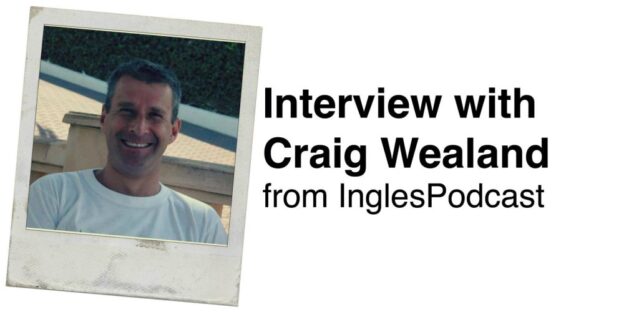
334. Interview with Craig Wealand (from InglesPodcast)

This episode features an interview with English teacher and podcaster Craig Wealand from InglesPodcast.com Craig is originally from Essex in England, but now lives in Valencia in Spain where he works as an English teacher and Cambridge examiner for the British Council. Craig has been an English teacher for over 20 years, and for the last few years he has also been producing episodes of his learning English podcast, which won the award for Best Educational Podcast in the UK Podcaster awards last year. In the episode we find out about Craig, talk about his career, his teaching experiences, his podcasting and also I ask him some random “quick fire” questions, just like he does with guests on his podcast.

Small Donate Button[DOWNLOAD]

Preamble (some stuff about swearing and vocabulary before the interview begins)

Before we get to the interview, I’m going to do a preamble where I mention a few things about swearing and vocabulary. This might take about 10-15 minutes. The interview is coming! A preamble is a ‘preliminary statement’ or ‘information that comes before the main content’ – before the main, “meat” of the episode. It’s a starter, essentially. This is a 3 course meal, this episode. You’ll get preamble, which is the starter. Then the main course, which is the interview, and then a desert, which is just some more info and announcements at the end. So, here’s the preamble. You don’t mind a preamble do you? Do you? No? Not really? Maybe a little bit? What’s that? Oh, “get on with it Luke?” oh, ok.

swearing-at-workA Note on Swearing in the Podcast

You should know that there is a little bit of swearing in this episode (just a couple of s- words in the middle of the interview). I know most of you don’t mind swearing but I thought I’d let you know just in case you’re particularly bothered by it.

I just want to mention these points about swearing though, just to be clear about it:

  • Swearing is pretty common in English language culture – but it’s still very rude if you use swear words in the wrong situations.
  • Usually, we just swear when we are with close friends, or in certain informal situations like at a football game, in a comedy club, or when we’re particularly angry – like when you’re driving and another driver does something dangerous on the road, or when you hit your thumb with a hammer, or something like that.
  • For you as a learner of English I’d say – just be aware of the impact of swearing in some situations and remember that, of course, you shouldn’t do it in business meetings (usually) or in classrooms, or with your host family or something. In fact, swearing is quite a subtle and complex art and if you do it wrong and in the wrong moment it can make you look really bad. I’d say – if in doubt, don’t swear.
  • However, I want this podcast to be an authentic reflection of natural English and so I include some swearing some times. My aim is not to offend anyone.
  • Personally, I’m not bothered by swearing. I am rarely offended by it, and in fact in the right circumstances I find it quite enjoyable.
  • But I know you might be listening with kids in the car or something, or you might not like these words, so when swearing happens in an episode I’ll just try to give you fair warning in advance.
  • For a while I used to bleep out swear words when they happened in interviews. You might have heard a “BEEP” instead of a swear word. Actually, I got a few messages saying “Why are you beeping out the swear words? I want to hear them? I want to be able to hear every word, especially the swear words!” So – in fact a lot of you really want to hear the swear words. Click here to listen to episode 83. “How to swear in British English”
  • I know what most of you are thinking. You’re thinking – “It’s fine Luke. There’s no need to justify it. We don’t mind. No worries. Now, get on with the podcast! Bring it on!” OK then. Yes, I don’t need to go on about it so let’s carry on. And that brings us back to…

Craig Wealand and his podcast – http://InglesPodcast.com

Craig produces and records episodes of InglesPodcast himself and there are 3 types of episode on the show. There’s “Learn English with Reza and Craig” in which he’s joined by his friend Reza, and there’s “Pass FCE” which is all about the Cambridge FCE exam and then there’s “Mansion Interviews” in which Craig interviews various interesting people that he has discovered in one way or another. Last year Craig contacted me for an interview on his podcast, and I was very happy to be considered interesting enough to be invited on to the show. You can listen to that episode of InglesPodcast, with me, by clicking the link below.

button-16

[DOWNLOAD]

By the way, you ought to know that Craig’s website and podcast are both created specifically for speakers of Spanish, who are learning English. So, if you’re a Spanish speaker you should be particularly interested in Craig Wealand’s work and I suggest that you check it out. But it’s not just for Spanish speakers – the majority of the content on the podcast is for anyone learning English. Some Spanish words crop up every now and then.


Craig and I have a few things in common as we are both English teachers who do podcasts and who live in foreign countries, so it was really nice to chat to him and I hope you enjoy listening to this episode as much as we enjoyed recording it.

Just a reminder: Check out http://MansionIngles.com and http://InglesPodcast.com for Craig’s work and his podcast.


Vocabulary

Now, during this conversation various nice chunks of vocabulary came up, and I’d like you to listen out for them. These are just bits of vocabulary that I think you should notice – natural expressions that you could add to your vocabulary. I have listened to the interview again and prepared a list of those expressions and I’ve printed them on the page for this episode – so you can go there, take the expressions, put them in your vocab list or flashcards app or whatever. I’m also going to read them out to you now. As a listening exercise you can then try and notice these expressions as they appear naturally in the conversation. That’s right – you can play a game of vocab hunter! (or just have a cup of tea and a biscuit if you prefer)

Here are the phrases you should try to identify. There are about 35 of them. I’m going to read them out but it’ll be super-duper quick. The main thing is I just want you to be mindful and notice these phrases. I’m not going to explain them all now, I’m just reading them out for you quickly. But, in the next episode of this podcast, which I’ll upload soon, I’m going to go through all these phrases properly, explaining and clarifying them. That should help you to really learn them.

So now, let me quickly just list these expressions like a robot – these are expressions to look out for in the episode. They will be fully explained and clarified in the next episode. OK, here we go…

  1. I thought it was about time that I got you (back) on LEP (it’s about time I did something)
  2. It’s been getting on for 3 years. (to be getting on for xxx years)
  3. How did you end up being an English teacher? (to end up doing something)
  4. He ended up marrying an Israeli girl.
  5. I took part of the credit for that. (to take the credit for something)
  6. I didn’t see myself doing a clerical job. (to see yourself doing something)
  7. You couldn’t just give away money willy nilly. (to do something willy nilly)
  8. You must have brushed shoulders, as it were, with Essex’s finest. (to brush shoulder’s with someone) (Essex’s finest)
  9. As soon as I got over the fear of standing in front of people… (to get over something)
  10. I came back to Spain with my tail between my legs. (with your tail between your legs)
  11. You start looking at things in a different light. (to look at something/see something in a different light)
  12. The grass is always greener on the other side.
  13. I lived in an English cocoon for the first year. (a cocoon)
  14. As drivers, they’re very erratic and dangerous! (erratic)
  15. It was just a scrape – a small dent in the car. (a scrape, a dent)
  16. Lots of tailgating goes on when you’re driving. (tailgating)
  17. Customer service sometimes falls a bit short. (to fall short)
  18. I’m always on a mission to go to the pub. (to be on a mission to do something)
  19. I want to sit in a pub, nursing a pint of Guinness. (to nurse something)
  20. To be constipated.
  21. My French is coming along. (to be coming along)
  22. It’s a question of trying to squeeze (in) bits of learning into the lifestyle. (to squeeze something in)
  23. It doesn’t just magically rub off on you. (to rub off on someone)
  24. They had to use the language in order to get by in a work environment. (to get by)
  25. If I don’t pull out the stops and work on the language then it’s not going to improve. (to pull out the stops)
  26. I’m turning the tables on you now Craig! You’re going to be in the hot-seat this time. (to turn the tables on someone / the hot seat)
  27. I guard my work desk with my life. (to guard something with your life)
  28. If she dares to put a pen on my desk I shout at her and we have an argument. (to dare to do something)
  29. You’d keep them in a bag and every now and then you’d take a look and have a whiff of the petrol. (to have a whiff of something)
  30. They (cats) look down their nose at you.  (to look down your nose at something)
  31. I’ve never been very keen on cats. (to be keen on something)
  32. I can’t talk you round. (to talk someone round)
  33. The thing about dogs is that they’re too needy, too high-maintenance. (needy / high-maintenance)
  34. Doesn’t that bother you, that they’re so fickle? (fickle)

Ok, so there are some phrases that you’re going to hear. Visit the page for this episode to read those expressions – you could google them or look them up in a dictionary, or just wait for the next episode when I will clarify them properly. The interview is about to start. See if you can spot the phrases I just mentioned, or alternatively, just kick back, relax and enjoy this mellow conversation with Craig Wealand.

*Interview Begins*

So, that was my chat with Craig Wealand

Hope you enjoyed it! Head over to his website to check out the podcast, especially if you’re a Spanish speaker and I know there are a lot of you listening to this – but promise me one thing – don’t forget me ok?

Remember all the vocab and expressions I listed earlier in the episode? That’s all going to be explained and clarified in the next episode, unless I get abducted by aliens and I can’t upload it.

So, we’ve had the starter – the preamble, we’ve had the main course – the interview, now here’s the dessert. Let’s say it’s a cake made from announcements.

Some more announcements

Here are just some other announcements and bits of news for you.

I’ll be on Blab, speaking to Craig + guests tomorrow (Thurs 10 March) at 5pm CET
If you enjoyed the conversation in this episode and you’d like to hear more than you might like to check out our blab conversation. We’re going to talk about comedy, and you can join us if you want. Just click this link to check it out https://blab.im/craig-wealand-comedy-with-luke-thompson

That’s really a message for those of you who listen to this as soon as it is published because I expect many of you will have missed the conversation now but never mind – I think you should have a look at Blab anyway, it’s a cool platform which is an interesting way to just listen to people talking online, or do some speaking if you’re feeling up for it.

You might be thinking – What’s Blab, Luke? OK, I’ll tell you.

Blab is an app and a website that allows you to have video conversations online. It’s a bit like Periscope, but 4 people can talk not just one, and everyone else can watch the conversation and add comments and questions. You can get Blab as an app on your phone or just through your web browser on your computer. If you’d like to join us, just click this link  https://blab.im/craig-wealand-comedy-with-luke-thompson (or find the conversation by searching my Twitter feed – I’m @englishpodcast )

To take part you’ll have to sign up with Blab (it’s free and easy to use). Then you can watch the conversation (you’ll see 4 video screens with the 4 people talking to each other), leave comments or questions, or if there is an open spot you can join the conversation yourself, and be one of the 4 people on video in the discussion. It’s fun, it’s free and it’s a chance to just listen to English, ask questions or even do some speaking practice if you feel up for it. Our blab conversation is going to start at 5pm tomorrow (Thurs 10 March). Here’s the link again https://blab.im/craig-wealand-comedy-with-luke-thompson

If you’re too late and you missed that, have a look at Blab anyway. It’s pretty interesting, and I might be doing more things on Blab in the future.

So that’s blab.

italki

Here’s a quick reminder about italki, the sponsor for this podcast. Go to teacherluke.co.uk/talk to check out italki where you can find native English speakers and qualified teachers for conversation or tailored lessons just for you. It’s one of the best ways to improve your spoken fluency and is also cheaper and more convenient than taking language lessons offline. This interview with Craig was done on Skype just like lessons on italki and it’s easy easy easy. Also, because you’re a listener to this podcast italki will give you a voucher worth 100ITC (about 10 dollars) which you can use on subsequent purchases of lessons and stuff. That’s not too shabby! https://teacherluke.co.uk/talk to start talking now! Oh, and if you’re shy – don’t be – the native speakers there are very friendly and it’s a totally cool and relaxed atmosphere in which you can just take your time and start speaking. Don’t be shy, give it a try.

Alright, that’s almost it for this episode, but I would still like to ramble on a bit more about some other podcast-related news and admin.

New comment system

As ever I invite you to leave your comments on the page for this episode.

You might have noticed that I have a new comment system on the website now. I’m now using the Disqus system. That’s basically an in-built comment system on my website. If you’ve seen it, let me know how it’s working for you. It should be smoother and more user-friendly than the previous comment system. For me, the improvements are these things:

You can now easily upload pictures into your comments. So that means you can share images, your own photos, memes etc.

If you include a link in your comment it should appear and will automatically be clickable (the old comment system used to do weird things with links sometimes – make them disappear etc). Some video content will automatically embed, which means that a link to a youtube link will automatically become an embedded youtube video in your comment.

Disqus is used on lots and lots of websites, so if you sign into Disqus you can then comment on lots of other websites using the same profile, and you can keep track of all the comments you’ve made on my website and any other website using Disqus.

Comments can now be deleted or edited by you, so if you’ve made an error or something, you can correct it later.

If you sign up to Disqus you can also get email notifications when other people reply to your comments. So it should now be easier to keep track of the conversations between you and other LEPsters on different pages of my website.

When you leave a comment with the new system, it won’t reload the whole page when you submit your comment. That used to happen with the old system, which was a bit annoying if you wanted to comment and listen at the same time. Now you can listen and comment and it won’t interrupt the episode by reloading the page. Nice.

Show us yer face! The Disqus system lets you show your own photo next to your comments. If you sign in with Twitter or Facebook it’ll show your Twitter or Facebook pic, or you can just upload another photo to your Disqus profile. If you just log in as a guest when you leave a comment (that means you just give a name and an email address but not a full Disqus user) you will appear as an LEP Ninja, with a little photo of an LEP Ninja – as you jump out of the shadows, leave your comment and then disappear into the night. ;)

All the old comments are still there and can still be read. At this moment in time, the website has had about 10,000 comments in total across all the pages on the site. They’re all still there.

The Disqus system should help to build more of a community feeling on teacherluke.co.uk

For full details about comment notifications (and how to control comment notifications from the old WordPress system), just click here: How to control comment notifications from WordPress and Disqus.

It’s good to see that so many of you have written about your commitments to learning English after listening to episode 332 with Olly Richards. It’s also nice to see that Olly himself is getting involved and writing some messages of encouragement there for you in the comment section for episode 332.

Also, I’m glad that lots of you enjoyed the misheard lyrics in the last episode. That was just a bit of a laugh wasn’t it? One thing I’d like to correct is that Meg and Jack from the White Stripes aren’t brother and sister. In fact, they were married to each other for many years. So, I just wanted to clarify that. For some reason I always thought they were siblings, but no – they were an item. That’s a bit weird. Maybe that explains why Jack was so upset about what happened with me at band practice, and why he chucked me out of the band. If you have absolutely no idea what I’m talking about, go back to episode 333 and listen to the whole thing!

Another nice thing I wanted to add here in this post-interview bonus section is that so many people have voted for their favourite pics in the LEP Photo Competition. Voting is now closed for that, so if you forgot to vote, that’s just your hard cheese! I’ll let you know about the winning pictures in due course.

That’s it – remember that the next episode should be about that list of vocab and expressions from the interview with Craig. I’ll explain and clarify them, which should help you both understand and pick up some more vocabulary, in this long and enjoyable journey into the acquisition of natural English. So, next stop – vocabulary in episode 335. (unless for some reason I can’t upload episode 335, like because I get abducted by aliens, or something less exciting, like I have to much work to do).

Small Donate ButtonThanks for listening all the way to the end of another long episode of LEP – you are a truly wonderful, attentive and patient human being and good things are bound to come your way sooner or later if there’s any justice in this world. Bye!

CraigWealandPODPIC

My interview with school kids from IES School in San Fernando, Spain

Hi listeners, here is some bonus content for subscribers or visitors to teacherluke.co.uk.

BILINGUALSANFER LOGOThis week I was contacted by teachers at a really great school in San Fernando in Spain. At the school they have a radio show which is hosted by children, and they do it all in English. The kids are 13-14 years old, and they’re very keen about studying English. Apparently, the teachers and children have been following my podcast and they wanted to interview me on their online radio show. I happily agreed to be interviewed. You can listen to the interview below.

We did the interview via Skype, with the children and teachers gathered together in their music room in the school, and me at home in my flat. There were about 25 kids in the room and they took turns to walk to the microphone and ask me their questions. It was very sweet to see them, listen to them speaking English and to hear the questions they had prepared.

IES San Fernando looks like a great school and the teachers, including Francisco Javier Rodríguez who first contacted me, look really cool. It was a fun experience for me so I thought I’d share it with you here. The interview is only 15 minutes long. You can listen and download using the media player below.

Thanks for reading!

Luke

CLICK HERE to visit the IES San Fernando school blog where you can find out more about the school and their bilingual teaching programme. Leave a comment on the page – I’m sure they’d be happy to read your words. :) http://bilingualsanfer.blogspot.co.uk

332. Olly Richards: English Polyglot – Top Advice and Strategies for Language Learning

This episode could make a huge difference to your English learning. So listen up and get ready for a motivational boost! Joining me on the podcast today is Olly Richards – a polyglot who speaks 8 languages. Olly has some very motivating and practical advice on how to learn languages as an adult. There’s so much to learn from Olly in this episode, so I really want you to pay attention and have a proper think about the ways in which you are learning English. (I really sound like a teacher, don’t I? – or your Dad or something – “Now pay attention! Sit up straight! Put that down! Stop fidgeting. Listen to the man! This is very important for your English in the future!)

Small Donate Button[DOWNLOAD]

Being Committed to Language Learning

What I’ve personally taken away from this episode is the importance of making a commitment to yourself about your language learning. Commitment is really important for giving you the motivation to get things done, and to add language learning habits into your lifestyle. Commitment, motivation, habit, positivity – these are some of the vital elements for language learning. It’s also about being honest with yourself about what you’re doing to really push your learning forwards. It’s about taking responsibility for learning and finding your own little strategies for adding language learning into your daily routine. Olly is a living example of how it really is possible to learn languages as busy adults.

If you listen until the end of this episode you’ll hear me make a commitment to myself about my French, and it’s a good feeling because I really need to get a grip on that, because my French is not as good as I would like it to be – so you’ll hear Olly encourage me to make a commitment about my French, but also Olly and I invite you to make a commitment about your English too – even a small commitment, and write it in the comments section of this episode. I’ll talk more about that in a moment. But first, let me tell you a bit about Olly Richards.

Olly Richards – English Polyglot

Here are some things that people say about language learning.
People say English people are no good at learning languages, right?
Wrong.
They also say that to learn a language quickly you need to be a child.
Wrong too, apparently.
Another thing people say is that the best way to learn is by signing up to group classes in a language school.
Not necessarily.
Also, it’s often said that to learn a language properly you need to be living in the country where that language is spoken. But that might not be the case.
And, a lot of people say “I’m too busy to learn a language. I don’t have time, and I never meet any native speakers!”
Another thing people say is, “I’m just no good at languages. I think I’m language proof!”
Don’t say that to yourself! A lot of excuses and reasons why we find it difficult to learn English.

Keep listening. (because you’re probably listening to this, not just reading it – right?)

Olly is living proof that English people, just like any other nationality, are perfectly capable of learning a foreign language to a proficient level. In fact, Olly is a polyglot, which means he can speak lots of different languages. In fact, at the moment Olly can speak Spanish, French, Italian, Brazilian Portugese, Japanese, Cantonese and Arabic. Not bad for a guy from England – a country where most people just speak one language, and some people struggle even with just one language, especially after a few drinks.

So, what’s the story with Olly? Is he just a specially gifted person? Was he born with the ‘language gene’, or does he have the force or something? Does he have waaaaay more time in the day than anyone else? Did he go to some really brilliant language schools and follow the amazing methods of a language guru? Did he just learn these languages as a child by growing up in different countries?

The answer to all of these questions seems to be no. No, he isn’t, he wasn’t, he doesn’t, he didn’t. Olly says he doesn’t have a particular gift for language acquisition. He wasn’t born with a language gene. He doesn’t really like learning in a classroom environment so he didn’t just attend some great classes in other languages, and these days he has a busy schedule just like the rest of us, with his job and also the great work he does on his website IWillTeachYouALanguage.com. So it’s not like he’s got acres of spare time at his disposal. Also, Olly didn’t learn any of these languages as a child. They’ve all been learned during adulthood.

So, how has he done it? How has he learned lots of languages and how does he keep them all in his head? What are the techniques for effective language learning as an adult? And, what’s Olly like and what stories can he tell us?

That is essentially what you’re going to get in this episode. All those answers and more. You’ll also hear Olly give me a much needed motivational boost about my French. In fact, while talking to Olly I made a commitment to myself to improve my French in one simple way every day – and that’s simply to do a minimum of 10 minutes of study from my French text book every evening. It doesn’t sound like much, but it’s a starting point and I really believe that if I make that a really fixed daily habit it could make all the difference to my French.

And you can do it too (but with English, not French obviously, unless you’re also learning French, in which case yes you could do it too). In fact in this episode we invite you to make a simple commitment to yourself about learning English, today, and to write that in the comments section. Listen until the end of the conversation to find out all about that.

OK, so it’s time to start the conversation with Olly Richards – the professional English polyglot who has tons of advice on how to learn languages as an adult. Ready? Let’s go!

*Interview begins*

So, that was the interview – I think you’ll agree that there is a lot to learn and to think about.

Make a New Commitment to Your Language Learning – Join Me!

Just think of one specific thing you can do every day, as part of your daily routine. It could be related to pronunciation, vocabulary, grammar, reading or any area you think is important for you. Write your commitment in the comment section of the episode. Then Olly will read your comments and give you some personal encouragement himself. Yes, he’ll write comments to you with some encouragement. For example, your commitment could be, as a starting point, “I will read a novel in English for 10 minutes every morning when I get up.” Just 10 minutes. Think of your commitment and write it in the comment section. Go ahead and give your English a boost! It could make all the difference.

Here are some links to Olly’s work online

Click here to visit Olly’s website, where you can read his blog posts, download his eBook, sign up to his mailing list and listen to his podcast – IWillTeachYouALanguage.com

Here’s a popular post which we mentioned in the episode – My Crazy 5AM Language Learning Routine

You can also find Olly on twitter here, where he tweets things related to language learning: https://twitter.com/Olly_IWTYAL

Other Links

Want to read a book in English? Don’t know which book to choose? Check out my reading list here.

Check out Flashcards Deluxe on the iTunes store here, or in the Google Play store here. There are lots of other free Flashcards apps available too.

Want to know more about using mnemonics and memory techniques for remembering vocabulary? Listen to my episode about that subject here https://teacherluke.co.uk/2014/02/05/167-memory-mnemonics-learning-english/

Click here to check out italki

Click here to check out italki

And finally, let me remind you about the sponsors for this show who decided that they wanted to give my listeners the chance to get 10$ worth of free lessons or speaking sessions. With iTalki you can find teachers or native speakers to give you speaking practice from the comfort of your own home. iTalki uses Skype as a platform and you can pick your teachers and schedule classes based around your specific lifestyle and routine. Speaking to native speakers is a vital way of genuinely accelerating your English. And remember that LEPsters – you get a discount if you sign up by going to https://teacherluke.co.uk/talk.

That’s it for this episode, I hope you enjoyed it. I did. I found Olly to be fascinating and very useful and I’m looking forward to following his advice for my French.

That’s all for now, speak to you soon. Bye!
ollyPIC3

331. How’s your English? (and why speaking is so important)

Hi listeners, I’ve got a big big slice of podcast pie for you in this episode because I’m going to talk to you about some important considerations for language learning, some ways that you can push your English to new levels with LEP, and I’m going to talk about italki, which is a really great service that you can use to arrange conversations with native English speakers online from the comfort of your own home, and why as a listener to this podcast, you should check it out. There is also a transcript for this episode already available at teacherluke.co.uk so check that out too. Now, let’s get started.

Small Donate Button[DOWNLOAD]
First of all, hello! How are you? I hope you’re well.
Here’s a new episode to listen to. I’m very glad to see that recent episodes have been popular with the LEP community. Episode 330 about Grand Theft Auto was particularly popular. I’ll have to do more of that sort of thing in the future.

New-Look Episode Archive
Have you listened to all the episodes of LEP? If not, maybe it’s because you don’t know which episodes to choose. You might not know where you can find them all.
If you’re subscribed with iTunes you can access all the episodes in the RSS feed. But, I’ve recently added a new episode archive with descriptions of the content and language in each episode of this podcast. Check it out. If you haven’t listened to the back catalogue and don’t know what is contained in all those episodes, have a look at the new archive by clicking on ALL EPISODES in the website menu. You’ll find links to all the old episodes and now you’ll see that each episode is accompanied by a description of the topic and theme, including the language focus in particular episodes, so you know what to look for. There are loads of classic episodes of Luke’s English Podcast just sitting there in the archive, waiting for you to listen to them. Remember, you can download them all individually from the website, and there are lots of transcripts available too. So, if you’re ever caught waiting for new episodes – just ask yourself the question, “have I listened to all the previous ones?” They’re all there, available for you, free.

How’s your English? Let’s talk about learning a language
More and more every day I am coming face to face with experiences of language learning. Either other people, like my students or the people who email me every day, or me – because I’m a language learner too – struggling to learn French.
I’m constantly aware of our need, in this incredibly interconnected world, to speak foreign languages. For you and my students it’s English. For me it’s French.

A lot of people struggle to push their level up
Some people don’t know how to do it. I meet so many students in language schools who know they need to improve their English, but they don’t know how to do it, so they just sign up with a language school and to an extent, they then expect us to do all the work for them. Not all of them are like that, some students do exactly the right things – but some students seem subconsciously to think that by signing up to the course and simply being in the room, that’s all they need to do. People like that tend to be the worst students because they don’t take responsibility for their own learning. It’s not necessarily their fault, because they just don’t realise that there is a better way to learn another language.

Like, a lot of people don’t realise they have to connect with English on quite a personal level, regularly and for extended periods of time. It’s not just a skill to add to the CV. Learning a language has to become part of who you are. The more you put your time and personality into it, the better the outcome.

A lot of people probably don’t realise that this podcast exists for example, or at least they just wouldn’t even think about listening to podcasts regularly in English, or they might listen a bit but just give up after a while because it’s too difficult.

That’s a pity because I think there’s a lot of enjoyment to be had from my episodes, and from many other podcasts – I really hope so anyway because that’s what I’m trying to do with Luke’s English Podcast – I hope it’s more than just a thing for learning English, but that rather it’s something that helps you learn and which you just enjoy listening to as a human being, or not – you might enjoy listening to it as some other life-form, but I imagine most of my listeners are humans. I know I have a few dogs, and some fish listening to this, at least – but mainly, homo sapiens. Whatever you are, if you’re a long-term listener I think you’ll agree that regularly listening to my episodes will give you an edge over the people who don’t. It’s quite simple really.

So, what I’m saying is – there are bad language learners and good language learners. The bad ones do things like sign up for language courses, expect that to be enough, sit in language classes, expect to be spoon fed, but don’t take responsibility for their own language learning. Good language learners know that learning a language is all about taking responsibility for your own learning, and making an effort to get some English into your lifestyle, on a regular basis, by experimenting with new ideas and new platforms. You don’t give up when it gets challenging and in fact you enjoy the whole process of doing it!

I have over 300 hours of content here on this podcast – and that’s a lot of English to listen to. That’s a lot of words, a lot of grammar and pronunciation that you can hear and it’s definitely going to be a great injection of proper English into your brain.

But, you and I know that listening to this and enjoying it is only part of what you could be doing to seriously push your English into overdrive. You’re probably aware that, despite listening to this, your English could still be so much better and that you’re capable of so much more. You could be more fluent, more accurate and more confident.

The cool thing is that all these things are achievable, and that is more true now than ever before.

You know that you can really accelerate your learning if you choose to. The power is in your hands. If you want to, you can take your English to the next level. It’s just a question of putting in the time and effort and finding ways that work for you.

Here are a few suggestions for how to push your English in other ways, beyond just listening. Now, some of you might be quite content just to listen – and of course you can do that, but I would like to reach out to you here and ask you to just stop for a moment and question yourself  – are you satisfied with your level of English? What more could you be doing to improve it?

Here are some techniques for the motivated LEPster who wants to do more than just sit back and listen.

Listen to episodes several times
This is really important. It allows you to not only understand the content much better, but will also allow you to notice specific phrases and then remember them over time. If you hear phrases or even grammatical structures and certain bits of pronunciation again and again, they will really stick in your memory and become part of your English. For example – I know a lot of the lines from the first Star Wars film. They’re absolutely stuck in my mind and they even come out in my speaking sometimes. How do I remember these lines so easily? Just because I’ve watched the film a lot of times – and weirdly, I even enjoy it more each time as well. In fact, having watched Star Wars a lot, I feel like it’s part of who I am now. If I’d just watched Star Wars once, I’d never remember any of the lines. There’s absolutely no way I would be able to see Star Wars once, then walk out of the cinema and quote lots of lines of dialogue after just one viewing. It took multiple views before the dialogue stuck in my head. It’s exactly the same with the podcast. Listen more than once and the language will stick much more easily.

Use the transcripts
There are transcripts available for lots of episodes of LEP and you really should be using them. They took a lot of work to produce, either by me, members of my family or by listeners who take part in the transcript collaboration project – and if you have done that, then you deserve a medal because, as well as the long list of fully transcribed episodes on the website, there is another very long list of transcripts which are also complete but haven’t been checked by me yet. They’re all available on Google docs and the links are on the transcript collaboration page. So, there are more transcripts available than you might think. The transcript collaboration has been going for several years now, it’s really quite a big project! Writing transcripts is time consuming and we wouldn’t be doing it unless it was really useful for you, my listeners. So please use the transcripts which are provided! Here are some ways to do that…

Read transcripts while I’m talking – just listen and read at the same time. You could print out the transcripts, or just read them on your phone or tablet while you listen. Reading the words while you hear them will allow you to do a number of things: it’ll help you to remember the words better because you’re not just getting an aural picture of the word, but a visual one too, and many of us have very visual memories. Words exist as physical entities in our minds – they have a shape, they have a sound, they have spelling and they have muscle memories too. By shape I mean simply the way the word looks – that means its spelling, but also just the general visual characteristics of a word – the length and other visual characteristics. Apparently, when we read we don’t just look at the individual letters and put them together, but we recognise the first and last letters and the rest is just a general shape. So, it is important to get to know the shape and spelling of words in order to keep them recorded as visual entities in your mind. Words are also sound memories – what they sound like, and muscle memories – how it feels to say them. There are many aspects of a word, and the more of those aspects you cover, the more 3 dimensional the word will be and therefore the better you will remember it. So, reading the words while listening will help to tie the visual side to the aural side. It’ll allow you to remember them better, and later on to spell them too. Repeating words or sentences will help to develop the muscle memory too – attaching that to the aural and visual pictures that you already have. You should learn words in 3D – that means listening to them and reading them.

Also, reading while listening may help you to notice particular high-frequency features such as collocations or grammatical structures. If you’ve printed the scripts, you could highlight these things with a highlighter pen, or select them on a computer and record them in your own lists and check them again later.

Just read them, and then listen to the episode later
If you just want to focus mainly on listening skills, but would still like to get the benefit of having seen the words too – just separate those two things. First, listen to the episode, try to understand it, then read the script and understand more, then listen again and see if you notice a difference.
You can break up the script and episodes and just focus on chunks or parts of episodes.
You can print the scripts and then write notes on them as you listen, or highlight particular phrases or aspects of pronunciation.

Take some of the words and keep them in word lists
Highlighting words in scripts is good, especially if you go back and read them later, or find ways of remembering those things. Also, you can print out the script and then have fun highlighting certain words with one of those brightly coloured highlighter pens – that’s always fun isn’t it – there’s just something satisfying about using a highlighter, but remember that the highlighter itself won’t learn English for you – you’ll need to go back to those words again and again in order to really learn them.

You can copy+paste words into your own vocabulary lists – then find ways of working on those lists in your free time, repeating words, testing yourself, putting them into sentences and so on. Just make sure that you’re applying some kind of process to your learning – don’t just mindlessly read through your word lists – you need to work with the words, and push them into your mind in various ways. Remember the episode I did in the past about using mnemonics and memory techniques (listen to it here https://teacherluke.co.uk/2014/02/05/167-memory-mnemonics-learning-english/). There are a lot of words for you to remember. You have to think outside of the box in order to keep those words in your head.

You can use flashcard apps to help you do this, or just a notepad. Try to record and repeat words in sentences, not just on their own. Consider how the words interact with other words – because they do that, words – they don’t exist on their own, they are always with other words.  Are there any particular collocations or grammatical features of these words – e.g. do they take a particular preposition? If it’s a noun, what is the verb that collocates with it? For example, if the word is “homework”, what’s the verb? It’s “do”. What about “housework”? (It’s “do” as well) What about the DIY (ok, that’s “do” as well – yes, all those examples take “do” as their verbs). Another consideration is the word family. What are the other words in the word family? Noun, verb, adjective, adverb forms. Are there any opposites or synonyms? Are they followed by -ing or infinitive forms? For example, the expression ‘used to’. You shouldn’t just record ‘used to’ but also ‘be used to + -ing’ and ‘get used to + -ing’.

Getting to know one word often means getting to know all the other words that they live with. Beyond just recognising words in phrases you could also use a good dictionary – like perhaps a collocations dictionary to help you make your lists, and make sure you go back to those lists and study/practice/test yourselves! You could get a dictionary like the Oxford Collocations Dictionary, or use one online. I found one today that looks great. It’s called the Online Oxford Collocation Dictionary. Search for a word and it will show you all the verbs, nouns, prepositions, adjectives that collocate with it, with examples. Here’s a link with the word “memory” http://oxforddictionary.so8848.com/search?word=memory

Also, try to practice producing your target words, not just recognising them. That means when you do some studying with your word lists, you should read out those words and sentences aloud, not just read them in silence.

Try to avoid simply converting words from your language into English and back again. Try to do it all in English.

Since these transcripts are in text form, you can do all sorts of things with the words on your computer. For example, you could create your own worksheets using the transcripts. Import the text into Microsoft Word, then gap certain words (you can select certain words and gap them all automatically), or gap random words, then print the worksheet you’ve produced, and then go back to it later and try to add the words from memory. You could remove all the punctuation and put it back in later. You could remove all the verbs and then put them back in the correct form. You could remove all the prepositions and put them back in later. You don’t have to do it to the whole text, you could just choose certain bits. Be selective about which bits of transcript you work with – for example, it would be a good idea to focus on part of an episode in which someone tells a story, or in which there’s lots of technical language that you don’t know.

Be your own teacher, create your own tests and exercises. You can do that. It will help.

Recording yourself reading transcripts
You could take a transcript and read it out loud. Try to sound exactly like me, or just try to read out the script in a natural way, as if you were talking to real people and you had to make it interesting. You could record yourself reading the script and then compare it to the original recording of me. See the difference, and try to copy my voice.

Shadow the way I speak when you’re in the car
If you listen while driving – that’s the perfect time to do some speaking in private. You can use the privacy of the car to do some speaking. You could try shadowing me – that means repeating everything I’m saying while I’m saying it! Don’t do this when you’re in conversation, it’s seriously annoying (I had a few students who used to try and mouth the words I was saying as I said them – weird) but you can do it in private. Either you repeat it after I’ve said it, or you allow your mouth to vaguely follow what I’m saying as I’m saying it.

Listen at different speeds – slower or faster
A lot of audio software and podcast apps allow you to speed up or slow down episodes. Why not try listening to an episode really fast the first time round, then slowing it down. You might find that after fast listening you’re suddenly able to understand normal speaking much better. It’s a bit like training in the mountains – you let your body get used to running with less oxygen, and then when you run at a normal altitude your body is tuned and able to consume much more oxygen and by comparison you’re much stronger and faster. If you get used to listening at a fast pace, you could become an amazing listener at normal speed. Alternatively, you could listen to an episode slowly to try and focus on specific things that you missed before. The main thing is – experiment with different listening speeds – and remember, if you listen faster you can listen to more because the episodes will be shorter.

Pause the podcast to say something
Remember, you have a pause button. You can use it to pause the episode when you have a thought or idea and just say your response. Again, this will work better if you’re in private so people don’t think you’re crazy, talking to yourself. You might be listening to an episode, and someone says something and you have a response. Pause the podcast and say your response, to yourself, to your pet cat, to the wall, to your teacher, to your friend who also listens.
And you don’t have to wait until a specific thing comes up. You could decide to stop every 10 minutes and summarise what has been said in the last 10 minutes, by saying it out loud. Try to use language which you’ve heard in the podcast.
Imagine: you listen, and every 10 minutes in you pause, summarise and respond, then continue. That way a 1 hour podcast will also involve you summarising and responding in your own words six times. That’s quite a lot of speaking, as well as listening.

Use episodes of LEP as the basis for discussions or activities with your speaking partner
If you have a language partner for practising English, or if you have one to one lessons with a teacher, you could take inspiration from LEP. I’ve done lots of episodes with speaking games like “The Lying Game” the vocabulary games with Amber & Paul, the difficult situation role plays, the random discussion questions with my family, the bank robbery activity, the 1 minute challenge, the A to Z game and all the topics and interview questions I’ve used in episodes over the years. You could recreate speaking tasks from episodes of the podcast, in your own lessons or language exchanges. Check the pages for each episode and see if there are questions or other notes that you could use for your lessons or speaking sessions.


So there I’ve just explained a few ways to be a more active listener. That’s all going to help you, definitely. Even just listening to these episodes and enjoying them means you’re certainly getting a leg up on the competition, especially those losers who don’t even know LEP exists! But being proactive and finding new ways of pushing your English with LEP is definitely going to help too.

But, I haven’t mentioned the elephant in the room. This is the thing that’s missing from the whole arrangement and that I haven’t talked about, because previously it was a bit of a problem, but not so much any more.

What does “the elephant in the room” mean?

What’s the elephant in the room that I’m talking about? I’m talking about the fact that LEP doesn’t give you everything you need for your English. That shouldn’t be a shock of course, because I’ve always said the podcast is best enjoyed as part of a balanced diet – I mean, that you get best results by combining listening to this with other things, such as study and speaking practice. But certainly what I haven’t mentioned so far is that the podcast certainly can’t give you the one thing that you really really need to make rapid progress in English, and that’s the chance to practice speaking with native speakers.

Beyond adding habits and techniques into your lifestyle and getting regular exposure to authentic English with the podcast, the best way is to push your English is to do plenty of speaking. Speaking speaking speaking – in authentic conversation with native speakers. That’s definitely the fastest way to push your fluency, accuracy and range of vocabulary, grammar and pronunciation to the level that it needs to be. Natural conversation with native speakers, hopefully teachers who understand your situation and can help you with error correction and explanations, and by listening to you more.

So, I haven’t mentioned it because I’ve known that for many of you that’s just not possible, and it’s something I can’t provide through the podcast. It’s always been hard to develop your speaking skills through this podcast, and so you need to find native speakers to talk to – but as I said, that might not be possible. It may be that there are just no native speakers in your area to talk to, or if there are native speakers, it’s difficult to get to know them, even if you live in London where native speakers are much harder to find than you might expect. The same goes with teachers – there might not be many native teachers who you actually like and who can teach you regularly on a 1 to 1 basis.

Now, maybe you’re lucky and you live in a situation in which you can speak to native speakers regularly. But I know that even when you live in the country of the language it’s still hard to meet the right people and find the right teachers. For example, for many students or foreigners living in London, it’s hard to make friends with local Londoners. They’re just a bit distant and tend to stick to their own little circle of friends.

So, essentially – although it’s vital for your English, regularly speaking with native speakers is also one of the most difficult things to achieve, because of access or lack of choice.

So, despite this lack of speaking practice, I imagine you just keep going, trying to learn or maintain your level of English as well as possible, without enough contact with natives. You listen to the podcast when you can and you love it when new episodes come out, and although you have plenty of feelings and ideas in your mind when you listen, you don’t have anyone to express them to. You might take English classes but it’s still not enough, especially if you’re in a group. You might find other opportunities to speak to natives, but it still might not be sufficient or convenient.

What you really need is need a regular person – a language partner or an individual teacher who you can rely on and who knows how to talk to you as a learner of English. Someone who is available at the right time, not too expensive or inconvenient.

Even me in France, I have native speakers of French all around me. I mean, I’m married to one for goodness sake! But none of them are quite suitable as a language teacher somehow. For example, my wife and I have already established our relationship in English and it’s hard to switch to French because there are just too many personal things going on in our lives and it’s not practical to speak French. Also, I don’t want her to think I’m stupid or anything (because I am pretty stupid in French).

I could go on a mission to find an individual teacher or someone who’s willing to do a language exchange with me, but honestly, I’d rather just go online, browse some teachers, find someone easily and schedule some one to one speaking lessons on Skype so I can choose exactly when and where the sessions will take place (my home) and it won’t be too expensive. I don’t want the hassle of having to go out, arrange a place to meet (if its my home that means cleaning the place up) – if it’s the teacher’s home that means travelling and extending the time I have to devote to it. If it’s a public place that means putting up with the fact that strangers around me are listening to my lesson and probably judging me and my teacher. I need an online service which completely cuts through all that annoying stuff. I’ve been looking for a service like that and I’m really pleased today because I’ve found the perfect one. I can now arrange all my French lessons and conversation classes online, and do them all online via Skype and all from the comfort of my own home. There are loads of teachers to choose from. I can have trial sessions with some of them and then pick any one that I want. Then I can schedule lessons according to my timetable and I don’t even need to leave the house. Also, prices are cheaper than they would be with a teacher or in a classroom. Of course, it’s online via videoconferencing software, which is not quite as good as being in the same room, but honestly – after 10 minutes you just don’t notice it any more and anyway – communicating via Skype is the future (in fact, it already is the present). So, I have found this service and it’s called italki. The super duper cool thing is that italki is also in English (in fact English is their #1 language) and they have thousands of teachers and native speakers that you can talk to right now.

The service is called italki
Some of you might be aware of italki already, which wouldn’t be a surprise because italki is one of the fastest growing websites in the language learning sector at the moment.

Have you heard about it?
Either you have, or you will, because it’s awesome.
Ok, so italki is an online community where you can find language partners and teachers for online lessons or conversations.
It’s not a surprise really that italki is one of the fastest growing websites, because now that Skype video calls are such good quality it makes total sense to use that for connecting students and teachers, and it’s a great way to cut out the middle man, avoid having to travel long distances, and get all the benefits of individual tuition. I think it’s going to make a huge difference to the way people learn languages in the future. This basically gets around the age-old problem of having no access to native speakers.

italki used to be a social network where you could find a language partner but over the last year or so it has grown a lot and they’ve just launched their new service, and it’s really smart, professional and high quality. It looks very good and loads of people are using it every day to learn languages and that includes these super motivated language learners called polyglots that speak like 10 languages at the same time. I’ve been interested in polyglots for a while and I’m in the process of contacting some of them for interviews on LEP. I’m talking about people like Olly Richards, Richard Simcott and Benny Lewis who are making a career from the fact that they speak lots of languages. Now these guys swear by italki – and if it’s good enough for them, I think it’s good enough for us, right.

Some of you already use italki and you’re going – “yep Luke you’re preaching to the converted. I already use italki. Been there done that, got the t shirt. In fact that’s how I know the phrase “been there, done that, to the t-shirt” – because I religiously listen to your podcast and I practise your language on italki. It helps me remember stuff like “been there, done that, got the t-shirt”.

Anyway, why are you now going on about italki so much Luke? Do you work for them now is that it?
No, I don’t, but I’m happy to say that after discovering them I did send them an email and ask if they wanted to sponsor the podcast. I’ve been searching for new sponsors for ages, and italki just seemed like the ideal sponsor. They offer a good service, for learners of English, in any country, it’s all online. They’re friendly people, it’s professional, and it’s growing fast. I’m happy to say that they responded to my email positively, and I’ve been talking to someone from the italki team and we have arranged a sponsorship deal for LEP which I am very happy about because it’s going to be mutually beneficial. Beneficial for everyone basically – you, me and italki. It makes total sense all round.

Now, let’s just talk about sponsorship for a moment
You should know that sponsorship for LEP is absolutely necessary – it’s important to understand that, especially if you don’t get it. This podcast must have sponsors – it’s the only way for the podcast to keep going, and for it to stay free. I have to be able to justify spending time on this. Now, I do spend time on the podcast – I do it all myself. I could spend that time on other things that would be much more profitable. I could use all my hours doing one to one lessons with university students or business people in Paris, or on Skype and that would make me more money than I earn from LEP. But I would rather spend time on this than almost any other job, and the only way to do that, while keeping the podcast free for you, is to have a sponsor that I mention briefly in my episodes.

I would rather do this podcast than work on one to one lessons or teach in language schools, and I expect you would also like me to continue doing this too. Well, sponsorship is the way I can achieve that.

Also, you should know that sponsorship is absolutely the standard for monetisation for podcasts today. All the big podcasts I listen to, unless they’re done by the BBC, have sponsors. I’m glad that my podcast is popular enough to attract sponsors. It means I’m doing something right.

So, sponsors are necessary for this show, and for me it’s vital to find a sponsor that offers you a quality service that can really make a difference to your English.

It’s been hard to find the right company. I’ve had Audible for a while now, but I’ve continued to look for other services that you might like.

Audible are great – those audiobooks are brilliantly produced, of excellent quality and it’s a good offer – 30 day trial and a free audiobook. You can’t argue with that. That’s staying open by the way. You can still get a free audiobook from Audible by going to teacherluke.co.uk/audible

But I think italki are an even better service for my listeners – in a more profound way for your English. You already have a lot to listen to with LEP – in fact, Audible are a sort of competitor for me. By sticking a 15 hour audiobook in your phone I’m giving you the choice of listening to me or listening to the book – I hope you choose me first! Anyway, you already have tons of stuff to listen to – either from me or from audiobooks, but speaking to native speakers is going to be so good for your English, and that’s what italki would allow you to do.

So I am really pleased that after checking out my podcast and my website the people at italki are really keen to work with me and to sponsor the podcast. So yes I have managed to secure italki as my new sponsors and I’m very happy to recommend them to you. The cool thing is that you can get free teaching time in italki if you’re an LEP listener. They’re offering all my listeners 100 lesson credits, which is about $10 of free teaching – that’s equivalent to about an hour.  Just go to teacherluke.co.uk/talk to check out italki, look at some teachers, start talking to people, and you can get 1hr of free lessons too. Nice.

Click here to check out italki

Click here to check out italki

italki
Let me just tell you a bit more about italki and how to use it before I move on to talk more about how to improve your English.
They already have over 2,000,000 language learners using the platform.
You can learn pretty much any language.
Of course, English is the most popular language and there are more English teachers and tutors on there than other languages.
So, after going to teacherluke.co.uk/talk you sign up free, like a social network.
Then you decide which language or languages you’re interested in. Let’s say English.
Then you can choose to find either ’Professional Teachers’ or ‘Community Tutors’. Professional teachers are qualified to teach English as a foreign language. There are professional teachers that specialise in different skills, different types of English (e.g. business or IELTS) and they’ll guide you through the learning process. It’s just like having 1to1 lessons with a teacher in a language school or in your own home, except that it’s done using video conferencing software, like Skype.
Then there are ‘community tutors’. Essentially, they’re not qualified teachers but they are educated native speakers of English who are passionate about sharing their language with you and helping you to practise communicating and developing your fluency. They’re also cheaper than the professional teachers. There are some great community tutors on italki and they’re a really really good option for those of you who need to talk to native speakers of English and have a more limited budget. In fact, I think that the community tutors could be the best thing about italki – friendly native speakers of English who are available and ready to talk to you right now, and cheaper than teachers.
But it’s not just teachers and tutors, italki offers you plenty of other content too.
There is a whole community of people on italki, because not only is it a marketplace for teachers, it’s also a social network for language learners. It’s a really cool place to hang out if you’re learning a language, and it’s better than other social networks like Facebook, because all the people who are on italki’s forums and blogs are motivated language learners – they’re not just there to make stupid comments and waste time like on Facebook.
So, there’s the social networking side.
Also, italki publishes lots of articles and blog pieces about language learning. There’s already a large catalogue of interesting and useful articles which you can access.
And finally, (and this may be one of the best features of italki) you can arrange language exchanges with speakers of other languages. This is a great option for people who are on a really tight budget. There’s bound to be people out there who want to speak your language, so check out the community and look for people who speak your target language (English) and who want to practice speaking your language too. You could find some great language partners for language exchange (one of the oldest ways to get speaking practice at no cost) and in the process you can make some awesome friends around the world and just have a lot of fun while doing it. Who knows, it could be the beginning of a beautiful friendship with someone in another country.

So there you have it – italki is a bit more than you might think. Now, you can talk to native speakers of English regularly, and from your own sofa, and they have tons of other services and a whole community of like-minded people. There’s a reason why italki sponsors LEP – it’s because they are the perfect service for you my listeners, and I wouldn’t promote them if I didn’t think it was useful.

I realise I’m talking about italki quite a lot in this episode. I’m not going to go on about this subject a massive amount in every single episode in the future – my episodes will run as they normally do, and I’m still free to talk about whatever I want to talk about – I will just mention italki at the start of episodes or at the end too just to remind you of the offer.

Generally, this is all very good news for LEP and is a big step in the right direction for me and for all of us. :)

Right, so now I’ve introduced the new sponsor, let’s get back to the subject of you and your English, specifically the importance of speaking for learning English, and why being a regular listener of Luke’s English Podcast gives you a big head start if you’re going to work on your speaking skills.

The importance of speaking, and how that is connected to regular listening
We know that all the areas of English are linked, so first of all improving your listening will have an effect on your pronunciation and speaking, and probably your vocabulary and grammar too. Then, following that up with regular speaking is a great combination for faster fluency and linguistic control.

I’m really convinced that regularly listening to this podcast and engaging in an authentic way with the things I’m saying and the sentiments I’m expressing – either humourous, serious, mysterious, factual or whatever –  is going to make a great difference. My professional knowledge tells me that’s true, but also my experience. First of all, I get messages all the time from listeners who swear that the podcast has helped them a lot – either by giving them confidence, better vocab or by generally improving their English to help get a higher score in an IELTS exam. But also, I’ve had first hand experience of listeners making progress with this. I’ve spoken to listeners a number of times and have noticed how their English has improved. I know people who started listening with next to no English, and have got to the point where they understand everything and can also speak and make themselves understood, and of course they have my accent and my speech patterns! It’s weird!

By listening you’re exposing your ears to a whole other side of the English language. If you think about it, there are 2 things: English as a written language (you read it, you write it, it’s visual and physical) and then English as a spoken language (you hear it, you don’t see it, you produce it physically using your body as an instrument). They’re two different beasts. If you just work with the written version, you’re only getting half of the story. By listening you’re engaging with that other type of English – the spoken version. Spoken English has been around longer than the written version. Stories and knowledge have been transferred orally for many many years and this form of communication was around before people developed written language.

Also, speaking is a very immediate and lively from of English. Spoken English takes many forms because of different accents, and is closely tied into codes of behaviour and body language. It can be much harder to understand spoken English, especially if you are used to reading all your English, and need a script of what is being said. So, regularly listening to authentic conversations can really give you an edge, certainly over the majority of people out there who have spent more time on reading and writing than on listening and speaking.

If you listen a lot you can really explore the way that sounds are used to create words and how those words connect to each other, and how the whole thing is interpreted by stress patterns and intonation in the voice. English has a rhythm and an accent that you can never find in the written version. The voice is used as a delivery system for English, and it’s vital that you get to know how that works. And to do that, you just have to listen to it. Also, regular listening exposes you to so many words and grammatical structures that you start to develop an intuition over grammar, and that’s the best situation to be in. You know the answer is right because it just feels right after having heard that particular phrase or prepositional collocation many times already. It just feels like the right answer, but you don’t have the rule. Now you’re thinking like a native speaker. The rule doesn’t matter – all that matters is that you’re familiar with the right kind of English. Listening to the podcast regularly is a great way to work on those things.

But speaking is absolutely vital, especially if you want to make fast progress and become a good communicator. That requires some practice and a positive attitude. The good news is that if you’re a regular listener to this podcast you have a head start, because having this podcast as a platform you can really push your spoken English further and faster. In fact, as well as giving you a foundation of passive knowledge from listening this podcast can give you lots of inspiration and information which you can use to push your speaking. First of all, you’re already interacting with the language in its spoken form by listening a lot. Your brain is already used to listening. This should make it much easier to then respond by speaking yourself. In fact, by listening and thinking, you’re already engaging the part of the brain involved in spoken communication. You’ll be more familiar with accent, rhythm and intonation and so it’ll be far less foreign for you to produce those sounds that you know quite well. In terms of topics and ideas, hopefully the conversations and topics that I cover in this podcast are exactly the sorts of topics that you could talk about in speaking lessons or conversations that you might have – and I’m assuming you’re considering working on your speaking for a bit. In your lessons you could use topics or activities that you’ve heard in this podcast. I think it’s time to activate the passive English which you have in your possession.

I’m glad about that because I think my podcast club, my LEPSters, ninjas, jedi knights, followers or whatever are my special team and I’m glad when you get a head-start in something. I think that people who want to improve their speaking (and I meet them all the time) and who HAVEN’T listened to this, are definitely at a disadvantage. Imagine starting conversations in English when you haven’t listened to any episodes of this or any other podcast. It would be like starting all cold, with no English on your mind, and no sense of how to create spoken discourse or understand the person you’re talking to. It would be like starting from scratch. So, hopefully my podcast is like lubrication for your brain, or brain training – to keep yourself fresh and ready for action. And you should activate that English as much as possible for quicker progress.

Some evidence for the importance of developing your speaking skills
Just in case you weren’t convinced of the importance of speaking, here are some reasons why it’s a good idea to focus on using speaking as your way of mastering communication in English, alongside regular listening.

First of all, top language educators and examiners like the British Council, International House and Cambridge University all stress the importance of speaking skills for achieving anything in English and this is reflected in the courses offered by those institutions and the way they run their courses, with many of these top schools putting a lot of emphasis on speaking and communication skills work in their lessons. It’s generally well known that speaking skills in English are learnt most quickly through engaging in communication activities directed by teachers in which you can really improve your spoken fluency through practice and feedback. Also, any Cambridge exam involves a speaking test which is worth at least 25% of your mark.

Improving your speaking also has knock on effects in other areas. It can help you to tune your ear while listening, improve your vocabulary and grammar and also feed into your writing, which can become faster and more expressive. The fact that it is instant and dynamic makes speaking a faster way of working on your English.

Comments about speaking from the website of Gerald Gillis, writer and public speaker
Here are some comments by respected public speaker Gerald Gillis who hits the nail on the head regarding how speaking skills are vital for success in business. Much of what he says can be applied to other areas of life. Originally posted on his website here http://www.geraldgillis.com/importance-speaking-skills/

The four language skills of listening, speaking, reading, and writing are all interconnected. Proficiency in each skill is necessary to become a well-rounded communicator, but the ability to speak skillfully provides the speaker with several distinct advantages. The capacity to put words together in a meaningful way to reflect thoughts, opinions, and feelings provides the speaker with these important advantages:

• Ability to inform, persuade, and direct. Business managers, educators, military leaders, lawyers, and politicians, among others, seek to develop their speaking skills to such a level that they are transformed into Jedi master communicators. (OK, he didn’t write Jedi masters, I added the word Jedi) Speaking clearly and confidently can gain the attention of an audience, providing the golden opportunity for the speaker to make the message known. Wise is the speaker who gains and then holds the attention of an audience, with well-chosen words in a well-delivered presentation, forming a message that is effective, informative, and understood.

• Ability to stand out from the rest. When one thinks of speaking skills, one tends to think of it as a common skill. Think again. The ability to stand before others and speak effectively is not an ordinary ability. Many people are deathly afraid of public speaking; others have little ability to form thoughts into sentences and then deliver those words in a believable way. The bad news is that at any given moment the world has precious few with the speaking talents of, say, Winston Churchill or John F. Kennedy. The good news is that a speaker whose skills are honed and developed with constant application and hard work can stand out.

• Ability to benefit derivatively. Well-developed verbal skills can increase one’s negotiation skills. Self-confidence is improved. A growing sense of comfort comes from speaking in front of larger and larger audiences. A reputation for excellence in speaking can accrue over time, thereby imparting a certain credibility to the speaker.

• Career enhancement. Employers have always valued the ability to speak well. It is, and always will be, an important skill, and well worth the effort in fully developing. This is especially evident when talking about English as a second language.

I can add a few other things: developing relationships – good speaking skills give you confidence which helps to install a feeling of trust into your relationships. You can truly be yourself, and this is very charming indeed. In fact, a confident, charming speaker of English from another country, speaking with a slightly different accent can be very seductive to native speakers of English – I might hasten to add that speaking good English will not just open doors, it could open legs too(if you know what I mean).

OK, so there it is. I hope you’re feeling fully motivated and ready to push your English onwards and upwards.

Click here to check out italki

Click here to check out italki

Don’t forget to check out italki and have a look at some of the qualified teachers and native speakers who can either give you lessons or give you conversation practice. Remember that if you choose to buy some lessons, as a listener to LEP italki will give you 100 ITC as a discount for being a listener to LEP (italki credits) – and 100 credits is worth about 10$ and is around the price of a 1 hour session. So, you can get a your first 1hr lesson free. That discount is applied when you make your first purchase. If you don’t want to buy, that’s fine – you can just go on and check out all the different teachers and people – they’re mainly English speakers from the UK – perhaps some professional teachers living in the UK, or native speakers who with someone who are really interested in sharing their English with you. A lot of those teachers and tutors offer trial lessons at discounted prices, so you can check out a few people before you decide on your favourite. Visit teacherluke.co.uk/talk to get started.

Just before we finish, I want to show you how committed I am about continuing to develop Luke’s English Podcast, and how getting the right sponsor is going to allow me to apply myself to this even more seriously than before. It’s a step towards me being able to eventually quit my job and do this full-time – something perhaps I should have done earlier. But anyway, I think you’ll agree that anything which makes it possible for me to spend time on the podcast is very good for you because you’ll get more free content and episodes that I’ve taken time to produce.

So, just to convince you of my good intentions for LEP, I’ve written a list of aims for this project. Aims are things you want to achieve. It’s important to have aims – not just in teaching (any good teacher will establish aims for each lesson) but as a language learner (you need achievable aims to give your learning some structure and some reward) and as an entrepreneur or anyone who’s trying to achieve something. Aims give you achievable targets that will guide you in whatever you’re doing. You should set aims for your learning of English. Here are my aims for episodes of Luke’s English Podcast.

LUKE’S ENGLISH PODCAST – 10 AIMS

  1. To provide a resource of authentic native English speech for learners of English to use for improving their English.

  2. To inform my audience about methods and strategies for improving their English.

  3. To educate my listeners about the English language by explaining or providing examples of grammar.

  4. To enrich the vocabulary of my listeners by presenting and teaching natural English usage in context.

  5. To entertain my audience by producing fun and interesting content specifically targeted at learners of English as a second language.

  6. To highlight particular aspects of English (language) culture including themes about Britishness, accounts of key moments in history, politics and the arts, with a particular focus on comedy and films.

  7. To develop the communication skills of my listeners by focusing on approaches to spoken discourse and interaction with interlocutors.

  8. To raise awareness of many features of British English pronunciation and provide practice of repeating certain phrases or constructions with a focus on connected speech.

  9. To keep my audience engaged in the listening process long term, by providing a resource to help them laugh while they learn.

  10. To dominate the world with an army of LEP ninjas equiped with biscuits and good English. …Ok, one of my listeners (Chriss) asked me to add this as an aim for my podcast, and sometimes I think it’s true that I have started a cult :)

That’s the end of this episode about learning, listening, speaking and my new sponsor – italki.

I’ll be back soon with a really interesting interview with an English guy who can speak 8 languages, and plenty of other episodes on different topics.

Don’t forget to go to the page for this episode at teacherluke.co.uk to read a transcript of everything I’ve said here.

That’s it! Speak to you soon. Bye!

315. Do me a favour – Take my Business English Survey!

SORRY, THE SURVEY NO LONGER WORKS. PLEASE DON’T COMPLETE IT. YOU CAN WRITE YOUR COMMENTS BELOW IF YOU LIKE.

Hello listeners, this episode of the podcast is entitled: Do me a favour – Take my business English survey! It’s called that because I’d like to invite you to take a very quick survey on my website. You can find the survey at https://teacherluke.co.uk/businessenglishsurvey. Please do take the survey. It’ll just take you a couple of minutes, but it will be extremely helpful for me because I’m planning new ways to help you. So, do me a favour and take the survey! Listen to this whole episode to find out all the details. There’s a transcript available too.

Here’s the survey (just below). The audio and transcript for this episode are under the survey. Just scroll down a bit and you’ll find them. Please do take the survey. Listen to the episode to find out more. Thanks! Luke

SURVEY: What do you want to know about business English?

Don’t worry – I will not give your email address to anyone else, I hate spam.

← Back

Thank you for your response. ✨

Choose any of the options below :)

Thanks!


Small Donate Button[DOWNLOAD]

Hi listeners, I hope you’re well and fine and fit and healthy and all that. This episode of the podcast is called: Do me a favour – Take my business English survey! I’m going to tell you more about that in just a moment but first…

I hope you’ve been enjoying recent episodes of the podcast, including the ones about Words of the Year, the one about comedian Tim Vine (which I might follow up with a second part soon) and then the relaxing sleep meditation episode that I uploaded the just other day. Don’t forget to send me your photos for the LEP photo competition – podcastcomp@gmail.com. For more details of the photo competition, just go back to episode 313, I explained it all then. The photo competition closes on 15 January 2016, so you have plenty of time to find out all the details and then send me your photos. I’ve already received some photos and there are some really interesting images in there, which I’m looking forward to sharing. A lot of people have sent me photos of them listening in the car while driving. I should say – please do be careful when taking a photo in the car. Remember to pay attention to the road at all times. Be careful when taking a photo while driving.

Now, let’s talk about episode 315, that’s this one. And this is not really a normal episode of Luke’s English Podcast – it’s just a quick spoken message from me to you, because I’d like you to do me a favour and take a survey on my website.

Essentially – I’m looking at ways of expanding my online services and I’m planning to do a business English course, alongside LEP (not instead of it) and I’d like to find out what you really want to know about learning business English. That’s the purpose of the survey.

I’ve been teaching business English for over 10 years and I really enjoy it. I have taught business English to thousands of people from around the world who work in many different jobs. It’s fascinating meeting these people because I get to explore their work and I can help them directly with the communication skills in English that they can then use to get more success in their lives.

I actually think it’s my favourite thing to teach, but I’ve never taught business English on Luke’s English Podcast. I’ve always focused this podcast on ‘general English’, just because that gives me the freedom to focus episodes of the podcast on absolutely any topic under the sun, whereas in business English you need to keep it more specific. I know from listener feedback that LEP is really helpful. But, I know that I can also help you a lot with the English you might need for your job or career.

In fact, I’ve been waiting for ages to share my business English teaching experience with you, and I think that I’m ready to start doing that now – not on Luke’s English Podcast – don’t worry – I’m not about to announce a big change or anything – LEP will stay the same. I’m talking about offering you another service, separate to Luke’s English Podcast, which will focus on communication skills for professional life.

That brings me to this survey. The survey I’d like you to take is a way for you to tell me exactly how I can help with your business English. I just want you to get involved by giving me your thoughts.

You can find the survey on my website – either on the page for this episode (episode 315) or on https://teacherluke.co.uk/businessenglishsurvey. It’s a very simple survey in which you just have to answer a couple of questions. It’ll take only a couple of minutes, but it will really help me to focus my service on your specific needs. So, go to https://teacherluke.co.uk/businessEnglishsurvey or just find the page for this episode (315).

It’s really simple – just answer a few questions and bob’s your uncle.
Basically, I’m doing this in the same way that I would run a business English course at school. I always start by asking my students for their input before I plan the course – that way I can make sure it’s designed to meet their needs, and ultimately it’s the best way to get results.

I’m pretty excited because I think I could make a big difference to your professional English, in ways that can really help your life and career, and because I’m about to embark on a new creative project – and that’s what I love doing.

So, I really want to know any questions you have about learning business English.
What are your thoughts, worries, needs or doubts about English for work?
Even if you think business English is somehow boring, corporate or formal or something – I want to know what you think.

I’m not saying LEP is going to become a business English podcast. Don’t worry, that’s not going to happen. At this point, I’m just planning other ways to help you.

So, please take the survey – I’m waiting to hear from you!

Business English doesn’t have to be boring and corporate
I know what many of you might be thinking – “I don’t like ‘business English’ – it’s boring and corporate. It reminds me of work and bosses and management and job interviews and stuff like that.

Not necessarily. English for work does not have to be boring and corporate. Quite the opposite. For me, the English you use in a professional context is pretty much the same English you use in your personal life, it’s just a bit more specific and practical.

In fact, business English and general English are pretty much the same thing, it’s just that business English is a bit more specific.

Let me explain what I mean a bit.

Firstly, business English isn’t boring.
It can be funny, fascinating, exciting and perhaps most importantly – very useful. The bottom line is, it can help you get success, personal value and money which you can use to do the things that you love. This makes it useful and empowering for you.

Secondly, the language of business English is just as vibrant and personal as general English.
Any moment that you use English, or any language, you’re doing it for a purpose. It could be to build relationships, buy something, ask for information when you’re travelling, make someone laugh, or even try to get someone into bed. These are all situations in which you’re using English to achieve a particular goal, and to do them successfully you need certain communication skills – using the right words, speaking and understanding clearly, communicating with confidence, using the tone of your voice to indicate specific meanings, and using subtle shifts in language in order to be more persuasive, charming, direct, indirect, polite, respectful and powerful etc. It’s exactly the same in a business context. In fact, we use much the same language and language skills in general English as we do in business English, and people with good general English skills tend to do well in business English situations too – because at the end of the day, it’s about establishing meaningful human connections – like trust, respect, compromise and reward, and if you can do that – if you can make the right connections – you’ll have success. The thing I like about business English is that it’s all about focusing specifically on the communication skills you need for quite specific things – like how to quickly make a point in a meeting, how to disagree without offending someone, how to ask someone to do something without being rude, or how to persuade someone to do something for you. These are specific communication scenarios that require specific language.

Thirdly, it doesn’t have to be all about technical language.
It’s not just about knowing technical language, or understanding business theory, it’s about refining your ability to communicate effectively, and that’s why it’s actually fascinating and fun.

Fourth, business English shouldn’t be scary – it’s best when it’s fun.
In my experience people really learn business English best when they just play around, have fun and experiment with the language. It doesn’t have to have the bad atmosphere of work. You’re not at work, you’re in a classroom, building your communication skills and having fun at the same time.

Because of those reasons, I find business English to be really motivating to teach, and I’m looking forward to sharing my teaching experience with you somehow.

So, take the quick survey so that you can give your input – share your thoughts, doubts, questions, ideas with me.

Find episode 315 or just go to https://teacherluke.co.uk/businessEnglishsurvey

Have a good day!

Luke