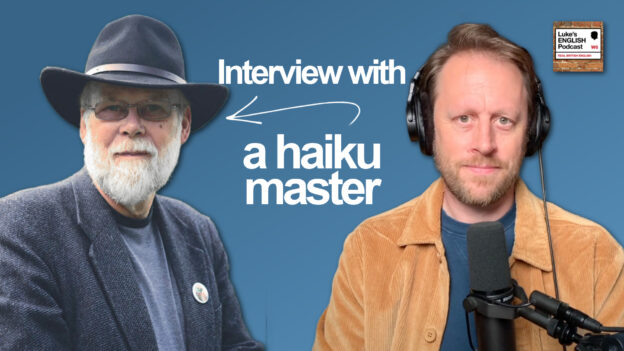
Practise your listening in English with a fascinating conversation with a writer of haiku poetry in English. John Stevenson is one of the world’s leading English language haiku poets, and in this episode I had the pleasure of talking to him for an hour. John taught me more about haiku and senryu poetry, revealed how he first became interested in haiku, and then was willing to discuss various haiku poems he has written over the years, giving details of what real events inspired them, what they mean and more about his process of writing haiku in English. I hope this episode is fascinating and inspiring. Keep listening because it becomes more and more revealing as it continues. John was a pleasure to talk to and I think this is the perfect conclusion to the trilogy of episodes I have done on this subject on the podcast recently.
[976] Here’s an epic rambling episode in which I talk about learning English with BBC Radio and TV 📻 expressions with the word ‘thumb’ 👍 the story of how I became a taxi driver on the streets of Paris 🚖 the grammar of Yoda 🐸 fantastic haikus written by my listeners ✍️ and getting pecked in the face by a swan 🦢. 3h30min+ of English from me to you.
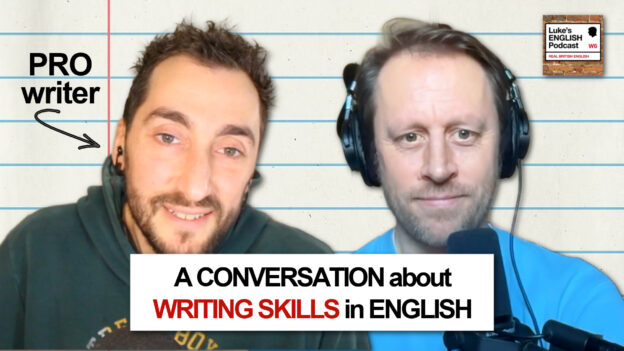
What skills are involved in being a good writer? What makes a good piece of writing? How is writing different to speaking? What are the challenges faced by learners of English who want to write well, and what are some solutions to these challenges? How can AI help develop writing skills? And, what does it take to write your own book in English? These are all questions which I talk about in this episode, with the help of professional writer and returning guest Fabio Cerpelloni.
Summary of Key Insights About Writing (for Learners of English) in our conversation 👇
1. Writing is permanent — and that’s why it feels scary
Unlike speaking, writing doesn’t disappear. Once it’s written, it’s there. That can make learners nervous, but it’s also what makes writing powerful: you have time to shape, revise, and improve your message.
2. Good writing is about impact, not perfection
A good piece of writing:
makes sense
does the job it’s meant to do
connects with the reader
Grammar and vocabulary matter, but effect on the reader matters more than sounding impressive or “advanced”.
3. Simpler language is often more effective than flashy language
Using complex vocabulary, idioms, or “advanced” expressions just to sound native can:
feel unnatural
distract the reader
reduce clarity
Clear, simple language often has more impact than complicated language.
4. Writing is about connection and self-expression
Beyond exams and emails, writing is a powerful tool for:
expressing ideas
sharing experiences
motivating or moving the reader
Even imperfect English can work well if the message connects emotionally.
5. Structure and organisation help the reader
Good writing:
has a clear beginning, middle, and end
is easy to follow
makes its purpose obvious
Organisation, coherence, and clarity all serve the reader — and improve impact.
6. Writing helps you clarify your thinking
Writing isn’t just about communicating ideas — it creates ideas. If something feels hard to write, it often means the idea isn’t clear yet. The struggle is part of the thinking process.
7. Cutting “fluff” is a key writing skill
Strong writing often comes from removing, not adding:
repeated ideas
vague sentences
unnecessary words
“Less is more” — especially in emails and practical writing.
8. Reading is essential if you want to write better
As Stephen King famously said:
“If you want to be a good writer, you must read a lot and write a lot.”
Reading helps you:
absorb natural structures
notice effective style
understand what works and why
If you want to write emails, read emails. If you want to write stories, read stories.
9. Writing a diary counts as real writing
You don’t need to publish or be famous to be a writer. Writing for yourself:
builds fluency
develops clarity
strengthens your connection with the reader (even if that reader is you)
A writer is simply someone who writes.
10. Exams focus on communication, not just accuracy
In exams like Cambridge English, accuracy is only one criterion. Higher priorities include:
communicative achievement
task completion
effect on the reader
Everything in your writing should serve the purpose of the task.
11. AI can help — if you use it wisely
AI tools are useful for:
checking grammar doubts
exploring word choices
finding synonyms
clarifying meaning
But they shouldn’t replace your thinking or your voice. Beware of letting AI do your writing for you – your own skills will not develop, and you will come across as unoriginal, indistinct and probably even lazy. Often, your reader wants to get the sense there is a person on the other side. Don’t be seduced by the dark side of the force. Sorry. I mean, don’t be seduced by the fact that ChatGPT will write flawlessly – with no errors. People can usually tell when something has been written by AI, and it doesn’t give a good impression of you.
Also, you need to question and evaluate what AI produces.
12. Dictionaries still matter
AI can make mistakes. A reliable dictionary — like the Oxford Learner’s Dictionaries — remains the final authority for:
Meaning of words
Examples of real usage
collocations
register
13. Writing improves confidence through small wins
Writing doesn’t have to mean a 300-page book. Small, achievable projects (emails, blog posts, short texts, “tiny books”) build:
confidence
momentum
motivation
Success encourages more writing. If you want to write well, write regularly.
14. Writing is hard — even for experienced writers
Struggling with a paragraph doesn’t mean you’re bad at writing. It usually means:
the idea needs refining
the purpose isn’t clear yet
Difficulty is normal and productive.
15. Ultimately, writing is about purpose
Before writing, ask:
Who is this for?
What do I want the reader to feel, know, or do?
What is the core idea?
When purpose is clear, language choices become much easier.
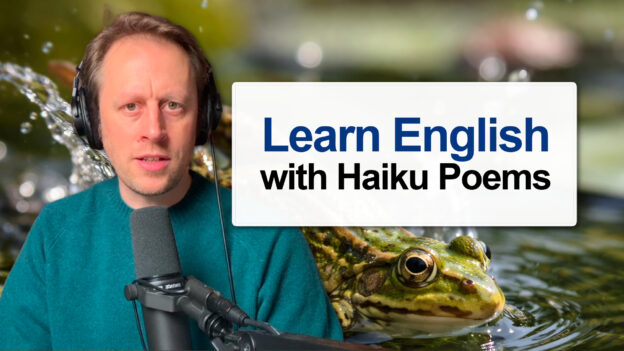
[974] In this episode I read out lots of haiku poems, explain their meaning, discuss what they make me think and feel, and use them to teach you some vocabulary. The haikus I read include some traditional Japanese ones translated into English, plus more modern ones written in English by writers from around the world. Some of these haikus are meditative, some are sad, some are funny and some find a way to capture feelings that are otherwise difficult to put into words.
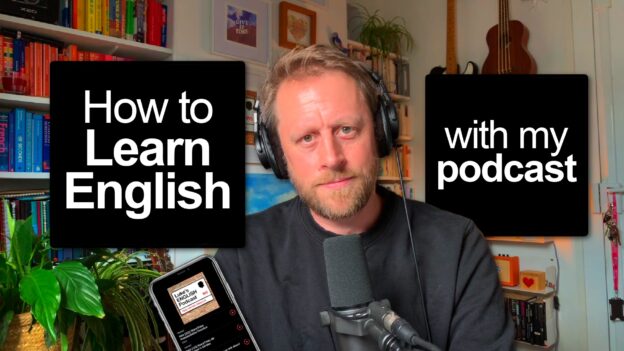
People keep asking me in comments, “How can I learn English with your podcast?” so in this episode I am answering that question as simply, directly and efficiently as possible. Expect advice about improving your English across the 4 skills of listening, reading, speaking and writing, and the language systems of grammar, vocabulary, pronunciation and discourse management. PDF available.
In this episode I talk to my parents about the topic of William Shakespeare. Enjoy a conversation about this important figure in English language and culture, with two other important figures – my mum and dad!
We discuss the enduring appeal and significance of William Shakespeare’s work, biographical details of his life, the key themes in Shakespeare’s plays, and the impact of his language on modern English. We try to explain the qualities that make Shakespeare great, using examples from plays like Hamlet, Twelfth Night, and Macbeth.
PDF available with transcript, vocabulary list and vocabulary quiz. Premium listeners – watch out for a language review of this episode coming soon, in P68 “Learn English with Shakespeare” parts 1 & 2.
Ian Moore returns to the podcast to talk about his career shift from stand-up comedy to writing “cosy” crime novels. After several decades as a professional stand-up comedian, Ian has transitioned to writing murder mysteries. Now he is a bestselling author and his books are being adapted for television. In this episode Ian talks about ending his stand-up comedy career, why he was not suited for life as the host of a guesthouse in the French countryside, writing books on trains, and why his COVID lockdown was actually great. Includes comprehension questions and a PDF transcript.
(Part 2 of 2) Let’s continue where we stopped in the last episode, by going through the rest of my list of funny English signs 🪧 from around the world. These signs are badly-written and have unintentionally funny double meanings. I will read out the signs, then explain what is funny and offer corrections to make the signs clearer. I will also explain vocabulary in the process. PDF available.
Let’s look at some funny examples of badly-worded signs from around the world (including UK & USA), which show the ambiguity and unintended consequences of unclear English. I analyse lots of signs, explaining the errors and offering improved versions, using them as teaching moments to illustrate grammatical and vocabulary points. The episode also features vocabulary explanations and corrections for the poorly written signs.
This is the first part of a series in which I share various little things which I have collected over the years for this podcast, including questions about English, some interesting talking points and some general motivation and inspiration for your English learning journey.
This website uses cookies to improve your experience while you navigate through the website. Out of these, the cookies that are categorized as necessary are stored on your browser as they are essential for the working of basic functionalities of the website. We also use third-party cookies that help us analyze and understand how you use this website. These cookies will be stored in your browser only with your consent. You also have the option to opt-out of these cookies. But opting out of some of these cookies may affect your browsing experience.
Necessary cookies are absolutely essential for the website to function properly. These cookies ensure basic functionalities and security features of the website, anonymously.
Cookie
Duration
Description
cookielawinfo-checkbox-analytics
11 months
This cookie is set by GDPR Cookie Consent plugin. The cookie is used to store the user consent for the cookies in the category "Analytics".
cookielawinfo-checkbox-functional
11 months
The cookie is set by GDPR cookie consent to record the user consent for the cookies in the category "Functional".
cookielawinfo-checkbox-necessary
11 months
This cookie is set by GDPR Cookie Consent plugin. The cookies is used to store the user consent for the cookies in the category "Necessary".
cookielawinfo-checkbox-others
11 months
This cookie is set by GDPR Cookie Consent plugin. The cookie is used to store the user consent for the cookies in the category "Other.
cookielawinfo-checkbox-performance
11 months
This cookie is set by GDPR Cookie Consent plugin. The cookie is used to store the user consent for the cookies in the category "Performance".
viewed_cookie_policy
11 months
The cookie is set by the GDPR Cookie Consent plugin and is used to store whether or not user has consented to the use of cookies. It does not store any personal data.
Functional cookies help to perform certain functionalities like sharing the content of the website on social media platforms, collect feedbacks, and other third-party features.
Performance cookies are used to understand and analyze the key performance indexes of the website which helps in delivering a better user experience for the visitors.
Analytical cookies are used to understand how visitors interact with the website. These cookies help provide information on metrics the number of visitors, bounce rate, traffic source, etc.
Advertisement cookies are used to provide visitors with relevant ads and marketing campaigns. These cookies track visitors across websites and collect information to provide customized ads.