Category Archives: Comedy

266. Telling Jokes in English (Part 3)

This is the third and final episode in this series on jokes. In this one we’re going to consider the psychology of puns, hear an old tape recording of my brother and me telling jokes when we were children, and you’ll also get lots more gags and their explanations.
Small Donate Button
[DOWNLOAD] [PART 1] [PART 2]
The Psychology of Puns
Why do we tell jokes? Is it all just fun, or is there something deeper and more psychological going on here? Let’s listen to a clip.
This is a clip from Tim Vine’s DVD ‘So I Said To This Bloke’ about the psychology of puns. Tim Vine (winner of the joke of the year) talks to a psychologist called Ingrid Collins about why we like puns.
Three questions:
1. Why do we tell puns? (two reasons)
2. What’s the condition she mentioned?
3. Why did the audience laugh a couple of times?

Answers
1. For two reasons. One is for the sheer joy of surprise, silliness and the joy of showing up our language in all its light and shade. Secondly, people use puns because they want to avoid talking about more serious things – emotional issues, fear of intimacy etc.
2. The condition is called paronomasia and a person who suffers from this is a paronomasiac.
3. The audience laughs a couple of times because, of course, Tim Vine makes a couple of jokes. The first one is a joke about the word paronomasiac. Para (like parachute) mosaic (a pattern) – he says; “A paronomsiac – as opposed to someone who like parachutes and strange patterns, a paranomosaic.” This is a made up word, and a pun which he came up with on the spot. The psychologist is not impressed, and just says “yes” – in fact we sense that the psychologist is probably judging him and maybe considers him to have paronomasia. Also: “Black beauty – he’s a dark horse”

Round 2 – yet more bad jokes!
11. What do you call a Saudi Arabian dairy farmer?
A milk sheik

12. Why can’t ants go to church?
Because they’re in sects.

13. Man walks into a bar with a piece of tarmac under one arm and says…
I’ll have a drink please and another one for the road.

14. Two fish in a tank, and one of them said…
How do you drive this thing?

15. Why did the scarecrow win the nobel prize?
He was outstanding in his field.

16. A policeman was standing by the side of a road watching traffic. He saw a bus drive past full of penguins, so he stopped it.
“Why is your bus full of penguins?” he asked the driver. “I found them all by the side of the road, they must have escaped” said the driver. “Well take them to the zoo!” said the policeman. “All right” said the driver, and drove off.
A couple of hours later the policeman saw the bus again, it was still full of penguins and now they were all eating ice-creams. He stopped the bus again and said to the driver – “I thought I told you to take them to the zoo?”
The driver said “I did take them to the zoo, and now we’re going to the swimming pool”.

17. Why don’t cannibals eat clowns?
Because they taste funny.

18. A man walking down the streets sees another man with a very big dog. One man says to the other, “Does your dog bite”, the man replies “No my dog doesn’t” The man pats the dog on the head and it bites his hand off. The man says “I thought you said your dog didn’t bite” and the other man says “Yes. Thats not my dog”.

19. Why do Marxists like to drink fruit infusions?
Because all proper tea is theft!

20. What’s ET short for?
Because he’s got little legs.

My Brother and me telling jokes when we were kids
Here’s an old recording from when I was about 6 years old of my bro and me telling jokes. The jokes are listed below. I was a bit young to be able to tell the jokes properly, and I found it hilarious to get the jokes wrong. Nothing has changed really…


Here are the jokes from the recording
Knock knock
Who’s there?
Doctor
Doctor Who?
That’s right!

Why did the fly fly?
Because the spider spider (because the spider spied her)

Doctor doctor I feel like a pack of cards
Sit down and I’ll deal with you later

Knock knock
Who’s there?
Cows go
Cows go who?
Cows go moo not who!

What did the cat do when it got to the motorway?
Meeeeooow!

– get your (py)jamas on

Louis CK talks about a joke written by his daughter
The point is that he loves his daughter’s joke because it is unexpected, and because he can imagine the situation. It’s a funny situation with no explanatory punchline. Normally this kind of joke has a contrived opening because it is leading to a punchline with a double meaning. His daughter’s joke just has a contrived setup, but no punchline, which is actually more surprising and therefore more satisfying! I’ll let Louis explain it.


Who didn’t let the gorilla into the ballet?
Just the people who were in charge of that decision.
(this is a sort of anti-joke made up by a child who doesn’t really understand the rules of jokes, which makes it funny to Louis)
For more jokes written by kids, click here.

Round 3
21. Did you hear about the ice-cream man? He was found dead in his ice-cream van, covered in chocolate sauce and pieces of hazelnut.
The police said that he had topped himself.

22. What lies on the bottom of the ocean and shakes?
A nervous wreck.

23. Q – what did the grape say when the elephant trod on it?
A – Nothing, it just gave a little wine.

24. A man walks into a bar and is about to order a drink when he notices Van Gogh in the corner. He calls over, “Hey, Van Gogh! Want a drink?” and Van Gogh replies, “No thanks. I’ve got one ‘ere.”

25. There were two cows in a field. One said “moo”, the other one said “I was going to say that!”

26. Patient : “Doctor I keep hearing “The green, green grass of home” in my head. Doctor : “That’s called the Tom Jones Syndrome”
Patient : “Is it common ?”
Doctor : “It’s not unusual”

27. Two aerials met on a roof, fell in love and got married. The ceremony was rubbish but the reception was brilliant.

28. A horse walks in to a bar. The bartender says: “Why the long face?”

29. A bear walks into bar. He goes up to the barman and says “Can I have a pint of beer and … … … and a packet of crisps?”.
The barman says, “yes… but why the big paws?

30. A Buddhist monk walks up to a hot dog vendor and says “Make me one with everything.”
Jokes3PODPIC

265. Telling Jokes in English (Part 2)

This is part 2 in a short series on jokes. In the last one we considered some of the social codes around joke telling, including when, why and how we should tell jokes and respond to jokes. I suggest that you listen to that if you haven’t already done so. [CLICK HERE FOR PART 1]
Small Donate Button[DOWNLOAD] [PART 1] [PART 3]
Introduction
In this episode we’re going to look at some typical joke structures, consider what makes a joke funny, and then I’m going to tell you lots of jokes. So, more entertaining and useful listening practice, with some jokes you can learn and share, and plenty of vocabulary teaching too. Again, there might be a part 3 to this episode, depending how long it is.

Just a reminder: This episode is all about jokes, but even if you don’t laugh at any of these jokes (many of which are, admittedly, quite bad jokes!) that is fine – because you’re learning lots of vocabulary. Perhaps, if you don’t get the jokes the first time, after you’ve understand the vocabulary, you can listen to these episodes again, come back to the jokes and see if any of them strike you as funny on a second listen. Also, I don’t expect you to remember all of these jokes, but you could pick a couple of jokes that you like, learn how to say them, and then share them with a couple of English-speaking friends. But be prepared to explain the jokes if nobody understands!

What are some typical joke structures?
Usually it’s this:
Question (setup)
“I don’t know” (response)
Answer (punchline)

e.g.
Why didn’t the ghost go to the dance?
– I don’t know
Because he had no body to go with.
Ha ha.

There are plenty of other joke types
Here’s a short list of examples

Knock Knock Jokes
Knock knock
Who’s there?
Luke
Luke who?
Luke through the window and you’ll see.

Doctor Doctor Jokes
Doctor doctor I feel like a bell
Well, take these pills and if they don’t work just give me a ring.

‘What do you call a…?’ jokes
What do you call a deer with no eyes?
No idea.

What do you call a deer with no eyes and no legs?
Still no idea.

‘What’s the difference between…?’ jokes
Q. What’s the difference between a tennis ball and the Prince of Wales?
A. One is thrown to the air and the other is heir to the throne.

Shaggy dog stories
E.g. the pink gorilla story

Light bulb jokes
How many psychiatrists does it take to change a light bulb?
None – the light bulb will change when it’s ready.

‘A man walks in to a bar’ jokes
A man walks into a bar…
and bangs his head.
It was an iron bar.

A man walks into a bar, sits down and orders a pint.
There’s a pianist in the corner, playing a song. The pianist has a monkey dancing on top of the piano.
As soon as the man’s drink arrives, the monkey jumps up, runs along the bar, pulls out its willy and pees into the man’s pint of beer.
Furious, the man walks over to the pianist and says “Do you know your monkey’s just pissed in my beer?”
The pianist says, “No I don’t, but if you sing the melody I’m sure I can pick it up”.

‘An Englishman, an Irishman and a Scotsman’ jokes (pretty old-fashioned and a bit racist)
An Englishman, an Irishman and a Scotsman are lost in the desert and their jeep breaks down. They’re going to have to walk. The Englishman takes the bottle of water, so if he gets thirsty he can drink it. The Scotsman brings a hat, so if the sun shines he can protect himself. The Irishman takes the car door and says “If it gets too hot I can wind down the window.”
– yes, the premise is that Irish people are stupid. It’s old-fashioned and a bit racist, as I said.

What makes a joke good?
It’s all a matter of taste. It’s completely subjective. There is no universal ‘best joke’ because different people with different tastes will laugh at different things at different times. In fact, the jokes which are totally safe and inoffensive will often be quite crap and boring. They lack any real punch, admittedly like a lot of the dad jokes in this episode. But there are certain things that will make a joke better – clever word play with double meanings of words being exploited, a bizarre or curious situation, the way the joke is told with correct timing, intonation, naturalness etc. There are also themes or subjects which will appeal to a wide audience, helping your joke get a better response from more people. These all help, but ultimately it’s a question of subjective personal taste.

The LaughLab Experiment
A study was done by a British scientist called Professor Richard Wiseman to discover the funniest joke in the world. The experiment, the results of which have been published on a website called laughlab.co.uk, went like this: People were invited to enter their favourite jokes into the website. Then other people from different countries around the world were asked to sign in, read the jokes and then rate the one they found the funniest. 40,000 jokes and 1.5 million ratings were received by the study. Do you want to know the joke? Here we go: (text reproduced from Prof Richard Wiseman’s website. Listen carefully. Do you get it?

The winning joke

After much careful scrutiny, we finally found the joke that received higher ratings than any other gag. Here it is:

Two hunters are out in the woods when one of them collapses and falls to the ground. He doesn’t seem to be breathing and his eyes are glazed. The other guy gets out his phone and calls the emergency services. He gasps, “My friend is dead! What can I do?”. The operator says “Calm down. I can help. First, let’s make sure he’s dead.”
There is a silence, then a shot is heard. Back on the phone, the guy says “OK, now what?” 

This joke was submitted by Gurpal Gosall, a 31 year old psychiatrist from Manchester in the UK. He told LaughLab:

“I like the joke as it makes people feel better, because it reminds them that there is always someone out there who is doing something more stupid than themselves.”

The joke is interesting because it works across many different countries, appeals to men and women, and young and old alike. Many of the jokes submitted received higher ratings from certain groups of people, but this one had real universal appeal.

Also, we find jokes funny for lots of different reasons – they sometimes make us feel superior to others, reduce the emotional impact of anxiety-provoking events, or surprise us because of some kind of incongruity. The hunters joke contains all three elements – we feel superior to the stupid hunter, realise the incongruity of him misunderstanding the operator and the joke helps us to laugh about our concerns about our own mortality.

What do you think? Did you get it?

Let’s hear a short extract from a documentary about jokes produced by the History Channel. It’s presented by an American comedian called Louis Black. In this extract he meets Professor Wiseman and they talk about the LaughLab study and the joke that won. As you listen, just consider this question: What does Louis think of the joke? What’s his opinion?

What did Louis Black think?
He thought it was a bad joke, and that there is no such thing as “the funniest joke in the world” because all humour is subjective. What’s funny to one person will not be funny to the next guy, and so on. It’s your humour, and don’t let anyone tell you otherwise. The only way to find out what is funny, is to actually go out and tell jokes and see what makes people laugh.

So, with that thought in mind, let me now tell you some jokes. If you don’t understand them, don’t worry – I will explain them all afterwards.

JOKE LIST 
I’ll read all these jokes to you, then explain them afterwards. I think I’ll read out 10, and then explain those, and then do the next 10 and so on…

How Many Jokes Can You Understand?
If you like, you can count how many of the jokes you get. If you get a joke, you get one point.
So, count how many jokes you get.
9/10 or 10/10 = You will probably laugh at anything, and you’re probably on drugs.
6-8/10 = well done! Either your English is brilliant or you just have a natural sense of humour.
4-6/10 = not bad! Jokes are difficult to understand, and if you got 50% that’s actually a very good score.
2-4/10 = Don’t worry too much if you didn’t understand many of the jokes – don’t feel bad, but I think you should watch more comedy in English.
1/10 = Never mind! Listen to this episode again to build up your vocabulary, and I expect you’ll understand more of the jokes. Don’t forget, I’m going to explain them afterwards.
0/10 = hello? Are you alive? – Just kidding. It’s quite normal if you didn’t find any of these jokes funny. Remember, understanding jokes and laughing at them is very hard in another language.

So, just laughing at a couple of these jokes is enough. I don’t expect you to laugh at them all. Just focus on understanding the meaning. If you laugh, that’s a bonus.

You Should Practise Saying the Jokes Too
Also – remember that the delivery is important. I suggest you practise telling these jokes yourself. Listen to the way I say them (I hope I’ll say them correctly) and try and copy the rhythm, intonation and sentence stress. Notice which words are emphasised and how. That’s important. You can read all these jokes on the page for this episode.

Round 1 (and yes, I know these jokes are really cheesy!)
1. Why was 6 afraid of 7?

Because 7 8 9.

2. What’s brown and sticky?
A stick.

3. A man walked into a bar and said “Do you have any helicopter crisps?”
The barman said, sorry we only have plane crisps.

4. What do you call a fly with no wings?
a walk

5. What do you call a fly with no wings and no legs?
a crash

6. What do you call a man with a car on his head?
Jack

7. How much fun do monks have?
Nun.

8. What do you call a blind dinosaur?
Doyouthinkhesaurus.

9. What’s black and white and red all over?
A newspaper in the bin.

10. A: My dog’s got no nose.
B: How does it smell?
Awful
Jokes2PODPIC
PLEASE LEAVE YOUR COMMENTS BELOW AND SHARE YOUR JOKES!

264. Telling Jokes in English (Part 1)

This episode is all about telling jokes, not as a comedian on stage, just in your normal life. Telling jokes is something that everybody does, in countries and cultures all around the world. We all love to make jokes, hear jokes and have a bit of a laugh. For me, jokes are fun and fascinating but I know that for non-native speakers of English they are also notoriously difficult things to manage. If English isn’t your first language, it can be difficult to understand jokes, find them funny, and also to be able to tell them effectively.
[DOWNLOAD] [PART 2] [PART 3]
Contents of this Episode
So, in this episode I’m going to tell you everything you need to know about jokes in English, and that includes these things:
What is a joke? (as if you didn’t know)
When/why do we tell jokes?
How do we tell jokes? What are the golden rules for telling a joke properly?
What’s the normal way to respond to a joke?
What are some the typical joke structures? (so you know how to identify a joke)
What are some jokes that you can remember and share with your friends?

So this is not just going to be a guide to jokes and the way they are told,  you’re also going to hear lots of jokes too – I’m going to read out loads of jokes, and explain them to you. So that means that you’re also going to learn a lot of vocabulary during the episode – because often jokes are based on the specific meanings or double meanings of words.

Most of what I’m saying to you here is written on the page for this episode – that’s right, there’s a transcript for most of this, so if you want to read what I’m saying – you can. Just find the page for this episode at teacherluke.co.uk.

Small Donate ButtonNot all of it is scripted because I expect I will go off script and say some spontaneous stuff too, but most of it is. That’s nice isn’t it? Yes it is. Mmm, very nice. I went to quite a lot of effort to prepare this episode in advance and I hope that’s obvious. It should be full of genuine insights. If you find it useful, you could consider making a donation by just clicking one of the yellow ‘donate’ buttons on teacherluke.co.uk. That is entirely optional and completely up to you of course! No pressure!

I expect this will be more than just one episode because it’s quite a big subject, and it’s a subject which is close to my heart so, naturally I have loads of things to say about this!

It might be the case that I do this first episode as an introduction to the subject of jokes, and then in subsequent episodes I’ll go through my list of jokes, and then explain them. That’s right, I’ve prepared a list of jokes. It’s quite a random list and hasn’t been fully tested for quality. It’s just a selection of jokes which I’ve managed to write down, or poach from other lists on the internet. I’ll tell you all those jokes either in this episode, or in separate episodes, depending on how long this all takes.

So this could be another series of episodes of the podcast. There’s so much to talk about and to share.

I’d also like to do an episode about telling jokes on stage and how to do stand up comedy, because stand-up is also a fascinating topic and one that more and more people are getting interested in. Telling jokes on stage is quite a different topic, so that’s another episode for another time.

I love jokes
I really do. I love hearing them and I love telling them. I love the way jokes exploit double meanings in language. Often a joke is based on a word that means two things at the same time, or two phrases that sound exactly the same. Or a joke might be a little story with a surprise which is revealed at the end. So jokes allow us to have fun with the little holes and coincidences that exist in languages. They’re like little language glitches – moments when your brain has to deal with a sudden change in meaning or something that has two meanings at the same time.
I love the surreal world of jokes – the way the normal rules can be broken – rules of language, but also the rules of physics, and behaviour too. Jokes often bend the rules of reality in order to make the punchline work. They lead you in one direction, and then suddenly surprise you with something completely different, and the only link is that the words sound the same.

What am I talking about? Here’s an example of a joke in which the punchline has two meanings.
A hole has been found in a nudist camp wall. The police are looking into it.
To get this joke you need to know that the phrase ‘to look into something’ can mean “to investigate” and also to literally “look inside”. So, someone found a hole in the wall of a nudist camp. A nudist camp is a place where people can enjoy spending time with no clothes on, in the nude. Someone found a hole in the wall and the police are investigating it, but they’re also just looking into the hole.

OK.

A hole has been found in the nudist camp wall. The police are looking into it.

I’ve said it before and I’ve said it again – explaining a joke kills the magic.

“Explaining a joke is like dissecting a frog. You understand it better but the frog dies in the process.”

― E.B. White


So, explaining a joke may allow you to understand it, but the joke dies in the process – you probably won’t laugh after it’s been explained. Jokes work best when they are instantly understood. It has to be instant. This is why jokes are often lost on non-native speakers, which is a pity.

However, here at Luke’s English Podcast I have a mission – and that is to try and make you laugh while you learn, and if I can’t make you laugh I’ll certainly aim to teach you something. So even if you don’t find all of the jokes I’m going to tell you (later) funny, then that doesn’t matter, because in the end you’ll learn some double meanings and you’ll be more ready to laugh in the future, because I’m going to explain lots of jokes for you. I expect that many frogs will die during the recording of these episodes…

What was I saying? That’s it – I love jokes!

Jokes can be stupid, brilliant, pointless, dangerous, harmless, disappointing, unexpected, light-hearted, dark, bizarre, rude, intellectual or even illegal.
Jokes can be just a bit of fun, or they can be used to make serious and critical points. They can be very complex things when you examine them but ultimately, jokes are about fun and laughter – and what is wrong with that?

There are all sorts of social rules that surround the telling of jokes.
They’re little bits of language, wrapped up in culture, presented via small social rituals.
Jokes, and humour in general, are often the most difficult aspect of a language to appreciate. The ability to appreciate humour is one of the last things you gain as a language learner.
To get a joke you need to be able to hear the individual words spoken, identify them, understand them, spot the punchline, grasp the pun or word-play and then know how to react appropriately, and this all has to happen instantly. Perhaps most importantly – you need to have identified that it was a joke in the first place, and not just another couple of sentences that you didn’t really understand. It can be even harder to deliver a joke – remembering the specific words, getting the timing right, emphasising the relevant words correctly using sentence stress and intonation. Oh my god! It’s complicated.

Imagine this situation – I’m sure you’ve experienced something similar. You’re in a group of people. They’re all native speakers and you’re not. One of them is speaking rather quickly but you can basically follow what’s being said – even the complex words and bits of grammar. You feel quite proud of yourself “I’m understanding all of this!”. Then the guy says something and everyone bursts out laughing, but to you it just sounded like another sentence. What’s wrong with everyone? Then it becomes clear that he just told a joke, and apparently it was a good one. “Was that supposed to be funny?” You think to yourself. Someone explains the joke to you – you think about it, you get it, but it’s just not that funny! It’s not even clever! Why did everyone laugh so much? Is everyone else weird, or is it you?

The fact is, jokes can be hard to get, and after it’s been explained to you the magic has probably gone. You’ve got to understand it 100%, and instantly. That’s why non-native speakers of English are often not very impressed by humour in English. Jokes don’t usually translate into other languages because they are based on specific sounds or similarities between words. Also the delay in understanding a joke can kill the enjoyment.

I’m not saying that non-native speakers don’t get humour in English. I know they do. Sometimes I make my students laugh a lot, although this is matched by the number of times my student don’t even identify that I’ve told a joke – is that their lack of English, or my bad jokes? A combination of the two I expect. So, even though non-native speakers clearly do laugh at a lot of things in English, I’m well aware that a lot of things are completely lost on them too.

I think that you (as learners of English) need to understand jokes – because it can help you socially, but also because you’re missing out on a lot of fun. That’s why I’ve decided to do this episode.

But don’t expect this to be a particularly funny episode! There’s nothing worse than high-expectations for a joke. If your expectations are too high, you won’t laugh. It’s like when someone says, “I’ve got a really great joke, you’re going to love this!” then the joke is never that funny. So, don’t get your hopes up. Despite the fact that this episode is all about jokes, it’s probably best if you realise at this point that there will be no laughs and no fun in this episode at all. OK?

DO NOT EXPECT LAUGHTER!

What is a joke?
It’s just anything said that is intended to produce laughter. It could be a traditional joke structure, or a comeback, a sarcastic comment or a small story or whatever. If it is intended to produce laughter, it’s a joke.

Vocabulary
There are a few words that you should know. They’re all different types of joke, or just related to jokes in some way. Here they are:
*a pun = a word joke – a short joke that is based specifically on two words/phrases that have the same meaning or sound the same. For example, “Did you hear about the guy whose whole left side was cut off? He’s all right now.”
[‘All right’ = okay, but also, ‘all right’ means ‘only the right’ – in this case, he only has a right side now because his whole left side was cut off. Yes it’s ridiculous. Yes, I like it.]
*a gag = just another word for a joke
*a shaggy dog story = a longer joke with a stupid punchline at the end (e.g. The Pink Gorilla Story or The Prawn Story)
*a one liner = a simple one line joke. E.g. “Conjunctivitis.com – now that’s a sight for sore eyes.” [Don’t get it? Don’t feel bad. Conjunctivitis = a health condition in which your eyes are infected and painful, or ‘sore’. The expression “a sight for sore eyes” = something which you are really glad to see, because you need it. e.g. “You’re a sight for sore eyes” = I’m really glad to see you (maybe because you’re attractive and nice, and I’m bored and surrounded by uninteresting people). Also “site” and “sight” sound the same. Here, ‘conjunctivitis.com is a website for people who have sore eyes. It’s literally a website for sore eyes, and I suppose it’s something you’re glad to see if you have conjunctivitis.] And if you’re in any doubt about the funniness of that joke, it won the “Joke of the Year” award in 2012. That’s an award which is given to the comedian who makes the best joke of the Edinburgh Fringe Festival which is one of the world’s biggest comedy festivals. It was written by Tim Vine, one of the UK’s top comedians. Click here to read more on this story.
*a wisecrack = a clever and funny response
*a comeback = a quick response to a criticism. Winston Churchill was famous for his comebacks. “Mr Churchill, you’re drunk!” “Yes, I am. And you’re ugly. But in the morning I shall be sober. But you will still be ugly.”
or “Mr Churchill, if I was your wife I would put poison in your tea!” “And if I was your husband, I’d drink it!” etc.
*witty (adj) = to describe someone who is funny and able to make quick and spontaneous jokes.
*the setup = the first part of a joke which sets the situation and linguistic context
*the punchline = the funny part of the joke, which is delivered last. E.g. “I couldn’t quite remember how to throw a boomerang” = the setup, “but eventually it came back to me.” = the punchline. [‘come back to me’ literally means ‘return to me’ – like a boomerang does, but it also means ‘remember’]
*a dad joke = a stupid, safe and rather bad joke. The kind of thing your dad would tell you. To be honest, most of the jokes in this series on jokes are dad jokes. They’re not very dangerous or cool. They’re pretty disposable, but they’re fun, and sweet.

Where do jokes come from?
Most jokes just seem to exist in people’s consciousness and nobody knows who wrote them. They get shared orally (or maybe written in emails) and get passed around, but nobody really owns them. When I was a kid, my friends and I used to own joke books. They were compilations of jokes. You could buy these huge books filled with hundreds or thousands of ‘knock knock’ jokes. We used to go around telling them to each other. There were so many. Sometimes I heard some pretty rude jokes too – jokes that involved sexual things that as a child I just didn’t understand. That was a weird way to be introduced to some aspects of sexual depravity – within the context of a joke told by a naughty kid at school. Only later would I understand what they actually meant.
Then there are jokes which have been made up by someone, like a professional comedian – like the conjunctivitis joke. Those ones are actually owned by those comedians and used in their stage performances, and when you tell one of those jokes it’s customary to say whose joke it is – “That’s a Peter Kay joke” or “That’s a Tim Vine joke” for example. It’s a surprisingly difficult skill to be able to write really good jokes. If you can do it well, it can make you quite rich. Some of the best comedians, writers and directors started out by writing jokes for other people. For example, Woody Allen, Steve Martin and David Letterman.
Then there are original jokes made up by people on the spot. If you’re a clever you might be able to come up with jokes spontaneously – and people might consider you to be ‘really witty’ (positive) or perhaps just a ‘smart aleck’ (negative) depending on how well received your jokes or funny comments are.

Mainly in this episode we’re talking about the first category of joke – ones that lots of people know, have no ‘owner’ and which get passed around by word of mouth. As I said, I’ll be sharing loads of them with you later in this episode or perhaps in the next one.
A lot of these jokes which are shared by friends have typical structures, which most people know. Like “Knock knock” or “Doctor Doctor” jokes.
There are also social conventions around joke telling that you need to know, for example – how to tell a joke, how to react when someone tells you a joke, how to identify when someone is joking and how to respond to a joke.
For example, if someone says to you,
“What’s the difference between a photocopier and the flu?”
You shouldn’t try to guess the answer. “Err, well, one is a kind of machine and the other one is a virus. They’re really different actually. Why?”
No – this is the wrong response. The person is clearly telling you a joke. You’re supposed to say “I don’t know” and then wait expectantly for the hilarious punchline.
“What’s the difference between a photocopier and the flu?”
– “I don’t know”
One makes facsimiles; the other makes sick families.
“Haha, good one!” you say, even if it wasn’t that good.

Telling and hearing a joke is like a little social interaction with its own specific rules and conventions that you have to know. We’ll look at this more later.

What’s the point of telling jokes? Why do we tell jokes?
It’s all about laughter and how it makes us feel good. According to Helpguide.org – a trusted non-profit online service giving advice about mental and physical health, Laughter is good for your health. “Laughter is the best medicine”.
According to them:
Laughter relaxes the whole body. A good, hearty laugh relieves physical tension and stress, leaving your muscles relaxed for up to 45 minutes after.
Laughter boosts the immune system.
Laughter decreases stress hormones and increases immune cells and infection-fighting antibodies, thus improving your resistance to disease.
Laughter triggers the release of endorphins, the body’s natural feel-good chemicals. Endorphins promote an overall sense of well-being and can even temporarily relieve pain.
Laughter protects the heart. It improves the function of blood vessels and increases blood flow, which can help protect you against a heart attack and other cardiovascular problems.

The link between laughter and mental health
Laughter dissolves distressing emotions. You can’t feel anxious, angry, or sad when you’re laughing.
Laughter helps you relax and recharge. It reduces stress and increases energy, enabling you to stay focused and accomplish more.
Humor shifts perspective, allowing you to see situations in a more realistic, less threatening light. A humorous perspective creates psychological distance, which can help you avoid feeling overwhelmed.

Social Benefits
Strengthens relationships
Attracts others to us
Enhances teamwork
Helps defuse conflict
Promotes group bonding

Jokes are crap, aren’t they?
You might be thinking: “But jokes aren’t funny. I sort of hate jokes. They’re usually awful and I don’t laugh.”
Yes, true. They’re often terrible – like the bad puns that your Dad tells you, or the awful jokes you get on lollipop sticks or inside christmas crackers, but that’s part of the charm really. It’s just a bit of fun – stop taking life too seriously! Kids like them of course, because kids don’t like to take life too seriously, and because most jokes are brand new to children. Also, when you’re a kid is when you are learning about the language and discovering any double meanings can be quite exciting. For me, it’s all about having the right attitude and being ready to laugh and find things funny. If you want to laugh at jokes, you will.

When to tell jokes
I suppose the best jokes are the ones that are spontaneous (made up on the spot).
They are usually received best when they are shared in light-hearted joke telling sessions, when everyone is telling jokes. Sometimes that happens – someone tells a joke and then everyone chips in with a joke they know. Like, “I’ve got one” or “Have you heard this one?” That way you’re not forcing your joke on someone who then feels pressure to laugh at a joke they might not find funny or understand.
Be careful of using them to impress people, break the ice or to charm people, like in a business meeting or on a date. They might have the opposite effect. You have to know when to tell jokes. Normally it’s in a moment where there’s no pressure.
The best results come from comments, or responses that happen spontaneously. If people feel that a joke is too planned or contrived – like you’ve planned it for days or weeks in advance, you’ll look like a prat. So, the best jokes are just unplanned comments that happen in that moment.
So, because the funniest things are spontaneous, it’s all about having the right attitude – being open, looking for the funny side of things, being self-deprecating (laughing at yourself), being sarcastic, joking about things that everybody experiences, not picking on anyone in particular, and wanting everyone to be happy and to enjoy themselves.

Jokes are often best told privately. For example, not announcing a joke to the whole room, but sneaking up on someone and sharing it just between you both, quietly.

Jokes can be risky
You might embarrass yourself or others if the joke is not funny or if you ‘fluff it’ – say it wrong.
Watch out for the content of jokes. A lot of them are pretty rude – and I don’t just mean sexually. They often have victims, or could be very politically incorrect. You could offend people and get yourself into serious trouble, depending on the context and the joke of course.
Watch out for these things: jokes about nationalities, jokes about disability, jokes about blondes, jokes about race, sexist jokes or jokes with rude images. I realise that I’ve just deleted most of the best jokes – but the point is, don’t underestimate how offensive a joke can be. Some people might laugh, some might not understand it, and some will take it seriously and be offended. Also, in some places, jokes are outlawed, especially if they are political in nature. So – be careful when joking.
The right joke at the right time makes everything ok.
The wrong joke, told at the wrong time in front of the wrong people could land you in serious trouble.

So:
be spontaneous
don’t pick on anyone in particular – don’t victimise anyone
be prepared to make jokes about yourself
make jokes about things that everyone is experiencing/sharing

How do you tell jokes?
Perhaps the most common structure for a joke is the Question-Answer format. That means that a joke often begins with a question. It’s quite normal to just ask someone that question, and if they’re familiar with the culture of telling jokes, they will respond with “I don’t know” and then you deliver the punchline.
E.g.
“Hey, how does Bob Marley like his donuts?”
“I don’t know”
“Wi’ jam in”.
“Do you get it? ‘With jam in’ – ‘we’re jamming”
“Ha ha oh yeah, I get it! Nice one!” etc.

So, at the right moment you can just tell your joke by asking the question like that.

Sometimes you can say “I’ve got a joke for you” or “Do you want to hear a joke?” or “Have you heard the Bob Marley joke?”

Try not to say “I’ve got an absolutely hilarious joke – you’re going to absolutely love this!” – because the person will expect too much and it’s bound to be an anticlimax.

Timing is important. It also has to be really clear. It has to be comfortably and easily told.
Make sure you learn it properly! The set-up has to be exactly right, and the punchline too!
Make sure the set up is not too long. It has to give only the most crucial information for the punchline to work.
Make sure you know your joke well, because there’s nothing worse than telling a joke wrong, or forgetting the punchline. It’s the equivalent of a magic trick going wrong – you look like a fool.
Don’t expect much of a response, and don’t expect your joke to make you popular or anything. The chances are, people won’t get it, and if they do laugh, they’ll probably just forget about it, unless the person is a joke fan like you. In the right moment though, jokes can be a lot of fun. So, jokes are not worth a lot, unless you find other people who love them, and then you can share your favourite jokes together.

When telling a joke – remember it! Run the joke through your head before saying it. Don’t get halfway through the joke and then start again because you forgot it.
Make it clear and be confident. People have to be able to hear and understand what you’re saying.
Sentence stress is very important. Usually certain words must be stressed for emphasis.
Make it look quite casual. Don’t be too desperate for a response or laughter.
The best jokes are completely improvised comments made in the moment. Sometimes there is nothing better than a very carefully worded quick response to a situation. It can make everyone burst out laughing quite magically. But again – watch out because jokes can backfire. People may find it offensive, inappropriate or just pathetic.
There are risks in joke telling. You risk losing respect from people, or offending people, but the rewards are high. If you make people laugh, they will like you, and ultimately everyone can enjoy a good laugh – and there’s nothing wrong with that. In fact, sometimes it’s the best, most honest feeling in the world – just letting yourself go and laughing uncontrollably. It’s joyful and infections, and being able to create it is a bit like being a good wizard (not an evil one).
Choose to tell good jokes which have a proven track record. Don’t tell jokes that don’t make people laugh, even if you find them funny yourself.
Don’t tell inappropriate jokes – ones that are sexual, racist or which have a victim. Instead try to tell jokes that are universal. Rude jokes can be very funny, but be aware that they are only appropriate in certain situations, and only funny for certain people.
Don’t get all angry, upset and defensive if people didn’t enjoy your joke. You can’t bully people into enjoying themselves. Just shrug it off.
You need to make it clear when the joke has ended and when people are expected to laugh, although don’t expect it to happen.
If you’re going to make a joke, try to connect it to what’s going on at that moment.
Often the best jokes are just one line responses to things happening around you.
Jokes are often best delivered with a straight face, with an understated style. Don’t make a big song and dance out of it. In the UK we normally tell a joke quite straight. We don’t laugh at our own jokes or slap our thigh when we tell the punchline. Laughing at your own joke too much is considered a bit unattractive.
Be prepared to carry on if the joke fails to make people laugh – people might not notice! Otherwise, it’s probably worth admitting that you told a joke and nobody found it funny. Then people will feel less awkward. Sometimes when I tell jokes, nobody laughs. Then I say “that was a joke, by the way, just in case you are wondering” and that sometimes makes people laugh a little bit – maybe out of sympathy if nothing else!
I realise I’m sounding a bit modest here – it may look like I spend all my time embarrassing myself with dodgy jokes. Well, it does happen sometimes, but not all the time.

English people love humour and it’s used a lot, for a lot of different purposes – including breaking the ice, as well as establishing power structures or social hierarchies, or breaking down social hierarchies.
I’m sure it’s similar in your countries too. Kate Fox says that for the English there is no right or wrong time for humour. I know what she means, but I don’t think it’s strictly true. We love joking in many situations, and we’re always ready for a joke or a funny/sarcastic comment, but of course there is a right or wrong place for it. If you just go around making crap jokes all the time, in every situation, you’ll soon become unpopular. I suppose what Kate Fox means is that humour, rather than jokes, pervades all aspects of British life and I agree with that.
The main thing is the intention you have behind your jokes – are you doing it to make people feel happy, to bond your team, to put people at ease, or are you doing it just to draw attention to yourself at the expense of other people’s comfort? If it’s the latter reason, then it’s probably better to curb your enthusiasm a bit.
Really, being funny is more about having the right attitude – being ready, prepared and confident enough to find the funniness in anything.
It’s also about being generous – just wanting to make people laugh without spoiling the situation.
It’s not about cruelty – bullying or targeting people with humour. It’s not picking on other people too much. It is about being willing to take a joke yourself. That’s the first step.
Some people just don’t want to be a person who jokes – they’d rather be serious and expect people to take them seriously too. That’s fine of course. Personally, I think that many of us take life too seriously – and a good sense of humour and the ability to take a joke are admirable, positive qualities. It’s hard to be a genuinely arrogant person while taking a joke about yourself. It’s a good leveler. It makes people equal in status.
Really, it’s just about having an attitude for laughter and jokes. For me it’s best when it’s sort of selfless.
There’s also a love of language involved. Sometimes jokes come out of picking the right words, or playing with language.
One advantage of a good joke is that people’s guard goes down when you make them laugh. You can say some outrageous things and get away with it. Also, people will warm to you if you make them laugh. It’s charming. Good jokes are harmless (and should be).
Also, there are all the benefits of laughter.

How do you react to a joke?
The worst thing you can do is not recognise it is a joke.
It’s also bad if you don’t acknowledge that a joke has been told. You have to show that you identified it as a joke, at the very least.
Some acknowledgement is good.
Ideally you’ll laugh naturally. You could fake a chuckle but don’t go over the top. You could say “good one”, or even “that’s a good joke!” (without laughing)
If you don’t understand it you say: “I don’t get it.”
If you’ve heard it before: “I’ve heard it before.”
If you understand the joke, but don’t find it funny: You can make a noise, like you’re suffering. “Ooohhh!” or even something like “Oh my god what are you like?”
If you understand it and find it funny: laughter!
It may be appropriate then to share a joke that you have too.

End of part 1

What’s the culture of jokes in your country? 
jokes1PODPIC

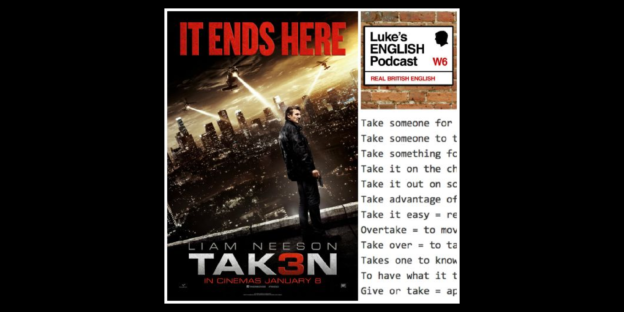
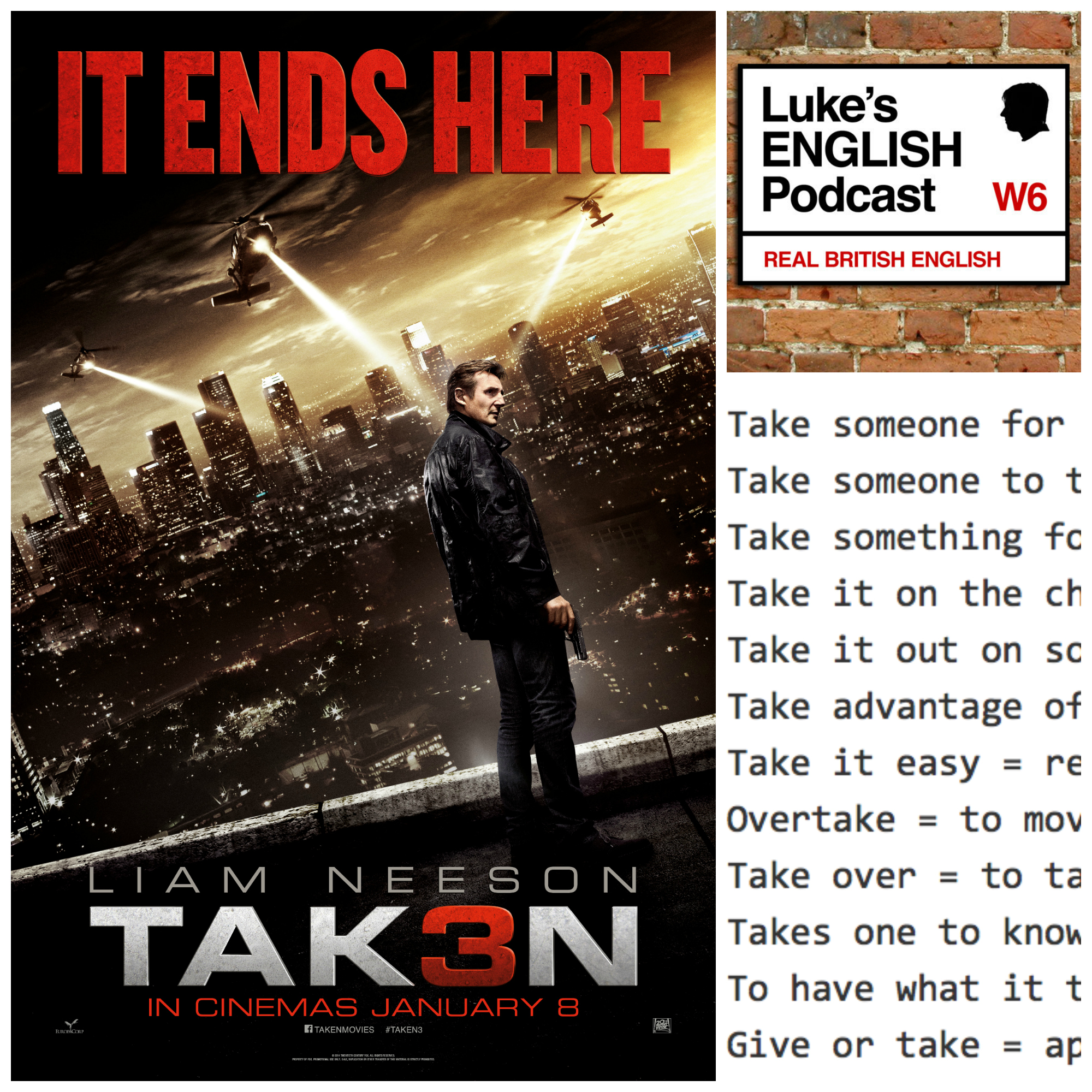
255. Taken 3 / Expressions with ‘Take’

My response to the film Taken 3, plus 12 expressions with the word ‘take’. [Download]

The Film
*Spoiler alert* – I might give away some details of the story line, although I think you probably have a good idea what kind of thing you can expect. Someone did something to his family, and Liam Neeson will use his very particular set of skills to find them, he will hunt them down and he will kill them. There will be loads of high-octane action, some very questionable moral actions, and the usual offensive stereotypes of foreign people.

You should know that I’ve talked, at length, about Taken 1 already on this podcast.

Yesterday I went to the cinema and tweeted “I’m on my way to see Taken 3…” Naturally, some people wanted me to talk about it on the podcast, so here it is.

In a nutshell, this film is bad – it’s total pants, it’s piss poor, it’s lame, it’s cheesy, and frankly, it’s dull. It’s like a b-movie, but with Liam Neeson. It retains few of the redeeming qualities of the original, brings nothing new to the table and just looks like everyone involved is just doing it for the money. That’s not to say it was without enjoyment – I did enjoy it a bit, perhaps because I’d lowered my expectations before going into the cinema.

Expressions with Take
There are loads. Here are 12. Listen to the episode to hear full explanations and examples.

1. Take someone for a ride = to rip someone off
2. Take someone to the cleaners = to rip someone off, or to beat someone
3. Take something for granted = to undervalue something which is actually very valuable to you
4. Take it on the chin = to be strong and resilient in the face of criticism or adversity
5. Take it out on someone = to express your anger/frustration by being nasty or aggressive towards someone else
6. Take advantage of something = to make the most of it, to exploit it
7. Take it easy = relax
8. Overtake = to move in front of someone (e.g. in a car)
9. Take over = to take control of something (to acquire)
10. Takes one to know one = In order to know something you have to be that thing too
11. To have what it takes = to have the necessary qualities to do something
12. Give or take = approximately

[socialpoll id=”2249079″]
Taken3PIC

246. Funny Flight Stories

Listen to some stand-up comedy and true stories about flying experiences, learn some vocabulary and consider what makes these comedy routines funny. [Download]

Small Donate ButtonIntroduction
This episode features a few humourous accounts of people’s experiences on aeroplanes. Why have I chosen this topic? Well, why not? There’s no Christmas connection or anything, it’s just an episode I’ve been thinking about for ages and I finally got around to doing it. Actually, the main reason is so I can play you some stand up comedy, which hopefully you will both learn from and enjoy.  I always want to play you some stand up comedy – because it’s brilliant and I want to share it with you! The subject of flying is something that is pretty universal, so I thought there was a good chance you’d be able to relate to it. Also, comedians all seem to have material based on flying. it’s a really common topic for stand-up, precisely because it’s universal but also because it’s a pretty bizarre experience in some ways!

Please be aware that there is some rude language in this episode.

Let’s listen to some stories of people flying.
Almost all of these are comedy routines by stand up comedians.
One of them is an inspirational story, which has some laughs in it.

3 things I wonder:

  • If you get the details of the stories
  • If you find them funny
  • If you know all the vocabulary

To understand the subtleties I’ll give you a quick summary of each story before you listen. Then you’ll know the main events, leaving you to focus on the funny details.
To deal with the humour, I will explain what I find funny about each sketch. Obviously, humour is totally subjective – it depends on the person and there is no universal form of humour. However, I also find that humour is one of the last things that you can pick up when you’re learning a language. Learners tend not to find the same things funny as native speakers – perhaps because they don’t get the cultural reference points, or because you can’t understand it well enough to get all the jokes immediately. Instant comprehension of all the subtle shifts in tone and meaning is very important for finding something funny. Most of the funny aspects of these routines are not obvious jokes. It’s far more subtle than that. So, let’s see if you can pick up on those subtle things and see the humour in each bit. I’ll give you my assessment of “what I think is funny” after each bit.

So, you’ll get summaries for general understanding, and some commentary on the humour as well.

There’s also vocabulary, which I don’t think will be such a problem but we will see. I’ll explain some items of vocabulary that appear.

And as if that’s not enough already, there are scripts of every stand up routine that you hear in this episode. You can check them out on the webpage and use them to understand every single word if that’s what you fancy doing.

So, I would like to know which is your favourite story or routine in this episode. you’re going to hear 5 stories/routines. Please vote for your favourite using the poll on the page for this episode.

In no particular order you will hear these things:

  • Louis CK – The Time I Thought I Would Die
  • Eddie Izzard – Biscuits On A Plane
  • Jerry Seinfeld – At the Airport
  • Ric Elias – 3 Things I Learned When My Plane Crashed

Louis CK’s Story
Summary

  1. Louis talks about a time when he was scared for his life. He thought he was going to die. It’s a true story.
  2. He was flying from Indianapolis to New York and there was a delay because of a technical problem with the plane. The fuel guage was broken.
  3. The pilot decided to fly even though he didn’t know how much fuel was in the plane.
  4. Louis just assumed that the pilot knew what he was doing. He unquestionably put his trust in the pilot. Why do we do this?
  5. Louis expresses some concern about the rather relaxed approach to safety which the pilot is taking.
  6. The plane is still delayed because of bad weather at their destination.
  7. The pilot informs the passengers that he is going to lie to the tower, telling them they’re going to Philadelphia, even though they’re going to go to new York.The plan is to say they’re going to Philadelphia, and then at the last minute, ask for permission to land in New York. He thinks the weather is not so bad there.
  8. Again, Louis expresses concern about the attitude of the pilot and he wonders why the pilot is sharing this information with him.
  9. Louis and the other passengers basically accept the situation because, perhaps stupidly, they have faith in the pilot and the whole situation.
  10. The weather during the flight is terrible. There was a big storm.
  11. He managed to listen to the conversation between the plane and the tower in new York.
  12. The tower didn’t allow the plane to land in New York because of bad weather.
  13. They could have run out of fuel and fallen out of the sky at any moment.
  14. suddenly the tower in NY announced that the airport was closed due to bad weather.
  15. The pilot panicked and requested urgent permission to land.
  16. The tower guy allowed him to land, but he was quite annoyed.
  17. The pilot immediately went in for landing.
  18. It was an extremely stressful and dangerous landing in low visibility.
  19. The pilot and all the passengers were extremely emotional at the end.
  20. Even the taxi drivers at the airport were surprised by the dramatic landing of the plane.

Louis CK – When I Thought I Was Going to Die (From the album “Word – Live at Carnegie Hall”)

Buy “Word – Live at Carnegie Hall” by Lous CK here https://www.louisck.net/purchase/word-live-at-carnegie-hall

I’ll tell you this story about one time that I thought I was going to die. I think it’s the only time where I thought “why wouldn’t this be when I die?”

I was on a plane. I’ve been on a lot of planes in a lot of shitty weather and stuff, but this shit was fucked up.

I was in Indianapolis on a plane, waiting to take off, and we’re sitting there and the pilot comes on, and he says “Hi folks, erm, the fuel gauge is broken so we’re waiting for maintenance.”

So, we wait, about 20 minutes. Then he comes back on,

“Folks the fuel gauge is still broken, but we’re going to go anyway. We don’t know how much fuel we have, but we feel confident that it will be okay so we’re going to go.”

And I’m thinking, okay, well, he’s a pilot, I’m sure he’s going by some manual that says, you know, ”(if) the fuel gauge breaks, call maintenance. If they’re not there in 20 minutes, fuck it. Fuel gauges are overrated, just go, you’re fine. Just top it off and remember what happened.”

So then we still don’t take off and the guy comes back on, “err folks we have another problem, LaGuardia Airport in New York won’t give us clearance to take off because the weather’s been bad there intermittently, so we’re going to wait for that.”

So we wait 20 minutes. Then he comes back on, “Folks, LaGuardia still hasn’t given us clearance, but we’re going to go anyway. We’re looking at the radar, we think the weather will be fine. So what we’re going to do is say that our destination is Philadelphia, we’ll get clearance to go there. Halfway to Philadelphia we’ll switch courses to LaGuardia airport and we’ll be probably there in a few minutes.”

I swear to god he said this.

First of all, I’m pretty sure you’re supposed to be honest with the dude in the tower. Does the tower have to go “Really? You’re going to… come on! Tell me where you’re going!”

And why is he telling us this shit? Am I going to have to corroborate this lie if we get pulled over by the sky police at some point in the flight? “Oh no we’re totally going to Philly, I’ve got a brother there and err, we’ve got a thing in Philly”

But I’m still fine with it because we’re travellers on the plane, like “yeah, I’ve got a thing, fuck it, I’m immortal, just go please. Yes, go into marginal weather, with shoddy equipment, secretly. I totally support this plan.”

So, we take off. We get above where we are right now, and it’s just a black motherfucker of a cloud. It’s just like The Wizard of Oz. It’s just there are trees throwing apples at us, it’s crazy. It’s just horrible, and we’re “GUGGGGGUGUGUGU” the whole flight, and we’re making these circles, and me and the guy next to me are both listening to the tower. You know how you can plug into your seat sometimes and you can listen to the tower talk to the airplanes, and we keep hearing our guy trying to get clearance to land, from LaGuardia.

PILOT: “Ah; this is Delta 288 requesting clearance to land.”

TOWER: “Ah, that’s a negative 288. Low visibility.”

A few minutes go by.

PILOT: “Ah, this is 288. We would really like clearance to land.”

TOWER: “Yeah, that’s a negative 288.”

Like he was getting annoyed. And meanwhile, we’re just circling, and burning this vague amount of fuel. We could just stop being an airplane at any second.

And then we hear this. This is all true. The LeGuardia guy comes on and says,

“This is LaGuardia airport to all area airplanes, we are closed for the night, zero visibility, not safe for landing, please divert to Philadelphia, Pennsylvania or Boston.”

And then we hear our guy.

“This is Delta 288, we need to land now! We have no fuel! We have no fuel we have to land right now!”

Interesting.

Then there’s a pause, and then we hear this.

“Well, then, clear to land then 288”

That’s how he said it, like “Dude… (sighs) No-one can see okay? But, just, I … (sighs) I guess all the dumb decisions you made today have made this a good one. Just take a shot, I’m going home. Just fuckin’, turn the lights off after you crash, I don’t give a shit frankly. By the way you’re not supposed to be here you fucking liar you said you were going to Philly.”

So as soon as we get clearance, we just “nyaaaaaaa”, like we start bulleting, “nyaaaaaaa…” We’re either flying desperately towards the ground or falling. I don’t know that there’s a difference.

We come out of the clouds and there’s the fucking earth, right fucking there! It’s right there! That’s what low visibility means. We come out of the clouds and “Oh fuck it’s right there oh jesus!”

And the plane just “nyaaaaaa…” And you can feel the plane go “Oh fuck, I can’t do that, what are you nuts?” We go “brrrrrrr” and veer over the highway, and I swear to god I saw people in their cars go “what the fuuuck?”

And we hit the runway like sideways, like “kapoof!” And the pilot comes back on, all true I swear to god, he’s totally out of breath, he’s like (heavy breathing & shaky voice) “welcome to LaGuardia airport, New York City, (crying) you may turn on your cellphones now and you may call your loved ones.”

He said that. He said “You may call your loved ones” and everybody on the plane was crying and rocking back and forth just sobbing, calling their husbands and their wives. I’m divorced, what am I (going to say) “Hi remember you hate me? Well I almost died.”

And I got in a cab, and the cab driver goes “that was a very bad landing.” I was like, “How did you know that was me?”

“That’s the only plane that landed in 4 hours. We all watched, the drivers, we said ‘they are going to die’”

What I think is funny about this

It’s always a bit of a bad idea to try and explain humour, because it usually kills all the comedy, but what the hell, let’s do it anyway.

Firstly, there aren’t really any jokes in this bit. It’s just the way Louis tells the story, adding some descriptions, some sarcasm, some attitude and drama. That’s it really. The first big laugh comes from the line “fuck it”. As if a manual for a pilot would say “If the fuel guage doesn’t work, fuck it. Just go.” Of course a manual wouldn’t write that. Instead, this indicates the negligent attitude of the pilot who is flauting the safety regulations. This is what is going through the pilot’s head, and is clearly a huge act of negligence.

There’s something funny about copying the voice of a pilot, especially when he’s acting rather irresponsibly. We all hear those pilot’s announcements. This is the guy who we are all trusting our lives to. He usually sounds quite relaxed. Pilots have a certain kind of voice, thankfully. If they sounded different it could be worrying. Anyway, copying his voice is quite amusing.

“I think you’re supposed to be honest with the dude in the tower”. This is a really funny line. It’s understating the formal protocol the pilots must follow. Being honest with the ‘dude’ in the tower is a fundamental responsibility of the pilot. The choice of the word ‘dude’ is also funny because we’re talking in informal terms about normally formal things. This highlights the careless attitude of the pilot.

“Why is he telling us this shit? Do we have to corroborate his story?” True – why was he telling them? The character of the pilot is like a shitty friend who expects you to lie for him.

Everyone on the flight just accepts everything that’s happening. This is a really good observation. We put our trust in people in authority positions very easily. We consider ourselves immortal when we’re not responsible for our own safety. It’s the same in taxis. We never put on our seatbelts in the backs of taxis. Why not?

Louis is just a great storyteller. He brings the story alive with certain detailed descriptions to elicit fear, surprise and so on. He knows just how much detail should be given in the correct places. The humourous bits are delivered with excellent timing. They’re not obvious jokes. He’s a master. He makes it look easy. This is not easy.

Then we have the irritated conversation between the pilot and the tower. The pilot is a total dick and the tower is getting annoyed with him. You don’t expect a pilot to behave like that.

Then the dramatic moment when Louis hears the pilot panicking, which he describes as “interesting”, clearly understating how alarming it must have felt to hear that.

The tower is so pissed off, and this is expressed with the line “Well, clear to land then” which is delivered with so much frustrated despondency by Louis, as if the guy in the tower is a tired parent who has run out of patience with his child. This kind of frustration in a conversation is usually over something like homework or another petty disagreement. In this case people’s lives are involved. Louis’ performance is great. He adds loads of attitude into the conversation between the pilot and the tower. Again, the pilot is a dick, who has everyone’s lives in his hands.

Louis even gives a voice to the plane which has a personality of its own, complaining that the pilot is pushing it too hard – “Dude, I can’t do that!” Expressing how low to the ground they were he mentions people in their cars who he could actually see mouthing the words “What the fuck?” which must have been very scary!

This is just a dramatic and engaging story, which seems to be true, told in a way which highlights the general irony of being at the mercy of a pilot making bad decisions.

By demonstrating that the pilot is emotional and out of breath after the landing, Louis allows us to imagine what we couldn’t see in the cockpit of the plane: the pilot had a really hard time landing the plane and is seriously traumatised. For some reason, letting the audience imagine something for themselves is quite funny. Also, Louis’ impression of the emotional pilot is just quite amusing.

The choice of phrase “You may call your loved ones” also emphasises the emotional nature of the landing. Louis considers calling his ex-wife, who hates him, which clearly would be a pointless move. This highlights Louis’ sense of alienation, and the fact that nobody really cares about him. Louis is like a classical comedy character – lonely, sad, alienated. We also get another character – that of the taxi driver who we learn justwatched the plane land, fully expecting everyone on board to die.

That’s it. Again, explaining it does NO JUSTICE to the quality of Louis’ work. Generally, I find that it helps if you care about the story you’re listening to. If you’re emotionally invested in it, it’s more engaging and therefore funnier. If you believe it’s true for example, it’s likely to be funnier. I expect that’s why Louis often says “I swear this is true”. Please listen to the routine again. Please care about it – you’ll find it more enjoyable and rewarding.

In case you were in any doubt about the comic value of that routine, Louis CK is widely considered to be perhaps the funniest stand-up working on the scene at the moment. He is a celebrated comedian. Anyone who knows anything about comedy knows that he’s great. If you were doubting if he really is that funny, well, I would say yes he is. In the end of course, humour is subjective – but it may help you find it funny if you know that many others do too.

Eddie Izzard – Biscuits on a Plane
Here’s my basic version of Eddie’s routine about eating biscuits on a plane. Again, I’m doing this so you can understand the main point, and then compare this description with Eddie’s version. It may allow you to notice the humourous aspects of it.

  1. Eddie describes a flight from Cork in the Republic of Ireland to Belfast in Northern Ireland. It’s not a long flight, and so the plane is really small. In fact there were only about 6 people on board.
  2. He walked across the runway to the tiny plane, carrying his bags. It felt like he was in the Beatles.
  3. The pilot was waiting by the plane, which reminded him of going on holiday with his Dad when he was a kid.
  4. He describes a few things which felt odd about being on such a small plane. The pilot was right there in front of them, and yet he still did the formal announcement like on bigger flights.
  5. He talks about the fact there was no co-pilot, but that the pilot had brought coffee and biscuits to share with everyone.
  6. He talks about the safety considerations of flying, including the idea of ‘bird strike’ which is when birds can go through the jet engine of a plane, causing an accident, although Eddie doesn’t agree with the term bird strike, because the birds aren’t choosing to strike the engine, but rather they are being sucked into the engine against their will.
  7. The pilot on the tiny plane gave the safety announcements, but people don’t usually listen to the safety announcements, so perhaps the staff should make it sound like there’s going to be an accident just to make sure people listen properly.
  8. Eddie makes fun of the life jacket and other safety procedures.
  9. Eddie describes the fact that the in-flight refreshments were some coffee and biscuits shared by the pilot. He notices that the pilot has a secret stash of chocolate biscuits and jammy dodgers, which he doesn’t share with the other passengers. He gets into an argument with the pilot over why he deserves to be given chocolate biscuits. This ends in the pilot crashing the plane into a mountain in order to win the argument.
  10. Eddie dies at the end of the story.

Eddie Izzard – Biscuits on a Plane
Download “Glorious” by Eddie Izzard in iTunes here https://itunes.apple.com/us/movie/eddie-izzard-glorious/id334208655

I had to do a flight last year on a tour which as from Cork to Belfast. There were only 6 passengers, and someone turned up and said “Well, we’re not going to put you on the 747 because that would be laughable, so we’ve got a Volkswagon Beetle with wings for you.

We had our bags, we didn’t give them to anyone, we just walked with them. Obviously I didn’t walk like this, that was comedy, I was walking like this, because that’s a better mime position, otherwise you just think I’m walking, but that’s with bags you see, in case you ever need it, you know in Nigeria and… They’re very big in mime in … anyway…

So yes I was walking along with the bags and going through. It’s a very small airport, you just go through a wooden door and someone goes “beep” “Oh there’s a problem there, I’d better check”.

And walking across the runway to get to the plane. If you ever do that, walking with your bags across a runway to an aeroplane you feel like The Beatles with squirrels going “Aahhhh”

We got there and the pilot was right by the plane. It was just like going on holiday with your Dad. He was going “Come on! Come on! Come on you don’t need that! Right!”

“That’s my bag! Bloody hell”

“Come on get in we’re going to miss the clouds, come on!”

So we get in and he was taxiing over to the runway, “Come on heads down put your head down I can’t see! Come on!”

And he was right there. We were sitting right here. I could touch him on the shoulder, just like in the car with your Dad. He was doing… even though you could turn around and talk to us he was still doing “This is your pilot speaking. Welcome to flight 1 from here to there. We’re going to be flying at a height of 10 feet, going up to a height of 12.5 feet if we see anything big. Your co-pilot today is a thermos of coffee.”

I thought there was a rule in flying that you have to have two pilots in case one goes “Oh for fuck’s sake” (and collapses) and the other one goes “I’ll take over!” Dun-da-de-dun-da-daa “I’ve got one of my own!”

People in the back “I’ve got one!”

We had a thermos of coffee that was going to fly us home.

And he’s there and doing the stuff and we’re getting into flying and, they have a word in airports, the industry, the airways industry have a thing called bird-strike, bird-strike it’s called. It’s when a flock of birds, just flying along “oh what a wonderful day, the sun’s…” splat! They go straight through a jet engine! It’s called bird-strike and it’s a misnomer, it’s not true because the birds aren’t striking, it’s an ‘engine-suck’. It’s an ‘engine-making-bird-soup-melange’ you know?

These birds aren’t going, “Who’s for bird strike eh? Johnny Human’s got these big metal buggers and they piss me off! I vote we go for bird strike! Alfie, Ginger, Stevie, Feathers, Stephens, Big Beak O’Reilly, Jimmy The Penguin, are you with me? Oh you’re a penguin so you stay here. Come on let’s do bird strike! Dun-da-de-dun-da-daa Faster faster! 747!” SPLAT

And just before they go through, do they go “look there’s Rod Stewart in first class” splat.

We don’t know.

But umm, they do the safety announcements there. My guy on my plane was going, “the safety instructions… the safety instructions are here, next to me. If you see me go through this door then please follow me quickly.”

If you’ve been in a big aeroplane recently, no-one is listening. It’s a problem I believe because noone’s listening to the security announcements, you know the safety things, because everyone’s going “yeah yeah, there there there lights, flash flash … and death”

Umm, it’s a kind of “yeah alright, you know, huuu”

But the pilots have been told to sort of, you know, pick up the importance of these speeches, and there going “please do listen to the safety… please do because we’ve changed things around now, so yeah you don’t know what we’re doing. We’re putting the lifejacket on back to front. Some of the safety exits are false now, they’re not true at all. Listen very carefully because I’ve got a bad feeling about this flight. I don’t think we’re going to make it.”

After that announcement everyone’s going “Show me! Show me! Show me everything! Private showing – show me again, that’s good, now I’m putting it on now, fuck it I’m putting it on now!”

Let’s all have a cup of coffee thanks. And they have these lifejackets, and they, you pull it and pffffff and you’ve got a little pipe here for top up. I don’t know about you but I don’t want top up. I want stays up. Top up implies hole in, implies having to (blows heavily) I want fucking stays up no hole in the first place thank you very much! Bloody top up? No, it’s all a bit, sort of, ‘tea and crumpets with the vicar’ “top up” you know. You crash in the atlantic, bobbing around, going “oh you survived as well… care for a top up? You couldn’t top me up could you? No I didn’t need it I’m just trying to break the ice. Hey float over here float over here. Look: two pipes – pan pipes! Doo doo doo doo doo.”

It’s 2000 miles to Europe, 1000 miles to America, you’ve got your whistle “Peeeeee” The little light going “beep beep” And after a while a pilot fish comes up and goes “Eh Eh! That’s my gag! WHat weird people” And there’s Noah shooting around in a speedboat going “Nurrrrrr-  If anyone’s got big ears you can get in and sit on the side. Photos for the Bible”

So I was in my aeroplane in my small aeroplane and the guy’s there, and we have drinks and light refreshments, when we get above the clouds, and coffee comes back from the thermos, and you go ooh, cheers, ta mate and that goes back, and he had this wicker basket with biscuits in, digestive, you know not terribly interesting. So I take the best ones, and it goes back to the guy at the back who goes “all these are crap”. You know when you’re not hungry but you get offered a biscuit, you want better than that, you know. “I didn’t want anything, but err, what have you got? Ohh”

So I’m nibbling my biscuits and drinking my coffee and I notice out of the corner of my eye the pilot reaches under his jacket and pulls out chocolate biscuits and in a flash I realise he’s hidden them there and taken them out of the wicker basket and hidden them underneath, and I knew that because that’s what I would have done. You know when you’ve got friends round, “Do you want some biscuits, I’ll just go and get you some biscuits and you’re in the kitchen and you go “Oh, I’ll just have one” Someone comes over, “Do you want a hand?” “Oh no no no. Just letting this mouse run over my hands here” [This is a VISUAL JOKE]

So the pilot’s there eating chocolate biscuits and I’m there going “Heeeeey, chocolate biscuits? Eh! Digestive! Crap, biscuit.”

He’s going “Get off! (I’m the) pilot! You know, stress! Chocolate biscuit! What the hell?”

And I’m going “No! Customer! Customer’s always right. Digestive crap biscuits?”

“Fuck off! Five years training for this! Hard time! Chocolate biscuits. Perks of the trade.”

“I don’t agree…”

“Fuckin’…” Naaaaaaaaaa (He starts flying towards the ground)

“Hold on hold on!”

Naaaaaaaaa

“What were you saying about chocolate biscuits?”

“No, fine! HAve the chocolate biscuits! I don’t care I don’t care!”

Nyaaaaaaaa (he steadies the plane) “…chocolate biscuits”

20 minutes later, reaches in and pulls out jammy dodgers!

“Jammy dodgers?!”

NAAAAAAAA (he flies at the ground again)

BOOM!

And we hit a mountain, and I died.

So that was the end of that plane flight, and err… and that is also the end of the show, so thank you very much for being here. Good night.

What’s Funny About This? (In my opinion)

Really, it’s all about Eddie and his idiosyncratic style. It’s a cute story, with some observational comedy around the subject of flying, but really it’s Eddie’s unique postmodern approach which makes it special for me.

The way he talks is amusing to me.

He bends reality. It’s surreal.

He deconstructs the whole performance – doing mime jokes and generally being self-conscious.

You know, I think with Eddie, either you get it or you don’t and no amount of explaining will change your mind. He’s a bit like Marmite.

Some specific things from the routine:

“We’ve got a Volkswagon Beetle with wings for you” – an image to describe the crappy little plane.

The visual mime joke about the way he walks. This is just a joke about how miming an action has to be quite specific because different mimes suggest different things. You have to watch the video.

You go through the wooden door and someone goes ‘beep’. The security is so basic that it’s just a person saying ‘beep’, not a security system.

The comparison between the pilot and his Dad, which highlights how small and cosy the flight was, while also having nostalgiac comedy value. Sometimes comedians will get lots of laugh from inciting the audience to just remember something from the past – like old mobile phones described in detail or in this case those memories of going on holiday with your parents. Comedians often do this – describe shared past memories in detail and the audience gets a pleasant nostalgic thrill from it.

The other thing is just making observations, with a specific attitude. This is the basis of a whole form of stand up comedy – observational humour. Lots of comics do this. Just observe or notice specific details about commonly experienced things, and express them with an attitude (usually questioning the strangeness of these small details we all experience). Jerry Seinfeld is the master of this. Eddie Izzard does it a lot, and in this routine he does quite a lot of this – talking about the safety routines on planes, the lifejacket and so on. We can all relate to this. Also, the juxtaposition of these familiar things in such a small plane.

Questioning the logic behind the term ‘bird strike’ and renaming it ‘engine suck’, and then voicing the thoughts of birds who team up to take down aeroplanes. For some reason they are portrayed like brave young WW2 era British pilots, like in the battle of Britain.

Then there’s the whole scene with the pilot and his secret supply of biscuits. I don’t really know why this is funny – I can’t explain it. I just enjoy Eddie’s account of arguing with the pilot and the reasons why they should or shouldn’t be allowed to share the chocolate biscuits.

Then the cheeky ending in which he dies, which is a playful deconstruction of first person story archetypes. Of course it’s impossible for him to have died at the end of the story. In the video I love the cheeky look on Eddie’s face at this point.

I just love Eddie.

Did I mention that I met him and had dinner with him earlier this year? Just saying…

Jerry Seinfeld – Airplane Flights
This is a famous comedy routine by one of the most well-known comedians in the world, but I shouldn’t build it up because it could end up being an anti-climax. Don’t expect too much, just try to follow what he’s saying. Basically, Jerry talks about various aspects of airports and flying, zoning in on some of the more ridiculous or pointless aspects of that experience. Observational comedy. Here are the observations. For me, it’s all about Jerry’s delivery, timing and choice of words.

Jerry’s Observations

  1. Jerry sarcastically points out that the people who work in airport security are quite incompetent and unmotivated, and probably not very bright. He wonders why the staff are so bored and lazy, using sarcasm.
  2. He describes the fact that the woman you typically see at security is quite fat and her trousers are stretched almost to breaking point. This would be quite cruel if it wasn’t so well worded. Jerry has a reputation for being a clean comic, but if you look more closely he is actually quite aggressively anti-social. He holds the whole world in contempt, which is hugely enjoyable because let’s face it – we hate queueing up in the airport and having to listen to the safety announcement. He’s just voicing the thoughts we all have in our heads in those situations. “What’s with these people? I mean, really?”
  3. He suggests that the x-ray machine is useless because it’s impossible to identify any objects, and the guy looking at the screen is unable to identify any bombs or weapons or anything.
  4. He wonders why the taps (or faucets) in airports have those special ‘on-off’ buttons. Why don’t they have normal taps? Don’t they trust us to use normal taps?
  5. He wonders why sandwiches are sooo expensive in airports.
  6. He wonders why the pilot tells us everything he’s going to do, and in a self-satisfied voice. We don’t need to know really. All we care about is that we get to our destination.
  7. He observes that the safety announcement is patronising – as if we need to be told how to open that old fashioned belt buckle. Of course he doesn’t mention this is explained to us for legal reasons, instead focusing on the fact that it’s just odd and annoying the way we are patronised so much in these situations.
  8. He notices that the stewardesses are very vague when pointing out the emergency exits during the safety announcement. The arm movements are always pretty vague aren’t they? It also looks like some sort of musical number in a Broadway production.
  9. He mentions that everything on the plane is tiny, even the language they use to diminish problems during the flight.
  10. He points out the idiosyncrasies of the aeroplane toilet, particularly the presence of a hole for razor disposal. Who is shaving on these flights?


Jerry Seinfeld – Airplane Flights

But I love to travel. I love it whether it’s a car or whether it’s a plane.

I like to get out there, I like to keep it moving.

I love airports. Feel safe in the airports thanks to the high caliber individuals

we have working at X-ray security.

How ’bout this crack squad of savvy motivated personnel?

The way you wanna setup your airport’s security, is you want the short, heavy set women at the front with the skin tight uniform.

That’s your first line of defense.

You want those pants so tight the flap in front of the zipper has pulled itself open, you can see the metal tangs hanging on for dear life.

Then you put the bag on the conveyor belt. It goes through the little luggage car wash.

Then you have the other genius, down at the other end, looking at the little X-ray TV screen.

This Eistein has chosen to stand in front of X-rays 14 hours a day as his profession.

Looking in that thing…

I have looked in that TV screen. I cannot make out one object.

He’s standing there… “What is that? A hairdryer with a scope on it?”

“That looks ok. Keep it moving.”

“Some sort of bowling ball candle? Yeah, I got no problem with that, just…”

“You know, we don’t wanna hold up the line.”

So, I go to the bathroom in the airport.

What is the story on the sinks in airport bathrooms that they will not give us a twist-it-on twist-it-off, human-style faucet?

Is that too risky for the general population?

Too dangerous? We gotta install the one-handed, spring-loaded, pain-in-the-ass Alcatraz-style faucet.

You know, those ones you gotta go: “Hey, boy I got a little water there”

“Hey I got a couple of drops.”

What is it they think we would do with a faucet?

Turn them all on full, run out into the parking lot,

laughing, pushing each other into the bushes?

“Come on, the water’s on, let’s go!”

“I turned it on full blast.”

“You idiot! We’re businessmen, we’re gonna miss our plane.”

“Who cares! Water!”

That’s how they think we’re gonna act.

Do the people that work in these little shops in the airport have any idea what the prices are every place else in the world?

“Yeah, $14 a tuna sandwich. We think that’s fair.”

Then you get on the plane. The pilot of course always has to come on the PA system.

This guy is so excited about being a pilot, he can’t even stand himself.

“Well, I’m gonna take it up to about 20,000.”

“Then I’m gonna make a left by Pittsburg.”

“Then I’m gonna make a right by Chicago.”

“And then I’m gonna bring it down to 15,000.”

He’s giving the whole route, all his moves.

We’re in the back going: “Yeah, fine.”

“You know, just do whatever the hell you gotta do. I don’t know.”

“Just end-up where it says on the ticket, really.”

Do I bother him with what I’m doing?

Knocking on the cockpit door: “I’m having the peanuts now.”

“Yeah, that’s what we’re doing back here.”

“I thought I’d keep you posted.”

“I’m not gonna have them all now, I’m just gonna have a few.”

“I don’t wanna finish it because it’s such a big bag.”

Then the stewardesses have to come out.

They have to do their little emergency equipment show.

You know, that thing they do. One of them reads it, the other one acts it out.

“Hey, we have seatbelts and oxygen masks.”

“Things for you to use.”

They show you how to use the seatbelt, in case you haven’t been in a car since 1965.

“Oh, you lift up on the buckle! Oh!”

“I was trying to break the metal apart.”

“I thought that’s how it works.”

“I was gonna try and tear the fabric part of the belt.”

“I thought if I could just get it started…”

Then they’re always pointing out the emergency exits,

always with that very vague point though, isn’t it?

“Where the hell would these places be?”, would you say.

The plane’s at a 90 degrees angle, your hair is on fire,

you’re looking for this.

How you think you’re gonna do there?

She’s thinking: “I’m getting out before you’re getting out.”

“You’re dead, you’re dead, I’m gone.”

Then they always have to close that first class curtain, too.

They always give you that little look.

“Maybe if you had worked a little harder… I wouldn’t have to do this.”

It’s all a tiny world on the airplane, isn’t it?

There’s always that little tiny table there, tiny computer,

little cramped seats, tiny food, tiny utensils,

tiny liquor bottles, tiny bathroom, tiny sink, tiny mirror, tiny faucet.

So, there’s a small problem, there’s gonna be a slight delay,

we’re gonna be a little late.

I always go in the airplane’s bathroom, even if I don’t have to go,

I gotta go in there.

It’s nice. It’s like your own little apartment on the plane, isn’t it?

You go in there, lock the door, the light comes on after second.

It’s like a little surprise party.

But I’m always impressed with the amount of equipment that they have in that place.

I mean it’s little, but they got tissues, towels, closets, compartments,

tiny slot for used razor blades. They always have that.

Who is shaving on the plane?

And shaving so much they’re using up razor blades?

Is this what’s happening?

What? Is the wolf man flying in there, for Christ’s sakes?

Who could shave that much?

What’s funny about this?

Well, it’s the wording, the timing, the delivery, the world-weary attitude, the fact that I know exactly what he means, and all the observations he points out.

I simply suggest that you listen again, and read the transcript and buy “I’m Telling You For The Last Time” on CD or DVD. It’s a masterclass in observational comedy.

The stuff about the staff is sarcastic. He describes them as ‘high-calibre’, ‘Einstein’ and ‘geniuses’ when in fact they’re quite the opposite. My favourite line is “Look at this crack squad of savvy motivated personnel.” A crack squad is a specialised team, like a team of excellent soldiers. The best of the best. ‘Savvy’ means that they have expert knowledge. ‘Motivated’ you know, and ‘personnel’ is a professional word to refer to members of staff. He’s describing them like a highly skilled team of experts. Obviously, they appear to be lazy, unmotivated and unambitious.

The bit about the x-ray machine always cracks me up. He describes the thoughts of the ‘Einstein’ who has chosen to sit in front of an x-ray machine for 14 hours a day. The guy is looking into the screen, completely misidentifying dangerous items – “What is that? A hairdryer with a scope on it?” – This is clearly some kind of gun.

“That looks ok. Keep it moving.”

“Some sort of bowling ball candle? Yeah, I got no problem with that, just…” – This is obviously a bomb.

But he lets all of them through.

Voicing the decision making process of the people who priced the sandwiches always amuses me. “14 dollars a tuna sandwich? Yeah we think that’s fair.” It’s clearly unfair, and  ‘it’s funny because it’s true!’

I love the bit where he voices the smug pilot explaining the route,

This guy is so excited about being a pilot, he can’t even stand himself.

“Well, I’m gonna take it up to about 20,000.”

“Then I’m gonna make a left by Pittsburg.”

“Then I’m gonna make a right by Chicago.”

“And then I’m gonna bring it down to 15,000.”

He’s giving the whole route, all his moves.

We’re in the back going: “Yeah, fine.”

“You know, just do whatever the hell you gotta do. I don’t know.”

“Just end-up where it says on the ticket, really.”

Do I bother him with what I’m doing?

Knocking on the cockpit door: “I’m having the peanuts now.”

I love that bit about “I’m having the peanuts now”


It goes on.

To be honest, it’s just a class act, it really is. I hope you enjoy it. That’s the point, it’s for your enjoyment. Sometimes it’s worth remembering that you should just go with this kind of comedy. Don’t try too hard to understand it on a deep level or anything. Just enjoy the delivery, the choice of words, the to and fro with the audience, the rhythm of the comedian telling jokes and constructing stories and the audience coming back with laughter at regular intervals. It’s very pleasant and pleasing to me. I can’t imagine something better to listen to as a way of improving your English, except just any episode of LEP of course ;)

Ric Elias – 3 Things I Learned When My Plane Crashed

This is not a stand-up routine, it’s just an awesome true story and we love engaging true stories on LEP don’t we? I thought it would be a good way to end this episode of the podcast.

This is an account of someone who was on board US Airways Flight 1549 which had to crash land in the Hudson River after a bird strike during take-off from LaGuardia airport in 2009. The pilot was a real hero as he managed to land in the Hudson River with no loss of life.

Here the storyteller reflects on what it is like to face your death, and what he learned from that. It’s worth remembering that we shouldn’t take anything for granted!

Ric Elias – 3 Things I Learned When My Plane Crashed

[ted id=1130 lang=en]

Imagine a big explosion as you climb through 3,000 ft. Imagine a plane full of smoke. Imagine an engine going clack, clack, clack, clack, clack, clack, clack. It sounds scary. Well I had a unique seat that day. I was sitting in 1D. I was the only one who could talk to the flight attendants. So I looked at them right away, and they said, “No problem. We probably hit some birds.” The pilot had already turned the plane around, and we weren’t that far. You could see Manhattan. Two minutes later, three things happened at the same time. The pilot lines up the plane with the Hudson River. That’s usually not the route. (Laughter)He turns off the engines. Now imagine being in a plane with no sound. And then he says three words –the most unemotional three words I’ve ever heard. He says, “Brace for impact.” I didn’t have to talk to the flight attendant anymore. (Laughter) I could see in her eyes, it was terror. Life was over.

1:22
Now I want to share with you three things I learned about myself that day. I learned that it all changes in an instant. We have this bucket list, we have these things we want to do in life, and I thought about all the people I wanted to reach out to that I didn’t, all the fences I wanted to mend, all the experiences I wanted to have and I never did. As I thought about that later on, I came up with a saying, which is, “I collect bad wines.” Because if the wine is ready and the person is there, I’m opening it. I no longer want to postpone anything in life. And that urgency, that purpose, has really changed my life.

2:02
The second thing I learned that day — and this is as we clear the George Washington Bridge, which was by not a lot — I thought about, wow, I really feel one real regret. I’ve lived a good life. In my own humanity and mistakes, I’ve tried to get better at everything I tried. But in my humanity, I also allow my ego to get in. And I regretted the time I wasted on things that did not matter with people that matter. And I thought about my relationship with my wife, with my friends, with people. And after, as I reflected on that, I decided to eliminate negative energy from my life. It’s not perfect, but it’s a lot better. I’ve not had a fight with my wife in two years. It feels great. I no longer try to be right; I choose to be happy.

2:52
The third thing I learned — and this is as your mental clock starts going, “15, 14, 13.” You can see the water coming. I’m saying, “Please blow up.” I don’t want this thing to break in 20 pieces like you’ve seen in those documentaries. And as we’re coming down, I had a sense of, wow, dying is not scary. It’s almost like we’ve been preparing for it our whole lives. But it was very sad. I didn’t want to go; I love my life. And that sadness really framed in one thought, which is, I only wish for one thing. I only wish I could see my kids grow up. About a month later, I was at a performance by my daughter — first-grader, not much artistic talent … … yet. (Laughter) And I’m bawling, I’m crying, like a little kid. And it made all the sense in the world to me. I realized at that point, by connecting those two dots, that the only thing that matters in my life is being a great dad. Above all, above all, the only goal I have in life is to be a good dad.

4:06
I was given the gift of a miracle, of not dying that day. I was given another gift, which was to be able to see into the future and come back and live differently. I challenge you guys that are flying today, imagine the same thing happens on your plane — and please don’t — but imagine, and how would you change?What would you get done that you’re waiting to get done because you think you’ll be here forever? How would you change your relationships and the negative energy in them? And more than anything, are you being the best parent you can?

4:40
Thank you.

4:42
(Applause)

He described the crash landing as a miracle, but was it really?

What do you think?

[socialpoll id=”2240609″]
flightstories

227. Sausages, Barcodes & Apple Watches (A Rambling Episode)

This is one of those episodes in which I set myself a 30 minute challenge. Can I talk for 30 minutes without pausing or repeating myself, and with absolutely nothing prepared in advance? Listen to the episode to find out. [Download]

Small Donate ButtonI’ve done this kind of episode before, for example on the Ice Cream Episode, in which I rambled on about whatever came into my head until eventually I ended up talking about how I wish everyone in the world could stop fighting and share some ice-cream instead (you may say I’m a dreamer – but I’m not the only one). That’s why I called it The Ice-Cream Episode.

This one is called “Sausages, Barcodes & Apple Watches” and you don’t have to be a genius to work out what came into my head while recording this episode. As well as these subjects I also touched upon the topics of: Evil cheese, a religion based on the hatred of pizza, and more…

Let me remind you again that this whole episode was recorded in a completely unplanned way, and my only conditions were that I had to just keep going without pausing, even when I had no idea what to say next, and that I wasn’t allowed to repeat myself at all. I came really close to failing this (admittedly pointless) task. In fact, maybe I did fail it. Ultimately, you the listener can decide if I failed or passed my mission.

The Missing Two Minutes of This Episode
About 2 minutes of this episode have been edited out because some members of my audience found the content to be offensive. Usually I don’t believe my episodes should be edited for causing offence, but in this case I’ve made an exception. If you’re wondering what I said, basically I expressed some scepticism regarding the fact that pork is banned in some religions. The last thing I want is to attract scorn from any religious groups. I don’t want to offend, and I don’t want to deal with the repercussions. So, in this instance I opted to edit out those 2 minutes.

What do you think? Did I fail this task? Does it really matter anyway?
[socialpoll id=”2228490″]

225. Film Club: “Taken”

This episode is all about the film “Taken” starring Liam Neeson as an ex-CIA agent who uses his ‘particular set of skills’ to save his daughter who is kidnapped while on a trip to Paris. Right-click here to download.

Small Donate ButtonYou might remember hearing me talking about this film in a recent episode of the podcast with my friend Corneliu. Remember that? Well, I’m a little bit obsessed by this film, and I talk about it in my stand-up shows, so I’ve decided to devote this episode just to this subject: The film Taken, starring Liam Neeson.

For ages on LEP I’ve been talking about doing episodes about films. I’ve done some movie themed episodes before, but this is the first episode in what I hope will become a series devoted to some classic moments from cinema history. (What Luke, another series – how many series have you started now? – accents, slang, British Comedy, Your English Podcast)
I’ve decided to call the series “Luke’s Film Club” or LFC. (Not Liverpool Football Club)
I could easily have called it “Luke’s Classic Movie Moments” but my brother thought that sounded too American, which put me off slightly. I quite like “Luke’s Classic Movie Moments” or LCMM, for short, so that is the other name of this series.
So, welcome to “Luke’s Film Club” or LFC, which is also known as Luke’s Classic Movie Moments, or LCMM.

taken-filmIn each episode in this series we’re going to look at a classic moment from the movies, and in this one I’ve decided to focus on “Taken” (2008) starring Liam Neeson. Director: Pierre Morel
Writers: Luc Besson, Robert Mark Kamen.

Plot synopsis: A retired CIA agent travels across Europe and relies on his old skills to save his estranged daughter, who has been kidnapped while on a trip to Paris.

Score on IMDB: 7.9/10
Score on Rotten Tomatoes: 58%

This is not one of the greatest works of cinema history. It’s certainly not Citizen Kane or The Godfather or anything. To be honest, it’s a slightly trashy exploitation thriller which pushsd emotional buttons in order to keep you engaged throughout. It has revived the career of Liam Neeson, who is a great actor with a lot of screen presence and gravity. I think Liam Neeson is one of the greatest actors of his generation. Perhaps his most famous role is from Schindler’s List, but he’s been in plenty of other movies and has worked with some of Hollywood’s top talent, including George Lucas, Ridley Scott and Christpher Nolan. Since making Taken, Neeson has become somewhat typecast as this kind of brooding, revenge obsessed middle aged man. He’s made several sequels (Taken 3 is coming soon) and a couple of other similar films since this one.

Now, why have I chosen to bang on about Taken for a whole episode. Well, if you’ve seen the film, you’ll probably agree that it was a wild ride – it’s a thrilling film, but when you think about it, it’s quite ridiculous, and has some very questionable ethics and undertones of racism. But for some reason we’re all expected to leave our brains at the door, and not think about that stuff too much. It pushes some rather strong emotional buttons, and that makes you ignore the dodgy politics and subtext of the film.

I expect a lot of you have seen it because it was a big hit around the world, but many of you won’t have seen it. If you haven’t seen it then don’t worry – I’ll explain the plot and other details you need to know. I should say “Spoiler alert” at this moment – which is something you say before you give away the details of the plot before people have seen it. Don’t worry though, because in my opinion it’s impossible for me to spoil this film. Honestly, it can’t be spoiled. If you’ve seen the trailer for the film you’ll know exactly what happens, and it’s still enjoyable. In fact, the title of the film tells you all you need to know: “Taken” – his daughter is taken (kidnapped) and he does everything he can to get her back. That’s it. It’s a ride, with very few surprises along the way. It does exactly what it says on the tin.
“It does exactly what it says on the tin”

So in this episode we’re going to hear a classic moment from this film, and then I’m going to give you my viewpoint on the film as a whole, and then we’ll go back to analyse some of the language in the classic scene.

You might be thinking: Luke, you’re thinking about it too much. Don’t over-analyse it. Well, I find it hard to leave my brain at the door when I see films and I don’t think I should. Why should I stop thinking when I see a film? No, I like to analyse and intellectualise films, and I LOVE to intellectualise trashy movies like this one. One of my favourite things is to sit around with friends and just take the piss out of a film while watching it. I studied films at university and I learned that any film can be analysed as a text and that everyone is free to take their own interpretation of a movie. I also love talking about films and popular culture in my stand-up routines and I find that they’re a great source of comedy.

So let’s deal with Taken.

1. The classic moment: “I will find you, and I will kill you.”

2. Taken: My point of view (it’s a rant really)

3. Intonation & Sentence stress from the classic scene. (plus some versions in different accents)

The Classic Moment -“I will find you, and I will kill you”
Liam Neeson is a retired CIA agent. While his daughter is on holiday in Paris she is kidnapped. He manages to speak to one of them on his mobile phone. This is his only opportunity to speak to the kidnappers and then save his daughter.

The speech

I don’t know who you are. I don’t know what you want. If you are looking for ransom, I can tell you I don’t have money. But what I do have are a very particular set of skills, skills I have acquired over a very long career. Skills that make me a nightmare for people like you. If you let my daughter go now, that’ll be the end of it. I will not look for you, I will not pursue you. But if you don’t, I will look for you, I will find you, and I will kill you.

[after a long pause] Good luck.

Taken Kill Map

Here’s a review of “Taken” from my favourite film review podcast Mark Kermode & Simon Mayo’s Film Review.

220. A Cup of Tea with Corneliu Dragomirescu

aka “The Son of the Dragon Tamer!” or “The guy with the longest name ever on LEP”
*The conversation starts at 11.39 – so please skip my introduction if you like* Right-click here to download.

Small Donate ButtonThis is one of those episodes in which I invite a friend onto the podcast and we chat about various things. I like these episodes because it gives me a chance to get to know someone on the podcast, and you can listen to some natural free-flowing conversation in English.

Let me tell you a bit about Corneliu. He is a film maker and comedian originally from Romania. He lives in France now where he writes, directs, produces and acts in films and television projects. Corneliu is a polyglot (he speaks Romanian, French and English), he’s a movie-buff and an he’s an all-round great conversationalist and therefore is the perfect guest for another episode of LEP.

Corneliu also has the longest name of anyone ever to appear on LEP so far. His name (first name and surname, but not including middle names) has 9 syllables in it. As far as I know, that’s longest so far on LEP. It’s not a competition or anything – I mean, that’s not the purpose of LEP – to find the guy with the longest name, but still, it’s an achievement of sorts.

Speaking of competitions – thank you for voting for your favourite recordings in the YEP! series of podcasts – episodes 211-218. I’m getting votes all the time. Voting closes at midnight Paris time on 30th September of this year, that’s 2014. I’ll then count the votes and announce the winners – yes, winners. I’ve decided that there will be a winner from each episode. That’s how I roll, okay? Also, if you were wondering about how I will be counting votes, and if I can prevent people voting for themselves again and again – I can see unique codes for every person who comments, so I know when comments are coming from the same computer again and again. I’m not going to count votes which are obviously repeated votes from the same computer, either intentional ones or accidental ones. So, you can put your mind at rest on that one, if indeed you had been thinking about it.

Thank you too if you have left a comment on my last episode which was about Scottish Independence. It’s great to see that lots of people are interested in this subject, and can see parallels with the situations in their countries too in some cases. The referendum is going to take place tomorrow. We’re all waiting with bated breath to see what happens. Will Scotland leave the union? Is the UK as we know it going to change forever? Will the Scottish people make the right decision? Only time will tell.

Now, let’s get back to this episode. Corneliu is an awesome bloke with a proficient level of English and I’m really happy to have him on the podcast. I invited him into the flat and onto the podcast with the intention of asking him some of the usual questions, such as “What do you do?”, “How did you manage to learn English to your current level?”, “Could you tell us about the common myths around your home country?” We ended up chatting for something like 2 hours and got sidetracked by all kinds of interesting things including films, his son, the fall of communism in Romania and 90s pop music. In fact, it felt like it was hard to contain the inspiration in this episode, and the conversation flowed very freely. I hope that comes through in this episode.

Sometimes I find it a bit tricky to begin an episode, and I have to work out a little introduction, but in this one we had already been chatting over a pot of tea for about half an hour and I just hit the record button mid conversation, so we just hit the ground running at the beginning. If you “hit the ground running” it means you start when you’re already moving or in progress. Imagine running in the air, and then you fall, you’d hit the ground running and you’d immediately be off at some speed. That’s what happened in this episode – we hit the ground running because we were already quite deep in conversation and I just hit the record button. That’s why the episode begins quite abruptly.

You will hear a bit of strong language at the beginning – so be prepared for that. I say the “F” word quite early on. What’s the “F” word? Well… it’s the word “Fuck” isn’t it? It’s a bit silly to call it the “F” word – but I suppose it’s a way of referring to the word without actually saying it, because, you know that is a very rude word which you shouldn’t use because it’s not big and it’s not clever. I realise that I’ve just said the word, just a second ago, which defeats the purpose of warning you about the word in the first place… Anyway, you’ll hear me say it in a moment, in the form of the noun phrase “a fuck up” or “a couple of fuck ups”. “to make a fuck up” (noun phrase) = a mistake or “to fuck something up” (verb phrase) = to do something badly, to make a mess of something, to make an error and ruin something. It’s a versatile word – but remember, just because you’ve heard it on LEP it doesn’t mean you should start throwing it around in conversation. Ok, I don’t mean to patronise you, I just felt it was necessary to say that. Anyway, let’s now join my conversation with my mate Corneliu. And here it is…

In Part 1:
– Hitting the ground running, and talking about the challenges of beginning an episode of LEP
– How to say Corneliu’s full name, and how it actually means ‘son of the dragon tamer’, and how awesome that is
– How we know each other
– My (slight) obsession with the film “Taken” starring Liam Neeson
– Fatherhood, Star Wars and how lack of sleep caused Darth Vader turned to the dark side of the force
– The birth of Corneliu’s son Alexander
– The fall of communism in Romania and the film “Independence Day”
– The shock of discovering that Milli Vanilli were fake
– The effect of pop music & capitalist culture on Romania after communism
– Throwing a TV out of a window
– Seeing Hollywood films in Romania in the early 90s
– “Chaplin” by Richard Attenborough, starring Robert Downey Junior
– Martin Scorsese
– Summarising what we’ve said in part 1 so far!

Coming Up In Part 2 (soon):
– The difference “pleasshure” and “pleasure”, “bio” and “B.O.”
– The importance of ‘passion’ in France
– Jamie Oliver’s (fake?) cockney accent
– British & American English
– Corneliu’s experiences in America, his acting and his accent
– Corneliu’s learning experiences with a great teacher when he was a child
– The interesting course-book which Corneliu used in his English lessons
– The myth of ‘the English gentleman’
– Depictions of Englishness in films
– Stereotypes of Romania
– Romania & Bulgaria’s entry into the EU and the media panic related to migrant workers
– Vampires, Dracula and Romania

Please leave your comments in response to this episode! We want to read your thoughts here. Thank you!

210. A Cup of Tea with Noman Hosni

Conversation & language feedback with comedian Noman Hosni. Right-click here to download.

Small Donate ButtonHi everyone. Just before starting this episode, I would like to say a very special thank you to all of the people who have entered my competition, which is entitled “Your English Podcast”. I have received about 80 recordings in total, and very soon you’ll be able to listen to them all and then vote for your favourites. So, hold on because the special competition podcasts are coming soon. But now, let’s get started with this episode, which is number 210. Let’s go!

Hello, and welcome to LEP. How are you? I hope you’re well. Hello to all my long-term listeners, or LEPPERS as you are affectionately known. “Why is he calling them LEPPERS?” That’s “Luke’s English Podcasters” or “Luke’s English Podcast People”, or LEPPERS, if you were wondering. If you are new to this podcast, then welcome! This is a podcast specifically designed for learners of English. My name is Luke. It’s my podcast. That’s why it’s called Luke’s English Podcast. I am an English teacher & a comedian from London and with this podcast I aim to help you improve your English while also entertaining you and hopefully making you laugh a little bit in the process. I have loads of listeners from all around the world – so welcome to the community of Luke’s English Podcast people, or LEPPERS – welcome to the LEPPER community, welcome to the club! I sincerely hope you enjoy the podcast and that it helps you get a grip on your English by practising some proper authentic listening! Don’t forget to visit teacherluke.co.uk where you can get lots more information including how to download the podcast, how to find the archive of over 200 previous episodes, how to subscribe to the podcast on iTunes and how to find transcripts and notes for episodes of this magical, wonderful, fantastic, exceptional, modest, and unashamedly self-promoting FREE podcast!

Today’s Guest is Noman Hosni
Sometimes I have guests on the show, and we just have a free-flowing conversation in English for your enjoyment & listening practice. Today my guest is a very funny friend of mine called Noman Hosni. Let me tell you a little bit about him. Noman was born in France but he has a multinational background. His father is from Tunisia, his mum is from Iraq, he spent much of his childhood growing up in Switzerland and these days he is spending more and more time in London where he works as a professional stand-up comedian – a lot of my guests are comedians as you may have noticed – and Noman regularly entertains audiences in French in Paris and now in English in the UK too. I think he’s a very funny guy indeed, he always entertains me when I see him performing on stage and I’m very happy to have him on the podcast in this episode. The plan is just to have a bit of a chat with Noman Hosni, but also to find out about his background, his learning English experiences and some of the funny misunderstandings he’s had when trying to speak to people in English.

Noman’s English
Now, before we go any further. Let’s talk for a moment about English. Noman is a similar case to Yacine from episode 182, if you remember him. I’ve invited Noman on the podcast in this episode even though, admittedly, his English is not ‘perfect’ because I’m just impressed by him as a learner of English and I generally just enjoy his company. I think that’s enough as a justification. I don’t really need to justify having particular guests on the show do I? No I don’t, but nevertheless here are a few things that occur to me when I think about Noman and his approach to learning English, and these are a few things that you can consider while listening to this episode:
– Noman knows that he has to learn English by actively using it to achieve something. He does this by not only performing stand-up in English but also by going out of his way to have conversations in English, even if he gets into some slightly embarrassing situations and misunderstandings sometimes – you’ll have to listen to the rest of this podcast to find out more about that. So, the point is, he doesn’t mind making a fool of himself sometimes, because he realises that the reward is a more rapid improvement in his English. He’s prepared to go out of his comfort zone in order to develop his English skills.
– He is really serious about learning English, but he approaches it with a sense of play – I mean, he’s aware of the value of just playing around in English. Sometimes just fooling around and having fun in English is a great way to break down your lack of confidence. The point is – there’s nothing to be afraid of because we’re just having fun. That’s a good attitude that you can adopt when practising your speaking I think. It allows you to open up, improvise and enjoy expressing yourself with the language.
– He’s serious about learning English, but he doesn’t take himself too seriously, and I think that really helps with his confidence.
– I think he’s really funny (although that is subjective, but I’m not alone in finding him funny – he’s a pro) even if his English is not 100% perfect. So, what that means to me is that, he’s already achieving a lot in English and he doesn’t let his mistakes hold him back. His English may not be perfect, but he is communicating successfully.

Now, I’m not saying that you shouldn’t try to avoid making errors. Of course, you’ve got to try to iron out your mistakes to improve, and yes, Noman makes a few language errors in our conversation, as you might notice. That’s certainly not a crime or anything, and it’s all part of the learning process but I am going to correct his mistakes at the end of this podcast so that you can all learn from any errors he makes. I asked him if he minded that, and he said it was fine and that he thought it would be funny actually. Okay, so let’s embarrass Noman by correcting all his errors! No, he really doesn’t mind actually. So, if you do notice errors in Noman’s speech, don’t worry because you will hear error correction and language feedback after our conversation. Do keep listening all the way until the end because the language feedback will be really useful to listen to. You can learn from Noman’s errors. I’ll try to make sure the podcast doesn’t go on for too long so I’ll keep the language analysis brief yet insightful. So, hold tight, enjoy the interview, and stick around for the error correction, and Noman, if you’re listening – do pay attention at the end, you might learn to avoid a few common errors! And next time, you can help me with my French or even my Arabic pronunciation. OK? Alright, it’s a deal, and I’m assuming that you’ve said yes to that deal by the way. What I’m saying is, Noman, you owe me a French lesson, whether you like it or not.

So, enjoy the episode everyone – the interview, and then the language feedback afterwards. Cheers!

Noman Hosni Online
Click here for Noman’s website: http://www.noman.ch
Click here for Noman’s Instagram where he posts videos every day: http://instagram.com/nomanhosni
Click here for more of Noman’s content on Vine: https://vine.co/u/1053524188788891648

Error Correction & Language Feedback
With Noman’s permission, here are some language errors that he made in the interview, with corrections. Listen to the podcast to hear my more detailed corrections.

By the way, this might seem like a lot of errors, but if you compare it to the number of good things & correct things he said, it’s not much at all. Also, I know that many of these are just ‘slips’ rather than proper errors. I mean, Noman will kick himself when he hears some of this because he knows what’s right and wrong, but in the heat of the moment errors will just slip out. Anyway, let’s start.

1. I can smell the saliva of a lot of people. “Saliva” – sa-lee-va /sæli:væ/.
It should be sa-lai-va – /səlaɪvə/

2. What I said before is on the record. “record” – ree-cord – /ˈri:kɔ:d/.
It should be “on the re-cord” – /ˈrekɔ:d/.
/ˈrikɔ:d/ – that’s the verb. “I’m going to record another podcast”

3. He say… and I say…
He said… and I said…

4. From downstairs it don’t look so high. I see the balcony so high.
From downstairs it didn’t look so high. I saw (that) the balcony was really high.

5. You’re not in the good podcast right now.
You’re not listening to the right podcast right now. (Of course I disagree – you’re always listening to the right podcast, when you’re listening to Luke’s English Podcast)

6. “If you broke your leg, just stay down”
If you break your leg, just stay down.

7. It went good.
It went well. Although this is fine in American English (so is it wrong or right? – good question for a DEBATE)

8. One of my first gig.
One of my first gigs.

9. I was trying to put a lot of energy to remove my french accent.
I was trying to put a lot of energy into removing my french accent. To put a lot of energy into doing something.

10. I do a lot of mistakes.
I make a lot of mistakes. (That’s an ironic mistake to make)

11. I write everything and I’ve learn it to make sure there are no mistakes in my English.
I wrote everything (down) and I learned it to make sure (that) there were no mistakes in my English – That’s if he was talking about one instance in the past.

12. Don’t tell to the crowd that I’m French.
Don’t tell the crowd that I’m French.

13. He said me that, and I said, “I fail”.
He told me that and I said, “I failed”.

14. I was not raised by an English person who got an accent.
I was not raised by an English person who had an accent. “Have got” is the same as “have” but we don’t use it in the past. In the past, forget about ‘got’ for possession.

15. Some term are confusing.
Some terms are confusing.

16. There’s some term that doesn’t exist in the dictionary.
There are some terms that don’t exist in the dictionary.

17. You have to masterise all the tools.
You have to master all the tools.

18. It’s the first time I went in London to do a gig in English.
It was the first time I’d been to London to do a gig in English. (Providing background context for an event in the past – the event is the taxi conversation, the context is the line about his first time in London)

19. He seems to be not very agree with me.
He didn’t seem to agree with me. (Remember not to use ‘be’ with ‘agree’)

21. When I realise, I don’t want to correct him.
When I realised, I didn’t want to correct him. (Repeat it for muscle memory)

22. She thought I’m British. I don’t want to embarrass her.
She thought I was British. I didn’t want to embarrass her.

23. We are in Paris actually but maybe you’ll listen to this in 2 years and maybe we will not.
We’re in Paris at the moment (or currently) but maybe you’ll listen to this in 2 years and then maybe we won’t be.

24. Two years ago I can’t imagine that I have this conversation with you.
Two years ago I couldn’t have imagined that I would be having this conversation with you now.

25. I keep talking about another subject. (past)
I kept talking about another subject.
I kept changing the subject.

26. English crowd are more easy to laugh.
English audiences laugh more easily.
It’s easier to make English audiences laugh.

27. I’m agree, I’m impressed.
I agree.

28. Every time someone kill people…
Every time someone kills people…

29. I put energy on it.
I put energy into it.

30. When I speak to English person.
When I speak to English people.

31. I’m keeping push it on my accent.
I’m putting pressure on my accent.
I keep pushing my accent.

32. It was in purpose.
It was on purpose.

33. One of the only things I could remember was the warm.
One of the only things I could remember was the heat.