[971] Part 2 of 2. Here is the continuation of last week’s episode about changes you can make to your lifestyle, mindset and habits in order to become a better learner of English in 2026. Each of these tips is backed up by scientific research from the fields of psychology and psycholinguistics, with insights into human behaviour and thinking processes that result in better learning. Full PDF available.
This is a listener-generated episode, meaning that the content is mostly written by listeners of this podcast. In this one I read out various comments and messages from listeners who have improved their English with the podcast. They describe the progress they’ve made and how they did it. Expect lots of success stories and plenty of advice for improving your English in 2025.
This is the first part of a series in which I share various little things which I have collected over the years for this podcast, including questions about English, some interesting talking points and some general motivation and inspiration for your English learning journey.
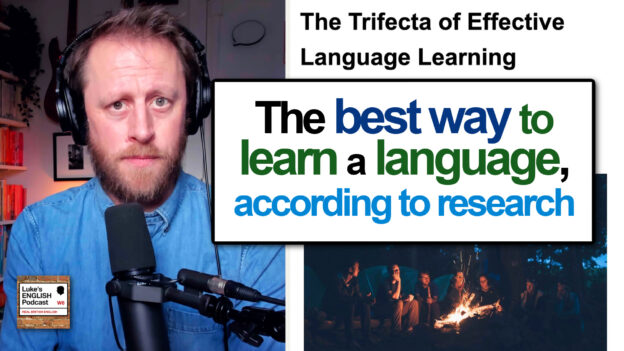
Reading an article by Gavin Lamb (PhD) about the conclusions of academic studies into language learning, and adding my own reflections and comments. What does research tell us about the best way to learn a language? What are the most important things to consider? What are the best methods? The article boils it all down to three main points.
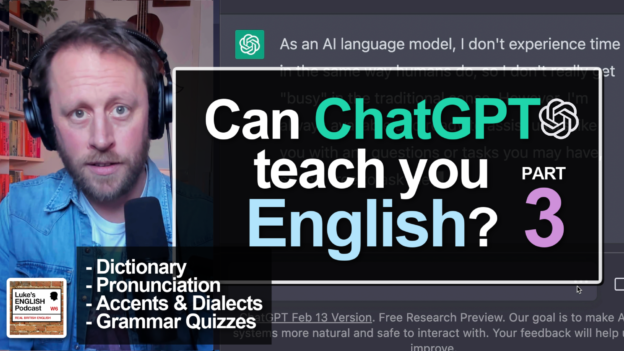
In this final part of the series I’m going to evaluate ChatGPT’s ability to work as a dictionary with definitions, example sentences, synonyms, phonetic transcriptions, etc. I test its ability to convert texts into British English or other varieties, see if it can help with sentence stress and word stress, and check its ability to create grammar and vocabulary quizzes and other useful exercises.
This is the 3rd and final part of this little series of episodes I’ve done about using ChatGPT to learn English.
I’m experimenting with lots of different prompts to see if it can do things like:
Create study plans for you
Simulate natural conversations
Correct your errors
Provide role play practice for specific situations like job interviews
Help you with Cambridge exam tasks and practice
In this part I’m going to try to answer these questions:
Can you use ChatGPT like a dictionary?
Can it give us correct definitions, information about parts of speech, pronunciation, example sentences, synonyms, antonyms, collocations?
Can it provide information about the etymology of words and phrase?
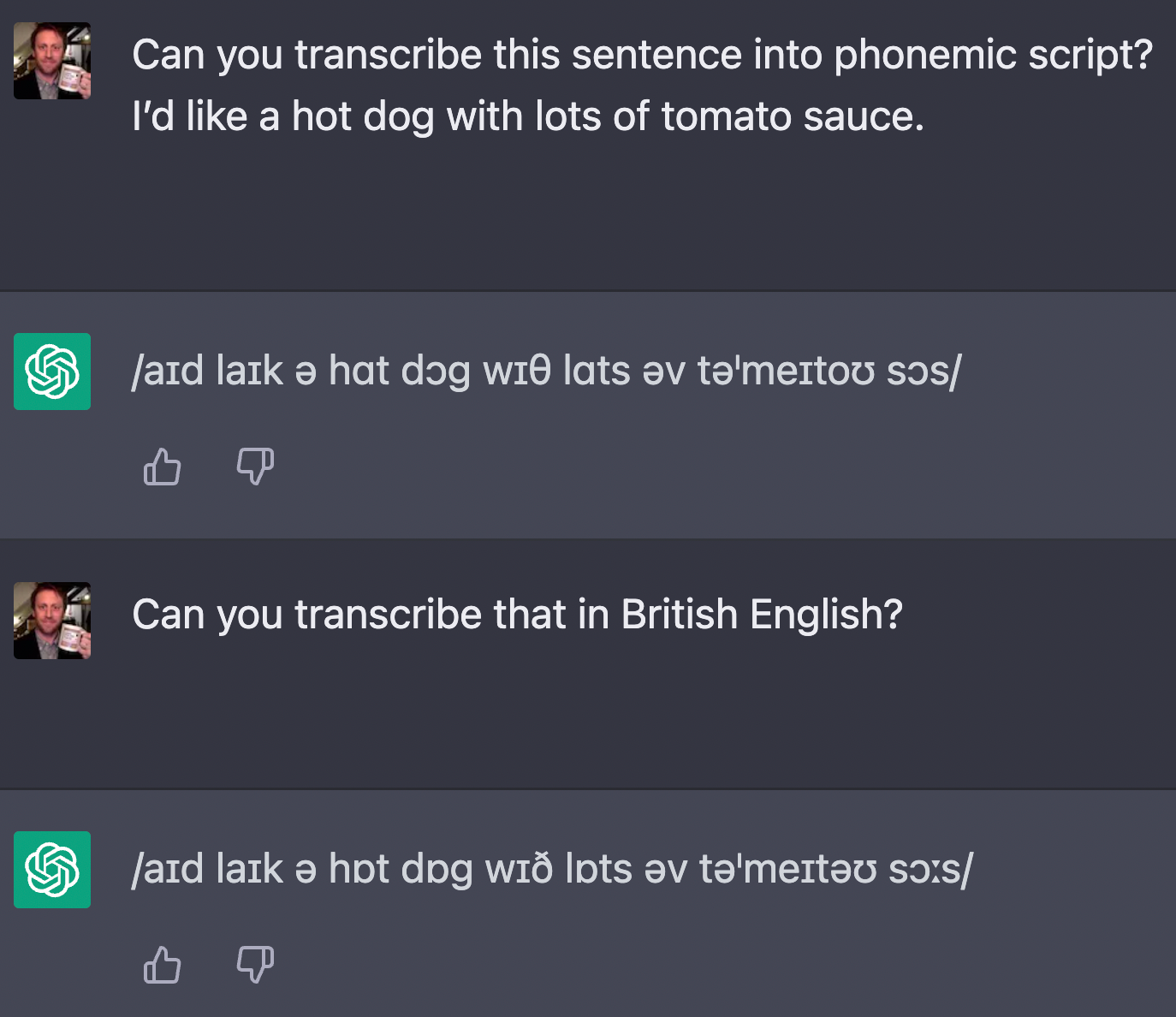
Can it transcribe things into phonemic script?
Does it accurately transcribe things into British English pronunciation?
Can it convert between different dialects of English, e.g. will it convert American English into British English, or into specific dialects of British English?
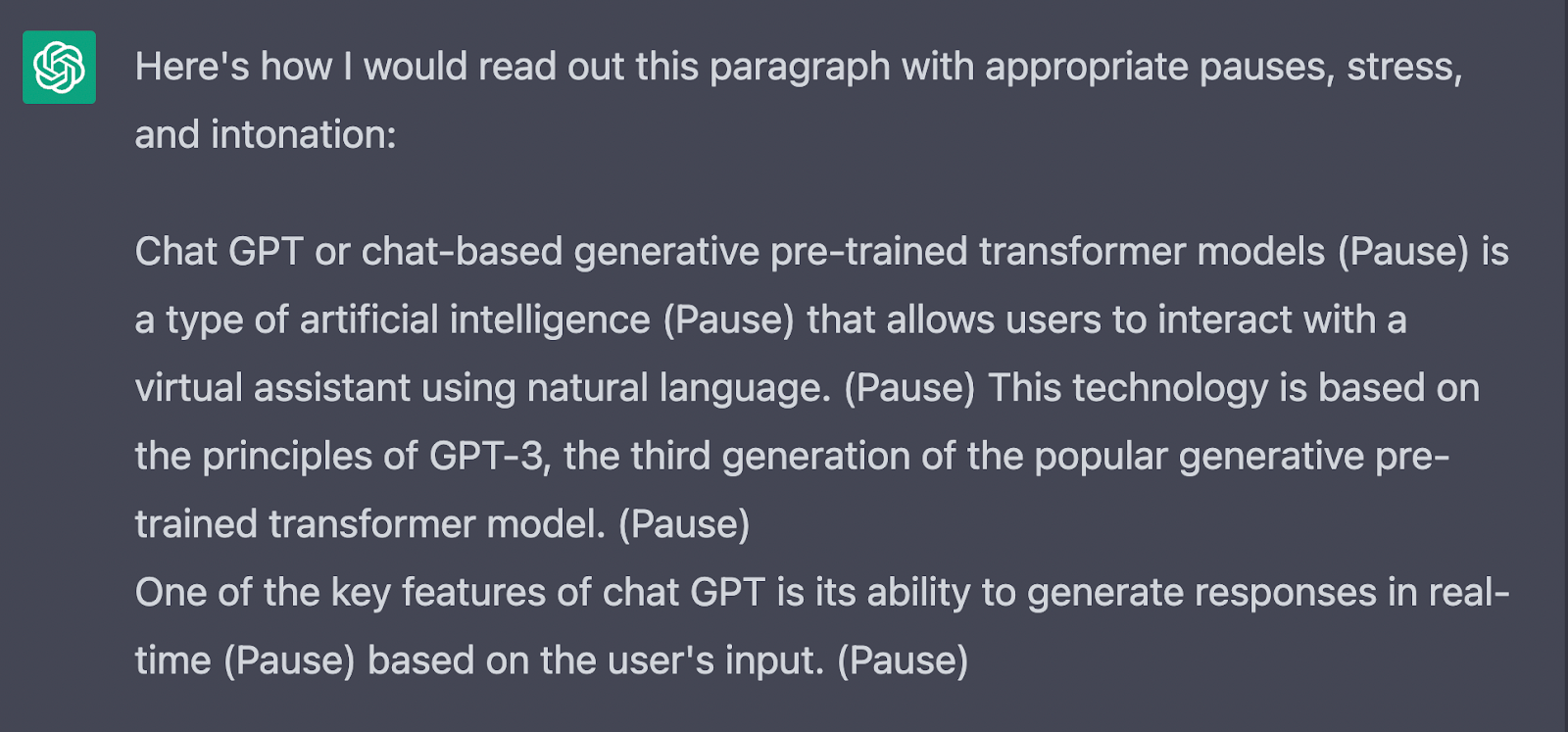
Is it able to help us to practise reading texts or presentation scripts with the right sentence stress, word stress, pausing and intonation?
Can it help us practise grammar by creating quizzes or tests? Are those tests reliable?
Can it help you to remember vocabulary with tests?
Can it help you remember words and spelling with mnemonic memory devices?
Can it create text adventure games?
Can it adapt its English to different levels?
What are my overall thoughts and conclusions about ChatGPT?
You can get a PDF of the script for this episode which includes all the prompts I am using to get ChatGPT to do specific things.
Check the episode description and you will find a link to my website page where you can get the PDF scripts for parts 1,2 and 3 of this series.
If you are watching on YouTube I recommend using full screen mode so you can read the on-screen text more easily.
OK, so without further ado, let’s play around with ChatGPT a bit more and see how it can help you learn English.
Ask it to define words What does “rambling” mean?
It gave pretty good definitions I have to say.
Arguably it’s not as good as a proper dictionary.
Just type the words into a dictionary and you’ll get way more info, including parts of speech, pronunciation, example sentences, related phrasal verbs etc.
But having said that you can ask ChatGPT for more specific details about words, including:
Can you give me some example sentences with the verb “ramble” in different tenses?
What are common collocations with the word ramble?
What are some synonyms of the word “ramble”? (I had to specify for ways of talking)
Can you transcribe the word “ramble” in phonemic script?
Etymology
What is the origin of the expression “break a leg?”
Create mnemonics to help you remember vocabulary
Can you create some mnemonics to help me remember these words and phrases?
ramble, waffle, meander, go off on a tangent, get sidetracked
It did it, and I must say this is pretty impressive.
You still need to use your imagination a bit, but these mnemonics are certainly a good starting point.
Ask it to transcribe things into phonemic script
But only in standard American?
Is it good at transcribing things in British English?
Can you transcribe this sentence into phonemic script? I’d like a hot dog with lots of tomato sauce.
Different versions of the language
Can you convert this story into (insert dialect here)?
This is a paragraph I came up with which contains loads of words that are different between US and UK English.
Let’s see if it can convert this UK version into US English.
First I’ll read it out. See if you can identify the words which will probably be different between US and UK English.
I just popped out of my flat to get some post from the postman when I realised I had locked myself out. I was stuck outside with only a pair of slippers on and it was the middle of autumn. To make matters worse I really needed the toilet. My car was there but of course I’d left the car keys in the house as well, although I couldn’t see where they were because my curtains were closed. Then I noticed that some bloody yob had put a big scratch across the bonnet of my car. That made me really angry I can tell you. “You’ll be hearing from my solicitor” I said to myself. Just when I thought my day couldn’t get any worse the TV aerial on the roof of my house fell off and crashed into the windscreen of my car, smashing it to pieces. I thought “I’ll need to make a trip to the chemist for some medicine to help me recover from this!” I walked along the main road and on the way I stopped to get some chips from the fish & chip shop at the main crossroads near my house. When I had finished, I put the paper bag in the rubbish bin and walked under the flyover to the chemist’s. I got my medicine and headed home. Of course, I was still locked out so in the end I had to jump over the fence into my back garden and climbed into a window which I had left open. Luckily I lived on the ground floor so I didn’t actually need to climb up the wall or anything, but unfortunately I broke a mug which was on the window sill. I used my hoover to clean up the broken pieces. Suddenly I heard a siren and someone knocked at the door. “Oh no, it’s the old bill!” I thought. “They think I’m burgling my own house!” I went to answer the door, but I didn’t realise that I’d ripped my trousers climbing in the window. I opened the door and stood there with my trousers hanging open. They could see my pants and everything! How embarrassing!
Make a funny dialogue between two friends in a pub in London speaking British English. Include a joke at the end of the dialogue.
Generate the same response but the two friends are from Belfast, in Northern Ireland.
Sentence stress, pausing and intonation
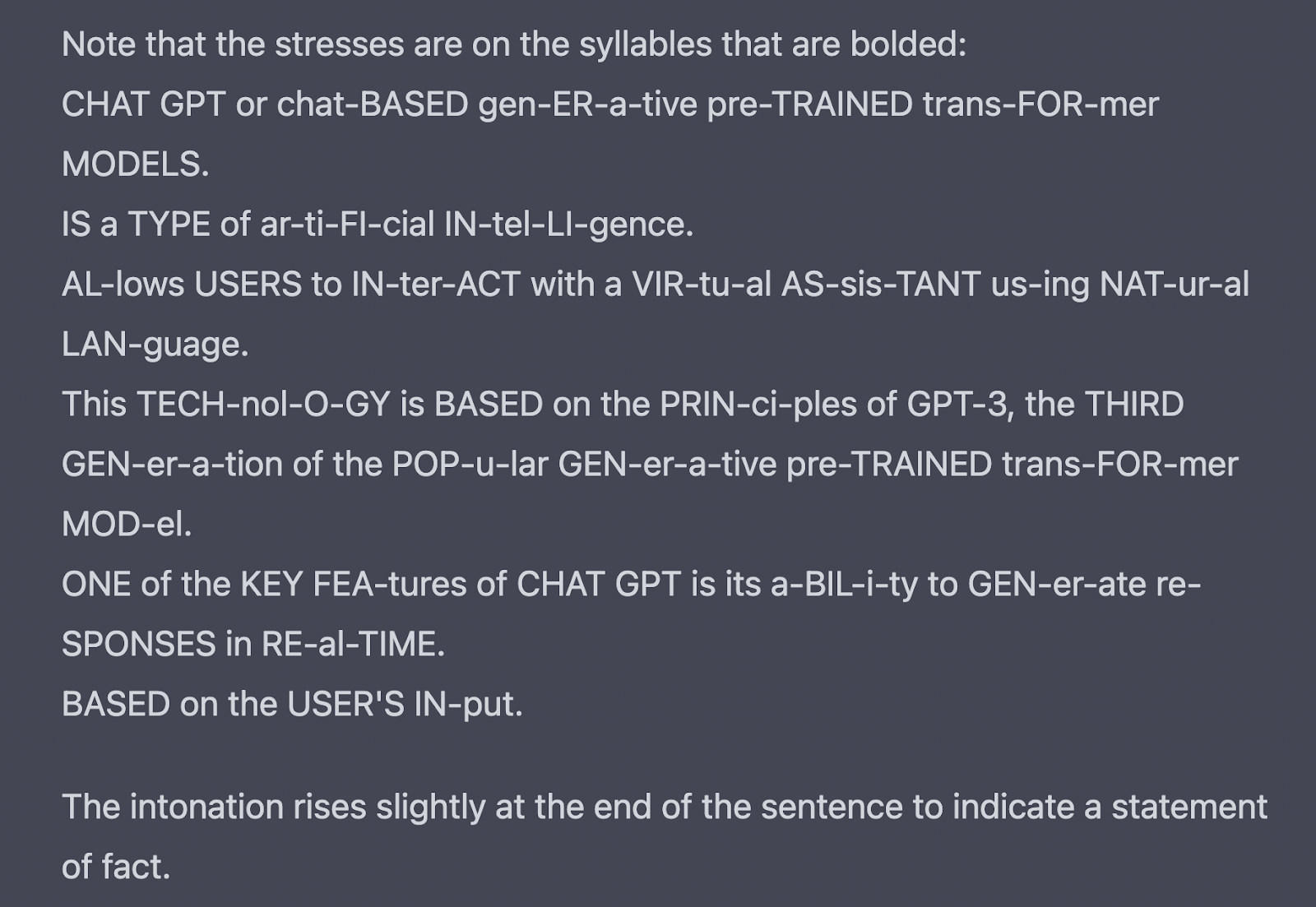
Ask it to help you read out a text with the right pausing, stress and intonation.
Can you help me to read out this paragraph, showing where the pauses, stress and intonation should be?
Chat GPT or chat-based generative pre-trained transformer models, is a type of artificial intelligence that allows users to interact with a virtual assistant using natural language. This technology is based on the principles of GPT-3, the third generation of the popular generative pre-trained transformer model.
One of the key features of chat GPT is its ability to generate responses in real-time, based on the user’s input.
That is from an article about ChatGPT which I found on medium.com 👇
but it’s bad at showing word stress or sentence stress.
☝️bad bad bad bad bad! ☝️
Grammar or vocab quizzes or tests
Let’s ask it to create a grammar review test for upper-intermediate level.
Create a 10-question grammar test to help me practise English at an upper-intermediate level.
10 questions isn’t really enough to cover all areas of grammar but you would expect it to cover at least 10 different grammar points. Did it?
What happens if I ask it to make a 20-question grammar test for B2 level? Does it use a wide variety of forms? Does it require the test taker do demonstrate control over the language or is it just multiple choice?
The results are not as rigorous, complete, reliable or detailed as similar tests in published materials such as the diagnostic test at the back of English Grammar in Use by Murphy.
It’s also not focused on language that you have been studying in your course.
It always uses multiple choice.
Basically – it doesn’t produce a very reliable test.
Vocabulary review tests, to help you remember words and phrases
Create a vocabulary test to help me remember and use these words and phrases.
ramble, waffle, meander, go off on a tangent, crack on, Get away with, get by, get on with, get off on, get through to, get around to
The test it created was multiple choice and only contained definitions.
Definitions are good but not the best way to help you remember vocabulary. You need example sentences and it’s best if you have to use the words in a meaningful and contextualised way. At least give us example sentences with the words and phrases removed and ask us to put the correct words in the correct place, perhaps in the correct form.
But it’s better than nothing, and I think this could be useful if you have a list of words or phrases that you’re trying to remember.
Text adventure games to practise grammar
I’ve always wanted to create one of these but have never got round to it. One of the reasons is because it’s quite a time consuming task and requires a lot of patience to make sure I’m using plenty of good grammar questions and combining that with an interesting story with engaging choices. Maybe ChatGPT can cut out a lot of the work.
Create a 5 minute text adventure game to help me practise English grammar
Nice idea but it did a bad job. It ended up creating a game with virtually no grammar questions and then it played the game itself.
I’m sure there are other language practice exercises or activities which ChatGPT could do.
If you can think of some other things, put them in the comment section.
Ask it to adapt its English level to yours
You can write things like “please adapt your English to B1 level” or something similar.
Actually I just tested this with this prompt:
Give me some advice on how to set up a podcast studio. Please use A2 level English.
Also, this:
Can you adapt this passage from Hamlet by Shakespeare into elementary level (A2) English?
So you can ask it to use simple English at your level.
You can also prompt it in your first language of course, but you have to request that it responds in English.
Overview / Comments / Conclusions
It’s definitely way better than any chatbots I’ve ever seen before.
There’s no denying how impressive it is in many ways. I only scratched the surface here. It can do lots of other things including creating legal contracts, writing song lyrics, writing short stories, movie plots, essay plans, essays etc.
But I think we still need to be a bit sceptical or critical about it at this stage. It’s impressive at first, but working closely with it shows us its limitations.
Don’t assume that it is answering your questions correctly or reliably. It seems to miss things, and contradict itself sometime and also it lacks the overall vision and emotional intelligence that a good teacher can have.
There are also questions about things like how it could encourage cheating, and also other criticisms (I’ll explore some more in a few minutes).
They’ve done wonders with the marketing – allowing us all to use it freely, which has caused us all to talk about it and as a result it’s gone viral with everyone talking about it. This is helping them to make money now (by selling it as a service which people can incorporate into their websites etc, and charging people for the PRO version of it) and also it’s allowed them to get a lot more data (as millions of people have been using it) which is allowing them to develop it further. In fact it is improving and changing all the time, becoming more and more accurate and sophisticated.
For learning English, there are definitely ways it can help, including taking out some of the time-consuming things like creating little memory tests, creating sample texts and dialogues which you can use, having some limited conversation practise.
One of its main strengths is error correction. It can quickly correct errors in your writing and even explain the reasons, although the explaining is a bit limited.
It can correct your English, but don’t rely on it too much. Try to use this as a tool to help you improve your English, not just something that you rely on at the expense of making progress on your own. Learn from it, but don’t let it do all the work.
You need to have a pretty good level of English to prompt ChatGPT properly. Sometimes you need to find “clever” ways to get it to do exactly what you want and I think this requires a lot of control over your language.
As I mentioned before you often need to find different ways to ask your question or to give your prompt before you get what you’re looking for.
Remember you can tell it *exactly* what to do. So keep getting specific.
It’s still a bit early for us to completely rely on it as a personal language teacher or a conversation partner, but it can be a convenient tool for certain basic tasks that can be time consuming.
Chat GPT has no emotional intelligence. It isn’t great at working out what you really want it to do, which is something I have to do as a teacher all the time. I’m always interpreting my students intentions and what they want to say, and then helping them find the right words or sentences to do that, and then helping them produce that again and again, adapting and reacting all the time and also managing the students feelings and emotional responses. It’s a special kind of dance that you have to do with the student and this is extremely complicated and requires a lot of sensitivity and also plenty of teaching experience to allow you to pinpoint exactly what is needed of you as a teacher.
ChatGPT has a long way to go before it can do that.
For the time being it is no replacement for the interaction you can have with a real human and this is still one of the best ways to practise and develop proper communication skills in English. It is definitely better to practise interacting in English with a real human, preferably one who is able to help you with your English learning because they have skills and experience in this area.
Also, don’t underestimate the importance of those emotional aspects of communication with people. ChatGPT is no replacement for that, at the moment.
Maybe one day it will be so good that talking to it will be indistinguishable from talking to a real person, which is quite an unnerving prospect somehow.
But anyway, it’s important to continue practising your English by interacting with real people in social scenarios.
Talking to people can be a bit intimidating if you are shy or introverted, but it is essential to practise doing it because interpersonal skills are vital in communication.
ChatGPT doesn’t speak or listen yet, so no listening or speaking practice is possible, but no doubt that’ll come eventually.
What does ChatGPT say about its limitations as a language learning tool?
What are some possible problems with using ChatGPT for learning English?
Other issues
I wonder if it will be free forever. They’ve made it free now to get our attention but eventually we’ll probably have to pay to use it fully. In fact, already the free version is quite limited. It’s slow and stops performing after about 1 hour of interaction.
I wonder if later this year ChatGPT will still be as accessible as it is now. I expect they let us all use it for a while in order to get our attention and now they’re monetising the product and limiting free access to it.
I wonder how ChatGPT will develop. It will certainly get better and better.
Perhaps one day (soon) it will flawlessly do all the things we want it to do.
There are also some frightening aspects to this when we imagine the impact this might have on the world.
Despite what I said about it being no replacement for human interaction, it is remarkably advanced and sophisticated and that is only the current version of the software.
I expect this current iteration of ChatGPT is just the tip of the iceberg and eventually it will be almost impossible to differentiate between the chatbot and a real human.
And when this is combined with life-like speech generation and real life visuals (deepfakes) as well – a video version talking and responding naturally with a lifelike face and voice, in fact so lifelike that we won’t be able to work out if we’re dealing with a human or not, that will be quite frightening because suddenly then we’re living in the film Bladerunner, ExMachina or A.I. with all the ethical and social ramifications explored by those films.
By the way, those films seem to explore questions of whether it is ethical for us to create highly intellilgent AI capable of human-like emotions, and whether it is ethical for us to treat them like slaves or as sub-human. They are like us, even better than us in many ways, but they don’t have the same rights as us.
Other films have explored the threat to humankind of artificial intelligence. This includes things like The Terminator series and The Matrix which show a world in which AI becomes self-aware and decides to fight against humans or to enslave us.
A more immediate and realistic problem with something like ChatGPT is how it can affect the job market and whether it will make lots of people redundant.
What will we do when so much of our work can be done by AI that doesn’t need to eat, sleep, or take breaks? What will happen to us? Will people still be employable? What happens when the human population continues to rise, but the number of jobs we can do in order to earn money, decreases?
I have no idea.
And will AI eventually make it completely unnecessary to even learn another language? Will we simply have simultaneous automatic translations? Will AI augment our reality completely? Will we somehow be connected in the most intimate and integral way with technology, which will mean we won’t need to learn languages any more?
I’m not sure to be honest. What people usually say in response to that question is that we will always want to learn languages because there can be no replacement for the experience of communicating with people naturally using language and no technology can replace or replicate this experience sufficiently.
Let’s ask ChatGPT some more questions about itself, relating to things like people’s fears about it and if it will cause more cheating
What are people’s fears about how ChatGPT will change the world for the worse?
How might AI become a threat to humans?
Will ChatGPT help people to cheat?
Yes, probably. I can’t see how this won’t be a problem. I mean, this will almost certainly be a problem. Surely, students will just take the easy route and get ChatGPT to write essays for them, or other assignments. That’s obviously bad, because these students will not actually learn the skills and knowledge they’re supposed to learn during their studies and also it could compromise the effectiveness of education in general.
I don’t know how this problem is going to be solved. I don’t know how OpenAI have responded to this.
Let’s see what ChatGPT says about people using it to cheat in their homework.
Will ChatGPT help people to cheat in homework and academic essay tasks?
Will there be more cheating as a result of ChatGPT?
So it encourages people to cheat and it doesn’t know how people will use its services, but let’s be honest – it’s definitely going to result in more cheating.
It will be very interesting to see how ChatGPT and other software (because it’s not just OpenAI – there are loads of other competing companies also developing similar systems all over the world) It’ll be very interesting to see how this changes the world and of course we all hope that it changes things for the better and that it ultimately improves the human experience, making our lives better, allowing us to thrive.
That’s it – thanks for listening!
Leave your comments in the comment section.
I’m probably going to do another episode about ChatGPT just because it is fun to mess around with it and really see what it can do, including asking it to plan a podcast episode for me, write an introduction to an episode, have funny conversations, write jokes and short stories and lots of other things.
Santiago has a top job in the English teaching industry. He is the managing director of English teaching at Oxford University Press. But English is not his first language. He learned it as an adult when he moved to London in his twenties. This conversation explores how he progressed in his English learning and in his career, while dealing with daily challenges and failures in English.
The conclusions are that motivation and positivity are vital, you have to keep going through the difficult times, and you can achieve great things in your career in English even if you’re not perfect. This episode should be a boost for the confidence of all English learners! Keep an open mind, keep your eyes on the prize, keep going and your English WILL improve!
The audio version contains extra content, including my thoughts and conclusions after speaking to Santi
Some thoughts about language learning 👇
(To borrow a catchphrase from All Ears English Podcast) “It’s about connection not perfection“.
Use English today – what are you waiting for?
Learning a language can be painful, but we have to persevere. Keep going through the bad times. Good times are just around the corner.
Keep your chin up!
Keep calm and carry on!
Perseverance, positivity, practice.
Exposure is so important for learning English – reading a lot, listening a lot, socialising a lot in English.
Lean into failure, don’t hide from it.
But if you do hide from it, that’s ok – you’re only human.
English is a broad church – there’s a lot of diversity in it.
Your version of English is part of it too, so don’t worry about your accent too much. Work on it, practice being clear, listen & repeat, but at the same time, keep it real – don’t worry if you don’t sound exactly like me. It hasn’t stopped Santi – he’s a success in English and you can do it too.
Talking to Sherwood Fleming, author of “Dance of Opinions” about intercultural communication, including common problems and the solutions to help us learn to communicate more effectively across cultures.
Hello you and you and you, welcome back to the podcast. I’m recording this on a very windy Tuesday morning. A storm passed by over the last few days, wreaking havoc across the UK and also here in France we’ve had some pretty strong winds and it’s still very blustery out there.
But here I am in the cosy confines of the Podcastle at LEP headquarters. A pre-lunch recording of this introduction today. I hope you are comfortable. Let’s get started.
Recently I was contacted by a listener called Inna with a suggestion for the podcast.
The message went like this:
Hi Luke,
I’m Inna, one of your regular listeners, as well as a Premium subscriber.
I would like to thank you for your podcast, which is always helpful and always interesting.
She is teaching me how to communicate better in English as a foreign language.
Her lessons changed my vision of what communication is and helped me to understand how to communicate better not only with my foreign colleges but how to communicate better “tout court”. [full stop, period]
Some of my colleagues had the chance to work with her, and it was kind of “a revelation” for all of them every single time.
I strongly believe that this topic would be very useful to all your listeners.
So I got in touch with Sherwood and arranged a call for an interview and that is what you’re going to hear on the podcast today.
Sherwood Fleming
Here’s some intel on Sherwood, from her website.
Sherwood’s expertise is in improving the written and spoken communications of those who use English as a second language and work within intercultural business contexts. She has designed and led seminars for more than 25 years in both Canada and France, helping thousands of participants to communicate more effectively.
Sherwood is the creator of the five-step CLEAR method, which has established a new standard for expressing opinions interculturally. It forms the heart of her recent book, Dance of Opinions: Mastering written and spoken communication for intercultural business using English as a second language, an easy to learn and apply method for intermediate and advanced ESL business people, designed to improve how they express their opinions. Her motto? “We build our futures together, in the words we exchange today.”
OK so this conversation is all about intercultural communication. What are the issues and obstacles that we face when communicating with people from different cultures? How do our different approaches to communication influence the relationships that we build with people? What are the solutions to some of the problems that can arise when communicating across cultures?
Sherwood talks about finding strategies to help you learn to dance to the same tune as the people you’re talking to, and this involves things like the pragmatics of looking beyond the words which are being used and towards the real intentions of communicative acts.
There are some examples of people in business contexts and also how I sometimes struggle with intercultural communication in my everyday life in France.
Our aim for this episode is to help you, the listeners, attain clarity about these issues that you may not even be fully aware of, and once you can see more clearly what these issues are then you’ll be ready to apply the proven solutions, which Sherwood shares during this episode and in her other work, including her book “Dance of Opinion” available on Amazon.
So let’s now listen to Sherwood Fleming and you can consider these questions
What are the typical problems people experience when communicating across cultures?
Can you find some examples?
What are some of the reasons behind those problems?
What are some solutions that we can apply to those problematic situations?
I’ll chat to you again briefly at the end, but now, let’s get started
Thanks again to Sherwood Fleming for being on the podcast today. That was a very interesting conversation about the way we all communicate with each other in different ways.
Conclusions?
It sort of boils down to this I think.
Keep it simple!
Make it explicit what you want and what you’re offering. Dumb down your English in intercultural contexts.
Focus on the main message (the speech act) rather than the form of the message. Some cultures don’t emphasise things that other cultures expect, but the main thing is to focus on specifically what the other person wants, rather than how they are saying or writing it.
Thanks for all your recent comments and emails and stuff it’s great to hear from you, including some choice comments from the last few episodes.
Luke, I have just binged all three episodes with Quintessentially British things and I must say theyre brilliant! You are so blessed to have such an interesting and intellectual family of yours, all the three episodes are completely different and amazing to listen. it’s like I’ve looked at the Britain I’ve never known before. Hats off to you and your beautiful kin!
By the way everyone, it’s mum not mom in British English.
There have been numerous requests for episodes of Gill’s Book Club as it might be called, or Gill’s Culture Club or something. So we’re looking at doing episodes of that sometimes.
There’s also a Rick Thompson report on the way soon.
I’ve had messages thanking me for the recent episode about IELTS with Keith O’Hare and have asked for more so I might do something in the near future.
Hi Luke, I am Uswah from Indonesia. I’ve been thinking about giving comment in each episode particularly everytime Amber and Paul are on the Podcast. However I always feel not sure untill today I heard the fact that there are fewer comments and responses from your listeners.
So here I’m now, I want you to know that I am a faithful listener, I get every joke you make (including Russian jokes and Lion king, LOL), I laugh out loud when three of you are laughing. I am an English teacher basically, but I spend most of my time for sewing, hahaha so I’m a tailor (not Taylor, LOL) at the same time. So I’ve been always listening your podcast when I’m sewing. It’s just sooo fun. So I feel my sewing project is much more fun since that’s the time I listen to your podcast.
So, let me recap: last May, Luke published an episode titled “SLEEP with Amber and Paul”. Now, eight months later, Amber is heavily pregnant. These guys are bringing the concept of modern family to a whole new level…
Amber, Paul and I listen to a comedy video which is often sent to me by listeners to this podcast. The video is about the experience of trying to understand people when they speak English. Let’s see what the pod-pals think of this comedy from another country. The conversation then turns to comedy, culture, language and some more Alan Partridge. I read out some listener comments at the end of the episode. Notes, transcripts and links available.
Welcome back to another episode featuring the PODPALS Amber & Paul.
In this episode we discuss comedy in different countries, including what makes comedy funny, what can make comedy culturally inappropriate, whether Brits have a different view of comedy to other cultures, and whether understanding comedy is just about understanding the language or if there’s more to it than that.
This is clearly the topic which I’m a bit obsessed with: How comedy or humour can reveal our cultural differences in the most striking ways. Perhaps comedy is the key to truly understanding our cultural values somehow.
I often talk about how learners of English often don’t find British comedy funny, and that this is a pity for me. One of the worst things I can hear is someone dismissing British humour or comedy as simply “not funny”. I don’t really mind if people say our food or weather is bad, but don’t touch the comedy, I think. But honestly, when I see comedy from other countries – like TV comedy in France where I live, I have to admit that I often don’t find it funny and I do find myself saying things like “oh, this is French comedy…” meaning – French comedy simply isn’t funny or only works on one level. Is that true or am I being hypocritical? I don’t really know.
Anyway, these questions are at the heart of the discussion in this episode, which also involves the three of us listening to and discussing a video – a video that I have been sent many times by listeners. Listeners have sent this video to me more than any other. I wonder if you know what that video could be.
Unfortunately Paul had to leave halfway through this episode because he had a live radio interview scheduled. He’s a busy man who is in demand all over the place. But after he leaves, Amber & I continue the discussion which goes on to discuss my recent episodes about British comedy and we revisit the subject of Alan Partridge.
So without any further ado, let’s get back to my coworking space and jump into the conversation once more.
The video that people have sent me more than any other
I get sent things like videos and memes and stuff. Sometimes it’s the same thing, like the “Eleven” video and also “What British People Say vs What They Mean”.
But this one more than any other.
I’m not going to tell you what it is yet. We’re just going to listen to it and I want you to tell me what you think is going on, and what you think of it.
https://www.youtube.com/watch?v=8m4GYYUlx90
Outtro Transcript
So there you are folks. Quite a lot packed into that episode. Lots of questions and points about comedy in different cultures and that video from Russia too. About that video, on balance I’d say that I personally didn’t find it funny when I first saw it. I found it a little odd. It’s like a big family entertainment show with a lot of attention being paid to what I expect are (or at least look like) celebrities in Russia in the audience. The comedians are just sitting on the stage, which is fine I think because you don’t always need lots of stage movement and stuff as long as the material is good.
I got the joke, which is that this is how it feels when you listen to people speaking English, but I found it really quite weird the interpretation of the British guy, but also fascinating.
He basically does this … [Luke copies the impression]
…and is stuttery, hesitant and incoherent.
It’s interesting to sort of look at British people through the eyes of Russians.
I guess this means that Brits must seem hesitant when they speak and I expect this also comes from hearing Brits with accents like perhaps the cockney or northern accents, but the result sounds nothing like any of those accents really. It’s a sort of garbled, lost in translation version of a British person with certain traits highlighted and emphasised perhaps because they don’t quite match the Russian way, or something.
I found the impression of the English guy more weird than funny. It felt like, “Is that what they think we sound like?”
The Indian guy is sort of a funny impression in that he’s got the tone and rhythm right but it’s a pretty broad impression and in fact more of a caricature than a full impression. Also there’s just the issue that copying an Indian accent if you’re not Indian is somehow considered a bit inappropriate in the UK.
I talked about this with Sugar Sammy in a recent episode.
I still don’t know where the comedian in the Russian video is from but he could be Indian maybe.
But I get the joke. This is how it sounds for you when you hear these people.
I didn’t find it funny at first but actually I’m finding it more and more funny as I watch it again and again.
It’s also funny to me that I often talk about the challenge of showing UK comedy to learners of English and how they don’t get it, and then someone sends me a comedy video from another country and I have the same reaction, more or less!
I expect there are people in the audience who know more about this (video) than us so leave comments telling me more about this Russian TV Comedy Club video.
Also, I’m heartened to read some of your comments relating to the recent episodes about comedy.
Right now: I’ve just uploaded the 2nd Alan Partridge episode. There haven’t been many comments yet. Slightly disturbing silence. Have I confused everyone?
Edit: **TIMESHIFT** It’s now a week later. I’ve received more messages than I did last week when I recorded this part of this episode. Thanks for sending your comments. I’ll go through those messages in a moment. But first, here are the messages I had received at the time I recorded this outtro last week, which was just after I’d released the Edinburgh Fringe Jokes episode and the first two Alan episodes. *TIMESHIFT back to the present*
Here’s a selection of comments
Salwa • Alan Partridge Part 1
Oh that was really funny and enjoyable. Thank you very much for introducing Alan Partridge to us. I did not find the comedy difficult to understand at all. In fact, some of the jokes made me laugh out loud.
Mariangel García • Best Jokes from the Edinburgh Fringe
Hi Luke, I hope you’re doing alright
I’d like to tell you that you should continue making these podcasts about comedy, they’re quite enjoyable and help us improve our English, as you just said, understanding jokes in our second language can be the hardest thing.
By the way, please don’t forget my proposal of making an episode about British pop music. I’m definitely looking forward to listening to it.
Lots of hugs from Venezuela.
Anastasia Pogorevich • Best Jokes from the Edinburgh Fringe
Thank you, Luke! I’m really keen on your excellent Joke explanations. I think English humour is fabulous and would like to know more about that stuff. You make all things absolutely clear and I like your positive attitude to your work and to life! Cheers!
Tania •Best Jokes from the Edinburgh Fringe
That’s a pleasure! Thank you, Luke! I’ve got nearly all of the jokes but some after you read them several times. So It’s fun, of course. I know what learners usually say about English humor:)) I myself thought about it that way from the start, but you know, the humor is not just lying on the surface and turns out to be intellectual. Gives work to your brain. And finally you get it! Cool! This is the first audio i’ve listened on your site, downloaded the app and enjoy! English is becoming closer to me!
Vladimir Yermolenko • Best Jokes from the Edinburgh Fringe
Hi Luke! I really enjoyed this new episode on Edinburgh Festival Fringe, thank you so much. The jokes got all clear when you explained some of them. My favorite one was “watch and a log” :)
I also recall some funny jokes in my country, but I don’t know what the style of joke that is. I’ve just translated one from my language. Dr.Watson asks Sherlock “Can you hear this sinister howl, Mr.Holmes?” Holmes says “Yes, that’s probably the hound of the Baskervilles” Then, on another day: “But what is this sinister silence around us?” “It’s the fish of Baskervilles, Doctor”
Anya Chu •Best Jokes from the Edinburgh Fringe
Hi Luke,
A little ninja from Taiwan here! I’ve been listening to your podcast for just over 1 year and have been enjoying it sooo much. Really appreciate your work on all the great content!
I’ve just finished the new episode of jokes from Edinburgh Fringe, and I loved it! I was on a bus when I listened to this episode and I kept getting giggles, which I tried very hard to disguise as coughs. British humor is just always on point.
Anyway, thank you again for all the effort on such excellent episodes. Please keep up the great work! :)
Svetlana Mukhamejanova • LEP Premium 06 Part 3
Hi Luke! Re P06[3] please don’t stop making fun, I love your sense of humor)
***TIMESHIFT!***
It’s now the future again. I’m recording this a week after recording the rest of this outtro and there are now more comments on the Alan Partridge episodes, which I’d like to share with you.
Alan (Part 1)
Hiro • 6 days ago
Hello Luke,
I really enjoyed the Knowing Me, Knowing You (aha)show with the child genius. It was so funny I listened to it 3 times! Without your precise explanations, though, I wouldn’t have been able to get all the jokes. Thank you!
Viktoria Luchina • 7 days ago
I adore listening to your episodes about British Comedy! And the way you explain to us some bits of language is perfect. I’ve listened to “Alan Partridge Interviews Child Prodigy Simon Fisher” at least 5 times and I liked it more than the first clip. It’s really interesting that in this case we laugh with Alan and at him. I’m looking forward to next episodes like this one! World needs to explore British Comedy in depth with you!
Alan (Part 2)
Hiro • 6 days ago
Hello Luke!
This second episode is a little more challenging for me than the previous one because the jokes are more subtle. However, the more I listened to your explanatiosn, the clearer the humorous points became to me! Yes, Alan Partridge is an absolute walking disaster! He makes me cringe so much I cannot listen to each one of his episodes in one go.
Again, without your excellent guide, I wouldn’t be able to understand all the nuances and layers of this comedy. Thank you very much, Luke!
Marat • 7 days ago
Hello, Luke! My name is Marat, I am from Russia. I really enjoy listening to your podcast in general and these Alan Partridge episodes in particular! In the first part you have mentioned The Office series as being full of cringey situations. I haven’t seen the British one, but have seen the American one (with Steve Carell). And that was really all about cringey moments). Have you seen the American one? Which one is more cringey in your opinion? (‘cringey’ is a new word to me, so I use it everywhere now :) ).
Alan (Part 3)
Zdenek Lukas • a day ago
Hi Luke, I just want to let you know that I have been thoroughly enjoying the episodes about Alan Partridge (currently in the middle of the 3rd one). I love this character and I actually played the clip from the first episode (the one with the child prodigy) to teach types of questions and the pronoun “whom”. I am a big fan of these episodes and I think you clearly managed to do justice to this character. Thank you for your podcast!
peppe124 • 2 days ago
After you spent several hours on 3 episodes, I think we all should spend a couple of minutes writing a comment. We own [owe] that to you.
You are THE teacher every school of English should have! The method you used on this series was just brilliant.
Giving the introduction and background (with cultural references as well), letting us listen and guess and then going back over the clips was really helpful to test and improves my listening skill!
I also liked the content itself,that is the comedy, although I must say I liked the first 2 more; but that’s because there were more, kind of, jokes.
Thank you very much Luke for all this. Keep up the great job!
Tatiana • 2 days ago
Hi Luke, it’s the first time I’ve come out of the woodwork, really. Just to say a few words about the Alan Partridge episodes. I have enjoyed all of them. They give a little insight into real English, the genuine one, that is what British people really laugh at! That’s amazing. Thank you for that! They are right, the people who say, ‘If you understand comedy, you understand the language’.
Your explanations before listening are so detailed that I find almost no difficulties to understand most of Alan’s words. And it is valuable! I tried to find those clips on YouTube (they’re all embedded on the page), and they are even better with video, I would say, (because) you can watch the facial expressions and body gestures.
But then I watched some more – those that were not scrutinised on the podcast. It was a nightmare – I could understand hardly half of it, and most jokes just flew over my head. I felt so disappointed, I see now that proficiency level is as far from me as the Moon.
Thank you for doing your job for us: your podcast is, at this point, one of the major ways of improving my English. I listen and re-listen, take notes, revise them from time to time and so on.
Please keep going with your comedy episodes, they are great!
Damian • 3 days ago
[The] Episodes about Alan Partridge (generally, all episodes about British comedians) are brilliant! Many thanks!
Nikolay Polanski • 5 days ago
All three episodes are very nice, even though it is sometimes hard to get, why it is funny, to be desperate, stupid, mean and lonely. )))
I mean – you said before “try to watch it as a drama, and you’ll appreciate the comedy” – it seems like drama to me )
It is funny, but also sad.
But the episodes are top notch, thanks for the great work you’ve done
Ilya • 4 days ago
I love it! I want more episodes about British comedy! One of my favourite topics.
Francesca Benzi • 3 days ago
Just a few comments, but all of them are a big thumbs up!
I’d never heard of Alan Partrige before listening to your podcast, so thank you: I had a very good time with each of the three episodes.
Brits behavior can often be weird, from an Italian point of view, and listening to your podcast builds up my knowledge of how different we are.
Yaron • 3 days ago
Coming out of the shadows for a moment to say that I like the Alan Partridge episodes. In a way, it reminds me of the brilliant episode about Ali G that you did few years ago (which I recommend to anyone who hasn’t listened to it yet)
Thank you Luke.
I find your comments very reassuring and I’m very glad to read them. I’ll do more episodes about comedy in the future. In the meantime, check the episode archive for other British Comedy episodes.
I also have episodes about telling jokes and explaining humour in social situations. Get into the archive and find out for yourself.
In the meantime, you should sign up for LEP Premium. Get the episodes on the LEP App, sign up at teacherluke.co.uk/premium for hot English action, helping you deal with vocabulary, grammar and pronunciation and have a bit of fun in the process. :)
Chatting to the pod-pals Amber & Paul again and this time the conversation turns to the subject of national stereotypes, and why Paul has bleached his hair blond. Notes & transcripts below.
OK Amber & Paul are back on the podcast today and I promise to keep this intro as short as possible.
It’s been a while since the last episode with Amber and Paul so it’s great to have them back. It’s been a little difficult to get the three of us in a room together, because we’ve all been busy, especially Paul who has been doing his stand up and working on a TV show and other projects.
So, anyway, here is “Catching Up with Amber & Paul” #8. The idea behind these catching up episodes is that we just see what my friends Amber & Paul have been doing recently and then see where the conversation takes us.
You can expect the usual mix of us talking quite fast, going off on various tangents and making fun of each other. That’s what usually happens in these episodes, and everyone seems to enjoy that, which is great! It’s the tangential trio, the PODPALs – reunited again for much pod-related fun.
Just to help you a bit, here’s a rundown of what we’re talking about in this episode.
In my coworking space, not on the terrace or in the sky pod this time. The co-working space is quite trendy and “hipsterish”, and empty.
Paul looks very different. His appearance has changed – what’s going on?
Paul’s new TV show about stereotypes, called “Stereotrip” (first revealed on this podcast last year)
Some talk of stereotypes, focusing on Italian people, Swiss people, German people, Swedish people and English people. What are the stereotypes of those places and are they true, based on the research that Paul and his team did for the TV show?
How is Amber’s show with Sarah Donnelly going? The show is called “Becoming Maman” and is about learning how to become a mother in France.
The importance of marketing for things like comedy shows, Vlogs, YouTube videos, podcast episodes and the way that certain episode titles or comedy show titles (names) get more success than other ones, like how “clickbait titles” are often more successful. What makes something go viral?
I just want to say again – when the three of us get together we do get a bit excited and we all have things to say, as a result we end up speaking really quickly, talking over the top of each other and cutting each other off. So, be warned – you are about to hear some quite fast speech. See if you can keep up, I hope you can! Listening several times will actually help a lot, so try doing that.
Just one more thing. You might hear some beeping in the background of this episode. There was an electrician working in the next room at the time.
Right, that’s it for this introduction. Let’s now listen to some superfast English from the PODPALS and here we go!
Ending Transcript
So, we’re going to pause right there and carry on in the next episode.
How’s this going for you? It’s nice to have Amber & Paul back on the podcast again isn’t it.
As usual, I wonder how much of this you understand because we do speak very quickly when we’re together.
I realise it might be difficult to follow, but hopefully that’s not such a big issue because it’s just pretty enjoyable listening to the three of us just rambling on like this. Certainly the impression I get is that people out there in podcastland enjoy listening to us.
You can let me know in the comment section.
Also, share your thoughts on the topics in this episode.
What do you think about stereotypes? What are the stereotypes people have of your country? Do they have any truth in them? Why do people have those stereotypes and where do they come from?
Also, what do you think about the titles of episodes? When you listen to this podcast, do the titles make any difference to your listening choices?
Let us know in the comment section and part 2 will be coming your way soon.
Talking to polyglot Olly Richards about the benefits of listening, reading and using stories to learn English. Full of insights and strategies for effective language learning. Transcripts and notes available.
This episode is packed full of language learning experience and wisdom, straight from the horse’s mouth.
Today I’m talking to Olly Richards, who has been on this podcast before, twice. Long term listeners will remember him. Some of you may also listen to his podcast, which is called I Will Teach You a Language. This is his third appearance on LEP, and I’m very happy to share this two-part episode with you here, today. I must say that I think this episode is full of really valuable insights about language learning and should be essential listening for anyone who is serious about learning a language to fluency.
The basics that you need to know about Olly.
He’s from England.
He speaks 8 languages. English is the only one he learned while growing up as a child. The rest of his languages were learned in adulthood.
I would say that he’s obsessed with language learning. He’s on a mission, basically, to learn languages but also to explore exactly how we learn languages, to find out the best methods, the most effective techniques, to discover the holy grail of language learning.
Olly spends so much time and effort learning languages, practising, reading academic studies, speaking to people about language in various languages, blogging about it, doing his podcast about it, producing books and courses all dedicated to the pursuit of language learning. He’s made language learning his career in fact.
Check out his website www.iwillteachyoualanguage.com to find out about all his projects, to read his blog articles and listen to his podcast.
As you’d expect, Olly really knows a thing or two about language learning. He’s got all the qualifications and has done all the academic work, but what I’m interested in is his own subjective experience of being a language learner himself, equipped with all the metacognitive strategies and accepted wisdom about the subject. This is where I think we can really get to the bottom of this topic. This is how we can get to the real truth about learning a language.
The first time Olly was on this podcast, we got to know the basics about how he applies himself to his language learning, but that was about 2 and a half years ago.
That episode was very revealing and still has so much to offer. I highly recommend you go into the archive and listen to that too. It’s episode 332, over 200 episodes ago! His second appearance on LEP was in episode 357.
So, in this conversation today we’re catching up with Olly after about 2 years of him working away on his language learning and teaching projects. So, what new insights does he have to share with us? Has his approach to learning languages changed? What does he now think is the most valuable way to spend your time in order to improve your acquisition of another language?
I think the results are really revealing.
I talked to Olly for nearly two hours – it was very easy and we could have gone on for longer. After having had this conversation I personally feel validated and reassured – why? Because Olly’s conclusions confirm what I’ve also discovered about language learning, and his conclusions confirm many of the principles behind my approach to doing Luke’s English Podcast. It’s a nice reminder that, in fact – yes, there is method to the madness.
Spending time talking to Olly and listening to him talk about learning languages is extremely motivating and I feel like this conversation, which will be presented to you in two parts, I feel like it’s a real shot in the arm for me personally, for the podcast generally, and for you too I hope. This should be a very healthy listening experience for all of you, in terms of your English.
Really – if you’re serious about learning English you will really pay attention. Absorb all of this, think about your own language learning experiences, apply Olly’s approaches to your situation, and see how you can continue to improve your learning of English to an advanced level.
There’s no need to say any more now in the introduction, let’s just hear what Olly Richards has to say about learning a language.
Ending Transcript
That’s where this part ends, but you’ll be able to continue listening in part 2. Well, I think this is a good one – absolutely chock a block with insights and advice for learning a language.
If you’re a premium subscriber you’ll soon be able to see a video of me reflecting on some of the things Olly said in this episode, summarising the main points and turning them into some bits of advice for those of you out there who are learning English with this podcast.
But for this audio episode, that’s it for part 1.
You’ll be able to hear the rest in part 2 as we discuss how to break the intermediate plateau and the connection between pronunciation and personality issues.
To get the full LEP experience and to get the full benefit of LEP on your English you should become a premium subscriber. For just the price of a coffee or beer per month you can access an ever growing library of lessons from me to you – covering language in more detail – usually explaining, clarifying and demonstrating real English – either because it has come up in specific episodes, or because it’s just stuff you should know and be able to do. I’ve been teaching for about 17 years and you can get the benefit of my particular set of skills by becoming a premium member – the perfect balance between getting loads of input and getting some advice, help, clarification and practice from me. All content in the app and online, .pdfs, full episodes, bonus episodes, videos, phrasal verbs, story lessons and more. teacherluke.co.uk/premium to get started. The app is the best way to get the premium content I expect.
OK that’s it for this episode. I’ll speak to you again in part 2. Thanks for listening.
Bye.
Cookies on teacherluke.co.uk
Click “Accept All”, to consent to the use of all cookies on this website, or visit "Cookie Settings" to control your consent settings.
This website uses cookies to improve your experience while you navigate through the website. Out of these, the cookies that are categorized as necessary are stored on your browser as they are essential for the working of basic functionalities of the website. We also use third-party cookies that help us analyze and understand how you use this website. These cookies will be stored in your browser only with your consent. You also have the option to opt-out of these cookies. But opting out of some of these cookies may affect your browsing experience.
Necessary cookies are absolutely essential for the website to function properly. These cookies ensure basic functionalities and security features of the website, anonymously.
Cookie
Duration
Description
cookielawinfo-checkbox-analytics
11 months
This cookie is set by GDPR Cookie Consent plugin. The cookie is used to store the user consent for the cookies in the category "Analytics".
cookielawinfo-checkbox-functional
11 months
The cookie is set by GDPR cookie consent to record the user consent for the cookies in the category "Functional".
cookielawinfo-checkbox-necessary
11 months
This cookie is set by GDPR Cookie Consent plugin. The cookies is used to store the user consent for the cookies in the category "Necessary".
cookielawinfo-checkbox-others
11 months
This cookie is set by GDPR Cookie Consent plugin. The cookie is used to store the user consent for the cookies in the category "Other.
cookielawinfo-checkbox-performance
11 months
This cookie is set by GDPR Cookie Consent plugin. The cookie is used to store the user consent for the cookies in the category "Performance".
viewed_cookie_policy
11 months
The cookie is set by the GDPR Cookie Consent plugin and is used to store whether or not user has consented to the use of cookies. It does not store any personal data.
Functional cookies help to perform certain functionalities like sharing the content of the website on social media platforms, collect feedbacks, and other third-party features.
Performance cookies are used to understand and analyze the key performance indexes of the website which helps in delivering a better user experience for the visitors.
Analytical cookies are used to understand how visitors interact with the website. These cookies help provide information on metrics the number of visitors, bounce rate, traffic source, etc.
Advertisement cookies are used to provide visitors with relevant ads and marketing campaigns. These cookies track visitors across websites and collect information to provide customized ads.