Category Archives: Culture

268. UK General Election 2015 (Part 1)

This podcast contains everything you should know about the general election which is happening across the UK this Thursday 7 May 2015. This could be a long episode, but I’m so determined to cover the whole story that I don’t mind how long it takes. I feel it’s worth spending some time to cover this topic in enough detail to make it genuinely interesting and informative. I’m not there in the UK at the moment, so I’m not able to take part in the discussions, or watch all the coverage on the TV, but I care about this a lot and I’ve just got to get this stuff off my chest – which means, I’ve got a lot of things inside that I want to tell you about. This is an important election (like any election) and it’s interesting because we genuinely don’t know what’s going to happen, and the consequences of the different outcomes could be quite drastic. Voting is on May 7, but I’ve already voted – I did it by post (yes, that’s possible in the UK). No, I’m not going to tell you who I voted for – I’ll let you try and work that out if you want.
Small Donate Button[DOWNLOAD] [PART 2]
I was on TV last week talking about this election last week. I wish I had been as prepared then as I am now! It was a live TV debate on France24. They invited me on at the last minute because they needed a guest who was British and was able to talk about the election. I knew a few things about it because I’ve been covering this topic in my classes this year, and last year and so I agreed to go on the show. Also, I think they were interested in having a comedian on the show, and so they ended up with Luke from Luke’s English Podcast in the studio! 2 hours later I was on live television, and yes I did manage to plug Luke’s English Podcast, as well as suggest to President Francois Hollande that he take English lessons with me. So, Francois – if you’re listening, the offer is still open! I did okay in the TV debate, although I was a little unprepared. Now, after having dealt with this subject in class a few times this week already I feel like I am even more prepared, and actually have a good grasp of the situation, good enough to be able to explain it to you, here, in this podcast, clearly and simply.
That is my challenge in this episode – to get across the complex facts and issues relating to this election in an understandable and engaging way. Your challenge is to just try to follow it step by step! The end result should be that you’re more well-informed about this significant moment in British life, and I’m sure you’re going to pick up plenty of language in the process.

You’ll be glad to know that you can read a lot of what I’m saying here on the page for this episode at teacherluke.co.uk. If you want to follow this, read these words, repeat it yourself, check some of vocabulary in a dictionary or whatever studying method you have, you can do it. Not every word is transcribed as I might improvise and go off script from time to time, but the main content is certainly there for you to read. :)

This subject is relevant to you
You might not think this subject is particularly relevant to you, but I’d like to try and persuade you that it is.
The UK remains one of the world’s most important countries. What happens here is in the interests of the whole world.
If you’re in a European country it is particularly relevant, because what happens in this election could dictate the UK’s relationship with the EU, including steps towards our exit from the union.
This election is fascinating because we really don’t know what’s going to happen. Usually, it’s pretty obvious. Not this time.
It could result in big changes to the UK’s constitution, including the our exit from Europe, Scotland’s exit from the UK, a fairly significant social and economic change of direction for the country, and changes to the way our government operates within Parliament. Is this the end of an age in UK politics? Maybe.
So, I think it is relevant to anyone interested in significant events beyond their borders – and I imagine that if you’re a listener to this podcast, you have some curiosity or relationship with the UK, which could make you want to know more about this big moment.

This is the number 1 story in the UK at the moment. There’s a huge buzz about it in the newspapers, on TV, all over the internet. It’s the big story – much bigger than the birth of the second royal baby, which happened on Saturday, and named yesterday (Charlotte Elizabeth Diana). So, in this episode I’ll explain the main details and nuances of this story, specifically for you as a non-native speaker, so you can understand it’s significance.

And as if that wasn’t enough you’ll get plenty of vocabulary, the opportunity to hear the leaders of 7 political parties in the UK. That’s 7 different voices from 7 different key figures in this election, including 1 Scottish accent and 1 Welsh accent. At the end of this episode, you’ll be far more informed about British politics than you were at the beginning, and we all know that knowledge is power. You may be able to impress people with your ability to chat about UK politics. Honestly, I’m often surprised at how little people understand politics, including fellow Brits. I think everyone benefits when we engage in politics. I’m certainly not cynical about this subject, and I definitely do not find it boring. Cynicism about politics is dangerous, because if we don’t care about politics, and ignore the subject – it doesn’t go away, it just gets dominated by people who do care about it – and often that means people with extreme, fringe ideas. So, let’s engage in politics because it’s not only fascinating, but vitally important.

So, are you convinced? I hope so.

The election is on Thursday, just a couple of days away. So, by the time you listen to this, the voting will probably have finished and there will probably be a new government in power. Many of you may be listening to this ages after the event. I still think it’s relevant, even some time after the election, because it’ll give you insight into not only the background story of what happened in May 2015 and the context of what’s going on in the UK at the moment, but it should also help to explain events that are happening in the future.

Context – the last 5 years
Traditionally, the UK has been dominated by two political parties – Conservatives (right) and Labour (left).
Now we’re seeing a much more diverse set of parties who not only represent different positions on the political spectrum, but also different regions in the UK. This is a story of not just right and left, but of England and Scotland, and also Wales & Northern Ireland of course. It could be the end of the two-party system, and the centralisation of Westminster.

Let’s just have a reminder of some basics of politics in the UK
The whole of the UK is divided into constituencies – these are political areas of the country. Each constituency votes for an MP to represent them in The House of Commons, which is in Parliament, which is in Westminster, which is in London, which is in England, which is in Britain, which is in the UK.
Each constituency has a seat in the House of Commons. There are 650 seats for 650 constituencies. So each seat is occupied by an MP who represents his/her constituency, including the Prime Minister, members of the Cabinet (ministers of different ministries, such as the Ministry of Education, etc) members of the opposition etc.
Those MPs represent different parties of course. That includes the main ones – Conservatives (302), Labour (256), Liberal Democrats (56) and also other ones with smaller numbers of seats, particularly parties that represent specific interests of other nations in the UK, such as the Democratic Unionist Party and Sinn Fein from N.Ireland, the SNP from Scotland and Plaid Cymru from Wales.

Those MPs vote on laws that affect the whole of the UK. After the laws have been passed, and given Royal Assent by The Queen (she basically stamps them “Yes, fine” next! I don’t think she actually does it herself), they are applied in England, Wales, Scotland and Northern Ireland. But, thanks to a process of decentralisation of government power called ‘devolution’, Wales, Northern Ireland and Scotland have their own parliaments which have a certain amount of independent power. They can adapt some of the laws from Westminster, and can write some new laws which apply only to those regions. This is particularly true in Scotland. England doesn’t have a devolved parliament like the other countries. We take laws from Westminster, unchanged. This arrangement has been relatively problem free for England, because the number of MPs from the other 3 countries in Westminster has been quite low, so it’s no big deal. But, if the SNP get lots of votes this year, it means the number of SNP MPs could rise by 40-50 seats, and that means that suddenly a lot of English laws are being voted on by Scottish nationalists. That’s making some English MPs freak out a bit. Do you understand that? Don’t worry if it’s a bit complex. It might make more sense later.

Basically, this is going to be a big year from the Scottish National Party and they’ll probably have a much bigger presence in Parliament than ever before, and that’s going to make a big difference to the way that government is run in the UK. The Scots will have much more influence.

What happened in the last election?
To form a majority government, one party needs to get at least 326 seats in Commons. For example, in 1997 Tony Blair’s Labour Party won 418 seats – that’s a big victory. They assembled a majority government that enjoyed a lot of support from the public (at the beginning). Labour won the next election too, but in the end, Blair lost the public’s support, mainly because he chose to get involved in the Iraq war in 2003 against public opinion. People decided that, with George Bush, he’d lied about his intentions for going to war in the middle east. He said it was about weapons of mass destruction, and it became clear that it was more about imperialism and a struggle for oil. Blair stepped down eventually, and was replaced by another Labour MP called Gordon Brown (an imposing Scottish guy who specialised in economics, was a bit more socialist in nature than Blair, had one eye and was unable to fake a smile on live TV) after a damaging power struggle within the party. Basically, Brown and Blair set up New Labour together in the 90s. They had an agreement that Blair would be the leader, and Brown the finance minister, and that after something like 8 years, Blair would step aside and let Brown have a go at leadership. I think Blair didn’t want to give up the leadership (if we can learn one thing from this episode, it’s that power is massively seductive, and when power is within reach people will be willing to change even their most important principles in order to get it). So there was an internal struggle within the party, and Brown won and became PM, but it left the Labour party divided. Blair is now generally disliked. Brown was also pretty unpopular. He didn’t have the charisma or charm of Blair, and he was PM at the time of the economic crash. A lot of people blame him and Labour for that. This is around 2008, 2009. In 2010 it was time for another election.

There was a lot of voter apathy, and there still is. This is the feeling among voters that voting is a waste of time and effort, because all the candidates are basically the same, they all lie, they don’t keep their promises, they’re corrupt and just seek power and don’t really have our interests at heart. That meant that we had a fairly low voter turnout at the election, and also the nation wasn’t particularly passionate about one candidate in particular. The three main candidates were David Cameron of the Conservatives, Gordon Brown of Labour and Nick Clegg of the Liberal Democrats. None of them did particularly well, and neither Conservatives or Labour got the magic 326 seats to form a majority government. So, the negotiations began. What negotiations? The negotiations to form a coalition government. This is when several parties get together and form a joint government. Usually a smaller party will join a bigger one if they can agree on certain policy ideas and an agenda for government. This involves the usual things you would expect from a negotiation – conditions, concessions, trading powers and so on.

The Conservatives
It was the Tories (Conservatives) and Liberal Democrats who made a deal, and formed the Conservative-Lib Dem coalition which has been in government for the last 5 years. They came into power when the UK was suffering a large budget deficit (the country just didn’t have enough money to pay for everything) as a result of the financial crisis. The Conservative solution to this was to introduce sweeping austerity measures – that means spending cuts. This is one of the key policies of The Conservatives, and part of their ideology. Stop spending money on social services. That means cutting welfare payments or cutting benefit given to people in society who need help, or anything that the state pays for. The logic there is that the state can save money by spending less on its people.

At the same time, they wanted to reduce taxes for the rich, and allow businesses to flourish (to be successful), especially the financial sector (the banks, particularly in London). Don’t tax corporations, banks or businesses too much – let them thrive. If businesses are successful, if there is wealth at the top end of society, that will benefit everyone because the money will come trickling down from top to bottom like a magical waterfall, it will lead to job creation, more people will have spending power and everything will be wonderful. This was the Tory plan. Cut public spending, promote the private sector. The Liberal Democrats, in joining the Conservatives, moved to the right (because Conservatives are a bit right-wing, and the Lib Dems were in the centre, to the left of the Tories). So the Lib Dems moved away from the left in order to get into government. Nick Clegg justified this by promising to protect certain key things – like tuition fees for example (that’s the price you have to pay to go to university in the UK). He promised to make sure the tories didn’t raise tuition fees. But he failed his promise and the government did raise tuition fees. In fact, generally, the coalition has been bad for Nick Clegg because he’s had to compromise lots of his principles, and he keeps having to apologise for it.

So, the Conservative-Liberal coalition went ahead with large spending cuts. Lots of people in the UK protested against the cuts, saying it was unfair and that the conservatives only cared about the rich, and didn’t care about ordinary working people, and they had a point. Anyway, ‘austerity’ has been the big word of this government. Spending cuts. For many people, particularly those in working class or poor communities, this was pretty bad news because suddenly they had fewer services, longer hospital waiting times and so on. So, austerity, austerity, austerity. The tories say “we have a long-term plan for the economy – it’s tough, but it’s necessary”.

Maybe they’re right, because according to lots of analysts, the UK’s economy has had more growth than most other countries in Europe. Maybe it’s been working – but it’s unclear if this growth is due to spending cuts, or if it would have happened anyway. Maybe there are macroeconomic factors which are beyond the control of the tories, which mean that the UK’s economy would grow out of recession quickly anyway, and that if they cared more about communities, then people would generally be happier and quality of life better.

Ultimately, it’s a question of values. We’ll come to that later.

This is long isn’t it! But I hope you’re keeping up!!!

So, the most recent government is David Cameron PM, Nick Clegg deputy PM – conservatives and Lib Dems together, with austerity measures their main economic policy.

The Scottish National Party
Then of course last year we had the high profile Scottish independence referendum. As part of a deal agreed by David Cameron some time before, the Scottish were given the choice to be in or out of the UK. I did a podcast about this before, which was very well received by my listeners. There were two camps – the “Yes Scotland” campaign (for independence) and the “Better Together” campaign (against independence). In the end, 55% of people voted “no” for independence. Scotland stayed in the union. Part of the reason people voted “no” was because it was still a pretty good option for them as all the MPs from England (Lab, Lib and Con) all promised to give Scotland more devolved powers as long as they stayed in the union. “We’ll give you more power – but please don’t leave us!” So, the campaign was such a great advert for Scottish political interests in the UK that the SNP have since attracted loads and loads of support in Scotland. All that campaigning for Scottish rights has been wonderfully helpful for Nicola Sturgeon, the leader of SNP. Now, the SNP are probably going to win a landslide victory in Scotland, stealing a lot of seats from Labour. 40-50 extra Scottish MPs are probably going to arrive in Westminster. How’s that going to affect UK politics?

So, tories are in government, pushing spending cuts and being accused of just looking after their rich friends in the banking industry (who appear to have got away with losing/stealing all our money). Lib Dems have been supporting them, but trying to stop them going to far.
SNP have been getting loads of support in Scotland.

What about Labour?
After losing out in the last election they changed their leader. There was a race for leadership, and it ended up being between two brothers. Ed Miliband and David Miliband. In the end, Ed won, but he had to stab his brother in the back to do it (not literally). Basically, he got ruthless and undermined his brother’s campaign, making friends with key Labour supporters, and pushing a more traditional left wing agenda. So, Ed Miliband became the new Labour leader. The thing is, he’s not particularly impressive. His party is more popular than him really. He’s a bit awkward, makes some clumsy mistakes like forgetting important details in speeches, or stumbling over his words sometimes. He also looks a bit odd, like a character from a Wallace and Gromitt cartoon, and he has a nasal sounding voice. Also, he comes from a fairly wealthy background, despite being quite left wing. All those things work against him, but nevertheless he and his party have consistently challenged David Cameron’s government over their position on social and economic issues. He’s emerged as a candidate who actually cares about ordinary people, and who has the guts to take tough decisions and lead the country. So, although he’s not quite as popular as the Labour Party itself, Miliband could be our next PM. It all depends on small details in the voting on Thursday, and whether the tories can make a coalition deal with other parties or not.

Oh, I forgot something important – UKIP and Nigel Farage.
We’ve seen from history that whenever times are tough and there’s a financial crisis, people get scared and insecure, and they look for a scapegoat to blame for all their problems. That scapegoat is often foreign people, immigrants and their damaging effect on a country. UKIP stands for the United Kingdom Independence Party, and they have, in my opinion, some slightly dangerous, reductive and simplistic solutions to the UK’s financial and social problems.
Essentially, for UKIP, all of our problems are caused by our open door policy on immigration. The government doesn’t have enough money – immigration, we’re spending too much on welfare for immigrants. You can’t get an appointment to see a doctor? Immigration. You can’t find a job? Immigration. There’s too much traffic on the road? Immigration. You’ve got a bit of a headache? Immigration. You keep losing socks in the washing machine? Immigration.
Oh and the other problem is the European Union. According to Nigel Farage, the UK needs to leave Europe. If we do that we can choose our own laws, close the open door to immigrants, and save billions of pounds a year.
Farage has quite a high number of very vocal and loyal supporters. Sometimes they’re accused of racism. Sometimes UKIP members and supporters are racist, and then Farage has to make a statement saying “I’m disappointed in this person, they don’t represent the views of UKIP etc”. I’m sure it’s a familiar story to you – I’m sure there are similar parties in your countries that tell us that the source of all our problems is the dirty, criminal, lazy, disease infected influence of ‘other people’ from across our borders. In my opinion it’s small minded, it’s distorted by prejudice, it’s backwards looking (in the mind of Nigel Farage, Britain was at it’s best when fighting against foreign invaders) and it’s dangerous.
Farage wants the UK to have an early referendum on the EU.

There are arguments for leaving the EU – like that it would save us money, and we could be free to choose other trading partners, but I wonder if there’s real truth in them. If we did leave the EU, surely we would lose billions from all the lost business, the companies that would close or pull out of the country, the trade deals we would lose with our biggest market, the bad faith that would develop between the UK and other European nations, etc etc.

But, lots of people seem to agree with him and there’s a chance that if UKIP get enough support in enough places, that they could gain enough seats to be in a position to form a coalition government with the Conservaties, and that is bound to involve one key condition – a referendum on the EU. So, watch this space – Britain’s exit from the EU (or Brexit) is more likely than you might think. Would the conservatives offer an early referendum on EU membership if it guaranteed them power? Yes, I think they would.

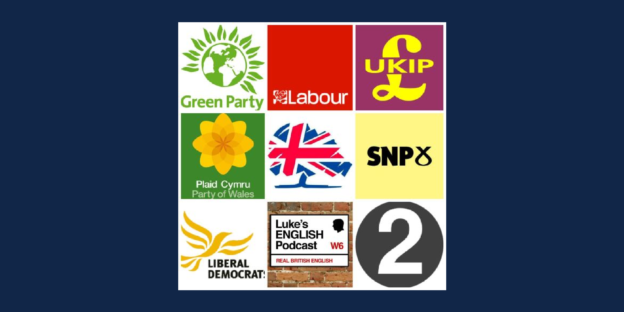
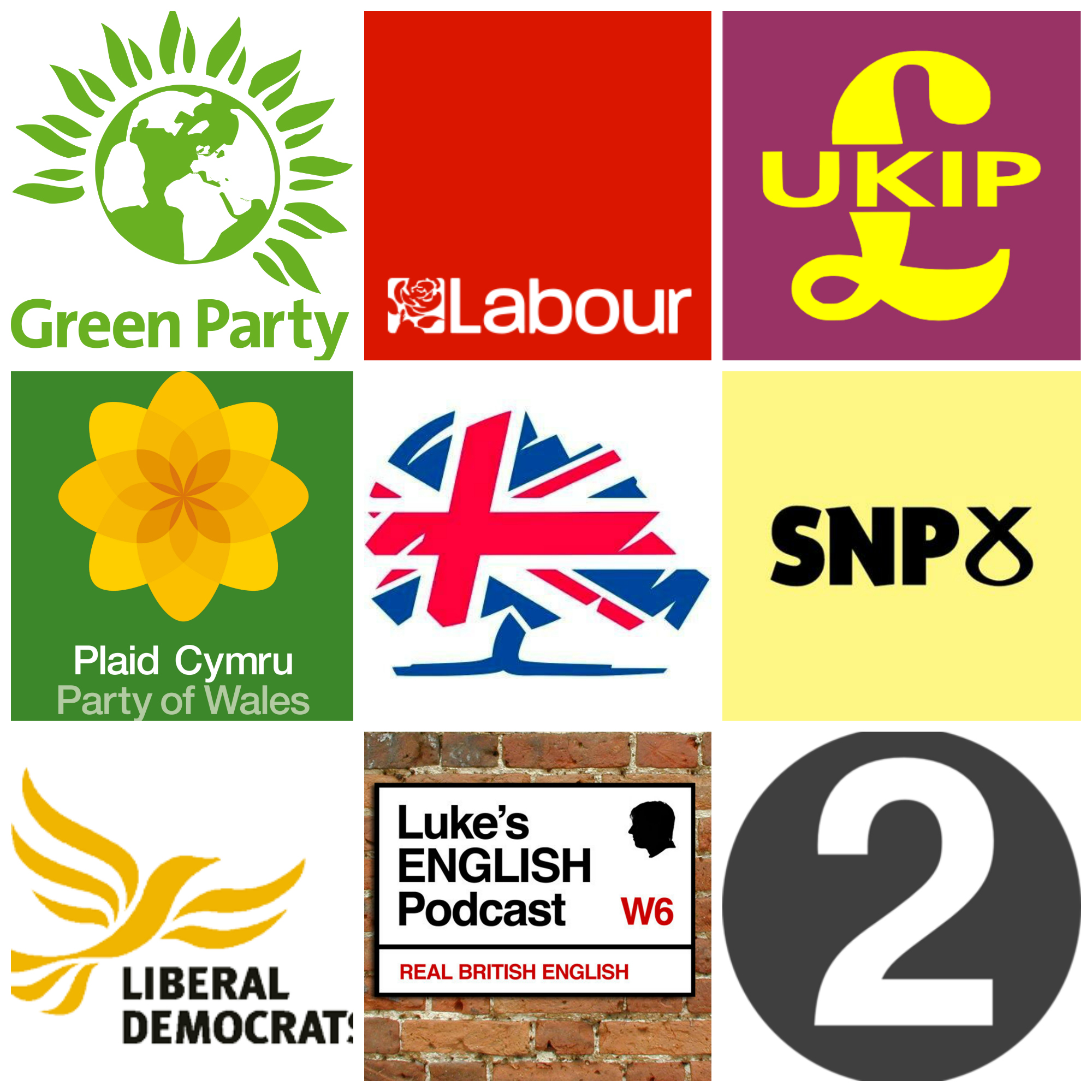
There are also other parties, with less influence, but who could be important in any coalition deals. This includes the left-wing Green Party, Plaid Cymru (representing Welsh interests, also quite left wing) and parties from Northern Ireland such as the Ulster Unionists (would support the conservatives).

End of Part 1 – 1hr05min
Click here to for part 2.
election1.1

266. Telling Jokes in English (Part 3)

This is the third and final episode in this series on jokes. In this one we’re going to consider the psychology of puns, hear an old tape recording of my brother and me telling jokes when we were children, and you’ll also get lots more gags and their explanations.
Small Donate Button
[DOWNLOAD] [PART 1] [PART 2]
The Psychology of Puns
Why do we tell jokes? Is it all just fun, or is there something deeper and more psychological going on here? Let’s listen to a clip.
This is a clip from Tim Vine’s DVD ‘So I Said To This Bloke’ about the psychology of puns. Tim Vine (winner of the joke of the year) talks to a psychologist called Ingrid Collins about why we like puns.
Three questions:
1. Why do we tell puns? (two reasons)
2. What’s the condition she mentioned?
3. Why did the audience laugh a couple of times?

Answers
1. For two reasons. One is for the sheer joy of surprise, silliness and the joy of showing up our language in all its light and shade. Secondly, people use puns because they want to avoid talking about more serious things – emotional issues, fear of intimacy etc.
2. The condition is called paronomasia and a person who suffers from this is a paronomasiac.
3. The audience laughs a couple of times because, of course, Tim Vine makes a couple of jokes. The first one is a joke about the word paronomasiac. Para (like parachute) mosaic (a pattern) – he says; “A paronomsiac – as opposed to someone who like parachutes and strange patterns, a paranomosaic.” This is a made up word, and a pun which he came up with on the spot. The psychologist is not impressed, and just says “yes” – in fact we sense that the psychologist is probably judging him and maybe considers him to have paronomasia. Also: “Black beauty – he’s a dark horse”

Round 2 – yet more bad jokes!
11. What do you call a Saudi Arabian dairy farmer?
A milk sheik

12. Why can’t ants go to church?
Because they’re in sects.

13. Man walks into a bar with a piece of tarmac under one arm and says…
I’ll have a drink please and another one for the road.

14. Two fish in a tank, and one of them said…
How do you drive this thing?

15. Why did the scarecrow win the nobel prize?
He was outstanding in his field.

16. A policeman was standing by the side of a road watching traffic. He saw a bus drive past full of penguins, so he stopped it.
“Why is your bus full of penguins?” he asked the driver. “I found them all by the side of the road, they must have escaped” said the driver. “Well take them to the zoo!” said the policeman. “All right” said the driver, and drove off.
A couple of hours later the policeman saw the bus again, it was still full of penguins and now they were all eating ice-creams. He stopped the bus again and said to the driver – “I thought I told you to take them to the zoo?”
The driver said “I did take them to the zoo, and now we’re going to the swimming pool”.

17. Why don’t cannibals eat clowns?
Because they taste funny.

18. A man walking down the streets sees another man with a very big dog. One man says to the other, “Does your dog bite”, the man replies “No my dog doesn’t” The man pats the dog on the head and it bites his hand off. The man says “I thought you said your dog didn’t bite” and the other man says “Yes. Thats not my dog”.

19. Why do Marxists like to drink fruit infusions?
Because all proper tea is theft!

20. What’s ET short for?
Because he’s got little legs.

My Brother and me telling jokes when we were kids
Here’s an old recording from when I was about 6 years old of my bro and me telling jokes. The jokes are listed below. I was a bit young to be able to tell the jokes properly, and I found it hilarious to get the jokes wrong. Nothing has changed really…


Here are the jokes from the recording
Knock knock
Who’s there?
Doctor
Doctor Who?
That’s right!

Why did the fly fly?
Because the spider spider (because the spider spied her)

Doctor doctor I feel like a pack of cards
Sit down and I’ll deal with you later

Knock knock
Who’s there?
Cows go
Cows go who?
Cows go moo not who!

What did the cat do when it got to the motorway?
Meeeeooow!

– get your (py)jamas on

Louis CK talks about a joke written by his daughter
The point is that he loves his daughter’s joke because it is unexpected, and because he can imagine the situation. It’s a funny situation with no explanatory punchline. Normally this kind of joke has a contrived opening because it is leading to a punchline with a double meaning. His daughter’s joke just has a contrived setup, but no punchline, which is actually more surprising and therefore more satisfying! I’ll let Louis explain it.


Who didn’t let the gorilla into the ballet?
Just the people who were in charge of that decision.
(this is a sort of anti-joke made up by a child who doesn’t really understand the rules of jokes, which makes it funny to Louis)
For more jokes written by kids, click here.

Round 3
21. Did you hear about the ice-cream man? He was found dead in his ice-cream van, covered in chocolate sauce and pieces of hazelnut.
The police said that he had topped himself.

22. What lies on the bottom of the ocean and shakes?
A nervous wreck.

23. Q – what did the grape say when the elephant trod on it?
A – Nothing, it just gave a little wine.

24. A man walks into a bar and is about to order a drink when he notices Van Gogh in the corner. He calls over, “Hey, Van Gogh! Want a drink?” and Van Gogh replies, “No thanks. I’ve got one ‘ere.”

25. There were two cows in a field. One said “moo”, the other one said “I was going to say that!”

26. Patient : “Doctor I keep hearing “The green, green grass of home” in my head. Doctor : “That’s called the Tom Jones Syndrome”
Patient : “Is it common ?”
Doctor : “It’s not unusual”

27. Two aerials met on a roof, fell in love and got married. The ceremony was rubbish but the reception was brilliant.

28. A horse walks in to a bar. The bartender says: “Why the long face?”

29. A bear walks into bar. He goes up to the barman and says “Can I have a pint of beer and … … … and a packet of crisps?”.
The barman says, “yes… but why the big paws?

30. A Buddhist monk walks up to a hot dog vendor and says “Make me one with everything.”
Jokes3PODPIC

265. Telling Jokes in English (Part 2)

This is part 2 in a short series on jokes. In the last one we considered some of the social codes around joke telling, including when, why and how we should tell jokes and respond to jokes. I suggest that you listen to that if you haven’t already done so. [CLICK HERE FOR PART 1]
Small Donate Button[DOWNLOAD] [PART 1] [PART 3]
Introduction
In this episode we’re going to look at some typical joke structures, consider what makes a joke funny, and then I’m going to tell you lots of jokes. So, more entertaining and useful listening practice, with some jokes you can learn and share, and plenty of vocabulary teaching too. Again, there might be a part 3 to this episode, depending how long it is.

Just a reminder: This episode is all about jokes, but even if you don’t laugh at any of these jokes (many of which are, admittedly, quite bad jokes!) that is fine – because you’re learning lots of vocabulary. Perhaps, if you don’t get the jokes the first time, after you’ve understand the vocabulary, you can listen to these episodes again, come back to the jokes and see if any of them strike you as funny on a second listen. Also, I don’t expect you to remember all of these jokes, but you could pick a couple of jokes that you like, learn how to say them, and then share them with a couple of English-speaking friends. But be prepared to explain the jokes if nobody understands!

What are some typical joke structures?
Usually it’s this:
Question (setup)
“I don’t know” (response)
Answer (punchline)

e.g.
Why didn’t the ghost go to the dance?
– I don’t know
Because he had no body to go with.
Ha ha.

There are plenty of other joke types
Here’s a short list of examples

Knock Knock Jokes
Knock knock
Who’s there?
Luke
Luke who?
Luke through the window and you’ll see.

Doctor Doctor Jokes
Doctor doctor I feel like a bell
Well, take these pills and if they don’t work just give me a ring.

‘What do you call a…?’ jokes
What do you call a deer with no eyes?
No idea.

What do you call a deer with no eyes and no legs?
Still no idea.

‘What’s the difference between…?’ jokes
Q. What’s the difference between a tennis ball and the Prince of Wales?
A. One is thrown to the air and the other is heir to the throne.

Shaggy dog stories
E.g. the pink gorilla story

Light bulb jokes
How many psychiatrists does it take to change a light bulb?
None – the light bulb will change when it’s ready.

‘A man walks in to a bar’ jokes
A man walks into a bar…
and bangs his head.
It was an iron bar.

A man walks into a bar, sits down and orders a pint.
There’s a pianist in the corner, playing a song. The pianist has a monkey dancing on top of the piano.
As soon as the man’s drink arrives, the monkey jumps up, runs along the bar, pulls out its willy and pees into the man’s pint of beer.
Furious, the man walks over to the pianist and says “Do you know your monkey’s just pissed in my beer?”
The pianist says, “No I don’t, but if you sing the melody I’m sure I can pick it up”.

‘An Englishman, an Irishman and a Scotsman’ jokes (pretty old-fashioned and a bit racist)
An Englishman, an Irishman and a Scotsman are lost in the desert and their jeep breaks down. They’re going to have to walk. The Englishman takes the bottle of water, so if he gets thirsty he can drink it. The Scotsman brings a hat, so if the sun shines he can protect himself. The Irishman takes the car door and says “If it gets too hot I can wind down the window.”
– yes, the premise is that Irish people are stupid. It’s old-fashioned and a bit racist, as I said.

What makes a joke good?
It’s all a matter of taste. It’s completely subjective. There is no universal ‘best joke’ because different people with different tastes will laugh at different things at different times. In fact, the jokes which are totally safe and inoffensive will often be quite crap and boring. They lack any real punch, admittedly like a lot of the dad jokes in this episode. But there are certain things that will make a joke better – clever word play with double meanings of words being exploited, a bizarre or curious situation, the way the joke is told with correct timing, intonation, naturalness etc. There are also themes or subjects which will appeal to a wide audience, helping your joke get a better response from more people. These all help, but ultimately it’s a question of subjective personal taste.

The LaughLab Experiment
A study was done by a British scientist called Professor Richard Wiseman to discover the funniest joke in the world. The experiment, the results of which have been published on a website called laughlab.co.uk, went like this: People were invited to enter their favourite jokes into the website. Then other people from different countries around the world were asked to sign in, read the jokes and then rate the one they found the funniest. 40,000 jokes and 1.5 million ratings were received by the study. Do you want to know the joke? Here we go: (text reproduced from Prof Richard Wiseman’s website. Listen carefully. Do you get it?

The winning joke

After much careful scrutiny, we finally found the joke that received higher ratings than any other gag. Here it is:

Two hunters are out in the woods when one of them collapses and falls to the ground. He doesn’t seem to be breathing and his eyes are glazed. The other guy gets out his phone and calls the emergency services. He gasps, “My friend is dead! What can I do?”. The operator says “Calm down. I can help. First, let’s make sure he’s dead.”
There is a silence, then a shot is heard. Back on the phone, the guy says “OK, now what?” 

This joke was submitted by Gurpal Gosall, a 31 year old psychiatrist from Manchester in the UK. He told LaughLab:

“I like the joke as it makes people feel better, because it reminds them that there is always someone out there who is doing something more stupid than themselves.”

The joke is interesting because it works across many different countries, appeals to men and women, and young and old alike. Many of the jokes submitted received higher ratings from certain groups of people, but this one had real universal appeal.

Also, we find jokes funny for lots of different reasons – they sometimes make us feel superior to others, reduce the emotional impact of anxiety-provoking events, or surprise us because of some kind of incongruity. The hunters joke contains all three elements – we feel superior to the stupid hunter, realise the incongruity of him misunderstanding the operator and the joke helps us to laugh about our concerns about our own mortality.

What do you think? Did you get it?

Let’s hear a short extract from a documentary about jokes produced by the History Channel. It’s presented by an American comedian called Louis Black. In this extract he meets Professor Wiseman and they talk about the LaughLab study and the joke that won. As you listen, just consider this question: What does Louis think of the joke? What’s his opinion?

What did Louis Black think?
He thought it was a bad joke, and that there is no such thing as “the funniest joke in the world” because all humour is subjective. What’s funny to one person will not be funny to the next guy, and so on. It’s your humour, and don’t let anyone tell you otherwise. The only way to find out what is funny, is to actually go out and tell jokes and see what makes people laugh.

So, with that thought in mind, let me now tell you some jokes. If you don’t understand them, don’t worry – I will explain them all afterwards.

JOKE LIST 
I’ll read all these jokes to you, then explain them afterwards. I think I’ll read out 10, and then explain those, and then do the next 10 and so on…

How Many Jokes Can You Understand?
If you like, you can count how many of the jokes you get. If you get a joke, you get one point.
So, count how many jokes you get.
9/10 or 10/10 = You will probably laugh at anything, and you’re probably on drugs.
6-8/10 = well done! Either your English is brilliant or you just have a natural sense of humour.
4-6/10 = not bad! Jokes are difficult to understand, and if you got 50% that’s actually a very good score.
2-4/10 = Don’t worry too much if you didn’t understand many of the jokes – don’t feel bad, but I think you should watch more comedy in English.
1/10 = Never mind! Listen to this episode again to build up your vocabulary, and I expect you’ll understand more of the jokes. Don’t forget, I’m going to explain them afterwards.
0/10 = hello? Are you alive? – Just kidding. It’s quite normal if you didn’t find any of these jokes funny. Remember, understanding jokes and laughing at them is very hard in another language.

So, just laughing at a couple of these jokes is enough. I don’t expect you to laugh at them all. Just focus on understanding the meaning. If you laugh, that’s a bonus.

You Should Practise Saying the Jokes Too
Also – remember that the delivery is important. I suggest you practise telling these jokes yourself. Listen to the way I say them (I hope I’ll say them correctly) and try and copy the rhythm, intonation and sentence stress. Notice which words are emphasised and how. That’s important. You can read all these jokes on the page for this episode.

Round 1 (and yes, I know these jokes are really cheesy!)
1. Why was 6 afraid of 7?

Because 7 8 9.

2. What’s brown and sticky?
A stick.

3. A man walked into a bar and said “Do you have any helicopter crisps?”
The barman said, sorry we only have plane crisps.

4. What do you call a fly with no wings?
a walk

5. What do you call a fly with no wings and no legs?
a crash

6. What do you call a man with a car on his head?
Jack

7. How much fun do monks have?
Nun.

8. What do you call a blind dinosaur?
Doyouthinkhesaurus.

9. What’s black and white and red all over?
A newspaper in the bin.

10. A: My dog’s got no nose.
B: How does it smell?
Awful
Jokes2PODPIC
PLEASE LEAVE YOUR COMMENTS BELOW AND SHARE YOUR JOKES!

264. Telling Jokes in English (Part 1)

This episode is all about telling jokes, not as a comedian on stage, just in your normal life. Telling jokes is something that everybody does, in countries and cultures all around the world. We all love to make jokes, hear jokes and have a bit of a laugh. For me, jokes are fun and fascinating but I know that for non-native speakers of English they are also notoriously difficult things to manage. If English isn’t your first language, it can be difficult to understand jokes, find them funny, and also to be able to tell them effectively.
[DOWNLOAD] [PART 2] [PART 3]
Contents of this Episode
So, in this episode I’m going to tell you everything you need to know about jokes in English, and that includes these things:
What is a joke? (as if you didn’t know)
When/why do we tell jokes?
How do we tell jokes? What are the golden rules for telling a joke properly?
What’s the normal way to respond to a joke?
What are some the typical joke structures? (so you know how to identify a joke)
What are some jokes that you can remember and share with your friends?

So this is not just going to be a guide to jokes and the way they are told,  you’re also going to hear lots of jokes too – I’m going to read out loads of jokes, and explain them to you. So that means that you’re also going to learn a lot of vocabulary during the episode – because often jokes are based on the specific meanings or double meanings of words.

Most of what I’m saying to you here is written on the page for this episode – that’s right, there’s a transcript for most of this, so if you want to read what I’m saying – you can. Just find the page for this episode at teacherluke.co.uk.

Small Donate ButtonNot all of it is scripted because I expect I will go off script and say some spontaneous stuff too, but most of it is. That’s nice isn’t it? Yes it is. Mmm, very nice. I went to quite a lot of effort to prepare this episode in advance and I hope that’s obvious. It should be full of genuine insights. If you find it useful, you could consider making a donation by just clicking one of the yellow ‘donate’ buttons on teacherluke.co.uk. That is entirely optional and completely up to you of course! No pressure!

I expect this will be more than just one episode because it’s quite a big subject, and it’s a subject which is close to my heart so, naturally I have loads of things to say about this!

It might be the case that I do this first episode as an introduction to the subject of jokes, and then in subsequent episodes I’ll go through my list of jokes, and then explain them. That’s right, I’ve prepared a list of jokes. It’s quite a random list and hasn’t been fully tested for quality. It’s just a selection of jokes which I’ve managed to write down, or poach from other lists on the internet. I’ll tell you all those jokes either in this episode, or in separate episodes, depending on how long this all takes.

So this could be another series of episodes of the podcast. There’s so much to talk about and to share.

I’d also like to do an episode about telling jokes on stage and how to do stand up comedy, because stand-up is also a fascinating topic and one that more and more people are getting interested in. Telling jokes on stage is quite a different topic, so that’s another episode for another time.

I love jokes
I really do. I love hearing them and I love telling them. I love the way jokes exploit double meanings in language. Often a joke is based on a word that means two things at the same time, or two phrases that sound exactly the same. Or a joke might be a little story with a surprise which is revealed at the end. So jokes allow us to have fun with the little holes and coincidences that exist in languages. They’re like little language glitches – moments when your brain has to deal with a sudden change in meaning or something that has two meanings at the same time.
I love the surreal world of jokes – the way the normal rules can be broken – rules of language, but also the rules of physics, and behaviour too. Jokes often bend the rules of reality in order to make the punchline work. They lead you in one direction, and then suddenly surprise you with something completely different, and the only link is that the words sound the same.

What am I talking about? Here’s an example of a joke in which the punchline has two meanings.
A hole has been found in a nudist camp wall. The police are looking into it.
To get this joke you need to know that the phrase ‘to look into something’ can mean “to investigate” and also to literally “look inside”. So, someone found a hole in the wall of a nudist camp. A nudist camp is a place where people can enjoy spending time with no clothes on, in the nude. Someone found a hole in the wall and the police are investigating it, but they’re also just looking into the hole.

OK.

A hole has been found in the nudist camp wall. The police are looking into it.

I’ve said it before and I’ve said it again – explaining a joke kills the magic.

“Explaining a joke is like dissecting a frog. You understand it better but the frog dies in the process.”

― E.B. White


So, explaining a joke may allow you to understand it, but the joke dies in the process – you probably won’t laugh after it’s been explained. Jokes work best when they are instantly understood. It has to be instant. This is why jokes are often lost on non-native speakers, which is a pity.

However, here at Luke’s English Podcast I have a mission – and that is to try and make you laugh while you learn, and if I can’t make you laugh I’ll certainly aim to teach you something. So even if you don’t find all of the jokes I’m going to tell you (later) funny, then that doesn’t matter, because in the end you’ll learn some double meanings and you’ll be more ready to laugh in the future, because I’m going to explain lots of jokes for you. I expect that many frogs will die during the recording of these episodes…

What was I saying? That’s it – I love jokes!

Jokes can be stupid, brilliant, pointless, dangerous, harmless, disappointing, unexpected, light-hearted, dark, bizarre, rude, intellectual or even illegal.
Jokes can be just a bit of fun, or they can be used to make serious and critical points. They can be very complex things when you examine them but ultimately, jokes are about fun and laughter – and what is wrong with that?

There are all sorts of social rules that surround the telling of jokes.
They’re little bits of language, wrapped up in culture, presented via small social rituals.
Jokes, and humour in general, are often the most difficult aspect of a language to appreciate. The ability to appreciate humour is one of the last things you gain as a language learner.
To get a joke you need to be able to hear the individual words spoken, identify them, understand them, spot the punchline, grasp the pun or word-play and then know how to react appropriately, and this all has to happen instantly. Perhaps most importantly – you need to have identified that it was a joke in the first place, and not just another couple of sentences that you didn’t really understand. It can be even harder to deliver a joke – remembering the specific words, getting the timing right, emphasising the relevant words correctly using sentence stress and intonation. Oh my god! It’s complicated.

Imagine this situation – I’m sure you’ve experienced something similar. You’re in a group of people. They’re all native speakers and you’re not. One of them is speaking rather quickly but you can basically follow what’s being said – even the complex words and bits of grammar. You feel quite proud of yourself “I’m understanding all of this!”. Then the guy says something and everyone bursts out laughing, but to you it just sounded like another sentence. What’s wrong with everyone? Then it becomes clear that he just told a joke, and apparently it was a good one. “Was that supposed to be funny?” You think to yourself. Someone explains the joke to you – you think about it, you get it, but it’s just not that funny! It’s not even clever! Why did everyone laugh so much? Is everyone else weird, or is it you?

The fact is, jokes can be hard to get, and after it’s been explained to you the magic has probably gone. You’ve got to understand it 100%, and instantly. That’s why non-native speakers of English are often not very impressed by humour in English. Jokes don’t usually translate into other languages because they are based on specific sounds or similarities between words. Also the delay in understanding a joke can kill the enjoyment.

I’m not saying that non-native speakers don’t get humour in English. I know they do. Sometimes I make my students laugh a lot, although this is matched by the number of times my student don’t even identify that I’ve told a joke – is that their lack of English, or my bad jokes? A combination of the two I expect. So, even though non-native speakers clearly do laugh at a lot of things in English, I’m well aware that a lot of things are completely lost on them too.

I think that you (as learners of English) need to understand jokes – because it can help you socially, but also because you’re missing out on a lot of fun. That’s why I’ve decided to do this episode.

But don’t expect this to be a particularly funny episode! There’s nothing worse than high-expectations for a joke. If your expectations are too high, you won’t laugh. It’s like when someone says, “I’ve got a really great joke, you’re going to love this!” then the joke is never that funny. So, don’t get your hopes up. Despite the fact that this episode is all about jokes, it’s probably best if you realise at this point that there will be no laughs and no fun in this episode at all. OK?

DO NOT EXPECT LAUGHTER!

What is a joke?
It’s just anything said that is intended to produce laughter. It could be a traditional joke structure, or a comeback, a sarcastic comment or a small story or whatever. If it is intended to produce laughter, it’s a joke.

Vocabulary
There are a few words that you should know. They’re all different types of joke, or just related to jokes in some way. Here they are:
*a pun = a word joke – a short joke that is based specifically on two words/phrases that have the same meaning or sound the same. For example, “Did you hear about the guy whose whole left side was cut off? He’s all right now.”
[‘All right’ = okay, but also, ‘all right’ means ‘only the right’ – in this case, he only has a right side now because his whole left side was cut off. Yes it’s ridiculous. Yes, I like it.]
*a gag = just another word for a joke
*a shaggy dog story = a longer joke with a stupid punchline at the end (e.g. The Pink Gorilla Story or The Prawn Story)
*a one liner = a simple one line joke. E.g. “Conjunctivitis.com – now that’s a sight for sore eyes.” [Don’t get it? Don’t feel bad. Conjunctivitis = a health condition in which your eyes are infected and painful, or ‘sore’. The expression “a sight for sore eyes” = something which you are really glad to see, because you need it. e.g. “You’re a sight for sore eyes” = I’m really glad to see you (maybe because you’re attractive and nice, and I’m bored and surrounded by uninteresting people). Also “site” and “sight” sound the same. Here, ‘conjunctivitis.com is a website for people who have sore eyes. It’s literally a website for sore eyes, and I suppose it’s something you’re glad to see if you have conjunctivitis.] And if you’re in any doubt about the funniness of that joke, it won the “Joke of the Year” award in 2012. That’s an award which is given to the comedian who makes the best joke of the Edinburgh Fringe Festival which is one of the world’s biggest comedy festivals. It was written by Tim Vine, one of the UK’s top comedians. Click here to read more on this story.
*a wisecrack = a clever and funny response
*a comeback = a quick response to a criticism. Winston Churchill was famous for his comebacks. “Mr Churchill, you’re drunk!” “Yes, I am. And you’re ugly. But in the morning I shall be sober. But you will still be ugly.”
or “Mr Churchill, if I was your wife I would put poison in your tea!” “And if I was your husband, I’d drink it!” etc.
*witty (adj) = to describe someone who is funny and able to make quick and spontaneous jokes.
*the setup = the first part of a joke which sets the situation and linguistic context
*the punchline = the funny part of the joke, which is delivered last. E.g. “I couldn’t quite remember how to throw a boomerang” = the setup, “but eventually it came back to me.” = the punchline. [‘come back to me’ literally means ‘return to me’ – like a boomerang does, but it also means ‘remember’]
*a dad joke = a stupid, safe and rather bad joke. The kind of thing your dad would tell you. To be honest, most of the jokes in this series on jokes are dad jokes. They’re not very dangerous or cool. They’re pretty disposable, but they’re fun, and sweet.

Where do jokes come from?
Most jokes just seem to exist in people’s consciousness and nobody knows who wrote them. They get shared orally (or maybe written in emails) and get passed around, but nobody really owns them. When I was a kid, my friends and I used to own joke books. They were compilations of jokes. You could buy these huge books filled with hundreds or thousands of ‘knock knock’ jokes. We used to go around telling them to each other. There were so many. Sometimes I heard some pretty rude jokes too – jokes that involved sexual things that as a child I just didn’t understand. That was a weird way to be introduced to some aspects of sexual depravity – within the context of a joke told by a naughty kid at school. Only later would I understand what they actually meant.
Then there are jokes which have been made up by someone, like a professional comedian – like the conjunctivitis joke. Those ones are actually owned by those comedians and used in their stage performances, and when you tell one of those jokes it’s customary to say whose joke it is – “That’s a Peter Kay joke” or “That’s a Tim Vine joke” for example. It’s a surprisingly difficult skill to be able to write really good jokes. If you can do it well, it can make you quite rich. Some of the best comedians, writers and directors started out by writing jokes for other people. For example, Woody Allen, Steve Martin and David Letterman.
Then there are original jokes made up by people on the spot. If you’re a clever you might be able to come up with jokes spontaneously – and people might consider you to be ‘really witty’ (positive) or perhaps just a ‘smart aleck’ (negative) depending on how well received your jokes or funny comments are.

Mainly in this episode we’re talking about the first category of joke – ones that lots of people know, have no ‘owner’ and which get passed around by word of mouth. As I said, I’ll be sharing loads of them with you later in this episode or perhaps in the next one.
A lot of these jokes which are shared by friends have typical structures, which most people know. Like “Knock knock” or “Doctor Doctor” jokes.
There are also social conventions around joke telling that you need to know, for example – how to tell a joke, how to react when someone tells you a joke, how to identify when someone is joking and how to respond to a joke.
For example, if someone says to you,
“What’s the difference between a photocopier and the flu?”
You shouldn’t try to guess the answer. “Err, well, one is a kind of machine and the other one is a virus. They’re really different actually. Why?”
No – this is the wrong response. The person is clearly telling you a joke. You’re supposed to say “I don’t know” and then wait expectantly for the hilarious punchline.
“What’s the difference between a photocopier and the flu?”
– “I don’t know”
One makes facsimiles; the other makes sick families.
“Haha, good one!” you say, even if it wasn’t that good.

Telling and hearing a joke is like a little social interaction with its own specific rules and conventions that you have to know. We’ll look at this more later.

What’s the point of telling jokes? Why do we tell jokes?
It’s all about laughter and how it makes us feel good. According to Helpguide.org – a trusted non-profit online service giving advice about mental and physical health, Laughter is good for your health. “Laughter is the best medicine”.
According to them:
Laughter relaxes the whole body. A good, hearty laugh relieves physical tension and stress, leaving your muscles relaxed for up to 45 minutes after.
Laughter boosts the immune system.
Laughter decreases stress hormones and increases immune cells and infection-fighting antibodies, thus improving your resistance to disease.
Laughter triggers the release of endorphins, the body’s natural feel-good chemicals. Endorphins promote an overall sense of well-being and can even temporarily relieve pain.
Laughter protects the heart. It improves the function of blood vessels and increases blood flow, which can help protect you against a heart attack and other cardiovascular problems.

The link between laughter and mental health
Laughter dissolves distressing emotions. You can’t feel anxious, angry, or sad when you’re laughing.
Laughter helps you relax and recharge. It reduces stress and increases energy, enabling you to stay focused and accomplish more.
Humor shifts perspective, allowing you to see situations in a more realistic, less threatening light. A humorous perspective creates psychological distance, which can help you avoid feeling overwhelmed.

Social Benefits
Strengthens relationships
Attracts others to us
Enhances teamwork
Helps defuse conflict
Promotes group bonding

Jokes are crap, aren’t they?
You might be thinking: “But jokes aren’t funny. I sort of hate jokes. They’re usually awful and I don’t laugh.”
Yes, true. They’re often terrible – like the bad puns that your Dad tells you, or the awful jokes you get on lollipop sticks or inside christmas crackers, but that’s part of the charm really. It’s just a bit of fun – stop taking life too seriously! Kids like them of course, because kids don’t like to take life too seriously, and because most jokes are brand new to children. Also, when you’re a kid is when you are learning about the language and discovering any double meanings can be quite exciting. For me, it’s all about having the right attitude and being ready to laugh and find things funny. If you want to laugh at jokes, you will.

When to tell jokes
I suppose the best jokes are the ones that are spontaneous (made up on the spot).
They are usually received best when they are shared in light-hearted joke telling sessions, when everyone is telling jokes. Sometimes that happens – someone tells a joke and then everyone chips in with a joke they know. Like, “I’ve got one” or “Have you heard this one?” That way you’re not forcing your joke on someone who then feels pressure to laugh at a joke they might not find funny or understand.
Be careful of using them to impress people, break the ice or to charm people, like in a business meeting or on a date. They might have the opposite effect. You have to know when to tell jokes. Normally it’s in a moment where there’s no pressure.
The best results come from comments, or responses that happen spontaneously. If people feel that a joke is too planned or contrived – like you’ve planned it for days or weeks in advance, you’ll look like a prat. So, the best jokes are just unplanned comments that happen in that moment.
So, because the funniest things are spontaneous, it’s all about having the right attitude – being open, looking for the funny side of things, being self-deprecating (laughing at yourself), being sarcastic, joking about things that everybody experiences, not picking on anyone in particular, and wanting everyone to be happy and to enjoy themselves.

Jokes are often best told privately. For example, not announcing a joke to the whole room, but sneaking up on someone and sharing it just between you both, quietly.

Jokes can be risky
You might embarrass yourself or others if the joke is not funny or if you ‘fluff it’ – say it wrong.
Watch out for the content of jokes. A lot of them are pretty rude – and I don’t just mean sexually. They often have victims, or could be very politically incorrect. You could offend people and get yourself into serious trouble, depending on the context and the joke of course.
Watch out for these things: jokes about nationalities, jokes about disability, jokes about blondes, jokes about race, sexist jokes or jokes with rude images. I realise that I’ve just deleted most of the best jokes – but the point is, don’t underestimate how offensive a joke can be. Some people might laugh, some might not understand it, and some will take it seriously and be offended. Also, in some places, jokes are outlawed, especially if they are political in nature. So – be careful when joking.
The right joke at the right time makes everything ok.
The wrong joke, told at the wrong time in front of the wrong people could land you in serious trouble.

So:
be spontaneous
don’t pick on anyone in particular – don’t victimise anyone
be prepared to make jokes about yourself
make jokes about things that everyone is experiencing/sharing

How do you tell jokes?
Perhaps the most common structure for a joke is the Question-Answer format. That means that a joke often begins with a question. It’s quite normal to just ask someone that question, and if they’re familiar with the culture of telling jokes, they will respond with “I don’t know” and then you deliver the punchline.
E.g.
“Hey, how does Bob Marley like his donuts?”
“I don’t know”
“Wi’ jam in”.
“Do you get it? ‘With jam in’ – ‘we’re jamming”
“Ha ha oh yeah, I get it! Nice one!” etc.

So, at the right moment you can just tell your joke by asking the question like that.

Sometimes you can say “I’ve got a joke for you” or “Do you want to hear a joke?” or “Have you heard the Bob Marley joke?”

Try not to say “I’ve got an absolutely hilarious joke – you’re going to absolutely love this!” – because the person will expect too much and it’s bound to be an anticlimax.

Timing is important. It also has to be really clear. It has to be comfortably and easily told.
Make sure you learn it properly! The set-up has to be exactly right, and the punchline too!
Make sure the set up is not too long. It has to give only the most crucial information for the punchline to work.
Make sure you know your joke well, because there’s nothing worse than telling a joke wrong, or forgetting the punchline. It’s the equivalent of a magic trick going wrong – you look like a fool.
Don’t expect much of a response, and don’t expect your joke to make you popular or anything. The chances are, people won’t get it, and if they do laugh, they’ll probably just forget about it, unless the person is a joke fan like you. In the right moment though, jokes can be a lot of fun. So, jokes are not worth a lot, unless you find other people who love them, and then you can share your favourite jokes together.

When telling a joke – remember it! Run the joke through your head before saying it. Don’t get halfway through the joke and then start again because you forgot it.
Make it clear and be confident. People have to be able to hear and understand what you’re saying.
Sentence stress is very important. Usually certain words must be stressed for emphasis.
Make it look quite casual. Don’t be too desperate for a response or laughter.
The best jokes are completely improvised comments made in the moment. Sometimes there is nothing better than a very carefully worded quick response to a situation. It can make everyone burst out laughing quite magically. But again – watch out because jokes can backfire. People may find it offensive, inappropriate or just pathetic.
There are risks in joke telling. You risk losing respect from people, or offending people, but the rewards are high. If you make people laugh, they will like you, and ultimately everyone can enjoy a good laugh – and there’s nothing wrong with that. In fact, sometimes it’s the best, most honest feeling in the world – just letting yourself go and laughing uncontrollably. It’s joyful and infections, and being able to create it is a bit like being a good wizard (not an evil one).
Choose to tell good jokes which have a proven track record. Don’t tell jokes that don’t make people laugh, even if you find them funny yourself.
Don’t tell inappropriate jokes – ones that are sexual, racist or which have a victim. Instead try to tell jokes that are universal. Rude jokes can be very funny, but be aware that they are only appropriate in certain situations, and only funny for certain people.
Don’t get all angry, upset and defensive if people didn’t enjoy your joke. You can’t bully people into enjoying themselves. Just shrug it off.
You need to make it clear when the joke has ended and when people are expected to laugh, although don’t expect it to happen.
If you’re going to make a joke, try to connect it to what’s going on at that moment.
Often the best jokes are just one line responses to things happening around you.
Jokes are often best delivered with a straight face, with an understated style. Don’t make a big song and dance out of it. In the UK we normally tell a joke quite straight. We don’t laugh at our own jokes or slap our thigh when we tell the punchline. Laughing at your own joke too much is considered a bit unattractive.
Be prepared to carry on if the joke fails to make people laugh – people might not notice! Otherwise, it’s probably worth admitting that you told a joke and nobody found it funny. Then people will feel less awkward. Sometimes when I tell jokes, nobody laughs. Then I say “that was a joke, by the way, just in case you are wondering” and that sometimes makes people laugh a little bit – maybe out of sympathy if nothing else!
I realise I’m sounding a bit modest here – it may look like I spend all my time embarrassing myself with dodgy jokes. Well, it does happen sometimes, but not all the time.

English people love humour and it’s used a lot, for a lot of different purposes – including breaking the ice, as well as establishing power structures or social hierarchies, or breaking down social hierarchies.
I’m sure it’s similar in your countries too. Kate Fox says that for the English there is no right or wrong time for humour. I know what she means, but I don’t think it’s strictly true. We love joking in many situations, and we’re always ready for a joke or a funny/sarcastic comment, but of course there is a right or wrong place for it. If you just go around making crap jokes all the time, in every situation, you’ll soon become unpopular. I suppose what Kate Fox means is that humour, rather than jokes, pervades all aspects of British life and I agree with that.
The main thing is the intention you have behind your jokes – are you doing it to make people feel happy, to bond your team, to put people at ease, or are you doing it just to draw attention to yourself at the expense of other people’s comfort? If it’s the latter reason, then it’s probably better to curb your enthusiasm a bit.
Really, being funny is more about having the right attitude – being ready, prepared and confident enough to find the funniness in anything.
It’s also about being generous – just wanting to make people laugh without spoiling the situation.
It’s not about cruelty – bullying or targeting people with humour. It’s not picking on other people too much. It is about being willing to take a joke yourself. That’s the first step.
Some people just don’t want to be a person who jokes – they’d rather be serious and expect people to take them seriously too. That’s fine of course. Personally, I think that many of us take life too seriously – and a good sense of humour and the ability to take a joke are admirable, positive qualities. It’s hard to be a genuinely arrogant person while taking a joke about yourself. It’s a good leveler. It makes people equal in status.
Really, it’s just about having an attitude for laughter and jokes. For me it’s best when it’s sort of selfless.
There’s also a love of language involved. Sometimes jokes come out of picking the right words, or playing with language.
One advantage of a good joke is that people’s guard goes down when you make them laugh. You can say some outrageous things and get away with it. Also, people will warm to you if you make them laugh. It’s charming. Good jokes are harmless (and should be).
Also, there are all the benefits of laughter.

How do you react to a joke?
The worst thing you can do is not recognise it is a joke.
It’s also bad if you don’t acknowledge that a joke has been told. You have to show that you identified it as a joke, at the very least.
Some acknowledgement is good.
Ideally you’ll laugh naturally. You could fake a chuckle but don’t go over the top. You could say “good one”, or even “that’s a good joke!” (without laughing)
If you don’t understand it you say: “I don’t get it.”
If you’ve heard it before: “I’ve heard it before.”
If you understand the joke, but don’t find it funny: You can make a noise, like you’re suffering. “Ooohhh!” or even something like “Oh my god what are you like?”
If you understand it and find it funny: laughter!
It may be appropriate then to share a joke that you have too.

End of part 1

What’s the culture of jokes in your country? 
jokes1PODPIC

262. What is Britishness? (Part 2)

Welcome back to part 2 of this episode in which we are exploring the subject of Britishness. In this one we are looking at how the Brits define and understand their own national identity. [Download]
Image: Gene Bible http://www.genebible.co.uk
Small Donate ButtonHow do British People define “Britishness”?
When you ask the average British person to define “Britishness” I find that they always give certain ‘stock answers’ to this question too. As we know, it’s hard to truly define this concept, so you end up listing various associations, which don’t fully deal with the whole subject in a satisfyingly complete way.

Video
I found a video on YouTube called “What is Britishness?” by Rebecca Devaraj. It’s a short video exploring Britishness for her final-year university project.
It looks like she spent the morning in a local park, asking passers-by the question “What is Britishness?”
Listen to the audio. Can you guess which answer I think is the best?

Some vocab from the video
Having a stiff upper lip and getting on with things
Being accepting and just getting on with it
Bulldog – it has connotations with Churchill, and the advert… https://www.youtube.com/watch?v=wbz-IsEOCKo
Bad weather – torrents (torrents of rain) ***I’ve just realised that they said “tolerance” not torrents! Did you notice that?***
Progress
We get behind our sports teams
You just are British – that’s it really. If you’re British – you enter the mix.

The best comment?
For me it’s the guy (Professor Jeremy Black, author of “A Short History of Britain”) who says this:
“I would have thought that Britishness defines the characteristics of whoever are the citizens of Britain, whatever their origins at any one time. Ordinarily, we would argue that Britishness is linked to notions of liberty and freedom and in fact the very diversity that makes it difficult to define what Britishness means”.

Wikipedia Definition

Britishness is the state or quality of being British,[2][3] or of embodying British characteristics,[3] and is used to refer to that which binds and distinguishes the British people and forms the basis of their unity and identity,[4] or else to explain expressions of British culture—such as habits, behaviours or symbols—that have a common, familiar or iconic quality readily identifiable with the United Kingdom.[5] Dialogue about the legitimacy and authenticity of Britishness is intrinsically tied with power relations and politics;[6] in terms of nationhood and belonging, expressing or recognising one’s Britishness provokes a range of responses and attitudes, such as advocacy, indifference or rejection.[6] Macphee and Poddar state that although the designation of the two differing terms, Britishness and Englishness, is not simple as they are invariably conflated, they are both tied into the identity of the British Empire and nation, since these last two are altering considerably as Englishness and Britishness do too. Thus the slippage between the two words can be seen as a play between these changing dynamics.[7]

That’s interesting.

So, in summary that means it’s:
– Whatever distinguishes British people and culture from other nations, whatever is unique to the UK.
– It includes habits, behaviours, or symbols that are specific or familiar to the UK
– This conversation usually ends up with references to the power structure of the UK – politics and monarchy.
– Expressing Britishness provokes a range of feelings. For example, waving a British flag might cause people (in the UK) to go “Yey!” or “whatever” or “I find that offensive”.
– “Britishness” and “Englishness” are different things, but they are often used to mean the same thing – Britain from an international point of view, especially as an empire.

So, what’s the difference between Britain, and England? (and indeed Scotland, Wales, Northern Ireland)
Why would it be offensive to wave a British flag?

Generally in England it’s less offensive, but in Scotland, Wales or Northern Ireland you might meet people who put their countries before the union of the UK, and in fact feel that the UK was forced on them in some way.
What about waving an English flag?
In England, the UK flag is associated with unity, inclusion, multiculturalism and so on. The English flag on its own is more associated with English nationalism, which in turn is associated with empire building, colonialisation and also football hooligans. Generally, the English flag is displayed when there’s a football match, and the behaviour that goes along with that.

In terms of how Brits define Britishness… This Guardian Article Sums It Up Rather Well
http://www.theguardian.com/uk-news/guardianwitness-blog/2014/jun/09/scottish-independence-10-things-that-sum-up-britishness

What about the Scots, the Welsh & the Northern Irish?
I’m English, and British, so when I talk about Britishness, I’m also talking about Englishness to a certain extent, but Britain also includes Scotland, Wales and N.Ireland. Do they feel included in all this talk of Britishness?
Not necessarily. Some people in those countries feel strongly about independence and resent being ‘lumped in with England’. They believe their countries have unique identities too, which are not always represented when people talk about Britishness. Some would rather not be part of Britain at all, as we say recently in Scotland with the strong independence movement.
Personally, I think Britishness is quite a flexible term, and it does include Scottishness, Welshness and Northern Irishness, but I can understand they get pissed off that their culture is not always represented in this kind of discussion. Personally, I was born and raised in England, and so many of my British associations are also English. I’d like to get more Scottish, Welsh and Irish people on my podcast.
Also, it’s worth remembering that most people don’t feel all that strongly about it. I reckon most people just want to get on and don’t want too much fuss. I’m proud of that too – usually resentment between countries in the UK does not result in violence these days, although that’s not to say violence has not occurred in the past, particularly regarding terrorist attacks related to the troubles in Northern Ireland, which is a subject that deserves to be covered fully in a podcast in the future.

What I think / What I’m proud of
When my students were brainstorming their British associations, I did too. Here’s my list, of personal British associations (in no particular order).

Tolerance and acceptance (although there seems to be a
Freedom (although this is a growing movement against immigration and about taking back the country from unwelcome foreign visitors – that British identity is being lost due to too many foreigners, and the fact we’re run by the EU. Those are views held by a fairly marginal political party called UKIP, who are having a big effect on voting patterns and the political landscape in the UK)
Fairness -“It’s just not cricket” (but are we really fair?)
Pragmatism – getting things done
Humour
Resolve
Music
Comedy
Literature
The land itself
Cricket, Rugby (football too?)
The diverse accents
The NHS
Diversity & Acceptance of Diversity
Certain inventions
Sherlock Holmes & Dr Watson
Drinking Tea with milk, the proper way
Pretending to be proudly British!
Taking the piss
Pubs
Liverpool, Birmingham, London
A slight sense of guilt about Scotland, Wales, Ireland etc – but knowing that is also nonsense, but it’s there a bit.
Tolkein
Monty Python
Ali G
I could go on…

When I came back from Japan, I saw the UK with fairly fresh and objective eyes. I remember the greenness of the place, the relaxedness, the small mindedness. It was very Tolkienesque.

Some things I’m not proud of, like certain racist or small-minded people, poor public services, corruption and elitism, blind national pride, etc…

All in all, I hope that Brits, and English people too, remember that our countries are diverse places and that is what makes us strong.

Billy Bragg – England, Half English (Live)

Lyrics

My mother was half English and I’m half English too
I’m a great big bundle of culture, tied up in the red white and blue
I’m a fine example of your Essex man
And I’m well familiar with the Hindustan (This is an Indian English-language daily newspaper)
‘Cause my neighbors are half English and I’m half English too

My breakfast was half English and so am I, you know
I had a plate of Marmite soldiers, washed down with a cappuccino
And I have a veggie curry about once a week
The next day I fry it up as bubble and squeak
‘Cause my appetites, half English and I’m half English too

Dance with me to this very English melody
From morris dancing to Morrissey
All that stuff came from across the sea

Britannia, she’s half English, she speaks Latin at home
St. George was born in the Lebanon, how he got here I don’t know
And those three lions on your shirt
They never sprang from England’s dirt
Them lions are half English and I’m half English too

Le-li, umma le-li-ya, le-li Umma le-li-ya
Le-li, umma le-li-ya, bledi g’desh akh! Le-li-ya

Oh, my country, what a beautiful country you are.

The conclusion (of sorts)
Britishness, like any cultural identity, is always changing. These things never stay the same. There is always a sense that the culture is being lost. That’s just the sense of the present order slipping away and being replaced by the new one, at every moment of every minute – things are changing and nothing will stay the same. That brings some sense of fear and panic – the idea that we’re going to lose the good things we have.

People also need a clearly defined culture in order to feel secure, so they know where they are and they can trust the people around them. People tend to prefer the things they know and distrust things they don’t know. It’s quite easy to blame others for that frightening sense that things are changing for the worse.

I think this is why a lot of people have fear and hatred of immigrants and foreigners. They’re scared of the unknown agents of change who look and behave differently. I suppose it’s human nature, but it’s sad and unnecessary when it ends up in violence and suffering. Obviously, we shouldn’t tolerate certain behaviour.

Where am I going with this?

What I mean is – there is no such thing as true “Britishness” unless it is just a snapshot of what is happening right at this moment in Britain. What is going on? What are most people thinking and doing? It’s almost impossible to comprehend the subtlety of what Britishness really is at any moment, because it’s so complex. That’s why the question invites the standard mind-numbing responses, like “It’s The Queen, tea, strawberry jam, Monty Python, a game of cricket, 9 pints of lager and a fight outside the chip shop” – people just list things they associate with the UK because there’s no other way of explaining it. Just a bunch of associations.

Britishness is negotiated
Also, I believe that Britishness is not an absolute concept, it’s something which is negotiated. Everyone has their own version of Britishness, and in fact Britishness changes depending on who is in power, who’s got the money, the influence and the cultural capital. In the end, it doesn’t matter how much you say that Britishness is all about cricket, when hardly anyone plays cricket any more because there’s no money in it.

Britishness is a blanket term which is supposed to incorporate all the diverse elements of multiculturalism.
Britishness means diversity, inclusivity and a celebration of the success and positivity of multiculturalism. So, in that sense, Britishness is something which is supposed to unify us, provide us with a sense of pride and therefore duty and obligation to the country we belong to. We’re less likely to smash the system if we believe in it.

Britishness is a unifying force which just keeps everything together
After the 2005 terror attacks, the government were keen to reinforce national pride, to promote the British brand to its own people, in an effort to fight back against the destructive forces behind the attacks. The idea of a Britishness day was suggested, but it didn’t really go anywhere. What could that be? A day when we argue about what Britishness is? Also, it’s all a bit close to nationalism, and we don’t like that in the UK. Nobody wants to be associated with facism, so often people have a defensive attitude to national pride, usually along the lines of “I think it’s fine to be proud of Britain” or “I AM proud of Britain and there’s nothing wrong with that.” It’s usually that sort of thing.

What about all the bad things done in the name of Britain? Are you proud of them too?
Most people seem quite happy to pick and choose which aspects they are proud of. They usually will ignore the atrocities in our colonial past, proudly declaring their pride in English tea – despite the treatment of India during the colonial era.
I’m wary of being too proud of my country because I know that we’ve done some pretty bad things in the past. Also, I think national pride can be blinding, and ultimately quite destructive. It’s good to be proud of your roots, but there is a more important thing to remember – that there is a bigger picture – and that is that it’s stupid to think that one nationality is intrinsically better than others.

You can be whoever the hell you want to be
It doesn’t matter where you pay your taxes you can just define your own identity as you see fit. Just as long as you don’t go out of your way to hurt others, go ahead and be whatever you like. That’s the main thing. Just try to be a good person. The rest is just fluff.

LEPSTERS – What’s it all about?
Leave your comments, thoughts and opinions in the comments section, and practice your English!

Related Episodes
If you found this episode interesting, check out these ones too:
261. What is Britishness? (Part 1)
128. Luke’s Stand Up Comedy Show – Featuring jokes about British food, weather and our Royal family – Now fully transcribed
131. Rickipedia – Conversation with my Dad, in which we answer various questions from listeners, including some things about British culture.
British Slang (A-C)
British Slang (D-G)
British Slang (H-M)
British Slang (N-Z)
156. British Comedy: Ali G
172. British Comedy: Peter Cook & Dudley Moore
177. What Londoners Say vs What They Mean
192. Culture Shock: Life in London (Part 1)
192. Culture Shock: Life in London (Part 2)
195. British Comedy: Monty Python’s Flying Circus
199. The UK/USA Quiz
202. British Comedy: Monty Python & The Holy Grail
219. Scottish Independence – Key notions of national identity

261. What is Britishness? (Part 1)

In this episode I’m going to explore the notion of “Britishness”, including the stereotypes, the reality and the complexity of defining Britishness, or any other national identity. You’ll find that a lot of what I’m saying is transcribed on the page on teacherluke.co.uk for this episode, although not all of it has been prepared in advance, and there will be moments when I go off script and improvise. So, this episode is a mix of scripted and unscripted bits. This might be a long episode – I have no idea at this stage! If it is really really long, I’ll divide it into several episodes, and you’ll just get even more for your money, which is a lot considering it is a free podcast! [Download]
Image: Gene Bible http://www.genebible.co.uk
Small Donate Button

I’m British so…
I must be some kind of 19th century cross between a gentleman and a hooligan, with a newspaper and umbrella under my arm, a cup of milky tea in one hand, and a pint of warm beer in the other, eating a bag of fish and chips while talking in Shakespearean English about the benefits of the rules of cricket and the class system before getting blind drunk at a football match, invading a bunch of developing countries, and then sort of apologising a bit, like Hugh Grant, because basically we’re just a bloody nice bunch of chaps who mean no harm and live in an antique world of Downton Abbey where we all just keep calm and carry on while being awfully polite and well-mannered, except when we’re playing Germany or France at football when we all forget our national anthem before transforming into a gang of brutal thugs who smash up the local town, blame it on illegal immigrants while we continue to eat our bad food under our bad weather using our bad teeth, the whole time making bad jokes in accents that nobody can understand before stopping everything in order to camp outside a hospital to await the birth of some blue blooded bawling British baby, who, if he’s lucky enough to make it to 100 years old, will probably put on a magic golden hat in an old castle to become our unelected and powerless king, like some twisted modern real-life version of Game of Thrones in 3D.

Yes, I’m from Britain. In fact, I’m from London…

Now, what’s all this about?
Well, this episode is all about defining “Britishness”, or attempting to do that.

I asked my students to define “Britishness” and that inspired me to do this episode
Recently in some of my English classes we’ve been studying topics related to the UK, such as the political system, the monarchy, the relationship to Europe and so on. In our first lesson we considered the idea of Britishness, national identity and the citizenship test. As a warm-up exercise I invited my students to try and define “Britishness”. The results were the usual mix of stereotypes and genuine insight. It’s interesting to me, to see the difference between how my students see my country from an outsider’s point of view, and how I see it from the inside.

Britishness is hard to define
It seems that defining “Britishness” is harder than you might expect. In fact, the more you think about it, the more complex it becomes. It’s remarkably hard to put your finger on a universally true definition of Britishness. Instead you end up with the usual stereotypes – either held by foreigners who have their own view of the UK, or by British people themselves who, for one reason or another, define their culture with certain reference points. E.g. it’s fish and chips, or it’s a cup of tea and a game of cricket on the TV. But I want to go a bit deeper than that. So that’s what I want to attempt to cover in this episode – Britishness. What is it? What is it not? I might not be an expert social historian, and I might not have all the answers, but nevertheless, let’s get stuck into this topic and see what we come up with. Essentially, in this episode I’m going to talk about British images in order to give you a broader understanding of the topic, beyond just the usual stereotypes.

To prepare for this question I’ve written myself some notes. I’ll add it to the transcript collaboration page. Also, please feel free to add comments under this episode on teacherluke.co.uk.

So, let’s get started – “What is Britishness?”

The Stereotypes of the UK from Abroad
Here’s what my students all came up with. I asked them to brainstorm things they associate with Britain, including values, people, and any other aspects of culture. You’ll find a lot of that listed below. I’ve also included what I’ve heard from students, and other people I’ve met over the years. I know I’ve talked about some of these things before (and I’ve talked about the fact that I’ve talked about things before, before too, and in fact now I’m pretty sure I’ve talked about talking about talking about things before, before, before too…) Anyway, here’s the list:
Bad food
Fish & chips
Jelly
Tea
The Queen (we worship her, apparently)
Hugh Grant
Bad Weather
Drunkenness
Football hooligans
Politeness
Indirectness
Colonial past
British Empire
Marmalade
Marmite
Margaret Thatcher
The Beatles, The Clash, The Arctic Monkeys, underground music and so on.
British movies (Gritty Brit Flicks?)
Relationship with the US
Literature – Shakespeare, etc
Sherlock Holmes
Confusing differences between the UK, Britain, England, Scotland, Wales, Northern Ireland, Ireland, Republic of Ireland, The British Isles, etc.
Strange “British” humour
…The list goes on – Please add your associations too in the comments. Are they well-informed ones, or just stereotypes. Don’t worry, I’m not going to judge you harshly. I’m interested in what the commonly-held images of the UK are in your country.

End of Part 1 – Click here for part 2

Song – “Autumn Almanac” by The Kinks
It’s song time again. I’d like to play a tune which I feel sums up a lot about British life, particularly English life. It’s called Autumn Almanac by The Kinks, written in 1967 I think.
It describes various aspects of English life. Imagine a picture book of images: Gardening, the weather, the end of summer and the approaching winter, escaping from the lack of sun by staying indoors and drinking tea, eating buttered currant buns, the atmosphere of a pub on a Friday evening, football on Saturdays, a roast lunch on Sundays etc. It has a kind of nostalgic feeling to it, and a slight sense of sadness along with national pride. Perhaps the sadness is the fact that this is a version of England which is slowly disappearing as the country modernises more and more, but perhaps these values and habits will always remain.

Buy “The Kinks – Something Else” (1967) on iTunes
Lyrics & Chords
A B7 E A B7 E
Am7 D7 G
From the dew soaked hedge creeps a crawly caterpillar
D7 C D G D G D7
When the dawn begins to crack, it’s all part of my autumn almanac
Am7 D7 G
Breeze blows leaves of a musty coloured yellow
D7 C D G D G D7
So I sweep them in my sack, yes, yes, yes, it’s my autumn almanac

Em E A9 B7 E A9 B7 E
Friday evening people get together, hiding from the weather
C#m G#7 C#m7
Tea and toasted buttered currant buns
F#7 Amaj7 Ab7
Can’t compensate for lack of sun because the summer’s all gone
Am7 D7 G D7
La-la-la la-la, la la la-la la la-la-la ohh! my poor rheumatic back
C D G D G D
Yes, yes, yes, its my autumn almanac
Am7 D7 G D7
La-la-la la-la, la la la-la la la-la-la ohh! my autumn almanac
C D G D G D
Yes, yes, yes, its my autumn almanac

G D C G G D C G
I like my football on a Saturday, roast beef on Sunday’s alright
G D C G G D C G
I go to Blackpool for my holidays, sit in the open sunlight
Gm Bb Eb F
This is my street and I’m never gonna leave it

F7 Bb Dm Fm G7
And I’m always gonna stay here if I live to be ninety-nine
G7/F C Cm G E7
Cos all the people I meet seem to come from my street
A7 B7 Em B7
And I can’t get away, because it’s calling me (come on home)
G A7
Hear it calling me (come on home)

Am7 D7 G D7
La-la-la la-la, la la la-la la la-la-la ohh! my autumn almanyac
C D G D G D
Yes, yes, yes, it’s my autumn almanac
Am7 D7 G D7
La-la-la la-la, la la la-la la la-la-la ohh! my autumn almanac
C D7 G D7 C D7 G D7 C D7 G
Yes, yes, yes, yes, yes, yes, yes, yes
C D7 G
Bop bop bop-m bop-m ba -ohh! (repeat and fade)

What do you associate with Britishness?
How do you define your own country’s national identity?
Please leave your comments below & practice your English ;)

Related Episodes
If you found this episode interesting, check out these ones too:
262. What is Britishness? (Part 2) – How do British people define Britishness?
128. Luke’s Stand Up Comedy Show – Featuring jokes about British food, weather and our Royal family – Now fully transcribed
131. Rickipedia – Conversation with my Dad, in which we answer various questions from listeners, including some things about British culture.
British Slang (A-C)
British Slang (D-G)
British Slang (H-M)
British Slang (N-Z)
156. British Comedy: Ali G
172. British Comedy: Peter Cook & Dudley Moore
177. What Londoners Say vs What They Mean
192. Culture Shock: Life in London (Part 1)
192. Culture Shock: Life in London (Part 2)
195. British Comedy: Monty Python’s Flying Circus
199. The UK/USA Quiz
202. British Comedy: Monty Python & The Holy Grail
219. Scottish Independence – Key notions of national identity

260. (Film Club) Kingsman: The Secret Service

In this episode I read out some poems written by listeners, and then it’s time for another episode of LFC (Luke’s Film Club). This time I’m reviewing the film Kingsman: The Secret Service. [Download]
Poems
Thank you for your poems in response to episode 258. I read some of them out in this episode. You can find the poems under episode 258.

kingsman_the_secret_service_ver7Kingsman: The Secret Service Film Review
Message from Dongsik (South Korean LEPSTER)
Luke, how are you?
It’s so abrupt but may I ask a favor of you?
Someday in your podcast, could you explain British culture in the film ‘Kingsman : the secret Seervice’? or just tell the audience about your thoughts on the film? If you don’t mind. For example, accent, clothes, social class, colin firth, whatever related to UK in the film. The movie really brings me back to UK. It’s so impressive to me.
I don’t push you, I kindly ask you, so I hope I could listen to those things in your podcast someday.

Kingsman: The Secret Service (Trailer)

Overview
-What kind of film is it?
-Who directed it?
-Who is in it?
-What’s the plot?
-What did I think of it?
-Elements of British culture
Certain symbols or icons of Britishness or certainly London life.
Class: The upper class & the lower class.
Posh people & chavs/hooligans

Good Things
It’s fast & furious, it’s never boring, it is visually quite arresting, there are some great actors involved, some gripping moments of action, and some genuinely shocking and stunning moments. It’s pretty funny and entertaining.

Bad Things
It’s a bit too ‘laddish’ for me. It’s too violent (Did I say too violent? Me?) I’m okay with violence in films usually, but this seemed to go over the top, in one scene in particular – and seemed to just enjoy the cartoon violence a little bit too much, like in Kill Bill Vol.1. It has its cake and eats it too – it’s parodying all the clichés of spy films, but at the same time celebrating them, and bringing the genre back to a point before it was post-modern and deconstructed.

It seems to have the same values as an old Bond film from the 1970s. It’s stylish and very British, but also misogynistic and quite right-wing. The ending, for example, is like something from the end of a Roger Moore film, but even more suggestive and explicit. Perhaps I’m being old-fashioned or something, but I found it to be a confirmation of sexist stereotypes. I think it was misjudged and a bit clumsy to end on a moment like that.
*Spoiler alert* I explain the ending here… (no great surprises though)
Posh images: tailors on Saville Row and their suits, umbrellas, pinstripes, wood panelled offices and gentlemen’s clubs in Mayfair, glasses of whiskey, old school ties, the British Army & secret service, privilege, a sense of entitlement, disdain for the lower classes.
Lower class images: Council estates, pubs full of aggressive criminals, cockneys, young criminals & gang members, petty crime, drugs, alcohol, fast cars, domestic violence, an irresponsible Mum who is abused by a violent boyfriend, London grime music such as Dizzee Rascal (although this side of London life is better captured by Attack The Block), London youth dialect.

Culture clash – between working class and upper class.
Much of this iconography belongs to the world of movies, fantasy or simply to the past. Not many people dress like Colin Firth in this film, or indeed act like him.
Other film/culture references: James Bond, The Avengers, Michael Caine films like The Ipcress File, My Fair Lady, The Bourne Identity.

All in all, I think it will do well internationally. The audience in Paris seemed to enjoy it a lot. It will probably be a hit with young blokes around the world who get off on the values of old James Bond movies, and who like comic book violence and a bit of casual sexism too.

Have you seen this film? Would you like to see it?

[socialpoll id=”2254996″]

257. Be Positive

This is an unplanned episode which contains some general thoughts on a range of different things. There is no specific agenda or language focus, but it does contain some news, a few film reviews as well as the usual spoken English and natural phrases which you can pick up if you’re listening carefully enough! The overall theme which emerged during the recording was that of being positive and making the most of what you’ve got. [Download]

Small Donate Button
Transcript
An LEP listener has transcribed this episode. Click this link to view the transcript. To view more transcripts for other episodes, click here to visit the transcript collaboration page.

In this episode I talk about lots of things, including:
Welcome to new listeners.
Getting used to living in Paris.
Going with the flow.
Looking on the bright side.
Seeing where life takes you.
The future is unwritten.
The benefits of staying positive and looking on the bright side.
Don’t let negative thoughts drag you down.
Take responsibility for the good and bad things you do.
Don’t beat yourself up if things go wrong.
See things as learning opportunities. (This is the self-help section of the podcast!)
No regrets.
Is the cup half full or half empty?
Philosophical Conundrums, such as “If a tree falls in the forest and there’s nobody there, does it make a sound?”, “What is the sound of one hand clapping?” and “How long is a piece of string?”
What is the word for a philosophical conundrum? I couldn’t think of it, but do you know the word I mean? Leave your comment below.
Macmillan competition news.
Please tell a friend about LEP.
The transcript collaboration.
Thank you to certain Lepsters who have contributed to the podcast – you’re super-special LEP ninjas.
Some quick film reviews: Imitation Game, It Follows and Foxcatcher.
Eulogy for Dennis, my grandfather.

Please do leave your comments here on the page. I look forward to reading your thoughts, conversations and responses.

Luke

p.s. the word I was looking for was… a paradox. Thanks Edgar for jogging my memory.
[socialpoll id=”2252240″]

256. Reading Books in English (and listening to them too)

This is an episode all about the benefits of reading books and listening to audiobooks in English. It contains lots of advice for using books for improving your English, and several lists of recommended books too. Also, claim your free audiobook from Audible.com – read below for details.
[Download] [Audiobook Offer]Small Donate ButtonThis episode is sponsored by Audible.com – the website for downloadable audiobooks. Audible.com has over 150,000 audiobooks for you to download, from almost any genre imaginable. If you like books, and you like listening in English, why not try an audiobook from Audible.com. In fact you can use a special link on teacherluke.co.uk to claim a free audiobook from Audible.com today – that’s right Audible.com would like to give listeners to LEP one free audiobook each to download. Where’s the link for this Luke? On teacherluke.co.uk on the right side, scroll down a bit – there’s an image which says “Download a free audiobook today” – click that to go to Audibile.com for your free book. For more details just listen to the rest of this episode. But now, let’s get started!

This episode is all about books and how reading books can really improve your English. I’m going to give you some recommendations for books you can read, and also tell you about some of my personal favourite books.

Before we start properly, let me tell you about how to get your free audiobook.

How to Get Your Free Audiobook from Audible.com
Amazon have set me up as an ‘affiliate’ which means they would like me to promote their audiobook downloads from Audible.com from time to time. What they’re offering to listeners of LEP is the chance to download one audiobook free of charge from their massive online selection.
Here are some reasons why you should definitely do it:
– You get a free audiobook. That’s any book you like. It could be The Hobbit, it could be The Lord of the Rings, it could be a biography of John Lennon, it could be some Charles Dickens, it could be Stephen King, it could be Harry Potter, it could be Jane Austen, it could be David Crystal or even Stephen Fry. Just click the link and add your details – and you can have any book you want.
– “What’s the catch?” – well, the catch is that when you get your book you also sign up for monthly membership with Audible.com – but the cool thing is that you can cancel your membership immediately after downloading your book, and you don’t have to pay anything at all. There is no legal obligation to continue membership, or pay for anything. So, if you don’t mind just clicking a few buttons, you can get your free book. All I ask is that you do it by clicking this link on my website so I can get a small reward from Audible.com.
Here’s what you do, and this is going to take just a couple of minutes – go to teacherluke.co.uk and on the right side you’ll see a pic that says “download a free audiobook today” click that, then click “Get my free Audiobook”, enter your details (and don’t worry about entering card details here – it’s just like buying something from Amazon, it’s the same company as Amazon – it’s extremely secure, and they won’t get any money because you’re going to cancel your membership) complete your purchase of a 30 day free trial, browse Audible and choose your book, download it by clicking on ‘library’ then ‘my books’.
You can download an mp3 to iTunes, or choose a number of different options for your audiobook, such as an audible app for android and apple phones and tablets.
Then, to cancel your membership, follow these steps: At the top is says “Hi, Luke” (not Luke, but your name) – From that menu select account details, then on the left it says ‘cancel my membership’. At the bottom of the next page, choose a reason for cancelling and then click continue. On the next page click “Continue cancelling” and then do it again on the next page, then click “Finish cancelling” then eventually you will be cancelled and you can enjoy your audiobook free of charge, and you avoid paying for monthly membership in the future. It’s even easier if you have an Amazon account.

I just did it, right now, and bought “Revolution in the Head” by Ian MacDonald – which is a brilliant book about every single Beatles song ever recorded and features amazing insights into all of their work. The audio version is recorded by actors such as David Morrissey, who starred recently in The Walking Dead as The Governor – he’s actually an excellent British actor from Liverpool. It’s in my iTunes now and I can listen to it whenever I want. And just in case you were thinking that this is rather a complex process for basically some audio that you can download free somewhere else – let me remind you that this is a whole book, read out by top actors, in English of course. A whole book – that’s a massive amount of work that you can just get for free, and Audible is the world’s number 1 provider of audiobooks, so they have a very complete library to choose from. This one about the Beatles I just downloaded is about 12 hours long. I just got 12 hours of listening, absolutely free. I strongly recommend that you do it. It’s good for you because you get a free book, it’s good for Audible because they get some publicity, and it’s good for me because I get a little kickback from Audible – only a small kickback of course, but a man’s got to make a living somehow! Little bits of income like that help me to keep doing this free service for you, and I’m edging in the right direction. You could send me a donation, but this is quite a good alternative to doing that, and you get a whole book out of it too.

The book that you download free is worth about 15$ in fact, so I am basically giving you a $15 audiobook for free, and to get it you just have to click a few things. Imagine if I’d sent you a gift through the post but you had to pick it up from the post office? Walking to the post office would be a lot more inconvenient than just adding some details on the computer, downloading and then cancelling your membership! By the way, you don’t have to cancel your membership to Audible, you could keep the account open and download more books. If you do nothing, your account stays open and for about $15 a month you can download more books

Right, you might now be thinking of which book you would like to get. Well, let me go through a list of some recommended books for learners of English, some of my favourite books too, and here’s an idea – perhaps you could buy the book itself, and then get the audiobook version too – that way you can read and listen at the same time!

Also, I am sure that I have some voracious readers listening to this podcast and I am always very keen to get your input too. So please, if you have some good book recommendations then please mention them in the comments section.

The Benefits of Reading for your English
There’s a lot of academic research which shows that reading is really good for your English. It’s no real surprise that students who do extensive reading outside class, perform a lot better in tests. In a 1992 article in College ESL, “Let Them Read Books,” Martino and Block mention studies in which students who are in courses involving extensive reading perform better on reading tests than students who are in courses that deal mainly with skill-building strategies. So, that seems to mean that just doing lots and lots of reading is the best way to improve your English, rather than studying lots of different strategies about reading. It does reinforce what I’ve said about listening in the past. It’s the seven P’s: practice, practice, practice, practice, practice, practice, practice.

I’ve often noted over the years that the students who are reading books outside class are almost always the ones who progress much faster and get better test results. It’s the same case with podcasts and things. When I question my classes about their reading and listening habits, it’s always the great students who reveal that they have a novel in their bag, or some podcasts in their phone.

By reading books, you are fast-tracking English into your brain! Simply by reading and following a story, you are practising a number of key reading skills. Firstly, you’re having to deal with a number of unknown words, but you don’t let these individual words prevent you from losing the story or the general context of what’s happening. You have to just fill the blanks in what you understand, and usually that’s enough to keep you going with the story. What happens is that your mind creates unconscious strategies for dealing with new words. You start to guess the meaning of new words, especially if they are used again and again. It’s exactly the same as when we are children. I remember growing up that I would often come across new words, and I’d just have to carry on and work it out. The more I came across these words, the more the meaning would be defined – by a process of elimination really, until I’d have a good sense of the word. This still happens if I’m reading particularly old books with words that aren’t used any more.

Another skill is that you improve your spelling, although pronunciation is not directly developed by reading alone. You should listen and read at the same time for that – a lot of books have audiobook versions.

By reading a lot you’re exposing yourself to pages and pages of language, so that reinforces collocations, grammatical structures and other lexical patterns.

Also, you learn to detect differences in general meaning, attitude of the writer and so on. These are all reading skills tested in Cambridge exams.

If you read lots of well-written work you will, sooner or later, come across almost all the different communicative strategies which are used to perform all kinds of functions in English. Persuasion, tension, joy, description and so on – these will all be part of what you read. How can you really expect to be able to use a language, without actually knowing what that language is? You need to see and hear a lot of English in order to know exactly what you’re dealing with, and what you can equip yourself with.

It’s also just a pleasing and motivating process.

You know that feeling when you first start reading a book. Usually the first few pages are a bit tricky, and you feel like you’re not really into it, but there always comes a point with any book that you suddenly get gripped by it, and you can’t wait to continue reading. I love that moment, and I think you should look for that moment when reading a book in English. Imagine how motivating it could be to get that feeling with an English book.
Some students believe it’s not possible to read books in English and enjoy them, and so they don’t. But wait a minute – it definitely is possible. Are you not reading books in English for some reason? Wise up – open a book. You can read it. In fact, if someone asked me: “How do I read a whole book in English?” my answer: “Just keep going. Just read it!” You might surprise yourself and understand a lot of it and really enjoy it too!
I just love the whole atmosphere of a book. Just imagining that someone has spent so much time working on it, and it’s such an ancient form of art. It’s so personal, because only you are reading it, and it’s like a one to one with the writer, and yet you feel connected to the common mindset of everyone else who’s read it.
Listening to an audiobook can also be great because essentially someone is doing the tricky part of reading the words and is reciting it for you. Often the readers are great actors themselves, so it’s a bit like being a privileged king who has his books read to you by the best storytellers in the land. In fact, before books were written down, stories would have been told by word of mouth. So, listening to stories is an even more ancient tradition than reading.

My Recommendations
The main thing is that you read a lot. That should be your main aim – just do a lot of reading.
Also, you should pick something that you really enjoy. According to experts like Stephen Krashen, the more you enjoy what you’re reading, the more you learn from it.

You do need to consider what kind of English you’ll be reading. Ideally, you want something which is in a neutral style/register, which contains some conversational English, normal every day English, up-to-date English and so on.
So, you’ll need to make your decision based on what will keep you reading, and what will be enjoyable.
In terms of length, choose a shorter book, just so you can get that satisfaction of finishing it and moving on to something else. Ploughing through a huge tome in English is likely to be a very long process, unless it’s a book you are particularly fascinated by.

So, choose short, engaging books that you’ll enjoy reading and which are written in a plain form of normal English. The main thing though is: a book that you’ll enjoy and that you’ll finish.

Here are some other tips:
Choose page turners & best sellers – books that encourage you to read at speed, desperate to get to the next page to find out what happens. You need something that will catch your attention and have a story that is easy to follow. So I do recommend that you read some popular novels by authors like Stephen King, Agatha Christie or even the Da Vinci code series. I don’t particularly like the Da Vinci Code books, but they are very easy to read and you can fly through them pretty quickly.
You need books with lots of action and a clear storyline. Again, page turners – mysteries, crime dramas and so on are good for this. I do consider Harry Potter to be a page turner.
Pick a book you know in your first language. This can prevent you from losing the plot and you can just focus on the language being used. In fact, why not read your favourite book in English. If it’s your favourite you will probably want to keep reading it, and you’ll know what happens so you’ll just be able to focus on the English.
Watch the film of the book, in English, then read the book. But watch out because they often change the books, like with the Hobbit series and other examples.
Read graphic novels. There are plenty of great graphic novels with intelligent stories and ideas. It can be a new way of reading, and you certainly fly through them quickly. I’ve added a few graphic novels to my list.
Watch out for the type of English being used. Some books set in the past will involve an outdated form of English, like Shakespeare, Jane Austen, Sir Arthur Conan Doyle or Tolkien – they tend to use an old-fashioned register. You might want to focus on something clear, modern and up to date. But then again it can be a lot of fun to explore different aspects of English. Generally, British writers in the 19th and 18th centuries wrote beautiful texts, and dialogue between people is particularly enjoyable.
Consider Penguin Readers. http://www.penguinreaders.com
Some books use lots of fantasy language, like Harry Potter or The Lord of the Rings. Watch out for that.
Non-fiction can be a great alternative to fiction, and there are many very practical and useful books on a range of subjects. You could also choose the self-help sections, history or other specialist subjects. IN fact there are so many books about improving your life, your memory, your spending, your career – and they are often the most irresistible books you can read. They’re written in an incredibly direct and engaging manner, often because they are holding your attention in order to sell you an idea.
Biographies of people you respect can be very fascinating, especially auto-biographies, written by the people themselves. They are some of my favourite books. I love reading about musicians and the crazy lives they had.
I did mention earlier that you can guess unknown words by reading, but you can also actively study with a dictionary while reading. IN fact, there’s nothing stopping you from writing notes in the margins of books so that you can see them again next time you read it. Reading and checking words in a dictionary has been a tried and tested way of developing your English for years. As the saying goes: “If it ain’t broke, don’t fix it.” In fact, you may be able to improve on this method by using technology such as the Amazon Kindle.
I’ve talked about the Kindle before – about 4 years ago, when I ranted about how nobody really needs Kindles. I still agree basically with that point, but I do now see the value of Amazon Kindles for learners of English, and I’m not just saying that because I’m an Amazon Affiliate (I get no kickback from Kindle sales), but because it’s true. The Kindle has a built-in dictionary, so you can immediately look up new words when you find them.
I think you’ll find that as soon as you get drawn into the story, you’ll stop picking up the dictionary all the time and you’ll start guessing or ignoring unknown words.

Easier Books that Non-natives Can Read
The Old Man and the Sea by Hemingway
The Woman in Black by Susan Hill
The Curious Incident of the Dog in the Night Time by Mark Haddon

Page Turners
The Da Vinci Code by Dan Brown
The Harry Potter series by J.K. Rowling
Anything by Agatha Christie
Any James Bond books (Ian Fleming)
The Time Traveler’s Wife (Audrey Niffenegger)
The film adaptation is worth seeing. It’s unusual and moving.

Just Good and Appropriate Books
Nick Hornby – I like High Fidelity (and there’s a film version) or indeed About A Boy.
Anything by Roald Dahl, like for example Fantastic Mr Fox, or a collection of his short stories. Revolting Rhymes is particularly fun as well.
Bridget Jones’ Diary by Helen Fielding. It’s personal, it’s informal, it’s funny, there’s a film version, and girls tend to like it.
Animal Farm by George Orwell – it’s short and it’s brilliant.
The Beach by Alex Garland – it’s gripping if you’re into travelling

Non-Fiction & Biography
Watching The English – Kate Fox
Revolution in the Head – Ian McDonald
Freakonomics – by Steven D. Levitt and Stephen J. Dubner
The World According to Clarkson (if you can stand Jeremy Clarkson that is)
Mr Nice by Howard Marks

Graphic Novels
There’s absolutely no reason why you shouldn’t go for some graphic novels.
There’s a great series of Sherlock Holmes cartoons which are really well made.
I find almost anything by Frank Miller to be great – especially the Sin City series or Batman Year One or Batman: The Dark Knight Returns. They don’t have to be superhero comics. There are plenty of comics for other topics.
For childish ones, I love Japanese manga, translated into English – The Dragonball and Dragonball Z series, or Dr Slump.

My Personal Favourite Books
These are just some books that I love. There are so many books that I have enjoyed over the years, and I can’t remember them all now, but here’s a selection of books which come to mind as I write this.
The Catcher in the Rye by JD Salinger. I read it when I was a teenager and it meant a lot to me then. I love the ‘unreliable narrator’ and the fact that this kid is lost. He’s also quite funny, but it’s sad and lonely at the same time. I love that version of New York – big and scary and a bit dangerous.
Lord of the Rings
Nick Hornby – High Fidelity
Keith Richards – Life
Fear & Loathing in Las Vegas by Hunter S. Thompson
Born Standing Up by Steve Martin
Factotum by Charles Bukowski
All The Pretty Horses by Cormack McCarthy
The Road by Cormack McCarthy
The Return of Sherlock Holmes by Sir Arthur Conan Doyle
The Fight by Norman Mailer
Miles by Miles Davis (but watch out because this one is written just like the way Miles used to speak – in a kind of dialect)
I’m also a big fan of Kurt Vonnegut- Slaughterhouse 5.

A website for e-books
http://english-e-books.net/

The LEP forum thread about reading books
https://teacherluke.co.uk/forums/topic/what-is-the-last-book-youve-read-so-far/

In conclusion
You can read novels in English, and you should. They provide tons of “comprehensible input” and if you believe in the studies of Stephen Krashen, this means you’ll be on the right track when it comes to acquiring some really great English.

Now, don’t forget – if you want to claim that free audiobook from Audible.com – just click this link

PLEASE ADD YOUR OWN BOOK RECOMMENDATIONS IN THE COMMENTS SECTION!
BooksPODPIC
[socialpoll id=”2250544″]

253. Rapping with Fluency MC!

Chatting and rapping with Jason R. Levine aka Fluency MC! [Download]

Small Donate ButtonI’m feeling pretty excited today because I’ve got a bit of a celebrity on the podcast. Jason R. Levine, also known as Fluency MC is something of a legend in the world of online English language teaching. He’s become pretty well known on YouTube in particular for his videos in which he uses hip hop to bring a fresh approach to teaching English. Jason raps his English lessons, and many of those raps have become YouTube sensations – for example “Stick stuck stuck” the past participle rap (over 2.5million views on Youtube), and the present perfect rap which is a full on explanation of the grammar rules for the present perfect tense, delivered in rhyme. But, Jason is not only a teacher who raps – a look at Jason’s CV shows that he is involved in a number of very interesting English teaching projects – he leads workshops, has published material and is an English specialist for the US department of State – which makes him sound like a government agent, and he has a very interesting academic and personal background which has led him to take this fresh new approach to language teaching. On the musical side, Jason raps but he also plays the drums like me, and he DJs and produces his own tunes. There’s so much to ask him and so much to talk about, and hopefully Jason will do some rapping on Luke’s English Podcast too, and who knows – I might even get involved in that as well. You can look forward to all of it in this episode. (In fact, if you listen to the whole episode you will hear both Jason and me rapping on some of my brother’s music)

I’ve never met Jason before, this is the first time I’ve spoken to him in fact. I always thought Jason lived in New York, but a while ago I was on Facebook and I saw a photo of him in Paris and I assumed he’d visited for work or for a holiday, so I sent him a message saying “next time you’re in Paris, how about an interview for LEP” and he wrote back saying “Actually, I live in Paris”. Needless to say I was pretty surprised. What are the chances of that!? So naturally, I thought I’d take the opportunity to hook up with him and interview him for the podcast, and he’s sitting right next to me now so let’s get started…

Links
Click here for Jason’s YouTube Channel
Click here for colloandspark.com Jason’s website
This is FluencyMC’s Facebook page

Questions & Stuff
These are some questions that we covered in this episode of the podcast.
I’m really chuffed to have you on the podcast Jason, because as we heard in my introduction you’re sort of a living legend of English teaching. Are you famous?
What are you most known for?
What other projects are you involved in?
Where are you from?
What did you study at university?
How does psychology come into your teaching method?
How long have you been teaching?
How did you get into it?
When did you first start rapping in the classroom? Was there one particular time when you first did it? What happened?
You travel quite a lot, teaching in different locations. Do you always rap in class?
How would you describe your approach to teaching?
How is rapping a part of that?
What are the reactions of your students to your method?
What’s collo and spark? Can you explain that?
Is it related to mnemonics?

FluencyMC on YouTube
This is the original video of Jason rapping “Stick stuck stuck” – just about 3.5minutes of one of his lessons.

Luke’s Rapping (Lyrics Below)

Here are the lyrics of my rap at the end of this episode!

The Well-Spoken MC (Lyrics)
Microphone check one two one two
Let me introduce myself to you
My name’s Luke
I’m an ordinary dude
I like food, I wear shoes
I like to watch YouTube
I’m just like you,
or maybe Doctor Who
when I’m in a good suit
I’m feeling in the mood

from time to time
I like to unwind
I Drink a bit of wine
and try to write a rhyme
and when I combine
all of this all online
then surely it’s a sign
it’s my time to shine,
cos I like to feel fine
I do it all the time
and in my mind
I’m going to get mine

It’s just a natural fact
and I like it like that
so relax and sit back
and listen to this track
It’s just a natural fact
and I like it like that
so relax and sit back
and listen…

I get dizzy
with a bit of thin Lizzy,
while drinking some fizzy
getting busy with Queen Lizzy
I’m a gentleman
With a lesson plan
I’ll Help you understand it with a diagram
Of different tenses
and complex senses
or ways of saying sentences with different kinds of emphases
Yes
You could say I’m blessed
With a CELTA and a DELTA and my CV’s fresh!
I teach pronunciation
Throughout the nation
To stop alienation
Caused by poor articulation
It’s just a natural fact
and I like it like that
so relax and sit back
and listen to this track

Cos I speak like a native
and I’m here to get creative
and I have already stated
that I’m very qualificated
I’ve got a wide CV
an even wider TV
which I’d like you to see
in Confidentiality
Because between you and me
and the deep blue sea
One day I’m going to be
On the BBC

Because I’ve got that BBC style
The one that makes you think for a little while
about the way most newsreaders speak
It sounds as if they’re trying to repeat
Sentences of information But With crazy intonation
and weird enunciation that’s clearly fascinating
And at the end of every news report
There is a summary of sorts
Of all the main sports, and some afterthoughts
Where the main news anchor
Turns to the camera
And delivers an answer
in the form of a mantra
This is the voice of the BBC,
and while you’re sitting there drinking cups of tea
We’re working away inside your TV
And on the screen you will surely see
that I go by the name of the Well-Spoken MC

Good night
FluencyMCPIC