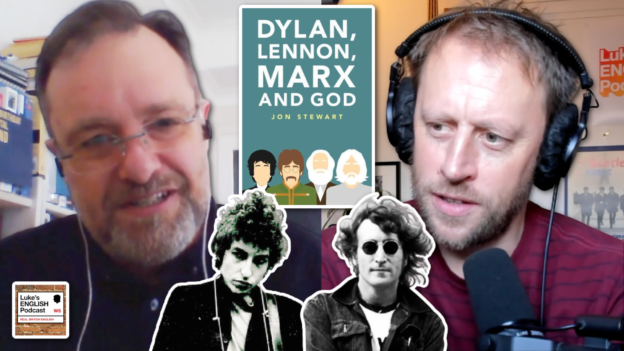
A conversation about two legends of contemporary popular culture – Bob Dylan and John Lennon, with pop-star academic Jon Stewart (guitarist in The Wedding Present and Sleeper).
Jon Stewart is an interesting mix. He is both a university lecturer and a pop star. He runs a Masters Degree course in Music Business and Popular Music Practice at the BIMM Institute in London, and he also plays guitar for legendary British band The Wedding Present, AND classic ‘Britpop’ band Sleeper.
So, Jon knows all about the music business from both a personal and academic point of view. In this conversation I ask Jon about his new book “Dylan, Lennon, Marx and God” which is an amazing dual-biography of John Lennon and Bob Dylan, two of the most significant figures in contemporary popular culture.
Jon talks about the way Dylan and Lennon used language in their work, the references they make to the culture they grew up in, including their spiritual and political views.
Jon also talks about his time as a musician, including working with Elvis Costello and George Michael, and a funny story about John Lennon’s “Imagine piano”.
I hope you find this conversation as fascinating as I did. If you like it, consider getting a copy of Jon’s book!
Flashback to the 1990s! This is Sleeper on Top of the Pops in 1995. Jon is playing guitar on the left of the stage. Great song!
Santiago has a top job in the English teaching industry. He is the managing director of English teaching at Oxford University Press. But English is not his first language. He learned it as an adult when he moved to London in his twenties. This conversation explores how he progressed in his English learning and in his career, while dealing with daily challenges and failures in English.
The conclusions are that motivation and positivity are vital, you have to keep going through the difficult times, and you can achieve great things in your career in English even if you’re not perfect. This episode should be a boost for the confidence of all English learners! Keep an open mind, keep your eyes on the prize, keep going and your English WILL improve!
The audio version contains extra content, including my thoughts and conclusions after speaking to Santi
Some thoughts about language learning 👇
(To borrow a catchphrase from All Ears English Podcast) “It’s about connection not perfection“.
Use English today – what are you waiting for?
Learning a language can be painful, but we have to persevere. Keep going through the bad times. Good times are just around the corner.
Keep your chin up!
Keep calm and carry on!
Perseverance, positivity, practice.
Exposure is so important for learning English – reading a lot, listening a lot, socialising a lot in English.
Lean into failure, don’t hide from it.
But if you do hide from it, that’s ok – you’re only human.
English is a broad church – there’s a lot of diversity in it.
Your version of English is part of it too, so don’t worry about your accent too much. Work on it, practice being clear, listen & repeat, but at the same time, keep it real – don’t worry if you don’t sound exactly like me. It hasn’t stopped Santi – he’s a success in English and you can do it too.
A bonus mini-ramble about my plans for episode 800 (send me your questions) and why I haven’t done any World Cup episodes yet, but you can listen to me talking about it with Zdenek on his podcast (link available).
In conversation with Mysterious Al, a contemporary artist / street artist from London now living in Melbourne, Australia. The conversation covers Al’s background, how he makes his art, the difference between street art & graffiti, attitudes towards graffiti, how Al needs to use social media (but doesn’t like it!) his recent ghost train exhibition, and more. Al’s Instagram https://www.instagram.com/mysteriousal/ Al’s website https://www.mysterious.alVideo version also available.
Welcome back to the podcast. I hope life is treating you kindly today and that you’re not being rained on, or baked by the sun or stuck in traffic or being chased by a bear or something. If you are being chased by a bear, well done for managing to press play on this episode of the podcast while also attempting to escape, and good luck. Maybe play this episode to the bear and he (or she) will suddenly become absorbed in the fascinating conversation that you’re going to hear in this episode, and then you can become friends with the bear and bond over a mutual love and interest in listening to Luke’s English Podcast. Or just throw your phone at the bear as hard as possible and hope that it just leaves you alone, I don’t know, but good luck with that.
OK, now I’ve got that out of my system, let’s start properly.
Welcome to this episode. This one is a conversation with Mysterious Al.
Mysterious Al is an artist from London, now based in Melbourne, Australia.
Al is known as a street artist. He is also a contemporary artist in the more conventional sense, but he is often been called a street artist.
So we’re talking about art here, contemporary art, but more specifically street art, and street art is similar to graffiti but it’s not exactly the same thing. We’ll discuss that during this conversation (the difference between graffiti and street art) as well as lots of other things.
Al used to live in London and was working there at around the same time as Banksy, who is probably the most well-known name in this particular world. You’ve heard of Banksy, right? Banksy is famous for his stencilled street art in the UK, particularly in London and in Bristol.
So, Al is a contemporary of Banksy and was part of the same scene as him in London..
These days Al still displays art work in outdoor urban areas but he also produces canvases, fine art prints, and NFTs in his studio, which he exhibits and sells privately.
A canvas is a work of art on a canvas, in the traditional way – a wooden frame with some canvas stretched over it, and then a painting is done on that surface and it’s then presented or exhibited in a gallery. So Al does canvases, and also NFTs, which are a fairly new thing. NFTs in the art world are basically original, unique digital art works which can be bought and sold online, but not copied. If you’re not sure what NFTs are, and blockchains and stuff, then listen on because we do explain that stuff.
So these days Al works in his studio in Melbourne creating canvases and NFTs, and putting on interesting exhibitions but he also works with councils and brands, making huge murals for buildings, and various other projects.
Al is an amazing artist, his work is really distinctive, and he’s also just an interesting person to talk to and so I thought it could be fascinating to interview him about his art, the specific ways that he makes it, and generally to make an episode about the issues related to street art, graffiti, and what it’s like to be a working artist today.
I hope you find it interesting and that you are motivated to keep listening.
By the way, this podcast is for adult learners of English around the world. I say that because some people listening to this or watching this might not know that. This is a podcast for people in different countries learning English and who want to listen to natural, authentic conversations as a way of developing their English skills.
This conversation might be a bit difficult sometimes because it’s not graded for a particular English level, but I have made a premium episode series in which I explain a lot of phrases that come up in this conversation. If you listen to that and use the accompanying pdf, it’ll really help you to understand this episode properly and you’ll definitely learn more English vocabulary from it, as well as work on your pronunciation too. So, to get the most from this, you could check out Luke’s English Podcast Premium series P42 and you can get it in your podcast app through Acast+ by signing up at www.teacherluke.co.uk/premium
So, English learners, we’re about to start this episode, but to get your mind in the right space for this, which will help you understand it all a bit better, here are some questions for you to consider.
If you like, you can discuss these questions maybe with your English teacher or conversation partners in English, or just on your own, out loud or in your head.
Some questions for you
We’ll start with graffiti
Do you live in a place where there is graffiti?
Do you see graffiti around you?
What do you think when you see graffiti? How do you feel about it?
Is graffiti a form of art? Or is it a crime? Or both?
What do you think when you see a piece of graffiti in a certain spot which must have been very difficult to reach, like high up on a building, or next to the train tracks?
Who is graffiti for? What’s the purpose of it?
Do you know the names for the different types of graffit or street art?
Tags, Posters (paste up – paper posters which are pasted to walls with paste), Stencils, Stickers (slapped onto walls, signs etc), Murals (large pieces on walls), Blockbuster murals (huge pictures that take up the entire sides of buildings), Wildstyle – which is the large letters and words painted on a wall or train or something in a very stylised way
And other types probably
This conversation is not all about graffiti though, it’s also about art and the life of an artist.
What do you think of the world of art?
The way art is presented to people, and also bought and sold?
There’s the big, famous, expensive pieces, but also plenty of other art which is made and sold every day at much more reasonable prices.
Where should art be exhibited? Just in art galleries? Or other places?
Do you find it interesting to look at art in galleries or do you think they could present art in a different and more exciting way somehow?
What do you think the life of an artist is like?
How do they spend their time?
What are the challenges and the advantages of living as an artist?
How might social media be important for artists today?
Which platforms do you think artists can use?
What might be the good and bad aspects of having to use social media as an artist?
Do you know what NFTs are?
Have you ever heard of NFTs?
What is a block-chain?
How could NFTs and blockchains change the way digital artists sell their work?
I could go on, but I think that’s enough in terms of questions and info to get you in the right headspace for this conversation.
This is a long episode. No need for me to make it even longer here in the introduction, but you know – you can listen to as much or as little of this as you like. You can pause and continue later, and that is the joy (just one of the joys) of podcasting.
Personally, I hope you listen until the end. I’ll have another little word with you then.
So that was Mysterious Al. I really enjoyed catching up with him after not having seen him for over a decade. He’s exactly the same as he used to be which is nice.
You might be thinking – Luke you didn’t ask him about Banksy!
You said that he used to hang around with Banksy in London.
So, has he ever met him and does he know the true identity of Banksy?
Banksy is a fascinating figure and part of the intrigue and mystique is that we don’t know who he is.
I asked Al by email if he has met him and if he can tell us his true identity.
This is his response.
Yes I have met Banksy, a few times. I think everyone who’s been in the London scene a long time would have crossed his path, but nobody would ever give away his identity because it would give away the fun and he’s worked so hard to protect it.
There are various theories about who Banksy is, including that he’s a member of Massive Attack or that he’s one of the founding members of Gorillaz the band, or even that Banksy is not just one person. I guess we will never know, which is all part of the mystique.
Anyway, this episode was not about Banksy, it was about Mysterious Al, and if you are curious about Al’s work, yes you can find him on Instagram, but also his website is a great place to go if you want to find out about exhibitions in Melbourne, and also if you want to buy some of his work. Mysterious.al
That’s it!
Remember, P42 is all about phrases from this conversation – not just language to describe art, but any phrases which I think you might not have noticed, or understood and which could help you push your level of English higher and higher. Check it out at teacherluke.co.uk/premium
Stephen from SEND7 podcast becomes the host to interview me about how I started LEP, the ins and outs of doing this, plus some advantages and challenges for podcasting to learners of English. Video version available.
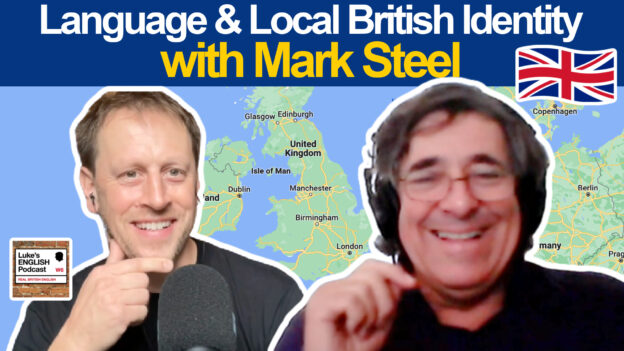
Special Guest Mark Steel joins me to discuss cultural and linguistic differences between the UK and France, plus accents in the UK and a little tour of some places in the UK that you don’t know about. Also includes a discussion of swearing and rude language in Britain. What is the R word which you should never say in a specific part of the UK? Listen on to find out. Video version available.
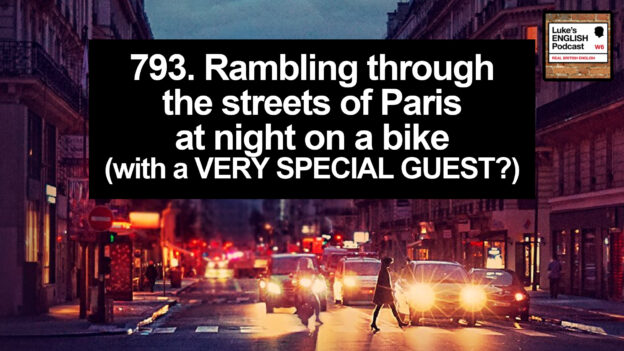
Last week a very special guest visited one of our comedy shows in Paris. I was given a ticket to the show, so I decided to record a podcast while riding through the streets on the way to the show, wondering if I might be able to interview this guest on LEP. Listen to find out what happened, and to hear some rambling and atmospheric sounds of Paris streets at night.
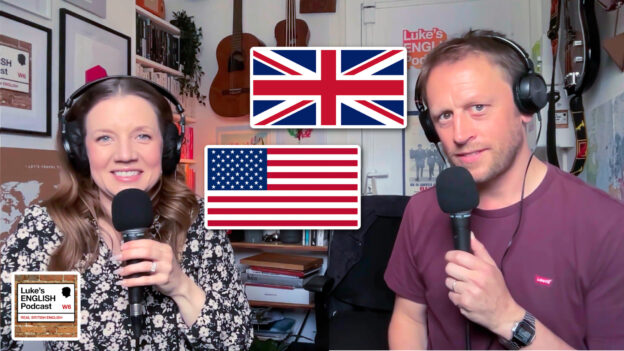
Comparing British and American English vocabulary with a fun online quiz. My guest today is American comedian Sarah Donnelly. Video version (of the conversation) available.
Video Version (images and text on scree, but no intro or ending comments & summary)
Introduction Transcript
Hello dear listeners,
Hello to all LEPsters in LEPland,
How’s your summer going? OK? I’m on holiday at the moment, but I recorded this earlier and I’ve managed to publish it now. That’s clever, isn’t it? Anyway, I hope your summer is going well and if it’s not summer where you are, I hope that your not-summer is also going well.
Welcome back to LEP.
In this episode, Sarah Donnelly is back on the podcast again.
You might remember Sarah from the other times she’s been on the show, if you are a long-term listener.
Sarah Donnelly is from the circle of friends I have here in Paris who all met each other doing stand up comedy, and that includes Amber and Paul, Sebastian Marx, Fred Eyangoh, Molly Martinez, Sarah Toporoff the Paris Quiz Mistress and plenty of others, many of whom have made appearances on this podcast over the years.
Sarah is originally from North Carolina in the USA. She’s been living in Paris exactly the same length of time as me. We both moved here in September 2012 – by coincidence I mean – we didn’t move here together. But when we did meet, we realised we had both moved here at exactly the same time, which is something we have in common.
The return of Sarah on this podcast is long overdue. As a theme for this episode I thought we could explore the topic of American and British English and so you’ll hear us discussing some of the vocabulary differences while doing a fun online quiz.
We start our conversation by referring to the fact that in my podcastle (the building here where I have my pod-room) there are lots of stairs, because I am on the top floor and also there is a shared toilet in the corridor, which is an old fashioned toilet, meaning it is basically a hole in the ground, rather than a thing you sit on. It’s not a sit down toilet, it’s more of a squatting toilet. That’s probably too much information for you, but there it is. I don’t know if it helps for you to know what kind of toilet we have here at the podcastle. Does that help, to know that? Does that help with your English? I’m telling you that to give you context at the start, so you don’t feel lost.
Anyway, it’s fine. The toilet, I mean. It works. It’s ok. But Sarah calls it a Turkish toilet for some reason (maybe that’s an American thing) whereas in the UK we’re more likely to call that kind of toilet a “French campsite toilet”. Anyway, I thought I’d just clarify that before you listen and wonder what’s going on.
After a bit of rambling about toilets, recording podcasts while sitting on the toilet, different types of toilet, old fashioned toilets and so on. After that toilet talk, Sarah and I get into that online quiz about British and American English.
So the main thing here is to compare some vocabulary differences between British and American English. You can learn some different vocab, and also just listen and compare these two varieties of English.
Listen carefully to hear our specific comments and to learn the subtleties of these differences. You’ll know some of them already, because some of these differences are very well known, but I bet there will also be some new things for you to pick up too.
I’ll sum up at the end of the conversation by the way – I’ll quickly summarise the vocab and the differences, and I will also give some comments about whether you should learn British or American English (which variety to choose). You will find notes and a transcript for the intro part and parts of the ending on the page for this episode on my website. You’re welcome.
I don’t need to say much more here, except that there is a video version of this on YouTube with the quiz questions shown on the screen. You could watch that too, but of course on YouTube you don’t get this wonderful introduction that you’re hearing now, or the bit where I ramble at the end. So there. That’s the advantage of being an audio LEPster in audioland (which is the most populated region of LEPland by the way). You get more.
Now, I will let you listen to my conversation with Sarah Donnelly, let you compare some American and British English and I will talk to you again a bit on the other side of this conversation, with a summary and some more comments.
But now, let’s get started…
The BuzzFeed quiz we did in this episode, focusing on British and American English
“I’m 99% Positive We Can Guess If You’re American Or British Based On This Word Test”
But I think a cookie and a biscuit are slightly different. A cookie is bigger and often has chocolate chips in it. Typically American. A biscuit is often smaller and a bit harder or with more crunch to it, and they are usually sold in a tube. Biscuits like that are very popular in the UK and we like to eat them as a snack with a cup of tea or coffee. Popular biscuits are things like the digestive biscuit or rich tea biscuit. In some parts of the USA a biscuit is something else entirely, and is larger and more like a scone (or scone) and is a savoury food eaten with gravy. We don’t have those kinds of biscuit in the UK.
Basically – a cookie is larger and a bit softer and very common in the USA. We have cookies in the UK too, but biscuits are more common.
UK: Petrol
USA: Gas / gasoline
The fuel that we put in our cars. In the UK we call it petrol. In the USA they commonly call it gas or gasoline. They’re wrong. Haha.
UK: Crisps
USA: (Potato) chips
Those snacks made from thin slices of potato which have been roasted and are sold in bags. Those are crisps in the UK and chips in the USA.
But, confusingly, chips in the UK are more like American french fries, but not the same because chips (like with fish and chips) are thicker and chunkier. We have fries in the UK too, but they are thin and the sort of thing you get with a burger at a McDonald’s or something.
Fun fact, french fries originally came from Belgium, so really we should all call them Belgian fries. As far as I know, that is true, but for some reason my spider sense is telling me that right at this moment Jean-Pierre is blowing the dust off his fingers in order to correct me. French people, if I’m wrong about that, feel free to correct me. I’m pretty sure it’s right though.
UK: Flat
USA: Apartment
Generally speaking in the UK we do refer to a home which is part of a larger building, as a flat, although we often use the word apartment too.
The building itself might be a block of flats (especially if it is more modern and contains lots of flats) or a tenement (I think more common in American English and perhaps associated with poorer communities) a condominium is a fairly common word in American English and refers to a block of flats but probably a more expensive one. We also might just say an apartment building.
Of course a house is one single property which has one owner or tenant. A house in the UK can be detached (on its own) semi-detached (with another house attached to it) or terraced (part of a terrace of attached houses in one long row, sometimes the whole street).
The word “home” is just used to refer to a place where someone lives. Anything can be your home – an apartment, a house, a cave, a hole in the ground, a boat, etc…
UK: Sweets
USA: Candy
One thing to note here is that the word “sweets” is plural and countable. So you can have a sweet or some sweets, or “how many sweets?” whereas candy is both countable and uncountable. So you can say “How much candy do you want?” and also “I want some candy” and “Do you want a candy?”.
UK: “The city centre”, the “town centre” or “the centre of town”
USA: Downtown
Downtown can be an adjective “A downtown address” or “in downtown Los Angeles” or an adverb (so you can do something downtown) “I’m going downtown” “An incident happened downtown yesterday”.
Also, that TV show about posh people living in a big house in England with their servants 100 years ago – that’s Downton Abbey and not Downtown Abbey.
UK: The greengrocers / the shop / the local shop
USA: The grocery store
The greengrocers in the UK is a small shop that just sells fruit and vegetables.
For a generic shop that sells lots of things including some fruit and veg maybe, but certainly drinks, snacks, milk, beer, bread etc, a kind of convenience store, we might just call it “the shop” or “the corner shop” or “a convenience store” or a “newsagent” (although that mainly sells newspapers and magazines) or “the local shop”.
A supermarket is a place that sells all kinds of food, including fruit and veg.
UK: Swimming costume
USA: Swimsuit
The clothes you wear when you go swimming. I think British people might also say swimsuit.
Those things that float in the water, probably attached to a rope or cable under the water – perhaps a large plastic ball – that’s a buoy, pronounced “boy” in British English and just pronounced all wrong and weird in American English like “boooeeee”, like David Booooeeee or something.
Bed sheets and stuff
It seems we use more or less the same words for this.
From floor to the top, here are the things on a bed:
The bed frame
The mattress
A fitted sheet which goes over the mattress
You
The top sheet which goes between you and
The duvet, which has a duvet cover on it
Also: a pillow and a pillow case
A blanket might be made of thick wool and could be added on the top to give an extra layer of warmth in the winter or something.
According to Sarah, a comforter in the USA is a kind of duvet that doesn’t have a cover on it.
That’s all I’ll say for that.
UK: a fringe
USA: bangs
In the UK the word fringe is singular. “I was thinking about getting a fringe. Shall I get a fringe? I think I’ll get a fringe.” In the USA “bangs” is a plural word. “I was thinking about getting bangs. Shall I get bangs? I think I’ll get bangs”.
UK: Peppers (red, green, yellow, orange)
USA: Bell peppers
Other vegetable names which are different:
UK: Courgette
USA: Zucchini
UK: Aubergine
USA: Egg plant (again they’re completely wrong on this. Eggs don’t have plants. What are they thinking? Egg plant. Eggs don’t grow on plants, they come out of chickens’ bums.)
UK: Trousers
USA: Pants
This is a well-known one, and I’ve talked about it plenty of times before.
It’s hilarious, isn’t it, because in the UK pants are our underwear. So funny. 😐
UK: The pavement
USA: The sidewalk
This is the place next to the road where pedestrians walk, and where those people on electric scooters endanger everyone’s lives.
Which version of English should I choose? British or American?
To be honest British and American English are not massively different. It’s mainly just little differences that might seem big when you get into very specific situations – especially if you are a British English speaker who goes to live in the USA or vice versa. So, first of all, don’t worry about it too much because the two versions of the language are mostly the same.
But there are differences – certain vocabulary (hopefully episodes like this can help), but also some spelling and grammar differences. There’s another episode for another time – although I did cover some of the pronunciation differences in an early episode 14. English Mania / British and American English
Also, pronunciation. The accents are fairly different and also certain words can be quite different (like buoy, aluminium, and so on).
The more you listen to spoken English from different places, the more you get a sense of the different sounds.
Feel free to choose whichever one that you like.
If you’re going to live in the USA, learning American English would make sense.
If you’re going to most other places where English is spoken including Canada, Australia, Ireland, New Zealand, South Africa, India and other places – British English spelling and grammar standards are used.
But, American English is probably more widespread than British English because there are just more American people in the world (300,000,000 of them) and because the popular culture is everywhere too – films, TV series, music etc.
So, I suppose it’s up to you.
But at the end of the day – the answer is. Learn British English, it’s just better.
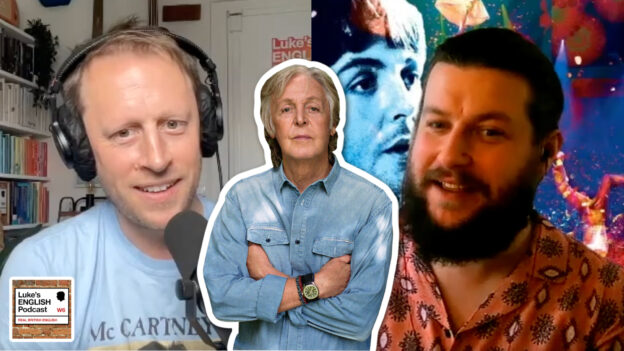
Paul McCartney turned 80 this year, so let’s talk about this legend of British music! In this one, I am joined by Sam Whiles, the host of the Paul or Nothing podcast. Listen to hear an overview of Paul’s career, and some Paul McCartney stories. Video version of the interview available on YouTube.
Video Version (with no introduction or ending ramble from Luke)
Introduction (audio version only)
Hello listeners,
Welcome back to my podcast. I hope you’re doing well. Here is another episode to give you some listening practice. This one features a conversation, at normal speed, about a specific topic relating to British culture.
If you’re looking for lessons from me specifically about language – English vocabulary, grammar and pronunciation practice then check out my premium episodes, and you can sign up to LEP Premium by going to www.teacherluke.co.uk/premium
The premium episodes always involve specific language teaching. These free episodes might have language teaching too, but also they often just feature more conversational content about topics which I hope will be interesting and motivating for you.
So what about this episode?
Paul McCartney – from The Beatles, and Wings – the rock star Paul McCartney (Sir Paul McCartney in fact) – he turned 80 this year and around the time of his birthday earlier this year I received a few messages from listeners asking me to record an episode about him and, of course, as a big Paul McCartney fan I am well up for this. I think it is a great idea.
I did a few episodes last year about John Lennon so it’s only right that I would also do something about Paul McCartney.
So let’s talk about this absolute legend of music, a British national treasure, an international star, one of the most well-known British people in the world with the Queen, and someone who we are lucky to have with us in the world, performing music, releasing new songs and generally entertaining and inspiring us. Let’s talk about Sir Paul McCartney and try to put into words why he is such a beloved and significant figure.
With the John Lennon episodes last year I spoke to Antony Rotunno who has a John Lennon podcast (Glass Onion: On John Lennon), and so for this one I thought I would do a similar thing and interview a Paul McCartney podcaster, and so my guest today is Sam Whiles who hosts the Paul or Nothing Podcast – a podcast dedicated to the life and work of Paul McCartney.
Actually, Sam and Antony already know each other. They did a couple of episodes together for their podcasts a while ago, which I heard and really enjoyed, and Antony said that Sam would be a great guest for my show, so here we go.
I have heard a few episodes of Sam’s podcast and I always enjoy listening to it. Sam is full of enthusiasm, knowledge and passion for his subject. He’s very articulate as you will hear. He uses a wide variety of vocabulary and he has the gift of the gab, which means he can certainly talk and talk, which is what you want from a podcast guest.
But, get ready -because I predict that this one could be a challenge for you (depending on your level of English). By the way, just in case you are listening to this and you’re not familiar with my podcast – my show is for learners of English. I like to present natural conversations and monologues as listening practice for learners of English around the world.
So, for some of my listeners, this episode could be a challenge. I say that because Sam speaks pretty quickly, he has a slight regional accent (and learners of English often find that more difficult) and in our conversation we make references to some things you might not know about – like Paul’s work – the names of albums, the names of songs, the names of projects, the names of other people in Paul’s life, etc. So this one might be a challenge for you for those reasons.
But as usual I really hope you stick with this as, hopefully there will be plenty to learn and enjoy from this chat.
The aims of this conversation are, on the one hand to explain the appeal of Paul McCartney and on the other hand to simply to present an enthusiastic conversation about him.
First you’ll hear me get to know Sam a little bit including where in England he comes from.
Then I ask Sam how he got into The Beatles and why he chose to focus on Paul McCartney in particular for his podcast.
I ask Sam to give us a short history of Paul’s life, which he does with amazing speed. He manages to cram a lot of important moments and events in Paul’s whole life into just a few minutes. It’s a bit of a whirlwind tour of Paul’s career.
We talk about how Paul’s image has changed over the years, why he is now (arguably) more celebrated than at any other time in his life and then we share a few stories and anecdotes about Paul – seeing him perform live, moments when people we know have met him and some of our favourite Paul McCartney stories.
And of course there are some Paul McCartney impressions or caricatures – where we copy Paul’s voice and mannerisms. Long term listeners will know that I just can’t help myself in that department.
There is a video version of this on YouTube as well – just the conversation part with Sam – this wonderful introduction is only available in the audio version, and that’s also true for the bit where I ramble at the end. Those bits are only in this audio version. The video is just the conversation with Sam, and have a look at that because the visual elements might help you and you really need to check out Sam’s shirt and his Zoom background too.
OK, that’s enough of an introduction from me.
Are you ready? Are you ready for some intense listening practice, to meet my wonderful guest Sam Whiles and to learn a thing or two about the living legend that is Paul McCartney? So, here we go!
Listen to the audio version to hear 30 extra minutes of rambling about Paul McCartney…
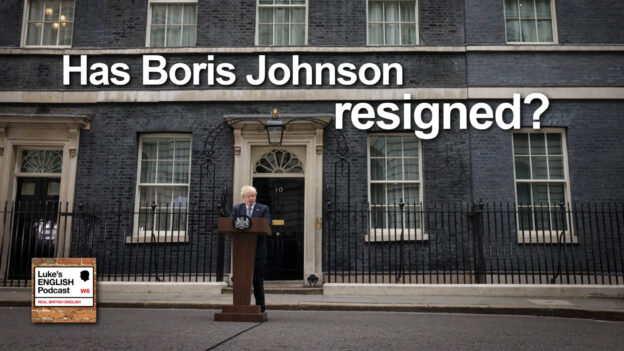
My dad talks about the latest news about Boris Johnson, who on Friday said the UK should now begin the process of finding a new Prime Minister. Why is Johnson going to step down? What scandals has he been involved in during his life? What might happen next? Listen to hear my dad’s comments in plain English.
Hello listeners. It’s new episode time. (applause)
Just before we start, I need to get a message to listeners who are subscribed to LEP Premium through Libsyn.
You’ve heard me say in recent announcements that the podcast has moved to a new host (Acast) and that people who were already subscribed to the premium subscription with the old system (Libsyn) would have to cancel, get a refund from Libsyn and then sign up with Acast. But I need to ask you to wait before doing that! Wait! Hold on! Hold your horses!
Basically – Libsyn premium subscribers – please wait before you cancel and move to the new system. Some of you are saying “but I’ve already done it!” That’s ok.
There’s been a slight problem (a hiuccup) with the process of moving LEP Premium from Libsyn to Acast. I’m working on a solution right now. Everything will be OK, but Libsyn premium subscribers – please wait before cancelling your old premium subscription and moving to Acast+. I will give you instructions as soon as possible about what to do (I’ll record an announcement and I will send you an email)
Some of you have already sent emails to Libsyn and they told you to email me. Again, just wait – I’m working on a solution and I’ll give you more instructions as soon as possible.
If you are not already a premium subscriber – you might want to know that LEP Premium is now available on Acast+. So if you want to get access to over 100 lessons from me about grammar, vocabulary and pronunciation with PDFs to download – go to teacherluke.co.uk/premium and choose the LEP Premium option.
Thanks for listening to that announcement. Now, here’s a Rick Thompson report for you to enjoy, recorded on Monday 11 July 2022.
I’ve got to do a quick intro just to help out the people listening to this who have no idea what’s going on – not generally I mean, but in UK politics. So, a 5-minute intro, then you’ll get your fill of Rick Thompson on Luke’s English Podcast. Here’s the jingle.
Jingle – You’re listening to Luke’s English Podcast. For more information visit teacherluke.co.uk
Hello listeners,
This is episode 777 and it’s a new episode of the Rick Thompson Report.
Just in case you don’t know, The Rick Thompson Report episodes are when I talk to my dad Rick Thompson about what’s been going on in the news, especially UK news and especially UK politics. My dad is a semi-retired journalist, broadcasting consultant and writer. We’re very lucky to have him as a guest on this podcast.
If you’ve seen any news from the UK recently, you’ll have seen that it’s all been about Boris Johnson (for a change). Boris Johnson is the current Prime Minister of the UK. Yes, the one with the funny scruffy blond hair, the badly fitting suits and the look on his face which makes him look like a schoolboy who’s done something wrong. Boris Johnson – our current Prime Minister. The leader of the Conservative Party and the head of the UK government.
Some of you now are thinking “But wait Luke, he’s not the current Prime Minister! Didn’t he resign on Friday?”
Well, yes, he did make a speech on Friday 8 July in which he said he the process to find a new leader of the Conservative Party and Prime Minister of the UK should begin now.
So, it looked like he resigned on Friday – he basically said he would resign when the new leader has been chosen, although he didn’t actually say the word resign in his speech (or the word sorry, or anything like that) so he is still the Prime Minister and he will be until the new one is chosen, which will probably happen in September.
What’s going on?
Why did he say he would step down?
What did he do wrong this time?
What are the events that have led up to this situation?
What might happen next?
And what do we really think of Boris Johnson?
That’s what we’re going to try and deal with in this conversation.
I hope you can follow this.
It’s all a bit complicated. To be honest, while my dad was talking during this conversation, as an English teacher, alarms were going off in my head. I mean, I kept thinking “oh, god, we’re going through a lot of quite specific and complex language here, at a fast pace, and we’re not really stopping to clarify things in the way that I know, as a teacher, that my learners often need to be done.” Maybe I could have interrupted the conversation at various points and added in some explanations, but you know what – that just wasn’t possible this time. Also, my dad was in full flow here, so I decided to just let him rip.
So, as is often the case, I’m just throwing you in at the deep end and playing the conversation for you. Hopefully you’re curious enough about this situation, and that listening to my dad is enjoyable enough, that you feel motivated to stay focused and keep listening. If you can do that, this will definitely help your English.
Perhaps I can make a premium episode explaining a lot of the language in this conversation, but – that might be difficult because I don’t have very much time available to me to do that. At the very least, I will try to add some words and phrases to the website page for this – you would check them if you want to see how certain words are spelled and you can check then in a dictionary if you like.
A lot of our conversation focuses on why Boris is resigning, and that means describing his personality, describing things he has done both as Prime Minister and before, describing the scandals he’s been involved in, and describing the way the UK government works (or doesn’t work in this case) and how leaders are chosen in the UK. Watch out for language relating to those things as well as little idiomatic phrases and so on.
But generally, I hope you can really just get into this subject and try to find out a thing or two about Boris Johnson that you weren’t aware of before. He’s not just a funny looking politician with a sense of humour. There’s more going on than that.
I’ll talk to you again briefly at the end of this, but now, let’s get started.
Sorry – I had no time to write some words and phrases from the conversation here!
What do you think? Leave your comments below.
Cookies on teacherluke.co.uk
Click “Accept All”, to consent to the use of all cookies on this website, or visit "Cookie Settings" to control your consent settings.
This website uses cookies to improve your experience while you navigate through the website. Out of these, the cookies that are categorized as necessary are stored on your browser as they are essential for the working of basic functionalities of the website. We also use third-party cookies that help us analyze and understand how you use this website. These cookies will be stored in your browser only with your consent. You also have the option to opt-out of these cookies. But opting out of some of these cookies may affect your browsing experience.
Necessary cookies are absolutely essential for the website to function properly. These cookies ensure basic functionalities and security features of the website, anonymously.
Cookie
Duration
Description
cookielawinfo-checkbox-analytics
11 months
This cookie is set by GDPR Cookie Consent plugin. The cookie is used to store the user consent for the cookies in the category "Analytics".
cookielawinfo-checkbox-functional
11 months
The cookie is set by GDPR cookie consent to record the user consent for the cookies in the category "Functional".
cookielawinfo-checkbox-necessary
11 months
This cookie is set by GDPR Cookie Consent plugin. The cookies is used to store the user consent for the cookies in the category "Necessary".
cookielawinfo-checkbox-others
11 months
This cookie is set by GDPR Cookie Consent plugin. The cookie is used to store the user consent for the cookies in the category "Other.
cookielawinfo-checkbox-performance
11 months
This cookie is set by GDPR Cookie Consent plugin. The cookie is used to store the user consent for the cookies in the category "Performance".
viewed_cookie_policy
11 months
The cookie is set by the GDPR Cookie Consent plugin and is used to store whether or not user has consented to the use of cookies. It does not store any personal data.
Functional cookies help to perform certain functionalities like sharing the content of the website on social media platforms, collect feedbacks, and other third-party features.
Performance cookies are used to understand and analyze the key performance indexes of the website which helps in delivering a better user experience for the visitors.
Analytical cookies are used to understand how visitors interact with the website. These cookies help provide information on metrics the number of visitors, bounce rate, traffic source, etc.
Advertisement cookies are used to provide visitors with relevant ads and marketing campaigns. These cookies track visitors across websites and collect information to provide customized ads.