This episode is unedited and contains all my pauses, mistakes and thoughts while I attempt to talk about what’s coming up on LEP, my recent appearances on other people’s podcasts, comments and emails of the week and a couple of songs on the guitar.
Do you have any other comments or feedback?: “Please please me” and read this email!
Dear Luke „Because“ I don‘t know if I deleted my first email or if I sent it „Across the universe“ to the other Luke, I decided to write another special one „ From me to you“ „ With a little help from my friends“! I‘ve been listening to your Podcast since February and „Do you want to know a secret“? The „Chains“ are broken, „I‘ve got a feeling“ for the English language and my listening skills are „Getting better“ and better all the time. I listen to LEP „Here, there and everywhere“ „Eight days a week“!Don‘t „Ask me why“ I discovered it so late. With LEP „In my life“ „I feel fine“ every day, especially in these difficult times. „Your mother should know“, that she has an amazing, kind, honest, funny and creative son (her two „Boys“ are so special) and an amazing family! I want to tell you, that LEP is a great „Help“ for English learners! „Yes, it is“! I hope, „It won‘t be long“, till my English is as good as I would like it to be. „Don‘t let me down“ and please keep going in „What you‘re doing“! I send „All my loving“ to you and your family especially your sweet little „Girl“. I wonder if her name is „Michelle“;) Stay healthy, take care and if it is too much loving at „The end“ because we don’t know each other I just say „Good night“! Greetings from Elma
PS. :) I hope, this is not a grammar disaster!! It is not my fault, my friends from Liddypool whispered the words in my ear!;)
Luke’s Reply:
I am the Eng-man! Goo-goo-ga-joob!
Hi Elma,
I love getting emails like this “Any Time At All” because it makes me feel like it’s my “Birthday” or “Something”. I’m “Flying”! I really “Dig It”. “Every Little Thing” in that email is impressive!
Would you mind if I read out the email on the podcast at some point? I’d like to share this with my listeners. I won’t reveal your email address, and If you prefer I can keep your name anonymous, or not – it’s up to you. Some of my listeners don’t want their name to be read out on the podcast for some reason.
Anyway, I should probably “Get Back” to my wife and daughter because “I Don’t Want To Spoil The Party” we are having together this Sunday afternoon.
So, let me say again, “Thank You Girl” for sending your “Words of Love” about my podcast.
More episodes are coming soon, and when you want to listen to something in English, “You Know My Name (Look Up The Number)”.
All the best!
Luke
Another comment of the week from Victoria
This appeared under episode 674 about driving insurance claims and car crashes.
I did some corrections and edits while reading the comment on the podcast. This version is how the comment was originally written.
Really enjoyed this episode! And you singing at the end of episodes is like the cherry on the cake! And as for the topic of the episode… I’ve never been in a car crash myself, though, Ihave a story to tell. It happened about 6 years ago when I was in my second year in college. It was a few minutes after a class started when my friend – Lena – stormed into a classroom and slumped into a chair in front of me. Her winter coat was slightly dirty, her hair was a bit of a mess and her hands were trembling while she was fishing out her textbook and other stuff. Lena is a type of person who always is in a rush and bumps into something. And so knowing that, I didn’t ask her what happened right away. However, as time went on, I noticed that she was rubbing a side of her body and occasionally her knees. My other friend who was sitting right next to me noticed that, too. When we asked Lena what’s wrong she said that a car hit her just a few minutes ago. To say that we were gobsmacked would be an understatement… Her tone of voice was casual and it seemed that she didn’t give much attention to the whole situation. We asked her how she feels and she said that she feels a bit dizzy. My friend and I told her to go to a nurse. But Lena refused and carried on writing in her notebook. We tried several times convince her to go to a nurse but she didn’t want to hear us out, apparently. All this time Lena didn’t stop rubbing some spots on her body… When it was time for a short break we noticed that she was paler than usual. Though, she smiled and chatted with us. She told us that when she was in the middle of a zebra crossing a traffic light changed to red all of a sudden. It was supposed to blink green a few seconds before going red. This traffic light was known for its acting up. She started running towards the other side of a road but was hit by a car. Lena was a lightweight girl. The next thing she registered was that she was laying on a bonnet of that car. Apparently, a driver of the car started pulling off without looking at a zebra crossing so they didn’t notice a rushing pedestrian. Lena hopped off the hood of the car and headed over to a college building. To be honest, I don’t really remember whether the driver got out of the car and offered some help or not. After Lena told us this story she lifted up her sweater slightly and we saw a few forming bruises. Shortly after that she said that she feels worse. In the end, she went to a nurse and then was sent home. She didn’t show up at classes a few weeks after the incident. She got a concussion.
————-
Song Lyrics
For No One by The Beatles (Paul McCartney was the main writer) 1966
Talking to writer and comedian James Harris about life as a writer, going to Oxford Uni, being an international Brit and learning German, French and Chinese as an adult.
Hello folks and welcome to the podcast. I hope you are doing fine on this particular day. This episode features a conversation, recorded a couple of weeks ago now, with a comedian and writer from the UK about various things, as you’ll see. Your task is to follow along and see what you can pick up and what bits of language learning wisdom you can glean from this conversation.
I don’t really know James that well. I’ve only actually met him once in fact.
He’s a comedian and a writer, he speaks several languages and his twitter feed is good value. He tweets about politics, learning languages, the issues of the day, comedy and various other things. We share a mutual friend – that’s Dharmander Singh from Birmingham, who I used to be in a band with and who is now a stand up comedian in Berlin. The time I met James was in Berlin when I was there on holiday, and I did some stand up on the same show as him.
So why have I invited him on the podcast? Well, it’s mainly because of Twitter. As I said his Twitter feed is interesting. He takes a moderate and balanced view of things, and his interests are pretty wide-ranging, including the fact that he’s very international. He’s married to a Chinese girl, he’s lived abroad, he used to work as a tour guide in several countries, he used to be an English teacher like me, he speaks very good German and French, he’s working on his Chinese, he works as a translator and he’s generally an articulate and interesting guy and so I just thought that he could be worth talking on the podcast.
The language learning thing is obviously very appropriate and I’m always interested in finding out as much as possible about how someone has learned a second language to a very decent level in adulthood, and that is something that we talk about for at least 50% of this conversation. The first half of our chat is basically me getting to know James properly, talking about his work, his studies, his experiences of going to Oxford University, why he chose to move to Germany, being married to a Chinese girl. Then we get into the details of how he learned German mainly, but also French and now how he’s working on his Chinese.
No need to say much more except that I hope you manage to follow the conversation clearly all the way through. Let me know how it was for you and I will speak to you again on the other side of this conversation, probably with some background music going over the top.
Long thread about languages (1/24): One of the most frequent ambitions I've seen for people during the lockdown is to learn a foreign language. I'm something of an exception, an Anglophone person who's managed to do this as an adult, and I have some thoughts on the matter.
Thank you to James for being on the podcast today. Look him up online to read some of his stuff, follow him on social media and help him out by keeping him fuelled up on coffee.
Follow James on Twitter @JamesHarrisNow Writing, Mini Screenplays https://shoeleatherexpress.org/ BUY A COFFEE FOR JAMES HARRIS https://t.co/8AAQ6P33wJ?amp=1
So, how are you listeners?
Did you pick up any useful nuggets from that conversation? I think there was some pretty good advice there especially the stuff about reading and noting down certain words, being a bit rigorous about your studying and believing that you can do it, really helps.
Hello and welcome to Luke’s English Podcast. This episode is number 669 and it’s called How To Learn English.
That’s quite a bold title but this really is a lot of what I have to say about learning English. If you really want to learn this language, this is my advice.
I’ve been teaching for about 20 years, podcasting for over 11 years now and I keep finding out more about learning a language through teaching it, getting feedback from listeners and also through my experiences of trying to learn French.
This episode is a distillation of many of my thoughts and advice on how to learn English. It’s not going to cover absolutely every aspect of it, because language learning is a huge subject that encompasses so many different things and you could talk about it all day, but I have decided to talk about learning English, breaking it down into the 4 skills, and giving you as much advice as I can in this single podcast episode. I hope you enjoy it and find it useful.
For those of you who are not so familiar with me and my work. My name is Luke Thompson, I think I am the 4th most famous Luke Thompson in the world. I’m an English teacher, a podcaster, a comedian, a husband and a dad. I am from England but these days I live in France. My podcast is free and is downloaded all over the world. I also have a premium subscription in which I focus specifically on improving your vocab, grammar and pronunciation. To find out more about that go to teacherluke.co.uk/premiuminfo
I expect you want to learn English, right? That’s the main reason you’re listening to this I expect. You want to learn English.
Well, good news! It’s definitely possible. You can learn English and you will if you put in the time and the effort. It’s important to remember that.
What do I mean by “learn English”, though? I mean that you can learn to speak English fluently, clearly and with confidence, expressing yourself with shades of meaning, adapting your English for the situation both in speaking and in writing, knowing and being able to use a wide variety of vocabulary and accurate grammar and ultimately being yourself in the language and developing beneficial relationships with others based on effective communication. Yes, you can. Where there’s a will, there’s a way.
That’s it, just a positive and encouraging message at the start. It’s important to always remember that making progress in your learning is a realistic prospect and will happen when you put in the time and effort, and more good news: the more you enjoy it, the easier it is.
I hope this podcast helps you to enjoy getting English into your life on a regular basis, which is a key part of learning the language effectively.
But what else should you be doing in order to improve your English overall?
In this episode I’d like to talk in some detail about learning English and how you can do it.
This episode is a sort of “come to Jesus moment”, which I feel I should do regularly, just to remind everyone listening that there is a method or approach at work here and that it’s not just you listening to people talking.
A “come to Jesus moment” in the world of business is when someone does a passionate speech or event in which fundamental priorities and/or beliefs are reassessed, or reaffirmed. It’s like when Jesus gathers his disciples around him in order to reaffirm their belief in what he’s preaching or to say some deep stuff which strengthens their faith.
This is a come to Jesus moment for me.
Not that I’m comparing myself to Jesus. No, not at all. Not even a little bit, and anyway that’s not for me to say, that’s for other people to point out isn’t it, not me. Anyway…
I’ve said it before and I’ll say it again. There is a method to the madness.
In my podcast episodes, I’m always teaching you, using my particular set of professional skills, but rather than presenting it all as a lesson I usually try to present it more like a radio show or a comedy show even.
So, amidst the episodes about music, comedy, interviews and so on, I thought it would be worth restating the core values of LEP, which I seem to do about once every 6 months or so.
I’m going to give loads of advice here, and this is all based on what I’ve learned from:
Teaching for about 20 years
Meeting thousands of learners of English, some of them successful, some of them not, working directly with them as their teacher and listening to them talk about their studying habits and experiences
The academic studies I’ve done, especially the DELTA which involved extensive reading and writing on various aspects of how people learn and teach English
Doing my podcast and getting testimonies over the years from many listeners who told me about how they’ve used it to improve their English
There’s also my own personal experience of working on my French
Anyway, the plan is to talk about learning English with a focus on the 4 skills: listening, speaking, reading and writing.
I have talked about these points quite a few times before on this podcast, and have given tons of specific advice about working on your English, including in episodes like 174 (and others)
So I will probably repeat myself a bit. But I still get asked to talk about “how to learn English” very regularly and I think it’s important for me to talk about learning English on this podcast on a regular basis. Obviously, that is what this podcast is about, first and foremost, even though a lot of the time in my episodes you’ll hear me and my guests talking about all sorts of other things.
Learning English is the main aim of this podcast
Essentially the thinking is that you should listen to natural conversation on a variety of topics and it’s simply listening to things in English (not just listening to things about English) that’s going to help you learn this language, especially if you enjoy the content.
I’ll probably talk about this again in a bit, but let’s say that ultimately the plan with the free episodes is to help you listen to English regularly, for longer periods of time, long term. The more, the better. If the content is enjoyable, that should just make it easier for you to achieve that. In fact, if you’re really into what you’re listening to, you don’t really even notice the time passing.
Then there’s the premium content, which is an effort to push your learning beyond the gains you get from all the exposure and input you get from just listening. The premium content is designed to let you get the benefit of my experience and teaching skills in order to cut out a lot of work that you would otherwise have to do yourself, so I can essentially take you by the hand and lead you through some intensive practice to work on your English more directly.
So that’s my content, but let’s talk now about learning English as a whole then.
Learning English is a holistic thing. It encompasses many aspects and skills that are connected as a whole.
There are receptive skills like listening and reading, productive skills like speaking and writing, language systems like grammar, spelling, vocabulary and phonology, social and psychological factors that come into play when we use language when interacting with others, then there are other factors that come into play like identity issues, body language, culture, literature, pragmatics and all sorts of other things. It’s hard to know where to start when talking about it.
You need to learn it to the point where you don’t even think about it any more.
The more you talk and think about it, the more it starts to sound like the force from Star Wars.
Stretch out with your feelings.
Do or do not, there is no try.
Do not think, feel.
Let go, let the English flow through you.
I am your father (oh wait)
It’s about learning how to do something which goes right to the core of who you are in fact.
It’s a holistic thing. It incorporates many aspects as part of a whole process and so it’s quite tricky to know where to start.
Let’s put it like this. Language goes in, and language comes out. (I told you it sounds like The Force)
Language is within you and language is without you. It flows through you. It binds the galaxy together.
There are receptive skills (this is how language goes in)
And there are productive skills (this is how language goes out)
There’s the written language
And there’s the spoken language
This is our system.
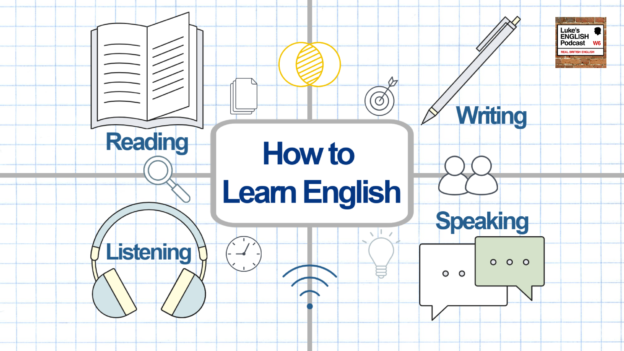
Think of it like a table with two categories on the horizontal axis and two on the vertical axis, so it’s like a grid with 4 squares in it.
On the horizontal access we have receptive and productive skills.
On the vertical we have written and spoken English.
Within the table we have 4 skills – the 4 squares.
So in the box marked “written” and “receptive” we have reading.
Below that in the “spoken” and “receptive” categoriy we have listening.
On the right in the “written” and “productive” side we have writing.
And then in the “spoken” and “productive” side we have speaking.
Those are your four skills. Reading, writing, listening and speaking.
The 4 skills are connected in various ways.
Reading and writing deal with the written word of course.
Reading helps you to write. It helps you to see how the language is built, how words are spelled and how sentences, paragraphs and texts are put together with grammar and textual conventions.
Listening and speaking deal with the spoken word.
Listening helps you to learn how English actually sounds, how words join together in sentences or longer utterances, it helps you get familiar with the speed, rhythm, flow and intonation of the language. It helps you get used to natural pronunciation which in turn helps you produce English in the same way.
Words exist in visual form, and in spoken form.
But reading and listening are connected too because they’re both receptive skills. They provide us with input which is the essential foundation of language learning.
And speaking and writing are connected because they’re productive skills.
These are the skills you need to use when using language for various purposes. This is where you are more active in the sense that you are constructing language and putting it down visually in the form of writing, or using your body to produce it orally.
Let’s talk about those receptive skills and input.
The reading thing there is something we’ll come back to in the section about reading.
This is the academic who is always mentioned in this context, when talking about how to learn English these days. Krashen was one in a long line of linguists who came up with theories about how language is learned and should be taught.
Arguably, we still don’t really know how people learn languages, but various academics over the years have put forward different hypotheses to explain it and these have been the backbone of our understanding of language learning that has informed the way we all learn and teach languages over the years.
Krashen though is the one that people often talk about today, including all the many YouTubers who regularly post videos about the best ways to learn, the only ways to learn, the secrets of learning and all that sort of thing. Krashen is usually brought up because his ideas fit in quite nicely to a model of language learning for today. I mean, it involves a lot of consumption of content in English – plenty of listening and reading and that sort of content is in plentiful supply online, like for example episodes of Luke’s English Podcast.
In his input hypothesis in which he makes the case for the importance of comprehensible input for language learning, he states that in fact the only way we can successfully increase our underlying linguistic competence. This is our system of linguistic knowledge or let’s say that “language instinct” that you have, which even subconsciously gives us a sense of when language is right or wrong. I suppose it could be active in that you know a certain grammar rule and can see when it’s been broken, or passive in that you just feel that something is right or wrong but can’t necessarily explain it.
I would say the passive knowledge is the vital one because ultimately you just want to be able to feel that language is right or wrong without thinking about it.
But that being said, your active knowledge can be really useful when doing things like avoiding common errors as a result of your first language, or consciously pushing yourself to create language which is normal.
Anyway, Krashen says the only way to increase your linguistic competence is through comprehensible input, meaning reading and listening to things that we mostly understand and that with the context of what you do understand, you are able to work out the bits that you don’t know. This is how we acquire new languages.
So basically, we learn a language when we understand it. So, naturally, according to Krashen, the receptive skills come first.
I think this makes a lot of sense to me. I think it’s bound to be true that we learn language by listening to it and reading it. But what about those moments when you have to speak or write, what about learning the grammar and all the rest of it?
Krashen would say that we learn the grammar, vocabulary and pronunciation of a language by listening to it or reading it, and that it’s a natural process and part of how we decode language through comprehensible input.
So, don’t worry about grammar rules and all the rest of it, just listen and do your best to keep up and work out what’s going on, and do it regularly.
Again, I am sure this is true but I also think it’s worth studying the language a bit too, breaking it down a bit, seeing how it works, actively trying to learn more vocabulary, checking up on the rules of grammar and doing some controlled practice. Working on your pronunciation by copying and training your mouth and brain to cooperate with each other, like the way we practise certain movements in sport or musical parts on an instrument.
I do believe that controlled practice and conscious learning like that must also be beneficial because I’ve seen it happen. Doing some active studying can be like a fast track of English learning. It can cut out a lot of time by helping you realise certain things about the language quickly, and I think if you then notice it again while listening and reading that only reinforces what you’ve learned.
Of course, you shouldn’t get blinded by grammar or pronunciation rules and so on, to the point that you can’t see the wood for the trees.
Try not to get hung up on grammar, because it can make you process language in an unnatural and contrived way. It can get stuck in your head and block you a bit. Instead, try to notice patterns and incorporate them into your use of English. Try to see grammar study as a way of confirming things you’ve already noticed, or a way of consulting with a reference book as you also just absorb English more naturally. If you only study English with the grammar, it’s going to be a weird abstract process for learning the language. It’s better to focus on consuming English in the form of messages which you are trying to understand, and then perhaps check your grammar later to straighten things out.
The premium subscription is where I help you with that sort of thing, hopefully combining with the free content to give you all the stuff you need to attack English from several angles.
How can you learn this language if you haven’t heard it and read it a lot?
Read and listen to things that are slightly above your level, so you can understand 60-80%. You need to be able to understand that much for your brain to work out the remaining 20-40% that you don’t know. Meaningful context is vital.
Basically, listen x5 and read x5.
It’s largely a question of finding the right stuff to listen to.
There’s this podcast of course. Others are available.
Watch TV and films with and without subtitles.
Hopefully you’ll find content that you actually want to listen to, not just for studying English. So if you do get addicted to a Netflix series and you can’t wait to find out what happens next, that’s good! That means you will get more comprehensible input and you will be much more focused and involved in it, which is great for your English. Or maybe you want to hear another stupid and funny conversation with my friends just because it makes you laugh and you feel some sort of connection to it. All of that is great because it will help you listen more, listen longer and listen long term.
Reading
This one is also a pleasure to talk about because it’s a pleasure to do and there are lots of great things to read.
Let’s hear from Krashen again as he is the master of the whole input model.
This is again from Wikipedia, which I think is fine usually for the basics like this.
Extensive reading, free reading, book flood, or reading for pleasure is a way of language learning, including foreign language learning, through large amounts of reading. As well as facilitating acquisition of vocabulary, it is believed to increase motivation through positive affective benefits. It is believed that extensive reading is an important factor in education. Proponents such as Stephen Krashen (1989) claim that reading alone will increase encounters with unknown words, bringing learning opportunities by inferencing. The learner’s encounters with unknown words in specific contexts will allow the learner to infer and thus learn those words’ meanings.
Of course that system is disputed because this is the academic arena we’re dealing with and people are always putting forward ideas, defending them, disputing them and so on. It’s how we move forwards and learn about this stuff.
So this is extensive reading which is different to the sort of intensive reading you do in English lessons, where you spend ages on just one page of text, break it down into tiny chunks, understanding every single morsel. With extensive reading it’s all about just getting as much English into your head as you can by reading as much as you can, and you focus on reading enjoyable things, especially stories and you don’t stop too much to analyse the language or even check words, you just keep trying to follow what you’re reading. The more involved in it you are, the better.
Again, this point about input is that it feeds your instinct for the language. You get a subconscious sense of what is right or wrong, which comes in very handy for when you’re doing those nasty sentence transformations and use of English tasks in a Cambridge exam like CAE. What you really want in those situations is to know exactly which preposition or auxiliary verb is missing, or to be able to manipulate sentences in a variety of forms. I reckon it helps to do a bit of language practice as well, with a few controlled exercises but the idea is that it should all go in naturally giving you this sense of language competence.
It’s important though to choose texts which are not too difficult for you. You need to be able to understand enough to be able to get a grip on the rest of the language.
So which books do you choose?
We’ve talked about the importance of choosing stuff that’s interesting to you, that reflects the type of English you might need.
Genre isn’t an issue. People assume you need to read or listen to the news but as we’ve already established they don’t really talk like normal people on the news, and they also write in a certain “newsy” style. Funnily enough it might be more useful to read the tabloid papers as they write in a more conversational style, but I think it’s worthwhile looking beyond the news.
Basically, read whatever you want.
Even comic books or graphic novels as they’re known for adults.
Graphic novels can be brilliant because they support your understanding with the images and often the English is in the form of speech so you learn really directly how to apply that stuff to real life. I love graphic novels in French. It’s my favourite way to work on the language.
You could consider the current bestsellers. If other people like the books then why shouldn’t you? Look in the fiction and non-fiction categories.
Or try graded readers, which are an excellent and underused resource. I really recommend them if you’re not a strong reader. They’re previously published books, and often some of the great classics and modern classics in English, but they’re republished with English that is graded for certain levels. The number of words is reduced, it’s truncated and essentially it’s a way to increase the percentage you do understand, and decrease the amount you don’t understand, getting to that 80/20 spot where you can maximise your language learning.
There are lots of titles to choose from and various publishers. Check these ones out
But your English may well be good enough now to have a go at a book for native speakers. So go for it. You have loads of options. Just make sure you enjoy reading on a regular basis.
I would also add that it’s important to choose texts which are written in modern style and perhaps about an area that you are particularly interested in. Perhaps think of it like this – what is the kind of English you want printed on the back of your head (on the inside)? Odd question, but I mean, what is your target English. Perhaps it’s the involving and descriptive storytelling of fiction, or it’s the matter-of-fact world of non-fiction. I reckon non-fiction is probably better because it reflects the kind of English you are more likely to be writing, especially if it’s things like academic work or reports at work, because they’re all about presenting you with information, data, commenting on what’s going on, describing how to do things and that’s probably the sort of thing you’ll need to use English for, especially in writing.
This might be a bit dry but it will really show you loads of examples of emails with full explanations, so you can read and learn.
David Crystal
The Story of English in 100 Words
Anything by David Crystal is fantastic, but this non-fiction book will teach you the entire story of the English language through 100 words and there are some great words in there like
Loaf, Street, Riddle, Arse, Jail, Wicked, Matrix and Skunk, to name but a few.
So you’re bound to learn tons from that.
Biography
Le Freak: An Upside Down Story of Family, Disco and Destiny By Nile Rodgers
Fiction
The War of the Worlds by HG Wells
The writing is a bit old fashioned. I have to be honest, but it’s mostly modern in style and I think it’s worth it because the story is amazing and it’s not too long. It’s wonderfully descriptive and much better than any movie version could be. Definitely one of my favourite books of all time.
Productive skills / output
This is where we get to the more nebulous world of productive skills. It’s like an alien land where monsters roam, a bit like war of the worlds maybe.
OK I’m exaggerating here but I mean that productive skills are a bit harder to pin down because even more psychological and social factors come into play. You have the public aspect of it, the fact that you’re trying to manipulate the language and get your ideas across in the right way, being coherent and cohesive and in the right style with the right level of politeness with the correct conventional replies and requests and on and on it goes!
Again, I’m making it sound tricky, but I mean that you are involved so much more because you’re making the language and actually using it. This is exciting because you get to express yourself which is the most wonderful and gratifying thing you can do in another language, and when it slides out quite fluidly and you’re not too blocked by who knows what, then it’s all gravy. But sometimes it just doesn’t seem to work out that way and you get mixed up and it doesn’t come out right at all. There’s a sense of performance in productive skills, and a sense that you have to be aware of the right way to conduct yourself, and to be able to utter things in English instantly, following what the other person is saying, it’s all done in a sort of unconscious blur and thinking about grammar in that situation is a killer.
So it’s about getting a level of ease, a level of comfort, a platform from which you can bob and weave your way through the conversation, finding other ways to say things and switching correctly between tenses and situations. I think you get what I mean.
So how do you work on these things?
Ease – a voice, fluency
Control – grammar, vocab, pronunciation
Range – a wide range of language for a wide range of things
Coherence – does it all make sense? Can people follow you easily?
Cohesion – particularly in writing, how does the whole text make sense as a whole?
Social factors – knowing how to put things and how to manage relationships through language
Again, the idea is that this language is just built into you from all that exposure and input.
I would say that there’s a great deal of other stuff you can do to improve your productive skills beyond reading and listening a lot, of course.
In both writing and speaking the first thing to remember is you need to engage in it as much as possible. Real writing and real speaking.
Ultimately this means trying to use language to communicate a message in some way and that’s what you should be focusing on. Meaningful interactions, especially ones in which you have something to offer or something to gain, such as negotiations or even information gap situations in which you’re telling someone something they don’t know. Also social interactions involving being polite or building relations with people. Ultimately, doing it for real is the best workshop in which you can work, rolling with the punches and trying to keep track of what you’re learning.
This is why people learn English best when they’re forced to do it because of their surroundings. They learn by being a waiter in London for a year or working in an office with native speakers, or being plunged into a foreign university for a year, or moving to a new country and having to cope with all the challenges that brings and in a second language. I suppose this is immersion, but it;s more than that. I recommend actually conversing with people to just practise. It’s the 5 Ps.
It’s like going to the gym. Fluency is like physical fitness in your mind and also in your body because you’re using your mouth, your breathing and your head and hands to communicate too.
It applies to writing too. You can observe the way other people write their emails and kind of copy their style, you have to really think about what you’re saying and doubtless you will end up writing emails with requests, with information, with questions and with complaints and so on, so you will have to learn on the job. Being thrown in at the deep end, or if you just have to use English at work it could either be a big stress for you or a huge opportunity to just go for it.
Anyway, let’s talk about specific productive skills – writing and reading, and how to work on them.
Let’s say you’re not actually in a situation where you can talk to people or have correspondence with people, or have to write things which other people will ultimately have to read. Unless you find a tutor on italki for example then that person could be your practice point for speaking and writing, giving you feedback as you go. But let’s say for the purposes of this episode, it’s just you and the English language, facing each other off in a kind of wild west fashion.
How can you practise on your own?
Writing
Obviously you need to write. But what are you going to write and who is going to read it?
Firstly – just write, write regularly, write meaningfully and write with a reader in mind, even if nobody reads it. This is important because it will help you get used to simply putting your ideas into words. It’s a creative process and also a mechanical process to an extent. Building sentences is a sort of art or a craft. You have to practise it in order to get some level of comfort with it. Let’s imagine there’s a muscle in your head (this is not scientific at all) which, if you never exercise it, will be quite weak and underdeveloped. But if you exercise that muscle regularly it will be strong, reactive and quick. I expect there is a part of the brain responsible for creating written language, and a sub-section for creating written English. Keep that part of your brain fresh by writing English as much as you can. That’s as scientific as I can get here.
So, here are some things you could write
What to write
Anything
A diary
Email an imaginary person (spooky?) or yourself (think outside the box here ok?)
Academic writing – text types
Emails – email types and conventions
Reports – same!
Formal and informal letters – same!
Applications – same same!
Basically – Whatever you have to write, you should try to find some samples of these texts and aim to copy them. Copy the style, the arrangement, the language they use and reproduce it yourself. Texts that you write will invariably be very practical so it’s about reporting information and asking questions. Look at the sample texts and copy them.
It helps if you have a specific workbook. I recommend Email English by Paul Emmerson. It’s a simple workbook that helps you work on almost all those things and I’m not even sponsored by Macmillan or anything, it’s genuinely a great book.
They also have downloadable email writing tasks on the Macmillan website or here
Ideally you’ll have a teacher to proofread your work, correct you and give you feedback.
If this isn’t possible, it’s still a good idea to write.
Other ideas
A diary (just describe things that happened, or make it more personal and really explore your thoughts and feelings. If the words don’t come, just use basic words. If you feel unable to express yourself perfectly, express yourself imperfectly but try to express yourself.
Writing is not just sentences, it’s paragraphs and pages. The thing you are writing will define how you write it. This means – conventions of certain texts, formality level of the language.
Specific exam tasks → IELTS, FCE, CAE, CPE, BEC higher and vantage
These will often push you to learn the conventions of different types of text, so it could be a good idea to take a Cambridge exam if you want to work on your writing.
Vocabulary Notes
You might write some notes on vocab and I would recommend here that you take a more extensive approach to doing this. Don’t just have one word per line. I want to see one word or phrase at the top of the page, and then loads of text underneath full of examples and your own examples with the language. You can then come back and cover up some of the words and try to remember. Alternatively you can use my PDFs with the notes and memory tests if you’re a premium subscriber. Little plug there for my other podcast.
But making more extensive vocabulary notes with plenty of examples means that not only are you recording vocabulary, you’re practising using it in writing too.
Speaking
I mentioned italki before and you can find tutors, teachers and conversation partners there for regular practice and I do recommend doing that.
Otherwise, let’s look at some ways you can work on your speaking other than in actual spoken practice with others. Developing your speaking on your own.
This is quite a tricky thing to do because normally speaking is an instantly interactive form of communication. It also involves a lot of listening and then being able to produce English instantly and without hesitating too much.
It’s also quite physical as it involves using your mouth to produce words and sentences in the right way.
And of course there are all those cultural things to think about too.
But really speaking should just be your attempt to find your own voice in English, with fluency and with a specific tone. Of course it comes through a lot of practice, of having conversations in which you’re not really thinking about what you’re saying on a grammatical level but it’s pouring out of you due to necessity and not being able to really think a lot. Doing that regularly helps your brain map out the extent of the English you have and increase it, keeping it sort of fresh. That’s not scientific but more a metaphor of what I think speaking can do. It activates something in you that you have to maintain and keep active or those parts of the brain go dull.
So practice x5
But with who?
The fact is, it just helps to talk to other people and that’s the best and most basic advice I can give. Outside of that, you have to manipulate your surroundings and use your imagination to practise speaking on your own.
Talking on your own (and even in your head)
This might sound a bit odd, but it’s a surprisingly effective way to activate English that is in your head. You essentially talk to yourself, out loud, in English, describing what’s going on, what you’re doing, what you’re thinking about, say it all in English. Alternatively you can just do it in your own head and just think the sentences. This also keeps that system of language production in your head fresh.
Listen and repeat
You can use certain audio and play a bit, pause, repeat what you heard, rewind, repeat again and keep going until you’ve got it, and then check the transcript or subtitles to see if you’re correct, check any new words and carry on. Always find ways to vocalise the things you are learning and that means saying them out loud even to yourself.
You can also practise different speaking scenarios.
Preparing for a Cambridge exam you can find past papers with speaking part preparation and practise. Find out what’s required in the different parts, watch videos of people taking the speaking part on YouTube, practise answering common questions about yourself, practise speaking on a topic for a minute or two, practise discussing your opinion on the issues of the day. Those are all specific speaking skills that you can practise on your own. I particularly recommend listen and repeat, especially when you have to take quite a long utterance in English, hold it in your head and repeat it like it’s one word? It’s like going to the gym in English. It involves a lot of things: Understanding the clip, identifying the words and grammar, being able to remember it all, being able to produce it in a similar way. That’s a whole punch of different kinds of practice. And if you repeat the sentence straight away, and again, you might notice certain little errors you’re making and correct them. So repeat over and over again, a bit like practising boxing combinations in the ring before the big fight.
In reality, the 4 skills are often mashed up together and you find you are doing things like listening and speaking at the same time, while also taking notes, looking at visuals and so on. It all gets very messy when language is actually applied to real communication in the real world.
A little note about pronunciation and a sort of disclaimer.
The disclaimer
I think there are probably plenty of other things I have not mentioned in this episode, such as not talking about specific memory techniques (done that) or specific features of pronunciation (done that) or exactly how to read a book to learn English (done) or plenty of other things probably. To be honest this is just a podcast episode that I wanted to make about the 4 skills and it expanded into an episode all about learning English as a holistic process.
Anyway, the note about pronunciation
It is worth learning the phonemic script
It is worth getting the sounds app on your phone
It is worth doing drills and practising different features
It’s worth getting a book called Ship or Sheep or other books of that nature.
It’s worth remembering that if you have an accent when you speak that is fine and it’s part of who you are, the main thing is that you speak clearly, not which regional accent you have. Clarity is the thing to achieve. Also, it’s extremely difficult to “lose” your accent in English. Hardly anyone does it. But you can still be fine with your accent. English is quite open like that. Everyone’s welcome.
But there you have it. That was quite a comprehensive look at how I think learning English is best when you combine two things: comprehensible input, and a clever studying routine.
I think it can work wonders for your English.
And that’s what I try to do with this podcast. Give you all the input in the free episodes and then do some more focused studying in the premium content. Hopefully, together those two channels can boost your English to the max.
Thanks for listening.
To sign up to lep premium go to https://www.teacherluke.co.uk/premiuminfo for all the details.
Listen to the audio version of the recent LEP Live Stream on YouTube including an audience Q&A, learning English tips, some crap ‘Dad Jokes’ and 3 songs on the guitar.
Hello dear listeners, how are you? I hope that you are well, wherever you are in the world, whatever you are doing, whatever situation you currently find yourself in at this moment in time.
Because we do often just find ourselves in situations, don’t we? I do, anyway. Oh, I’m living in France, and I’m married and I have a daughter now… wow, how did that happen? Now I’m in a French bakery ordering a baguette. Now I’m walking down the street with the baguette under my arm and I’m stopping to say “Bonjour” to a shop owner that I am on speaking terms with. Not something I really planned to be doing a few years ago before I moved here. That’s just life, isn’t it? Wwe just find ourselves in different situations, unless of course your life only contains moments which you have prepared, expected, planned for and constructed. In which case, congratulations. How did you manage that?
And then last Wednesday I found myself sitting in front of my computer about to start live streaming on YouTube, the tube of you – a tube full of you. I was about to start talking into a camera to who knows how many people, to talk about who knows what. I did it. It went fine, I had lots of fun, it was cool to talk so directly to my listeners (or viewers as they were on Wednesday) – maybe you were there – if you were, then hello! I hope you enjoyed it too… and now, in this episode in fact you can listen to the audio of that recent live stream I did on YouTube. That’s what this episode is.
Obviously, this was a video live stream and I was talking to viewers who could see me and send messages and questions to me via the chat and I was responding to those messages and questions during the live stream and because this was a video live stream, some of this might come across a little bit weirdly in the audio version because you’ll be missing certain visual clues like the expressions on my face, body language, objects I’m showing you on the screen, the text in the chat and so on, but if you prefer to consume your LEP content with your ears rather than your eyes, then here is the audio track of the live stream for your listening pleasure, and I hope it is pleasant to listen to, even if it is a bit different to a normal audio episode.
The experience of doing YouTube lives is a bit odd for me because it’s hard to do anything other than respond to the comments coming in from the chat, which is different to the way I usually record audio episodes, because normally I get to prepare myself more in advance and I know that people aren’t watching me, and it’s not live so I can edit afterwards, in case I say something that, on reflction, I probably shouldn’t say, and that sort of thing. This means that doing live videos is a bit intense, it’s quite hard to think straight and I found myself saying stuff off the top of my head that I might not have said if I had had time to really think about it. But I did find it fun. It’s just a bit different and takes some getting used to.
You’ll hear me jump from one topic to the next quite quickly. Some of the questions that came in were quite serious, and others were a bit more silly. Also, I sang 3 songs. You can find links to the lyrics to those songs on the page for this episode on my website. There are some crap jokes and In terms of the other stuff it’s a mix of questions related to learning English, some fairly personal questions, slightly bizarre questions and some funny questions.
Anyway, I will let you discover it for yourself. If you haven’t seen the video and would like to, you’ll see the video embedded on the page for this episode on my website. Also you can see it on my YouTube channel (search for Luke’s English Podcast on YouTube – and subscribe / hit the bell icon to get notified if I do more live streams in the future).
If you watch it on my youtube channel you’ll be able to watch the live comment feed as well, so you can see the comments I was reading at the time. I might upload the video to the LEP App as well, but it’s a large file and so it would be a bit costly for me to do so (I get a certain amount of uploading data per month).
Anyway, enough rambling. I’ll now let you listen to the audio from the slightly chaotic but fun YouTube live stream from last Wednesday, 10 June 2020. I’ll speak to you a bit on the other side of this recording.
_____________
Song Lyrics & Chords
Walk On By (Dionne Warwick) https://tabs.ultimate-guitar.com/tab/dionne-warwick/walk-on-by-chords-848867
Piggy In The Middle (The Rutles) https://genius.com/The-rutles-piggy-in-the-middle-lyrics
I’m Looking Through you (The Beatles) https://genius.com/The-beatles-im-looking-through-you-lyrics
_____________
Ending Transcript
Again, to actually watch that video, go to my youtube channel. You’ll also find various other videos there, including last year’s YouTube live for episode 600, plus some videos of me recording a few other episodes from the archive, including a couple of episodes with Amber & Paul and more…
I had fun with this but, to be honest (and don’t tell YouTube) I still prefer doing normal audio episodes of the podcast. This is what I do. I make audio podcasts. I’ll do more YouTube stuff and live streams in the future, but I’m still going to focus my main energy on these audio episodes. I love doing audio content.
If you’re wondering when the next YouTube live will be. Honestly, I don’t know yet. I might even just randomly go live like I did the week before.
Anyway, if I do another proper live stream I will let you know in advance.
Coming up on the podcast I have some more interview episodes, plus some more episodes with funny stuff like some comedy, plus some more specific content about learning English and plenty of other things.
Thank you to those of you who have sent me messages of encouragement on social media, on my website and by email. It’s great to get your messages, especially when they are basically first hand accounts of how regularly listening to my content has helped with your English. That’s really encouraging. I am always very happy to find out that people enjoy the podcast, but I am especially pleased when people tell me that it has made a genuine difference to their English. I actually find that I am becoming more and more convinced of the value of podcasting for people’s English, so that this is probably the most rewarding teaching experience I have – more rewarding than classroom teaching in many ways.
Anyway, the point is – thank you for your messages and I apologise if I haven’t got back to all of you.
Also, thank you sincerely for donations. You are keeping the project alive.
And thank you to my premium subscribers. I hope you’ve been enjoying the premium content, including P23 which I uploaded recently. I’ve had some great comments about the pronunciation drills in particular recently, proving to me that I am doing the right thing and so I will keep pushing on with that kind of content, so stay tuned for more premium content coming soon, with specific language teaching from me to you.
OK, enough rambling! Thank you for listening and for being a stakeholder in LEP.
This episode features a chinwag (that’s a conversation by the way) with Sebastian Marx – a friend of mine who is originally from New York (he’s an American) but who has been living in France for the last 15 years. Long term listeners might remember him from his past appearances on this podcast. You’ll see links to those episodes on the page for this episode.
Sebastian is a stand up comedian who performs both in English and French, and he was the one who first started doing stand up in English in Paris. So all of us comedians who perform on stage here in English, including Amber, Paul, Sarah Donnelly and others – we all have Sebastian to thank for originally giving us that opportunity as he is the one who got the whole scene started in the first place with the New York Comedy Night which he set up years ago.
I invited Seb onto the podcast just for a bit of a chat, but also to test his knowledge of British English slang. I’m always interested to see how much my American friends know about my version of English.
The Chinwag
In terms of the general chinwag – we talk for the first 25 minutes or so about a few topics, including:
What he thinks of the Trump presidency
His learning of French
Speaking French or English to French people, like waiters in cafes
Then, after about 25 minutes of jibber-jabber, we decide to focus on language and you’ll hear me testing Seb’s knowledge of British English slang – informal spoken English phrases that most Brits know but which Americans are probably unfamiliar with.
This is slang so you should know that things get a bit rude later in the episode with some references to sexual acts – you know, sexual stuff, and also a few other fairly lewd and crude things like bodily functions and so on.
Some of you are probably delighted to hear that and have no problem with it at all but I feel I should give you a heads up about rude content, just in case you’re a teacher listening to this in class or something (I can imagine getting a message from a teacher who’s heard it, or perhaps even having a conversation, like this: Luke, I used an episode of your podcast in my young learners’ class the other day and oh, you started talking about… arseholes and chests, it was quite awkward — Oh dear I’m terribly sorry Mrs Crawly, I should have provided a warning of some kind. I trust that this will not affect my daughter’s entry into the Royal Academy in September. Perhaps you should come for tea and we can discuss it at length. I have one or two things to say to you about your conduct and how this is affecting your reputation among the staff at Downton. Oh, I’m terribly sorry to put you out Lady Crawley… etc… Sorry, I accidentally slipped into an episode of Downton Abbey there. Papa and Mama would be awfully disappointed, and we’ve just received a telegram that the first world war has started and we’re all terribly worried about how this might affect life at Downton and blah blah blah).
I dunno, maybe you’re a teacher or you’re listening to this with children, or maybe you just don’t like rude things of that nature. Basically – there’s some rude stuff in the second half of this episode. Alright? No big deal.
*it’s ok Luke – we fucking love rude stuff, don’t worry*
Alright, steady on…
OK, I promised myself I wouldn’t ramble too much at the start of this one so let’s crack on now, and here is the jingle….
The Slang you can hear in the episode
(listen to hear the full descriptions, examples and American English equivalents)
✔️= Sebastian knew it or guessed it correctly ❌= Sebastian didn’t know it or guessed it wrong
❌“Pants” (adjective) “That film was pants” = not great, rubbish ✔️“Knackered” (adjective”) “I’m absolutely knackered today” = exhausted, really tired / American English equivalent: “beat” ❌”Gobsmacked” (adjective) “I was absolutely gobsmacked” = shocked, surprised Also: “shut your gob” = shut up, stop talking (gob = mouth) ✔️“a slash” (noun) “Hold on, I’m going for a slash” = I’m going to go and urinate ❌“On the lash” (prepositional phrase) “I’m going out on the lash tonight” = to go out drinking alcohol ✔️“To pull” (verb) “Hopefully I’m going to pull” = to score, get lucky, to get laid, to have sex with someone “On the pull” = trying to ‘get lucky’ with someone “To go out on the pull” “To chat someone up” = to talk to someone to make them like you (sexually) to try to pull someone by talking ❌“To get off with someone” (phrasal verb) “I got off with her” = to kiss passionately on the lips (USA: to make out with someone) “To get on with someone” = to have a good relationship with someone, to “hit it off with someone” ✔️“A plonker” (noun) “You are such a plonker” (not a swear word) = an idiot ❌”A tosser” (noun) “Stop being such a tosser” (synonym of “wanker” but less rude) an idiot, a person you don’t like “a wanker” is a mean nasty unpleasant man that you’re angry with “To wank” = to masturbate “Asshole” (US English) “Arsehole” (UK English) ✔️“A fag” (noun) “I’m just having a fag” = a cigarette (in US English it’s a very rude term of abuse meaning a homosexual) ❌“A wind up” (noun) “He’s a wind up merchant” “Is this a wind up?” = a joke, a piss-take, teasing, making fun of someone, playing a trick on someone, a con, a prank, lying to someone as a joke “To wind someone up” = to annoy someone ❌“whingeing / to whinge” (verb) “Stop whingeing! You’re always whingeing.” = to complain, to moan, to whine, in an annoying way ✔️“Smart” (adjective) “You’re looking smart today. What’s the big occasion?” = to be well dressed, to be wearing formal clothing, to look clean and tidy (opposite = casual) (USA: smart = intelligent) ❌“Lush” (adjective) “Oh that’s lush” “Those trainers are lush” “Oh she is lush isn’t she?” = good, attractive (for a person), cool, great, awesome ❌“Grotty” (adjective) “I smoked a cigarette earlier and I’m feeling dead grotty now.” = unpleasant, dirty, feeling a bit unwell or under the weather ❌“Ta” (exclamation) “Could you pass me the sugar? Ta.” = thanks ✔️”A chinwag” (noun) “We’ve had a good chinwag” = conversation ❌“It’s all gone pear shaped” (idiom) “We did a Zoom call but everything went pear shaped because of technical problems” = to go wrong
Schlep (verb – US slang, from Yiddish) to carry something with difficulty, to carry something heavy – “I’ve been schlepping this bag around all day” Schlep (noun – US slang, from Yiddish) a long and arduous journey – “I work on the other side of town and getting there is a real schlep!”
50 British phrases that Americans just don’t understand (MatadorNetwork) https://matadornetwork.com/notebook/50-british-phrases-americans-just-dont-understand/
Ending
Music: Sippin’ Gin by Jim Thompson
Righty-ho, that was Sebastian Marx (thanks Sebastian) and 18 bits of British English slang.
How many did he get right? He predicted 50% I think. Well, out of 18 he identified 7. And my criteria for getting it right was whether he knew the word or phrase already or if he worked it out correctly, first guess, from my example. 7 out of 18. What’s that as a percentage? Some of the mathematicians are already on that, but I need a calculator to work that one out, unless you want to listen to me working that out in my head. Trust me, you don’t want to listen to that. I don’t think I can do it. Anyway, the result is… 38.88888888889 Let’s round that up to 39% which is a clear fail I think everyone can agree.
What does this mean? I’m not sure, except that it proves something about American and British culture and language. Sebastian made the point during the episode and I think I’ve said it before previously, like in that slang game I did with Jennifer from English Across the Pond last year.
Brits are way more familiar with American English than Americans (and of course I mean people from the USA) are with British English because we are exposed to a lot more American culture through TV and film than Americans are exposed to British culture.
America produces tons of TV and film of course and exports a massive amount too, but it doesn’t import as much TV and film as it exports. Basically, most Americans don’t get exposed to that much British English, certainly not the kind of local informal slang stuff that we touched on in this episode. Big surprise eh! Not really! We know this about the USA – big place, quite loud on the world’s stage, exports a lot of stuff, but to a large extent doesn’t look beyond its own borders all that much, relatively speaking. We all knew that though didn’t we!
Anyway, never mind all that geo-political stuff. I just enjoyed chatting with Sebastian in this episode and sharing some of my version of English with him. That is more interesting and fun for me.
What about you? How much of the slang in this episode did you know? I’ve definitely talked about some of those things before, but I bet there were one or two new things in there too. But how much of it did you know and how much did you learn from me in previous episodes? And if you didn’t get it from me, where have you learned British slang? Let us know in the comment section!
Also, feel free to add other bits of British slang that you think is especially, quintessentially British in the comment section.
All the slang I tested Seb on is listed on the page for this episode on the website, so check it out. That’s where you can see specific spellings of words and phrases, and you can check some example sentences and definitions that I’ve given for you.
Talking of British English expressions – I must finish that series I started last autumn – 88 English expressions that will confuse everyone. Remember that? I still have about 25 expressions left to cover I think! I must get round to doing that.
My podcast is a bit like a big, slow moving ship. Sometimes I miss something or forget something and kind of sail past it, but for some reason it’s very hard to stop the ship or turn it round and go back. So, if I don’t do a specific episode I was planning to do at one point, general momentum keeps pushing me forwards and it’s difficult to turn the ship around and go back. I’m not sure why this is.
Stuff to mention at the end
Lovely comments from listeners on the last episode (in different locations like YouTube, website, twitter, email) My wife said that the comments were cute and lovely.
Something evil this way comes… Episode 666 is next.
666 → often described as the number of the beast. The mark of the devil.
Lots of people have been asking if I’m planning anything special for that.
Lots of practical advice and comments about how you can use films and TV series to work on your English. This episode is a recap of some advice in episode 523 with Cara Leopold. Transcript available below.
Have you heard the last episode of this podcast (#659)? I spoke to Cara Leopold about being stuck indoors during the lockdown. Cara is an English teacher who likes to help her students to improve their English with TV series and films and we know that because of the lockdown, loads of people at the moment are watching more TV and films on platforms like Netflix and are probably thinking about how to use those things to learn English.
Cara and I talked about that a bit near the end of the last episode, and we also did a whole episode about it a couple of years ago. That was episode 523, called Tips for Learning English with Films & TV Shows.
I mentioned before that I would sum up the main bits of advice that Cara and I gave in that episode.
So here we are, that’s what I’m going to do now – I’m going to consolidate some advice for learning English with TV series and films.
Then, when I’ve done that I’ll give you some personal recommendations for British TV shows and films that you can watch on Netflix.
Learning English with Films & TV – Summary of Advice Given in Ep.523 + more comments
Time and time again we have heard this advice – “Want to improve your English? Just watch TV series and films in English with English subtitles!”
It seems that people assume that you should just watch TV series in English with English subtitles and you’ll learn English magically as a consequence. People say it all the time, and I do think there is some truth in this. Watching lots of content in English is definitely a good idea, although of course that might not be enough on its own. There are plenty of other things you need to do, including regular speaking practice, writing, plenty of reading, using a systematic approach to learning vocabulary, taking time to understand how grammar works.
I suppose the thing is, there are two approaches that seem to be important in learning a language. One approach involves absorbing loads of English just through reading and listening. This is exposure, or immersion or comprehensible input – whatever you want to call it. You have to see and hear the language a lot if you want to be able to use it properly.
This is input. It is really important to get loads of English into your everyday life. You must regularly connect with English, get exposure to English and immerse yourself in English and binging on TV series is probably a pretty good and usually fun way to do that.
Personally I would say that podcasts are the best way, but whatever floats your boat. Ultimately it’s about finding the thing you really want to do. Obviously if you are a regular listener to my podcast then you might agree with me. But if TV shows and films are your thing then go for it.
The point there is you can get loads of English input from TV series and films in English and there are so many amazing shows and films available to us now. It’s amazing. We are spoiled for choice. Anyway – input is important.
Added to that is the importance of using the language regularly in order to communicate. This is output. So this means doing loads of speaking practice and writing practice in order to develop your ability to express yourself, find your voice, develop genuine fluency without just translating everything in your head. So, plenty of input and output.
I’m being quite general here but anyway, the point is → you’ve got to spend lots of time with the language in both receptive and productive ways.
Then the other approach is to be more systematic and disciplined – examining the language in some way, understanding how the English language is structured both in terms of grammar but also in terms of pronunciation so that you know how English is not only written but also produced orally, how it sounds when people actually speak it which helps you understand native speakers and also how to speak fluently yourself. It also involves using monolingual dictionaries to expand your vocab and investigate words, doing controlled practice for grammar and pronunciation and finding ways to remember vocabulary.
And throughout all of that you need to maintain your motivation, because enjoying the whole process is vital. If you’re motivated, you’re likely to do more, spend more time on the language, remember more things and generally get into a more positive and confident frame of mind about your relationship with English.
Using TV and films seems to fulfil the first category to some extent (input) because it allows you to immerse yourself in English, spend lots of time absorbing the language and it should be motivating because watching TV and films should be enjoyable.
It’s also worth stating that learning English doesn’t have to be a chore. It doesn’t have to be a boring thing that you’re forced to do by other people, like teachers or parents. I suppose people often say “Just watch Netflix in English with English subtitles” and this feels like good news because it means “this doesn’t have to be boring homework! It can be enjoyable if you give it a chance”. So, getting addicted to a TV show in English is a good thing for your English.
But is it just a case of just sitting back and watching all the episodes of Peaky Blinders or any other show that you’re into? What about the other things I just mentioned like speaking practice, writing, pronunciation, studying grammar and vocabulary? Well, it is possible to use TV and films in a more active way in order to achieve some of those things too if you’re willing to do more than just sit back and watch.
So here are some bits of advice which did come up in my conversation with Cara in episode 529 but given again and with a few other comments from me.
Watching to learn English and watching just for pleasure are two different things. Watching in order to learn English might involve thinking outside the box and doing things a bit differently.
Using TV and films for learning English is not just a simple or easy way to learn, despite what people say “Just watch stuff in English and bingo you’ll be a native speaker!” It’s not that simple.
In your first language you might just switch on a film or show and then kind of veg out while watching it – without really concentrating. This probably won’t work in English. Be prepared to focus and perhaps be more active while watching, often that mainly involves using the English subtitles, which are a real advantage.
I do recommend choosing content that gives you the option to have English subtitles. Watching with subtitles in your language can be useful because you can see how things are being translated and you can compare your language with the English you’re hearing, but generally speaking it’s best to operate only in English so I’d recommend that you forget about subtitles in your language, or watching something in your language with English subtitles. Do everything in English. So, put the audio in English and the subtitles in English too.
“So, should I always watch with the English subtitles on?” There are no hard and fast rules about using subtitles. There are advantages and disadvantages to both options.
Using English subtitles can help you understand what you’re hearing, especially when you realise that spoken English and written English can be very different. Subtitles can help bridge the gap between how words and sentences sound, and how they are written. You might hear something and then read the subtitles and kind of go “Ooooh that’s what she said! Ahhhh! That’s it then!” which is a great moment in language learning → that kind of “Oh it’s THAT?” moment when you realise something. But watch out because sometimes the subtitles are slightly different to the speech you’re hearing, because they might have to use fewer words than were spoken in order to actually fit them on the screen. But that only happens occasionally. So, an advantage of subtitles is that they help you bridge the gap between what language sounds like and what it looks like. When you listen without subtitles, you will no-doubt miss a lot of what is being said, without realising you’re missing it.
But be aware that if you only ever watch with subtitles you might not develop real listening skills, because you’re basically just reading while you watch and as we know, in the real world, you don’t get subtitles appearing in the air when people speak, unfortunately (well, yet. I expect eventually you’ll be able to get augmented reality glasses or perhaps some kind of biotech which lets you see simultaneous automatic subtitles when people talk, but not yet… that does sound like something out of an episode of Black Mirror…) Anyway, the point is, there are pros and cons of subtitles and no subtitles so you should have both. Experiment with switching the subtitles on and off while you are watching in order to try to get the best of both worlds.
Watch stuff more than once. You can watch a film or show several times, especially if you enjoy it or already know it. Some films improve with multiple viewings. So, try watching certain films several times, perhaps first with subtitles in your language, then subtitles in English and then in English with no subtitles at all. You will be surprised at how much more you notice, understand and remember after watching things numerous times. You will probably appreciate the show or film on a new level too, if you do this. There’s nothing wrong or weird about watching more than once. Like I said – think outside the box a bit.
If you’re watching a TV show you can alternate between watching episodes with and without subtitles. Perhaps do one episode with subtitles, then the next one without. If you just can’t understand episodes without subtitles, try watching the episode with subtitles first then watch again without subtitles. Again, don’t worry, that’s not a weird thing to do, it’s fine – because I say so. And anyway, like I said before if it is a genuinely good show, you might appreciate it even more the second time you watch it and this can actually raise the quality of your listening practice. There are no rules here. Watching episodes several times is normal and useful.
So, we’ve talked about watching films several times, watching episodes several times, but you don’t have to watch the entire thing again from the start. You could just do it with certain scenes. Watch certain scenes several times, with and without the subtitles.
Test yourself on what you heard and check with the subtitles. You could try watching a scene, then trying to explain what just happened, and what people said. Then watch again with the subtitles in order to check. When you explain what you saw, you can do it out loud, with a friend, or just in writing.
You could keep a sort of viewing diary for films or series. Write down little summaries of scenes, episodes or perhaps whole films (although it’s probably best to do it in smaller chunks) then review the scene you’ve written about by checking with subtitles, and re-write your summary if necessary. This is a good way to flip listening practise into productive practise. Remember, it is worth writing in English even if nobody else reads it. It’s just a good idea to practise producing English regularly. Of course it would be better if you had a language partner, coach or teacher who could check your writing and correct errors. Consider finding one on italki – https://www.teacherluke.co.uk/talk – but doing it on your own is still a good idea.
Search for certain new bits of vocabulary when they come up– using monolingual dictionaries. I recommend using online dictionaries like collinsdictionary.com macmillandicionary.com dictionary.cambridge.org Longman Dictionary of Contemporary English Online https://www.ldoceonline.com/ or https://www.oxfordlearnersdictionaries.com/ They’re all decent dictionaries and you can check words and phrases, see examples and crucially hear how the words are pronounced. It’s worth taking a bit of time to get familiar with how these online dictionaries present information to you. It can pay off massively in your learning. Please resist the temptation to just use google translate to get quick translations into your language. It might be a super-fast solution, but it’s not a healthy thing to do for your English long term. Monolingual dictionaries are amazing and can really help you. So use them.
Don’t worry too much about certain specific cultural details. Sometimes characters will talk about stuff that you just don’t know about. For example when I watch some American shows they refer to places, people, sports or events which I don’t know about and it does mean I get a bit lost sometimes. It’s normal. You could google those things of course if you really need to and learn as you go, or just don’t worry about them too much. It’s worth remembering that it might not be your listening skills that prevent you from understanding. It could be your general knowledge too.
Try transcribing certain scenes – especially if you thought it contained really cool dialogue. Then watch again with the subtitles to check your transcription. (I made that suggestion earlier, but there it is again)
It’s not just a case of what you’re doing while you’re watching. Think about doing things both before and after you watch too. In fact, doing some preparation before you start watching can really help you.
Before you watch a film or TV show, check online reviews or summaries to help prepare yourself. Being prepared can help. If you know the general storyline or tone of the thing you’re watching, it can help to prevent you getting lost. Watch out for spoilers though. Maybe you can search for a spoiler-free review of the thing you’re going to see, this can really help put you in the right place before you actually click PLAY.
Similarly, after you’ve watched you can read online reviews of what you’ve watched. That way you can add some extra reading practice to your listening, and you will be a lot more engaged and invested in what you’re reading. Personally I like to read reviews or re-caps of episodes of shows I’ve watched. It helps me understand what I’ve seen and also I like to read other people’s opinions on episodes. Websites like Den of Geek, Vulture, The Independent or The Guardian often do episode recaps of the big TV shows. Read them! It can also help you to appreciate subtle details that you’ve missed and you’ll pick up bits of English from the articles you’ll read. Go the extra mile. It will pay off for your English later. If you find those online newspaper reviews to be a bit “wordy” and opinionated then consider reading IMDB or Wikipedia plot summaries instead as they are often written in slightly more plain English.
I’d also recommend finding YouTube reviews of the films or series you’ve watched. Just go to YouTube and search for the title of the episode or film you’ve seen plus the word review and see what you get. You’ll find this is a great way to get more effective listening input because you’ll be fully engaged in what you’re listening to. You’ll be on the same page as the person speaking because you will understand all their reference points and you’ll be interacting with their opinions and thoughts a lot more. This is an important part of turning listening input into intake → language that is more likely to stick with you.
Be a little selective in your viewing choices – pick stuff that you’d normally enjoy, and remember that films and TV shows can contain very “mumbly” dialogue, and even just “grunting” during long fight scenes. Try to pick films that are pretty simple and perhaps comedies that focus on the dialogue. Also, as Cara mentioned before, some content is in a certain kind of register that might not be applicable to the English you need to use. Documentaries, for example, feature a different style of English than conversational English that you might hear in content with natural dialogue between people.
Pronunciation & Speaking → There’s the concept of shadowing, which works for a lot of people. This involves basically repeating what you hear. It can be a good way to essentially transcribe orally. I mean, you’re attempting to identify word for word what is being said and to replicate speech patterns. You should also check those useful subtitles to help you identify what you’re getting right and wrong. When you come across words and phrases you don’t know, those are opportunities to expand your vocabulary.
It’s hard to practise your speaking on your own. You can essentially do what you’re doing with writing (like keep a diary, summarise things you’ve seen, give your opinions about what you’ve seen and so on) but just do it with your mouth rather than with your fingers, but speaking works best when you’re speaking to another person. So, you could talk to the person you’re living with if they’re up for it. Otherwise, consider italki again.
I want to mention motivation again, and the importance of enjoying what you’re watching or listening to. If you’re not enjoying something you’re watching you definitely have permission to stop and choose something else instead. It might take a little while to find the right show for you. But don’t force yourself to watch something you don’t like.
Also, I’ve mentioned various things in this episode, like watching scenes or episodes several times, writing things down and then comparing with subtitles, shadowing, writing reviews, and all that stuff. I do think it will help, but I know from experience that most people out there probably won’t bother to do it. That’s up to you. If you don’t take initiative and do some of those things, or at least try them a bit, I suppose you’ll never know how they can help you. If you don’t do anything more than just watch, then fine. Don’t feel bad about it.
Understanding films and TV can be really hard! Don’t worry too much if you don’t understand 100%. Even in our first languages we don’t always understand what’s going on in films. So, don’t beat yourself up if you’re not able to understand it all.
Of course you can always listen to LEP or whatever other listening resource you have that you can mostly understand, but it’s worth pushing yourself sometimes. Hopefully you get that from my episodes because they feature a mix of me speaking on my own which is probably easier to understand, with me speaking to guests which is harder. But hopefully you’ll find that you understand my content enough for language acquisition to happen. What’s my point here? I suppose it’s that you’ve always got episodes of my podcast to listen to, but you should also explore films and TV shows too, and try to do more than just sit back on the sofa in comfort while doing it. Try to be a bit more active if you can.
There is probably a lot of other advice that could be given. If you have other things to add, why not share them in the comment section.
Some Netflix Recommendations for British English
There are loads of great shows in American English of course, but I’m trying to narrow my focus to British English stuff here.
Here are some shows and films in British English which are on Netflix, which I have seen and can recommend.
I’ll mention the title, then talk about the show/film a little bit.
These things are all available on Netflix where I am (France) at the time of recording this (April 2020). You can probably find a lot of them elsewhere too, including on DVD.
Some of these shows you will have seen before, others will be new to you.
I’ll try to mention what kind of English you can hear in these shows, including accents.
TV Series
Black Mirror
Sherlock
The Crown
After Life
Bodyguard
Films
Shaun of the Dead
Hot Fuzz
Lock Stock & Two Smoking Barrels
Snatch
Remains of the Day
Monty Python and the Holy Grail
Monty Python’s “The Life of Brian”
Wallace & Gromit – The Curse of the Were-Rabbit
Stand up Comedy
James Acaster – Repertoire
Greg Davies – You Magnificent Beast
Jimmy Carr – The Best of Ultimate Gold Greatest Hits
Also, check out www.OpenCulture.com and spend some time looking through the long list of free documentaries, TV shows and films there. For example, I found a documentary about Pink Floyd which was really fascinating.
A vocabulary episode with lots of phrases for describing the experience of living in self-isolation. It also includes a bit of a ramble about the situation in the UK, my personal experiences of living in Paris during the lockdown and a song at the end. Vocabulary list & notes available.
Hi everyone, here’s a new episode to keep you company and to help you learn some English that you can use to describe the experience of living in self-isolation. We’ll be looking especially at vocabulary to describe the feelings and emotions that you might be going through during this experience.
Something like 2.5 billion people in the world are in self-isolation at the moment, including me, my wife and our daughter and no doubt many of you too. Not the band.
Some of you out there won’t be in isolation, confined at home or on lockdown, for whatever reason. It depends on the approach that your country is taking to this pandemic.
Maybe you are making personal choices to stay at home even if your government hasn’t imposed it. In the UK for example, the government has only recently imposed it, a week or two late in some people’s opinions. I’m trying not to talk about politics here though, just how it feels to be stuck inside, and as I said – this is mainly a vocabulary episode so I will be talking about expressions like “on lockdown”, “in isolation”, “confinement” and also loads of other things.
In France we are on lockdown and we’re only about a week and a half into it. I’m not sure how long it will go on for. Some people say a couple of weeks, some say it will continue into May, others suggest longer.
If you aren’t sure, being “on lockdown” means being ordered by the government to stay at home for an extended period of time, without a lot of human contact in an attempt to prevent the spread of this virus.
Plenty of countries in the world are on lockdown.
So you might be starved of human contact at this time, or perhaps the opposite. You might be having a bit too much human contact if you are locked up with members of your family, boyfriends, girlfriends, children, flatmates and so on and you’re trying your hardest not to become homicidal under the circumstances.
There are various possibilities in terms of what you might be going through at the moment.
Maybe
You’re just lonely because you’re not used to spending so much time on your own.
You’re frustrated because you can’t stand not being able to do what you want to do (i.e. go out and live normally).
You can’t stand being confined with other people, who you are trying your best to get on with. You might be craving a bit of solitude at this time, just to get away from your family or something.
You are worrying about work.
You are worrying about family and friends who might get the virus, especially those who are in the “at-risk” category (e.g. those with underlying or existing health issues, or elderly people).
Or maybe
You’re strangely enjoying this time.
You are really enjoying having more time to yourself.
You’re managing to do things.
It feels a bit like a stay-at-home holiday, or a “staycation”.
You don’t mind self-isolation. In fact it’s kind of normal for you.
I’m slightly concerned about talking about this, because I am very aware that for some of you out there this is a really hard time and I don’t want to be frivolous about it.
I know that a lot of you are not having a sort of “staycation” (a holiday at home / a vacation in which you stay at home). I mean, this is not a holiday for many of you, but a very difficult and worrying time.
But having said that, I am now going to talk about this a bit.
Here’s the general plan.
In this episode
Teach you some vocabulary to describe isolation, lockdown and the things that might be going through your mind as you experience this – particularly feelings and emotions.
Comment on some recent news about this situation, focusing on the UK mainly again
A couple of corrections from the previous episodes in which I talked about this (651 and 652)
Ramble a little bit about what I’ve been doing these past couple of weeks
1. Vocabulary
I’m not talking about symptoms and health issues. I’ve already done that in episodes 651 and 652.
Basics – Some trending words & phrases
First some basics to describe this situation – words which are trending
Self-isolation To be in self-isolation – “I can’t stand being in self-isolation. It’s doing my head in.” To self isolate – “Boris Jonson has tested positive for COVID-19 and is now self-isolating at home” (more on this later) To isolate yourself (from) – “Those people who are displaying symptoms have been told to stay at home and isolate themselves from other family members.”
Lockdown To be on lockdown – “We are on lockdown. We’ve been on lockdown for a few weeks in Paris.” To be locked down – “Paris is almost completely locked down. You’re only allowed to go out for certain things. You might be stopped by the police and you could face a large fine if you don’t have a written justification for being outside.” The lockdown – “The lockdown is going to last indefinitely”
Confinement To be in confinement – “We’ve been in confinement for nearly 2 weeks now” To be confined at home – “Billions of people around the world are currently confined at home, listening to Luke’s English Podcast and washing their hands.”
Quarantine To be quarantined (keeping a possibly infected person or animal separate from others) “Lots of people have been quarantined at the airport.” To be in quarantine – “They’re currently in quarantine until further notice” To quarantine someone – “If you arrive at immigration, you will be immediately quarantined in an effort to contain the spread of the virus in the country”
Containment To contain the virus – “Visitors to the city have been quarantined in an effort to contain the spread of the virus” The containment of the virus – “We’re confident that the lockdown will result in the containment of the virus.”
Vocabulary to describe this experience – Feelings & Emotions
Words and phrases you might need to talk about what you’re going through (mainly for those of you who are just stuck at home, not the symptoms of the disease)
Bad things
Bad mood / Relationships Bored / boredom
I’m just so bored of being stuck indoors
I’m so sick of this boredom To be at a loose end – “I’m just knocking around the house at a loose end” = bored and with nothing to do Frustrating
It’s frustrating not being able to do what you want to do To be/get frustrated
I’m starting to get frustrated. I need to go outside and get exercise. Depression – “It’s normal to suffer from a bit of depression in conditions like this.” To get depressed – “Try not to get depressed” To feel down – “I must admit I’ve been feeling a bit down today.” It’s getting to me – “It’s getting to me, being locked up. It’s started to get to me.”
It’s starting to get to me To be locked up (with) someone – “I’m not sure I can face being locked up with my family for another 6 weeks!” To irritate someone / To annoy someone / To get on someone’s nerves To be irritating / to be annoying
“Could you use headphones while you’re gaming? It’s just really starting to irritate me.”
“The neighbours have their TV on really loud. It’s so annoying!”
“The sound of them talking is really starting to get on my nerves now” To be at each other’s throats – “They were at each other’s throats after just 3 days!” Familiarity breeds contempt To have enough of someone/something – “I’ve had enough of this. I’m going out.” To be fed up with someone/something – “I’m just so fed up with being stuck indoors all day” To miss people – “I’m missing my friends” To be / To feel cut off (from) someone – “It’s quite hard feeling cut off from my normal circle of friends”
Mental issues / Struggling to deal with the situation I’m struggling to cope = I am finding it difficult to deal with this situation, i.e. I am mentally struggling. I’m feeling upset, emotional, depressed, unable to do anything.
This is like Groundhog Day = A film in which Bill Murray repeats the same day again and again
How am I going to get through this? – to get through something means to progress from start to finish. To be able to move from the start of the experience to the end of the experience without stopping or failing. To get through a tunnel. To get through an experience. To be overwhelmed by fears / doubts / worries – “Try not to let yourself get overwhelmed by fears / doubts / worries” (e.g. about the knock-on effects on the economy, or even more paranoid thoughts about what’s really going on) To get carried away / To let your mind get carried away – “You’re getting carried away. I don’t think things are that bad.” Try not to think too much – “Look, don’t think too much. Try not to think too much. Just take it one day at a time.” To feel paranoid – “I started feeling a bit paranoid the other day when I was outside.” To feel anxious – “It’s easy to feel anxious in this situation” Nervous vs stressed vs annoyed vs angry Try not to worry Don’t panic! Don’t freak out Panic buying – “You see footage on the news of people panic buying toilet roll and pasta. Apparently these are the two most essential things for us. Eating pasta and then wiping our arses when we poo it out.” [?]
Going mad To climb the walls – “My teenage kids are climbing the walls, almost literally” To lose it – “Any more time spent in this room and I’m just going to lose it.” He’s lost it – “Uh oh, Luke’s lost it.” To lose your mind – “I feel like I’m slowly losing my mind.”
Locked in To go stir crazy – “I’m going a bit stir crazy to be honest” = feeling upset, angry, emotional, mad, mentally unwell because you are locked in somewhere, like if you were in prison. (in the 19th century “stir” was a nickname for prison, or specifically Newgate Prison in London, but now it refers to any situation in which you are cooped up)
I’m getting cabin fever To be cooped up = to be locked inside, like you’re a chicken in a chicken coop. “I can’t stand being cooped up all day”. Feeling claustrophobic Feeling trapped To be stuck indoors Stuck (past of stick) To be stuck somewhere – “I’m stuck at home” “They’re stuck in Morocco” “He got stuck in his car for hours” “I was stuck to the TV watching the news for 9 hours.” To be stuck indoors – “I’m stuck indoors and it sucks.”
Others
My hands are chapped – “Have you got any moisturiser? My hands are so chapped from constantly washing them.”
On the front line – to be on the front line means to be doing the hardest and most important work. It was originally used to talk about soldiers in a war, specifically those people who are on the front line of the conflict, facing the enemy and fighting with them directly. This is the first meaning, but these days it is used to refer to the people who are doing the hardest and most important work in any situation.
In the past, working in a language school I have heard people talking about the teachers being the ones who are on the front line, meaning they are the ones who face the clients in the form of students in class, so if the students are unhappy for whatever reason, it’s the teachers who have to deal with that directly, rather than the marketing people, the management, the agents etc.
At the moment this phrase is being used a lot for those people who are working in hospitals, so health workers, doctors, nurses, paramedics and so on. In fact these are the real heroes of the moment.
Any of the negative things I’m mentioning in this episode, including all the boredom, the friction with those you live with, the fears about work, the frustrations and isolation – none of it compares to the struggles, risks and sheer exhaustion of those working on the front line of this situation.
Every evening here in Paris at 8pm people open their windows or go out onto their balconies in order to applaud together as a public display of gratitude for all the health workers who are working on the front line. It’s started happening across the UK as well, and I’m sure it’s the same in many other countries.
And I’d like to echo that. Thank you, if you are a health worker or if you’re involved directly in the fight against this fucking virus. Thank you. (applause)
Oh and by the way, we will beat this. It’s not the end of the world.
Positives
This could be a chance for you to do things Every cloud has a silver lining
Spending a lot more time together Quality time To spend quality time with someone Toreconnect with your family Reconnecting with family To catch up on things
Finally catch up on things you’ve been meaning to do for a while
My friend Vanessa on FB shared this
“Day 9 of lockdown My inner Emily Dickinson is loving this (Emily Dickinson was an American poet who was very withdrawn, introverted and reclusive) I’ve never felt less pressure to go out or accomplish anything. I’m loving the mandated family time. My around-the-world loved ones actually have time to write back to me, quickly! The air quality is the best it’s been in 40 years. There have been no traffic jams, nor annoying honking out my window. The sun shines against a beautiful blue sky. I’m thankful the tragedy of losing someone to covid has not yet become a reality for me. What are you lockdown silver linings? Tell me ⬇️”
Not having to wear a bra to go to work. Lol.
Taking care of your mental health
https://www.mind.org.uk/information-support/coronavirus-and-your-wellbeing/
Try to stay optimistic Focus on the positives
If you’re with other people, just accept that there will be friction. Work on being generous if you can. Keep to a routine Keep active Get as much sunshine and fresh air as possible Keep your mind stimulated Focus on a hobby Meditate Do yoga Play music Read and write Write a diary. Pour out your thoughts into the diary. It can be very rewarding. Cross things off your to-do list To binge watch TV series
To binge listen to podcasts / audiobooks To binge on something To spend time doing something To daydream To let your mind wander
The next episode of Gill’s Book Club:
A Gentleman in Moscow by Amor Towles
Coming in a couple of months I expect
2. Some of the recent news in the UK at the time of recording this
Since I spoke to my Dad in episode 652 and we talked about how the UK government had been pursuing a plan of herd immunity, which basically means → don’t make people stay at home, don’t close restaurants, pubs, gyms and other places (don’t put the country on lockdown) just let everyone get the virus, let every become immune and so what if some people die, at least the economy will be ok.
*I’d like to add a point here after having listened to the recent episode of the Adam Buxton Podcast with Dr Xand Van Tulleken in which they talk about lots of things relating to the situation (I highly recommend it) and I just wanted to add that actually it’s really hard to calculate the human cost of either the coronavirus or the effects of the containment measures. Which will kill more people or cause more suffering? The virus itself or the knock-on effects of all these containment measures and the impact they will have on the economy and also on people’s lives? It’s hard to balance the two things…
Anyway, let’s carry on*
Since then, the government has changed its position and has put the country on lockdown but it was only imposed at the start of this week. Probably a bit late.
I’ll have to talk to my Dad again about this to go into more detail about what’s going on in the UK, although I don’t want to overload you all with coronavirus content.
Also there’s the fact that Prince Charles has tested positive for the coronavirus and today so has Boris Johnson, and you might want to know what I think about those things.
Prince Charles has tested positive for the coronavirus. This doesn’t mean he likes it, it means he’s got it. What do I think? Well, I wish him well of course, like anyone who’s got this. He is in the at-risk category being 71, but apparently his symptoms are fairly mild. I expect he’s got excellent medical care so he’ll probably be alright.
I reckon most people when hearing the news just thought “But what about the Queen, is the Queen OK?” because if the Queen got it that would be very bad news. She’s got good medical care too of course, but still, she’s 93. We know that when The Queen dies it will be so significant that the country will definitely change. It’ll signify the end of an era, there will be national mourning on an unprecedented scale, not necessarily because everyone loves her, but just because she is such a significant figure and one of the only symbols of national unity that we have left. I say national unity, I suppose I mean continuity in the sense that she has been a constant thing for decades, while so many other things have changed and I think the whole of the UK gets some sense of security from that sense of continuity. It’s a complex situation and of course there are various opinions on the monarchy, including many who think that it’s an outdated institution and represents inequality and privilege in society, but still, it’ll be a hugely significant moment when she does die, and the country will grind to a halt (again) for days, with public holidays and various other things happening. So, if she died during this coronavirus lockdown that would be devastating.
And if she got it, died and everyone thought that Charles had given it to her, they’d chop his head off! Obviously they wouldn’t, I’m joking, but let’s just say that the knives would be out (an expression) and it would be extremely bad for his popularity which is already quite shaky. Anyway, this isn’t about the monarchy!
Boris Johnson has tested positive for it too. Apparently he has mild symptoms and is staying at home, working from home. Ironically so does the health secretary Matt Hancock. To be honest, it’s no surprise because until about a week ago the government’s position on this whole thing was to just let everyone get infected, let the population develop herd immunity it’s no big deal really, and if loads of elderly people die and the NHS collapses under the pressure then never mind we’ll just keep calm and carry on.
In fact Boris was bragging only recently during a press-conference about how he had met loads of coronavirus sufferers in hospitals and how he’d shaken their hands and he was shaking everyone’s hands. I expect he is eating his words now. What’s perhaps more serious and shocking is how irresponsible he’s been. Sure, he’s got it now which a) doesn’t help him or the country, or his pregnant girlfriend but also b) he’s possibly spread the virus to loads of other people, potentially thousands (due to the way the virus spreads exponentially) → so congratulations Boris, you have directly helped to make the situation much much worse than it could have been.
Here he is, talking about it in that press conference.
I said that flu was a form of coronavirus. Apparently that’s not true. Coronavirus and flu are totally different, and while flu is a killer, Coronavirus is potentially a much bigger killer, because of the way it spreads.
And for those people out there saying “Flu kills more people per year than Coronavirus, what’s all the fuss about?” here’s a clip of stand up comedian Nico Yearwood talking about it on stage before the lockdown when the comedy clubs were still open.
— Nico Yearwood | Bajan Comedian (@neeksman) March 14, 2020
I accidentally said that we should be washing our hands for 20 minutes. Obviously that was just a slip and I meant to say 20 seconds. (We corrected that in the RT report)
I also said that masks don’t stop you from getting the virus. I realise now that I had almost no actual evidence to back that up. It turns out there are several types of mask and some are more effective at protecting you from this than others.
Disposable face masks vs N95 respirator masks
CNET.com Disposable face masks block large particles from entering your mouth (which I suppose means that small droplets containing the virus might still be able to get in, and anyway you can probably still get infected through the eyes and ears too, potentially – but maybe these disposable masks can help prevent you spreading it around),
So that’s the disposable face masks. Then the more tight-fitting N95 respirator masks are far more effective at shielding you from airborne illnesses. Those are the ones with the filters fitted in the front.
Both of these masks could potentially help protect you from getting a viral infection, but US government officials have emphasized that the American public should not purchase face masks to prevent themselves from getting infected. Instead, only people who are displaying symptoms of coronavirus should wear masks to prevent the spread of the disease to others.
Apparently the N95 masks are much harder to find than the standard disposable ones.
ADDITIONAL (added after recording – this doesn’t appear in the episode)
I have just been sent this video on Twitter. The message is clear. It’s better to be safe than sorry. Masks help to prevent the spread of the virus. They might not be perfect, but they’re better than nothing. In the Czech Republic they seem to have been very successful in containing the spread of the virus.
4. Personal experiences of lockdown / self-isolation with a 2-year-old child
Some details about what we’re doing and some of the challenges we’re facing
France has been on full lockdown for nearly 2 weeks now. Almost everything is closed except certain shops selling “essential items” –> note that the wine shops and cheese shops are very much open in our area :)
My daughter isn’t going to creche so we have to look after her all the time. That’s great but also exhausting. I’m not complaining, we knew what we were doing when we created her, so, you know, it’s our fault. Anyway, the thing is, it takes a lot of time and all that, and my wife and I have work to do but it’s not bad, we divide the day and I look after her in the morning and in the afternoon it’s the other way around.
I still teach classes for the British Council but now they are happening on Zoom – the videoconferencing platform. Actually, Zoom are doing pretty well out of this, aren’t they? I had just a few hours to learn how to use the platform but it’s pretty good. It’s not as good as teaching in real life, but it’s not bad. → Talk a bit about teaching on Zoom.
One thing I thought the other day is that this crisis is going to force us to change and will be a driver of change in various ways. Certainly we’re all becoming a lot more familiar with videoconferencing and I think a lot of employers and employees will realise that working from home is really doable and will become more and more normal.
Let me now talk about going outside and staying indoors. Most of our time is spent indoors of course, but we do go outside from time to time.
Going outside
Feeling a bit guilty and also a bit nervous (don’t want to catch the virus, but don’t want to spread it), but going outside is vital for our mental and physical health.
Strict instructions from the government, which we are trying to comply with.
People are getting pretty angry about this on social media.
Only going outside for a bit of exercise, staying max 1km from our home.
Only ever just one of us, or one of us with our daughter.
We just walk around the block, choosing quiet streets, crossing the road to avoid people etc.
It’s like a ghost town
It’s quite eerie
It’s also quite peaceful and wonderful
Paris is a very beautiful city and usually it’s very busy and stressful. Not at the moment. Well, not busy anyway.
The weather has been fantastic, which makes this much easier to deal with.
But it’s also a dirty place, like most inner-city areas.
Rubbish and also general uncleanliness.
I wonder what condition the place will be in after weeks of this. Are the streets usually this dirty or is it just more obvious now?
Rubbish on the floor, dog poo not cleaned up.
I’m teaching my daughter to count and we often count things we see in the street. She now counts the dog poo. There’s nothing I can do about it. At least she knows she should avoid it. (I’m still not sure if there is a taboo about talking about this in Paris, which would be odd. Surely the taboo would be to let your dog do it and then not clean it up.)
Actually, I think Paris is always like that!
Anyway, let’s not dwell on it too long.
Some shops are open – those ones for essential food, supermarkets, boulangeries (bakeries), cheese shops. Yep, I live in Paris!
Queues are more orderly. There are lines on the ground. People know that they have to stay at least 1m away from each other. There’s more politeness actually.
Not touching anything.
Getting our daughter to run while holding my hand.
Jumping onto manhole covers.
Looking into the windows of guitar shops.
Spotting things in the street and counting them.
Staying in
The main challenge for us is: keeping our daughter busy, keeping up her education (even though she’s just two and 3 months), limiting screen time, maintaining our mental health – I mean just trying to stay in a good mood, getting enough physical exercise for all of us but especially the little one, managing to get work done and also keeping in touch with friends and family. I feel like we’re only partly successful in all areas.
Yoga for kids
Reading, reading, reading
Using a pre-school app on the ipad
Worrying about screen time
Playing games for numbers, colours
Listening to music
Limiting screen time
Speaking a lot more English
Showering together
Washing hands and singing happy birthday to celebrities
Overall → things are really not that bad for us at all. We are incredibly lucky.
For some others this might be an impossible time.
Some people have been laid off
Some people who are self-employed are unable to do their work
Some people will be unable to feed their kids because schools are closed (and they rely on those schools to provide a decent meal once a day)
A lot of people will have lost money
Some people will be worried about loved ones who are in vulnerable positions
And of course some people will be sick with the coronavirus and feeling terrible, wondering if they should go to hospital etc.
A chat with Jessica Beck from the IELTS Energy Podcast about the new computer-based IELTS test, plus some funny stories about doing things for the first time, motivation in language learning, dealing with the stress of public speaking and seeing “The Fonz” on a ski slope. Get a $50 discount on Jessica’s new IELTS online course by going to www.teacherluke.co.uk/3keys
Hello listeners, how are you? I hope you’re alright. How are you all coping? I hope you’re all doing ok out there in podcastland.
Here is a new podcast episode to listen to and this time I am joined by IELTS teacher Jessica Beck who you might know from the IELTS Energy Podcast and All Ears English.
Jessica has been on LEP a couple of times before as you may remember. She is a specialist in IELTS preparation, having taught IELTS courses for many years now both in classrooms and online.
Just in case you don’t know, IELTS stands for the International English Language Testing System. It’s a proficiency test which reveals a person’s English level, and it’s fiendishly difficult, requiring a lot of preparation in order to make sure that you get a result that reflects your English at its best. I recently talked about the speaking part of the test with Keith O’Hare in episode 640.
Jessica recently invited me onto an episode of her podcast – the IELTS Energy Podcast, and we talked about differences between American and British English (because the IELTS test features both versions so it’s interesting to compare them and look at some common vocabulary differences).
That is #850 of The IELTS Energy Podcast, called “What’s a Zebra Crossing? Luke Will Tell You!” There’s a link on the page for this episode if you’d like to hear it.
And now Jessica Beck is back on my podcast again in this episode.
Here’s a little overview of what’s coming up, in order to help you follow the whole thing.
First you will hear some chat about the weather where we live. I’m in Paris and she’s in Portland up in the North West of the USA near Seattle. This smalltalk should give you a chance to get used to the speed of the conversation, before we move on to talk about the computer-based IELTS test.
Planning to take IELTS? You’ll need to prepare properly.
Some of you will be planning to take the IELTS test in the future and you might be wondering about the best way to prepare, especially if you’re studying at home. If that is you, then you could check out the 3 Keys IELTS course which Jessica and the other girls at All Ears English have created. It’s a really solid and complete package which includes pretty much everything you need to get success in this course, including video lessons, test practice and 90 minutes of one-to-one counselling with one of the girls over skype.
I suggest you check out the Personal Coach course for the computer based test. And listeners to my podcast can get a 50$ discount on that, which is nice.
Check out www.teacherluke.co.uk/3keys for all the information. You’ll hear some more details about that later.
So there’s some chat about the weather and then some chat about taking the computer based version of the test, but it’s not all about IELTS. I think we just talk about IELTS for the first 10 minutes in fact and then you will hear us sharing a couple of personal stories about doing things for the first time, one involving the importance of not giving up even when it hurts, and the other story is about how to deal with the stress of public speaking. We reflect on the lessons learned from those experiences and their relevance to the challenge of learning a language.
Also, listening to this you will be able to notice differences between Jessica’s American English and my British English, not necessarily in terms of vocabulary used but more just in terms of our intonation patterns or the tone of our speaking in general. It will probably seem really obvious at the beginning, especially if you are very used to hearing me speak.
Listening back to this conversation myself and during I somehow felt extra British (a bit awkward, perhaps a bit posh and quite wordy) and that Jessica was being extra American (super enthusiastic, energetic, positive). Actually, we end up making fun of each other’s speaking style at one point as we do impressions of each other presenting our podcasts. It’s a bit of a laugh and you should enjoy it.
Anyway, I will now stop rambling now so you can listen to this conversation with Jessica about IELTS and about what we learned from the challenge of doing some things for the first time and I’ll talk to you again briefly at the end of the episode.
Not sure who “Fonzie” is? Have a look… (he’s the guy in the leather jacket on the motorbike)
Ending
Thanks again to Jessica for coming on the podcast again and sharing that story. I can’t believe she saw The Fonz on a ski slope. That doesn’t happen every day, does it?
I’m genuinely curious to see if any of you actually know who The Fonz is. He is mentioned in the film Pulp Fiction, if you remember. The scene in the diner with Samuel L Jackson, Tim Roth, Amanda Plummer and John Travolta. There’s a kind of Mexican stand-off (of course there is, it’s a Quentin Tarantino film!) and if you don’t know what a Mexican stand-off is, it’s when loads of people point guns at each other in a film (and maybe in real life I don’t know).
Anyway, Samuel L Jackson manages to make Amanda Plummer’s character calm down by saying “We’re going to be like 3 little Fonzies here, alright? And what’s Fonzie like?” and she’s like “What? Wh…” “WHAT’S FONZIE LIKE???” “He’s cool.” “That’s right he’s cool. So we’re going to be like three little Fonzies here ok” etc. It’s a memorable moment, if you remember it that is.
Anyway, if you are considering preparing for IELTS and you have, say, 30 or 60 days available ahead of you, then you might consider the 3 Keys IELTS Personal Coach course for the computer test, and if you’re interested go to teacherluke.co.uk/3keys to get a $50 discount.
It’s a tough and weird time, there’s no doubt about it. As I’ve said before, this virus isn’t just a threat to your physical health. Obviously you need to take steps to avoid catching it, but also to avoid spreading it too, but at the same time please do look after your mental health. Keep yourself busy, find a routine in your daily life, do some indoor exercise like Yoga. Read books. Don’t spend the whole day staring at social media or watching 24 hour news. Use this as a chance to get some things done that you’ve been putting off for a while. Keep in touch with friends and family. Just a few ideas. I mean, what do I know? In any case, do take care of yourselves out there and I hope that this podcast can keep you company just a little bit during this weird time.
Talking to my mum about a good book she read recently; a social history about 5 women who had one thing in common – they were all murdered by Jack The Ripper in 1888. Also includes some advice and comments about reading books to learn English.
Hello everyone, How are you doing out there in podcastland, or should I not ask?
We all know that the dreaded coronavirus is making life difficult for everyone and I very much hope that you are basically well and that you’re keeping your spirits up despite the many difficulties that you might be facing during this tricky period. I expect you will either be extremely busy looking after children, or perhaps trying to solve work-related problems, or perhaps you’re growing increasingly bored and lonely if you’re just stuck at home in self-isolation. I am also attempting to adjust to a new routine as we are looking after our daughter, trying to keep her busy, while also trying to get work done. But really, things are not too bad for us at this stage. We’re quite lucky.
I just want to wish everyone all the best and I hope you’re managing to stay positive. I won’t talk a lot more about this situation right now. I’m thinking of doing one or two episodes about self-isolation and associated vocabulary in the coming days or weeks.
In any case, this can be a good opportunity, if you have the time, to focus on things like listening to podcasts or reading books to improve your English and in fact that is what this episode is all about. It’s a podcast conversation with my mum about books, well, about one book in particular.
That’s right, this is the first episode of Gill’s Book Club, which I mentioned on the podcast a while ago, I think in my mum’s episode about Quintessentially British Things from January in which she chose to talk about 3 of her favourite books. I suggested that that might make a good regular feature for episodes of this podcast. Lots of LEPsters agreed and my mum is happy to do it and so here it is. Gill’s Book Club.
The concept is pretty simple. I talk to my mum about books that she has read. She describes them, tells us what they are about and what she found interesting about them. We can also read some samples from the books too if possible.
It could be any book or books she wants → an old favourite, a recent discovery or just something she thinks will be interesting to talk about. Hopefully it will just be a pleasant listening experience for you, but it could also give you some inspiration if you’re looking for a book to read in English.
Briefly, before we start. Here is some advice on how to use these episodes of the podcast.
How to use these episodes of Gill’s Book Club
You can either
a) Just listen to the episode, try to follow what my mum and I are saying and hopefully find it pleasant to listen to without feeling the need to actually read the book being described. As I’ve said before, it is very important and beneficial for your English to listen to things like this on a regular basis, equally it is important to read regularly.
So, your other option could be this:
b) Having heard us talk about this book, you can then get your own copy and then read it yourself. Alternatively you could get the audiobook version.
And perhaps if the particular book we’re talking about isn’t exactly what you’re looking for, listening to my mum talking about reading could just encourage you to read more in English yourself even if it’s not the book we’re describing.
If you do want to read a book to improve your English then I have some advice for you, but I’m going to tell you that advice after you’ve heard my conversation with Mum because I don’t want to go on and on too much here at the start.
So listen all the way until the end of this episode to hear specific advice from me regarding how to choose a book to read in English.
Anyway, let’s now talk to my mum. We decided to talk about just one book in this conversation in order to be able to focus our attention more clearly.
Don’t forget to check the page for this episode on my website, where you will find all the details of the book plus some other notes, transcripts of my intro and ending and so on.
So, without any further ado, let’s talk to my mum.
Ending
OK so there you are, that was the very first episode of Gill’s Book Club. Let us know what you think by leaving your comments in the comment section on my website. You’ll find this episode in the archive, or just click the link in the show notes in your podcasting app.
I said at the beginning that I had a few tips to help you choose a book in English.
I’ve talked about this on the podcast before in quite a lot of detail, but here’s some of my advice just distilled into a few brief points.
Tips for choosing and reading books in English
Choose a book you want to read. You’ve got to be motivated to read the book. Would you choose to read that book in your first language? People often say to me things like this, “I thought of reading Harry Potter, what do you think?” and I ask them if they would read it in their language and they kind of say “No”. I wonder then why they would choose to read it in English. Choose a book that you actually want to read, not only because you think it might be good for your English. Don’t choose to impose a boring and ‘homework-style’ reading experience on yourself. It is possible to read in English for pleasure and improve your language skills as a result.
Pick a book which contains the right kind of language. Pick something modern if possible. Older books (including really popular stuff like Sherlock Holmes Jane Austen and Charles Dickens) tend to be written in a fairly old-fashioned style which can be really difficult for learners of English (and me too – I love Sherlock Holmes but I often struggle to understand what is actually happening because it’s all so dense and detailed). Try to find something in a plain, modern style. Obviously, if point 1 is more important to you (i.e. you just really really want to read that book) then point 2 is less of a concern. Ultimately it’s good to be exposed to all types of English and if you’re motivated that’s the best thing. But to be on the safe side, pick a modern book in plain English. Harry Potter for example is not a bad choice in this case. It’s not perfect, because a lot of the words are made up words in the HP universe, but mostly it is written in a modern way, similar to how people actually speak now. You heard Mum and me mention Bridget Jones’ Diary, which I think would be a great choice actually, because it’s a good book and it’s written in the sort of English that people actually use these days.
Pick a book which you will be able to finish. Finishing a book is great isn’t it? It gives you a sense of success and closure, literally. That’s important! So, consider a shorter book, or even a book which has been graded for your level (Check: Macmillan Readers, Penguin Readers, Pearson English Readers – they all have some excellent books graded for different levels – choose a book you want to read and something appropriate to your level, probably B1 intermediate, B2 upper-intermediate or C1 advanced). Also consider buying the sort of book that is quite easy to read, like a page turner (The Da Vinci Code is an example of a page turner – it’s quite easy to read and you just want to know what happens next. Page turners usually contain mystery, romance or horror). An advantage of page turners is that you can fly through them quite quickly, which is one of your aims – get as much English into your head as possible. A disadvantage of page turners is that they can be a bit meaningless and of poor quality. For example, I found the 5th HP book to be a good example of a page turner. I couldn’t wait to get onto the next page to find out what was going to happen next. I read it incredibly fast, but at the end I realised that nothing really happened in the book. Somehow JK Rowling wrote it so that I felt something interesting was always around the corner, but then when I finished it I realised that it was mostly nothing. Someone dies at the end and that’s it really. But I read it extremely quickly. And that is actually a good thing for learning English. You want something that will allow you to read more and more and more.
So, overall you need to strike a balance between
A book which you want to read
A book which contains the right kind of English (today’s English, basically)
A book which you will be able to read
But the most important one is #1 → Pick a book you want to read, because motivation will carry you through points 2 and 3, and if you enjoy something the language is more likely to stick with you.
You can also choose to stop and check words in a dictionary, note them down, perhaps note the extract in which they appear, or just carry on and focus on continuing the book and only check new words when you think they’re really important. If literally every other word is new to you, then it might be better to choose a graded reader as I said before. In those graded books, the range of vocabulary is narrower and they’re easier to read. And remember, it’s not about being able to understand the most difficult books. It’s about reading as much as possible, as regularly as possible and enjoying the experience.
I think The Five is certainly an interesting sounding book which I can imagine many of you would like. The reviews for it are great. It has a rating of 4.5/5 on Amazon.co.uk. Although the English can be quite dense (which is normal for books like this), it is written in a modern style and there is definitely a lot of vocabulary which you would pick up from it. So if you’d like to learn more about these 5 women and their lives, then get yourself a copy of The Five by Hallie Rubenhold.
It’s available in Kindle version, Audiobook version and normal paperback and hardback versions.
Get a free 30 day trial with Audible.com including a free audiobook of your choice by going to www.audibletrial.teacherluke.com
Basically there are two approaches. Oh, I’ve already mentioned these things. Forgive me now as I repeat myself a bit.
1. Have a dictionary and check words as you discover them, noting little definitions or other things that might help you remember the words, possibly keeping a vocabulary notebook as you go.
2. Just focus on reading for pleasure and try to tolerate or guess the words and phrases you don’t know. Keep going and try not to be distracted by bits you don’t understand. It might make more and more sense as you continue.
I do strongly suggest that you persevere through the first 25% of the book. Often it takes a while to get used to a new book and it might not grab you until you get through a certain number of pages.
Resist the temptation to give up. Keep reading! Don’t stop! Push through the difficult or boring bits. From time to time, stop to think about the book and try to form some opinions on it as you go. What do you think of the characters? What’s actually going on? What is the writer’s point of view? What is this really about? What does the world of the book actually look like, feel like and even smell like? All of that can help you to get into the book more as you read it.
That’s it! Leave your comments below and tell us what you think of Gill’s Book Club.
Luke talks on his own without stopping, restarting or editing, including responses to comments about recent episodes, thoughts on the methodology behind this podcast, some vocabulary teaching, a few songs on the guitar and more. This is no-stress episode, and a chance for me to just check in on you and make sure you’re all doing ok out there in the world! 😉
These are just notes and not a full transcript. Some chunks of target vocabulary are highlighted in bold.
In this episode you’re going to hear me talking on my own, which probably means it’s going to be easier to understand and follow what I’m saying than some of the episodes I’ve uploaded recently, because I’ve uploaded some pretty challenging episodes over the last few weeks and months, and years… I try to mix it up a bit, with some challenging ones and some easier ones. Let’s say the easier ones are when I’m on my own and the more challenging ones are when I’m with other people or when we are breaking down recordings of other people.
But this one is just me, and you, because you’re involved. You’re listening aren’t you?
I hope this will come as something of a relief to you, at least to those of you who are pushing yourselves by listening to my podcast, and who might have quite a tough time understanding the more challenging episodes.
I know that some episodes are difficult to follow sometimes, because of the speed of English you’re hearing from my guests and me, and because we might be talking about subjects that you aren’t so familiar with.
Anyway, no stress today, there’s enough stress in the world. The plan here is just to chat to you, have a good old-fashioned ramble on LEP.
So you can have a bit of a breather today and just enjoy listening to this. And I hope you listen to all of it, from start to the finish. If it makes any difference to you, I will sing you a song or two with my guitar at the end. So if you’d like to hear me singing again, as I do at the end of episodes sometimes, then stick with it and keep listening until the end. Don’t be tempted to skip forward. That’s cheating.
Two words: deferred gratification.
It’s important to have a bit of self-discipline and I’m talking to myself there as much as I’m talking to you.
When I decided to do this episode I thought (and it’s always like this, with these rambling episodes as I’ve come to call them) I decided initially to just talk without preparing anything in advance. Just no pressure, no specific agenda, just speak my mind and try to express the ideas which have been building up in my head since the last time I spoke to you like this.
The idea is that I can keep it authentic, in the moment and I don’t have to spend ages working on it before I even start recording. That’s what I think when I decide to do an episode like this.
But that’s easier said than done, because…. (What happens Luke? How do you end up writing so much in advance?)
Basically: I want to talk with no preparation, but then I have to write some things down or I won’t remember to mention them, but then I end up starting to type out everything in advance.
It’s hard to know when to stop preparing and when to start recording.
So I’ve decided to just get started here without worrying too much about having every single detail prepared in advance.
I know it’s probably not an issue for you, but I’m just giving you bit of insight into what goes through my mind when I prepare and record an episode.
So → No more preparing, it’s time to start talking, which might mean there is some rambling here, which is fine and great.
Episode Aims
The main aim of this episode is to check in on you (make sure you’re doing alright) but not check up on you (to investigate, gather information, spy on someone)
And just chat to you about various things on my mind, things that I think are of interest to you as a member of my audience.
Talk a bit about recent episodes, just to establish where we are.
Give a few bits of news.
Respond to a couple of comments I’ve received
Have a bit of a laugh → just have some fun on the podcast because that is one of my favourite things about doing this. Just messing about and having fun, with no stress involved!
Sing one, two or maybe three songs on the guitar, which I will leave until the end.
As we go through all of this, I am sure that there will be various expressions, vocabulary and other language points that will come up. [A lot of it is highlighted for you here]
When I talk in episodes of this podcast I am sure that some people don’t notice what the method is. Most people like to think there is a specific pedagogical method at work and in my experience it is necessary to tell people (my students for example) exactly what the method is in order to put their minds at rest so they know they’re in safe hands.
What I will say is this – it might not be obvious all the time, but there is method to the madness I can assure you. I’ve been teaching for nearly 20 years now and to an extent I am now just always teaching. I’m always in teaching mode. This means that I’m always thinking about what you while I am talking. I’m always thinking about the listener not because I’m so selfless and wonderful but because I know what I’m doing.
*You don’t need to justify it Luke*
Let’s just say this → Even when it’s not obvious that I am teaching you, I am teaching you. Every minute you listen to this (and indeed most other things you could listen to, but the difference here is that I am doing this specifically for you as a learner of English and even more specifically as a LEPster) … every minute you listen to this is a minute in the bank of your English.
I’ll talk more about methodology and this podcast in a bit. I’m still technically in the introduction here.
I have no idea how long this will take, but it usually takes longer than I expect, so this could easily be two episodes.
But seriously, let’s forget about the clock for a while, ok? Don’t worry about how much time is passing. If you need to stop for some reason, just stop. Your podcasting app will remember where you were when you stopped and you can carry on again when you’re ready.
The main thing is: just listen, just try to follow everything. If you can follow it all without trouble, then fantastic, give yourself a little pat on the back. If you can’t follow it all, just do your best, keep going, don’t give up, rewind and listen to certain bits again if you need to.
And this is where your podcasting app will help once more because you should have those helpful buttons which let you skip back by a few seconds. I use them a lot when I’m listening to podcasts, including ones in French (Any good french podcasts to recommend Luke? I’ll add that to the list for this episode – see below)
You will see various notes on the page for this episode. This is all the stuff I wrote down before recording. It’s not a transcript, but if you hear me saying something and you’re wondering what it is, check out the page and you might see it written there.
I understand that checking a website isn’t all that convenient, even when you have a smartphone to hand.
But anyway, it is there. If you’re listening in an app (including the LEP app) check the show notes → There is a link there that takes you right to the relevant page each time. That’s one of the fastest ways to get straight to the correct page. Otherwise, join the mailing list to have the link sent to your inbox, or just check out the episode archive on teacherluke.co.uk where you can find everything.
Is everyone ok out there? Let’s be honest, this is a pretty crazy time. I hope you’re doing ok. Hang in there, stay positive!
Recent episodes
Ian Moore → It’s interesting that Jack in the comment section mentioned that he found it waaaay easier to understand Ian this time compared to last time. This could well mean that his English listening skills have improved in that period – considering there are about 300 episodes between Ian’s first appearance and his second. So, I’m very happy to hear that, basically.
I’m also happy to have had Ian on the podcast again. He really is a very witty man, not to mention well-dressed. There are a few videos of him online, doing comedy, being interviewed on TV and so on, and he is very good.
Alan Partridge episodes
What doesn’t kill you, makes you stronger. (or so they say)
“You can please some of the people some of the time, all of the people some of the time, but you can’t please all of the people all of the time.”(and you shouldn’t try to) ~originally attributed to John Lydgate and then Abraham Lincoln.
Slightly puzzling stats for the AP episodes. Part 4 and 6 have a similar number of listens, but episode 5 has about 25% fewer listens. What’s that all about?
The Intercultural Communication Dance with Sherwood Fleming → The main point is, focus on the message, not how the message has been delivered to you. I would also add: be thoughtful, be respectful, think about the other person, listen to them and pay attention to them, adapt your style accordingly. Ultimately it comes down to compassion. Be compassionate. Think about the other person, think about their situation, be less self-involved. Thinking about the other person, what they want and what they are really trying to say → this helps a lot. It helps you avoid conflict and it helps to bring more respect to you. In theory.
RecentAmber & PaulEpisodes
It was fantastic to speak to them on the podcast recently. I think it’s best when the three of us have a specific aim for an episode, especially if it is a game of some kind.
Amber had her baby! It’s a girl. Mum and baby are both doing fine. I’m hoping to speak to Amber soon about it, with Paul there too. Congratulations to Amber, her husband, and their little boy who now is the brother to a little baby sister.
Quintessentially British Things
James – A few people going Hmmm. Some saying how fun it is to listen to the two of us, a couple of people saying they found James to be a bit rude because he kept cutting me off. We have a close relationship, but like all brothers we fight sometimes etc… conditions for recording, we both had a lot to say, etc. We mention it at the end of an upcoming episode we’ve done about music.
James’ comment
Hi people, sorry if I came across as rude / impatient. It was late, we were tired, and I’m afraid to say I was very, very drunk. ; )
Ones with Mum and Dad – all positive saying they found them interesting and lovely and I’m lucky to have a family like that, and I am. Episodes of Gill’s Book Club (which it will probably be called) should arrive this year. RT report too, when we feel like it!
A lot of conversations with native speakers at normal speed. What is your method, Luke?
Upcoming music episode with James
Thoughts about the challenge of listening to some of my episodes.
I like to consider the thoughts of my listeners but ultimately I have to go with my gut and use my own judgement
The majority of comments come from LEPsters with pretty good English. So I don’t hear from lower-level listeners so much.
Comments on the website → More people came out of the woodwork and that’s great. I’m not concerned. People need to go out of their way to visit the website, find the episode page, find the comment section, possibly sign into the comment section (Disqus) and write a comment in English. Most people just end up being ninjas often because there are various little barriers in the way. I get it!
People comment in various ways → comment section, email, twitter, facebook, Youtube. The LEPsters’ comments are spread out all over the place. So they’re not all consolidated in one place. Maybe I should just stick to ONE platform, but I think this would ultimately make it more complicated for people to listen.
Premium → I am working on new stuff all the time. I say it’s about grammar, vocab & pron, and it is, but that sounds a bit dry doesn’t it? Remember – it’s still me, I’m still trying to do it in the LEP way, which means I make efforts to keep it entertaining at all times, as well as clear. Upcoming episodes will be about common errors I’ve noticed in comments and emails and things.
You’re reading a book, right? What are you reading?
Name: Miguel
Message: Hello there Luke, it is a great pleasure to be one of your thousands of listeners. Must admit that I am on the ninja´s listener side…Just a quick question, What kind of book would you suggest I should read in order to improve my english comprehension? I am going for the c1 advanced by the way and the big deal for me is the huge amount of sources offered on the Internet…
Thanks in advance my friend, carry on the good work!
Luke’s Reply
To be honest Miguel, you should just pick a book that you really want to read and that you will probably enjoy. You could pick the English version of one of your favourite books or perhaps a book of a film you like.
You can also get graded books at the C1 level, which would also be a good idea.
I’m assuming you mean reading novels rather than grammar/vocab books.
French podcasts (difficult to find the right one for me, I must be quite picky)
Un Cafe Au Lot 7 → Louis Dubourg chats with French stand-up comedians, including some of my friends and acquaintances. Paul is interviewed there, so is Seb Marx and also some other big names like Fary and Gad Elmaleh.
French Voices → Conversations with interesting people with some things to look out for in English at the start)
French Your Way Podcast –> Specifically about teaching us French, making things clear and memorable, correcting certain mistakes, a lot of it is in English. Jessica is on maternity leave, starting in June. She’s probably fully involved with her baby. I hope she comes back soon when she is able to.
This comment is sponsored by LEP Premium – www.teacherluke.co.uk/premium
Message: Hello Luke,
I have been a regular listener of your fantastic podcasts since 2018 and I am the one who requested an episode on the topic of “articles” a couple of weeks ago.
I just finished the fifth episode of this series this morning and I must say that it is the most brilliant episode that you have ever recorded. I didn’t not think you were capable of doing that in 2009 because this requires a lot of experience. I do not know if the Lepsters realize the amount of work that you have performed to complete this series. During the last 20 years, I have often searched for such a lesson focused on the right use of articles but I have never found it. There are so many rules but also exceptions that it drives me nuts. As a neuroradiologist at Lille University hospital, I regularlly write scientific papers on neurovascular diseases in international journals and I am frustrated to systematically see the editorial office of the journal change my sentences by adding or removing articles. I feel more confident now even if it takes a long time to master the correct use of articles.
I don’t know if I have correctly used the articles in this message but I am very happy to get a comprehensive document on this topic.
Thanks a lot Luke and keep it up. You are such a lovely person who is very inspiring to me.
Take care
Xavier
Luke’s response
Oh what a wonderful email, thank you very much Xavier.
Yes, you used all the articles correctly in this email. I’m glad to see my episode has helped you!
I’m also very glad to receive emails such as this, from interesting and intelligent people who actually use my content to actively improve their English. It’s very inspiring.
TRANSCRIPTION PROJECT
This is a community effort in which LEPsters can transcribe episodes of the podcast.
I’ve mentioned it before, now I’m mentioning it again.
Antonio’s comment
The transcription project is one of the most powerful options we have in this podcast.
Since I started learning English, I’ve always heard the same piece of advice from teachers I’ve been listening to, which is: “We must read, listen and write to have better English skills.”
Well, the transcription project is the perfect example and could allow us to reach this goal entirely.
The transcription project does not only involve transcribing but also proofreading episodes. That’s why I created two teams. The Orion team makes the transcriptions, and the Andromeda team proofreads and corrects the texts done by the Orion team.
And I want to tell to people, asking to join the project, that we can fulfil our goals staying in this project longer than one or two episodes. Nobody is going to encourage us or give a hug or give a kiss. Still, the joy of seeing this project growing up and becoming better than when we started participating in it is immense. Staying for an extended period allows you to see your real improvement.
When you proofread the episodes you did one year before, you are going to find a lot of mistakes and misheard words. That means that you can hear sounds and terms you couldn’t hear previously. That also means that you are becoming a better English speaker.
As I’ve often said, the transcription project is a hard task to do, sometimes we can feel bored, but we can not forget why we are doing it and what goal we want to reach. Mastering a language when you don’t live with native speakers is very hard. This project and Luke’s English Podcast episodes allow us to fill the gap. However, we need something more to stay in this project longer. We need to have another goal. A different goal than learning English. A goal which means giving back something to others.
Yes! Learning plus giving back is something much more powerful. We learn English for free, and we transcribe episodes and correct them for free.
Doing that we fulfil another goal: We help everyone coming to LEP to learn faster with our transcripts. The number of them is close to 342. (probably more since this was done – because 618. The Climate Crisis is also finished now and needs to be proofread).
I started my collaboration in 2015, and even if I am not as good an English speaker as I want, I know I am much better than then.
Thanks to people joining the Orion and Andromeda teams, staying with me, and helping me to continue with this project.
I don’t think people realise how important it is to keep listening and coming back to the same material, instead of just moving on to the next thing. Your engagement becomes much deeper and you’re more likely to learn and remember the new words, as well as improve your listening skills. I also really like the fact that it’s collaborative and that the transcription improves over time as more people listen to it – a community effort!
Jurgen Klopp’s response when asked about Coronavirus is absolutely class. This man speaks so much sense, absolutely spot on. 👏 pic.twitter.com/NlfxlNQ9Iu
This website uses cookies to improve your experience while you navigate through the website. Out of these, the cookies that are categorized as necessary are stored on your browser as they are essential for the working of basic functionalities of the website. We also use third-party cookies that help us analyze and understand how you use this website. These cookies will be stored in your browser only with your consent. You also have the option to opt-out of these cookies. But opting out of some of these cookies may affect your browsing experience.
Necessary cookies are absolutely essential for the website to function properly. These cookies ensure basic functionalities and security features of the website, anonymously.
Cookie
Duration
Description
cookielawinfo-checkbox-analytics
11 months
This cookie is set by GDPR Cookie Consent plugin. The cookie is used to store the user consent for the cookies in the category "Analytics".
cookielawinfo-checkbox-functional
11 months
The cookie is set by GDPR cookie consent to record the user consent for the cookies in the category "Functional".
cookielawinfo-checkbox-necessary
11 months
This cookie is set by GDPR Cookie Consent plugin. The cookies is used to store the user consent for the cookies in the category "Necessary".
cookielawinfo-checkbox-others
11 months
This cookie is set by GDPR Cookie Consent plugin. The cookie is used to store the user consent for the cookies in the category "Other.
cookielawinfo-checkbox-performance
11 months
This cookie is set by GDPR Cookie Consent plugin. The cookie is used to store the user consent for the cookies in the category "Performance".
viewed_cookie_policy
11 months
The cookie is set by the GDPR Cookie Consent plugin and is used to store whether or not user has consented to the use of cookies. It does not store any personal data.
Functional cookies help to perform certain functionalities like sharing the content of the website on social media platforms, collect feedbacks, and other third-party features.
Performance cookies are used to understand and analyze the key performance indexes of the website which helps in delivering a better user experience for the visitors.
Analytical cookies are used to understand how visitors interact with the website. These cookies help provide information on metrics the number of visitors, bounce rate, traffic source, etc.
Advertisement cookies are used to provide visitors with relevant ads and marketing campaigns. These cookies track visitors across websites and collect information to provide customized ads.