[974] In this episode I read out lots of haiku poems, explain their meaning, discuss what they make me think and feel, and use them to teach you some vocabulary. The haikus I read include some traditional Japanese ones translated into English, plus more modern ones written in English by writers from around the world. Some of these haikus are meditative, some are sad, some are funny and some find a way to capture feelings that are otherwise difficult to put into words.
[964] You get double content this week as the audio and video episodes are different. In the audio episode you can join me at home, as I stay cosy, lie on the floor in a shaft of warm sunlight, and ramble about robberies, the Louvre and plenty more. In the video episode, it is time for another walk and talk. This time I am on a mission in one of Paris’s loveliest neighbourhoods, with a range of mission objectives to keep things exciting. Get both audio and video episodes here.
A spontaneous monologue about being taken by surprise by public holidays in May (in France), a podcast recommendation, and seeing a hard-rocking and hilarious band perform live in a big arena last week. Includes a song at the end as a tribute.
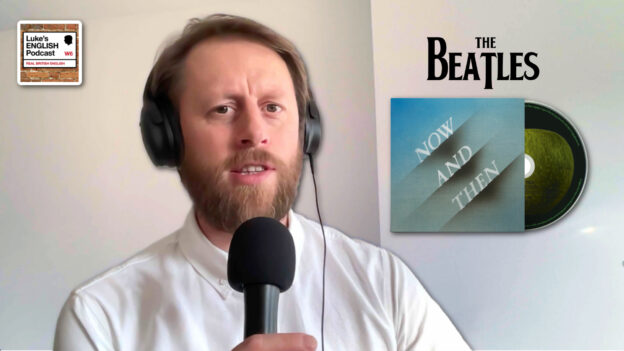
A listener left a comment on my website asking for my thoughts on the new Beatles song which was released last week, and I was happy to ramble about it for 45 mins. Listen to hear me give my thoughts and tell several stories related to what is being described as “the last Beatles song”. First I talk for about 10 minutes about burning down my apartment and my thoughts on the content I make for this podcast, and then I start talking about The Beatles until the end of the episode. To skip straight to the Beatles bit, go forward to about 12 minutes into the episode.
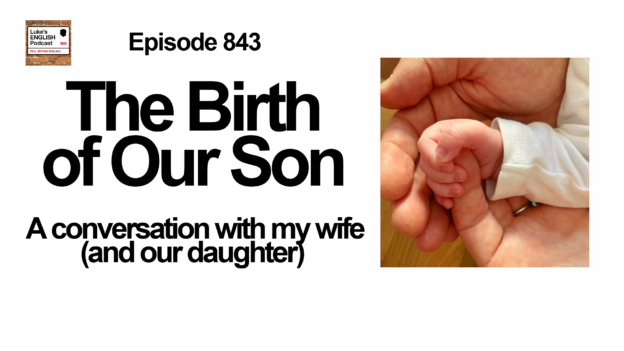
Talking to my wife (and daughter) about the birth of our son, who came into the world just a few weeks ago. We describe what happened, and explain how it feels to become parents for the second time. This is a very personal, first-hand account of childbirth and the experience of bringing a child into the world. Watch out for the language of childbirth and children which has previously been explained in episodes 162, 491, 492 and 814.
Hang out with me for an unscripted and unedited ramble about things like engaging moments while English teaching, how it feels to be about to become a father again, a funny new recording of my daughter speaking English, some recent films I’ve seen, and a recording of me doing stand-up comedy in front of an audience recently.
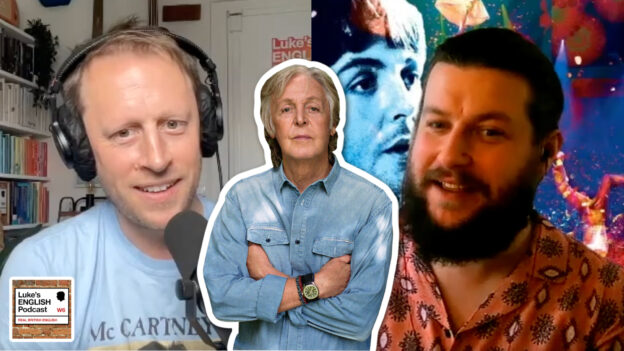
Paul McCartney turned 80 this year, so let’s talk about this legend of British music! In this one, I am joined by Sam Whiles, the host of the Paul or Nothing podcast. Listen to hear an overview of Paul’s career, and some Paul McCartney stories. Video version of the interview available on YouTube.
Video Version (with no introduction or ending ramble from Luke)
Introduction (audio version only)
Hello listeners,
Welcome back to my podcast. I hope you’re doing well. Here is another episode to give you some listening practice. This one features a conversation, at normal speed, about a specific topic relating to British culture.
If you’re looking for lessons from me specifically about language – English vocabulary, grammar and pronunciation practice then check out my premium episodes, and you can sign up to LEP Premium by going to www.teacherluke.co.uk/premium
The premium episodes always involve specific language teaching. These free episodes might have language teaching too, but also they often just feature more conversational content about topics which I hope will be interesting and motivating for you.
So what about this episode?
Paul McCartney – from The Beatles, and Wings – the rock star Paul McCartney (Sir Paul McCartney in fact) – he turned 80 this year and around the time of his birthday earlier this year I received a few messages from listeners asking me to record an episode about him and, of course, as a big Paul McCartney fan I am well up for this. I think it is a great idea.
I did a few episodes last year about John Lennon so it’s only right that I would also do something about Paul McCartney.
So let’s talk about this absolute legend of music, a British national treasure, an international star, one of the most well-known British people in the world with the Queen, and someone who we are lucky to have with us in the world, performing music, releasing new songs and generally entertaining and inspiring us. Let’s talk about Sir Paul McCartney and try to put into words why he is such a beloved and significant figure.
With the John Lennon episodes last year I spoke to Antony Rotunno who has a John Lennon podcast (Glass Onion: On John Lennon), and so for this one I thought I would do a similar thing and interview a Paul McCartney podcaster, and so my guest today is Sam Whiles who hosts the Paul or Nothing Podcast – a podcast dedicated to the life and work of Paul McCartney.
Actually, Sam and Antony already know each other. They did a couple of episodes together for their podcasts a while ago, which I heard and really enjoyed, and Antony said that Sam would be a great guest for my show, so here we go.
I have heard a few episodes of Sam’s podcast and I always enjoy listening to it. Sam is full of enthusiasm, knowledge and passion for his subject. He’s very articulate as you will hear. He uses a wide variety of vocabulary and he has the gift of the gab, which means he can certainly talk and talk, which is what you want from a podcast guest.
But, get ready -because I predict that this one could be a challenge for you (depending on your level of English). By the way, just in case you are listening to this and you’re not familiar with my podcast – my show is for learners of English. I like to present natural conversations and monologues as listening practice for learners of English around the world.
So, for some of my listeners, this episode could be a challenge. I say that because Sam speaks pretty quickly, he has a slight regional accent (and learners of English often find that more difficult) and in our conversation we make references to some things you might not know about – like Paul’s work – the names of albums, the names of songs, the names of projects, the names of other people in Paul’s life, etc. So this one might be a challenge for you for those reasons.
But as usual I really hope you stick with this as, hopefully there will be plenty to learn and enjoy from this chat.
The aims of this conversation are, on the one hand to explain the appeal of Paul McCartney and on the other hand to simply to present an enthusiastic conversation about him.
First you’ll hear me get to know Sam a little bit including where in England he comes from.
Then I ask Sam how he got into The Beatles and why he chose to focus on Paul McCartney in particular for his podcast.
I ask Sam to give us a short history of Paul’s life, which he does with amazing speed. He manages to cram a lot of important moments and events in Paul’s whole life into just a few minutes. It’s a bit of a whirlwind tour of Paul’s career.
We talk about how Paul’s image has changed over the years, why he is now (arguably) more celebrated than at any other time in his life and then we share a few stories and anecdotes about Paul – seeing him perform live, moments when people we know have met him and some of our favourite Paul McCartney stories.
And of course there are some Paul McCartney impressions or caricatures – where we copy Paul’s voice and mannerisms. Long term listeners will know that I just can’t help myself in that department.
There is a video version of this on YouTube as well – just the conversation part with Sam – this wonderful introduction is only available in the audio version, and that’s also true for the bit where I ramble at the end. Those bits are only in this audio version. The video is just the conversation with Sam, and have a look at that because the visual elements might help you and you really need to check out Sam’s shirt and his Zoom background too.
OK, that’s enough of an introduction from me.
Are you ready? Are you ready for some intense listening practice, to meet my wonderful guest Sam Whiles and to learn a thing or two about the living legend that is Paul McCartney? So, here we go!
Listen to the audio version to hear 30 extra minutes of rambling about Paul McCartney…
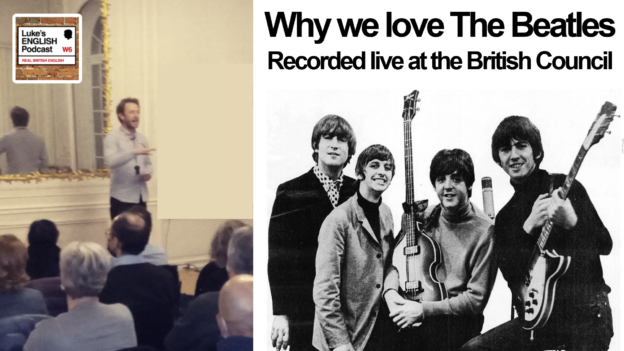
This is a presentation I did at the British Council in Paris recently, in front of a live audience. First I talk about public speaking and my approach to doing presentations and then you can hear the recording of my talk. The Beatles were a global phenomenon when they first appeared in the 1960s and their appeal continues to this day. The world still loves The Beatles. But why is this? Join me as I take a deeper look at the social, cultural and psychological factors that make The Beatles story so compelling even after all these years.
Another day, another new podcast episode. Let’s keep calm and carry on, shall we?
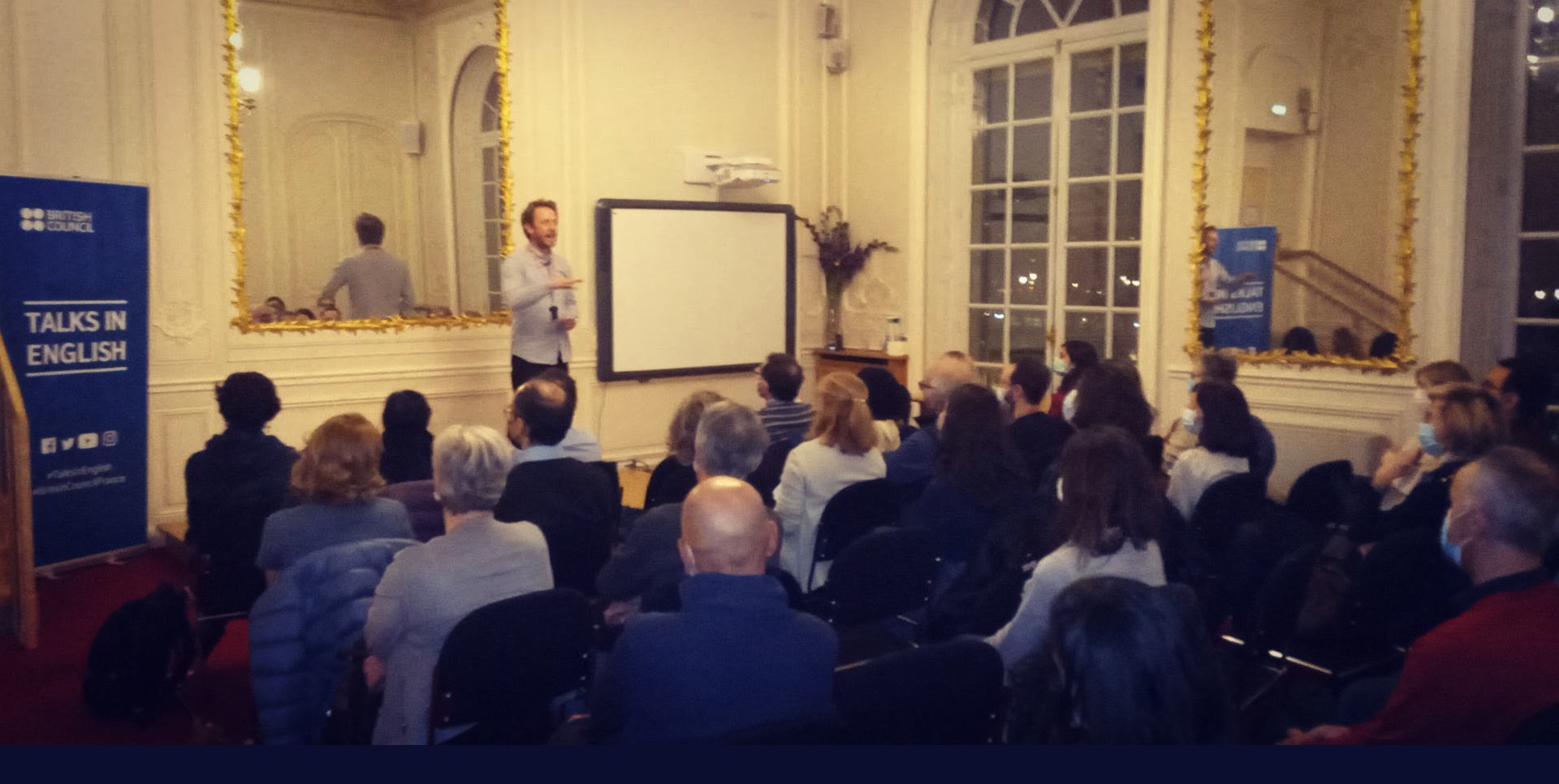
This is episode 761 and most of this one was recorded live at the British Council in Paris in front of an audience of people. I think it is the first podcast I’ve ever recorded with a live audience there and it sounds a bit different because you can hear the audience reacting to things I’m saying and there are some moments of interaction with the crowd and some jokes and stuff. I hope you enjoy it.
As you may know, I teach English to classes of adults at the BC in Paris but also we have some extra events there in the evening. The talk you can hear me doing in this episode was one of those extra events. I’m hoping to do more of this kind of thing in the future – podcasting in front of a live audience.
Private Online English Lessons with the British Council
Just before we start properly I want to tell you something about taking English lessons with the British Council, which is something that you can do online. Did you realise that?
Are you interested in having private English lessons online with a British Council teacher? Because you can.
Sometimes people ask me if I am available for private lessons, and unfortunately my answer to that question is usually no. I just spend my time making episodes of my podcast and teaching group classes in the real world so if you wanted lessons with me you’d need to be in Paris and you’d need to become a student at the BC there using the normal registration process and just hope that you end up in one of my classes.
But, other British Council teachers are available and they are online.
So if you are looking for an English teacher for private lessons, I just want to let you know that the British Council does offer this service now – personalised one to one lessons with a British Council teacher online
And this is great because you can do it anywhere in the world, you can choose the date and time for lessons, it’s totally flexible, you can choose the teacher and you can basically have classes which are designed around your needs completely, whenever and wherever you want, basically.
Want to practise your speaking and have your errors corrected – you can.
Want to work on your grammar and vocabulary. You can.
Want to develop your pronunciation to be a clearer speaker or to work on a more British-sounding accent if you like. You can do that too.
Also, you can have lessons for specific purposes such as for exams, for job interviews, for specific work arrangements, to prepare for IELTS. It’s all possible with these private online lessons because they’re all based around what you want to do and the British Council teachers will design the lessons based on your priorities.
I’ve always said that listening to my podcast regularly (or any podcast for that matter) is an important part of your learning process – the 5 Ls – listening, listening, listening, listening, listening but of course you need to be doing plenty of speaking too and to practise all the other things – the other language systems and skills.
One to one lessons are a really great way to achieve that and doing them online with an actual human teacher face to face is now a completely normal, tried and tested way to do this. All you need is just the right service.
And the British Council does offer that service.
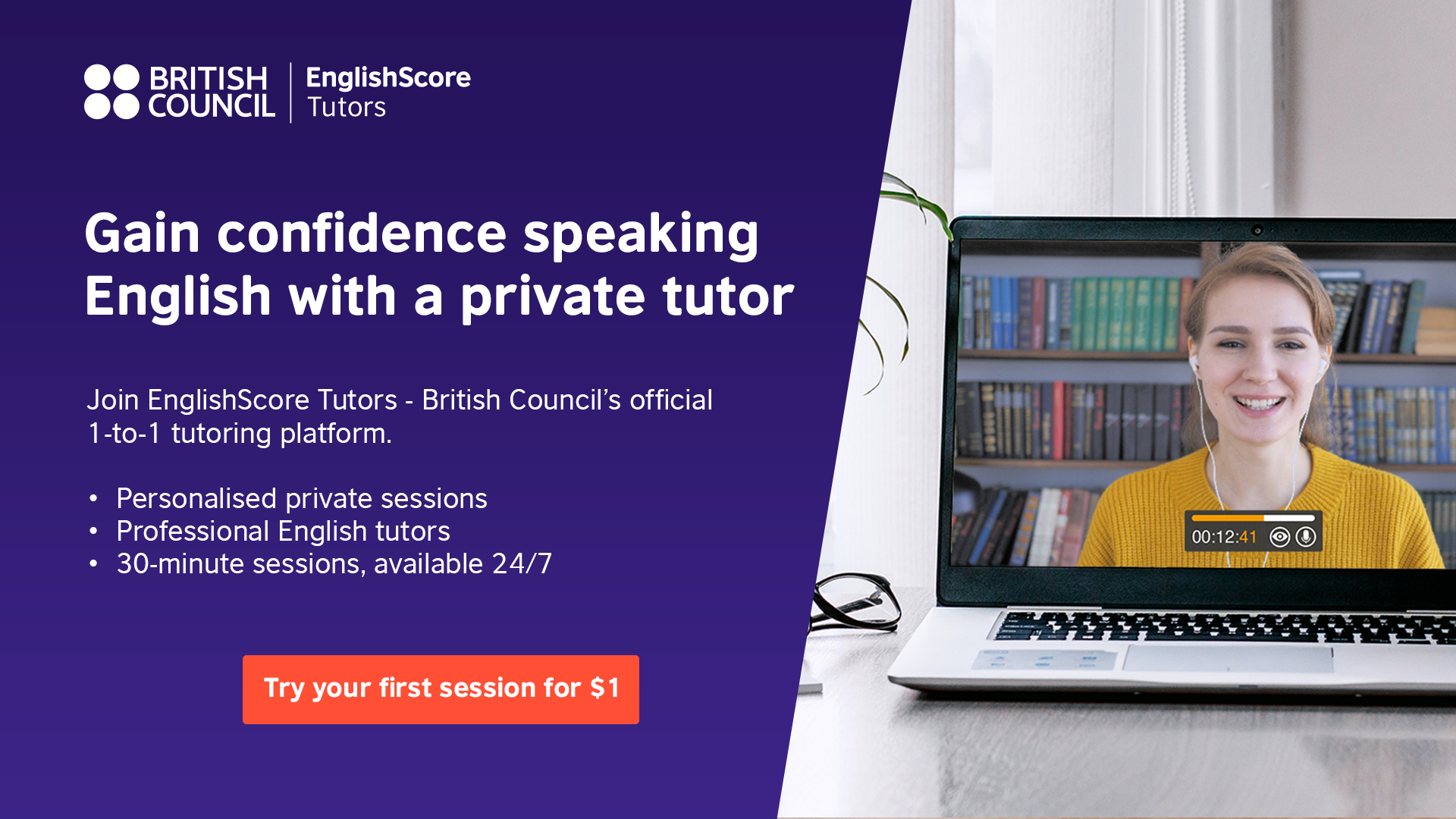
It’s called British Council English Score Tutors. (Click the pic below for the details)
It’s the official 1 to 1 tutoring service from the British Council.
It’s quite new but they already have 12,500 learners of English using the platform.
There are currently over 150 teachers there.
The tutors on English Score have an average rating of 4.9 stars (out of 5), which is reassuring.
The teachers are all British Council approved and a lot of them are in the UK but there are also British Council teachers living in other countries all over the world so you can find teachers in most time zones, which means, basically, there are teachers available 24/7. So you’ll be able to find someone to match your timetable.
So, why not go ahead and find a teacher for you and book some lessons to really push your English further and gain more confidence. There’s an offer for you because you listen to this podcast by the way – I’ll tell you about it in a moment.
Maybe you listen to me regularly and you’re happy that you can understand me or that you’ve got to the stage where you’re understanding most of what I say, which is a very good sign – why not build on that and get your speaking up to a similar standard.
If you’re working on your listening and making progress, there’s a good chance you can convert that to speaking and make progress there too. Activate your English.
Work on your fluency and accuracy and clarity and general confidence.
The 5 Ss – speaking speaking speaking speaking speaking.
You’re asking – What about that special offer for us Luke? Yes.
The BC is offering you a first introductory session for just $1, just so you can see if you like it.
So the first session is just $1.
You can try it and see if you like it.
There’s no pressure or obligation to continue after that.
But if you do choose to buy a pack of lessons (normally about 20 hours or something) the BC will throw in a free lesson for you because you’re a LEPster.
So, the first lesson is just $1.
If you like it you can buy a pack of lessons with a teacher, and get a free lesson included because you’re a LEPster.
Sounds pretty good right?
This could be your way to really work on your speaking as well as your listening.
Think about it. Could be a really good move.
Young learners – they do young learners too. There are classes available for 13-17 year olds and you get the same deal.
To find out more and to get that special offer of the free lesson go to teacherluke.co.uk/english or click the PRIVATE LESSONS button on my website menu.
The link is also in the description of this episode.
You’ll only get that free lesson if you enter the website through my link though.
All right then. Let’s begin the episode properly. Here’s the jingle.
761. Why we love The Beatles (Recorded Live at The British Council)
Hello listeners! Welcome back to the podcast. Let’s get back to some normal podcasting, shall we? OK then.
This is #761 Why we love The Beatles (Recorded Live at The British Council).
As you can tell from the title, this episode was recorded live at The British Council in front of an actual audience of people, as I mentioned earlier.
I’ll play the recording to you in a few minutes. First I want to tell you about the talk I did and how I prepared for it in order to perhaps share some personal tips I have about public speaking. This might seem like another one of my epically long introductions, but it’s not. In fact, let’s imagine that the introduction is over now and here we are in the main body of the episode, and I’m giving you some comments and advice about how to speak to an audience of people – public speaking.
Public speaking is a slightly different skill to normal podcast recording and so it might be interesting for you to hear me doing it in this episode.
Here’s some context.
The British Council in Paris, where I work part-time, is essentially a language school in a nice building not far from the Eiffel Tower. We teach classes to adults and children and there’s also a exam centre for the IELTS test.
The BC in Paris also offers some special evening events including regular Talks In English. This is when a guest is invited to come and talk about a specific topic at the school in one of our nice big rooms on the 2nd floor.
Everyone is invited to attend at that means students at the school but anyone else too – friends, staff in the school, other teachers, just anyone who’s interested in attending.
The speaker does their talk and afterwards there’s a chance to socialise, drink some wine and talk in English together.
Our marketing manager Phil is always on the lookout for people to do one of these Talks in English, and a couple of months ago he asked me if I’d like to do a talk about anything. I immediately thought of The Beatles, because it’s one of my favourite topics and it’s a very British topic, relevant to British culture and it’s the sort of thing that would probably attract some people. Also the series produced by Peter Jackson called “Get Back” had just been released on Disney+. Phil happily agreed and we put it in the diary.
I decided the title of my talk would be Why We Love The Beatles and basically I wanted to try and explain why The Beatles were and still are so popular. What is the appeal of this group? Why are they so adored by people even 60 years after they first came onto the scene?
I also decided I’d try and record it as an episode of this podcast.
Now, I know this is another episode about The Beatles and some of you might not be that interested or keen. My talk is called Why We Love The Beatles – but some of you probably don’t Love The Beatles that much, or you just don’t know. That’s totally fine of course. I get it. I’m not here to convince you that they’re the best band. Music is subjective. It’s a question of personal taste.
But I still hope you listen to this, because I might be able to help you understand why people love them.
Public Speaking – Talking to an Audience (Some tips and comments)
I’m now going to give some tips and comments about public speaking and how I prepared for my presentation but if you’d rather just skip straight to the recording of my Beatles talk, then you can move forward to 30:00 (the 30 minute mark).
Let’s think about public speaking then, and doing a presentation to an audience. I just want to mention a couple of things about how I prepared to do this talk.
Maybe this can help you learn a little bit about public speaking.
So I had to prepare to talk to a room full of people for about 45 minutes.
It was a fairly small audience to be fair – about 50 people.
Is that a small number or a big number? I don’t know. I’ll let you decide.
Imagine you had to do that.
What would you be thinking?
How would you do it?
How would you prepare?
What are the important things to consider?
I knew the audience would be a mix of adult learners of English (mostly French people and maybe some other nationalities) with an English level at intermediate and above and also some native English speakers.
I didn’t want to write a script, because I wanted to keep the presentation spontaneous. I find that if I write a script then I just get stressed during the talk because I’m trying to remember everything I’ve written and that’s impossible, and reading from a script can take the life out of a presentation. It can take away a certain spark, especially if the person is actually reading from the script on paper and they have to keep glancing up at the room but not really connecting with anyone.
It depends, of course. Sometimes you need a script because in some cases every single word is vital, and you might have a prompter or something (that’s a screen which shows you your script without the audience seeing it – like in those big political speeches) or maybe if you are doing a best man’s speech at a wedding it can help to have the script in your hand. It depends on the situation of course. But for me, I decided that I didn’t want a script.
Also I didn’t want to use presentation slides on a screen with lots of words or information on them. Slides can be good, but they can also be very distracting. It’s human nature for the audience to just stare at the slides and then you lose the connection with them, and an old rule from stand-up comedy is: if it’s not adding anything, then it’s taking something away.
Sometimes slides are not really adding anything to your talk, and so they just take away the focus from you and cause the audience to get distracted, especially when there’s lots of text and they end up reading rather than listening to you. No thanks.
Nothing is better than just trying to establish a good connection with the people in front of you. So I decided to do it without a script and without any slides, just like in a stand-up comedy who.
Doing it without a script can seem a bit daunting though, because you think “How can I get it right? How can I be sure that I’m going to say the right things?”
Basically, in my experience, you have to just try to get to know your subject really well, create a simple structure for your talk, practice a lot and then trust yourself to be able to do it. So that’s what I tried to do. (I’m talking like I’m some expert public speaker here – I’m not, but I do have some experience from teaching and from doing comedy, so I’m just trying to share my experience with you).
In the weeks leading up to the talk I just thought about it a lot, thought about the specific focus of the talk “Why do people love The Beatles?” wrote some ideas down when they came to me, asked friends and family for their advice, talked out loud to myself a bit, imagining I was doing the talk and eventually worked out a general plan for what the content and structure should be. I did write some things down as a script but then I boiled it all down to a list of simple one or two word prompts. I then printed those prompts on some cards which I held in my hands during the talk. The idea was that I could just glance at the card in my hand and then ramble on that topic, hopefully remembering the main things I wanted to say. I also wanted to leave myself room to improvise and respond to what was happening in the room because in my experience, that’s the best way to keep things entertaining and to stop the audience falling asleep at all.
I also wrote a few other things on the cards in pencil. Just some names, dates and quotes in case I forgot them while talking.
So that’s what I did as preparation and in a moment you can hear how it went.
Let me just say a couple of very basic facts about The Beatles for listeners who are new to the subject, just so you don’t get lost.
The people in the room for my talk were probably already fans of The Beatles, but you might be new to them.
The Beatles
They were a group of musicians (a band) from Liverpool in England who recorded and released music together from 1962 to 1970 more or less.
Members:
John Lennon (guitar & vocals)
Paul McCartney (bass guitar & vocals)
George Harrison (lead guitar & vocals)
Ringo Star (drums & vocals sometimes)
Pete Best and Stuart Sutcliffe were members of the band before they became really famous.
They formed in the late 1950s and played live concerts together from the early days in Liverpool and Hamburg until the year 1966 when they were playing stadiums and huge theatres around the world. Then they stopped performing live and concentrated on making music in the studio.
The band broke up officially in 1970 and went their separate ways.
John Lennon was killed in 1980 meaning that the four members could never reunite again as a band.
The Beatles were not just commercially successful. They represented a huge cultural shift and also were groundbreaking in many ways beyond just their influence on popular music. They were also just very funny, stylish and charming and their message was ultimately one of peace and love.
So, “Why we love The Beatles” that’s the title of my talk, that’s what I talked about a couple of weeks ago, and that’s what you can hear now in this first episode of LEP recorded in front of a live audience. I hope you enjoy it…
Ending
So, there you have it. That was my talk about The Beatles at The British Council.
I am not completely sure if I managed to answer the question of why people love them so much, but ultimately I think I managed to entertain my small audience and everyone seemed to enjoy themselves and maybe that’s the most important thing at the end of the day, and the beginning of the day, and the middle of the day…
I wonder how that was for you listening in podcastland.
A couple of questions for you.
Did I manage to tell you something new about The Beatles that you didn’t know before?
If you’re not a fan of the band, did I give you a sense of why people love them so much, including the fact that it’s not just about the music, and there’s more to them than just Yellow Submarine, Yesterday, Hey Jude and Let It Be?
What was it like listening to a podcast episode that was recorded live in front of an audience, and should I do more episodes like that in the future?
Actually, I have sort of already decided that I would like to do more stuff like this in the future and I would like to do talks at the British Council that can also be published as podcasts.
One idea is that I re-record some old episodes but in front of an audience, especially episodes which are essentially stories. For example, I would love to do the Sick In Japan story because I think it’s long enough, has enough funny moments and drama in it and it’s been a long time since I published the episode (10 years in fact – omg).
So look out for more stuff like this in the future and maybe a live version of Sick In Japan or something like that. We will see.
Anyway, let me know how it was listening to this as a podcast episode.
Thank you for listening all the way until the end.
If you got this far, let’s think of a code word you could use to show that you’ve listened until the end. Let’s say that if you got this far, you have to use the word “LOVE” in your comment, especially in a Beatles lyric such as “Love is all you need” or “All you need is love” or “The love you take is equal to the love you make” – or in fact, quote ANY Beatles lyric in the comments to show that you have listened all the way until the end, and if you mention that a semolina pilchard was climbing up the Eiffel Tower during the episode, you will get bonus points. More than just 10.
Thank you for listening.
More podcast episodes will be coming towards your ears soon.
Just a reminder – Private Lessons with British Council English Score Tutors
If you’re looking for private one-to-one lessons online with a teacher, check out British Council English Score Tutors.
At least 150 BC Approved teachers to choose from.
Classes adapted to your needs.
All from the comfort of your own home.
$1 for the first lesson so you can check it out.
Then if you pay for a pack of lessons, you’ll get one lesson free because you’re a LEPster.
Thank you for listening! I hope you loved this episode.
My pod room is nearly ready, for goodness sake. There’s still no electricity connection! A guy came to fit plugs around the room, and to connect it to the earth. He just needs to come back to do a bit of paperwork but of course he keeps texting saying it’s not possible today and then the next day, then he says he can come on Friday afternoon which is a full week after he actually did the main part of the job. Why does everything take so bloody long? Then it’s just a few clicks and switches and I need another hard working motivated guy to come and connect the room to the fibre optic internet and then I will be able to actually get installed and start working properly again. Damn, I can’t wait! I’m buying a second-hand desk from a local company tomorrow (it was supposed to be today but yep – she had to cancel and postpone). I’m looking for a decent office chair at a good price. I will podcast standing up if I have to!
Speak to you soon but for now it’s just time to say, good bye bye bye bye bye bye
Hello listeners, welcome back to my podcast. I hope you’re doing well and that you’re ready to learn some more English with me in this new episode.
This one is called The Mountain and I’m going to read you a short story and then use it to teach you some English.
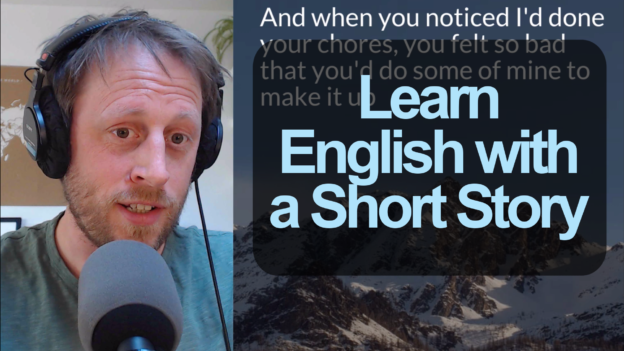
There is a video version of this available on YouTube with the text on the screen, so you can read and listen at the same time and you can see my face while I’m recording this, if that’s what you’d like to see. You can find that video on the page for this episode on my website or on my YouTube channel – Luke’s English Podcast on YouTube, don’t forget to like and subscribe of course.
Stories are great for learning English, and I’m always searching for various stories that I could read out on the podcast. I’ve found a few stories and texts, both online and in books that I have on my bookshelves, so you can expect more story episodes like this coming in the future as I read things in different styles, from different texts, including some well-known published work and some independently published stuff and fan fiction that is available online.
Stories make ideal material for language learning. They are compelling and often the text of the story is also available which makes it extra useful for language learning because it works as a transcript for what you are listening to.
Today I googled “Free short stories online” and I ended up on a website called commaful.com
This website is described as the largest library of multimedia stories online. Commaful.com
On Commaful you can read and share stories written by users of the site, fan fiction, poetry and comics, and they have a picturebook format, which means that their stories are presented in a slightly different way, which makes them a bit more pleasant to read online or on mobile devices – more pleasant than just reading text on a screen, which is never a pleasant way to read literature. So rather than just presenting their texts on screen, they put each line of the story on top of an image of some kind (like a picture of a lake or a landscape or something) and you can swipe from one image to the next, reading each line of the story as you go, which is quite nice.
When reading these stories out loud the format encourages you to pause as you read each line, which is quite a good habit. Pausing is a good presentation skill.
It can be a good discipline to practise because pausing can add some space for the audience to think and can change the atmosphere slightly, adding extra weight to each line that you say. So pausing and taking your time can be good presentation skills to practise.
First I’m just going to read the story to you. You can just follow along and try to understand what’s going on.
Then I’ll read it again and I will stop to explain some bits of English that come up, and there are various nice bits of English in here – phrasal verbs, expressions and other nice bits of vocabulary mainly.
The story is written in American English, which is mostly the same as British English really, but I will point out any differences and will give you the UK English equivalents, so this can be a chance to learn some British and American English equivalents.
I’ll do a vocabulary and language summary at the end too.
As I said, there will be some pauses between the lines of the story, because of the way the story is presented to me on the website. I don’t normally pause like this when doing this podcast, but it could be useful because it might help you absorb what I’m saying and you can use those pauses to repeat after me if you like. This will be easier if you can read the lines with me, and again you can do that by watching the youtube video, or visiting the story on commaful.com.
Or you can try repeating without seeing the lines if you want an extra challenge.
And of course you can simply enjoy listening to the story without worrying about repeating or anything like that.
The story is about 10 minutes long, just to let you know what to expect.
The rest of this episode is me explaining and describing the language in the story.
By the way, this story was posted on commaful.com by a user called Aknier and I am assuming that Aknier is the author of this, so credit goes to him or her for writing it.
Follow the link in the description to access the story and you can leave comments there if you like.
I hope you enjoy it!
But now let’s begin the story…
Ending Transcript
OK so that is where the video ends, but I’m adding a bit more here to the audio version in order to do a quick language summary of the bits of vocabulary that came up in that.
How was that for you? Did you enjoy the story? As I said, there weren’t many narrative elements. It was more an emotional story, but quite an interesting one.
Again, I do recommend that you try reading the story out loud, either by repeating after me or not.
Now let me recap some of the vocabulary items and British and American English differences that you heard there, just to sum up and help you remember what you’ve just heard. I’ll be as brief as I can while jogging your memory here.
You can find this vocabulary list on the page for this episode on my website of course.
Vocabulary List
I hardly cried (I didn’t cry a lot)
To work hard / to hardly work
To fuss / to make a fuss (Fuss = anxious or excited behaviour which serves no useful purpose. “What’s all the fuss about?” “Everyone’s talking about this Meghan & Harry interview. What’s all the fuss about?” “Why don’t you complain?” “Well, I don’t want to make a fuss”)
To make a scene = do something which attracts a lot of attention, like angrily shouting at staff in an airport terminal or hotel lobby
Siblings (brothers and sisters)
To bet that something will/would happen (to be sure it will/would happen) “I bet that England get knocked out of the World Cup on penalties” or “I bet it rains this afternoon”.
To shrug your shoulders
To grit your teeth = (literally) clench your jaw so your teeth are held tightly together (idiom) to decide to do something even though you don’t want to “I had to tell my dad that I’d crashed his car, so I just gritted my teeth and told him”)
A cast / a plaster cast
To be able to afford something “We couldn’t afford it” “We can’t afford it” (use ‘be able to’ after modal verbs when you can’t use ‘can’ – “We won’t be able to afford it”)
A cripple (offensive word)
To get picked on
To get teased
To make fun of someone
To get bullied
To get catcalled
To flash a smile
A blinding smile
To take that as a yes
To get upset
To get fired
To skip lunch
A scholarship
To be stunned
To soften your voice
To talk back
To sneak into the kitchen
To sneak money back into your wallet
Fight – fought – fought
Buy – bought – bought
To cheat on someone
To freak someone out
To make it up to someone
To raise your voice
To shout
To scream
To cave (in)
Emotional outbursts
To melt
To punch someone in the jaw
To stare blankly
Stand up for yourself
A mess
Serene
Tranquil
Deadly / the deadliest
American English / British English
Fifth grade – Fifth year
Pants – trousers
Mad – angry
To figure something out – to work something out
To yell – to shout
A jerk – an idiot
To take out the trash – to take the rubbish out
Chores – housework
To punch someone in the jaw – to punch someone in the face
Cookies on teacherluke.co.uk
Click “Accept All”, to consent to the use of all cookies on this website, or visit "Cookie Settings" to control your consent settings.
This website uses cookies to improve your experience while you navigate through the website. Out of these, the cookies that are categorized as necessary are stored on your browser as they are essential for the working of basic functionalities of the website. We also use third-party cookies that help us analyze and understand how you use this website. These cookies will be stored in your browser only with your consent. You also have the option to opt-out of these cookies. But opting out of some of these cookies may affect your browsing experience.
Necessary cookies are absolutely essential for the website to function properly. These cookies ensure basic functionalities and security features of the website, anonymously.
Cookie
Duration
Description
cookielawinfo-checkbox-analytics
11 months
This cookie is set by GDPR Cookie Consent plugin. The cookie is used to store the user consent for the cookies in the category "Analytics".
cookielawinfo-checkbox-functional
11 months
The cookie is set by GDPR cookie consent to record the user consent for the cookies in the category "Functional".
cookielawinfo-checkbox-necessary
11 months
This cookie is set by GDPR Cookie Consent plugin. The cookies is used to store the user consent for the cookies in the category "Necessary".
cookielawinfo-checkbox-others
11 months
This cookie is set by GDPR Cookie Consent plugin. The cookie is used to store the user consent for the cookies in the category "Other.
cookielawinfo-checkbox-performance
11 months
This cookie is set by GDPR Cookie Consent plugin. The cookie is used to store the user consent for the cookies in the category "Performance".
viewed_cookie_policy
11 months
The cookie is set by the GDPR Cookie Consent plugin and is used to store whether or not user has consented to the use of cookies. It does not store any personal data.
Functional cookies help to perform certain functionalities like sharing the content of the website on social media platforms, collect feedbacks, and other third-party features.
Performance cookies are used to understand and analyze the key performance indexes of the website which helps in delivering a better user experience for the visitors.
Analytical cookies are used to understand how visitors interact with the website. These cookies help provide information on metrics the number of visitors, bounce rate, traffic source, etc.
Advertisement cookies are used to provide visitors with relevant ads and marketing campaigns. These cookies track visitors across websites and collect information to provide customized ads.