Category Archives: Podcast Information

450. Comments & Questions

In this episode I’m going to go through some questions from the comment section and give a bit of news. There will be some grammar, some vocab, some reactions to recent episodes and some bits relating to how you can continue to push your English with this podcast.

[DOWNLOAD]

Episode notes

The comment section is buzzing with chat. Photos are being shared of people’s running routes and shots of gorgeous spring flowers and blossoms in full bloom. A listener called Sylvia is doing an illustration for every single episode and posting it in the comment section. Regular commenters are having some long and funny conversations – they’re very friendly and like a laugh so get stuck into the comment section and see what all the fuss is about.

The usual commenters are: Cat, Nick, Jack, Agnes, Marta, Antonio, Eri, Hiro, Euoamo, Sylvia, Jilmani, Mayumi, Ethan, Syntropy and more people I have probably forgotten about!

Cat is the top commenter with a total of 2795 COMMENTS
Nick is in 2nd place with 1851 COMMENTS
Jack is in 3rd place with 963 COMMENTS

David Crystal

Bit of news: I’ll be interviewing Prof. David Crystal on the podcast soon.

David Crystal is the foremost writer and lecturer on the English language, with a worldwide reputation and over 100 books to his name. He is honorary professor of linguistics at the University of Wales, Bangor, and in 1995 was awarded the OBE for services to the English language.

I met him in 2012 when he gave me an award (with Andy Johnson). He’s really nice and I’ve always wanted to have him on the podcast.

And I am interviewing him soon, which is a serious treat.

This is the guy who knows everything there is to know about language and I’m going to interview him.

Honestly, I have millions of questions I could ask him, and I could easily fill up several episodes with him just asking all the questions in my head.

But I’d also like to give you a chance to ask a few questions. So leave your questions for David Crystal in the comment section. I can’t guarantee I’ll ask him all of them, but if there are some particularly good ones I’ll ask them.

Otherwise, I might be able to answer some of the questions myself.

Recent Comments on the Website

Here are some comments which arrived recently.

Cat – in reply to the British Humour episode
Hi Luke and Amber, thanks for your lovely chat! It was a most enjoyable and also educational episode.
I’ve got two questions:
1. You mentioned “NHS” (?) as something that each Brit is proud of. What is it exactly?
2. During the dissection of the Hugh Grant’s quote you said that he was “public school”. What does it mean?
Thanks for explanations!

IMG_4148Oil painting by Sasha Sokolova

Thanks for the oil painting! – www.sashasokolova.com


JAPANESE LEPSTER GIFT VIDEO ~ I need to do this!

Paul
Congratulations, teacher Luke, for the podium! Great job and another great podcast, thanks!
“It’s time for me to leave Audioboom.com” = LUKEXIT!!!!!

Amber’s podcast – Paname – it’s not available yet, but soon!

Orion Transcription Team

Just a reminder about the Orion transcription team – they continue to produce transcripts, mainly under the management of Antonio from Spain, and they are always on the lookout for new recruits. Antonio regularly posts messages in the comment section saying “Episode blah blah is now available for transcription” and with a google link. E.g. the latest one is episode 444. The Rick Thompson Report.

Remember, it can be really good for your English so check it out! Transcribe just 3 or 5 minutes. It doesn’t have to be a massive commitment. If you do it regularly you’ll see that it allows you to focus your attention on what you’re hearing and you’ll be surprised at how much that focus allows you to examine the language up close. You could also try repeating out loud some of the things you’re hearing as you transcribe, that could be a good way to convert the process into a speaking exercise.

Turning Input into Intake

Here’s some vaguely academic stuff about Turning input into intake to increase your language acquisition. There’s language input, and there’s language acquisition. Between those two things, there’s intake. Intake is the stuff we really learn from.

This from the University of Austin Texas
The term “input” referred to all the exposure to a foreign language that is around us. However, as years went on, researchers realized that input was not enough. If the learners were not noticing or concentrating on the incoming flow of language, comprehension would be limited. So today, researchers in second language acquisition commonly make a distinction between input and intake. Simply put, input is all the written and spoken target language that a learner encounters, whether it is fully comprehended or not. Intake is limited to the comprehended input that impacts the learner’s developing linguistic system. For our purposes, we suggest that technology provides ways to increase the foreign language input that learners are exposed to and enhances the process of how input is converted into intake.

Without getting too fancy, let’s say that to really learn from the things you hear you need to convert what you’re hearing from input into intake.

This means listening to content which is comprehensible – i.e. basically understandable even though there may be some things you don’t get. A mix of things you already know (this is your foundation that allows you to work out the bits you don’t know) and some things you don’t know or don’t understand.

It also means sometimes really focusing and giving all your attention to certain bits of what you’re hearing. Some things might kind of pass you by a bit, but it’s important while you listen to be sort of emotionally involved in it and to interact with it while listening – to really think and feel in response to what you’re hearing. Apparently this helps turn input into intake.

Transcribing pushes this to the max. It forces you to turn everything from mere input into intake – which is the good stuff. I think it’s backed up by not just academic research but by the experiences of transcribers. It helps push your English, and remember you can just do a short chunk, you don’t have to do a whole episode, that’s crazy!

In summary – focusing all your attention on 3-5 minutes of an episode can really help turn input into intake and can maximise your learning potential with this podcast, or any audio resource.

Yuko – language question “shall”
Dear Luke, my name is Yuko. I have been a ninja listener of your pod cast for a long time, and I am originally from Japan, which makes my ninja status more authentic, doesn’t it? I am living in New York, but really fond of British English.
I have a question. When it comes to the usage of ‘shall’, it is rarely used here except for those two occasions: to suggest something, for example, “shall I do this for you?”, and to use following “Let’s”‘ for example, “let’s go, shall we”. Back in Japan, I learned that shall is also used interchangeably with will for describing the things or action in the future, but, here, all American friends said that shall is never used in daily life except for the examples above, and that if I used shall instead will, it would sound quite archaic.
However, I have a sense that sometimes I catch “shall” as description of future in bbc or British dramas even in modern setting. Would you mind telling the use of “shall” in today’s British English? Thank you very much. I always enjoy and admire your witty, and sophisticated subjects, not to mention it was quite honoring that you chose my country as the destination of your latest trip. I hope all is well and both of you and your wife have enjoyed it.

Yuko, all the right info is in your question.
You’re just not sure about it and you need confirmation.
OK then!
Shall – for suggestions (shall I? Shall we?) – after Let’s…
Shall for future (like ‘will’ – yes, old-fashioned and a bit posh, but some people still do it, like my Mum “I shan’t be coming to the cinema.” or “I expect I shall be exhausted by the end of the day!”
Also in contracts for obligations
That’s it!

Agnes – Sport
I’m just curious whether Luke is taking some exercise or not, he looks sporty and I suppose that he does some sport activities:-)) I usually jog before going work, early morning – the best time for burning calories.

Anna Mrozek
I had an English class today and my classmate asked me “how the hell do you know all these words?!”, so…
Thank you Luke, because you deserve the credit for that. :)

Leonid
Hi there everyone! Does someone know the accurate meaning of the phrase “to be on E”? Thanks in advance!

Great comment from Cat
Just keep listening to Luke’s English Podcast. And try to listen to episodes more than once. It is on the second listen that we start to notice the language consciously and start learning. After some time, you can listen to the episode for the third time. And there you will see how much you have learned in the meanwhile. Do it with your favourite episodes. And try to listen to OPPs as well. And use the same technique. It’s very effective. Also listening during a physical exercise speeds up the learning process. Because your brain is working at 5x of it’s performance capability. So use such shortcuts, especially if you are a bit lazy like I am! ;))

I would add that you can also do some transcribing, or check out previously written transcriptions – either the unproofread ones in google docs, or episodes with published scripts. That can help you notice language too.

Film Club: Touching the Void

Hope you enjoyed the “Touching the Void” episodes. I have had a few comments indicating that it moved a few people. but my stats show the episode hasn’t been listened to as much as normal episodes.

I often worry about uploading too much, but there’s always someone who says “we want more!”
I recorded an episode about Alien Covenant the other day. It’s about an hour of rambling about the Alien franchise. I’m a bit wary of uploading it straight away because it would be 3 film club episodes in a row and this isn’t strictly a film podcast. I probably shouldn’t think about it all that much.

But I’ve been quite productive lately and I have some episodes in the pipeline – Alien, 2 Amber & Paul episodes, one about music and culture with James.

Anyway, going back to Touching the Void, I’m glad to see those of you who have listened to it seemed to enjoy it.

Agnes
Have been listening to this story based on facts for the second time today I felt an incredible chill down my back and my hair stood up on both of my hands.
Luke, telling us this story, you made me be there, with them, I saw this horribly broken leg, I saw as Joe dropped down, I saw everything, even though I haven’t watched the documentary yet.
just thank you

Ethanwlee
One step at a time – this is my biggest takeaway from this episode. At the end of the day, that’s the mantra that keeps us going, staying focused. This story leaves me lots of food for thought. Thanks Luke!

Jilmani
Thank you so much Luke! It’s an amazing episode I can’t express how amazing it is. I want to tell you my personal story about climbing. My parents are both climbers and they had a club for climbers. They worked there a lot to train and coach also they took a lot of people in trips for camping. And I always went with them when I was a child. I liked climbing and adventurous trips more than anything else. I had always climbed and camped before I had an accident in 2014 in Lebanon. I was terribly injured and they expected that I’d die. Luckily I managed to survive. I needed a lot of eye surgeries because my cornea was damaged. Now I can’t climb at all not because I’m afraid of it, but my doctor prevented me. I got rid of all my pictures and anything that might remind me of climbing or my adventures. I haven’t climbed since that day, but I skydived a lot. Climbing always helped me to relax and forget about the troubles that we have in the Middle East. Also I’m a religious person it always made me feel happy and close to God. My doctor told me that I will be able to climb again when he removes the stitches. Thanks again Luke. I’ll watch the episode tonight luckily I have a Netflix subscription and I love documentaries a lot. Waiting for the next episode!

Luke: Be careful if you climb again! Be like me, just stay at home and watch other people do it on YouTube, it’s safer (except maybe I should do more exercise)

daav
Wow! Thank you, Luke! I really appreciate the topic you’ve chosen for a new episode. The film is pretty good and the book as well. I’ve got one in my bookcase. I have just little experience with high mountains because after my wedding I decided to bury my climbing gear to the very bottom of my wardrobe and since that day I’ve been “only” a hiker. But anyone, who has ever spent some time in the mountains without any support, just with a climbing mate on the other end of the rope, an ice axe in hands and a pair of crampons knows, that the fact Joe Simpson survived the Siula Grande ordeal is a …. real miracle, nothing else than a real miracle…
If someone wants to buy a book I recommend Bookdepository instead of Amazon. They offer free worldwide delivery which is a real bargain in my opinion. I buy books from them regularly (from The Czech Rep.) and it works well.

Cat
Daav, but why did you put away your climbing gear?! It’s like giving up on a part of your true self. Can you be happy with that for long?

daav
Hi Cat. At first I must admit I was never a climbing machine. I used to climb few times a year. Let’s say just few weekends and one or two trips to the Tatra Mountains or to the Alps. So it wasn’t so difficult to give up. In the Czech Rep. climbing is very popular and there are many people who spend every possible moment climbing a piece of rock in their surrounding area. So I can’t say I was a climber. I usually say that I have done some climbing :c) One day I considered that my wife meant a lot more to me than climbing. She had never asked me to stop climbing. She had even climbed with me once. But any time I had packed my climbing gear I had seen the same wish in her eyes – please, stay alive. During my last climbing trip I had a minor accident I have never told my wife about. Fortunately nothing comparable to Joe and Simon :c) But I realized that I was being very selfish. I enjoyed it, I liked it, but my parents and other people who truly love me were frightened to death every time I left them with a rope in my bag. Now I know that it wasn’t the climbing that I liked. It was mainly a peaceful and calm space around me. It was the fact I can leave all my daily routine behind me. Now i know it’s not adrenalin that I need. It’s just some kind of feeling I am alone, just on my own in some remote area. So today, long distance hiking is an activity that gives me everything I need. I just pack my rucksack, a tent, a fuel stove, some food, maps and a compass and I just walk. It’s different to climbing. It’s definitely not so dangerous. However it provides me the same pleasure. Unfortunately the Alps are full of people and there are so many huts. But some parts of the Pyrenees are amazing, the western part of Ukraine as well and the Andes are a dream for any hiker. I have many dreams, CDT in USA is one of them as well as many others around the world. The only disadvantage of long distance walking is that it’s very time-consuming compared to climbing. Are you a climber Cat?

Cat
Daav, if I were Luke, I would read your comment out in the next episode. It is deeply felt and full of love. :)

daav
Thank you Cat. But I’ve noticed that some people don’t like long episodes. And my comment is so long that Luke would have to record an extra episode just to read it out :c)

Success story from Erick in Brazil
Hello Luke,
This is Erick from Brazil.
Today when I was listening to your #429 podcast while running, I felt encouraged to share my listening experience with you.
I have been listening to you for about 1,5 years usually when I go running, so you have been my partner twice or three times a week. Strange, but I feel as if I have known you for a long time…
I actually think your podcast is more than just a teaching one, but it is more like a variety show with news, entertainment, fun stuff, etc. I really enjoy your ‘long talks’ which can be just some information, funny talk or more deep issues which are very good for getting immersed into the English language.
It is gratifying to hear other points of view of the various subjects on the media agenda especially when you bring guests to your show, like your Father, Amber and Paul, etc.
Sometimes it can be very hard for me to understand, but I took your advice, I keep going, listening to some episodes more than once, trying to get as much as I can.
Now I can say that I broke through the language barrier and I can really understand and talk in English because of you! So, I just have to thank you for all the material that you provide for free and especially for your success in making your podcast so popular and genuine!
Cheers from Brazil,
Erick Takada

I didn’t share that just to remind you of how wonderful I am, but also to just remind you that if you find it difficult to follow everything you hear on this podcast that you should keep going and battle through the moments of difficulty and you’ll find that bit by bit you build your understanding.
I can’t understand how anyone could expect to learn English properly without listening to a lot of it. I think it’s vital.

Do me a favour!

If you know someone who might like this podcast, share it with them! Recommend it to that person. It’s a good way to spread the word.

Another thing you could do is to write a nice review on iTunes – that’s really good for the podcast because it helps things like algorithms and getting my podcast featured in the ‘recommended’ section on iTunes. Also it looks good when new people check it on iTunes, and it would just make me feel good and put a smile on my face, which ultimately will feed back into the podcast.

Subscribe to the mailing list.

Watch this space for news of a potential LEP app for your phone or tablet which could include some bonus app-only content!

445. British Podcast Award / Hello to New Listeners / 17 Vocabulary Expressions

In this episode I’m going to talk a little bit about the results of the British Podcast Awards and also do a sort of introduction to the podcast for new people who might be listening for the first time. I’m going to bring you up to speed on what this podcast is all about and also recommend a few episodes from the archive that you could listen to. Also – for the dedicated language learners, at the end of the episode I’m going to explain 17 expressions which you’ll hear as I’m talking. Which expressions will they be? You’ll have to wait and see.

Small Donate Button

[DOWNLOAD]

As ever, I encourage you to listen out for words, phrases, bits of grammar and so on, so that you can notice them and add them to your vocabulary. It’s notoriously difficult to notice new language when listening because unlike when you’re reading, if you don’t know a new word when you hear it, it’s hard to even notice that it’s there. You tend to just follow the bits you understand and the new language can pass you by if you’re not careful, so I always encourage you to just pay a little bit more attention when you’re listening and try to notice new any interesting phrases as the podcast goes along. I’ll be picking out 17 of them and explaining them at the end. You can try to guess which ones I’ll be explaining.

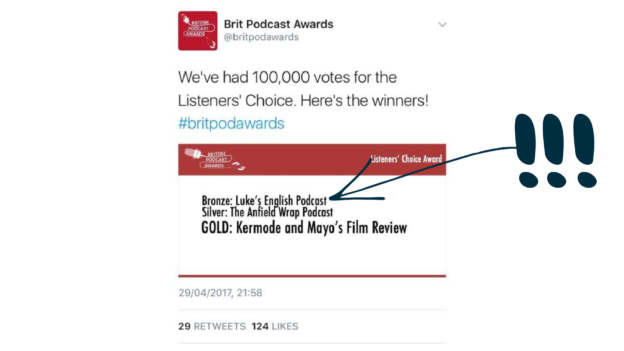
The British Podcast Awards – LEP WON BRONZE IN THE LISTENERS’ CHOICE AWARD!

For the last couple of months I’ve been asking you to vote for LEP in the BPA, saying things like “I need all your votes if I’m going to stand a chance of winning this!”
I honestly didn’t believe I could win. I thought, “it’s a long shot but it might just happen!”
The awards event was this weekend in London but I didn’t get tickets because I didn’t think my podcast was going to win anything. I was up against some pretty stiff competition. But damn it, I should have got tickets! I shouldn’t have underestimated the awesome power of my audience!
I have to thank you, my listeners soooo much, because I actually won the bronze medal in the Listeners’ Choice Award.

This means I came third, and I beat some other really great podcasts in that category and I’m blown away.

This means so much to me.

The winner was Mark Kermode & Simon Mayo’s Film Review – my favourite podcast of all time. I’ve been listening to Mark and Simon forever. Hello to Jason Isaacs. The silver award went to The Anfield Wrap Podcast, which is the #1 podcast for Liverpool Football Club and then I am in 3rd place, and I beat so many of these giant podcasts that I love to listen to all the time, like Athletico Mince, Distraction Pieces with Scroobius Pip, My Dad Wrote a Porno, The Adam Buxton Podcast (although Adam did win an award in another category), The Empire Film Podcast, Unexplained, Monkey Tennis The Alan Partridge Podcast, Richard Herring’s Leicester Square Theatre Podcast (or RHLSTP as the cool kids call it) and more.

This is mind-blowing and immensely satisfying.

Here are some phrases to explain how I feel

  • I’m blown away
  • I’m over the moon
  • I’m buzzing today
  • I’m feeling pretty good about myself
  • I’m feeling on top of the world
  • I’m absolutely delighted
  • I’m very flattered
  • I’m immensely proud
  • I am feeling quite smug, self-satisfied and a bit pleased with myself

My podcast is featured on the front page of the iTunes store today right next to Mark Kermode & Simon Mayo, and other podcasts that I am a fan of. I’ve been tweeted by the British Podcast Awards and there’s my podcast in the winners list with these other big names, for the whole world to see.

I feel like I’ve just won a Bronze medal at the Olympics of podcasting.

Actually, I’m still yet to find out if I get anything at all. Obviously the winners (Mark & Simon) got a nice glass award. I don’t think I’ll get anything, but I hope they send me some sort of badge that I can display on my website because that would help a lot to give a good impression when people visit my site for the first time.

But I might get a bit more exposure from this. I’m not sure how much, but I expect a few people might be checking out my podcast at the moment, which is nice. Hello!

Now the things is, I owe this to you my listeners because without your support I wouldn’t have got this boost.

So, really – thank you thank you thank you if you voted for the podcast. I really appreciate it.
I especially want to thank all those ninja listeners out there who normally just hide in the shadows listening but never coming out and revealing yourselves.

If I can just activate you lot more often I could be in a position to actually take over the world, in the best possible way of course.

It’s brilliant, isn’t it, this? Podcasting. I still find it incredible that I can produce these episodes in my home and have people around the world listen to them.

I’ve said it before and I’ve said it again, never before have we had language learning resources available to us so conveniently. In the past, previous generations found it very difficult to get access to sources of English to help them learn. They had to use books mainly, or records, tapes, CDs and they were hard to come by and costly. Now it’s all here for you online and I’m sure this is going to have an impact on the world as this generation takes advantage of these resources and uses them to become genuinely much better at speaking English and communicating.

Some people are out in the world right now arguing that globalisation is a bad thing, but let’s not forget the positives – that the fact we’re all more connected today means we can learn to understand each other a bit more, communicate better and hopefully make things work well for everyone, rather than retreating into closed off worlds where we don’t trust people from other places and we harbour resentments and rivalries. Basically, I’m saying that podcasting will save the world, and this podcast specifically is going to save the world, or at the very least people will know more phrasal verbs than they did before, but it’s something isn’t it!?

Hello to new listeners

I expect that various new people will now be having a look at the podcast. If you are new then hello! Welcome to my podcast. I guess you’ve worked out that it’s a podcast for learners of English, but everyone’s welcome to listen.

I’m an English language teacher – a TEFL teacher. That’s been my full-time job for about 16 years now and I’ve been doing the podcast for about 8 years. I’m also a stand-up comedian and what I try to do on the podcast is just create content which is enjoyable as well as being educational. I do teach English on the podcast but over the years I’ve worked out that my audience responds best to content which is quite genuine, personal or entertaining, so that’s what I try to do. I just try to make it easier for my audience to listen to lots of English on a regular basis. I’m not sure I’m always successful but I do try to make the content engaging and funny as well as of some educational value.

Most of the time it’s just me talking about different subjects relating to British culture, the English language and just life in general, but I try to get lots of guests on the show too including members of my family, friends who are comedians and anyone interesting. Hopefully this gives my listeners a bit of variety in terms of the types of English they can listen to and also a few different types of interaction.

Generally, the plan is to create diverse personalised content covering a range of different topics, to make sure I am always presenting real English in context and to help my listeners to get as much English into their lives as possible. Basically, I’m trying to inject English directly into the brains of my listeners as much as I can, in any way I can.

It’s backed up by a few principles of language learning including the idea that people learn more effectively when they are personally engaged with what they’re hearing and that they’re motivated by more than just the desire to learn the language. Also, it’s important to listen regularly, and for as much time as possible. The longer the better.

I’m from Hammersmith in London but these days I spend most of my time living in Paris where I work at the British Council and also do stand-up comedy in English. I often travel back to the UK and record episodes there in London where I used to live or in the midlands where I grew up.
I have a brilliant, lovely audience from all around the world who regularly contact me with comments, questions and general encouragement and I’m really flattered that so many of them chose to vote for me in this award. I’m blown away by it really.

My audience

My biggest countries are China, Russia, Japan, the UK, Spain, Poland, South Korea, Ukraine, Germany, Italy and the USA.

They are really the ones who really make the podcast great because I don’t really do any marketing and so I think most of my publicity is done by word of mouth, which is the best form of publicity I think.

Some listeners are really active in the comment section of my website and they have some funny conversations there.

I meet my listeners sometimes at comedy gigs, or in classrooms by coincidence. I went to Japan recently and did a show there and I was treated like a celebrity with a big queue of people waiting to take my autograph. It was amazing.

Transcriptions

For learners of English, having transcriptions for episodes is very useful because it allows them to check the words they’re hearing and also practise sound scripting where you write notes on the script to indicate where the stresses, pauses and intonation patterns are. This helps to identify speech patterns and then practise copying them. It’s really useful.

I don’t usually script my episodes. Some of them are scripted but most of the time I try to talk off-the-cuff. I think it’s a better indication of how people actually speak when they’re thinking on their feet and therefore is better practice.

So a lot of my episodes don’t have scripts, BUT there is a team of LEPsters called the Orion Transcription Team that work together to transcribe portions of my episodes and then proofread and correct each other’s work. The result is that they end up transcribing many of my episodes and those scripts are available for everyone to see on Google docs. It’s a cool way for my audience to generate scripts for my website and work on their English in a very effective way at the same time.

Some recommended episodes

You can get all the episodes in my archive on my website at teacherluke.co.uk and so just check it all out there.

Click here to visit the episode archive

It’s really hard to know which episodes I would recommend if you’re new to this podcast. You could just look in the archive on my website and just listen to whatever takes your fancy.

You could choose (and this is based on what my listeners tend to enjoy)

  • Ones where I teach language or learning strategies. These ones are designed to help my listeners learn the language more effectively – either by exploring methods for motivation and self-study or by teaching specific language like grammar, vocab or pronunciation. I like to do episodes about regional accents in the UK.
    174. How to Learn English with LEP
    385. Breaking the Intermediate Plateau
    405. Accents in The Lord of the Rings movies
    40. Health and Feeling Ill – vocabulary
    176: Grammar – Verb Tenses
    29: Mystery Story: Narrative Tenses
  • Episodes about British culture. My listeners tend to be interested in the UK’s culture and I think it helps to learn the language if you learn some things about the mindset and lifestyle of that language. I’ve done episodes about British humour, tea drinking, holidays and festivals, British comedy, communication style and more.
    432. British TV: Gordon Ramsay
    427. British Comedy: Limmy’s Show
    411. British Holidays & Festivals
    420. Let’s Have A Nice Cup of Tea
    261. What is Britishness?
    83. How to Swear in British English
  • Ones where I have my friends Amber & Paul. These ones tend to be a little more difficult for my listeners but they are so popular with my listeners just because we have a good dynamic between the three of us, Amber has the loveliest voice in the world and Paul’s laugh is very infectious. We usually play games or respond to comments from the website. Amber and Paul are both stand-up comedians. Paul is now quite a famous because he has his own TV show on Canal+ and YouTube (Amber and I help him write it) – it’s called What The Fuck France? You might have seen it. An angry English guy going on about French culture and swearing a lot? Yes, that’s him. He gets away with it because he speaks French like a native and really the show is quite an affectionate piss-take of French culture from a British point of view.
    435. Catching Up With Amber & Paul #5
    436. The Lying Game Returns
    410. Teaching Idioms in the Street / On the set of WTF France.
    272. Bad Haircut
  • Ones where I have my Dad on the podcast. My Dad used to be a BBC journalist and he generally keeps a close eye on current affairs, particularly in Europe, so he’s the ideal person to talk to about politics. Every now and then I ask him for his thoughts on Brexit and other issues. He is very good at breaking down these complex issues clearly and concisely.
    444. The Rick Thompson Report: Snap General Election
    390. The Rick Thompson Report: Hard Brexit / US Election
  • I also have other members of my family on the podcast quite a lot, particularly my brother who is known for being quite sardonic and a bit grumpy. Generally though, my listeners seem to enjoy hearing the 4 of us rambling on about various things.
    415. With the Family (Part 3) More Encounters with Famous People
  • Silly comedy stories. As a comedian I like to do some episodes just for the sake of fun and laughs. Every now and then I like to improvise stories with lots of tangents and different characters. They’re basically long shaggy dog stories. The most well-known one is The Pink Gorilla Story – and there’s part 1 and the sequel, part 2.
    125. The Pink Gorilla Story
    400. The Pink Gorilla Story 2
    173. The Curse of the Lambton Worm
  • Travelling stories. Whenever I go away on holiday somewhere I usually do an episode about the experience and they often involve some story telling, bits of history and general reflections on the different culture. I’ve done ones about Japan, Thailand, California, Indonesia and France.
    443. The Trip to Japan (Part 2)
    377. Holiday in Thailand Parts 1 & 2
    209. Travelling in Indonesia Part 2

So, that’s a selection of recommended episodes, but really – I hope you just have a look at the episode archive and pick whatever seems interesting to you and have a listen.
Remember, this podcast is primarily for people who don’t have English as a first language, although I try to make it as entertaining as any other podcast out there.

If you like it – great! If it’s not your cup of tea, no worries!

But if you do enjoy it then I hope you listen regularly and really get into it. Join my community of listeners – you’re all welcome, whoever you are, wherever you are and whatever you’re doing.
I do have native speakers listening to this as well, which I’m very happy about!
Anyway, thanks for listening.

Technical stuff – moving to a new audio host

It’s time for me to leave Audioboom.com They’ve been great hosts. I like their service a lot. Their embedded players look fantastic and I have had hardly any problems with them over the years.
But for one reason or another it’s time for me to move on. I want to be able to offer more things for my listeners, so I’m moving to a new podcast host.

This is going to be a bit more expensive for me, but I think it’ll be worth it.

I’m moving to Libsyn which is probably the biggest podcast host online. The cool thing with them is that I get a lot more control over the things I can do. This might not mean a lot to you, but essentially I can start controlling my catalogue and I can also launch an LEP app for Android and IOS, which could include bonus content only available in the App, as well as premium content and more. So, hopefully things will develop in a good way over the coming months.
This podcast has gone from strength to strength every year, and I want that to continue. In 2016 I got about 9 million downloads. This year I already look set to smash that number. My listening figures are more than double what they were this time last year. It’s brilliant.
So, watch this space!

Moving to a new host might cause a few technical problems, so if you experience anything, just hold in – it should all be fixed soon.

Those 17 Expressions

Remember at the beginning I said I’d pick out 17 expressions and explain them?
Why 17? No reason.

Did you notice any language that you think I would be explaining?

Here’s my list – and the only criteria for me picking these expressions is because I think you might not know them, or they’re just idioms or fixed expressions which I think are useful and you could add them to your vocabulary if you want.

If you know them already – excellent, but that’s only about 30% of the battle won – you also have to be able to pronounce them properly and use them correctly in a variety of ways (e.g. in different tenses and so on).

  • to bring you up to speed (on something) = give someone all the updated information about something, so they know the same as everyone else. If you come to something late, you’ll be behind everyone else, you need to catch up with everyone. If I tell you all the info that you’re missing, I’ll bring you up to speed. “Let me just bring you up to speed on what we’ve done so far.” “Could you bring me up to speed on this?”
  • to stand a chance of + ing = to have a hope/likelihood of winning or being successful. “I wouldn’t stand a chance if I had a fight with Anthony Joshua or Wladimir Klitschko.”, “They didn’t stand a chance, the attack came without warning.”
  • it’s a long shot (but it might just work!) = something that’s unlikely to succeed but it’s worth trying anyway
  • to be up against some pretty stiff competition = up against competition (competing with people), stiff competition (difficult competition)
  • to be/feel blown away = impressed, shocked (positive)
  • to be/feel over the moon = delighted
  • to be buzzing = feeling happy and excited, with a really good feeling inside.
  • to feel pretty good about yourself = it’s quite clear, but the construction is worth noting – feel good about yourself
  • to be/feel on top of the world = delighted
  • to be/feel flattered = pleased about something because it makes you feel important or special. It’s also a slightly embarrassing feeling. It’s how you feel when people say very nice things about you. “Don’t flatter me” “You’re flattering me.” “I feel very flattered” “That’s very flattering, thank you.”
  • to be/feel immensely proud = you know the word proud, but how about immensely?
  • to be/feel smug = (negative) feeling pleased with yourself to the point it becomes unattractive
  • to be/feel self-satisfied = smug
  • to be/feel pleased with myself = smug, sometimes not negative
  • to be backed up by (evidence, research) = supported
  • off-the-cuff = unprepared (apparently it comes from the idea that if you did a speech which wasn’t fully prepared you had to write notes on the cuff of your shirt)
  • to think on your feet = think without any preparation – to react to things in the moment

438. Hi Luke, I have a question!

Here’s another episode done in a similar style to the last one, with some news, some rambling and some questions and comments from the website. Topics in this episode will include: My live comedy show in Tokyo on 13 April, Differences between Comedy & Humour in France and the UK, Understanding TV shows and movies in English, Talking about Breaking Bad, Logan (the latest Wolverine movie), some grammar teaching and more…

Small Donate Button[DOWNLOAD]

Japan show – 13 April

19.00-22.00
Gamuso in Asagaya
2 Chome-12-5 Asagayakita, Suginami, Tokyo 166-0001, Japan
There will be a few other comedians first, doing comedy in English, then I will take the stage and do a set of stand-up comedy for you to enjoy.
FB Event page: https://www.facebook.com/events/396651460705556/

I’m not sure I’ll be filming or recording it because it’s stand-up and I have to be careful about what stand-up material I film and make public on YouTube.

Sorry to people in Osaka – I can’t be there this time!

London LEPster meetup

Host: MO (in LEP t-shirt)
Hi Luke
I am happy to say that I have finally managed to organise a time and a place. The time is Saturday the 8th of April at 1300hrs I chose this time because it is in the Easter holiday and I am assuming that most of the people are going to be on a break. The place is Costa Coffee and the address is 33-34 Rathbone Place, Fitzrovia, London W1T 1JN. It’s just off Oxford Street. The nearest station is Tottenham court road station. For any enquiries they can send me an email on bayle2003@hotmail.com

Russian LEPsters in St Petersburg

Hi Luke! How are things, man? We have already organised the first Get Together in Saint Petersburg! It will be on 9 April. Will you help us with publicity once we announce this event? :))
The Facebook Group
The Facebook Event on 9 April

Don’t forget to check the ARCHIVE for my recent interviews on ZEP and MFP

Other Comments & Questions

Mattia Andrao

I write this comment just hoping to be mentioned in the next episode…….

Carine (a reference to a message in the last episode from Adam, whose family hates my podcast because Adam forces them to listen)
Hello Luke,
To make you feel better about being hated by Adam’s family, which you do not deserve, I want to let you know that my two 9 year old daughters like your podcast very much and they love to listen to it when we are travelling by car! Listening to your podcast is a family thing we sometimes do the 3 of us together. They particularly enjoyed episodes 425 and 426, the Victorian Detectives. They are also Paul Taylor’s fans now!
Thank you for your funny podcast,
Take care,
Carine from La Rochelle, France.

Hello Carine from La Rochelle and her two 9 year old daughters!
I learned French in school from a book called Tricolore and it was set in La Rochelle.
All the characters, everything, happened in La Rochelle.

Danil Zelichenko
Hi Luke! Thank you for you podcast! I’ve been listening to it since September 2016. It really helps me. I still make a lot of mistakes, but I feel more confident.
I have a few questions
1. Have you ever listened to comedy in other languages with subtitles?
What can you say about the sense of humor in different countries?
French comedy without subtitles. I don’t really understand it! I also feel like their comedy is a bit different to ours. Some differences.
Our humour is self-deprecating, theirs isn’t. French humour is quite combative and involves quite a lot of put downs. We do that too but we also put ourselves down a lot.
Ours involves a lot of understatement, theirs doesn’t.
Comedy – theirs is situational.
Theirs is very visual.
Theirs is quite traditional – it is linked to theatre traditions that go back years.
In the UK we have alternative comedy which is counter-culture and subversive (even though it’s mainstream now) whereas in France it’s still tied into the theatre tradition.
2. Do you listen to other podcasts about learning English? Maybe you can compare your one with others?
Ingles Podcast (mainly focuses on Spanish learners of English, a little slower than mine, they focus more on teaching specific language points and language related questions – I do that less these days, preferring instead to focus on topics)
All Ears English (They’re very bright and energetic, they focus on communication strategies, natural sounding language and everything is focused on learning to communicate like an American native speaker – my episodes are longer and a bit looser than theirs.)
3. I like to listen to your old episodes every now and then, but I found that in iPhone first episodes had disappeared. It starts only from 33 now. Can you do something about it?
Daniel from Moscow (I’m not ninja) :) you can notice (mention) my name if you want.
P.S. I’ve just voted for your podcast!

Ivan
I’d like to listen to you Luke, speaking more about Breaking Bad.

Can’t remember who wrote this!
I have a basic question to you, teacher Luke! Well… maybe most lepsters will laugh at this doubt, but I really can’t notice sometimes the difference between for example: “I did walk” versus “I walked”. I mean… when I should use did or the suffix “ed”. Maybe it’s a basic grammar issue but I hate studying grammar. Thanks!

Christopher
Hi Luke,
How do you do? As a start I want to say thank you for the great work you do. Besides your podcast, I also hear a lot of BBC Stuff. Most of them are political talks or documentaries. I find it very interesting to hear different opinions about a topic. But there is one thing I find really curious and I was hoping that you might be able to help me out of my confusion.
In every talk show the guest addresses the host with his forename. For example:
“Today we are talking with the new director of Strawberry Media, Jackie Smith. Welcome! Thanks Steve… nice to be here…”
In Germany we would find this very informal and it never would happen on a political talk show.
Why do you do that in GB?
Best wishes to France,

Dmitry from Russia
Luke, I really adore your podcasts. But I’ve got a question: When I listen to your podcasts I understand absolutely everything you say, no matter how quick you speak. But when I try to watch something that is made for natives and by natives (movies, also songs) it’s extremely difficult (or sometimes completely impossible) to get what they say. Could you, please, explain this in one of your episodes, why this happens, and also come up with some ideas how to cope with this problem. Thank you in advance. Your podcasts are amazing!!!

Reasons

  • Familiarity with my voice.
  • My clear way of speaking. I try not to speak too slowly but I do make an effort to be clear. I am talking to an audience, I am doing a show. In episodes with guests you hear a slightly more natural speech pattern as I’m in a real conversation, but when I’m talking to you I am making an effort to communicate to you – just like you’d expect from someone doing a presentation. In movies they’re not talking directly to you like that.
  • Films feature people talking to each other – not talking to you. THere’s a difference. It’s easier to understand it when the person is engaging you directly, rather than you listening to other people’s conversations.
  • It’s just me, so no distracting stuff, no interruptions, no sounds etc.
  • Films contain loads of sound effects, music and background noise.
  • It’s recorded to be listened to and for every word to be understood. Movies are not always supposed to be understood completely.
  • Films are realistic. The dialogue is not always audible – many films feature “naturalistic dialogue” – i.e. incomplete sentences mumbled under the breath. This is a totally intentional stylistic choice. It’s supposed to be natural and realistic.
  • Films are confusing. They often don’t make sense. My episodes have a pretty linear structure.
  • My podcast is recorded to be heard – i.e. I use microphones for clear voices. I reduce background noises. Movies aren’t like that. They add noise, they record voices to be blended with the rest of the soundscape.
  • Movies are a visual medium – so much of the message is in the visuals. The audio is an accompaniment to that, so it has secondary importance. Also, you get distracted by the visuals and you end up not concentrating on the audio. You could try just listening to some movies. This sounds a bit strange but try getting the audio from a movie and simply listen to it. Then watch the movie – you might find you understand more of the dialogue that way, because you’re allowing yourself to focus only on the speech.
  • Most films are in US English. I speak British English, although there aren’t that many differences really.
  • Movies also feature lots of different accents and characters who might speak in ways you’re not familiar with.
  • Songs don’t always make sense. There’s a lot of artistic licence. I often can’t catch the lyrics of songs (check out my misheard lyrics episodes). The English isn’t normal English.
  • Sometimes they’re just a stream of consciousness with no proper discourse like in spoken English.

Solutions

  • Watch more movies! Familiarity is important. Getting used to it.
  • It’s just a question of continuing to improve your English.
  • Subtitles sometimes, then no subtitles, then subtitles again.
  • Don’t worry about it too much. Sometimes I can’t catch the things they’re saying in movies either. Realise that there are times when you won’t understand. Realise that movies are hard to understand, and so don’t be shocked when you don’t understand them. Often they’re mysterious or simply don’t make sense. I often struggle. Don’t worry about it too much.
  • Try using headphones so you can hear more clearly.
  • Specific techniques: Practice shadowing specific scenes first without subtitles, then with, then without again. Do this with favourite scenes from films. I do it a lot too and it can be really fun. It will help train yourself to hear and understand movie dialogues more easily.

Jane
Hi Luke!

I really like those episodes you talked about superheroes.
Could you do an episode about the movie, “Logan”, please?
I would love to hear your thoughts!
Thank you soooo much!
Best regards,
Jane


437. Ramble News – 31 March 2017

A rambly episode with some news from the UK, some comments, some questions, some updates about LEPster meetups in Moscow, Tokyo and London and so on.

Small Donate Button[DOWNLOAD]

British Podcast Awards

Thank you for voting – I’ve had loads of comments on FB and the website saying “I’ve voted! Thank you for your podcast! Etc. Lovely.

If you haven’t voted yet. Please consider doing it now!

I’m up against extremely stiff competition.

I need every single one of you to vote.

Go to https://www.britishpodcastawards.com/vote

The comp closes at 23:59 on the 14th April 2017.

What can I say to convince you to vote?
This could simply be your way of saying thanks, or your way of giving something back to me in return for the work I’ve done over the years.
But also it would just make me happy and it would help the podcast a lot!

Message from Adam

Hi Luke,
it this ok, if I will ask all my family to vote on your podcast?
All my family members (wife + 4 children) hate your podcast because I force them to hear it when we are traveling by car ;-)
Regards
Adam
P.s. My first episode was 303 years ago (I am from Poland) [Luke: I think he means it was episode 303, which was a few years ago]. Now I am completely addicted. Do you know how to cure me.

Hi Adam,
LEP Addiction is a chronic condition – there’s no known cure I’m afraid. It’s also unlikely to go away.
Maybe I should set up LEPaholics Anonymous.
“Hello, my name’s Adam and I’m a LEPaholic”
Well done Adam, admitting it is the first step to finding some way of managing this addiction. We’re all suffering from the same issue here. This is a safe space, you can tell us more. What has brought you here today Adam?
I just can’t stop listening to the podcast. It just feels so good, the sound of the voice, the stupid jokes – I know they’re stupid but I can’t help it! Paul Taylor’s laugh, it gets me every time. Amber’s voice, it just sounds so lovely My wife and kids, they don’t understand and… I just don’t know what to do!

Email about transcripts found on a train. Are they yours?

Someone found some transcripts of my episodes on a train to Manresa in Spain. Are they yours?

Hi,

I found a paper transcript of your lessons 11 to 20, “Men vs. women” to “Beware of bad pronunciation” today in the train in Manresa, Catalonia, Spain.

There is no indication whatsoever of who the owner may be. However, since it is a nicely bound copy, I am using the only option I have to find them.

Whoever forgot it took the train that reached Manresa (from Barcelona) at around 9 am. If you happen to know any teacher, school or college in this area who use your podcasts, I could forward it to them.

Yours,
—– —— ——-

Email from Ana – London Attack

Hello Luke,

I’m a great, great, really great fan of your podcasts . I’m a Spanish teacher (or teacheress, I’m a woman) of English. I’ve been recommending your podcast to my students for at least four years. I enjoy, more than enjoy, in fact , I REALLY LOVE your way of explaining things and your good sense of humour…

But now , I’m quite worried because as you have probably heard, there’s been a terrorist incident in London. My daughter (16 y.o.) is visiting London on 3rd April and I’m a bit worried. I don’t want to be scared by terrorists, I am a strong woman, but, in spite of this, I am aware of the danger . Could you share your thoughts with me or with the Lepsters?

Thank you in advance , really grateful for your wonderful podcasts,

Ana.

http://www.bbc.com/news/uk-39355108

Hi Ana,

Thank you for your nice comments about my podcast in your message. That’s very pleasing to read.

About the attack in London, obviously it’s a terrible thing that happened and I can understand why you’re concerned about your daughter.

I’m not sure I’m the one who can give you the perfect answer about this, but I’m willing to write my thoughts to you.

I was considering talking about this in an episode of the podcast actually, and reading out your message (I’d keep the name and your location anonymous). I’m still thinking about it.

Honestly, I don’t really know what to say to you Ana. I understand that you’re worried about your daughter, but is London any more dangerous than any other place in Europe at this time?

Also, there are many more dangerous things than attacks like this. The chances of her being involved in something like this are very low, compared to other things. Crossing the street, for example, is more dangerous. But we continue to do it because the other choice is: stay at home and don’t live your life.

Despite the amount of news coverage and the general fear that we have, terrorist attacks are far less frequent and dangerous now than in the past.

Have a look at this article. It shows that terrorism is less dangerous now than it was in the 1980s, when the IRA was targeting the UK regularly. http://www.telegraph.co.uk/news/0/many-people-killed-terrorist-attacks-uk/

Now, I am not an expert on security or policing, I’m just a guy whose podcast you listen to. So, you can “take it or leave it” – I have no influence over what you choose to do. But the message that’s coming from the people of London since this attack is that everyone should “Keep calm and carry on”, which means that we don’t panic, we don’t let terror stop us from living our lives.

I don’t know if this email helps you at all. If it brings you any comfort or confidence, I’m glad. Whatever you decide to do, I hope that you and your daughter have a good time doing it! If she stays in Spain – do something fun because we all have to make sure we carry on enjoying ourselves, despite the efforts of people who want us to live in fear.

All the best,

Luke

Keep Calm and Carry On

LEP Meet-ups

Hi Luke,
This is Betul from London (originally from Turkey). I was in Paris last week. I remembered the episode you were recording when strolling around Montmartre, it was before Brexit referendum you asked opinions of people on the street. I would have been really happy to be one of them:), if you schedule a meeting for Lepsters or stand-up comedy show in London I’d really like to join for sure and I believe there are so many Lepsters out there who would like to meet you:)
lots of love.

No plans to attend a LEPster meeting in London at this moment, but you should have let me know you were in Paris because that’s where I live! You could have attended one of my shows!

Last Saturday I met a LEPster called Diego from Italy. A really nice guy. He came to one of our shows and saw Rob, Amber, Tom and me performing comedy. He spent quite a long time talking to Amber afterwards. It was nice.

So, if you’re in Paris – check out my “Luke Thompson – Comedy” FB page. There you’ll see details of my shows and you can come, see the show and (probably) say “hi” to me afterwards.

I still encourage everyone to get together in their own meetups without me. It’s good for your English and you could make some friends!

London LEPster MeetUp

mo
Hi everyone,
First of all can I say you look great Luke. Secondly just listening and seeing the Moscow LEPster get together I thought it would be amazing idea for a London lepster version. London is an amazing multicultural city and there are people who are from all around the world. We could learn one or two from each other whilst improving our English. I know there a lot of LEPsters in London so guys get in
touch with me and we can arrange something.

Hi Luke
I am happy to say that I have finally managed to organise a time and a place. The time is Saturday the 8th of April at 1300hrs I chose this time because it is in the Easter holiday and I am assuming that most of the people are going to be on a break. The place is Costa Coffee and the address is 33-34 Rathbone Place, Fitzrovia, London W1T 1JN. It’s just off Oxford Street. The nearest station is Tottenham court road station. For any enquiries they can send me an email on bayle2003@hotmail.com

Tokyo LEPster Meetings

Subject: We had 3rd meeting in Tokyo

Hello Luke, how have you been?
Thank you for announcing our meet up event on your episode!

Actually, yesterday we had another meeting in Shinjuku.

This time 5 people came.
We talked about general stuff, how we found your podcast, favorite
episodes, LEPsters in Moscow and so on.

Also because we heard that you are coming to Japan in April, we were
thinking maybe when you are in Japan, we can have another meeting with
you. Probably you are busy but it would be great if you could join us.
Also we are very interested in your stage show in Tokyo. Basically we were
excited that you are coming to Japan.

Anyway, if you have any questions or needs about Japan, please contact
us. We’re happy to help.

Cheers
Hideki Kanazawa

I will be in JPN in April but it’s a holiday and I’m not sure there will be an event. The holiday plans are already super-full! However, we are looking at something on Thursday 13 April somewhere in the Tokyo area. Hopefully a stand-up show – but it’s not confirmed yet! Watch this space!

I have so many ideas for episodes! A big list and lots of episodes which are in the pipeline. I realise I haven’t really been directly teaching you recently, but just talking about topics and having conversations, but you seem to like that.

Another message from Adam

Hi Luke,
When you were reading story about person driving 35 km from home to a work I was thinking it is my story, because I have exactly 35 km between home and work. The only problem was: I could not remember when I was telling the story. In fact it wasn’t me, but I could happen to me also.
Due to my job I drive quite a lot. Since I listen your podcast while I drive the time and distance seem to be compressed. Instead of saying I was driving for 6 hours I could say I was driving 5 Luke’s podcasts.
To make you immortal (thanks) (reference to the 303 years error) I have a proposal to define a new unit of distance or time and call it a ‘Luke’. You would be among Joule, Newton, Wat (Watt) etc.
I will propose to International Bureau of Weights and Measures the following definitions:
1) 1 Luke is the average time of the first 100 podcasts. It is equivalent to about 75 minutes
or
2) 1 Luke is the distance which can be covered during 75 minutes while driving with constant speed of 130 km/h. It is equivalent to 162.5 km.
In this new unit: I need to travel about 0.4 Lukes in order to get to work.
What do you think about this idea?
Regards
Adam

So, it’s either a measure of time or distance.
“How long’s the journey?” it’s about 1 Luke. Ok. Do you mind if I just pop to the loo first?
“Is Stonehenge far from here?” “Yes, it’s quite far, it’s about 3 Lukes from here.”
The UK is about 6.5 Lukes long.
Tokyo is nearly 60 Lukes away.
Star Wars is 1.6 Lukes long.
A football match is about 1.4 Lukes long.
Etc.

How far (in Lukes) do you travel to work or college every day?

Don’t forget to

  • Vote – http://www.britishpodcastawards.com/vote
  • Join the mailing list
  • Check the website for the archive and for other bonus material.
  • Like the FB page for LEP and my Luke Thompson Comedy page.
  • Subscribe to the YouTube channel.
  • Follow me on Twitter @englishpodcast
  • Don’t forget to be awesome (how could you forget?)

I was interviewed on “My Fluent Podcast” by Daniel Goodson

Hello website people and email subscribers! Here’s some extra content for you.

In this post I’m sharing a conversation I had recently on someone else’s podcast. I thought you might enjoy listening to it.

Would you like to know about how my learning of French is going? How about some more behind-the-scenes info about how I make LEP, and my plans for future projects? Listen to my conversation with Daniel Goodson on “My Fluent Podcast” here. Click the link below to check out Daniel’s podcast.

E28 – interview with Luke Thompson / Luke’s English podcast

If you enjoyed listening to my recent interview on Zdenek’s English Podcast recently, you might also enjoy this one.

I was recently interviewed by another LEPster with his own podcast. This one is called “My Fluent Podcast” and the concept of the series is that you can “learn with a learner”, in this case that learner is Daniel Goodson from Switzerland.

Daniel is a dedicated language learner, and in his short episodes he talks about his goals, habits and methods for learning languages. I’m sure you could pick up some tips from him and enjoy sharing his journey towards genuine fluency in English and other languages.

In our conversation Daniel asked me about these things:

  • My current level of French and how I feel about it
  • What I would do if I could go back in time and start learning French again
  • Some inside info about how I do Luke’s English Podcast

So if you want to hear about those things, just check out the link below. Enjoy!

E28 – interview with Luke Thompson / Luke’s English podcast


434. Interview with Paul Taylor – “WTF France?” [Video]

Interviewing Paul Taylor about his comedy projects, including “What the F*ck France” on Canal+ / Youtube and his stand-up shows #Franglais and The Paul Taylor Comedy Night. Video available.

Audio


[DOWNLOAD]

Video

Hello! Welcome to another episode of the podcast!

There’s a video for this one – you can see it on the website or on YouTube.

In this one you are going to listen to a conversation with my friend Paul Taylor.

Before that I would like to make an announcement. I’ve got some good news and also I need your help with something!

Please vote for LEP in The British Podcast Awards!
https://www.britishpodcastawards.com/vote

LEP has been nominated in the British Podcast Awards for the “Listeners Choice Award”.

If I’m going to stand a chance of winning I need every single one of you out there to vote!

How to vote

  • Go to https://www.britishpodcastawards.com/vote
  • Search for Luke’s English Podcast and click on it.
  • Vote using your email address – they won’t send you spam, they’re just trying to stop multiple votes by the same person.
  • You will be added to a free prize draw as well – you could win tickets to the award ceremony.
  • The comp closes at 23:59 on the 14th April 2017.

Paul Taylor on the Podcast

A few days ago Paul came over and we sat on the terrace to do a podcast. I thought I would interview him all about his TV show and find out how it’s all going.

We talked about his writing process for the show “What the F*ck France?”, about how the success of the show has changed his life in some ways, about the reactions he gets from people he meets these days – including people who recognise him in the street or on public transport, about the differences between performing on video and performing in front of a live audience on stage and about his plans for other projects in the future.

I also asked him a few questions sent in by listeners on the website.


Questions for Paul

Do you remember a couple of years ago, you’d come back from the fringe, and we talked about some dodgy reviews?
Now you’re successful with the TV show and the web series.
Has it changed your life?
Do you get noticed?
Do you prefer doing the videos or the stand up?
What’s your favourite episode?
What are the topics you’ve covered?

Website comments

Chris Benitez
What are you doing next, and are you going to do WTF for other countries?

Laura Fisher
Paul speaks fluent french, ask him to pronounce this tongue twister : ” Un chasseur sachant chasser sans son chien est un bon chasseur ” Amber could try this too. 

Cristina Ricciardo
I’d like they to tell about their very first performance. Good luck to you all!

Jack
Hello Paul hello Amber, how art you guys
My question is when and where did you first meet King ?
King please film this episode if possible, fanks.

What the F*ck France – Videos

LEP on ZEP – My recent interview on Zdenek’s English Podcast

Hello email subscribers and website users! This is not an episode of LEP but keep reading because I have 5 cool things to share with you (below).

In this post you will find 5 episodes of a podcast. It’s not my podcast but I am featured in the episodes.

It’s a 5-part series of interviews between English teacher Zdenek Lukas and me on his podcast, “Zdenek’s English Podcast”, including 2 episodes of language analysis. You’ll hear lots of conversation between us about teaching, learning and behind-the-scenes information about Luke’s English Podcast. Also in the language analysis episodes Zdenek will help you pick up 50 features of English grammar, vocabulary and pronunciation from the interview.

You can listen to and download the episodes below.

Part 1

We discuss our experiences of taking the Cambridge DELTA qualification (it’s seriously challenging!) and then we try to break the commonly-believed stereotype of a native speaker teacher of English being superior to a non-native one.

Part 2

In part 2 we talk about each other’s podcasts and I give some behind the scenes information about some popular episodes of LEP, including some stories about the episodes Sick in Japan, Travelling in Indonesia and California Road Trip. At the end, we also talk about our experiences of teaching English for specific purposes, namely business English and English for engineering.

Part 3

In this part you can hear us talk about what we both like teaching the most in classrooms, some of my favourite teaching techniques, what it was like recording Pink Gorilla Story 1 & 2, and also what episodes I enjoy doing the most on the podcast. Also, you can find out more about the secret of Paul Taylor’s success and what it would take to do a live LEP meet-up with listeners.

Part 4 – Language analysis

Zdenek picks out 25 features of grammar, vocabulary and pronunciation for analysis. He applies his knowledge of linguistic features of English to clarify meaning, highlight usefulness, correct some of his own errors and help you to avoid common mistakes.

Part 5 – Language analysis

Zdenek picks out 25 more features of grammar, vocabulary and pronunciation for analysis and gives them the teacher treatment.


[DOWNLOAD PART 5]

About Zdenek Lukas…

I’m really impressed by what Zdenek is achieving with his English as a second language.

He’s from Czech Republic and he has learned English as a second language in adulthood. He’s now a teacher of English, just like me and he does his own podcast, just like me.

He has a masters degree in English language teaching. He’s got a CELTA and DELTA (pending) in English teaching to adults. He’s really well qualified.

Also, he’s been doing Zdenek’s English Podcast for years and it’s still going. Admittedly he says the podcast is influenced by my podcast, and I’m ok with that. It’s his way of pushing his English and it seems to be working for him.

You’ll hear in our interview that Zdenek has just passed a significant part of his DELTA qualification with a really good grade. That is not easy to do. You need to be a good teacher to get a good result in your DELTA and you really need to know about grammar and linguistics.

So, don’t underestimate Zdenek. He’s achieved a hell of a lot, just like many of you have also achieved a lot in your language learning. Sometimes it’s worth taking a step back and realising how much you’ve achieved.

I was very happy to be interviewed by him and I really hope you listen to the episodes, and in fact check out his other episodes too. A lot of them contain interviews with other interesting people, many of them English people he knows. Other episodes cover Zdenek’s personal journey with English and also you can hear him interacting with his students too.

You’ll find links to Zdenek’s English Podcast here on this page. www.audioboom.com/channel/zdeneks-english-podcast

Zdenek has an FB group where he communicates with his listeners. Here’s the link www.facebook.com/groups/zdeneksenglishpodcast/

But you can also leave comments here and I’m sure that Zdenek will read them at some point.

Cheers,

Luke

429. RAMBLENEWS!

A video is available for this episode (see below). Here is an episode with some rambling about recent news, LEPster meetups, transcript project team, listener comments & questions, teaching phrasal verbs with ‘in on’ and some music. This episode is also on YouTube. See below for details.

Small Donate Button[DOWNLOAD]

Video (with some extra content)

Links

Moscow LEPster Conversation Club on Facebook https://www.facebook.com/groups/734996946664425/

Tokyo LEPsters 3rd Meetup https://www.facebook.com/events/1850850918464336/

A Phrasal Verb a Day https://teacherluke.co.uk/archive-of-episodes-1-149/phrasal-verb-a-day/

Introduction

I’m just checking in on you. How are you? I’m videoing this one. You can see it on the page for this episode, or on YouTube. I might do this more often if I can. (more about this later)

Are you growing a beard?
I’m not really doing anything! It’s just coming out of my face.
Someone in one of my classes said to me “Oh you’re wearing a beard!” – we don’t really saying this. You might say “Oh you’ve grown a beard!” or “Oh, you’ve got a beard”.

Here’s an overview of stuff I’m going to talk about in this episode

  • Some news, some admin, some language tips, some phrasal verbs and probably some rambling!
  • LEPster get togethers in Moscow and Tokyo
  • The pros and cons of uploading LEP videos onto YouTube
  • A quick reminder about The Transcript Collaboration
  • Playing the podcast at different speeds
  • Some recent comments from the website and other places
  • A question about phrasal verbs with ‘in’ and ‘on’
  • An update about a phrasal verb a day
  • A song on the guitar
  • Plus the usual rambling and stuff!

A lot of what I’m reading is written on the page for this episode, so check it out.
Also, if you’re transcribing – don’t forget to check the page for the episode because some content might already be written there and you can copy it into the transcript.

LEPster get togethers

Moscow

Moscow LEPsters – every weekend in cool anticafes where you pay a fixed price and then get as much tea, coffee and cake as you can stuff into your face. Sounds cool.

You can see from the FB pics that these spaces are interesting – one of them has a big lizard in a glass tank (like an aquarium, not a tank for war).

Click here for the FB page for the Moscow LEPsters Conversational Club

Alex (one of the Moscow LEPsters) sent me a message. It was his birthday and he asked me if I could talk to them for a few minutes. It looked like – or sounded like they were in a Russian sauna or something (!) but they were just crowded around the phone.

  • Alex said “You look good in the frame” – The phrases in English would be: ‘Photogenic’, ‘the camera loves you’, ‘you look good on camera’
  • I didn’t tell Alexander to say that thing about italki – but it’s true!
  • “Mafia” sounds like a fun game. They played the Lying Game the previous week.

Doing YouTube videos

Advantages

  • There’s a much bigger audience there. As Alexander said, many people don’t know what podcasts are (or how to spell or pronounce “podcast” either). He’s right, it’s still a bit of a niche, which I quite like in a way – if you’re taking the time to find this, get it on your phone and listen to it, it probably means you’re the sort of person who will like it, and YouTube is full of lots of general viewers who might discover my videos without really knowing what it’s all about, and they might not be the sorts of people who want to listen to me – but that’s a bit negative isn’t it. I’m sure there are plenty of people on YouTube who could like what I do, so I should try it more. Lots of YouTubers get high numbers of views. It could be successful for me. I could reach an even bigger audience.
  • Some people prefer to watch, like visual learners etc. You can see my mouth moving and my body language. We know that the majority of the message we communicate is visual, so it might be good to see the way I move, the expressions on my face and so on.

Disadvantages

  • Video is much more complex, inconvenient and time-consuming to produce. It takes up much more storage space and processing space on my computer. It slows down my computer a lot. I prefer audio for that reason – it cuts down the time I have to spend on this and allows me to produce more work.
  • It can actually be a distraction from the language. Ultimately, I want you to focus on the spoken language and not get too distracted by the things you can see.
  • But when possible I will try to video myself doing podcasts. Like Alex said, it shouldn’t require much extra effort to have the camera running while I’m talking and then upload the video straight onto YouTube, except that I won’t have the option to edit the video – as soon as I start trying to edit a 1hr video, everything takes absolutely ages.
  • Perhaps I should also do more short videos on YouTube, rather than just the . It’s something I am thinking about certainly.
  • Another thing I’ve been asked about is whether I’ve considered doing Facebook Live or Instagram Live videos. I keep thinking about doing that and I really should. I’m basically in the habit of doing the audio podcast and it’s working really well for me. BUt from time to time it would be cool to do FB live (I don’t have Instagram) and just hang out with some of my listeners. Some of you will be thinking – but I don’t have FB or Instagram! I’d have to video myself doing it on a separate camera and then upload that to YouTube. You wouldn’t be able to send comments and likes during the video, but you’d at least be able to watch it.

Facebook page for Moscow LEPsters: https://www.facebook.com/groups/734996946664425/

Tokyo!

Tokyo LEPsters are getting together on 3 March. Click here for the FB page!
https://www.facebook.com/events/1850850918464336/

We’re still coming to Tokyo in April – first and foremost it’s a holiday, because I’ve always wanted to show Japan to my wife who has never been, and I haven’t been back since 2005. But I am hoping to do a gig there, perhaps on the evening of Saturday 15th April.

Transcript collaboration

re-establish the rules and the benefits, and answer a few common questions.
How does it work
Rules on the page
Leave messages next to your chunks
Everyone has access to all the scripts, including the ones that are fully transcribed now.

Play the podcast at different speeds!

At 0.5x speed – I sound totally drunk.

Comments on the website

The comment section is alive with conversation these days in a way that’s never happened before. This is largely due to a few listeners like Cat, Nick, Eri, Antonio, Jack and Hiro who have been very chatty there recently – but also because of other listeners who drop in and leave comments – which is lovely to see and it’s adding some lively conversation and extra content under each episode because people are sharing videos, thoughts, pictures and other content.

Phrasal Verb Question

Frank asked me about the expression ‘in on’

Would you do me a favour? Can you sometime explain the usage of the expression “in on”? I don’t know in what cases it’s appropriate and why it is used in that way.
The last time I came across with it, was when I watched the first movie of Grey’s Anatomy. The young doctors, who came fresh from the university to the hospital in Seattle to work there, were welcomed by the director with the words: “Each of you comes here today hopeful, wanting in on the game.”

This expression is a little confusing to me. Usually, we use in or on in a sentence. Unfortunately, I can’t remember the other example I have seen it. I hope this makes more sense for you. Thank you for all your effort.

Have a great weekend!

Response

“In on” doesn’t mean anything really. It’s all about how that combines with other parts of the sentence.

At the beginning of this episode I said “I just want to check in on you and see how you’re doing”

Don’t focus on ‘in on’. You need to focus on “check in on you” or “check in on someone”.

So this is not about the meaning of the prepositions ‘in and on’ but the meaning and grammar of verbs, like “Check in on”.

Some people say this is a phrasal verb, or a multi-word verb, or an intransitive prepositional phrasal verb. To be honest we could spend ages trying to categorise this kind of grammar/vocabulary, to get exactly the correct term for these slightly different types of verbs – there are many different names in different books, and I guarantee that if we did spend loads of time defining what a phrasal verb is and what they should be called, it will just give you a headache. Phrasal verbs are notoriously difficult to understand from a grammatical point of view and as a result people don’t really agree on what to call them. Type 1 phrasal verbs, type 2 phrasal verbs, separable phrasal verbs, inseparable phrasal verbs, transitive or intransitive, prepositional verbs, intransitive non-separable idiomatic particalized verb phrases! Let’s just call them bastards, ok.

Because they are bastards, certainly when you first encounter them properly – I mean, they’re difficult and tricky, so they can seem like bastards if you’re learning the language or trying to teach it.

When you first encounter them, they can seem like bastards. Of course, once you get beyond that feeling and you learn a few phrasal verbs and get comfortable using them, they become less like bastards and more like slight bastards and then not bastards at all, and eventually you can call them your friends.

You’re already friends with some of them. E.g. “Take off” “Give up” “Shut up” “Carry on” “Find out” – you probably know all of those and you’ve discovered that they’re not really that bad. They’re pretty cool actually. And you have a sort of deep respect for them after a while, to the point at which you can call them bastards again, but in a good way. Like, “you cool bastard” or “Ah, you’old bastard you! Come here ya bastard! How have you been!?”

Anyway – ‘in on’. Let’s have a look.

The phrase you quoted from Grey’s Anatomy was “Each of you comes here today hopeful, wanting in on the game.” The director of the hospital is giving a speech to the new trainee doctors.

This phrase “To want in on something” means to want to be part of something, to want a piece of something, to want to be involved in something.”

E.g. “I’m putting together a team of people for a bank job. We’ve found out that 100 million dollars in diamonds is being delivered to the city bank next month, and we’re going to take it. We’ve got an inside man at the bank. Everything’s cleared. Security’s been paid off. We need a driver and some muscle to carry the bags and take the money to the safe house. Who wants in? Who wants in on this job?”

Some phrasal verbs have ‘in on’ as part of the phrase.

Copy me in on any correspondence (copy me in) – to be included in the email chain (to be CCd)
I want in on this job (to want in) – to want to be included in the job.
Are you in on the joke? (to be in on a joke) – to be included in the joke.
It took me ages to catch on to what he was talking about. (to catch on)
I’m just checking in on you. (to check in on someone) – suggests visiting a person to check how they are doing – also used for phone calls. Imagine popping into someone’s office and saying “How are you guys doing? I just thought I’d check in on you, see if you need anything.”

Mainly these are intransitive phrasal verbs with a dependent preposition.

Now, verbs in English aren’t always one word. Sometimes they’re two or even three words. We have a lot of verb phrases, also called phrasal verbs.

Just like normal verbs, some phrasal verbs are intransitive.

Intransitive means the verb doesn’t need an object.

Comment – would you like to comment?
Participate – I’ll participate.
Object – He strongly objected.
Complain – She didn’t like it. She complained.

But if you add an object you have to use a preposition.
Comment – would you like to comment? Would you like to comment on the game?
Participate – I’ll participate. I’ll participate in the workshop.
Object – She strongly objected. She strongly objected to the decision.
Complain – She didn’t like it. She complained. She complained about the changes.

This works with some phrasal verbs too.
E.g.
Copy in.
Catch on.
Drop in.
Talk back.

When you add an object, you need another preposition.
Could you copy me in on the email.
Did you catch on to the secret plan.
Shall we drop in on Jeff in his new flat?
What do I have to do to keep ahead of the competition?
The teachers hate it when Dave talks back to them.

So, in the end, I would suggest that you try to learn this kind of language as a chunk of vocabulary and choose not to be too distracted by the vocabulary.

So, try to notice all the phrasal verbs in this paragraph.

“I’m just checking in on you. Just thought I’d drop in on you, just to see how you’re getting on with the project. I’m really glad to see you working hard on this one. It’s exactly the sort of thing we need to do in order to keep ahead of the competition. Make sure you keep copying me in on all the email correspondence with the clients and suppliers so that I can keep up to date with all the work that you’re doing, while I sit in my office smoking a cigar and watching the cricket, ok?”

You’ll see that written on the page for this episode. Try to learn them and add them to your active vocabulary.

A Phrasal Verb a Day

I haven’t done one of those episodes for months. The reason is that it’s hard to get back into the habit, and because there isn’t enough incentive for me to keep doing them.

Hi I’ve started listening to your phrasal verb podcast. I found that It is the perfect content to study by myself since I can use phrasal verbs in my real life right after listening to it. I can rather easily find written version of phrasal verb list but actually listening to your explanation is better for me to understand and memorize it.
Though It’s a shame that you couldn’t reach your goal, which is making 365 list of it. but I also understand It will be very hard for you to carry on this without any sponsorship. I actually think this content is worth to pay, you might want to publish it through another platform.
Thank you again^^
DY from Korea.

Even though episodes are short, it does take quite a lot of time – I have to create lots of pages on my site, manage transcripts for each one, and it’s taking time and I have to wonder what’s in it for me?

Click here for A Phrasal Verb a Day – Episode Archive

Spotify playlist

Song

The Flaming Lips – Yoshimi Battles the Pink Robots (Part 1) – Lyrics

422. Learning British Dialects with Korean Billy

Talking to Billy from Korea about his videos about regional British dialects and accents.

Small Donate Button[DOWNLOAD]
Today on the podcast I’m very glad to be talking to the one and only Korean Billy.

You might already know about Korean Billy because he has recently made a name for himself on YouTube by producing videos about British English dialects showing and explaining specific words, phrases and accents you might hear in different parts of the UK, and they’re proving to be very popular, especially with people in Britain. I think the appeal of his videos is that although Billy is from another country, he’s really managed to identify a lot of the specific dialect words and pronunciation of these forms of British English that even some Brits aren’t that familiar with. Also, he just seems like a really nice guy who is not only enthusiastic about understanding different local dialects of British English but also helping other people to understand them too.

Billy used to live as a student in England. In fact he studied at university in Preston in the north of England for a few months where he met people from many parts of the country and then he started making YouTube videos about British dialects last year.

In the last few months his videos have gone viral, particularly in Britain, and he’s been featured on websites like BuzzFeed as well as on various radio and television programmes in England including several BBC programmes. He’s most famous in the UK for his videos on Scouse, Geordie, Mancunian and “Roadman” dialects. The Scouse dialect is from Liverpool, the Geordie dialect is from Newcastle, the Mancunian dialect is from Manchester and “Roadman” is a kind of dialect associated with groups of young people in London. Since recording this conversation Billy has uploaded videos about Hull dialect words and Birmingham dialect words. He’s also got some videos which feature some good clear advice for other people learning English as a foreign language, based on his own learning experiences.

I’m interviewing him on the podcast because I think he’s a really clever guy who has learned English to a good standard and he knows a lot about British accents and dialects. I want to know more about how he has done that, and I just love regional accents so I think it could just be a lot of fun to talk to Billy about this whole subject.

Let’s now talk to Korean Billy.

* * *

If you want to hear Billy doing those British regional dialects and learn about them yourself, then check out Billy’s YouTube videos. Click here for Billy’s YouTube channel

What do you think?

As a Brit, I’m interested in Billy’s work, but I wonder what you think, because you’re approaching this subject from a different point of view, as foreigners who don’t have English as a first language (most of you) and who might not be so familiar with these specific versions of British English.

How do you feel about this? What I hope is that you feel inspired by Billy,  and you feel like he’s a good example of an English language learner, and that he shows that if you’re enthusiastic and outgoing about learning English and if you apply yourself to your learning that you can make heaps of progress. I also hope that although you might not want to speak with a Scouse accent or a Geordie accent, that you’re still curious about these different varieties of British English. I think that knowing the different versions of the language helps you to develop a fully rounded and solid English, and that involves not only listening to different accents but also trying to copy those accents. It’s all good for raising your awareness of features of pronunciation and improving the range of your English in general.

Korean Billy on YouTube

Click here for Billy’s YouTube channel

Korean Billy on the BBC

Jimmy Carr explains how to do some British accents, including Scouse “I want some chicken and a can of coke” (Billy mentioned this in our converstion)

Also mentioned

Misfits (TV show) – Features lots of different UK accents and some *explicit content*

https://www.youtube.com/watch?v=bow2df3rOls

Attack the Block (Film) – South London youth dialect

What have you been thinking while listening to this episode?

Whoever you are, wherever you are – let us know your thoughts in the comment section.

Thanks to Korean Billy for taking part in this episode.


POST-RAMBLE

Some more thoughts, from me to you, at the end of this episode…

I just want to mention a few other things that might make you think a little bit.

LEPster Get-Togethers

I recently got this message from Nick Wooster, one of the guys who has been organising Get Togethers with other LEPsters in Moscow. This is basically his report about the get togethers.

Thanks for your inter­est in our meetings, Luke! It’s reall­y i­mportant and plea­sant­ for us! Almost like a­ virtual participatio­n :) Actually, on ­ave­rage 10 people “ge­t ­together” in our meetings! And it­’s ­nice to know that ­th­e­re are already so­m­e regular L­EPsters who come almost ever­­y time! BTW, are the­r­e really 50/50 male­s a­nd females among ­your ­listeners?! Acc­ording­ to our modest­ stats ­we have 80 ma­les to 20­% females h­ere in Mosc­ow:) Prob­ably the fa­ct that y­ou are alrea­dy marri­ed somehow in­fluence­s, doesn’t it?­

Activities. At the ve­­­ry beginning newcom­e­r­s tell the rest of the group a­bo­ut­ themselves and­ ho­w they happened to start­ list­ening to ­you:)­ After­ that­ we shif­t to th­e main­ topic­ mention­ed in t­he a­genda – e­ach one sha­res his/her op­inion ­and the others ­ask s­everal questions­ or ­give comments if­ the­y have some. Usually ­t­he discussion is qu­it­e lively and not a­ me­ss. I mean, we do ­with­out loud interru­ption­ or arguing, wh­ile th­e talk is quit­e inte­ractive itself­, which­ is surprisin­gly good­ for people ­from dive­rse backgro­unds who h­ardly know­ each other­! We also­ share our o­wn life ­stor­ies conn­ected w­ith th­e topic­s. Nex­t time w­e are ­going­ to pla­y a lyin­g ga­me (to guess if s­mb.­’s story is true or f­alse) at ­the very be­­ginning – it should ­b­e fun and also a go­­od chance to work on­ ­our speaking skills­. Also, Luke, if you ­have some ideas, piec­es of advice, maybe j­ust interesting and e­ffective games or wha­tever we would be gra­teful to you for shar­ing best practices:) ­with us!

We also publish on­ F­­B and VK the lin­k­s­ to useful resource­­­s discussed at the ge­­­t-togethers.

Most of the participa­­nts have known about­ ­these meetings due ­to­ your announcement­ of­ the first one. T­hat’­s why we were th­inkin­g if we could a­sk you­ to announce t­hat our­ Get-Together­s are al­ready regula­r! Curren­tly we meet­ every Sun­day at 6 p­m. The best­ way to b­e informed o­f agenda­, place and t­ime is ­to join our gr­oups o­n FB  https://m.facebook.com/groups/734996946664425?ref=bookmarks an­d VK ­http://www.vk.com/clubnu1

Previously a­s far as I remember w­e and you posted link­s for a particular ev­ent, if LEPsters join­ the group, they will­ be always aware of a­ll the events. Everyb­ody is welcome!

All in all, current M­oscow LE­­Psters are ­really gl­ad that we ­have s­uch a club now­ and can sh­are their­ thoughts on topics y­ou have raised­ in yo­ur episodes and gener­ally just s­peak Engl­ish with lik­e-minded­ people! Than­k you, ­­Luke, for suc­h an o­pp­ortunity;)

Nick.

P.S. Regards from my ­frien­d Dmitry who al­so contacted you!

Hello Nick, hello Dmitry and hello to all the other listeners who have got together recently in a conversation club. It’s odd, normally I imagine my listeners as individuals on their own, but I suppose there are some people out there who listen as a shared experience with other people, not necessarily at the same time, but there are other people you know who also listen – so I just want to say a special hello to listeners who listen with other people – like, if you listen with a brother or sister “Hello”, if you listen with your husband, wife, boyfriend of girlfriend “hello”, if you listen with your kids or parents, “hello” and if you listen with your teacher or some classmates or something, then “hello” to you too. If you listen with a pet animal or even a wild animal “hello”, and if you listen with friends or indeed any other living beings, then “hello” to you – the communal LEPsters out there.

My thoughts on LEP Get Togethers

I want to encourage this sort of thing in general. Meeting publicly, or meeting online. Let’s be clear about it – what you’re doing is creating your own peer group for improving your English, and that’s a really important part of your English learning.

The more I speak to people who have learned English to a proficient level, the more I notice that one of the habits or features of their learning was the fact that they spent regular time with a group of friends who talked in English. For example, there’s Kristina from Russia – a good example, but also Korean Billy and plenty of other people. Another thing worth noticing about this is that you don’t necessarily have to be hanging around with native speakers. Just spending meaningful and enjoyable time in the company of others and doing it in English, building friendly relationships and all that – it’s all very good for your English, even if you’re not mixing with native speakers. If you’re getting exposure to English in your life, having a peer group to interact with is going to allow you to develop your communication skills as a natural social process. So I fully agree with the idea of these get togethers and I think it’s great!

Also, the more my listeners get together in local communities like this, the easier it might be for me to come and visit at some point and put on a show or have a live podcast recording or something. So, carry on everyone, you’re doing it right!

Several Get Togethers have also happened between LEPsters in Tokyo and in London if I remember correctly. So it’s not just the Moscow LEPsters. And you could do it too in your town. Just set up an FB page and let me know, I’ll give you some publicity if I can.

What to talk about or do?
Playing a game or having a topic – good ideas, definitely. I recommend using all your creativity, playing the lying game for fun or any other parlour games like the name game for example. Also, consider playing different board games in English too. As long as you’re having a relaxing and pleasant time and you’re exchanging information in English, it’s good.

One idea is simply to agree on your topic beforehand and simply write down a load of discussion questions relating to that topic. Then you can fall back on those questions if you need to. You can just let the conversation go wherever it feels like going, but go back to the questions if you want.

Be interested in what the others are saying. Really interesting people are interested in others. It’s important to create an atmosphere in which people listen to each other – this is really important because it makes people feel valued, and when you really listen to what people are trying to say and you show your interest in those people, it’s like giving water to a plant – it just helps it grow. Imagine you’re in a social situation. If you feel like people are interested and listening, you’ll feel far more comfortable and ready to talk. So, listen to each other and remember that everyone’s got a story to tell, you just need to be ready to notice it. So, your get-togethers are not just speaking sessions, they’re listening sessions too.

It might be worth assigning a leader to each session who is generally in charge of things, but also each participant should take the initiative to ask questions and start conversations and things, but of course it shouldn’t feel like a role or a job, just let it happen naturally.
Just have fun and keep me informed about how it’s all going!

I encourage other people to set up their own conversation groups. I’m calling them “Get-Togethers” – what do you think of that? Do you think the name works? You could call them Meetups, or Gatherings or Meetings or whatever you like really.

I just want to remind you that this sort of thing used to happen every week online on Skype in the ChatCast which was setup by Guillaume from Switzerland. It was basically a Skype group that recorded their group conversations and also published it as a podcast. I appeared on it a few times. They picked a different topic each week and just discussed it in a friendly and open way. The ChatCast is having a break at the moment but you can hear some of the episodes in the ChatCast archive at http://chatcast.ch/

There was also an LEP Whatsapp group and an LEP Skype group that used to share contact details in my website forum. I have closed the forum now because I streamlined my website recently, but I don’t know if the WhatsApp group and Skype groups are still running. So, if you are still chatting to other LEPsters as part of a conversation group on Whatsapp or Skype, please let me know because I can find a way for you to continue to share your contact details with each other on my website. I still have an archive of the Forum posts about the skype and whatsapp groups by the way.

There are lots of LEP related projects going on and I think it’s cool.

The comment section, with lots of friendly chatting about episodes, the topics of episodes and other tangents.

The LEP Get Togethers.

The Transcript Collaboration – run by The Orion Team – an awesome band of podcast listeners who work together to transcribe episodes of this podcast and proofread each others’ work.

Podcasts done by listeners to this podcast (although I can’t claim credit for all of them of course) but still, it’s great that they’re doing it. Notable ones of the moment are Zdenek’s English Podcast and Daniel Goodson’s My Fluent Podcast. There was also Chriss’ English Podcast and Guillaume’s Engilsh Podcast as well as the Chatcast and I’m sure I’m forgetting someone else.

Podcasting is brilliant anyway and of course I recommend that you try it, experiment with it and have fun. And of course Korean Billy could be an inspiration to you. You could consider sharing your learning experiences on your own YouTube channel. You might catch people’s attention, and who knows what cool things could happen to you. At the very least you’ll practise your English a lot.

All right, thanks for listening. This podcasting thing is pretty amazing isn’t it? Yes it is. OK good, I’m glad you agree. I’ll speak to you soon. Bye!

416. What was the most popular episode of LEP in 2016? + more podcast statistics

Here is an overview of how 2016 was for Luke’s English Podcast including some details about the top 5 episodes, the top 20 countries, and more statistics for the last 12 months.

Small Donate Button[DOWNLOAD]
Plenty of people said that 2016 was a pretty crap year, mainly because of what happened in politics but also because of the number of well-loved celebrities that we lost. But it was a pretty good year for LEP.

In fact 2016 was the best year ever for this podcast.

It got nominated for a BC Elton award, and I’ve had more listens this year than in previous years. In fact the figures have been going up steadily since I started the podcast. For some reason the downloads shot up in September and continued to climb, reaching a peak in December.

Here are some stats for you

Screen Shot 2017-01-12 at 16.00.14

Top Countries in 2016

  1. China
  2. Russia
  3. Japan
  4. United Kingdom
  5. Spain
  6. South Korea
  7. Poland
  8. Germany
  9. Ukraine
  10. United States
  11. Italy
  12. Brazil
  13. Australia
  14. France
  15. Turkey
  16. Vietnam
  17. Taiwan
  18. Czech Republic
  19. Thailand
  20. Canada

Thanks for listening!

Why do you think episodes 396, 398, 337, 409 and 392 are the most popular of 2016?

Screen Shot 2017-01-12 at 16.00.14


Also, what’s your favourite episode?