Category Archives: Story

718. Michael the Shaman 🇵🇱 (WISBLOEP Runner-Up)

Talking to competition runner-up Michael from Poland about two top English learning tips, scary hitch-hiking stories and the practice of shamanism using psychoactive substances.

Small Donate Button

[DOWNLOAD]

Introduction Transcript

Hello everybody and welcome back to Luke’s English Podcast. How are you today? I hope you’re doing well as you listen to this, wherever you are in the world at this particular moment in time.

This is the 5th in the WISBOLEP competition series – Why I Should Be On Luke’s English Podcast, talking to winners and runner ups from the listener competition I did at the end of last year. 

So far I have spoken to Walaa from Syria, Tasha from China, William from France and Robin from Germany. Now it’s the turn of Michael from Poland, also known as Michael the Shaman (this is the nickname that he often uses, for reasons which will become clear later in this episode). Michael actually came sixth, and Bahar from Iran was fifth, but at the time of recording this I haven’t spoken to Bahar yet. Her interview is coming soon though.

So, let me tell you a little bit about Michael the Shaman, from Poland.

Michael, who for the record is not an English teacher, has a lot to offer both in terms of language-learning tips that have worked for him and some very interesting stories and insights into some pretty deep and fascinating things, and I think this should be a great episode. So, listen closely.

Here’s a quick overview of the things we cover.

First we talk about language learning and those specific tips from Michael. These are resources and approaches that he has used to work on his English, especially his vocabulary and pronunciation, with some success I would say. I won’t go into them now, but pay attention so you can hear him describe these things, how he uses them and how they have helped him make some significant improvements to his English. I will summarise them again at the end and give a few extra comments.

Secondly, Michael tells us some of his hitch-hiking stories. Michael has spent lots of time travelling around in neighbouring countries near Poland and doing it by hitch-hiking, which basically means getting picked up by drivers who are going in the direction he wants to go, and hitching a ride with them as a way of travelling around. Now, this sounds adventurous and possibly a bit risky, because it does involve travelling in the cars of strangers, and Michael has some genuinely frightening and incredible stories of doing this. Again, listen closely to hear the specifics of the edgy situations that Michael has found himself in. 

Then, thirdly we have the topic of shamanism, or being a shaman. Michael is probably better placed to describe this than me, but being a shaman basically refers to the use of certain rituals and practices to enter different states of consciousness, which can lead to new discoveries, new perspectives, new ways of thinking and different ways of seeing the world, or the universe in fact, and our place within it. This is something that Michael has explored and for him it has been very beneficial to his life in various ways. So let’s listen to what Michael has to say about shamanism and the use of psychedelics.

At this point I feel I need to say something about the use of psychedelic substances, which is part of what Michael describes as being a shaman, and we’re talking about using substances that occur in nature, like certain magic mushrooms and ayahuasca as well as the synthetic chemical LSD or acid as it is also known. 

So I would like to just say one or two things about this topic as a sort of disclaimer or preface to our conversation.

First of all, the substances I just mentioned are controlled substances in most countries, which means that they are illegal to some extent. So, we are certainly not suggesting that people go out and start using them. 

By the way, I’m referring to these things here as controlled substances, but in many cases they are also called drugs, and they’re not just prohibited by law, but also in the general culture. For a lot of people drugs are a serious taboo and people often have quite strong and negative feelings towards this subject. I am aware of this, and I hope that you are comfortable listening to us talking about it on this podcast. I think it’s alright, but I am aware that for some people drugs are just not ok, and that’s fine.

I feel it’s necessary to say that in talking about psychedelic drugs here we are not condoning their use in any kind of flippant way, and “condoning” means promoting or supporting something. We take this seriously and as you will hear Michael is very articulate and quite serious about the subject. He’s very well-read and knowledgeable, and we are just talking about his personal experiences and knowledge, which I do think are interesting as well as being new as a subject on this podcast. I’ve never really talked about this kind of thing in depth before on the podcast.

Also I think it’s worth making a distinction between different types of drug or substance.

There are many different types of drug, and they are extremely different to each other. 

People often just say “drugs” without making any distinction between them. They just lump them all together as if they are all the same, basically. But I think it is worth making a distinction. Despite that fact that controlled substances are often grouped together as drugs, they are not really the same as they have very different effects and different levels of risk and we are certainly not talking about things like cocaine, crack cocaine or heroin, which are obviously very dangerous substances and very serious substances. We are not talking about those things here.  

So, I thought it would be worth making that distinction and I’m trying to be responsible about this topic, but I’m also attempting to manage your expectations here because I don’t want you to get the wrong impression or to be shocked or to have a knee-jerk reaction while listening to us mention psychoactive substances in the latter part of this conversation. For many of you, these words are not really necessary, you’re fine with it, but there it is. I felt I should make those points. We’re not promoting any kind of illegal behaviour, we are not talking about those damaging and addictive things that ultimately will destroy a person’s life, instead we are taking what I hope is a more reasonable and rational approach here and discussing the more intellectual and spiritual aspects of shamanism and how certain psychoactive substances are part of that.

Right, now before we get to the talk of psychedelics in the second half of our conversation, you can first hear Michael’s specific language learning tips, which I think are really useful, and then his crazy hitch-hiking stories, which are pretty mind-blowing and entertaining.

Right, no need for me to add anything else here. I really hope you enjoy this conversation. I’ll be recapping and summarising some details later but let’s now meet Michael the Shaman from Poland, another runner up in the WISBOLEP competition. 

Are you ready? Listening carefully? OK, here we go.

Bruce Parry’s short film about Ayahuasca

Ending Transcript

So that was Michael from Poland, and wow, that was awesome stuff, wasn’t it? It got very deep there, and cosmic, didn’t it? I hope you liked it. As usual, I’m very interested to read your responses to the things that Michael said. 

I’m going to sum up some of the things Michael said at the start of the conversation about learning English, because after all that mind-expanding talk of psychedelic trips and also the hitch-hiking stories, it seems like we talked about his language learning methods ages ago, and I think he made some really great recommendations that you could find really useful for your English.

Now, considering Michael’s English again. I think it’s fair to say that it’s good, right? 

I do want to repeat a couple of points.

Don’t compare yourself to others too much

Don’t compare yourself to other people too much. This can lead you to judge yourself a bit harshly, which is totally normal. Whenever we listen to other language learners, the tendency is to either judge their language level, or judge our own level in comparison to theirs, but this isn’t a very healthy thing to do in terms of language learning, and what I’d encourage you to do is only judge yourself by your own success, and rather than comparing yourself to others, try to notice how your English is better than it was before. 

Just compare yourself to yourself at earlier points in your language learning journey. Notice improvements you’ve made, and celebrate them. This is more likely to put you in a better mental space than comparing yourself with others. 

Just think how far you’ve come as a learner of English and take note of your progress. That’s probably healthier than falling into any kind of negative thinking which can happen if we compare ourselves unfavourably to other language learners.

So, try not to judge others too harshly, and don’t compare yourself to others too much. 

And hopefully listening to other language learners can give you some inspiration and some practical ideas which you can use to work on your English in ways you hadn’t considered before. Even little things like changing certain habits can make a big difference to your learning of English. 

And with that in mind, let me quickly just go over the tips Michael had for learning English, which worked for him. Have you tried these things or used these resources?

Michael’s Language Learning Resources

There were two things really:

  • Use English/English dictionaries to expand your vocabulary with correct definitions, examples, phonemic transcriptions and synonyms. My 5 favourites are www.collinsdictionary.com  www.cambridge.dictionary.org  https://www.oxfordlearnersdictionaries.com/ https://www.macmillandictionary.com and Longman Dictionary of Contemporary English https://www.ldoceonline.com/
    I have been planning to do a full episode on using online dictionaries to improve your English (in fact I’ll be touching on this a bit in a couple of upcoming episodes), but I will just say that these dictionaries are fantastic resources not just for getting definitions, but getting synonyms, examples, phonemic transcriptions and more – all of which are really important ways of really getting to know new words. Bookmark the dictionaries, use them all (because they have slightly different examples and details which you can cross reference) and get into the habit of checking words in them and exploring the information they can give you. Never before have we had access to so many wonderful language learning resources, completely free of charge, and at our fingertips at all hours of the day. It’s like living in a massive library. So, use those online dictionaries to explore new words.
  • The second resource Michael mentioned was the website www.dialectsarchive.com  – a website full of voice recordings used by actors and voice coaches trying to learn different accents, and especially the text Comma Gets a Cure, which is designed to reveal a huge variety of pronunciation features in English. You can hear the text being read in different accents, you can shadow the text, repeat it, record yourself repeating it and more. I plan to do some premium episodes using this text and other similar texts too. There is a lot to explore and use there, including some podcast episodes by the creators. www.dialectsarchive.com 

OK, so just two tips there, but they are solid ones.

And returning to the hitch-hiking stories. I just want to sum up the main one, just to be sure you got it. I think it was probably clear, but I want to retell that story just because I think it was such an exciting story, and maybe you didn’t catch the specifics.

Michael’s Hitch-hiking Story – recap

So Michael and his friend Kuba were hitchhiking from Poland to Amsterdam and they got picked up by a couple of very dodgy guys in a van. They didn’t realise it when they first got in the van but these guys were drinking alcohol and smoking some kind of crystal – perhaps crystal meth, like in the TV series Breaking Bad. Meth is a pretty nasty drug.

Michael is an intuitive person and he picked up on a very bad vibe from these guys and became convinced they were planning to do something very nasty with Kuba and him. Like I said, it sounds like something from a horror film. Listening to their comments, watching their demeanour and generally reading between the lines, Michael became convinced these guys were organ traffickers, who are people that kidnap healthy people in order to steal their internal organs and sell them on the black market. Certainly these guys seemed to be very dodgy and probably involved in organised crime.

Michael decided he would subtly let the guys know that he and Kuba were actually not that healthy and therefore their organs were not worth taking, which would convince them to just let them go.

It’s crazy I know, but I kind of know what Michael is talking about when he said he just knew something wasn’t right and that they were in danger. I feel like I’ve been in similar situations before, where you realise that the people you are with are dangerous and up to something, and so you just have to get out. It’s a weird feeling. I can’t remember any specific stories from my own life, but I’ve met guys in pubs before who just seemed dangerous and untrustworthy, even though there were no specific things that would give me that impression. It’s more of a vibe that certain people give off.

Anyway, Michael said that he heard the guys making jokes about stealing their organs, which appeared to be jokes, but there was a sinister undercurrent which suggested that perhaps they were not really joking. Michael’s friend Kuba was not quite as observant maybe and he didn’t seem to realise something was wrong, but anyway Michael sent him text messages to convince him that something wasn’t right. They managed to persuade the drivers to stop the van at a petrol station because Michael needed to be sick or had diarrhea and then they escaped at a petrol station.

They then decided to continue their hitchhiking trip to The Netherlands, but decided they would not accept lifts from any more Polish people, nobody drinking or using drugs and no vans. This is because they didn’t want to risk running into any similar people or perhaps their friends who they suspected were also on the road, but somehow the next car that picked them up, by coincidence maybe, contained the friends of the dodgy guys they had just escaped from. So, it was a case of “out of the frying pan, into the fire”.

Michael said that these other guys seemed more intelligent and perhaps were the bosses of the other two they had met previously, and the only way Michael and Kuba got away without being taken, was because the guys ended up liking them, as they played along with their jokes and generally tried not to antagonise them at all. So, phew! What a lucky escape! 

And Michael said that hitchhiking was not that dangerous! 

Actually I do believe that on balance his experiences of hitch hiking have been much more positive than negative, but what a scary story! And I do believe it is true. I find it very believable. There are dodgy people in the world.

And finally, a few more words on the topic of psychedelics like magic mushrooms.

A final note on Magic Mushrooms

All the things Michael mentioned about Amanita muscaria (Fly Agaric) are definitely worth researching. In his words (from a recent email exchange we had) “I think I talked about maybe 1% of things you can do with this mushroom. I’d like to stress once again that I don’t recommend everybody uses this mushroom. I’m all about education and knowledge. The mushroom can have medical, therapeutic and spiritual effects, but only if one does it correctly. It is not easy to work with this mushroom.

An excellent resource for Amanita muscaria is Amanita Dreamer on YouTube and her website www.AmanitaDreamer.net. Also, a recently published book: ‘Fly Agaric: A compendium of History, Pharmacology, Mythology & Exploration’ by Kevin Feeney is also great.

These resources are essential as there are many dangerous myths regarding Amanita muscaria. Remember, it’s important to make sure that you are fully knowledgeable about this mushroom. You can’t just pick the caps and eat them. 

I think the same goes for all kinds of psychedelic substance that Michael talked about. Please remember that we’re not condoning the use of these things in any kind of casual way. You must be very careful, very well-read and personally very prepared before going any further.

Right then, what did you think of this episode?

Any thoughts on Michael’s language learning resources, his hitchhiking tales or his comments on the use of psychedelics? If you have things to say, just express your thoughts in English, ideally in the comment section on my website.

That’s all from me. Have a good morning, afternoon, evening or night. Be excellent to each other, good luck with your English and do take care.

Speak to you again on the podcast soon, but for now it’s just time to say good bye bye bye bye bye.
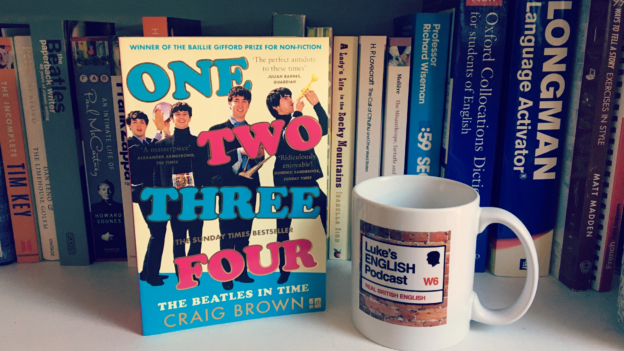
717. Gill’s Book Club: “One Two Three Four – The Beatles In Time” by Craig Brown

Talking to my mum about a book which you could read as part of your English learning routine. The book tells the story of The Beatles and their impact on society. We review the book and then discuss many aspects of The Beatles story, especially the four Beatles themselves.

Small Donate Button

[DOWNLOAD]

Introduction Notes & Transcriptions

Hello listeners, and welcome to the podcast. 

This is a new episode of Gill’s Book club and I’m talking again to my mum, Gill Thompson about a specific book which you might want to read as part of your English learning routine. 

Hello Mum, how are you? 

Introduction

The book this time is all about The Beatles, which is a band from England that you *might* have heard of.

You could read this book, and if you did I’m sure you would learn plenty of things both in terms of language and general knowledge, but there’s no pressure to do so. If you like, you can just listen to this conversation with my mum and hopefully this will be interesting and useful enough on its own. 

But if you are looking for a good book to read in English, then this one could be a good choice, and hopefully this conversation will help you to understand the whole thing a bit more, which in turn should help you pick up more English from it. So, my advice is: listen to this conversation with my mum and if you’re inspired, get a copy of the book and read it, or if you prefer, just listen to us without feeling any pressure to read the book at all. Hopefully this will still be enjoyable and interesting even if you haven’t read the book and have no plans to do so.  

Over 700 episodes and 12 years ago, in the 3rd episode of this podcast, I interviewed my mum about her memories of seeing The Beatles performing live on stage in the 1960s, which she did, twice. 

Now, we’re going to talk about the band again, this time focusing on a book which is all about the Beatles phenomenon and their place in history. The plan is to review the book as a text for learners of English, and then have a deeper discussion about The Beatles. 

You probably know that I’m a big fan of The Beatles and grew up with their music, as my parents were (and still are) fans too. For years I’ve been thinking about doing more episodes about The Beatles story, and mentally preparing myself for it, but I have never actually got round to recording anything, mainly because the topic is just too big and there’s too much to say! But finally I have actually recorded some episodes that might scratch the surface of this topic a bit, and hopefully will give you something insightful and interesting to listen to, whether you are a fan of this band or whether you know almost nothing about them at all. 

So this is going to be the first in a series of episodes in which I talk about Beatle-related things. There’s this one with my mum and then a few episodes with another guest who is an English teacher and something of an expert on The Beatles, and John Lennon in particular.

So, Beatle episodes are coming. I suppose, for some of you, episodes about The Beatles are like busses. You wait ages for one and then loads of them arrive at the same time. 

And by the way, I am certainly not forgetting the main focus of this podcast, which is all about helping you learn English. I think The Beatles can help you learn English, reading is very important in learning English, and so why not do some reading about The Beatles? 

Plus, later in this Beatles series there will be some language-focused episodes, using The Beatles as a context – focusing on some specific descriptive vocabulary and also some analysis of the Beatles’ song lyrics.

Maybe you’re not a fan of The Beatles. This is fine. I’m not going to try to convince you that you should like their music. That’s a matter of taste. But I do think that their story is something else entirely. I think it is hard to deny the fact that the story of these 4 individuals, the things that happened to them and the impact they had on the world – this is all simply fascinating. It’s an epic story. So, even if you don’t like the music, I hope you stay just for the story.

Now, let’s start this episode of Gill’s Book Club, talking about a recently published book about The Beatles.

LengthIs it a long book?

It’s long (642 pages) but the chapters are short, so it’s possible to read it in little chunks.

It’s available in audiobook and Kindle versions.

Appropriacy for Learners of English

The language is modern and plain in style. It’s quite literary of course, because it is a book and not a screenplay or something, but generally speaking it is clearly written and should be readable for learners with an Upper Intermediate level or above, although there will be some difficult words of course, but that’s good. I would say that overall the style is modern, neutral and definitely the kind of English that I would recommend as a good model of English for my listeners.

The short chapters make the whole thing quite easy to digest. It’s in bitesize chunks.

You can dip into it and you don’t necessarily have to read it in order. It’s almost like a collection of essays.

Audiobook version

The audiobook version on Audible is good – different voices and voice actors doing different accents, including pretty good impressions of the main people involved.

Why is it called “One Two Three Four”?

This is the first thing you hear on the first song on side 1 of The Beatles’ first album “Please Please Me”, released in early 1963 – You can hear Paul McCartney counting the band in at the start of the song by saying “1, 2 , 3 , 4”. Also, there were four Beatles, so…


Ending

So there you have it, after more than 700 episodes I finally returned to the topic of The Beatles with my mum and I think it’s fair to say that we went into quite a lot more depth than we did in episode 3 back in 2009, although episode 3 does include stuff we didn’t mention here, specifically my mum’s account of actually seeing The Beatles perform live, twice. So check out episode 3 if you haven’t done so.

Also you could check out that episode in which I asked my uncle Nic to tell us about the time he met Paul McCartney. He told the story in episode 414, and not only has he met Paul, he’s also played football with the members of Pink Floyd and hung out with The Who backstage at one of their concerts, and more. So check that one out too. Links for those episodes are on the page for this one on my website of course.

I really hope you enjoyed listening to this episode. I must admit that although I feel compelled to talk about this subject at length, part of me is concerned that this is all too much for my audience but I suppose those people who aren’t into this can just skip this stuff. It’s completely up to you. But do let me know what you think.

Remember, any time you have any thoughts about what you are hearing on this podcast, if you have responses or comments in your head as you listen, you can express them in English and I will read those comments, and so will many other LEPsters. The best place to leave your comments is on the page for the relevant episode on my website. Go to EPISODES in the menu and find the relevant episode page, scroll to the bottom and that’s where you will find the comment section. I am curious to see what you think. Any Beatle fans, get in touch. Non Beatle fans, I want to know what you’re thinking. Remember, sometimes doing this podcast is a bit like talking into the void and not quite knowing what people are thinking while I’m doing it.

I won’t talk much more at the end here, except that of course there are millions of things I wish I could have mentioned or talked about in this conversation.

We didn’t talk enough about Ringo!

There are also loads of other people and events that I wanted to mention.

I hope I didn’t talk too much.

Just in case this wasn’t quite enough rambling about The Beatles on this podcast, remember there are four (count them) four more episodes on The Beatles to come, but hopefully those episodes will be different enough to justify this series. 

Anyway, 4 more Beatle related episodes are coming up.

One is a discussion about John Lennon.

Another two are language focused and we’ll be talking about adjectives for describing personality traits.

And the last one is about Beatles song lyrics and little phrases and idioms that you can learn from them.

So it’s not just rambling about The Beatles, although that will be part of it too.

Thanks again to mum for her great contribution to this episode, and yes I am lucky to have a mum who is this cool. I appreciate that and I’m really glad to get her voice on the podcast along with my other guests.

And thank you as ever for listening all the way to the end, you are the best.

Take care, look after yourselves and each other and I will speak to you again soon. I think the next episode will be Michael from Poland.  But until then it’s time to say good bye bye bye bye bye.
707. [2/2] Let’s Play Another Text Adventure Game – “Zombolocaust” by Peter Carlson

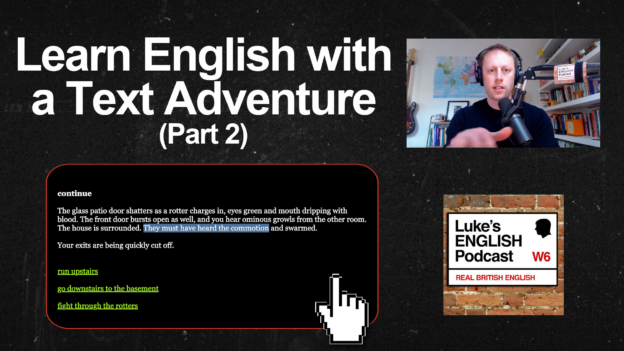
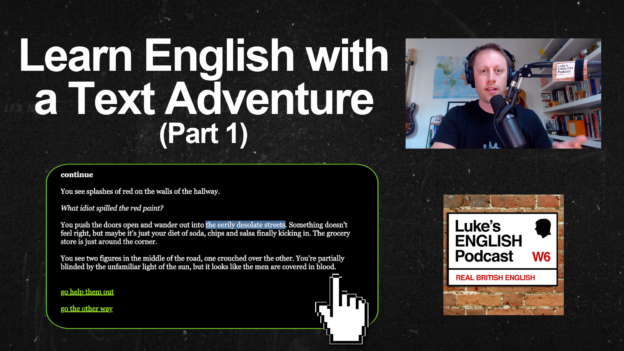
Continuing the text adventure game about the zombie apocalypse from episode 706, with text on the screen so you can read with me while you listen. Video version available. Play the game with me – follow the links below. [Part 2 of 2] Listen to part 1 first!

Small Donate Button

AUDIO VERSION

[DOWNLOAD AUDIO]

VIDEO VERSION

Works best on full-screen mode. Don’t forget to like & subscribe folks! 👍

Links

Play “Zombolocaust” by Peter Carlson https://textadventures.co.uk/games/view/5kjlubyvzuitox6z52xipq/zombolocaust

Text Adventures website http://www.textadventures.co.uk

Part 1 of this episode https://wp.me/p4IuUx-oBr

Part 1 on YouTube

706. [1/2] Let’s Play Another Text Adventure Game – “Zombolocaust” by Peter Carlson

Playing a text adventure game about the zombie apocalypse, with text on the screen so you can read with me while you listen. Video version available. Play the game with me – follow the links below.

AUDIO VERSION

Small Donate Button[DOWNLOAD AUDIO]

VIDEO VERSION

Works best on full-screen mode. Don’t forget to like & subscribe 👍

Links

Play “Zombolocaust” by Peter Carlson https://textadventures.co.uk/games/view/5kjlubyvzuitox6z52xipq/zombolocaust

Text Adventures website http://www.textadventures.co.uk

Part 2 will be available here https://wp.me/p4IuUx-oBv

Notes (used at the start of the episode)

Let’s Play Another Text Adventure Game – Zombie Survival

Let’s just have some fun in this episode, and also work on your English a bit.

I’m going to play another text adventure game.

Read the text and make decisions to progress through the game.

This is good for your English because you can practise your listening and reading, and there’s bound to be some vocabulary that you can pick up too.

This works best if you can read the text that I’m reading too, either by visiting the text adventures website or by watching the video version of this.

I’ll give you some learning tips in a second.

As well as the audio version of this, there is a video version on YouTube and the episode page on teacherluke.co.uk

I’m sharing my screen, so you can see the text that I’m reading.

I’ll try to be clear and to explain things as we go, so this should also work as an audio episode.

textadventures.co.uk – “Zombolocaust” by Peter Carlson

Previous episodes like this in the episode archive at teacherluke.co.uk (search for episodes 338, 339, 425, 426, 612, 613, 614)

Peter Carlson emailed me once and said he was OK for me to do more of his games on the podcast. Nice one Peter 👍

COVID-19 is real (but this game isn’t)

We’re going to try to survive a zombie apocalypse

but there’s a real pandemic happening outside (have you noticed?)

So – wash your hands! Wear your mask! Be careful, good luck! 

We will get through this.

The COVID-19 pandemic is serious, but we still have to have fun.

Luckily, it’s not as bad as a zombie apocalypse.

Link for this game https://textadventures.co.uk/games/view/5kjlubyvzuitox6z52xipq/zombolocaust 

How to use this episode (your options)

  1. Just listen and try to understand (audio only)
  2. Watch the video and read the text with me (YouTube)
  3. Listen to the audio and follow the story on textadventures.co.uk
  4. Listen to the audio and do the text adventure later

Learning Tips

  • Check words and phrases in dictionaries like collinsdictionary.com 
  • Just try to follow the story and work things out from context.
  • Shadowing – repeat after me, with and without the text.
  • But mainly – just enjoy following the story with me.

This might be long, I don’t know! I’ve never played the story before. (It’s two episodes. 1 hour each)

I might split it into parts.

I’m signed in to textadventures.co.uk and I can save my progress, so I can pause and continue later, perhaps in other parts. 

701. Legal English with Louise Kulbicki

Discussing some of the most important terms and concepts in legal English, while also learning about key cases through some amusing stories, with legal English trainer Louise Kulbicki.

Small Donate Button

[DOWNLOAD]

Download Episode Transcript

https://teacherluke.co.uk/wp-content/uploads/2021/01/701.-Legal-English-with-Louise-Kulbicki-PDF-Transcript.pdf

Text Video Version

Uploading soon… here www.youtube.com/lukesenglishpodcast

700. Marooned With My Music: Luke Thompson

Guest host Oli Thompson interviews Luke using a classic format from BBC Radio. Luke is going to be marooned on a desert island but he is allowed to bring 8 pieces of music, one book and a luxury item. For episode 700 this is a chance to get to know Luke and his musical choices a little better. (Transcript and text video versions available)

Small Donate Button

[DOWNLOAD]

Download 100% Transcript

Text Video Version

My 8 Musical Choices

The Return of the Los Palmas 7 by Madness

Cheese & Onions by The Rutles

We’ve Got Johnny Wells by Booker T & The MGs

And Your Bird Can Sing by The Beatles

To Each His Own by Patrice Rushen

Tone Twilight Zone by Cornelius

Bach Cello Concerto in G Major (Yo Yo Ma)

Rule My World by Kings of Convenience

Full Spotify Playlist including loads of music I couldn’t choose as part of my 8 pieces

694. The Crown / The Royal Family (A Royal Ramble with My Wife)

Talking to my wife about the latest season of the Netflix TV drama The Crown, which follows the life and times of Queen Elizabeth II and her family. We talk about Charles & Diana, Margaret Thatcher, The Queen’s accent, Prince Andrew’s BBC interview and more.

Small Donate Button

[DOWNLOAD]

Introduction Transcript

Hello listeners, How are you today? I hope you are doing well. Here’s a new episode of the podcast. 

Several things before we start. 

WISBOLEP

The voting is over in the WISBOLEP competition. Yep, the voting closed on Sunday 6 December at midnight. I will be announcing the results in an episode of the podcast soon. So, stay tuned for that.

LEP Premium – www.teacherluke.co.uk/premiuminfo

Premium LEPsters – hello. I just want to let you know that I have uploaded several premium episodes covering language from my conversation with Lucy in the last episode. I went through the conversation again and picked out over 50 words and phrases that you might have missed, or that I think are worth highlighting and then I presented them to you with explanations, examples, a memory test and pronunciation drills. That’s P28 parts 1 and 2 and it’s in the premium section now. Also, Premium series 27 is underway and I recently uploaded parts 1 and 2 of that to the premium section – they contain some grammar and vocabulary language tips and practice, with pronunciation drills too. Parts 3-8 will be coming up in the next couple of weeks. If you want to know more about LEP Premium including how to get the episodes, and how they can really help your English in various ways – go to www.teacherluke.co.uk/premiuminfo 

JINGLE

694. The Crown / The Royal Family (A Royal Ramble with My Wife)

In this episode I am returning once again to the topic of the UK’s Royal Family. This time I’m talking to my lovely wife about the royals because we’ve recently been watching season 4 of The Crown and so royal stuff is definitely on our minds at the moment. 

Just in case you don’t know, The Crown is a Netflix TV series about the British Royal family. I expect many of you will be aware of it too and maybe you’ve also been binge-watching season 4 recently, like us. Here’s an episode all about it. 

My wife, who is French, is particularly fascinated by the bizarre lives of my country’s monarchs and we often talk about the show and the real events it is based on, so we thought it might be interesting to share some of our thoughts with you in an episode of the podcast. 

If you haven’t seen The Crown yet, and you’re worried about spoilers in this conversation, I don’t really think it is possible to spoil this show as it’s all based on real events which most people know about. In fact, listening to this before you watch the show, could even help you understand it and enjoy it a bit more. Also, if you have no plans to watch The Crown, I think that you can still enjoy listening to this. It’s not just for people watching the show.

I know what some of you will be thinking. You’ll be thinking – “Do you recommend this as a good show for learning English?” 

Yes, as long as you genuinely enjoy it.  I think most people agree that The Crown is good and that it’s interesting – high drama, beautiful to look at, great actors, an interesting topic.

You should also be aware that the characters speak in a very posh accent, which is not how most people speak. It’s not massively different to, let’s say, “normal English” but you should be aware that they do sound very posh and have a posh accent. It’s important to hear a wide variety of accents in English, because this is the nature of the language. It’s a diverse language and you need to take that into account when learning it. You should be able to understand the various accents and hopefully be able to identify them to some extent anyway.

So, overall – yes, I think it’s a good show to watch and can definitely be useful for your English.

To get more specific tips about how to use TV shows like this to improve your English, listen to episode 660 of my podcast.

The Crown is currently in its 4th season, which deals with the period in which Maragaret Thatcher was the Prime Minister, and when Prince Charles married Lady Diana Spencer – later to be known as Princess Diana. So this is the late seventies, the eighties and the early nineties. 

In this conversation you will hear us talking in the usual rambling fashion about things like:

  • What we think of the show, including descriptions of how it looks and the production in general
  • The performances by some of the actors 
  • Accents you can hear in the show, especially the high RP which is spoken by the Queen and other royals.
  • What the show makes us think about specific members of the family, their stories, their relationships with each other and how they are represented in the show
  • What the show makes us think about the institution of the monarchy itself, including some of the pros and cons of having a royal family – for the country as a whole, but also for the individual members of the family itself who enjoy the luxuries of their privilege but are bound by the duties that they have to the crown 
  • We also assess the reign of Elizabeth II, and talk about “Operation London Bridge is Down”, which is the codename that refers to the official plan for what will happen in the days after the death of Queen Elizabeth II, when that inevitably happens. It’s actually quite extraordinary and makes you realise how significant The Queen is to the nation.
  • We also end up talking about the recent scandal involving Prince Andrew, who is one of The Queen’s four children – he’s the third one in fact. I don’t know if you are aware of this scandal, but it was big news in the UK. It is actually a disturbing and shocking story, but it’s also fascinating. I am referring to Andrew’s association with Jeffrey Epstein, who was convicted of the trafficking and prostitution of underage girls. Epstein died in prison in pretty suspicious circumstances. The official story is that he committed suicide but plenty of people believe that he was killed in order to prevent the truth from coming out. Anyway, Andrew was allegedly one of Epstein’s friends or “associates” let’s say and in fact one girl who was a victim of Epstein’s has made claims against Andrew specifically. In response to those claims, Andrew chose to conduct an interview with the BBC in 2018 . He wanted to deny all the claims against him, but the interview did not go very well and it was a bit of a PR disaster for Andrew. I find it absolutely fascinating as well as disturbing and I’ve been wondering for ages whether I should discuss it on the podcast. Keep listening to find out more about this whole story.

The Royal Family Tree

Before we start properly I think it will really help if I remind you of the basic family tree in the Royal Family.

So there’s The Queen of course. Queen Elizabeth II. She has been Queen since 1952 and that’s the longest reign of a UK monarch in history. Her husband is known as Prince Philip, the Duke of Edinburgh. In season 4 of the show The Queen is played by Olivia Coleman and Philip is played by Tobias Menzies.

The Queen’s mother was also called Elizabeth but she was commonly known as The Queen Mother. She died in 2002.

The Queen had a sister, called Margaret, known as Princess Margaret, played in the show by Helena Bonham Carter. Margaret also died in 2002, less than 2 months before The Queen Mother, in fact.

Queen Elizabeth and Prince Philip had 4 children. The oldest is Charles, the Prince of Wales and the heir to the throne. Charles married Lady Diana Spencer in 1981 and she became Princess Diana of course. They had two children. The first is William, now the Duke of Cambridge and married to Kate Middleton, the Duchess of Cambridge. They have three children. The oldest is George and he is third in line to the throne after Charles and William. 

Charles and Diana’s second child is Harry who is now married to Meghan Markle. Harry and Meghan are to some extent cut off from the royal family as they chose to leave their public duties fairly recently, and they were quite heavily criticised for that. William, Kate, Harry and Meghan don’t actually feature in the show, but they do come up in this conversation.

Charles and Diana’s marriage ended in divorce in 1992. Diana of course died tragically in a car crash in Paris in 1997.

Charles later married Camilla Parker-Bowles, who he had been romantically involved with since before he married Diana. Charles and Camilla are now known as the Duke and Duchess of Cornwall.

The Queen’s other children are Princess Anne, Prince Andrew and Prince Edward.

That’s probably enough information about the family tree there, but I decided it was probably a good idea to remind you of their names and their positions in the family, just so you definitely know who we are talking about.

Anyway, I won’t go on much longer here in the introduction, except to say that my wife  enjoys being on the podcast from time to time and she loves talking about this topic, but she’s a little bit self-conscious about speaking English in front of my entire audience like this. But I assured her that my audience are all lovely and non-judgemental and that she has nothing to worry about – so, listeners, don’t let me down. OK? 

Right then, I hope you now can enjoy sharing some time with us in our living room, having quite a long and rambling conversation about The Crown and all things Royal and here we go…

—–

Video Clips

That moment when Charles said “Whatever love means anyway…”

When The Queen met Michael Fagan after he broke into her bedroom

https://www.youtube.com/watch?v=M5sDg5Nkqjc&ab_channel=MJLourensMJLourens

Ending

There’s nothing more for me to add here except this:

  • What do you think about all of this? I mean about the royal family and all that stuff. Do you feel sympathy for the individual members of the family?  Have you seen The Crown? What do you think of it?
  • We didn’t talk much about Margaret Thatcher, played in this series by Gillian Anderson who first became known for playing Scully in The X Files. We are fans of hers, and my wife thinks her performance in the show was great. I’m not so sure. I partially agree. Anyway, we couldn’t cover everything in this conversation.
  • Finally, what do you think – should I do an episode all about the Prince Andrew interview on the BBC?

Thank you for listening.

Reminders

Premium LEPsters – check out the app and the website for the latest premium episodes. If you’d  like to sign up go to www.teacherluke.co.uk/premiuminfo 

WISBOLEP – I’ll be revealing the results and talking about what happens next in a forthcoming episode, soon.

Right, so I will speak to you again soon, but for now – goodbye!

683. Feelgood Stories of Flirting with Marie Connolly

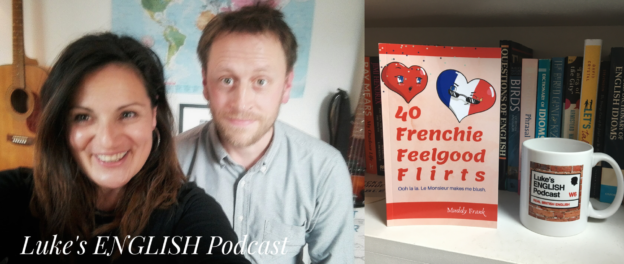
Marie Connolly is an Australian stand-up comedian and TEFL teacher who has written a book of short stories about times when men (from various countries) have flirted with her. In this episode Marie shares some of those stories, tells us about English men vs French men vs Australian men and much more. Small Donate Button[DOWNLOAD]

Transcripts & Vocabulary Notes for this episode (promos, introduction, ending)⤵

LEP Premium Promo

Before we start – a quick mention about LEP Premium. Premium LEPsters, I just want to let you know that P24 is now finished and uploaded. It is an epic series – homophones, jokes, building your vocabulary (which is so important) and also working on your pronunciation. I’ve also uploaded P25 which contains pronunciation drills for the previous free episode (LEP682) which was all about English accents. I said I’d do a pronunciation episode for that, and I’ve done it. You can practise saying the sentences with my normal accent, and also with several regional accents too. The aim being to strengthen both your listening skills and your speaking skills.

WISBOLEP Competition

Second thing – the WISBOLEP competition deadline is 15 October. Is that clear? Originally I said 31 October but the date has changed! The deadline is now the 15 October 2020. If you don’t know what the competition is, check out episode 681. But this is episode 683, and I’m keen to get started, so let’s go…

Introduction

Hello and welcome back to LEP. It’s new episode time again! This is an episode with a guest. So you’re going to be listening to another authentic conversation at natural speed in English which can be difficult to follow but is good training for your English. Before going any further, let me explain the title of this episode. “683. Feelgood Stories of Flirting with Marie Connolly” Feelgood is an adjective (one word) which we use to describe anything that makes you feel good! For example we can say a feelgood film, feelgood food and or feelgood stories, which would be stories that will make you feel good. Feelgood stories of flirting Flirting means interacting with someone in a way that shows that you fancy them, find them attractive, and are probably interested in perhaps getting ‘romantically involved’ with them, let’s say. Synonyms include ‘chatting someone up’ , ‘hitting on someone’ or perhaps ‘trying to pick someone up’. A person can be a flirt, and the adjective is flirtatious. Feelgood stories of flirting with Marie Connolly And Marie Connolly is my guest in this episode.

Marie Connolly

Marie is a stand-up comedian, a ski-instructor, an English teacher and writer. Her latest book is full of short stories about flirting with the opposite sex. Before we meet Marie, let me give you some context to help you understand this conversation, which can ultimately help you learn more English from it. Marie is from Australia but she has lived in a few different countries. It’s a bit of a stereotype that Aussies like to travel away from Australia (this is called Going on Walkabout), but in this case it’s true. Marie has spent time in various places including Brisbane, Syndey, London, Liverpool, The French Alps and now Paris. Marie was born in Australia but her dad was from Liverpool and her mum was from El Savlador in central America, which is quite an interesting combination. For those of you who are interested in accents and pronunciation – Marie has a slight Australian accent because that’s where she grew up. It’s not super strong, but you should be able to notice it a bit. Here are the main things you’re going to hear us talking about: As you might expect we chat a bit about stand-up comedy, what it’s like dealing with tough moments on stage and reasons why it can be hard to do stand-up in front of audiences of non-native speakers. I’m afraid to say that the infamous Russian Joke story makes yet another appearance, which is my fault because as you’ll hear, I’m the one who brings it up. I know, I know. I can’t believe I’m still talking about the Russian Joke, and some of you are now saying “Wait, what’s the Russian Joke?” Long-term listeners will know all about this. Clearly I have deep mental scars from this experience which still haven’t healed. Either that or I secretly love telling this story. If you don’t know what I’m talking about, just keep listening because I am going to tell the story once more. Yes, I know. Marie gives some thoughts on Liverpool where some of her cousins live, and her favourite English shops for buying clothes, which leads to some chat about Marks & Spencer – the quintessentially English clothing and food shop, which also has branches in Paris where you can buy proper tea. (not property, no – they don’t sell flats and houses, no I mean “proper tea” good quality tea) ….I’m now pausing for laughter… Marie tells us about her time living and partying hard in London, and then her decision to move to France to work as a ski instructor at a ski resort in the Alps, while making trips to Paris to perform comedy gigs. You’ll hear some details of Marie’s comedy shows in English and French in Paris. At the moment she is doing her own one-woman show in English called “Sydney, London, Paris, Darling”. You can see it if you’re in town, COVID permitting of course. At the moment, in France, Theatres are still allowed to open and Marie’s show is in a theatre so it’s still on. If you’re in town why not come and check it out? She is very funny and has some great stories to share. Then we move on to talk about the latest book that Marie has written, called “40 Frenchie Feelgood Flirts”. It contains 40 short stories. This is yet another book recommendation on the podcast. I think it could be a really good thing to read, if this is your cup of tea. Short stories are perfect for learners of English, because they’re short – do I need to say more? It’s chick-lit, which means books primarily for women that usually include romantic themes. The stories in Marie’s book are all cute anecdotes about times when men have flirted with her, hit on her, or chatted her up. There’s no explicit sexual stuff in Marie’s book. As Marie says it’s just innocent fun. So it’s less “40 Shades of Grey” and more “40 Shades of Hey, How are you doing?” — I’m now pausing for more laughter and applause, thank you — The rest of the episode is mainly Marie sharing some of her stories of flirty moments with men who she has encountered. She also talks a bit about how French men are different to Australian or English men. What do you think the differences might be? What do you think Marie is going to say about the way a French man will approach her, compared to an English or Australian man? Hmmm, have I piqued your interest? I hope so. Listen on to find out the details.

VOCABULARY

Vocab hunters – Here is some language which you can simply notice as you listen. When you hear these things, take a mental note. I know you are keen to get to the conversation, but bear with me. This will be useful for your English, and that’s what this is all about at the end of the day (and the beginning of the day, and the middle of the day, etc) Trust me, I am a professional. I’m not explaining this all now, I’m just saying it so you can notice it yourself when it comes up naturally. If you don’t understand these phrases, don’t worry. I will explain it later in the episode. But you might be able to work it out from context as you listen. *There is some swearing*
  • To backtrack – “You can’t backtrack” [this one comes up twice]
  • To stick in someone’s craw – “It stuck in my craw. It bothered me.”
  • To be over it – “Maybe I’m not over it”
  • Deep scars – “Maybe there are deep scars”
  • To wilt – “I wilted in front of them”
  • To be sick to your stomach – “I was sick to my stomach”
  • To be swallowed up – “Can I please be swallowed up?”
  • A halterneck top (an item of women’s clothing that is quite revealing) “I was wearing a halterneck top”
  • To snuggle under the duvet – “If I could have, I would have snuggled under the duvet and just stayed in bed for a year.”
  • ______ by name, ______ by nature – “Alex Love, our mutual friend; lovely by name and lovely by nature.”
  • A coping strategy – “Every comedian has their own coping strategy”
  • To rectify – “Get back on stage as soon as possible and rectify”
  • Dainty / pastries – “I’m not used to French dainty pastries, I prefer the big fat Australian ones”
  • Self-soothing
  • To pay through the nose – “I will pay through the nose. I just want the best tea I can get.”
  • A hub / antipodeans – “It was a hub for antipodeans”
  • To be up shit creek (without a paddle) – “Because of Brexit I’m up shit creek.”
  • A snapshot of something – “It’s a snapshot of life in France”
  • To be hit on / to be picked up / to be complimented – “40 times I’ve been hit on, picked up or complimented by men”
  • Abs – “One was very white but he had super-fit abs”
  • White vs Pale (to describe a person)
  • Calf muscles
  • A sand castle
  • To blush – “He would blush and I would feel amazing.”
  • The contents (of a book) / to pique someone’s interest – “Can I read through the contents to pique people’s interest?”
  • To mime – “He started swimming with his hands. He was miming and I was laughing.”
  • A man bun – “He had long hair up in a man bun. I called him Mr Man bun.”
  • Chick-lit
Ok so try to notice those things, maybe try to guess what they mean and I’ll be explaining them on the other side of the conversation. But mainly, I hope you just enjoy listening to this chat. Now, get ready because things are going to speed up a bit, as we meet Marie Connolly…

Ending

Thank you again to Marie. After finishing the recording, we realised there were other stories we’d forgotten to tell, including the time Jerry Seinfeld turned up at one of our little comedy shows in Paris and performed in front of about 20 people including Marie and me, and how it was just a little bit awkward, but still amazing and quite surreal. Jerry Seinfeld at one of our shows? What are the odds? So Marie will have to come back for another episode in which we can describe that experience for you. Just a reminder about Marie’s comedy show (if you’re in Paris) and her books (which you can get anywhere in both paperback and Kindle versions). The One-Woman Comedy Show “Sydney Paris London Darling” you need to check her Facebook page – Marie Connolly Comedy. https://www.facebook.com/marieconnollycomedy/ Marie’s books, including “40 Frenchie Feelgood Flirts” Marie’s page on Amazon where you can find her books. The main one we talked about is “40 Frenchie Feelgood Flirts”. She writes under the pseudonym Muddy Frank (read the titles of the books available)

Explaining the Vocabulary

Let’s go through that vocabulary again, from the beginning of the episode. Did you notice any of the words and phrases I listed before? Did you get a sense of what they mean? Let me go through them again, and I’m going to clarify them as quickly as possible. I’m not giving these phrases the full LEP Premium treatment (because I like to go into lots of detail in those episodes) I might put them into an upcoming episode of LEP Premium so I can make sure you learn the vocabulary properly and we can do the usual memory tests and pronunciation drills as well. But now, this is the sort of quick version. Let’s call it the 10 peso version. The vocabulary is already listed above ⤴️ Still not sure about the meanings? Try using www.oxforddictionaries.com to check them out. Other online dictionaries are available.
And that is the end of this episode. What’s coming up in the future? Who knows – nobody can predict the future, except weather forecasters. As usual I have more episode ideas than time, but I do have a few interviews lined up, including some more friends you might not have heard on the podcast before, and some regular guests that you’re probably waiting to hear from too [yes episodes with Amber & Paul are in the pipeline, it’s just a bit tricky to find times when we are all free]. Basically – more conversations with guests are coming up as well as the usual episodes on my own on various topics. So, it’s going to be more of what you normally get with LEP! Right, I will let you go now. Thank you for listening. Check the episode page on my website where you’ll find transcripts for 95% of what I’m saying in the introduction and ending parts of this episode, plus other things like a photo of Marie and me (oh Luke, a photo!?) plus the comment section and things like that. I often put other things on the website page for you to check out as well, including little YouTube videos relating to the episode or other bits and pieces. I look forward to reading your comments on the website. Follow me on Twitter @englishpodcast which is where I am also quite active. Sign up to LEP Premium to access all the other episodes I make, all focused on helping you build your English in various ways. www.teacherluke.co.uk/premiuminfo Have a good one. Be excellent to each other, and party on in your own sweet way.

Speak to you soon. Bye bye bye…

681. New Competition: Why I Should Be On LEP (WISBOLEP) / Story: The First Time I Said F*ck

Announcing a new LEP competition which everyone is welcome to enter, plus an anecdote about the first time I said a rude word in front of my parents. Send your competition entries to podcastcomp@gmail.com

Small Donate Button[DOWNLOAD]

LEP Premium Promo

LEP is brought to you by LEP Premium. This is how I pay for this podcast, along with donations from kind philanthropic listeners using the PAYPAL DONATE BUTTONS. LEP Premium though is my paid subscription service which includes loads of audio and video content to help develop your grammar, vocabulary and pronunciation. You can get episodes in the LEP App or online, with PDFs, tests and pronunciation drills. For all the information you need go to www.teacherluke.co.uk/premiuminfo 

Notes & Transcriptions for #681

Hello everyone! In this episode I’m going to tell you about a new competition for LEP, which you can enter, and then I’m going to tell you a true story of something that happened to me when I was a child. In fact, the title of the story is “The First Time I Said F*ck”. I’m reluctant to blurt out the F word so early in the episode, but anyway, the story is about the first time I swore in front of my parents, and it’s a story I wrote for doing stand up comedy on stage, but I’m going to read it out on the podcast today.

But first, what about this new…

Competition

I’ve decided to launch a new competition and I’m going to tell you all about it in this episode.

I hope you feel welcome to take part. Everyone is invited to enter this competition, and that includes you, so I hope you consider taking part this time.

I mentioned this in the last episode and got a number of positive responses from people saying things like “I really hope you do the competition!” and so on.

Again, I want to say thanks to a listener called Vadim for prompting me to do this. 

It’s been ages since the last competition (the last one concluded with episode 407 – the interview with Kristina from Russia) and I sort of wasn’t planning to do a new one, but then Vadim sent me this email and I just thought “OK, why not!?”

Here is Vadim’s message (with some error correction).

There are a few errors in here I’m afraid, Vadim. I’m going to correct those errors as I go along, hope you don’t mind.

New Competition?

Vadim

Hello, Luke!

I have an idea for new competition! It’s been awhile, since you have launched one.

I have an idea for a new competition. It’s been a while since you launched one.

So, an idea is very simple. It will be called WSIBOLEP, or Why Should I Be On Luke’s English Podcast [Actually, I’ll call it WISBOLEP – Why I should be on LEP]. 

So, the idea is very simple. It will be called WSIBOLEP

All you need, it’s just ask your listeners to record a little voice message, telling Why you MUST interview them on your Podcast. 

All you need to do is just ask your listeners to record a little voice message saying why you must interview them on your podcast.

Because I believe that you have a lot of interesting people listening to you. Russian oligarchs, pornstars, ex-nazis hiding in Argentina, bobsleigh world champions, writers, celebrities, presidents, royal family members etc, etc.

And then your listeners will vote for the person who has a story that they want to listen to in more detail.

What do you think about it? I believe that it will be a good way to encourage people to do a bit of a practice and stop being a ninjas [being ninjas]. And those who don’t want to take part in this competition can just have a fun [just have fun], listening to exciting intriguing stories from all around the world.

Well, I actually think this is a fine idea and I’m curious to see what happens. 

Let’s do another competition on LEP.

The prize this time – being interviewed in a full episode. I hope you consider that to be a prize!

WISBOLEP (Why I should be on LEP)

So let me summarise the plan for this competition.

You have to:

  • Record up to 2 minutes of audio explaining why you should be interviewed on LEP, then send it to me at podcastcomp@gmail.com (only)
  • Listeners will hear all of the clips and vote for the person they want to hear, then I’ll interview the winner.
  • Remember: You are talking to the listeners, not to me. 
  • You can use a script, or no script, but I encourage you to not use a script, and instead make some notes and do some improvising too. If you do read from a script, make an effort to make it sound natural, rather than robotic.

Also, if you’re wondering how to record – it’s pretty easy these days. You could make a voice recording on your phone and send it to podcastcomp@gmail.com or you could use Quicktime on a Mac or the equivalent on a PC and then email it to podcastcomp@gmail.com or you could use SpeakPipe.com – just go to speakpipe, record a message, put your name on it, then send the link to podcastcomp@gmail.com

What am I going to say?

Now, you might be thinking, “what am I going to say?”

Well, first, remember that you’re trying to persuade the audience that you should be on the podcast, so think of some reasons you should be on, and not just because you really want to (although that’s ok too).

Basically, you’re saying “Hi listeners, Hi Luke. Thanks for this opportunity, and this is why I think I should be on LEP…”

Then you’d need to explain why you should be on LEP (obviously).

Remember, you have UP TO 2 minutes. This means that you don’t have to do 2 minutes. It could be 1 minute if you like, but no more than 2 minutes. 

2 minutes is your maximum allotted time. 

You might be thinking “Just two minutes?? That’s not very long.” 

I’ve chosen 2 minutes because I need to keep this manageable! I have no idea how many people will send me entries to this competition, but since I’m going to be playing the audio recordings on the podcast, I need to limit how long they are, otherwise I’ll have too much audio. So, 2 minutes MAX, please. If your recording is over two minutes, it might not be entered into the competition.

Here are some ideas of why you should be on LEP.

Ideas

  • Maybe you have an interesting story to tell – either related to English, to the podcast, or to neither of these things! Do you have something interesting you could share with us? Some kind of story, perhaps related to you or someone else?
  • Maybe you want to talk about how you learn or have learned English, and give some advice.
  • Perhaps you’ve had some success with a particular technique that you could share with the listeners. 
  • Perhaps you have experienced progress in some way, and you could share that. 
  • Perhaps you discovered the podcast in a special way. 
  • Perhaps the podcast has been a way for you to connect with other people. 
  • Perhaps you met your partner because of LEP, or got a job because of LEP.
  • Maybe you have an interesting story or experience relating to English that you can share.
  • Perhaps you have a cross-cultural experience you could talk about.
  • Maybe you are involved in something interesting that you think people will want to know about.
  • Perhaps you are particularly funny, or have something to offer to the audience.
  • Or maybe you’re just up for a proper conversation with me, on the podcast!
  • And maybe you just have something original to say.

In any case, prepare two minutes – with or without a script – in which you convince the audience that you should be picked for a feature length episode of LEP. 

Then record it and send it to me! And then maybe you will be on LEP.

This competition is open to everyone. Anyone and everyone can take part, regardless of your level of English. 

This is Why I Should Be On LEP – WISBOLEP

I expect the rules this time might limit the number of participants, because some people will be too shy. But I still hope that people send me recordings! 

I expect there will be fewer entries than before, but hopefully I’ll still get some people! 

So, if you have something to offer the audience, get in touch and try to persuade everyone to pick you for LEP!!

In terms of level of English, as I said – there are no rules at all. 

You can have a low level, you can have a high level. 

It’s not about who has the best English. 

It’s more about who would be the most interesting and engaging guest, not just because of their level of English. 

DEADLINE

15 October. That’s your last chance. Midnight on 15 October 2020. [Previously the date was 31 October, but I have changed it]

As I said, I’ll probably get fewer people sending me recordings this time, but we’ll see – I often underestimate this kind of thing. 

Last time I had over 100 recordings which was great, but obviously that was a ton of preparation work for me – downloading all the recordings, preparing them, balancing out the sound levels of each one, making them into podcast episodes, dealing with the voting and counting etc. Quite a lot of work as you can imagine! I don’t mind of course, I liked hearing from everyone, but it messed with my workflow quite a lot!

But do send me your recording, especially if you have something interesting to say to the audience. 

When I’ve received all the recordings, I’ll edit them together, play them on the podcast and let you vote for the one you want.

Then I’ll arrange an interview with that person, and Bob’s your uncle.

So there you go! That is the new competition – WISBOLEP – Why I Should Be On LEP.

  • 2 minutes max
  • Persuade the audience to choose you for a full-length interview
  • Send your recordings to podcastcomp@gmail.com
  • Competition closes at midnight 15 October 2020.

I hope you take part even if you’re not completely sure. 

Go to the page for this episode on my website to read the rules and the details again if you like. Teacherluke.co.uk then click EPISODES and this is episode 681.

Feel free to ask questions in the comment section.

———

Premium LEPsters, I just wanted to remind you that P24 is drawing to a close. We’ve been through my massive list of homophones and expanded your vocab a bit in the process, now there are just two episodes left and they’re the ones that feature the jokes (not just crap ones made up by me). So P24 parts 11 and 12 are in the pipeline and will be coming to your Premium subscription soon.

To get the premium episodes, download the LEP App on your phone to listen to the episodes, or listen online. For all the info you need, go to www.teacherluke.co.uk/premiuminfo

679. Gill’s Book Club: A Gentleman In Moscow

Talking to my mum again about her latest book recommendation. A Gentleman In Moscow is about a Russian Count who is put under house arrest in 1922 in the beautiful Metropol Hotel in Moscow. 

[DOWNLOAD]

LEP Premium Promo

This episode is sponsored by LEP Premium. With Luke’s English Podcast I have two podcasts in fact. There’s the free episodes, which feature monologues, conversations with guests or specific topics. That’s where you get to listen to natural English on a regular basis, presented to you, for you. Then the premium episodes are all about language. Often I take samples from free episodes, then break them down for target language which I teach to you, help you remember and pronounce correctly. So the double whammy is to listen to LEP and also be a premium subscriber, to get the maximum benefit from my work. To get started with LEPP go to www.teacherluke.co.uk/premiuminfo for more info.

Introduction Transcript

Welcome to Gill’s Book Club, on Luke’s English Podcast.

This is the second Gill’s Book Club episode and this is where I talk to my mum, Gill Thompson, about books that she’s enjoyed.

My mum loves books, she’s a voracious reader, a member of a book club with her friends and she works in a second hand bookshop.

She gets through loads of books, and so this is naturally a topic that we can explore together on the podcast.

How does this work?

We pick a book a few months in advance, give people a chance to read it, then talk about it on the podcast, including some of the main plot points (no spoilers) characters, context and details.

Do you have to read the book too?

No. We’ll explain the main plot points without giving away any spoilers.
But you can read the book if you like, or get the audiobook version.

You could read the book first, then listen. Or listen first, then read the book, or just listen without reading the book at all, and enjoy hearing my mum talking about it, the characters, the story and so on. There might also be some nice vocabulary coming up which you can notice as we go along. As usual, check the episode page on my website to see some vocabulary notes and transcripts.

For other episodes I’ve done with advice on reading books to improve your English, check the episode archive.

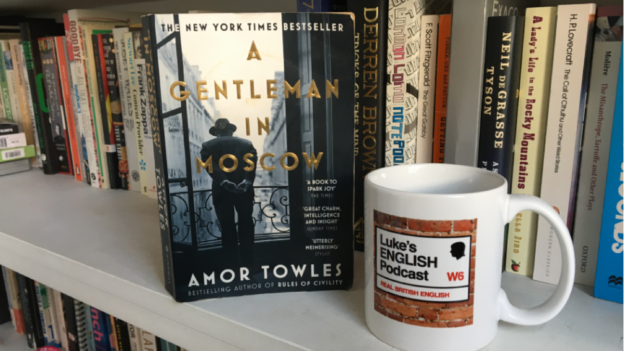
I said earlier this year that the book we’d be talking about is A Gentleman In Moscow, by Amor Towles, and so that’s the main topic of conversation here.

A Gentleman in Moscow is a 2016 novel by Amor Towles. It is his second novel, following the release of the New York Times bestselling novel Rules of Civility. The novel concerns Count Alexander Ilyich Rostov, a man ordered by a Bolshevik tribunal to spend the rest of his life in a luxury hotel in the heart of Moscow. Wikipedia

There’s a bit of smalltalk at the beginning, and then we get stuck into the book.

I’ll talk to you again on the other side of this conversation, but now, let’s listen to my mum talking about her latest book recommendation.

——

Vocabulary Notes & Questions

Can you comment on these things with reference to the characters and events in the book?
Manners
Integrity
Loyalty
Vocabulary
Class

Do these words apply to Count Alexander Rostov?
Witty
Likeable
Standoffish
Spoiled
Privileged
Glass half full / Glass half empty

Does he change during the book?

House arrest
Did this book make you think of the lockdown?
If you had to be on house arrest, but you can choose any building you like, which building would you choose?
Which building would you choose to be locked inside? (not your own home)

Book club
What did the women from the book club think of it?

Book recommendation
The Year of Reading Dangerously by Andy Miller

Picture of Ivan the Terrible
https://booksyo.files.wordpress.com/2015/01/repin_ivan_terribleivan.jpg

Ivan the Terrible and His Son Ivan on 16 November 1581 is a painting by Russian realist artist Ilya Repin made between 1883 and 1885.

Ivan the Terrible and His Son Ivan on 16 November 1581 is a painting by Russian realist artist Ilya Repin made between 1883 and 1885.

Ending Transcript

So there you are. That was my lovely mum talking about a lovely book and it was all lovely lovely lovely.

Again, check out the page for this episode on my website for vocabulary notes, and the names of the different books and things that we mentioned, plus the chance to see that painting of Ivan the Terrible and more.

I’m still deep inside P24, having published 9 out of 12 parts. More coming for premium subscribers soon…

Later today I’m interviewing my dad.

I don’t like to talk on the podcast about stuff I’m going to do, because I’ve learned that often things don’t go as you expect and it’s unwise to make the listeners think that something is coming when it actually can’t happen because of a technical issue or a scheduling problem or something.

So, who knows, we might not be able to actually do the recording, but the plan is to talk to my dad later today, also about a book. But this isn’t a book that he’s read, written by someone else, it’s actually a book he’s written himself. Yep, he wrote a book during the lockdown. What’s with all these books!? About 5 people I know have written books during the lockdown, including my dad. So stay tuned to LEP in order to (hopefully) listen to a conversation with Rick Thompson about his new book.

Thanks again to my mum for her contribution to this episode.

I hope you all enjoyed listening to it and as ever I look forward to reading your comments and responses to this episode in the comment section on my website, but also on YouTube where you can find all my episodes, and you can keep in touch on social media, my favourite being Twitter and my handle is @EnglishPodcast

Take care everyone. I’ll speak to you again soon, but for now, good bye…