Tag Archives: english

416. What was the most popular episode of LEP in 2016? + more podcast statistics

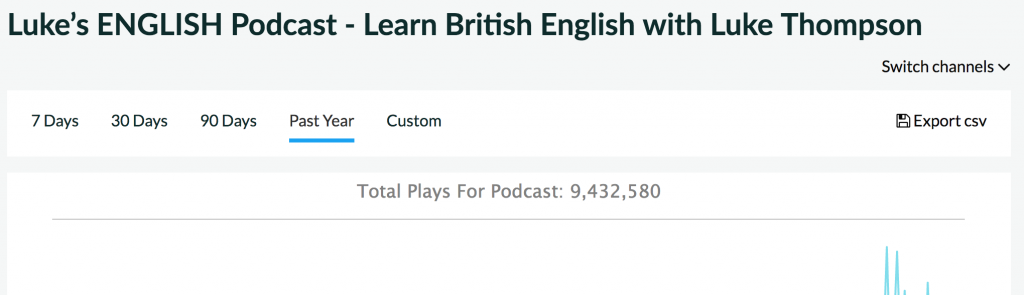
Here is an overview of how 2016 was for Luke’s English Podcast including some details about the top 5 episodes, the top 20 countries, and more statistics for the last 12 months.

Small Donate Button[DOWNLOAD]
Plenty of people said that 2016 was a pretty crap year, mainly because of what happened in politics but also because of the number of well-loved celebrities that we lost. But it was a pretty good year for LEP.

In fact 2016 was the best year ever for this podcast.

It got nominated for a BC Elton award, and I’ve had more listens this year than in previous years. In fact the figures have been going up steadily since I started the podcast. For some reason the downloads shot up in September and continued to climb, reaching a peak in December.

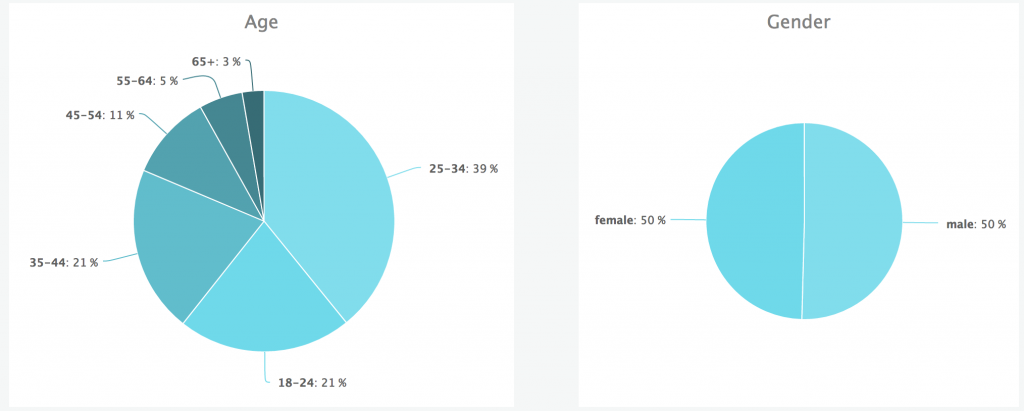
Here are some stats for you

Screen Shot 2017-01-12 at 16.00.14

Top Countries in 2016

  1. China
  2. Russia
  3. Japan
  4. United Kingdom
  5. Spain
  6. South Korea
  7. Poland
  8. Germany
  9. Ukraine
  10. United States
  11. Italy
  12. Brazil
  13. Australia
  14. France
  15. Turkey
  16. Vietnam
  17. Taiwan
  18. Czech Republic
  19. Thailand
  20. Canada

Thanks for listening!

Why do you think episodes 396, 398, 337, 409 and 392 are the most popular of 2016?

Screen Shot 2017-01-12 at 16.00.14


Also, what’s your favourite episode?

415. With the Family (Part 3) More Encounters with Famous People

Here’s the final part in this trilogy of episodes recorded at my parents’ house on Boxing Day. In this one my mum, dad and brother tell us a few more anecdotes about their encounters with some well-known people.

Small Donate Button[DOWNLOAD]

Introduction Transcript + some ad-libs

The conversation you’re about to hear was recorded with my family on the same day as the last couple of episodes. It was quite late in the evening, after my uncle and aunt had gone home and after dinner and number drinks had been consumed. Picture a very warm and cosy living room with a wood burning stove going in the background.

After listening to Nic describing his encounters with some famous rock stars earlier in the day, the other members of my family wanted to get in on the action too with their stories about brushing shoulders with the stars. So here are a few other anecdotes from my dad, my brother and my mum.

It turns out that my family have met some genuine legends. I didn’t even realise that a couple of these things had happened. You’ll have to wait and see who they are. But here are some slightly cryptic clues.

Can you guess which people I’m talking about?

  • One of the UK’s favourite authors who wrote a series of beloved books which have also been made into successful films.
  • A British comic actor who likes eating ice-creams and fighting zombies, criminals and aliens, in his movies (not real life of course).
  • A small but very important woman who often appears in public but is also a very private person.
  • A nonagenarian who once said that he was “the only man in the country not allowed to give his name to his own children.” A nonagenerian is someone in their nineties – also, septuagenarian (70s) and octogenarian (80s).

There are others too, including an American punk rock star with lots of tattoos and muscles, a Shakespearean actor who has become a successful film director and an actor who had a bit part in the British TV series The Office.

I should perhaps remind you of several other anecdotes which you might have heard on this podcast before, which are mentioned in this conversation.

  • The time my brother ended up lost in Hastings and slept on a stranger’s sofa and woke up to discover the guy sitting in a chair next to him. Was the guy just friendly and welcoming, or slightly creepy? Originally told by my bro in this episode https://teacherluke.co.uk/2016/08/09/372-the-importance-of-anecdotes-in-english-narrative-tenses-four-anecdotes
  • The time my mum met the King of Tonga. Originally told in this episode too https://teacherluke.co.uk/2016/08/09/372-the-importance-of-anecdotes-in-english-narrative-tenses-four-anecdotes
  • The time I met comedian Eddie Izzard and was a bit lost for words. I sort of went to pieces a bit and made it really awkward and weird by saying “You’re in my head!” – not the right thing to say at all. Originally told be me in this episode https://teacherluke.co.uk/2014/06/10/184-lukes-d-day-diary-part-2/

Anyway, you can now sit back and enjoy some more time with The Thompsons.

***

Outro Transcript + ad-libs

Funny, isn’t he? My brother. I would like him to be on the podcast more often, if he’s up for it. The thing is that he’s a bit modest really and isn’t the sort of outgoing person who likes to broadcast his thoughts and opinions over the internet, although he obviously should because he’s got a lot to offer. He ought to do a podcast or something like that, right? He does have a YouTube channel but it’s mainly skateboarding. https://www.youtube.com/user/VideoDaze/videos

*All the background music in this episode was also made by James*

The people mentioned in this episode

If you liked this one, try listening to these ones

79. Family Arguments and Debates (with The Thompsons)

322. With The Thompsons

372. The Importance of Anecdotes in English / Narrative Tenses / Four Anecdotes

OLYMPUS DIGITAL CAMERA

414. With the Family (Part 2) My Uncle Met a Rock Star

Listen to my uncle Nic telling some stories about British rock stars he has met over the years, including an encounter with one of the most famous musicians in the world!

Small Donate Button[DOWNLOAD]

Introduction (transcript)

In this episode I’m going to play you another conversation which I recorded during the recent Christmas holiday. In this one you’re going to hear my brother and me talking to our uncle Nic about some of the amazing rock stars that he’s met over the years.

Nic has always been a huge fan of rock music and because he was born in the early 1950s he saw many of Britain’s greatest rock stars performing live on stage quite early in their careers. I’m talking about the late 1960s, throughout the 70s and beyond.

So, Nic has met a lot of musicians at gigs but he also just has a knack for bumping into rock stars in normal everyday situations and then being very cool, calm and casual in their company. It’s almost like they’re on the same wavelength or something.

Anyway, my brother and I have always enjoyed hearing Nic’s anecdotes and I’m very glad to have recorded some of those stories for this podcast.

If you’re a fan of rock music, especially some of the classic bands of the 60s and 70s then I’m sure you’re going to be impressed by some of the people my uncle has met, talked to, and even had breakfast with.

And there is one person in particular that he once bumped into – who is not only a bonafide legend of the music world, but also just one of the most famous people on the planet today. Any idea who that is? Well, to find out just listen on.

So, here’s a chat with my Uncle Nic, with some help from James.

I say “help” from James, what I mean is that he just takes over the interview at one point because he thinks he can do a better job than me, and maybe he’s right. Anyway, that’s enough rambling… here’s the conversation.

***

Thank you very much to Uncle Nic and belated happy birthday to him too.

Let us know what you think, and which one you think is the most impressive story. Because they are impressive stories, aren’t they. Come on! Paul McCartney of The Beatles. Pink Floyd! Fast Eddie from Motorhead!

[socialpoll id=”2411231″]

I realise there will be people out there who don’t really know a lot of the people we were talking about. I’m sure you know Paul McCartney, but you might not know The Who, Motorhead, Pink Floyd (hard to imagine), The Damned, Slade…

And I’m sure there are others too, not necessarily in the toilet but in other situations, but who knows.

VIDEOS

The Who – Pete Townshend, Keith Moon, Roger Daltry, John Entwistle

https://www.youtube.com/watch?v=sanAHVITCDY

Motorhead – “Fast Eddie” & Lemmy

Free “All Right Now” live at The Isle of White Festival (1970)

Paul McCartney & Wings “Junior’s Farm” (Nic’s favourite)

Pink Floyd recorded at Live 8, Hyde Park in 2005

Slade in 1973

https://www.youtube.com/watch?v=Qu_ozjAu_vM

The Damned

Have you ever met a famous musician? Let us know in the comment section.

audience-868074_1280

413. With The Family (Part 1) Mum’s Cooking + Vocabulary (with Uncle Nic)

Happy New Year! I hope you’re well! Here’s the first episode of LEP in 2017 featuring a conversation with my family and then some vocabulary explanations.

Small Donate Button[DOWNLOAD]

Introduction

I had a lovely Christmas and New Year. We played games, ate loads of food, went to the pub, took walks and generally had a good time with each other, as planned.

My uncle Nic (my mum’s younger brother) and my auntie Rose (Nic’s wife) were with us too, which was really nice because it’s always great to spend time with them, and I’m glad to say that I managed to get Nic on the podcast, which is something I’ve been meaning to do for ages because he’s great and he has some good stories to tell, as you will hear.

I didn’t get a chance to do a lot of recording with my family because it was the holiday period and I didn’t want to stick microphones in people’s faces too much.

But on Boxing Day I managed to do some recordings with my uncle, my mum, my brother and my dad.

I’m going to play those recordings to you over the course of the next two episodes.

In this episode you’ll hear these things:

  • My mum and my uncle talking about specific methods of cooking a really good Christmas dinner
  • Some vocabulary explanations – because there are loads of good words and phrases relating to cooking and food preparation, and also some other general bits of vocab that crop up in the conversation that are worth learning.
  • A bit of rambling at the end of the episode about the holiday period, including a quick report about the Christmas Olympic games that my Dad organised for us and some other bits and pieces

Part 1 (overview)

We start with James and Uncle Nic talking about how early in the morning it is, because we recorded this before breakfast on Boxing Day. This is probably the first pre-breakfast podcast I’ve ever done.
My wife accidentally spills some coffee down the back of one of the armchairs in the living room and you’ll hear that there’s a bit of commotion and disturbance in the background as people run around and she desperately tries to clean it up.
My uncle and I ask my mum about the secret to cooking a succulent, moist turkey, which apparently is done using a process called basting.
My uncle expresses some concern about the cleanliness of the microphone covers I’m using, asking if they have been sterilized, and that leads to a slight tangent about Health & Safety in the workplace.
We then get back to talking about my mum’s turkey technique with some explanations of exactly how to make sure the meat stays moist all the way through the cooking process. Moist is the key word here obviously, as the word is repeated a few times until my brother interrupts by shouting “stop saying moist!”
We then turn to the vegetables and go on a bit about how my Mum prepared the sprouts, carrots, potatoes and parsnips. There are a couple of other interruptions from James, including a joke about the secret of comedy and then an explosive sneeze. Throughout all of this my wife is still rushing around in the background and searching the internet for “how to get coffee stains out of an armchair”.
We talk briefly about the complications of preparing Christmas lunch with a vegetarian at the table, as my auntie Rose is a veggie.
Talk then turns naturally to sweet food and my uncle Nic expresses some disappointment about the lack of a traditional Christmas pudding at the table the evening before.
Finally, my Auntie Rose arrives in the room and sits in the chair that my wife spilled coffee onto, but thankfully my wife has already managed to clean it all up, without my help, there’s no evidence of a spillage, so it looks like my wife got away with it.

So, now you can actually listen to that conversation as it happened and when it’s over I’ll go through some of the vocabulary in more detail so you can not only understand everything my family say but also so you can actually learn loads of vocabulary properly and add it to your active English.

Conversation extract starts
Conversation extract ends

That was quite a short bit of conversation, wasn’t it! By the usual standards of LEP, it was quite short. But there’s more coming in the next episode.

Vocabulary

I said before that I would go through some of the words and phrases in that conversation in order to help to boost your learning process.

A lot of phrases related to specific ways of cooking and preparing food were in there. There were also lots of other nice bits of vocab too.

So, this is the language section of the podcast. As I am explaining the vocabulary, you can think about these things:

  • Did you notice these words and phrases while you listened?
  • Did you already know them or are they new to you?
  • Did you misunderstand or mishear any of them?
  • What other words go with these words? Try to notice words in groups, chunks or phrases.
  • How exactly are these words and phrases pronounced? How is the pronunciation different from the spelling. Remember to check the page for the episode to see the words written down in order to check their spelling.
  • After my help, would you be able to use these words in your own conversations?
  • And will you use these expressions? That’s a question, but also a request! I wonder if you will use them, and I suggest that you use them too because that’s how you will make them a part of your active vocabulary.

As I’m going through this list you can test your knowledge – see if you really know these words and phrases properly.
You could repeat some of this language after me as well. Do some shadowing.
And I suggest that after listening to me explain all this vocab that you go back and listen to that conversation extract again, try to notice the vocabulary when you hear it and see how much more you understand.

Vocabulary List

You can tell what time it is based on the rapidity of his response. (rapid – adj / rapidly – adv / rapidity – noun)
My wife’s just spilled/spilt tea all over the armchair.
To spill / spilt / spilt (UK spelling)
To spill / spilled / spilled (US spelling)
A spillage (noun)
The secret to a succulent, moist turkey is basting.
Succulent (adj) = tender, juicy and tasty (for meat)
Moist (adj) = slightly wet (can be used to describe food, e.g. moist turkey or moist cake, but it also can describe anything else which is slightly wet and for that reason the word is a bit suggestive and rude-sounding)
Moist / moisture / moisturise
Paul Foot – Moist Cake bit. Essentially he’s making the observation that when someone serves you some home-made cake you have to compliment the person by saying how moist it is! Even if it’s not that moist. “Oh, this cake is so moist! How did you get it so moist!” There’s social etiquette which dictates that you have to compliment the person on how moist their cake is, and you have to do it quite quickly. “Mmm, it’s lovely this cake – so moist! How did you get it so lovely and moist! Whenever I make cake it’s so dry! I’m an awful cook, but your cake is so moist!” – it’s polite to compliment the person who made the cake.

https://www.youtube.com/watch?v=SM_F6VWF40s?start=62

A ladle (noun) / to ladle (verb)
They make a heck of a din. (the bells)
A hell of a …
A heck of a …
A din = a loud and unpleasant noise
“You’ll be the judge of that” – a way to emphasise that someone has to make their own judgement about something.
Also: “I’ll be the judge of that” – used to express some anger while saying “I will make that judgement – not you!” e.g. “I make the best tea in London”, “We’ll I’ll be the judge of that!”
Have these microphone covers been sterilised?
To sterilise something (verb)
Health & Safety legislation
Fire extinguishers are in good order.
To trip over the carpet.
To sue you for a lot of money. To sue the shop.
Line the dish with lots of foil and then put some turkey stock in the base of the dish.
Giblets
Sprouts
She sliced the sprouts.
I saw it in a recipe book.
It cuts the cooking time down.
Stove / oven / cooker / cook
Oven = a large metal device with a door in which you cook food at high temperature.
Stove = an oven, with gas or electric hobs on the top where you can cook things over heat
It’s also something which heats your room. You burn wood and coal in it. E.g. a wood-buring stove in the living room.
Cooker = a device which cooks things – it can be an oven, a stove, or just an electric pot, slow cooker etc.
“What’s the secret of comedy?” …Timing.
Parsnips (root vegetable)
“Tatties and neeps” (Scotland) = potatoes and parsnips
You have to parboil them, drain the water off, roast them in hot oil in the oven (just a little bit).
You mean like, deep-fry them?
No, just roast them.
In the last minute rush and fluster I forgot about the potatoes.
Gill took it upon herself to do poached pears and caramelised oranges.
She’s sitting in the chair that Luke’s wife spilt coffee on so it might be a wee bit damp.
wee = little (typical word in Scotland)

In forthcoming episodes…

More conversations with my family, including some anecdotes about meeting famous people – with stories about meeting members of the royal family, some legends of TV comedy and perhaps the biggest rock and roll star on the planet right now. Who do you think that is? Well, my uncle met him once. You can hear that story and others in an upcoming episode.

Also on the podcast soon I’m hoping to record a ramble about some general stuff that happened over the Christmas period, including some words about a few books I received as presents, some comments about the well-loved celebrities that we lost in 2016 including, notably Carrie Fisher and George Michael during the Christmas holiday. We lost some great people at regular intervals during the year. Let’s hope 2017 doesn’t continue that trend.
Also, I’ve seen Rogue One: A Star Wars Story and I will be doing a full episode about that too.

So, brace yourselves, more podcasts are coming!

But for now – GOODBYE!

Background music – JukeDeck – make your own tunes at www.jukedeck.com

410. Teaching 12 Idioms in the Street / On the Set of Paul’s TV Show (with Amber)

Amber & I teach you 12 idiomatic English phrases while attending the filming of an episode of Paul’s TV show on the street in Paris. See below for videos and photos, and a list of the idioms with definitions.

Small Donate Button[DOWNLOAD]

Introduction

In the last couple of episodes do you remember what happened? Do you remember what our plans were? Yes, Amber & I talked about Christmas and all that. But also, you might remember that we were planning to go and visit Paul on the set of his TV show and record a podcast while we were doing it, and that’s what we did last Thursday afternoon. We went to the 7th Arrondissement – a rather posh district on the left bank of the river Seine. We saw the film crew, a few scenes being filmed and Amber & I even appeared in one of those scenes as extras in the background. When the video is released you’ll be able to see us, briefly! It will be the one about French cinema, when that is released. By the way Paul’s TV show is broadcast on Saturday evenings on French TV station Canal+ and then released onto YouTube the following week. His YouTube channel is called “What the Fuck, France?”

Unfortunately they weren’t filming in the English pub as expected because they did that in the morning – so no beer or crisps or warmth or beer. Instead we joined them while they were filming in the street outside a little church. So, a street, a church and no warmth or beer.

Despite the harsh conditions and lack of beer I brought my recording equipment and we did a podcast while standing around with the film crew there, and all the local Parisian people in the street going about their lives, walking past us and even talking to us at certain moments.

You’re going to hear descriptions of what was happening during the recording, and some general chat with Amber. There were also a couple of moments where Paul stopped shooting and came over to join us, with a few other people too in some cases, including Robert Hoehn who you might remember from the “Have you ever…?” episode recently.

As well as the conversation and descriptions, there’s some English teaching in this episode because while standing there on the street I realised I had 12 idioms in my pocket, written on little bits of paper. Of course I did because as an English teacher that’s the kind of thing I have in my pocket – a bunch of idioms in pieces of paper. It pays to always be prepared as an English teacher! I sometimes have teaching materials in my pocket or up my sleeve! I actually had the idioms on me for another podcast episode that I’d planned ages ago but didn’t do – but the idioms came in handy this time and provided us with some teaching content for you.

All of the idioms you’re going to hear were taken from the Oxford Idioms Dictionary and I chose them quite carefully because I think they’re all expressions which are commonly used today.

You can find the list of those idioms on the page for this episode. I wonder if you know them all. You might know some, but do you know them all, and do you use them?

Now, I could list them all for you here in the introduction in advance, and even teach them to you in advance, but I’m not going to do that because I want to encourage you to notice them for yourselves. That’s a good skill to develop if you can. You should always be on the lookout for bits of language which you can identify and eventually make part of your active vocabulary. So, listen carefully to notice the idioms, and then keep listening because in the second part of the lesson Amber & I explain all the idioms for you.

So, that’s what you’re going to get – a podcast recorded in the street in Paris, with all the sound effects of what was happening around us, a couple of guest appearances, and then 12 common English idioms taught by Amber and me!

So, I hope you are feeling comfortable and that you’re cosy and warm – because it was bitterly cold on the streets of Paris when we recorded this! I recommend listening to this one when you are indoors, with the heating turned on and a hot drink nearby, or if you are outside make sure you’re wearing a pair of thick woolen mittens or gloves and a warm hat – unless of course you’re in a hot place like Australia or something, in which case you can just bask in the hot weather and try to avoid being bitten by a snake or spider or something. If you’re in Brazil then go to the beach or something like that and get ready for that big party you’re going to have on Christmas Eve.

Anyway, now let’s go back in time to last Thursday afternoon on the very chilly streets of the 7th Arrondissement of Paris with a film crew and rich old Parisian ladies walking around, and let’s begin the episode, and remember – can you spot the 12 idioms, do you know them and can you use them? Here we go.

The 12 Idioms

  1. To cost an arm and a leg = to be expensive (those cameras must have cost an arm and a leg)
  2. As a rule of thumb = as a general rule
  3. To flog a dead horse = to be futile
  4. To get back to the drawing board = to start again
  5. To be over the moon = to be delighted
  6. To hit the nail on the head = to say something which is totally accurate
  7. To drive someone up the wall = to drive someone mad / to make someone very annoyed
  8. To find your feet = to establish yourself
  9. Break a leg! = good luck! (for performers)
  10. Hold your horses! = hold on! Wait! Slow down!
  11. To go the extra mile = make an extra effort
  12. The ball is in your court = it’s your turn to make a decision

Also

  • To get fired / to be let go
  • A housewarming party
  • To see red
  • To have your cake and eat it too

Over to you!
What is your version of the idiom “You can’t have your cake and eat it too”?

Photos & Videos

Introduction

In the street

From left to right: Rob, Amber, Luke, Josephine (costume lady), Paul

From left to right: Rob, Amber, Luke, Josephine (costume lady), Paul


with Josephine (costume lady), Vlad (Director of Photography) & Robert Hoehn

The finished episode of WTF France

This is the episode that was being filmed during this episode. Check out the cameo apperances by Rob (2:26), Amber (2:30) & me (2:35).

Outro (with mistakes & no edits!)

Other stuff

Message from a Chinese LEPster about “Pudong” near China

I’d like to just clarify something that was said on the podcast in episode 408 when Paul and I made some silly jokes about the word “Pudong” and we talked about Pudong area near Shanghai in China. Paul brought it up when we were talking about pudding and none of us were too sure about the name Pudong and what it really means. I got a message which clarifies that.

Here’s the message from Sylvia from China. I was a bit worried that she was offended by our crappy jokes (particularly mine), but she assures me that she’s not offended and that she still loves us, so that’s alright. In any case I wanted to read this out because it’s got proper information about Pudong. If you remember, Paul said that he wasn’t sure exactly what the name meant and that one of our listeners could clear it up. Well, here is that clarification.

Dear Luke,

I want to make several things clear here in episode 408, in which Paul talked about Pudong in Shanghai. I live in Shanghai now, and the content of the conversation made me a bit uncomfortable.

1. It’s not ‘Pudong River’, it’s called ‘Huangpu River’.
2. It is ‘Pu’, not ‘Poo’.
3. ‘dong’ in Chinese means ‘east’, Chinese character ‘东’.
4. ‘Pudong’ is an area, which is on the east bank of the Huangpu River.
Pudong is situated on the east coast of the Huangpu River of Shanghai, and sits at the intersection of China’s coastal belt for international trade and the Yangtze River estuary. It is backed up by the Yangtze River Delta urban megalopolis and faces the boundless Pacific.

Pudong New Area (“Pudong” or the “New Area”), in eastern Shanghai, is named because it is located to the east of the Huangpu River.

screen-shot-2016-12-20-at-16-10-08

Now Pudong New Area has become the economic, financial, trade and shipping center regionally and internationally. In 20 short years, a dramatic change has taken place in Pudong, changing from farmlands into high buildings and from out-of-the-way villages into a prosperous urban area. Pudong has become the “Pearl of the Orient” with world attention, acclaimed as the “epitome of Shanghai’s modernization” and the “symbol of China’s reform and opening up”.

screen-shot-2016-12-20-at-16-10-16

Cruising on the Huangpu River, you can see many European style buildings on the western bank, because Shanghai used to be a foreign concession before 1949. At that time, Shanghai was known as the ‘paradise of foreign adventures’. Many foreigners, mostly Europeans, came to try their luck here. That’s why you can see buildings of different architectural styles here, Spanish, Greek, Roman and Russian. While on the other bank, skyscrapers in the Pudong New Area rear high into the sky, which were all built by Chinese people after 1990.

Luke, welcome to China, welcome to Shanghai, welcome to Pudong. And I hope when Paul comes to your place again, you can show him this, and let him make it clear.

Merry Christmas! Happy New Year!

Luke
I’m sorry this made you uncomfortable. No offence intended – I was just making a joke, and failing (as usual). I appreciate the information about Shanghai – would you mind if I read out your message on the podcast?

Sylvia
hello Luke
I knew it was a joke, that’s okay. It’s just that Pudong New Area has alway been a prosperous Area in my mind, but from now on everytime i think of it or come to there it will remind me of those jokes you made…Haha…
It would be great if you could read it on the podcast. Because i don’t want Paul to mislead people around the world thinking that China has a ‘poo dong river’. You can say my name, that’s okay.
And I know Amber And Paul didn’t mean any offence.
Always love you!
Sylvia

spoken_full_logo_transparentSPOKEN

Don’t forget to check out Spoken. 2 free lessons and then 20% off! English lessons for Professionals on WhatsApp, sent straight to your phone by an English teacher. http://www.getspoken.com/lep

408. Catching Up With Amber & Paul #4 (+ videos)

Amber & Paul are back on the podcast and we do the usual catching-up session and go off on a few tangents about Amber’s play, Paul’s showbiz life, marshmallows, microphones, tea & coffee, accents and more. There are videos for the intro and outro of this episode (below).

Small Donate Button[DOWNLOAD]

INTRODUCTION

This episode sees the return of pod PALs Amber Minogue and Paul Taylor, which means that The Talkative Trio are reunited on the podcast once more.

Time was pretty tight for this conversation because Paul was working to a very strict schedule on the day it was recorded, which was yesterday in my flat.

As you’ll hear, Paul arrives a little bit late because he was having lunch with some TV industry people and then he has to leave before the end of the recording to be interviewed on the radio, because he’s so hot right now in the world of showbiz.

Amber has also been very busy recently doing various things including writing and rehearsing a play, so it’s been hard to get the three of us in a room together all at the same time.

As a result this episode was arranged at the last-minute and the conversation was completely unplanned. All I wanted to do was to catch up with the two of them and ask the usual question: What have you been doing?

You’ll hear that things carry on quite rapidly and there are plenty of the usual tangents – those moments when the topic suddenly goes off in a different direction.

It might be hard to follow, so to help you keep up, here’s a basic summary of the main things that we talk about. You’ll find these notes written on the page for this episode, including some words that you might hear in the conversation but not know. You might want to check these notes to see words that you might have missed, to check their spelling etc.

  • First of all Amber tells me about the play for children that she’s been working on with our friend James Simpson.
  • Paul then arrives, you hear the buzzer buzzing and he comes in carrying a bag containing a new iPhone 7, still in its box, which he collected from the shop earlier in the day. It’s a present which all his friends bought for him a few months ago for his 30th birthday, organised by his girlfriend. We all chipped in some money and got him a new phone.
  • Amber tells us some more things about her play, including how it contains a few slapstick moments, meaning some funny scenes of fairly violent physical comedy involving a first-aid box and some marshmallows. Apparently at one point in the play James hits Amber over the head with the first aid box. By the way, a first-aid box is a box that contains basic medical supplies for administering first-aid, that’s why it’s called a first-aid box. It contains, things like plasters, bandages, antiseptic, tiny scissors, and maybe some other little medical things that you don’t understand etc.
  • Also in the play they also fight over a marshmallow, which Amber wants to dip into her tea.
  • This leads us to talk about dipping things into cups of tea, like marshmallows and biscuits, which then causes us to talk about what you put in your tea when you’ve run out of milk, which actually happened to Paul the other day. His solution was to use whipped cream as a substitute.
  • That leads me to ask the question of whether you really can put cream in tea, and we agree that you can definitely put cream in coffee, especially a particular type of coffee which is served with whipped cream on top, which in France is called café Viennois – which I think translates as a Viennese coffee – or a coffee from Vienna.
  • That causes me to ask what they call a Viennese coffee in Vienna, speculating that they might just call it a coffee, which leads to a similar question about the French phrase “creme anglais”, which translates literally as “English cream” – but in the UK we just call it “custard”.
    I then ask Paul and Amber to explain to you my audience what custard is, and Paul suggests that instead of us explaining it at great length, you could just ‘google’ it.
  • I remind Amber & Paul that it is necessary to explain some words sometimes, like the word ‘custard’, because this is Luke’s English Podcast and it’s probably a good idea to explain words sometimes.
  • This prompts Amber to comment on the way that I seem to choose to explain words quite randomly in my episodes – like when I recently spent quite a lot of time explaining the word ‘flea’ in a recent conversation I had with my Dad on the podcast.
  • We then go back to food and talk about typical English puddings which can be served with custard, including crumble, sticky toffee pudding and the oddly named ‘spotted dick’.
    I refer to spotted dick as a dessert, which causes Amber to comment that this is the wrong choice of word and that I should say that it’s a “pudding” not a “dessert”.
  • This brings up the slightly confusing and long-running debate about the correct choice of words to describe certain things in Britain, especially in relation to the dinner table. This all relates to British rules of etiquette and language in polite society, perhaps relating to French vocabulary we sometimes use in English. We don’t talk about this very clearly and it might be a bit confusing for you, and really the whole subject of the rules of British etiquette and social class deserves an episode of it’s own.
  • Nevertheless, in order to clear it up a bit, here’s a quote from a book called “Watching the English” by Kate Fox. Kate Fox is a social commentator who writes about social behaviour in England, and “Watching the English” is a good book that explains many things about English life. This is what Kate has to say about the words “pudding” and “dessert” in English. By the way, both these words are used to refer generally to sweet food which is served after the main course. You have the starter, then main course, then the pudding/dessert. Your choice of the word ‘pudding’ or ‘dessert’ seems to depend on your level of class, and apparently according to upper-class culture the word “dessert” is vulgar. Kate Fox: ‘The upper-middle and upper classes insist that the sweet course at the end of the meal is called the ‘pudding’ – never the ‘sweet’, or ‘afters’, or ‘dessert’, all of which are déclassé and unacceptable’ (Fox, 2005, p79). So, according to upper-class etiquette, pudding is the correct term for the sweet course that comes at the end of the meal. Fine. Amber seems to think this is because the word “dessert” is of French origin, but I’m not sure. By the way, in some places (e.g. France and Japan) pudding is a specific kind of dish. For example in Japan ‘pudding’ is a sort of caramel or custard creme dish. In the UK it just means the sweet course at the end of the meal and can include all kinds of things, like cakes, pies, ice-cream, trifle, Eton mess, bread and butter pudding or even jelly. “What’s for pudding?” for example.
  • I try to explain all of this, but I can’t manage it, instead saying “This is tangent city” when I realise that we keep going off on mad tangents and it’s probably quite confusing for the audience – that’s you.
  • Our talk of pudding then causes us to start talking about Pudong, an area in Shanghai, and specifically the Pudong River in Shanghai. Paul tells us a bit about that and then there are a couple of references to the slightly rude sounding English words ‘poo’ and ‘dong’ before things settle down a bit and we start talking about Paul’s recent showbiz news, including how he is going to be interviewed on a radio station called “Oui FM” later in the afternoon, so we go from poo to wee in just a few sentences.
  • At one point Paul nearly uses quite a clever word – ‘concise’ but then doesn’t use it, preferring instead to choose a more simple way of putting things “using the least words possible” (which means to be concise).
  • We talk about responses to Paul’s recent videos including a few YouTube comments & some criticism he received from a serious person in an email (the criticism was in the email, not the person – you can’t put a person in an email).
  • Things get quite geeky when I then start talking about cameras and microphones and the challenges of capturing good audio when you’re recording videos.
  • There’s some talk of different types of microphone, including boom mics, lapel mics, dynamic mics and shotgun mics but then Amber decides it’s all getting a bit too geeky and we move onto something else.
  • We make plans to hang out again on Thursday on the set of Paul’s TV show while they’re doing some filming, and we decide to record a podcast while we’re there.
  • Following on from my recent episodes about accents, I ask Paul & Amber what their accents are, and what they think my Dad’s accent is, and Amber declares her love for my Dad.
  • Then Paul has to go for his radio interview on “Oui FM” and leaves, and Amber & I carry on and talk a bit more about her play before having a massive conversation about Christmas which will probably be uploaded in a forthcoming episode.

So, I hope that helps you understand what you are about to hear from the Tangential Trio. But, now, without any further explaining – here is that conversation as it actually happened!

JINGLE + CONVERSATION

‘OUTRO’

Amber and I started talking about Christmas there and we went on to talk about it for ages – like over an hour of chat about Christmas shopping, games, food, family traditions and everything else relating to the festive time of year. That conversation will continue in the next episode, maybe the episode after.

We talked a little bit about Paul’s English in that conversation.

People sometimes say “Paul’s accent/English is influenced by his French”.
It isn’t. Certainly not his accent anyway.

That’s one of the interesting things about Paul. When he speaks French there is pretty much no trace of an English accent in his speech, and when he speaks English there is no trace of a French accent.

Other announcements

LEP Moscow Get-Together
Hey Luke!
Well, the very first LEP Moscow GET-TOGETHER has just happened! The first of it’s kind, it seems to be a historical :) event in Russia! Everything went great, it was awesome to chat in ENGLISH with like-minded people!!! Personally I felt as if I had known all of the participants for ages – open, nice and smiley friends! I hope somebody else could feel a similar thing.
First, we got to know each other, which was the main achievement! It was interesting to know when and how everyone had found LEP one day, which episodes were our favourite ones, which experiences in English language learning we had (useful Internet resources, grammar books, pronunciation etc.)
A couple of pics and a short audio message from us to you are attached.
Thanks again and again for that announcement and actually for everything you do!!!
We hope to provide more listeners with a chance to meet and speak regularly and one more way to let them know is to “friend” your group on FB with ours https://www.facebook.com/groups/734996946664425/ and VK https://vk.com/clubnu1 .
Have a nice Monday, Jedi-Podmaster!
Dmitry

Here are those Moscow LEPsters saying hello!

Transcript Collaboration
~ well done everyone!
Thank you especially this month to Antonio for managing everything.
There is an email now for the Orion team. Just write a comment on the page for the transcript collaboration and Antonio will let you know what to do.
Make sure you read the rules.
Transcript collaboration page: https://teacherluke.co.uk/episodes-with-transcripts/transcripts/ 

Daniel Goodson – My Fluent Podcast
A LEPster podcast in which you can join Daniel in his quest to become better and better at English.
Daniel interviewed one of the managers of the Transcript Collaboration – Piotr from Poland
http://www.myfluentpodcast.com/e20-interview-with-piotr-from-poland-transcribing-transcript-collaboration/

Zdenek’s English Podcast
Also, on the subject of LEPster podcasts – Zdenek Lukas continues to do his show, called Zdenek’s English Podcast. Recently he’s been doing episodes about his experiences studying for the DELTA (Diploma in English Language Teaching for Adults) which is a seriously challenging postgraduate qualification in English teaching, which involves not only a lot of writing about linguistics and teaching methodologies, but also plenty of assessed teaching sessions too. It’s a difficult course with many challenges and many things to learn. You can listen to Zdenek talking about it on his podcast in some recent episodes.
Get it here https://audioboom.com/channel/zdeneks-english-podcast

Join the mailing list for direct access to the page for every episode, and for any other content I put up, including videos that I might start doing with my new camera soon.

That’s it! Cheers!

VIDEOS

Here’s one of Paul’s “What the F*ck France?” videos. This one’s about how it’s difficult to learn French.

LEP VIDEOS

Here are a couple of bonus videos of me recording the introduction to this episode, and a failed attempt at recording the outro too (I forgot to press ‘record’ on my audio device!)

They’re in black & white because I think it looks cool. The gorilla ↴ is pink, ok! 

Thanks for watching. I’m just experimenting with videos at the moment, but if you like them, I might do more.

The Russian Joke appeared in US TV show Parks & Recreation – watch until the end

https://www.youtube.com/watch?v=VxQ_ywY-luE

Music credits

Jazzy xylophone tune & piano tune by BenSound – www.bensound.com

Other music by me, or by my brother James Thompson.

407. Reflections on Language Learning & Working as a Translator: Interview with Kristina from Russia, Winner of the LEP Anecdote Competition 2016

In this episode you’ll hear me talking to Kristina from Russia, the winner of the LEP anecdote competition this year. We talk about her work as a translator and interpreter, her reflections on language learning, how she learned English to a good level and some other bits and pieces.

[DOWNLOAD]
Small Donate Button

Introduction transcript

Hello! Welcome back to the podcast. In this episode I am talking to Kristina from Russia. If you’ve heard episode 403 of this podcast you’ll know that she is a listener who won my anecdote competition this year. Her anecdote was about how she ended up having to interpret for Emir Kusturica – the famous Serbian film director, on stage at a film festival in front of an audience of movie industry people with absolutely no preparation.

It sounded stressful and it’s also impressive that she managed to get through the whole thing successfully, without running screaming from the building.

Kristina’s story was the clear winner in the final round of the competition. It was interesting to hear about how she described that stressful and exciting experience and how her language skills were involved. The prize for winning, as suggested by one of my podcast listeners, was to have a one-to-one Skype conversation with yours truly (that’s me).

We did that the other day. We chatted on Skype for nearly an hour, with her in Saint Petersburg and me in Paris, and I thought it might be interesting to record part of the conversation for an episode of this podcast. Kristina agreed and so, in this episode you can hear the result.

So in this episode you are going to hear Kristina talking about

  • How she became a translator and interpreter
  • The differences and challenges of those two types of work
  • How she has learned English to her current level, and some general reflections on language learning (by the way she speaks several other languages including Norwegian and German)
  • The way she maintains her level of English and how listening is an important part of that process

I think Kristina is an example of someone who has not only managed to learn English to a proficient level but has also built a career around her language abilities. It was lovely to speak to her and I hope you enjoy listening our conversation.

So, without any further ado, here is Kristina from Russia, the winner of the LEP anecdote competition 2016.

* CONVERSATION *

Announcement: LEP Meeting for Conversation in Moscow

Here’s a message from a listener in Moscow called Dmitry:

Is here anybody from MOSCOW?!
A friend of mine is organizing the first MEETING of The Moscow LEPsters Conversation Club – a club for those who study English, like Luke’s podcast and want to develop speaking skills as well! Everybody is welcome on Sunday, December 11th at 4pm in the Wooden Door anti-cafe. We intend to discuss Luke’s podcast, your favorite episodes, drink tea/coffee, eat cookies, SPEAK and have fun! The meeting itself is absolutely free BUT the anticafe charges everybody 2 roubles per minute. Coffee and cookies included in this standard price. [Luke: About 1.7E per hour for free cookies and coffee? Not bad!] REGISTRATION: just send your name and several words about you (if you wish) to smartnb@mail.ru or click “I will participate” on the Facebook page
Link here: https://www.facebook.com/events/275649646170689/
It will be great to share emotions and ideas! See you on Sunday at 4pm!

Let me know if you’re planning an LEP Get Together in your area

If you’re planning an LEP Meeting in your area, let me know and I can spread the word!
Getting together with like-minded people and having some fun speaking English is a great idea! It can be a great way to practise speaking and you can make some friends too.

Music

Background music (introduction): Jukedeck – create your own at http://jukedeck.com

Other background music: Jim Thompson https://soundcloud.com/jt-2000 and here https://jt2000.bandcamp.com

405. British Accents in The Lord of the Rings (Part 2)

In this episode we continue to analyse the various British accents that you can hear in the film version of The Lord of the Rings. Let’s consider the accents of some of the main characters, such as Frodo, Sam, Pippin, Merry, Treebeard, Elrond, Boromir, Gandalf, Saruman, Legolas, Gimli and the orcs.

Small Donate Button[DOWNLOAD]

Frodo and Sam at the river (Frodo: English RP, Sam: English West Country)

Merry, Pippin & Treebeard (Merry: mild Manchester – Stockport, Pippin: Glasgow Scottish, Treebeard: old fashioned Scottish? RP with traces of Tolkien’s made-up elvish accent?)

Boromir at the Council of Elrond (Elrond: Heightened RP, Boromir: RP with traces of Yorkshire)

Sean Bean interview with Larry King (Sean Bean: Sheffield in Yorkshire, England / Larry King: Brooklyn NYC)

Gandalf and Saruman (Heightened RP / trained thespian actors at their best!)

Gimli & Legolas (Legolas: Heightened RP, Gimli: Welsh, which sounds Scottish at times)

Orcs (Cockney! Oi Oi!)


one-does-not-simply

402. The Rick Thompson Report: What’s Going On? Nov. 2016 (Post-Truth Politics, Cricket and Tetris)

Last week I asked my Dad for his opinions about recent news and we talked about Brexit, post-truth politics, the US election, the right-wing press in the UK, the political landscape in the EU, the rules of international cricket and the music from Tetris. You can listen to the conversation in this episode. Introduction and and ending transcriptions available below.

Small Donate Button[DOWNLOAD]

Introduction Transcript (script begins 1 minute into the episode)

My Dad is back on the podcast in this episode and in a few moments you’re going to hear our conversation which I recorded last week on Thursday 17 November 2016.

In the conversation we touch on these subjects: the weather (naturally), a bit about the rules of international cricket, then a Brexit update including details of the recent UK high court decision regarding the government’s power to trigger Article 50. Article 50 is a piece of legislation (part of the Lisbon Treaty) that when triggered begins the legal process of the UK’s exit from the EU. We’re not actually out of the EU yet, despite the result of the referendum. We have to wait for the government to ‘trigger article 50’ and then it all starts.

“Trigger article 50” – it sounds like something from Star Wars episode 3 “Revenge of the Sith”. In fact it feels like the political narrative these days is getting more and more similar to the plot to a Star Wars prequel, with lots of complex negotiations with shadowy trade federations, insidious political manoeuvring and the general sense of an impending journey towards the dark side, which is a pity isn’t it? “Trigger Article 50!” In Star Wars episode 3 it’s “Execute Order 66” which is an order by the evil emperor Palpatine to have all the Jedi assassinated by their own soldiers. “Execute order 66” “Trigger Article 50!”

But no, this isn’t Star Wars – we’ll have to wait until December for that.

You’ll also hear my Dad’s views on the presidential election result in the USA, some stuff about the UK’s right-wing press (newspapers), the OED’s word of the year – ‘post-truth’, ‘post-truth’ politics and general political trends across Europe and other regions at this time.

At one point the podcast gets interrupted when someone rings my Dad’s doorbell and it turns out to be a lost postman (which is actually quite a welcome break from all the depressing post-truth politics), then we somehow end up talking about the idea of a giant flea jumping over St Paul’s cathedral, a bit more about the joys of international cricket, the music from the classic Russian videogame Tetris and how a cup of tea is sometimes the best solution to almost any problem.

Language-wise this episode gets quite technical in places, especially when we talk about the UK’s constitutional, legal and political frameworks. So, watch out for lots of big words and big phrases relating to constitutional law, the inner-workings of government and even more complicated than both of those things: the rules of international test-match cricket.

Depending on both your level of English and your familiarity with these topics, this might be a difficult conversation to follow, but we all know that these challenges can be good for your English.

You might try transcribing some minutes of the episode (go to the transcript collaboration page to get started) or try some shadowing or any other techniques for active listening. Alternatively, just sit back, relax, have a cup of tea and enjoy the company of my Dad for a little while, as we try to work out what’s going on in the world.

I’ll talk to you again briefly on the other side of the conversation, but now you can listen to the Rick Thompson report.

*CONVERSATION*

So, there you go, that was my Dad and me going on about what’s going on. What do you think is going on? Get stuck into the comment section at teacherluke.co.uk if you’ve got something to share.

You can hear the Tetris music in the background. This one is Theme A – which I believe is a version of a Russian folk song called Korobeiniki. I’m sure many of you out there know more about it than I do, so I will let you explain the meaning of the song, and indeed the correct way to pronounce it.

For me, it reminds me of journeys in the back of my dad’s car, trying to get to level 9 on Tetris.

I actually prefer the B theme. It still gets stuck in my head to this day as I find myself humming it even when I haven’t heard it recently.

If you know about this tune as well, you can write a comment on the website.

Comments: Let me know what you think of these things

  • What do you think is going on generally in the world today?
  • On a positive note, what are you looking forward to? What are you optimistic about? Is there anything coming up that you’re impatient for? (On that note, I am looking forward to seeing the new Star Wars film, which is a prequel to the original trilogy, as many of you will know. This one isn’t a sequel to episode 7, it actually takes place between episodes 3 and 4. Yes, they still can’t count in the Star Wars universe. So far they’ve gone in this order 4, 5, 6, 1, 2, 3, 7, 3.5 and after that it will be 8. I’m looking forward to it just because I love the SW universe, and the trailer looks pretty good – although I’m a bit concerned by the script which seems a bit dodgy in places (“This is a rebellion, isn’t it? – I rebel.” It’s not Star Wars without a bit of clunky dialogue) I expect I’ll be talking more about this soon. Anyway, what are you looking forward to exactly?
  • Are you a fan of cricket? Have you ever heard of cricket? Do they play cricket where you live? Do you understand the rules at all?
  • Going back to Tetris – Did you use to play Tetris? Do you still play Tetris? What do you know about the history of this classic game? Do you have any stories to share about Tetris, including how it was developed and the people who created it? Or stories about how you played it, and how you used to get that tune stuck in your head, and how you’d play it until you got ‘Tetrisitis’?

So, feel free to get involved in the comment section.

Listen to Australian comedian Jim Jeffries trying to explain cricket to some Americans *contains rude language*

Join the mailing list

It’s the best way to get access to the page for the episode where you’ll find notes, transcripts, videos, links, other useful bits and pieces, as well as easy- access to the episode archive, the comment section and lots of other things.

Another note about the transcript collaboration team

This is now called The Orion Transcript Collaboration Team, which is cool. I didn’t name it – the name was chosen by Antonio because “Orion” is a constellation of stars in the night sky, and the members of the team are also a group of stars – so the name seems appropriate now. I like it anyway.

The team have been doing a great job. Go to the website -> (hover the mouse over TRANSCRIPTS -> TRANSCRIPT COLLABORATION and click the red, yellow or green buttons to access the google docs.

Episodes are divided up into 3 minute chunks. You transcribe your 3 minutes. Other people check your 3 minutes and make corrections. Eventually the whole episode is transcribed – it might not be completely perfect, but it’s done. Next, I have to proofread them all! So actually, this project rapidly creates more and more work for me. I am going through them *extremely* slowly, and publishing the full scripts on the website. It might be necessary to employ some proofreaders to check the finished scripts. Perhaps I should launch a kickstarter campaign for that or something, because it’ll cost money to get a pro to do the final proofreading.

I got a message from Antonio about this recently and he said this at the end:

I laugh a lot when someone corrects my chunk and I see certain mistakes I do. But I have improved a lot my understanding and can watch the BBC TV, not only the news, understanding much, much more than before I started transcribing you episodes. Maybe in this area, I am experiencing the famous breakthrough all teachers speak about. See you, Luke and thanks again for your commitment. Antonio

BENEFITS OF TRANSCRIPT COLLABORATION
Catherine Bear
Since I’ve been proof-reading a little bit of the transcripts, I have the feeling that my short term memory has improved considerably.
So, guys, I would encourage each of you to do little bit of transcribing.
Also shadowing is a nice way to improve not only the short term memory but also the sentence stress, intonation and pronunciation.
I used to speak with a kind of American accent, but since I started actively listening to Luke’s English Podcast back in August and doing lots of shadowing (like 5 minutes in one go, a couple of times a day) — my English accent suddenly started to switch towards the British RP English. :)
Guys, let’s share some personal success stories related to Luke’s English Podcast.

Yes, please do share some personal success stories of learning English!

Take care and I’ll speak to you soon.

402

401. ‘Switch off your editor’ to improve your fluency in English

Welcome back to the podcast. This is episode 401 and it’s about developing your fluency in English. I’m going to talk about creativity, open and closed thinking and about how turning off your internal editor can help you to make more progress in your language learning.

Small Donate Button[DOWNLOAD]
Episode 401. It feels like the beginning of a new season of the podcast. Season 4 of LEP is here. If you’re new to the podcast, then welcome. My name’s Luke and I’m an English teacher from England. That’s Luke – not look, not luck, Luke – L u k e, like Luke Skywalker from Star Wars.

A lot of learners of English get my name wrong – both the pronunciation and the spelling. I’ve been called some pretty funny things in my time. Luck, Look – “Look Luke” that’s very common. But some others names – Rook, Duck, Like. Luck is the most common. In fact I can see from stats on my website the google searches people make when they find my site – a lot of people are searching for teacher luck or teacher like and postcard or potcast and even podcats.

So, it’s L U K E, ok?! (just L U K E – don’t add the ok at the end).

This podcast is here to help you to generally improve your English – specifically British English. The subtitle of the podcast is “Real British English”. British English because I’m British  – I grew up in England – in London and in the midlands – in Warwickshire not far from Stratford Upon Avon, and I speak a standard from of British English. “REAL British English” because on this podcast you can listen to the kind of natural, authentic English that people actually use in the real world. I try to present the English language to you in a meaningful context, often by just talking to you in what I hope is an engaging and hopefully entertaining manner in order to help you to keep listening to English regularly over long periods of time, and plenty of research has shown that doing exactly that can be a really effective way of improving your English long term. So, if you want to develop natural, communicative English, listening to my podcast can certainly help. There are also a number of other things you can do beyond just listening to this and I sometimes talk about those things in my episodes in order to give you some ideas, some motivation and some general advice about how you can get a grip on how to learn this language.

How are you? Are you doing alright?

Transcript Collaboration

Before I start properly I just want to mention the Transcript Collaboration project.

There is a team of listeners who work together to produce transcripts of my podcast episodes – and they need your help. You can get involved in this project – yes you! It’s good for everyone – it helps me because I can offer the scripts on my website, it’s good for lower-level listeners because they can check the finished scripts to help them study the English more easily, and it’s really good for you because transcribing is a really intensive way of improving your English. Listening to every single word and writing it down is intensive practice that pushes your English in a number of ways – it’s good for listening, pronunciation awareness, vocabulary and grammar too. Intensive listening is quite different to general listening. It’s like looking at the living English language under a microscope. You can learn a lot more, and in a lot more detail. Don’t worry – you don’t have to transcribe a whole episode, just do 3 minutes. Yes, just 3 minutes. Each member of the team does a different 3 minute section and together you create the whole transcript. It’s surprising how quickly a whole episode gets transcribed using this method, but the team needs willing participants. The more people get involved the more effective the whole project is. There’s no alterior motive for me here – it’s a good project and the project manager Antonio recently asked me to encourage you to take part because he knows it can be a big success. Find out more and contribute your 3 minutes of transcription by clicking on “Transcript Collaboration” in the menu on my website. You can also email Antonio at ptholome@gmail.com

Switching off your editor to unlock your creativity and how this can help you learn English

In the last episode I told you a long and very silly story. The point of that was to celebrate my 400th episode by having some fun and hopefully making you laugh a bit, as well as giving you more English listening practice. Also, it was kind of an exercise in creativity for me.

I began the episode by talking about this idea of ‘switching off your editor’ in order to allow yourself to be creative, then I switched off my editor and improvised a comedy story for you. Now, in this episode I’d like to reconsider the idea of ‘switching off your editor’ and clarify that in the context of learning English.

You might think “what’s this editor?” and what do you mean by “switch off my editor”? What are you going on about?

First of all I should credit this idea of “switching off your editor” to Logan Murray, who is a bit of a legend in the London stand-up comedy circuit (and elsewhere) because he does comedy writing workshops and has written a great book about stand-up which is called “Get Started in Stand Up Comedy”. It’s not about language learning, but about being a comedian. For many of us Logan is sort of like our comedy mentor. For me personally the idea of switching off my editor really helped me to come up with lots of comedy ideas when I first started and I find the idea is still very true today and it’s something I keep in mind a lot.

When I say “your editor” I mean that voice in your head which edits your work while you’re producing it. It’s the part of you that says “No, you can’t say that” or “That’s ridiculous, you can’t say that” or “People will think you’re stupid if you say that” or “Don’t say the wrong thing, don’t make a mistake” or “You’d better not say anything at all because you might make a fool of yourself”.

Making an effort to switch off that voice, like the way you switch off a light, can help you become very productive as part of a wider creative process – and I think it applies to many things that involve creativity, including language learning.

Creativity is a big part of the mastery of a language

“Language is creative by its very nature. We can express or communicate one idea in many different ways. … Every single sentence, phrase or word we say or write is created in a unique moment of communication and can be recreated, reformulated, paraphrased or changed according to the goals of the speaker or writer.” – LIBOR STEPANEK (Prof of English from the Czech Republic)

“Linguistic creativity in particular is so much part of learning and using language that we tend to take it for granted. Yet from the ability to formulate new utterances, to the way a child tells a story, to the skill of a stand-up comedian, to the genius of Shakespeare, linguistic creativity is at work.” – Alan Maley (Legend of the TEFL world – former chair of IATEFL and editor of Oxford published teaching materials)

These quotes show that creativity is very much present in our ability to use language effectively. It’s true – when you’re producing English, you are using words or sounds in combination creating utterances, sentences, paragraphs, arguments or any kind of complex message. You take the materials and you build it into something that represents what you’re thinking. It involves your imagination, ambition, vision and everything – in a small way when you’re just stringing a sentence together and in a larger way when you’re constructing a larger point in a conversation, expressing a complex idea or writing an email, essay or report.

So, how is “switching off your editor” an important part of this creative process?

There’s a really great presentation by British comedian John Cleese (one of the Monty Python team) about creativity. He did it for a company called Video Arts some years ago. It’s excellent – very clear, true and funny. Here’s a quote in which he talks about how creativity is not a talent that only some people have, but that it is a mode of operation – a way of working.

John Cleese’s presentation for “Video Arts” on Creativity

Click here to get the transcript and audio of Cleese’s presentation http://genius.com/John-cleese-lecture-on-creativity-annotated

“[Psychologist] Brian MacKinnon showed [in his research] that the most creative people had simply acquired a facility for getting themselves into a particular mood — “a way of operating” — which allowed their natural creativity to function. In fact, MacKinnon described this particular facility as an ability to play. Indeed he described the most creative (when in this mood) as being childlike. For they were able to play with ideas… to explore them… not for any immediate practical purpose but just for enjoyment. Play for its own sake.” – John Cleese’s presentation on creativity.

https://www.youtube.com/watch?v=5xPvvPTQaMI

To paraphrase John Cleese, creativity comes in two stages. There’s one stage in which you just let everything come out without limitations – he calls it the open mode and it involves no limitations, a spirit of play and the motivation to do things just for their own enjoyment. The next stage is the refining of what you’ve created. He calls this the closed mode. That mode is characterised by time deadlines, quality standards and other necessary limitations. For example, when working on a comedy sketch, Cleese and the Monty Python team might just let any old crazy idea come out, and have a hell of a lot of fun while doing it (the open thinking stage) and then later refine those ideas, tidy them up, order them, edit the whole thing down and produce a script or screenplay (the closed thinking stage). The first stage is about letting all the ideas spill out, the second stage is about tidying them up.

How does this relate to learning English?

I think creativity has a part to play in our language development. When we just speak, in conversation, we are constantly producing language and editing it while we go. When writing this is perhaps even more evident because we type, we stop to think, we delete things, we rearrange the paragraphs etc. When we’re speaking, both parts of the creative process are working at the same time. There’s fluency on one hand, and accuracy on the other hand.

The accuracy part is dealt with by your editor who lives in your head and has a copy of a grammar book. He frowns, points out errors, corrects you and shouts out grammar rules and things like that. He’s important for avoiding mistakes and saying exactly the right thing but he can kill your fluency. He can kill your inspiration and confidence – and confidence is vital. It’s the fuel and the lubrication that keeps the wheels spinning at all times. Confidence is what you need to keep your fluency flying high.

Your internal editor is definitely important, there’s no doubt about it. And of course accuracy is massively important too when talking about the end product of your English. But sometimes you have to work on different aspects of your English independently in order to make big steps that allow you to make big steps in other areas.

So in this episode I’m not talking about accuracy, I’m focusing on the fluency. I’ve done lots of accuracy-related episodes before in which I talk about grammar and things like that. What I’m talking about now is how you can develop your fluency, how sometimes it’s good to stop listening to that inner editor and how my crazy pink gorilla stories can help illustrate this point.

So, if we just look at developing fluency – with a focus on spoken fluency in particular (you could apply this to writing, but I’m mainly talking about speaking here), it’s a question of practising the creation of fluid English in which ideas are turned into speech without much hesitation. If you’re interested in building your fluency it can be useful to switch off your editor in that situation and just focus on freely producing English – maybe in a safe environment for practice – a speaking situation which has been agreed with other participants first. For example you could suggest with a language partner, friends, study group, class or 1 to 1 teacher that you spend some time without a particular language focus just freely producing some English – probably a conversation, or a speaking game or speaking club or something. It could be offline in an appropriate place somewhere or online on Skype for example. Then after some practice of just producing English with your editor switched off you can examine what you produced and then let the editor come back. You analyse what you did, you notice mistakes, you learn from them, you make progress.

Switching off your internal editor for a while can allow you to just be really creative allowing you to practise your productive skills and build your fluency. You can then develop the accuracy later by analysing and correcting the English that you produced earlier.

Here’s another example of the use of ‘switching off your editor’. Sometimes writers get writer’s block. It’s that feeling of staring at a blank page because you can’t produce anything. Or starting a paragraph and then constantly going back, editing it, deleting it, re-writing it. It’s hell. Sometimes I experience that at the beginning of a podcast – I hit record and can’t quite get it right in the beginning. The internal editor keeps stepping in and I get that feeling of “oh no that’s ridiculous” or “no you paused for too long there” or something.

One approach that people use to break writer’s block is to switch off the editor and just write, without worrying what you produce. Because you’ve got to get some content on the page before you can refine it. It’s very hard to make progress when you can’t even start. So start with no limitations, just produce whatever that comes into your head, and then refine it later. Some people dim the screen of their computer, or cover it, so they can’t judge their own work and edit it. That helps them to keep writing. Then when you’ve finished, you brighten the screen and reveal what you created. You’ve got loads of stuff there. It might not be the best in the world, but surprisingly enough – there it is. Now, you’ve got something to work with!

The point is, it’s hard to develop work which doesn’t exist yet. Switching off the editor allows the work to manifest itself, then you can work with it and develop it.

For your English this can mean doing speaking sessions in which there’s no correction, or no concern about perfection, but there is lots of imagination, creativity and vibrant ideas being turned into language. It’s good for your fluency, your productive skills and your sense of confidence. Next is the analysis stage where you work to identify room for improvement.

If you have a teacher or language partner, this person could note errors and feedback during the production stage, then go through that feedback. You could also record the speaking session and listen back to it, if you can bear the sound of your own voice – nobody likes their own voice, so don’t worry, this is normal. Listen and notice room for improvement. Don’t judge yourself too harshly! Notice good things too, and feel good about them.

Obviously you will probably need a teacher or language partner to help you with the feedback and error correction. Anyone with good English can be that person, but of course it’s better if the person is a teacher because they’ll be able to help you more easily because of their experience and knowledge.

Then do more focused practice on the areas that you think need improvement.

So, that’s how you can use the technique of ‘switching off your editor’ to improve your fluency in English speaking and later your accuracy too.

If you’re going to do that in a class or one to one, make sure everyone understands what you’re doing and agrees to it. If you have a one to one teacher, you might need to explain briefly that you’d like some practice without correction, for the teacher to note your errors during a natural conversation without interrupting you, and then to go through those errors and perhaps spend some time improving the areas where you were making mistakes.

Hopefully your teacher will agree to do this! Remember that often, teachers have their own ways of doing things and they might not be receptive to other techniques. That’s up to you to discuss with the teacher, but try not to rub the teacher up the wrong way by telling them how to do their own job! Let me repeat that – beware of telling your teacher how to do their own job, we don’t like that. So, approach this by making a respectful, polite suggestion of what you’d like to do in your lesson. If it’s a group class, you’ll obviously need to take into account the preferences of everyone else and they might not appreciate you trying to dictate the class.

Anyway – that’s a suggestion for how switching off your editor can help you build your fluency, and how you can use that as a means of then reflecting on your English and finding room for improvement.

As for me, well in episode 400 I switched off my editor and had a lot of fun creating The Pink Gorilla story. Now, you might not have found it that funny – I don’t know! That’s up to you! (I have had comments from people saying they laughed their heads off – I hope your head is back on now) I feel pretty proud because I came up with a lot of material and content! Here’s how that’s good in my opinion:

  1. More content for the podcast, created efficiently! I made a full episode, which should be quite entertaining, without doing a lot of preparation in advance!
  2. It produced tons of spontaneous language which I can use as the basis of language analysis in other episodes. There’s a lot to learn from episode 400. I could go through the story and pick out the phrases, double meanings and other references which I could then teach and clarify in later episodes of this podcast.
  3. Comedy material! I could now go through the pink gorilla episode and turn it into a one-man-show for the stage! It will need editing, re-writing, production etc but I think I could get quite an original one-hour one-man comedy show from what I produced. I’ve got the first draft.

You see the benefit of switching off your editor sometimes? It can make you very productive!

Also, I find ‘switching off my editor’ to be quite healthy. We all judge ourselves quite harshly. This can make us a bit unhappy and depressed. Switching off the editor can be liberating and can make you feel good about yourself. It’s cathartic and therapeutic, and I think that is really important in today’s world.

But be careful – choose the right moment.

Don’t just switch off your editor all the time, in every scenario, of course. Don’t do that in normal social situations and conversations. You still need to respect general customs and social norms and if you start coming out with ridiculous free-form comments in your conversations, people might think you’re weird! There’s an appropriate time and place for switching off your editor, for example when you’re trying to produce some work.

So, there you go.

Thanks very much for listening to the episode. I’ll talk to you again very soon. :)

Vocabulary List (thanks to Jack from the Comment Section)

Open and closed thinking.
Turning off your internal editor.
Some other slightly obscure ones.
Chess board
How to get a grip about how to learn this language.
Trying to identify every single syllable.
Episodes are divided up into 3 min chunks.
There no ulterior motive here.
Switching off your editor to unlock your creativity.
I switched off my editor and improvised a comedy story for you to listen to.
What are you going on about Luke?
Logan Murray is our comedy Guru.
You better not say anything at all! Or you might make a fool of your self.
It is just part of your thought process.
Productive.
To support a claim.
Language is creative by its very nature.
…….Recreated. Reformatted paraphrased, or changed.
A bit of a legend……
Linguistic creativity in particular is so much part of learning and using language that we tend to take it for granted.
Ability to formulate new sentences.
It’s true Really when you really think about it.
Utterance
Sense of ambition.
Stringing a sentence together.
Get those ideas out.
He’s sort of a national treasure really.
Comedy sketches.
Mode of operation (way of working)
Entering into creative way of thinking.
Psychologist.
Acquired a facility for getting themselves into particular mood.
Immediate practical purposes.
To paraphrase john kleeze.
A spirit of things….
Refining
Open thinking
Closed thinking
Time deadlines
Might just let any crazy idea come out
Tidy them up (ideas)
Letting all the idea spill out.
How does this relate to learning English?
Rearrange the paragraphs
The editor is slightly less competent (when you are speaking your first language)
Less stressed out
Flying through the grammar book.
He frowns, he points out grammar errors to you.
Your sentences grind to a halt.
The editor is totally taking over at that point.
Confidence is vital.
Fuel
Lubrication
Confidence pushes you through…..
Operational fluency.
Fluency may be the first thing you gotta work on.
To help illustrate a point.
To open a bank account.
Writer’s block – It’s hell.
My internal editor keeps stepping in….
To break writers block
Just produce whatever comes in your head.
So that they can’t judge their own work.
Vibrant ideas being turned into language.
Getting your ideas across.
Sense of confidence.
If it doesn’t feel like a pleasant prospect – Don’t worry it’s normal.
Don’t worry if you can’t stand the sound of your own voice.
Receptive to ideas.
So that they are on the same page as you.
Try not to rub the teacher up the wrong way.
……In a respectful and tentative way.
You will need to take into account the preferences of every one else into the group.
To rub someone up the wrong way.
Stroke a cat.
Dealing with people in a smooth way (opposite of it would be: in a rough way)
That’s a question of taste.
To laugh your head off
I came up with a lot of material and content in that episode.
I could turn it into a one man show.
I’ve got the first draft.
Raw material
It produced lots of spontaneous language.
I could go through the story and pick out the phrases, the double meanings and the other references which I could then teach you and clarify in later episodes of the podcast.
Production values.
Switching off the editor can be liberating and it can make you feel good about your self. It’s cathartic and liberating.
Customs
Etiquettes
Norms
Weirdo
I’ve been rambling on for 50 mins now.
I’ve got some episodes in the pipeline.


consciousness-1719996_1280