Bed bugs in Paris & London, Mosquito hunting in the middle of the night, a home invasion by fleas and the terrors of cockroaches – listen to some anecdotes about encounters with insects with Zdenek who has recently relocated to Vietnam. Also watch out for various insect idioms which appear during the conversation.
Here are the idioms which popped up during this conversation.
1. **To have a Bee in Your Bonnet** This idiom means that someone has an idea or a thought that’s constantly on their mind, often an obsession.
2. **To have Ants in Your Pants** If someone has “ants in their pants,” it means they are restless or fidgety, unable to sit still.
3. **To be as Busy as a Bee** This idiom describes someone who is extremely busy and productive, like a hardworking bee in a hive.
4. **To have Butterflies in Your Stomach** When you’re nervous or anxious, you might say you have “butterflies in your stomach.”
5. **To be The Bee’s Knees** This expression is used to describe something excellent or outstanding.
6. **To Make a Beeline for** If you “make a beeline for” something or someone, you head directly towards it, just like a bee flying straight to a flower.
7. **Like a Moth to a Flame** If someone is drawn to something or someone despite the potential dangers, they are said to be like a moth to a flame.
8. **To bug someone** To annoy someone
Also, to bug a place means to hide recording equipment in a place in order to spy on the people living there. Zdenek believes his apartment is not bugged, thankfully.
Hang out with me for an unscripted and unedited ramble about things like engaging moments while English teaching, how it feels to be about to become a father again, a funny new recording of my daughter speaking English, some recent films I’ve seen, and a recording of me doing stand-up comedy in front of an audience recently.
This is the longest episode of LEP so far, and it’s a solo ramble. Relax, follow my words, hang out with me for 3 hours, get stranded on a desert island of the imagination, and then get rescued. Includes a haircut, a sleep and a t-shirt change during the episode.
My friend Anna has written a book for children (7+) which has a full publishing contract and is available in all good bookshops now. The book tells the story of a boy who accidentally creates a monster when his secret collection of nose bogeys gets struck by lightning! This conversation includes lots of talk of snot and bogeys, as well as stories from Anna’s time as a travel writer.
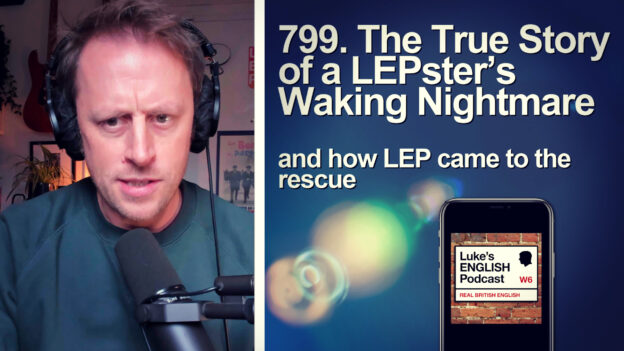
Sharing a disturbing true story sent in by a LEPster by email. This episode contains some slightly scary and graphic descriptions of nightmare scenarios, visions, hallucinations and bad dreams, but there is a happy ending. Video version also available.
Iñaki’s Nightmare (and how LEP came to the rescue)
Hello listeners, welcome back to the podcast. In this episode I’m going to tell you the terrifying true story of a LEPster who went through a horrible nightmare but was rescued thanks to LEP.
This episode is based on an email I received a while ago (quite a long time ago now). I have been meaning to read this out on the podcast for some time now and I am glad to say that today is the day I am doing it.
I feel compelled to share this story with you and I sincerely hope you enjoy it.
LEP Ninjas
I often talk about LEP Ninjas on this podcast and complain that the vast majority of my listeners never get in touch with me, and I wonder who you are, what you’re doing while you’re listening and what this all means to you.
I often say that, but in fact I must say that I do get a lot of correspondence from listeners in various forms – episode comments, tweets, YouTube comments and emails. I love receiving your messages because it really helps me to know that there are people on the other end of this podcast – not just numbers but people, receiving my words and connecting with what I say.
Every now and then I receive a message that I simply have to stop and respond to there and then, even if I’m in the street or something, and there are also some emails which I feel I must share on the podcast with my audience. This is one of those emails.
I absolutely felt compelled to share this particular email with you, and felt it had to be in an episode of its own. So here we go.
It’s a compelling story which you might find fascinating, stories are good for learning English, as we know, I’m sure little bits of language teaching will come up here, and in this particular story I emerge as the hero who saves the day! So, naturally I am delighted to let the world hear it! (haha)
A slightly disturbing story
Some people might find this story a bit disturbing because it involves descriptions of surgery. So this is a heads up about that.
There are references to some physical, body related stuff, but also some slightly disturbing mental images too – some nightmarish visions and bad dreams, let’s say.
You’ll just have to listen to the story to understand what I’m referring to, but FYI the story has some slightly disturbing moments.
I should also say that this story has a happy ending. Things turn out fine in the end. So, if this makes you anxious, then don’t worry, the story ends in a happy place.
So, without any further ado, let’s just get straight to the email which I received from a listener called Iñaki.
I’m going to read it out as it was sent to me. It’s very well-written, but I might make a few changes here and there – I will correct one or two little errors relating to vocabulary or grammar.
Also I will comment on certain words in this story to help you learn some things as we go.
Inaki’s Email
Email Message: Hi Luke: How are you doing? My name is Iñaki and I am writing from San Sebastian, in the north of Spain.
First of all I’d like to thank you for your podcast. I started listening to it some six months ago because my wife recommended it to me (she’s been a premium subscriber for a year or so). I have been listening to you ever since because I think what you do is very entertaining and interesting and I think that my English gets better too.
I know what I am about to tell you looks a bit boring in the beginning but please keep on reading because you show up in the middle of the story.
On the 29th of March I got a surgery operation to cure my apnea.
For your information, this operation took around 6 hours while I had general anesthesia.
They cut both sides of my jaw. Also they cut below my nose to move the position of my palate. Then they put everything together again in another (slightly different) position by using some screws.
All of this sounds a big frightening but it is a very usual operation with very low risk. All the surgery is done from inside your mouth so it doesn’t leave scars.
I took the decision to go ahead and everything went OK, and now I am fine at home and getting recovered but it is also true that when I woke up I felt a bit lost and my mind was not thinking straight and this was the most difficult part of my recovery.
So my operation was on a Monday at 08:00 and I woke up on Tuesday at 13:00. The doctor told me that the operation went fine. After, when my wife came to visit me she also said that the operation had gone right.
So why did I think that this was not true? Why did I start to suspect that something very bad had occurred during the operation?
I can’t quite explain since I don’t think I am such a negative person or I am not so hypochondriac.
But the truth is that my mind freaked out quite seriously and my paranoia was that the doctor had committed a fatal mistake during surgery and now all the doctors and nurses were backing one another up to hide this mistake.
Since this idea was on my mind I couldn’t let it go and it only went bigger and bigger. All of the things I heard or saw fitted perfectly in MY reality. For example, a nurse said to me “Iñaki, why are you so sad? The operation has been v… successful”. So my head went: “why successful? Why not VERY successful? Why did she start the word VERY but she didn’t finish it?”
And this went on and on without control. My wife was with me all the time and she did a great job but still she didn’t manage to get these ideas out of my head. Monday night I was totally sedated with the anesthesia. Tuesday night I couldn’t sleep (and I mean not even a minute) because I was so frightened… Tuesday and Wednesday I couldn’t eat anything.
So by Wednesday evening I was exhausted due to the lack of rest and food. This didn’t help my mind get stronger. So on Wednesday evening I was quite certain that their plan was to let me die on medication.
I could feel that my wife had taken part in that decision. I thought that the idea was that since my life was not going to be worth living it onward, they decided to let me go. Of course, now I see that it didn’t make any sense at all but my mind was not able to work better than that on Wednesday evening.
I accepted this idea and I decided to be collaborative in the process. They gave me medication to calm me down and I could feel that my mind was even more clumsy. My wife told me once and again that the most important thing was to rest, to sleep. In this way the next day I would feel stronger.
For me this was a soft way of saying: “If you calm down and you get to sleep soon, then your death will be more pleasant”.
This sounds terrible to me now but I also think: in some situations in your life you need to lie to the ones you love in order to protect them, don’t you?
I mean, what would my girl tell me in a situation where I really was about to die? Would she clearly say it? Would she tell me straight? I don’t know…
I tried to sleep but this was very difficult because when I closed my eyes I could see some horrible images.
These images were not dreams.
All the time I knew that I was in the hospital and my wife was beside me. So I guess the images were a result of the medication and also my lack of strength.
The images were really terrifying. All the scenarios were dark, humid and steamy. In many of these images there were thick fluids (black, brown, dark grey…) flowing in different directions.
Among these ugly liquids there were macabre things floating: a pig’s mask, the face of my son in the 3D radiography when he was still in his mum’s belly, bones, parts of bodies…. I could also see parts of machinery like gears or parts of motors. These metal parts were broken and I was looking at them from very close and I had the feeling that they were looking at me, judging me… and it didn’t feel good.
Also crazy things like a kid crawling on the ceiling (clearly inspired by the film Trainspotting) or even me crawling on the ceiling. In another moment I was like a video camera up in space and suddenly I went down to the earth, to England and I ended up inside Brian Jones’ swimming pool and I could see his corpse from the inside of the water.
I also had to say no to entering inside tunnels with a light in the end. A couple of times I was brave enough to go inside the tunnels because I thought“OK, this must be it, let’s end it all now”. But then nothing happened….
With all these images in my mind I was not getting calmer, my breathing was out of control and I couldn’t sleep. This took like 2 or 3 hours, I think.
Then my wife came up with a new idea. She said: “Iñaki, what about listening to that episode of Luke’s podcast that you liked a lot? That one in which he read the short story by Roald Dahl? Maybe that’s going to calm you down….”.
Honestly, I didn’t believe that this would work but at least it was something different and since I was desperate I agreed that it was worth giving it a try.
When I heard your voice, the images automatically changed to something different. I started listening to your words, but since the images where suddenly very nice I was paying more and more attention to them and even if I could hear your voice in the background I wasn’t listening to your words anymore.
Now the images where very colourful ones. For example I saw some based on cartoons that my kids see on the TV.
I remember seeing characters of the series “True and the Rainbow Kingdom” and “The Octonauts”. I also saw some very nice cartoons in the style of Sgt. Pepper’s artwork and the Yellow Submarine film.
Among these “visions” I remember one in particular. It was very pleasant and it stayed for a while: there where some magic carpets with stripes of very beautiful colours. They were floating in the air and my 6 year old twins were jumping on them and using them as slides.
They were laughing and having so much fun.
Mixed up with this action I could see pictures floating around in the air. These were pictures of the 4 members of the family together: my wife, the kids and me….. When your voice stopped because the chapter ended I noticed it. I was conscious for the first time that my breathing was very calm. I also was conscious that I was thinking in a more positive way. I was thinking: “OK, maybe I don’t have to die tonight”. Since my breathing was calmer and my mind was calmer too I got more relaxed and I finally managed to get to sleep.
That night I slept and woke up many times but I think I got to sleep a total of around 3 hours. Early next morning, at around 6:00 am I listened to birds singing. It made me feel good because by then I was totally convinced that I would hear that sound many times in the future.
I was also a bit ashamed that my mind had been so confused and I made my wife suffer so much. I thought a lot about you too and I felt grateful that you helped me in my recovery. I was also grateful that my wife came up with this great idea which really made the difference.
But, of course, my mind was mainly with my kids. Can you imagine the infinite happiness of knowing that I would be able to hug them again when only a few hours back I thought the opposite?
All of these words are only to explain to you how I went through a very rough situation and how you helped me get out of it. The moment I heard your voice is the exact moment that I started to get out of this horrible hole I was locked up in. So in the end all of this is only to say thank you. Just because it makes me feel good to do so. Thanks Luke!!! Iñaki
Luke: Summarise the story in your own way, in your own words.
Iñaki and I exchanged a couple of emails after this and he said he was happy for me to read this out on the podcast.
Here is my response.
Hi Iñaki,
I’m glad you’re ok with me reading out your story on the podcast. I think it’s absolutely fascinating, and of course I’m always happy to tell the world any story in which I emerge as the hero!!
Joking aside, your experience must have been absolutely terrifying and horrendous and I am genuinely amazed and pleased that the sound of my voice was reassuring for you in those moments.
I don’t know if you’ve heard my Sick In Japan episode (episode 118 – I think). I ended up in hospital in Japan once. I felt dreadful and I didn’t really know why I was there because I didn’t really understand what the doctor was saying. Thankfully it turned out that I was not seriously ill, but the first couple of nights were very frightening because I felt very bad and my diagnosis was lost in translation. \
I thought I was seriously ill and was afraid that I might die. I felt very paranoid and had to work hard to keep my mind calm. Like I mentioned – my experience wasn’t quite as bad as yours, but still – I have a slight sense of what your experience must have been like, and it’s incredible to me that the sound of my voice helped you to get through it. It’s flattering to know that, but also very reassuring and encouraging that my podcast can bring comfort to someone.
I also think your story is very compelling and well-described, so I think it should be fascinating for the LEPsters to hear it.
And, I truly believe that bad experiences become a little better in our minds when we turn them into stories which we can share.
You certainly have a great story there, and I think my audience are the perfect people to appreciate it.
So, I’m very glad you’re happy to let me share it. Hopefully it will provide something gripping for the audience and I really hope you enjoy hearing me read it out on the podcast. Congratulations on your English too by the way. You described the story very specifically and clearly.
In any case, I’m glad to hear that you’re basically back to normal again. Thank you for sharing your story with me. I read it again this morning and I found it very moving – especially the moments when the joy and colour came back into your mind when you listened to my episode, particularly the visions of your happy family.
Have a great week, and all the best to you.
Some words & phrases to review
A compelling story
A waking nightmare
A vivid dream
To have surgery
To have an operation
To have a local anaesthetic
To have a general anaesthetic
An anaesthetist
To anaesthetise
Jaw
Palate
Hypochondriac
Sedated
To (not) think straight
To suspect that something is happening/has happened
Paranoia / paranoid
To back someone up
To manage to do something
To tell something/someone straight
Macabre
Breathing / breath
Ending
Thanks again to Inaki for providing that story.
Quite a scary one!
I often wonder where you are and what you’re doing while you’re listening to this podcast, and if you have a similar story, don’t be a ninja – let me know in the comment section.
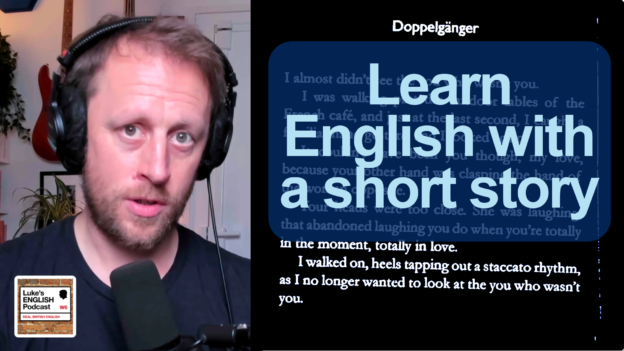
Learn English with another short story. In fact, this episode contains two stories. Listen until the end for the 2nd one. Repeat after me to practise your pronunciation. Learn some vocabulary & grammar in the second half of the episode, with an explanation of modal verbs of deduction in the past and present. Video version available.
It is published by OUTPOST 19 and it was put together by the team behind the website, including Grant Faulkner, Lynn Mundell and Joshua Michael Stewart.
It is available for you to purchase and I recommend it if you are looking for bite size stories to use for learning or teaching English.
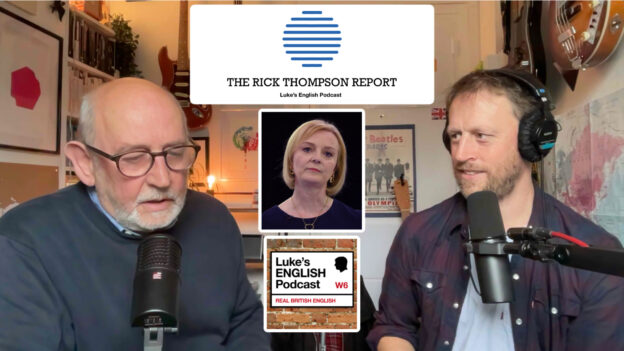
My dad returns to talk more about UK politics, this time describing the disastrous economic policy of Liz Truss and her Chancellor (finance minister) Kwasi Kwarteng. Advanced level English listening practice – this is complicated stuff, but keep listening to develop your English skills and learn about what’s going on in UK politics and current affairs. Video version available.
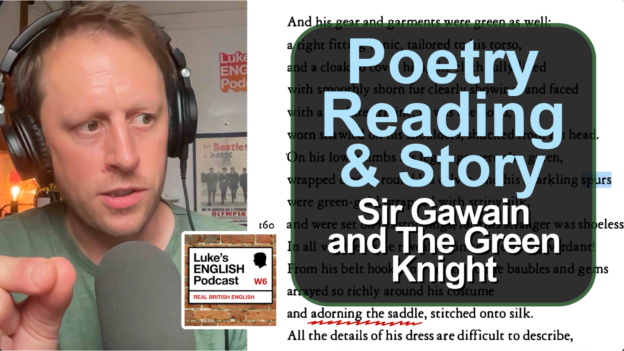
Luke reads verses from a modernised version of this medieval poem, considered one of the masterpieces of Middle English literature. Listen to hear the rhyme and rhythm of the poetry, the descriptive vocabulary and details of the story, with vocabulary explanations and comments from Luke. This is part 2 of a double episode about this story. Video version available with on-screen text.
Sir Gawain and The Green Knight by Simon Armitage, published by W. W. Norton & Company (available in all good bookshops)
Introduction Transcript
Hello listeners,
Welcome to episode 779 of my podcast for learners of English. This is in fact part 2 of a 2-part episode.
In part 1 of this (episode 778), I talked to my dad about an old poem from the medieval period in Britain.
The poem is basically a really mysterious and wonderfully descriptive adventure about a knight from King Arthur’s table at Camelot.
King Arthur was a mythical king of Britain who people told and wrote stories about, many centuries ago.
We’re not sure if he really existed, if the stories about him are all fictional, or some combination of those two things.
Anyway, the Arthurian legends, or stories of King Arthur and his Knights from Camelot are full of magic, chivalry and adventure.
Chivalry means the rules that all honourable knights had to follow – a code of honour.
Anyway, the poem I talked about with my dad in the last episode is about one of Arthur’s knights who accepts a strange and dangerous challenge. The poem is called Sir Gawain and The Green Knight.
If you listened to episode 778, you heard my dad describing the story of the poem, the linguistic style and how it fits into British history and the history of the English language.
At the end of that episode I read some verses from a modernised version of the poem, by Simon Armitage.
In this episode I’d like to read some more verses from the poem, but this time I’d like to explain some of the vocabulary and other aspects of the language while I am doing it.
So here you will be able to hear part of a medieval poem written in middle English, which has been updated into modern English, with explanations and comments from me.
Again, the poem is called Sir Gawain and The Green Knight.
It was probably written in England in the 14th century (probably around the year 1370).
Since this text was discovered it has been studied and translated and is now considered one of the greatest works of medieval English literature.
Modernised versions have been published, including one by JRR Tolkein and another one more recently by Simon Armitage.
The one I’m going to read from here is the modernised version by Simon Armitage, which is available as a book from W. W. Norton & Company – you can get it in any good bookshop.
I do recommend it. It has a really interesting introduction and it presents both the modernised version and the original text, side by side.
In terms of language, there are three main things to notice.
These linguistic features or poetic devices were all present in the original version and Simon Armitage has done a great job of replicating them in this modern version.
Alliteration This is when the same sounds are used at the beginnings of words.
It creates a kind of rhythm or music to the lines.
Examples:
a fearful form appeared, framed in the door
a mountain of a man, immeasurably high,
a hulk of a human from head to hips,
so long and thick in his loins and his limbs
I should genuinely judge him to be a half giant,
or a most massive man, the mightiest of mortals.
The “Bob and Wheel”. This is a poetic device which can be found in poems from this era.
Each “stanza” (group of lines) ends with two syllables (the bob) and then four flowing lines which follow (the wheel)
So listen a little while to my tale if you will
and I’ll tell it as it’s told in the town where it trips from
the tongue;
and as it has been inked
in stories bold and strong,
through letters which, once linked,
have lasted loud and long.
Descriptive vocabulary The poem is full of vivid descriptions, and Simon Armitage has managed to modernise the vocabulary so most of the language used here is up-to-date and still used by people today.
So, let’s get into the poem.
I’ll read each verse one by one, and then I’ll go back through and explain the language.
You could try to repeat the lines of the poem after me. That would be a good way to practise your pronunciation.
I’m going to start reading from line 130.
Just to bring you up to speed with the story, here’s what happens between lines 1 and 129.
The poem begins by referring to Greek mythology. It briefly describes the fall of Troy and the foundation of Rome, and it makes a clear connection between King Arthur of Britain and those heroes from Greek and Roman mythology.
It’s Christmas in Camelot and King Arthur is celebrating with a big feast (a big meal which lasts for a long time).
The poem describes the celebrations, the food, the games they’ve been playing, the decorations, the seating arrangement with all the knights, ladies and their guests. King Arthur’s wife Guinevere is there, and the poem describes how beautiful she is.
They are just about to start eating, when the celebration is interrupted by something extraordinary.
Luke reads lines 130 – 466 from the Simon Armitage version of the poem.
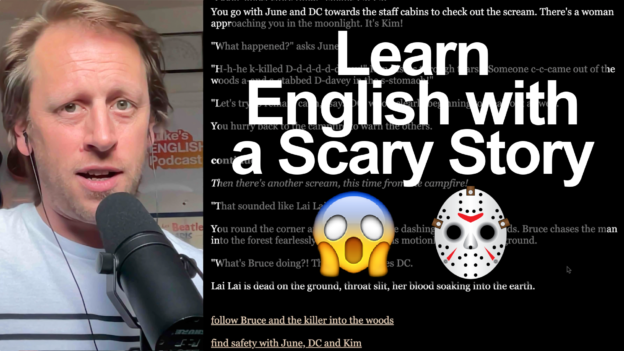
Listen to Luke reading a text adventure story set in a summer camp. You can read the story at the same time as you listen, or just relax and have fun following this action packed horror story, and read do text adventure later. Includes some vocabulary explanations, differences between British & American English and some very dodgy jokes. Video version available.
An episode with my friend Moz from the Murder Mile True Crime Podcast. Moz returns to tell us some true stories of crimes in the London area. Expect some smalltalk about living on a boat, some murder stories and an interactive detective game in which we have to solve a murder.
This website uses cookies to improve your experience while you navigate through the website. Out of these, the cookies that are categorized as necessary are stored on your browser as they are essential for the working of basic functionalities of the website. We also use third-party cookies that help us analyze and understand how you use this website. These cookies will be stored in your browser only with your consent. You also have the option to opt-out of these cookies. But opting out of some of these cookies may affect your browsing experience.
Necessary cookies are absolutely essential for the website to function properly. These cookies ensure basic functionalities and security features of the website, anonymously.
Cookie
Duration
Description
cookielawinfo-checkbox-analytics
11 months
This cookie is set by GDPR Cookie Consent plugin. The cookie is used to store the user consent for the cookies in the category "Analytics".
cookielawinfo-checkbox-functional
11 months
The cookie is set by GDPR cookie consent to record the user consent for the cookies in the category "Functional".
cookielawinfo-checkbox-necessary
11 months
This cookie is set by GDPR Cookie Consent plugin. The cookies is used to store the user consent for the cookies in the category "Necessary".
cookielawinfo-checkbox-others
11 months
This cookie is set by GDPR Cookie Consent plugin. The cookie is used to store the user consent for the cookies in the category "Other.
cookielawinfo-checkbox-performance
11 months
This cookie is set by GDPR Cookie Consent plugin. The cookie is used to store the user consent for the cookies in the category "Performance".
viewed_cookie_policy
11 months
The cookie is set by the GDPR Cookie Consent plugin and is used to store whether or not user has consented to the use of cookies. It does not store any personal data.
Functional cookies help to perform certain functionalities like sharing the content of the website on social media platforms, collect feedbacks, and other third-party features.
Performance cookies are used to understand and analyze the key performance indexes of the website which helps in delivering a better user experience for the visitors.
Analytical cookies are used to understand how visitors interact with the website. These cookies help provide information on metrics the number of visitors, bounce rate, traffic source, etc.
Advertisement cookies are used to provide visitors with relevant ads and marketing campaigns. These cookies track visitors across websites and collect information to provide customized ads.