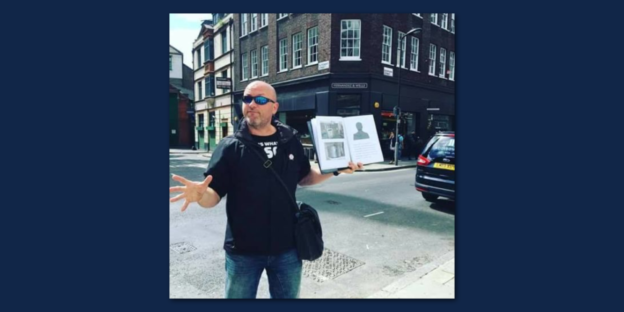
My friend Moz, who runs a murder-themed tour company in London, is back on the podcast to talk about some more creepy stories of crimes from London’s history and his new podcast. Vocabulary list and quiz available below.
Moz (aka Michael Buchanan-Dunne) has appeared on the podcast a number of times before, for example in the Brighton Fringe Festival episodes, the drunk episode, the episode recorded on Moz’s narrowboat and also the episode from last year called “Murder Mile Tours”.
If you haven’t heard those episodes, let me bring you up to speed as it might help you understand some of the things we talk about in this conversation.
I first met Moz and made friends with him about 8 years ago while doing stand-up comedy in London.
He used to work for the BBC, making comedy television programmes, but then a few years ago he decided to set up a tourism company and bought a narrowboat which he now lives on. Narrowboats are boats that can be used on the UK’s canal system. They’re long and narrow and they’re boats, hence the name “narrowboats”.
Moz now lives on his boat which he usually moors at different locations throughout London’s canal network (there are lots of canals running through London).
He also runs a successful tour company in London, called “Murder Mile Tours”.
His most popular tour is called the “Murder Mile Walk” which currently takes place in Soho in central London every week. The walk takes in various sites where murders have actually occurred. Some of those murders were the work of serial killers and they all have gruesome stories connected with them, stories which Moz has painstakingly researched by looking up lots of archived material including court records from courtrooms in London.
Last year I invited him onto the podcast to tell us some of those stories. That proved to be one of the most downloaded episodes of the podcast last year. Since then his tours have gone from strength to strength – not directly a result of being on this podcast of course, although that has helped because quite a lot of LEPsters have been on the murder mile walk with Moz, no, the tour seems to be going really well because it seems really fun, it’s original, the stories are fascinating, and the tour has had loads of 5 star reviews on Trip Advisor.
In fact just recently Murder Mile Tours received a TripAdvisor certificate of excellence, which is a really great achievement. TripAdvisor describe it as one of the 150 best things to do in London and Time Out Magazine described it as one of the top 3 themed tours in the city.
Now Moz has decided to start up his own podcast in which he will regularly share some of the stories he has discovered while doing his research. His podcast, called “The Murder Mile True Crime Podcast” will be available from 1 October (you’ll be able to find it on iTunes – or just check https://www.murdermiletours.com/podcast).
So, I’ve invited Moz to come back onto the podcast to talk about all of this.
Moz and I are friends, so this isn’t just an interview, it’s also a light-hearted informal conversation and a chance for the two of us to catch up on each other’s personal news and just have a bit of fun while we’re doing it, and you are invited to join us.
You should know that this episode contains some graphic content and explicit language
including some fairly detailed descriptions of violence and murder
and some other things that you might find disturbing or disgusting.
I feel I should let you know that in advance, just in case you’re squeamish and you don’t like that sort of thing – but to be honest the content of this episode is no worse than what you would see in the average episode of a TV show like CSI or Game of Thrones.
But still – there are some creepy and gruesome details in this episode, so – you have been warned.
By the way, if you’re interested in some of the items of vocabulary that you can hear in this conversation, you should check out the page for this episode on my website. You’ll see a list of words and phrases there which you learn in order to add real strength and depth to your English.
OK so here is part one of my conversation with Moz, the guy from Murder Mile Tours.
Vocabulary List
“Sacre bleu!” (French – used to express surprise or amazement)
“There’s lovely” (this is what Welsh people apparently say a lot – it means “that’s nice”)
“Zoot alors!” (an old-fashioned French phrase – it’s used to express surprise, shock etc)
More excuses for my lack of improvement in French. [absence of]
I’ve got to pull my socks up, pull my finger out and turn over a new leaf. [all these phrases are ways of saying “improve my attitude and approach”]
I don’t have long to get the French up to scratch. [improve it to an acceptable level]
Rutting [when animals, such as deer, have sex – but also when the male deer fight with each other during the mating season]
“During the ruttingseason the male boars have terrible mating battles”
It’s a scratchyhowl [a howl is the sound an animal makes – usually a dog or wolf at night, e.g. ‘to howl at the moon’. ‘Scratchy’ describes the rough sound of the howl]
Foxes, when they’re mating, make a high-pitched scream which sounds like someone being murdered
I’m not registered for council tax [tax you pay when you live in a house or flat]
I’ve got a P.O. Box [a post office box where you can have post delivered if you don’t have a fixed address]
I’m not condoning mass murder [promoting it, saying I agree with it]
The police had sectioned off the walkway [used plastic tape to prevent people from accessing that part of the walkway]
Someone may commit suicide and the body floats down (the canal) [commit suicide = kill yourself / float = not sink, but stay on the surface of the water]
Grisly details [unpleasant, involving death or violence]
People think that a canal is a good place to dispose of a body [to get rid of a dead person]
The canal has been used for dumping rubbish, but also corpses [dumping = throwing away, getting rid of, disposing / corpses = dead bodies]
They decided to take this guy’s card and start withdrawing money [taking money out of the bank]
The culprits were found guilty of ‘denial of a proper burial’ [culprits = people who committed a crime / ‘denial of a proper burial’ = a criminal charge which is given in a court – it means when someone didn’t bury a dead person properly, or perhaps didn’t dispose of the body in the legal way]
That was the main charge that they could definitely pin on them [a statement by prosecutors in court that someone committed a crime]
Eastenders is a soap opera that’s been on TV for years [a TV drama which is about ordinary people, shown on television on a regular basis]
“My auntie’s brother’s sister left me 10% of this pub in her will!” [a will = a document which explains who should receive someone’s property when they die]
He smoked skunk all the time [a strong and smelly form of marijuana]
He had an argument with her, killed her, chopped up the body [cut the body into pieces] and then wrapped up [put inside a sheet or some clothing] her limbs [arms and legs] and her torso [the body, but without the arms or legs], put them in a suitcase and dumped [threw away, disposed of] them in the canal
He bought loads of bin bags [bags for rubbish] and saws [tools for cutting something up]
Things got out of hand, they had an argument [things got out of control]
He dragged her down to the canal [pulled her along the ground]
The suitcase floated for about two miles [didn’t sink]
Poking out of the top of the suitcase was hair [you could see part of it coming out of the top of the suitcase]
I like having a good poke around [looking and investigating, perhaps by looking into something and moving things around] different streets and digging into [going deep into something] murders
Most murders are just men having fights, but occasionally you come across [find] a really good one
Don’t worry, we’re hung over! [feeling sick because they drank alcohol the night before]
I was a cannibal, [someone who eats human flesh] I’d eaten my girlfriend and her body was slowly working its way through my bowel (yuk!) [moving slowly through the lower part of the digestive system] yuk yuk!
It was one of the darkest jokes I’ve ever pulled off [managed to succeed bit it was difficult]
It didn’t get a laugh it just got a gasp [a shocked sound when people breathe in suddenly
😱] and for me that was enough
It certainly got the evening off to a different start [to get something off to a start = to make something start]
Often the murderers are like slapstick movie idiots [a form of comedy involving funny physical movements, like people falling over or hitting each other]
Can you remember the vocabulary in the list?
Were you listening carefully? Take the quiz to find out.
I was on the RealLife English Podcast and we talked about why I became an English teacher, doing James Bond impressions and also comedy & how to use humour in learning English. You can listen to it here. More details about Real Life English below. Enjoy!
Last week I was featured in an episode of the Real Life English podcast and I just wanted to share it with you here on my website.
RealLife English is an online community with a mission to inspire, empower, and connect the world through English, both online and in-person.
It’s run by three English teachers, Justin (USA), Ethan (USA) and Chad (Australia) and they do a podcast, write blog articles, create YouTube videos and also host an online community for social learning. A lot like LEP, they believe in teaching English to the world in a fun, personal and inspiring way.
Recently I spoke to Ethan on the Real Life English podcast (and also recorded an episode of LEP) and we talked about lots of things, including British & American comedy shows, and how to use humour (and alcohol) in learning English. Listen to it above, or on the Real Life English website. I’m sure they’d appreciate some comments from friendly LEPsters.
I’ll be speaking to Ethan in an episode of LEP soon. You can look forward to that in the next few weeks.
This episode includes anecdotes and descriptions of our short visit to Las Vegas, including stories of more rental car issues, Las Vegas craziness, winning and losing $$$ and 11 English idioms that come from gambling.
⬇️ Episode script and notes (Idioms list below) ⬇️
Why Vegas?
It was just as a stopover between L.A. and other areas, and to have a one look in your life, see what all the fuss is about sort of experience.
Take the rental car back to the car rental company.
Remember them, from part 1 of this?
Wrong Cars™
When we picked up the car in LA – just a Nissan hatchback by the way, nothing fancy, at the start of the trip we had to go and wait in a boiling hot car park in Inglewood or somewhere, where I stood waiting on my phone for ages waiting to get through to someone to tell them we had arrived, standing there on hold with my arm going numb and the sun beating down on both me and my pregnant wife, and after about 40 minutes a guy in a rental car came and picked us up, and told us “oh yes, the shuttle busses are in the garage – they broke down on Tuesday”.
We drop off the car, pay the money, ask about the difference in price between the bill and the receipt –
“Sorry Mani, isn’t here today.”
“Can you do it?”
“Sorry, I can’t. He’s the manager.”
(We got fobbed off by the girl behind the counter)
There’s supposed to be a shuttle (bus) service back to the airport.
But it’s obvious that this is a crappy little rental car company that is cutting corners and fobbing everyone off with this talk of the “shuttle” that is mysteriously always in the garage.
Again we’re told that the shuttle is in the garage so we squeeze into another rental car with a German couple this time.
My wife is in the front, and I’m squeezed in with the Germans.
The Germans are quite nice, but it’s pretty clear they didn’t have the best experience with their car and they’ve driven a really long distance, without cruise control (which is standard for rentals usually) and they’re saying to the driver,
“Do you not have cars with cruise control? Because it’s very uncomfortable to drive 4,000 miles without cruise control, you know?”
I’m thinking – 4,000 miles! Without cruise control. His leg must be knackered.
The driver goes “Cruise control? Yes, there is cruise control.”
“No, there is no cruise control in this car.”
“This was your rental?”
Turns out the “shuttle” is just the same car the Germans just rented.
“Yes, there is no cruise control in this car. It was very difficult for us. Do you not have cars with cruise control?”
The driver is not interested in taking questions. He says “Some of them do and some of them don’t.”
“I think it would be good if your cars have the cruise control”
“I’m just the driver man”
I note in my head that our car had cruise control, and I never used it, not once, but I don’t say anything. I don’t think it would have helped.
“Well, our car had cruise control, and guess what we never used it! Ha ha, it would have been useful if we’d swapped, right? I bet you would have appreciated that after the first 3,000 miles!!”
But I didn’t say that. I just ‘enjoyed’ the really awkward vibe in the car, and the knowledge that my wife was pretty much steaming, but keeping herself under control.
After the Germans got out my wife chose to cross-examine the driver.
“So, where are the shuttles?”
“Oh, they’re in the garage, we had some trouble with them.”
“Both of them?”
“Yes, it’s just a coincidence.”
“OK. When did they go in the garage?”
“Oh just on Friday.”
“Well last week you said they broke down on Tuesday.”
“I’m just the driver”
“I know you’re just the driver but…”
“You’re getting driven there, I’m driving you personally…”
“I know but we just don’t appreciate being lied to, that’s all…”
At this point he got really angry and started making it personal.
“OK, you’re getting personal with me now, and I don’t appreciate you making personal attacks against me, ok?”
As I was taking the bags out of the back, I was trying to say, “Look, it’s not personal we’re just commenting on the service. We were told one thing, we get another thing. It’s not you, right? it’s your management, right?”
He just went “Well I deliver you to the airport and you make it personal” and he just got in the car and drove off.
I couldn’t help feeling bad for the guy. I think he probably has no choice but to lie about the shuttle thing because the crappy management of this company keeps telling their customers there will be a shuttle. It’s written in their emails and stuff. I imagine he’s just trying to keep his job.
He couldn’t really say “Yes, well to be honest sir our company is lying to you. We don’t have any shuttles, it’s not worth it – you know? Because we don’t get enough customers to justify using a whole bus, and there’s obviously nowhere for us to park one anyway, so we just use these cars and I’m always dealing with these problems, but it’s because the management keep lying.”
He can’t admit that the company lies or is wrong. It’s unfair on him. I know, I’m making excuses for the guy, but what can he do?
The management should just say they have a personal car service, it would solve the problem.
That’s the solution. We don’t care about shuttles. Just say there’s a personal car service. The driver can introduce himself. “Hi, I’m Carlos, I’m your driver, where are you guys from?” Etc. That would solve the problem. Instead, Carlos (or whatever he’s called) is on the defensive and can’t start talking to the customers because he knows they’re not happy. Poor Carlos, and poor customers.
I wonder what’s really going on there – at this particular franchise of Wrong Cars™.
Anyway, after that we got on our plane for the short flight to Vegas. We could have driven but we planned this to make sure there was as little driving as possible, because when you’re pregnant it’s not good to sit in a vibrating car for hours on end, and anyway it sucks to be stuck in a car all the time.
We arrive in Vegas
It’s hot.
It’s in the middle of the Mojave Desert for goodness sake.
We rent a car from another company this time – more established. Enterprise. Admittedly, it’s a bit more expensive but we don’t want to risk it because we’ll be driving in some fairly deserted spots and we want a car that will not break down and that has customer service that’s actually available by telephone.
So we get to the car rental area – a massive building in airportland. Dazzling service. We’re in the car in a matter of minutes and it looks brand new. We rented a small SUV. The main thing was that it was comfy and could deal with bits of rough terrain if needed. We get a Jeep Renegade. It’s pretty cool. Wife is happy and in comfort. OK.
Staying at New York New York Hotel.
Vegas is completely insane and, honestly, not a great place. In fact it’s the most tawdry, sleazy, tacky place ever.
Pick the most touristy part of any town and amplify it by 1000. It’s like that.
It’s boiling hot outside but inside it’s freezing, and it doesn’t make a lot of sense to build this massive place with all these things like swimming pools, hotels and golf courses in the middle of the desert.
God knows how they get their water.
And it’s just a weird place cut off from reality in which you are constantly being seduced and distracted by flashing lights and big things and encouraged to gamble your money away. It’s like one huge sales pitch in the form of a city.
Inside the casinos there are no windows. They’re like huge circus tents on the inside, with big restaurant facades around the edge, tables for gambling – playing poker or roulette or the one where you throw the dice and there are loads of different numbers and letters and it’s a bewildering illusion of choice, big individual gambling machines, lamp posts (inside the hotel), fake little streets, massive Irish pubs (which is never really a bad thing in itself) but all this stuff and you look up to the sky and it’s the black ceiling of the hotel above you, quite high and in the background. It’s probably daylight outside, but you can’t see the desert sun. Inside the hotel’s gambling area there’s this black canopy of the ceiling above all this trashy fake stuff.
It’s so weird to come to the desert and then find yourself in this totally synthetic place all set against a black backdrop.
This is some people’s idea of a wonderful place – a vast plastic playground with so many attractions, but there’s something very unnatural and twisted about it.
Weird things
People smoke indoors and this feels wrong now after 10 years since the smoking ban. No big deal, but still… I think the reason is that they prioritise the gambling, so even though it fills the air with harmful smoke, it means people stay at the tables and don’t go outside to smoke their cigarettes.
There are tourists wandering around, families and stuff but also you spot these grizzled gamblers losing fortunes.
You see some old people who have travelled for miles to spend their money because they don’t really know what else to do with it, so it all goes in these machines.
There are some really drunk people, sitting at the bar.
But also families with kids walking around.
Even some bars have gambling machines built into them, so you can lose money (or maybe win) while you’re taking a break from the bigger tables.
In one casino, where we went to the theatre – there was a girl in suspenders dancing erotically on a table, and kids were wandering around.
Seriously weird.
It was like a strip club in Disneyland. It was like a cross between Disneyland and a lap dancing club. Adult Disneyland, but with families wandering around in it.
Our hotel had a rollercoaster going around it.
Yep, a rollercoaster, with tracks that actually went around the outside of the hotel.
You can stand in the bedroom and every now and then you hear the rumble of the rollercoaster and the muffled screams of people outside the window. This is from inside your hotel room..
If you part the curtains and look out you can see part of the track twisting around past the window and eventually you’ll see the rollercoaster race past, people screaming.
Take a look into the distance and there are the mountains, some desert and then closer to you just weird, big shiny bright buildings and Trump tower. A massive tower with his name at the top in huge gold letters.
“We’ve got the greatest buildings folks, all the best casinos. You’re gonna have fun, and you’re gonna make so much money. We’re gonna Make America Great Again. Believe me folks.”
And the house always wins.
That’s the thing with these casinos.
You have to enjoy the process of it, because you’re basically paying money to experience the excitement of possibility of having more money, even if the probable outcome is that you’ll end up with less.
You’re paying for the excitement of losing, it’s exciting because there’s a possibility that you won’t lose, but the fact is you will probably lose.
So the chances are that you’re going to lose
but you might win
and that’s what makes it exciting
to throw your money away.
The house always wins.
Sometimes somebody wins.
But most people are losing.
And the house is always winning.
Fair enough though, people choose to gamble and they probably enjoy it. People seem to enjoy it – that’s their choice, but it doesn’t appeal to me very much, beyond just having a go to see what the fuss is all about.
But there are some good things about Vegas, ok!
It’s not all awful! It’s fun for a night or maybe two, depending on what you do.
It is a big spectacle – some of the hotels look amazing and massive, and also there are some spectacular shows that you can see – like dance shows such as Cirque du Soleil or Blue Man Group and magic shows like David Copperfield or Penn & Teller.
We chose to go there as a stopover but also to experience it and we did have a laugh!
You have to just go with it a bit and just go ‘ wow, look at that, that’s ridiculous!’
A lot of the time we were walking around, couldn’t believe our eyes, saying “this is insane” “Look at that! It’s a massive Egyptian pyramid!
Our hotel was basically a recreation of the New York skyline. Other hotels have things like an Eiffel Tower, an Egyptian Sphinx, massive fountains and light shows.
It was pretty weird to see the Eiffel Tower considering we see it every day in Paris.
Also, it’s a very convenient place – in the sense that it’s really easy to access the airport, it’s not all that big, things are open 24 hours a day.
People are helpful and friendly.
There was a wholefoods there. In fact there are a few Wholefoods supermarkets there – say no more!
Some of the stuff is good fun.
So, that’s that then isn’t it.
Penn & Teller
https://www.youtube.com/watch?v=oJhYySXzOq0
Gambling in the Casino
We played some one of the “one armed bandits” – the fruit machines. It’s like one dollar to pull the arm and watch some things spinning around. We put aside about 50 dollars for fun. My wife enjoys the one armed bandits and she’s actually very lucky. I’m a lot more sceptical about it.
But she thinks she’s blessed with luck or something.
(Actually she’s blessed with Luke, but anyway… I’m not sure “blessed” is the right word – “married to” is probably better)
In England, when we had first met each other, we took a trip to Brighton, on the south coast, and we went to the pier (a wooden walkway that stretches out over the sea, wooden legs supporting it – a pier) where there are lots of arcade machines and gambling machines and other attractions, and she was convinced she would win money on the machines and I was going “ but the house always wins” and she was saying “no I’m magic!”.
I was shaking my head thinking “there is no magic, only the force” and she put one pound in a slot machine and promptly won £20, and said “I told you I was magic”. We walked away £20 richer. We didn’t continue gambling. I think she’s smart enough to know that you quit while you’re ahead.
The same thing happened years later, we were in a little resort in the north of France where you find some casinos. She’s not a gambling addict or anything. She just likes playing the machines a few times when we’re on holiday sometimes.
We went to a casino and chose to spend no more than 50E. A 50E limit. Ooh, big bucks, right?
We were walking around trying to find a good machine. There were some slightly sad looking people just sitting there plugged into these persuasive light shows – it’s a sort of low level basic addiction (or high level for some people) – an addiction to the sales pitch, basically.
I was being very sceptical, and making various sceptical noises.
We ended up leaving with 80E, 30E up from when we went in.
Not bad.
We quit while we were ahead.
In Vegas we did some gambling on the machines. I was thinking, “Well, she is magic. Maybe we’ll win enough to get a half decent dinner.”
We lost all the money we took in. All of it.
It was a steady one directional flow of us putting money into the machines and getting nothing in return. Las Vegas just ate our 50 dollars like a crocodile eats a chicken. One gulp, all gone, didn’t even chew. It didn’t even touch the sides as it went down.
We won nothing.
Well, almost nothing. We always seemed to win a few credits just before our money ran out, which I’m sure is a little trick to encourage you to put more money in because you think the machine is going to ‘start paying out’ at some point.
Obviously, we didn’t know what we were doing. We had no clue and I’m sure those machines were the wrong ones to be playing, and some of the casinos are better than others, but anyway we weren’t really there for the gambling. We were more interested in playing it safe.
11 Gambling Idioms (that don’t just apply to gambling)
to be on a winning streak (when you’re winning)
to be on a losing streak (when you’re losing and nothing is going your way)
to break even (when you take the same amount of money that you spent – in gambling or in business. No profit, no loss.)
to quit while you’re ahead (stop when you’re winning)
the house always wins
to bet (to gamble) “I bet you £20 that Arsenal win the game” or (a challenge) “I bet you can’t throw this paper ball in the bin from there!” or (an expectation) “I bet all the tickets are sold out”
to show your hand (show the cards in your hand / reveal your position)
a poker face (a facial expression which reveals nothing – used while playing poker, or in any other situation where you keep a straight face)
don’t push your luck (take a big risk and try doing something that could end in failure – it’s a bit like saying “watch what you’re doing” or “be careful”)
to raise the stakes (the stakes = the money which you have to gamble in a round of poker. The expression is used to mean to increase the amount of money you can win or lose in a gambling game, but also to raise the general level of what you can win or lose – e.g. this line from a recent Daily Mail news article “Mr Trump raised the stakes in the escalating crisis over North Korea’s nuclear threats, suggesting drastic economic measures against China and criticising ally South Korea.”
http://www.dailymail.co.uk/wires/pa/article-4847836/North-Korea-conducts-nuclear-test-making-hydrogen-bomb-claims.html
the chips are down (chips = the plastic coins you use while gambling. The expression means – when you’re feeling bad, or when the situation is bad) E.g. in cricket – “When the chips are down for England, Moeen is often the side’s most useful player.”
I once saw a great documentary by Louis Theroux about high stakes gamblers in Vegas. Some of them lose thousands of dollars, but they keep gambling because they think they’re going to eventually start winning it all back. I’ve put some videos from the documentary on the page for this episode. I love Louis Theroux’s documentaries. They’re fascinating.
The phrase that I take away from one of the videos: Louis and a high-stakes gambler are standing in the biggest hotel suite in the city, looking out of the window at the huge hotels and Louis says “Vegas – they didn’t build these casinos on winners you know” and the guy says “I think in the lifetime, everyone’s a loser. But the thrill of being able to win today, lose next month, win the year after. I think it’s the challenge. I think it’s the thrill. I think it’s the entertainment in this city.”
Louis Theroux Gambling Documentary – video clips
Louis hangs out with a high-stakes gambler in a very expensive hotel suite in Las Vegas
Here’s the same guy, after losing about $400,000 dollars in 3 days
Louis gambles with a couple of gambling “enthusiasts” (addicts?)
Louis plays the “one armed bandits” with Martha (these are the machines that took our $50 in just a few minutes) Martha says “I lost 4 million dollars in the casino in 7 years.”
Louis gets lucky playing Baccarat
“Because I resigned myself to failure that night, Lady Luck had decided to tantilise me by making me win.”
How gambling can be dangerous
It seems that this is how it goes:
You might begin by winning some money. Then you feel lucky so you bet bigger, but you lose it.
You then start digging yourself in deeper and deeper, expecting your luck to change but there is absolutely no certainty that it will.
Some people talk about ‘the law of averages’ – suggesting that in time any sequence will balance out. E.g. you might spend a certain amount of time losing, but ultimately this will be balanced out by the number of times you win.
But that’s assuming that gambling in a casino is random. Usually it is subtly weighed in favour of the casino so that the pattern is that the casino wins more often than you. Even if you win a lot, the casino can afford it because more people have lost overall.
Often these high stakes gamblers keep betting because they think they’ll eventually start winning. They often don’t and then leave utterly devastated by the loss.
The house always wins.
Then what might happen is that you’ve lost, you’re dejected. You resign yourself to failure but play another game because why not, and then you hit a winning streak.
What a powerful combination of defeat and then victory, all out of your control. You’re at the mercy of this external force, playing around with “luck”. (Not Luke)
And the house always wins.
We drove along the strip. It’s madness out there! Just all the flashing lights and the spectacle, it’s like Picadilly Circus on steroids and the steroids are also on steroids.
Unbelievably massive plate of pancakes for breakfast.
Then we got out of town.
I told you I would talk about nature and canyons, and big rocks! All that stuff I really loved seeing, but I got carried away – distracted by tales of gambling in Vegas.
Las Vegas – a place that seems diametrically opposed to somewhere like Bryce National Park or The Grand Canyon.
I’m glad we only spent an afternoon, one evening and a night there.
Natural beauty is so much more real.
Well, anything is more real than Las Vegas, I suppose.
Thanks for listening.
Join the mailing list.
Thanks to the Orion transcription team and Andromeda proofreading team.
Shout out to the comment section crew.
Shout out to the Long-Term LEPsters, you know who you are.
Shout out to the new listeners, I hope you stick with us.
Shout out to every single one of you all around the world, listening to this right now and united by the fact that you are all citizens of LEPland or Podland or whatever we are calling this community which crosses international boundaries.
Be excellent to each other and party on!
Hi everyone, I’m back from my holiday so here’s a new episode of the podcast. In this one you’ll hear me talking about some recent news (including quite a big announcement) and then an account of what we did on holiday including some descriptions, opinions and stories. There’s talk of disturbing political events, dodgy car rental experiences, and a couple of beautiful cities where urban life meets wild nature. Enjoy!
Some of this text (below) is a full transcript of what I say in the episode, and other parts are just basic notes which I used while recording. So it’s not a 100% complete script.
Hello! I’m back from holiday!
How are you? Did you have a good August? Did you go anywhere?
Let us know in the comment section what you’ve been up to.
In this episode I want to just tell you about my holiday.
As you know, I’ve been away and it’s become sort of customary for me to give you a sort of holiday report whenever I come back from a trip away, so that’s what I’m going to do in this episode.
I’m going to describe places we visited, things we saw and I’ll tell a few little anecdotes along the way and give you my opinions on some things.
You will find some notes and transcriptions on the page for this episode if you want to read some of the words I’m saying, for example if you hear me say something in particular and you’re not sure what it is, check the episode page it will probably be there.
I don’t know how long this is going to be. I might divide it into a couple of episodes. It’ll be as long as it takes for me to just feel like I’ve told you the things that are on my mind and were on my mind while we were away.
Just before we start
Andy interview part 2 (Episode 472) – it seems a lot of people were quite moved by Andy’s story. It was an emotional one. Andy deserves some respect for sharing it with us and for managing to get through such a terrifying experience when he was relatively young. It’s also interesting to see in the comments that many of you have had similar experiences to Andy or your lives have been affected by cancer in some way, and you have used running as a way to deal with it and so you found his account to be particularly poignant. Unfortunately cancer touches many people’s lives in one way or another. But a story in which someone beats it is always a reassuring boost to anyone who knows about it.
Website only stuff – I hope you enjoyed some of the website only material I uploaded while I was away. There are three things in the episode archive that you won’t know about if you just subscribe to the audio podcast. One is an episode of Zdenek’s English Podcast in which he recorded us speaking in London when we met there and we had fun teaching some crime-related idioms and just making up some stuff about my supposed criminal past. The second thing is a DVD commentary track that I recorded with James for Star Wars Episode 4. We just sat down in his flat one evening, put on his Star Wars DVD and recorded our own commentary. That’s just for the Star Wars fans I suppose. You can just listen to it, or watch the film and listen at the same time and you’ll hear James and me discussing the various scenes, making fun of the film, doing some impressions of the characters and generally messing around over the top of the film. Then the third thing is a long musical mix that James and I did using his vinyl record collection. He has a lot of vinyl records, many of them original 7inch and 12inch singles from the 60s, 70s and 80s. We went through his records in a long mix and the plan was to go through a history of British music. THe mix has some speaking between the records and you’ll hear music all the way from 1961 to the mid 90s when we ran out of time. If you like music and you’d like to learn a bit about the UK’s musical history, check it out.
Transcript projects – The Orion Team and Andromeda Team have been busy producing more and more transcripts. You can now find over 250 finished scripts and also many scripts which are 100% proofread. Go to the transcripts page on my website for more info. I’ll be updating that page soon to make it easier for you to find the transcripts.
So, the holiday.
Where did we go? And why?
We wanted to have kind of a blowout – that’s a fairly big holiday as a celebration because my wife is pregnant. Yes, she’s pregnant, we’re going to have a baby so we wanted to go on another big trip while it’s just the two of us before the baby arrives.
That’s right – my wife is pregnant. We’re going to have a baby in December.
That’s kind of a big deal isn’t it?
If you are now thinking of writing to me by email or in the comment section to send me a message about this, and you’re wondering what to write exactly. Here are some things that would be appropriate.
Congratulations! Very happy for you! Fantastic news! That’s great! When is it due? Do you know if it’s a boy or a girl? Do you have any ideas for names? Are you ready?
Those are some appropriate things.
Basically, congratulating us and wishing us well.
Needless to say, anything other than that would be inappropriate, right?
No doubt some of you will choose to think about the podcast and how that might be affected by this oncoming change in my life.
Don’t worry, I’m not going to stop doing the podcast because I’m having a baby (correction: my wife is actually the one who is going to have the baby, I’m just going stand there, let her dig her fingernails into the back of my hand and hope for the best.)
It’s true, things are bound to change in my life because of this and certainly at the beginning when the baby is newly born it might be hard to record and upload episodes as regularly as normal, but I definitely plan to carry on the podcast because honestly, this podcast is like my job these days – it is a job because I get income from sponsorship. It is a job I thoroughly enjoy and that I chose for myself.
Confucius: Choose a job you love and you’ll never work a day in your life.
But it is a job nonetheless.
So there are several reasons why I plan to continue doing it. I’m not about to just abandon it.
So we chose to have a big trip to celebrate our last summer holiday just the two of us.
This would be our last holiday just the two of us! We kept saying, “It’s our last summer together!”
We’ve always gone abroad for our recent holidays – it seems alternating between parts of Asia and North America. Indonesia, California, Thailand, Japan.
But we think that with kids it would be easier and also safer to go on holiday in France or the UK.
So, this year we wanted one more fairly big trip!
2 years ago we had our honeymoon in California – we had an amazing time and had a few mini adventures involving bears outside tents and injuries on hiking trails (I made something like 8 podcast episodes about it! Called California Road Trip)
But there were things we didn’t manage to do or see on that trip and we always said “We’ll come back and do it next time” – at the time it helped deal with the disappointment of knowing were missing something, like for example the Grand Canyon or something else we really wanted to experience. “We’ll get it next time” we would say.
You can’t always see everything you want.
So this time we decided to have what we’re calling a ‘babymoon’ by going back to that part of the world to do the things we missed out on last time, just as a big final holiday just the two of us.
So, we went back to the USA – to Southern California for some days and then quite a lot of time exploring the National Parks and areas within the Navajo Nation territories. Places like Zion National Park, Bryce Canyon National Park, Monument Valley, Lake Powell and The Grand Canyon. Incredible landscapes, natural scenery and wild beauty – but also the kind of infrastructure that would make it possible for my pregnant wife to see all that stuff without it being too inconvenient or risky.
So this is like the California Road Trip 2 but this time we went to lots of other states too, including Nevada, Arizona and Utah.
Back to the USA and for some reason I feel slightly sheepish about telling you that.
Feeling sheepish = slightly embarrassed, uncomfortable or unsure about something.
Why?
Politics
Maybe because of the political situation over there which is throwing a weird shadow on everything. It feels like a controversial time to go over there, as if you’re somehow taking part in it, validating it or making a statement about it.
There was nothing political about our trip so that has nothing to do with it.
It was hard to escape the politics there though, but only on the TV, mostly.
In our everyday experience we didn’t see any trouble, unrest, no anti-Trump rallies, no white nationalists marching around. We saw a couple of bumper stickers saying MAGA and also a poster that said “Hillary for Prison 2016” but that was it. A couple of people we met talked about how ashamed they were that Trump was their president and seemed surprised that we still wanted to visit the country.
But generally speaking, everyone we met – including people I imagine had voted for Trump and others who hadn’t – everyone was very polite and nice to us and apparently to each other too.
On the TV though, there were scenes of violence and chaos as fighting broke out between white supremacists and anti-facists in Charlottesville Virginia, on the other side of the country.
On TV it was fighting, chaos, debates, angry tweets, all kinds of drama. I took a look at Twitter a few times and there was a lot of quite angry debate on there with strong opinions on both sides – those who were clearly against the white supremacist groups and those who defended them. It felt at times like the country was in turmoil.
Then we looked out of the window and it was just silence, maybe a car driving by.
It just showed me the sharp contrast between the reality of TV and the internet (because I think the internet is the new mainstream media – despite what all the YouTubers think – it’s fast becoming the mainstream media, especially when they get more views than many TV shows). It showed the contrast between what you get in the media, and what you actually experience, but then again we were just tourists and were probably just scratching the surface.
Reminds me of Bill Hicks https://www.youtube.com/watch?v=tGjuPJskNRE
I could go into all the complicated politics of what happened in Charlottesville but I think I won’t, in this episode.
I could describe the reasons why white nationalists were marching through a town in Virginia (on the other side of the country to California), why they were waving confederate flags, why some of them had swastika flags, why they were shouting Trump Trump Trump and MAGA. I could go into how they fought with anti-facist protestors, and how we’re not sure who started the fighting. I could talk about how someone from the white supremacist side drove a car into the anti-facists, killing a woman and injuring 20 others, and I could go into why many people feel so upset and angry with their president for not taking a clear position on these people who some describe as fascists and neo-Nazis, and how lots of people believe Trump is somehow encouraging these people.
I could go into all of that, but this episode is supposed to be about a travelling experience, not about a fight in a town on the other side of the country.
I might come back to it in another episode. I’ll see how I feel.
The Holiday
Itinerary
Paris – Montreal (half a da) – L.A. (a few days) – Vegas (one evening is enough!) – National Parks & Canyons – Vegas (for about 2 hours) – L.A. (a few more days) – Paris – Bed!
Cities and national parks. Urban areas with metropolitan life and amazing geological features in desert canyons.
Montreal
One afternoon and an evening.
We hung out mainly in the Mont Royal area and the old town.
Reasons Montreal is an awesome place
People are really friendly and polite.
Everyone’s bilingual, which is amazing. It’s shows that it’s totally possible for a whole city to be bilingual. No need to panic and freak out about several languages being spoken in a city at the same time.
It’s really diverse and in a good way because everyone’s really chilled out and there seems to be a lot of mixing between ethnic groups and not a lot of tension or anything.
They have this food called “poutine” which is basically French fries covered in cheese and gravy – not that healthy but it is seriously tasty.
The city has this nice colonial vibe to it and there’s loads of greenery everywhere. In the streets we walked down there were leafy trees, big bushes outside people’s houses, just plants growing everywhere – some of them planted, some of them weeds, but it felt like there was lots of plant life almost taking over the city, which is great. In Paris, it’s all stone and as a result it can feel a bit brutal. The greenery adds some much-needed calm to the place and also oxygen.
The buildings are really cool-looking, with really interesting looking staircases outside them and awesome wrought iron balconies and verandas.
Montreal has access to some amazing wilderness areas like local mountains, lakes and forests so you can get into nature really quickly while also enjoying the benefits of living in a city.
We were walking around going, “oh my word this is the perfect city for us”.
But, the bad side is that in winter it’s totally freezing and everything gets covered in 4 feet of snow, which makes life really inconvenient.
I know some of you listening to this live in similar places. What’s that like? How bad is that really?
Anyway, I loved Montreal and would gladly return there one day.
I like all the space, the convenience, the feeling of being in the ‘new world’, the vast natural landscapes and all that, but it’s Canada so you don’t get the feeling you’re in a completely crazy country where people shoot each other and stuff like that. I’d love to go back to Canada again one day. I did travel there for a month when I was 19 with my cousin Oliver and we had an amazing time then too. We’d very much like to go back there. We were even talking of moving there, but we don’t want to leave our family and friends behind.
Left Montreal and Flew to Los Angeles
Nightmare rental car experience with “Right Cars”.
Arrive and the woman at the info desk doesn’t know the company. Not a good start.
We work out that we need to get a shuttle to a car park a couple of kilometres away from the airport. A car park.
Everyone else is getting out of the shuttle at the proper rental places, getting greeted with smiling service agents from Enterprise and Avis.
We’re the last ones on the bus. Dropped off and told to go around the corner. “Round the corner! Round the corner! Just go on round the corner sir.”
At least they called me sir.
Tried to call them. Call centre hell.
Now I’m on hold in blazing sunshine in a car park, or parking lot.
It’s even called the cell phone lot. There’s no chance of not standing there on your cell phone, that’s the name of the place.
Finally get through to someone. There’s a driver coming.
We’re expecting a shuttle.
Dude turns up in a rental car.
We get in, asking questions. He tells us the shuttles are in the garage. Both of them just broke down this week.
OK.
We pick up the car, they add some other charges we didn’t know about like a toll road charge. Never went through a toll road.
And the bill and the receipt didn’t match but we were told it would be sorted out because the guy wasn’t there.
Shady dealings.
I’d ordered a GPS with it too and he said “Do you still want the GPS?” after we’d already paid.
Nah, that’s fine I took a good look at the city from the plane window, I think I’ve got it all worked out. I’ve played a lot of GTA5 I think I know my way around this city.
I watch a lot of movies, I know LA like the back of my hand, I’ll be fine.
Of course we wanted the GPS. “Do you still want it?”
No it’s ok, I’ve decided to just use the force. Thanks.
What’s it like walking around in LA? (I talked about this a bit in previous episodes)
Like being in a movie
GTA5
Sunset Boulevard
Cool looking little shops and bars.
Hippie stuff everywhere.
Shops selling jewelry and cool clothes.
Constant smell of vaping, but not seeing where it came from.
Vegan coffee shops and stuff.
Amazing sunshine, lazy cars drifting past.
50s style burger joints and dudes on cool bicycles.
Tattoo’d people, bikers.
Stopped at a sports bar.
First hearing of Hotel California (this ubiquitous song that you hear everywhere)
Los Angeles is a big city with millions of people, an urban place where everyone drives, but there is a surprising amount of nature there with lots of wild plants, cactuses, trees, animal life, and hills with tree-filled canyons. You feel like it’s not difficult to get into nature quite easily. It’s not exactly like it is in the movies. In many ways, it’s better.
To be continued in Part 2 with some content about: Modern art, astronomy vs astrology, flat-earth conspiracy theories and more descriptions & stories!
Thanks for listening.
Luke
Oasis of calm – in the middle of Silverlake, Los Angeles.
Rambling (in my sweltering hot flat) about the benefits of playing football, giving encouragement to a shy new listener, some prepositions with transport, comparing formal and informal styles and commenting on the risks of using humour in emails.
Effects of exercise on the body and mind (less stress, less anxiety, less frustration – clear head, positive feeling, lighter feeling etc)
Teaching
Intensive courses
Are there any LEPsters in Germany who are up for a meetup?
There are rumours of a LEPsters meeting somewhere there. If you’re in Germany – let us know!
Messages and Comments from Listeners
Encouraging Laurentiu Adam Hi Luke I just have done one of the best or the worst things in my life – only time will tell. I have just visited one of my colleagues in Romania, during a business trip. His name is Laurentiu. I have never seen such a shy person who completely has no trust in his English skills – except myself years ago. One could ignore this if English was not a must in our international company. But without English he will lose the chance for communication among colleagues, professional development, promotion etc. What is funnier is that probably 30% of the words in our language are almost the same (based on Latin origin). I gave him homework for the next 30 days. I have copied for him about 50 of your podcasts. I hope he will hear at least one per day traveling to the plant and back home. He spends 2 hours daily on the bus. I think everybody deserves a chance, like I got several times. I was thinking that you could give some courage to Laurentiu. If it isn’t me, he might believe you. Thank you Luke Regards Adam p.s. I still measure time in Lukes ;-). Today about 4.5 Lukes to get home.
Luke’s Comments to Laurentiu
Laurentiu – if you’re listening. Hello! I know how you feel, because of my experiences with French.
How can you persuade someone to change their mind? How can we change your mind Laurentiu?
I hate it when people go on at me and put pressure on me.
I’m sure Laurentiu knows the reasons why he should learn English.
I think, what do I need to hear to get me to do more French?
Here are some ideas:
It’s loads of fun. The more you do it the better it is.
You can do it in your own way! It’s totally up to you. Anything and everything you do with
English is good. It’s all good man! Don’t worry about the best way to start, just start even if it’s not perfect. Listen, read, speak. Make mistakes. It’s fun. You WILL make progress.
Just do a little bit per day. Just 10 minutes of reading or listening. Try 10 mins of a podcast per day. If you don’t like it, just stop after 10 minutes. If it’s not too bad, keep going for a bit.
Just try to understand what’s being said and relax.
That’s it – no pressure, just take it step by step and start with a little bit.
Adam continues…
Hi Luke,
I am just finishing my business trip to Romania (no vacation just a job in many plants in different places in Europe). Last week I was trying to convert Laurentiu to English – let’s wait and see how it works.
I have a feeling that I have successful infected my other Romanian colleague – Cristian with LEPoholism.
I hope you are not angry if I try to cure myself with the In Our Time podcast?
Please if you could encourage Laurentiu and he could hear this, it would be great (see my previous podcast comment).
Can you imagine being so afraid to say more than 3 words and then you jump to your comfort zone – to your language. He is like this ;-(. I know the following story. 17 years ago a young well educated guy went to an interview to get a good job in a big American food company. He got, like other candidates a case study – a real problem and he gave quite an interesting solution to it. Finally he qualified for the next round. Everything went well until the check of the English language. The guy wisely said: I have learned German in one year, so for sure I will learn English, but at the moment I cannot say anything longer than “my name is …” . The manager seemed to understand, so he tried to encourage the guy. The discussion was like this: “please say anything” and the answer was like this – “no, no, not now, but I will learn for sure.” Eventually the guy was so convincing that the manager could not give the job to him. I hope Luke you will not ask who the guy, was. Thank you in advance. Regards Adam
More Things to say to Laurentiu
Don’t be shy, give it a try.
The worst thing you can do is to say nothing and do nothing.
If you’re worried about making mistakes – the biggest mistake is to do nothing.
Don’t do it later. Do it now. Right now! Even if you’re on your own, speak some English to yourself. Don’t put it off until later. Later doesn’t exist in language learning, there is only now. Speak English now, you must.
Do or do not, there is no try.
Stretch out with your feelings. Use the force.
Feel the English! Breathe, relax. Let the English flow through you.
Worried about looking stupid? Don’t worry too much. Sorry, but nobody really cares that much. Nobody is judging you as much as you are judging yourself. So give yourself a break.
Every day millions of people are experiencing exactly the same feeling as you, in exactly the same situation. Do you think you’re different?
Anyone can learn English, the only thing stopping you, is you.
You feel like an idiot when you speak another language and you don’t want to look like an idiot who can’t express yourself and who can’t make the right sounds, but nobody will think that you’re an idiot. They’ll actually be impressed that you’re making an effort. They’ll find it charming and nice. And if someone judges you, it means they’re a loser who’s not worth worrying about.
When you speak English it feels like you’re not in control. But not being in control is the most fun thing ever. People love not being in control. Drinking, going crazy to music, going on a rollercoaster at Disneyland or something. You’re not in control then and it’s fun. Enjoy the feeling of danger and excitement in taking a risk with English. (and anyway, it’s not that risky, what’s the worst that’s going to happen? YOu’re going to break your tongue? Injure your chin?)
Take it one step at a time. You don’t have to be brilliant at the start. Be crap at the start, it’s fine! Anyway, I’m sure you’re not that crap.
Just improvise. Make it up as you go along. Nobody has a clue what they’re doing anyway.
You’ll be fine.
Everyone has to be a beginner when you begin, that’s why it’s called being a beginner. But when you don’t even begin, you’re nothing – just a monkey spinning through space – there is no name for you if you do nothing. You’re a zero. So open your mouth and say something and you’ll automatically be upgraded from ‘nothing’ to ‘beginner’. Immediate level up!
My French is terrible and I often feel awful about it – I know how you feel! But I promise you, when I do open my mouth and say a few things I feel much better than before I started speaking. And when I don’t say anything because I feel shy, I regret it. The only cure for this situation is to just speak the language.
Jilmani’s 15 Day Challenge
If you’re part of the challenge, I hope you’re managing to keep up with it and that you’re discovering or rediscovering some episodes from the archives.
On “30. The Mystery Continues” (15 Day Challenge) Naomi – Episode 30 The Mystery Continues (Click here to listen) Thank you Jilmani for day 2. I love this story. It’s amazing and funny both the story and Luke’s narration! In the term of grammar I often get confused between ‘jumped in a cab’ ‘jumped on a bus’ ‘on the train’ etc. Does it depend on the vehicles? How do I know which preposition to use?
Luke:
Carrick Cameron once told me this: if you can stand up it’s ‘on’, if you can’t stand up it’s ‘in’.
Test it out on different modes of transport. All of them.
Car, taxi, horse, bike, motorbike, canoe, helicopter, plane, spitfire, tank, camel, skateboard, train, boat, dinghy, hovercraft, UFO. [Listen for the answers]
Formal vs Informal Salwa El Zallawi Brilliant! I like the idea of dedicating the whole episode to one specific delexical verb. I love learning phrasal verbs and expressions. Learning these will help us end the intermediate plateau. Looking forward to more episode on other verbs, ( go , put, keep….). But we shouldn’t use them in formal speech and formal writing, should we ? I don’t know. I know that I shouldn’t use phrasal verbs in formal e-mails. But again, articles in newspapers today are taking more and more of an informal tone. The line between formal and informal English is not clear for me, and is a bit confusing. Thank you, Luke, for this wonderful episode.
Luke
Salwa – you’re right.
Don’t use them in really formal writing like impersonal emails & letters, academic writing.
But they do appear in newspaper articles that use a neutral tone and sometimes in financial reports that use quite a lot of idiomatic language, including phrasal verbs – like “shot up” and “picked up” etc.
Formality in writing. It depends on the situation. It’s also true of speaking.
Let’s look at writing first.
People seem to think phrasal verbs might be these very informal and therefore disrespectful language or something. Not so. Phrasal verbs are very common in neutral speech and writing, including in professional contexts, in newspaper articles including stories about financial reports and so on. You see them all the time in those contexts.
To be honest the vast majority of the English you’ll use will be neutral in tone.
There are 3 forms, I would say. 1. Formal 2. Neutral 3. Informal
Formal language – primarily an impersonal form. E.g. university essays and assignments, professional correspondence in which you have to use lots of distance because of the respect that you’re attempting to show in a business relationship. You use it when you’re communicating on behalf of the company with people you don’t know and you want to add that impersonal distance to show respect, high levels of politeness and so on. It can also make you sound incredibly old fashioned and distant, like a bad guy from a science fiction movie, or Dracula.
Informal language – much more personal. This is like the way you would speak to a friend or a family member. It can sound friendly, but very out of place and rudely familiar in the wrong situation. Imagine writing to the Queen. “Hi Liz, what’s up? How are you handling this heatwave? It’s a nightmare isn’t it! I’m totally boiling here in my flat – no aircon because my landlord’s an idiot. WTF right? Bet you’re keeping cool tho cos you’ve got so many fans! LOL!” On one hand it’s really friendly and relaxed, but on the other hand it shows no respect if you aren’t personal friends with that person because it’s too close – there isn’t enough distance.
Neutral language – somewhere in the middle. In fact, you can get formal/neutral and informal/neutral. It’s a bit personal and friendly sounding, but not to the extent that you seem overly familiar. The vast majority of language that we use every day is neutral. It can be a bit more formal, e.g. using no contractions, probably using the bigger latin words, certain polite constructions.
Examples
Are these formal, neutral or informal situations? Let’s play around a bit. (Listen for the answers)
Darth Vader and Emperor Palpatine are visiting your office and you’re writing a welcoming letter to be presented to them on arrival.
A letter from the RMC about the annual expenditure and building costs (which I have to pay for).
You are writing to a manufacturing company (maybe a weapons manufacturer) requesting information about a new product range.
You are a marketing manager writing an internal email to a member of the accounts department to ask for some sales data. You know this person because you sometimes have meetings with them and you have had lunch together a few times.
You’re writing to your best friend because you want to remind them to water the plants in your flat when you go away.
You’re writing to your wife to suggest that you have pizza for dinner this evening.
With phrasal verbs, I’d say – it’s a fairly reliable rule that the more formal you get, the less you use them.
There’s usually a formal equivalent – probably a latin origin word.
E.g.
Phrasal verb – more formal equivalent
Call off – cancel
Put off – postpone
Carry out – execute
Get across – communicate
Hold up – delay
Pick up – collect
Get off – alight
Turn down – refuse
Phrasal verbs are less formal than their ‘latin’ equivalents, but you will find them in language including some financial reports, professional emails and so on.
If you’re being really formal, avoid them. If you’re being just neutral, you will probably want to use some.
If you’re being informal, you’ll use them a lot.
That’s the best I can say right now without writing a whole book on the subject. Keep your eyes peeled when you’re reading or hearing different types of English.
Cat in reply to Salwa
I have the same confusion here, Salwa. I have to write tons of emails each day, to people from different countries, using English, of course. The question I’m always asking myself is — how formal and how informal can I get without confusing the other side… Often I have to check myself before I wreck myself; and at times failing badly, I fear…
The other day I wrote to a lady in UK with the name “Clare” — she wanted to double check on something — and I wrote to her “Hi Clare! I see, there is a need for some Clare-fication here. ;)” Now I’m a bit worried, maybe I shouldn’t have written such things…. What do you think?
…
Then, on the same day, I was desperately trying to invite some students to one event we were organising for the said Clare. And I wrote to our students:
“Come and build a bridge
to the University of Cambridge!”
(she was from Cambridge). I don’t know how it sounds for native speakers… But sometimes it’s fun to have a bit of fun at work. :))
Using Humour in Emails
It’s fun – but beware of making jokes in emails it almost never works.
If you’re lucky, and Clare is 100% lovely, she will find it charming.
But what are the chances she is 100% lovely?
There’s a big risk that she will think it’s pretty cheesy.
Humour is very hard to pull off unless you’re being self-deprecating (and I don’t recommend that too much either, especially in emails).
Beware of making jokes with people’s names. They might just get a bit triggered by that and won’t see the funny side.
I feel a bit awkward here because I have said that humour is everywhere in British culture, but remember that we go for self-deprecating humour a lot – understatement, putting ourselves down a little bit. If you do wacky puns on someone’s name, they might just think you’re the annoying office joker.
But maybe not! Brits love a pun, and Catherine you are very charming and I don’t know the relationship you have with Clare, so maybe she will like it and it will help you two bond more.
Thing is, how is she now supposed to respond? It’s hard for her to adopt the same tone. That’s why it’s potentially inappropriate.
Clare might think you’re a bit nuts, to be honest!
But I think you’re wise enough to know what you’re doing Cat, right?
The Cambridge University joke is better, because it’s not a joke about someone’s name. But, does she work at Cambridge University? If not, she might be thinking, “well, what do I have to do with Cambridge University, just because I’m from Cambridge?”
I’m teachersplaining now, and possibly making you feel bad, I don’t know. The jokes are sweet and nice but the danger is that they will backfire on you.
But if it was me, I would avoid that kind of thing in emails. Mainly because there’s no chance for you to react quickly to rescue the situation if she doesn’t like it or understand it, and email lacks all the subtlety of body language, facial expressions and intonation that you need to help make a joke like that.
I speak from experience as someone who has put my foot in it by making silly jokes which impressed nobody, and as someone who has found silly jokes to be slightly inappropriate, annoying and awkward.
That’s it for now! Thanks for listening.
Join the mailing list and watch out for some website-only content coming in the future.
Conversation and language analysis with the podpals and guest Sarah. Hear some conversation about being married to a foreign person, bringing up kids to be bilingual, and learn some slang in Australian and Northern Irish English. Vocabulary is explained at the end.
This episode is choc-a-block with natural conversation and language.
Yesterday I had Amber and Paul over to the flat, and I also invited Sarah Donnelly, a friend of the podcast. Sarah also brought her baby who she had since she was last on the podcast. There’s no relation by the way between her being on the podcast and having a baby. Purely coincidental. Anyway, the four of us sat around the table yesterday in the blistering heat to record some podcast material and that’s what you’re going to hear.
Sometimes you can hear the baby screaming and gurgling in the background but I don’t think it spoils the recording really. She hasn’t learned to talk yet, but who knows being on the podcast might help a little bit in some way.
The conversation is a bit chaotic because there are 4 people, sometimes talking over each other. If you like you can imagine you’re in a business meeting. A business meeting in which no business actually takes place, nobody observes the rules of formality and where the participants just chat with each other. So, not much like a business meeting really, but anyway a meeting of sorts, and this is the kind of thing you might have to deal with in the future if you go to a meeting in English and there are a number of people discussing things and you have to keep up. It’s good practice to listen to this kind of thing to help you prepare for that kind of situation.
This recording was slightly shorter than the usual full-on ramble that we have together. But I’m going to do a bit of language analysis at the end. I’ll pick out a few words and phrases and will clarify them after the conversation has finished.
Also there’s another language-related episode coming soon with Amber, Paul and Sarah.
Here now is a discussion between podpals Amber and Paul, also featuring Sarah Donnelly the American with Irish roots who has been on this podcast before, most recently talking about the US Presidential Elections with Sebastian Marx.
Things we all have in common:
We’re all English speaking expats in France
We are all with French partners, either married or “paxed”
We’re all comedians on the stand up scene too
In this chat we discuss a few things, such as the complexities of being with a foreign partner, bringing up a child in a foreign country to be fully bilingual, getting married and what it feels like for the bride and groom on the big day, Amber’s podcast which was recently released online, Paul’s upcoming gig in Australia, Sarah’s Irish roots and some English slang from New Zealand, Australia and Northern Ireland.
Questions
Here are some questions for you to consider as you listen. This can help you to focus on the content.
Are you or have you ever been with a foreign person in a relationship? What are the difficulties of that?
What’s the best way to bring up a child to be bilingual? Is it possible to raise a bilingual child when only one of you speaks one of the target languages to the child?
Are you married? How did it feel for you on the big day? Did you cry? Have you ever been a guest at a wedding, and did you cry?
Have you heard Amber’s podcast, which is called Paname? It’s now available at panamepodcast.com
Can you identify different English accents and dialects from around the world? How about American vs British, or different areas of the UK? How about Ireland and Northern Ireland? What about Australia and New Zealand? Do you know what their English sounds like?
Right. Consider those questions as you listen to this conversation and hold on until later when I’ll explain some of the vocabulary and some cultural stuff too, maybe touching on different accents, wedding vocabulary and more.
But now you can listen to Amber, Paul, Sarah and me, melting in my boiling hot apartment.
Vocabulary and other language points – Explained
It’s really hot
It’s hot as hell
It’s boiling
It’s sweltering
It’s baking
It’s blisteringlyhot
Being partnered with a French person is hard work.
I have one hour’s worth of material on this. One hour’s worth of something 5 minutes’ worth of something
We’ve got 3 days’ worth of food left
I’ve got about 10 minutes’ worth of battery left
Bringing Up Children
Bringing up a baby in a foreign country with a foreign partner – will they speak English? Bring up a baby Raise a child Be raised in / to Grow up
Do you have experience of bringing up a baby to be bilingual? Let us know.
If just one parent speaks English, and the rest of the time it’s French with school, friends and everything else – will the kid be bilingual?
Anglophone
Francophone
Condone/Condemn I don’t condone the hitting of a child (stupid thing to say actually – but that’s what happens when you joke – sometimes you go over the line a bit – obvs I didn’t mean it)
Condone / condemn
Paul’s Wedding
An out of body experience
We were so stressed out
Crying To cry
To be in tears
To well up
To choke up
Neither of us cried
I thought everybody would be in tears
I welled up a bit
I was choking up
Walk down the aisle
The altar
Her parents aren’t with her any more. They passed away.
Paul’s dad gave her away. “It was so sweet that it was your dad that was giving her away.”
I’m left-handed
I can’t grip it like I like to grip it. (innuendo)
He’s jumped ahead. (he’s gone to the innuendo before we realised it)
Some ninjas came out of the woodwork. (to come out of the woodwork) to appear after having been hidden or not active for a long time: After you’ve been in a relationship for a while all sorts of little secrets start to come out of the woodwork. Mildly disapproving. From Cambridge Dictionary Online.
They feel like they’re going to do mistakes. Makemistakes.
Aussie slang http://mentalfloss.com/article/61847/25-awesome-australian-slang-terms
G’day mate, how are you going?
Arvo: afternoon
Barbie: barbeque
Bogan
Chockers
Fair Dinkum
Fuckin’ oath!
Sweet as
Strewth! (Cliche)
Kiwi slang
The slang is pretty similar to Aussie or UK slang, but the accent is different. For years I couldn’t differentiate it from Aussie, but the more you hear the more you realise how different it is. Watch Flight of the Conchords to hear lots of it. Episode in the pipeline.
This week I’m featured in episodes of The Rock N Roll English Podcast and The Earful Tower Podcast.
The Rock n’ Roll English Podcast
This one is presented by English teacher Martin Johnston, who lives in Italy. It’s a learning English podcast for intermediate students who want to listen to people talking about normal things like sex, drugs and rock and roll, all of which are completely normal things!
Martin makes an effort to teach the vocabulary that comes up in his conversations that cover fun and interesting topics. It should be easy to understand this one as Martin grades his English a bit so that intermediate students can understand him.
In this episode Martin presented me with some very awkward social situations and we discussed my choices for each one. Often the best option was to just jump into a lake. Listen to the episode above to find out more and visit Martin’s website here.
The Earful Tower
This one was recorded a few weeks ago and has been published now. The Earful Tower podcast is run by Oilver Gee and their goal is to figure out France with the help of a new guest each week – from cooks and comedians to TV hosts and tour guides.
In the past they’ve interviewed Paul Taylor and this week it was my turn. The topic was how French people learn English.
You’ll hear three voices. Oliver Gee the host, who is half Australian and speaks with a bit of an Aussie accent and James his co-host who is half French but speaks English like a native, and me.
This one might be a little difficult to follow as Oliver has a bit of an Australian accent and the three of us talk pretty quickly.
This was a fun discussion about the ways French people approach learning English. There’s one thing I regret saying here and that is that French teachers of English aren’t good at English. What I meant was that this is always what French people say as a kind of excuse for why their English “isn’t good enough”.
It was lots of fun being on The Earful Tower. You can listen to it above and check out their website here and Facebook page here.
Thanks for reading and listening! New episodes of the podcast will be available soon. Hope you’ve been enjoying the Rick Thompson report!
The story of British politics continues in this episode as I talk to my Dad about the most recent developments, specifically the results of the snap general election which took place on 8 June.
A general election is when all the MPs in the UK’s House of Commons are chosen by voters across the country. The party with the highest number of MPs wins the right to form a government. The leader of that party becomes the Prime Minister, the leader of the country.
At the moment our PM is Theresa May of the Conservative party and she called this election just 5 or 6 weeks in advance. I talked about it to my Dad last month. Her reason for doing it was to make sure she had a proper mandate from the people before beginning the brexit negotiations.
Everyone expected the Tories to win a bigger majority and for Labour to lose miserably.
But the results were quite surprising.
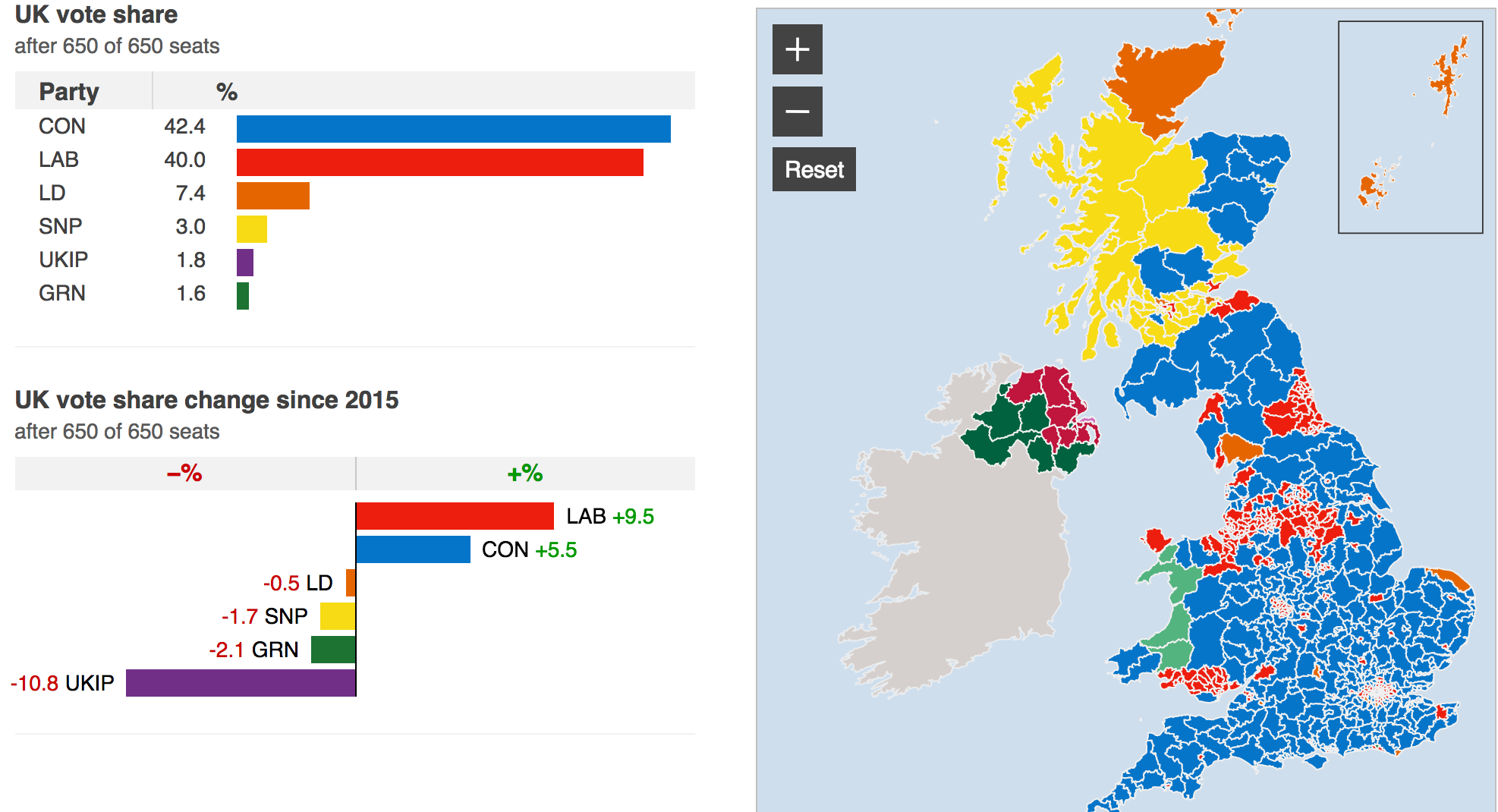
Here’s a very quick summary. http://www.bbc.com/news/election/2017/results
It’s a hung parliament. No party won enough seats to gain an overall majority.
The main parties are Conservatives and Labour.
Conservatives lost 13 seats. They now have 318.
Labour gained 30. They now have 262
This is a huge failure for the Conservatives.
SNP lost 21 seats. This is significant because they won so many in the last election and the SNP are all about gaining Scottish independence.
UKIP are out completely – they lost their single seat. They were the party campaigning for the UK to leave the EU and the immigrants to leave the UK.
Since the Tories are the incumbent party they get the first opportunity to try and form a government by making a deal with one of the other parties.
That’s the position at this moment. We’ll expand on it during our conversation but the words turmoil and disarray are again being used to describe the messy and complicated condition of politics in the UK today.
So let’s talk to my Dad – the professor of broadcast journalism and former BBC news man, for some much needed clarity on this whole subject in order to find out what happened, what it all means, how Northern Ireland and Scotland are involved and how this all relates to the ongoing story of Brexit.
As ever, watch out for all the key language as it appears. There is a lot of political language in this episode, which applies mainly to political systems in the UK but also could be used to talk about politics and international relations in other countries. Also, there are the usual fixed expressions, idioms and phrasal verbs that you normally find in any natural conversation.
Remember that in episode 352 of this podcast (nearly 100 episodes ago) I explained some key concepts and vocabulary related to this whole subject. So if you need some clarification and you want a reminder of some of the important words and terms relating to all of this, check out episode 352 in the archive.
But now, let’s hear from my Dad, Rick Thompson about the current state of politics in the UK, just after last week’s snap general election.
Outtro Transcript
So there you are. I hope it’s all a little bit clearer now, but equally it might even be more complicated!
It is a complicated situation but I hope you agree that we’re quite lucky to be able to listen to my Dad talking about it in his typically lucid and articulate way.
Don’t forget that you can listen to previous episodes of this podcast in which I have gone into detail about the language of politics in the UK.
Episode 352 goes into detail about the vocabulary of Brexit and you can listen to that one again in order to learn some of the key language of this subject.
Also you can listen to episode 82 from way back in January 2012 when I did an episode about voting, elections, politics and government in the UK, in which I explain and teach all the essential language you need to talk about the political process and also you can listen to a funny sketch about a general election.
That’s it for now. As ever, I remind you to join the mailing list which will mean you get an email in your inbox whenever I post new content here.
That’s new episodes of the podcast but also I sometimes post something when I’ve been featured on someone else’s podcast and recently I was invited to talk on the English Across the Pond podcast, The Earful Tower podcast and the Rock n Roll English podcast. If you’re signed up to the mailing list you will get notified of those things and will easily be able to listen to those fun conversations I’ve had and find out about some other people’s podcasts that you might not know about.
I’m going to end this episode after the jingle by playing you parts of the speeches by Theresa May and Jeremy Corbyn in the first session of Parliament since the election results came out.
Listen carefully to the voices of the PM and opposition leader as they make statements about the results and about the democratic process in Parliament over the coming months.
The cheering and jeering sounds you hear in the background are all the other MPs sitting in the House of Commons. It’s quite normal to hear them all shouting and cheering in agreement, or heckling and laughing at people they don’t agree with. I wonder if the parliament in your country is as loud and boisterous as it is in the UK.
So thanks for listening, and keep on listening after the jingle if you’d like to hear the words of Prime Minister Theresa May and leader of the opposition Jeremy Corbyn. (Image below, BBC.com)
Hamid If English keeps taking on words from other languages, will it stop being English?
This is the story of English.
English is a vacuum cleaner of a language.
Something like 300-600 languages have influenced English with words. If you look at English today. Where are the germanic words? They’re only about 20%. The other 80% is from French, Spanish, latin and others.
There is no single dominating influence on English today.
How many Urdu words have gone into English? Maybe 100. But English has over 1,000,000 words. No new cluster of words coming in is going to come in all at once (tidal wave) they come in drip drip drip.
New words are assimilated to reflect a need – e.g. for new types of food.
This is no threat to English.
In fact it’s evidence of the power of English, that it absorbs so many other influences from other languages and cultures. It’s like the blob!
Jilmani What’s the future of English?
Unpredictable! Absolutely an unanswerable question. You should never try to predict the future of a language. It’s all about events which just happen, e.g. the Norman invasion, Trump or Brexit.
Will Brexit reduce the influence of English in EU?
Not much. But it will change its character because it won’t be used by so many native speakers, so there will be more developments “Euro English” (I think it has emerged a bit).
But English will continue to change and diversify.
Jairo – wants help managing the workload of studies.
Learning about language is a huge burden.
Learning about a language you have to learn about the history, society and events of the time to understand why people were using language in those particular ways.
What was it like to be an old norse speaker?
But most philologists don’t have a psycholinguistic background to their studies.
Philology can be a bit dry.
David prefers the socially aware approach to the history of language which doesn’t just ask “what happened and when” but “why?” – let’s explore the nature of the people who made it happen. This should ease the process.
Cat English syntax – can you explain it?
Come on you’re asking for a book here!
English has a simple morphology compared with German (or French).
How many possible word endings are there for a verb in English?
The difference between English and German is morphological but also syntactic.
English and German are quite close. They only diverged 2000 years ago.
Word order is a bit different.
Everyone understood David when he went to Germany and spoke German with the wrong word order.
There aren’t that many differences, although the few differences are noticeable.
Cat, why are you worried about local areas of syntactic difference between English and German. Why has this become an issue?
It usually comes down to identity. German English (used by people who have learned it really well) still is distinctively German English.
The point is, don’t be too concerned about micro differences in syntax between your language and English. As long as we understand you that’s the main thing, although obviously style is important so I imagine you want to write in the style of a native speaker (but which one though!) You might have to accept that it’s important to find your own voice in English, which might be influenced a bit by who you are (it is your own voice after all) – which is someone who lives in Germany. That’s not to say your English can be totally different and like German with English words – that would probably be unintelligible and a bit ridiculous. But micro differences aren’t such a big deal.
Don’t sweat the small stuff, it’s just small stuff.
Wesley Do people who speak different languages think differently?
It’s difficult to translate words sometimes because there are some words which don’t directly translate because there isn’t an equivalent word. 10-15% of the words might be untranslateable. But in Chinese it’s a lot more.
But when you do psycholinguistic experiments we discover that people can see the different concepts, but having those specific words makes it easier to talk about those things. You can see the colours but you might not have the language for describing it.
Different languages might not have the same word for something but it doesn’t mean they think about them any differently.
E.g. in English we don’t have a word for a certain thing in Japanese – natsukashii for example. But we find other ways of describing it. Ah, it takes me back or “good old” or “it feels nostalgic” or “it’s good to be back”.
So it doesn’t seem to be the case that languages affect or reflect different perception of the world.
*But I reckon there might be something to it Wesley. E.g. sense of humour, patterns of understatement, all contribute towards expressing a sardonic outlook on life (UK) rather than a direct attitude in the mediterranean for example.
The fallacy is that it’s words that translate, but it’s not it’s sentences. A group of words together are what hold meaning. So even if there’s no single word equivalent, you put some words together and make a sentence and that’s how the language transcribes.
“Snow that you use to build an igloo with” – he can still express that thing with a sentence and you can see that kind of snow.
Learn the vocabulary of a new language and you’ll see the cultural things that it reflects. It shows that to learn the language properly you should learn about the culture too – the mindset, the reference points and so on. You can see all those things too, but having certain words and expressions makes it easier to talk about them.
The result is that in languages it’s easier to talk about commonly occurring cultural phenomena because the language has the tools to do it, but people are all still basically the same, we might just take a bit longer to talk about a concept that in your language is very normal.
Mayumi Why do Brits use indirect language?
It’s just a cultural difference. It’s the British temperament. The reason for that is hard to say. Maybe it’s because the UK is an island and the psychogeographic factors might affect that kind of language use.
Pragmatics – the study of why people are using specific bits of language.
Language norms reflect the cultural context – that’s the identity argument.
But why does the UK use this polite language? We don’t really know! You have to ask why British people want to be polite. (obviously it’s because we’re such nice people)
You just have to accept the cultural differences. Learn about them and accept them. “That’s who we are.” should be a good enough answer.
As ever, you must accept cultural differences. They’re not weird, they’re just different. It’s a good bit of advice for anyone coming into contact with another culture. You can speculate about why people behave the way they do, but ultimately you’ve just got to accept it and move on, like the way you often have to accept in English that “this is just what people say in this language” and that’s it.
Synchronic not diachronic method.
Wikipedia: Synchrony and diachrony are two different and complementary viewpoints in linguistic analysis. A synchronic approach (from Greek συν- “together” and χρόνος “time”) considers a language at a moment in time without taking its history into account. Synchronic linguistics aims at describing a language at a specific point of time, usually the present. By contrast, a diachronic approach (from δια- “through” and χρόνος “time”) considers the development and evolution of a language through history. Historical linguistics is typically a diachronic study.
DC says we should use a synchronic approach to understanding these things – why is this particular person choosing to say it in this way, right now?
Some more modern dictionaries now contain essays about usage and pragmatics, which help us to identify how culture affects language. It’s worth reading the extra comments and information pages you find in many dictionaries.
Also, consider reading cultural guides as well as purely linguistic ones.
Antonio Will AI replace the need for language learning?
Babel fish (Hitchhiker’s Guide)
In 100 years it’ll probably be perfect.
(I’ve seen auto subs have improved recently).
Imagine a situation where the babelfish is operating perfectly. It would solve lots of problems, but identity hasn’t been addressed. I still want to “be French” and the AI might not include those differences. People will still hold onto their languages in order to express their identity. It won’t affect language diversity.
But it might mean that AI might make the need for a global language redundant. Maybe AI will replace English. Why bother learning an international language?
But there are various answers to that – tech might let you down so people might not choose to constantly rely on it – some conditions in which there is no electricity.
Will AI manage to be perfect like a human, with the ability to translate with a view to expressing the culture?
Human translators choose between different competing nuances. I could say it this way, or this other way. We make those decisions based on complex social and psychological factors. A computer might not have that cultural sensitivity, maybe only in the long term.
The number of people learning languages might be reduced, but it’s also ignoring another factor in learning another language – the want to become aware of the culture, history and literature of the other language. There’s a personal satisfaction in learning another language and enjoy the pleasant things about it. People learn languages because they want to not because they need to. It’s a pleasure.
There are many reasons to want to continue to learn, it’s not just about intelligibility.
For the forseeable future he can’t see that it would be economically viable to create that technological solution for language when the traditional methods are the best way to foster relationships.
Jack – I don’t know where you come from.
First of all, David doesn’t mind being addressed in the Ali G dialect.
“Me” instead of “I”.
“Me wants to know…”
“I is well impressed…”
Subject verb agreement. “I is…”
“Booyakasha”
“It is a well big honour”
It’s quite a skill to be able to switch between registers. Sometimes we break the rules as a stylistic choice, like with the expression “If it ain’t broke, don’t fix it.”
It’s important to be able to switch between different styles and registers but you also have to know when it is appropriate to do it.
I’m not bothered by it in the comment section of my site, but you should be aware that some other people might find it weird or inappropriate, like for example if you write that in forums on other websites, in the comment section of Amber’s new podcast about Paris history, or in some business meeting. It’s going to seem really weird. So, you need to seriously think about the appropriacy of the things you’re doing and that means the style of English you’re using, or the decision to post dodgy pictures of cakes on my website. Should the listeners learn the rules of grammar, or should they just focus on meaning, and let the rules look after themselves?
Both but in a structured sort of way.
In communicative teaching the structured side was a bit lost.
Just listening and working things out by being dropped in at the deep end is a bit of a big step – it takes a while.
It’s also important to do some structure work, but also to expose the learners to things that illustrate the language point being used in a functional way.
So it’s not just about form, but also about function and trying to balance the two.
So, as we’ve said before – do both. Some structured language work, combined with exposure in which you are really focused on following the meaning of what’s being communicated. Then probably some more reflection on the way it was done. Moving between grammar and pure meaning all the time. Juggling.
Back to the conversation with friends recently.
People get upset by failing standards in English.
Again, David doesn’t mind – as long as the language is intelligible then it’s a sign of changing identities – a sigh of the times.
Are we better at communicating than we used to be?
It is possible to measure, but not possible to give a simple answer. It depends on the situation.
Book: “The Gift of the Gab” How eloquence works.
Eloquence standards do vary from generation to generation, circumstances, individual to individual. E.g. Obama and Trump – differences in eloquence. Is Trump incoherent? Is Obama a better communicator? Some people say Trump is incoherent and inarticulate. But it’s not necessarily true considering Trump’s ability to communicate with his core voters.
People cite various things as examples of falling eloquence standards, e.g. using “like” but often these aren’t really examples of falling standards, it’s just a question of style.
How do we use “like”?
As long as it doesn’t get in the way, it’s just a question of style.
Again, people see language changes and they equate it with decline. It’s not.
Usually, people are giving examples of things that are just a different type of eloquence (again, change not death).
Trump’s English has a style with its own values. He avoids the rhetorical style of Obama with balanced, complex sentences. Trump uses everyday conversational strategies. “Look, believe me folks..” Every day conversational strategies. He doesn’t use carefully crafted sentences, he changes direction even mid sentence. These are all features of informal American speech.
Semantically it can be extremely difficult to understand what he really means. But adopting that style allows him to appeal to certain people.
These days he might have become a bit more formal, but during the campaign he was noticeably less formal and more colloquial than Clinton and the other candidates. As a result he clearly stood out from the crowd, during a climate of dissatisfaction with the traditional political class. People were fed up with the type of boring politician speaking in that boring old way. They thought they were out of touch with ordinary people, and part of a crooked system. Trump got in by presenting himself as an alternative to this established political system and the way he used English was a big part of that.
Thanks for listening! I hope that helps!
Cookies on teacherluke.co.uk
Click “Accept All”, to consent to the use of all cookies on this website, or visit "Cookie Settings" to control your consent settings.
This website uses cookies to improve your experience while you navigate through the website. Out of these, the cookies that are categorized as necessary are stored on your browser as they are essential for the working of basic functionalities of the website. We also use third-party cookies that help us analyze and understand how you use this website. These cookies will be stored in your browser only with your consent. You also have the option to opt-out of these cookies. But opting out of some of these cookies may affect your browsing experience.
Necessary cookies are absolutely essential for the website to function properly. These cookies ensure basic functionalities and security features of the website, anonymously.
Cookie
Duration
Description
cookielawinfo-checkbox-analytics
11 months
This cookie is set by GDPR Cookie Consent plugin. The cookie is used to store the user consent for the cookies in the category "Analytics".
cookielawinfo-checkbox-functional
11 months
The cookie is set by GDPR cookie consent to record the user consent for the cookies in the category "Functional".
cookielawinfo-checkbox-necessary
11 months
This cookie is set by GDPR Cookie Consent plugin. The cookies is used to store the user consent for the cookies in the category "Necessary".
cookielawinfo-checkbox-others
11 months
This cookie is set by GDPR Cookie Consent plugin. The cookie is used to store the user consent for the cookies in the category "Other.
cookielawinfo-checkbox-performance
11 months
This cookie is set by GDPR Cookie Consent plugin. The cookie is used to store the user consent for the cookies in the category "Performance".
viewed_cookie_policy
11 months
The cookie is set by the GDPR Cookie Consent plugin and is used to store whether or not user has consented to the use of cookies. It does not store any personal data.
Functional cookies help to perform certain functionalities like sharing the content of the website on social media platforms, collect feedbacks, and other third-party features.
Performance cookies are used to understand and analyze the key performance indexes of the website which helps in delivering a better user experience for the visitors.
Analytical cookies are used to understand how visitors interact with the website. These cookies help provide information on metrics the number of visitors, bounce rate, traffic source, etc.
Advertisement cookies are used to provide visitors with relevant ads and marketing campaigns. These cookies track visitors across websites and collect information to provide customized ads.