Category Archives: Video

470. Understanding the Liverpool Accent

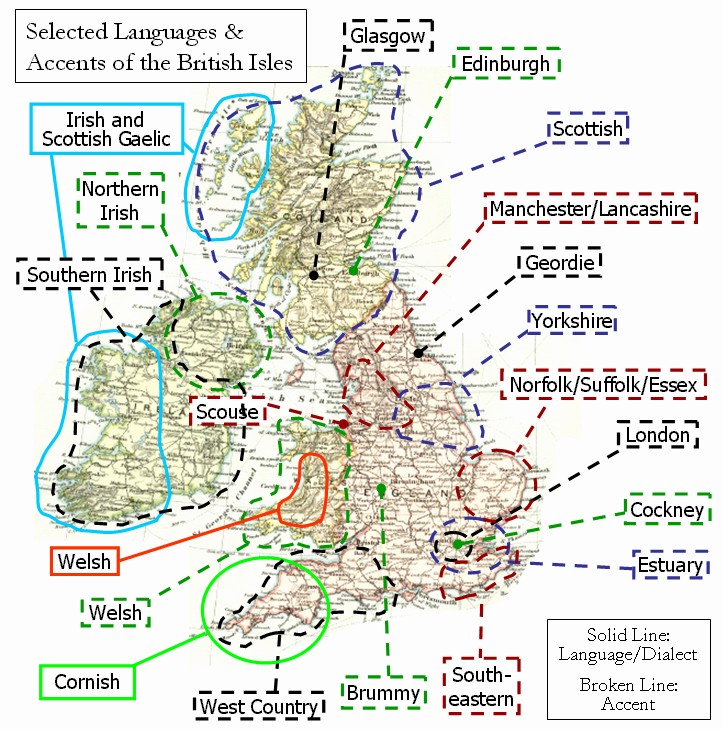
Helping you to understand and appreciate the Liverpool accent and Scouse English, featuring clips of comedy a short history of Liverpool and interviews with famous footballers, actors and musicians.


Small Donate Button
[DOWNLOAD]

Transcript – Introduction

Hello listeners – how are you doing? In the last episode we listened to some comedy routines by Scouse comedian John Bishop and I said we’d take a closer look at the Liverpool accent, break it down, listen to some more samples and also learn some typical words you might hear being used in Liverpool. So that’s the plan in this episode. All about the Liverpool accent.

There’s nowhere in the UK quite like Liverpool. You probably know it as where The Beatles came from, or because of the football clubs LFC and EFC. Perhaps some of you have visited it or studied there are students, because it’s a big university town.

I lived there for 4 years as a student.

My feelings when I moved there:
It’s definitely in the north! Up north.
First time I lived in the north, and there is a north/south divide in the UK
Climate is different
People are different to the people anywhere else – they’re cheeky, chatty, tough, humourous, a bit tricky sometimes, proud and also quite sentimental and sensitive about the city.

The place has a particular history that isn’t shared by other towns in England. Its cultural mix is different to the rest of the country. The accent in particular is very distinctive, and it’s confined to just the local Liverpool area – a relatively small space when you consider the accent diversity in other larger countries where the same accent may be heard for many miles, like for example in Texas. In England our accents are very specific and very local. Travel 30 minutes by car from Liverpool to neighbouring Manchester and the accent is very different and this is largely because of the history of Liverpool as an international port and the rich diversity of influences.

This is a corner of the country with a strong character and a recognisable accent to go along with it.

Scousers, or people from Liverpool are instantly recognisable by their accent. The sound of a Liverpool accent instantly conjures up certain images, certain cliches, certain reference points and a certain history which is unique to that part of the country.

In this episode the plan is to investigate the Liverpool accent, and to some extent the dialect, listen to some samples, find out some of the pronunciation features, and consider a little bit of Liverpool’s history and culture. We’ll listen to a few different people speaking in a Liverpool accent and I’ll help you to understand it all, and I’m sure you’ll pick up some nice vocabulary on the way – and not just local slang words but words that everybody in the country uses but which the Scousers might just pronounce in their own way.

The aim is to broaden your horizons, broaden your exposure to different accents and to help you get a full appreciation of English in all its forms.

The Milk Advert on TV

Let’s start with an advert that used to be on the TV and which millions of British people watched many times – The famous milk advert.This is what the whole nation (of my generation) might think of as a sample of Scouse English. Many of us heard it lots of times growing up and a lot of us even learned it. I used to be able to recite it word for word when I was a kid.

Picture two children from Liverpool who have been playing football in the garden. They come into the house to get something refreshing to drink from the fridge (or should that be “fridge”). One asks for lemonade, the other one chooses to drink milk because it’s “what Ian Rush drinks”.

Ian Rush was a famous footballer in the 80s. He played for Liverpool for years and scored many goals for them. He was Welsh. By the way, you should also know that there is a place in England called “Accrington” (north of Manchester) and their football team (Accrington Stanley) aren’t very good – so Accrington Stanley is a reference for an unknown football team that nobody wants to play for.

Audio sample 1 – The Milk Advert

Lee Mack making fun of the Scouse accent

Features of the Liverpool Accent

Let’s now take a closer look at the Liverpool accent, considering some of the main features that make Scouse English different to the kind of RP that I speak. Then we’ll listen to some more samples of Scouse speech and you can see if you understand them.


Consonant sounds

  • /k/ can become /x/ like in “loch” “Accrington Stanley” “milk” “Lee Mack”
  • /r/ sounds – alveolar tap “accrington stanley” “I’m afraid I’m not from round here” “alright”
  • /t/ can sound like /s/ “butter” “I’m going to go into town later, do you want something” “Come on then mate, let’s start. Come ed, Let’s get started.”
  • /g/ is pronounced not just with the /ŋ/ but all the way to a /g/ sound “sing” “singer” “Ere mate are you a singer? You gonna sing us a song?”
  • And yet sometimes it’s completely dropped like in “Eh mate what are you doing?” – “what are yew dewin? What are youse doing coming over here like that?” “Milk, that’s disgusting”
  • /h/ sounds are often dropped “That has never happened to be honest”
  • /d/ sounds instead of /th/ sounds – “They do though don’t they though?”

Vowel sounds

  • /ɜː/ like “bird” becomes [ɛː] like “air” – “work”, “first”, “bird” “Are you always the first one to get to work in the morning”
  • /a:/ sounds in the south are like /æ/ in the north (normal in the north generally) “bath” “grass” “laugh”
  • But sometimes it goes wider like aaaa in “card” or “pokemon cards”
  • /ʊ/ in book sounds like /u:/ “book” (but not every time – sometimes they say it like me, and words like ‘took’ and ‘look’ are often pronounced. I don’t know why it’s “book”)
  • /-er/ sounds at the ends of words normally pronounced with schwa sound are pronounced with an /e/ sound “computer” “teacher” “fitter” “singer”
  • /ʌ/ becomes like /ʊ/ or /ɒ/ “but erm… shut up” “shut up will ya”
  • “Errrm“
  • /eə/ sometimes becomes /ɜː/ – “hair” “over there”

All those features are interesting, but there’s a good chance that all just went over your head. Really the best way to get used to hearing scouse English is just to listen to some people using it.

Audio Sample 2 – Jamie Carragher “Butchers” the English Language

Just listen and tell me these things:

  • Who is he?
  • What’s he talking about? (general subject)

https://www.youtube.com/watch?v=nDaTTVR2JXY

Audio sample 3 – Stephen Gerrard, former England captain

  • What is he looking forward to?
  • Is he worried about the regime change with Fabio Cappello (known for being a discipinarian)
  • Does he have a message of hope for England fans?
  • What would it mean to David Beckham to achieve 100 caps?

https://www.youtube.com/watch?v=6cph2TnHW4Y

Audio Sample 4 – Wayne Gerrard – a spoof of Scouse footballers by Paul Whitehouse

Wayne Gerrard (spoof)

Language:

  • Just get my head down
  • Let my feet do the talking
  • Very pleased for the fans
  • Very pleased for the manager
  • One game at a time
  • Keep my head down
  • Let my football do the talking

A short history of Liverpool

Liverpool is in the north west of England. It’s a port town on the river Mersey, just where the north coast of Wales meets the west coast of England.

Liverpool started as a small trading port probably in the 13th or 14th centuries.
By the 17th and 18th centuries it was the primary port for trade with Ireland. There was lots of trade with Ireland, and also ships coming from Norway and Sweden or other scandinavian countries.

The industrial revolution, globalisation and Britain’s colonialism meant that Liverpool became a hugely important port for British ships heading to the Americas in the 19th century.
As a result by the mid 19th century, Liverpool was a hugely important city for trading with the new world.

The population of the city grew quickly with amazing diversity – everyone from around the world was there, including large numbers of Irish and Welsh workers, scandinavian sailors but also Chinese workers, Caribbean workers associated with the slave trade.

Liverpool was one of the most important and most impressive cities in the world at this time.
It was sometimes called the New York of Europe, and you can see evidence of that in some of the buildings – parts of the city resemble some of the style of New York buildings, especially in the old part of town and by the docks.

The diverse history is still evident in the cultural make-up of the city. There is still a large Chinese community and also many families of Caribbean origin in parts of Liverpool.
The biggest influences though were the Welsh and certainly the Irish communities who moved in for the manual work that was available there in the 19th century. Liverpool is heavily influenced by the Irish, and it was described as the capital of Ireland just because so many Irish people lived there.

All of these influences can be heard in the Liverpool accent – some Irish, some features of Welsh (which is a totally different language to English) and also some scandinavian influences and many others that make Liverpool so different. That’s also combined with the local Lancashire accent too. All of it combines to create this particularly rich and vibrant form of English.
The city was very rich and very important during the industrial revolution, but conditions for many people were appalling – living squeezed into dirty and dangeous slums.

Gradually Britain’s position as the global industrial imperial power started slipping, and the two world wars sped up that process. Many young men were killed in World War 1, and between the two wars Liverpool was partly redesigned with many residential areas being built around the outskirts of the city, and lots of the people who previously lived in the slums being relocated there. This changed the nature of the city, with large outlying residential areas with row upon row of terraced houses.

World War 2 was devastating to Liverpool as it was the target of bombing raids by the Luftwaffe. Like many cities in the UK, Liverpool got pounded by bombs night after night and lots of buildings were destroyed, and they stayed destroyed for many years.

When the Beatles were growing up in Liverpool in the 1950s it was common for children to play in bombsites – in the remains of buildings destroyed by bombs, and even when I was living there in the 1990s I saw lots of empty spaces in residential streets where buildings used to exist but still hadn’t been replaced since the war.

With the end of the industrial revolution, Liverpool’s importance slipped and basically since WW2 Liverpool has been a rather tough place to live, with various social problems, unemployment, poverty, and perhaps the sense that the city has been somewhat ignored or forgotten by the country which used to rely on it so much.

These days the city is known for The Beatles, the football clubs and players, some cultural things such as the vibrant art scene and just the scouse people themselves who are known for their humour and their unique character.

Here’s a female voice – Jennifer Ellison, an actress from Liverpool.

Audio sample 5 – Jennifer Ellison “Mum of the Year Awards 2013”

Vocabulary

Here are some bits of the dialect or just typical sounding words.

To be honest, you hear most of these things in many parts of the country, but listen out for how scousers would say these things.

  • ‘Me’ not ‘my’ – “You’ve broken all me biccies!”
  • ‘You’ (plural) – ‘youse’ “Youse are all a bunch of bleedin eejits”
  • Adding “me” at the end of a sentence starting with ‘I’. “I’m dead hungry, me.”
  • Mate – “Alright mate, are you a student?”
  • “Sound” – “He’s alright isn’t he, him? Yeah, he’s sound.”
  • “Boss” – That’s boss that. Have you played FIFA. It’s boss.”
  • “made up”
  • “Eeeerm”
  • “Eh!”
  • “Alright?”
  • “Laa”
  • “Ta-raa”
  • “See ye later”
  • “Come ed”
  • “Go ed” “g’wed”
  • “Alright! Calm daaaawn!” (cliche)
  • “Bevvies”
  • “Nice one son”
  • “Gutted”
  • “Scran”
  • “bevvie”
  • “Bacon barm” – “two bacon barms please”
  • “brekkie”
  • “Chocka block”
  • “Like” – “I was like, walking down the Scotty road and I seen these two like students.”

Lots of people in the UK got to know Scouse very well from watching Brookside, a soap opera that started in the 80s. It was about middle class and working class life in Liverpool and it often showed scenes of social problems including frequent arguments between the main characters. This helped to build the stereotype that Scousers are argumentative and prone to social problems.

Audio sample 6 – Brookside argument

Summary

  • 3 people – Barry, Barry’s mum and Billy
  • Barry wants his money
  • But the account is £500 short
  • Because his Mum lent it to someone else (Billy)
  • So, let’s cut out the middle man, give us the money
  • He hasn’t got it – he needed it to pay the mortgage and the car
  • Barry gets angry with Billy saying “you’ve got it made here”
  • Barry is angry with Billy because he’s borrowing money from his Mum
  • “I’m going to have to go back to the car fella, tell him I can’t have the car”
  • You’ve screwed up our Christmas!
  • Then he pushes him.

Cliche

This cliche of argumentative Scousers was summed up in a series of sketches on a comedy TV show called Harry Enfield’s TV Programme.

This cemented the stereotype of Scousers as:

  • Argumentative & violent – often fighting and infighting
  • From large families with lots of brothers
  • Always wearing shellsuits
  • Unemployed – around the house all day
  • With mustaches and curly permed hair

Audio sample 7 – Harry Enfield – The Scousers (the cliched view)

https://www.youtube.com/watch?v=6k2YEc6dozA

Language:

  • Alright, calm down calm down.
  • Are you telling me to calm down?
  • Alright you two, break it up!
  • What’s going on here eh?
  • Friggin
  • Do you have to make such a friggin fuss about it?
  • Just keep out of it Barry.
  • Are you telling me to keep out of it?

The Beatles

The Beatles are also famously from Liverpool, but nobody seems to really speak like them any more. The accent has become more nazal and harsher. The Beatles spoke in this kind of “Beatle voice” which you don’t hear so much any more.

You can hear the scouse in their voices though if you listen carefully.

Audio sample 8 – Beatles


Audio Sample 9 – Local documentary on YouTube

Mini doc https://www.youtube.com/watch?v=yIcPTpWq5jY

469. British Comedy: John Bishop

Helping you to understand a comedian with a Liverpool accent – learn vocabulary, culture and accents in English.


Small Donate Button
[DOWNLOAD]

London LEPsters MeetUp

There’s going to be a meetup of some London-based LEPsters this coming Sunday 30th July at 7pm at the Fitzroy Tavern on Charlotte Street. It’s just north of Soho and to the west of Tottenham Court Road. There should also be a Facebook link soon.

The Fitzroy Tavern
6 Charlotte St, Fitzrovia, London W1T 2LY, UK
Sunday 30th July 7pm Fitzroy Tavern on Charlotte Street.

Zdenek Lukas of Zdenek’s English podcast will be there with any other London-based LEPsters that choose to come out. The plan is to have conversation, a beer or two and perhaps play some board games, because Zdenek is bringing some board games too. So head on down to practise your English, meet some like-minded people in a cool part of central London.

Episode Notes & Transcripts

Introduction

Hello dear listeners, welcome to the podcast. This is one of those episodes in which I go through some British comedy and help you to understand it. We will cover some vocabulary and also some cultural stuff too.

This is also chance to for you to listen to some Scouse English – the kind of English you might hear in Liverpool.

Scouse – that means from Liverpool. A Scouser is a person from Liverpool, and in that area people speak with a Scouse accent. In fact you find that accent in many parts of Merseyside – which means, Liverpool and its surrounding areas.

I’m going to tell you briefly about a popular stand up comedian from Merseyside (the Liverpool area) called John Bishop, who is often on the TV and on stage across the UK. I think he’s probably one of the most famous scousers in the UK these days. We’re going to listen to one or two of his routines which you can find on YouTube, we’ll understand them and notice some features of his Liverpool accent.

By the end of this episode I expect that you’ll have broadened your vocabulary, you’ll have become more familiar with the way people speak English in Liverpool and you’ll have learned some cultural details about family life in the UK. Also, you’re going to be introduced to the comedy of John Bishop, who you might enjoy. There are various John Bishop videos on YouTube and you can can buy his comedy DVDs which are very popular in the UK. If you like what you hear in this episode, you could get one of those DVDs and use it for both learning English and for your own general amusement.

John Bishop – some info on him

To cut a long story short, he was born in Liverpool and has lived in the Merseyside area for most of his life.

Where is Liverpool? Why is it called Merseyside?

People in Liverpool – amongst other things they are known for having a particular accent which people say is a kind of mix between Irish, Welsh (a lot of Irish and Welsh workers moved into the city during it’s time as a major industrial port in the 19th century), Lancashire and even Scandinavian influences. The accent is instantly recognisable to anyone in the UK.

So, John Bishop was born in Liverpool and has lived in the area for most of his life.

In his 20s he had what seems to have been a fairly boring and ordinary career selling pharmaceuticals. By the age of 30 he was married and had a baby son but he wasn’t particularly happy. He ended up getting separated from his wife and they were going to get divorced. He started doing stand-up during this period because he says it stopped him staying at home on his own in the evenings and drinking. It got him out of the house. The thing is, he found that he was good at it and eventually he quit his job to do stand-up full-time. Basically stand-up saved him and it rescued his marriage too – because one day his wife (who was divorcing him at the time) happened to see him on stage during a show and she went up to him afterwards and said “that was the man I fell in love with years ago” and they got back together. Since then his stand-up comedy career has taken off, and how he’s one of the most popular and well-known comedians in the UK. He’s often on the TV and his stand-up comedy DVDs are very popular.

Now he’s got quite a big family with 3 kids – all of them boys. In his comedy he talks a lot about family life and being a father – the typical frustrations, difficulties and experiences that many parents go through.

He’s definitely a mainstream comedian. I mean, his routines are not political, they’re not particularly challenging or controversial. They’re not super intellectual. It’s just straight forward observational comedy and storytelling. He’s not my #1 favourite, but I just love stand-up and I definitely enjoy his work even if he’s not my absolute favourite. But he is very successful. I think his appeal is that he’s an ordinary guy and his stories and routines are very relatable – people enjoy them because they can relate to them.

Scousers have a reputation in the UK for a few things – one of them is for being funny. This maybe a cliché or a stereotype, but I do think it’s quite true, having lived in Liverpool for 4 years. I met lots of Scousers who were very funny – just characters with stories to tell and who had the gift of the gab and good comic timing.

John Bishop is a good example of that. Partly it’s to do with the Liverpool accent which has so much character and I think helps the delivery of his routines. He tells endearing stories in a relaxed way. He wears a suit and tie so he’s well-presented. He is quite handsome and charming, but in an average kind of way. He’s like the ‘boy next door’ kind of guy. Just a normal bloke. His delivery is quite casual and easy-going, he keeps it pretty short and simple with pauses in the right places which is always a good approach to storytelling.

His attitude on stage is quite dry or deadpan (Wikipedia defines “dry” or “deadpan” like this: Deadpan or dry humor/wit describes the deliberate display of a lack of or no emotion, commonly as a form of comedic delivery to contrast with the ridiculousness of the subject matter. The delivery is meant to be blunt, sarcastic or apparently unintentional).

~

Usually his stories allow us to see that his life is actually quite frustrating and ridiculous – just like normal life is for everyone from time to time. Watching observational comedy like this makes you feel good because you totally understand what he’s going through because in fact your life is quite frustrating and ridiculous too. So it’s therapeutic – that’s what’s great about comedy. It lets you laugh at life and realise that you’re not alone and that we all experience these frustrating things.

Let’s listen to John Bishop, with his Liverpool accent, telling a couple of stories of family life from some of the videos on YouTube and let’s pick up some English in the process.

I’m going to play the first clip to you in just a moment.

As you listen, I wonder what you will be thinking. We’ve done this before, listening to English with different regional accents. You might feel that you can’t understand him completely – I think he speaks pretty clearly, delivering stories in a slow but punctuated way, but the accent might be hard for you to understand. You might think “Oh his accent is too strong”. I wouldn’t be at all surprised. But remember, English is a very diverse language. You might not want to speak like John Bishop (or maybe you do I don’t know) but you certainly should try to understand him. English comes in many different forms – many different accents – and even if you’re not familiar with those accents, they are normal and perfectly valid forms of the language which everyone can not only understand but appreciate.

It would be a pity for you to only understand one standard form of English. It would mean your English was limited. Anyone with a decent sense of English should be exposed to different accents. David Crystal said it, we all know it’s true. So let’s listen to some Scouse English. And please, do not think “Oh god his English is bad”. That’s not fair and it’s simply not true. I understand all of it, so do his audiences. British people do not struggle to understand him at all, quite the opposite – he’s very understandable and relatable. He draws in very large crowds of people to his shows all across the country. All those people understand and enjoy the things he says. His Liverpool accent is a very important part of his charm. If it’s hard to understand him I think it would be wise to consider that maybe you’re just not familiar with his accent, and that you just need to broaden your exposure to English a bit, and that this is a chance for you to do that.

Anyway, maybe you won’t have trouble understanding him at all and you’ll just enjoy listening to his story. Let’s see.

Video

Here’s John talking about going on holiday with teenage kids (I wonder what teenagers are like in your country.)
You’re going to hear him say that he had a massive tour one year and he was away from home a lot so he wanted to spend some quality time with his kids – in a kind of nostalgic way – like he imagines it used to be when he was a kid – go somewhere in the countryside where there’s no internet so he can spend some quality time with his teenage sons, spending a sort of idyllic Christmas and New Year’s Eve sitting around the fireplace playing board games, like it was in the good old days. But, his kids are modern British teenage boys who are addicted to the internet – so that might make things difficult…

You’ll also hear a few sound effects from the video, which you can see on the page for this episode.


Holidays with the kids (video 1)

https://www.youtube.com/watch?v=HMHYtGPpyko

White trainers, growing up, puberty, hormones and getting your head kicked in by your own son. (video 2)

John Bishop gets a new fridge and takes his old one to the dump (video 3)

https://www.youtube.com/watch?v=N9yAJKcIVxk

Language Learned

Here is some of the vocabulary you could learn from this episode.

Going on holiday with the kids (video 1)
Scouse
Scouser
Nostalgic
Quality time
Idyllic christmas
Sitting around a log fire playing board games
Teenagers
Addicted to the internet
Sound effects
A reconstruction
A cottage
It’s on the border between Scotland, england and Narnia
Internet, it’s Berwick son, we haven’t even got ceefax
We turned up at the cottage
In the middle of nowhere
Youse three, go in the living room, put the telly on
Looking at the past through rose-tinted glasses
In the middle of nowhere

White trainers (video 2)
You don’t realise how much of a cock you are
They do your (bleedin) head in don’t they?
Going through puberty
You have a week off school for half term (holiday)
You do P.E. (physical education)
You walk into the showers all self-conscious
Some kid walks in with a beard and bollocks by his knees!
Your voice breaks and that’s when you don’t get control over your voice
The hormones just come flying in and you’ve got no control over them
It’s the funniest thing on the planet bar none
I’m not asking you, I’m telling you!
Get up them (those) stairs and take them off.
Make me
It’s like the little lion is taking on the big line and all the other lions are running around going “it’s kicking off here!”
We’re stood toe to toe
I can take you!
There’s a chance he can take me here.
Thinking you’re going to get your head kicked in with your shoes

Taking the fridge to the dump (video 3)
The fridge
The freezer
The dump
To get rid of some stuff
It’s health and safety gone mad
It’s political correctness gone mad
A silver fridge that’s the size of a bungalow
A bungalow
That hasn’t half changed our lives (that has changed our lives a lot)
Put it next to the sink
I’m saving meself (myself) a yard of walking
We had a spare fridge
I turned up at the dump
There’s a fella there with a yellow vest and a clipboard
He’s done an NVQ in clipboard management
You can’t just dump a fridge now
You’ll have to phone us up
Then we come and get it
Who do I ring?
The phone in his hut rang
A hut
I’m outside dickhead!

462. British Comedy: Bill Bailey

In this episode I talk to you about one of my favourite stand up comedians from the UK. We’re going to hear some of his comedy and use it to learn English.


[DOWNLOAD]

Introduction

I’ve always been a big fan of Bill Bailey since I first saw him on telly in the 1990s, and I’m glad to say I once saw him performing stand-up in Hammersmith, which is where Bill lives and I used to live too.

Who is Bill Bailey?

Bill Bailey (born 24 February 1964) is an English comedian, musician, actor, TV and radio presenter and author. Bailey is well known for his role in the TV show Black Books in which he plays the part of Mani, and for his appearances on Never Mind the Buzzcocks, Have I Got News for You, and QI as well as his extensive stand-up work, including his DVD specials such as “Part Troll” and “Dandelion Mind”.

Bailey was listed by the Observer newspaper as one of the 50 funniest acts in British comedy in 2003. In 2007 and again in 2010, he was voted the seventh greatest stand-up comic on Channel 4’s 100 Greatest Stand-Ups.
In this episode

This episode

In this episode we’re going to listen to some of Bill’s comedy and we’re going to understand it all so that you can hopefully enjoy it as much as a native speaker. So, lots of language, lots of listening and all the usual stuff.

Obviously, your enjoyment of comedy is subjective and what’s funny to one person isn’t funny to another, but the vast majority of what goes into appreciating a comedian is being able to actually understand the things they are saying. So, don’t judge it until you fully understand it.

I hope there’s a lot for you to learn from this episode and that you also enjoy it and find out about a very funny comedian, who has a lot of videos on YouTube and DVDs that you can buy and enjoy over and over again.

Let’s talk a little bit more about Bill Bailey and then hear some of his comedy.

Here are a few little things that you should know that might help you appreciate his humour a bit more.

Bill’s Appearance
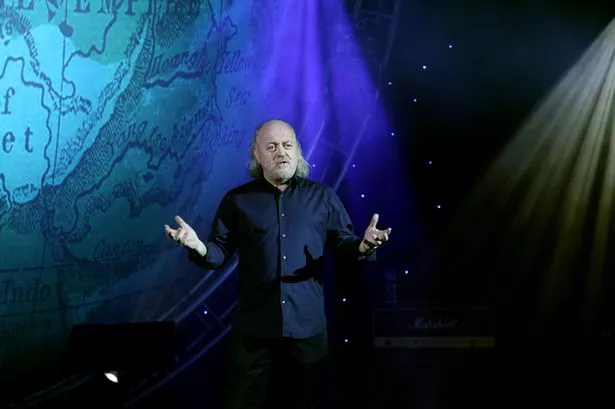
He’s got quite a funny appearance. He looks like an old hippy (even though he associates more with the punk movement) – he has boggly eyes, a bald forehead, long straggly hair, a round face. That sounds almost mean, my description, but Bill is also a lovely person, quite sort of cuddly and is amusing just to look at. He uses his appearance well, making himself look like a crazy person. It helps gain laughs I think. Inside he is a very down to earth guy with a good sense of humour.

Type of comedy
A bit weird, a bit surreal, quite cerebral and intelligent, considering the stranger aspects of life. He’s the sort of comic that some people would say was “random” – meaning he is a bit strange and tends to look at life from a different angle. He doesn’t just do ordinary observational comedy, but instead his work is full of musical parodies and existential thoughts.

Music – parodies, mixing different styles together, observations about musical tropes.

Left-wing politics – He’s a member of the Labour party and his political views come into his comedy in various ways as he tends to make fun of capitalist culture and the establishment.

Drugs – they come into it sometimes when he makes reference to weed and generally it seems that Bill has probably taken a few drugs in his time, as is evident in his surreal style and his existential musings.

Hammersmith – this is where he’s from. It’s in West London where I used to live, but Bill also grew up in the West Country – so he has a slight west country accent, and Wales too. Generally though, he speaks a kind of RP with a West Country or London twang.

So let’s now listen to a few clips, and then I’m going to explain what you hear. There are so many clips on YouTube and I basically like all of them, but I’m going to play you probably about 5 things taken from various TV appearances and live shows over the years. You can find the embedded videos on the page for this episode.

Most of these videos showcase his musical talents as well as his comedy, his story telling and so on.

Let’s get started.

Beethoven loses a penny

Some vocabulary and language
A lot of institutions had to merge due to funding cuts
I attended the Bovington Gurney School of Performing Arts and Owl Sanctuary
I studied Beethoven.
A fascinating character.
A very lonely embittered man, a very drunken man, slovenly, covered in dust, and filth and beer. He was a very unpleasant man. He was prone to dark fits of temper. He would hurl stuff around the house and then scrawl sonatas on big blocks of cheese and then eat them to spite the world.
He channeled his anger into his work.
Rage Over A Lost Penny – inspired by an argument he had with his cleaning lady.
You know when you lose something… how frustrating.
Have you seen my penny?
Can you think where you last had it?
No I can’t remember where it is!
Have you checked your pockets?
Of course I have you stupid b*tch!

Starsky & Hutch and the jazz news

Things you need to know about Starsky & Hutch – it was a show about two cops in the 1970s with groovy music

Dramatic cop action, sometimes they were on a stakeout, they drove a cool fast car, they had an informant called Huggy Bear, sometimes they’d have fights with criminals, mafia guys etc, they’d often have car chases and they’d always drive down alleyways with lots of cardboard boxes and they’d drive through the boxes because it looked good on TV.

Stephen Hawking / A Brief History of Time

Learning Chinese – Owl story

Doorbells

https://www.youtube.com/watch?v=SMNX11y0dVo


451. Film Club: Alien Franchise / Alien Covenant

Another film club episode, this time about the Alien franchise and a review of the new film “Alien: Covenant”. The film is in the cinemas now and you could watch the other films at home (with or without subtitles) for some more English listening practice.

[DOWNLOAD]

Introduction

Here’s a film club episode about the Alien movies. I hope you’re a fan of those films. If you’re not a fan then this might not be for you I guess, but I hope you listen. In terms of language you’ll hear loads of descriptions of the events and themes of the Alien films and my opinion of “Alien: Covenant”. As ever I encourage you to listen out for language – you might notice some specific phrases. Check out the page for the episode where you’ll see a lot of the notes I made before recording. There are also a few YouTube vids there for you to see as well. OK, let’s get started.

I got a message the other day from a listener in South Korea called Ethan Lee. Ethan asked me if I was going to see the new Alien film “Alien: Covenant” and if I could talk about it on the podcast.

Well, I’m sort of a fan of the Alien movies and today I’m going to see Alien: Covenant, so here’s a film club episode all about the Alien franchise.

I’m going to describe the films, their stories, what makes them great or not so great, including Prometheus from a few years ago.

Then I’m going to go and see Alien: Covenant, the new movie and afterwards I’ll tell you what I think of it.

I’m going to do my best to avoid spoilers throughout this episode while discussing these films, although I’m assuming that you’ve probably seen at least Alien and Aliens and you know some of the big moments – like probably the most famous scene in the original alien film where we first see the alien – when the alien comes to dinner, let’s say.

So I expect you know some stuff, but in any case I’ll try to avoid big plot spoilers.

I’m also going to give mini reviews of the films in the franchise, before focusing on Alien: Covenant

Episode notes

Why are you interested in the Alien films?

First time I heard about it.

First time I saw clips from Aliens in a sci-fi exhibition in America when I was about 14.

First time I saw Aliens when I was a kid.

The Alien franchise – Timeline

Alien
Plot
What type of film is it
Director
Alien
What makes it good
Mystery
Slasher film
The design by HR Geiger
Subtexts about sex, reproduction and motherhood
Limitations in filming
Ridley Scott

Aliens
James Cameron
Action movie
More aliens & explosions
New additions like The Queen
An amazing action sequence at the end where Ripley fights the Queen and then a few shocks at the end.
Annoying marines being macho, but great action sequences and Aliens on top form.

Alien 3
Disappointing
Poor storyline – killing off some of the characters from the last episode
Set on a prison colony
Bland set designs – all these characters with shaved heads
I’ve seen it a few times and even now I can’t remember what it’s all about
Poor CGI aliens

Alien: Resurrection
This was slightly better than Alien 3
It’s about a gang of mercenaries who find out that the military have cloned Ripley and used her to create aliens, which as ever they want to weaponise. The Aliens get loose in the ship and it all goes wrong while the ship heads towards earth.
There are some creepy bits about cloning including the times they’d failed to clone Ripley and also at some point a weird Ripley/Alien mix is created which is quite a horrific monster that just wants to kill everyone except Ripley who she considers to be her mother. The scene where the monster goes is both hideously disgusting but also terribly sad.
All in all it’s a weird, gross film which explored some of the themes of reproduction and motherhood.

Alien vs Predator and Alien vs Predator: Requiem
Never seen these films in full although I’ve caught some of them on TV and watched a bit but didn’t continue.
Quite horrible direction, in the dark, close up, so you can’t see anything. Generally it’s Aliens punching Predators. It could have been great but it’s not. There’s a predalien. Another weird name.
Neither of the Alien vs Predator films are considered ‘canon’.

Prometheus
Ridley Scott, back on board.
Let’s bring back the original world of Alien.
Excessive marketing with Ridley Scott really talking up the film in very high level terms – talking about ancient myths and big themes about humankind dabbling in too much power and the gods taking revenge and all this stuff, the legend of prometheus.
The film deals with humanity’s relationship with the gods—their creators—and the consequence of defying them.
I thought – this sounds amazing.
I binged on the publicity and the hype.
Went to see it expecting something huge.
What I got was cheesy dialogue, B-Movie level plot points and action sequences, pseudo-intellectualism, amazing visuals, some bizarre monsters and some extremely stupid decision making.
All in all I’m not sure what to think of Prometheus, but I am slightly obsessed with it.
There are some great things – the effects, the visuals, the performance of Michael Fassbender as the android David.
Some of the monster scenes are amazing.
It’s also mysterious and makes me wonder what it’s all about really.
It spawned numerous “fan theory” videos on YouTube with people going on at length about all the hidden meanings and real meanings – it all makes my head spin.
Here’s my take on it
Millions of years ago on earth an ‘engineer’ arrives and drinks weird black stuff that makes him disintegrate and spread DNA into the ecostystem on earth, seeding life on earth – probably human life. Alright. I wonder why he has to drink that stuff to do that. It looks cool though.
Then, cut to the present day or the near future or whatever. A couple of scientists have worked out from cave paintings where the engineers come from.
They go to find them, sponsored by the Wayland corporation.
They get there to find a seemingly deserted planet.
Find a spaceship. Apparetly this isn’t the engineers’ home planet. THere’s a ship there with loads of these kind of jars of black goo.
The ship also has some murals including one of a xenomorph. The black jars of goo look a bit like alien eggs, but not.
It looks like the engineers were loading the goo onto the ship and something went wrong. Maybe they got infected by the goo and had a bit of trouble. It looks like it. They’re dead anyway.
Apparently they were heading for earth with this load of black goo.
What’s the black goo? A kind of bioweapon.
David tests it. Doesn’t go well.
Shaw’s weird alien birth.
Two of the crew members are utterly stupid.
Apparently the black goo has infected some worms…
Find an engineer in hypersleep.
Wake him up and he’s angry.
Apparently the engineers were fed up with us and wanted to kill us. Maybe because they’ve been observing us and they’ve thought – no, start again! Humans are rubbish! Look, DOnald Trump, The Kardashians, Brexit – no, kill them all!
The remaining crew members stop the engineer sending all the goo to earth.
Engineer ends up getting impregnated
The ship crashes – stupid running away scene.
“Deacon” is born.

Alien Covenant
It’s been advertised in the same way as Prometheus.

A LOT of youtube videos. A LOT of footage released in trailers. LOADS of different versions of the trailers. LOTS of shots of the alien – as if to say “Look there are definitely aliens in this!”

But I have to say I don’t think it looks good.

Why?

First of all they appear to be repeating the same steps as the original Alien film. It looks like the same thing.

Then there are some clips of moments that look utterly cliched.

For example there’s a person who apparently has been infected by the black goo.

Black goo is rubbish by the way. It’s not as good as the Alien. It’s just goo and it’s really unspecific. If it touches you you become a monster with super strength. The alien with it’s weird reproduction cycle is far more interesting. Black goo just doesn’t make any sense.

Anyway, in the trailer one person apparently is mutating into a monster but it’s the most cliched thing of him standing under a bright light and kind of shaking while apparently possessed. We’ve seen it a million times before.

Then there’s a clip of two people in a shower and the Alien creeps up on them in the shower and you see the tail coming up between their legs while they’re in the shower. Basic sexual imagery – not like the inventive designs of Geiger, just old fashioned Freddie Kruger type stuff.

So, I don’t expect much from this but I feel like I should see it just to find out for sure. Who knows, it could be really great.

So now I’m off to see it so let’s see!


I then went to see Alien: Covenant in the cinema down the road. Listen to the episode to find out what I thought!

https://www.youtube.com/watch?v=RDWZk7Qwedo


What do you think of the Alien films? Leave your comments below.


449. Film Club: Touching the Void (Part 2) Learning a Language is Like Climbing a Mountain

Part 2 of this Film Club episode looking at the award-winning documentary “Touching the Void” which tells the story of a mountain climbing expedition which goes wrong. Listen to this episode and then watch the film on Netflix or DVD for that extra bit of English input.

Small Donate Button
[DOWNLOAD]

Click here to get the book “Touching the Void”

Click here to get the film on DVD.

The Story Continues…

Their plan was to climb back down the North ridge and then abseil down a part of the north face.

Abseiling is when you use ropes to kind of lower yourself down. But the clouds started coming in again.

The walk along the north ridge was much harder than expected. It was vertical on one side (with overhangs) and steep flutings (like grooves going down) on the other side. You wouldn’t know if you were stepping on something safe or not.

As they were descending, with the weather setting in, things got a bit out of control.

They got lost and they were in a whiteout – unable to see anything.

Their plan was to get down that day. But, by the time the sun went down they were still very high up the mountain, still over 6,000m up.

That night while they were making a brew of water, their gas ran out.

Day 4

The next day they could see that they’d managed to get down the worst part of the ridge and Simon thought they’d get down the rest of the mountain that day. He thought the whole climb was “in the bag” (if something is ‘in the bag’ it means you’re certain to achieve it, you’re definitely going to get it.)

Simon thought it was in the bag. He was wrong.

Joe was climbing in the front, before Simon. He reached a vertical wall, a fall in front of him, so he started to lower himself off it.

The method of lowering yourself down an ice wall, using pick axes and spikes on your feet.
Joe swung his pick into the ice, and it made a strange sound, so he decided to take it out and place it in again.

He was about to swing again, and the whole piece of ice he was attached to with his left hand just came off like a pancake, so he fell through the air.

And he landed hard, on his leg.

It broke, really badly. Not just a fracture.

Pain flew up his thigh from his knee. Incredibly painful.

I’ve never broken my leg and I hope I never do because I’m sure it’s horrible.
I have injured myself before. Of course, I’ve cut my fingers on knives etc. When you do injure yourself there is a shock, especially a kind of shock where you think it could be serious. That kind of shock lasts a few moments, when you don’t just feel pain but you feel a kind of panic, thinking “I’ve seriously hurt myself”. Most of the time that feeling goes away when you realise it’s not bad.

But if it is serious, you get this dreadful feeling that comes on. A truly dreadful feeling that comes from the realisation of just how difficult and inconvenient things are going to get. Not just the pain, but the fact that you now have this injury which is going to make everything so damn hard for you.

Now imagine that feeling when you’re 6000 metres up the side of a freezing mountain in Peru with no water and no medical services anywhere near you.

I don’t know about you, but I would feel more than dread, I’d feel pretty hopeless. I imagine I would feel more than the pain and the inconvenience, there would also be all this emotion coming, like anger, tragedy, sadness.

Anyway, Joe at this point was mainly feeling the intense pain of a badly broken leg.

Here’s what happened, and this is really horrible, ok?

The impact of the fall caused his knee joint to actually split. The joint split and the bone from the lower leg went up through the knee joint, split the end of his femur (the thigh bone) and carried on up the leg.

Unimaginable really. All those ligaments completely ruined, the bone, cartilage, nerve endings, and of course the blood vessels broken by it.

The whole leg would have been unusable of course, and there was a lot of internal bleeding inside his leg.

Apparently he couldn’t cope with the pain at all at the beginning, but after breathing for a while he started to get a grip on it.

But he thought he was done for. He was still level with the peaks of some of the other mountains.

He tried to stand on the leg – impossible.
Simon eventually arrived, and he describes seeing Joe’s face – a complex mix of terror, pain and anguish.

Simon said “Are you ok” and Joe nearly said “I’m fine thanks” – because that’s what we say to that question, even if you’re not fine!

But he said “No I’ve broken my leg” and immediately Simon thought, “Oh god, we’re stuffed”
Now. What would you do if you were Simon and Joe here?

Let’s imagine you’re Joe.

You say, “mate, you’ve got to help me” or “Go ahead without me, I’m stuffed!” or “Don’t you dare leave me!”

Let’s say you’re Simon, what do you say here?
“Mate, don’t worry. We’ll get you down this mountain.”
“Look, you’re not going to make it. Do you have anything you want me to say to your parents?”
“Wait here, I’ll go and get help. I’ll come back for you I promise!”

Obviously, Joe is the one with the broken leg and the pain, but Simon also is in a difficult situation here because they’re partners.

According to Joe, Simon gave him some painkillers which did nothing, and they didn’t talk about it for a few moments because they both knew that Simon was going to have to leave Joe there, because they couldn’t get Joe down from the mountain without risking both their lives in the process.

Joe thought Simon would leave him there because there was no other choice.

Meanwhile, Richard, the third guy is sitting at base camp wondering what has happened to them, thinking that they both might be dead and that he’d find them at the bottom of the mountain because they’d just fall all the way to the bottom! There wasn’t really anything Richard could do because they were many many miles away from civilisation. There was no ambulance service to call. No mobile phones in the 80s. He just had to wait and see.

Back on the mountain, Simon pulled himself together to think about how he was going to get Joe down the mountain.

He decided to try and save him and had to come up with a practical solution.

The plan was, he’d just lower Joe down the mountain on a rope. Just slide him down.

He tied two 150ft ropes (there are about 3.3 feet per metre) together, with a knot in the middle and Simon was attached to one end, and Joe on the other.

Slide Joe down, letting the rope through the belay device. When the knot got to the belay device, stop letting Joe slide. Joe would stand up to take the weight off the rope. Simon would then unattach the rope from the device, let the knot through, then reattach the rope and then let it continue for the rest of the 150feet.

Then when Joe was at the end of the rope, Simon would downclimb to join him.

They continued like this for quite a long time, repeating the process. Letting Joe slide down, then letting the knot through the rope, letting Joe slide down further, then Simon climbing down.

Simon was letting Joe slide down quite quickly, conscious of the time running out and the fact they needed to get down to the bottom as quickly as possible.
It must have been excruciating for Joe.

But there were still these interpersonal things going on.

Apparently Joe kept wondering if Simon was pissed off.

These are the things you think about when you’re with a friend, doing something. Is he pissed off? Does he mind? Apparently Joe was wondering if Simon was annoyed by it all.
But I think Simon was also suffering from shock and panic too, and to an extent he held a lot of responsibility now for both of them, because Joe was out of action. It was basically a single-handed mountain rescue by Simon, in extremely difficult conditions.
It must have been a desperate desperate feeling for both of them.

What they didn’t know at the time though, was that this was just the start and that it would get a lot worse, and that something awful was approaching that they had no idea about.
They continued going down the mountain in this fashion – Joe badly injured, in shock and losing blood into his leg, both of them exhausted, both dehydrated at altitude and close to hypothermia.

A race against time.

The weather turned bad again, and within an hour or two they were descending in a full storm, with wind chill factor of something like -80 degrees.

They couldn’t dig a cave and rehydrate because they’d run out of gas. There was nothing they could do. Apparently at this point they lost control and started panicking, flying down this mountain in this desperate fashion.

As they made some good progress, albeit in such awful conditions, Simon started feeling a sense of hope because he could see that they were virtually down. Almost down at the bottom.

Things were looking up.

I say “reach the bottom” – in reality there were lots of different sections and terrains between the summit and the camp. From top to bottom it was like this:
Peak
Ridge
Face
Less-steep part of the face (approach to the face)
Glacier (like a huge river of ice that flows from the top of the mountain range down to the river bed at the foot of the mountain – slowly moving down, carving out the valley as it goes, crushing rock underneath it) – full of crevasses (massive cracks in the glacier with drops that went down all the way to the floor – to the river bed of the glacier)
The bottom of the glacier – full of huge boulders and stones, with water trickling deep underneath them.
A long section of this rocky terrain.
The base camp next to a glacial pool.

God knows how far from civilisation this base camp was.

Anyway, they were nearly down the mountain face, approaching the glacier. For Simon, he could see a glimmer of hope.

Until suddenly, Joe slipped off a cliff.

Neither of them realised it was coming, but Joe suddenly felt the ground under him get icier and more and more steep, and he started slipping faster and faster – going like a rollercoaster downwards, screaming at Simon to stop, but Simon couldn’t hear him and had no idea it was happening, just assuming that Joe was going faster over some steeper ground..
And then -whoosh, Joe slipped right off the edge of a cliff and was left dangling in the air, right above a massive crevasse – a huge crack in the mountain that went straight down into pure darkness. Joe was dangling over a huge abyss. About 80 feet between him and the opening of the crevasse.

Describe the problem from Joe’s point of view.

He gave up hope and would have died as hypothermia began to set in.

From Simon’s point of view.

Simon’s decision. What would you have done?

What Simon did.

Night fell – Simon dug a snow cave.

Meanwhile, Joe wasn’t dead. He survived the fall and had landed on a ledge in the crevasse, not far from the top.

Day 5

Follow Simon as he goes down.

He was suffering from shock and was also in a serious condition with dehydration, hypothermia and exhaustion. He was also seriously traumatised by what had happened. Apparently he said he was convinced that he was going to die too.

But what about Joe?

Attached himself to the ice wall of the glacier.

Called for Simon.

Pulled the rope.

Saw it had been cut.

Impossible to get out – broken leg, overhangs. Ice.

Joe lost it.

He came face to face with his own death.

He didn’t have a religious moment. He knew nobody was coming to save him. There was no god, just the abyss. It filled him with fear.

Imagine the worst darkness. Fear of the dark – it’s primal.

He was also extremely angry and felt like this was not the end of his life.

Joe’s bravery and refusal to give up.

One of the most impressive moments that has stuck with me.
“You’ve got to keep making decisions, even if they’re wrong decisions, you know. If you don’t make decisions, you’re stuffed.”

Joe could have stayed on the ledge. He could have given up.
He chose to keep making decisions. He chose to keep moving forwards.
It just shows that you must not let things happen to you. Don’t just let yourself be carried away by events. Don’t stop making decisions and let yourself be carried away.
Even if you feel hopeless, like all options are screwed and that you’ll fail no matter what happens. Don’t stop making decisions.
You have to continue and keep going.
Like the famous quote, often attributed to Churchill – “If you’re going through hell, keep going!”
Don’t give up when things are hard and hellish. Keep going.
Don’t just stop and let things happen to you, especially when you’re in hell.
That’s no time to stop! You’re in hell. Keep moving! You’ll get out.
Joe decided he’d use the remaining rope he had to lower himself into the crevasse and possibly reach the bottom.

Bottom.
Crawled along.
Horrible sound – imagine the fear.
A spot of light. Hope.
The incredible joy of the light and emerging, born again.
But out of the frying pan into the fire.
This was still just the beginning of his challenge.
He started following Simon’s tracks.
Night fell. He crawled in the dark until he couldn’t go further and managed to create a snow cave.

Day 6

Simon’s tracks had gone.
He could see the massive challenge ahead of him. He nearly gave up when he realised how far he had to go. The challenge overwhelmed him almost completely.

He was presented with this massive maze near the bottom of the glacier, where it was full of crevasses, creating all these little pathways with huge holes down the sides. Joe had to shuffle through all of this.

He got to the rocks at the edge.
Much harder terrain.

Created a splint using his sleeping mat. Discarded his other gear.

Horrendous experience of trying to get through the boulders and through the rocks. Hopping, falling onto the rocks, getting up, continue. Falling virtually every hop, like breaking his leg again every time.

Just 25 yards but it took so long and with so much pain.

But he describes himself as insanely stubborn at times (spell it correctly this time!)
This worked to his advantage because he was determined not to be beaten. He wanted to have it his way.

This is where the second most impressive part came.

He broke up the challenge into bits. He said – right, I’ll get to that rock in 20 minutes. Everything became about getting to the next rock in 20 mins, then the next 20 minute challenge and so on.
He became obsessed with these targets. If he got to the rock in 18 minutes he’d be over the moon, ecstatic. If he made it in 22 minutes he’d be furious with himself.

This is another thing we can learn about achieving something big. It’s true – trying to achieve one huge thing can seem impossible. You might look at the whole challenge and think, “oh my god, there’s no way I can do that, it’s too big”. But the key to it is to set a series of small goals and just try to reach that, then another small goal. Break it down into little chunks and you will be able to do it. Looking at the whole challenge doesn’t help. It dwarfs you.

I’ve said this before and I’ll say it again – it’s like something my Dad said to me about how to eat an elephant (that sounds weird because you might think – why are you trying to eat an elephant? But it’s just a metaphor that my Dad said to me once).

The thing about my Dad is that he often tends to be right about things. It’s quite annoying when you’re having a discussion or debate because he always somehow ends up being right, but it’s also great because I have learned some pearls of wisdom from him. I don’t know where he got this one from himself, maybe his Dad.

Anyway, when I was a child I think I was talking about how I was finding a school project difficult – I think we were even walking in the garden, but that sounds like it’s too good to be true – walking in the garden with my Dad and he gives me a piece of wisdom, like something out of a Hollywood movie or something. Tell me father, how can I train in the force and become a jedi? Etc.

Anyway, I said “I can’t do my history project Dad…” and he dropped some wisdom on me, saying “How do you eat an elephant?”

The point is this:
Seeing the challenge as one whole thing can destroy your motivation, but step by step, bit by bit – that’s how you get a big thing done. And don’t give up.
Also, you just have to have drive – you have to be stubborn, you have to be motivated. Listen to that army captain you have in your head and obey him!

Joe says that at times he felt like there were two voices in his head. One saying, “let’s rest here in the sun it’s nice” and another part of him which was completely unsympathetic, saying “No, you’ve got to get to that rock. Now get up and go!”

We all have that inside us. That cold, pragmatic voice, which seems frightening or something, but we just have to listen to it sometimes, just to get things done.

Obviously Joe was in seriously bad physical condition at this point. Exhaustion, the badly broken leg, internal bleeding, shock, frostbite, hunger, injuries from his falls.
But also he started falling apart mentally too.
That feeling of there being several voices in his head or several parts of his mind got stronger and stronger – with one part being this cold pragmatic feeling of just relentlessly getting to the next point and the next after that, and the other part of him was just almost disconnected as his mind wandered away from what was happening as if he was observing it all from a distance. It must have been seriously strange and disturbing.

Sound of water driving him mad.

Night fell and he lay on the rock staring up at the stars and his consciousness became quite unhinged, having psychedelic out-of-body experiences. He says he felt like he was becoming part of the rocks and part of the mountain itself, and he lost all sense of time, feeling that he had lain there for centuries.

Day 7 – Joe still isn’t dead!

Meanwhile, Simon and Richard are preparing to leave the next morning.

Joe finds water.
Peeing himself, enjoying the sensation.
Feeling totally robbed of his dignity.
Realises he could make it.
But hit hard by the realisation that Simon and Richard might have gone.

The delusions – thinking that Simon and Richard were, for some reason, following behind him but choosing not to come and help him because they didn’t want to embarrass him.
Then realising that they weren’t there and feeling utterly hopeless and alone and distraught.
Considered just getting in his sleeping bag. But felt it was too pathetic.

Sun went down and he completely lost it. He couldn’t hold his mind together any more.

Confusion and madness. He tried to look at his watch but couldn’t work out what time it was.
The worst thing – he got a song caught in his head. Boney M – Brown Girl in the Ring. It went on and on for hours.

You know when you can’t sleep and you get a song caught in your head, really vividly. Imagine that but 1000x worse.
Like being trapped in hell.
It really upset him because he really wanted to think of other things but he couldn’t because of the song.
“Bloody hell I’m going to die to Boney M”

He would drift off, then wake up thinking he was in a pub car park drunk, he kept losing it. Totally delirious.

He woke up (or became conscious) because of a strong smell – it acted like smelling salts.
He’d crawled into the toilet area of the camp site.
After all that – he ends up crawling through their own shit at the end.
But it gave him hope that Simon and Richard might still be there. He had reached the camp. He called out to Simon, but got no reply.
That was the end for Joe.
This is when he finally knew he was finished.
He described how he lost himself completely at that moment. Ego death.

Simon and Richard were still in their tents, ready to leave the next morning. Apparently, Richard woke up because he thought he heard something.
Imagine you’re in the tent. This is about 4 days after Simon got back. They both thought Joe was dead.

Imagine you’re in the tent, feeling terrible, ready to leave the next day. Darkness.
The wind, blowing across the fabric of the tent. The shadow of the mountains in the background, with the knowledge that the body of your friend is still up there.
You wake up and you freeze because you’re sure you’ve just heard something.

There it is again, but it can’t be true. It sounded like a voice on the wind.
Apparently Richard waited, listening, and heard it again, and it really scared him because he wasn’t sure if it was real, or he was imagining it, or if it was a ghost.
He decided to check on Simon and discovered that he was already up – Simon had heard it too and was convinced it was Joe.

They searched for him shouting his name and found him on the ground a few minutes from the camp site.

What they found was the body of Joe, like a ghost or some kind of monster.
Joe was in such bad condition, covered in earth, crap, frostbite and sunburned, thin, starving, dehydrated and nearly dead.

They carried him to the camp and began the process of trying to rebuild his strength.
That’s where the story ends. We know that eventually Joe was brought down to a nearby civilisation where he received medical attention.

The challenge was not over there of course. I understand that he received some poor medical help in the basic hospital he ended up in, had to be flown back to the UK and his leg had to be amputated.

About the decision to cut the rope.

Joe has always defended Simon’s decision, saying that he would have done the same thing.
I can’t really understand why anyone would have a problem with what Simon did. Why should they both have died? It doesn’t make sense.

In fact, when you think about it, by cutting the rope, Simon saved Joe’s life, or helped to save him.

If Simon hadn’t cut the rope, they both would have fallen and it’s likely that one of them would have died. Let’s say that Joe would have landed on the ledge like before. Simon would probably have died. It’s unlikely that he would have landed on a ledge too. He probably would have fallen into the crevasse, dragging Joe in too. They both would have died.

Anyway what do you think?

Again, I urge you to watch the documentary film on Netflix, on DVD or on what other platform you can find.

Also, consider reading the book, or Joe Simpson’s other books – because apparently he had even more near death experiences on mountains too!

Let me also leave you with this

  • If you’re going through hell, keep going.
  • How do you climb a mountain? One step at a time. How do you get down a mountain? One step at a time too! Or you slide, or you drag yourself, or you hop. But you break down the challenge into achievable steps.
  • Nobody even broke their leg learning English – so, enjoy your studies and seize the day!

Thanks for listening.

What happened next?

Returning to Siula Grande


435. Catching Up With Amber & Paul #5 [Video]

Amber & Paul are back on the podcast in this episode as we respond to some questions and comments from the website and social media. Video available. Some swearing and rude language.

Audio


[DOWNLOAD]

Video

Amber Minogue

  • Amber is from London in England, but she’s been living in France for ages and she speaks fluent French.
  • She has the loveliest voice in the known universe, causing hundreds of thousands of listeners from around the world to melt as soon as she begins talking.
  • She has a son called Hugo who makes dinosaur noises and poos under tables (well, once).
  • She sometimes has nightmares about fish.
  • She loves listening to audiobooks and BBC Radio 4.
  • She sometimes works as a teacher with kids, but also has a background in theatre. In fact she studied mime for 2 years (actually it’s “physical theatre”)
  • She is a tour guide in Paris sometimes. In fact she is very well read and knows a lot about the history of this great city.
  • One of these days she’s going to produce her own podcast about the history of Paris and everyone is waiting for it expectantly. No pressure.
  • She recently learned the words burlap, gaslighting and Hobson’s choice. Listen to episode 431 for more details.
  • She’s probably more intelligent than either of us.

Paul Taylor

  • Paul is from Canterbury in England, which is in Britain, which is in the UK, which is in Europe (sort of).
  • He’s from England but also spent some time growing up in France where, as a child, he once nearly burned down his house and stabbed himself in the face with a kitchen knife while pretending to be one of the teenage ninja turtles.
  • He has a funny, infectious laugh which causes my listeners to make fools of themselves on public transport when they can’t help laughing too (which is one of the aims of this podcast)
  • He has naive eyes (a reference to a comment by a listener called Olga a couple of years ago).
  • He doesn’t know any words. (kidding of course)
  • He speaks French with “no accent”.
  • He also speaks Spanish, and has a bit of a talent for doing accents in English.
  • He used to work for Apple but quit his job to do comedy. It’s going pretty well.
  • He does his one man stand up show #Franglais twice a week to sold out audiences and his TV show “WTF France?” is a hit on YouTube and Canal+
  • He used to do a podcast called “Becoming a Comedian” which was all about the challenges of becoming a comedian, but now he’s become a comedian so the “Becoming a Comedian Podcast” is now redundant!

Comments & Questions from Listeners

Nick (on our recent ‘restaurants’ episode)
I was missing Paul’s laugh while listening to this…

Anonymous (on an episode from few months ago)
Amber’s voice seduced me

Eri
No!!!!!
I just found this comment now…
Oh, dear… [thinking it’s too late]
If I could add some message for both Amber and Paul…
☆To Amber
I am looking forward to listening to your podcast with the most lovely voice in the world!!!
☆To Paul
I have been checking all video of “What The Fuck France” and can not wait next episodes and other videos on YouTube!!!
And please join in LEP sometime when you have time…

Alexandr Shnaider
Hi, Luke. I wonder when we should expect the release of Amber’s podcast and how we can find it.

Sylvia
I am looking forward to Amber’s podcast. I love her.

Naomi
Hello,Luke,Amber and Paul! How are you doing?
My questions are
1.You are very funny. Did you use to make jokes in the classroom when you were students?
2. If you could have a special power, what would it be?
3. What food would you bring to a desert island?
Sorry for my silly questions.
Have a nice recording. I’m looking forward to listening to the Pod Pals!
And I can’t wait for Amber’s podcast!

Pavel Rybalko
Do you guys have favorite YouTubers?

Paul: JaackMaate (angry rants by a British guy in a shed)

Amber: Diane Love (not really a YouTuber but she does have some lovely hula-hooping videos)

Luke: Nerdwriter1 (Brainy video essays)

Jairo Trujillo García
Good luck for the show tonight!!! 👍
Question : What do you admire the most about the people you are sitting with right now ?
and why ?

oksipuskya (Comment on the TripAdvisor episode – episode 431)
One day about 10 years ago I’d a supper with my future husband and his father in a roadside cafe on the way home. The waiter brought my meal and we three noticed a small insect lying on the plate. In spite of this I ate all the supper. Then my husband’s father said that his son had to marry me. If I hadn’t been frightened to eat it I wouldn’t be struck by family routine. (?)

This image from Chris Benitez for fans of the Russian Joke (don’t know where it was originally posted)

Screen Shot 2017-03-24 at 15.10.20
Boy Trent (On YouTube)
Are you the same luke english who bid on a PS4 PRO system on ebay at the last minute? Then. Didn’t pay or leave me with any information as to what was going on? Ebay are now going to issue you with a non payment mark on the 19th March. 2017.
I should state that many honest people were bidding on this item and strangely – you appeared out of nowhere at the very last minute. After I had blocked bids from the usual eastern european fraudsters et al.
I am a person of integrity and honesty and am really sick and tired of people making false bids on items. Destroying the core purpose of ebay and leaving me with an unsold item and without £300 from the honest bidder you dishonestly won over.
Yes. I am angry. etcetc…

Sorry mate – you got the wrong guy! I’m not Luke English, my name’s Luke Thompson!

Wesley
Hello Luke, Amber, and Paul,
Are you doing all right? As the French presidential election is drawing nearer, I was wondering what the three of you think about the candidates. After Brexit and the Italian constitutional referendum result, Marine Le Pen being the next French President could be the final blow for the European Union. In your opinion, does she stand a good chance to win the election? In this so-called ‘post-truth era’, do you consider opinion polls to be reliable enough?
All the best,
Wesley

434. Interview with Paul Taylor – “WTF France?” [Video]

Interviewing Paul Taylor about his comedy projects, including “What the F*ck France” on Canal+ / Youtube and his stand-up shows #Franglais and The Paul Taylor Comedy Night. Video available.

Audio


[DOWNLOAD]

Video

Hello! Welcome to another episode of the podcast!

There’s a video for this one – you can see it on the website or on YouTube.

In this one you are going to listen to a conversation with my friend Paul Taylor.

Before that I would like to make an announcement. I’ve got some good news and also I need your help with something!

Please vote for LEP in The British Podcast Awards!
https://www.britishpodcastawards.com/vote

LEP has been nominated in the British Podcast Awards for the “Listeners Choice Award”.

If I’m going to stand a chance of winning I need every single one of you out there to vote!

How to vote

  • Go to https://www.britishpodcastawards.com/vote
  • Search for Luke’s English Podcast and click on it.
  • Vote using your email address – they won’t send you spam, they’re just trying to stop multiple votes by the same person.
  • You will be added to a free prize draw as well – you could win tickets to the award ceremony.
  • The comp closes at 23:59 on the 14th April 2017.

Paul Taylor on the Podcast

A few days ago Paul came over and we sat on the terrace to do a podcast. I thought I would interview him all about his TV show and find out how it’s all going.

We talked about his writing process for the show “What the F*ck France?”, about how the success of the show has changed his life in some ways, about the reactions he gets from people he meets these days – including people who recognise him in the street or on public transport, about the differences between performing on video and performing in front of a live audience on stage and about his plans for other projects in the future.

I also asked him a few questions sent in by listeners on the website.


Questions for Paul

Do you remember a couple of years ago, you’d come back from the fringe, and we talked about some dodgy reviews?
Now you’re successful with the TV show and the web series.
Has it changed your life?
Do you get noticed?
Do you prefer doing the videos or the stand up?
What’s your favourite episode?
What are the topics you’ve covered?

Website comments

Chris Benitez
What are you doing next, and are you going to do WTF for other countries?

Laura Fisher
Paul speaks fluent french, ask him to pronounce this tongue twister : ” Un chasseur sachant chasser sans son chien est un bon chasseur ” Amber could try this too. 

Cristina Ricciardo
I’d like they to tell about their very first performance. Good luck to you all!

Jack
Hello Paul hello Amber, how art you guys
My question is when and where did you first meet King ?
King please film this episode if possible, fanks.

What the F*ck France – Videos

433. British TV: Gordon Ramsay’s Kitchen Nightmares (Part 2) [Video]

Learn more authentic English directly from the mouths of these native speakers in an episode of the popular British TV show “Kitchen Nightmares” with famous chef Gordon Ramsay. Videos and vocabulary lists available below. 

**This episode includes swearing and some rude content** 

Audio


[DOWNLOAD]

This video is a combination of part 1 and part 2, with vocabulary on-screen and the TV show video clips included 👇

Video

Video clips and vocabulary lists

Video 2 – The orange sauce looks like “sci-fi sperm”

Vocabulary

Let’s watch the family in action
Is there any chance you could talk to her
If you open up and ask…
You don’t remember after 5 minutes
Like fuck do I!
You try to make me look small
It’s like a one man band in there
It’s totally upside down
A backlog of orders
Mick starts to crumble
I don’t want no (*any) more food sent down
He can’t handle it
I’ll get my head bitten off / to bite someone’s head off
I’d rather you didn’t take it out on me

Video 3 – The family at war

Vocabulary

Michelle’s impressive
She’s left to face the fallout of Mick’s incompetence
The meals are now being sent back
He can’t handle it / can’t cope / can’t take it / can’t deal with it
I’ll go and sort it out
My husband’s big fucking dream is a complete farce
I’m not having a heart attack over this
My heart’s booming
He speaks to me like shit
I try and take all the knocks
Even I have a breaking point

Video 4 – Catching up with the Martin family at the end

The entire episode (with Korean subtitles)

432. British TV: Gordon Ramsay’s Kitchen Nightmares (Part 1) [Video]

Talking about restaurant culture in the UK, an introduction to one of the UK’s most famous chefs and a chance to learn some authentic English from a popular British TV show featuring Gordon Ramsay. Video available. Includes swearing.

Audio


Small Donate Button[DOWNLOAD]

This video is a combination of part 1 and part 2, with vocabulary on-screen and the TV show video clips included 👇

Video – Episode 432

Introduction Transcript

Hello, and welcome back to this podcast for learners of English. Here is a new episode for you to listen to and indeed watch, because I’m videoing this one. You’ll be able to find the video on the page for this episode on my website, or by visiting the YouTube channel for Luke’s English Podcast.

A lot of what I am saying here – particularly in this introduction is written on the page for this episode. So you can read it with me, or check it for certain words you hear me using. The best way to get access to these pages is to subscribe to the mailing list.

In the last episode of this podcast you heard me talking to Amber about restaurants and hotels and some crazy TripAdvisor reviews.

At one point in the episode we talked briefly about Gordon Ramsay – one of the UK’s most famous chefs, and his TV show “Kitchen Nightmares” which was a really popular show in the UK a few years ago, and I thought it could be interesting to do a whole episode about that.

So in this one I’m going to talk a little bit about Gordon Ramsay and then we’re going to listen to some YouTube clips from one of his TV shows and I will help you understand all the language that you’ll hear. No doubt there will be some new vocabulary in the process – probably on the subject of food, cooking, restaurants and kitchens but lots of other natural language that just comes up, including plenty of swearing, because Gordon Ramsay is known for his frequent use of swear words.

Yes, there will be quite a lot of swearing in this episode, and you know my position on this. I’m choosing to show you the language as it is really used and that includes the rude words, but don’t be tempted to start throwing swear words into your everyday English. Don’t make the mistake of thinking that swear words are a short cut to sounding exactly like a native speaker. Often it just gives people a bad impression of you. We’ll go into it more later, because there are quite a lot of unwritten social rules around swearing that you need to be aware of – the main one being, that with swearing it is much much easier to sound rude and inappropriate than it is to sound cool. Think of swearing as a motorbike – you might think it’s cool but unless you really know what you’re doing you’re likely to seriously injure yourself. Similarly, swearing can be cool when it’s done in movies or even by someone like Gordon Ramsay, but if you try and do it in your normal life there’s a good chance you’ll just offend people.

So anyway, we’ll listen to some of the English in these YouTube clips and analyse the things they’re saying so that in the end you can understand it all just like I do, which should help you learn some real English in the process. You’ll also learn a thing or two about restaurant culture in the UK and about Gordon Ramsay who is one of the most well-known people in Britain.

Who is Gordon Ramsay and what’s the TV show?

Gordon James Ramsay, is a British celebrity chef, restaurateur, and television personality.

*Difference between a chef and a cook? Basically, a chef is someone who’s had professional training – at least a culinary degree, but a cook is just someone who cooks food. Both might work in a kitchen, but mainly being a chef is about having the status of culinary qualifications and experience.

Ramsay is one of the most famous chefs in the UK and probably in the world too. He has a reputation for being an excellent restaurateur and chef, and also for his extremely strict and direct style. He’s often very rude, saying exactly what he thinks about the people he’s working with in the strongest most colourful language. Imagine an army captain shouting at a platoon of soldiers during military training, but with really good food.

Ramsay was born in Scotland, but he grew up in Stratford-upon-Avon, which is in fact not far from where I grew up in England). So, he is Scottish but doesn’t speak with a Scottish accent.
Ramsay now has restaurants all over the place – in London, in Paris and in New York. During his career he has trained at the highest level with French chefs in the UK and in Paris. He specialises in Italian, French and British recipes, and his cooking is known for being simple, unpretentious, high quality and delicious.

His restaurants have been awarded 16 Michelin stars in total. The term “Michelin Star” is a hallmark of fine dining quality. Michelin stars are very difficult to win and restaurants around the world proudly promote their Michelin Star status if they have one. His signature restaurant, Restaurant Gordon Ramsay in Chelsea, London, has held 3 Michelin stars since 2001, which is a mark of extremely high quality in restaurant dining.

As well as being a top chef, Ramsay is also a TV presenter. He first appeared on TV in the UK in the late 1990s, and by 2004 Ramsay had become one of the best known celebrity chefs in British popular culture, and, along with other chefs like Jamie Oliver, Nigella Lawson, and Delia Smith, he has influenced viewers to become more culinarily adventurous.

As a reality TV personality, Ramsay is known for his fiery temper, strict demeanour, and use of expletives. He often makes blunt and controversial comments, including insults and wisecracks about contestants and their cooking abilities.

Gordon Ramsay’s Kitchen Nightmares used to be on British TV a few years ago – probably around 10-15 years ago now. These days you can find most of the episodes on YouTube.

Local restaurants vs manufacturing companies and processed food

Ramsay is actually very passionate about local restaurants in the UK.

In the UK our eating out culture is vibrant and successful but it is being undermined by a number of factors. One is the industrialisation of food culture. THis means that big businesses are involved in preparing food at an industrial level and then selling it to restaurants as part of a large corporate chain.

These chains might be restaurants which are all owned by one company, or food manufacturers who dominate the wholesale market, driving down their prices and pushing out competition such as local producers who sell fresh products.

In these industrial food manufacturing companies, the food is prepared in high quantities and then sold off to other companies and restaurants as part of a corporate supply chain for food.

There’s a big infrastructure for food purchasing in the UK which is dominated by these big food manufacturers. As a result, many smaller restaurants are forced to buy industrialised and mass-produced food because it is cheaper and more convenient than fresh food which you can buy direct from farms or markets.

If you were a struggling restaurant owner in a town in the UK, what would you do? Buy your food fresh from a local producer and then make sure you sell it in a short-term period, or buy similar products from a mass producer but at a lower price, and it’s food which you can store for longer because it has been processed to stay fresh.

In the end, people choose to eat at home, especially during an economic crisis.

So, economic factors are having a negative effect on the restaurant culture in the UK to an extent. Family owned restaurants should be where you get proper traditional and delicious local food, but these restaurants are being squeezed economically and forced to go along with the industrialised food manufacturing process.

Also, there are many chain restaurants which you find on high streets in the UK. These are not locally run, but are owned by big companies who have a single business model which they apply to all their restaurants. The fact that these places are part of a big corporate chain means that they can drive down their prices, making it very hard for local restaurants to be competitive. As a result, these smaller places suffer, struggle and often close down.

Gordon Ramsay believes that these local restaurants are the backbone of our restaurant culture in the UK, and he strongly believes that they need to be supported so they can compete with the corporate chains, and given training so they can serve the best food possible. Essentially that’s the concept behind Gordon Ramsay’s Kitchen Nightmares, but also it’s just entertaining watching him shouting at incompetent chefs. You sort of let him get away with the way he bullies people because you believe that really he’s just trying to help them to learn the discipline you need to run a really good restaurant.

But he does seem really passionate about proper restaurant culture in the UK and I like that about him. Even though he’s making this reality show and he’s making money from doing it, I think he really does care about improving restaurant culture in the UK.

On the other hand, he is very good at TV. He knows how to make entertaining TV, and he’s got a good formula for it. Basically, this means that he takes the harsh discipline and the no-nonsense brutally honest approach that he applies to his kitchen management, and uses it when giving feedback to the restaurants which he visits.

Let’s listen to a few scenes and I’m going to make sure you understand everything that’s going on and everything that’s being said.

Let’s learn English with Gordon Ramsay

The TV Show

Gordon Ramsay’s Kitchen Nightmares used to be on UK TV about 10-15 years ago.
The format is this – Gordon Ramsay visits a failing restaurant somewhere in the UK. So, restaurants that are failing – e.g. losing money, getting terrible reviews etc. He goes into the restaurant and spends a week there, observing the way the owners run the kitchen, how the business works and what’s going on at all levels. Usually he starts by sitting down to eat the chef’s speciality dish, and it’s nearly always disgusting, and Ramsay comments on how it tastes, how it looks, and also the decor of the restaurant and the service from the staff.

Then Ramsay gives his feedback to the owner and the chef, and it’s always a massive reality check, and it usually involves very strong words and lots of swearing. This is what happens when a top-level chef enters the world of a crappy low-level restaurant.

Then over the course of the week, Gordon helps the managers turn the restaurant around. It’s almost always a huge challenge and often the most difficult part is dealing with the psychological aspects – the stubborn chefs, the relationship issues in the kitchen, the fact that these people have personal issues which are causing the business to go horribly wrong.

It is car-crash TV. We see arguments, meltdowns, unhappy customers and so on.
In almost every episode Gordon seems to go hopping mad as he can’t believe the incompetence or shockingly low standards of service shown by the people in the restaurant. He then tries to help them change everything and turn the business around. It all makes really great telly.

And by the end of the episode, with Gordon’s help they have usually turned the restaurant into a successful business again.

There’s a UK version and a US version.

If you search for Kitchen Nightmares on YouTube you will probably find the US version first, but I think the UK version is better!

But really, it is better because the US version is horrible. It’s full of really fast editing and there’s loads of music which is added in order to tell you how you should be feeling about what’s happening. It’s distracting and patronising.

Example of the US version (just listen to all the distracting sound effects and music)

The UK version just has some rock music in the background at the start, but then during the show it’s more simple and you can just focus on what’s happening without constant sweeping sounds and tense music.

Let’s listen to some scenes from one of the episodes.

These scenes actually come from an episode called “Gordon Ramsay’s Great British Nightmares” which was shown on TV between series 5 and 6 of Kitchen Nightmares. It’s basically the same as any other episode of the series.

Gordon Ramsay’s Great British Nightmare – Dovecote Bistro

Summary
Gordon goes to visit a restaurant in Devon called Dovecote Bistro, which is run by a guy called Mick.
Mick is a former truck driver and burger van operator who has opened this bistro with his wife and adopted daughter, Michelle. Ramsay is firstly appalled by the psychedelic wallpaper decorating the restaurant, and then his attention turns to the food and the way it is cooked. While Ramsay is impressed with the simple menu, he is furious to find that Mick has very little cooking ability, using orange squash to make a sauce and using vacuum-sealed pre-cooked lamb shanks in a microwave bag. Not only does he show little responsibility in the kitchen, he is also secretive with his spending and is hugely in debt. Mick is adamant that the problems in the kitchen are not his fault, and his stubbornness causes a rift with his wife and daughter. Ramsay solves the crisis by taking the business matters out of Mick’s hands and kicks him out of the kitchen. His daughter, Michelle, is placed in charge of the kitchen despite having no cooking experience. She rises to the challenge, and while Mick is not convinced over replacing his microwave food, the reopening is a success.
Months later, Ramsay returns to find that the restaurant is making profit. He sent Michelle for further culinary training, and she impresses Ramsay with freshly cooked food.
The restaurant was renamed Martins’ Bistro during production.

Video 1 – Flourescent duck cooked in orange squash

Vocabulary

Let’s see what this ex-trucker can do
Lamb shanks
Fuck me! (surprise / shock)
Your blouse matches the wallpaper
I feel like I’m tripping out!
I’ve never touched the stuff but I feel like I just swallowed an E.
The hideous wallpaper
On paper it looks delicious
Orange squash
A spoonful of gravy
Fuck me do I need sunglasses!
That’s worse than fucking Benylin
They’re actually vacuum packed
They can last for about a year
They’re bought in, they’re vacuum packed
They’ve got a shelf life of about a year
Well, fuck me!
That might be the worst food I’ve ever come across
He might be beyond my help
It doesn’t need refrigerating
How in the fuck could you charge 11 pounds for that?
E numbers, like Tartrazine
Do you feel like having a shit?
Thank fuck I didn’t eat it.
I’m surprised you haven’t killed off half the population of Okehampton

End of part 1 – part 2 available very soon!

429. RAMBLENEWS!

A video is available for this episode (see below). Here is an episode with some rambling about recent news, LEPster meetups, transcript project team, listener comments & questions, teaching phrasal verbs with ‘in on’ and some music. This episode is also on YouTube. See below for details.

Small Donate Button[DOWNLOAD]

Video (with some extra content)

Links

Moscow LEPster Conversation Club on Facebook https://www.facebook.com/groups/734996946664425/

Tokyo LEPsters 3rd Meetup https://www.facebook.com/events/1850850918464336/

A Phrasal Verb a Day https://teacherluke.co.uk/archive-of-episodes-1-149/phrasal-verb-a-day/

Introduction

I’m just checking in on you. How are you? I’m videoing this one. You can see it on the page for this episode, or on YouTube. I might do this more often if I can. (more about this later)

Are you growing a beard?
I’m not really doing anything! It’s just coming out of my face.
Someone in one of my classes said to me “Oh you’re wearing a beard!” – we don’t really saying this. You might say “Oh you’ve grown a beard!” or “Oh, you’ve got a beard”.

Here’s an overview of stuff I’m going to talk about in this episode

  • Some news, some admin, some language tips, some phrasal verbs and probably some rambling!
  • LEPster get togethers in Moscow and Tokyo
  • The pros and cons of uploading LEP videos onto YouTube
  • A quick reminder about The Transcript Collaboration
  • Playing the podcast at different speeds
  • Some recent comments from the website and other places
  • A question about phrasal verbs with ‘in’ and ‘on’
  • An update about a phrasal verb a day
  • A song on the guitar
  • Plus the usual rambling and stuff!

A lot of what I’m reading is written on the page for this episode, so check it out.
Also, if you’re transcribing – don’t forget to check the page for the episode because some content might already be written there and you can copy it into the transcript.

LEPster get togethers

Moscow

Moscow LEPsters – every weekend in cool anticafes where you pay a fixed price and then get as much tea, coffee and cake as you can stuff into your face. Sounds cool.

You can see from the FB pics that these spaces are interesting – one of them has a big lizard in a glass tank (like an aquarium, not a tank for war).

Click here for the FB page for the Moscow LEPsters Conversational Club

Alex (one of the Moscow LEPsters) sent me a message. It was his birthday and he asked me if I could talk to them for a few minutes. It looked like – or sounded like they were in a Russian sauna or something (!) but they were just crowded around the phone.

  • Alex said “You look good in the frame” – The phrases in English would be: ‘Photogenic’, ‘the camera loves you’, ‘you look good on camera’
  • I didn’t tell Alexander to say that thing about italki – but it’s true!
  • “Mafia” sounds like a fun game. They played the Lying Game the previous week.

Doing YouTube videos

Advantages

  • There’s a much bigger audience there. As Alexander said, many people don’t know what podcasts are (or how to spell or pronounce “podcast” either). He’s right, it’s still a bit of a niche, which I quite like in a way – if you’re taking the time to find this, get it on your phone and listen to it, it probably means you’re the sort of person who will like it, and YouTube is full of lots of general viewers who might discover my videos without really knowing what it’s all about, and they might not be the sorts of people who want to listen to me – but that’s a bit negative isn’t it. I’m sure there are plenty of people on YouTube who could like what I do, so I should try it more. Lots of YouTubers get high numbers of views. It could be successful for me. I could reach an even bigger audience.
  • Some people prefer to watch, like visual learners etc. You can see my mouth moving and my body language. We know that the majority of the message we communicate is visual, so it might be good to see the way I move, the expressions on my face and so on.

Disadvantages

  • Video is much more complex, inconvenient and time-consuming to produce. It takes up much more storage space and processing space on my computer. It slows down my computer a lot. I prefer audio for that reason – it cuts down the time I have to spend on this and allows me to produce more work.
  • It can actually be a distraction from the language. Ultimately, I want you to focus on the spoken language and not get too distracted by the things you can see.
  • But when possible I will try to video myself doing podcasts. Like Alex said, it shouldn’t require much extra effort to have the camera running while I’m talking and then upload the video straight onto YouTube, except that I won’t have the option to edit the video – as soon as I start trying to edit a 1hr video, everything takes absolutely ages.
  • Perhaps I should also do more short videos on YouTube, rather than just the . It’s something I am thinking about certainly.
  • Another thing I’ve been asked about is whether I’ve considered doing Facebook Live or Instagram Live videos. I keep thinking about doing that and I really should. I’m basically in the habit of doing the audio podcast and it’s working really well for me. BUt from time to time it would be cool to do FB live (I don’t have Instagram) and just hang out with some of my listeners. Some of you will be thinking – but I don’t have FB or Instagram! I’d have to video myself doing it on a separate camera and then upload that to YouTube. You wouldn’t be able to send comments and likes during the video, but you’d at least be able to watch it.

Facebook page for Moscow LEPsters: https://www.facebook.com/groups/734996946664425/

Tokyo!

Tokyo LEPsters are getting together on 3 March. Click here for the FB page!
https://www.facebook.com/events/1850850918464336/

We’re still coming to Tokyo in April – first and foremost it’s a holiday, because I’ve always wanted to show Japan to my wife who has never been, and I haven’t been back since 2005. But I am hoping to do a gig there, perhaps on the evening of Saturday 15th April.

Transcript collaboration

re-establish the rules and the benefits, and answer a few common questions.
How does it work
Rules on the page
Leave messages next to your chunks
Everyone has access to all the scripts, including the ones that are fully transcribed now.

Play the podcast at different speeds!

At 0.5x speed – I sound totally drunk.

Comments on the website

The comment section is alive with conversation these days in a way that’s never happened before. This is largely due to a few listeners like Cat, Nick, Eri, Antonio, Jack and Hiro who have been very chatty there recently – but also because of other listeners who drop in and leave comments – which is lovely to see and it’s adding some lively conversation and extra content under each episode because people are sharing videos, thoughts, pictures and other content.

Phrasal Verb Question

Frank asked me about the expression ‘in on’

Would you do me a favour? Can you sometime explain the usage of the expression “in on”? I don’t know in what cases it’s appropriate and why it is used in that way.
The last time I came across with it, was when I watched the first movie of Grey’s Anatomy. The young doctors, who came fresh from the university to the hospital in Seattle to work there, were welcomed by the director with the words: “Each of you comes here today hopeful, wanting in on the game.”

This expression is a little confusing to me. Usually, we use in or on in a sentence. Unfortunately, I can’t remember the other example I have seen it. I hope this makes more sense for you. Thank you for all your effort.

Have a great weekend!

Response

“In on” doesn’t mean anything really. It’s all about how that combines with other parts of the sentence.

At the beginning of this episode I said “I just want to check in on you and see how you’re doing”

Don’t focus on ‘in on’. You need to focus on “check in on you” or “check in on someone”.

So this is not about the meaning of the prepositions ‘in and on’ but the meaning and grammar of verbs, like “Check in on”.

Some people say this is a phrasal verb, or a multi-word verb, or an intransitive prepositional phrasal verb. To be honest we could spend ages trying to categorise this kind of grammar/vocabulary, to get exactly the correct term for these slightly different types of verbs – there are many different names in different books, and I guarantee that if we did spend loads of time defining what a phrasal verb is and what they should be called, it will just give you a headache. Phrasal verbs are notoriously difficult to understand from a grammatical point of view and as a result people don’t really agree on what to call them. Type 1 phrasal verbs, type 2 phrasal verbs, separable phrasal verbs, inseparable phrasal verbs, transitive or intransitive, prepositional verbs, intransitive non-separable idiomatic particalized verb phrases! Let’s just call them bastards, ok.

Because they are bastards, certainly when you first encounter them properly – I mean, they’re difficult and tricky, so they can seem like bastards if you’re learning the language or trying to teach it.

When you first encounter them, they can seem like bastards. Of course, once you get beyond that feeling and you learn a few phrasal verbs and get comfortable using them, they become less like bastards and more like slight bastards and then not bastards at all, and eventually you can call them your friends.

You’re already friends with some of them. E.g. “Take off” “Give up” “Shut up” “Carry on” “Find out” – you probably know all of those and you’ve discovered that they’re not really that bad. They’re pretty cool actually. And you have a sort of deep respect for them after a while, to the point at which you can call them bastards again, but in a good way. Like, “you cool bastard” or “Ah, you’old bastard you! Come here ya bastard! How have you been!?”

Anyway – ‘in on’. Let’s have a look.

The phrase you quoted from Grey’s Anatomy was “Each of you comes here today hopeful, wanting in on the game.” The director of the hospital is giving a speech to the new trainee doctors.

This phrase “To want in on something” means to want to be part of something, to want a piece of something, to want to be involved in something.”

E.g. “I’m putting together a team of people for a bank job. We’ve found out that 100 million dollars in diamonds is being delivered to the city bank next month, and we’re going to take it. We’ve got an inside man at the bank. Everything’s cleared. Security’s been paid off. We need a driver and some muscle to carry the bags and take the money to the safe house. Who wants in? Who wants in on this job?”

Some phrasal verbs have ‘in on’ as part of the phrase.

Copy me in on any correspondence (copy me in) – to be included in the email chain (to be CCd)
I want in on this job (to want in) – to want to be included in the job.
Are you in on the joke? (to be in on a joke) – to be included in the joke.
It took me ages to catch on to what he was talking about. (to catch on)
I’m just checking in on you. (to check in on someone) – suggests visiting a person to check how they are doing – also used for phone calls. Imagine popping into someone’s office and saying “How are you guys doing? I just thought I’d check in on you, see if you need anything.”

Mainly these are intransitive phrasal verbs with a dependent preposition.

Now, verbs in English aren’t always one word. Sometimes they’re two or even three words. We have a lot of verb phrases, also called phrasal verbs.

Just like normal verbs, some phrasal verbs are intransitive.

Intransitive means the verb doesn’t need an object.

Comment – would you like to comment?
Participate – I’ll participate.
Object – He strongly objected.
Complain – She didn’t like it. She complained.

But if you add an object you have to use a preposition.
Comment – would you like to comment? Would you like to comment on the game?
Participate – I’ll participate. I’ll participate in the workshop.
Object – She strongly objected. She strongly objected to the decision.
Complain – She didn’t like it. She complained. She complained about the changes.

This works with some phrasal verbs too.
E.g.
Copy in.
Catch on.
Drop in.
Talk back.

When you add an object, you need another preposition.
Could you copy me in on the email.
Did you catch on to the secret plan.
Shall we drop in on Jeff in his new flat?
What do I have to do to keep ahead of the competition?
The teachers hate it when Dave talks back to them.

So, in the end, I would suggest that you try to learn this kind of language as a chunk of vocabulary and choose not to be too distracted by the vocabulary.

So, try to notice all the phrasal verbs in this paragraph.

“I’m just checking in on you. Just thought I’d drop in on you, just to see how you’re getting on with the project. I’m really glad to see you working hard on this one. It’s exactly the sort of thing we need to do in order to keep ahead of the competition. Make sure you keep copying me in on all the email correspondence with the clients and suppliers so that I can keep up to date with all the work that you’re doing, while I sit in my office smoking a cigar and watching the cricket, ok?”

You’ll see that written on the page for this episode. Try to learn them and add them to your active vocabulary.

A Phrasal Verb a Day

I haven’t done one of those episodes for months. The reason is that it’s hard to get back into the habit, and because there isn’t enough incentive for me to keep doing them.

Hi I’ve started listening to your phrasal verb podcast. I found that It is the perfect content to study by myself since I can use phrasal verbs in my real life right after listening to it. I can rather easily find written version of phrasal verb list but actually listening to your explanation is better for me to understand and memorize it.
Though It’s a shame that you couldn’t reach your goal, which is making 365 list of it. but I also understand It will be very hard for you to carry on this without any sponsorship. I actually think this content is worth to pay, you might want to publish it through another platform.
Thank you again^^
DY from Korea.

Even though episodes are short, it does take quite a lot of time – I have to create lots of pages on my site, manage transcripts for each one, and it’s taking time and I have to wonder what’s in it for me?

Click here for A Phrasal Verb a Day – Episode Archive

Spotify playlist

Song

The Flaming Lips – Yoshimi Battles the Pink Robots (Part 1) – Lyrics