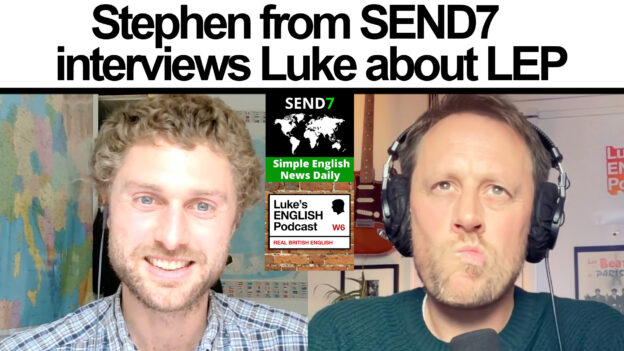
Stephen from SEND7 podcast becomes the host to interview me about how I started LEP, the ins and outs of doing this, plus some advantages and challenges for podcasting to learners of English. Video version available.
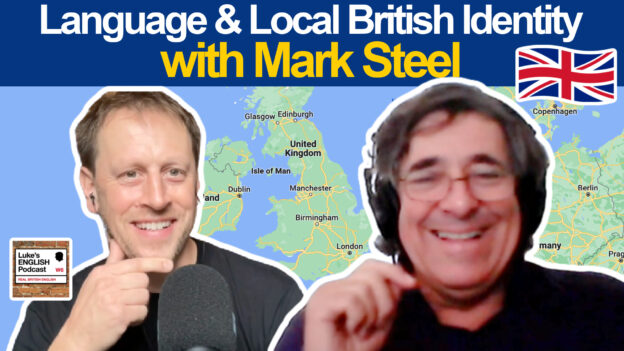
Special Guest Mark Steel joins me to discuss cultural and linguistic differences between the UK and France, plus accents in the UK and a little tour of some places in the UK that you don’t know about. Also includes a discussion of swearing and rude language in Britain. What is the R word which you should never say in a specific part of the UK? Listen on to find out. Video version available.
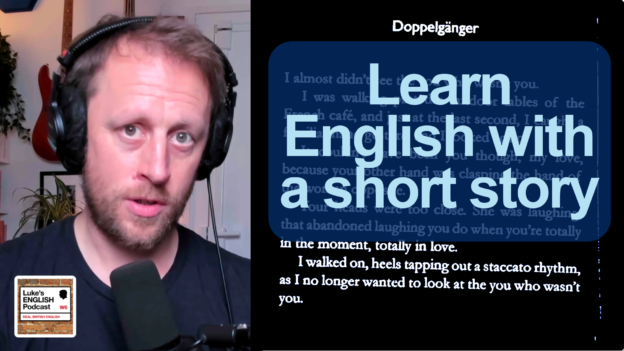
Learn English with another short story. In fact, this episode contains two stories. Listen until the end for the 2nd one. Repeat after me to practise your pronunciation. Learn some vocabulary & grammar in the second half of the episode, with an explanation of modal verbs of deduction in the past and present. Video version available.
It is published by OUTPOST 19 and it was put together by the team behind the website, including Grant Faulkner, Lynn Mundell and Joshua Michael Stewart.
It is available for you to purchase and I recommend it if you are looking for bite size stories to use for learning or teaching English.
Reading out loud can have lots of surprising benefits for our memory and our mental health. How can it also help with your English? In this episode I read an article to you, help you understand it and give comments on the importance of reading, both quietly in your head, and out loud. Video version and full transcript available.
Welcome to this new episode. This one is about reading and the power of reading aloud (reading out loud) and I think it can definitely help you with your English in various ways. Stick with me, there’s a lot to discover here.
I found an article the other day on the BBC’s website and I thought it was really interesting and definitely something I could turn into an episode of this podcast.
I am going to read the article to you in this episode. You can read it with me if you like. The link for the article is in the description, or if you are watching the video version you will see the text on the screen.
I’ll help you understand it all, we’ll consider the main points being made by the writer, I’ll give my thoughts on how this all relates to learning English and I’ll point out some bits of vocabulary for you to learn along the way.
Reading out loud ← what does this mean?
Normally when we read, we read silently. We read in our heads. 📖👀
But when we read out loud we actually say the words we are reading with our voice so that other people can hear you. 🗣️ That’s what out loud means.
Aloud and out loud are synonyms.
To read out loud (I had to read out loud in front of my class during my French lesson and it was a bit embarrassing)
To say something out loud (Don’t say that out loud, it’s supposed be a secret!)
To think out loud (What are you talking about? Oh, sorry, never mind, I’m just thinking out loud really)
To laugh out loud (LOL)
The Article
The title of the article I found is The Surprising Power of Reading Aloud, and I found it in the “Future” section of the BBC’s website.
BBC Future is a section of the BBC website where you can read some really interesting articles about lots of different subjects.
The articles are written in an academic style (so we are looking at academic English here to an extent), but these articles are very readable and they are exactly the type of reading text that you might find in an IELTS reading test. You often find academic texts about scientific subjects, or history, or psychology in IELTS tests.
So, it would be really good practice for you to read articles like this on a regular basis, whether you are preparing for IELTS or you’re just interested in developing your English generally. The articles on BBC Future are quite advanced – they are for native English speakers, but with a good dictionary and a bit of motivation, they could really help your English.
I’m going to help you do that in this episode with this particular article. I’ll take you through it and will explain things.
Let’s get started.
Before we start reading, I’ve got two tasks for you (and they’re important)
1st task: Consider some questions
Here are some questions to get you thinking 🧐🤔💭
I want you to consider these questions because this will get you in the right mental space to understand the article we’re going to read. It’s important to do this because this is how you get your mind ready before you read. So, consider these questions (below).
If you like you can pause this episode after I say these questions in order to actually answer them, in your own head or out loud.
Saying your answers out loud would be the best thing to do – to practise your speaking and putting your thoughts into words. So, if you can do that, do that, right now, with these questions.
Questions to consider before reading
When was the last time you read something in English? What was it, and why did you read it?
When you read in English or in your first language, do you usually read silently in your head or do you read out loud? Why?
In what situations do people sometimes read out loud?
Do you think reading out loud is more or less common these days than it used to be? Do people read out loud more these days, or did they do that more in the past? Why could this be?
Can you remember a time when someone read something out loud to you? What was the situation? How did it make you feel?
How about when you were a child? Can you remember any moments when someone read out loud to you? How do you feel about those memories?
What do you think is better for your English – reading texts silently in your head, reading texts out loud, or listening to other people read out loud to you? Why?
2nd task: Read the text 📖
Here’s a reading task for you
Before I read this article to you, I want you to read it yourself. Twice.
🔗 link in the description 🔗
First, read the text silently, then try reading it out loud.
You don’t have to read the whole thing. Maybe just do the first few paragraphs if you prefer.
But try it. Go on.
Read it silently first, then read it out loud.
Try not to sound like a robot 🤖
Put some life into the reading ❤️🔥
If/When you read it out loud, consider these questions. you .
Where are the pauses? Where should you pause when you read?
Which words in each line should be stressed (emphasised)?
Where does the voice go up and where does the voice go down?
How would you read it out like a TV presenter or a university lecturer?
Imagine you are reading this out for an audience.
It might affect the way you read it. 🗣️
You can do that now. The link to the article is in the description.
Read it – first silently, and then out loud like a presenter.
I’ll let you pause the episode right now and do that. I’ll continue speaking to you again in a moment.
– – – –
This is where you pause to read the article
– – – –
OK, welcome back. I know some of you didn’t pause the episode and read the text, which is totally fine.
But some of you did. Nice one.
I wonder how it was for you.
Was difficult or not?
Was it difficult to read the text?
It’s a different experience isn’t it, reading it out loud.
It has its own challenges.
Unknown vocabulary, difficult pronunciation, understanding the overall flow and structure of the text.
Now, let me read the article to you. You can read it with me too, or just listen. It’s up to you.
I’ve broken the text into sections. I’ll read a section of the article, then paraphrase what I read, add my comments and explain some words. Then we’ll move to the next section.
Whenever there’s a break in the text like this, it’s the end of a section.
– – – – – – – – –
When that happens, I’ll stop and explain things, then we’ll move on to the next section.
You’ll see some words highlighted in bold. These are words that you might not know, so I’ll explain them as we go.
Try reading aloud with me to work on your pronunciation if you like.
Most adults retreat into a personal, quiet world inside their heads when they are reading, but we may be missing out on some vital benefits when we do this.
For much of history, reading was a fairly noisy activity. On clay tablets written in ancient Iraq and Syria some 4,000 years ago, the commonly used words for “to read” literally meant “to cry out” or “to listen”.
“I am sending a very urgent message,” says one letter from this period. “Listen to this tablet. If it is appropriate, have the king listen to it.”
Only occasionally, a different technique was mentioned: to “see” a tablet – to read it silently.
Today, silent reading is the norm. The majority of us bottle the words in our heads as if sitting in the hushed confines of a library. Reading out loud is largely reserved for bedtime stories and performances.
But a growing body of research suggests that we may be missing out by reading only with the voices inside our minds. The ancient art of reading aloud has a number of benefits for adults, from helping improve our memories and understand complex texts, to strengthening emotional bonds between people. And far from being a rare or bygone activity, it is still surprisingly common in modern life. Many of us intuitively use it as a convenient tool for making sense of the written word, and are just not aware of it.
– – – – – 1/10 – – – – –
Colin MacLeod, a psychologist at the University of Waterloo in Canada, has extensively researched the impact of reading aloud on memory. He and his collaborators have shown that people consistently remember words and texts better if they read them aloud than if they read them silently. This memory-boosting effect of reading aloud is particularly strong in children, but it works for older people, too. “It’s beneficial throughout the age range,” he says.
MacLeod has named this phenomenon the “production effect”. It means that producing written words – that’s to say, reading them out loud – improves our memory of them.
– – – – – 2/10 – – – – –
The production effect has been replicated in numerous studies spanning more than a decade.
In one study in Australia, a group of seven-to-10-year-olds were presented with a list of words and asked to read some silently, and others aloud. Afterwards, they correctly recognised 87% of the words they’d read aloud, but only 70% of the silent ones.
In another study, adults aged 67 to 88 were given the same task – reading words either silently or aloud – before then writing down all those they could remember. They were able to recall 27% of the words they had read aloud, but only 10% of those they’d read silently. When asked which ones they recognised, they were able to correctly identify 80% of the words they had read aloud, but only 60% of the silent ones. MacLeod and his team have found the effect can last up to a week after the reading task.
MacLeod says one reason why people remember the spoken words is that “they stand out, they’re distinctive, because they were done aloud, and this gives you an additional basis for memory”.
We are generally better at recalling distinct, unusualevents, and also, events that require active involvement.
For instance, generating a word in response to a question makes it more memorable, a phenomenon known as the generation effect.
Similarly, if someone prompts you with the clue “a tiny infant, sleeps in a cradle, begins with b”, and you answer baby, you’re going to remember it better than if you simply read it, MacLeod says.
– – – – – 4/10 – – – – –
Another way of making words stick is to enact them, for instance by bouncing a ball (or imagining bouncing a ball) while saying “bounce a ball”.
This is called the enactment effect. Both of these effects are closely related to the production effect: they allow our memory to associate the word with a distinct event, and thereby make it easier to retrieve later.
– – – – – 5/10 – – – – –
The production effect is strongest if we read aloud ourselves. But listening to someone else read can benefit memory in other ways. In a study led by researchers at the University of Perugia in Italy, students read extracts from novels to a group of elderly people with dementia over a total of 60 sessions. The listeners performed better in memory tests after the sessions than before, possibly because the stories made them draw on their own memories and imagination, and helped them sort past experiences into sequences. “It seems that actively listening to a story leads to more intense and deeper information processing,” the researchers concluded.
Reading aloud can also make certain memory problems more obvious, and could be helpful in detecting such issues early on.
In one study, people with early Alzheimer’s disease were found to be more likely than others to make certain errors when reading aloud.
– – – – – 6/10 – – – – –
There is some evidence that many of us are intuitively aware of the benefits of reading aloud, and use the technique more than we might realise.
Sam Duncan, an adult literacy researcher at University College London, conducted a two-year study of more than 500 people all over Britain during 2017-2019 to find out if, when and how they read aloud. Often, her participants would start out by saying they didn’t read aloud – but then realised that actually, they did.
“Adult reading aloud is widespread,” she says. “It’s not something we only do with children, or something that only happened in the past.”
Some said they read out funny emails or messages to entertain others. Others read aloud prayers and blessings for spiritual reasons. Writers and translators read drafts to themselves to hear the rhythm and flow. People also read aloud to make sense of recipes, contracts and densely written texts.
“Some find it helps them unpack complicated, difficult texts, whether it’s legal, academic, or Ikea-style instructions,” Duncan says. “Maybe it’s about slowing down, saying it and hearing it.”
– – – – – 7/10 – – – – –
For many respondents, reading aloud brought joy, comfort and a sense of belonging. Some read to friends who were sick or dying, as “a way of escaping together somewhere”, Duncan says. One woman recalled her mother reading poems to her, and talking to her, in Welsh. After her mother died, the woman began reading Welsh poetry aloud to recreate those shared moments. A Tamil speaker living in London said he read Christian texts in Tamil to his wife. On Shetland, a poet read aloud poetry in the local dialect to herself and others.
“There were participants who talked about how when someone is reading aloud to you, you feel a bit like you’re given a gift of their time, of their attention, of their voice,” Duncan recalls. “We see this in the reading to children, that sense of closeness and bonding, but I don’t think we talk about it as much with adults.”
– – – – – 8/10 – – – – –
If reading aloud delivers such benefits, why did humans ever switch to silent reading? One clue may lie in those clay tablets from the ancient Near East, written by professional scribes in a script called cuneiform /ˈkjuːnɪˌfɔːm/.
Over time, the scribes developed an ever faster and more efficient way of writing this script. Such fast scribbling has a crucial advantage, according to Karenleigh Overmann, a cognitive archaeologist at the University of Bergen, Norway who studies how writing affected human brains and behaviour in the past. “It keeps up with the speed of thought much better,” she says.
Reading aloud, on the other hand, is relatively slow due to the extra step of producing a sound.
“The ability to read silently, while confined to highly proficient scribes, would have had distinct advantages, especially, speed,” says Overmann. “Reading aloud is a behaviour that would slow down your ability to read quickly.”
– – – – – 9/10 – – – – –
In his book on ancient literacy, Reading and Writing in Babylon, the French assyriologist Dominique Charpin quotes a letter by a scribe called Hulalum that hints at silent reading in a hurry. Apparently, Hulalum switched between “seeing” (ie, silent reading) and “saying/listening” (loud reading), depending on the situation. In his letter, he writes that he cracked open a clay envelope – Mesopotamian tablets came encased inside a thin casing of clay to prevent prying eyes from reading them – thinking it contained a tablet for the king.
“I saw that it was written to [someone else] and therefore did not have the king listen to it,” writes Hulalum.
Perhaps the ancient scribes, just like us today, enjoyed having two reading modes at their disposal: one fast, convenient, silent and personal; the other slower, noisier, and at times more memorable.
In a time when our interactions with others and the barrage of information we take in are all too transient, perhaps it is worth making a bit more time for reading out loud. Perhaps you even gave it a try with this article, and enjoyed hearing it in your own voice?
– – – – – 10/10 – – – – –
Conclusion
As a language practice exercise, try reading texts out loud.
You don’t have to do it all the time, but simply trying to read a text out loud as if you are reading it to some people, can be a good exercise.
Research suggests that it could help you remember words more effectively. The production effect means – producing words (saying them out loud) makes a difference to your ability to remember them later. Even just mouthing words when you read them helps them to go into your brain.
So, read aloud and mouth words when you read them.
Also, being prompted with a clue helps you remember words. This is called the generation effect. This encourages me a lot, because it confirms things I have been doing as a teacher, including in LEP Premium episodes when I use little prompts to help you recall words. For you, you could always create your own clues to help you remember words or phrases, or play word games in English in which you define words and then have to guess which words they are. Do this with new vocabulary. Of course, you would need friends or language partners to play with.
Acting words out, or linking them to physical movements also helps you remember words. So, when trying to remember words, add a physical element somehow, even if it means imagining yourself doing the word or being in a certain physical space when thinking of new words. For example if the expression is “to be wary of doing something” – put your hand to your chin and pretend you are being nervous about something or reluctant to do it. Make a sound like “Naaaaaaah, I’m a bit wary of doing that”. Perhaps imagine yourself at the end of a dark street and say “I’m a bit wary of going down there on my own. I think I’ll take the main road.”
Listening to other people read to you also helps a lot. So, the conclusion here is just keep listening to LEP of course! I am sure this works when someone is just speaking to you as well, especially if you are involved and caught up in what they are saying. That’s what I’ve always thought and I am sure scientific research would suggest that it’s true. My hypothesis is that people will remember more L2 words when they are presented in a meaningful context. It’s pretty obvious really.
Reading aloud might be good for your mental health. It seems that the exercise can reveal signs of dementia. Maybe reading aloud does require quite a lot of brain work – not only are you reading and decoding the words, but your brain is involved in some motor exercise too – meaning, muscle work, movement work. Surely, making your brain multi-task like this can only be good as a way of keeping it active. Brain training, basically.
It’s a good way to keep your brain young.
Reading aloud also makes you feel quite good, especially if you do it with others. It could be a good exercise with other learners of English, or with your English teacher. Of course, don’t only read aloud, but include it as part of your regular English practice. It’s especially enjoyable if you are reading out some interesting texts, and try to mix it up – some non-fiction stuff and also some stories and so on.
When you read aloud, consider where you need to chunk the text, pause, emphasise and use intonation.
Reading texts out loud is something I often do with my students in class. I ask my students to work out where the pauses should be, which words to emphasise and where the voice goes up or down.
This exercise reveals things about the text, including the structure and the real meanings and intentions of the writer.
Try reading aloud from time to time. Also try reading out loud with me, at the same time as me sometimes (if there is a transcript with the episode). It might help you notice more aspects of the language in the text, help you remember it more, and help you practice your pronunciation as well as your reading. It might also just make you feel good.
What do you think?
Leave your comments below.
What have you been thinking while listening to this?
Has it given you any ideas about learning English?
Do you have anything to add?
Put your thoughts into English in the comment section.
A Premium Series
I’m also publishing a 3-part premium series all about the language in this episode. It’ll be available soon or maybe it’s already available now. I’m going to record them right away in fact. They are the next things I’m going to record.
In those premium episodes I will go through the vocabulary which I highlighted in the text again, and I’ll expand things with slightly more detailed explanations and examples, then I’ll test your memory of those words and phrases (with some prompts and some sentences with missing words) and give you a chance to practise pronouncing all the words in sentences.
There will also be an episode where we practise reading aloud some of the paragraphs from the text, with advice about where to pause, which words to emphasise and so on, with sentences to repeat after me.
To get those episodes, sign up to LEP Premium on Acast+. You can add the premium episodes to your podcasting app, and also access PDFs and video versions that way. www.teacherluke.co.uk/premium for the premium series focusing on the language in this episode.
That’s it for this episode, but I will be back soon with more things for you to listen to, including more stories which I would like to read to you, and conversations with guests, and all the other types of episode I like to present to you on my show.
Thanks for listening, but for now – good bye bye bye!
Last week a very special guest visited one of our comedy shows in Paris. I was given a ticket to the show, so I decided to record a podcast while riding through the streets on the way to the show, wondering if I might be able to interview this guest on LEP. Listen to find out what happened, and to hear some rambling and atmospheric sounds of Paris streets at night.
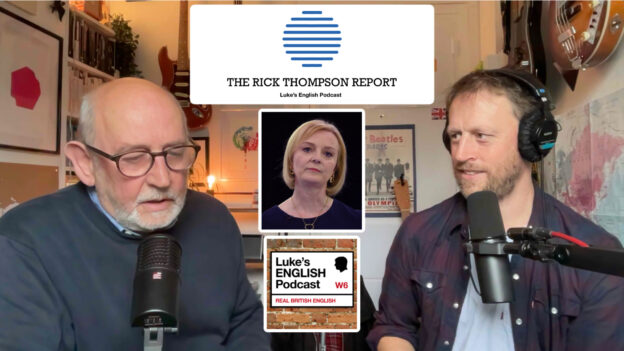
My dad returns to talk more about UK politics, this time describing the disastrous economic policy of Liz Truss and her Chancellor (finance minister) Kwasi Kwarteng. Advanced level English listening practice – this is complicated stuff, but keep listening to develop your English skills and learn about what’s going on in UK politics and current affairs. Video version available.
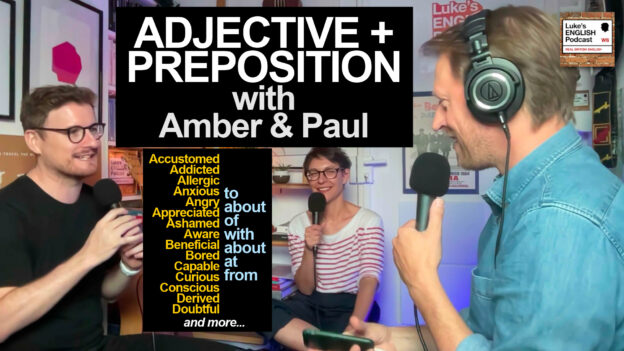
Amber and Paul join me in my pod room again for a rambling discussion about everything! Includes a language point about adjective + preposition collocations. Notice the phrases and try to find examples of them in context. Video version available.
Check out the premium series which accompanies this episode (P39 parts 1-3) 👇
Sign up to LEP Premium to get the 3-part series of episodes (audio, video, PDFs) about the language point in this episode.
P39 Part 1 – All about the grammar of prepositions and how they fit into sentences, including plenty of vocabulary and a quick pronunciation exercise at the end
P39 Part 2 – Let’s go through my list of adjective + preposition phrases from the conversation with Amber & Paul. I’ll test your memory and help you notice the target language, while clarifying some of the adjectives. Also includes discussion questions for free practise.
P39 Part 3 – Pronunciation, pronunciation, pronunciation, pronunciation, pronunciation. The 5 Ps. There’s a focus on weak forms of prepositions, -ed endings of adjectives and 40 sentences to repeat after me.
Here are a few words and phrases that you will hear us saying at the start of the episode.
Let’s do a wager. How long do you think it’s going to be?
I think he’s probably written a short introduction. The problem is he gets waylaid.
To go down a rabbit hole.
There is room for random rambling and tangents. I have factored that into the exercise. That’s all been factored in.
If I’d been left to my own devices I think I would have cracked that in about 2 minutes, but because I kept getting interrupted by you two, it took longer!
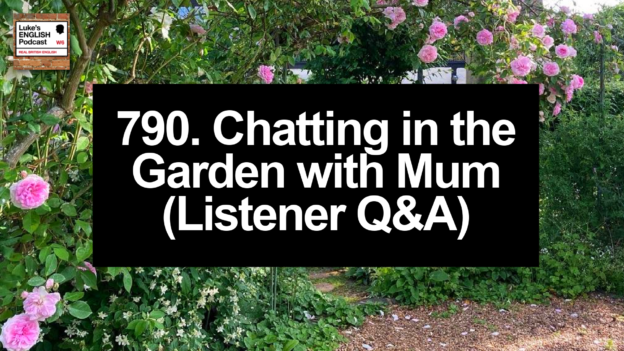
My mum returns to the podcast to answer some questions from listeners about books, cooking, her relationship with Luke and her granddaughter, the war in Ukraine, the song Imagine by John Lennon, family games, the time she fell off a horse & more…
Today I am joined by my mum and we’re going to spend the episode chatting about this and that, and responding to some questions from LEPsters on Twitter.
I hope you enjoy the episode everyone, Stick with us, and as usual you’ll find that the more you listen, the better it is for your English.
Hi Mum, how are you today?
Where are we?
It’s been ages since you’ve been on the podcast, with your own episode (April 2021 – 717. Gill’s Book Club).
We were doing Gill’s Book Club (we did 3 or 4 of those) and every now and then we talk about doing another one, but we have found it a bit tricky to choose books that
Most other people probably have read
That I have read too
That would appeal to enough people
That we remember clearly
Plus you somehow got out of the habit of reading every day.
Anyway, it’s nice to be able to have you on the podcast again.
My aim for this is mainly to let people just listen to your voice, listen to your words and it sort of doesn’t matter too much what we talk about, as long as we just let the conversation flow and let the English happen naturally. We decided not to limit ourselves to any one specific topic here, preferring instead to cast our net quite wide in terms of things to talk about.
Yesterday evening, I Tweeted this:
Very late notice, but I'm going to record a podcast with my mum tomorrow morning. Any questions for her?
Not a very original one but a classic: what book(s) did she enjoyed recently? I’m looking forward to listening to you two, it’s always such a treat. Please give your mum my best and as always, thanks for the podcast!
So happy so hear for your mother ! I would like to know what is she currently reading of course. And if she thought you would become a journalist like your father ? When I listen to the Rick reports, I realise that journalism is not so far from your podcast… Many thanks !
Yes.I’ve one maybe too personal. So you couldn’t take in account. How she feels as a Brit nanny ? Any special food for her niece as a British grandmother?
I use both English and Portuguese when talking to my niece. I speak Portuguese, she answers in English and vice-versa. I wonder if she fears not being able to have a fluent comprehensible conversation with her granddaughter in future. That was my main motivation to study English.
How is her cooking? What is her signature dish? Any secret family recipes?
Is it true that English people in general are not good cook? Gordon Ramsay is a great chef but he usually cook Asian food, his restaurant in London is Asian restaurant.
Luke: Ramsay has 53 restaurants (according to the list on his website, and they serve a variety of things – French fine dining, rustic English food, burgers, pizza, asian food and more…)
In an interview with David Sheff for Playboy Magazine, shortly before his death in December 1980, Lennon shared that Dick Gregory had given him and Ono a Christian Prayer-book which had inspired him to write the track. “The concept of positive prayer…If you can imagine a world at peace, with no denominations of religion – not without religion but without this my God-is-bigger-than-your-God thing – then it can be true.”
The Beatle continued, “The World Church called me once and asked, “Can we use the lyrics to ‘Imagine’ and just change it to ‘Imagine one religion’?” That showed [me] they didn’t understand it at all. It would defeat the whole purpose of the song, the whole idea.”
Well then listeners, that was my mum in her own episode again, but hold on, we’re not done yet, there’s more.
As you just heard at the end, my wife and daughter just came back from the market so we thought we should stop recording and get ready to have lunch with everyone.
But then my daughter did come into the garden and she picked up the microphone, so here is a little interview with her. So you get 3 generations of the family in one episode. A cross generational podcast for you.
So, I asked my daughter to describe what she had done at the market and before I managed to press record on my recorder, she started talking about how they had gone into the local museum in the town square, where they have various items including a large stuffed bear (a real one, stuffed – it’s quite odd and quite interesting), as well as other things, and I asked if she found the bear frightening or if she’d been traumatised by the bear, and then I asked her about the word traumatised, and she ended up describing how she’d been traumatised by a loud automatic hand dryer in a public toilet once (you know those hand dryers which you get on the wall in public toilets?), and that is where this 10 minute clip begins.
So here we go with a bonus bit of chat with youngest member of the Thompson family.
Ending
There you go listeners.
A bit of wisdom there from the voice of the future.
Don’t fight.
You have to love each other.
You have to love le world.
Be excellent to each other.
Party on.
And sign up to LEP Premium on Acast+ for ad-free content and of course many many extra episodes in which I help you with your vocabulary, grammar and pronunciation 😅
Well, I hope you agree listeners, that that was a real treat, especially if you listened all the way until the end.
I really enjoyed that – being able to ask my mum those questions and get her responses, while sitting in the very nice surroundings of her garden, and I hope you enjoyed it too.
I must say I love making these recordings – in order to publish them for your listening pleasure and for your English listening practice (hopefully both) but also just as a record of family life – the voices of my family and my friends, stories, thoughts, memories, opinions and so on. How nice.
I’m very grateful to my mum for this episode and generally for all my guests who contribute so much.
Send us your comments. It’s nice to read them and to get some human responses to our words.
Sorry if you weren’t able to send in a question. I put up the request on Twitter without much notice. I do that sometimes, in order to get opinions or podcast questions from my audience.
If you want to follow me on Twitter, please go ahead. @EnglishPodcast
I’m also on Instagram but I hardly ever use it. In fact, at the moment I only use it to help me book and promote stand up comedy shows (because some of the comedy nights use Instagram to communicate with comedians), but I am there @lukesenglish
Thank you again for listening and for supporting the podcast.
Do me a favour:
Like and subscribe
Leave a positive review on Apple Podcasts
Tell you friends
Support the show by becoming a premium lepster (and oh you’ll get all the premium content too and no ads) www.teacherluke.co.uk/premium
I will speak to you again soon. I have loads of episode ideas and so many things I want to record, but I mustn’t overwhelm you.
[Part 2 of 2] James and Luke discuss some more “facts” about the UK, but can you guess if they are true or false? Learn some interesting trivia about life in Britain, and improve your vocabulary in the process.
Video Version with facts on the screen – Automatic Subtitles Available
Introduction Transcript
Hello listeners, and welcome back to the podcast.
This is part 2 of a two-part episode called 50 Random British Facts (True or False Quiz) with James.
This is part 2 – so if you haven’t heard part 1, go back and listen to that. It’s the previous episode.
In this one we’re going to go through the rest of the random facts about Britain which my brother and I put together earlier this year.
Just a reminder, of the way this works:
First, James and I will read out some more random facts about the UK
Some of the facts are true, and other facts are not true – they were completely made up by James and me.
You have to decide which facts you think are true and which ones are false
Then, after reading out the facts, James and I will reveal the answers and we will also discuss each fact a little bit.
Hopefully you can learn some odd and interesting bits of information about the UK, spot some useful English vocabualry, generally practise your listening skills and have a bit of fun in the process.
If you’d like to work on your pronunciation, here’s a challenge. Try reading the facts out loud, like James and I did. When you read them out, try to say them clearly and fluently, emphasising the right words, connecting parts of the sentence and adding pauses and intonation in the right places. It’s actually quite difficult but a good exercise. You can read the facts on the page for this episode on my website, or you will see them on the screen if you are watching the YouTube version. You could compare the way you say the sentences to the way James and I say them, and perhaps try to copy us, or shadow us. That could be a good way to push your English a bit further with this episode.
As I said at the beginning of the 1st part of this double episode, James and I recorded this in August 2022 and that was before the Queen died in September, and so this is a bit anachronistic as we talk about The Queen in the present tense as she was still alive and the head of state of the country at the time we recorded this. So just keep that in mind while you are listening to this I guess.
Oh and by the way, listen out for a cameo appearance by my daughter somewhere in the middle of the episode.
Now, are you ready to keep calm and carry on?
OK then, here we go with more random British facts – are they true or are they false?
Random British Facts 26 – 50 [True or False?] Listen to find out the answers
Section 3
26. In 1657, England’s puritanical leader Oliver Cromwell passed a law making it illegal to serve richly flavoured food, believing it to be a pathway to sin.
27. It is illegal to enter the Houses of Parliament wearing a suit of armour.
28. It is illegal to put a stamp with the queen’s head on it upside down on an envelope (it’s considered treason).
29. It’s customary to let out a little bit of gas when you accept something which has been offered to you. A small fart or a burp. Keep some gas in reserve for moments like this. This is why English people eat beans.
30. Loch Ness is the largest body of freshwater in Britain by volume. It also keeps a temperature of 6°C all year round, not even freezing in the coldest Scottish winters.
31. More than half of the London Underground network in fact runs above ground.
32. There are 6 official ‘native’ languages in the UK.
33. Queen Elizabeth II was born in the same room that Charles Dickens died in.
34. Recent studies found that skin from British people was more resistant to water compared to that of continental people, due to higher levels of wax residue found on the skin surface.
35. The Glasgow accent is so strong that people there often have trouble understanding each other when they speak.
36. Taxis are obliged to carry a bale of hay in the boot, thanks to old laws regarding the feeding of horses.
37. The Queen doesn’t have a passport.
38. The Queen owns all the swans in the UK, and as a result it is illegal to kill or eat them.
Section 4
39. The department store Harrods sold cocaine until 1916.
40. The name of the UK’s flag is the Union Jack.
41. The word soccer originally comes from the UK.
42. There are 6 ravens which live at the Tower of London and an old royal decree from the reign of King Charles II states that if one of them leaves, the kingdom will fall.
43. During the time of Henry III (mid 13th century), a live polar bear was kept in the moat at the Tower of London.
44. There are more than 70 beaches in the UK.
45. There are now more parakeets in London than pigeons.
46. There’s a secret underground tunnel which runs directly from Buckingham Palace to Number 10 Downing Street.
47. Under the Salmon Act of 1986, it is an offence to handle a salmon ‘suspiciously’.
48. Until the late 70s it was common practice for doctors to recommend that pregnant women drink Guinness because the high iron content was thought to be beneficial for the pregnancy.
49. Until 1968 tobacco was commonly included in a child’s packed lunch along with bread, fat drippings, and tripe.
50. Until 1982 all buses and taxis were legally obliged to carry a bottle of brandy to revive any passengers taken ill during the journey.
Ending Transcript
That’s it listeners.
Thank you for listening.
Don’t forget, you can read all those facts on the page for this episode on my website. That could be a good way to just check some of the words and phrases that you heard in this episode.
I’m sure there’s some new vocabulary in there.
Here’s a selection (just read through them)
Puritanical
Richly-flavoured
A pathway to sin
A suit of armour
Gas / wind / a fart
To keep something in reserve
A body of water
A bail of hay
A muzzle / to keep an animal muzzled
To handle something (two meanings)
Fat drippings
Tripe
To be taken ill
To revive someone
That’s just a selection. I’m not going into it all now, but you could pursue that vocabulary and research it and try to remember it and use it, or at least try to notice it again as you listen, read and generally come into contact with English.
Some of them are more frequently used than others. I don’t know how often you will talk about tripe or bails of hay in your life, but that’s the thing about pushing your vocabulary beyond the intermediate plateau. You have to go beyond the limits of the vocabulary that you come across on a daily basis and go into the more uncharted areas of English in order to open things out and expand.
Also, I explained some vocabulary at the end of part 1. I don’t know if you heard that, but I went into various words relating to laws, rules, regulations, government legislation and so on, as quite a lot of those things came up in the 50 facts. So go back and listen to the last 30 mins of part 1, if you haven’t already done so.
You see, it pays to listen to episodes all the way until the end.
Talking to my mum and dad about events in the UK following the death of The Queen on 9 September, including the media coverage, the proclamation of King Charles III, comments about Charles as King and a discussion of the role of the monarch in the UK’s constitution. Also includes some comments about the new Prime Minister Liz Truss and the future of the UK government over the next 18 months.
YouTube version (Audio only, but try activating the automatic subtitles)
Introduction & Ending Transcript
Hello listeners,
Welcome back to the podcast. Here is another episode, published only a few days after the last one. As you can see from the title it is another episode talking about the big news of the moment in the UK, the death of The Queen, but also this episode is about the new King, Charles III.
Thank you for the messages which you wrote in the comment section in response to the last episode in which I gave my instant reaction to the news. It is very interesting to read your thoughts, and to see how people have reacted to the news in other parts of the world. There’s been a fairly diverse response but overall most people have expressed their sorrow or their sympathy, with lots of people writing things like “Sorry for your loss” and that’s “loss” not “lost”. Quite a lot of people made that little error. Lost is an adjective and the noun is loss. So, “sorry for your loss”.
As I suggested in the last episode, this one is a conversation with my dad in the form of a Rick Thompson report, but my mum is joining us this time as well. So you’ve got the two of them. Two Thompsons for the price of none. Three in fact including me.
So, if you were wondering what’s been going on in the UK and how it is from the point of view of British people, here we are.
My parents are not flag waving royalists exactly. Long term listeners will probably be aware of their general views on the monarchy. My mum is probably a bit more sceptical about it than my dad, but I think they both think and care deeply about it all and have a critical yet balanced view of the system and the royals as people, overall.
Here is an overview of the things we talk about in this episode.
What’s been happening since The Queen’s death – descriptions of the media coverage.
Vocabulary → Two words: coverage and footage
Coverage
The broadcasts in the media covering an event or series of events. Coverage means how a story is covered by the media.
Footage
This is video of something, for example footage of William, Kate, Harry and Meghan meeting the crowds of people outside Windsor Castle. If someone takes a video of that on their phone or something, they then have some footage in their phone. If it’s filmed with a camera, then the footage is probably on an SD card and can be put into a news report, uploaded, broadcasted on TV as part of the coverage.
Footage – actually refers to “rolls” or “lengths” of video tape, measured traditionally in feet (12 inches or 30 centimetres). Nowadays it’s all digital of course and not measured by length, but it’s still called footage.
Coverage – the way in which events are covered with all the news programmes and news reports of the event – this is media coverage and it includes the broadcasting of footage with commentary etc.
Why people say The Queen was extraordinary and that her 70-year reign was so significant
Details of the ascension of Charles to the throne, to become King Charles III.
How this was officially pronounced as part of a ceremonial “proclamation” – a sort of traditional ceremony which took place in London over the weekend in which Charles signed legal papers and the news was announced to important people in the government. It was all filmed and broadcast on television for the first time in history. Charles had to sign official documents stating that he was willing and able to take on the role – all part of the legal and constitutional process.
Mum’s observations of how Charles handled the pressure of this momentous occasion, especially certain moments when he had to sign some papers and he didn’t quite have enough room on the table to do it, which must have been a very stressful moment for him.
How they feel about Charles and if he will be a good king, plus the challenge he has ahead of him, following in the footsteps of his mother, who was such a successful monarch.
This leads to a sort of debate or at least an exchange about the nature of that challenge and what it really means to be a successful king or queen in the UK, and the personal sacrifices which must be made in order to fulfil the duty of the role, and how this fits into the democratic process.
We also talk a bit about Charles’ health and some of the images going around the internet of his swollen fingers, and what might be causing that. It’s just speculation really and we are not doctors of course.
We do turn our attention away from the monarchy and towards the government nearer the end of the conversation, and the new Prime Minister Liz Truss who replaced Boris Johnson very recently, and what they’re all actually doing, the cost of living crisis in the UK and what the future might be for Liz Truss and for the government over the next 18 months.
As I ever I hope you find this useful as a way of finding out what’s going on in the UK at this moment in time, and also as a way of practising your listening in English and as a way to notice and pick up bits of English as it is spoken.
One thing – I had the wrong microphone selected in my recording software during this conversation, which is a bit annoying, so without realising it I was recording myself using the inbuilt microphone on my laptop, so the sound quality isn’t up to the same standard as usual. My voice is a bit muffled basically, but it should be ok.
Right, without further ado, let’s get started.
Ending Transcript
So that was the Rick and Gill Thompson report. I hope you found that interesting and useful.
Overall I think that the effect on the country of The Queen’s death has not been quite as profound as I predicted in previous episodes. I think I said I thought that the entire country would stop and that everything would be cancelled. Of course it means different things to different people and a lot of people will be very affected by it, but as far as I can tell to a large extent things are pretty much carrying on as normal this week except that the story is definitely dominating the news on TV. Over the weekend it was pretty much around the clock coverage of everything relating to the event and we’ve all been getting lots of notifications on our phones of news stories about it. But people are largely getting on with normal life and work and people aren’t mentioning it in their work emails and everything. Anyway, that’s just how I see it from my position.
As always, leave your comments in the comment section. I am always curious to know what you are thinking as you listen to this.
To end the episode here I thought I would play you the audio from King Charles’s video message to the nation, which was published by Buckingham Palace on Friday, the day after it was announced that The Queen had died. I was going to play just the second half of this, where he gives his promise to uphold his constitutional duty and then describes the new roles and duties of the other members of the family. I was going to play just that part, but in fact I’ve decided just to play you the whole thing. So this is 9 minutes of King Charles III addressing the nation, expressing grief at the passing of The Queen and the promising to fulfil his duties as the king.
This is a chance for you to listen to his statement, but also to notice how he does it. Pay attention to his accent, his choice of words and structures, the way he delivers it all and also the more emotional and personal tone which he uses, especially nearer the end of the message.
I’ll also put this video on the page for this episode on my website and you can activate subtitles on that by the way.
So this is King Charles III addressing the nation in a recorded message published on Friday 9 September.
That was King Charles III.
What’s next for the podcast?
I think I won’t publish more episodes about this now for a while, unless I manage to record interviews with people in London when I am there at the weekend. But we’ll see. I don’t want to do too much on this subject. Probably these two episodes are enough. But as I said, if I end up interviewing some local people on Saturday or Sunday, then I will probably publish that, but we’ll see. I don’t want to overdo it.
The official period of national mourning last until The Queen’s funeral which is on 19 September. I think I will wait until then before publishing any more content. That’s about a week away anyway so it’s the usual period between episodes.
So, I will speak to you again in about a week.
About my choice for what to publish next, I think that I don’t need to be too precious about it and I reckon I will probably publish those episodes I did with James, with a little disclaimer at the start stating that they were recorded before The Queen passed away, and any references to her were not meant to be disrespectful, and I hope people don’t take offence or consider the general tone of the episode to be disrespectful at all. Apparently The Queen had a good sense of humour anyway.
All right. Thank you for listening. Thank you to my parents for their contribution this time.
Do take care, and I will speak to you again in about a week.
But for now, good bye bye bye
Cookies on teacherluke.co.uk
Click “Accept All”, to consent to the use of all cookies on this website, or visit "Cookie Settings" to control your consent settings.
This website uses cookies to improve your experience while you navigate through the website. Out of these, the cookies that are categorized as necessary are stored on your browser as they are essential for the working of basic functionalities of the website. We also use third-party cookies that help us analyze and understand how you use this website. These cookies will be stored in your browser only with your consent. You also have the option to opt-out of these cookies. But opting out of some of these cookies may affect your browsing experience.
Necessary cookies are absolutely essential for the website to function properly. These cookies ensure basic functionalities and security features of the website, anonymously.
Cookie
Duration
Description
cookielawinfo-checkbox-analytics
11 months
This cookie is set by GDPR Cookie Consent plugin. The cookie is used to store the user consent for the cookies in the category "Analytics".
cookielawinfo-checkbox-functional
11 months
The cookie is set by GDPR cookie consent to record the user consent for the cookies in the category "Functional".
cookielawinfo-checkbox-necessary
11 months
This cookie is set by GDPR Cookie Consent plugin. The cookies is used to store the user consent for the cookies in the category "Necessary".
cookielawinfo-checkbox-others
11 months
This cookie is set by GDPR Cookie Consent plugin. The cookie is used to store the user consent for the cookies in the category "Other.
cookielawinfo-checkbox-performance
11 months
This cookie is set by GDPR Cookie Consent plugin. The cookie is used to store the user consent for the cookies in the category "Performance".
viewed_cookie_policy
11 months
The cookie is set by the GDPR Cookie Consent plugin and is used to store whether or not user has consented to the use of cookies. It does not store any personal data.
Functional cookies help to perform certain functionalities like sharing the content of the website on social media platforms, collect feedbacks, and other third-party features.
Performance cookies are used to understand and analyze the key performance indexes of the website which helps in delivering a better user experience for the visitors.
Analytical cookies are used to understand how visitors interact with the website. These cookies help provide information on metrics the number of visitors, bounce rate, traffic source, etc.
Advertisement cookies are used to provide visitors with relevant ads and marketing campaigns. These cookies track visitors across websites and collect information to provide customized ads.