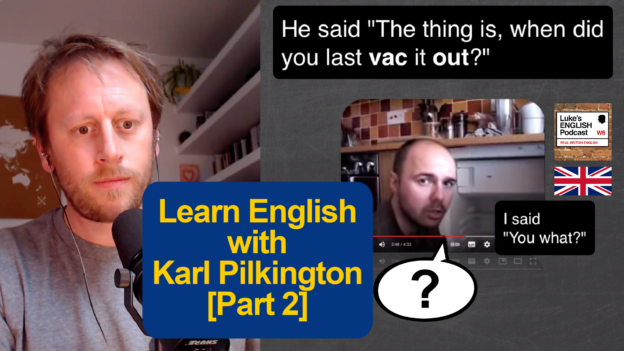
Understand more of Karl Pilkington’s rambling as we learn about the Manchester accent and pick up vocabulary along the way. Video version available on YouTube.
Hello everyone. Welcome back to LEP. This is part 2 of a double Karl Pilkington themed episode. I would recommend that you listen to part 1 of this first – it contains important context about who Karl is plus more details about Karl’s pronunciation and accent.
Listening to that first will help a great deal in understanding this one.
I got plenty of good responses to part 1 of this, so let’s carry on.
In this part we are going to continue as we did before – listening to Karl Pilkington talking about various subjects, understanding exactly what he says, looking at features of his Manchester accent and picking up vocabulary along the way.
Karl is basically just a normal bloke from Manchester and his accent is fairly typical for people from that area so this episode aims to help you understand his accent and pick up vocabulary too.
Some responses to part 1
I disagree with Karl on most things.
Is he arrogant?
I just enjoy the way he puts things. He speaks like a comedian in the way that he expresses a point of view and has a certain way with words, but he’s not a comedian.
This is the enigma of Karl Pilkington – is he really just being himself, or is he playing a comedy character, and in real life he’s a lot more erudite.
I actually think it’s the former not the latter and that he’s just being himself. He just happens to have a funny way of putting his opinions across.
Sometimes the best comedy comes from someone sharing a specific opinion. I think this is what I enjoy about this, rather than the opinions he is expressing, and as I said I disagree with Karl about most things, and some things he says are quite laughable – especially stuff he’s said on the Ricky Gervais podcast, like his Monkey News stories.
One other thing – apparently it is possible to be choked by a live octopus as you eat it. What I meant was that it would be impossible for an octopus to strangle you from the inside, as strangling means choking from the outside of the throat, with your hands for example, but of course a live octopus could choke you from within, by sticking its arms up into your throat or your windpipe. So, fair enough, it is possible for an octopus to choke you.
Also, in the UK we do eat oysters – which are raw seafood, so I think raw fish are generally ok in the UK but most other raw things would be considered a bit strange for us.
Quick Pronunciation Recap
In part 1 we listened to Karl talk about life, health and food and in terms of his accent I talked about H-drops
I’m 32, I think I’ve got the hang of it.
Look, how many do you need?
glottal stops
I’ll have a look at the meteorites.
If you’re going to eat a live animal, don’t eat one that’s got eight arms that can get hold of your neck.
The ‘bath/trap’ split
podcast/podcast
laugh/laugh
path/path
bath/bath
/ʊ/ not /ʌ/
Do you go to the gym much?
Topics: Holidays & Karl’s Fridge
This time he’s going to talk about holidays and his fridge and we will look at more features of his accent.
There’s a video version of this on youtube with text on the screen, plus you will find all the text presented on the page for this episode on my website.
Just one more thing before we start – I have premium episodes in the pipeline for these two episodes of LEP. The Premium episodes will be a chance to review and remember the vocabulary that comes up in these episodes, and then pronunciation drills too. So, I’ll do a sort of memory quiz with you to see how much vocab you remember and then the usual pronunciation drills – but in my accent, not Karl’s.
Karl is on a camping holiday, sitting in a tent and moaning.
Why does Karl think holidays are stressful?
What does Karl think of Lanzarote’s nickname?
What did Karl do on his holiday there?
What’s the problem with holidays in the UK?
What did he think of the seal sanctuary he went to?
What’s the best place Karl has been? Why?
What does Karl think of holidays to the moon?
Vocabulary
You’ve got free time on your hands which you’re not used to.
We ended up walking around this seal sanctuary. 14 quid. £
They were just floating about, hardlymoving.
I’m not having a go, but don’t charge me to come in, or at least let me see them again when they’re better.
The coliseum, they don’t do it up.
There’s no overheads.
That’s a mess. Get it knocked down.
At the end of the day the moon is just a big rock. You may/might as well go to Lanzarote.
PRONUNCIATION #3
Nasal
Alright so I went on holiday and it was great and all that.
I’ll have a look at the meteorites.
If you’re going to eat a live animal, don’t eat one that’s got eight arms that can get hold of your neck.
When’s the last time you heard about a tortoise having a heart attack?
Works well with glottal stops.
Nasal sound in /aʊ/ and /ai/ sounds
/aʊ/ in words like about and now sounds more nasal.
What’s he going on about now?
If there were dinosaurs about now and that.
If we’ve run out we need to go outside and get some more.
Nasal sound in /ai/ sound
The /ai/ sound in words like alive, inside, survive, fighting, riot and dying sounds more nasal.
You’re not supposed to eat them alive.
We’ve got to stay inside if we want to survive.
If they were running about fighting and dying and that.
Running riot (sounds like “roonin raiyut”)
#5 Karl on his fridge
Karl’s fridge is broken and he called out a guy to fix it.
Naturally he’s moaning about workmen who come to your house to do different jobs.
Why does the guy charge £80?
What is Karl’s main problem with engineers, plumbers, workers who have to come to his house?
What advice does the fridge guy give to Karl?
What’s the problem with Karl’s new fridge?
Vocabulary
The fellaturnedup, right.
Yeah, it’s broke. (broken)
That’s why I called you out.
That’s 80 quid.
I said, “you what?”
An 80 quid callout charge.
I tell you. They windmeup.
I had a fella come round to do the tiling.
Turned up late with a carrier bag.
A pot noodle
A copy of the Daily Mirror
A crossword book
He was asking what the pub was like across the road. “What is …. like?”
Having a laugh
When did you last vac it out?
Vacuum cleaner
You’re meant to vac them out, because dustand that gets in.
Can’t afford any food to put in it.
It needswiringin. It’s got one of those fancy plug things.
PRONUNCIATION #4
A lot of other vowel sounds are nasal too.
Turn the corner /ɔː/
They becomes thee
It depends what they do with it.
Why have they only just found that?
How did they miss that?
Also, he adds little fillers like:
(Do you) know what I mean?
Right? (just sounds like a nazal grunt, almost)
… and that
Like that
And whatnot
And stuff like that
Do you know what I mean?
I tell ya…
Watch out for those things if you like.
Ending
Ladies and gentlemen, this brings us to the end of this episode, as we now prepare to exit the world of Karl Pilkington and re-emerge blinking into the light of the normal world.
Welcome back to yourself, your own attitudes and your own personality again.
I urge you to (just wanted to use that phrase) check the page for this episode on my website where you will find a downloadable full transcript, the audio file for download in mp3 format, a text video version of this episode where you can read the entire thing as you listen and it’s all presented in a rather majestic looking font before your very eyes and of course there’s the comment section where you can share your thoughts not to mention the episode archive with all the previous episodes plus lots of bonus extra stuff.
Teacherluke.co.uk
LEP Premium LEP App LEP Merch
Have a good one and I will speak to you again soon, bye!
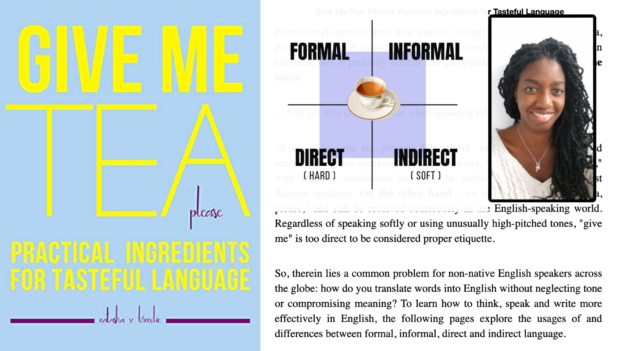
Talking to author Natasha V Broodie who has written a book which aims to help learners of English understand the subtle codes of polite language when making requests and giving information in professional and personal contexts. In the conversation we explore the topic and consider some tips for making your language more culturally appropriate.
In this episode I am talking to author Natasha V Broodie who has written a book which aims to help learners of English to find the right tone in their speaking and writing. Tone is something which is very much affected by culture and often relates to things like being direct, indirect, formal, informal, the use of modal verbs and phrasal verbs and so on. In English the general tone is often quite friendly, indirect and polite, and this can sometimes cause problems for English speakers coming from different places where codes of politeness or professionalism are different.
Natasha has worked as an English teacher and has also worked in international contexts for the UN and so she has direct experience of observing people communicating in English and not quite getting the tone right.
So in her book, “Give me tea, please. Practical Ingredients for Tasteful Language” she lays out a sort of style guide with theory, practical tips and a glossary of defined vocabulary at the back.
It sounds like an interesting book which could be a worthwhile read for my listeners, so I thought it would be good to chat with Natasha a little bit and explore some of the ideas presented in her book.
“Give me tea, please” is currently available on Amazon but from 24 September should be available from all other providers too.
Right, so now you know what sort of thing we’re going to be talking about, let’s meet Natasha Broodie and find out some of those practical tips for tasteful language.
So that was Natasha V Broodie, talking about her book Give me tea, please – available from all good bookstores. Go ahead and pick up a copy and if you like it, leave a review on Amazon.
Thanks again to Natasha for her contribution in this episode.
A Short Ramble
T-shirts Design comp – link here for details https://teacherluke.co.uk/2021/09/22/742-new-lep-t-shirts-merch-lep-design-competition-2021-with-james/ Premium YouTube
Sneezing caused me to take a trip to tangent town…
LEP merch is now available, including t-shirts, mugs and more featuring special LEP designs made by James Thompson. Luke and James discuss the new designs and launch a new design competition to give you the chance to get your design in my merch store and a cash prize of £80.
Hello listeners, it’s nice to be talking to you on this fine morning. I’m also joined by James, my brother.
If you’ve seen me on YouTube in a t-shirt with a magnificent LEP logo on the front of it, or drinking tea from a lovely looking mug with an LEP logo on it, or perhaps writing something down on my special LEP notepad, then you might be thinking…
Where can I get one of those t-shirts? Where can I get one of those mugs?
Where do I get one of those amazing pads?
Or even: How can I get one of my designs on some LEP Merch?
Your questions are finally being answered today, because the LEP merch store is back open, and I am launching a design competition to give you the chance to get your design on an LEP t-shirt, and a special cash prize of £80!
The merch store is now open. That’s where you can get t-shirts, sweaters, mugs, stickers and loads of other things with the LEP logo on, but also there are various other new designs which you should love if you are a LEPster.
I suspect that you’re going to want more than just one of the things on offer for you today – In fact I’ve already ordered some and I am wearing one now.
In this episode I’m going to talk a little bit about the different merchandise available just to make sure it’s clear and that you understand everything.
Also in this episode I am launching a design competition – this is your chance to have your design on an official LEP t-shirt. Not only that, but there are cash prizes available too for the winners. I will explain more later.
My brother James is the one who did all the design work to produce the various images which are available across a range of products, so he is joining me for this one.
We’re going to talk about each design one by one, I’ll give you a little tour of the store to make sure you can use it properly, I will give you the full details of the LEP Design competition and then we’re going to open things out to have a larger conversation about merchandising and stories related to that.
I opened this store so Chinese & Russian LEPsters could buy merch too. The website is simple enough. It shows t-shirts in the thumbnail pictures, but check the list on the left to see all available products.
Various types of t-shirt are available.
RedBubble doesn’t do double sided t-shirts.
Avoid buying dark designs on a dark colour t-shirt (although personally I think an LEP Ninja design on a black tri-blend t-shirt looks really cool)
Let me know what other ideas or changes you’d like to make to the store, and I will see what I can do. So, if you have any other design ideas, or suggestions for things you’d like to see in the store, or changes you’d like to make – let me know. luketeacher@hotmail.com
LEP DESIGN COMPETITION 2021
We are looking for cool t-shirt designs by LEPsters, for the LEP Merch Store.
Think of a t-shirt that LEPsters would want to wear
PRIZE: The winning design will be put on t-shirts, mugs and other merch, and the winner will also win £80!
SPECS: A high-resolution transparent .PNG at 150dpi. Minimum dimensions of at least 1500px by 1995px (not including outer transparent pixels).
CLOSING DATE: 22 October 2021
Send your t-shirt designs to podcastcomp@gmail.com
James and I will consider all designs which are sent to me, and a selection of designs will be displayed on the website so you can leave your comments. James and I will also discuss them in a podcast episode.
Ultimately, James and I are the judges and we make the final choice on the winner(s).
Reading a short story presented on Commaful.com. The Escaped Man is a mystery full of tension and intrigue. Listen closely as I break it all down and explain the vocabulary fully. YouTube video version also available.
It’s time to do another story on the podcast. This time I’m going to be reading a story called The Escaped Man which was written by CT Platt and is presented on the Commaful website.
Commaful.com is a website where you can find short stories, fan fiction and other reading texts and it’s all presented in quite a nice and easy-to-read format.
I’m going to read the story to you once and all you have to do is follow it, and hopefully enjoy it. I have a couple of questions for you to help you stay focused on your listening.
Then I’ll read through the story again and break it down line by line, explaining, pointing out and teaching you bits of vocabulary and grammar as I go.
Learning English through stories is a great idea and tends to work because it places language in a vivid context and is generally quite entertaining and fun.
So listen to the story and then let me break all the language down for you bit by bit.
Just before I read the story, here are a couple of questions for you.
Where does the story take place? How do you know? Is this American English or British English? How do you know? What is going to happen next?
I’m back in the podcast-zone after my holiday so I thought I would do another rambling episode before getting down to work on other content to be released soon. Video version also available.
This is episode 735 and it is a rambling episode, which means it’s just me talking to you about various things – including: whatever comes into my head while I’m recording, but specifically this time I’m aiming to talk about
Being back from holiday and getting back into the podcast zone
Comments about my audio listeners and my video viewers on YouTube
News about moving flat and moving to my new pod room (You can see that the move hasn’t started yet and so the podcast has not been disrupted yet)
Some common questions from the YouTube comment section (new listeners)
Charlie Watts – the drummer from the Rolling Stones who passed away yesterday
A couple of comments from the comment section including one very motivational email I got from a long-term listener
Whatever else occurs to me as we record this!
As well as being available as a normal episode of the audio podcast, this is also available on YouTube with some text on the screen – the notes and scripts that I’m reading from, so you can read along with me and spot certain phrases and spelling and so on.
By the way – you can always pause this and check the screen if you feel you didn’t understand something or you found a new word or phrase.
I’m reading from a script / notes
In this episode I’m reading from a script which I wrote last night. I don’t normally read from a pre-written script when I do these rambles, but this time is different.
I wrote most of this script last night, when it wasn’t really the right time to do a podcast recording, but I still consider this to be a rambling episode because I just rambled with my fingers last night and now I’m just reading out the text-ramble that I created, so it still counts as rambling as far as I’m concerned, and I of course I can deviate from the script/notes whenever I want.
So stick with me and I hope you enjoy listening to my words as they flow out like endless rain into a paper cup – a cup which you can take and drink from, metaphorically of course.
Drink my English – that’s what I’m saying. I hope you know what I mean!
In the podcast zone (this is what I wrote last night)
I’m sitting here in front of the computer. My wife is lying across the sofa watching a French TV show on her phone and she’s under a nice sheepskin blanket that we have so she is feeling very cosy. I’ve just made her a cup of mint tea and I’ve tucked her feet into a blanket because I’m such a great guy and a really wonderful husband.
The child is in bed asleep, and despite the madness that is going in on the world outside, this is a little moment of peace and quiet.
Now I’m sitting with my computer on my lap, but I’m pretty much in the podcast zone right now – meaning, that I’m thinking of ideas for the podcast, considering what I’ve been doing and what I should do next. I know I should be able to record tomorrow as the little one is going to her French grandparents for a few days and my wife has work to do, so tomorrow is podcast day.
But I’m in the podcast zone now because I’m thinking about podcast ideas and things to record tomorrow. I’m just writing down my thoughts on my computer as they come into my head. I’m trying to write down every thing I’m thinking in order to make sure this is actually a rambling episode. I’m rambling everything down in text form here and I’m trying to make it sound like I am actually speaking normally and not reading from a text.
What I’ll have to do tomorrow is record this but make it sound like I’m just saying it all off the top of my head.
Also I might just go off on a tangent at any point and deviate from the script, if something occurs to me.
In fact, what I’m going to do is, the word-for-word script for this is going to stop soon and I’m going to just write down some basic notes and then expand on them as I talk into the microphone tomorrow (which is actually today – so, tomorrow is now, so, are we in the past, the present or the future? I think I might have just invented time travel. These words are from yesterday, but I’m reading them now and you’re going to listen to them in the future – let’s just say that in podcastland, time is a sort of flexible thing a bit like a jelly or something.
Yep, in LEPland, time is jelly – which might explain why my episodes are quite long sometimes.
In any case, I would like to record this episode tomorrow as a kind of welcome back before embarking on things like premium content and other episodes I’ve been planning.
I do have other episodes I’d like to do and tbh while I was away on holiday over the last 3 weeks or so I was itching to get back to podcasting.
I had lots of ideas popping into my head which I couldn’t quite hold onto and as I didn’t get the chance to write them down, they’ve all disappeared into the ether – little ideas, comments, stories that occurred to me at various moments, like when I’m in the shower but which I almost instantly forgot – so I was quite keen to do some recording again after being away just to satisfy the compulsive podcasting side of me.
The holiday was fantastic and one of the best ones we have had for ages. I’ll tell you about it a bit later in this episode.
Those other episodes I could be doing right now:
P31 parts 4,5,6
Learn English from my mum as we look at phrases which came up in our conversation in episode 717 – learn them properly with loads of examples and the chance to do plenty of listen and repeat pronunciation work with me so you don’t just learn new language, but learn how to produce it too.
War of the Worlds part 4 (conclusion?)
88 English expressions that will confuse everyone! (remember that? I never finished it)
More stories like The Mountain
Reading from more texts or books
An episode with The Thompsons which I recorded when I was in England
Some invitations to other podcasters/English teachers who have interviewed me recently
Top 10 Jokes from the Edinburgh Fringe 2021
And I have a big list of other ideas which I am slowly working my way through.
But I think before I do those ones and perhaps some others, I’d like to just do this rambling episode with you.
These rambling episodes are where I just talk to you directly and move from topic to topic almost making it all up as I go along.
So just keep up with me, follow along and let the words flow through you like the force in Star Wars.
Feel the English, let it flow through you.
Be the English.
Imagine blue lazers and Star Wars / The Matrix type stuff.
Be one with the living English and listen with me as I chat to you about various things.
Audio listeners / Video Viewers (LEP is an audio podcast, with some videos on YouTube)
Most people listening to this – the vast majority listening to my words right now are listening to my podcast on their phone probably with headphones on, using a podcasting app of some sort, probably the native Apple Podcasts app on the iPhone or something like Spotify or another podcasting app, or perhaps you are listening on the LEP App.
Most people listen to the audio version of this – and I’m saying this now because I’m also recording a video version of this on YouTube and I feel like YouTube is a pretty different audience.
All the other platforms (ways to listen to the audio podcast) are united in one sort of group – the audio LEPsters and they’re more ninja-ish but they’re perhaps a bit more solid, reliable, dependable and loyal.
I don’t mean to have a pop at (criticise) the video LEPsters on YouTube, but they seem to be a slightly different type of LEPster. I feel like YouTube LEPsters are less ninja-ish because there are many more comments.
Also, YouTube LEPsters (hello) seem to be less aware of the back catalogue of episodes, and I get a lot of people who have never heard the podcast ever before. (shocking, I know)
But YouTube has enormous potential to go viral. In fact, in a way it’s like swimming in the deep ocean and you could catch a current and get into the very deep water.
I mean, most episodes on YouTube get less attention than the audio versions, but then some videos go viral as they get picked up by the algorithm which is responding to the way people interact with your video and I guess that the algorithm sort of picks up on videos which are popular and promote them, as a way to always present the best content on the platform.
So a couple of my recent videos went a bit viral (not a lot but a bit), which was nice.
So – YouTube LEPsters – here, let me just have a word for a moment.
Really, this is an audio podcast that also has a youtube channel and recently I’ve been uploading more to it, but really this is still, mainly, an audio show and I have a big archive of audio episodes on my website and in my app.
Not all the episode are available on YouTube and they’re not all on Apple Podcasts, but they’re all there on my website, with episode pages for each and every single one of them and audio download links.
Go to my website teacherluke.co.uk (I know it looks like it was made in 2012) and then click EPISODES in the menu, and also in the LEP App you can get every single episode.
Most people listen to my podcast using an app on their phone and they listen when they are probably doing something else, like walking around, driving (please be careful), doing housework, doing exercise or simply breathing.
So listening to the audio version on your phone seems to be the normal way to do it.
If you listen using a podcast app on your phone, and you need to stop listening for whatever reason, the app will remember where you stopped listening and you can then carry on from that point later. So, you don’t have to listen to an episode in one single go.
The majority of my audience listen to the audio version of this and I’ve been doing the audio podcast for over 12 years now, and I have a big back catalogue of episodes and I have talked about lots of different things over the years including some things that I’m sure you’d like to hear, so check out the episode archive for the older episodes.
LEP App
My app disappeared from the Apple App store for a couple of days (I had a payment issue with Apple) and when it came back all the ratings and reviews had gone (3 years’ worth), which was annoying. Can you do me a favour (no obligation of course) and give the app a rating and a review (if you use it)?
How was your holiday?
It was great. No need to go into full detail like I have in the past, but basically we got lucky with the weather and had a really lovely time.
What about moving to your new flat and moving to a new pod-room?
Building work is being done in the new flat. I think the downstairs neighbours will want to murder us.
I probably won’t get the keys to the new pod-room until mid September, and then I’ll move in there. I’ll need to get electricity and internet connected there, and to fit a desk and some shelves, and then it’ll be the official new pod-room.
Common Questions since going viral on YT
I am going to try to answer these questions as quickly and succinctly as possible without rambling at all in fact. So in this rambling episode, here is a section with no rambling.
I hope that’s clear.
So, this is a rambling episode, with a bit where there’s no rambling.
Anyway – no rambling here, let’s just get straight to the point and keep it simple.
Common Questions from YouTube
Where are you from?
Can you do an episode about ______?
Check the episode archive on my website. There’s a chance I’ve already talked about that.
Go to the archive and do a ctrl+F search for the keywords you’re interested in.
How can I learn English by listening to your podcast?
This can really help you a lot, but it’s not the only thing you should do.
It’s also important to read a lot (find texts which are not too tricky, use fairly modern English and which you actually want to read) study a bit (use grammar, vocabulary and pronunciation teaching materials of any kind and work with them – it’s not the only thing, but it helps) do lots of speaking if you can (ideally find someone to have meaningful conversations with, perhaps a teacher or language partner who can give you some little corrections and encouragement) and write on a regular basis too (practise writing different types of text or just write a diary every day in which you express your thoughts in English – you’ve got to express yourself in English regularly in order to find your voice).
Learning English is about learning how to do something, not just learning how to understand something, and we generally get better at things by trying to do them again and again.
So listen and read a lot and try to speak and write a lot too. That’s quite general advice but there it is.
For more specific advice on how to use the podcast to improve your English, you could listen to these episodes
174, 568.
Should I listen to the episodes on order?
It’s up to you really. You can just listen to all the new ones as they come out, but if you really want to learn from me properly then I would suggest listening from episode 1.
Certainly if you are a lower level learner, the first 50-ish episodes are probably a bit easier to understand and have more specific language-teaching objectives, so it would be good to start with them.
But equally, if you just find my episodes fun and interesting you can listen to them in any order you like. Be aware though: multi-part episodes should be heard in order, and there might be little private jokes and references from earlier episodes which you might not understand (like the dreaded Russian Joke).
Can you do more story episodes?
Yes, I’m planning to do more stories.
Can you do episodes about grammar, vocabulary and pronunciation?
Consider signing up to LEP Premium for loads of episodes like that.
Can you feature ___(insert name here)___ again? (Check previous episodes)
Check the archive – a lot of my guests have been on the podcast before, especially favourites like Amber & Paul and my family. Check the archive.
Can you do video episodes every time?
Not every time, but I’ll try to do them as often as possible.
Is there a transcript for this episode?
teacherluke.co.uk
Transcripts
Episodes with transcripts
Episode archive and check
Transcript collaboration
YouTube channel – automatic subtitles
Live without subtitles – Learn to hear the spoken version of English without the aid of the written version (Although subtitles and scripts can also be a great resource, and so you should do a bit of both).
Recent appearances on other people’s podcasts
So in the last episode I mentioned:
The Level Up English Podcast
Stories of Language Learners Podcast
Since then I was also on:
English Small World Podcast (by Apex Language Consulting & Training in Taiwan) (2 episodes) apexenglishpodcast.podbean.com
The Clark and Miller English Podcast
Charlie Watts
The Rolling Stones seem to be missing a drummer and a bass player. I hear Ringo Starr and Paul McCartney are available. Imagine if they formed a Beatles/Stones supergroup at the very end of their careers?
But of course nobody could replace the people who are gone like Charlie Watts and Lennon and Harrison, but still it would be fun for the five remaining guys to get together and perform.
Actually I think they’d be an amazing band but there would be ego struggles between Jagger and McCartney for stage limelight.
Paul and Keef are great mates I believe and they used to meet up together when they both stayed in the Caribbean
and probably have a few cups of tea and have a laugh and tell stories of the old days.
So they’re pretty tight, and Ringo is friendly with everyone and still drumming.
The Rolling Beatles
Message from Lio in Brazil
Remember the WISBOLEP competition? That was awesome.
From Lio from Brasil who didn’t make it to the last 16.
Lio appears at about 2:24:00 in the Wisbolep 1 video.
The point is – there were so many people who sent really great recordings and who didn’t get through to the last 16.
I want to share this because it is a very real example of someone who has connected the learning of English to their personal life in a very human way – which means, making mistakes, acknowledging motivational issues and finally coming to terms with the fact they have to take responsibility for learning and the end result is great.
This is an excellently written email that obviously just came out of Lio without him planning it and rewriting it. He has done really well with his English, as have so many other LEPsters. This is what he wrote.
…
Lio from Brasil
I had so much fun during this competition, even though I didn’t pass the first round.
Let me tell you something, I’ve been meaning to write it for a long time..:)
You know, I need to be frank, I was sooo happy and keen to participate that, when I recorded my pitch, I wasn’t thinking about “what” I should have said, but only about “how” to say it, (very slowly and clearly).
My thought was: “I want everyone to understand me”, because I guess that there are different types of lepsters, people who just started and people who have been listening for years…
So I decided to speak that way..,I guess the result was that I made myself sound like a robot 😶
I don’t want to be too hard on myself but knowing that there is always room for progress, helps me on the journey, it tells me that I could be working even harder on my English, while at the same time having fun.
I love this language and when I was younger, it was so frustrating and tiring. You know the vibe because you’re learning French and you need it in one way or another.
As a non native speaker I knew as a child that I HAD to learn English, sooner or later.
It was only 9 years ago that I started to want to learn it…and did I start then? Of course not!!! naaa, too easy!! Let’s just procrastinate for other 5 or 6 years 😜
And so, as the story goes, in 2016 (November, I swear 😂) I started googling “learn English” online, Youtube and other websites…but I wasn’t satisfied, I was looking for something that wasn’t boring or “slow-paced”.
I desired something interesting and alive, that could help me defeat my tendency to quit learning the language.
Why? Because English represented this scary monster in my head and I had more worries than solutions at the time. So I felt the need to challenge myself and, as a beginner your podcast seemed quite advanced and not doable, I thought I couldn’t possibly succeed in understanding everything that was being said, episode after episode.
And then, at a certain point, I don’t know when or how, it just “clicked”…I think around episode 60 or 70…I suddenly realized I was understanding everything on the podcast.
At that point, after years of procrastination, failures and half attempts at learning the language, I felt like: “that’s it! I got it! Finally!”
Now, let me just tell you that I was aware of how much work I still needed (and need now)..but believe me…I cracked the code, I finally unlocked this thing, I got this! That’s how I felt…
But I need to add that, although I had finally found the resource I was looking for, I wasn’t disciplined enough for self studying and I already knew very good books (Raymond Murphy’s and collegues), but as you said so many times that I couldn’t possibly remember, you need to take responsibility for the learning process.
I really liked episode 686, you and Christian from Canguro English said a very important thing.
Sometimes people think that when one wants to learn a language, he/she simply needs to take lessons from a teacher saying: “Ok, I’m here, just fill me up with English”, so to speak..but if that was the case, how much easier things would be?
There is that film with Keanu Reeves, what was its name? Oh Yeah “Johnny Mnemonic” (1995) in which they put data inside his brain and he has to carry it, as a courier I believe.
Anyway the point is, it doesn’t work like that, us, learners, we are the ones that need to do the hard work, guided by our teachers, in the lepsters case, by you of course, 😁you’re the one who unlocks all of this.
I followed a lot of advice you gave and let me tell you… thank you, it worked wonders!
So yeah, 80% of what I know comes from here! LEP!
But there is also something I love doing as much as possible, and that’s creating my own learning bubble where I’m immersed in the language, as much as possible. Your podcast is a great way to do that ! You definitely revolutionized my English comprehension, aquisition and assimilation and I’m so thankful for that! Not only the language, but your culture too!
I remember episode 100 of Lep: “Going to the pub”, (wow, so many years ago), that’s how it felt in this journey, sitting in a pub with a friend, chatting about so many things, that was the classroom. And episode 99:” The Rotary Sushi Bar of English”, where you pick up all the different portions of English.
Let’s wrap this up, shall we? :)
Thank you for all of this! I had and I’m having so much fun with Lep and knowing that so many people are part of this community is a strong reminder that in the end we’re all from Lepland, we all share this passion for the language and, as our teacher said many times, it’s all about connection, not perfection!
P.S. Let me do it at least once …I’m certainly rushing to get to next episode…hehe ;)
Until then…bye bye byee bye bye
All the best,
Lio
HAMAD – STOP LISTENING TO LEP IN THE BATHROOM!
Hi Luke,
Hope you are doing great in these Covid-19 times.
One of your very dedicated listeners is Hamad, my husband, who annoyingly keeps listening to your podcasts in the bathroom, while showering, even when he is changing his clothes!
He keeps waking me up from my sleep during his morning “rituals”, or anytime he goes to the bathroom to do ANYTHING.
Please let him know i sent you this message, and tell him to PLEASE stop listening to your podcasts in the BATHROOM.
Hello listeners, here is an episode about English Tests like TOEFL and the Duolingo English Test which I hope will still be an interesting episode even for those who have no plans to take one of these tests. I’m joined by online English teacher Josh MacPherson. I guess you have heard of TOEFL, and the Duolingo English Test is a test made by Duolingo, that company which helps you learn languages on your phone, and which seems to be managed by a green cartoon owl, who is some kind of master of learning English. They make a test now, and it’s getting really big.
Some time is spent describing the tests but we don’t just spend an hour describing TOEFL. Most of the time we are doing samples from the test, commenting on my performance in a TOEFL speaking task, discussing testing methods in general and giving comments on ways to perform well, particularly in the speaking parts of a test like TOEFL and IELTS.
Also, tests should be reliable and having genuinely good English skills should (of course) cause you to get decent results, so a lot of the tips relating to getting a better score are also generally good tips for improving your level of English, so even if you’re not planning to take one of these tests, the tips and advice here should be applicable to your English anyway.
There is a video version of this episode on YouTube and you can see Josh’s screen and can observe our conversation as if you are taking part in a Zoom call with us. You can find the video on the page for this episode or on my YouTube channel.
Again, the audio is not tip top this time round and that was caused by things like microphone echo, which I have managed to fix, but in any case I think you can still hear everything clearly.
That’s it, I hope you enjoy it and you will find all the links you need on the page for this episode on my website.
Let’s get started
I am joined today by Josh MacPherson from TSTPrep.com and the TST Prep YouTube channel.
Josh is an English teacher who specialises in helping learners of English prepare for English tests, particularly TOEFL and also the fairly new DuoLingo English Test.
I thought I’d interview Josh to find out more about these tests and to get some tips from him about how to get the best result that you can.
Also, we’re going to do some test questions during this interview, so we can see how well I perform in these tests too.
How to think or reasons for your opinion document – https://drive.google.com/file/d/1NpEhd9BLNVKOuOO08LpJ6lA2NSLOZgJO/view?usp=sharing
Duolingo English practice test – https://englishtest.duolingo.com/home
Duolingo English test list of institutions – https://englishtest.duolingo.com/institutions
Duolingo Research articles – https://englishtest.duolingo.com/research
Ending Transcript
Thanks again to Josh for his contribution to this episode.
Don’t forget, links are available on the page for this episode for all the things Josh mentioned there including test practice, sample answers, tips and videos.
Thank you as ever for listening all the way up to this point.
There’s not much more for me to add here. I haven’t played the guitar on the podcast lately, but I will be coming back to that soon, but for now I will just wish you a fond farewell and until next time, good bye bye bye bye bye
YouTube sent me an award for reaching a subscriber milestone, so I opened the box live on video, answered some questions from the audience and played a song on the guitar. Audio and video versions available here.
This is the second part of my recent conversation with Fred Eyangoh about learning new vocabulary. This one includes a word quiz with homophones and commonly confused words from the Collins Dictionary website.
Hello listeners, how are you doing today? I trust that all is well in podcastland.
This is the second part of a double episode about learning vocabulary with one of my friends Fred Eyangoh.
In the last episode you heard about how Fred has been using a spelling game to discover new words, and this led to a discussion about what to do when you come across new bits of vocabulary, including how using online dictionaries can be a really good way to expand your knowledge of words, and also about how just staying curious about new words is very beneficial, and how learning one word leads you to another word and before you know it your vocabulary has expanded exponentially. It certainly works for Fred, whose vocabulary is really strong.
And at the end of the last episode, Fred and I were on the Collins Dictionary website and we were about to do one of the word quizzes that you can find there. The one we chose was about easily confused words. Words that sound the same but are in fact different.
So that’s what happening in this episode. Listen to Fred and me doing a quiz about some homophones – words which have different spelling, different meanings and yet the same pronunciation. So there’s vocabulary, pronunciation and spelling to learn here as we go through various words, but also there are the usual tangents, little jokes and things like that. I hope you learn some things from it and that you have fun while listening.
I will recap the various bits of vocabulary you’ll hear on the other side of this conversation, and it’s a list of at least 30 vocabulary items. I’ll go through that list at the end of the episode to make sure you’ve got it. You’ll see the word list on the page for this episode on my website.
But now, I will let you rejoin my chat with Fred about learning vocabulary, using online dictionaries and a word quiz about homophones.
OK so that was Fred and me doing a word quiz about easily confused words on the Collins Dictionary website.
I certainly hope you found that useful, and perhaps you could consider checking out those word quizzes as well on the Collins Dictionary website – again, they don’t sponsor this podcast, but maybe they should. I’ve even got the perfect line for the advert, “Are you confused about which word to use? Just think, ‘What would Colin say?’ and go to collinsdictionary.com”
It’s not actually Colin’s dictionary by the way, a dictionary owned by a man named Colin. “Hello, I’m Colin. This is my dictionary. It’s got lots of words in it.” No, I think that Collins is a surname (double L), like Phil Collins. In fact, the name comes from William Collins, an industrialist from Glasgow who set up a printing press in the 1820s, and in the early 1840s he started printing illustrated dictionaries, and the rest, as they say, is history. The publishing company is now known as HarperCollins, and in fact they are based in Hammersmith in the W6 postcode of London, which is where I was living when I first started my podcast. That’s why there’s a W6 on my logo by the way. It’s because that’s my London postcode.
So, wow! That’s interesting isn’t it!? In any case, you can find more of those word quizzes and things at www.collinsdictionary.com
Vocabulary Re-cap
Right, so just like the previous episode about the New York Times spelling bee, there are a few words that I feel I should re-cap at the end here.
Let me just quickly go through some of those words again, just to make sure you got them.
Words
A miner
To mine
A coal miner
A minor (person)
Minor key
Major key
Bleak
Evocative – “The minor key is so much more evocative”
Seller / Buyer
Cellar (a room below the house for storage)
Basement (an underground floor which could be furnished – more common in US English)
Attic
Loft
Steaks
Stakes
The stakes are high
That terrible joke:
A man walks into a butcher’s shop and inquires of the butcher: “Are you a gambling man?” The butcher says yes, so the man says: “I bet you £50 that you can’t reach up and touch that meat hanging on the hooks up there.” The butcher says “I’m not betting on that”, “But I thought you were a gambling man” the man retorts. “Yes I am” says the butcher “but the steaks are too high!”.
Bridal
Bridle
Baby shower
Hen do
Hen party
Bachelorette party
Bridal shower
Mussels
Muscles
Molluscs
Shellfish (molluscs and crustaceans that we eat)
Seafood (food that includes fish, octopus, squid, crab, lobster, shellfish etc)
Moolah (a slang word meaning cash)
Herbs
Thyme / Time
You also heard us talking briefly about Wandavision at the end there. Wandavision is a new-ish TV series by Marvel Studios. We also mentioned The Madalorian, which is a Star Wars TV series. I really must talk about all this new pop culture at some point on the podcast. There’s new Star Wars TV stuff, Marvel TV stuff (like Falcon & The Winter Soldier which I’ve also been watching) and even Zack Snyder’s Justice League, but it’s all going to have to wait I’m afraid. There are so many things to talk about and do on this podcast but there are only so many hours in the day. Also, I have quite a big backlog of episodes in the pipeline at the moment, so I’ll have to publish all of those before I can think about new stuff.
Fred often plays spelling games on his phone during his lunch break, and he has discovered lots of new words as a result. In this episode I talk to Fred about his process of discovering and understanding new words and I talk about learning vocabulary with online dictionaries.
I hope you are doing well out there in all the various parts of LEPland. Are you ready for a new episode? Yes, you are? That’s why you’re listening to this? Yes, that makes sense. It would be pretty weird if you had pressed play on this episode and thought “Wait wait! I’m not ready! I must immediately reasses my life choices. What am I doing?” I’m assuming you’re ready for this episode, and that you are fully on-board and prepared mentally, physically and spiritually for another dose of English.
This episode is called How Fred Learns Vocabulary with the New York Times Spelling Bee.
Fred Eyangoh is my guest for this one and he is a returning guest, as some longer-term listeners might remember. Fred has been on the podcast a few times before. Basically, I know Fred from doing stand-up comedy at English language comedy shows in Paris. He’s a stand up comedian, like me. Fred is also a bit of a movie geek and he loves to talk about films of various kinds. His last appearance on this podcast was when we talked about Avengers Endgame a couple of years ago.
But this episode is not about films. We decided instead to talk about how Fred expands his vocabulary in English using the New York Times Spelling Bee.
Do you know what a spelling bee is? It’s not an insect that is good at spelling words and making honey. No. A spelling bee is basically a spelling competition. Often spelling bees are done in the USA in schools.
But the New York Times Spelling Bee is basically just a spelling game that they publish in their daily newspaper, and it’s for adults or students, not children. It’s the sort of thing you can do on your lunch break or while commuting to work or college or something and it involves trying to spell as many words as possible from a limited number of letters.
In case you’re wondering, the ‘bee’ part in ‘spelling bee’ is nothing to do with the insects that make honey. The word bee here is actually derived from the middle-English word ‘bene’ (spelled B E N E, and middle-English is not used any more of course) which basically meant when neighbours get together to do an activity that helps someone. A sort of group activity in which everyone gets together to help someone in the community. Somehow along the way this word became associated only with these competitions designed to help kids improve their spelling, and the word ended up being spelled “bee”. As far as I know, there are no other uses of the word “bee” like this. So, you can just learn the phrase “spelling bee” to mean a spelling competition.
So, this episode is all about ways to expand your vocabulary. Recently Fred has found that this little spelling game has introduced him to various new words, and this has been an inroad into English for him, so we decided to talk about it on the podcast.
The overall point here is that there are many ways to expand your vocabulary. You can come across words while reading books or articles, you can find them by listening to podcasts, you can find them by checking transcripts and by using subtitles, by playing computer games, by checking song lyrics, or by playing word games. There are probably other ways that you can think of. There are many ways to come across new words.
I should say that as well as doing these word games, Fred is also a big reader of books and a film nerd. He watches loads of films and TV series in English and investigates the English he hears (or sees if he has the subtitles on) and when he came to the flat to record this episode he had a copy of Alice In Wonderland by Lewis Caroll which he had been reading, and that book is full of word play, poetry and little jokes. So, there are many ways that Fred gets English into his life, but in this episode we’re focusing on how Fred uses this particular little spelling game.
This leads to some discussion about the steps I think you should take when discovering new words, and this relates to one of the recommendations made by Michael from Poland which was to use certain online monolingual English/English dictionaries because they help you to find not only definitions of new words, examples and correct pronunciation but also plenty of synonyms and as you explore the definitions of words you end up discovering other words and it all expands outwards like the branches of a tree.
So this is the overall point – find words in whichever way that you enjoy, but try to go a bit further and explore those words using good English/English dictionaries. Notice how one word leads to another, notice what kind of words they are (nouns, adjectives, verbs etc) and how they fit into a sentence (including which other words they usually go with or collocate with, like certain prepositions, and if they are followed by certain forms like -ing verbs or infinitive verbs), notice how the words are pronounced and if there are several acceptable ways to say them, make note of the spelling and watch out for discrepancies between the spelling and pronunciation, consider if the words are from a specific register (e.g. medical language, legal language, old-fashioned literary language or just general English), if they tend to be from American English or British English. All that information is available from a good dictionary. Also, perhaps consider recording your new words in a notebook or a flashcard app like anki, try to use new words yourself and then try to notice the words again and again as you keep listening and reading. That’s the overall point of this episode.
This is a conversation between two people and so you are going to hear the usual moments when we get sidetracked and there are various conversational tangents, little jokes and things as we make each other laugh. So, it might be a bit tricky to keep up with it all, so just bear that in mind and get ready.
As you will notice, quite a lot of specific items of vocabulary come up during this conversation and it might be a little difficult for you to keep track of them all, but I will be repeating them at the end of the episode, and they’re also written on the episode page on my website if you’d like to take a look.
Right, so I hope you can keep up with all of this. There will be a part 2 of this conversation, where we explore some word quizzes about commonly confused words in English, but now let’s listen to Fred talking about how he uses the New York Times Spelling Bee to expand his vocabulary, and here we go.
So, that was Fred Eyangoh talking about how the New York Times Spelling Bee has helped with his vocabulary, which in turn helps with things like pronunciation and improving your pronunciation helps with your speaking and also your listening skills, and improving your listening skills helps to improve your ability to understand people, and the more you understand people the more you’re able to notice more language that people are using and the cycle continues, and all the while your confidence is improving. This is the idea anyway. Certain habits or at least certain mindsets can help to put you in a positive cycle of language acquisition.
You also heard at the end there how we were about to start a word quiz on the Collins Dictionary website. In part 2 of this conversation we will continue where we stopped. So the next episode will be another one with Fred, exploring some commonly confused words, most of which are homophones – words which sound the same but are spelled differently. So check out that episode too when it arrives. There should be more learning opportunities for you there, and also some silly jokes and tangents too from Fred and me.
Let me now recap some specific things from the conversation you’ve just heard.
Look beyond just the definition. These are resources designed specifically to help you build your vocabulary.
Some of them have other resources too, like vocabulary quizzes based on things like idioms, synonyms and commonly confused words, and you’ll hear more about that in part 2 of this conversation as I just said.
Repeat the word stress and give an example of each.
Admittedly (adv) (use this when you are saying something that weakens the importance or force of what you have just said) “Daily practice is so important in language learning, although admittedly, I don’t follow my own advice when it comes to working on my French”
Horrendous (adj) (something unpleasant or shocking, horrific, appalling, awful, ghastly) “Getting sick in a foreign country can be an absolutely horrendous experience”
Severe (adj) (very intense or serious) “I had to stop working because I had a severe headache”
Word stress
Embarrassed
Important
Necessary
Accessory
Umbrella terms (all these ones are nouns)
Invertebrate
Arthropod (invertebrates that include arachnids, insects and crustaceans)
Insect (types of arthropod)
Flea (types of insect)
Arachnid (aka spiders – types of arthropod, but not insects)
Crustacean (also types of arthropod which are neither insects or spiders – includes crabs, lobsters, shrimp)
Heart bypass (noun) – According to the NHS A coronary artery bypass graft (CABG) is a surgical procedure used to treat coronary heart disease. It diverts blood around narrowed or clogged parts of the major arteries to improve blood flow and oxygen supply to the heart. We laughed about the fact that the guy in the example had two heart bypasses, but of course this is a serious procedure that a lot of people have to have.
To take something with a pinch of salt (UK) – this means to be sceptical about something, or to not completely believe everything that someone says. “Take online medical advice with a pinch of salt. Sometimes it’s not completely accurate.”
To take something with a grain of salt (US) Allele (noun) (a specific scientific term from genetic biology, pronounced “uh leal” – I remember this word coming up in my biology A level lessons when I was 17, but I haven’t heard it since, until this conversation. I failed that A level by the way.)
Pelf (noun) (money, especially if it has been illegally obtained – this word is hardly ever used today, so don’t worry about it. Collins is the only dictionary that lists it) Synonyms might be swag, booty – but those words aren’t really used either, unless it’s some pirate adventure story set in the 18th century)
Pilfer (verb) (a slang word meaning to steal – it’s still used but I would probably go for the words “nick” or “pinch” instead) “Someone’s nicked my wallet!” “I pilfered some biscuits from my flatmate’s cupboard.” “Someone’s pinched my mobile phone”.
Quid (noun) (slang word meaning pounds, it’s both the singular and plural form) “A pint of beer in a pub can cost over 7 quid these days. It’s daylight robbery!”
That’s it for this episode then. Part 2 should arrive soon, and it will be called something like Learning Vocabulary with Collins Dictionary Word Quizzes (with Fred Eyangoh) Commonly Confused Words.
So, sit tight until that one arrives!
I hope all is well in LEPland. Don’t be a ninja – write something in the comment section, and by the way, writing one comment like “I’m writing a comment, so I’m not a ninja any more” this doesn’t completely revoke your ninja status, because you have to stay out of the shadows you know!
Speak to you soon, but for now – bye bye bye bye bye
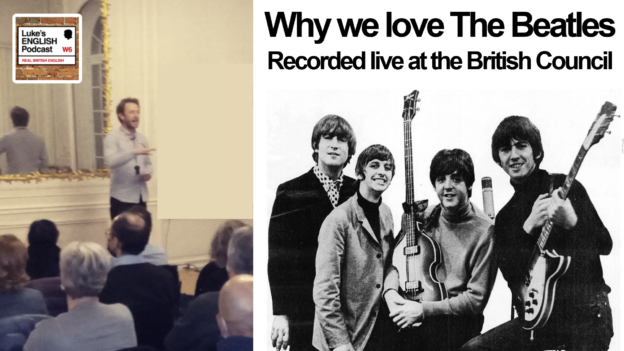
Talking to my mum about a book which you could read as part of your English learning routine. The book tells the story of The Beatles and their impact on society. We review the book and then discuss many aspects of The Beatles story, especially the four Beatles themselves.
This is a new episode of Gill’s Book club and I’m talking again to my mum, Gill Thompson about a specific book which you might want to read as part of your English learning routine.
Hello Mum, how are you?
Introduction
The book this time is all about The Beatles, which is a band from England that you *might* have heard of.
You could read this book, and if you did I’m sure you would learn plenty of things both in terms of language and general knowledge, but there’s no pressure to do so. If you like, you can just listen to this conversation with my mum and hopefully this will be interesting and useful enough on its own.
But if you are looking for a good book to read in English, then this one could be a good choice, and hopefully this conversation will help you to understand the whole thing a bit more, which in turn should help you pick up more English from it. So, my advice is: listen to this conversation with my mum and if you’re inspired, get a copy of the book and read it, or if you prefer, just listen to us without feeling any pressure to read the book at all. Hopefully this will still be enjoyable and interesting even if you haven’t read the book and have no plans to do so.
Over 700 episodes and 12 years ago, in the 3rd episode of this podcast, I interviewed my mum about her memories of seeing The Beatles performing live on stage in the 1960s, which she did, twice.
Now, we’re going to talk about the band again, this time focusing on a book which is all about the Beatles phenomenon and their place in history. The plan is to review the book as a text for learners of English, and then have a deeper discussion about The Beatles.
You probably know that I’m a big fan of The Beatles and grew up with their music, as my parents were (and still are) fans too. For years I’ve been thinking about doing more episodes about The Beatles story, and mentally preparing myself for it, but I have never actually got round to recording anything, mainly because the topic is just too big and there’s too much to say! But finally I have actually recorded some episodes that might scratch the surface of this topic a bit, and hopefully will give you something insightful and interesting to listen to, whether you are a fan of this band or whether you know almost nothing about them at all.
So this is going to be the first in a series of episodes in which I talk about Beatle-related things. There’s this one with my mum and then a few episodes with another guest who is an English teacher and something of an expert on The Beatles, and John Lennon in particular.
So, Beatle episodes are coming. I suppose, for some of you, episodes about The Beatles are like busses. You wait ages for one and then loads of them arrive at the same time.
And by the way, I am certainly not forgetting the main focus of this podcast, which is all about helping you learn English. I think The Beatles can help you learn English, reading is very important in learning English, and so why not do some reading about The Beatles?
Plus, later in this Beatles series there will be some language-focused episodes, using The Beatles as a context – focusing on some specific descriptive vocabulary and also some analysis of the Beatles’ song lyrics.
Maybe you’re not a fan of The Beatles. This is fine. I’m not going to try to convince you that you should like their music. That’s a matter of taste. But I do think that their story is something else entirely. I think it is hard to deny the fact that the story of these 4 individuals, the things that happened to them and the impact they had on the world – this is all simply fascinating. It’s an epic story. So, even if you don’t like the music, I hope you stay just for the story.
Now, let’s start this episode of Gill’s Book Club, talking about a recently published book about The Beatles.
Length – Is it a long book?
It’s long (642 pages) but the chapters are short, so it’s possible to read it in little chunks.
It’s available in audiobook and Kindle versions.
Appropriacy for Learners of English
The language is modern and plain in style. It’s quite literary of course, because it is a book and not a screenplay or something, but generally speaking it is clearly written and should be readable for learners with an Upper Intermediate level or above, although there will be some difficult words of course, but that’s good. I would say that overall the style is modern, neutral and definitely the kind of English that I would recommend as a good model of English for my listeners.
The short chapters make the whole thing quite easy to digest. It’s in bitesize chunks.
You can dip into it and you don’t necessarily have to read it in order. It’s almost like a collection of essays.
Audiobook version
The audiobook version on Audible is good – different voices and voice actors doing different accents, including pretty good impressions of the main people involved.
Why is it called “One Two Three Four”?
This is the first thing you hear on the first song on side 1 of The Beatles’ first album “Please Please Me”, released in early 1963 – You can hear Paul McCartney counting the band in at the start of the song by saying “1, 2 , 3 , 4”. Also, there were four Beatles, so…
Ending
So there you have it, after more than 700 episodes I finally returned to the topic of The Beatles with my mum and I think it’s fair to say that we went into quite a lot more depth than we did in episode 3 back in 2009, although episode 3 does include stuff we didn’t mention here, specifically my mum’s account of actually seeing The Beatles perform live, twice. So check out episode 3 if you haven’t done so.
Also you could check out that episode in which I asked my uncle Nic to tell us about the time he met Paul McCartney. He told the story in episode 414, and not only has he met Paul, he’s also played football with the members of Pink Floyd and hung out with The Who backstage at one of their concerts, and more. So check that one out too. Links for those episodes are on the page for this one on my website of course.
I really hope you enjoyed listening to this episode. I must admit that although I feel compelled to talk about this subject at length, part of me is concerned that this is all too much for my audience but I suppose those people who aren’t into this can just skip this stuff. It’s completely up to you. But do let me know what you think.
Remember, any time you have any thoughts about what you are hearing on this podcast, if you have responses or comments in your head as you listen, you can express them in English and I will read those comments, and so will many other LEPsters. The best place to leave your comments is on the page for the relevant episode on my website. Go to EPISODES in the menu and find the relevant episode page, scroll to the bottom and that’s where you will find the comment section. I am curious to see what you think. Any Beatle fans, get in touch. Non Beatle fans, I want to know what you’re thinking. Remember, sometimes doing this podcast is a bit like talking into the void and not quite knowing what people are thinking while I’m doing it.
I won’t talk much more at the end here, except that of course there are millions of things I wish I could have mentioned or talked about in this conversation.
We didn’t talk enough about Ringo!
There are also loads of other people and events that I wanted to mention.
I hope I didn’t talk too much.
Just in case this wasn’t quite enough rambling about The Beatles on this podcast, remember there are four (count them) four more episodes on The Beatles to come, but hopefully those episodes will be different enough to justify this series.
Anyway, 4 more Beatle related episodes are coming up.
One is a discussion about John Lennon.
Another two are language focused and we’ll be talking about adjectives for describing personality traits.
And the last one is about Beatles song lyrics and little phrases and idioms that you can learn from them.
So it’s not just rambling about The Beatles, although that will be part of it too.
Thanks again to mum for her great contribution to this episode, and yes I am lucky to have a mum who is this cool. I appreciate that and I’m really glad to get her voice on the podcast along with my other guests.
And thank you as ever for listening all the way to the end, you are the best.
Take care, look after yourselves and each other and I will speak to you again soon. I think the next episode will be Michael from Poland. But until then it’s time to say good bye bye bye bye bye.
Cookies on teacherluke.co.uk
Click “Accept All”, to consent to the use of all cookies on this website, or visit "Cookie Settings" to control your consent settings.
This website uses cookies to improve your experience while you navigate through the website. Out of these, the cookies that are categorized as necessary are stored on your browser as they are essential for the working of basic functionalities of the website. We also use third-party cookies that help us analyze and understand how you use this website. These cookies will be stored in your browser only with your consent. You also have the option to opt-out of these cookies. But opting out of some of these cookies may affect your browsing experience.
Necessary cookies are absolutely essential for the website to function properly. These cookies ensure basic functionalities and security features of the website, anonymously.
Cookie
Duration
Description
cookielawinfo-checkbox-analytics
11 months
This cookie is set by GDPR Cookie Consent plugin. The cookie is used to store the user consent for the cookies in the category "Analytics".
cookielawinfo-checkbox-functional
11 months
The cookie is set by GDPR cookie consent to record the user consent for the cookies in the category "Functional".
cookielawinfo-checkbox-necessary
11 months
This cookie is set by GDPR Cookie Consent plugin. The cookies is used to store the user consent for the cookies in the category "Necessary".
cookielawinfo-checkbox-others
11 months
This cookie is set by GDPR Cookie Consent plugin. The cookie is used to store the user consent for the cookies in the category "Other.
cookielawinfo-checkbox-performance
11 months
This cookie is set by GDPR Cookie Consent plugin. The cookie is used to store the user consent for the cookies in the category "Performance".
viewed_cookie_policy
11 months
The cookie is set by the GDPR Cookie Consent plugin and is used to store whether or not user has consented to the use of cookies. It does not store any personal data.
Functional cookies help to perform certain functionalities like sharing the content of the website on social media platforms, collect feedbacks, and other third-party features.
Performance cookies are used to understand and analyze the key performance indexes of the website which helps in delivering a better user experience for the visitors.
Analytical cookies are used to understand how visitors interact with the website. These cookies help provide information on metrics the number of visitors, bounce rate, traffic source, etc.
Advertisement cookies are used to provide visitors with relevant ads and marketing campaigns. These cookies track visitors across websites and collect information to provide customized ads.