A conversation with Cara Leopold about the differences between life in Paris and life in provincial France, plus how it feels to live abroad away from your home country.
Sign up to LEP Premium to watch my stand-up comedy performance in London https://www.teacherluke.co.uk/premiuminfo
Ending Transcript (The last part of the episode)
That was Cara Leopold from leo-listening.com. Thanks again to Cara.
I’m curious to read your comments and responses to this conversation in light of the things I said in the introduction.
I would like to say again – if you have ANY questions about behaviour, customs or culture in the UK which you don’t understand or find frustrating – please write them in the comment section. I would be glad to try and answer your questions both in the comment section and potentially in a whole podcast episode.
Actually, I have done episodes about culture shock in the UK before, because I think, to be honest, I’ve probably heard all the comments, complaints, grumbles, gripes, questions and criticisms before – and so I have dealt with a lot of that stuff in previous episodes, but nevertheless I am very curious to see if I have any listeners who have experienced British culture shock. Ask me your questions and I will try my best to explain my country and my culture. This is my job, to an extent! So go ahead.
By the way, the specific episodes I did in the past about culture shock in England are episodes 192 and 193 – entitled “Culture Shock London” (focusing mainly on life in the capital city actually) and to give you an idea of the things I talked about in those episodes, here’s a little list. This is a list of some of the most common questions and complaints I have heard from foreign visitors in my country.
Questions / Complaints I have heard about London/The UK
Why do you have two separate taps in the bathroom rather than one single mixer tap? (This question has haunted me for many years actually)
Why don’t you have electrical sockets in the bathroom? I want to dry my hair with my hair dryer or use my hair straighteners but there’s no plug in the bathroom. How do British people manage this? How do you live like this??
Why is your food so plain and unhealthy?
Why is your weather quite miserable?
Why do you drive on the left? It’s like you do everything differently here.
Your trains are often late, delayed, overcrowded and too expensive. Why is this?
Why are there so many foreigners in London? I haven’t met a “real English person” yet.
Why are the houses and flats in London so old and draughty, with windows that don’t keep out the cold and yet the rent is so expensive?
Why don’t people talk to each other on the Underground, it’s like everyone’s ashamed or something, and it’s really hard to make friends with people. English people are so reserved. It’s like they’re impossible to make friends with.
Why don’t people carry umbrellas all the time, even when it’s raining?
The internet is too slow here.
You just don’t make any effort to speak other languages here. It’s just ENGLISH, and that’s it. Also, people don’t make any effort to help me when I’m trying my best to talk to them in their language.
Why oh why do the pubs close at 11PM!?? I’m just getting ready to go out at 11!
Why do you eat dinner so early?
Why do English people go to the pub after work and just drink and drink and drink, standing up, without eating. It’s not very civilised.
Cigarettes are ridiculously expensive.
When English people do the washing up (the dishes), they use too much soap and then don’t rinse the soap off when they’ve finished. That’s like leaving chemicals all over your plates.
Why do you have carpet everywhere – even in the toilet sometimes, that seems unhygienic.
Why don’t you take your shoes off when you enter a house? That’s like bringing the dirt from the street into your home!
The British have a weird sense of humour. “What is this? British humour?”
If those are some of the complaints or questions in your head, then you might want to listen to episodes 192 and 193 to hear my full responses.
But also, feel free to write new questions or indeed any responses you have in the comment section.
That’s pretty much it for this episode.
Cara’s chat with a Spanish friend attempting to adapt to life in the USA
Some reminders
New LEP Premium content is coming soon – I keep saying this, but I just want to reassure you. If you want to unlock all the premium episodes and also help me pay the rent, go to www.teacherluke.co.uk/premiuminfo
Download my app to get the entire episode archive on your phone, including loads of bonus content and access to LEP Premium episodes – search for Luke’s English Podcast App in the app store – you can do it right now! It’s completely free!
If you are listening to this on YouTube don’t forget to like and subscribe and leave a comment, it helps the algorithm to promote my episodes. Also, if I reach 100,000 subscribers YouTube will send me a nice glass thing which would be lovely, wouldn’t it. I am currently on about 76,000 so do subscribe to the channel to help that happen.
This episode of Luke’s English Podcast is sponsored by Luke’s English Podcast Premium. Premium LEPlanders, did you know that in the LEP App, as well as the category for premium audio episodes, there’s a category called Pronunciation Videos? Did you know that? There are currently 13 pronunciation videos in there with drills for you to repeat after me with annotations on the screen, plus a new video which I created and uploaded just the other day – a set of pronunciation drills for present perfect simple and continuous. I just thought I would let you know. I’m also working on a new premium audio series which is coming soon, so keep checking the premium category in your LEP App and also on my website. If you’d like to become a premium listener, then go to www.teacherluke.co.uk/premiuminfo
Introduction Transcript
Hello listeners, how are you today? I hope you’re basically doing alright.
Sometimes I get messages from people who say things like this:
“Luke, when you talk on the podcast, are you talking at your normal speed, because I can understand everything you say” and “Can you speak at your normal speaking speed on the podcast please? Because we want to hear natural, fast speech – like the way native speakers usually speak.”
OK then. Actually, I think I do speak at my normal speed on this podcast more or less, most of the time, but as I’ve said before it’s probably easier for you to understand me when I’m talking on my own than when I’m talking to a guest. My conversations with guests tend to speed up. As you may have noticed.
But if you are one of those listeners who is looking for English listening at a fast, natural speed, then this kind of episode (that’s this one, that you’re listening to right now) is for you, because the conversation I’m presenting this time goes at a really rapid pace.
My guest and I got quite carried away during this conversation, which does happen when I speak to guests. We didn’t see the time passing and we covered a lot of different little topics with some bits of humour thrown in and we weren’t simplifying our English throughout. It’s just like when you’re talking to your friends in your native language I expect.
Basically, listeners – are you up for another English listening challenge? If the answer is “yes” then, great. Here you are. Here is this episode.
But it might be difficult, so brace yourself. It depends on your level of English of course. Maybe you’ll have no problem understanding this at all. But I think for some people, it might be a challenge.
Nevertheless, I’m not going to explain all the main points you are going to hear in advance, like I do sometimes at the start of episodes – that kind of explaining can be very helpful, but I’m not doing it this time, mainly because I want to keep the episode length under control – I don’t want it to end up being tooooo long. In fact, I’m going to stop this introduction in a moment and just let you listen to the conversation in full without loads of support from me. You’ll be alright. You’ll be fine.
My guest this time is Kate Billington, who you haven’t heard on this podcast before – so another new voice for you to get to know.
Kate does a lot of different things – she speaks multiple languages. British English is her mother tongue but she also speaks Chinese, French, Spanish too I believe. She is an English teacher like me. She makes cakes at a professional level (unlike me – I’m not great at making cakes but I’m very good at eating them) But Kate is a pro. I mean she is a professionally-qualified cake maker. She has a particular set of skills as you will hear – and watch out for some descriptions of some classic British cake recipes. Kate is a stand-up comedian (yes, another one), and she is interested in lots of other things too, as you will hear.
Kate and I really enjoyed this conversation. I hope you do too and that you just get really involved in listening to us and that you don’t see the time passing. If you do lose track of what we’re talking about at any point, which is quite possible, maybe use your podcasting app to skip back a bit and listen again.
If it is difficult, all I can do now is just encourage you to complete the episode from start to finish, even if you don’t get 100% of what we’re saying. It’s important when learning a language to persevere. It’s worth it. Anyway, if you simply enjoy the atmosphere and the things we say, hopefully that will make things much more pleasant for you.
Remember you don’t have to listen to the whole thing in one go. If you need to stop at any point, your podcast app will remember where you were and you can just carry on again later, which is one of the great things about podcasts.
The icing on the cake
Juuuust before we start, I feel I should explain one idiom in English which comes up near the beginning. “The icing on the cake”
I was thinking of calling this episode “The Icing on the Cake with Kate Billingon” but then I thought “no, people don’t know what that means”. But I want to explain it anyway because it does come up and you’re here to learn English, right?
If you say that something is “the icing on the cake” it means that it is something extra that is added to an already good situation, which makes it even better.
You have a situation which is already good, and then you add a little extra something to make that situation even better.
“The episode was good – but that joke that Kate told at the end was the icing on the cake”.
This is an idiom in English of course. It’s not only used to refer to cakes.
Icing is a sugary frosting which is added as a thin layer on top of a cake. So, the icing on top of a cake is an extra little layer of yummy sweet stuff which is added, making it even better. A cake is already amazing, right? Well, adding icing on top makes it even more amazing.
For exmaple: “It was incredible seeing Neil Young doing a concert in Hyde Park but Paul McCartney arriving on stage at the end of the show was the icing on the cake.”
This idiom comes up at the start. Watch out for it.
OK, I’m going to stop this introduction now. So let’s meet Kate Billington for the first time on Luke’s English Podcast, and here we go…
Ending Transcript
So, that was Kate Billington in an epically long conversation. Thanks again to Kate.
Hello you! You made it until the end. Nice one. How was that for you? I hope you enjoyed it as much as we did.
If this episode was a cake, what kind of cake would it be?
Maybe a long fruit cake – rich, quite heavy, fruity, made in the run up to Christmas, very British and best enjoyed with copious amounts of brandy.
Or maybe you found it more like a Victoria sponge cake – light, fluffy, sweet and moreish.
Or perhaps a battenburg cake – it looks like one solid whole, but when you get into it you realise that it’s made up of different sections.
Anyway, thank you for listening all the way up to this point.
Let us know any thoughts or reactions you have by writing something in the comment section on the website.
How was this episode for you?
Did you learn anything from it?
Do you have any specific questions about vocab that came up?
Do you have any thoughts that you’d like to share?
Do you have any thoughts in your head, generally? (I hope so)
Check out the page for this episode on my website where you will see things like transcriptions for my introduction and this ending bit, plus pictures of most of the cake types and pastry types that we talked about → Victoria sponge, fruit cake, Battenberg cake (aka window cake) plus some lovely French things like croissants, pain au chocolate and more.
Kate Billington on Instagram
Check out Kate’s Instagram to see lots of lovely pictures of lovely delicious cakes that she has made – yum yum yum and indeed, yum.
Also you can check out Comedy Croissant on Instagram & Facebook, especially if you are in the Paris area and you’d like to come to one of the shows when they eventually come back. And as I record this ending bit France is again under strict lockdown measures, which means the comedy shows are not happening for the foreseeable future, but when they’re back, which they will be one day, you’ll know about it if you follow Comedy Croissant on Facebook.
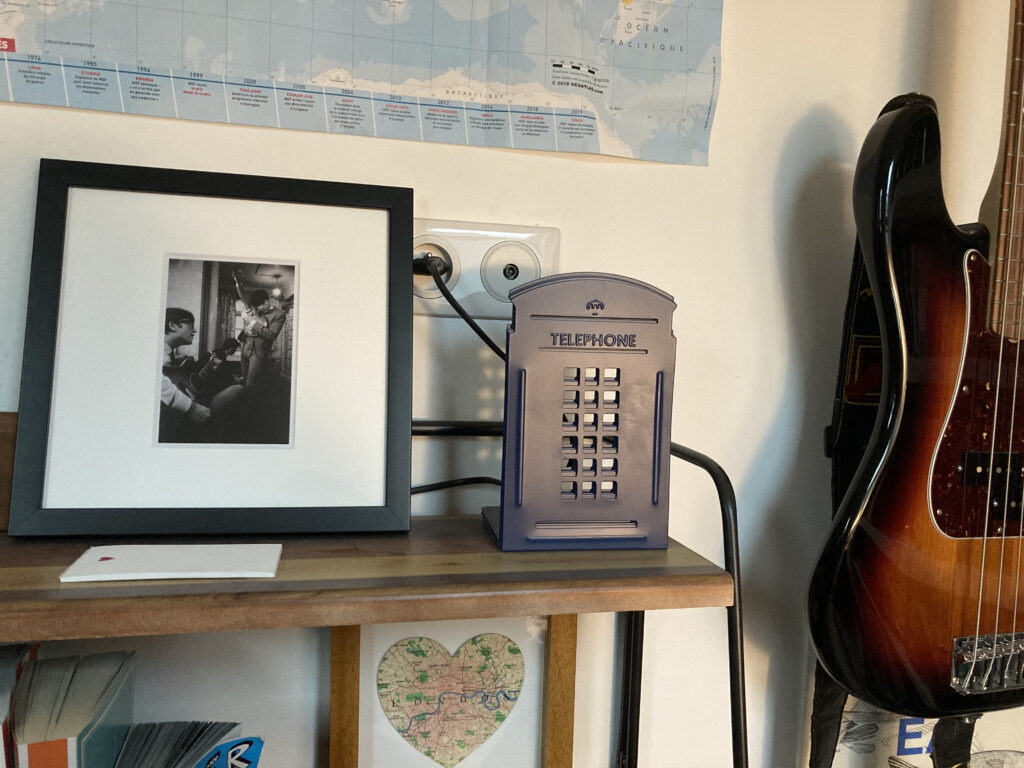
LEP App users – There is a little outtake in the app (extra audio – just in case you didn’t get enough from this episode) – tap the gift icon while listening to the episode and you’ll hear a couple of bonus minutes of Kate and me talking about some blue bookends that I have in my pod-room. Bookends are things you put on the end of shelves to stop the books falling off. Usually they are rectangular in shape, but also L shaped – because part of the bookend has to go under the books. My blue bookends, which you might have seen in my videos, look like the Tardis from the TV show Doctor Who. The Tardis looks like a blue telephone box. Doctor Who fans will know. If you’d like to hear us talking about my Tardis-shaped bookends and whether I am a proper Whovian (Doctor Who fan) or not, then find the gift icon for this episode in the LEP app and tap it!
The bookends in my pod-room which caught Kate’s eye. The bookends look like The Tardis. Listen to the bonus audio in the app to find out more.
Posh, or not posh? Gap yah, etc…
Another thing is, if you are wondering about posh people – how to know if someone is posh, what a posh accent sounds like, and that whole “Gap Yah” thing, then go to the episode archive and find the “Posh or not posh” episodes – 581, 582 and 584. They should explain everything relating to poshness and how posh people speak.
Thank you again to Kate for this episode. Thanks Kate.
Dear listener, I will speak to you again soon on the podcast in either a free episode or a premium one (I’m working on more content for you), and yes the next part of the WISBOLEP competition is on it’s way. I am working on that too.
Thank you for choosing to listen to my podcast.
If you are feeling up for it you could leave a nice review for LEP on iTunes – it helps the podcast appear in those recommended lists and things. Like and subscribe and leave a comment if you’re listening on YouTube. Consider donating to support the podcast by clicking a donate button on my website. Download the Luke’s English Podcast app from the app store and consider becoming a premium lepster by going to www.teacherluke.co.uk/premiuminfo
And finally, please remember to be excellent to each other, stay safe, stay healthy, stay positive.
Traditional English fruit cakeThe Christmas version of an English fruit cake – probably “fed” with brandy and left in the cupboard for weeks.Victoria Sponge CakeBattenberg Cake (a.k.a “Window cake”) https://www.bbc.co.uk/food/recipes/battenburg_cake_60878
French Viennoiserie
“All butter” CroissantPain au chocolat (also known as a chocolatine in some parts of the country) 😋
A conversation with English-teaching stand-up comedian Elspeth Graty, which covers lots of different topics including Elspeth’s background in England, teaching English, cultural differences, “French-bashing”, old-fashioned telephones and The Tellytubbies. Enjoy!
This podcast is made possible thanks to donations from lovely listeners (click a yellow PayPal button on the website if you’re feeling generous) and also the premium subscription, which costs, per month, slightly less than a pack of 80 Yorkshire Gold Teabags from Sainsbury’s. So if you would like to make sure I never run out of tea, then consider signing up.
There are now well over 100 audio and video episodes in the premium archive and you can access them all, plus new ones that are coming. That’s what you get when you become a premium lepster. To get all the information, including how it works and exactly how wonderfully reasonable the prices are – go to www.teacherluke.co.uk/premiuminfo
Introduction Transcript
Hello listeners,
How are you today? Doing alright all things considered? I do hope you’re managing to keep calm and carry on during this weird and difficult period of history that we are all experiencing.
Shall we start the episode? OK.
Here’s the second in a series of interviews I’ve been doing lately featuring people I’ve been meaning to talk to on the podcast for quite a while (quite a while — is that a short time or a long time? Quick answer: It means a long time.)
I just wanted to record natural conversations with some new guests so you can hear their voices, their stories, their thoughts so you can notice bits of language and practise your English listening as usual.
The first of these recent interviews was with Marie Connolly from Australia, which was the last episode of course. I hope you all enjoyed it.
This conversation is with a friend of mine called Elspeth who is from England.
Elspeth is an English teacher and she also does stand-up comedy in the evenings, which is how we met each other. Yep, she’s another English-teaching comedian friend of mine.
Explaining this episode’s title
The title of this episode is “Chasing the Tangent Train with Elspeth”.
The title is just a metaphor – please don’t expect a conversation about train travel!
It’s just a metaphor to explain the fact that this conversation is full of tangents and I hope you can keep up with it. In fact, it’s mainly tangents.
What is “a tangent”? Long term listeners should know this, but plenty of people won’t know so let me explain.
In a conversation, a tangent is when the topic changes to something quite different and seemingly not related to the main point of that conversation.
It’s when you digress from the main point, go away from the main point or get sidetracked.
“To go off on a tangent”
There are lots of tangents in this conversation. So, for the title of the episode, I was trying to think of a way to describe the experience that you will have of just following the changes in direction in a conversation and seeing where it goes.
I ended up with “chasing the train”, which is not actually an expression you will find in the dictionary – I made it up.
Let’s imagine, then, that this conversation is a train and it’s going down the tracks and every now and then it switches to new tracks and continues for a while, then it switches to another new track and then does it again, and again and so on. Can you keep up with the train? I think you get the idea.
My overall aim for this interview was mainly to get to know Elspeth in more depth and to capture an authentic conversation to help you learn English. That is the destination for this train journey. But as I said, the topics move around a bit, which is totally normal in a conversation. Just ask David Crystal, he wrote a book all about it and he’s a professor and definitely knows what he’s talking about.
What I’m getting at is that this might be hard for you to follow – depending on your level of English.
So you’ll have to focus.
Nevertheless, I can help you keep up with this if I let you know what the main changes will be in advance.
So I’m now going to give you a quick overview of the main changes in topic in this chat.
The main points in this conversation are, thus: (these aren’t spoilers)
We talk about
Where Elspeth comes from originally, and how her family moved around parts of England
Being the daughter of a vicar (that’s her, not me obviously) A vicar is a priest in the Anglican church – the church of England. The cliche of the typical English vicar is that they wear black with a little white collar, they’re often softly-spoken grey haired men with glasses who ride bicycles around their parish and love drinking tea, eating cake and generally worshipping god.
Our accents, which are not strongly affected by the region where we grew up (we actually come from the same general area in England)
Having harvest festivals at church when we were children
Then there’s a big, random tangent → Remembering the old dial telephones we had in our houses when we were children. Remember them? You had to put your finger in and turn numbers around a dial, and it went went kkkkkkkkk. You don’t remember? That must be because you’re young, or you’re old and you’ve lost your memory.
Services you could get on the old analogue telephones, like the operator (a person who you could speak to and who would deal with your telephone-related enquiries) and the talking clock (a recorded voice that was constantly telling the time and you could call a number and listen to it)
Coventry Cathedral in Coventry, which was almost destroyed during World War 2 but was rebuilt and is now definitely worth a visit if you’re in the city
Elspeth’s life in France, her French, and whether or not she feels French or English after living here for quite a long time
Some of the cultural differences between England and France that frustrate us a bit, like the usual things – being punctual, walking down the street and in particular, queueing – standing in line to wait for things in public
Teaching English to young engineers, and the challenges that French students have when learning English
Some of Elspeth’s experiences of learning French
How Elspeth can behave slightly differently in English and in French, especially when doing stand-up comedy in the two languages
Elspeth’s thoughts on her own clothing choices and fashion sense, and how people react to it, especially the Nike Air Max trainers that she wears
Teaching English online using Zoom – and what that is like
Doing stand-up (going on stage and telling people jokes and stories to make them laugh) and Elspeth’s favourite and least favourite things about doing that Where her inspiration for comedy material comes from and “flow activities” or being in a “flow state”
If there is a connection between stand-up and English teaching
A little story about The Tellytubbies that Elspeth uses in her English lessons, which makes the students laugh (The Tellytubbies is a children’s TV show) The story involves The Tellytubbies, William Shakespeare, the county of Warwickshire in England and April Fool’s Day. Basically, the county council of Warwickshire played an April fool’s trick on the people of Warwickshire, and it involved The Tellytubbies and Shakespeare, and people didn’t like it.
Why English people get into rages – like road rage, or trolly rage in the supermarket
The concept of French-bashing (criticising or making fun of the French and French culture) and why Parisians seem to complain about each other’s behaviour quite a lot (Parisians are people living in Paris)
How people’s behaviour in public in Paris compares to behaviour in the UK and in Tokyo
Things we love about France – because there’s a lot to love about this country too
Finally, a bit at the end where we both conclude that Paul Taylor is basically a cake – a delicious British cake.
Actually, reading out that list – it doesn’t seem like there are that many tangents, but there are tangents ok? What I’ve just given you there is the main flow of the conversation.
Right. Now that you have an overview of the track layout, let’s get this train rolling.
Let’s just get started. Here is my conversation with Elspeth, and here we go.
Luke’s fuddy-duddy slippers (a Christmas present from a couple of years ago)
Ending Transcript
Right, so that was my conversation with Elspeth. I enjoyed it a lot, especially because we have quite a lot in common, not least because we are from the same neck of the woods (a local area where someone lives).
How did you get on? Did you manage to follow it ok? Well, you must have done, because you made it. You’ve caught up with the train. You can have a rest now. Well done for keeping up.
I expect you’re getting out your phone now. If that’s what you’re doing, open up Instagram on your phone and check out Elspeth’s page, which is @elslostinfrance which I now realise would have been the perfect name for this episode, right?
I could do a lot of rambling on now, about all sorts of things, like what’s been going on and the WISBOLEP competition (which is now closed by the way – no more entries please. The deadline has passed, unless maybe you’re in a part of the world where it is still the 15th October – in which case, you have until midnight).
I’ve received loads of entries and let me tell you – it is going to be difficult to choose just one winner. There are so many really interesting recordings and stories of how people learned English and all kids of other things. It will be hard to pick just one person. Also I’m now wondering how I’m going to manage the whole thing. I’ve had nearly 90 entries. I don’t know why I didn’t expect to get so many. Each entry is about two minutes long and so – 180 minutes, even without my comments (and I really want to make even very short comments).
Shall I play them all on the podcast? That’s a lot, isn’t it?
I think the best way to do it might be to make a YouTube video of all the audio (if that makes sense) and then I can add time stamps for each person, which will make it much easier for everyone to find each recording.
In any case, I will find a way to manage this. It could take a while though, so be patient.
I do want to re-state that it has been amazing listening to all the recording (I’ve had brief listens to most of the recordings sent). There are some awesome people in my audience. I just want to give a shout out to anyone who sent in a recording. Well done for plucking up the courage to do that. The competition is going to be a bit of a celebration of my audience from around the world.
Not much more to add here, except the usual mention of LEP Premium which you can find out more about by going to www.teacherluke.co.uk/premiuminfo I’ve been getting some very positive feedback about it. There are now over 100 episodes of LEPP now in audio and video form. Check it out to see what you’ve been missing.
I’ll be back again soon with another episode, perhaps one in which I just ramble on about all the stuff that I’ve been meaning to say on the podcast for a while, a few listener emails, some songs perhaps and more…
Let me say thank you again to Elspeth for her contribution to this episode. Thank you Elspeth.
Everyone: Hang in there. Keep your chin up.
Hey, do you want some anti-covid funk music to cheer you up? (Yeah)
OK. This is something that I recorded this morning. I probably should have been doing some work but after dropping off my daughter at school I suddenly felt compelled to play some bass, and one thing led to another and I ended up recording a little 2-minute funk groove. The drums are from a youtuber called Dimitri Fantini (link on the episode page). I needed a 90bpm 16-beat funk groove and he delivered. Credit to Dimitri for the drum track. I’ve added bass using my Mexican-made Fender P-Bass, some rhythm guitar with my Fender Stratocaster (also made in Mexico) as well as some string sounds which are from my Yamaha P-45 electric piano.
I called the track Funk in the Kitchen, because it’s supposed to make you dance in your kitchen, or indeed in any other location.
Brace yourselves – music is coming… In 5, 4, 3, 2, 1, let the funk commence…
Announcing a new LEP competition which everyone is welcome to enter, plus an anecdote about the first time I said a rude word in front of my parents. Send your competition entries to podcastcomp@gmail.com
LEP is brought to you by LEP Premium. This is how I pay for this podcast, along with donations from kind philanthropic listeners using the PAYPAL DONATE BUTTONS. LEP Premium though is my paid subscription service which includes loads of audio and video content to help develop your grammar, vocabulary and pronunciation. You can get episodes in the LEP App or online, with PDFs, tests and pronunciation drills. For all the information you need go to www.teacherluke.co.uk/premiuminfo
Notes & Transcriptions for #681
Hello everyone! In this episode I’m going to tell you about a new competition for LEP, which you can enter, and then I’m going to tell you a true story of something that happened to me when I was a child. In fact, the title of the story is “The First Time I Said F*ck”. I’m reluctant to blurt out the F word so early in the episode, but anyway, the story is about the first time I swore in front of my parents, and it’s a story I wrote for doing stand up comedy on stage, but I’m going to read it out on the podcast today.
But first, what about this new…
Competition
I’ve decided to launch a new competition and I’m going to tell you all about it in this episode.
I hope you feel welcome to take part. Everyone is invited to enter this competition, and that includes you, so I hope you consider taking part this time.
I mentioned this in the last episode and got a number of positive responses from people saying things like “I really hope you do the competition!” and so on.
Again, I want to say thanks to a listener called Vadim for prompting me to do this.
It’s been ages since the last competition (the last one concluded with episode 407 – the interview with Kristina from Russia) and I sort of wasn’t planning to do a new one, but then Vadim sent me this email and I just thought “OK, why not!?”
Here is Vadim’s message (with some error correction).
There are a few errors in here I’m afraid, Vadim. I’m going to correct those errors as I go along, hope you don’t mind.
New Competition?
Vadim
Hello, Luke!
I have an idea for new competition! It’s been awhile, since you have launched one.
I have an idea for a new competition. It’s been a while since you launched one.
So, an idea is very simple. It will be called WSIBOLEP, or Why Should I Be On Luke’s English Podcast [Actually, I’ll call it WISBOLEP – Why I should be on LEP].
So, the idea is very simple. It will be called WSIBOLEP
All you need, it’s just ask your listeners to record a little voice message, telling Why you MUST interview them on your Podcast.
All you need to do is just ask your listeners to record a little voice message saying why you must interview them on your podcast.
Because I believe that you have a lot of interesting people listening to you. Russian oligarchs, pornstars, ex-nazis hiding in Argentina, bobsleigh world champions, writers, celebrities, presidents, royal family members etc, etc.
And then your listeners will vote for the person who has a story that they want to listen to in more detail.
What do you think about it? I believe that it will be a good way to encourage people to do a bit of a practice and stop being a ninjas [being ninjas]. And those who don’t want to take part in this competition can just have a fun [just have fun], listening to exciting intriguing stories from all around the world.
Well, I actually think this is a fine idea and I’m curious to see what happens.
Let’s do another competition on LEP.
The prize this time – being interviewed in a full episode. I hope you consider that to be a prize!
WISBOLEP (Why I should be on LEP)
So let me summarise the plan for this competition.
You have to:
Record up to 2 minutes of audio explaining why you should be interviewed on LEP, then send it to me at podcastcomp@gmail.com (only)
Listeners will hear all of the clips and vote for the person they want to hear, then I’ll interview the winner.
Remember: You are talking to the listeners, not to me.
You can use a script, or no script, but I encourage you to not use a script, and instead make some notes and do some improvising too. If you do read from a script, make an effort to make it sound natural, rather than robotic.
Also, if you’re wondering how to record – it’s pretty easy these days. You could make a voice recording on your phone and send it to podcastcomp@gmail.com or you could use Quicktime on a Mac or the equivalent on a PC and then email it to podcastcomp@gmail.com or you could use SpeakPipe.com – just go to speakpipe, record a message, put your name on it, then send the link to podcastcomp@gmail.com
What am I going to say?
Now, you might be thinking, “what am I going to say?”
Well, first, remember that you’re trying to persuade the audience that you should be on the podcast, so think of some reasons you should be on, and not just because you really want to (although that’s ok too).
Basically, you’re saying “Hi listeners, Hi Luke. Thanks for this opportunity, and this is why I think I should be on LEP…”
Then you’d need to explain why you should be on LEP (obviously).
Remember, you have UP TO 2 minutes. This means that you don’t have to do 2 minutes. It could be 1 minute if you like, but no more than 2 minutes.
2 minutes is your maximum allotted time.
You might be thinking “Just two minutes?? That’s not very long.”
I’ve chosen 2 minutes because I need to keep this manageable! I have no idea how many people will send me entries to this competition, but since I’m going to be playing the audio recordings on the podcast, I need to limit how long they are, otherwise I’ll have too much audio. So, 2 minutes MAX, please. If your recording is over two minutes, it might not be entered into the competition.
Here are some ideas of why you should be on LEP.
Ideas
Maybe you have an interesting story to tell – either related to English, to the podcast, or to neither of these things! Do you have something interesting you could share with us? Some kind of story, perhaps related to you or someone else?
Maybe you want to talk about how you learn or have learned English, and give some advice.
Perhaps you’ve had some success with a particular technique that you could share with the listeners.
Perhaps you have experienced progress in some way, and you could share that.
Perhaps you discovered the podcast in a special way.
Perhaps the podcast has been a way for you to connect with other people.
Perhaps you met your partner because of LEP, or got a job because of LEP.
Maybe you have an interesting story or experience relating to English that you can share.
Perhaps you have a cross-cultural experience you could talk about.
Maybe you are involved in something interesting that you think people will want to know about.
Perhaps you are particularly funny, or have something to offer to the audience.
Or maybe you’re just up for a proper conversation with me, on the podcast!
And maybe you just have something original to say.
In any case, prepare two minutes – with or without a script – in which you convince the audience that you should be picked for a feature length episode of LEP.
Then record it and send it to me! And then maybe you will be on LEP.
This competition is open to everyone. Anyone and everyone can take part, regardless of your level of English.
This is Why I Should Be On LEP – WISBOLEP
I expect the rules this time might limit the number of participants, because some people will be too shy. But I still hope that people send me recordings!
I expect there will be fewer entries than before, but hopefully I’ll still get some people!
So, if you have something to offer the audience, get in touch and try to persuade everyone to pick you for LEP!!
In terms of level of English, as I said – there are no rules at all.
You can have a low level, you can have a high level.
It’s not about who has the best English.
It’s more about who would be the most interesting and engaging guest, not just because of their level of English.
DEADLINE
15 October. That’s your last chance. Midnight on 15 October 2020. [Previously the date was 31 October, but I have changed it]
As I said, I’ll probably get fewer people sending me recordings this time, but we’ll see – I often underestimate this kind of thing.
Last time I had over 100 recordings which was great, but obviously that was a ton of preparation work for me – downloading all the recordings, preparing them, balancing out the sound levels of each one, making them into podcast episodes, dealing with the voting and counting etc. Quite a lot of work as you can imagine! I don’t mind of course, I liked hearing from everyone, but it messed with my workflow quite a lot!
But do send me your recording, especially if you have something interesting to say to the audience.
When I’ve received all the recordings, I’ll edit them together, play them on the podcast and let you vote for the one you want.
Then I’ll arrange an interview with that person, and Bob’s your uncle.
So there you go! That is the new competition – WISBOLEP – Why I Should Be On LEP.
2 minutes max
Persuade the audience to choose you for a full-length interview
I hope you take part even if you’re not completely sure.
Go to the page for this episode on my website to read the rules and the details again if you like. Teacherluke.co.uk then click EPISODES and this is episode 681.
Feel free to ask questions in the comment section.
———
Premium LEPsters, I just wanted to remind you that P24 is drawing to a close. We’ve been through my massive list of homophones and expanded your vocab a bit in the process, now there are just two episodes left and they’re the ones that feature the jokes (not just crap ones made up by me). So P24 parts 11 and 12 are in the pipeline and will be coming to your Premium subscription soon.
To get the premium episodes, download the LEP App on your phone to listen to the episodes, or listen online. For all the info you need, go to www.teacherluke.co.uk/premiuminfo
I’ve come back from my holiday so it’s time to ramble on about some holiday stories, holiday vocabulary, podcast stats and other bits and pieces including an appearance by my daughter.
Hello and welcome back to Episode 666 of LEP in which my brother James and I are talking about scary and evil things. In the first two parts we talked about the number 666, the devil in music, Black Sabbath, and then in part 2 we described some genuinely frightening experiences that we’ve had in our lives. I’m glad to say that more comments have arrived. It’s good to see that people have been enjoying this series.
In this third and final part the plan is to talk about scary films, including the first scary films we ever saw, why people enjoy watching scary films, and then some descriptions of our favourite scary films. I’m sure that not all of you are into films like this, but I hope you can still enjoy listening to us describing them and talking about the effect they had on us when we saw them.
I’ve been thinking. Will you be able to identify the films that we are talking about? I expect that some of these films have different titles in your language. It’s quite important that you know which films they are, even if you haven’t seen them.
You might want to check them out quickly before you listen in order to identify them. You don’t have to watch them all. I just want to be sure that you know which ones we’re actually talking about.
In fact, I’ll give you the English titles now and very brief one-line descriptions (and you’ll see all these titles listed on the page if you want to know the spelling or whatever) so you can hopefully work out which films these are, or you can google them yourself, see if you recognise them and see what they are called in your country.
So here are the films which we mention during this conversation.
Do you know which ones they are? Do they have different titles in your language?
The Texas Chainsaw Massacre One of the original horror/slasher films from 1974 about a group of hippies who go on a road trip that ends badly when they get attacked by a weird family of cannibals in Texas, one of whom wields a chainsaw.
Children of the Corn (1984) Not a very widely known film, to be honest. Adapted from a Stephen King short story of the same name. The plot of the film is described by IMDB as “A young couple is trapped in a remote town where a dangerous religious cult of children believes that everyone over the age of 18 must be killed.” It stars Linda Hamilton who plays Sarah Connor in The Terminator films.
Jaws The 1975 Stephen Spielberg film about a shark. It’s an absolute classic and the most famous film about a shark, ever.
The Thing 1982, John Carpenter director, Kurt Russel star. IMDB: A research team in Antarctica is hunted by a shape-shifting alien that assumes the appearance of its victims. It was pointlessly remade a few years ago. The 1982 version is definitely the best one. Amazing and disturbing visual effects.
Alien 1979, directed by Ridley Scott, starring Sigourney Weaver. The one with the xenomorphs, face huggers and stuff. It spawned a whole franchise with sequels including the more recent ones Prometheus and Alien: Something. (I did a whole podcast episode about that actually) Alien: Covenant (Alien: Covent Garden would have been a much better film).
Evil Dead 2 1987, directed by Sam Raimi, starring Bruce Campbell. IMBD: The lone survivor of an onslaught of flesh-possessing spirits hides in a cabin with a group of strangers while the demons continue their attack.
Ghostbusters 1984 Dir: Ivan Reitman, starring Bill Murray – Three former parapsychology professors set up shop as a unique ghost removal service.
Those are the main films we talk about then. I hope you know which ones we mean.
As well as the talk of films, there are a couple of other topics in this episode, including a story that James felt compelled to share with us, from the business world of skateboarding about a skateboard with a famously controversial illustration on it – a picture of satan in hell, being evil. A skateboard with a dangerous design, basically. The story is about the power of superstition, I think.
We also have a go at some armchair philosophy at the end as we consider the idea of whether humans have free will or not, and how this might affect the existence of evil in the world, and whether the existence of the devil can somehow confirm one’s faith in the existence of god. If humans do bad things, is that because they are evil, or is there a more rational explanation for why people do bad things? Big questions which we’re not really qualified to answer, but we have a stab at it.
Also there’s the legendary story of blues guitarist Robert Johnson from the 1930s who, legend has it, sold his soul to the devil at the crossroads in return for amazing guitar playing technique and a mastery of the blues. The question is: for what price would you sell your soul to the devil?
That’s an overview of what’s coming up.
I gave a warning at the start of part 1 of this that you would hear some weird and frightening sounds at some moments during the episode.
I’d like to say that again now “You will hear some weird and frightening sounds at some moments in this episode”, because we play some audio from some of those horror films, and of course they contain some frightening noises. So be ready to hear some banging or crashing sounds, some scratching and scraping sounds, ominous voices, the sound of a chainsaw, some screaming, and other disturbing noises. OK?
Apologies again for James’ microphone cutting out a bit during this episode. I hope it’s not too distracting for you.
So, if you are ready and prepared – mentally, physically and spiritually, and not feeling too sensitive, let’s continue with the final part of episode 666.
And here we go…
Ending
So there you are that is the end of part 3, the last part of this series. I hope you’re not too traumatised by all this!
There is also some bonus audio for this episode in the app. Open the app, find this episode, tap the episode in the list and then tap the little gift icon to access the bonus audio. You’ll hear me describing and reacting to a creepy scene from an old black and white film called The Innocents. James wanted to show me this scene and wanted me to react to it, describing what I was seeing. So if you like you can listen and hear my descriptions, and you can watch the scene for yourself too. I’ll put the video of that scene on the website, and I think I’ll also make that bonus audio available on the website too.
So, that’s the bonus audio in the app and also on the website.
Check out the page for this episode to see a few select film clips and other bits and pieces.
As ever, we look forward to reading your comments on the episode page. Perhaps you could tell us what you thought of this series. Are there any scary films you’d like to mention? What’s the first scary film you remember seeing? Why do people choose to watch scary films?
This really is the end now. Thank you for listening. Stay safe, stay healthy, stay happy and be excellent to each other.
Bye bye bye bye bye…
Video Clips
Quint describes the USS Indianapolis shark incident (Jaws)
Quint gets eaten by the shark (Jaws)
BONUS AUDIO
Luke sees a scene from The Innocents (1961) for the first time, and describes it. You can watch the scene below.
Hello, are you a learner of English? Would you like something to listen to to develop your listening skills and by extension all other aspects of your English and your life? Well, you could listen to this. That’s the idea. Learning English through listening. Learning through listening. Listening through learning. Listening while learning. Listening and learning. Living and learning.
Anyway, welcome to this episode of my podcast.
This is part 2 of episode 666 in which my brother James and I are talking about scary things, horror, evil and general moodiness.
I uploaded part 1 of this a few days ago and so far there has almost been radio silence from the LEPsters. Just the sound of crickets in the comment section and on social media, despite the fact that I was regularly receiving messages from people before publishing episode 666 asking about what I was planning to do for this episode with an apparently significant number. There have been one or two comments, but I feel it’s less than usual. What’s going on. Have you been spooked by the subject matter? Are you all freaked out by the number 666? It’s possibly because the episode got blocked on YouTube and YouTube is normally where the first comments come in because it’s easier to comment on YouTube. So nothing from YouTube. I don’t know. The download numbers have been good. Maybe you’re just superstitious but like Stevie Wonder once said “Superstition ain’t the way”.
In any case, let me introduce this properly. This is part 2 and there are 3 parts to this episode. James and I recorded all this a couple of weeks ago – him in London, me in Paris (we did it online of course, we didn’t just shout really loud) and we chatted for about 4 hours I think. I’ve edited that down, but still, this was a marathon recording, just because we had a lot of stuff we wanted to talk about.
In part 1 we talked about why the number 666 is associated with the devil, and then we talked about the devil in music with a little history lesson from James’ friend Kate Arnold who is an expert in medieval music and then there was some rambling from James and me about some of our favourite scary music – mostly the band Black Sabbath who are probably the first band to really make a name for themselves by being quite frightening, but also some death metal, some hip hop and some Aphex Twin. Apologies to those of you who were expecting us to talk more about Iron Maiden and also other genres like black metal and so on.
So that was part 1, but here in part 2 James and I are going to move on from music and instead share a few anecdotes of genuinely scary experiences we’ve had in our lives, scary things that have actually happened to us. So, a bit of storytelling in this one.
Then in part 3 of this we’re going to talk about scary films and horror movies, and then that will be it for episode 666.
I recorded this conversation with James remotely over video conferencing software and for some reason James’ microphone kept cutting out at various times. You might be able to hear it sometimes. He talks and then some of his sentences get cut in half or he suddenly goes silent a bit. I managed to fix this in most cases, but sometimes you will hear his voice cutting out and some words are missing or half pronounced. It was quite frustrating at the time, because of course I want you to be able to hear everything. It becomes a bit more obvious in the second half of this episode, and I hope you don’t find it too distracting. Hopefully you won’t even notice, although obviously you will now because I’ve mentioned it.
OK, so without any further ado, let’s jump back into episode 666 with some scary stories of real-life experiences from James and me, and here we go!
What is sleep paralysis?
https://www.nhs.uk/conditions/Sleep-paralysis/
Sleep paralysis (32 scary experiences from Reddit users)
OK listeners, that is where we are going to stop part 2, but this marathon episode will continue in part 3 in which James and I are going to talk about scary films and some other bits and pieces on this theme.
If you liked hearing our stories, you could check out some other episodes from the archive, which are similar. Here they are (just two of them).
Episode 140 is the one I mentioned earlier. That’s the ghost stories episode in which I tell 4 weird and disturbing stories from my life. Just a heads up: There’s quite a long and waffling introduction to that episode (what a surprise), so if you’d like to skip that and get straight to the stories, you should fast forward to about 17 minutes into the episode. Start listening from 17 minutes in if you want to get straight to the stories. You’ll hear The Scary Clock story again, plus 3 other weird anecdotes. That’s episode 140, starting 17 minutes into the episode.
Also there’s episode 372 which was called The Importance of Anecdotes in English, and that one contains 4 true stories told by my mum, my dad, James and me. At least 3 of them are quite frightening, including the time James got stranded in Hastings and ended up sleeping on a stranger’s sofa and it got a bit weird. My dad had a confrontation with a taxi driver in Greece when he was a student and I had a taste of the violent underworld crime scene in Liverpool when I used to live there. That perhaps sounds worse than it is – basically one evening a poor guy who had been kidnapped by drug dealers ended up at our front door and my housemates and I took him in without really realising what was happening, and the next thing we knew we had a bleeding traumatised stranger in our house and potentially some armed drug dealers outside looking for him. That was fun. Oh such lovely days as a student in Liverpool in the 90s.
Anyway, that’s an episode with 4 anecdotes told by my family and it is episode 372. There’s some language teaching about narrative tenses and how to tell anecdotes in that one, but if you want to skip straight to the stories again you’ll need to jump ahead to the 34 minute mark. Episode 372, 34 minutes in.
Have you ever wondered why British people sometimes change their accent when they sing? This episode explores the question of why this happens, with various examples and some (dodgy) singing by me. Notes, videos and transcripts available on the page below.
This is episode 657 and it’s called “Why do Brits sing with American accents?”
Essentially this episode is about accents in English, and how our accents sometimes change when we sing.
This is all based on an email I got from a listener recently. Here is that email. I’m curious to see if you have ever wondered the same thing.
An email from a listener, with a question about accents
Name: János Bernhardt /jænɒʃ bɜːnhɑːt//
Janos gave me the OK to read this out, and I’ll make some corrections as we go.
Message:
Dear Luke,
I have just watched this video (attached) and one question came to my mind about the british english accent.
A couple of corrections from Luke
“British English” should have a capital B and a capital E (British English) because we capitalise the first letters of nationality adjectives and the names of languages in English. Also, I’d avoid saying “The British accent” or “The British English accent” because there are lots of British accents, and this often annoys British people, who often get a bit offended by other people writing “the British accent” and they say “There’s no such thing as The British Accent!”. So, I suggest that instead you should say “British accents”, just “British English” or maybe “a British accent”.
Let’s rephrase Janos’s sentence like this:
I’ve just watched this video and one question came to my mind about British accents…
The video in question is of a British singer called Charlotte Awbery who became a sensation (in February) due to a viral Instagram and YouTube video in which she was randomly asked to sing in a Tube station in London.
In the video sent by Janos, we see that she sings Lady Gaga’s song “Shallow” from the film A Star Is Born really well, just like Lady Gaga, but when she speaks she does so in a completely different accent to the one she was singing in.
We’ll listen to the video in a moment, but let’s continue Janos’ email.
In the video Charlotte clearly loses her accent when she sings, but when she speaks I can hear her beautiful british accent. Is this a normal thing or she has to pay close attention to this during singing? Does she have to…
Sorry for disturbing you if it is a stupid question and also sorry for my bad english.
By the way I love your podcast. I just discovered it recently but I really try to relisten as much episodes as I can.
I am really trying to relisten to as many episodes as I can.
Thanks a lot Luke! Kind Regards, János Bernhardt
This is an example of an email from a listener which immediately sent me down a huge rabbit hole (a complicated journey in which you get lost looking for an answer).
That doesn’t always happen when listeners send me questions, but it did with this one. To be honest, I should have been working on other things but when I received this email it caught my attention and then I got sucked in! I thought it would make a perfect episode of the podcast because it’s about accents in English, it’s about American and British English, it’s about music, it’s about culture, it’s about identity and I am certain this is a question that a lot of you have thought of → Why is it that British singers often sing with American accents?
Brits don’t always sing with American accents (there are plenty of cases when this doesn’t happen, as we will see later in the episode), but they often do.
This is the stuff I’m interested in. Also it gives me a chance to play a bit of guitar and do some singing on the podcast too, which I will probably do a bit later when we get stuck into this properly.
God knows how long this episode will be, because there’s a lot to unpack here. It might be a double episode. We’ll see.
Before we go any further, we should check out that clip that Janos sent to me, so we know what he was talking about.
Let’s listen to the video that he mentioned.
Charlotte Awbrey on The Ellen Show
This is a clip from the Ellen show (an American chat show), and you’ll hear various people speaking including chat show host Ellen Degeneres, and also some other people. I won’t explain any more. Let’s just listen to the clip and your job is to work out what is going on, who is speaking and where they are from.
Comprehension Questions
What’s happening?
Who is talking?
Where are they from?
What accent does Charlotte have? Don’t just say “British”. Can you be more specific?
“Charlotte Awbery is an internet sensation after a video of her showcasing her incredible singing voice went viral on February 20. Just four days prior, a content creator named Kevin Freshwater shared a video of a segment he hosted called, “Finish the Lyrics.” In the video, Freshwater can be seen traveling through the streets and subways, asking random people to finish the lyrics of popular songs. And, that’s where he came across Charlotte, who was making her way to a train in the subway. [The Underground!]
Freshwater approached Charlotte who was visibly caught off guard, and began singing the lyrics to “Shallow” — Lady Gaga and Bradley Cooper‘s Oscar-winning hit from the film, A Star Is Born. Charlotte began singing the lyrics quietly, but just enough for Freshwater to recognize how talented she is. When he kept asking her to sing more, Charlotte went all out and it took the internet by storm.“
Then she was invited onto the Ellen show with Ellen Degeneres, to sing the song and then be interviewed.
The thing is, she sang with an American accent but then spoke with a really broad Estuary English accent (some call it cockney, some call it Essex – basically it’s a strong local accent from the area to the east of London.)
So, going back to Janos’ original question then:
Why did Charlotte Awbery switch from an American accent when singing, to a British accent when talking?
Is this normal? Do British people normally do that when they sing? Do they/we have to make special effort to do it? What’s going on?
Is this normal? Do Brits normally do this when they sing? Yes, lots of Brits suddenly change their accent and sound American when they sing. (Why? We’ll see). I’m talking about singing pop music, which sort of covers various forms of modern music that largely originate in the USA, like jazz, blues, soul, country, rock & roll, rock, gospel –> all the main ingredients of modern pop music.
It’s not just Brits. Irish people, Australian people, people from New Zealand, people from South Africa, any English speaker, including non-native speakers of English in France, Germany, Japan, wherever! Everyone does this.
I’m sticking with Brits though because that’s what I am and that’s what I know.
Yes it is very normal and very common. There are various degrees of it – sometimes it’s just a slight American accent, sometimes it’s really strong. We’ll be looking at some examples later.
But it doesn’t happen every time. There are plenty of examples of British singers singing in their own accent too (again, more on this later).
Do British people have to make a special effort to sing in an American accent? I would say “no”, it normally happens completely effortlessly but it does depend on the song, or the style of the song. In fact, in many cases it would take a lot of effort to sing some songs in a British accent even if that is your native accent. I’ll hopefully demonstrate this later when I try to sing some songs myself.
What’s going on? Various things! This is a complex question to answer and that’s what the rest of this episode is about. I’m going to explore the answer to the question, although I’m not a linguist or a sociologist or anything so I’m kind of working it out myself. One thing that can help is to listen to some samples of music and also it might help if I try and sing in different accents myself and we can see what happens.
Basically, singing and speaking are different. Let’s talk about why.
Social, linguistic and musical conventions
American accents are conventional in music which has its roots in the USA.
Certain genres of music were born in the USA, including most pop music, soul, rock, R&B, jazz, funk, hip hop → this goes back to the roots of modern pop music, American blues, gospel and country music.
Therefore, when singing pop songs an American accent is the standard and is therefore easier, more normal and more natural.
Singing those songs with an obvious RP accent (or other) just ends up being weird, unnatural and wrong sounding, mainly because it would be unconventional. It just doesn’t sound right to sing certain songs with a British accent like mine.
But there are plenty of exceptions to this too, and that’s songs, genres or bands that have something authentically British about them.
In the case of this song (Shallow) Charlotte is singing a Lady Gaga song, and Lady Gaga sings it with an American accent because she is American. It’s a cover version and it would be a bit weird if she made it sound different to the original. Also the song is in a country-rock style, and in country music it’s normal to sing with a really pronounced accent – probably a southern or mid-western drawl. “Shallow” is a song from the film “A Star is Born” which is about a country singer.
Singing “Shallow” in a British accent
Let’s play “Shallow” on the guitar and first sing it in an American accent and then in a British accent.
How does it sound in my accent?
What’s your accent Luke? Just a reminder (and because people often ask me questions about this) My accent is basically standard RP, which is said to be not specific to any region of the UK, but to be honest it’s usually associated with educated, middle-class people, probably from the South East of England. I’m not trying to say I’m educated (and of course you can be highly-educated and everything and have a regional accent), but I’m definitely middle class and from the south east of England, but I also spent time growing up in the midlands as well as west London, so you might hear a bit of west-midlands Brummie in my voice or a bit of a London accent – if you’re listening very carefully. But basically, I speak with standard British RP from the south east of England but I’m not posh.
I don’t know what you think. There’s bound to be some people who prefer my British version. It’s a question of taste, but I think overall my British RP version wouldn’t really be accepted by most audiences. It would be weird, different, unconventional. Most people in the USA would think it was weird and wrong, I reckon.
But some songs and genres are definitely British and British voices are more obvious → things like folk music, UK hip hop (does Rapping count? It’s basically talking), Britpop, merseybeat, punk – in fact any music which is uniquely or authentically British in some way, or in which the local identity is being emphasised.
Brits sing in a British accent when they’re really being themselves, when it’s traditional British folk music, or when they’re pushing the British identity in the music.
Some British musicians make an effort not to sound American. You can hear that in some of the Beatles’ output (although sometimes they’re a bit American sounding too) and definitely in punk bands, new wave bands, britpop bands and so on → any musical movements in which a British identity gets pushed to the forefront.
Some examples of British music sung in a British accent
Madness – My Girl
Original version
Me singing it with an American accent (sounds wrong!)
So, in summary, I’d say that although this seems a bit weird, it’s common for Brits to sing with American accents because of the conventions of pop music which has its roots in the USA, but there are also examples of Brits singing in their own accents.
There’s a lot more to talk about and to investigate here, so let’s go into a bit more detail.
This article from thrillist.com has some more comments (read some extracts)
I might be re-emphasising what I just said, but I think it’s worth reading these extracts from an article I found on a website called Thrillist.com
One of the most prominent academics on this case is Peter Trudgill. In 1983, the man published an oft-cited study that examined the disconnect between how so many British pop singers talk in real life and how they perform. He concluded that acts like The Beatles and The Rolling Stones incorporated American phonetics because they were so influenced by Yankee musicians — particularly blues acts. (Remember, the Stones got their name from a Muddy Waters track.) It was an attempt to ape their idols and break into the U.S. market.
Rolling Stones singing “Not Fade Away”
https://www.youtube.com/watch?v=sUNXQNkl_QI
Trudgill noted the American-ness got less aggressive as time wore on, and the British Invasion acts became more comfortable with their native speaking voices. By the time the ’70s arrived, punk bands like The Clash were turning away from American affectations.
So, basically –> In the beginning, UK singers were copying their American idols, but later this influence lessened.
Here are a couple of examples of UK punk bands singing in obvious British accents, to illustrate what Peter Tudgill said.
Sham 69 – Hurry Up Harry
Peter & The Test Tube Babies – Banned from the Pubs
That’s one explanation, but seeing as we still have modern fakers like Adele, it’s incomplete.
Adele speaks with a cockney accent like Charlotte Awbrey but sings in an American accent.
https://www.youtube.com/watch?v=oXe57uRRlPk
Some people argue that the phenomenon is more a matter of technique. Billy Bragg, who’s normally pretty cool with singing like a Brit, once said, “You can’t sing something like ‘Tracks of My Tears’ in a London accent… the cadences are all wrong.”
Billy Bragg singing normally
Billy Bragg singing Tracks of My Tears by Smokey and the Miracles.
So the point here is that it is just easier to sing in an American accent and sometimes an American accent is just appropriate for the song.
A recent study by Andy Gibson, a sociologist in New Zealand, would appear to back Bragg up. Gibson found that Kiwis defaulted to an American singing voice across the board, and it wasn’t a conscious choice. He surmised it was just easier to sing in that accent. That’s partially because of the way we round off certain words when we sing, and partially because the world is so used to hearing American accents in pop songs, it requires more effort and concentration to sing in a different accent. Even if that “different accent” is your default speaking voice.
Clearly, researchers are still working on a definitive answer. But people do “lose” their accents through song, and it’s not some weird conspiracy. It’s just linguistics! Or Mick Jagger’s fault. You decide.
What are the phonetic features of this “American Singing Accent”?
Let’s break down “the American singing accent” vs my British accent
I’ve decided called it “the American singing accent” because it might not match perfectly with General American or with all American accents.
America is a diverse place and there are many diverse accents there. But it seems that there is a certain kind of American accent that we can hear in a lot of music.
I get the feeling that this accent comes from the people who sang the blues and gospel (basically that means black communities in southern states) and from people who sang country (mostly white singers from southern or midwestern states) but I’m not a musicologist.
Features of The American Singing Accent (my own made-up term)
Diphthongs are flattened to long single vowel sounds. This can help in singing, because it allows you to hold one note for a long time.
Common examples: I (often) sounds like aaaa My (often) sounds like maaa Try sounds like traaaaa Life sounds like Laaaaaaaf Time “Out” sounds like “aaaat” “Sight” sounds like “saaaaat”
/r/ sounds are often more rounded “Now you’re out of sight here” “Now yurrrraaaaatu saaaaat heRe”
It’s generally a bit more nasal “Tell me something girl. Are you happy in this modern world? Or do you need more?” “Tell me something boy. Aren’t you tired tryin’ to fill that void?”
“Baby” sounds like “Baybeeee”
I’m sure there are other features. Let me know in the comment section if you can think of others.
To be honest, the best way I can demonstrate this is to try and sing some more songs in different accents and see what happens.
Ending
That’s where we’re going to pause. This is the end of part 1, and we will continue in part 2, which will be available soon, possibly already.
In part 2 the plan is to explore this question further by doing some more singing. I’m going to take some songs which are normally sung in that American singing voice, sing them normally and then sing them in my accent and we’ll see how it sounds.
We’ll also hear some more examples of British singers singing in American accents, and also British singers singing in British accents.
So, a lot more examples in part 2 to illustrate what I’ve been talking about in this episode.
As ever, I’m interested in your comments. Perhaps you have examples of British singers singing in American accents, or British singers singing in British accents.
Or maybe there’s a song which you like, but you don’t really know what the accent is?
In any case, you can share your thoughts and YouTube videos in the comment section.
I hope you’re keeping well, that you’re not climbing the walls or going stir crazy if you are currently in self-isolation at home. If you’re cooped up with members of your family I hope you’re managing to make it work and that you’re not at each other’s throats. Maybe you’re a lovely lovely time, in which case I am happy for you. If you’re struggling then hang in there, this won’t last forever. And if you or anyone else you know is currently unwell, then I wish you a speedy recovery and what else can I say –> may the force be with you? Actually, that’s when the lockdown is supposed to be lifted here. May the 4th (although I suspect it will be extended) but anyway, “May the 4th be with you”.
Alright, that’s enough. I hope you have found this interesting and part 2 should be available now or very soon, so you can get stuck into that.
So, speak to you again in part 2 but for now –> bye bye bye!
Listen to a funny story told in a Manchester accent, and learn various bits of English in the process including vocabulary and pronunciation. Improve your understanding of regional British accents. Story transcript & vocabulary notes available.
To understand a funny story in English to the same level as a native English speaker
To become more familiar with a Manchester accent (mancunian) and to practise listening to colloquial speech in English
To learn vocabulary relating to working on a building site, and more
Listen to the story – Monkey News / Builder
What are the main events in the story?
What’s going on?
What does the builder do?
What does he see?
A quick summary of the story
A man gets a new job on a building site. He’s just told to get to work and to not ask any questions. He sees another guy working at the top of the building who seems to work really well. He’s efficient, he doesn’t take breaks, he seems to take risks and be a hard worker. He asks the other builders and they say not to worry about it. Never mind. Don’t ask questions. He notices this guy at the top doesn’t have lunch, except for a bucket of nuts which is sent up to him. Peanuts. He gets v suspicious and asks the boss what’s going on. The boss just tells him to get back to work and not ask questions. Ultimately the guy clocks what’s going on and works out that it’s a chimpanzee working on the building and he complains, but the boss gives him the sack. So it turns out that a chimp was working on a building site and he was actually a more valuable worker than this experienced builder. Well, fancy that.
Vocabulary
Go through it quickly, just giving quick definitions and pronunciation pointers.
A bloke
A builder (person)
A building (noun)
To build / building (verb / -ing form of verb)
To get going on it = start doing something
To get on with it = hurry up, continue doing something
Bricks
Cement
Girders
The spire = the pointed top part of a building
The foundations
A fella
To take someone on
The work rate
Scared of heights (scared of the heights which are up there)
Riveting (verb)
Riveting (adjective) “This is really riveting stuff, Luke”
Nuts (that you eat)
Nuts and bolts
To hook something (on)
To check someone out
To stare
A tyre
To be wise to what’s going on
To clock something
It’s not on
Don’t get involved
Don’t interfere
You pay peanuts, you get monkeys.
A good grafter
To graft (verb)
Graft (noun)
To let someone go
To be made redundant
To be laid off
A chip off the old block
Monkey News – Transcript
Ricky: Ooh, chimpanzee that! Monkey news, you fff…
Karl: There was this bloke who was a builder, right?
Steve: Oh yeah
K: And, er, you know what builders are like. They sort of move about, don’t they, from, from sort of building to building just building.
R: Well yeah. Once they’ve built it, the building’s done and they move on to build some more.
K: So he goes to his next job and that, right?
S: Who does, the builder?
K: The builder
S: Yep.
K: He goes to, like, the boss of this building who’s building it.
S: OK, yeah. And he says what unto him?
K: Do you need anything building?
S: OK, yeah
K: So anyway, so he says, err, he says “Yeah yeah there’s plenty of work and that going about”. He says “We’re working on this one here”. He said, err, “Get going on it, like. There’s your bricks and your cement and stuff. Get on with it.”
R: Any plans? Nah, JUST BUILD.
S: Just start building.
R: GO UP
K: They’re getting on with it and stuff. It’s all going well. But he notices that there’s someone working high up, on the top bit.
S: Sure
K: Because you know how, like, there’s girders and stuff on these big buildings.
R: And he’s still building the bottom bit, which is weird.
K: And he’s still… Yeah well that’s, that’s the way they do it there apparently, just to sort of speed it up. Work from top to middle, from top to bottom.
S: Sure. And that’s where? That’s in imaginary land.
R: We put the spire on and then we’d better do the foundations, and then put some stuff in the middle to keep it up there.
K: So anyway, he’s saying to, like, the other workers, he’s going “What’s… Who’s that up there? …
S: Who’s that up there?
K: … He’s working on his own.
R: What? Little fella was he?
S: Little hairy fella up there.
R: The little hairy fella up there with the hard hat.
K: The other fellas are going “Look, you know, don’t ask questions, you know. The boss decides who he takes on. We’re happy to be getting paid here.”
R: [Laughing] DON’T ASK QUESTIONS?? Well I’ll see him when he comes down.
K: So he said, “Well he’s pretty impressive, you know. The work rate he’s doing, the way he’s getting from one girder to the other “
S: Haha, he’s swinging is he?
K: “He doesn’t seem to be scared of the heights of anything.” He said “no, we just let him get on with it, you know. We work well as a team.” Lunch time comes. They’re all sat there. Sat on a little wall having their sandwiches. He’s just thinking that he’ll come down in a bit. [But] He’s just carrying on.
S: Is he? He’s just still going.
K: He’s still going and that, right? So, the fella says to the boss man, he says “Isn’t that fella up there going to come down and join us for lunch?” He said, “Err, like I said mate, don’t worry about him, right?” So he said “Oh, anyway, you’ve reminded me that he’s up there. He’s doing a lot of riveting and stuff up there. He probably needs some more nuts, to err…
S: Right, sure, and what kind of nuts is that? Is that nuts the food, or…?
K: So he said “What? Nuts?” He says “Yeah, just… There’s a bag full of them there, just just put them on the hook. Send them up and he can get on with his job.” So, anyway, he picks these nuts up.
S: Nuts, yep.
K: Just hooks them on and thinks “They’re not that heavy, considering, you know, they’re normally pretty heavy aren’t they like nuts and bolts and stuff.”
S: A big bag of nuts, yeah.
K: Anyway, he has a little glance in.
S: Ah no, what’s in there?
K: Nuts
S: What, you mean nuts you can eat?
K: Nuts that you can eat.
S: Ah
K: So they send the bag up and he’s thinking “What’s all that about?” He checks him out. Starts to stare. Worked it out. He can see that… It’s a little chimp running about. So he goes, “I’m not happy with this.”
R: Why isn’t he? Is the boss sitting in a tyre?
K: He said “All them lot out there might not be wise to what’s going on here, but I’ve clocked it, and you’re sending nuts up to it. It’s a monkey, it’s not on.” So he goes, “Look, you know, we’re all just trying to earn a living here.” He said, err “Don’t get involved in it. I’m happy to pay you, but I’m paying him. Don’t interfere.”
R: He’s paying him?
K: He’s saying “Look, I’m just not happy with this. It’s not allowed.” So the boss was saying…
R: We pay peanuts, we get monkeys.
K: He said “To be honest mate, you know, err, he’s a great worker. He’s known for doing what he does. He’s a good grafter. If one of you is going to go, right, I’m afraid I’ll have to let you go because he’s been here longer and that.”
S: Blimey. He was made redundant.
R: None of that happened.
K: He was laid off.
R: None of that happened.
K: He’s laid off and that. And that’s where that saying, about, err, you know how there’s a lot of tower blocks and that in America, it’s not like, err… ‘a chimp off the old block’, is where…
R: [Laughs hysterically]
K: So that’s monkey news.
Can I still listen to the Ricky Gervais Podcast?
Yes, you can.
Some episodes are still available on
The Ricky Gervais Podcast (find it on iTunes and wherever you get your podcasts, and just scroll back through the archive to find some “best of” stuff)
The Ricky Gervais Show website https://www.therickygervaisshow.com/podcasts
YouTube (Search or Monkey News and you’ll find full compilations of them)
Another Monkey News – Chimp Goes Into Space
Links & More
A full page listing all instances of Monkey News, with summaries, and time codes for where they appear in episodes of the Ricky Gervais Podcast.
Talking to my dad about what’s happening in the UK at the moment, how serious this pandemic is, what the consequences might be and how the UK’s government is responding to it.
Hello listeners out there in the world. How are you? I hope you’re ok. What a weird time this is on planet earth.
Here’s my second episode about the coronavirus which is currently sweeping across the globe in fairly dramatic fashion.
This one is an episode of the Rick Thompson Report on Luke’s English Podcast and this is where I talk to my dad, who is a semi-retired journalist, about current affairs and politics.
Obviously, the big story at this moment is the coronavirus COVID-19. So let’s hear what my dad has to say about it.
This is the second episode I’ve done on the subject. Yesterday I uploaded an episode which covers some of the key vocabulary relating to this issue. If you’d like to know some specific words and phrases that will help you to talk about this topic, then go back and listen to episode 652. Listening to that first should help you understand this conversation better and the idea is that getting specific teaching from me and then just listening to a conversation about it, you’ll be better equipped with the right language for your own conversations in English.
There’s also another episode in the archive which is all about vocabulary and phrasal verbs for feeling ill. That is episode 40. So, two episodes with specific explanations of high-frequency vocabulary on the coronavirus and on feeling ill in general.
Neither of us are experts on this subject of course but my dad does his best to stay informed about things like this and my listeners often comment that they appreciate the clear way he describes what’s going on.
Our conversation focuses mainly on what’s happening in the UK at the moment, how serious this pandemic is, what the consequences might be and how the UK’s government is responding to it.
Just before we start, I want to give you a quick reminder of two words – a cold and the flu.
A cold or the common cold is what we call a mild virus that people typically catch during the winter. It’s not very serious, just annoying really. Having a cold usually means having a sore throat, a bit of a cough, perhaps a headache or a runny nose, but you can still usually work or do the things you usually do even if you feel a bit run down. That’s a cold and we say ‘to have a cold’ or ‘to have got a cold’ or ‘to catch a cold’ when you refer to the moment you become infected. “I’ve got a cold”, “I’ve caught a cold” or “I’m coming down with a cold” or “I’m getting over a cold” (recovering). So that’s a cold – not serious, but very common.
Then there’s the flu (full name: influenza) which is also very common but much worse because it usually knocks you off your feet. If you have the flu you will have to stay at home, probably stay in bed for several days. The flu gives you much stronger symptoms, like a very bad cough, a high temperature, aches and pains in your body, weakness, very sore throat and sometimes diarrhea. “I’ve got the flu” or “I’ve caught the flu” or “I’m coming down with the flu”. So that’s the flu. More serious than having a cold.
I just wanted to clarify those things because in my experience there’s always some uncertainty from learners of English about the exact difference between a cold and the flu and they are words that come up in this conversation.
OK. I will talk to you again at the end of the episode, but now, let’s talk to my dad and here we go.
Professor Graham Medley on BBC Newsnight yesterday
Ending
Right, so there we go.
Thank you again to Dad for his contribution.
I wonder what you think of the UK’s position on this whole thing? I expect some people will definitely disagree with the apparently casual approach that the government is taking. Is it irresponsible not to close the schools and put the country on lockdown? Is it possible to really stop this happening? Is it better to let the population get exposed to the virus, in order to create herd immunity, or is that just irresponsible? Is it realistic to imagine that putting everyone in isolation will curb this? I don’t know all the answers, but I am curious to read comments from people in different countries.
What is going on where you are?
Get in touch, leave a comment on the website. Where are you? In which country do you live? What is the situation there? What are people doing and saying?
So, this is all pretty weird isn’t it? It’s like something out of a film. The whole world is facing this situation and it is really impacting on our daily lives.
Speaking for myself, I don’t know what the future holds. I don’t know how long this is going to go on. I don’t know the extent to which the country will be on lockdown, and as a result I don’t know how the podcast will be affected. In terms of LEP Premium, as I said, there is a new series coming very soon and I just have to put the finishing touches to it before publishing it as soon as possible. The series is about common errors, this first one dealing specifically with some linking words of contrast, like despite, in spite of and although, plus some spelling and pronunciation of tricky words. To sign up to LEP Premium in order to hear all the episodes (and there are over 60 of them now) go to teacherluke.co.uk/premium.
There are worse ways to spend your time than using my content to really push your English.
My thoughts go out to you if you are directly affected by this.
What more can I say than just “keep calm and carry on”.
I don’t know if I will be referring to this again in future episodes, this isn’t the coronavirus podcast. In future episodes it will just be business as usual, as long as I manage to get the time to produce more content. I might be spending all my time just hanging out with my daughter and keeping her busy. We will see.
But as I said, leave your comments on the website and I will speak to you soon. First in a premium episode and then in other episodes of LEP which are yet to be decided.
Thanks for listening, speak to you next time, but for now, it’s bye bye bye….
Leave your comments to let us know what’s going on where you are.
Cookies on teacherluke.co.uk
Click “Accept All”, to consent to the use of all cookies on this website, or visit "Cookie Settings" to control your consent settings.
This website uses cookies to improve your experience while you navigate through the website. Out of these, the cookies that are categorized as necessary are stored on your browser as they are essential for the working of basic functionalities of the website. We also use third-party cookies that help us analyze and understand how you use this website. These cookies will be stored in your browser only with your consent. You also have the option to opt-out of these cookies. But opting out of some of these cookies may affect your browsing experience.
Necessary cookies are absolutely essential for the website to function properly. These cookies ensure basic functionalities and security features of the website, anonymously.
Cookie
Duration
Description
cookielawinfo-checkbox-analytics
11 months
This cookie is set by GDPR Cookie Consent plugin. The cookie is used to store the user consent for the cookies in the category "Analytics".
cookielawinfo-checkbox-functional
11 months
The cookie is set by GDPR cookie consent to record the user consent for the cookies in the category "Functional".
cookielawinfo-checkbox-necessary
11 months
This cookie is set by GDPR Cookie Consent plugin. The cookies is used to store the user consent for the cookies in the category "Necessary".
cookielawinfo-checkbox-others
11 months
This cookie is set by GDPR Cookie Consent plugin. The cookie is used to store the user consent for the cookies in the category "Other.
cookielawinfo-checkbox-performance
11 months
This cookie is set by GDPR Cookie Consent plugin. The cookie is used to store the user consent for the cookies in the category "Performance".
viewed_cookie_policy
11 months
The cookie is set by the GDPR Cookie Consent plugin and is used to store whether or not user has consented to the use of cookies. It does not store any personal data.
Functional cookies help to perform certain functionalities like sharing the content of the website on social media platforms, collect feedbacks, and other third-party features.
Performance cookies are used to understand and analyze the key performance indexes of the website which helps in delivering a better user experience for the visitors.
Analytical cookies are used to understand how visitors interact with the website. These cookies help provide information on metrics the number of visitors, bounce rate, traffic source, etc.
Advertisement cookies are used to provide visitors with relevant ads and marketing campaigns. These cookies track visitors across websites and collect information to provide customized ads.