I've been teaching English for over 20 years in London, Japan and France. I also do an award-winning podcast for learners of English called "Luke's English Podcast". In my free time I'm a stand-up comedian who regularly performs shows in English in Paris and sometimes London.
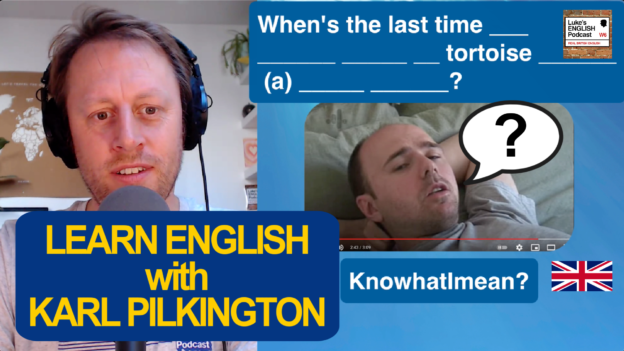
Understand English as it is spoken by native speakers. Let’s listen to Karl Pilkington rambling about life, the universe & everything, and see what we can understand and learn. Karl is from Manchester, so we’ll be looking at some features of his accent, picking up plenty of vocabulary and having a bit of a laugh along the way.
Welcome back to the podcast. How are you doing today?
In this episode we’re going to do some intensive listening and use it as a chance to learn some vocabulary and pronunciation.
This episode should be a bit of a laugh as we’re going to take a deep dive into the world of Karl Pilkington and listen to his thoughts on some big issues like health, food, animals, holidays and just existence itself.
We’ll be looking at the different features of his Manchester accent, and there will be lots of vocabulary to pick up too as we are covering a range of different topics. You can also consider this as a little intensive listening test, as I will be setting questions that you have to find answers to, then going through each clip in detail and breaking it all down for language.
We last heard about Karl Pilkington on my podcast in episode 656 in which we listened to a couple of his Monkey News stories about a chimp that works on a building site and another chimp that pilots a space rocket.
Do you remember that? If you don’t, then get the LEP app and listen to episode 656. It was a very popular episode and it should make you laugh out loud on a bus maybe.
That was pretty funny stuff, and Karl is very funny even though he’s not actually a comedian.
Who is Karl Pilkington?
To be honest, Karl Pilkington was most well-known about 10 years ago and these days he’s not in the public eye as much as he used to be, but he’s still a fairly well-known person in the UK, especially for Ricky Gervais fans.
Karl is just an ordinary bloke from Manchester who met comedians Ricky Gervais and Stephen Merchant when he worked for them as a radio producer in London.
Later, Ricky invited Karl to be on his podcast in order to broadcast his weird ideas and inane ramblings to the whole world, and the rest is history.
The Ricky Gervais Podcast became a world record-breaker with over 300,000,000 downloads.
In episodes, Ricky, Steve & Karl would talk about big topics like religion, evolution, philosophy, nature, birth and death and Karl would often say some bizarre and hilarious things, apparently without intending to be funny.
Ricky was always slightly obsessed with Karl, and he always described him as “an idiot with a perfectly round head like an orange”.
After being on Ricky’s podcast, Karl went on to become a fairly well-known figure in the UK, doing more podcasts with Ricky, then TV shows, books and documentaries like “An Idiot Abroad”.
Karl is known for his funny and slightly odd musings and observations about life.
He comes from a working class background in the Manchester area, and his accent has many of the features that you would expect from that.
Accent / Pronunciation
We will be going into the specific features of his accent in more detail as we go and this kind of follows on from episode 682 which was all about common features of pronunciation in England which are different to RP.
Which accent should you have?
So this episode is about one of the UK’s regional accents.
You might be thinking – Luke, by doing this episode are you saying that we should all learn to speak like Karl?
I’m not saying that. You can choose your accent, and many learners choose a neutral accent to learn, but it’s not all about learning an accent, it’s also about learning to understand different accents, and learning about the varieties of English that are out there.
So, you might not want to speak like Karl, but I certainly want you to understand Karl and the many millions of other people who speak English in a non-standard way.
So this episode is all about understanding an accent, rather than copying it. But of course you can copy Karl’s Mancunian accent if you like.
Vocabulary
There will also be plenty of vocabulary coming up too as we pick apart the things that Karl says and the way he says them.
You’ll find it listed on the screen on the video version and also presented in text form on the page for this episode on my website.
Video
We’re going to be using a series available on youtube in which Karl ponders certain big questions in just 3 minutes of video, originally broadcast on Channel 4 in the UK as part of their “3 Minute Wonders” series.
These are short videos in which Karl talks about his fridge, health, food, animals and holidays, covering each topic with his usual ramblings, all delivered in that Manchester accent, know what I mean?
I have about 6 recordings, which are about 3 minutes each (this could become two episodes).
Before I play the recording I’ll give you a little bit of context and I’ll set some questions.
Then you listen and try to get the answers.
Then I’ll break it down – listening to each bit again, with some explanations if necessary.
We’ll also pay attention to pronunciation – specifically his Mancunian accent. I’m going to break that down too, exploring the main features of that particular accent.
And I’ll sum up some of the vocab from each clip before moving on to the next one.
#1 Karl on Life
Karl goes around a museum looking at meteorites, dinosaur skeletons and endangered animals (stuffed ones or models) and muses about life in general medical science.
What does Karl wonder about the big bang?
What makes the meteorite room a bit disappointing?
What’s Karl’s main criticism of humanity today?
What does Karl think would happen if a dinosaur got loose and started to “run riot”?
What’s Karl’s main point?
Vocabulary
The big bang
Did it only seem big because there was no other noise to drown it out at the time?
Meteorites (on earth)
Meteors (flying in earth’s atmosphere)
Asteroids (flying in space)
The edge is taken off it because that isn’t the only one.
I’m not surprised they went extinct, they’re all in here.
Enough’s enough. If your body is that done in, call it a day.
The more we know, the more we interfere.
Don’t interfere with nature and that.
Even if it was going round running riot they’d go “We don’t want it to go extinct”
The panda is dying out.
Notes on Karl’s accent
Here’s a summary of the main points regarding Karl’s Manchester accent.
Many of these features are common in people from the Manchester area, although not all people from Manchester will speak like this, and there are different degrees of it.
This is certainly Karl’s Manchester accent in any case.
A lot of what I’m about to say will include things brought up in the episode I did about Key Features of English accents, episode 682.
PRONUNCIATION #1
H dropping
Look, how many do you need?
I’m not surprised they went extinct, they’re all in here.
She’d had a new lung, a new heart
He puts his hand in and goes “Yep, it’s broke”
They weren’t doing anything. They weren’t jumping through hoops. (talking about animals in a zoo)
I don’t know if it’s cruel or not, to have them in there.
I’m 32, I think I’ve got the hang of it.
Glottal stops (/t/ sounds get replaced by /ʔ/ )
I’ll have a look at the meteorites.
If you’re going to eat a live animal, don’t eat one that’s got eight arms that can get hold of your neck.
Let me see them again when they’re better.
Go back to my episode called 682. Features of English Accents, Explained to find out more about glottal stops.
#2 Karl on Health
Karl recounts a conversation he had with a woman about going to the gym.
Does Karl go to the gym?
What does he think of the idea of breathing classes?
What does he think of drinking 7 pints of water a day?
What’s Karl’s argument for not going to the gym? Heart beats, tortoise
Vocabulary
I know what’s probably putting you off – the fact that it’s hard work.
Breathing classes – I’m 32 I think I’ve got the hang of it.
My Dad’s like 60-odd. I’ve never seen him drink a pint of water, yet they’re telling us we should have, like, 7 pints a day or something, and then they wonder why there’s a water drought on.
They keep coming up withdaft ways of keeping fit.
Chucking paint at each other.
PRONUNCIATION #2
/æ/ not /ɑː/ (the “bath/trap split”, again)
Short A sound /æ/ in bath, podcast
(gas and glass have the same vowel sound in Karl’s Manchester accent).
This is normal across all northern accents, and many accents in the midlands. I would use /ɑː/ because although I lived in the midlands for many years (half my childhood), my accent is mostly from the south because I’ve lived there more and my parents don’t have strong regional accents.
Come to my class. We do breathing classes.
/ʊ/ not /ʌ/
The U sound in but, enough and much.
I pronounce it /ʌ/ but Karl pronounces it more like /ʊ/
Do you go to the gym much?
#3 Karl on Food
Karl talks about a new trend – eating things which shouldn’t be eaten.
Coming from England, Karl thinks it’s weird to eat certain things that might be eaten in other cultures, like live octopus, insects, frogs, snails, probably raw meat, raw fish and sushi.
What is the danger of eating a live octopus?
What’s Karl’s issue with kids and food today?
What does Karl think about eating dog?
Vocabulary
They choke you. Why would you want to eat that?
If we’re eating octopuses, why are dogs getting away with it?
Talking to English teacher Ray Addam from Glasgow in Scotland about mental factors in learning English, such as anxiety, confidence, stress and motivation. Video version available on YouTube.
This is a swapcast between LEP and English with Ray, which means we are both uploading this to our podcasts/youtube channels.
Ray is an English teacher from Glasgow in Scotland (and you’ll be able to notice his accent, which is not the strongest Glaswegian accent I’ve ever heard but it’s definitely noticeable – which is great, because I love Scottish accents). Ray has recently started making videos on YouTube for learners of English.
One of his students – Ivan (from Russia I think) who is also a LEPster, suggested to Ray that he start doing that and that he also contact me for an interview, so that’s what you’re going to listen to or watch here. This is Ray Addam interviewing me for his channel.
This is a fairly relaxed and free-ranging conversation, and after chatting a bit about playing music and performing in front of people, we ended up talking about the psychology of learning English, particularly how to manage anxiety or nerves when using English in stressful situations, and then our comments about how to work on your confidence and how to have the right mental approach to learning a language, which is one of the most important steps to take.
So listen on for some comments and tips about how to manage your stress levels in English, how to become more confident in English and how to take control of your communication skills in general.
Thanks to Ray for sending this recording to me. You might want to check out his channel on YouTube, which is called English with Ray. He only has a few videos there at the moment, but everyone’s got to start somewhere. I’ve noticed that Ray also speaks fluent Arabic so any Arabic speaking LEPsters might be particularly interested in Ray’s content as he might have some insights into differences between Arabic and English. I haven’t actually asked him about that yet, but maybe it’s something he could work on in a future video.
Anyway, that’s it for this introduction and I will now let you listen to this conversation with Ray Addam, firstly about playing music in front of audiences of people, and then about the challenges of managing your confidence when using English in stressful situations. I will probably speak to you again briefly at the end of this chat, but for now, let’s get started.
Links for Ray
Take online English lessons with Ray Addam on Preply https://preply.com/en/tutor/447455/
English with Ray on YouTube https://www.youtube.com/c/EnglishWithRay/featured
Song (audio version only) – “Questionnaire” by The Rutles https://genius.com/The-rutles-questionnaire-lyrics
Talking to my dad about the latest in the Brexit saga, including the current fuel crisis due to lack of lorry drivers and other problems which were predicted in the run up to the Brexit referendum in 2016. Video version available on YouTube and below.
This is The Rick Thompson Report, where I talk to my dad about politics, news, current affairs – which almost always means an update to the ongoing Brexit saga.
What’s going on in the UK at the moment? How is Brexit going? Remember before the referendum when predictions were made by experts who recommended that Brexit was a bad idea – do you remember any of the predictions? They were labelled by the pro-Brexit camp as “Project Fear” suggesting that critics of Brexit were just trying to make everyone scared about leaving the EU but it was all baseless and everything was going to be wonderful in a very non-specific way. Well, we are now getting to a stage where we can see if those predictions are coming true or not?
So, how long has the UK actually been out of the EU now? How’s it going?
Talking to author Natasha V Broodie who has written a book which aims to help learners of English understand the subtle codes of polite language when making requests and giving information in professional and personal contexts. In the conversation we explore the topic and consider some tips for making your language more culturally appropriate.
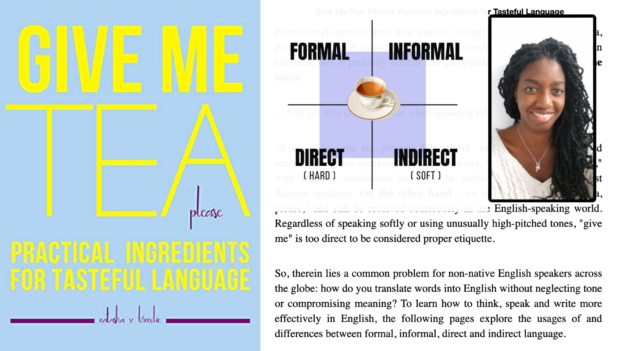
In this episode I am talking to author Natasha V Broodie who has written a book which aims to help learners of English to find the right tone in their speaking and writing. Tone is something which is very much affected by culture and often relates to things like being direct, indirect, formal, informal, the use of modal verbs and phrasal verbs and so on. In English the general tone is often quite friendly, indirect and polite, and this can sometimes cause problems for English speakers coming from different places where codes of politeness or professionalism are different.
Natasha has worked as an English teacher and has also worked in international contexts for the UN and so she has direct experience of observing people communicating in English and not quite getting the tone right.
So in her book, “Give me tea, please. Practical Ingredients for Tasteful Language” she lays out a sort of style guide with theory, practical tips and a glossary of defined vocabulary at the back.
It sounds like an interesting book which could be a worthwhile read for my listeners, so I thought it would be good to chat with Natasha a little bit and explore some of the ideas presented in her book.
“Give me tea, please” is currently available on Amazon but from 24 September should be available from all other providers too.
Right, so now you know what sort of thing we’re going to be talking about, let’s meet Natasha Broodie and find out some of those practical tips for tasteful language.
So that was Natasha V Broodie, talking about her book Give me tea, please – available from all good bookstores. Go ahead and pick up a copy and if you like it, leave a review on Amazon.
Thanks again to Natasha for her contribution in this episode.
A Short Ramble
T-shirts Design comp – link here for details https://teacherluke.co.uk/2021/09/22/742-new-lep-t-shirts-merch-lep-design-competition-2021-with-james/ Premium YouTube
Sneezing caused me to take a trip to tangent town…
LEP merch is now available, including t-shirts, mugs and more featuring special LEP designs made by James Thompson. Luke and James discuss the new designs and launch a new design competition to give you the chance to get your design in my merch store and a cash prize of £80.
Hello listeners, it’s nice to be talking to you on this fine morning. I’m also joined by James, my brother.
If you’ve seen me on YouTube in a t-shirt with a magnificent LEP logo on the front of it, or drinking tea from a lovely looking mug with an LEP logo on it, or perhaps writing something down on my special LEP notepad, then you might be thinking…
Where can I get one of those t-shirts? Where can I get one of those mugs?
Where do I get one of those amazing pads?
Or even: How can I get one of my designs on some LEP Merch?
Your questions are finally being answered today, because the LEP merch store is back open, and I am launching a design competition to give you the chance to get your design on an LEP t-shirt, and a special cash prize of £80!
The merch store is now open. That’s where you can get t-shirts, sweaters, mugs, stickers and loads of other things with the LEP logo on, but also there are various other new designs which you should love if you are a LEPster.
I suspect that you’re going to want more than just one of the things on offer for you today – In fact I’ve already ordered some and I am wearing one now.
In this episode I’m going to talk a little bit about the different merchandise available just to make sure it’s clear and that you understand everything.
Also in this episode I am launching a design competition – this is your chance to have your design on an official LEP t-shirt. Not only that, but there are cash prizes available too for the winners. I will explain more later.
My brother James is the one who did all the design work to produce the various images which are available across a range of products, so he is joining me for this one.
We’re going to talk about each design one by one, I’ll give you a little tour of the store to make sure you can use it properly, I will give you the full details of the LEP Design competition and then we’re going to open things out to have a larger conversation about merchandising and stories related to that.
I opened this store so Chinese & Russian LEPsters could buy merch too. The website is simple enough. It shows t-shirts in the thumbnail pictures, but check the list on the left to see all available products.
Various types of t-shirt are available.
RedBubble doesn’t do double sided t-shirts.
Avoid buying dark designs on a dark colour t-shirt (although personally I think an LEP Ninja design on a black tri-blend t-shirt looks really cool)
Let me know what other ideas or changes you’d like to make to the store, and I will see what I can do. So, if you have any other design ideas, or suggestions for things you’d like to see in the store, or changes you’d like to make – let me know. luketeacher@hotmail.com
LEP DESIGN COMPETITION 2021
We are looking for cool t-shirt designs by LEPsters, for the LEP Merch Store.
Think of a t-shirt that LEPsters would want to wear
PRIZE: The winning design will be put on t-shirts, mugs and other merch, and the winner will also win £80!
SPECS: A high-resolution transparent .PNG at 150dpi. Minimum dimensions of at least 1500px by 1995px (not including outer transparent pixels).
CLOSING DATE: 22 October 2021
Send your t-shirt designs to podcastcomp@gmail.com
James and I will consider all designs which are sent to me, and a selection of designs will be displayed on the website so you can leave your comments. James and I will also discuss them in a podcast episode.
Ultimately, James and I are the judges and we make the final choice on the winner(s).
Learn English from some jokes in this episode as we go through 9 jokes chosen as the best of the Edinburgh Festival Fringe stand up comedy scene this year (2021). Let me tell you the jokes, see if you understand them, and then I will break them down for language learning opportunities. Video version available.
Hello listeners, hello video viewers. How are you? How is the world treating you today? Not too badly I hope.
Here’s a new episode. So stick with me. Listen closely. Pay attention. You can definitely learn some new English from this. Let’s get started.
Introduction
It’s time to dissect the frog again as we look at some of the most popular jokes from the Edinburgh Festival Fringe of this year 2021. I’m going to read them to you and then explain them so you can understand them fully and also learn some new vocabulary in the process.
This is something I’ve been doing every year at the end of the Ediburgh Festival when the list of the most popular jokes is published in the newspapers.
Last year I didn’t do one of these episodes because Ed Fringe got cancelled due to Covid-19.
But the festival was back this year, so here we go again. Let’s find some popular jokes told by comedians at the fringe and use them to learn English.
Edinburgh Festival Fringe
Just in case you don’t know, the Edinburgh Fringe (full name: The Edinburgh Festival Fringe) is a huge comedy festival that happens every August in Edinburgh, the capital city of Scotland.
Sometimes it’s called The Edinburgh Festival Fringe, Edinburgh Fringe, The Edinburgh Comedy Festival, Ed Fringe, just The Fringe or simply Edinburgh.
It’s one of the biggest comedy festivals in the world, and every August comedians travel to the city in order to perform comedy to the large crowds of people who travel there.
For comedians August in Edinburgh is a huge opportunity to get exposure and experience, but it is very tough, especially at the beginning when you have to drum up an audience of people to come to your shows every day.
Just in case you didn’t know, stand-up is a form of entertainment that involves one comedian standing on stage with a microphone telling stories and jokes in an effort to make the audience laugh. It is an extremely popular form of entertainment in the English speaking world.
This episode is about specific jokes told by comedians during the fringe this year, but stand-up comedians don’t really just go up and tell individual jokes one after the other (except in the case of some specific comedians), rather they fit their jokes into stories, observations about the world or confessions about themselves.
However, this list of the “best jokes from the fringe” just picks simple one or two line jokes from people’s performances.
Lower Your Expectations Now😅
I expect that taking these jokes away from their original performances will not help the jokes.
They will probably be less funny outside the comedy show that they came from because we’re going to remove the context of the joke, the attitude and personality of the comedian who told the joke and what was happening in the room that particular evening. All those elements have a huge impact on how funny the joke will be.
So, it’s not very fair to judge these jokes on their own like this, outside of their original context, but this is still an interesting experiment in learning English, so here we go.
Here’s how we’re going to do this
First I will read each joke one by one.
There are 9 jokes in total.
How many jokes do you “get”?
If you “get” a joke, it means you understand why it is funny.
Ideally you will laugh, but you can also groan.
If you don’t understand it you need to say “I don’t get it!”
The main thing is: You have to notice and acknowledge that a joke has been told to you.
So, listen to the jokes, do you get them all?
Then I will go through each joke one by one and I will break them all down, explaining exactly how they work, showing you double meanings, explaining any specific vocabulary or cultural reference points and giving you all the information you need to be able to understand these jokes properly.
There is a lot of vocabulary to be learned from this, which I will highlight as we go through and recap at the end.
So, get ready, it’s time to dissect the frog again.
Of course, I have to say the quote:
Explaining a joke is like dissecting a frog. You can learn something from it, but the frog dies in the process.
I expect I will be killing all these jokes by explaining them.
You’re not meant to explain jokes, and if you do, the joke suddenly becomes less funny.
Most jokes work by surprise.
Getting the double meaning instantly is usually the only way to find a joke funny.
So I can’t guarantee that you will laugh at these jokes, but this is certainly going to be good for your English in any case.
Joke types
A lot of these jokes use
synonyms (different words with a similar meaning),
common fixed expressions and sayings
homophones (different words that sound the same)
similies (finding similarities between otherwise different things),
pull back & reveal (revealing extra information to change the situation)
Top Jokes from Edinburgh Fringe 2021
I’m getting this list from the website Chortle.co.uk which is the UK’s number 1 comedy website.
1. “I thought the word ‘Caesarean’ began with the letter ‘S’ but when I looked in the dictionary, it was in the ‘C’ section.”
– Masai Graham
2. “My therapist told me, ‘A problem shared, is a hundred quid’.” – Ivor Dembina
3. “Me and my ex were into role play. I’d pretend to be James Bond and she’d pretend she still loved me.”
-Tom Mayhew
4. “The roman emperor’s wife hates playing hide and seek because wherever she goes Julius Caesar.”
– Adele Cliff
5. “Marvin Gaye used to keep a sheep in my vineyard. He’d herd it through the grapevine.”
– Leo Kearse
6 “My grandparents were married for forty years, but everything took longer back then.”
– Will Mars
7. “I think Chewbacca is French because he understands English but refuses to speak it.”
– Sameer Katz
8. “I don’t know what you call a small spillage from a pen but I have an inkling.”
– Rich Pulsford
9. “People say zoos are inhumane. But that’s because they’re for animals.”
– Sameer Katz
Vocabulary Focus
Now let’s go through those jokes again and break them down so you can understand them fully, picking up bits of vocabulary along the way.
Broken down versions (sorry frogs)
1. “I thought the word ‘Caesarean’ began with the letter ‘S’ but when I looked in the dictionary, it was in the ‘C’ section.”
– Masai Graham
Vocabulary
A caesarean
A C-section
2. “My therapist told me, ‘A problem shared, is a hundred quid’.” – Ivor Dembina
Vocabulary
Common phrase: “A problem shared is a problem halved.”
Quid
Halved (verb)
3. “Me and my ex were into role play. I’d pretend to be James Bond and she’d pretend she still loved me.” – Tom Mayhew
Vocabulary
To be into role play
Role play – pretending to be someone else, often during sex to make it more interesting.
To pretend to be someone / to do something
He pretended he was James Bond
She pretended she still loved him.
4. “The Roman emperor’s wife hates playing hide and seek because wherever she goes Julius Caesar.” – Adele Cliff
This is a pun – a word joke and it’s just that one thing sounds like something else.
“Julius Caesar” sounds like Julius sees her, which is why his wife hates playing hide and seek because Julius always sees her. Julius Caesar. I think you get it.
Vocabulary
To play hide and seek
5. “Marvin Gaye used to keep a sheep in my vineyard. He’d herd it through the grapevine.” – Leo Kearse
Oooh, this is a bit of a groaner. That’s where you go Oooooh like it almost hurts.
“Heard it through the grapevine” is one of Marvin Gaye’s most famous songs.
“Herd” can mean to move a group of animals in a certain direction, like sheep or cows. You herd your sheep into a field.
Marvin used to keep a sheep in my vineyard. A vineyard is a place where you grow grapes for wine.
The grapevine is where the grapes grow, but there’s also an idiom “through the grapevine” meaning when you hear people gossiping about something, or you over hear people talking about something.
In the case of the song, he hears that his girlfriend is cheating on him and he hears it through the grapevine.
He heard it through the grapevine. He heard rumours or gossip about it.
He’d herd it through the grapevine. He attempted to move the sheep around through the grapevines of the plants in the vineyard.
Vocabulary
To herd sheep
To hear something on/through the grapevine
Vinyard
This is too much of a stretch and if you get the joke please let me know. Write a comment in the comment section – do you get the Marvin Gaye joke?
6. “My grandparents were married for forty years, but everything took longer back then.” – Will Mars
This is quite a clever little joke. Everything took longer in the past – travelling, communicating etc.
Marriages seemed to last longer, but everything took longer back then.
7. “I think Chewbacca is French because he understands English but refuses to speak it.” – Sameer Katz
This is quite funny and of course it hits two of my favourite notes, well three in fact: Star Wars, France and speaking English.
There is a common misconception that French people arrogantly refuse to speak English in Paris let’s say,
but I find that French people are more willing to speak English than it seems, and in fact they’re a bit more shy than arrogant, and if a French person in Paris speaks French to you, that’s quite normal as you are in France.
Also, rather than being arrogant, a lot of French people just feel quite self conscious about their accent and certain common mistakes that French people often make. They also might have bad memories from English lessons at school which knocked all the confidence out of them, and they’re afraid to be judged by each other. So it’s more likely to be shyness than arrogance.
8. “I don’t know what you call a small spillage from a pen but I have an inkling.” – Rich Pulsford
This is a clever little joke.
To have an inkling means to have a suspicion or an idea of something.
“I don’t know who stole the last biscuit, but I have an inkling. Or I have an inkling of an idea who took that biscuit, and I think it was you!”
But an inkling does sound like a small spillage of ink from a pen. A small puddle of ink, or ink on your hand. An inkling.
What do we call that? I don’t know, but I have an inkling!”
Vocabulary
To have an inkling
A spillage
9. “People say zoos are inhumane. But that’s because they’re for animals.” – Sameer Katz
I’m not sure I have to explain that, do I?
Being humane means treating people in reasonable and humanistic manner.
Treating people with respect, dignity, justice.
Inhumane is the opposite – and although it includes the word human, we do use this word to refer to the cruel treatment of animals.
Keeping animals in a cage is inhumane.
Even though they’re animals, we still use the word inhumane, and this is just a funny little thing that can make you laugh when you notice it.
Talking to English teacher Matt Halsdorff about a project to train native English speakers how to communicate better with non-natives. We talk about the reasons why native speakers are often bad at communicating with non-natives, what they should do to fix this and the wider issues relating to this project. Video version available.
Hello listeners and video viewers, how are you doing today?
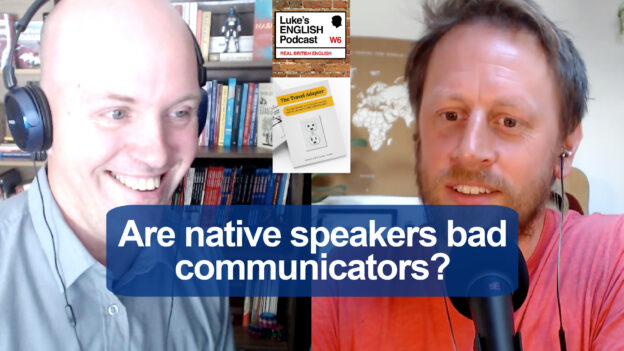
In this episode you’re going to listen to me in conversation with Matt Halsdorff who is an English teacher with many years of teaching experience, and we’re going to be discussing the question of whether native English speakers are in fact the worst communicators in an international English environment.
Matt is currently working on a project with Christian Saunders from Canguro English. I think the project sounds really interesting and raises a few good questions about how native speakers of English and non-native speakers communicate with each other, what non-natives really struggle with in this language, and whether native speakers can do anything to help.
If you saw my latest video interview with Christian from Canguro English and you watched until the end you might remember us discussing this project briefly. If you remember, Christian mentioned a training course in communication in English – but the twist is that it’s for native speakers – more specifically it is for native English speakers who need to communicate internationally.
Because, It’s not just learners of English who need training in this language. Apparently – It’s native speakers too.
English is a global language, and everyone is using it for business and also for travel purposes. Everyone needs to use this language to communicate successfully so the world can continue spinning.
Everyone uses English, and everyone has to work on the way they use it, in the same way that we all have to work on our email writing and IT skills to make them as efficient and effective as possible.
As a non-native speaker of English, of course you’ve got to work on the entire system – you need vocabulary, you need correct grammar, you need clear pronunciation, fluency, confidence and so on – obviously, that’s what’s involved in trying to use another language.
You learn as you go and try to do your best and you almost certainly feel a great deal of responsibility, pressure, and challenge when communicating in English. You are probably keenly aware of your performance in English and sensitive about any kind of failure in communication and how that might be your fault.
But do native speakers share a similar sense of responsibility?
In fact here are a number of other questions which arise when thinking about this topic.
Do native English speakers do all they can in international situations to make sure they are understood clearly, just like everyone else does?
Are native speakers aware of what it is like to operate in a second language?
Might there be other reasons why native English speakers don’t adapt the way they speak in order to improve shared communication?
Who is responsible for the success of any act of communication? Just one side, or both?
Should native speakers adapt their English? Or is it up to the non-natives to do all the heavy lifting in this situation?
And if native speakers should adapt their English, how should they do it?
What kind of English should they avoid and what kind is likely to be the most successful?
And what about other considerations and questions, such as what happens to the English language when it is being adapted in this way?
Well, I am interviewing Matt today in order to discuss these things and find out about this project in general. First we’re just going to take a few minutes to get to know him, and then we’re going to dive into this training project for native speakers, which is called The Travel Adaptor by the way. We’re going to find out about the project, about what native speakers do and say which can be so confusing, how native speakers can facilitate communication with non-natives, and the wider issue of global English and successful international communication.
As well as getting into the specifics of this conversation, you can certainly learn about some of the major obstacles that non-native speakers have when understanding natives.
So there’s plenty to pick up from this. There is a YouTube version too just in case you need to see our faces as well as listen to us.
Well, that was Matt Halsdorff talking about The Travel Adapter – a training course for native-speakers of English, to help them communicate better globally.
So, what do you think? I’m very keen to read your comments and I am sure you had things popping into your head during this conversation. Why not express them in English here in the comment section?
Do you have experiences of communicating with native speakers in English? What was it like? Did they adapt their speech? What was difficult?
Do you think native speakers should adapt their speech when talking to non-natives, or not? Why?
But that’s it for now. Thank you for listening and I will speak to you again soon. I’ve got a little announcement coming in the next few weeks that’s pretty cool, plus the usual free episodes and premium episodes on their way as usual.
Speak to you soon, but for now – goodbye bye bye bye bye bye bye!
Reading a short story presented on Commaful.com. The Escaped Man is a mystery full of tension and intrigue. Listen closely as I break it all down and explain the vocabulary fully. YouTube video version also available.
It’s time to do another story on the podcast. This time I’m going to be reading a story called The Escaped Man which was written by CT Platt and is presented on the Commaful website.
Commaful.com is a website where you can find short stories, fan fiction and other reading texts and it’s all presented in quite a nice and easy-to-read format.
I’m going to read the story to you once and all you have to do is follow it, and hopefully enjoy it. I have a couple of questions for you to help you stay focused on your listening.
Then I’ll read through the story again and break it down line by line, explaining, pointing out and teaching you bits of vocabulary and grammar as I go.
Learning English through stories is a great idea and tends to work because it places language in a vivid context and is generally quite entertaining and fun.
So listen to the story and then let me break all the language down for you bit by bit.
Just before I read the story, here are a couple of questions for you.
Where does the story take place? How do you know? Is this American English or British English? How do you know? What is going to happen next?
Chatting to my family about some old anecdotes and stories from the past. Listen for some enjoyable chat, memories, descriptions and tales from days gone by.
In this episode I am happy to present to you a conversation with my mum, dad and brother all about old family stories and anecdotes from the past.
The episode is called Do you remember…? And that’s the title of the activity I chose for this episode. The idea is that we could generate some stories about things that happened in the past and you can follow along and see if you can pick up some English in the process, or simply enjoy a bit of storytelling on the podcast.
So you’re going to hear stories of little accidents, moments when James and I got into trouble, learning to drive and failed driving tests, how my parents first met each other and how my bottom lip was always left trembling at the end of every story.
We recorded this in my parents’ living room, sitting around after dinner and if you like you can imagine that you’re there too, listening into the conversation – not taking part though. For some reason you’re not allowed to speak, you can only listen like a weird audience in our living room just lurking in the background. Anyway, you can imagine that you’re there if you like, if it helps you to tune into the conversation and follow along more easily.
I will now leave you to enjoy this relaxed conversation, follow the stories and little jokes and I will speak to you again at the end of this episode.
Ending Transcript
So, that was my family, recorded in the living room recently while I was on holiday in England. I hope you enjoyed that.
Apologies if we repeated any stories you had heard before (perhaps all of them?) but then again it can be really helpful to hear the same stories over and over when learning English. You could even try to tell the stories yourself, and then compare your story to the recorded version.
If you want other, similar episodes from the archive, check out these ones.
79. Family Arguments & Debates (Debating things like language and politics)
But for now I will leave you to go back to your life, unless you choose to listen to another episode which you will find in the archive.
Don’t forget to check out LEP Premium. P31 parts 4,5, 6 are on their way and may have already been published by the time you listen to this.
But in the meantime, be excellent to each other, have a lovely day, morning, afternoon, evening or night and I will chat to you later but now it’s just time to say good bye bye bye bye bye.
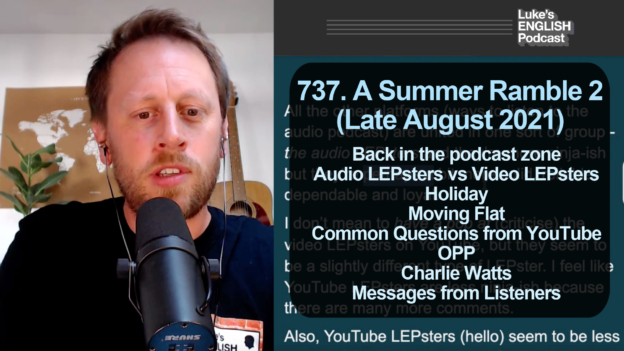
I’m back in the podcast-zone after my holiday so I thought I would do another rambling episode before getting down to work on other content to be released soon. Video version also available.
This is episode 735 and it is a rambling episode, which means it’s just me talking to you about various things – including: whatever comes into my head while I’m recording, but specifically this time I’m aiming to talk about
Being back from holiday and getting back into the podcast zone
Comments about my audio listeners and my video viewers on YouTube
News about moving flat and moving to my new pod room (You can see that the move hasn’t started yet and so the podcast has not been disrupted yet)
Some common questions from the YouTube comment section (new listeners)
Charlie Watts – the drummer from the Rolling Stones who passed away yesterday
A couple of comments from the comment section including one very motivational email I got from a long-term listener
Whatever else occurs to me as we record this!
As well as being available as a normal episode of the audio podcast, this is also available on YouTube with some text on the screen – the notes and scripts that I’m reading from, so you can read along with me and spot certain phrases and spelling and so on.
By the way – you can always pause this and check the screen if you feel you didn’t understand something or you found a new word or phrase.
I’m reading from a script / notes
In this episode I’m reading from a script which I wrote last night. I don’t normally read from a pre-written script when I do these rambles, but this time is different.
I wrote most of this script last night, when it wasn’t really the right time to do a podcast recording, but I still consider this to be a rambling episode because I just rambled with my fingers last night and now I’m just reading out the text-ramble that I created, so it still counts as rambling as far as I’m concerned, and I of course I can deviate from the script/notes whenever I want.
So stick with me and I hope you enjoy listening to my words as they flow out like endless rain into a paper cup – a cup which you can take and drink from, metaphorically of course.
Drink my English – that’s what I’m saying. I hope you know what I mean!
In the podcast zone (this is what I wrote last night)
I’m sitting here in front of the computer. My wife is lying across the sofa watching a French TV show on her phone and she’s under a nice sheepskin blanket that we have so she is feeling very cosy. I’ve just made her a cup of mint tea and I’ve tucked her feet into a blanket because I’m such a great guy and a really wonderful husband.
The child is in bed asleep, and despite the madness that is going in on the world outside, this is a little moment of peace and quiet.
Now I’m sitting with my computer on my lap, but I’m pretty much in the podcast zone right now – meaning, that I’m thinking of ideas for the podcast, considering what I’ve been doing and what I should do next. I know I should be able to record tomorrow as the little one is going to her French grandparents for a few days and my wife has work to do, so tomorrow is podcast day.
But I’m in the podcast zone now because I’m thinking about podcast ideas and things to record tomorrow. I’m just writing down my thoughts on my computer as they come into my head. I’m trying to write down every thing I’m thinking in order to make sure this is actually a rambling episode. I’m rambling everything down in text form here and I’m trying to make it sound like I am actually speaking normally and not reading from a text.
What I’ll have to do tomorrow is record this but make it sound like I’m just saying it all off the top of my head.
Also I might just go off on a tangent at any point and deviate from the script, if something occurs to me.
In fact, what I’m going to do is, the word-for-word script for this is going to stop soon and I’m going to just write down some basic notes and then expand on them as I talk into the microphone tomorrow (which is actually today – so, tomorrow is now, so, are we in the past, the present or the future? I think I might have just invented time travel. These words are from yesterday, but I’m reading them now and you’re going to listen to them in the future – let’s just say that in podcastland, time is a sort of flexible thing a bit like a jelly or something.
Yep, in LEPland, time is jelly – which might explain why my episodes are quite long sometimes.
In any case, I would like to record this episode tomorrow as a kind of welcome back before embarking on things like premium content and other episodes I’ve been planning.
I do have other episodes I’d like to do and tbh while I was away on holiday over the last 3 weeks or so I was itching to get back to podcasting.
I had lots of ideas popping into my head which I couldn’t quite hold onto and as I didn’t get the chance to write them down, they’ve all disappeared into the ether – little ideas, comments, stories that occurred to me at various moments, like when I’m in the shower but which I almost instantly forgot – so I was quite keen to do some recording again after being away just to satisfy the compulsive podcasting side of me.
The holiday was fantastic and one of the best ones we have had for ages. I’ll tell you about it a bit later in this episode.
Those other episodes I could be doing right now:
P31 parts 4,5,6
Learn English from my mum as we look at phrases which came up in our conversation in episode 717 – learn them properly with loads of examples and the chance to do plenty of listen and repeat pronunciation work with me so you don’t just learn new language, but learn how to produce it too.
War of the Worlds part 4 (conclusion?)
88 English expressions that will confuse everyone! (remember that? I never finished it)
More stories like The Mountain
Reading from more texts or books
An episode with The Thompsons which I recorded when I was in England
Some invitations to other podcasters/English teachers who have interviewed me recently
Top 10 Jokes from the Edinburgh Fringe 2021
And I have a big list of other ideas which I am slowly working my way through.
But I think before I do those ones and perhaps some others, I’d like to just do this rambling episode with you.
These rambling episodes are where I just talk to you directly and move from topic to topic almost making it all up as I go along.
So just keep up with me, follow along and let the words flow through you like the force in Star Wars.
Feel the English, let it flow through you.
Be the English.
Imagine blue lazers and Star Wars / The Matrix type stuff.
Be one with the living English and listen with me as I chat to you about various things.
Audio listeners / Video Viewers (LEP is an audio podcast, with some videos on YouTube)
Most people listening to this – the vast majority listening to my words right now are listening to my podcast on their phone probably with headphones on, using a podcasting app of some sort, probably the native Apple Podcasts app on the iPhone or something like Spotify or another podcasting app, or perhaps you are listening on the LEP App.
Most people listen to the audio version of this – and I’m saying this now because I’m also recording a video version of this on YouTube and I feel like YouTube is a pretty different audience.
All the other platforms (ways to listen to the audio podcast) are united in one sort of group – the audio LEPsters and they’re more ninja-ish but they’re perhaps a bit more solid, reliable, dependable and loyal.
I don’t mean to have a pop at (criticise) the video LEPsters on YouTube, but they seem to be a slightly different type of LEPster. I feel like YouTube LEPsters are less ninja-ish because there are many more comments.
Also, YouTube LEPsters (hello) seem to be less aware of the back catalogue of episodes, and I get a lot of people who have never heard the podcast ever before. (shocking, I know)
But YouTube has enormous potential to go viral. In fact, in a way it’s like swimming in the deep ocean and you could catch a current and get into the very deep water.
I mean, most episodes on YouTube get less attention than the audio versions, but then some videos go viral as they get picked up by the algorithm which is responding to the way people interact with your video and I guess that the algorithm sort of picks up on videos which are popular and promote them, as a way to always present the best content on the platform.
So a couple of my recent videos went a bit viral (not a lot but a bit), which was nice.
So – YouTube LEPsters – here, let me just have a word for a moment.
Really, this is an audio podcast that also has a youtube channel and recently I’ve been uploading more to it, but really this is still, mainly, an audio show and I have a big archive of audio episodes on my website and in my app.
Not all the episode are available on YouTube and they’re not all on Apple Podcasts, but they’re all there on my website, with episode pages for each and every single one of them and audio download links.
Go to my website teacherluke.co.uk (I know it looks like it was made in 2012) and then click EPISODES in the menu, and also in the LEP App you can get every single episode.
Most people listen to my podcast using an app on their phone and they listen when they are probably doing something else, like walking around, driving (please be careful), doing housework, doing exercise or simply breathing.
So listening to the audio version on your phone seems to be the normal way to do it.
If you listen using a podcast app on your phone, and you need to stop listening for whatever reason, the app will remember where you stopped listening and you can then carry on from that point later. So, you don’t have to listen to an episode in one single go.
The majority of my audience listen to the audio version of this and I’ve been doing the audio podcast for over 12 years now, and I have a big back catalogue of episodes and I have talked about lots of different things over the years including some things that I’m sure you’d like to hear, so check out the episode archive for the older episodes.
LEP App
My app disappeared from the Apple App store for a couple of days (I had a payment issue with Apple) and when it came back all the ratings and reviews had gone (3 years’ worth), which was annoying. Can you do me a favour (no obligation of course) and give the app a rating and a review (if you use it)?
How was your holiday?
It was great. No need to go into full detail like I have in the past, but basically we got lucky with the weather and had a really lovely time.
What about moving to your new flat and moving to a new pod-room?
Building work is being done in the new flat. I think the downstairs neighbours will want to murder us.
I probably won’t get the keys to the new pod-room until mid September, and then I’ll move in there. I’ll need to get electricity and internet connected there, and to fit a desk and some shelves, and then it’ll be the official new pod-room.
Common Questions since going viral on YT
I am going to try to answer these questions as quickly and succinctly as possible without rambling at all in fact. So in this rambling episode, here is a section with no rambling.
I hope that’s clear.
So, this is a rambling episode, with a bit where there’s no rambling.
Anyway – no rambling here, let’s just get straight to the point and keep it simple.
Common Questions from YouTube
Where are you from?
Can you do an episode about ______?
Check the episode archive on my website. There’s a chance I’ve already talked about that.
Go to the archive and do a ctrl+F search for the keywords you’re interested in.
How can I learn English by listening to your podcast?
This can really help you a lot, but it’s not the only thing you should do.
It’s also important to read a lot (find texts which are not too tricky, use fairly modern English and which you actually want to read) study a bit (use grammar, vocabulary and pronunciation teaching materials of any kind and work with them – it’s not the only thing, but it helps) do lots of speaking if you can (ideally find someone to have meaningful conversations with, perhaps a teacher or language partner who can give you some little corrections and encouragement) and write on a regular basis too (practise writing different types of text or just write a diary every day in which you express your thoughts in English – you’ve got to express yourself in English regularly in order to find your voice).
Learning English is about learning how to do something, not just learning how to understand something, and we generally get better at things by trying to do them again and again.
So listen and read a lot and try to speak and write a lot too. That’s quite general advice but there it is.
For more specific advice on how to use the podcast to improve your English, you could listen to these episodes
174, 568.
Should I listen to the episodes on order?
It’s up to you really. You can just listen to all the new ones as they come out, but if you really want to learn from me properly then I would suggest listening from episode 1.
Certainly if you are a lower level learner, the first 50-ish episodes are probably a bit easier to understand and have more specific language-teaching objectives, so it would be good to start with them.
But equally, if you just find my episodes fun and interesting you can listen to them in any order you like. Be aware though: multi-part episodes should be heard in order, and there might be little private jokes and references from earlier episodes which you might not understand (like the dreaded Russian Joke).
Can you do more story episodes?
Yes, I’m planning to do more stories.
Can you do episodes about grammar, vocabulary and pronunciation?
Consider signing up to LEP Premium for loads of episodes like that.
Can you feature ___(insert name here)___ again? (Check previous episodes)
Check the archive – a lot of my guests have been on the podcast before, especially favourites like Amber & Paul and my family. Check the archive.
Can you do video episodes every time?
Not every time, but I’ll try to do them as often as possible.
Is there a transcript for this episode?
teacherluke.co.uk
Transcripts
Episodes with transcripts
Episode archive and check
Transcript collaboration
YouTube channel – automatic subtitles
Live without subtitles – Learn to hear the spoken version of English without the aid of the written version (Although subtitles and scripts can also be a great resource, and so you should do a bit of both).
Recent appearances on other people’s podcasts
So in the last episode I mentioned:
The Level Up English Podcast
Stories of Language Learners Podcast
Since then I was also on:
English Small World Podcast (by Apex Language Consulting & Training in Taiwan) (2 episodes) apexenglishpodcast.podbean.com
The Clark and Miller English Podcast
Charlie Watts
The Rolling Stones seem to be missing a drummer and a bass player. I hear Ringo Starr and Paul McCartney are available. Imagine if they formed a Beatles/Stones supergroup at the very end of their careers?
But of course nobody could replace the people who are gone like Charlie Watts and Lennon and Harrison, but still it would be fun for the five remaining guys to get together and perform.
Actually I think they’d be an amazing band but there would be ego struggles between Jagger and McCartney for stage limelight.
Paul and Keef are great mates I believe and they used to meet up together when they both stayed in the Caribbean
and probably have a few cups of tea and have a laugh and tell stories of the old days.
So they’re pretty tight, and Ringo is friendly with everyone and still drumming.
The Rolling Beatles
Message from Lio in Brazil
Remember the WISBOLEP competition? That was awesome.
From Lio from Brasil who didn’t make it to the last 16.
Lio appears at about 2:24:00 in the Wisbolep 1 video.
The point is – there were so many people who sent really great recordings and who didn’t get through to the last 16.
I want to share this because it is a very real example of someone who has connected the learning of English to their personal life in a very human way – which means, making mistakes, acknowledging motivational issues and finally coming to terms with the fact they have to take responsibility for learning and the end result is great.
This is an excellently written email that obviously just came out of Lio without him planning it and rewriting it. He has done really well with his English, as have so many other LEPsters. This is what he wrote.
…
Lio from Brasil
I had so much fun during this competition, even though I didn’t pass the first round.
Let me tell you something, I’ve been meaning to write it for a long time..:)
You know, I need to be frank, I was sooo happy and keen to participate that, when I recorded my pitch, I wasn’t thinking about “what” I should have said, but only about “how” to say it, (very slowly and clearly).
My thought was: “I want everyone to understand me”, because I guess that there are different types of lepsters, people who just started and people who have been listening for years…
So I decided to speak that way..,I guess the result was that I made myself sound like a robot 😶
I don’t want to be too hard on myself but knowing that there is always room for progress, helps me on the journey, it tells me that I could be working even harder on my English, while at the same time having fun.
I love this language and when I was younger, it was so frustrating and tiring. You know the vibe because you’re learning French and you need it in one way or another.
As a non native speaker I knew as a child that I HAD to learn English, sooner or later.
It was only 9 years ago that I started to want to learn it…and did I start then? Of course not!!! naaa, too easy!! Let’s just procrastinate for other 5 or 6 years 😜
And so, as the story goes, in 2016 (November, I swear 😂) I started googling “learn English” online, Youtube and other websites…but I wasn’t satisfied, I was looking for something that wasn’t boring or “slow-paced”.
I desired something interesting and alive, that could help me defeat my tendency to quit learning the language.
Why? Because English represented this scary monster in my head and I had more worries than solutions at the time. So I felt the need to challenge myself and, as a beginner your podcast seemed quite advanced and not doable, I thought I couldn’t possibly succeed in understanding everything that was being said, episode after episode.
And then, at a certain point, I don’t know when or how, it just “clicked”…I think around episode 60 or 70…I suddenly realized I was understanding everything on the podcast.
At that point, after years of procrastination, failures and half attempts at learning the language, I felt like: “that’s it! I got it! Finally!”
Now, let me just tell you that I was aware of how much work I still needed (and need now)..but believe me…I cracked the code, I finally unlocked this thing, I got this! That’s how I felt…
But I need to add that, although I had finally found the resource I was looking for, I wasn’t disciplined enough for self studying and I already knew very good books (Raymond Murphy’s and collegues), but as you said so many times that I couldn’t possibly remember, you need to take responsibility for the learning process.
I really liked episode 686, you and Christian from Canguro English said a very important thing.
Sometimes people think that when one wants to learn a language, he/she simply needs to take lessons from a teacher saying: “Ok, I’m here, just fill me up with English”, so to speak..but if that was the case, how much easier things would be?
There is that film with Keanu Reeves, what was its name? Oh Yeah “Johnny Mnemonic” (1995) in which they put data inside his brain and he has to carry it, as a courier I believe.
Anyway the point is, it doesn’t work like that, us, learners, we are the ones that need to do the hard work, guided by our teachers, in the lepsters case, by you of course, 😁you’re the one who unlocks all of this.
I followed a lot of advice you gave and let me tell you… thank you, it worked wonders!
So yeah, 80% of what I know comes from here! LEP!
But there is also something I love doing as much as possible, and that’s creating my own learning bubble where I’m immersed in the language, as much as possible. Your podcast is a great way to do that ! You definitely revolutionized my English comprehension, aquisition and assimilation and I’m so thankful for that! Not only the language, but your culture too!
I remember episode 100 of Lep: “Going to the pub”, (wow, so many years ago), that’s how it felt in this journey, sitting in a pub with a friend, chatting about so many things, that was the classroom. And episode 99:” The Rotary Sushi Bar of English”, where you pick up all the different portions of English.
Let’s wrap this up, shall we? :)
Thank you for all of this! I had and I’m having so much fun with Lep and knowing that so many people are part of this community is a strong reminder that in the end we’re all from Lepland, we all share this passion for the language and, as our teacher said many times, it’s all about connection, not perfection!
P.S. Let me do it at least once …I’m certainly rushing to get to next episode…hehe ;)
Until then…bye bye byee bye bye
All the best,
Lio
HAMAD – STOP LISTENING TO LEP IN THE BATHROOM!
Hi Luke,
Hope you are doing great in these Covid-19 times.
One of your very dedicated listeners is Hamad, my husband, who annoyingly keeps listening to your podcasts in the bathroom, while showering, even when he is changing his clothes!
He keeps waking me up from my sleep during his morning “rituals”, or anytime he goes to the bathroom to do ANYTHING.
Please let him know i sent you this message, and tell him to PLEASE stop listening to your podcasts in the BATHROOM.
Sincerely, a concerned yet disturbed wife, Aysha
Thank you.
Sent from my iPhone
That’s all folks!!!
Cookies on teacherluke.co.uk
Click “Accept All”, to consent to the use of all cookies on this website, or visit "Cookie Settings" to control your consent settings.
This website uses cookies to improve your experience while you navigate through the website. Out of these, the cookies that are categorized as necessary are stored on your browser as they are essential for the working of basic functionalities of the website. We also use third-party cookies that help us analyze and understand how you use this website. These cookies will be stored in your browser only with your consent. You also have the option to opt-out of these cookies. But opting out of some of these cookies may affect your browsing experience.
Necessary cookies are absolutely essential for the website to function properly. These cookies ensure basic functionalities and security features of the website, anonymously.
Cookie
Duration
Description
cookielawinfo-checkbox-analytics
11 months
This cookie is set by GDPR Cookie Consent plugin. The cookie is used to store the user consent for the cookies in the category "Analytics".
cookielawinfo-checkbox-functional
11 months
The cookie is set by GDPR cookie consent to record the user consent for the cookies in the category "Functional".
cookielawinfo-checkbox-necessary
11 months
This cookie is set by GDPR Cookie Consent plugin. The cookies is used to store the user consent for the cookies in the category "Necessary".
cookielawinfo-checkbox-others
11 months
This cookie is set by GDPR Cookie Consent plugin. The cookie is used to store the user consent for the cookies in the category "Other.
cookielawinfo-checkbox-performance
11 months
This cookie is set by GDPR Cookie Consent plugin. The cookie is used to store the user consent for the cookies in the category "Performance".
viewed_cookie_policy
11 months
The cookie is set by the GDPR Cookie Consent plugin and is used to store whether or not user has consented to the use of cookies. It does not store any personal data.
Functional cookies help to perform certain functionalities like sharing the content of the website on social media platforms, collect feedbacks, and other third-party features.
Performance cookies are used to understand and analyze the key performance indexes of the website which helps in delivering a better user experience for the visitors.
Analytical cookies are used to understand how visitors interact with the website. These cookies help provide information on metrics the number of visitors, bounce rate, traffic source, etc.
Advertisement cookies are used to provide visitors with relevant ads and marketing campaigns. These cookies track visitors across websites and collect information to provide customized ads.