Author Archives: Luke Thompson

About Luke Thompson

I've been teaching English for over 20 years in London, Japan and France. I also do an award-winning podcast for learners of English called "Luke's English Podcast". In my free time I'm a stand-up comedian who regularly performs shows in English in Paris and sometimes London.

465. How I make episodes of the podcast (Part 2)

Talking about the technical side of making podcast episodes, including fascinating* insights about my recording equipment and an exciting** anecdote game. Includes upbeat music to absolutely guarantee*** that you will not be bored during the episode!

*insights may not actually be fascinating
**management holds no liability for any lack of excitement experienced
***not actually a legally binding guarantee


[DOWNLOAD]

Introduction

Here’s a new episode and I’m continuing to talk about how I make episodes of the podcast, and this whole thing is a response to a question sent to me by Carlos from Barcelona

In the last episode I was talking about the creative side of coming up with ideas and making them into podcast episodes. Not that I know what I’m doing really, but a few listeners have asked me about this over the years and I thought it might be interesting to answer those questions and just lift the lid on LEP and let you see how episodes are recorded.

In this one the plan is to talk about the technical side of doing the podcast.

Vocabulary

Watch out for vocabulary which will be explained in forthcoming episodes, including uses of get, technical language and other expressions.

Feedback

[socialpoll id=”2275035″]

Send me a private message with more details.

Please be constructive with your feedback! Thanks :)

← Back

Thank you for your response. ✨

464. How I make episodes of the podcast (Part 1)

Talking about the creative side of making podcast episodes, including some thoughts on how to come up with ideas and how to speak in front of an audience.


[DOWNLOAD]
Small Donate Button

Introduction

Today I’m talking all about how I make episodes of this podcast including details about the technical side (all the gear I use and how I use it) and the creative side (how I come up with ideas and make them into episodes).

I’ve also decided to make sure there’s plenty of language content in this one too. Obviously it’s all English – these are all words, you know.

But what I mean is that later I’m going to highlight certain bits of vocabulary that will come up in my descriptions, including;

  • vocabulary for talking about technical stuff like recording audio
  • some uses of the word “get”, which is one of the most commonly occurring verbs in the English language
  • and also just some other fixed expressions and bits of language I think are worth pointing out to you.

As you listen to this, you can watch out for vocabulary and try to predict which bits you think I will be explaining later.

So, even if you’re not completely married to the subject matter of this episode, you can just try to get through the bits about how I make the podcast, try to spot some vocab and then hold on until the end when you’ll hear me going through that language for you which should help you to get your head around it all.

In fact, did you notice that I’ve already used ‘get’ several times. I said ‘try to get through the bits I say about recording equipment [how I make the podcast]’ and also ‘help you get your head around it all’.

To get through something = to finish it, or pass from one end to the other. “I’ve just got to get through this work.” or “I’ve got a lot of emails to get through” or “I know it’s hard when you have depression, but don’t give up, you’ll get through it.”

To get your head around something = to understand it. It’s often used in the negative form. “I just can’t get my head around all this recording equipment.” or “I can’t get my head around this tax return. It’s a nightmare.”

So, watch out for that kind of thing – other uses of ‘get’ and more expressions, I’ll be highlighting and explaining it later.

Let’s get back to the topic of this episode: How I make episodes of Luke’s English Podcast.

Message from Carlos in Barcelona

Just to explain why I’ve chosen to do this episode, here’s a message I got not long ago from a LEPster in Spain.

Hello Luke,

My name is Carlos and I’m a listener of your Podcast. I’m from Barcelona.

First of all, I’d like to congratulate you, your podcast is excellent. It helps me to improve my English and it’s also fun. Hence, I think it’s a way of learning English without realizing that I’m actually studying it.

In addition, I’d like to suggest a topic to be talked in one of your programmes. It would be great if you told us how you record a podcast, like how you prepare it and record it and what software and hardware you use.

Well, it would be fun to know what the podcast is like. Sometimes, I wonder about the insides of it.

I hope you like my suggestion.

Yours sincerely,
J.Carlos Mena

I do get quite a lot of messages like that, from people asking me either about the technical side of the podcast making process – like what kind of gear I use, or the creative side – like, where I get the inspiration for episodes, how I come up with ideas.

I’ve been meaning to do this episode for a while now and so finally I’m glad to have actually got round to doing it at last.

OK, so let’s talk about what goes into the making of episodes of this podcast – the whole process from me starting from scratch to you listening to the podcast and, if I’m doing it correctly, you learning some English and maybe even getting the giggles on a bus somewhere while people give you weird looks, if I have managed to amuse you at all.

Listen to the episode for all the details… the expressions with ‘get’ will be explained later.

Music created at https://www.jukedeck.com/

463. News, Comments & Questions (A Rambling Episode)

Giving some news, responding to comments & questions, rambling about new shoes and getting lost in the jungle.


Small Donate Button
[DOWNLOAD]

JILMANI’S 15 DAY CHALLENGE

LEP MEETUP GROUPS

ALEXANDER GREK’S DETECTIVE NOVEL

SONG


462. British Comedy: Bill Bailey

In this episode I talk to you about one of my favourite stand up comedians from the UK. We’re going to hear some of his comedy and use it to learn English.


[DOWNLOAD]

Introduction

I’ve always been a big fan of Bill Bailey since I first saw him on telly in the 1990s, and I’m glad to say I once saw him performing stand-up in Hammersmith, which is where Bill lives and I used to live too.

Who is Bill Bailey?

Bill Bailey (born 24 February 1964) is an English comedian, musician, actor, TV and radio presenter and author. Bailey is well known for his role in the TV show Black Books in which he plays the part of Mani, and for his appearances on Never Mind the Buzzcocks, Have I Got News for You, and QI as well as his extensive stand-up work, including his DVD specials such as “Part Troll” and “Dandelion Mind”.

Bailey was listed by the Observer newspaper as one of the 50 funniest acts in British comedy in 2003. In 2007 and again in 2010, he was voted the seventh greatest stand-up comic on Channel 4’s 100 Greatest Stand-Ups.
In this episode

This episode

In this episode we’re going to listen to some of Bill’s comedy and we’re going to understand it all so that you can hopefully enjoy it as much as a native speaker. So, lots of language, lots of listening and all the usual stuff.

Obviously, your enjoyment of comedy is subjective and what’s funny to one person isn’t funny to another, but the vast majority of what goes into appreciating a comedian is being able to actually understand the things they are saying. So, don’t judge it until you fully understand it.

I hope there’s a lot for you to learn from this episode and that you also enjoy it and find out about a very funny comedian, who has a lot of videos on YouTube and DVDs that you can buy and enjoy over and over again.

Let’s talk a little bit more about Bill Bailey and then hear some of his comedy.

Here are a few little things that you should know that might help you appreciate his humour a bit more.

Bill’s Appearance
He’s got quite a funny appearance. He looks like an old hippy (even though he associates more with the punk movement) – he has boggly eyes, a bald forehead, long straggly hair, a round face. That sounds almost mean, my description, but Bill is also a lovely person, quite sort of cuddly and is amusing just to look at. He uses his appearance well, making himself look like a crazy person. It helps gain laughs I think. Inside he is a very down to earth guy with a good sense of humour.

Type of comedy
A bit weird, a bit surreal, quite cerebral and intelligent, considering the stranger aspects of life. He’s the sort of comic that some people would say was “random” – meaning he is a bit strange and tends to look at life from a different angle. He doesn’t just do ordinary observational comedy, but instead his work is full of musical parodies and existential thoughts.

Music – parodies, mixing different styles together, observations about musical tropes.

Left-wing politics – He’s a member of the Labour party and his political views come into his comedy in various ways as he tends to make fun of capitalist culture and the establishment.

Drugs – they come into it sometimes when he makes reference to weed and generally it seems that Bill has probably taken a few drugs in his time, as is evident in his surreal style and his existential musings.

Hammersmith – this is where he’s from. It’s in West London where I used to live, but Bill also grew up in the West Country – so he has a slight west country accent, and Wales too. Generally though, he speaks a kind of RP with a West Country or London twang.

So let’s now listen to a few clips, and then I’m going to explain what you hear. There are so many clips on YouTube and I basically like all of them, but I’m going to play you probably about 5 things taken from various TV appearances and live shows over the years. You can find the embedded videos on the page for this episode.

Most of these videos showcase his musical talents as well as his comedy, his story telling and so on.

Let’s get started.

Beethoven loses a penny

Some vocabulary and language
A lot of institutions had to merge due to funding cuts
I attended the Bovington Gurney School of Performing Arts and Owl Sanctuary
I studied Beethoven.
A fascinating character.
A very lonely embittered man, a very drunken man, slovenly, covered in dust, and filth and beer. He was a very unpleasant man. He was prone to dark fits of temper. He would hurl stuff around the house and then scrawl sonatas on big blocks of cheese and then eat them to spite the world.
He channeled his anger into his work.
Rage Over A Lost Penny – inspired by an argument he had with his cleaning lady.
You know when you lose something… how frustrating.
Have you seen my penny?
Can you think where you last had it?
No I can’t remember where it is!
Have you checked your pockets?
Of course I have you stupid b*tch!

Starsky & Hutch and the jazz news

Things you need to know about Starsky & Hutch – it was a show about two cops in the 1970s with groovy music

Dramatic cop action, sometimes they were on a stakeout, they drove a cool fast car, they had an informant called Huggy Bear, sometimes they’d have fights with criminals, mafia guys etc, they’d often have car chases and they’d always drive down alleyways with lots of cardboard boxes and they’d drive through the boxes because it looked good on TV.

Stephen Hawking / A Brief History of Time

Learning Chinese – Owl story

Doorbells

https://www.youtube.com/watch?v=SMNX11y0dVo


461. 25 Deceptively Difficult Questions (with Amber, Paul & Sarah)

An episode about the tricky little questions that we use when socialising. What are the appropriate answers? What are the subtle differences? How do native speakers use these questions? Can you take the test and get all the right responses to my list of deceptively difficult questions?


Small Donate Button
[DOWNLOAD]

25 Deceptively Difficult Questions – Proper Introduction Transcript!

Hi everyone,

This is an episode about social English, the kind of English you use when you’re socialising, particularly the little things you say when you greet someone or at the beginning of a conversation.

There are many ways to say “hi” and also lots of ways to say “how are you?” or “what are you doing?” The tricky thing is being able to judge the subtle differences in the questions with the presence of auxiliary verbs or modals which change the meaning slightly from the past, to the present to the future or with slightly different levels of formality.

I’d like to do a test in this episode today. I am going to test you, so get ready.

A Test

Here’s what’s going to happen.

I’ve prepared a list of 25 questions. I’m going to read them to you in a moment.

As I say each question, what I want you to do is to think really quickly and really naturally about the first thing you would normally say when you hear that question. What’s the first answer that comes into your mind?

Let’s see if you answer correctly.

To find out the proper answers we’re going to listen to me directing those questions at Amber, Paul and Sarah. Then you can listen out for how they answer them and the comments we make afterwards, which should explain these tricky little bits of English.

Not only can you learn some essential social English in this episode, you can also hear plenty of humorous conversation between the four of us.

Sarah’s baby is also there in the background. I’m sorry if this bothers anyone. I’ve removed some of those noises but a few are still there. I think it sounds fine and adds a bit of atmosphere and after all she is a very cute baby.

So, the test. Let’s get started.

Are you ready? Just give the first answer that comes to mind.

Also, you should know that some of the questions are intentionally incorrect. So, if you hear a question which is grammatically wrong or just not used ever, you can say “wrong”.

Ok, so, your quick answer to the question, or “wrong” if it’s incorrect.

I’ll say the question once quickly, once slowly and once again quickly.

Some of these questions may seem extremely simple – the point of this is the pragmatics of social English and how you should give certain stock answers to some questions. They get a bit harder as they go along.

Also, you can try to repeat the questions too.

They’re going to come pretty quick, so use the pause button if you want.

Here we go. You might think these are easy, but that’s why this is called ‘deceptively’ difficult questions.

*4 questions are intentionally incorrect. Can you spot them?

  1. What are you doing?
  2. How are you doing?
  3. How’s it going?
  4. How are you going?
  5. What’s happening?
  6. What’s going on?
  7. What’s going down?
  8. What’s going up?
  9. What’s up?
  10. How do you do?
  11. How are you?
  12. How have you been?
  13. How have you been up to?
  14. What are you up to?
  15. What have you been up to?
  16. How long has it been?
  17. Can I use your phone?
  18. I can’t use your phone, can I?
  19. Do you mind if I open the window?
  20. You don’t mind if I open the window, do you?
  21. What are your plans for later?
  22. What are you up to later?
  23. Can you tell me where is the best bar in town?
  24. Do you know how long is it going to be?
  25. Would you be prepared to give me a 5% discount?

Ta = thanks

You’re now going to hear all those questions and how Amber, Paul and Sarah will respond to them. See if you got them right or wrong!

I’ll go through them again quickly at the end.

Listen to the whole episode for all the correct answers and explanations.

Don’t be a ninja! Let me know your thoughts in the comment section.

Cheers!

Luke

460 Catching Up With Amber & Paul #6 (feat. Sarah Donnelly)

Conversation and language analysis with the podpals and guest Sarah. Hear some conversation about being married to a foreign person, bringing up kids to be bilingual, and learn some slang in Australian and Northern Irish English. Vocabulary is explained at the end.

Small Donate Button
[DOWNLOAD]

Introduction

This episode is choc-a-block with natural conversation and language.

Yesterday I had Amber and Paul over to the flat, and I also invited Sarah Donnelly, a friend of the podcast. Sarah also brought her baby who she had since she was last on the podcast. There’s no relation by the way between her being on the podcast and having a baby. Purely coincidental. Anyway, the four of us sat around the table yesterday in the blistering heat to record some podcast material and that’s what you’re going to hear.

Sometimes you can hear the baby screaming and gurgling in the background but I don’t think it spoils the recording really. She hasn’t learned to talk yet, but who knows being on the podcast might help a little bit in some way.

The conversation is a bit chaotic because there are 4 people, sometimes talking over each other. If you like you can imagine you’re in a business meeting. A business meeting in which no business actually takes place, nobody observes the rules of formality and where the participants just chat with each other. So, not much like a business meeting really, but anyway a meeting of sorts, and this is the kind of thing you might have to deal with in the future if you go to a meeting in English and there are a number of people discussing things and you have to keep up. It’s good practice to listen to this kind of thing to help you prepare for that kind of situation.

This recording was slightly shorter than the usual full-on ramble that we have together. But I’m going to do a bit of language analysis at the end. I’ll pick out a few words and phrases and will clarify them after the conversation has finished.

Also there’s another language-related episode coming soon with Amber, Paul and Sarah.

Here now is a discussion between podpals Amber and Paul, also featuring Sarah Donnelly the American with Irish roots who has been on this podcast before, most recently talking about the US Presidential Elections with Sebastian Marx.

Things we all have in common:

  • We’re all English speaking expats in France
  • We are all with French partners, either married or “paxed”
  • We’re all comedians on the stand up scene too

In this chat we discuss a few things, such as the complexities of being with a foreign partner, bringing up a child in a foreign country to be fully bilingual, getting married and what it feels like for the bride and groom on the big day, Amber’s podcast which was recently released online, Paul’s upcoming gig in Australia, Sarah’s Irish roots and some English slang from New Zealand, Australia and Northern Ireland.

Questions

Here are some questions for you to consider as you listen. This can help you to focus on the content.

  1. Are you or have you ever been with a foreign person in a relationship? What are the difficulties of that?
  2. What’s the best way to bring up a child to be bilingual? Is it possible to raise a bilingual child when only one of you speaks one of the target languages to the child?
  3. Are you married? How did it feel for you on the big day? Did you cry? Have you ever been a guest at a wedding, and did you cry?
  4. Have you heard Amber’s podcast, which is called Paname? It’s now available at panamepodcast.com
  5. Can you identify different English accents and dialects from around the world? How about American vs British, or different areas of the UK? How about Ireland and Northern Ireland? What about Australia and New Zealand? Do you know what their English sounds like?

Right. Consider those questions as you listen to this conversation and hold on until later when I’ll explain some of the vocabulary and some cultural stuff too, maybe touching on different accents, wedding vocabulary and more.

But now you can listen to Amber, Paul, Sarah and me, melting in my boiling hot apartment.


Vocabulary and other language points – Explained

It’s really hot
It’s hot as hell
It’s boiling
It’s sweltering
It’s baking
It’s blisteringly hot

Being partnered with a French person is hard work.
I have one hour’s worth of material on this.
One hour’s worth of something
5 minutes’ worth of something
We’ve got 3 days’ worth of food left
I’ve got about 10 minutes’ worth of battery left

Bringing Up Children
Bringing up
a baby in a foreign country with a foreign partner – will they speak English?
Bring up a baby
Raise a child
Be raised in / to
Grow up
Do you have experience of bringing up a baby to be bilingual? Let us know.
If just one parent speaks English, and the rest of the time it’s French with school, friends and everything else – will the kid be bilingual?
Anglophone
Francophone

Condone/Condemn
I don’t condone the hitting of a child (stupid thing to say actually – but that’s what happens when you joke – sometimes you go over the line a bit – obvs I didn’t mean it)
Condone / condemn

Paul’s Wedding
An out of body experience
We were so stressed out

Crying
To cry
To be in tears
To well up
To choke up

Neither of us cried
I thought everybody would be in tears
I welled up a bit
I was choking up

Walk down the aisle
The altar

Her parents aren’t with her any more. They passed away.
Paul’s dad gave her away. “It was so sweet that it was your dad that was giving her away.”
I’m left-handed
I can’t grip it like I like to grip it. (innuendo)
He’s jumped ahead. (he’s gone to the innuendo before we realised it)

Some ninjas came out of the woodwork. (to come out of the woodwork)
to appear after having been hidden or not active for a long time:
After you’ve been in a relationship for a while all sorts of little secrets start to come out of the woodwork.
Mildly disapproving.
From Cambridge Dictionary Online.

They feel like they’re going to do mistakes. Make mistakes.

Aussie slang http://mentalfloss.com/article/61847/25-awesome-australian-slang-terms
G’day mate, how are you going?
Arvo: afternoon
Barbie: barbeque
Bogan
Chockers
Fair Dinkum
Fuckin’ oath!
Sweet as
Strewth! (Cliche)

Kiwi slang
The slang is pretty similar to Aussie or UK slang, but the accent is different. For years I couldn’t differentiate it from Aussie, but the more you hear the more you realise how different it is. Watch Flight of the Conchords to hear lots of it. Episode in the pipeline.

459. Lazing on a Sunny Afternoon (A Rambling Episode)

Rambling on about so-called “facts” I found on the internet, while sitting in direct sunshine wishing I had beer.


[DOWNLOAD]

Introduction

In this episode I’m just sitting in the sunshine and I just want to ramble with absolutely no preparation. I’ve been doing quite a lot of fairly serious episodes about language, and politics and there’s more to come. But in this one I don’t want to feel obliged to make any serious points at all. Instead I’d much rather just be light hearted and talk about whatever comes into my head in an effort to just relax and have fun.

Nothing is written down. I have literally no idea what I’m going to talk about. I’ve got loads of episodes in the pipeline but for this one, it’s just turn on the microphone and let’s go. It might be pretty inane and stupid. Don’t take too much of it seriously. But who knows what kind of vocab or idioms will pop up, and maybe some other bits.

So – expectations should be a full on ramble with no particular language aim than to just follow the English as it accompanies my stream of consciousness.

Let’s go through 9facts.co.uk. I have no idea if they are actually facts, but it’ll give me a springboard to just ramble about whatever I come across.

http://9facts.co.uk/en/


Images and “facts” from www.9facts.co.uk


Song

The Kinks – Sunny Afternoon https://tabs.ultimate-guitar.com/t/the_kinks/sunny_afternoon_crd.htm

What do you think?

What are your thoughts on the topics that came up doing this episode?
Leave your comments below.

I was on The Rock n’ Roll English Podcast and The Earful Tower Podcast this week

Some news of Other People’s Podcasts

This week I’m featured in episodes of The Rock N Roll English Podcast and The Earful Tower Podcast.

The Rock n’ Roll English Podcast


This one is presented by English teacher Martin Johnston, who lives in Italy. It’s a learning English podcast for intermediate students who want to listen to people talking about normal things like sex, drugs and rock and roll, all of which are completely normal things!

Martin makes an effort to teach the vocabulary that comes up in his conversations that cover fun and interesting topics. It should be easy to understand this one as Martin grades his English a bit so that intermediate students can understand him.

In this episode Martin presented me with some very awkward social situations and we discussed my choices for each one. Often the best option was to just jump into a lake. Listen to the episode above to find out more and visit Martin’s website here.

The Earful Tower


This one was recorded a few weeks ago and has been published now. The Earful Tower podcast is run by Oilver Gee and their goal is to figure out France with the help of a new guest each week – from cooks and comedians to TV hosts and tour guides.

In the past they’ve interviewed Paul Taylor and this week it was my turn. The topic was how French people learn English.

You’ll hear three voices. Oliver Gee the host, who is half Australian and speaks with a bit of an Aussie accent and James his co-host who is half French but speaks English like a native, and me.

This one might be a little difficult to follow as Oliver has a bit of an Australian accent and the three of us talk pretty quickly.

This was a fun discussion about the ways French people approach learning English. There’s one thing I regret saying here and that is that French teachers of English aren’t good at English. What I meant was that this is always what French people say as a kind of excuse for why their English “isn’t good enough”.

It was lots of fun being on The Earful Tower. You can listen to it above and check out their website here and Facebook page here.

Thanks for reading and listening! New episodes of the podcast will be available soon. Hope you’ve been enjoying the Rick Thompson report!

Bye bye bye bye bye

Luke

458. The Rick Thompson Report: Post-Election 2017

Talking to my Dad about the results of the UK’s general election on 8 June 2017.

[DOWNLOAD]

Introduction Transcript

The story of British politics continues in this episode as I talk to my Dad about the most recent developments, specifically the results of the snap general election which took place on 8 June.

A general election is when all the MPs in the UK’s House of Commons are chosen by voters across the country. The party with the highest number of MPs wins the right to form a government. The leader of that party becomes the Prime Minister, the leader of the country.

At the moment our PM is Theresa May of the Conservative party and she called this election just 5 or 6 weeks in advance. I talked about it to my Dad last month. Her reason for doing it was to make sure she had a proper mandate from the people before beginning the brexit negotiations.

Everyone expected the Tories to win a bigger majority and for Labour to lose miserably.

But the results were quite surprising.

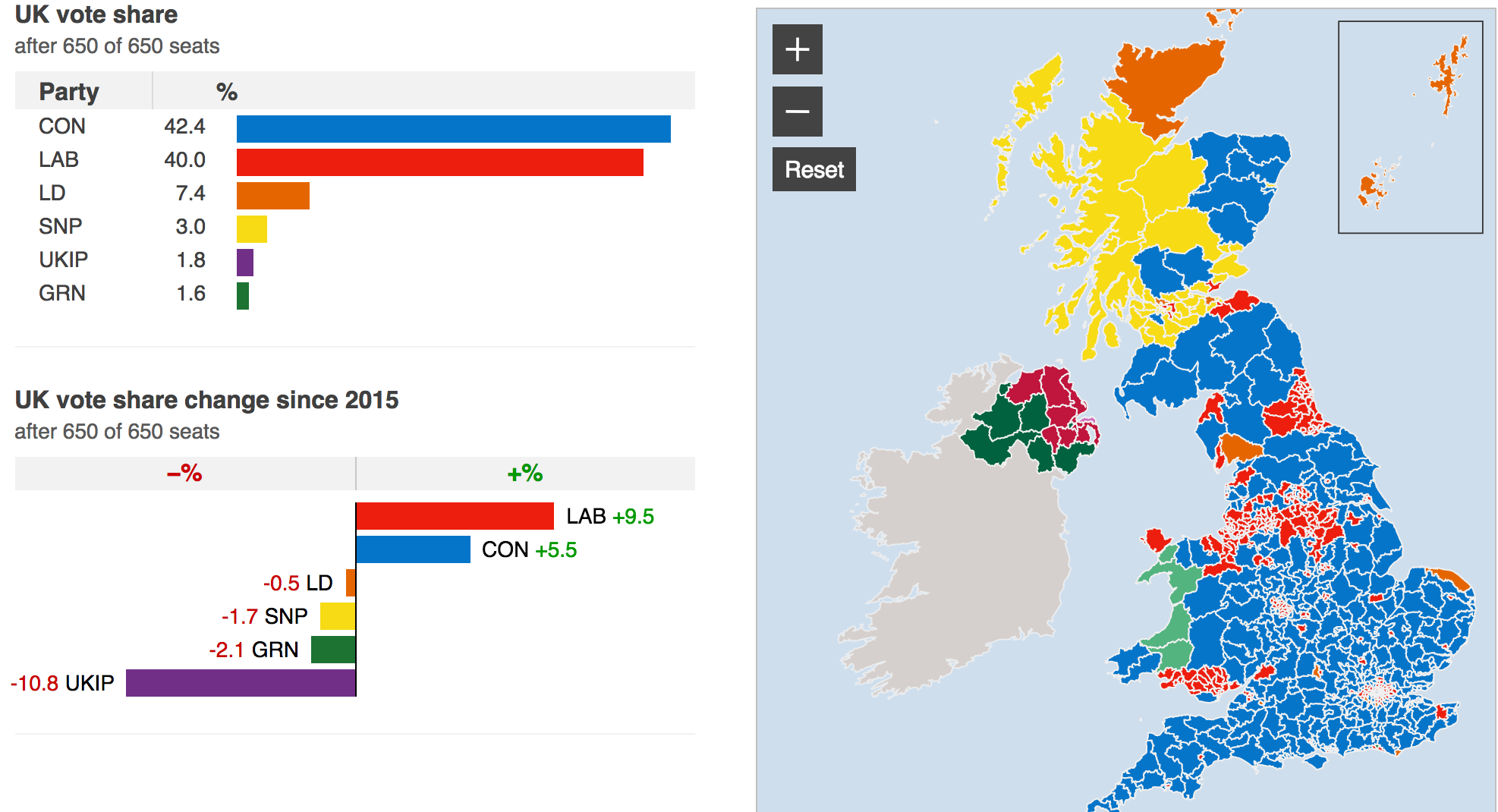
Here’s a very quick summary. http://www.bbc.com/news/election/2017/results

It’s a hung parliament. No party won enough seats to gain an overall majority.
The main parties are Conservatives and Labour.
Conservatives lost 13 seats. They now have 318.
Labour gained 30. They now have 262
This is a huge failure for the Conservatives.
SNP lost 21 seats. This is significant because they won so many in the last election and the SNP are all about gaining Scottish independence.
UKIP are out completely – they lost their single seat. They were the party campaigning for the UK to leave the EU and the immigrants to leave the UK.

Since the Tories are the incumbent party they get the first opportunity to try and form a government by making a deal with one of the other parties.

That’s the position at this moment. We’ll expand on it during our conversation but the words turmoil and disarray are again being used to describe the messy and complicated condition of politics in the UK today.

So let’s talk to my Dad – the professor of broadcast journalism and former BBC news man, for some much needed clarity on this whole subject in order to find out what happened, what it all means, how Northern Ireland and Scotland are involved and how this all relates to the ongoing story of Brexit.

As ever, watch out for all the key language as it appears. There is a lot of political language in this episode, which applies mainly to political systems in the UK but also could be used to talk about politics and international relations in other countries. Also, there are the usual fixed expressions, idioms and phrasal verbs that you normally find in any natural conversation.

Remember that in episode 352 of this podcast (nearly 100 episodes ago) I explained some key concepts and vocabulary related to this whole subject. So if you need some clarification and you want a reminder of some of the important words and terms relating to all of this, check out episode 352 in the archive.

352. BREXIT: Key Vocabulary and Concepts

82. Voting / Elections / Politics / Government

But now, let’s hear from my Dad, Rick Thompson about the current state of politics in the UK, just after last week’s snap general election.


Outtro Transcript

So there you are. I hope it’s all a little bit clearer now, but equally it might even be more complicated!

It is a complicated situation but I hope you agree that we’re quite lucky to be able to listen to my Dad talking about it in his typically lucid and articulate way.

Don’t forget that you can listen to previous episodes of this podcast in which I have gone into detail about the language of politics in the UK.

Episode 352 goes into detail about the vocabulary of Brexit and you can listen to that one again in order to learn some of the key language of this subject.

Also you can listen to episode 82 from way back in January 2012 when I did an episode about voting, elections, politics and government in the UK, in which I explain and teach all the essential language you need to talk about the political process and also you can listen to a funny sketch about a general election.

That’s it for now. As ever, I remind you to join the mailing list which will mean you get an email in your inbox whenever I post new content here.

That’s new episodes of the podcast but also I sometimes post something when I’ve been featured on someone else’s podcast and recently I was invited to talk on the English Across the Pond podcast, The Earful Tower podcast and the Rock n Roll English podcast. If you’re signed up to the mailing list you will get notified of those things and will easily be able to listen to those fun conversations I’ve had and find out about some other people’s podcasts that you might not know about.

I’m going to end this episode after the jingle by playing you parts of the speeches by Theresa May and Jeremy Corbyn in the first session of Parliament since the election results came out.

Listen carefully to the voices of the PM and opposition leader as they make statements about the results and about the democratic process in Parliament over the coming months.

The cheering and jeering sounds you hear in the background are all the other MPs sitting in the House of Commons. It’s quite normal to hear them all shouting and cheering in agreement, or heckling and laughing at people they don’t agree with. I wonder if the parliament in your country is as loud and boisterous as it is in the UK.

So thanks for listening, and keep on listening after the jingle if you’d like to hear the words of Prime Minister Theresa May and leader of the opposition Jeremy Corbyn. (Image below, BBC.com)

Screen Shot 2017-06-14 at 12.31.30

457. Conclusions about Language Learning from the David Crystal Interview (Part 2)

A follow-up to episode 455 consolidating the insights of Professor David Crystal including various pearls of wisdom about language learning.

[DOWNLOAD]

Notes & Transcriptions

Hamid
If English keeps taking on words from other languages, will it stop being English?
This is the story of English.
English is a vacuum cleaner of a language.
Something like 300-600 languages have influenced English with words. If you look at English today. Where are the germanic words? They’re only about 20%. The other 80% is from French, Spanish, latin and others.
There is no single dominating influence on English today.
How many Urdu words have gone into English? Maybe 100. But English has over 1,000,000 words. No new cluster of words coming in is going to come in all at once (tidal wave) they come in drip drip drip.
New words are assimilated to reflect a need – e.g. for new types of food.
This is no threat to English.
In fact it’s evidence of the power of English, that it absorbs so many other influences from other languages and cultures. It’s like the blob!

Jilmani
What’s the future of English?
Unpredictable! Absolutely an unanswerable question. You should never try to predict the future of a language. It’s all about events which just happen, e.g. the Norman invasion, Trump or Brexit.
Will Brexit reduce the influence of English in EU?
Not much. But it will change its character because it won’t be used by so many native speakers, so there will be more developments “Euro English” (I think it has emerged a bit).
But English will continue to change and diversify.

Jairo wants help managing the workload of studies.
Learning about language is a huge burden.
Learning about a language you have to learn about the history, society and events of the time to understand why people were using language in those particular ways.
What was it like to be an old norse speaker?
But most philologists don’t have a psycholinguistic background to their studies.
Philology can be a bit dry.
David prefers the socially aware approach to the history of language which doesn’t just ask “what happened and when” but “why?” – let’s explore the nature of the people who made it happen. This should ease the process.

Cat
English syntax – can you explain it?
Come on you’re asking for a book here!
English has a simple morphology compared with German (or French).
How many possible word endings are there for a verb in English?
The difference between English and German is morphological but also syntactic.
English and German are quite close. They only diverged 2000 years ago.
Word order is a bit different.
Everyone understood David when he went to Germany and spoke German with the wrong word order.
There aren’t that many differences, although the few differences are noticeable.
Cat, why are you worried about local areas of syntactic difference between English and German. Why has this become an issue?
It usually comes down to identity. German English (used by people who have learned it really well) still is distinctively German English.
The point is, don’t be too concerned about micro differences in syntax between your language and English. As long as we understand you that’s the main thing, although obviously style is important so I imagine you want to write in the style of a native speaker (but which one though!) You might have to accept that it’s important to find your own voice in English, which might be influenced a bit by who you are (it is your own voice after all) – which is someone who lives in Germany. That’s not to say your English can be totally different and like German with English words – that would probably be unintelligible and a bit ridiculous. But micro differences aren’t such a big deal.
Don’t sweat the small stuff, it’s just small stuff.

Wesley
Do people who speak different languages think differently?
It’s difficult to translate words sometimes because there are some words which don’t directly translate because there isn’t an equivalent word. 10-15% of the words might be untranslateable. But in Chinese it’s a lot more.
But when you do psycholinguistic experiments we discover that people can see the different concepts, but having those specific words makes it easier to talk about those things. You can see the colours but you might not have the language for describing it.
Different languages might not have the same word for something but it doesn’t mean they think about them any differently.
E.g. in English we don’t have a word for a certain thing in Japanese – natsukashii for example. But we find other ways of describing it. Ah, it takes me back or “good old” or “it feels nostalgic” or “it’s good to be back”.
So it doesn’t seem to be the case that languages affect or reflect different perception of the world.
*But I reckon there might be something to it Wesley. E.g. sense of humour, patterns of understatement, all contribute towards expressing a sardonic outlook on life (UK) rather than a direct attitude in the mediterranean for example.
The fallacy is that it’s words that translate, but it’s not it’s sentences. A group of words together are what hold meaning. So even if there’s no single word equivalent, you put some words together and make a sentence and that’s how the language transcribes.
“Snow that you use to build an igloo with” – he can still express that thing with a sentence and you can see that kind of snow.

Learn the vocabulary of a new language and you’ll see the cultural things that it reflects. It shows that to learn the language properly you should learn about the culture too – the mindset, the reference points and so on. You can see all those things too, but having certain words and expressions makes it easier to talk about them.
The result is that in languages it’s easier to talk about commonly occurring cultural phenomena because the language has the tools to do it, but people are all still basically the same, we might just take a bit longer to talk about a concept that in your language is very normal.

Mayumi
Why do Brits use indirect language?
It’s just a cultural difference. It’s the British temperament. The reason for that is hard to say. Maybe it’s because the UK is an island and the psychogeographic factors might affect that kind of language use.
Pragmatics – the study of why people are using specific bits of language.
Language norms reflect the cultural context – that’s the identity argument.
But why does the UK use this polite language? We don’t really know! You have to ask why British people want to be polite. (obviously it’s because we’re such nice people)
You just have to accept the cultural differences. Learn about them and accept them. “That’s who we are.” should be a good enough answer.
As ever, you must accept cultural differences. They’re not weird, they’re just different. It’s a good bit of advice for anyone coming into contact with another culture. You can speculate about why people behave the way they do, but ultimately you’ve just got to accept it and move on, like the way you often have to accept in English that “this is just what people say in this language” and that’s it.

Synchronic not diachronic method.

Wikipedia:
Synchrony and diachrony are two different and complementary viewpoints in linguistic analysis. A synchronic approach (from Greek συν- “together” and χρόνος “time”) considers a language at a moment in time without taking its history into account. Synchronic linguistics aims at describing a language at a specific point of time, usually the present. By contrast, a diachronic approach (from δια- “through” and χρόνος “time”) considers the development and evolution of a language through history. Historical linguistics is typically a diachronic study.

DC says we should use a synchronic approach to understanding these things – why is this particular person choosing to say it in this way, right now?
Some more modern dictionaries now contain essays about usage and pragmatics, which help us to identify how culture affects language. It’s worth reading the extra comments and information pages you find in many dictionaries.
Also, consider reading cultural guides as well as purely linguistic ones.

Antonio
Will AI replace the need for language learning?
Babel fish (Hitchhiker’s Guide)
In 100 years it’ll probably be perfect.
(I’ve seen auto subs have improved recently).
Imagine a situation where the babelfish is operating perfectly. It would solve lots of problems, but identity hasn’t been addressed. I still want to “be French” and the AI might not include those differences. People will still hold onto their languages in order to express their identity. It won’t affect language diversity.
But it might mean that AI might make the need for a global language redundant. Maybe AI will replace English. Why bother learning an international language?
But there are various answers to that – tech might let you down so people might not choose to constantly rely on it – some conditions in which there is no electricity.
Will AI manage to be perfect like a human, with the ability to translate with a view to expressing the culture?
Human translators choose between different competing nuances. I could say it this way, or this other way. We make those decisions based on complex social and psychological factors. A computer might not have that cultural sensitivity, maybe only in the long term.
The number of people learning languages might be reduced, but it’s also ignoring another factor in learning another language – the want to become aware of the culture, history and literature of the other language. There’s a personal satisfaction in learning another language and enjoy the pleasant things about it. People learn languages because they want to not because they need to. It’s a pleasure.
There are many reasons to want to continue to learn, it’s not just about intelligibility.
For the forseeable future he can’t see that it would be economically viable to create that technological solution for language when the traditional methods are the best way to foster relationships.

Jack – I don’t know where you come from.
First of all, David doesn’t mind being addressed in the Ali G dialect.
“Me” instead of “I”.
“Me wants to know…”
“I is well impressed…”
Subject verb agreement. “I is…”
“Booyakasha”
“It is a well big honour”
It’s quite a skill to be able to switch between registers. Sometimes we break the rules as a stylistic choice, like with the expression “If it ain’t broke, don’t fix it.”
It’s important to be able to switch between different styles and registers but you also have to know when it is appropriate to do it.
I’m not bothered by it in the comment section of my site, but you should be aware that some other people might find it weird or inappropriate, like for example if you write that in forums on other websites, in the comment section of Amber’s new podcast about Paris history, or in some business meeting. It’s going to seem really weird. So, you need to seriously think about the appropriacy of the things you’re doing and that means the style of English you’re using, or the decision to post dodgy pictures of cakes on my website.
Should the listeners learn the rules of grammar, or should they just focus on meaning, and let the rules look after themselves?
Both but in a structured sort of way.
In communicative teaching the structured side was a bit lost.
Just listening and working things out by being dropped in at the deep end is a bit of a big step – it takes a while.
It’s also important to do some structure work, but also to expose the learners to things that illustrate the language point being used in a functional way.
So it’s not just about form, but also about function and trying to balance the two.
So, as we’ve said before – do both. Some structured language work, combined with exposure in which you are really focused on following the meaning of what’s being communicated. Then probably some more reflection on the way it was done. Moving between grammar and pure meaning all the time. Juggling.

Back to the conversation with friends recently.

People get upset by failing standards in English.

Again, David doesn’t mind – as long as the language is intelligible then it’s a sign of changing identities – a sigh of the times.

Are we better at communicating than we used to be?

It is possible to measure, but not possible to give a simple answer. It depends on the situation.
Book: “The Gift of the Gab” How eloquence works.

Eloquence standards do vary from generation to generation, circumstances, individual to individual. E.g. Obama and Trump – differences in eloquence. Is Trump incoherent? Is Obama a better communicator? Some people say Trump is incoherent and inarticulate. But it’s not necessarily true considering Trump’s ability to communicate with his core voters.
People cite various things as examples of falling eloquence standards, e.g. using “like” but often these aren’t really examples of falling standards, it’s just a question of style.

How do we use “like”?
As long as it doesn’t get in the way, it’s just a question of style.
Again, people see language changes and they equate it with decline. It’s not.
Usually, people are giving examples of things that are just a different type of eloquence (again, change not death).

Trump’s English has a style with its own values. He avoids the rhetorical style of Obama with balanced, complex sentences. Trump uses everyday conversational strategies. “Look, believe me folks..” Every day conversational strategies. He doesn’t use carefully crafted sentences, he changes direction even mid sentence. These are all features of informal American speech.
Semantically it can be extremely difficult to understand what he really means. But adopting that style allows him to appeal to certain people.

These days he might have become a bit more formal, but during the campaign he was noticeably less formal and more colloquial than Clinton and the other candidates. As a result he clearly stood out from the crowd, during a climate of dissatisfaction with the traditional political class. People were fed up with the type of boring politician speaking in that boring old way. They thought they were out of touch with ordinary people, and part of a crooked system. Trump got in by presenting himself as an alternative to this established political system and the way he used English was a big part of that.

Thanks for listening! I hope that helps!