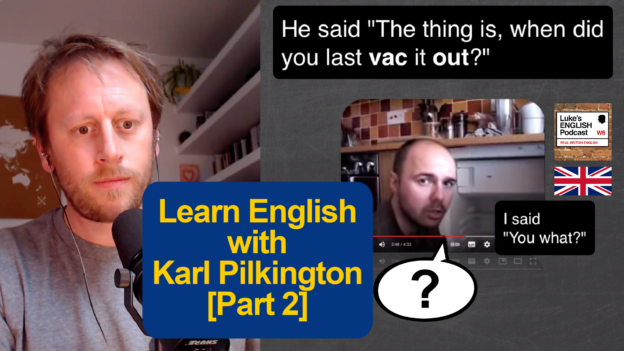
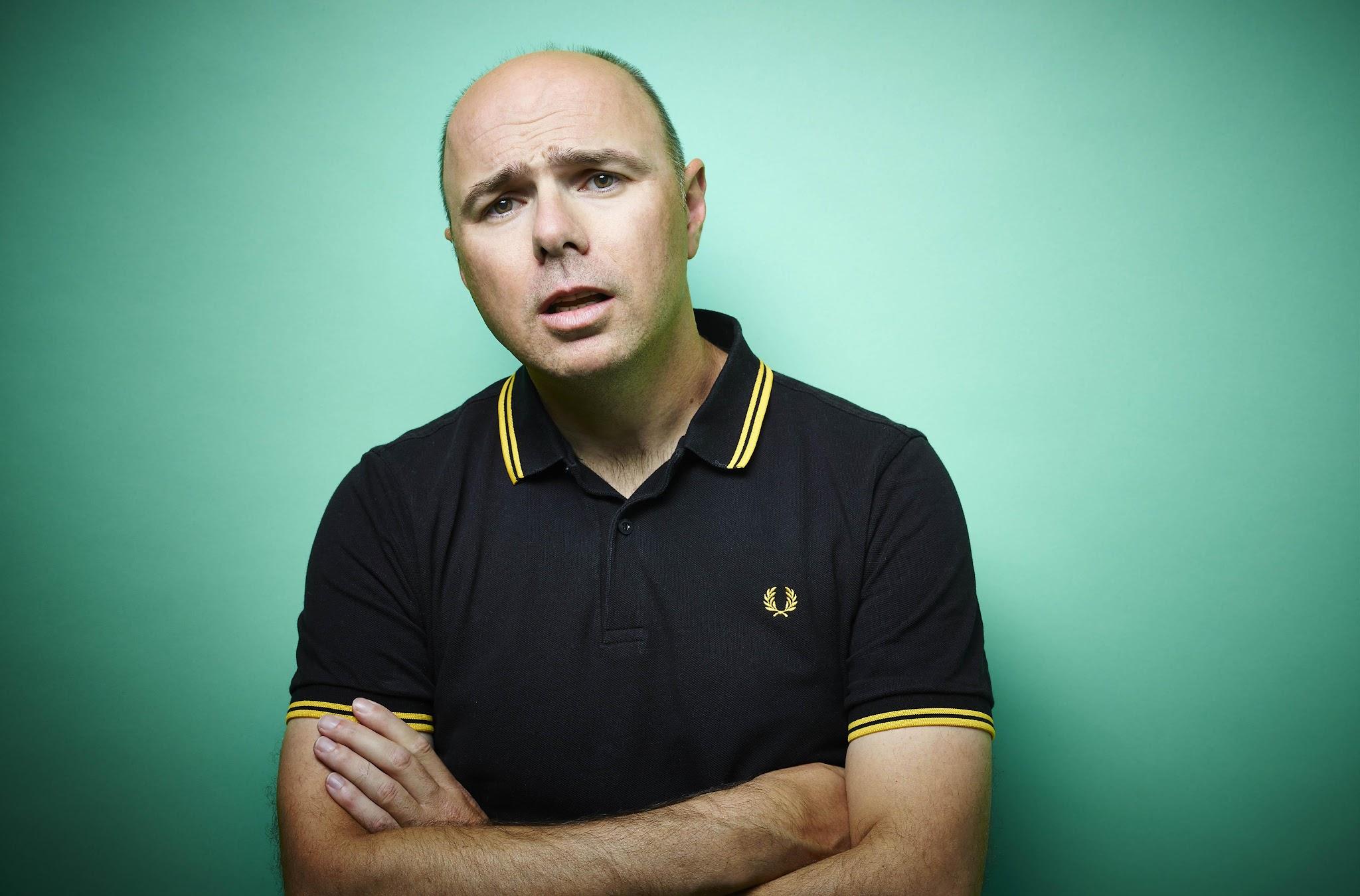
Understand more of Karl Pilkington’s rambling as we learn about the Manchester accent and pick up vocabulary along the way. Video version available on YouTube.
Hello everyone. Welcome back to LEP. This is part 2 of a double Karl Pilkington themed episode. I would recommend that you listen to part 1 of this first – it contains important context about who Karl is plus more details about Karl’s pronunciation and accent.
Listening to that first will help a great deal in understanding this one.
I got plenty of good responses to part 1 of this, so let’s carry on.
In this part we are going to continue as we did before – listening to Karl Pilkington talking about various subjects, understanding exactly what he says, looking at features of his Manchester accent and picking up vocabulary along the way.
Karl is basically just a normal bloke from Manchester and his accent is fairly typical for people from that area so this episode aims to help you understand his accent and pick up vocabulary too.
Some responses to part 1
I disagree with Karl on most things.
Is he arrogant?
I just enjoy the way he puts things. He speaks like a comedian in the way that he expresses a point of view and has a certain way with words, but he’s not a comedian.
This is the enigma of Karl Pilkington – is he really just being himself, or is he playing a comedy character, and in real life he’s a lot more erudite.
I actually think it’s the former not the latter and that he’s just being himself. He just happens to have a funny way of putting his opinions across.
Sometimes the best comedy comes from someone sharing a specific opinion. I think this is what I enjoy about this, rather than the opinions he is expressing, and as I said I disagree with Karl about most things, and some things he says are quite laughable – especially stuff he’s said on the Ricky Gervais podcast, like his Monkey News stories.
One other thing – apparently it is possible to be choked by a live octopus as you eat it. What I meant was that it would be impossible for an octopus to strangle you from the inside, as strangling means choking from the outside of the throat, with your hands for example, but of course a live octopus could choke you from within, by sticking its arms up into your throat or your windpipe. So, fair enough, it is possible for an octopus to choke you.
Also, in the UK we do eat oysters – which are raw seafood, so I think raw fish are generally ok in the UK but most other raw things would be considered a bit strange for us.
Quick Pronunciation Recap
In part 1 we listened to Karl talk about life, health and food and in terms of his accent I talked about H-drops
I’m 32, I think I’ve got the hang of it.
Look, how many do you need?
glottal stops
I’ll have a look at the meteorites.
If you’re going to eat a live animal, don’t eat one that’s got eight arms that can get hold of your neck.
The ‘bath/trap’ split
podcast/podcast
laugh/laugh
path/path
bath/bath
/ʊ/ not /ʌ/
Do you go to the gym much?
Topics: Holidays & Karl’s Fridge
This time he’s going to talk about holidays and his fridge and we will look at more features of his accent.
There’s a video version of this on youtube with text on the screen, plus you will find all the text presented on the page for this episode on my website.
Just one more thing before we start – I have premium episodes in the pipeline for these two episodes of LEP. The Premium episodes will be a chance to review and remember the vocabulary that comes up in these episodes, and then pronunciation drills too. So, I’ll do a sort of memory quiz with you to see how much vocab you remember and then the usual pronunciation drills – but in my accent, not Karl’s.
Karl is on a camping holiday, sitting in a tent and moaning.
Why does Karl think holidays are stressful?
What does Karl think of Lanzarote’s nickname?
What did Karl do on his holiday there?
What’s the problem with holidays in the UK?
What did he think of the seal sanctuary he went to?
What’s the best place Karl has been? Why?
What does Karl think of holidays to the moon?
Vocabulary
You’ve got free time on your hands which you’re not used to.
We ended up walking around this seal sanctuary. 14 quid. £
They were just floating about, hardlymoving.
I’m not having a go, but don’t charge me to come in, or at least let me see them again when they’re better.
The coliseum, they don’t do it up.
There’s no overheads.
That’s a mess. Get it knocked down.
At the end of the day the moon is just a big rock. You may/might as well go to Lanzarote.
PRONUNCIATION #3
Nasal
Alright so I went on holiday and it was great and all that.
I’ll have a look at the meteorites.
If you’re going to eat a live animal, don’t eat one that’s got eight arms that can get hold of your neck.
When’s the last time you heard about a tortoise having a heart attack?
Works well with glottal stops.
Nasal sound in /aʊ/ and /ai/ sounds
/aʊ/ in words like about and now sounds more nasal.
What’s he going on about now?
If there were dinosaurs about now and that.
If we’ve run out we need to go outside and get some more.
Nasal sound in /ai/ sound
The /ai/ sound in words like alive, inside, survive, fighting, riot and dying sounds more nasal.
You’re not supposed to eat them alive.
We’ve got to stay inside if we want to survive.
If they were running about fighting and dying and that.
Running riot (sounds like “roonin raiyut”)
#5 Karl on his fridge
Karl’s fridge is broken and he called out a guy to fix it.
Naturally he’s moaning about workmen who come to your house to do different jobs.
Why does the guy charge £80?
What is Karl’s main problem with engineers, plumbers, workers who have to come to his house?
What advice does the fridge guy give to Karl?
What’s the problem with Karl’s new fridge?
Vocabulary
The fellaturnedup, right.
Yeah, it’s broke. (broken)
That’s why I called you out.
That’s 80 quid.
I said, “you what?”
An 80 quid callout charge.
I tell you. They windmeup.
I had a fella come round to do the tiling.
Turned up late with a carrier bag.
A pot noodle
A copy of the Daily Mirror
A crossword book
He was asking what the pub was like across the road. “What is …. like?”
Having a laugh
When did you last vac it out?
Vacuum cleaner
You’re meant to vac them out, because dustand that gets in.
Can’t afford any food to put in it.
It needswiringin. It’s got one of those fancy plug things.
PRONUNCIATION #4
A lot of other vowel sounds are nasal too.
Turn the corner /ɔː/
They becomes thee
It depends what they do with it.
Why have they only just found that?
How did they miss that?
Also, he adds little fillers like:
(Do you) know what I mean?
Right? (just sounds like a nazal grunt, almost)
… and that
Like that
And whatnot
And stuff like that
Do you know what I mean?
I tell ya…
Watch out for those things if you like.
Ending
Ladies and gentlemen, this brings us to the end of this episode, as we now prepare to exit the world of Karl Pilkington and re-emerge blinking into the light of the normal world.
Welcome back to yourself, your own attitudes and your own personality again.
I urge you to (just wanted to use that phrase) check the page for this episode on my website where you will find a downloadable full transcript, the audio file for download in mp3 format, a text video version of this episode where you can read the entire thing as you listen and it’s all presented in a rather majestic looking font before your very eyes and of course there’s the comment section where you can share your thoughts not to mention the episode archive with all the previous episodes plus lots of bonus extra stuff.
Teacherluke.co.uk
LEP Premium LEP App LEP Merch
Have a good one and I will speak to you again soon, bye!
Understand English as it is spoken by native speakers. Let’s listen to Karl Pilkington rambling about life, the universe & everything, and see what we can understand and learn. Karl is from Manchester, so we’ll be looking at some features of his accent, picking up plenty of vocabulary and having a bit of a laugh along the way.
Welcome back to the podcast. How are you doing today?
In this episode we’re going to do some intensive listening and use it as a chance to learn some vocabulary and pronunciation.
This episode should be a bit of a laugh as we’re going to take a deep dive into the world of Karl Pilkington and listen to his thoughts on some big issues like health, food, animals, holidays and just existence itself.
We’ll be looking at the different features of his Manchester accent, and there will be lots of vocabulary to pick up too as we are covering a range of different topics. You can also consider this as a little intensive listening test, as I will be setting questions that you have to find answers to, then going through each clip in detail and breaking it all down for language.
We last heard about Karl Pilkington on my podcast in episode 656 in which we listened to a couple of his Monkey News stories about a chimp that works on a building site and another chimp that pilots a space rocket.
Do you remember that? If you don’t, then get the LEP app and listen to episode 656. It was a very popular episode and it should make you laugh out loud on a bus maybe.
That was pretty funny stuff, and Karl is very funny even though he’s not actually a comedian.
Who is Karl Pilkington?
To be honest, Karl Pilkington was most well-known about 10 years ago and these days he’s not in the public eye as much as he used to be, but he’s still a fairly well-known person in the UK, especially for Ricky Gervais fans.
Karl is just an ordinary bloke from Manchester who met comedians Ricky Gervais and Stephen Merchant when he worked for them as a radio producer in London.
Later, Ricky invited Karl to be on his podcast in order to broadcast his weird ideas and inane ramblings to the whole world, and the rest is history.
The Ricky Gervais Podcast became a world record-breaker with over 300,000,000 downloads.
In episodes, Ricky, Steve & Karl would talk about big topics like religion, evolution, philosophy, nature, birth and death and Karl would often say some bizarre and hilarious things, apparently without intending to be funny.
Ricky was always slightly obsessed with Karl, and he always described him as “an idiot with a perfectly round head like an orange”.
After being on Ricky’s podcast, Karl went on to become a fairly well-known figure in the UK, doing more podcasts with Ricky, then TV shows, books and documentaries like “An Idiot Abroad”.
Karl is known for his funny and slightly odd musings and observations about life.
He comes from a working class background in the Manchester area, and his accent has many of the features that you would expect from that.
Accent / Pronunciation
We will be going into the specific features of his accent in more detail as we go and this kind of follows on from episode 682 which was all about common features of pronunciation in England which are different to RP.
Which accent should you have?
So this episode is about one of the UK’s regional accents.
You might be thinking – Luke, by doing this episode are you saying that we should all learn to speak like Karl?
I’m not saying that. You can choose your accent, and many learners choose a neutral accent to learn, but it’s not all about learning an accent, it’s also about learning to understand different accents, and learning about the varieties of English that are out there.
So, you might not want to speak like Karl, but I certainly want you to understand Karl and the many millions of other people who speak English in a non-standard way.
So this episode is all about understanding an accent, rather than copying it. But of course you can copy Karl’s Mancunian accent if you like.
Vocabulary
There will also be plenty of vocabulary coming up too as we pick apart the things that Karl says and the way he says them.
You’ll find it listed on the screen on the video version and also presented in text form on the page for this episode on my website.
Video
We’re going to be using a series available on youtube in which Karl ponders certain big questions in just 3 minutes of video, originally broadcast on Channel 4 in the UK as part of their “3 Minute Wonders” series.
These are short videos in which Karl talks about his fridge, health, food, animals and holidays, covering each topic with his usual ramblings, all delivered in that Manchester accent, know what I mean?
I have about 6 recordings, which are about 3 minutes each (this could become two episodes).
Before I play the recording I’ll give you a little bit of context and I’ll set some questions.
Then you listen and try to get the answers.
Then I’ll break it down – listening to each bit again, with some explanations if necessary.
We’ll also pay attention to pronunciation – specifically his Mancunian accent. I’m going to break that down too, exploring the main features of that particular accent.
And I’ll sum up some of the vocab from each clip before moving on to the next one.
#1 Karl on Life
Karl goes around a museum looking at meteorites, dinosaur skeletons and endangered animals (stuffed ones or models) and muses about life in general medical science.
What does Karl wonder about the big bang?
What makes the meteorite room a bit disappointing?
What’s Karl’s main criticism of humanity today?
What does Karl think would happen if a dinosaur got loose and started to “run riot”?
What’s Karl’s main point?
Vocabulary
The big bang
Did it only seem big because there was no other noise to drown it out at the time?
Meteorites (on earth)
Meteors (flying in earth’s atmosphere)
Asteroids (flying in space)
The edge is taken off it because that isn’t the only one.
I’m not surprised they went extinct, they’re all in here.
Enough’s enough. If your body is that done in, call it a day.
The more we know, the more we interfere.
Don’t interfere with nature and that.
Even if it was going round running riot they’d go “We don’t want it to go extinct”
The panda is dying out.
Notes on Karl’s accent
Here’s a summary of the main points regarding Karl’s Manchester accent.
Many of these features are common in people from the Manchester area, although not all people from Manchester will speak like this, and there are different degrees of it.
This is certainly Karl’s Manchester accent in any case.
A lot of what I’m about to say will include things brought up in the episode I did about Key Features of English accents, episode 682.
PRONUNCIATION #1
H dropping
Look, how many do you need?
I’m not surprised they went extinct, they’re all in here.
She’d had a new lung, a new heart
He puts his hand in and goes “Yep, it’s broke”
They weren’t doing anything. They weren’t jumping through hoops. (talking about animals in a zoo)
I don’t know if it’s cruel or not, to have them in there.
I’m 32, I think I’ve got the hang of it.
Glottal stops (/t/ sounds get replaced by /ʔ/ )
I’ll have a look at the meteorites.
If you’re going to eat a live animal, don’t eat one that’s got eight arms that can get hold of your neck.
Let me see them again when they’re better.
Go back to my episode called 682. Features of English Accents, Explained to find out more about glottal stops.
#2 Karl on Health
Karl recounts a conversation he had with a woman about going to the gym.
Does Karl go to the gym?
What does he think of the idea of breathing classes?
What does he think of drinking 7 pints of water a day?
What’s Karl’s argument for not going to the gym? Heart beats, tortoise
Vocabulary
I know what’s probably putting you off – the fact that it’s hard work.
Breathing classes – I’m 32 I think I’ve got the hang of it.
My Dad’s like 60-odd. I’ve never seen him drink a pint of water, yet they’re telling us we should have, like, 7 pints a day or something, and then they wonder why there’s a water drought on.
They keep coming up withdaft ways of keeping fit.
Chucking paint at each other.
PRONUNCIATION #2
/æ/ not /ɑː/ (the “bath/trap split”, again)
Short A sound /æ/ in bath, podcast
(gas and glass have the same vowel sound in Karl’s Manchester accent).
This is normal across all northern accents, and many accents in the midlands. I would use /ɑː/ because although I lived in the midlands for many years (half my childhood), my accent is mostly from the south because I’ve lived there more and my parents don’t have strong regional accents.
Come to my class. We do breathing classes.
/ʊ/ not /ʌ/
The U sound in but, enough and much.
I pronounce it /ʌ/ but Karl pronounces it more like /ʊ/
Do you go to the gym much?
#3 Karl on Food
Karl talks about a new trend – eating things which shouldn’t be eaten.
Coming from England, Karl thinks it’s weird to eat certain things that might be eaten in other cultures, like live octopus, insects, frogs, snails, probably raw meat, raw fish and sushi.
What is the danger of eating a live octopus?
What’s Karl’s issue with kids and food today?
What does Karl think about eating dog?
Vocabulary
They choke you. Why would you want to eat that?
If we’re eating octopuses, why are dogs getting away with it?
Talking to Christian again about some of the themes and controversial opinions he talks about in his YouTube videos, plus some bits about men wearing thongs on the beach, an obsession with rabbits and if Christian was the Donald Trump of English teaching. Video version available.
How are you today? You are now listening to episode 732, and in this one I am talking again to Christian Saunders from Canguro English.
This is the second time I’m talking to him on the podcast. I previously interviewed Christian in episode 686 last year and got to know him a bit, but I wanted to talk to him again after having seen some of his most recent videos on YouTube about language and language learning.
In his videos Christian often challenges certain assumptions and myths about language learning, and so I thought it might be interesting to talk to him about those things, so I came up with some questions about language, learning language and teaching English on the internet.
There is a video version of this conversation on my YouTube channel too, so don’t forget to check it out and of course to like and subscribe while you’re there.
There’s no more for me to add here in the introduction. I hope you enjoy this conversation and get some good things from it. Once again, Christian’s YouTube channel is called Canguro English and his website is canguroenglish.com
Let’s get started.
So that was Christian from Canguro English. Thanks again to Christian.
And here we are, at the end of yet another episode. I wonder what you thought of the points which came up in that conversation? Feel free to let us know in the comment section or perhaps under the YouTUbe version of this. Where do you stand on things like comprehensible input, workbooks and clickbait titles? Let us know.
For me, this is one of the last episodes I’m recording before officially starting my summer holiday. As usual I have loads of stuff to record and publish before I go away, and I might end up recording some of it while I am back in the UK. But here’s a little overview of what’s in the pipeline right now.
A Summer Ramble
War of the Worlds
P31
So I have my work cut out.
In terms of holiday – we’re going back to the UK to stay at my parents’ place and we will have to deal with the whole quarantine thing, and the day 2 and day 8 testing process and all that. It’s quite annoying. But after we quarantine we will be going to a posh camp site for some “glamping” and generally spending a couple of weeks in the UK.
Meanwhile our new flat in Paris is being demolished (on the inside) and remade to our specifications. Let’s hope that all goes according to plan.
I’ll talk more about this stuff in that rambling episode which is coming up.
Talking to competition runner-up Michael from Poland about two top English learning tips, scary hitch-hiking stories and the practice of shamanism using psychoactive substances.
Hello everybody and welcome back to Luke’s English Podcast. How are you today? I hope you’re doing well as you listen to this, wherever you are in the world at this particular moment in time.
This is the 5th in the WISBOLEP competition series – Why I Should Be On Luke’s English Podcast, talking to winners and runner ups from the listener competition I did at the end of last year.
So far I have spoken to Walaa from Syria, Tasha from China, William from France and Robin from Germany. Now it’s the turn of Michael from Poland, also known as Michael the Shaman (this is the nickname that he often uses, for reasons which will become clear later in this episode). Michael actually came sixth, and Bahar from Iran was fifth, but at the time of recording this I haven’t spoken to Bahar yet. Her interview is coming soon though.
So, let me tell you a little bit about Michael the Shaman, from Poland.
Michael, who for the record is not an English teacher, has a lot to offer both in terms of language-learning tips that have worked for him and some very interesting stories and insights into some pretty deep and fascinating things, and I think this should be a great episode. So, listen closely.
Here’s a quick overview of the things we cover.
First we talk about language learning and those specific tips from Michael. These are resources and approaches that he has used to work on his English, especially his vocabulary and pronunciation, with some success I would say. I won’t go into them now, but pay attention so you can hear him describe these things, how he uses them and how they have helped him make some significant improvements to his English. I will summarise them again at the end and give a few extra comments.
Secondly, Michael tells us some of his hitch-hiking stories. Michael has spent lots of time travelling around in neighbouring countries near Poland and doing it by hitch-hiking, which basically means getting picked up by drivers who are going in the direction he wants to go, and hitching a ride with them as a way of travelling around. Now, this sounds adventurous and possibly a bit risky, because it does involve travelling in the cars of strangers, and Michael has some genuinely frightening and incredible stories of doing this. Again, listen closely to hear the specifics of the edgy situations that Michael has found himself in.
Then, thirdly we have the topic of shamanism, or being a shaman. Michael is probably better placed to describe this than me, but being a shaman basically refers to the use of certain rituals and practices to enter different states of consciousness, which can lead to new discoveries, new perspectives, new ways of thinking and different ways of seeing the world, or the universe in fact, and our place within it. This is something that Michael has explored and for him it has been very beneficial to his life in various ways. So let’s listen to what Michael has to say about shamanism and the use of psychedelics.
At this point I feel I need to say something about the use of psychedelic substances, which is part of what Michael describes as being a shaman, and we’re talking about using substances that occur in nature, like certain magic mushrooms and ayahuasca as well as the synthetic chemical LSD or acid as it is also known.
So I would like to just say one or two things about this topic as a sort of disclaimer or preface to our conversation.
First of all, the substances I just mentioned are controlled substances in most countries, which means that they are illegal to some extent. So, we are certainly not suggesting that people go out and start using them.
By the way, I’m referring to these things here as controlled substances, but in many cases they are also called drugs, and they’re not just prohibited by law, but also in the general culture. For a lot of people drugs are a serious taboo and people often have quite strong and negative feelings towards this subject. I am aware of this, and I hope that you are comfortable listening to us talking about it on this podcast. I think it’s alright, but I am aware that for some people drugs are just not ok, and that’s fine.
I feel it’s necessary to say that in talking about psychedelic drugs here we are not condoning their use in any kind of flippant way, and “condoning” means promoting or supporting something. We take this seriously and as you will hear Michael is very articulate and quite serious about the subject. He’s very well-read and knowledgeable, and we are just talking about his personal experiences and knowledge, which I do think are interesting as well as being new as a subject on this podcast. I’ve never really talked about this kind of thing in depth before on the podcast.
Also I think it’s worth making a distinction between different types of drug or substance.
There are many different types of drug, and they are extremely different to each other.
People often just say “drugs” without making any distinction between them. They just lump them all together as if they are all the same, basically. But I think it is worth making a distinction. Despite that fact that controlled substances are often grouped together as drugs, they are not really the same as they have very different effects and different levels of risk and we are certainly not talking about things like cocaine, crack cocaine or heroin, which are obviously very dangerous substances and very serious substances. We are not talking about those things here.
So, I thought it would be worth making that distinction and I’m trying to be responsible about this topic, but I’m also attempting to manage your expectations here because I don’t want you to get the wrong impression or to be shocked or to have a knee-jerk reaction while listening to us mention psychoactive substances in the latter part of this conversation. For many of you, these words are not really necessary, you’re fine with it, but there it is. I felt I should make those points. We’re not promoting any kind of illegal behaviour, we are not talking about those damaging and addictive things that ultimately will destroy a person’s life, instead we are taking what I hope is a more reasonable and rational approach here and discussing the more intellectual and spiritual aspects of shamanism and how certain psychoactive substances are part of that.
Right, now before we get to the talk of psychedelics in the second half of our conversation, you can first hear Michael’s specific language learning tips, which I think are really useful, and then his crazy hitch-hiking stories, which are pretty mind-blowing and entertaining.
Right, no need for me to add anything else here. I really hope you enjoy this conversation. I’ll be recapping and summarising some details later but let’s now meet Michael the Shaman from Poland, another runner up in the WISBOLEP competition.
Are you ready? Listening carefully? OK, here we go.
Bruce Parry’s short film about Ayahuasca
Ending Transcript
So that was Michael from Poland, and wow, that was awesome stuff, wasn’t it? It got very deep there, and cosmic, didn’t it? I hope you liked it. As usual, I’m very interested to read your responses to the things that Michael said.
I’m going to sum up some of the things Michael said at the start of the conversation about learning English, because after all that mind-expanding talk of psychedelic trips and also the hitch-hiking stories, it seems like we talked about his language learning methods ages ago, and I think he made some really great recommendations that you could find really useful for your English.
Now, considering Michael’s English again. I think it’s fair to say that it’s good, right?
I do want to repeat a couple of points.
Don’t compare yourself to others too much
Don’t compare yourself to other people too much. This can lead you to judge yourself a bit harshly, which is totally normal. Whenever we listen to other language learners, the tendency is to either judge their language level, or judge our own level in comparison to theirs, but this isn’t a very healthy thing to do in terms of language learning, and what I’d encourage you to do is only judge yourself by your own success, and rather than comparing yourself to others, try to notice how your English is better than it was before.
Just compare yourself to yourself at earlier points in your language learning journey. Notice improvements you’ve made, and celebrate them. This is more likely to put you in a better mental space than comparing yourself with others.
Just think how far you’ve come as a learner of English and take note of your progress. That’s probably healthier than falling into any kind of negative thinking which can happen if we compare ourselves unfavourably to other language learners.
So, try not to judge others too harshly, and don’t compare yourself to others too much.
And hopefully listening to other language learners can give you some inspiration and some practical ideas which you can use to work on your English in ways you hadn’t considered before. Even little things like changing certain habits can make a big difference to your learning of English.
And with that in mind, let me quickly just go over the tips Michael had for learning English, which worked for him. Have you tried these things or used these resources?
Michael’s Language Learning Resources
There were two things really:
Use English/English dictionaries to expand your vocabulary with correct definitions, examples, phonemic transcriptions and synonyms. My 5 favourites are www.collinsdictionary.comwww.cambridge.dictionary.orghttps://www.oxfordlearnersdictionaries.com/https://www.macmillandictionary.com and Longman Dictionary of Contemporary English https://www.ldoceonline.com/ I have been planning to do a full episode on using online dictionaries to improve your English (in fact I’ll be touching on this a bit in a couple of upcoming episodes), but I will just say that these dictionaries are fantastic resources not just for getting definitions, but getting synonyms, examples, phonemic transcriptions and more – all of which are really important ways of really getting to know new words. Bookmark the dictionaries, use them all (because they have slightly different examples and details which you can cross reference) and get into the habit of checking words in them and exploring the information they can give you. Never before have we had access to so many wonderful language learning resources, completely free of charge, and at our fingertips at all hours of the day. It’s like living in a massive library. So, use those online dictionaries to explore new words.
The second resource Michael mentioned was the website www.dialectsarchive.com – a website full of voice recordings used by actors and voice coaches trying to learn different accents, and especially the text Comma Gets a Cure, which is designed to reveal a huge variety of pronunciation features in English. You can hear the text being read in different accents, you can shadow the text, repeat it, record yourself repeating it and more. I plan to do some premium episodes using this text and other similar texts too. There is a lot to explore and use there, including some podcast episodes by the creators. www.dialectsarchive.com
OK, so just two tips there, but they are solid ones.
And returning to the hitch-hiking stories. I just want to sum up the main one, just to be sure you got it. I think it was probably clear, but I want to retell that story just because I think it was such an exciting story, and maybe you didn’t catch the specifics.
Michael’s Hitch-hiking Story – recap
So Michael and his friend Kuba were hitchhiking from Poland to Amsterdam and they got picked up by a couple of very dodgy guys in a van. They didn’t realise it when they first got in the van but these guys were drinking alcohol and smoking some kind of crystal – perhaps crystal meth, like in the TV series Breaking Bad. Meth is a pretty nasty drug.
Michael is an intuitive person and he picked up on a very bad vibe from these guys and became convinced they were planning to do something very nasty with Kuba and him. Like I said, it sounds like something from a horror film. Listening to their comments, watching their demeanour and generally reading between the lines, Michael became convinced these guys were organ traffickers, who are people that kidnap healthy people in order to steal their internal organs and sell them on the black market. Certainly these guys seemed to be very dodgy and probably involved in organised crime.
Michael decided he would subtly let the guys know that he and Kuba were actually not that healthy and therefore their organs were not worth taking, which would convince them to just let them go.
It’s crazy I know, but I kind of know what Michael is talking about when he said he just knew something wasn’t right and that they were in danger. I feel like I’ve been in similar situations before, where you realise that the people you are with are dangerous and up to something, and so you just have to get out. It’s a weird feeling. I can’t remember any specific stories from my own life, but I’ve met guys in pubs before who just seemed dangerous and untrustworthy, even though there were no specific things that would give me that impression. It’s more of a vibe that certain people give off.
Anyway, Michael said that he heard the guys making jokes about stealing their organs, which appeared to be jokes, but there was a sinister undercurrent which suggested that perhaps they were not really joking. Michael’s friend Kuba was not quite as observant maybe and he didn’t seem to realise something was wrong, but anyway Michael sent him text messages to convince him that something wasn’t right. They managed to persuade the drivers to stop the van at a petrol station because Michael needed to be sick or had diarrhea and then they escaped at a petrol station.
They then decided to continue their hitchhiking trip to The Netherlands, but decided they would not accept lifts from any more Polish people, nobody drinking or using drugs and no vans. This is because they didn’t want to risk running into any similar people or perhaps their friends who they suspected were also on the road, but somehow the next car that picked them up, by coincidence maybe, contained the friends of the dodgy guys they had just escaped from. So, it was a case of “out of the frying pan, into the fire”.
Michael said that these other guys seemed more intelligent and perhaps were the bosses of the other two they had met previously, and the only way Michael and Kuba got away without being taken, was because the guys ended up liking them, as they played along with their jokes and generally tried not to antagonise them at all. So, phew! What a lucky escape!
And Michael said that hitchhiking was not that dangerous!
Actually I do believe that on balance his experiences of hitch hiking have been much more positive than negative, but what a scary story! And I do believe it is true. I find it very believable. There are dodgy people in the world.
And finally, a few more words on the topic of psychedelics like magic mushrooms.
A final note on Magic Mushrooms
All the things Michael mentioned about Amanita muscaria (Fly Agaric) are definitely worth researching. In his words (from a recent email exchange we had) “I think I talked about maybe 1% of things you can do with this mushroom. I’d like to stress once again that I don’t recommend everybody uses this mushroom. I’m all about education and knowledge. The mushroom can have medical, therapeutic and spiritual effects, but only if one does it correctly. It is not easy to work with this mushroom.
An excellent resource for Amanita muscaria is Amanita Dreamer on YouTube and her website www.AmanitaDreamer.net. Also, a recently published book: ‘Fly Agaric: A compendium of History, Pharmacology, Mythology & Exploration’ by Kevin Feeney is also great.
These resources are essential as there are many dangerous myths regarding Amanita muscaria. Remember, it’s important to make sure that you are fully knowledgeable about this mushroom. You can’t just pick the caps and eat them.
I think the same goes for all kinds of psychedelic substance that Michael talked about. Please remember that we’re not condoning the use of these things in any kind of casual way. You must be very careful, very well-read and personally very prepared before going any further.
Right then, what did you think of this episode?
Any thoughts on Michael’s language learning resources, his hitchhiking tales or his comments on the use of psychedelics? If you have things to say, just express your thoughts in English, ideally in the comment section on my website.
That’s all from me. Have a good morning, afternoon, evening or night. Be excellent to each other, good luck with your English and do take care.
Speak to you again on the podcast soon, but for now it’s just time to say good bye bye bye bye bye.
This is a conversation with my mum about philosophy, how the film Groundhog Day can help us understand the principles of stoicism, and how this can all help us to feel a bit better about the world.
This conversation with competition runner-up Tasha Liu is a way to get to know Chinese culture in a more personal way including the story of how Tasha’s father gave up drinking alcohol, and other interesting details about real life in the world’s most populated country.
How are you doing? Thanks for choosing to listen to my podcast today. I hope you enjoy it.
In this episode you’re going to hear me in conversation with Tasha Liu from China, the listener of this podcast who came 2nd in the WISBOLEP competition.
Let me explain quickly what the WISBOLEP competition is, for that one person who doesn’t know.
If that’s you, and you don’t know what WISBOLEP is → Hello! I’m now going to explain it to you in one single sentence. You’re welcome.
Here it is. The competition, summarised in one single sentence.
WISBOLEP stands for Why I Should Be On Luke’s English Podcast and is a competition I ran at the end of last year in which the prize was to be interviewed by me in an episode, the winner of the competition being the one who received the most votes from listeners after I played all of the 2-minute recordings sent in by the competitors in episode 692 of this podcast.
There you go.
Walaa Mouma from Syria was the overall winner. You may have heard her episode. It was published last month. If you haven’t heard it, I highly recommend that you do so! It’s episode 703 and Walaa explained in some detail how she improved her English to a good level, despite the hardships that she faced in her life. It was an inspiring episode, to say the least. We focused on Walaa’s approach to learning English – both her attitude and specific things she has done and continues to do to improve her skills. So the focus was definitely on learning English.
The conversation in this episode though, focuses mostly on cross cultural understanding.
Walaa is quite a hard act to follow, but we’re not comparing here. It’s not a competition you know! Wait, it is a competition, isn’t it? It totally is competition, isn’t it. It was a competition anyway. But for me, the competition part is done, and now it’s just a case of listening to LEPsters who were chosen by the people who voted in this competition.
And the spirit of this competition was always about this: Finding some interesting guests to talk to on the podcast and letting some LEPsters speak a bit and share their experiences. Let’s see what insights we can learn from other learners of English around the world. And let’s celebrate the citizens of LEPland! Everyone has a story to tell. We can all learn things from each other. All we have to do is just listen.
So, now that I have said that, here’s a brief overview of the content of this chat.
There’s a bit of “getting to know you”, as this is the first time I’ve ever spoken to Tasha, so we talk a bit about her studies, where she lives and so on.
Then we move onto the things she hinted at during her competition recording – and overall these things are ways to get to know China and Chinese culture a little bit more, in a personal way. So this is a cross-cultural exchange here and a chance to get beyond the stereotypes and cliches and find out some real things about life in the most populated country in the world.
There’s the story of how her father managed to stop drinking, which might tell us some things about family life in China.
Then we talk about some of the commonly-held beliefs about China (particularly beliefs held in the west) such as the way Chinese people eat (do they, as the saying goes, “eat anything with 4 legs except the table, and everything that flies except planes”? (and helicopters I suppose), or are they more discerning in their eating habits than that? Another assumption that people might have is that China is quite undeveloped in certain ways compared to the west, or how it could be ahead of the west in various ways too, like the way technology is used – payment systems for example, and the idea of the cashless society.
And there’s more detail about what it’s really like living in China today.
Just a heads up: There were some technical difficulties during the recording, due to a slightly poor internet connection between the two of us. This meant that sometimes we couldn’t hear each other properly or the connection just failed. I think I’ve saved it in the edit, but there may be a few moments where the bad connection affects our conversation. It shouldn’t be too bad, but I thought I’d mention it anyway.
OK, now I’ve done my introduction, let’s get started properly, and here we go!
Ending Transcript
So that was Tasha Liu from China. It was really interesting to talk to her and I got that amazing feeling that you get when you actually talk to someone who lives in a completely different part of the world and in a different culture but you just connect as human beings.
That’s always special – talking to people from other places and getting a glimpse of how they live their lives and the fact that although we’re different in many ways, we’re also really similar in the fact that we’re still having human experiences ultimately.
It’s easy to forget but I feel like as humans we have many more things in common than differences. We’re all humans living on earth (as far as I know – you might be an alien on another planet as far as I know) but we’re all having a human experience ultimately, and so there are many more things that unite us than divide us, aren’t there?
I’m sounding a bit pretentious there, possibly, but hopefully you know what I mean.
Here are some reflections – just things that I thought about after having that conversation.
These are reflections about cross cultural understanding.
When we think about other cultures or experience them, there is a tendency to not fully understand those other cultures, and as a result we jump to conclusions about them, probably based on the fact that we’ve never had proper experiences of those cultures, never met or talked to those people properly and never observed things from their point of view. This is normal I suppose because we can’t always be everywhere and see everything.
We end up with limited views of other cultures, which might also be informed by other people’s attitudes, like “these people are just unsophisticated” or “it’s such a backward society” and this could be in any direction. It could be, in a broad sense – the west looking at the east, or the east looking at the west, and not just east and west, any culture thinking about another culture – we often don’t see the whole picture. We are all humans, but there are all sorts of complicated reasons why we behave or live slightly differently.
We are all the same, but our contexts are different.
That’s it really. I could ramble on more, but I think I’ve said enough.
I wonder what your thoughts are, now that you’ve listened to this conversation. What reflections do you have?
I found it really interesting to talk to Tasha, and I just want to thank her again for telling us her stories, and for being willing to share her comments about her country. Also, congratulations to her! 2nd place is certainly nothing to be sniffed at.
Right then. More competition runners up will appear on the podcast in due course.
Next up in the WISBOLEP series will be William from France. That will probably arrive in a couple of episodes’ time. I had a really nice conversation with him, which I think was just as insightful as the other WISBOLEP conversations we’ve had so far. If you’ve enjoyed this conversation with Tasha and the one with Walaa, then I think you’ll like hearing William’s story as well.
That’s coming up on the podcast soon.
I’m working on new content all the time, including new Premium episodes which will arrive in the LEP app before too long.
Guest host Oli Thompson interviews Luke using a classic format from BBC Radio. Luke is going to be marooned on a desert island but he is allowed to bring 8 pieces of music, one book and a luxury item. For episode 700 this is a chance to get to know Luke and his musical choices a little better. (Transcript and text video versions available)
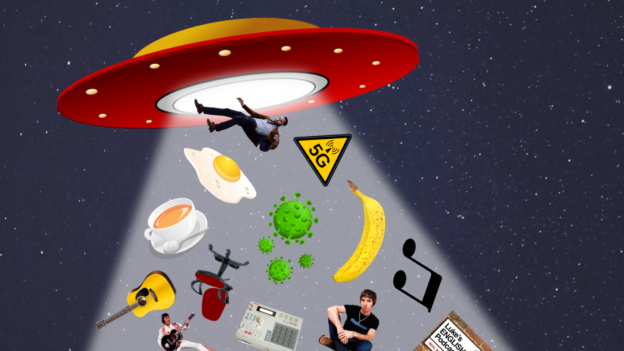
This episode is called CONSPIRACIES / UFOs / LIFE HACKS with James and I’m going for the full Joe Rogan clickbait title here, as you will see later.
I’ve said before that I wonder if clickbait titles actually work (I think they do) and whether I should use them (still not sure). I guess we will find out with this episode, which is a rambling conversation with my brother.
Clickbait, by the way, is any content on the internet which is designed just to get you to click it – usually with some sensational title or a promise of amazing exclusive information which is often not actually included. Usually they’re there as bait for clicks which ultimately will be turned into advertising revenue.
E.g. (for example) “Dermatologists hate her new skin care routine that will save you thousands” “Why Jabba The Hutt is the key to the Skywalker bloodline in ways you couldn’t imagine” “10 Life Hacks guaranteed to change the way you live forever” “Proof that aliens have already landed, and are living among us” “7 Secrets about COVID-19 that the government don’t want you to know” “These simple Language Hacks will help you speak like a native OVERNIGHT”
I hate clickbait but as an online content creator I am drawn to and fascinated by the impact of attention grabbing, wildly sensational titles. They obviously work, that’s the thing, because they’re everywhere. But a lot of the time I find clickbait titles annoying and even depressing because it’s so devious and also hackneyed. Anyway…
I’ve gone with the simple: “Conspiracies / UFOs / Life Hacks” as a title. It’s clickbait-ish, with certain buzzwords that seem to attract attention. But really this is just a bit of a joke as you will hear in the episode.
Let’s see if it makes any difference.
Anyway…
What are you going to listen to in this episode then?
The other evening I called my brother James and I started recording our conversation before he answered the call, which I probably shouldn’t have done because he wasn’t expecting a podcast recording this time. But I pressed record before he’d picked up and what resulted was a spontaneous chat that ended up going all Joe Rogan as we talked about UFOs, conspiracy theories and life hacks.
First of all there’s a bit of a catch up and a chat about the COVID situation and how James has been handling it, and then we get on to some of the major topics of our time, including whether we are alone in the universe, how to cook poached eggs, how to walk up stairs, how not to make “British Tea”, The Beatles meeting Elvis, some sketchy impressions of celebrities, a dodgy chair and what you should do with overripe bananas.
I hope you enjoy it. I will be back at the end to chat to you again with some music going in the background as usual.
But now, let’s call my brother and see what happens…
Ending
I hope you enjoyed that. It was really silly in the most fun way possible. I’m glad I recorded it.
This tune in the background is one of James’ own, made on the Akai MPC2000. Those of you who work for the Akai consumer electronics company – James’ MPC2000 is currently on the floor of his living room, with the top off and all the circuits and boards visible. It’s not looking good. There’s something wrong with it and he needs a new one. So, if you’re in a position to provide him with an Akai MPC1 that would definitely help him to help the podcast by providing more background music. Just get in touch with the show if you’d like to help out and we will dedicate a special episode just to the wonderful Akai company and their delightful music making machines!
If you like James’ stuff check out his Soundcloud page where you can hear most of them
As you may know, James is also a DJ and since his MPC broke, he did a brand new LEP DJ set using his record decks and some new vinyl that he got recently. That special, exclusive DJ mix is now available on the page for this episode, it’s also available on the Music Mixes page on my website. Check it out there and have a listen. You’ll hear James introducing the tunes, speaking to you and DJing some music. Alternatively, get the Mixcloud app for your phone and listen to it there.
Here’s a link to James’ Mixcloud page with music mixes across various genres, including Drum & Bass, dub, punk, hip hop and so on
Music and comedy mixes (mostly done by me) on my website
Moto Mix (with plenty of silly improvisations, characters and voices by James and me)
Leave your comments below
Have you heard any conspiracies about COVID-19? Have you ever seen a UFO? Do you believe aliens exist? Do you think they’ve made contact with us yet? Who do you think might be posing as an alien in the world? Do you think I might be an alien? Do you have any good life hacks?
More Life Hacks (to justify the title)
OK, here are a few more life hacks. 5 fairly good ones I just found online, just in case you feel there weren’t enough life hacks in this episode.
This meaning of “hack” is something that makes your life easier – it’s like a solution to a problem in life. We talk about life hacks, learning hacks for language learners – simple little tricks you can apply that make your learning more successful.
I think you know what life hacks are then, so here are 5 more half-decent ones just to make sure you don’t feel undersold by the title of the episode, which is not a sentence that many internet content creator feel the need to say very often is it. “Oh yes, after all this video doesn’t quite live up to the promise of its title, sorry about that” – something you never hear. But I like to be different, so here we go.
Use a pillow case from a sheet set to keep the sheets in
When You Have To Hang Something With Exact Holes, Photocopy The Back And Use As A Template
Put a post it note on the wall when you’re drilling a hole
The Pomodoro Technique (dunno why it’s called that) Work for 25 mins then take a 5 min break. After doing this 4 times, take a 30 minute break. This will dramatically increase your productivity. (I definitely agree – when I was marking exams – 200 or more – I would set the clock for 10 minutes, blast as many as possible in 10 minutes and then perhaps mess around for a few minutes, then do it again. It made a huge difference, compared to just trying to sit and work constantly. Just focus for 10 minutes at a time.
Put your phone on airplane mode to charge it faster (but you knew that one already)
Dangle a fork into an opened bottle of champagne to keep it fizzy (This is an old myth I think. Apparently it makes no difference).
Noel Gallagher story about champagne “Arr kid” means his brother Liam
(Liam had a fork in a pint of milk because he thought it would keep it fresh)
That’s the end of this episode, have a lovely morning, day, afternoon or night and I’ll speak to you next time!
Hello everyone, welcome back to the podcast. Here is a new episode of the Rick Thompson Report.
In the Rick Thompson Report I talk to my dad about the issues of the day, news and current affairs from the UK, especially politics.
The last time we spoke was in episode 652 at the beginning of the lockdown. We talked about COVID-19, how the government was handling it, what kind of crisis it could become.
Now, recording this at the start of July 2020, the world is coming out of lockdown in many areas. Are we out of it now, or are some places still affected? What’s been going on in the UK all this time? And will the government be ready to properly leave the EU at the end of the year when the transition period ends?
With his usual clarity then, here is my dad, Rick Thompson, to talk about these things.
And here we go.
Outro
There you are then. That was the Rick Thompson Report for July 2020 here on planet earth, specifically focusing on the UK sector.
Thanks again to Dad for taking the time to talk to me on the podcast today and for taking me to Wembley Stadium once in 1991 to see the FA Cup Final between Tottenham Hotspur and Nottingham Forest. I was a Nottingham Forest fan but I also liked Tottenham and we went along and it was amazing. I saw some of my heroes like Stuart Pearce, Gary Linaker and Paul Gascgoine. So, thanks for that Dad. Forest lost the game but it was still amazing.
Anyway, what’s up with you? How’s your English? How’s that lockdown treating you?
Hey, can you do me a favour? Could you send me a message telling me what your favorite kind of LEP episode is?
What’s your favourite kind of LEP Episode?
Here are some categories
Talking to guests I don’t really know
Talking to guests I do know, like my family and friends, James, Amber & Paul
Talking about learning English with strategies and advice
Episodes about specific topics like 666, films, music and so on, often with James
Conversations with my wife
Listening to comedy and breaking it down
Explaining jokes and dissecting the frog
Rambling monologues
Made up stories and improvisations
Voices, impressions and characters
The Rick Thompson Report
Gill’s Book Club
Luke’s Film Club
Vocabulary, Idioms or Slang
Exploring a British TV show
Detective Stories and Mysteries
Something else
I think that’ll do for now.
Let me know what your favourite type of episode is. It’ll help me think of more ideas in the future.
You can write an email to me, leave a comment under the episode, or tweet me @EnglishPodcast
Hello, are you a learner of English? Would you like something to listen to to develop your listening skills and by extension all other aspects of your English and your life? Well, you could listen to this. That’s the idea. Learning English through listening. Learning through listening. Listening through learning. Listening while learning. Listening and learning. Living and learning.
Anyway, welcome to this episode of my podcast.
This is part 2 of episode 666 in which my brother James and I are talking about scary things, horror, evil and general moodiness.
I uploaded part 1 of this a few days ago and so far there has almost been radio silence from the LEPsters. Just the sound of crickets in the comment section and on social media, despite the fact that I was regularly receiving messages from people before publishing episode 666 asking about what I was planning to do for this episode with an apparently significant number. There have been one or two comments, but I feel it’s less than usual. What’s going on. Have you been spooked by the subject matter? Are you all freaked out by the number 666? It’s possibly because the episode got blocked on YouTube and YouTube is normally where the first comments come in because it’s easier to comment on YouTube. So nothing from YouTube. I don’t know. The download numbers have been good. Maybe you’re just superstitious but like Stevie Wonder once said “Superstition ain’t the way”.
In any case, let me introduce this properly. This is part 2 and there are 3 parts to this episode. James and I recorded all this a couple of weeks ago – him in London, me in Paris (we did it online of course, we didn’t just shout really loud) and we chatted for about 4 hours I think. I’ve edited that down, but still, this was a marathon recording, just because we had a lot of stuff we wanted to talk about.
In part 1 we talked about why the number 666 is associated with the devil, and then we talked about the devil in music with a little history lesson from James’ friend Kate Arnold who is an expert in medieval music and then there was some rambling from James and me about some of our favourite scary music – mostly the band Black Sabbath who are probably the first band to really make a name for themselves by being quite frightening, but also some death metal, some hip hop and some Aphex Twin. Apologies to those of you who were expecting us to talk more about Iron Maiden and also other genres like black metal and so on.
So that was part 1, but here in part 2 James and I are going to move on from music and instead share a few anecdotes of genuinely scary experiences we’ve had in our lives, scary things that have actually happened to us. So, a bit of storytelling in this one.
Then in part 3 of this we’re going to talk about scary films and horror movies, and then that will be it for episode 666.
I recorded this conversation with James remotely over video conferencing software and for some reason James’ microphone kept cutting out at various times. You might be able to hear it sometimes. He talks and then some of his sentences get cut in half or he suddenly goes silent a bit. I managed to fix this in most cases, but sometimes you will hear his voice cutting out and some words are missing or half pronounced. It was quite frustrating at the time, because of course I want you to be able to hear everything. It becomes a bit more obvious in the second half of this episode, and I hope you don’t find it too distracting. Hopefully you won’t even notice, although obviously you will now because I’ve mentioned it.
OK, so without any further ado, let’s jump back into episode 666 with some scary stories of real-life experiences from James and me, and here we go!
What is sleep paralysis?
https://www.nhs.uk/conditions/Sleep-paralysis/
Sleep paralysis (32 scary experiences from Reddit users)
OK listeners, that is where we are going to stop part 2, but this marathon episode will continue in part 3 in which James and I are going to talk about scary films and some other bits and pieces on this theme.
If you liked hearing our stories, you could check out some other episodes from the archive, which are similar. Here they are (just two of them).
Episode 140 is the one I mentioned earlier. That’s the ghost stories episode in which I tell 4 weird and disturbing stories from my life. Just a heads up: There’s quite a long and waffling introduction to that episode (what a surprise), so if you’d like to skip that and get straight to the stories, you should fast forward to about 17 minutes into the episode. Start listening from 17 minutes in if you want to get straight to the stories. You’ll hear The Scary Clock story again, plus 3 other weird anecdotes. That’s episode 140, starting 17 minutes into the episode.
Also there’s episode 372 which was called The Importance of Anecdotes in English, and that one contains 4 true stories told by my mum, my dad, James and me. At least 3 of them are quite frightening, including the time James got stranded in Hastings and ended up sleeping on a stranger’s sofa and it got a bit weird. My dad had a confrontation with a taxi driver in Greece when he was a student and I had a taste of the violent underworld crime scene in Liverpool when I used to live there. That perhaps sounds worse than it is – basically one evening a poor guy who had been kidnapped by drug dealers ended up at our front door and my housemates and I took him in without really realising what was happening, and the next thing we knew we had a bleeding traumatised stranger in our house and potentially some armed drug dealers outside looking for him. That was fun. Oh such lovely days as a student in Liverpool in the 90s.
Anyway, that’s an episode with 4 anecdotes told by my family and it is episode 372. There’s some language teaching about narrative tenses and how to tell anecdotes in that one, but if you want to skip straight to the stories again you’ll need to jump ahead to the 34 minute mark. Episode 372, 34 minutes in.
This website uses cookies to improve your experience while you navigate through the website. Out of these, the cookies that are categorized as necessary are stored on your browser as they are essential for the working of basic functionalities of the website. We also use third-party cookies that help us analyze and understand how you use this website. These cookies will be stored in your browser only with your consent. You also have the option to opt-out of these cookies. But opting out of some of these cookies may affect your browsing experience.
Necessary cookies are absolutely essential for the website to function properly. These cookies ensure basic functionalities and security features of the website, anonymously.
Cookie
Duration
Description
cookielawinfo-checkbox-analytics
11 months
This cookie is set by GDPR Cookie Consent plugin. The cookie is used to store the user consent for the cookies in the category "Analytics".
cookielawinfo-checkbox-functional
11 months
The cookie is set by GDPR cookie consent to record the user consent for the cookies in the category "Functional".
cookielawinfo-checkbox-necessary
11 months
This cookie is set by GDPR Cookie Consent plugin. The cookies is used to store the user consent for the cookies in the category "Necessary".
cookielawinfo-checkbox-others
11 months
This cookie is set by GDPR Cookie Consent plugin. The cookie is used to store the user consent for the cookies in the category "Other.
cookielawinfo-checkbox-performance
11 months
This cookie is set by GDPR Cookie Consent plugin. The cookie is used to store the user consent for the cookies in the category "Performance".
viewed_cookie_policy
11 months
The cookie is set by the GDPR Cookie Consent plugin and is used to store whether or not user has consented to the use of cookies. It does not store any personal data.
Functional cookies help to perform certain functionalities like sharing the content of the website on social media platforms, collect feedbacks, and other third-party features.
Performance cookies are used to understand and analyze the key performance indexes of the website which helps in delivering a better user experience for the visitors.
Analytical cookies are used to understand how visitors interact with the website. These cookies help provide information on metrics the number of visitors, bounce rate, traffic source, etc.
Advertisement cookies are used to provide visitors with relevant ads and marketing campaigns. These cookies track visitors across websites and collect information to provide customized ads.