Category Archives: Cross Cultural Understanding

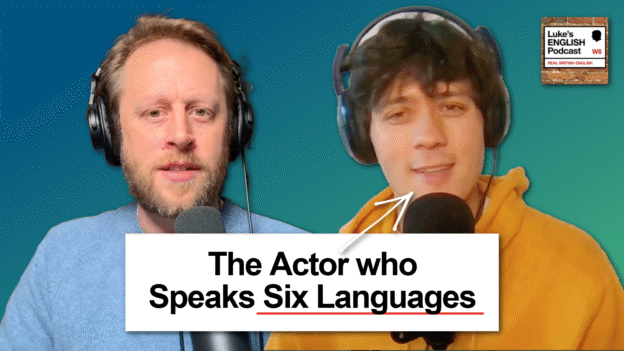
Identity, Mindset, Accents & Learning English with Multilingual Actor Ivan Doan [972]

[972] I talk with multilingual actor Ivan Doan about his multicultural background, his learning of languages and his work as an actor. Ivan shares his insights and experiences of learning English, dealing with different accents in film & TV roles, and the importance of mindset and discipline in his life. There are plenty of language learning insights in this episode, which I summarise at the end. Full transcript available.

[DOWNLOAD AUDIO]

Get the PDF transcript here 👇

An 11-point list of practical advice for learning English inspired by this conversation.

1. Learning through doing, not just studying

  • Use English for real things.
    Ivan’s English really improved when he started making projects in English (web series, acting work, talking to people), not just studying grammar.
  • Make English the tool, not the subject.
    Start a small project: a vlog, a diary, an Instagram account, a DnD group, movie scene re-enactments – anything that requires English.
  • Theory helps, but it’s not the engine.
    Grammar explanations are useful, but they’re not what makes you fluent. Real communication is.

2. Multimodal learning: use your whole body & brain

  • Don’t reduce English to rules + word lists.
    When Ivan was with the Mormons or on set, he learned from body language, tone of voice, facial expressions, rhythm, context, not just words.
  • Watch people, not just subtitles.
    When you watch something in English, pay attention to:
    • how people look at each other
    • when they pause
    • what their hands/face are doing when they say something important
  • Combine skills.
    Listen + read + speak + move. For example, repeat a line while copying the actor’s body language and facial expression.

3. Listening & repetition are superpowers

  • Re-listen on purpose.
    Take a podcast episode or YouTube clip and:
    1. Listen once for general meaning.
    2. Listen again and note unknown words/phrases.
    3. Look them up.
    4. Listen a third time and catch those items in context.
  • Notice “repeat offenders”.
    If a word or chunk keeps appearing, it’s a sign: you probably need it. Put it on a list.
  • Make targeted vocab lists.
    Like Ivan did for filmmaking, you can make lists for your world: tech, business, medicine, design, gaming, etc.

4. Discipline beats talent

  • You don’t need to be “gifted at languages”.
    Ivan’s message is clear: people think he’s “special”, but in reality, discipline and repetition are doing most of the work.
  • Be stubborn.
    Let it bother you (in a good way) that you don’t understand a phrase yet. Go back to it. Again. And again.
  • Small, realistic goals.
    For example:
    • “I want to be able to have a 10-minute small-talk conversation without switching to my language.”
    • “I want to understand one specific podcast episode without subtitles.”
    • “I want to tell one story about my life in English clearly.”

5. Step-by-step progression (like acting training)

Ivan’s “levels” are a good model:

  1. Basic conversation – you can talk about everyday things.
  2. More advanced conversation – opinions, stories, feelings, more nuance.
  3. Improvisation – you can react in real time with no preparation.

6. Accents, rhythm & sounding natural

  • First: learn to hear the accent.
    You can’t produce what you can’t hear. Choose one accent (e.g. London, General American) and really listen to it.
  • Find your “accent twin”.
    Pick a native speaker:
    • similar age
    • same gender
    • whose voice feels close to your natural voice
      Use them as your model.
  • Create an “accent map”.
    Notice:
    • Which vowels are different from yours?
    • How do they stress words?
    • What is the rhythm (fast/slow, chunky/smooth)?
  • Rhythm & word stress are often more important than perfect vowels.
    BAna-na vs baNAna can be the difference between confusion and clarity.
  • Shadowing works.
    Play 1–2 sentences, then:
    • say them with the speaker,
    • match their timing, stress, and melody,
    • repeat several times until it feels comfortable.

7. It’s okay to exaggerate (caricature as a training tool)

  • Overdo it first, then calm it down.
    Like an actor, you can:
    • exaggerate the British or American intonation
    • really push the stress and melody
      Then slowly bring it back to something natural.
  • This is not “fake”; it’s training.
    As with acting, you push beyond your comfort zone, then refine.

8. Identity, culture & letting yourself change

  • To speak like an English speaker, you must allow yourself to “borrow” a new identity.
    That might feel weird: “This isn’t me.”
    But that flexibility is part of real fluency.
  • Different cultures, different communication rules.
    British politeness isn’t necessarily “fake”; Russian directness isn’t necessarily “rude”. They’re different systems.
  • Adapting ≠ betraying your culture.
    You can still be 100% you and also learn to play by local rules when you’re speaking English.

9. Talk to yourself – a lot

  • Self-talk is powerful, not crazy.
    Walk around your flat narrating what you’re doing in English, or:
    • rehearse future conversations,
    • re-tell a story you heard,
    • argue with yourself about something.
  • The goal is to stop translating.
    Like Ivan said, it’s like changing gears in a car: once you’re “in English gear”, you just drive.

10. Treat English like a role you inhabit

  • Think like an actor.
    When you speak English:
    • step into the “role” of an English-speaking version of you,
    • use your voice, but with English rhythm and intonation,
    • add the body language and facial expressions that match.
  • Use emotion.
    Don’t just say the words; feel them. This makes you remember the language and sound more authentic.

11. Inspiration: you can do this

Messages implied by Ivan’s story:

  • You can start with school English that isn’t great and end up working in English internationally.
  • You don’t need a perfect method; you need consistent action, curiosity, and the courage to interact.
  • Being “from somewhere else” is not a weakness; it’s often your superpower – a different perspective, more empathy, and a richer identity.


The Trip to Norway / Learn Vocabulary in Context [952]

A description of my recent family holiday to Norway 🇳🇴, including rambling about how I can’t stand beach holidays 🏖️, chasing my son around different international airports 🏃, visiting Oslo ⛴️, Bergen 🏠, fjords 🚤 and mountains 🏔️. Edward Munch’s The Scream 😱, staying in a cabin with no hot water, shower or washing machine, swimming in a freezing lake 🥶, catching a trout 🎣 and driving an electric Jaguar 🐆(that’s a car). Includes a PDF with vocabulary in context, definitions, full transcript, and vocabulary quiz.

[DOWNLOAD AUDIO]

https://youtu.be/sbMY6Z4bWfI?si=6kyKL2GSxoi6BYzB

Get the PDF with vocabulary list, vocabulary quiz and full transcript 👇


The Flatmate from Japan Returns – Travelling Tales & More [950]

Peter, my old flatmate from Japan, is back on the podcast after his previous appearance 11 years ago! We chat about travelling experiences, teaching English in Malaysia and Japan, dealing with jet lag and culture shock, doing stand-up comedy abroad, and some of the funny, strange, and even weird experiences we’ve had while travelling. A relaxed, wide-ranging conversation full of stories, laughs, and cultural insights.

[DOWNLOAD AUDIO]

This is an audio-only episode.

Get the full PDF transcript here 👇

Listen to my first episode with Peter here 👇

203. A Cup of Tea with Peter Sidell (The Flatmate from Japan)

931. Overcoming Fears (with Zdenek)

This episode features a conversation with Zdenek about fears and anxieties experienced in everyday life. We explore common fears such as driving, flying, culture shock, language learning and public speaking. Listen for stories of Luke’s fear of Paris cafes ☕️, airport anxiety ✈️, Luke’s dramatic scooter ride in Nha Trang 🛵, Zdenek’s fears of Vietnamese roads and driving 🛣️, Luke’s recent cycling accident in Paris 💥, Zdenek’s encounter with a London police officer 👮‍♂️, nerves about teaching 😳, and more.

The PDF worksheet offers a vocabulary list from the conversation, with definitions, examples, and quizzes and a full transcript to help you boost your English with the episode.

[DOWNLOAD AUDIO]

https://youtu.be/_0yTntyjeA4?si=dbuRaCfdbJBnQHa_

📄 Get the PDF here (lucky you – it’s very expensive but you can have it completely free) 👇

  • Detailed vocabulary list
  • Vocabulary quiz
  • Full episode transcript

Other links 👇

⚽️ The Footglish Podcast (Learn English with Football)

💬 Zdenek’s Discord server “The Achiever’s Chamber”

🏆 LEP Premium 👉 www.teacherluke.co.uk/premium

929. Sarah Donnelly: The Only American In Paris + UK vs US Accent Quiz

Sarah Donnelly comes back onto LEP to catch up and to tell us about her stand-up special, now available to watch on YouTube, and to do a British English vs American English pronunciation quiz.

Sarah’s show is called The Only American in Paris and we discuss some of the themes of the show – the real experience of being a US citizen living in Paris, the Netflix show Emily in Paris, cultural differences, learning French, plus a pronunciation quiz to help you compare UK and US English.

[DOWNLOAD AUDIO]

https://youtu.be/2iLkgCv5984?si=M9sguk4b5QOLO0cH

Get the episode PDF👇 (pronunciation quiz and full transcript)

925. Walaa’s Experience in Syria / Walaa Mouma Returns (Part 2)

When Walaa was first on this podcast in episode 703 she talked about living in Syria as a student during the civil war (or people’s revolution) but at that time she felt she could not talk in detail about the situation. Now that the Assad regime is no longer in control of Syria, Walaa feels she can talk more candidly about what it was like to live near Damascus during those days. Walaa’s descriptions are both shocking and moving. This is the topic of this episode, which is part 2 of a two-part series.

[DOWNLOAD AUDIO]

Links for English with Walaa

Listen to Part 1 👇 (Walaa talks about her academic studies in Wales)

Walaa’s previous appearance on LEP (episode 703) 👇

https://www.youtube.com/watch?v=w9ythdvbKKM&t=1s&ab_channel=Luke%27sEnglishPodcast

Episode Transcript

917. Listener Stories: How LEP has helped my listeners with their English ★ Success & Advice

This is a listener-generated episode, meaning that the content is mostly written by listeners of this podcast. In this one I read out various comments and messages from listeners who have improved their English with the podcast. They describe the progress they’ve made and how they did it. Expect lots of success stories and plenty of advice for improving your English in 2025.

[DOWNLOAD AUDIO]

https://youtu.be/BlH-bFyVcv0?si=-WmTiFteVhRlFpot

👇Get the PDF with transcript, vocabulary list, study guide and essays 👇

903. Reading from my Japanese hospital diaries (Sept 2002)

By popular demand I have chosen to publish this episode! In 2002 I ended up stuck in a Japanese hospital feeling very ill and confused. I ended up staying there for about two weeks. During my stay I wrote a diary nearly every day. In this episode I read from my diaries, share my personal experience with you and explain a few bits of vocabulary.

[DOWNLOAD AUDIO]

https://youtu.be/IrYBDau9Fws?si=1zGP2aZGyCak-lIL


896. A Rambling Chat with Martin Aaron

Martin Aaron is an old friend of mine from the days when I taught English in London. In this episode we chat about being an English teacher, travelling to different countries, the status of English in other places, how native English speakers (don’t) learn languages, stories of learning French in school, and Martin’s memories of boarding school.

[DOWNLOAD AUDIO]

Listen to Marton’s podcast 👉 https://pod.link/1742336735

891. The Bilingual Journalist (with Charles Pellegrin)

Talking to bilingual journalist Charles Pellegrin (France 24) about how the conventions of broadcast journalism influence the way the English is used in news reports, how Charles started as a journalist, the challenge of making TV news reports, our time at university, the Olympics in Paris, and Charles’ experiences of living and working in China.

[DOWNLOAD AUDIO]

My guest today is Charles Pellegrin, a bilingual (English & French) journalist working for the TV channel France 24. Charles currently works as the presenter of a morning business program, but used to be based in China, where he lived in Beijing for 3 years. Charles also does stand-up comedy in English, which is how I know him, and we are doing a 2-man show together this Friday, 19 July 2024 (details below).

In this conversation we talk about why reporters speak in a certain way when they read the news, how the conventions of broadcast journalism influence the way the English is used, how Charles started as a journalist, the challenge of making TV news reports, our experiences at university, the Olympics in Paris and whether it will be beneficial for France, and Charles’ experiences of living and working in China.


Links

Luke & Charles’ stand-up comedy show in Paris on 19 July

Charles on Instagram & X
https://www.instagram.com/chpilgrim/
https://www.x.com/chpilgrim/ https://www.instagram.com/charles_pellegrinf24/