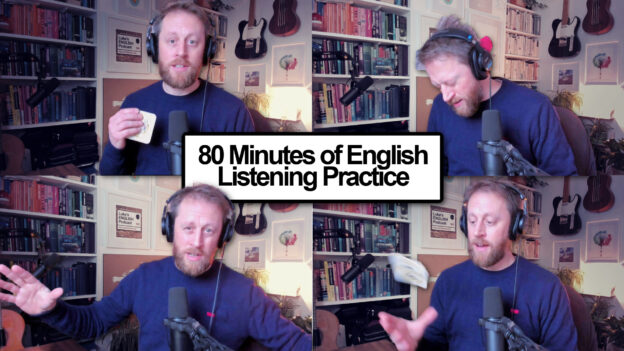
Join me as I talk without a script about lovely cold weather ❄️ being too lazy to wash my cups 🍵 feeling exhausted because my son won’t sleep 👶😮💨 New Year’s Eve celebrations 🛋 performing stand up comedy to 4200 people 🎤 a recommended YouTube channel about adventurous missions in the UK countryside 🥾 and recent horror films I’ve seen 🙀.
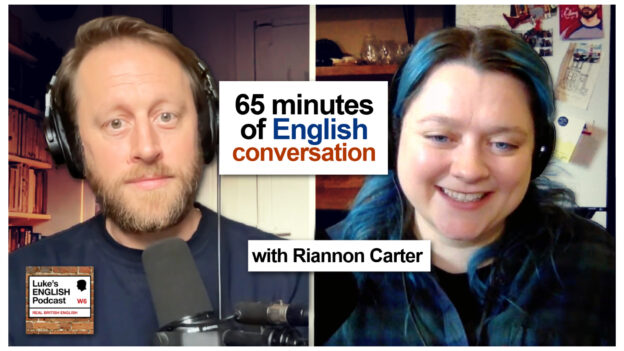
Join me as I meet and get to know Rhiannon, an English coach whose mission is to help you feel awesome about your English. I had never met Rhiannon before this interview, so listen as I get to know her and we chat about her English & Welsh roots, moving to Edinburgh, studying theology at university, early experiences as an English teacher, why learners often feel ashamed of their English, and how she can help. We also discuss the wonders of fish & chips and deep fried Mars bars which you can buy on the streets of Edinburgh.
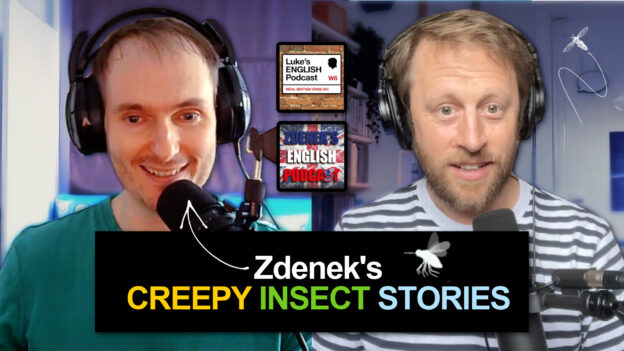
Bed bugs in Paris & London, Mosquito hunting in the middle of the night, a home invasion by fleas and the terrors of cockroaches – listen to some anecdotes about encounters with insects with Zdenek who has recently relocated to Vietnam. Also watch out for various insect idioms which appear during the conversation.
Here are the idioms which popped up during this conversation.
1. **To have a Bee in Your Bonnet** This idiom means that someone has an idea or a thought that’s constantly on their mind, often an obsession.
2. **To have Ants in Your Pants** If someone has “ants in their pants,” it means they are restless or fidgety, unable to sit still.
3. **To be as Busy as a Bee** This idiom describes someone who is extremely busy and productive, like a hardworking bee in a hive.
4. **To have Butterflies in Your Stomach** When you’re nervous or anxious, you might say you have “butterflies in your stomach.”
5. **To be The Bee’s Knees** This expression is used to describe something excellent or outstanding.
6. **To Make a Beeline for** If you “make a beeline for” something or someone, you head directly towards it, just like a bee flying straight to a flower.
7. **Like a Moth to a Flame** If someone is drawn to something or someone despite the potential dangers, they are said to be like a moth to a flame.
8. **To bug someone** To annoy someone
Also, to bug a place means to hide recording equipment in a place in order to spy on the people living there. Zdenek believes his apartment is not bugged, thankfully.
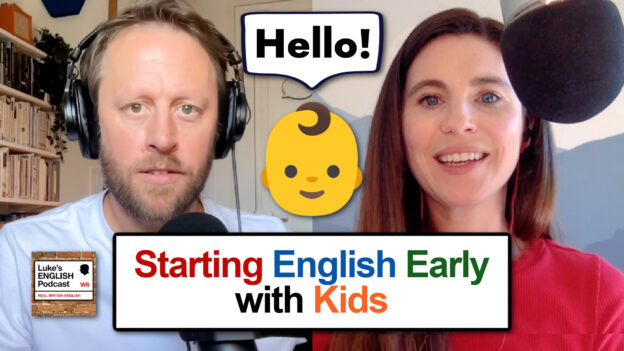
Bree Aesie is an English teacher with a background in psychology, especially child development, and in this episode she comes onto LEP with advice and encouragement for parents who want to help their children to learn English from an early age.
Intro Script for Episode 848 The Superpower of Starting English Early with Kids
Hello folks,
As you can see, this episode is called The Superpower of Starting English early with kids and as you can probably work out from the title, we’re going back the subject of helping your children to learn English.
This is a topic I’ve touched upon in the past, notably with Alexander and his daughter Alice in episode 685 and also conversations I’ve had with my wife about this over the last few years. Also there was the fairly recent episode with Anna Tyrie about the language of children and parenting where we looked at lots of vocabulary surrounding the world of kids. That was episode 814.
This time, the focus is on how you as a non-native speaker of English, can give your kids a head start with their learning of English by talking to them in English at home. Obviously for many of you, this might not be relevant because you don’t have children, you’re not planning to have children or because you already have children and they’re all grown up now and so it’s just too late! Or perhaps your kids are all grown up and they speak better English than you! (Some of my students do say this is a reason for their learning English)
But for a lot of you out there who are parents of young children or who are going to have children, and you want them to speak English, this episode is for you. Everyone else – stick around, there are bound to be things you can gain from this.
I know that it might seem a bit strange to speak English to your children, or you might feel reluctant to do it because you think your level isn’t quite right. Well, this conversation is here to speak to you about that, to encourage you to do speak English with your kids, to show you that you can do it and to show you some ways in which you can do it.
My guest is Bree Aesie. She is a podcaster too and has a podcast for learners of English that focuses on storytelling. It’s called Into The Story. She invites guests onto her show to tell their personal stories. As you’ll hear, Bree invited me onto her show to tell a story of my own, and I told one which I haven’t shared on LEP before. It’s a funny and quite dramatic story of fatherhood, challenges with operating in a second language, with a bit of culture shock mixed in too. It should give you a laugh or two. You can listen to it on her podcast now – it’s being published by Bree on the same day I’m publishing this. “Into the Story” – it’s available where you get your podcasts. Link in the description.
Bree is an English teacher. She works with adults and children. She has a background in psychology and child development, and she’s very interested in the whole subject of language learning in children. Let’s listen to what she has to say about it, and here we go!
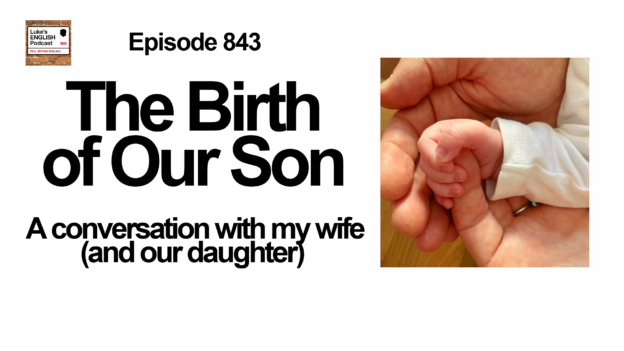
Talking to my wife (and daughter) about the birth of our son, who came into the world just a few weeks ago. We describe what happened, and explain how it feels to become parents for the second time. This is a very personal, first-hand account of childbirth and the experience of bringing a child into the world. Watch out for the language of childbirth and children which has previously been explained in episodes 162, 491, 492 and 814.
Hang out with me for an unscripted and unedited ramble about things like engaging moments while English teaching, how it feels to be about to become a father again, a funny new recording of my daughter speaking English, some recent films I’ve seen, and a recording of me doing stand-up comedy in front of an audience recently.
My dad has written a new book and he’s come on the podcast to tell us about it. The book follows the path of the river Avon as it flows through the middle of England, telling stories of key moments in British history, nature and the current condition of Britain’s rivers.
A conversation with Anna Tyrie from English Like a Native (YouTube, Podcast) about children, the way we talk to children, and vocabulary relating to children and childcare, and some special news from the Thompson family…!
Here is another episode with more English listening practice for you to get stuck into, and I have another guest on the show today.
This time it is Anna Tyrie from English Like a Native, the channel on YouTube. You might also know her from Instagram and TikTok.
Anna has recently set up a podcast too, which you can find wherever you get your podcasts. It’s called the English Like a Native Podcast.
In fact, on the same day we recorded the conversation for this episode of my show, Anna also interviewed me for her podcast and we had a good long conversation about all sorts of things. It was very nice to be interviewed by her. You should be able to find that episode on her show now. So if you enjoy this one, go ahead and listen to the one on Anna’s podcast too. You will find a link in the description 👆.
In this conversation: Get to know Anna a bit and talk a bit about her podcast and youtube channel and what the name really means.
The main subject – talking about children. We decided that we could talk about a particular topic for this episode and that topic ended up being children. I’ve had requests from listeners in the past for more on the subject of children and the English language, including the way we talk to children, the way we talk about children and the specific words for lots of things related to children.
We talk about our own kids, and specifically about how we communicate with them, typical things we say to them (in English of course), how we should be careful about the things we say to our kids, the ways adults adapt their English when talking to little children, including examples of so-called “baby talk” or “parentese” and then there is a sort of quiz at the end with questions about specific English words for lots of the different objects, toys and bits of useful equipment that we use with babies and little kids.
As you know I have a daughter and she is 5 so a lot of that baby stuff almost seems like a distant memory now, but, well, it’s high time I remembered all of that vocab again now because – drum roll… yes, my wife is pregnant again and we going to have another baby!
Yes we are delighted.
Thank you – because at this moment of course you are now saying…
“Wow, that’s fantastic! Congratulations! I’m so happy for you!” and then all the typical questions will come to mind, including:
Can I ask when the baby is due?
Do you know if it’s a boy or a girl? Would you like to know?
Are you ready?
Do you have any ideas for names?
How’s your wife doing, is she ok?
How does your little daughter feel about it? Is she excited?
Etc.
I’m sure I’ll talk about it again in another podcast, but I thought I would let you know now.
Of course the child hasn’t even been born yet, so there’s a long way to go.
But all being well, in July there will be a new Thompson arriving 😊
I don’t know how that will affect the podcast.
Of course it’s probably going to disrupt things to some extent as I will be busy at home, with my wife, looking after the baby, helping my wife with anything if she needs it, taking care of our daughter, trying to keep things ship shape and under control and generally just being at home focusing on the family.
So I won’t be able to do much podcasting around the time of the birth and in the weeks after. Who knows, maybe I’ll disappear completely for July and August, or maybe I’ll find a way to keep podcasting.
Maybe, if I’m organised and industrious enough, by the time the baby arrives I will have recorded lots of episodes beforehand, which I will be able to publish over the summer, or maybe I’ll dig into my archives for some unpublished or lesser-known material, which a lot of people haven’t heard – like app-only episodes from the LEP App (which is now defunct by the way).
In any case, there might be some kind of disruption to the show. Thank you for your understanding and your patience and your lovely messages of congratulations and support, which you are welcome to write to me.
Obviously, I’ve just said thank you for a thing you haven’t even done yet, which is kind of against the rules, but anyway. There it is. We’re very happy. We’re hoping everything goes well. I’ll probably talk about it a bit more in another episode later on.
So, now let’s get back down to earth here because this is a conversation with Anna from English Like a Native, getting to know Anna a bit and then talking about the English which we use with kids, about kids and for all the bits and pieces involved in looking after kids.
By the way, this conversation was recorded in January, which is why I say “It’s January” at the start. I probably didn’t need to say this, did I? You probably have the deductive skills to work out that when I say to Anna “it’s January” it’s because we recorded that in January. But just in case you were worried that I don’t know what month it is, don’t worry, I do know what month it is, what year it is and generally where I am and what’s going on. OK, fine.
I will speak to you a bit again at the end, but now let’s get started with the interview right now.
Ending Transcript / Notes
Thanks again to Anna.
You can find a vocabulary list and notes on the page for this episode on my website if you want to check specific words.
A reminder – after recording this, Anna interviewed me on her podcast and as I said earlier we had a good long conversation about lots of things, with little stories and jokes and stuff. A long conversation. I think it was even longer than the one you just listened to. I’m wondering how Anna is going to deal with that, but you can find out for yourself by listening to that episode on Anna’s podcast- English Like a Native, which is available wherever you get your podcasts.
Thanks for listening everyone.
Have a lovely day, morning, evening or night etc. Goodbye!
Vocabulary Lists
Baby-talk in English
Examples of baby talk in English
Cutie-pie
Sweetie-pie
Munchkin
Cheeky-monkey
Wee / Wee-wee / pee / pee-pee
Poo / poo-poo
Potty
Dog / doggy
Cat / kitty
Jim-jams
Beddy-byes
Nighty-night
Sleepy-time
Nap-time (do-do)
Blankie
Din-dins
Ickle (little)
Icky – disgusting
Bedtime stories / Story time
Tummy / Belly
Oopsy-daisy
Mama
Mummy / Daddy
Uncle Jamie
Grannie / Grandad
Yuk / yukky
Common words and phrases relating to babies/children/childcare
This list includes words and phrases which came up in the quiz.
Activity arch / baby arch / arch toy
Baby bouncer (like a small deck chair)
Baby carrier / sling
Baby jumper
Baby fence / play-pen / baby-gate
Baby monitor
Baby-grow (a one-piece outfit that babies wear)
Bib (to catch or protect against food that falls while they eat)
Blanket (a lot of children have a special blanket that they use as a comforter)
Bottle (for milk)
Breast pump (a device which allows the mother to pump her milk into a bottle)
Changing mat (where you change the baby’s nappy)
Cot (where the baby sleeps – a bed with high sides so the baby doesn’t crawl out of bed)
Drool bib (to absorb drool which comes out of the baby’s mouth when teething)
Dummy / pacifier (what the baby sucks while sleeping)
Flannel (an absorbant cloth)
High-chair (what the baby sits in while eating)
Mobile (the thing that hangs above the bed and gives the baby something to look at)
Nappy (US English: diaper)
Powdered milk
Pram / pushchair (UK) buggy / stroller (US)
Pyjamas
Rattle (a toy that the baby can shake to make a rattling noise)
Talcum powder / talc (powder which can be put on the baby’s bum to keep it dry)
Teddy bear / stuffed toy
Teether / Teething toy(for teething babies) (something the baby can chew while the teeth come through)
A quick ramble about why this is the final part of episode 800, why there was a delay between part 2 and part 3, some comments about having flu, and about World Cup 2022.
This website uses cookies to improve your experience while you navigate through the website. Out of these, the cookies that are categorized as necessary are stored on your browser as they are essential for the working of basic functionalities of the website. We also use third-party cookies that help us analyze and understand how you use this website. These cookies will be stored in your browser only with your consent. You also have the option to opt-out of these cookies. But opting out of some of these cookies may affect your browsing experience.
Necessary cookies are absolutely essential for the website to function properly. These cookies ensure basic functionalities and security features of the website, anonymously.
Cookie
Duration
Description
cookielawinfo-checkbox-analytics
11 months
This cookie is set by GDPR Cookie Consent plugin. The cookie is used to store the user consent for the cookies in the category "Analytics".
cookielawinfo-checkbox-functional
11 months
The cookie is set by GDPR cookie consent to record the user consent for the cookies in the category "Functional".
cookielawinfo-checkbox-necessary
11 months
This cookie is set by GDPR Cookie Consent plugin. The cookies is used to store the user consent for the cookies in the category "Necessary".
cookielawinfo-checkbox-others
11 months
This cookie is set by GDPR Cookie Consent plugin. The cookie is used to store the user consent for the cookies in the category "Other.
cookielawinfo-checkbox-performance
11 months
This cookie is set by GDPR Cookie Consent plugin. The cookie is used to store the user consent for the cookies in the category "Performance".
viewed_cookie_policy
11 months
The cookie is set by the GDPR Cookie Consent plugin and is used to store whether or not user has consented to the use of cookies. It does not store any personal data.
Functional cookies help to perform certain functionalities like sharing the content of the website on social media platforms, collect feedbacks, and other third-party features.
Performance cookies are used to understand and analyze the key performance indexes of the website which helps in delivering a better user experience for the visitors.
Analytical cookies are used to understand how visitors interact with the website. These cookies help provide information on metrics the number of visitors, bounce rate, traffic source, etc.
Advertisement cookies are used to provide visitors with relevant ads and marketing campaigns. These cookies track visitors across websites and collect information to provide customized ads.