Category Archives: Movies

288. California Road Trip (Part 1)

Hello! Welcome back to LEP. This should be episode 288. How are you? I hope you’re doing alright. I’m fine thanks. I got back from my honeymoon in California just a couple of days ago. I’m dealing with jet lag. It’s grey and windy here (can you hear the wind noise in the background?) and my sun tan is fading, but it’s good to be back.

Small Donate Button[DOWNLOAD]
Thanks for lots of recent comments on the last few episodes of this podcast. Thank you sooooo much for all the lovely things so many of you wrote in response to the wedding episode of the podcast that I did recently. It’s really touching to read your comments. My wife also found them very sweet and nice.

This episode is about my recent honeymoon trip to California and I have so much to tell you about it. But before we start, let me just say a few things in the first few minutes of this episode.

First of all, I’d just like to say don’t forget to join the mailing list so you’ll get an email whenever I post a new episode, or other bits of content such as videos or blog posts. Also, you can subscribe to comments on this website too. When you leave a comment on a page, you can tick a box that says “Subscribe to comments”. Then whenever anyone else leaves a comment, including responses to your comments, you’ll get an email notification. It’s a good way to keep up with what other LEPsters are writing on teacherluke.co.uk

Secondly, I would like to say a big hello to YOU – yes, YOU – the one who is listening to this episode, and to say thank you for tuning in, using whatever means – either on the website, on iTunes, on your phone, your iPad, your android device, in your car, on your mp3 player, on your internet radio or just hearing it by chance because someone else is playing it to you, like your English teacher or something. If you’re with other people while listening to this, why not just turn to them and say a friendly, “Hi, how are you? Are you alright?”, just as a gesture of goodwill. There, that feels nice doesn’t it? If you’re a regular listener to LEP, then hi – welcome back. If you’re a long term listener then “hello old friend”. If you’re new to the podcast, then welcome to LEP. I’d just like to say that I strongly recommend that you keep listening to this podcast on a long-term basis, because let’s face it – learning a language is a long-term process, and I record this podcast with that thought in mind. Just listen regularly over a fairly long period and you will see improvements in your English – and that’s just from listening. There are other ways of speeding up the learning process by using my podcast and website as a resource (listen to episode 174 for more information on this) but at the very least, just enjoying listening to this podcast regularly is definitely a great way of keeping your English fresh. People often underestimate the importance of doing lots and lots of listening. It can make a big difference to many other areas of your English, including speaking, pronunciation, vocabulary and grammar. It’s particularly useful if you enjoy what you listen to, and you basically understand most of it, and that you feel that the person you are listening to is speaking to you personally. That’s what I aim to give you in these podcasts. The perfect listening resource to help you improve your English. So, I’d like to say thanks for listening, but I’d also like to say “well done” for listening too, in order to remind you of the benefits that you get from listening to this. Well done, you’re doing the right thing and your English will benefit from it as a result. It’s quite simple really. It’s not rocket science. For more information on this kind of thing, just listen to my other episodes, and have a look at my website which is teacherluke.co.uk. You’ll find loads more information and useful content there.

Introduction
Now, as I mentioned before, this episode is all about my recent trip to California in the USA for my honeymoon! As you probably know, I recently got married and my wife and I decided to go to California, and now I’m back, and my tan is fading, but the memories are still fresh in my mind, and I’d like to share them with you. So, let’s go to the USA in this episode and go on a road trip around California!

Notes & Transcriptions
You will find some notes and some transcriptions on the page for this episode. In fact, if you’re reading them now then you’re reading them now. There they are right in front of your eyes! Just a reminder if you want to find this episode on teacherluke.co.uk – just look in the ALL EPISODES archive for episode 288, or just type in the search bar on the right of the screen the number “288” or the word “California” and you’ll find it easily.

The following words and sentences that you can read on this page are not a full transcription. They’re just notes. Some parts are transcribed, but mostly these are just basic notes, which means that they are not always full sentences. They’re just words and phrases written to help me remember details of the trip.

I wrote these notes on my iPhone during spare moments on holiday, and also when I got back, and I used them to help me record the episode you’re listening to now. I hope you’re listening, and not just reading – remember, this is a podcast and not a blog. It is designed primarily to be listened to.

Here’s what you’re going to get in this episode (or series of episodes)
This is a sort of diary or report of what happened on my honeymoon in California, but it’s not just a description of a honeymoon. It’s more than that, because not only am I going to tell you a few stories about what happened and what we did, but I’ll also explain a bit of cultural and historical information, as well as give you some practical tips, including ways of communicating effectively in various situations.

I’m going to tell you what it’s really like to be in California. It’s a description of the culture, geography, people, history, sights, sounds, smells and more. I’m going to tell you what it’s really like to deal with customer service there, what’s it’s really like to drive in the USA, what it’s like to deal with problems, what some of the linguistic differences are, what the climate is really like, what the food is really like, some of the history and cultural highlights, how to get along with people in the USA, how to develop the right relationship with waiters, hotel staff and other key people. It is a description of my honeymoon, but I also want it to be a lot more than that. I want to take you with me on my holiday, and teach you some things along the way, and it’s all in English of course so not only are you going to join me on a geographical and cultural journey, but also you’re going to plug yourself into a source of natural English spoken from me to you, right here, right now. You can pause it any time you like, you can rewind and listen again, you can slow it down, you can speed it up, you can fall asleep and listen again later, you can transcribe it, you can repeat after me or you can just relax and enjoy listening. So, brew a cup of tea or coffee, get comfortable, get uncomfortable and then get comfortable again, smoke a big cigar, pretend your working on a big excel spreadsheet at work – do whatever you have to do to enjoy the episode. I hope you like it and find it useful.

As usual, I’m not sure how long this episode will be, but I’m pretty sure it will be another mini-series of episodes as I have quite a lot to say about this trip.
You can visit the page for this episode in order to find some of this episode transcribed, some of the notes I wrote in my phone while I was there and other things like links and photographs of the trip.
Now let’s get started with the first part of this story.

Following the tradition, you are going to hear me doing my first recording in a toilet on a plane.

6 August – Recording 1 – In a toilet on a plane again, above the Atlantic Ocean
You’re listening to Luke’s English Podcast
Where am I? I’m in a toilet on a plane again.
This is becoming a tradition – recording podcasts inside toilets on different modes of transport.
We are going to California for our honeymoon.
It’s the land of Hollywood, Baywatch, Coastal Highways, the Golden Gate Bridge, Alcatraz, Yosemite national park, the tallest trees in the world and open top cars etc.
I’m hoping to record short episodes at regular times during the holiday.
I’ll try to teach you something in every location, and I’ll just describe what I’m seeing and what it’s like.
I might even interview a few people that I meet because, you know, they speak English in America too of course – a kind of English.
I’m flying to New York.
What happened?
Flight was overbooked. Flight companies overbook their flights to make sure it’s not a loss of money for them.
We checked in, in person, not online. Why? We were hoping to get upgraded because we’re on our honeymoon.
Everyone told us to mention we’re on our honeymoon, as that would be the key to unlock numerous upgrades, rewards and treasures.
We were hoping to be upgraded to business class or something.
In fact we sort of got downgraded.
Talk about the overbooking process.
Mention the change of route.
It’s not that bad.
All’s well that ends well.
Despite the inconvenience and the delay and the stress we are nevertheless on our way. So all’s well that ends well.
(Let’s hope this ends well and that we do get to our destination ok in one piece)
That’s it – this is Luke Thompson in the toilet signing out.

I originally intended to do recordings while I was there, using my mp3 recorder, including some random interviews with American people, but that didn’t really happen in the end. I mean, it was my honeymoon so the main point was to share a special time with my wife. I wasn’t going around with a microphone the whole time, interviewing people and talking to myself.

However, I did manage to get an interview with one person – and that was perfect and really special, and very appropriate to Luke’s English Podcast, which is primarily for people who are learning English as a foreign language. Who did I manage to speak to? Well, it was the one and only AJ Hoge, who you may well be aware of. He’s the internet’s most famous English teacher. You’ve probably come across him at some point. He has an online teaching programme which he has called Effortless English. He’s made a big success of himself as an independent online English teacher, he’s a native speaker of American English and a resident of California, so he’s the perfect person for me to have spoken to. So, in the end that makes up for the fact that I didn’t speak to any locals on the podcast. I got AJ, so that’s fantastic – it happened in San Francisco so you can expect to hear my conversation with him in that part of the story.

Our California Itinerary
California has so much to offer – climate, different environments, famous sights, shopping, good food, beer, wine, musical history, literary ties, connections to counter culture and it’s the place we’ve seen in so many films and TV shows.

Itinerary: LA – Yosemite – SF – Coastal Highway via Monterey, Carmel, San Luis Obispo, Santa Barbara, Malibu – LA.

We only had two weeks, so there was no way that we could do and see everything. In fact, I think you shouldn’t try to do too much on holiday. I’ve said it before: holidays are like pizzas. Don’t put too many toppings on a pizza. Don’t try to do too many things on a holiday. OK, maybe holidays aren’t that similar to pizzas, but you get the idea.

I’m lucky enough to be able to travel
I generally get the chance to travel somewhere on holiday about once a year. This trip was a bit special because it was my honeymoon and we planned to go on a slightly more expensive trip. Anyway, I’m still lucky to have the opportunity to go to different places, quite far away. Not everyone has that luxury. You might not have that luxury. Admittedly, you might have that luxury – I’m sure many of you are very well travelled. But I also know that plenty of the people who listen to this free podcast don’t have the chance to go on many foreign adventures. So, I hope you enjoy the experience of listening to my account and that I give you an idea of what it’s really like to drive around California for a couple of weeks. And if you have had the luxury of going there, then perhaps you can compare your experiences to my experience. Did you experience similar things and have the same thoughts and feelings? What are some of the the thoughts in your head as you listen to my account on this podcast?
As ever, please leave your comments on the page or pages for this episode series. That’s not just for my reading pleasure, but also so you can share thoughts and ideas with your fellow LEPsters.

California Diary Continued – 6 August/7 August
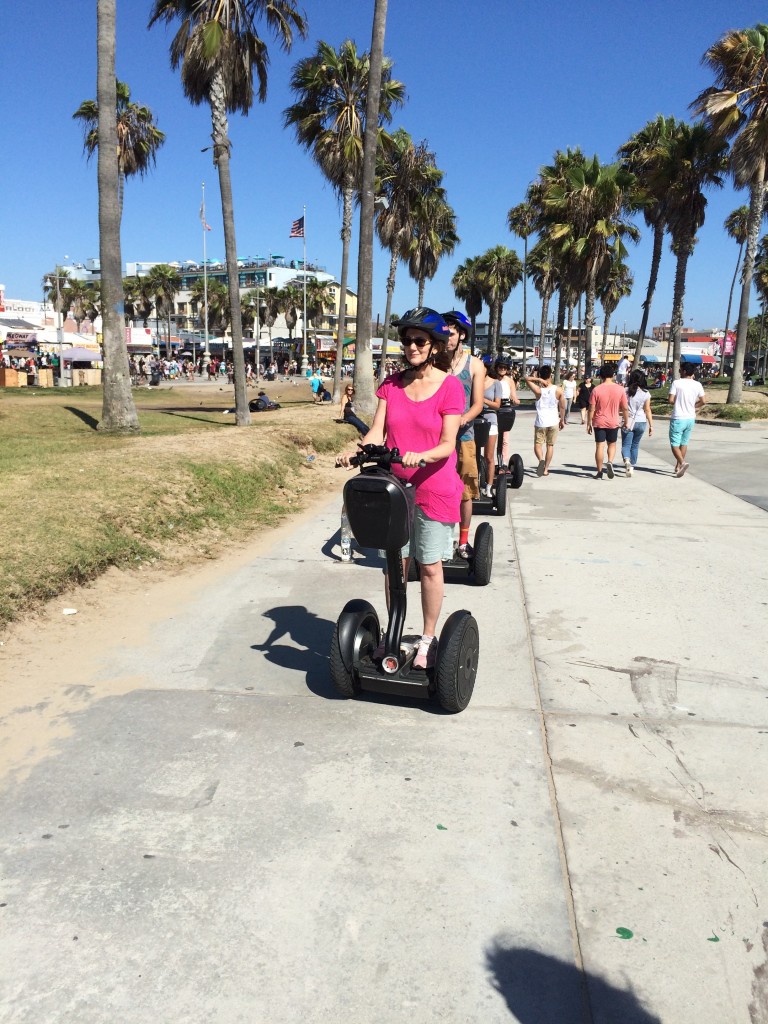
In the taxi we heard “Hotel California” on the radio, and even though it’s a bit of a cliché, it was a perfect soundtrack to the trip. From the taxi we saw silhouettes of palm trees swaying in the breeze, the shapes of the Hollywood hills in the distance, Spanish style villas, lines of headlights of cars on long highways, the warm temperature outside and the spacious streets and empty sidewalks. Wow, we’re in movieland – LA, is it real or just a jet-lagged dream? This is how it felt at the beginning. We felt a million miles from home, and in a strangely familiar environment – one that we’d seen before in a hundred movies. It was like entering a recurring dream.
LA is a big place, but so is the USA as a whole.
We flew over it for hours and hours. It made me think of the people, years ago, who made that journey on foot or horseback. It took them years and years. They travelled in groups, families etc. People died and were born on the journey. Now we see it as an annoying inconvenience that takes 5-6 hours out of our holiday.
LA, Hollywood
Arrived and went for some dinner.
Service – very personalised. “Hi my name’s Derek, I’ll be looking after you this evening. Can I get you something to drink before we start?” Mammoth sized cups of water and ice arrived. I ordered one beer, I got two because of some kind of special offer I wasn’t even aware of. There’s always some kind of deal, discount or offer available. Already we had way more than we needed.

A Note on Customer Service
Generally, in my experience customer service in the USA is good, despite a couple of negative experiences I had there. There’s a bit more ‘back and forth’ than in the UK (I mean, standard things that you say in general interactions with waiters or staff), and it’s a bit like a little game you have to get used to.
For example:
Hi guys, good morning, how are you today?
Fine thanks, and you?
I’m good thanks for asking. If you need anything at all, my name’s Stacey.
What if we don’t need anything, then what’s your name?
I’m sorry?
You said, if we need anything, you name’s Stacey. What if we don’t need anything, is your name still Stacey? It’s… I’m sorry it’s just a joke.
Oh, I see! You’re joking! Hahahaha!
Sorry, I’m English.
No problem! I love your humour, so dry, right?
Yeah.
Well, just enjoy you guys. Let me know if you need anything.
Thanks for your help Stacey.
Have a nice day now.
You too.
I will, thanks for asking!

Staff tend to be friendly, attentive and professional, probably because quite a large part of their wages comes from tips, so they have to make the right impression. Sometimes though, as a foreigner, it seems a little tricky to get through to the staff if you have particular requests, or perhaps because of the cultural/language barrier. I think this applies to the UK too. Because you’re not local, you don’t know the normal ways of doing things, so you need to make a slightly bigger effort to help bridge the cultural gap. You might think – but this is exclusively the job of the waiter, he/she should make all the effort.

Be realistic, the waiter is a person and they’re not always an expert in cross cultural relations either. If you want to achieve something, and get what you want, you just need to make a bit of extra effort yourself. This means greasing the wheels with some niceness, charm, a smile and a willingness to make things work. So, what’s my advice for getting good customer service when you’re in a foreign country? Just that – try to be clear, positive, friendly and remember that the waiter or whoever it is that’s giving you a service is just a person doing a job. It’s easy to let things break down because of slight cultural differences. It’s important to make an effort to help the person to help you. I say that because I’ve seen people in the UK who got offended by what they perceived was bad service, but was in fact just a slight breakdown in communication. Give your communication a chance and be patient, friendly and helpful, and don’t expect the staff member to understand everything you say the first time around.

L.A. Continued… 7 August
Space.
Coffee & breakfast
Car
Weather
Location
Phrases “you got it” “you’re all set” “I’m good”.
Palm Trees, hotel California, film noir, Raymond chandler, Charles Bukowski, a million movies. The whole place is like a movie set.
This is a movie town – everything is fake and it’s all about veneer. As well as being sunny all the time, there is a mysterious and slightly sinister feeling to the place too, which is perfectly captured by the classic detective stories of Raymond Chandler and other writers, and the movie versions of those stories, collectively part of the film noir movement. I’ll talk more about this mysterious atmosphere in a bit, but first…

Recommended Audiobook Download – The Big Sleep by Raymond Chandler
Let’s take a break from the UK’s favourite books for this series, and look at a few recommendations for California-related audiobooks you could download free by going to www.audibletrial.com/teacherluke
Recommendation #1 – The Big Sleep by Raymond Chandler
This is perhaps THE classic American detective story. It’s set in LA and it is absolutely full of dark and mysterious atmosphere, as well as understated cool humour and sizzling tension. It follows private detective Philip Marlowe as he tries to solve a complex case, while dealing with several dangerous and seductive female characters and some violent murderers. It perfectly captures the atmosphere of a film noir movie set in LA, and it’s really well read by Ray Porter. This is the blueprint for so many other detective stories featuring tough and cool, yet ultimately vulnerable heroes. Imagine films starring Humphrey Bogart for example. It’s glamorous, brutal and extremely well written stuff. www.audibletrial.com/teacherluke The Big Sleep by Raymond Chandler. It’s got an average rating of 4.3 out of 5.

California Diary – LA, Continued…
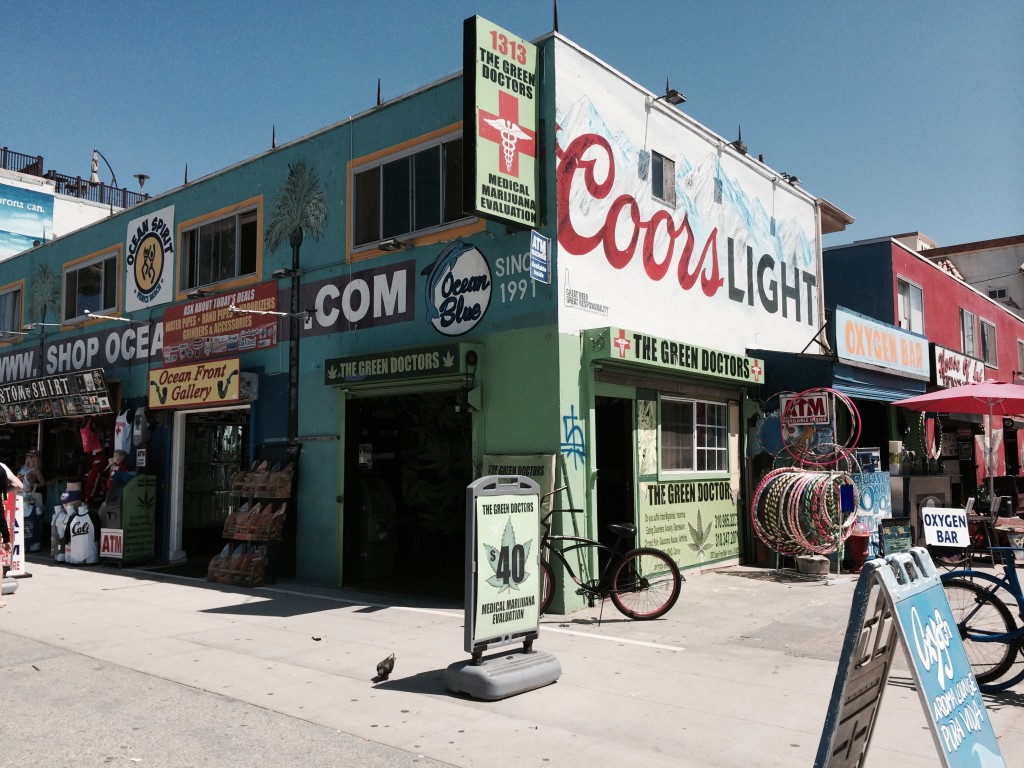
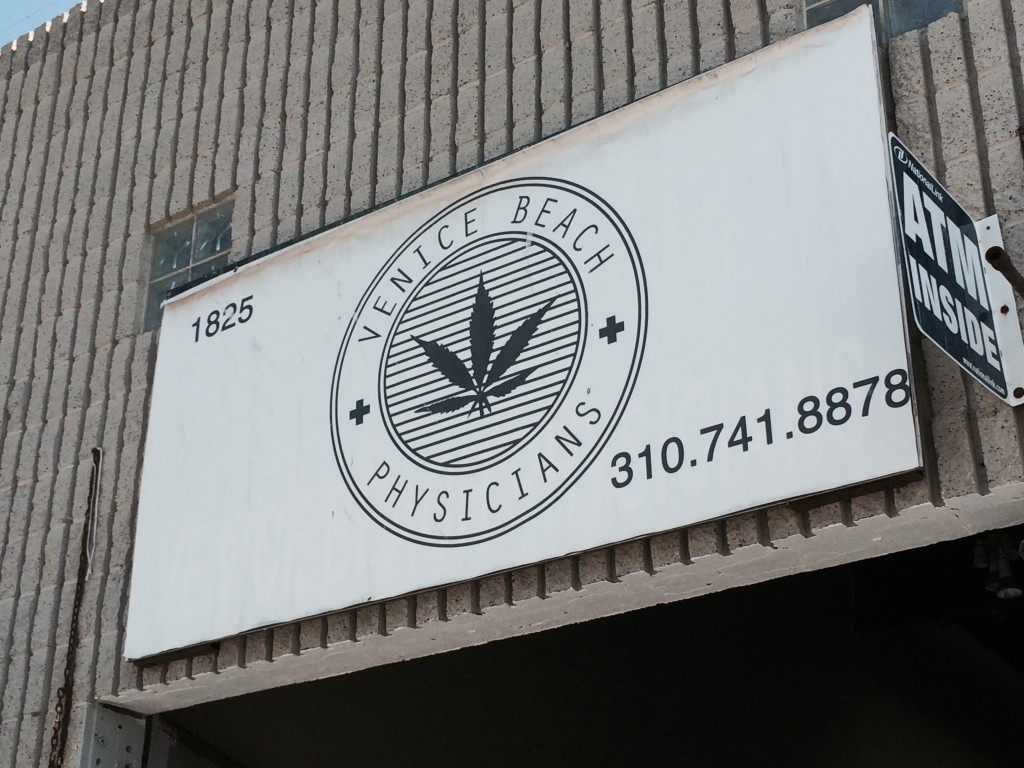
Nothing is real here. There’s a strange feeling that you’re living in some kind of dream, and I don’t think that is entirely the result of breathing in the marijuana vapours which are floating around in the street in so many places.

It’s hard to date the buildings. They could be old, or they could just be built in an old style. LA doesn’t have the same depth of history as in Europe. There’s evidence of a colonial past, but also so many buildings are new but designed to look like they come from another period, like Spanish villas for example.

It’s all like a movie set, and if you took away the facades of the buildings, it’s just a desert underneath. So, the buildings are a kind of facade. Everything is a bit fake, like in a movie. It’s hard to know what is real. The people also seem a bit distant. They’re sweet, and hippyish, if a bit shallow in some circles. It feels like everyone is high, in fact they probably are, because smoking marijuana is more and more popular.

There’s no evidence of smoke when you walk around, but I’m sure people are ‘vaping’ all over the place. I can smell it. In the corridors of our hotel, in the street outside bars.

California’s Marijuana Laws – An Interesting Legal Conflict
California has an interesting position on marijuana use, and this reveals an interesting conflict between state and federal law in the USA.
Is pot legal in California?
What about smoking tobacco?
Do people smoke in the street?
What is ‘vaping’?
Where do people buy weed in California?
Did you see it or smell it there?

More in part 2 soon…
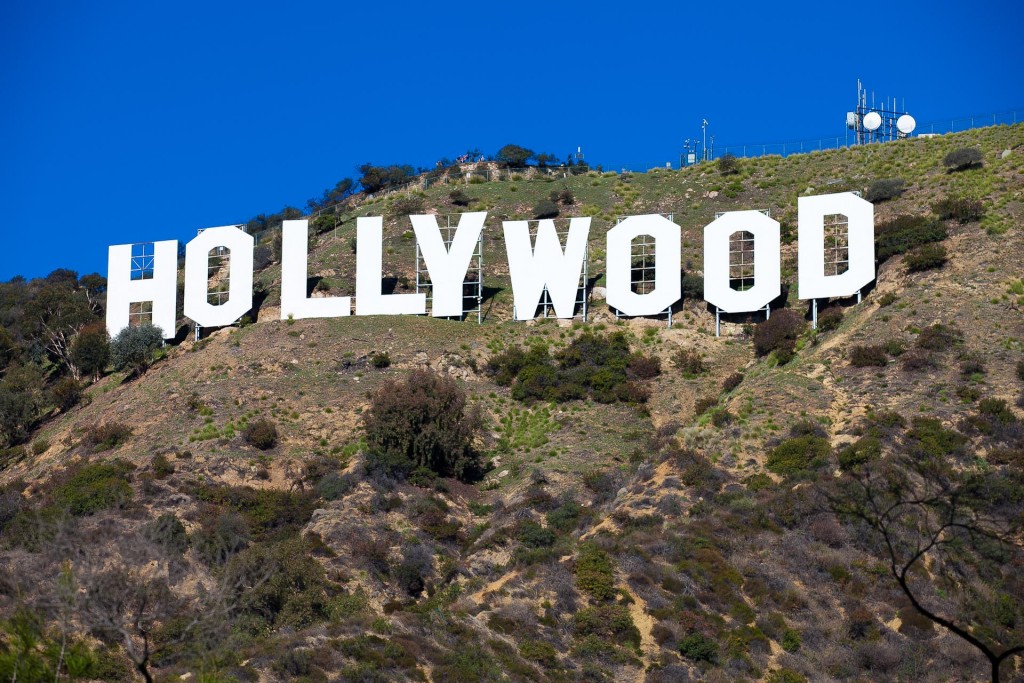
Hollywood-Sign

271. Catching Up with Amber & Paul

Today I’m joined by my mates Paul Taylor and Amber Minogue, both of whom have been on the podcast before. Let’s catch up with them and see what they’ve been doing. Listen to the episode to hear a completely unscripted and authentic chat between 3 native speakers from England, as we talk about having babies, pedestrian crossings, having ginger hair, the difficulties of being English in the sunshine, and some of our favourite TV shows and films.
Small Donate Button[DOWNLOAD] [FREE AUDIOBOOK OFFER]
Amber
Click here to listen to Amber’s previous interview on LEP, in which she talked about having a baby.
How was the birth?
You said you would go with a natural birth before. Did you?
What’s it like being a mum?
Best things? Worst things?
Sleep? Nappies?

Paul
Click here for Paul’s previous episodes on LEP. Part 1 and Part 2.
What have you been doing?
Click here to visit Paul’s YouTube channel for Taylor’s Top Tips

Topics in this Episode
We talk about various things including:
– Amber’s baby, the birth and what it’s like to be a Mum
– Paul’s news, including his short YouTube videos called Taylor’s Top Tips (started on Instagram, then moved it to YouTube).
– The sound effects from my terrace (the sounds of the street, the sounds of people stepping in dog poo in the street)
– Pedestrian crossings in Paris vs Dog poo
– The dangers of crossing the road in Paris
– The difficulties of being English in the sunshine
– Struggling with a folding chair while avoiding a spider
– Ginger people / having a ginger beard / being a ‘ginger ninja’
– Are Italian people obsessed with ginger people?
– Game of Thrones and other TV shows like Breaking Bad, Suits, Dexter, The Walking Dead, Lost, House of Cards etc.
– TV series vs Films
– J.J. Abrams the director of the new Star Wars film, and his love of lens flare.
– Amber doesn’t like ‘wiggly camera’ – shaky, handheld camera effects – like in the Jason Bourne films and the Taken films.
– The film Cloverfield (directed by J.J. Abrams)
– The Blair Witch Project (1999)
– Recommended TV series (plural – series, singular – series). Amber: Game of Thrones and The Wrong Man’s, Paul: Fawlty Towers, Luke: Louie.
– Vocabulary: A TV series (e.g. Game of Thrones) – not a serie, a season (e.g. season 1, season 2 etc – in the UK we used to say ‘series’ not ‘season’ but now most people say ‘season’)
– Serial? It’s an adjective to describe a series of things – e.g. a serial publication. In my opinion we don’t say a ‘TV serial’, we say a ‘TV series’. Amber and Paul don’t agree.
– Criticisms of French television (a bit of French bashing here? or genuinely valid criticisms of French TV?)
– Summarising the conversation: Jumping into gingers (“Don’t jump into anyone too quickly, you have to give them fair warning in advance”), we detoured into TV, the escapade/debacle with the chair, spending time in the sun
– Orphan Black (TV show)

Taylor’s Top Tips

For the Geeks: What is lens flare?

The trailer for Cloverfield
Directed by J.J. Abrams. Lots of shaky, handheld camera (or ‘wiggly camera’ as Amber described it)

Orphan Black trailer

AmberPaulPIC

261. What is Britishness? (Part 1)

In this episode I’m going to explore the notion of “Britishness”, including the stereotypes, the reality and the complexity of defining Britishness, or any other national identity. You’ll find that a lot of what I’m saying is transcribed on the page on teacherluke.co.uk for this episode, although not all of it has been prepared in advance, and there will be moments when I go off script and improvise. So, this episode is a mix of scripted and unscripted bits. This might be a long episode – I have no idea at this stage! If it is really really long, I’ll divide it into several episodes, and you’ll just get even more for your money, which is a lot considering it is a free podcast! [Download]
Image: Gene Bible http://www.genebible.co.uk
Small Donate Button

I’m British so…
I must be some kind of 19th century cross between a gentleman and a hooligan, with a newspaper and umbrella under my arm, a cup of milky tea in one hand, and a pint of warm beer in the other, eating a bag of fish and chips while talking in Shakespearean English about the benefits of the rules of cricket and the class system before getting blind drunk at a football match, invading a bunch of developing countries, and then sort of apologising a bit, like Hugh Grant, because basically we’re just a bloody nice bunch of chaps who mean no harm and live in an antique world of Downton Abbey where we all just keep calm and carry on while being awfully polite and well-mannered, except when we’re playing Germany or France at football when we all forget our national anthem before transforming into a gang of brutal thugs who smash up the local town, blame it on illegal immigrants while we continue to eat our bad food under our bad weather using our bad teeth, the whole time making bad jokes in accents that nobody can understand before stopping everything in order to camp outside a hospital to await the birth of some blue blooded bawling British baby, who, if he’s lucky enough to make it to 100 years old, will probably put on a magic golden hat in an old castle to become our unelected and powerless king, like some twisted modern real-life version of Game of Thrones in 3D.

Yes, I’m from Britain. In fact, I’m from London…

Now, what’s all this about?
Well, this episode is all about defining “Britishness”, or attempting to do that.

I asked my students to define “Britishness” and that inspired me to do this episode
Recently in some of my English classes we’ve been studying topics related to the UK, such as the political system, the monarchy, the relationship to Europe and so on. In our first lesson we considered the idea of Britishness, national identity and the citizenship test. As a warm-up exercise I invited my students to try and define “Britishness”. The results were the usual mix of stereotypes and genuine insight. It’s interesting to me, to see the difference between how my students see my country from an outsider’s point of view, and how I see it from the inside.

Britishness is hard to define
It seems that defining “Britishness” is harder than you might expect. In fact, the more you think about it, the more complex it becomes. It’s remarkably hard to put your finger on a universally true definition of Britishness. Instead you end up with the usual stereotypes – either held by foreigners who have their own view of the UK, or by British people themselves who, for one reason or another, define their culture with certain reference points. E.g. it’s fish and chips, or it’s a cup of tea and a game of cricket on the TV. But I want to go a bit deeper than that. So that’s what I want to attempt to cover in this episode – Britishness. What is it? What is it not? I might not be an expert social historian, and I might not have all the answers, but nevertheless, let’s get stuck into this topic and see what we come up with. Essentially, in this episode I’m going to talk about British images in order to give you a broader understanding of the topic, beyond just the usual stereotypes.

To prepare for this question I’ve written myself some notes. I’ll add it to the transcript collaboration page. Also, please feel free to add comments under this episode on teacherluke.co.uk.

So, let’s get started – “What is Britishness?”

The Stereotypes of the UK from Abroad
Here’s what my students all came up with. I asked them to brainstorm things they associate with Britain, including values, people, and any other aspects of culture. You’ll find a lot of that listed below. I’ve also included what I’ve heard from students, and other people I’ve met over the years. I know I’ve talked about some of these things before (and I’ve talked about the fact that I’ve talked about things before, before too, and in fact now I’m pretty sure I’ve talked about talking about talking about things before, before, before too…) Anyway, here’s the list:
Bad food
Fish & chips
Jelly
Tea
The Queen (we worship her, apparently)
Hugh Grant
Bad Weather
Drunkenness
Football hooligans
Politeness
Indirectness
Colonial past
British Empire
Marmalade
Marmite
Margaret Thatcher
The Beatles, The Clash, The Arctic Monkeys, underground music and so on.
British movies (Gritty Brit Flicks?)
Relationship with the US
Literature – Shakespeare, etc
Sherlock Holmes
Confusing differences between the UK, Britain, England, Scotland, Wales, Northern Ireland, Ireland, Republic of Ireland, The British Isles, etc.
Strange “British” humour
…The list goes on – Please add your associations too in the comments. Are they well-informed ones, or just stereotypes. Don’t worry, I’m not going to judge you harshly. I’m interested in what the commonly-held images of the UK are in your country.

End of Part 1 – Click here for part 2

Song – “Autumn Almanac” by The Kinks
It’s song time again. I’d like to play a tune which I feel sums up a lot about British life, particularly English life. It’s called Autumn Almanac by The Kinks, written in 1967 I think.
It describes various aspects of English life. Imagine a picture book of images: Gardening, the weather, the end of summer and the approaching winter, escaping from the lack of sun by staying indoors and drinking tea, eating buttered currant buns, the atmosphere of a pub on a Friday evening, football on Saturdays, a roast lunch on Sundays etc. It has a kind of nostalgic feeling to it, and a slight sense of sadness along with national pride. Perhaps the sadness is the fact that this is a version of England which is slowly disappearing as the country modernises more and more, but perhaps these values and habits will always remain.

Buy “The Kinks – Something Else” (1967) on iTunes
Lyrics & Chords
A B7 E A B7 E
Am7 D7 G
From the dew soaked hedge creeps a crawly caterpillar
D7 C D G D G D7
When the dawn begins to crack, it’s all part of my autumn almanac
Am7 D7 G
Breeze blows leaves of a musty coloured yellow
D7 C D G D G D7
So I sweep them in my sack, yes, yes, yes, it’s my autumn almanac

Em E A9 B7 E A9 B7 E
Friday evening people get together, hiding from the weather
C#m G#7 C#m7
Tea and toasted buttered currant buns
F#7 Amaj7 Ab7
Can’t compensate for lack of sun because the summer’s all gone
Am7 D7 G D7
La-la-la la-la, la la la-la la la-la-la ohh! my poor rheumatic back
C D G D G D
Yes, yes, yes, its my autumn almanac
Am7 D7 G D7
La-la-la la-la, la la la-la la la-la-la ohh! my autumn almanac
C D G D G D
Yes, yes, yes, its my autumn almanac

G D C G G D C G
I like my football on a Saturday, roast beef on Sunday’s alright
G D C G G D C G
I go to Blackpool for my holidays, sit in the open sunlight
Gm Bb Eb F
This is my street and I’m never gonna leave it

F7 Bb Dm Fm G7
And I’m always gonna stay here if I live to be ninety-nine
G7/F C Cm G E7
Cos all the people I meet seem to come from my street
A7 B7 Em B7
And I can’t get away, because it’s calling me (come on home)
G A7
Hear it calling me (come on home)

Am7 D7 G D7
La-la-la la-la, la la la-la la la-la-la ohh! my autumn almanyac
C D G D G D
Yes, yes, yes, it’s my autumn almanac
Am7 D7 G D7
La-la-la la-la, la la la-la la la-la-la ohh! my autumn almanac
C D7 G D7 C D7 G D7 C D7 G
Yes, yes, yes, yes, yes, yes, yes, yes
C D7 G
Bop bop bop-m bop-m ba -ohh! (repeat and fade)

What do you associate with Britishness?
How do you define your own country’s national identity?
Please leave your comments below & practice your English ;)

Related Episodes
If you found this episode interesting, check out these ones too:
262. What is Britishness? (Part 2) – How do British people define Britishness?
128. Luke’s Stand Up Comedy Show – Featuring jokes about British food, weather and our Royal family – Now fully transcribed
131. Rickipedia – Conversation with my Dad, in which we answer various questions from listeners, including some things about British culture.
British Slang (A-C)
British Slang (D-G)
British Slang (H-M)
British Slang (N-Z)
156. British Comedy: Ali G
172. British Comedy: Peter Cook & Dudley Moore
177. What Londoners Say vs What They Mean
192. Culture Shock: Life in London (Part 1)
192. Culture Shock: Life in London (Part 2)
195. British Comedy: Monty Python’s Flying Circus
199. The UK/USA Quiz
202. British Comedy: Monty Python & The Holy Grail
219. Scottish Independence – Key notions of national identity

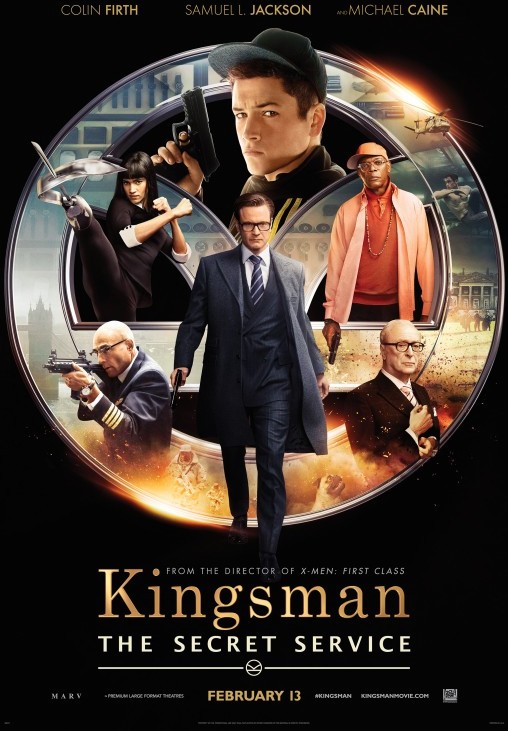
260. (Film Club) Kingsman: The Secret Service

In this episode I read out some poems written by listeners, and then it’s time for another episode of LFC (Luke’s Film Club). This time I’m reviewing the film Kingsman: The Secret Service. [Download]
Poems
Thank you for your poems in response to episode 258. I read some of them out in this episode. You can find the poems under episode 258.

kingsman_the_secret_service_ver7Kingsman: The Secret Service Film Review
Message from Dongsik (South Korean LEPSTER)
Luke, how are you?
It’s so abrupt but may I ask a favor of you?
Someday in your podcast, could you explain British culture in the film ‘Kingsman : the secret Seervice’? or just tell the audience about your thoughts on the film? If you don’t mind. For example, accent, clothes, social class, colin firth, whatever related to UK in the film. The movie really brings me back to UK. It’s so impressive to me.
I don’t push you, I kindly ask you, so I hope I could listen to those things in your podcast someday.

Kingsman: The Secret Service (Trailer)

Overview
-What kind of film is it?
-Who directed it?
-Who is in it?
-What’s the plot?
-What did I think of it?
-Elements of British culture
Certain symbols or icons of Britishness or certainly London life.
Class: The upper class & the lower class.
Posh people & chavs/hooligans

Good Things
It’s fast & furious, it’s never boring, it is visually quite arresting, there are some great actors involved, some gripping moments of action, and some genuinely shocking and stunning moments. It’s pretty funny and entertaining.

Bad Things
It’s a bit too ‘laddish’ for me. It’s too violent (Did I say too violent? Me?) I’m okay with violence in films usually, but this seemed to go over the top, in one scene in particular – and seemed to just enjoy the cartoon violence a little bit too much, like in Kill Bill Vol.1. It has its cake and eats it too – it’s parodying all the clichés of spy films, but at the same time celebrating them, and bringing the genre back to a point before it was post-modern and deconstructed.

It seems to have the same values as an old Bond film from the 1970s. It’s stylish and very British, but also misogynistic and quite right-wing. The ending, for example, is like something from the end of a Roger Moore film, but even more suggestive and explicit. Perhaps I’m being old-fashioned or something, but I found it to be a confirmation of sexist stereotypes. I think it was misjudged and a bit clumsy to end on a moment like that.
*Spoiler alert* I explain the ending here… (no great surprises though)
Posh images: tailors on Saville Row and their suits, umbrellas, pinstripes, wood panelled offices and gentlemen’s clubs in Mayfair, glasses of whiskey, old school ties, the British Army & secret service, privilege, a sense of entitlement, disdain for the lower classes.
Lower class images: Council estates, pubs full of aggressive criminals, cockneys, young criminals & gang members, petty crime, drugs, alcohol, fast cars, domestic violence, an irresponsible Mum who is abused by a violent boyfriend, London grime music such as Dizzee Rascal (although this side of London life is better captured by Attack The Block), London youth dialect.

Culture clash – between working class and upper class.
Much of this iconography belongs to the world of movies, fantasy or simply to the past. Not many people dress like Colin Firth in this film, or indeed act like him.
Other film/culture references: James Bond, The Avengers, Michael Caine films like The Ipcress File, My Fair Lady, The Bourne Identity.

All in all, I think it will do well internationally. The audience in Paris seemed to enjoy it a lot. It will probably be a hit with young blokes around the world who get off on the values of old James Bond movies, and who like comic book violence and a bit of casual sexism too.

Have you seen this film? Would you like to see it?

[socialpoll id=”2254996″]

257. Be Positive

This is an unplanned episode which contains some general thoughts on a range of different things. There is no specific agenda or language focus, but it does contain some news, a few film reviews as well as the usual spoken English and natural phrases which you can pick up if you’re listening carefully enough! The overall theme which emerged during the recording was that of being positive and making the most of what you’ve got. [Download]

Small Donate Button
Transcript
An LEP listener has transcribed this episode. Click this link to view the transcript. To view more transcripts for other episodes, click here to visit the transcript collaboration page.

In this episode I talk about lots of things, including:
Welcome to new listeners.
Getting used to living in Paris.
Going with the flow.
Looking on the bright side.
Seeing where life takes you.
The future is unwritten.
The benefits of staying positive and looking on the bright side.
Don’t let negative thoughts drag you down.
Take responsibility for the good and bad things you do.
Don’t beat yourself up if things go wrong.
See things as learning opportunities. (This is the self-help section of the podcast!)
No regrets.
Is the cup half full or half empty?
Philosophical Conundrums, such as “If a tree falls in the forest and there’s nobody there, does it make a sound?”, “What is the sound of one hand clapping?” and “How long is a piece of string?”
What is the word for a philosophical conundrum? I couldn’t think of it, but do you know the word I mean? Leave your comment below.
Macmillan competition news.
Please tell a friend about LEP.
The transcript collaboration.
Thank you to certain Lepsters who have contributed to the podcast – you’re super-special LEP ninjas.
Some quick film reviews: Imitation Game, It Follows and Foxcatcher.
Eulogy for Dennis, my grandfather.

Please do leave your comments here on the page. I look forward to reading your thoughts, conversations and responses.

Luke

p.s. the word I was looking for was… a paradox. Thanks Edgar for jogging my memory.
[socialpoll id=”2252240″]

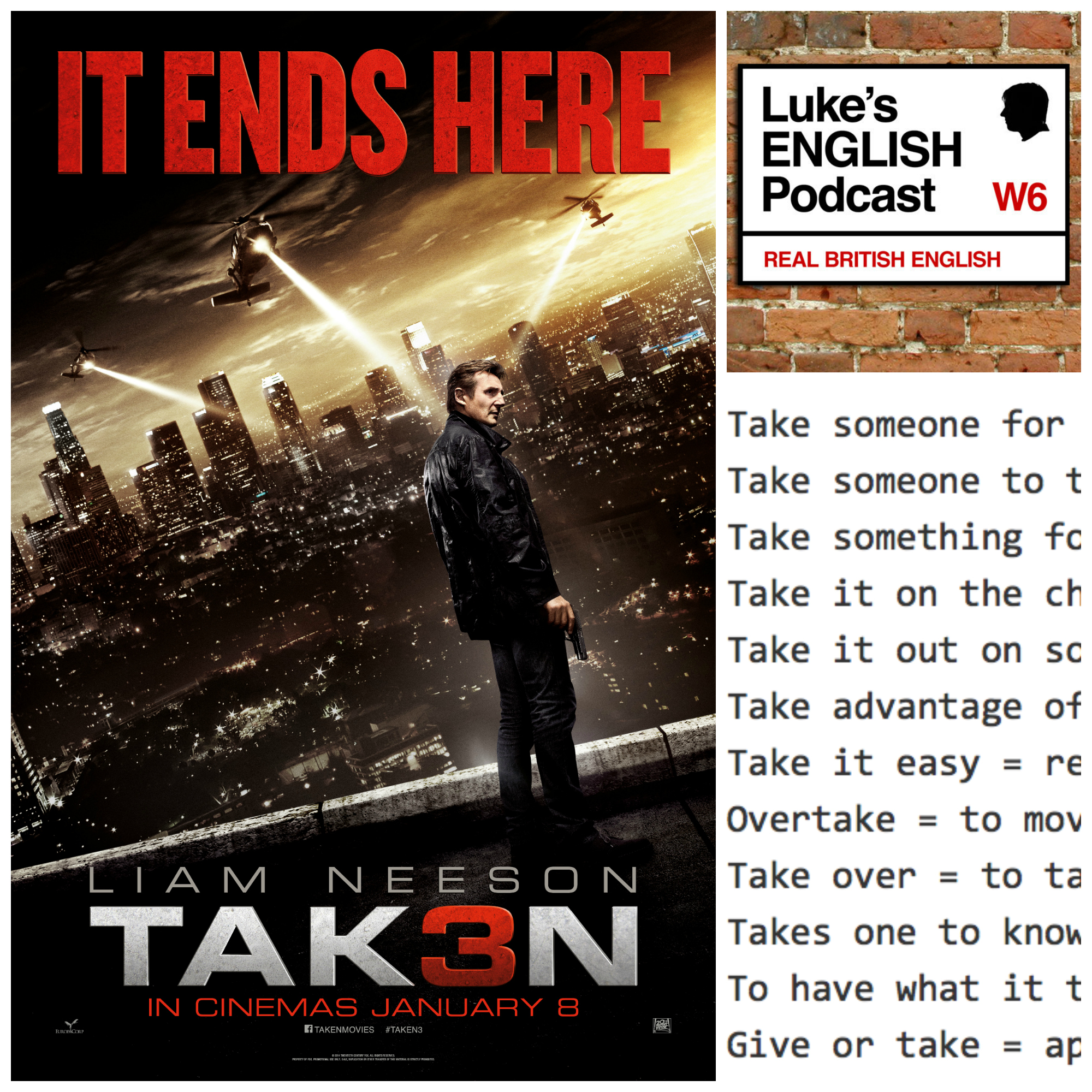
255. Taken 3 / Expressions with ‘Take’

My response to the film Taken 3, plus 12 expressions with the word ‘take’. [Download]

The Film
*Spoiler alert* – I might give away some details of the story line, although I think you probably have a good idea what kind of thing you can expect. Someone did something to his family, and Liam Neeson will use his very particular set of skills to find them, he will hunt them down and he will kill them. There will be loads of high-octane action, some very questionable moral actions, and the usual offensive stereotypes of foreign people.

You should know that I’ve talked, at length, about Taken 1 already on this podcast.

Yesterday I went to the cinema and tweeted “I’m on my way to see Taken 3…” Naturally, some people wanted me to talk about it on the podcast, so here it is.

In a nutshell, this film is bad – it’s total pants, it’s piss poor, it’s lame, it’s cheesy, and frankly, it’s dull. It’s like a b-movie, but with Liam Neeson. It retains few of the redeeming qualities of the original, brings nothing new to the table and just looks like everyone involved is just doing it for the money. That’s not to say it was without enjoyment – I did enjoy it a bit, perhaps because I’d lowered my expectations before going into the cinema.

Expressions with Take
There are loads. Here are 12. Listen to the episode to hear full explanations and examples.

1. Take someone for a ride = to rip someone off
2. Take someone to the cleaners = to rip someone off, or to beat someone
3. Take something for granted = to undervalue something which is actually very valuable to you
4. Take it on the chin = to be strong and resilient in the face of criticism or adversity
5. Take it out on someone = to express your anger/frustration by being nasty or aggressive towards someone else
6. Take advantage of something = to make the most of it, to exploit it
7. Take it easy = relax
8. Overtake = to move in front of someone (e.g. in a car)
9. Take over = to take control of something (to acquire)
10. Takes one to know one = In order to know something you have to be that thing too
11. To have what it takes = to have the necessary qualities to do something
12. Give or take = approximately

[socialpoll id=”2249079″]
Taken3PIC

247. Understanding The USA (with Sebastian Marx)

This episode is an attempt to understand The USA in more detail, getting beyond the made-up version that we see in movies and on TV in order to get a proper understanding of the country, its culture and its people. I’m joined by an American friend of mine called Sebastian Marx, and during our conversation we go through most of the main events in the history of the USA and discuss some of the most important principles in the story of the country. The ultimate aim: to understand The United States of America. [Download]

As well as being a relaxed conversation between friends, this episode is a summary of some of the main ideas and topics that I’ve covered this semester in my university classes, and in fact our conversation deals with some of the most important issues and concepts that will help you to get a proper understanding of the USA – and you’re getting it all for free in this episode! You’re welcome of course… if you fancy making a donation to support my work you can just click this button here! Small Donate Button

Speaking to Sebastian in this episode allows me to check some of the thoughts I had about the USA with a genuine American guy, as a way of getting the inside story. Ideally I would like ask all the people of the USA for their opinions, but as I can’t do that I have decided to just ask one American guy for his input, and he isn’t even in America at the moment – but that’s more than good enough for me!

You probably know Sebastian from previous episodes of LEP. He was in 130. A Cup of Tea with Sebastian Marx and also 183. Luke’s D-Day Diary (Part 1). He’s a stand-up comic who performs a one-man show in English and French, entitled “A New Yorker in Paris”, and he’s a very funny and interesting bloke. For more info on Sebastian go to www.sebmarx.com.

As usual, I would like to know your opinions, so if anything occurs to you, please leave your comments below this episode. I’m actually quite pleased with the outcome of this one because I think there is some genuine insight in this episode, even if it is delivered by two guys just having a chat.

America

241. Film Club: Star Wars

“Luke’s Film Club” continues with one of my all-time favourites: Star Wars! In this episode I’m going to ramble on about the Star Wars franchise, including the original trilogy (episodes 4-6), the prequel trilogy (episodes 1-3) and the upcoming new trilogy (episodes 7-9). If you’re a Star Wars fan, this one’s for you! If you don’t like Star Wars, I hope this episode will give you some idea of why people are so crazy about these movies. [Download]

Small Donate ButtonContents
In this episode I talk about these things:
– The new Star Wars Episode VII Trailer
– A history of the Star Wars films
– An overview of the storyline for the original trilogy and prequel trilogy
– Some reasons why I like the original films so much
– Some sound effects from the films!

Videos
Here’s the Episode VII Teaser Trailer

Here are some must-see video reviews of the prequel trilogy by RedLetterMedia. For me, these explain (in a very funny way) exactly what is wrong about episodes 1-3. They’re genuinely brilliant reviews, which must have taken a long time to make.


2000px-Star_Wars_Logo.svg
[socialpoll id=”2235106″]

228. Zombies! (Part 1)

This is part 1 of a two-part series about zombies! Right-click here to download.

Small Donate ButtonThis episode is all about zombies – the undead, flesh eaters, walkers, biters, the infected – whatever you want to call them, zombies have become an indelible part of our popular culture now. There are zombies in the cinemas, zombies on TV in shows like AMC’s The Walking Dead, zombies in computer games, zombies online, even zombie walks in which people get together in large groups in order to dress up like zombies and walk around going “uhhhhh”. We’re pretty obsessed by zombies, and I am too. I love zombies and zombie films. Maybe that makes me some kind of sick and twisted individual, but I’m not alone. In fact, I think that zombies are perhaps as popular and present in our culture as vampires and ghosts. But, what is some of the history behind the zombie phenomenon? Where do they come from? What do they want? Why are we obsessed by zombies? How can you survive if zombies really attack? And, how do we talk about zombies in English? That’s the focus of this extra-special and extra-creepy episode of Luke’s English Podcast.

This episode is in 3 parts (and 2 episodes). In the first part we’re going to examine the zombie as a popular cultural phenomenon, then in the second part I’m going to test my survival skills by taking a zombie survival quiz. You can join me as I make various decisions that will affect my chances of surviving the zombie apocalypse. In part 3 we’re going to consider some conditional structures. That’s 0, 1st, 2nd, 3rd and mixed conditionals.

Part 1. The Zombie in Popular Culture
Zombies seem to be more popular than ever, but why? (The Walking Dead, zombie films like Zombieland, Shaun of the Dead and computer games like Left 4 Dead or Resident Evil)

The origin of the word “zombie”.
The concept has been popularly associated with the Vodou religion, but it plays no part in that faith’s formal practices.
In Haitian folklore, a zombie is an animated corpse raised by magical means, such as witchcraft. Zombies featured widely in Haitian rural folklore, as dead persons physically revived by the act of necromancy of a bokor sorcerer (the bokor is a witch-like figure). Zombies remain under the control of the bokor as their personal slaves, since they have no will of their own. Some people say that zombie voodoo magic is real, but others claim that it’s just a chemical or hypnotic control of a living person – causing them to act like mindless slaves of the bokor sorcerer. That’s certainly very creepy and fascinating from a social, biological, chemical and psychological point of view.

The history of zombies in movies and games
There were a few books and films made in the 1930s that used the voodoo legend to create creepy stories, but it wasn’t until I Am Legend, a 1954 horror fiction novel by American writer Richard Matheson and then principally the film “Night of the Living Dead” by George A. Romero that zombies properly entered popular culture. Romero’s film created the image of the zombie that we know today: dead people who return from the grave – the undead, who pray on the living and feed on their flesh, a world in chaos, the individual against masses of brainless enemies. One of the most interesting things about Night of the Living Dead is the subtext of the film. The hero is a black man in America, during the era of the civil rights movement. The ending is particularly relevant as we see that not only does the hero have to deal with the zombies, he also has to deal with the living and their prejudice.

George A. Romero went on to make a number of other zombie films, and really defined the genre and the whole zombie subculture, including most of the ‘rules’ for zombies and the general standards by which all other zombie culture is measured. The thing about zombie movies, and zombie culture in general is that there is always some kind of subtext – a criticism of consumer culture, a comment on the horror of the uneducated masses or the brainlessness of the population at large. For example in his 1978 classic “Dawn of the Dead” the main characters find shelter in a large shopping mall. The zombies too choose to go to the mall, but only out of some distant memory of being alive – they brainlessly walk around the mall in death just like they brainlessly walked around the mall in life. I suppose the subtext is that consumer culture is turning us into mindless mall zombies – unable to think for ourselves, acting like sheep, easily manipulated by marketing, branding and the allure of materialism.

Computer games took over from movies in the 1990s with the release of the Japanese computer game series “Resident Evil” which perfectly captured the lingering dread, the sudden horror and enjoyment of the zombie subculture. Resident Evil…

Then around the millennium we got Danny Boyle’s film “24 Days Later” which brought back zombies, but with a twist. They’re now able to run really fast! This re-booted zombie movies and it wasn’t long before we got a remake of Dawn of the Dead complete with running zombies.

The genre began to ‘eat itself’ and got even more postmodern with the brilliant comedy/horror/romcom (zom-rom-com) “Shaun of the Dead” which was directed by Edgar Wright and starred Simon Pegg and Nick Frost. This is such a brilliant film as it combined the romantic comedy with the zombie movie. In it we follow Shaun, who is not going anywhere in his life. In fact, he is becoming increasingly like a zombie by not challenging himself, being lazy and unabitious, getting stuck in a routine. His girlfriend dumps him and he has to grow up, realise his responsibilities, change his life and try to get her back. While this is all happening to him he doesn’t realise that London has become over-run with zombies. He ends up having to battle them while also saving the girl he loves. It works on lots of levels, it’s quite scary and it’s really funny.

More recently the film Zombieland was a big hit. That was an American made comedy featuring zombies and it’s definitely worth checking out. Now we have the massive hit TV show “The Walking Dead” which is one of the most successful American shows on TV at the moment. At it’s worst it’s just a soap opera with zombies. At it’s best it is a terrifying look at the ways in which people have to survive genuine hardship – how it unites people, how it tests courage and fortitude and how it can test the limits of a person’s morality.

Rules of Zombies
Like vampires, zombies have rules too. Let’s just evaluate those rules.
They’re ‘undead’, meaning they were dead and have come back to life.
You have to die to become a zombie.
Usually you become a zombie by being bitten by one. The bite kills you by infecting you with a virus and then you turn into a zombie.
Usually zombies are caused by some kind of virus, but the outbreak can have more mysterious origins.
Often the cause of the outbreak is somehow connected with the actions of secretive government departments. It’s usually the government’s fault. They’ve been doing medical tests, testing on animals, or have caused some kind of radiation leak that somehow causes the dead to come back to life and start feeding on the living.
Zombies have a taste for human flesh, not dead flesh, although they have been known to feast on recently deceased bodies.
They don’t have super powers, although their powers are a bit ambiguous. Do their muscles retain their full strength? Probably. What actually causes them to move? We’re not always sure. I think it’s an infection of the central nervous system which causes the brain to ‘turn’ and then operate the muscles, usually with one intention – to feed on living flesh, especially brains.
How do you kill a zombie?
You have to remove the head or destroy the brain. That’s it.
Zombies are quite sensitive to sound, and they can see.
If you don’t do that, the zombies will keep on coming, even crawling across the floor without legs.
Some things I’m not sure of: How long can zombies keep going? Can they swim? Is it possible to hide among zombies if you copy them? If you remove their jaws and teeth do they become harmless?

What do zombies represent to us? Some different ‘readings’ of the zombie as a metaphor.
– Disease or viral infection
– The herd mentality of people in society – mindless followers of religion, politicians, or social convention and the way that zombies want to annihilate individuality.
– The drudgery of every day life. Habits turn us into zombies.
– Consumer society and cultural imperialism.
– Fear of overpopulation and the potential for catastrophe, or natural disaster.
– Blaming the establishment (it’s usually due to a failing by the government, or some big thing which is out of the control of ordinary people)
– USA Libertarian fantasy
– Back to basics fantasy
– Post-apocalyptic fantasy

Part 2: Zombie Survival
The Zombieland 32 Rules of Zombie Survival

That’s it! Click here for episode 229. Zombies! (Part 2)
Videos
Nick Frost & Simon Pegg’s Guide to zZombies:
Part 1
Part 2
Part 3

225. Film Club: “Taken”

This episode is all about the film “Taken” starring Liam Neeson as an ex-CIA agent who uses his ‘particular set of skills’ to save his daughter who is kidnapped while on a trip to Paris. Right-click here to download.

Small Donate ButtonYou might remember hearing me talking about this film in a recent episode of the podcast with my friend Corneliu. Remember that? Well, I’m a little bit obsessed by this film, and I talk about it in my stand-up shows, so I’ve decided to devote this episode just to this subject: The film Taken, starring Liam Neeson.

For ages on LEP I’ve been talking about doing episodes about films. I’ve done some movie themed episodes before, but this is the first episode in what I hope will become a series devoted to some classic moments from cinema history. (What Luke, another series – how many series have you started now? – accents, slang, British Comedy, Your English Podcast)
I’ve decided to call the series “Luke’s Film Club” or LFC. (Not Liverpool Football Club)
I could easily have called it “Luke’s Classic Movie Moments” but my brother thought that sounded too American, which put me off slightly. I quite like “Luke’s Classic Movie Moments” or LCMM, for short, so that is the other name of this series.
So, welcome to “Luke’s Film Club” or LFC, which is also known as Luke’s Classic Movie Moments, or LCMM.

taken-filmIn each episode in this series we’re going to look at a classic moment from the movies, and in this one I’ve decided to focus on “Taken” (2008) starring Liam Neeson. Director: Pierre Morel
Writers: Luc Besson, Robert Mark Kamen.

Plot synopsis: A retired CIA agent travels across Europe and relies on his old skills to save his estranged daughter, who has been kidnapped while on a trip to Paris.

Score on IMDB: 7.9/10
Score on Rotten Tomatoes: 58%

This is not one of the greatest works of cinema history. It’s certainly not Citizen Kane or The Godfather or anything. To be honest, it’s a slightly trashy exploitation thriller which pushsd emotional buttons in order to keep you engaged throughout. It has revived the career of Liam Neeson, who is a great actor with a lot of screen presence and gravity. I think Liam Neeson is one of the greatest actors of his generation. Perhaps his most famous role is from Schindler’s List, but he’s been in plenty of other movies and has worked with some of Hollywood’s top talent, including George Lucas, Ridley Scott and Christpher Nolan. Since making Taken, Neeson has become somewhat typecast as this kind of brooding, revenge obsessed middle aged man. He’s made several sequels (Taken 3 is coming soon) and a couple of other similar films since this one.

Now, why have I chosen to bang on about Taken for a whole episode. Well, if you’ve seen the film, you’ll probably agree that it was a wild ride – it’s a thrilling film, but when you think about it, it’s quite ridiculous, and has some very questionable ethics and undertones of racism. But for some reason we’re all expected to leave our brains at the door, and not think about that stuff too much. It pushes some rather strong emotional buttons, and that makes you ignore the dodgy politics and subtext of the film.

I expect a lot of you have seen it because it was a big hit around the world, but many of you won’t have seen it. If you haven’t seen it then don’t worry – I’ll explain the plot and other details you need to know. I should say “Spoiler alert” at this moment – which is something you say before you give away the details of the plot before people have seen it. Don’t worry though, because in my opinion it’s impossible for me to spoil this film. Honestly, it can’t be spoiled. If you’ve seen the trailer for the film you’ll know exactly what happens, and it’s still enjoyable. In fact, the title of the film tells you all you need to know: “Taken” – his daughter is taken (kidnapped) and he does everything he can to get her back. That’s it. It’s a ride, with very few surprises along the way. It does exactly what it says on the tin.
“It does exactly what it says on the tin”

So in this episode we’re going to hear a classic moment from this film, and then I’m going to give you my viewpoint on the film as a whole, and then we’ll go back to analyse some of the language in the classic scene.

You might be thinking: Luke, you’re thinking about it too much. Don’t over-analyse it. Well, I find it hard to leave my brain at the door when I see films and I don’t think I should. Why should I stop thinking when I see a film? No, I like to analyse and intellectualise films, and I LOVE to intellectualise trashy movies like this one. One of my favourite things is to sit around with friends and just take the piss out of a film while watching it. I studied films at university and I learned that any film can be analysed as a text and that everyone is free to take their own interpretation of a movie. I also love talking about films and popular culture in my stand-up routines and I find that they’re a great source of comedy.

So let’s deal with Taken.

1. The classic moment: “I will find you, and I will kill you.”

2. Taken: My point of view (it’s a rant really)

3. Intonation & Sentence stress from the classic scene. (plus some versions in different accents)

The Classic Moment -“I will find you, and I will kill you”
Liam Neeson is a retired CIA agent. While his daughter is on holiday in Paris she is kidnapped. He manages to speak to one of them on his mobile phone. This is his only opportunity to speak to the kidnappers and then save his daughter.

The speech

I don’t know who you are. I don’t know what you want. If you are looking for ransom, I can tell you I don’t have money. But what I do have are a very particular set of skills, skills I have acquired over a very long career. Skills that make me a nightmare for people like you. If you let my daughter go now, that’ll be the end of it. I will not look for you, I will not pursue you. But if you don’t, I will look for you, I will find you, and I will kill you.

[after a long pause] Good luck.

Taken Kill Map

Here’s a review of “Taken” from my favourite film review podcast Mark Kermode & Simon Mayo’s Film Review.