Continuing to talk about the latest Star Wars film at length(!) – going through the storyline and giving my thoughts on the characters, events and the audience backlash. Transcript available below.
[DOWNLOAD]
Transcript (95% complete)
OK, so if you check the length of this episode you’ll see it’s more than 2 hours long – Yes, this is definitely the longest episode of LEP I’ve ever done! And this is part 2 of a double episode. If you put parts 1 and 2 together that adds up to nearly 3.5 hours of me talking about Star Wars The Last Jedi. Added to that, the next episode will also be about Star Wars – and that will be a conversation between my dad, my brother and me. So, this has become something of a Star Wars marathon on Luke’s English Podcast. Those of you who are fans of Star Wars will probably be happy about that! Those of you who aren’t interested in Star Wars, or if you just think this film completely sucks – of course you could just skip this episode – I’ll be uploading more non-Star Wars episodes soon, I promise. OK, so strap in then, let’s embark on part 2 of this epic Star Wars themed episode…
Transcript (95% complete)
OK, so if you check the length of this episode you’ll see it’s more than 2 hours long – Yes, this is definitely the longest episode of LEP I’ve ever done! And this is part 2 of a double episode. If you put parts 1 and 2 together that adds up to nearly 3.5 hours of me talking about Star Wars The Last Jedi. Added to that, the next episode will also be about Star Wars – and that will be a conversation between my dad, my brother and me. So, this has become something of a Star Wars marathon on Luke’s English Podcast. Those of you who are fans of Star Wars will probably be happy about that! Those of you who aren’t interested in Star Wars, or if you just think this film completely sucks – of course you could just skip this episode – I’ll be uploading more non-Star Wars episodes soon, I promise. OK, so strap in then, let’s embark on part 2 of this epic Star Wars themed episode.
Hi, welcome back to the podcast. This is part 2 of a double episode I’m doing about Star Wars: The Last Jedi. In this one I’m going to continue going through the storyline of the film and giving my thoughts and feelings about the characters and events. I thought I’d be able to do all of this in one episode but I have got a bit carried away so I’ve split it into 2 parts.
You should listen to part 1 before listening to this…
If you’re not a fan of Star Wars you could just skip this one. I’m recording it really for the people who’ve seen the film.
Spoiler alert – I’m revealing lots of details about the film, so you should wait until you have seen the film before you listen to this.
There is a script for most of what I’m saying on the episode page on my website so you can read along while listening, or just check for certain words and phrases that you’ll hear me use.
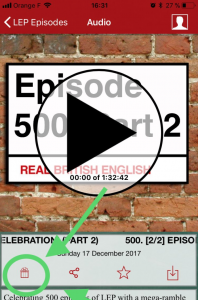
If you’re listening in the LEP app, just click the link for the episdoe page in the episode description – that will allow you to read the script while you’re listening.
After this episode there will be another one about Star Wars – and that will be a chat with my brother and my Dad that I recorded just after we all saw the film together about a week ago.
I realise I’m devoting quite a lot of podcast time to this new film – but I just really enjoy talking about it right at this moment
and as far as I’m concerned that’s enough of a reason for me to do this on the podcast.
Don’t worry, I won’t be doing Star Wars forever of course and we’ll get back to other topics and themes on the podcast soon.
OK then, so I expect the ones still listening to this are the Star Wars fans – so, let’s now continue where I left off.
I was describing that moment when General Leia gets blasted into space when the bridge of her ship gets blown up.
I said that this is quite a controversial scene…
I admit that this scene is weird and we’ve never seen this before in a Star Wars film, but I really don’t think it’s as bad or ridiculous as some people think.
So, Leia is hanging in space in zero gravity after the bridge of her ship has been blown up. She’s hanging in zero gravity. Apparently now we have zero gravity in space. Now – there is no consistency regarding the science in these films as we’ve seen already many times. This is not science fiction – there doesn’t need to be consistent, logical physics. This is a film series in which there are explosions in space, a huge planet sized space station that blows things up with lazers and a mystical force that allows people to control minds, lift objects and even project lightning from their fingers.
In this particular scene. The science serves the characters, the action and the plot, and it can be bent this way and that. We are supposed to just suspend our disbelief and go with the vague rules of this universe. In this case, in this scene, there is zero gravity in space and so Leia is just hanging there. It seems that her skin maybe beginning to freeze, which is what would happen in space I suppose.
She looks dead.
But then her fingers twitch and her eyelids open. When I saw this I immediately thought – she’s using the force to keep herself alive. It’s a survival thing. Then she extends her arm and floats back towards the ship.
Some people say she flies and they get very angry and upset saying “The force doesn’t let you fly”. Well – first of all, she’s not flying – she’s floating through zero gravity.
It wouldn’t require much force power to do that, right? There’s no atmosphere or gravity so it just requires a little bit of force power to pull herself back to the ship.
Also, we know that Leia is force sensitive but up until this point her power has just been to communicate with Luke through the force, to feel and sense things through the force and perhaps the suggestion that she’s been influencing events through the force for a while – like perhaps helping that bomber in the opening battle sequence, and influencing Kylo’s decision not to attack the fleet and so on.
So she has the force but she’s never used it to her full potential. It’s not hard to imagine that in a crucial moment like this that she’d be capable of keeping herself alive and pulling herself back to the ship through zero gravity.
We see this slightly odd, yet strangely beautiful image of Leia floating through space in the middle of a battle. It’s eerie and we’ve never seen anything like this before.
Again, a lot of people hate this scene, but I think they’re being a bit hysterical.
This has never happened before – it’s not consistent!
Yep, well a lot of people complained about episode 7 because it contained nothing new.
This is something new and it’s not completely far fetched. She’s not flying, she’s floating in zero gravity. Leia can’t fly ok? She’s not superwoman. It’s zero gravity. She’s just floating.
So, I’m fine with this scene, but only fine with it.
They could have done this differently.
Other criticisms of this scene include the fact that Leia uses the force here just to save herself, other characters die and she could have saved them.
Well, let’s face it – this film is all about breaking away from the old stuff and that means that some of the old characters have to die, and that includes someone like Admiral Akhbar- the guy who looks like a fish.
I’m not that bothered that Akbar is gone. I liked him – I had the Admiral Akbar toy when I was a child, but it’s fine – we can let him go. These are tragic events.
But maybe she could have used the force differently – like perhaps she could have somehow contained the explosion and held the bridge together – but that surely would have taken much more force strength and ability. I reckon keeping herself alive and then floating back to the ship is consistent with the fact that she’s never fully trained or developed her force abilities.
This moment is also weird and spooky considering the fact that we all know that Carrie Fisher died just after making this film. Here in the film we see her character apparently die, but then her eyes open and she makes a miraculous recovery. I find this spooky and odd, but it doesn’t make me angry or make me want to throw my toys out of the pram and weep for the death of Star Wars. That’s a bit hysterical.
Also, there’s a sense that in the negative reaction to this scene (and to quite a lot of the rest of the film) there’s a bit of sexism going on. Perhaps people just don’t like the idea of a woman flying. I know one person in particular who expressed this opinion – like “What, women can fly now?” “Women can do anything in movies now – this is ridiculous – it’s just rampant feminism”.
Again, that seems like a slightly hysterical reaction. How many times have we seen flying men in movies? How many times are male heroes celebrated by seeing them fly through the air? Tons of times. Superman, Batman (alright he doesn’t fly but almost) Iron Man, Spiderman, Thor and tons of others. Nobody complains about flying men, it happens all the time and it’s not going to stop happening. Then we get one flying woman (who isn’t even flying) and some people throw their toys out of the pram and start complaining about rampant feminism. It’s not the end of the world.
Some people might say – but it’s not consistent with the films. I’d say – yes it is consistent – she’s using her latent force abilities to briefly preserve her life and to pull herself back to the ship.
You might disagree with me on this one – because it’s a really divisive moment in the film and I think a lot of people just couldn’t handle it and this was the moment when they just gave up on the film. If that’s you – write your thoughts in the comment section. What exactly is wrong with this moment? Put your thoughts into words. I’ve given you my point of view, why not give me yours?
So, Leia gets back to the ship and is in a coma. She’s replaced by Vice Admiral Holdo.
Ahch-To – Luke & Rey
Words I used to describe Luke Skywalker:
- grisled
- haggard
- he looks like a wizened old hermit
Luke chucks the lightsaber away.
I was really shocked – gobsmacked. My jaw dropped at this moment.
I was expecting him to refuse the lightsaber but I didn’t expect him to do that, but I went with it.
I was shocked but I went with it.
This is another one of those moments that’s a deal breaker for a lot of people. Some people see Luke throw the light sabre over his shoulder and they find it to be a fundamental problem.
I can understand that. I think it seems a bit dismissive and casual, but this is where Luke is as a character in the story. He has been on this island for god knows how long and he’s utterly lost faith in the Jedi and in the so-called myth of Luke Skywalker. He doesn’t believe in these symbols any more and he has no time for people who expect him to live up to the legend of Luke Skywalker and that’s because at one point he believed in his own legend himself and as a result of that he thought he could do more than he could and this ended in complete failure. He couldn’t live up to all the expectations that he even had of himself.
Some people say this is not consistent with Luke’s character, but I say – why not? Why can’t Luke have gone in this direction in the 30 years since Return of the Jedi?
I found it really interesting that Luke had undergone such dramatic and traumatic changes since episode 6.
Luke’s character in this film is about learning from failure, about being fallible, about struggling with expectations, about the legacy of the Jedi, about the heavy burden that is being the last jedi.
In this film they could have made Luke a massively powerful hero who takes on the First Order armed only with his laser sword, but instead they went for a more complex study of a man who has failed, isolated himself and then slowly comes to terms with what it means to be a myth and how he can use this to do powerful things.
Rey hangs around but Luke refuses to talk to her.
We get some scenes which show Luke’s weird and eccentric lifestyle on the island. He fishes for massive fish in the sea, he lives among the porgs, he even drinks milk from the breast of some kind of weird sea mammal. Not directly from the breast, but he fills a flask with green milk that he gets from the breast of a weird creature that looks a bit like a walrus or something. He then drinks the milk and it drips down his beard, and he stares at Rey while doing this, looking pleased with himself. He’s being purposefully disgusting, and Rey thinks it’s weird.
The green milk scene is another controversial one – controversial meaning that it has split opinions. Some people say this kind of thing has no place in Star Wars and that the humour didn’t really work.
Personally I was fine with it. Both times I saw this in the cinema I was one of the only ones laughing at this moment.
I don’t mind a bit of weird humour and I think Star Wars has always featured this kind of thing.
For example – Jabba The Hutt is a weird creepy slug which licks its slimy lips in a really creepy way when looking at female characters, and there are plenty of other weird moments in the original trilogy. None of them are as blatant as this, but it’s not a complete departure from the world of Star Wars in my opinion.
And just personally, I found it really funny. I also thought that this was Luke testing Rey a bit, in a similar way to how Yoda tested Luke in The Empire Strikes Back. When Luke first arrives on Degobah to meet Yoda (and he doesn’t know what Yoda looks like) Yoda meets him and makes him think he’s just a weird and annoying little creature. He pretends to fight with R2D2, steals Luke’s food and seems totally eccentric and strange. It’s only later that Yoda reveals himself to be a great master. It’s as if he needed to show Luke that you shouldn’t expect heroes to look like heroes and that true heroism is in your actions not in your appearance.
Also this is a trope in a lot of kung fu movies from the 70s. The kung fu master appears as a sort of crazy fool who tests the patience of the main apprentice, giving him lots of annoying tests – and secretly he’s training the apprentice without him realising it.
I like Luke’s grumpy, weird side in this and I found it to be a pleasant surprise.
Anyway, Rey tries unsuccessfully to persuade Luke to join the Resistance and Luke hides in his cabin.
Chewie smashes the door in.
Luke finds out that Han is dead. This doesn’t change his mind, but maybe a little bit.
He visits the Milennium Falcon – this is a big nostalgia moment. The first time we’ve seen Luke on the Falcon since Episode 5 maybe.
He finds R2D2 and the moment they reunite is pretty amazing. Luke removes his hood in order to see him and it reminded me of when Obiwan removed his hood to look at R2D2 in Episode 4.
Them reuniting made me well up…! I’m not ashamed to admit it. R2 is so important to Luke’s whole journey. He’s the whole reason he ended up on this adventure in the first place.
R2 seems to try and persuade Luke to join the Resistance but Luke says “no way”. R2’s response is brilliant. He just plays the hologram of Princess Leia from Episode 4. Luke says “that was a cheap move” or something – and it’s a bit true, this is a pretty cheap way for R2 to persuade Luke, but also a fairly cheap way for the film to make any Star Wars fan feel emotional.
R2D2 goes straight for the jugular (vein).
This was always one of the most magical moments in the original film. When he was a frustrated farmboy dreaming of having adventures, this hologram of a beautiful princess asking for help completely captured his imagination and catapulted him on this journey into adventure, heroism, the force and self-discovery. The function of it here is that it brings Luke one step further towards remembering who he was and it is a stark contrast to who he has become now.
But he’s still committed to the fact that he can’t be involved because he’s convinced that he’ll do more harm than good.
In fact Luke has cut himself off from the force completely. He’s lost faith in the Jedi order.
But you get the sense that he’s not a lost cause. He acts like he’s definitely against the idea of coming back, but we see that he is quite curious about Rey and there is still a spark of the old Luke Skywalker in there.
At one point Rey seems to be called to a big old tree on the island, which I think is the original Jedi temple – or a force tree – I’m not sure of it’s significance completely but I expect it is mentioned in one of the books or something. The tree also houses the sacred Jedi texts. Rey seems drawn to this place and Luke notices this and follows her from a distance.
That’s when he becomes curious about Rey – when he notices that she’s been drawn to this significant place and there’s an interesting exchange there where we see that Rey is confused and doesn’t know who she is. She doesn’t understand how she has her force sensitivity and who her parents are (she’s feeling a bit force sensitive). She’s desperately looking for answers to the questions of her identity while also trying to get Luke to come and help the Resistance. She seems lost and is desperate for guidance.
No idea of how the time works here – all this is going on while the Resistance are battling against time up in space somewhere. Perhaps Ach-To runs on different time cycles. God knows. I don’t think it matters that much.
Luke finally agrees to train Rey a bit. “Tomorrow at dawn – 3 lessons”. Again this is like a kung fu movie or a samurai movie or something, and that is really cool.
3 lessons about the Jedi and why they have to end.
All the while, Rey and Kylo keep having weird force visions in which they are connected and they chat. It’s a bit like secret Skype or something. ForceTime.
She berates him for killing Han Solo and says he’s a monster.
He makes fun of the fact that she is looking for parental figures everywhere.
They grow strangely close, mainly because they’re in similar situations. She’s desperate for guidance. He’s curious about her force abilities, and perhaps is working out if she is an enemy or perhaps a potential ally. They both are alienated from their so-called mentors.
It’s weird and I didn’t know which way this would go. I expected that they’d join forces somehow and fight against both Snoke and Luke Skywalker, but I didn’t believe Luke Skywalker would be a real antagonist.
Like I said before – there’s nothing like watching a Star Wars film when you don’t know what is going to happen next.
Skywalker gives Rey some lessons in the force, but his intention is to break down her misconceptions about what it is, and what the Jedi really are. I could have had more of this to be honest, but then again in the original trilogy there wasn’t much detail about the force either.
With the force I think the more you explain it, the less interesting it becomes. In The Phantom Menace there were these things called midiclorians, which are living organisms that actually carry the force – and it was possible to measure, scientifically, how much force a person had based on their midichlorian count – and because this is physical that this could be genetic and handed down through family connections.
But midichloreans were never spoken of again because they took the magic out of the force. The version of the force we have here is back to how it was in Episode 4 – a mystical energy that binds the galaxy together.
Rey doesn’t understand the force at all – thinking it’s just about controlling people’s thoughts and about moving rocks. This is the childish version of the force. Skywalker tells her it’s a lot more than that, giving a similar version that Obiwan gave to him in episode 4 – that it’s a neutral natural power that exists in the balance between everything.
There are some funny moments where Luke makes fun of her and the way she misunderstands the nature of the force. Again, I’m not bothered by the jokey bits because this is Star Wars not Batman The Dark Knight.
One funny moment is when he tells her to ‘reach out’ and she takes it literally. He means that she should reach out with her feelings, but she reaches out with her arm and he tickles it with a piece of grass saying “can you feel that? That’s the force!” and then he slaps her hand and says “that’s not how the force works” or something. Again, this reminds me of training sequences from kung fu movies which have some humour in them and involve the pupil getting it wrong and the master teasing them.
Then Rey does reach out to the force with her feelings and Luke gives her a little lesson in what it is, and how to connect with it. He’s shocked that she immediately gets pulled towards the dark side, which is represented by a weird dark cave under the island. The rock under her cracks and she has a weird vision of being covered in water.
Luke is shocked that Rey didn’t resist the dark side and he refuses to train her any more because the last time this happened it all went horribly wrong.
He also attempts to explain to Rey how he has lost faith in the Jedi, how they were wrong and arrogant in assuming that they owned the force and how their legacy is failure. In the prequels the Jedi were blinded by their own arrogance – they didn’t see how a powerful sith was taking control of the senate right under their noses. Lack of vision etc. Again – more hubris. They were too sure of themselves and that’s why they failed.
I find this pretty interesting. A lot of that is true, right?
I’m not surprised that Luke has gone this way and I just find it interesting from a character point of view.
Later, I’m not sure when, we get more info about what happened between Luke and Ben Solo (Kylo Ren).
The story is told 3 times, and each time you get a slightly different version of events.
First time is what Luke says to Rey.
He tells her that he sensed growing darkness in Ben and he went to see him during the night to try and reason with him, but Ben flew into a rage and pulled down the building on top of his head, and then destroyed the temple.
The second version of the story is what Kylo tells Rey during one of their ForceTime sessions. He tells her that Luke didn’t give the complete story and that Luke had come with his lightsabre to murder Kylo in his sleep.
A lot of fans can’t handle this and just believe that Luke would never do this and that their childhood is ruined and all that, but it’s not the final version of events.
The third version of the story is the true one.
Luke explains to Rey that he had become aware of a growing darkness in Ben and that he struggled with what to do about it. He went to Ben’s room in the night to read Ben’s mind and was so shocked by the darkness inside him that in a moment of compulsion he ignited his lightsabre in order to kill him and rid the galaxy of another possible evil tyrant, but that as soon as he ignited his sabre, he regretted the decision and realised that this meant killing his nephew, one of his students in a cowardly way. So he immediately changed his mind when he realised what he was doing.
I think this just gives Luke’s character more depth. Remember that he was the last jedi and perhaps he’d taken on too much in agreeing to train these young students. That’s a big job and perhaps he wasn’t really capable of doing it all on his own.
Maybe Yoda and Obiwan’s force ghosts hadn’t visited him for ages so he hadn’t had guidance from them.
As he said – he believed in his own legend and this was his failing. He took on too much and ultimately wasn’t able to handle the task of restarting the jedi order on his own, taking on his sister’s troubled son who was also incredibly powerful in the force but touched by the dark side and was already being manipulated and controlled by Snoke through the force. It was all too much for one guy.
I think there is a lesson here and that is that success can be very dangerous – in this case Luke had success in the fact that he helped to redeem Darth Vader and kill the emperor. This can lead to a false sense of confidence which can lead ultimately to failure. There’s a lot of that in this film. It’s tragic, but at least there’s more depth to it than just gymnastic lightsabre duels and “being badass”.
Anyway, Luke tells his story – of how he immediately changed his mind and was not going to kill Ben, but then Ben woke up and saw Luke standing over him with his ignited lightsabre and that’s when he pulled down the building on top of Luke and destroyed the temple. It’s a sort of misunderstanding that makes Ben think Luke really was going to kill him. In any case, Ben rejects Luke and he then probably gave his allegiance to Snoke.
Luke again tells Rey to get off the island. He’s gone there to die, etc.
This pushes Rey closer to Kylo who is the only one who seems to understand her. Will she turn to the dark side to be with him? Will he turn good? No idea.
Not sure of the chronology here.
At one point Rey visits the dark cave, like Luke does in Empire Strikes Back. This is a really cool and spooky sequence where she seems to see herself trapped in a time line or perhaps it’s just her reflection repeated again and again. She follows this line of reflections until she’s face to face with a mirror and she’s convinced that this will reveal the truth she’s been looking for – her parents. A dark figure approaches her in the mirror. Who is it? Luke? Snoke? Han? Leia? Another figure from Star Wars lore? In the end, she finds herself staring at her own reflection.
What does this mean? I guess it means that she’s on her own and her parents just aren’t important.
Also, at some point here, Luke decides to reconnect with the force. He sits on the stone altar on the clifftop and meditates. I think he makes a connection with Leia, who is in her coma. I think this is where Luke realises a lot of things – but it’s not actually shown in the film. By reconnecting with the force here, I think he gets strength from his renewed connection with Leia, realises that there is something he can do. Basically, by reconnecting with the force he realises his power and perhaps his hope again, or realises the importance of Rey. I’m not sure.
Rey and Kylo have a Forcetime – again they’re getting closer to each other all the time. I think in this one Kylo is topless which kind of amps up the sexual tension between them. Rey seems to believe in Kylo more than she does in Luke at this point and she probably believes she can turn him to the light side of the force etc, but we still don’t really know how Kylo feels. He’s hard for us to read – he’s just blank and unreadable, which is a strength in terms of the acting performance. He could be a bit vulnerable, perhaps a bit lost, but possibly pure evil – we don’t really know!
They actually touch, and when they do Luke bursts into Rey’s hut and is shocked to discover them in contact, and he destroys the hut and breaks the connection.
Then there’s a sort of fight between Rey and Luke, where Rey demands to know if Luke really did try to kill Kylo, and she attacks him with her staff, and Luke defends himself with a stick and disarms her. To me this looks like he’s still training her. When he disarms her, she force grabs the blue lightsabre and appears to have beaten Luke who kind of falls to the ground and gives up – but if you watch closely we see his hand is raised and I’m sure that he could have summoned his green lightsabre whenever he wanted in order to defend himself. I think he let Rey get the better of him.
This is when he confesses that he did momentarily contemplate killing Ben, but that he instantly changed his mind. So – just to set the record straight on this, Luke was not going to kill Ben in his sleep. The idea flashed across his mind when he saw that Snoke had turned him to the dark side, but he instantly changed his mind. I say that because a lot of the hardcore fans have lost faith in this film because they thought Luke was going to murder a child in his sleep – he wasn’t.
Rey then decides to leave the island in order to go to Kylo because she believes she can turn him. Luke says “No, it won’t go the way you think”. It’s a bit like that moment in Empire Strikes Back when Luke goes to confront Vader but Yoda tells him he’s not ready yet.
Rey is delivered to Kylo Ren in an escape pod from the Millenium Falcon and then we get one of my favourite moments in the film. Kylo puts Rey in handcuffs and on the way to Snoke’s throne room they have a conversation.
She explains that she’s confident Kylo will turn to the light because she’s had a vision.
But Kylo explains that he’s also had a vision that Rey will turn to the dark.
I suspected that Kylo would turn to the light, because there was more evidence for it.
I didn’t really believe Rey would turn to the dark side, but there were a few things that suggested that she could – e.g. she was drawn to the dark side during her vision while training with Luke.
She is pretty impulsive and often strikes out in anger, it seems – and that’s often the way towards the dark side.
Then the doors open and Rey meets Snoke for the first time.
Meanwhile, Luke goes to destroy the Force Tree and the ancient Jedi texts.
Yoda appears and stops him.
It’s wonderful to see Yoda again.
He’s not CGI Yoda, it’s puppet Yoda.
They actually used the original mould from Return of the Jedi.
It works.
Basically, he tells Luke that this is all a lesson and that Luke is a good master because he is teaching Rey the value of failure.
“The greatest teacher, failure is.” – he says. Apparently Yoda still hasn’t perfected his grammar, despite failing to speak it correctly for probably about 900 years or something.
Anyway, it’s a good lesson and it brings some redemption to Luke – who feels like he’s a lost cause. Everyone has to fail and it’s your failures that help you to improve. Success brings over-confidence and arrogance sometimes, whereas failure and accepting your failures brings us opportunities to learn.
It’s true for learning English too – our failures are great learning opportunities. We have to say something wrong a few times before we can say it correctly. Expecting to get everything right first time is just unrealistic. Accept failure as the best way to learn, and not something to be ashamed of, you can overcome your problems and learn to be really strong.
Yoda then destroys the force tree and (apparently) the sacred Jedi texts, as if to say to Luke – yes, you’re right – let’s destroy the past and start again. Luke is shocked that Yoda has done this (and apparently force ghosts can summon lightning now in Star Wars – fair enough, we were looking for some new force abilities, right? Apparently force ghosts can interact with the real world now – ok, fine)
The tree burns, containing the books – and Luke says “But the sacred jedi texts!” and Yoda says “Read them have you? Page turners, they are not.” I laughed out loud at this line.
Yoda’s two lessons for Luke:
Failures are valuable learning experiences.
Students always grow beyond their masters.
Back to Snoke’s room.
Snoke reads Rey’s mind, plays around with her – she attempts to fight back several times – grabs her light sabre but snoke makes it fly around the room – she grabs Kylo’s light sabre and Snoke flings her around the room. He seems impressed with her tenacity and he actually says “such spunk!” which made me laugh, because… well the word “spunk”. Do you know what that means?
It’s a bit rude. Here are the two definitions.
Courage, bravery, strength of character.
Semen (offensive)
He means defintion 1, but still – it’s a bit creepy that Snoke gleefully talks about “spunk”. Snoke is a horrible, creepy old git.
He’s also really arrogant and wealthy – he wears a gold robe a bit like Hugh Hefner the playboy guy. He’s horrible. But the CGI motion capture is brilliant. He looks really realistic. Good job Andy Serkis and the special effects team.
Snoke then reads Rey’s mind. I think he was considering whether she could be turned to the dark side, perhaps to become his apprentice and replacement for Kylo. That’s often the way it goes – but he summarises that she’s too pure or can’t be turned or something. So, he decides that Kylo should kill her, perhaps to complete his training.
Meanwhile Kylo looks at the situation quite blankly except for subtle reactions and the movement of his eyes. It reminds me of how Vader observed the Emperor when he was attempting to turn Luke to the dark side. We suspected that Vader was loyal in his heart to Luke. Similarly, I suspect that Kylo hates Snoke and feels resentment towards how manipulative he is, and we suspect that Kylo has feelings for Rey or at least believes that Rey might join him somehow. I wonder if this is a romantic feeling or a strategic one.
Snoke orders Kylo to kill Rey, and we still don’t know what Kylo is thinking. Rey looks up at him and simply says “Ben” – appealing to his good side.
At this point Snoke gets really carried away, proclaiming that he can see Kylo’s thoughts and that Kylo is turning his lightsabre and is going to ignite it in order to kill his true enemy.
But secretly Kylo is using the force to turn Luke Skywalker’s lightsabre which is sitting on the table next to Snoke, and as Snoke is convinced that he’s seeing Kylo’s intentions to kill Rey, perhaps he’s not seeing it clearly and in fact Kylo ignites Luke’s lightsabre killing Snoke.
I found this really surprising and satisfying. The look on Snoke’s face – he’s so shocked! It’s also a really well-directed sequence.
The lightsabre stabs Snoke in the side and then we see the scene from Kylo’s point of view, and Kylo pulls the sabre towards him, cutting Snoke in half! The ignited sabre flies through the air and Rey’s hand comes up to grab it.
Rey stands and for a moment Kylo and her face each other and we wonder whether Kylo is going to attack her, or what will happen…
Then everything goes in slow motion as Rey and Kylo, are attacked by 8 Praetorian guards and they fight back to back on the same side against the guards.
This is an absolutely wicked sequence. The guards are fantastic. They wear this weird red armour which appears to be able to deflect some lightsabre blows. They also have different weapons – swords, staffs, a sort of whip that becomes a sword. It all happens incredibly quickly and the screen is filled with several fights at the same time. Sparks fly, Rey screams and roars as she fights, Kylo’s fighting style is brutal and sketchy. It’s raw power.
At one point the wall catches fire and in the middle of the fight the room starts buring down. One of the guards gets thrown into some kind of fan unit and gets chopped into pieces. It all happens incredibly quickly and intensely.
Rey also has some good moves. Again – I don’t know how she learned to fight like this. Let’s just say that growing up on a rough junk planet like Jakku meant that she had to learn how to defend herself, add to that the fact that she’s obviously gifted with force abilities and has had some light sabre fighting experience now – she’s also brave and intelligent.
The two of them manage to fight off the guards and defeat them, but it’s not easy. At one point it looks like they’ve been beaten. Kylo is unarmed, Rey is held by one of the guards, but she manages to get out of it by dropping her lightsabre, getting out of the guard’s grip and then catching the sabre again in mid air before dispatching the guard.
Kylo is still being held by the last guard, who is kind of strangling him. Rey quickly throws her sabre to Kylo who catches it and ignites it instantly, sending the beam through the guards face, who drops away, dead.
What I like about this moment is that Kylo catches the lightsabre, ignites it, lets the guard drop and steps forward and he never takes his eyes of Rey at any point, and never blinks.
Then, still staring intensely at Rey he steps forward. Rey tells him there’s still time and that they can save the Resistance. She assumes he’s turned good, but he hasn’t.
He tells Rey they should let the past die and start anew – kill Snoke, kill Skywalker, let the Resistance die.
Rey is sort of heartbroken and just says “Ben, don’t do this”.
He also tells her who her parents are – I guess he saw it in a vision or something. He says that they were junk traders who just sold her off as a slave for money and that now they’re dead and buried in the desert. “You’re nobody, nothing…” “but not to me”.
He begs Rey to join her, but she’s heartbroken and won’t do it.
She sees that Kylo is beyond redemption at this point. I think Kylo has crossed a line and he’s the new Snoke. All these changes of position happen really fast. Surely, this is the interesting part of this film – what is really going on in Kylo’s head? Will he go good or bad? In Return of the Jedi we have similar questions about Darth Vader and ultimately he turns good, but in this one Kylo doesn’t. He’s the bad guy. He wants to kill her friends and he’s being very manipulative. He might be lying about her parents, even though she says she’s always known deep down that they abandoned her. But maybe he’s lying or something. Perhaps we’ll see.
Or perhaps her lineage isn’t important and it doesn’t matter what your family connections are. Anyone can be strong in the force.
She goes to grab Luke’s lightsaber from Kylo and it ends up suspended mid air between them as they both struggle to grab it. The lightsabre explodes.
In the film this part of the story is told in parallel with the other parts which I haven’t mentioned yet – namely the Finn and Rose storyline and the Poe/Admiral Holdo storyline.
Finn and Rose storyline.
Finn is going to escape and find Rey. Rose stops him. They work out together (cheesily) that the hyperspace tracking can be stopped if they disarm it from the lead ship. Finn has intel on the location of the tracker and they work out that they can get in and disable it, and save the Resistance. It’s surely a suicide mission.
Poe agrees, and they call Maz Kanata for info.
Maz Kanata is a crap character, isn’t she? A sort of vague orange Yoda who isn’t as interesting as Yoda.
A complex and contrived plot is set up where Finn and Rose have to meet a code breaker who can help them access Snoke’s ship (is it Snoke’s ship or another ship – not sure).
So they head to Canto Bite.
“The worst type of people”
Just park on the beach – bad move. But these kids don’t really know what they’re doing.
A bit like the Cantina Bar but everyone’s rich.
Weird horse things on a racetrack, they’re looked after by slave kids.
Rose hates the town.
Little drunk creature putting coins inside BB8.
They get caught and thrown in jail. Pretty rubbish.
Then Benicio Del Toro’s character turns up in the film.
He’s great. I’ve always liked him in films. He’s an “engaging screen presence” to quote Mark Kermode.
He overhears them discussing their plan and says he can get them in the room on the FO ship.
Somehow he has a way to pick the lock and get out, and with BB8’s help they get away, so do Finn and Rose who escape on the horses, which smash up the casino resort before being released into the forest. This is a bit cheesy and feels a bit like a “message” about animal cruelty.
I love animals, so fair enough – but it’s a very Disney moment. Anyway, DJ turns up in a ship with BB8 and they get rescued, and the fly towards the FO ship for their mission, which is to go undercover and turn off the hyperspace tracking, while the Resistance are still running away from the FO and slowly running out of fuel.
DJ is an interesting character. He’s one of those ones who exists in the moral grey area between the good and bad sides, a bit like Boba Fett and even Han Solo at the start of Episode 4.
I think this gives some much needed moral ambiguity.
Also, he shows us that the rich people on Canto Bite make their money making and selling weapons to the FO and the Resistance. This adds a bit of complexity to the whole “intergalactic war thing” which underpins this whole series of films, and just shows that there’s more to this than just good guys vs bad guys – there’s a whole industry behind these wars that makes some people really rich. I think for some fans this is a bit too political for Star Wars, which is ironic considering how politics were involved so much in the prequel films.
They make it onto the Supremacy (I think) and go undercover.
BB8 disguises himself as one of those little black droids – a “mouse” droid I think they’re called.
He’s disguised as one of them by hiding under a black dustbin as far as I can see.
Amazingly nobody really notices them, including Finn who surely is a famous traitor by now …
I say nobody notices them, actually an evil black version of BB8 does notice them. I love this evil BB8. He’s actually called BB9-E and it’s interesting how just a few changes in design makes this little droid instantly evil looking. I think I heard Mark Hamill talking about this in an interview – just a few changes – make the droid black, with a different shaped head and it just screams “Nazi!” It does look like a nazi version of BB8. Also, they manage to endow him with a lot of menace and malice. His red eye narrows with suspicion when he sees Rose, Finn, DJ and BB8.
Long story short – they get to the tracker and it turns out that DJ has set them up – he betrayed them and he betrays the whole Resistance and their plan to escape to Crait because the FO offered him loads of money. Finn gets angry and calls him a traitor I think, or says something like “They’re the bad guys” – and DJ says something along the lines of “Good guys, bad guys, what’s the difference. They blow you up today, you blow them up next time…”
I find his cynicism and pragmatism to be refreshing and interesting in the context of this binary good guys vs bad guys conflict. This is a really enjoyable bit of ambiguity and I really hope we see Benicio Del Toro’s character again.
Perhaps the most interesting moments in all of Star Wars are the moments when there’s moral ambiguity – like the character of Boba Fett who is only interested in self-preservation and money, or the moments when Luke Skywalker appears to drift towards the dark side slightly in order to achieve things – specifically when defeating Darth Vader, or when Anakin/Vader goes dark and then light at the end. These are the interesting moments and DJ is an example of that.
So, Finn & Rose are caught, The Resistance are screwed…
Some people complain that the Finn and Rose storyline doesn’t achieve anything. But that’s the whole point – it’s another lesson in failure. Sometimes characters fail in films – it’s boring if they just succeed every single time – and anyway the Resistance were always the underdogs and Finn and Rose were never going to succeed with this plan anyway – it’s was a suicide mission. They’re lucky that they got this far.
Back to what’s happening with The Resistance fleet.
Leia is in a coma, Holdo takes over. Poe disagrees with her strategy – which appears to be just to jump ship and escape the fleet. He thinks it won’t work and it’s cowardly. He attempts a mutiny but gets stunned by Leia who she comes back.
She uses a blaster set to stun. We haven’t seen this since episode 4 – blue rings firing out, rather than red or green laser blasts.
It turns out that Holdo’s plan is not to just escape the ship, but to evacuate to a nearby planet that they’ve been heading for.
Poe wasn’t aware of this because he was demoted.
They plan to escape to Crait where there’s an old rebel base. They can use that as a defensive fortress and can call for support from around the galaxy.
Just as well really, because Finn and Rose’s mission has failed.
Then we discover that DJ has told the FO about this plan to evacuate to Crait and the FO begin attacking the escape vehicles as they head towards Crait. The Resistance is screwed now.
Finn and Rose’s mission to stop the hyperspace tracking has failed and now the FO know about the other plan to escape to Crait and are blowing up the escape transports. Also, at this moment it looks like Rey is about to be executed by Kylo Ren.
Finn and Rose are about to be executed.
Oh yeah and Captain Phasma has turned up too – apparently she didn’t die in Episode 7.
She doesn’t really do much, except being Finn’s nemesis.
Leia and the rest of the Resistance have boarded the escape transports to Crait, but Holdo stays with the main fleet, and when she realises that the escape transports are being attacked she suddenly decides to sacrifice herself and aims the Raddus at The Supremacy (Snoke’s ship) and goes into hyperspace.
WOW – a really mind blowing moment and done really well because the Raddus enters hyperspace and flies at lightspeed through the Supremacy and a bunch of other FO ships causing massive damage and a huge explosion and it’s all done instantly and in total silence, followed by a really cool sound effect.
Silence used to great effect.
The explosion on The Supremacy gives Finn and Rose the chance to avoid being executed and they fight back against Captain Phasma and the storm troopers while the whole hangar bay explodes around them. There are tie fighters falling on the floor and blowing up, AT-AT walkers crashing here and there.
In the midst of all this chaos, Finn and Phasma have a battle and Finn fights with a lot of spirit. Rose shoots Phasma but the blast deflects off her armour. Cool moment.
Phasma appears to have the upper hand in the fight and knocks Finn into a lift shaft, but clearly Phasma hasn’t seen the Original Trilogy – we know that there are moving platforms that go up and down in these shafts and of course Finn hasn’t fallen to his death, he reappears and smashes Phasma in the face, cracking her mask. She says “You’ll always be scum” before falling into an explosion. I doubt that she’s dead. She’s bound to come back next time.
“Rebel scum” – this is the default insult for Rebels or Resistance fighters it seems. Scum is a bit like a dirty layer that floats on the top of old water or something. It’s just a generic insult, but it was used once in Return of the Jedi when an imperial officer said it to Han Solo and it sounded cool – so now the word is used a lot.
These films still trade a lot on nostalgia for the old films, and it works.
Finn and Rose manage to escape the burning ship – how? They’re rescued by BB8 driving a AT-ST “scout walker” thing, which made me go “Yeah, right?!” out loud in the cinema when I first saw it.
People complain that Rey’s character is too perfect and that she can do anything and that this is unrealistic and unfair and some sort of feminist agenda or something, but BB8 (and R2D2 for that matter) is also a perfect character who seems to be able to do anything. He takes out FO guards, he can pilot an AT-ST walker, he can get blown up and assemble himself again, he can fix any problem on an X-Wing – but nobody complains about that.
OK, so now the storylines come together.
The Resistance (Leia, Poe and the few remaining other people) make it to Crait and set up their base there. God knows why it takes the FO so long to attack them here, but it does. Maybe they needed a bit of time to set up all the awesome weaponry that they’re going to use to smash through this big door to this old Rebel base where The Resistance are hiding.
Finn and Rose escape The Supremacy with BB8 and join the Resistance on Crait.
The idea is that The Resistance can defend themselves here, call for help and then wait for the help to arrive.
The thing is, no help comes. None of their allies out in space care. No Lando Calrissian or anyone like that – nobody’s coming to help them. So it’s about a couple of hundred REsistance members vs the FO with their huge AT-M6 walkers.
They have trenches, with some defensive weapons and this huge reinforced door protecting them, and a few very sketchy looking ground fighters, and that’s it.
The FO have a massive battering ram cannon which is “Death Star technology” – basically a smaller version of the Death Star’s big green laser that can blow up planets. This is what they’ll use to break through the door.
The idea is that The Resistance need to somehow destroy the cannon if they stand a chance of surviving.
Now, what about Rey.
Last time we saw her she was locked in a tug of war with Kylo over Luke’s blue lightsabre, which caught in the middle between the two of them, explodes.
Apparently Kylo was knocked out by the explosion and Rey managed to escape in Snoke’s personal ship, and she took the fragments of the light sabre with her.
We see Snoke’s dead body, his tongue sticking out, lying on the floor. Also both his hands were severed when Kylo killed him – this is pretty neat because someone always gets their hand or hands removed in Star Wars films, in this case it was Snoke, but he also lost the whole top half of his body. I wonder if we’ll ever find out Snoke’s back story, but I guess we never learned The Emperor’s backstory in the original films, he was just a powerful old dark side user and that’s it. I think we probably knew more about him than Snoke though, and I admit that we could have used just a little bit more exposition about Snoke – just a bit of detail. I think the hardcore fans are very upset about this, because they spent 2 years coming up with very elaborate theories about his origin – like, he’s Mace Windu, or he’s Darth Plageius (The Emperor’s old master). It seems he’s not that important, and anyway we don’t need an origin story for everyone, do we? I expect there will be a book about him coming out or whatever.
Then General Hux comes into the room and can’t believe what he’s seeing – Snoke is dead, his tongue sticking out and everything. Kylo is still unconscious and Hux actually goes for his gun – he would have killed Kylo in his sleep probably – because they don’t like each other and Hux would probably like to take control of the FO, but Kylo wakes up. They argue and then Kylo force chokes Hux, which is very reminiscent of Darth Vader. Hux capitulates and calls Kylo “Supreme Leader” – “The Supreme Leader is dead – long live The Supreme Leader!” So, Kylo is in charge of the FO now.
So, the confrontation on Crait.
The FO approach the base with the big gun.
The Resistance launch a counter attack with these beaten up old speeder things. There’s almost no way they can win.
The Millennium Falcon turns up at the last minute and helps out by making all the Tie Fighters chase it. This is another big emotional moment, when the Falcon turns up to save the day – or save that particular moment anyway – the music swells (John Williams’ score is brilliant again) – there are some stunning visuals as the Falcon is chased by Tie Fighters through these crystal caves and tunnels under the surface of Crait.
But ultimately, the Resistance mission to destroy the battering ram cannon can’t win and Poe calls it off. This shows us that he’s learned something about leadership and strategy from the beginning of the film.
But Finn doesn’t want to give up and he’s about to sacrifice himself for the Resistance by flying his ship into the cannon in a suicide mission. I was convinced he was going to do it, but at the last minute Rose crashes into him and saves him.
This is a really cheesy moment I have to say.
First of all, you can see from the wide shots as Finn is flying that Rose is nowhere near him – but again, this is a bit like that moment with the detonator button that gets caught by Rose’s sister at the start of the film – movies often break the rules of physics like this – so I’m willing to let it slide. And then there’s the moment where after Rose saves Finn she gives a little speech saying “We don’t do this to destroy the things we hate, we do it to protect the ones we love,” and then she kisses him. So this is a slightly forced romantic moment first of all, but the sentiment is nice. We should protect the things we love rather than destroy the things we hate – and it’s all sweet and good and nice, but I thought about a moment from Episode 3 – a crucial moment when Anakin turns to the dark side. He decides to join Emperor Palpatine precisely because he thinks this is how he’s going to save the one he loves – Padme. He is seduced by the dark side because he wants to prevent Padme from dying. So, it’s all about point of view isn’t it.
Protecting what you love, destroying what you hate – they’re sort of two sides of the same coin aren’t they?
Still, I think the basic message is nice – love conquers hate. I do agree with that. Be careful of doing things for hateful reasons. We should be motivated by love, basically.
But isn’t this a slightly selfish thing for Rose to do? She stopped Finn from potentially saving the entire Resistance just because she personally loves him.
But maybe The Resistance were screwed anyway. I think the point is – we shouldn’t think about this toooooo much. We shouldn’t expect Star Wars to be this perfect flawless thing. As I said before, I think the good things in this film outweigh the bad things
But then again – if you’re angry about this Star Wars film, that’s fine – it’s up to you. I’m not going to tell you you’re wrong. Everyone has their own subjective reaction to the film.
So it looks like The Resistance are screwed then.
Somehow Finn manages to fly back to the base or perhaps even drag Rose back there – I’m not sure how, but I dunno, maybe he used some of those trenches or something, or maybe one of the crashed speeders still worked.
Leia looks defeated. She says that hope is lost.
But then Luke Skywalker turns up. There’s an emotional moment when he speaks to Leia – they agree that Kylo wasn’t Luke’s fault, and Luke comforts Leia by giving her a memento of Han Solo – a pair of dice that used to hang in the Millenium Falcon.
Luke then goes out to face the First Order armed with his Light Sabre.
When I saw this I was really excited and yet didn’t know what to expect. Luke said it himself that he couldn’t face the entire FO armed only with a laser sword.
Kylo, in his command ship, orders everyone to fire on Luke, using all their weapons.
The AT-M6 walkers all fire on Luke.
Kylo is enraged – shouting for more more more!
This really is overkill. There’s just a huge cloud of red dust where the lasers are firing.
Hux says “that’s enough” and the guns stop.
Kylo slumps in a seat. He should be satisfied, but he’s not. He’ll probably never be satisfied.
We’re all thinking – surely Luke isn’t dead! And of course he isn’t. He steps out of the cloud of red dust, unscathed. He looks up at Kylo’s ship and even brushes his shoulder dismissively, which is pretty cool.
There’s something strange about Luke. He looks younger. His beard and hair are shorter. He has no dust on him.
Kylo is furious again and instructs his soldiers to take him down to the surface to face Luke.
Kylo says “I suppose you’ve come here to save my soul”
Luke: No.
This was awesome, I can’t really explain why. Also, Mark Hamill in this film is absolutely brilliant. He’s really developed as an actor since the original trilogy.
He ignites his light sabre – and it’s the blue one. Weird, I thought the blue one got split in two when Kylo and Rey were fighting earlier. Kylo doesn’t seem to notice this because he’s in a rage.
He ignites his crackling red light sabre. I love Kylo’s brutal style and the way he stands sort of hunched over. Luke looks really cool in his classic Jedi clothing. Kylo runs at Luke and attacks him but Luke manages to avoid all his attacks. He does some pretty cool moves where he kind of rolls out of the way, making Kylo really angry.
This is not the epic gymnastic light sabre combat from the prequels. This is a lot more about the drama between the two characters. There’s a lot more emotion and feeling in this than in watching Anakin and Obiwan jumping from object to object swinging their lightsabres again and again until you’re emotionally uninvested in the action.
This is much more like a Japanese samurai movie, where the swordplay is brief but intense. In fact Luke looks a lot like a samurai in this scene and that is fantastic. So atmospheric and powerful.
An interesting detail in this fight is that Kylo’s feet leave red marks on the floor where the salt gets disturbed, but Luke’s feet make no impressions on the floor at all. Apparently you can also see salt particles falling from Kylo during the fight, but nothing falling from Luke. Only later do we realise that Luke isn’t really there at all – he’s doing a force projection from Ahch-to and it’s all part of a plan to mentally defeat Kylo while giving the remaining members of the Resistance a chance to escape.
Luke tells Kylo – “today the Resistance is reborn and you can never defeat me.”
He also does some Obiwan Kenobi stuff to him, saying “If you strike me down in anger I’ll always be with you, just like your father.” That’s got to hurt!
Kylo angrily charges at him and swipes his lightsabre at Luke but the blade passes straight through his body.
At the time I was thinking – wow, has Luke been hiding his power all this time? Is he immune to lightsabres? Then I thought, oh wow he’s a force ghost!
Then it’s revealed that the real Luke is meditating on a rock in Ach-to. This whole thing is a force projection!
Luke then says to Kylo – “see you around kid.” and disappears. That’s a Han Solo quote too!
I think what this means is that Luke is going to haunt Kylo as a force ghost – he’s always going to be there and Kylo will never have peace, he’ll always be reminded of how he murdered his own father.
Then Luke disappears and Kylo is in a rage again.
What I like about this:
We don’t get a big light sabre duel, but that makes a change – at least we have some really interesting character-based interaction.
Luke manages to teach Kylo a lesson without using violence.
He only uses defence.
He defeats Kylo mentally.
He sacrifices himself to save the Resistance.
He shows Rey that the force isn’t just about lifting rocks, controlling people’s actions or being really good with a lightsabre – it’s also about introspection and peace.
Also, I like the fact that in the midst of all this fighting, explosions – Luke has learned how to win a battle without using violence.
In fact, I respect Luke’s decision to just go on an island to live like a hermit. At least he’s decided that he’s fed up with the incessant fighting and war. He’s perhaps the only character to say that he’s had enough of the fighting – and isn’t this a sort of logical progression of what he learned while facing the emperor in Episode 6. He threw his lightsabre away and refused to fight or give in to his anger because he is a Jedi.
Don’t blame Luke for choosing to go to that island and for feeling like a failure – he was actually just trying his best to prevent any further catastrophe.
This feels like the true way of the Jedi – from a certain point of view.
Also, he’s demonstrating incredible force power by doing this projection. This is something new that we haven’t seen before. Again, some people are pissed off with this saying “That’s not how the force works!” but honestly I’m glad that we’re seeing some new force powers in this film. It’s about time we had some slightly new things.
By doing this, Luke also manages to create the myth of Luke Skywalker, which will no-doubt be told again and again. He’s accepted his place as a myth and how important and powerful this can be as a way of inspiring new generations to have hope. This is beautiful. Luke has always been a symbol of hope, but he’s a fallible human who couldn’t always live up to his own myth, but he manages at the end to do it in his own way according to how he understands the light side of the force – using defence not attack, without using violence, fighting a mental battle.
Then on Ach-To we see Luke collapse from the strain of doing this massive force projection. He climbs back up onto the rock and stares out across the ocean at the sunset, and it’s two suns.
This made me cry! I couldn’t help it. It just took me straight back to the moment in Episode 4 when Luke was not much more than a boy staring across the desert at the dual sunset – full of aspiration and dreaming of adventure, and that’s how he ends his life. I can’t put it into words really, but this got me right in the feelings. It’s pretty ridiculous I know, but there it is.
Luke then disappears in the same way Obiwan did and Yoda did. He becomes one with the force.
I guess this means that he’ll be back as a force ghost in episode 9. Good – I really like Mark Hamill and I hope to see more from him.
Meanwhile, the last remaining members of the Resistance have worked out that there must be a way to get out through the back of the caves by following the crystal foxes that live there. There’s quite a magical moment where one of the beautiful crystal foxes leads them to a gap at the back, but it’s filled with boulders.
Rey is on the other side – she’s used the tracking device to follow their position from the surface, in the Falcon with Chewie.
She works out that the pile of boulders is blocking them from escaping and she’s going to need to use the force to move them all.
This is a bit ironic because earlier in the film Luke told her that the force isn’t about lifting rocks! But apparently sometimes it is! Of course she manages to lift all the rocks, freeing the last remaining members of the Resistance and they escape in the Falcon. There must be just about 10 people left! But Leia says they have all they need to start again. They’re the spark that will light the fire to burn the First Order down, etc.
We see also that Rey has managed to keep the sacred jedi texts – they’re in a drawer on the falcon. So I suppose this means she can learn the ways of the Jedi properly and maybe she’ll get some help from Luke’s force ghost.
Kylo and Rey have one more force vision before the Falcon leaves. They stare at each other and Rey closes the door – signifying that she’s closing herself off from him, I suppose. But surely the interesting thing going forward will be their relationship. Will she be able to turn him back to the light, or defeat him somehow? Will Kylo turn her to the dark somehow? What’s going to happen to Kylo? I quite like the idea that he’ll be haunted by Luke – a bit like the way Macbeth is haunted by his friend Banquo in the Shakespeare play Macbeth.
In the final scene of the film we see some of the slave kids on Canto Bight – one of them is telling the others the legend of Luke Skywalker – him standing up against the entire First Order. It reminds me of how C3P0 tells the Ewoks the story of the rebellion. The other children are enthralled by the story and seem genuinely inspired. This shows that the legend of Luke Skywalker gives hope to the next generation.
Then the kids are told off by their cruel slave owner boss type guy and one of the kids goes out to sweep the yard. He grabs the broom using a force pull – showing that he is force sensitive, and then he looks up at the stars and sees a distant spacecraft fly across the sky. The End!
I suppose this scene means that:
Anyone can be strong in the force – you don’t have to be part of a specific bloodline
Luke’s legend is an inspiration to the poor, lost or forgotten people
The Resistance is not dead and there’s still hope left in the galaxy
That’s a nice message isn’t it?
So in summary, I found The Last Jedi to be bold in the way it refuses to pander to the fan theories and expectations, brave in the way it pushes the saga forwards by doing some new things and letting some old things die, nuanced in the way it allowed the characters to develop in complex and quite flawed ways, fun in how it included some pretty weird comic moments and just awesome in the way it dealt with several key moments of action that were fuelled more by emotion than by technical skill. I think it’s an intelligent film, a surprising film, it’s one of my favourite Star Wars episodes and I’m looking forward to seeing it again so I can pick up on some more of the subtle details that made it enjoyable.
I have no idea how episode 9 is going to carry on – and I like that feeling.
Apparently JJ Abrams is going to conclude the saga by directing episode 9. JJ is obviously a very competent filmmaker and someone who understands the core appeal of Star Wars but I’m also a little bit worried because JJ has an approach to making films that involves posing lots of mysterious open ended questions rather than by providing satisfying resolutions. Think of Lost, the TV show – it was brilliant at setting up lots of questions and mysteries that kept the audience guessing, but none of those questions and mysteries were adequately explained in the end. I just hope that episode 9 can at least bring some resolution to the story, rather than just leaving it all open to the interpretations of the slightly unhinged fanbase.
[socialpoll id=”2481205″]
I look forward to reading your opinions if you have them.

 [DOWNLOAD]
 The Office