Category Archives: Interview

667. Four Way Call (with Alex, Moz & Paul)

A lockdown Zoom call with my friends Alex, Paul and Moz which should be a fun but challenging listening exercise. Intro & ending transcripts available.

Small Donate Button

[DOWNLOAD]

Click here for information about LEP Premium.

Transcript (Intro & Ending)

Hello dear listeners and welcome back to the podcast. This episode features a 4-way conversation between three of my friends and me, recorded on Zoom recently (other video conferencing platforms are available), and it’s basically us asking each other questions in a sort of 4-way interview scenario. I think it should be a fun conversation to listen to but I also think it will probably be a challenge for your listening skills. That is what I expect but I will let you find out for yourself.

Upcoming YouTube Live Stream

Before we get started on that, I just want to remind you about the YouTube live stream I’m doing on Wednesday 10 June at 3PM CET.

Did you hear the announcement episode I published at the weekend? Well, if you did, then you’ll know all about this.

I’m doing another YouTube Live Stream on Wednesday 10 June at 3PM Paris time, and you are invited to join me. I’m going to be messing around, answering questions from listeners in the chat, maybe singing a couple of songs with the guitar, and generally just hanging out with my audience on YouTube.

If you can’t make it, the video (and audio) will be published later so you will still be able to watch it or hear it. I’m doing it at 3PM on a Wednesday because my daughter will be in the nursery (or creche as they call it in France – the daycare centre) and so I’m free to get up to some online antics, and at the weekend it’s family time – so, midweek and in the afternoon (my time) is just the right time for me to do it.

Anyway, join me on Wednesday 10 June at 3PM for a YouTube Live “Ask Me Anything / Hang Out with Luke”. To find the specific location on YouTube, check the show notes for this episode and you’ll find a YouTube link or just subscribe to my YouTube channel – that’s Luke’s English Podcast and click the bell icon to receive a notification when I go live.

OK, so that’s that…

This is number 667, and here is my introduction…

This intro is quite long but I’ve done that on purpose to help you understand what I think will be a difficult episode, but if you really prefer, you can skip forward to approximately 22mins but of course if you skip forward you won’t know what you’ve missed and you’ll live the rest of your life thinking “I wonder what Luke said in that introduction to episode 667? What did I miss? And when you’re old and grey and near the end of your life and you’re asked by a grandchild one day, “Do you have any regrets?” you might manage to say “If I have one regret, it’s that I skipped that introduction to episode 667, that’s …that is my only regret in life. I skipped the introduction and I didn’t fully understand that conversation with his friends. I didn’t have sufficient context. A lot of jokes went over my head. Oh, it was confusing and I just gave up on learning English. And that’s when it all went wrong for me. I’m sorry children. It still haunts me to this day. What did he say? What did I miss…? I suppose I’ll never know.” So, if you want that to be you, just skip ahead to 22mins now.

Ok so you’re still with me. You didn’t skip ahead. Excellent choice. You’ll be fine now, for the rest of your life. Everything in your life is just going to slot into place now, just right. It’s going to be perfect from now on. You’ll have no regrets and it’s all going to be roses. Just remember though, when you are sipping cocktails on your own private yacht somewhere in the future. Just remember to thank me, OK.

Introduction

One of the only good things about the coronavirus pandemic lockdown confinement social distancing isolation situation is that it has encouraged people to get in contact with each other more than they normally would. Maybe this is because we’re unable to get together physically (if you know what I mean), so we’re making up for it by calling each other more, or we’re just aware that it’s important to stay connected during this weird time, in order to make ourselves feel a bit better.

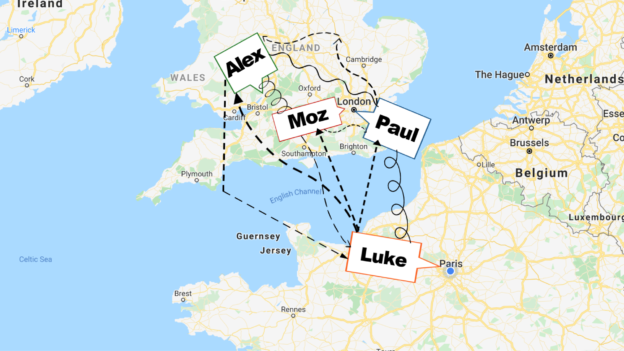
I don’t know if it’s the same for you but I’ve been in touch with friends and family more than usual during this time, including my mates Paul Langton, Alex Love and Moz. We’ve had a few Zoom calls together recently just to have fun chatting and also to generally keep our spirits up. Paul, Alex and Moz have all been on the podcast before so I thought it might be fun during one of our Zoom calls for us to reunite on the podcast again, for the first time in years. And that’s what you’re going to hear today. This episode was recorded during the lockdown with me in Paris and the others in their homes in England.

This was recorded 2 or 3 weeks ago when the lockdown was fully in place both in France and the UK.

The four of us first recorded podcasts together at the Brighton Fringe Festival in episodes 104, 105 and 106, then there was the Slightly Drunk Episode (ep 109) and On a Boat (ep226), recorded on Moz’s narrow boat. I wonder if you’ve heard those episodes? Let me know if you remember Paul, Alex, Moz and me sitting on the beach in Brighton and the creation of Luke Johnson, my evil clone. Do you remember us sharing beers inside Moz’s boat one summer evening and talking nonsense in my flat and other weird moments from deep in the episode archive?

Super-duper long term listeners will remember those episodes, but for those that don’t know here is a quick summary of some background context to help you understand this episode a lot more.

Forgive me for rambling on in this introduction (as usual). I know this is long but this kind of context is essential to help language learners understand a conversation between four friends, and listening to a group of friends chatting can be really hard in another language.

So this is all necessary context to help you piece together what you’re going to hear in this episode which will help you enjoy it more and learn more from listening to it.

Background Context

We all first met each other doing comedy in London in 2009 when we did the Amused Moose stand up comedy course run by Logan Murray, which I have mentioned before. That was a series of comedy workshops designed to help us develop basic skills for doing stand up comedy.

After doing that course, we did various comedy gigs together in London and also shows at the Brighton Fringe Festival from 2010 to 2012. That’s a comedy festival in Brighton, a bit like the Edinburgh Fringe but smaller, and in Brighton. Paul, Alex and I were in a show together called Snigger Happy, and Moz did his own shows, in the same venue as us.

Here’s some intel on each person in this conversation.

Paul Langton
Paul was born and brought up in central London and has a London accent. As a stand up comedian in London, Paul used to regularly MC one of London’s best open mic comedy shows, called “Comedy Virgins” at the Cavendish Arms in Stockwell, South London, and he was also the host of one of the first live-streamed comedy/music shows that I know of, which was called Teaserama (and that was at least 10 years ago), but more recently Paul decided to stop doing stand up comedy. He made a fairly big career move and became a police officer for London’s Metropolitan Police Service, which is what he now does on a full time basis, working on London’s streets, fighting crime, a bit like Robocop, if Robocop was actually an Irish man called Rob O’Cop who liked drinking lots of Guinness during his time off.

Paul was on the podcast on his own in episode 349 talking about Marvel and DC superheroes, as he is something of an expert in that kind of thing – basically, he’s a tall police geek with a London accent and a penchant for Guinness.

Alex Love
Alex grew up near Stroud, which is in Gloucestershire, which is in The Cotswolds, which is in the south west midlands, in England. As well as working as a freelance journalist writing articles for newspapers, Alex continues to do stand-up comedy (although not during the lockdown of course). Recently he has been doing a successful show called “How to Win a Pub Quiz” which he has performed at the Edinburgh Festival Fringe to sold out rooms in recent years. Unfortunately Edinburgh is cancelled this year, leaving Alex with a huge August sized gap in his summer. I say Edinburgh is cancelled. I mean the festival, not the city. The city still exists as far as I’m aware. Alex has also brought his pub quiz show to various other places including a recent trip to Australia and New Zealand. He managed to get back home to Stroud in England just before New Zealand closed its borders because of the coronavirus outbreak. This sounded like quite a dramatic escape, which I imagine was pretty much as exciting as that moment in The Empire Strikes Back when Han Solo manages to escape from the belly of a huge space worm just before it closes its mouth. Remember that scene? I’m sure taking off in a plane from New Zealand in the nick of time, was exactly like that.

Alex has been on the podcast a few times before, talking about his Edinburgh show, doing a pub quiz with me, and talking about Queen the rock band.

Moz 
Moz used to work for the BBC as a producer of comedy TV shows, and he worked on various shows including one memorable flop called Horne and Corden, a sketch show with James Corden who you might know these days as the presenter of The Late Late Show with James Corden on TV in America. A few years ago Moz changed career a bit and became a writer, podcaster and tour guide, setting up Murder Mile Walks and the Murder Mile True Crime Podcast, both of which are about real murders which occurred in various parts of London. On his tours he takes people round various parts of the city and tells them true stories of grisly murders that happened there in the past. You might remember his previous appearances on this podcast telling the gruesome stories of some of those killings. Moz does loads of research into these crimes using court and police records, in order to describe what really happened in proper detail. This level of research is one of the things that makes Moz’s work unique. The other things are of course Moz’s animal magnetism and his captivating storytelling abilities.

You can hear these stories by listening to the Murder Mile True Crime Podcast (link in the show notes) or by going on one of Moz’s walking tours of London (link also in the show notes). More recently Moz started doing storytelling shows on stage in front of live audiences (rather than dead audiences) that’s until COVID-19 came along of course, putting a stop to those live shows, but his podcast continues. Moz also used to do stand-up comedy with Alex, Paul and me, but his performances were a bit different. In stand up it is normal to be yourself on stage. But Moz always performed in character. He also used a lot of pre-recorded audio. He would record an audio track beforehand and then while the audio played through speakers he would stand on stage in costume and mime his performance without speaking, except maybe for a few noises here and there. One of the characters he used to do was called Sloppy Party Bottom, who was a sort of surreal clown (in the proper French clowning tradition) but that description doesn’t really do it justice at all. It was very funny and very weird. These days Moz lives on a narrow boat on London’s canal network, and yes, he does have a toilet and a shower on his boat, which I assume he uses. I hope he uses them anyway.

Luke
I think you know who I am, but I should remind you that I also do stand-up comedy, although not as regularly as I should and not at all since COVID-19 came along of course. I performed at the Brighton Fringe Festival 3 years running with Alex and Paul in a show that we called Snigger Happy. In 2010 our show was reviewed by Steve Bennet, who is probably the UK’s most well-known comedy reviewer, certainly among comedians. I had a good gig and got quite a good review. Bennet said I had a promising future. Ooh, exciting. 2 years later Bennet unexpectedly reviewed our show again, but I had a truly awful gig that day and died on my arse in front of him and the rest of the audience. Naturally, his 2nd review was not positive at all, quite the opposite. This still stings to this day, when I think about. I promised Steve Bennet that I would have a bright future as a stand up comedian, and I then two years later when the future arrived I spectacularly failed to deliver on that promise. I think I have told the story of what happened during that awful performance before, so I won’t explain it now. Perhaps I’ll tell the story again some time. Suffice to say, it was bad, and I will never really live it down, meaning, it is an embarrassing comedy failure that may haunt me for years to come, especially if Alex, Paul and Moz keep reminding me of it, which they often do, because it amuses them.

I wanted to interview Alex, Paul and Moz all at the same time so what we’re going to do in this episode is take turns to be interviewed by each other. We’re all going to be cross examined by each other one by one. It’s a bit hard to explain this idea, but you’ll see.

Basically you’ll hear us talking about a variety of topics like our lives, our comedy stuff, how our careers have been affected by coronavirus, regrets we have about our pasts, little anecdotes, criticisms we’ve faced over the years and of course the occasional bit of toilet humour.

What’s the purpose for learning English, you might ask? Well, just the usual thing, which is that it’s vital to regularly listen to authentic conversations in English. It’s this kind of immersion, exposure and input which can make a crucial difference to your learning of English. Obviously the episode is long but I’ve said it before and I’ll say it again, you don’t have to listen to this in one go. Pause, take a break, come back and your podcast app will remember where you stopped.

One issue – audio quality

This episode was recorded online via Zoom and despite my best efforts I couldn’t get any of the others to use proper USB microphones. I even sent one by international post to Alex, but unfortunately his laptop is basically kaput so he had to use his phone. Not everyone is a teched up podcaster with a plethora of microphones at his disposal you know. So if you struggle to understand this conversation, then you can blame them for not having state of the art microphones, or blame me for choosing to do this whole project in the first place, or blame your old English teachers at school who didn’t give you enough listening practice, or blame yourself, or just don’t blame anyone. Probably the last one would be best.

Anyway, the main difficulty that I expect you will have with this is the sound quality. It’s going to sound like it was recorded online during a 4-way Zoom call, and that’s because it was recorded online during a 4-way Zoom call, and because there are 4 of us and you might not know Alex, Paul and Moz that well, and because nobody is speaking super slowly to help you understand them, this could definitely be a challenging episode. So, brace yourself. But then again, for all I know, this will be fine for you.

Some of you will be fine with that, but others will find it tricky. But, rarely in the real world do we get the luxury of perfect sound conditions, especially when doing video conferencing which is becoming more and more commonplace during these times.

OK, I don’t want to waffle on any longer. Instead I will say now that it’s time to join me as I chat with my friends. I hope you enjoy it.

Your tasks are:

  • a) to be able to identify who is talking (basically, can you differentiate between Paul, Moz and Alex’s voices and
  • b) can you actually understand what we’re all talking about?
  • c) Can you use your imagination a little bit and imagine that the whole coronavirus thing isn’t actually happening and that we’re all in fact all sitting around a table sharing a beer or soft drink in the pub and you’re there with us and everything is fine in the world.

OK, that is all. Now let’s get started, and here we go!


Questions

Round 1

  • What is your name?
  • What do you do? 
  • How has that been affected by the coronavirus?

Round 2

Questions for Paul

  • Luke: When questioning a suspect in the police station, have you ever thrown a chair against a wall or slapped a cigarette out of someone’s mouth?
  • Alex: What is your biggest regret from your time doing comedy?
  • Moz: Why do you love Rick Mayall?

Questions for Alex

  • Luke: In the episode we recorded together about the rock band Queen, one listener said “I don’t understand any words in this conversation. This guy speaks like alien.” How do you respond to this claim?
  • Moz: What advice would you give to 8-year old Alex Love?
  • Paul: As the only one of us who regularly still gigs, what advice would you give to your younger self just before you got on stage many moons ago?

Questions for Luke

  • Paul: What do you most miss about London?
  • Moz: What part of your body annoys you the most and why?
  • Alex: You were once predicted a bright future in comedy? What happened?

Questions for Moz

  • Luke: You live on a narrowboat on the canal network. What’s the most annoying behaviour that you’ve observed and experienced from others on the canal network?
  • Alex: In your time at the BBC, what’s the worst TV show you worked on and why?
  • Paul: Have you ever been tempted to get back on stage as one of your old characters?

Round 3

Questions for Paul

  • Alex: How close have you been to pooing your pants on duty as a police officer?
  • Moz: If you had to go shopping at the supermarket right now, what would you buy?
  • Luke: What’s the best way to talk to a police officer, to avoid being arrested? (inspired by this Adam & Joe video – below)

Questions for Moz

  • Alex: You did a lot of pre-taped audio tracks with your comedy. Why did you never do stand up as yourself?
  • Paul: You do your murder mile walks in London. What is the funniest crack-head story you have from your tours?
  • Luke: What’s the wettest you’ve ever been?

Questions for Luke

  • Alex: When you were young, what job did you want to do when you grew up?
  • Paul: What is the most surreal review or comment you’ve received in the 10 years you’ve been doing this podcast?

Questions for Alex

  • Moz: Why would you make a great or a shit astronaut?
  • Luke: What is the worst or best gig you’ve ever had?
  • Paul: What’s the worst heckle you’ve received on stage?

At the end: Some stories of awful gigs, including stories of weird audience members – a woman with a glass eye, a deaf man, a poor man who had a seizure during a show, another poor man who was a burns victim, a scouser who just didn’t like me and more…


Ending

OK everyone, that’s it. I would just like to thank Paul, Moz and Alex for being on the podcast today. I hope you enjoyed joining us on our Zoom call. I know the audio quality might have made it a bit tricky for you to follow all of it. Let me know. I expect someone will comment that my friends sound like alien or something. But they don’t to me.

Remember, check out Moz’s podcast. It’s called The Murder Mile True Crime Podcast and it’s available on all good podcast apps.

Alex doesn’t have a podcast but he is still writing a blog, which you can find at alexlove.co.uk

If you want to find Paul, just commit a crime in the London area and he will probably find you and then you might end up having a one on one sit down interview with him in a police station. There’s an interesting approach to finding ways to talk to native speakers – just get arrested! The police will ask you lots of questions, and you’ll have lots of people to talk to in prison too! Yey!

By the way, I did have a lovely birthday, thank you for asking. I’m recording this bit about a week after doing the call, so yes I had a nice birthday and thank you for those of you who sent me birthday wishes. That was very nice of you. Those of you who didn’t, I will still accept your birthday messages quite gladly, and I am still open to gifts, flowers, chocolate, gold bullion and cash donations in most currencies but especially pounds sterling. If you don’t know my age, I wonder how old you think I am, perhaps just based on the sound of my voice.

If you’re wondering about my gifts, I got some new trainers from my wife and also I got a multi-track recorder for making music. If I actually have any time, I plan to record some music so I got a digital muti-track which will allow me to record guitar, bass, keyboards, vocals. Now, all I need is some actual musical talent and I might be able to create something half-decent. We will see.

I was also treated to a birthday cake of pancakes in bed – that’s a cake made of pancakes, with honey – a pancake cake, with candles and decorations and the candles set the decorations on fire and so they were fully ablaze by the time the cake got to me, so essentially my wife brought me a fire hazard directly to my bed first thing in the morning, which was actually very funny and not as dangerous as it sounds. Anyway I had a nice birthday, if you’re interested.

How about you? Are you ok? I sincerely wonder how this episode was for you. I really enjoyed getting together with Paul, Moz and Alex again on the podcast, and I hope you did too, but I expect it was difficult to follow. Let me know in the comment section.

You know, difficult to follow isn’t necessarily a bad thing. That’s the sort of episode that challenges you a bit and pushes your English skills a bit further, in theory anyway.

Well, in any case, it’s time to draw this all to a close. Thanks for listening and speak to you soon, but for now — good bye!


Links

The Murder Mile True Crime Podcast 

Murder Mile Walks

Alex Love’s Blog

665. A Chinwag with Sebastian Marx / 18+ British slang phrases that Americans don’t understand

Chatting to Sebastian Marx from New York and testing his knowledge of British English slang phrases. Slang vocabulary list available below.

Small Donate Button

[DOWNLOAD]

Introduction

This episode features a chinwag (that’s a conversation by the way) with Sebastian Marx – a friend of mine who is originally from New York (he’s an American) but who has been living in France for the last 15 years. Long term listeners might remember him from his past appearances on this podcast. You’ll see links to those episodes on the page for this episode.

Sebastian is a stand up comedian who performs both in English and French, and he was the one who first started doing stand up in English in Paris. So all of us comedians who perform on stage here in English, including Amber, Paul, Sarah Donnelly and others – we all have Sebastian to thank for originally giving us that opportunity as he is the one who got the whole scene started in the first place with the New York Comedy Night which he set up years ago.

I invited Seb onto the podcast just for a bit of a chat, but also to test his knowledge of British English slang. I’m always interested to see how much my American friends know about my version of English.

The Chinwag

In terms of the general chinwag – we talk for the first 25 minutes or so about a few topics, including:

  • What he thinks of the Trump presidency
  • His learning of French
  • Speaking French or English to French people, like waiters in cafes

Then, after about 25 minutes of jibber-jabber, we decide to focus on language and you’ll hear me testing Seb’s knowledge of British English slang – informal spoken English phrases that most Brits know but which Americans are probably unfamiliar with.

This is slang so you should know that things get a bit rude later in the episode with some references to sexual acts – you know, sexual stuff, and also a few other fairly lewd and crude things like bodily functions and so on.

Some of you are probably delighted to hear that and have no problem with it at all but I feel I should give you a heads up about rude content, just in case you’re a teacher listening to this in class or something (I can imagine getting a message from a teacher who’s heard it, or perhaps even having a conversation, like this: Luke, I used an episode of your podcast in my young learners’ class the other day and oh, you started talking about… arseholes and chests, it was quite awkward — Oh dear I’m terribly sorry Mrs Crawly, I should have provided a warning of some kind. I trust that this will not affect my daughter’s entry into the Royal Academy in September. Perhaps you should come for tea and we can discuss it at length. I have one or two things to say to you about your conduct and how this is affecting your reputation among the staff at Downton. Oh, I’m terribly sorry to put you out Lady Crawley… etc… Sorry, I accidentally slipped into an episode of Downton Abbey there. Papa and Mama would be awfully disappointed, and we’ve just received a telegram that the first world war has started and we’re all terribly worried about how this might affect life at Downton and blah blah blah).

I dunno, maybe you’re a teacher or you’re listening to this with children, or maybe you just don’t like rude things of that nature. Basically – there’s some rude stuff in the second half of this episode. Alright? No big deal.

*it’s ok Luke – we fucking love rude stuff, don’t worry*

Alright, steady on…

OK, I promised myself I wouldn’t ramble too much at the start of this one so let’s crack on now, and here is the jingle….

The Slang you can hear in the episode

(listen to hear the full descriptions, examples and American English equivalents)

✔️= Sebastian knew it or guessed it correctly
❌= Sebastian didn’t know it or guessed it wrong

❌“Pants” (adjective) “That film was pants” = not great, rubbish
✔️“Knackered” (adjective”) “I’m absolutely knackered today” = exhausted, really tired / American English equivalent: “beat”
❌”Gobsmacked” (adjective) “I was absolutely gobsmacked” = shocked, surprised
Also: “shut your gob” = shut up, stop talking (gob = mouth)
✔️“a slash” (noun) “Hold on, I’m going for a slash” = I’m going to go and urinate
❌“On the lash” (prepositional phrase) “I’m going out on the lash tonight” = to go out drinking alcohol
✔️“To pull” (verb) “Hopefully I’m going to pull” = to score, get lucky, to get laid, to have sex with someone
On the pull” = trying to ‘get lucky’ with someone
To go out on the pull
To chat someone up” = to talk to someone to make them like you (sexually) to try to pull someone by talking
❌“To get off with someone” (phrasal verb) “I got off with her” = to kiss passionately on the lips (USA: to make out with someone)
To get on with someone” = to have a good relationship with someone, to “hit it off with someone”
✔️“A plonker” (noun) “You are such a plonker” (not a swear word) = an idiot
❌”A tosser” (noun) “Stop being such a tosser” (synonym of “wanker” but less rude) an idiot, a person you don’t like
a wanker” is a mean nasty unpleasant man that you’re angry with
To wank” = to masturbate
Asshole” (US English)
Arsehole” (UK English)
✔️“A fag” (noun) “I’m just having a fag” = a cigarette (in US English it’s a very rude term of abuse meaning a homosexual)
❌“A wind up” (noun) “He’s a wind up merchant” “Is this a wind up?” = a joke, a piss-take, teasing, making fun of someone, playing a trick on someone, a con, a prank, lying to someone as a joke
To wind someone up” = to annoy someone
❌“whingeing / to whinge” (verb) “Stop whingeing! You’re always whingeing.” = to complain, to moan, to whine, in an annoying way
✔️“Smart” (adjective) “You’re looking smart today. What’s the big occasion?” = to be well dressed, to be wearing formal clothing, to look clean and tidy (opposite = casual) (USA: smart = intelligent)
❌“Lush” (adjective) “Oh that’s lush” “Those trainers are lush” “Oh she is lush isn’t she?” = good, attractive (for a person), cool, great, awesome
❌“Grotty” (adjective) “I smoked a cigarette earlier and I’m feeling dead grotty now.” = unpleasant, dirty, feeling a bit unwell or under the weather
❌“Ta” (exclamation) “Could you pass me the sugar? Ta.” = thanks
✔️”A chinwag” (noun) “We’ve had a good chinwag” = conversation
❌“It’s all gone pear shaped” (idiom) “We did a Zoom call but everything went pear shaped because of technical problems” = to go wrong

Schlep (verb – US slang, from Yiddish) to carry something with difficulty, to carry something heavy – “I’ve been schlepping this bag around all day”
Schlep (noun – US slang, from Yiddish) a long and arduous journey – “I work on the other side of town and getting there is a real schlep!”

50 British phrases that Americans just don’t understand (MatadorNetwork)
https://matadornetwork.com/notebook/50-british-phrases-americans-just-dont-understand/

Ending

Music: Sippin’ Gin by Jim Thompson

Righty-ho, that was Sebastian Marx (thanks Sebastian) and 18 bits of British English slang.

How many did he get right? He predicted 50% I think. Well, out of 18 he identified 7. And my criteria for getting it right was whether he knew the word or phrase already or if he worked it out correctly, first guess, from my example. 7 out of 18. What’s that as a percentage? Some of the mathematicians are already on that, but I need a calculator to work that one out, unless you want to listen to me working that out in my head. Trust me, you don’t want to listen to that. I don’t think I can do it. Anyway, the result is… 38.88888888889 Let’s round that up to 39% which is a clear fail I think everyone can agree.

What does this mean? I’m not sure, except that it proves something about American and British culture and language. Sebastian made the point during the episode and I think I’ve said it before previously, like in that slang game I did with Jennifer from English Across the Pond last year.

Brits are way more familiar with American English than Americans (and of course I mean people from the USA) are with British English because we are exposed to a lot more American culture through TV and film than Americans are exposed to British culture.

America produces tons of TV and film of course and exports a massive amount too, but it doesn’t import as much TV and film as it exports. Basically, most Americans don’t get exposed to that much British English, certainly not the kind of local informal slang stuff that we touched on in this episode. Big surprise eh! Not really! We know this about the USA – big place, quite loud on the world’s stage, exports a lot of stuff, but to a large extent doesn’t look beyond its own borders all that much, relatively speaking. We all knew that though didn’t we!

Anyway, never mind all that geo-political stuff. I just enjoyed chatting with Sebastian in this episode and sharing some of my version of English with him. That is more interesting and fun for me.

What about you? How much of the slang in this episode did you know? I’ve definitely talked about some of those things before, but I bet there were one or two new things in there too.
But how much of it did you know and how much did you learn from me in previous episodes? And if you didn’t get it from me, where have you learned British slang? Let us know in the comment section!

Also, feel free to add other bits of British slang that you think is especially, quintessentially British in the comment section.

All the slang I tested Seb on is listed on the page for this episode on the website, so check it out. That’s where you can see specific spellings of words and phrases, and you can check some example sentences and definitions that I’ve given for you.

Talking of British English expressions – I must finish that series I started last autumn – 88 English expressions that will confuse everyone. Remember that? I still have about 25 expressions left to cover I think! I must get round to doing that.

My podcast is a bit like a big, slow moving ship. Sometimes I miss something or forget something and kind of sail past it, but for some reason it’s very hard to stop the ship or turn it round and go back. So, if I don’t do a specific episode I was planning to do at one point, general momentum keeps pushing me forwards and it’s difficult to turn the ship around and go back. I’m not sure why this is.

Stuff to mention at the end

Lovely comments from listeners on the last episode (in different locations like YouTube, website, twitter, email) My wife said that the comments were cute and lovely.

Something evil this way comes… Episode 666 is next.

666 → often described as the number of the beast. The mark of the devil.

Lots of people have been asking if I’m planning anything special for that.

Well, you’ll have to wait and see…

Previous episodes with Sebastian

130. A Cup of Tea with… Sebastian Marx

183. Luke’s D-Day Diary (Part 1)

247. Understanding The USA (with Sebastian Marx)

298. The Bank Robbery (Part 1)

299. The Bank Robbery (Part 2) with Amber, Paul & Sebastian

388. US Presidential Election 2016 – Trump vs Clinton (with Sarah & Sebastian) Part 1

389. US Presidential Election 2016 – Trump vs Clinton (with Sarah & Sebastian) Part 2

654. Computer-based IELTS / Stories about The First Time… (with Jessica Beck from IELTS Energy Podcast)

A chat with Jessica Beck from the IELTS Energy Podcast about the new computer-based IELTS test, plus some funny stories about doing things for the first time, motivation in language learning, dealing with the stress of public speaking and seeing “The Fonz” on a ski slope. Get a $50 discount on Jessica’s new IELTS online course by going to www.teacherluke.co.uk/3keys

Small Donate Button

[DOWNLOAD]

Transcripts for the introduction & ending

Hello listeners, how are you? I hope you’re alright. How are you all coping? I hope you’re all doing ok out there in podcastland.

Here is a new podcast episode to listen to and this time I am joined by IELTS teacher Jessica Beck who you might know from the IELTS Energy Podcast and All Ears English.

Jessica has been on LEP a couple of times before as you may remember. She is a specialist in IELTS preparation, having taught IELTS courses for many years now both in classrooms and online.

Just in case you don’t know, IELTS stands for the International English Language Testing System. It’s a proficiency test which reveals a person’s English level, and it’s fiendishly difficult, requiring a lot of preparation in order to make sure that you get a result that reflects your English at its best. I recently talked about the speaking part of the test with Keith O’Hare in episode 640.

Jessica recently invited me onto an episode of her podcast – the IELTS Energy Podcast, and we talked about differences between American and British English (because the IELTS test features both versions so it’s interesting to compare them and look at some common vocabulary differences).

That is #850 of The IELTS Energy Podcast, called “What’s a Zebra Crossing? Luke Will Tell You!” There’s a link on the page for this episode if you’d like to hear it.

https://www.allearsenglish.com/ielts/ielts-energy-850-whats-a-zebra-crossing-teacher-luke-will-tell-you/

And now Jessica Beck is back on my podcast again in this episode.

Here’s a little overview of what’s coming up, in order to help you follow the whole thing.

First you will hear some chat about the weather where we live. I’m in Paris and she’s in Portland up in the North West of the USA near Seattle. This smalltalk should give you a chance to get used to the speed of the conversation, before we move on to talk about the computer-based IELTS test.

Planning to take IELTS? You’ll need to prepare properly.

Some of you will be planning to take the IELTS test in the future and you might be wondering about the best way to prepare, especially if you’re studying at home. If that is you, then you could check out the 3 Keys IELTS course which Jessica and the other girls at All Ears English have created. It’s a really solid and complete package which includes pretty much everything you need to get success in this course, including video lessons, test practice and 90 minutes of one-to-one counselling with one of the girls over skype.

I suggest you check out the Personal Coach course for the computer based test. And listeners to my podcast can get a 50$ discount on that, which is nice.

Check out www.teacherluke.co.uk/3keys for all the information. You’ll hear some more details about that later.

www.teacherluke.co.uk/3keys

So there’s some chat about the weather and then some chat about taking the computer based version of the test, but it’s not all about IELTS. I think we just talk about IELTS for the first 10 minutes in fact and then you will hear us sharing a couple of personal stories about doing things for the first time, one involving the importance of not giving up even when it hurts, and the other story is about how to deal with the stress of public speaking. We reflect on the lessons learned from those experiences and their relevance to the challenge of learning a language.

Also, listening to this you will be able to notice differences between Jessica’s American English and my British English, not necessarily in terms of vocabulary used but more just in terms of our intonation patterns or the tone of our speaking in general. It will probably seem really obvious at the beginning, especially if you are very used to hearing me speak.

Listening back to this conversation myself and during I somehow felt extra British (a bit awkward, perhaps a bit posh and quite wordy) and that Jessica was being extra American (super enthusiastic, energetic, positive). Actually, we end up making fun of each other’s speaking style at one point as we do impressions of each other presenting our podcasts. It’s a bit of a laugh and you should enjoy it.

Anyway, I will now stop rambling now so you can listen to this conversation with Jessica about IELTS and about what we learned from the challenge of doing some things for the first time and I’ll talk to you again briefly at the end of the episode.


Not sure who “Fonzie” is? Have a look… (he’s the guy in the leather jacket on the motorbike)

Ending

Thanks again to Jessica for coming on the podcast again and sharing that story. I can’t believe she saw The Fonz on a ski slope. That doesn’t happen every day, does it?

I’m genuinely curious to see if any of you actually know who The Fonz is. He is mentioned in the film Pulp Fiction, if you remember. The scene in the diner with Samuel L Jackson, Tim Roth, Amanda Plummer and John Travolta. There’s a kind of Mexican stand-off (of course there is, it’s a Quentin Tarantino film!) and if you don’t know what a Mexican stand-off is, it’s when loads of people point guns at each other in a film (and maybe in real life I don’t know).

Anyway, Samuel L Jackson manages to make Amanda Plummer’s character calm down by saying “We’re going to be like 3 little Fonzies here, alright? And what’s Fonzie like?” and she’s like “What? Wh…” “WHAT’S FONZIE LIKE???” “He’s cool.” “That’s right he’s cool. So we’re going to be like three little Fonzies here ok” etc. It’s a memorable moment, if you remember it that is.

Anyway, if you are considering preparing for IELTS and you have, say, 30 or 60 days available ahead of you, then you might consider the 3 Keys IELTS Personal Coach course for the computer test, and if you’re interested go to teacherluke.co.uk/3keys to get a $50 discount.

www.teacherluke.co.uk/3keys

Alrighty then. So how are you holding up?

It’s a tough and weird time, there’s no doubt about it. As I’ve said before, this virus isn’t just a threat to your physical health. Obviously you need to take steps to avoid catching it, but also to avoid spreading it too, but at the same time please do look after your mental health. Keep yourself busy, find a routine in your daily life, do some indoor exercise like Yoga. Read books. Don’t spend the whole day staring at social media or watching 24 hour news. Use this as a chance to get some things done that you’ve been putting off for a while. Keep in touch with friends and family. Just a few ideas. I mean, what do I know? In any case, do take care of yourselves out there and I hope that this podcast can keep you company just a little bit during this weird time.

I’ll speak to you again soon, but for now, Bye!

648. Ian Moore Returns

Talking again to comedian Ian Moore about favourite films, a trip to New York, British & American audiences, how to iron a shirt, and funny stories about taking the language test to qualify for French citizenship.

Small Donate Button

[DOWNLOAD]

Introduction

Hello everyone and welcome back to this podcast for learners of English and here is your regular dose of English conversation presented here to help you develop your listening skills and pick up grammar and vocabulary along the way.

In this episode of the podcast you can listen to me in conversation with Ian Moore who is back on the podcast after a 3 and a half year absence.

He first appeared in episodes 382 and 383 when we got to know him and talked about mod culture in the UK.

If you haven’t heard those episodes, or if you have heard them and you need me to jog your memory, here is some background info about Ian, just to bring you up to speed.

Ian Moore is a professional stand-up comedian from England. He moved around during his upbringing and is from a combination of places including the north, East Anglia and the London area as you will hear during the conversation.

He has been described by the Guardian newspaper as “one of the country’s top comedians” and he regularly performs in the best stand up comedy venues all around the UK, notably at London’s top stand up comedy club “The Comedy Store” which just off Leicester Square, where he is a frequent host.

He’s a mod – Mod is a British fashion subculture from the 1960s which involves a very particular style featuring certain clothing (like slim Italian suits, green parka coats – and a lot more besides), riding scooters and listening to American R&B music. Ian is definitely the best-dressed guest I have ever had on this podcast and came dressed in a 3-piece 60s Italian suit, gold watch chain, handkerchief in the pocket with a pin and everything.

Ian now lives in rural France on a farm, and has been living there for nearly 15 years, which is at odds with his mod style.

So he has been living a kind of double life – living on the farm in the French countryside, looking after various animals (his wife keeps introducing new animals into the family), making chutney, and commuting to the UK and other cities in Europe to perform stand up comedy.

He has written several books about his double life, which are available from all good book shops including Amazon.

A la Mod: My So-Called Tranquil Family Life in Rural France
C’est Modnifique!: Adventures of an English Grump in Rural France

As well as writing these funny autobiographical stories, Ian has also branched out into writing fiction, and his first novel, called “Playing the Martyr” was published a couple of years ago. It’s a crime thriller about an English man who gets murdered in the Loire valley – I don’t know if this is based on Ian’s life at all. I have no idea if there have been attempts on his life for some reason. But anyway, the book is well-reviewed on Amazon and is available in both Kindle and paperback versions.

Ian is also a language learner – French in this instance. He actively works on his French and passed the language test to gain citizenship in France.

There are plenty of things to talk about – all that is just background context, and if you’d like to know more – listen to episodes 382 and 383 (both of which have transcripts written by the Orion Transcription team available in google documents. Just check the transcripts section of my website).

In those episodes you can hear:
A full explanation of the mod subculture including the clothing, the music and all the rest of it – and mod is very much a part of British youth culture today – especially the clothing, which influences many high-street British clothing brands.
Various stories of Ian’s rural French lifestyle including how his children were once threatened (rather shockingly) by a French hunter armed with a shotgun, some anecdotes about his experiences of performing comedy to audiences in cities all over the UK, accounts of his comedy triumphs and one or two comedy disasters and more ramblings of that nature.

So that’s all background context that you can hear more of in episode 382 and 383 –

This time, I decided to just see where the conversation takes us and the result was an extremely tangential and rambling conversation that takes in such things as

  • Ian’s favourite films
  • Ian’s recent trip to New York where he did comedy and spent time as a tourist
  • The complications of Woody Allen’s current public image
  • Differences between British and American audiences
  • Differences between Burlesque and stripping
  • Ian’s different accents as a child moving from Blackburn to Norfolk to London.
  • Details of Ian’s clothing
  • How to iron a shirt properly
  • Ian’s various health issues and physical complaints and what might be causing them
  • Comedy shows you can see at The Comedy Store in London
  • Ian’s stories about learning French and attempting to pass the language test for French citizenship

Watch out for various little jokes and funny stories along the way and try to keep up as the topic of the conversation veers from one thing to another.

But now, let’s listen to my conversation with Ian Moore and here we go…

Ian Moore Photo: Richard Wood @comictog twitter.com/comictog


Ending

I won’t talk a lot more here at the end because I don’t want the episode to be too long, but I would like to say thanks again to Ian for being on the podcast.

You can find out more about Ian on his website at https://ianmoore.info/

Well done for managing to follow this entire conversation. I wonder how much you understood, how many little jokes and funny moments you picked up on. It might be worth listening again and I wouldn’t be surprised if the transcription team chose to transcribe this episode like they did with episodes 382 and 383. You can find those transcriptions in the google documents by clicking transcripts in the menu on my website.

That’s it for now then, have a fantastic day, morning, lunch, afternoon, late afternoon, early evening, mid evening, late evening and night and I will speak to you again on the podcast soon.

But for now,

Bye!

643. The Intercultural Communication Dance with Sherwood Fleming

Talking to Sherwood Fleming, author of “Dance of Opinions” about intercultural communication, including common problems and the solutions to help us learn to communicate more effectively across cultures.

Small Donate Button[DOWNLOAD]

Introduction

Hello you and you and you, welcome back to the podcast. I’m recording this on a very windy Tuesday morning. A storm passed by over the last few days, wreaking havoc across the UK and also here in France we’ve had some pretty strong winds and it’s still very blustery out there.

But here I am in the cosy confines of the Podcastle at LEP headquarters. A pre-lunch recording of this introduction today. I hope you are comfortable. Let’s get started.

Recently I was contacted by a listener called Inna with a suggestion for the podcast.

The message went like this:

Hi Luke,

I’m Inna, one of your regular listeners, as well as a Premium subscriber.

I would like to thank you for your podcast, which is always helpful and always interesting.

I would like to talk to you about my teacher Sherwood Fleming, her blog: https://sherwoodfleming.com/.

She is teaching me how to communicate better in English as a foreign language.  

Her lessons changed my vision of what communication is and helped me to understand how to communicate better not only with my foreign colleges but how to communicate better “tout court”. [full stop, period]

Some of my colleagues had the chance to work with her, and it was kind of “a revelation” for all of them every single time.

I strongly believe that this topic would be very useful to all your listeners.

So I got in touch with Sherwood and arranged a call for an interview and that is what you’re going to hear on the podcast today.

Sherwood Fleming

Here’s some intel on Sherwood, from her website.

Sherwood’s expertise is in improving the written and spoken communications of those who use English as a second language and work within intercultural business contexts. She has designed and led seminars for more than 25 years in both Canada and France, helping thousands of participants to communicate more effectively.

Sherwood is the creator of the five-step CLEAR method, which has established a new standard for expressing opinions interculturally. It forms the heart of her recent book, Dance of Opinions: Mastering written and spoken communication for intercultural business using English as a second language, an easy to learn and apply method for intermediate and advanced ESL business people, designed to improve how they express their opinions. Her motto? “We build our futures together, in the words we exchange today.”

OK so this conversation is all about intercultural communication. What are the issues and obstacles that we face when communicating with people from different cultures? How do our different approaches to communication influence the relationships that we build with people? What are the solutions to some of the problems that can arise when communicating across cultures?

Sherwood talks about finding strategies to help you learn to dance to the same tune as the people you’re talking to, and this involves things like the pragmatics of looking beyond the words which are being used and towards the real intentions of communicative acts.

There are some examples of people in business contexts and also how I sometimes struggle with intercultural communication in my everyday life in France.

Our aim for this episode is to help you, the listeners, attain clarity about these issues that you may not even be fully aware of, and once you can see more clearly what these issues are then you’ll be ready to apply the proven solutions, which Sherwood shares during this episode and in her other work, including her book “Dance of Opinion” available on Amazon.

So let’s now listen to Sherwood Fleming and you can consider these questions

  • What are the typical problems people experience when communicating across cultures?
  • Can you find some examples?
  • What are some of the reasons behind those problems?
  • What are some solutions that we can apply to those problematic situations?

I’ll chat to you again briefly at the end, but now, let’s get started

sherwoodfleming.com

Ending

Thanks again to Sherwood Fleming for being on the podcast today. That was a very interesting conversation about the way we all communicate with each other in different ways.

Conclusions?

It sort of boils down to this I think.

Keep it simple!

Make it explicit what you want and what you’re offering. Dumb down your English in intercultural contexts.

Focus on the main message (the speech act) rather than the form of the message. Some cultures don’t emphasise things that other cultures expect, but the main thing is to focus on specifically what the other person wants, rather than how they are saying or writing it.

Thanks for all your recent comments and emails and stuff it’s great to hear from you, including some choice comments from the last few episodes.

Tatiana • 18 hours ago

Luke, I have just binged all three episodes with Quintessentially British things and I must say theyre brilliant! You are so blessed to have such an interesting and intellectual family of yours, all the three episodes are completely different and amazing to listen. it’s like I’ve looked at the Britain I’ve never known before.
Hats off to you and your beautiful kin!

By the way everyone, it’s mum not mom in British English.

There have been numerous requests for episodes of Gill’s Book Club as it might be called, or Gill’s Culture Club or something. So we’re looking at doing episodes of that sometimes.

There’s also a Rick Thompson report on the way soon.

I’ve had messages thanking me for the recent episode about IELTS with Keith O’Hare and have asked for more so I might do something in the near future.

Uswah • 4 hours ago

Hi Luke, I am Uswah from Indonesia.
I’ve been thinking about giving comment in each episode particularly everytime Amber and Paul are on the Podcast. However I always feel not sure untill today I heard the fact that there are fewer comments and responses from your listeners.

So here I’m now, I want you to know that I am a faithful listener, I get every joke you make (including Russian jokes and Lion king, LOL), I laugh out loud when three of you are laughing. I am an English teacher basically, but I spend most of my time for sewing, hahaha so I’m a tailor (not Taylor, LOL) at the same time. So I’ve been always listening your podcast when I’m sewing. It’s just sooo fun. So I feel my sewing project is much more fun since that’s the time I listen to your podcast.

Keep the good work Luke.

Looking forward to having Amber and Paul again .

Enrico Furlan • 21 hours ago

So, let me recap: last May, Luke published an episode titled “SLEEP with Amber and Paul”.
Now, eight months later, Amber is heavily pregnant.
These guys are bringing the concept of modern family to a whole new level…

That’s it for this episode.

I’ll speak to you again on the podcast soon.

Take care out there. Until next time. Bye!

Image by Gerd Altmann from Pixabay


630. The English Guy with a Sitcom on Japanese TV (with BJ Fox)

A conversation with English comedian BJ Fox, who performs stand-up in Japan and has his own TV show on NHK. Our conversation includes the story of how BJ managed to pitch the show to Japanese producers, how he learnt Japanese to a proficient level, doing stand-up in a different culture and much more.

Small Donate Button

[DOWNLOAD]

Introduction

Hi everyone, welcome back to the podcast. It’s lovely to be talking to you again. I hope the feeling is mutual.

Let me tell you about this episode. So, this one is a conversation with an English stand-up comedian, living in Japan. He goes by the name of BJ Fox and he’s doing really well over there. He’s one of the top comedians on the English language comedy scene in Tokyo (which is a relatively big scene in fact) he also performs stand-up in Japanese, which is really cool because it means that his Japanese must be really good – he makes audiences of Japanese people laugh a lot in his shows. He has also performed stand-up in lots of other countries, especially across Asia but also in the UK and now he has his own sitcom on Japanese TV – on NHK, which is basically the Japanese equivalent of the BBC. So, he’s got his own TV show.

Now this is quite an extraordinary achievement – to get your own sitcom on Japanese telly. BJ writes the show himself and also plays the main character. So, how did he manage this? How did he get his own TV show? I mean, a lot of people move to other countries, manage to learn the language and live quite successfully there, but not everyone ends up with their own TV show. Also, how did he learn Japanese to such a high level? What’s it like doing stand up in Japan? What’s his TV sitcom all about?

BJ has also worked in the video games industry, including time spent at the Pokemon company and at Rockstar Games. I don’t know if you know Rockstar Games. They’re the ones who produce the Grand Theft Auto series and also the Red Dead Redemption series, and in fact BJ was one of the people responsible for bringing Grand Theft Auto and Red Dead Redemption to the Japanese market.

I spoke to BJ over Skype recently and asked him about all these things.

Sign up to LEP Premium to get a vocabulary / pronunciation episode based on this conversation – https://www.teacherluke.co.uk/premium

Before we listen, I just want to mention that I have published a premium episode covering specific vocabulary from this conversation. I went through the recording, picked out lots of vocabulary and in the premium episode I explain it, demonstrate it and also drill it for pronunciation. Those of you who are premium subscribers will have access to that in the app and on the website. It’s Premium episode 18 (parts 1 & 2) and I think you’ll find that listening to that episode (either before or after you listen to this converstion) will really help you understand everything much better, it’ll help you notice and pick up certain phrases and to practise saying them with all the correct, natural pronunciation, and all of that is a great way to maximise your learning potential with an episode like this. That’s what my premium episodes are all about.

So check out Premium series 18 – which accompanies this episode. It’s already available in the app and on the website. To sign up to LEP Premium just go to www.teacherluke.co.uk/premium and the best way to listen to premium content is by using the Luke’s English Podcast App. If you have any questions, just send me an email through my website or through the app.

Right then, let’s meet BJ Fox and find out about his stand-up, his career, how he learned Japanese and what it’s like having his own sitcom on Japanese TV.

Home Sweet Tokyo – Season 3 – coming soon to NHK World

Videos & Links

A clip from an episode of Home Sweet Tokyo.

https://www.youtube.com/watch?v=syPyidGo6hA

Watch episodes of Home Sweet Tokyo on NHK’s website here.

BJ Fox’s Website where you can see more videos and find out his gig dates.

The Comedian’s Comedian Podcast – Stuart Goldsmith interviews some of the best comedians in the world in great depth and finds out exactly how they do their comedy.


Ending

That was BJ Fox then. I’d like to say thanks again to him for coming on the podcast. It was really interesting to talk to him.

I suggest that you have a look on the page for this episode on the website where you will find a clip from Home Sweet Tokyo, links to BJ’s website and also a link to The Comedian’s Comedian Podcast, which is absolutely fascinating for anyone interested in exactly how comedians do what they do – which is, basically, to make people laugh really hard until their faces hurt. It’s like actual magic, it’s amazing.

And don’t forget that I recently published a two-part Premium episode covering language from this conversation. If you haven’t done so already, sign up to LEP Premium in order to listen to that and maximise your English learning from this podcast. The episode covers vocabulary and pronunciation, so you can expand your range of English and sound more like a native speaker. Sign up at www.teacherluke.co.uk/premium .

I’ve also recently uploaded more little premium videos with pronunciation drills. They’re short videos in which I drill some sentences, you can see me saying the sentences, I highlight some features of pronunciation like sentence stress, weak forms and connected speech, you can see my mouth moving as I say them, you can copy me and also the target sentences are written on the screen with some features highlighted like the stress and the weak forms. Premium LEPsters – there’s a heads up. Check out the latest content – it’s there in the premium category in your app, and also online at teacherluke.co.uk/premium . There should be more content coming this month.

A bit of a ramble

Recent episodes

Basically, it’s been great to get some nice feedback from listeners. The 2 episodes with James (Oasis, Do you ever…?) have had great responses. People really enjoyed them. I am lucky to have a brother who I get on with most of the time, and we make each other laugh a lot. I’m glad if that comes across on the podcast and that you can join in the laughter too.

The Emina episode – I’m very happy that lots of you found it inspiring and also that you found lots in common with her. I think it’s always interesting to speak to people who have learned English to a proficient level, and to try to work out how they did it.

The Rick Thompson Report is always popular – people often say that this is how they get informed about Brexit. Even some of my friends who are native speakers of English listen to those episodes. The UK’s general election is due to happen on 12 December (Thursday) and I would like to record something about that after the results are in. My Dad will hopefully be up for it, but I can’t guarantee it. It depends if we find the right time to do it. December is shaping up to be an extremely busy month.

I haven’t finished the 3-part series about “88 Expressions that will confuse everyone” – the series about very British expressions and slang. I do plan to finish that. I promised you 88 expressions and so far I’ve given you 50. So I owe you another 28. Check out my maths!

Also, the episode about terrible jokes went down well, so I do plan to do more of that kind of thing. Basically, we’re going to keep on trucking here at LEPHQ. I say “we” – it’s mainly just me, isn’t it? With a little help from my friends and family of course, who join me as guests sometimes and of course the support I get from you my listeners in the form of donations (thank you thank you thank you if you’ve donated) and also just the fact that you are loyal listeners, that you recommend the podcast to your friends, leave glowing reviews on places like iTunes (LEP is simply sensational, there’s no other word for it). So thank you for the support.

Crazy strikes in France

Emmanuel Macron (the French president) is currently attempting to reform pension laws here. I don’t fully understand it, but because of this, a lot of workers across many sectors are protesting and going on strike at the moment and it looks like the strikes are going to continue throughout December, which could make life extremely difficult here. It already is, in fact. The main problem is transport, but this has some major knock on effects in other areas. Almost all the public transport is closed – The Metro, busses, train lines, trams, and in Paris that makes a huge difference because almost everyone relies on it to an extent. So this means that loads of other things are affected. Lots of people can’t get to work and it causes a lot of general chaos. For us the main problems are the creche and our travel plans at Christmas.

The daycare centre (creche) for our daughter could be closed for the next couple of weeks, so my wife and I will not be able to work like normal. We’ll have to stay at home with the little one. Now, I’m not complaining – it’s always lovely to be able to spend time with her and I can walk to school when I have lessons to teach. Also, I have some sympathy with the people who are on strike but this could seriously affect my podcast output this month because while I’m looking after my daughter I can’t really do anything else, including podcasting.

Update: Our daughter is being looked after for a few days by her grandparents, leaving us free to concentrate on work we need to do before Christmas. But it’s only for a few days – so I have to cram all my content creation into these next few days. So I will be locked in the Pod-Castle, making episodes as quickly as I can!

Luke – tell us what happened yesterday, as an example of the travel chaos gripping the city.

Also it could affect our travel plans to the UK for Christmas, so everything is up in the air at the moment. The main thing for you is that it might be difficult for me to prepare, record and upload all the content I’m planning for the next few weeks, and that includes the annual Christmas episode (which this year is going to be about Christmas jokes), perhaps one other free episode of the podcast which I haven’t worked out yet, maybe a Star Wars episode if I get to see Episode 9 when it is released here on 18 December, also I’m planning another premium audio series and more premium pronunciation videos. That’s quite a lot of content but I will be off on holiday during the Christmas period so I want to publish or prepare quite a lot of content before that, but I might not be able to do anything. We will see what happens and whether we can find childcare for the little one.

Anyway, let’s see how much I can get done in the time I have. It might just be that I have to do some late night or early morning podcasting, or perhaps no podcasting at all. We will see. But I just wanted to let you know, in case you get radio silence from LEP later this month.

But now it is time to wish you all a warm farewell until next time. Check out the LEP App if you don’t already have it, check out LEP Premium, sign up to the mailing list on the website, follow me on Twitter, have a look at the page for this episode for all your BJ Fox info and I will speak to you again soon I hope, but for now it’s just time to say GOODBYE!

627. Emina’s Long Journey to English Proficiency

My friend Emina Tuzovic has learned English to a proficient level as a non-native speaker of the language. She says it has been “a long journey”. Let’s find out all about that journey of English learning in this conversation, recorded in London just a couple of days ago.


[DOWNLOAD]

Introduction

Today on the podcast I am talking to my friend Emina Tuzovic, who is an English teacher.

For ages and ages I have been meaning to have Emina on this podcast for 3 main reasons:

1. Emina is absolutely lovely and it’s just nice to spend time talking with her, plus there’s plenty I’d like to find out from her that I’ve never really asked her before. That’s a benefit of the podcast, it gives me a chance to have in-depth conversations that often just don’t happen otherwise.

2. She is a non-native speaker of English who has learned the language to a proficient level – good enough to do a masters, a PhD, and to teach English at a very high level, to deliver workshops and seminars and just to live in the UK for a good length of time. So, she must have some valuable insights and experiences about learning English because she’s done it herself, but also about the cultural experience of moving to London and living there for what must be about 15 years at least I think.

3. She is a very well-qualified and experienced English teacher and so I am sure she has loads of insights into learning English from that point of view too, including certain areas of specialist knowledge as a result of her academic studies, including things like the challenges faced by native speakers of Arabic when they learn English. I’ve never talked about Arabic speakers of English on the podcast, so hello to all my Arabic speaking listeners (or should that be marhabaan.

As I said, it’s been quite hard to pin Emina down and interview her – mainly because our timetables are different, I live in Paris, she lives in London and she goes to bed so early in the evening. Thankfully the universe has finally allowed it to happen, here at the London School of English in Holland Park, London. This is where I used to work and where Emina still does work.

So the aim here is to have a long(ish) and natural conversation with Emina, touching on topics like learning English, cultural differences in the UK, teaching English and her academic studies in linguistics.

604. London Native Speaker Interviews REVISITED Part 2

Listening to the audio from another old YouTube video of mine, and then exploring it for new vocabulary and English learning opportunities.


Small Donate Button[DOWNLOAD]

Transcript

Hello folks, welcome to a new episode. In this one I’m going to go through some more audio of interviews I did with native speakers of English in London 10 years ago and will mine if for any nice bits of English vocabulary that we find.

Before we begin this episode properly I just want to say a couple of things about the last episode – the one about Queen & Freddy Mercury and also to let you know about my plans for the summer and how that might affect the podcast.

We’ll start with summer plans.

Summer Plans

First of all, I’m going away on holiday during the 2nd week of July, so no podcasts will go up during that time. Then when we get back I’m teaching intensive summer courses at the British Council, which means teaching all day every day. I still have the evenings, but having a lot less time probably means I won’t be able to produce podcasts at the usual rate. So, things might go quiet for the rest of the month. Also, in August we have several holiday plans which are currently coming together and that will mean being away for at least half of the month. So things might go quiet during July and August, only to return at the normal rate in September. I’ll also prioritise premium content, because that is stuff I I feel I have a duty to publish.

Right, so that’s the summer plans and how they will affect the podcast. Things might be a bit quiet as usual at this time of year, but there’s the whole episode archive to explore, all the app-only episodes you might not have heard and all the premium content too.

Audio Quality – Queen Episode

Next let me say a couple of things about the last episode, which was all about Queen, before starting this episode properly in a few minutes.

First of all, I received some nice, enthusiastic responses from people who were very pleased that I was finally talking about Queen on the podcast.

For example, Francisca Lopez Aperador on YouTube wrote:
Hi, Luke, I was waiting for this episode. You really made my day. How could express how thrilled I am. Thanks, thanks, thanks. Cheers from Spain, teacher.

However, some people are saying that Alex is unintelligible in the Queen episode. There weren’t many comments, but I reckon if I just get one or two comments about something, it’s probably representative of what a lot of other people (ninjas) are thinking too.

For example, Arsiney wrote on the website:
I don’t understand any words in this conversation.
Luk`s speech is clear but this guy speaks like alien.

So, is Alex unintelligible? Does he speak like (an) alien?

Personally I understand every single word Alex says and said in the episode and also I noticed that YouTube’s automatic subtitles understood most of what he said (my episodes go up on YouTube now too, so you can see the automatic subtitles, which are 90% correct, going up to 95% correct when I’m on my own).

But there were definitely moments when it was difficult to understand everything he said – largely due to the audio quality during the call and partly due to Alex’s speech, and that probably made it a less satisfying listening experience for you.

Apologies for that. The audio quality wasn’t up to the normal high standard that you have become used to.

Also, Alex doesn’t enunciate as clearly as I do, but then again most people don’t.

This brings us back to this perpetual question of the way I speak on the podcast.

“Luke, do you speak normally or do you slow down because I understand everything you say but I don’t understand other native speakers.”

I do try to be normal and natural but I’m also trying to speak clearly. This is actually how I speak. I always make an effort to speak clearly. That’s who I am – partly as a result of being an English teacher, but also it’s just the way I was brought up to speak.

However, in the real world you’re going to hear people who don’t speak as clearly as me, and you need to prepare for that. I think that most people don’t speak as clearly as I do and it’s not just about speed, it’s about diction. Diction is the manner in which words are pronounced. To an extent you’ve been spoiled by my clear diction. You also have to listen to people who are harder to understand. It trains you to do things like use the context, and other words you can hear to piece together the bits you don’t understand. It’s not always going to be laid out on a plate for you, and you can’t always blame the speaker for not being clear enough for you. As I said, I always understand everything Alex says, so as far as we are concerned, he doesn’t have a problem with his speech. He goes through his life fine, communicating without issues, doing comedy on stage and making people laugh. So, Alex’s pronunciation isn’t a problem in his life. He doesn’t speak as clearly as me, but not many people do.

So, listening to someone like Alex is actually good training.

The Pros and Cons of Audio Quality & Learning English

It’s important to listen to subprime audio.

But I know that some of you will be frustrated that you couldn’t understand or hear everything, and I’m sorry about that. I thought it would be alright. I think the main thing was the audio quality actually.

Understanding what you hear is an important part of the learning process, but be careful of getting used to understanding everything. Sometimes you have to learn to fill in the gaps yourself.

I want you to understand everything you hear. Understanding what you’re hearing is an important part of the enjoyment of this podcast. It’s also an important part of how this works. I’ve talked about the role of comprehensible input. Basically, this is the theory that you learn language when you understand it, and so finding compelling material to listen to that you understand is vital.

So, naturally, clear audio is a part of that and that’s why I spend a lot of time attempting to make sure the audio is of good quality on this podcast. Where possible I even send microphones to guests I’m interviewing by Skype. I’ve sent mics to my dad, my brother, Raphael in Liverpool. I sent a mic to Andy Johnson. I couldn’t send a mic to Alex because he was using his phone, making a whatsapp call over a cellular connection. I expect this meant that the bandwidth of the audio was very narrow, or something like that. Perhaps the audio was compressed so much that there was not much range in the frequency, making it sound squashed or small. I’m not an expert in audio broadcasting so I’m not sure, but it’s probably something like that. Alex doesn’t have wifi at home – believe it or not, and so our only option was to do a voice call. No way for him to plug in a USB microphone. So, that’s one of the reasons for the difficult audio.

I’m probably going too far here and people are going to write to me saying “It’s ok Luke, don’t apologise too much!” etc. I usually go a bit over the top if I’m apologising for something on the podcast – usually because I’ve mispronounced a place name, I’ve made some factual error about your country, like saying your country is part of another country when in fact they’re separate independent nations. You know, stuff like that. Even apologising for uploading too much content. And now, apologising for less-than-perfect audio in one episode. I am probably going too far.

But it’s still worth taking this moment to talk about the pros and cons of good and bad audio, when learning English.

There are good and bad things about having super clear audio and English you can understand easily.

The pros are that you can learn a lot from it (comprehensible input) and you get the satisfaction of understanding it all.

The disadvantage is that you get used to it and then struggle to understand fast native speech.

There are also pros and cons of having audio that’s harder to understand.

Difficult audio trains you to listen more actively and intelligently.

But sometimes it’s frustrating when you don’t understand.

It’s about striking the right balance. Hopefully on my podcast I mix it up and have some audio which is not too difficult to follow, that you can learn from and enjoy, while also presenting you with more difficult things that you have to really focus on.

Now, about this episode you’re listening to right now.

This is London Native Speaker Interviews Revisited part 2.

Recently I uploaded part 1 of this series. That was episode 591.

If you remember, what I’m doing is revisiting some videos I made 10 years ago, when I went into central London with my video camera in order to do quick interviews with people about life in London. My question was “What is London really like?” I got loads of little responses from people talking about the good and bad points of life in our capital city and the videos were pretty successful. Two of them now have over a million views. Not bad.

So in these audio episodes what I’m doing is revisiting those videos. We’re going to listen to the audio from the video – see how much you can understand, and then I’m going to break it down in the usual way, clarifying bits of language and helping you to expand your vocabulary.

Also this gives me a chance to be like a film director doing my own DVD commentary track, which is always fun.

How does this relate to the topic of audio quality?

Well, I recorded these video interviews on a basic handheld camera just using the inbuilt microphone. There’s a bit of wind and loads of atmospheric noise (because central London is a very noisy place) and so yes, the audio isn’t as crystal clear as you might expect, but as I’ve said – it’s good practice. This is where we strike that balance between challenging listening and comprehensible listening.

Right, so let’s go! Let’s listen to the audio – we’ll do each mini interview one by one, and then I’ll break them down for language one by one.

We’ll listen to each clip twice. The first time I’ll just ask you the question “What are the good and bad things about living in London?”. Then listen and try to understand. Then we’ll listen again and I’ll break it all down bit by bit, and there’s quite a lot of nice, natural vocabulary to learn from this video.

On the page for this episode on the website you’ll see:

  • The video
  • A transcript for most of this, especially the first part
  • Transcripts for each part of the video
  • Vocabulary notes with definitions, for the bits of vocabulary I explain during the episode

Right, so let’s get started!

Student / Justin Bieber / Ed Sheeran

Transcript

Graphic design student: Hello
Luke: So, how long have you been in London?
Graphic design student: Two weeks
Luke: Really? What do you do?
Graphic design student: Err, graphic design. Camberwell, School of the Arts.
Luke: Ok. So, your first two weeks.
Graphic design student: First two weeks. It’s quite a big impact. Very big, lots of people, and it’s quite expensive as well.
Luke: Ok. What’s the best thing about it?
Graphic design student: Err, night life. Very good night life. It’s got, you know, erm… If you go to the right places… A lot of action, erm, you know, a lot of friendly people as well.
Luke: Excellent. What about the worst thing?
Graphic design student: Depends on where you go. I mean, there’s quite a lot of, err, muggers about, dodgy people looking at you weirdly. You want to just, turn, turn away from them
Luke: Ok yeah
Graphic design student: Apart from that, generally a lot of people are quite nice. I mean, there’s some people that shove about, but, you know, you’ve just got to deal with it.
Luke: Ok, thank you very much
Graphic design student: That’s ok
Luke: Cheers.

Vocabulary
how long have you been in London?
night life
A lot of action
Muggers
dodgy people
looking at you weirdly
Apart from that, generally a lot of people are quite nice
there’s some people that shove about
you’ve just got to deal with it.

Girl in the red scarf

Luke: So, hello
Girl in red scarf: Hello
Luke: Where are you from?
Girl in red scarf: I live in Redhill, which is about half an hour away from London
Luke: Ok, erm, how long have you lived there?
Girl in red scarf: Two weeks!
Luke: Ok. Everyone’s been living in London for two weeks for some reason. So, what’s London really like then?
Girl in red scarf: London, well, London’s a really really massive place which can be quite overwhelming, but it’s not that scary after you’ve, you know, got stuck in there. Erm, London has everything you’d ever want, if you’re into theatres, art, education, night clubs, anything. Erm, I would say, just get stuck in there and go for it!
Luke: Ok, great, and what’s the worst thing about London?
Girl in red scarf: The worst thing… oooh the worst thing… err, I think the worst thing would have to be the pollution. It’s probably not as bad as some countries, but you always feel like you’ve got black fingernails.
Luke: Ok. Thank you very much.
Girl in red scarf: Thank you

Vocabulary
Overwhelming
but it’s not that scary after you’ve, you know, got stuck in there
if you’re into theatres, art, education, night clubs, anything
just get stuck in there and go for it!

Real Londoner

Real Londoner girl (who hates pigeons): Hi!
Luke: So, are you from London too?
Real Londoner girl (who hates pigeons): Yes, I am
Luke: Ok, so how long have you lived here?
Real Londoner girl (who hates pigeons): Err, my whole life. Luke: Ok, so you’re a real Londoner
Real Londoner girl (who hates pigeons): Yes, a real Londoner
Luke: Ok, what’s it really like then, living here?
Real Londoner girl (who hates pigeons): What’s it really like? Erm, well I think it’s fantastic. It’s nice to live in such a cosmopolitan place with lots of things to do. You can never say that you’re bored or have nothing to do because then that’s all down to you, so…
Luke: What’s the best thing about it?
Real Londoner girl (who hates pigeons): Erm…
Luke: You might have just answered that
Real Londoner girl (who hates pigeons): Yes I think I have. Just the variety and everything you want to do. Lots of things for different age groups, there’s always something for someone to do. I would say the best thing is, like, the cultural little occasions that we have, like Chinese New Year and things like that, where you have big street parties. I would say that’s the best thing.
Luke: Ok, what about the worst thing?
Real Londoner girl (who hates pigeons): Oh… I don’t like to answer that question
The girl with the red scarf (off screen): Pigeons!
Real Londoner girl (who hates pigeons): Oh yeah! I hate pigeons! I hate pigeons! They’re just…
Luke: What’s wrong with them?
Real Londoner girl (who hates pigeons): They’re diseased!
Luke: They’re diseased. Flying rats.
Real Londoner girl (who hates pigeons): Yes
Luke: Right?
Real Londoner girl (who hates pigeons): Yeah. That’s the worst thing, I don’t dislike anything else.
Luke: Ok, thank you very much
Real Londoner girl (who hates pigeons): You’re welcome
Luke: Cheers

Vocabulary
It’s nice to live in such a cosmopolitan place
that’s all down to you
I hate pigeons! They’re diseased. Flying rats.

Young Business Couple

Smartly dressed couple: Hi
Luke: So, are you from London
Smartly dressed girl: Err, we’ve just moved here, yeah.
Luke: Just moved here, right, so err… How long have you been here?
Smartly dressed girl: Err… We’ve been here for a couple of weeks.
Luke: Ok. Everyone I’ve interviewed today has been in London for, like, two weeks. I don’t know why… So, what’s London really like then? What do you think?
Smartly dressed guy: Err, it’s a huge place. There must be about 10 million people living here. It’s got a lot of good things, bad things. It’s vibrant, it’s multicultural. It’s got fantastic places to eat, fantastic places to go out in the evening.
Smartly dressed girl: Fantastic theatre, fantastic restaurants. Fantastic museums, art galleries. Absolutely loads of stuff.
Luke: Ok
Smartly dressed guy: It’s a fast paced place. People seem to be moving around a lot faster than in the rest of the country
Smartly dressed girl: Sometimes that can get quite a bit much, you know. People sort of rushing everywhere all the time
Smartly dressed guy: But it’s interesting, but there’s also negatives to living here
Smartly dressed girl: It’s very congested, it’s very expensive. Err, extremely expensive, public transport is expensive. It’s hard… it can take a long time to get anywhere
Smartly dressed guy: And there’s also a lot of pollution, and crime as well. So, if you come to live here I think it’s about finding the right enclave
Smartly dressed girl: Yeah, the right neighbourhood to live in, definitely…
Smartly dressed guy: And having friends. Set up your own community of friends, rather than knowing your next door neighbour.
Luke: Yeah. Ok, thank you very much
Smartly dressed guy: No worries
Luke: Cheers, bye bye
Smartly dressed girl: Cheers, bye

Vocabulary
we’ve just moved here
How long have you been here?
We’ve been here for a couple of weeks.
There must be about 10 million people living here.
It’s vibrant
It’s a fast paced place.
Sometimes that can get quite a bit much, you know
People sort of rushing everywhere all the time
It’s very congested
I think it’s about finding the right enclave

Vocabulary with definitions

Here are some definitions of some of the vocabulary in the video.

night life – social life at night, for example clubs and bars
a lot of action – lots of exciting things happening, and lots of nice girls to meet
muggers – criminals who might steal things from you in public (e.g. attack you and steal your bag)
dodgy people – people who are strange and can’t be trusted
looking at you weirdly – looking at you in a strange way
turn away from them – look/turn in the other direction
shove about – push people when in a large crowd (e.g. pushing people when getting on or off a crowded train)
you’ve just got to deal with it – you have to just learn to live with it. You can’t let it make you unhappy.
massive
overwhelming – having such a great effect on you that you feel confused and do not know how to react
if you’re into theatres, art, education, night clubs, anything – ‘to be into something’ means to be interested in it, or to enjoy it
just get stuck in there – get involved without hesitation or fear
and go for it – just do it!
pollution – dirty air caused by cars, bad air conditioners etc
a cosmopolitan place – a place with lots of people from all over the world (positive adjective)
Pigeons – very common birds which you find in the city (see the video at about 3:33)
vibrant – full of energy and activity in an exciting way
multicultural – involving people from many different cultures
fast paced – with a quick lifestyle (e.g. people rushing about everywhere, walking very quickly, in a hurry)
get quite a bit (too) much – be stressful and annoying
congested – full of traffic, lots of traffic jams
the right enclave – a small area within the city in which you live and feel comfortable
neighbourhood – part of town in which you live

599. Oliver Gee Returns with Stories to Tell

Australian journalist and podcaster Oliver Gee returns to LEP to tell us some stories about the Notre Dame Cathedral fire, meeting famous comedians as a journalist, learning Swedish and French and his honeymoon tour of France on a 50cc Vespa scooter.


Small Donate Button[DOWNLOAD]

Introduction Transcript

Welcome to episode 599 of Luke’s English Podcast, a podcast for learners of English presented by me, Luke Thompson an English teacher and comedian from England now living in Paris.

In this episode you’re going to hear a conversation I recorded last week here in my flat. The conversation is with my friend Oliver Gee who is a journalist and podcaster, from Australia now also living in Paris.

As some of you will remember, Oliver has been on the podcast before, in episode 495, over 100 episodes ago. Can you believe it!? In that episode we talked all about Australian things, including Australian English, so while you’re listening to Oli’s voice and you’re wondering about his accent and other Australian things, check out episode 495.

Oliver is a podcaster and YouTuber who makes content about Paris and France, in English. Recently I joined Oliver on one of his live YouTube video walking tours in Paris, which you can find on the page for this episode and it was a lot of fun talking to him and I thought it was high time I invited him back on the podcast for a chat and to tell us some stories.

And, as a journalist, Oliver is very interested in stories. That’s what journalism is about a lot of the time – finding stories, covering stories, reporting stories and generally reporting events in the form of stories. So, that’s what I wanted from this conversation. I wanted Oliver to tell us some stories – not bedtime stories or fairy tales. I’m talking more about true stories of people’s lives, moments that people experience, big events that happen in the world, etc.

We communicate so much of what we do and see via stories – either in the media, or in the way we just talk to each other and describe things. Stories are central to the way we communicate with each other.

So, the focus for me in this conversation was to let Oliver tell us some of his stories, and I wanted to hear him speak about these things in particular:

The Notre Dame Cathedral fire

When the world-famous Notre Dame Cathedral in Paris caught fire recently (you must have seen it in the news) Oliver went down to the cathedral with his camera in order to see and record what was happening and to capture the moment. He also interviewed to a tour guide all about it for his podcast in which they described it in full detail. So, Oliver can tell us about what he saw that evening, generally what happened at the cathedral and what’s happening next and there are some pretty weird coincidences in his story too. In fact there are quite a of weird coincidences and special moments described during this episode.

Meeting famous comedians

I also wanted stories about Oliver’s time working as a journalist, how he started and particularly moments when he ended up meeting some famous people – especially comedians that we’re big fans of.

So listen on to find out who Oliver has met, how he met them and what they were really like in person. There’s one comedian who is particularly famous at the moment. Oliver got to meet him in really quite an intimate situation, and I love the story.

Learning Swedish & French

Oliver has lived in Sweden and now lives in France, so I wanted him to tell me about his experiences of learning languages, particularly moments when he felt challenged and when he’d made significant progress.

The honeymoon tour of France on a scooter

And finally, there’s the story of Oliver’s honeymoon road trip around France on the back of a scooter. Imagine two newly married people travelling all around France, even crossing over the alps, all on a small 50cc Vespa scooter. Listen on to find out what happened.

So those are the main topics – Notre Dame Cathedral, meeting famous people, learning languages and a honeymoon road trip. There’s also some chat at the start about my podcast as Oliver noticed that LEP has had over 50 million downloads in total and I’m approaching episode 600. So we talk a bit about podcasting vs using YouTube as different platforms for what we do.

We’re about to jump into the conversation now, just before we do let me prepare you a little bit because the conversation starts quite quickly.

In episode 495, if you remember, we said that the better people know Oliver, the shorter his name becomes. This is normal. It’s like nicknames. So, acquaintances probably call him Oliver, then friends call him Oli, then close friends might call him Ol, then really close friends might just call him O.

I just wanted to remind you of that, because it’s the first thing you’ll hear, so you might immediately get lost and go “Wait, what? I’m lost already!”

The better people know you, the shorter your name becomes. That’s how this begins.

Alright, so now you’re ready, let’s go!


Ending

So that was Oliver Gee on the podcast again. I really hope you enjoyed that conversation full of stories. If you struggled to understand everything that was said I just want to say congratulations and well done for listening all the way through to this point. I know sometimes it is difficult to follow these long, fast conversations on my podcast but I truly believe that you can make progress if you manage to just keep listening. Sometimes you’ll get lost and not understand, but try to tolerate the bits that you can’t understand and use the bits that you do understand to help you guess the rest and keep going. The best language learners persevere even when things aren’t completely clear.

Stay positive, keep it up.

As ever I look forward to reading your comments in the comment section if you have anything to share or any thoughts regarding any of the things that came up in this episode.

On the episode page you will find loads of links and videos relating to the things we talked about in this conversation, including… (links all listed below)

So this is the end of episode 599. Episode 600 will be the next one.

I hope you can join me for the YouTube live stream when I will be recording episode 600.

That is going to happen at 3PM (CET) on Friday 7 June on my YouTube channel. You’ll find the link to that on the front page of my website in the comment section.

If you can’t attend the live stream, then I am sorry! You will be able to watch the video later and obviously listen to the audio in episode 600.

The theme of the live stream is “Ask me anything” (although I do reserve the right not to answer questions if I don’t fancy it, like “what colour is your underwear?” “Mind your own business!” or “What are your credit card details?” etc. You can ask me questions about English or whatever comes to you and I will try to answer the questions as best I can, and as briefly as I can in the time we have available.

Also, premium subscribers – premium episodes are coming! I’m working on several premium series at the moment, and so June will see more premium stuff and less free stuff.

OK then, that’s it! Until episode 600 I will now say, good bye bye bye bye bye…


Links

Oliver’s episode about Notre Dame Cathedral (The Earful Tower Podcast)

Notre Dame fire: What happened and what next?

Oliver’s tour of Notre Dame when it’s empty – before the fire (The Earful Tower)

When Notre Dame Cathedral caught fire (France 24 News)

Oliver’s video of Parisians singing hymns while Notre Dame burns (The Earful Tower)

My walking tour with Oliver in the Square des Batignolles (5 minute version)

Bill Bailey does comedy about minor and major keys in music

LEP #462 British Comedy: Bill Bailey

462. British Comedy: Bill Bailey

A clip from Russel Brand’s Netflix Special (I think this is the one that Oliver & his wife attended)

Oliver’s live walking tour / interview with French model/author/music producer Caroline de Maigret (The Earful Tower)

595. Andy Johnson Returns (Part 2) Eating / TV Series / Football / Music

Asking Andy questions from a speaking task in the English File Intermediate course book and chatting about eating habits, TV series, Liverpool & Tottenham in the European Champions’ League and music we’ve been listening to recently including some stories about Steely Dan and The Beatles. Intro & ending transcripts + Videos available below.


Small Donate Button[DOWNLOAD]

Introduction Transcript

Hello and welcome back to the podcast. How are you? You’re doing alright?

How’s the weather? Not too rainy I hope. Sunny? Bit cloudy? Windy?

OK, that’s the small talk, the chit chat out of the way. But enough of this idle banter, let me introduce the episode.

This is part 2 of a conversation I had with Andy Johnson. You should probably listen to part 1 first, if you haven’t already done so.

In this part I ask Andy some questions from a speaking exercise from English File Intermediate 3rd Edition, a book I’ve been using with some intermediate classes I’ve been teaching at the British Council.

I’ve been helping my students practise their grammar, pronunciation and speaking using this book and I thought it would be interesting to ask Andy some questions that my students have been discussing with the aim of practising “used to” and other ways of talking about habitual behaviour in the past or present.

So, what you’re going to hear is us using “used to” and some other bits of grammar and then rambling on in a natural way, answering these questions designed to help learners of English develop their fluency.

The topics of the questions include stuff about our eating habits, TV series we used to be addicted to (Andy gives a nice summary of The Wire and we talk a bit about how neither of us have ever watched Game of Thrones – shock horror!) and then we go on to talk about music we’ve been listening to on Spotify recently – the latest Vampire Weekend album in Andy’s case and a classic album by Steely Dan in my case. If you’re a fan of Steely Dan, then listen all the way to the end for a bit of Steely Dan chat. I’ve been listening to their stuff on repeat recently and I’ve become slightly obsessed by a couple of their songs.

We also end up talking about football at some point, specifically the dramatic and unbelievable recent events in the European Champions’ League. Barcelona and Ajax fans, I expect you’re currently feeling a bit wounded by what happened last week, but I think it’s fair to say that football fans around the world were stunned at how both Liverpool and Tottenham Hotspur managed to win their semi-finals against all odds, beating Barcelona and Ajax respectively. Basically, it looked like Liverpool and Spurs were both definitely going to be knocked out as they were both behind by quite a few goals each, but they both managed to come back in spectacular fashion, winning their games and going through to the final. That description doesn’t quite do it justice. Those of you who saw the games will know that they were somehow two of the most astonishing moments of football in recent memory, certainly for us Europeans.

Right then, so now you’re prepped for the rest of the conversation, let’s get started.

Check the page for this episode on the website and you’ll see a script for this introduction and some more bits and pieces including a load of recommended YouTube videos relating to the music we talk about. Oh and one more thing – bonus points for anyone who manages to notice the sound of a hoover in the background during this conversation. You might hear a hoover (a vacuum cleaner) at one point and you might think “Where’s that coming from? Is that someone hoovering in my house or something? I SAY! WHO’S HOOVERING?” Well, it was our cleaner who comes round once a week and was doing some hoovering outside my room while I was recording this. Hopefully you won’t notice, but just in case – there you go. So, extra bonus points for anyone who notices the sound of my flat being cleaned in the background.

All right then, let’s go!


Ending Transcript

Thanks again to Andy for being a great guest on the podcast as usual, and also a special thanks to my cleaner for doing the hoovering in the background.

Any comments you have – leave them on the page for this episode and Andy might well reply to you. He quite often does that when he’s been on the podcast.

Before we finish, I would like to just clarify something I said near the end of the conversation about drummer Bernard Purdie. It just seems important somehow.

Bernard Purdie & The Beatles

At the end there you heard us talking about a drummer called Bernard Purdie who played drums on some Steely Dan songs back in the 70s. I said that Purdie was a compulsive liar who claimed to have played on some Beatle records. This is actually a bit of a legendary story in the world of music, especially for Beatle fanatics like me.

I’d like to just fact check this or clarify this a bit, because I don’t want to spread misinformation and I would like to be fair to Bernard Purdie. He’s one of my drumming heroes. Long term listeners might remember that he appeared in episode 88 of this podcast, which was called How to play the drums. He wasn’t a guest on the show, unfortunately. I mean, I just played some audio of him talking about one of his drumming techniques. Episode 88 is in the archive of course.

88. How To Play The Drums (Describing Music)

So here’s the story of Bernard Purdie and The Beatles.

The facts as far as I know are that Purdie once said that he’d played drums on 21 Beatle songs (we’re not sure which ones exactly) and that the Beatles’ manager Brian Epstein was in the studio when he did it. We think he means he overdubbed drums on some of the songs, but he’s never been 100% clear about it. in fact his story changed quite a lot over the years, which makes it seem like he’s lying.

He also said that there were 4 drummers who played in the Beatles, and Ringo wasn’t one of them.
For any Beatle fans, those are slightly outrageous claims to make.
Which 21 songs is he talking about?
Ringo didn’t play the drums in the Beatles?
What’s he talking about?

Also, this isn’t just some nutter with no credentials. Purdie was a bona fide legend of the drumming world. His drumming was amazing. One of the best funk, soul & RnB drummers ever. His work was outstanding, he was recognised for it and was highly respected as a session musician.
Also, looking at interviews and drum tutorial videos he did, he seems to be a jovial, friendly, big hearted person.

So I was a bit unfair when I said he was a compulsive liar.

He might have misremembered events from his life, or perhaps made a mistake that he just didn’t repair over the years. Perhaps he was just saying something outrageous in order to give himself a bit of publicity as a drummer, which worked because, well people are still talking about it.

The truth of the matter is that he did overdub drums on some recordings featuring John, Paul and George, but they weren’t recorded under the Beatle name, and they were songs the boys recorded while living in Hamburg, Germany in 1961.

Beatle fans will know those songs as the Tony Sheridan recordings, the most famous one being “My Bonnie” which was a minor hit at the time. The Beatles – John, Paul, George and Pete Best played as the backing band to Tony Sheridan who was a singer working in Germany at the time. They recorded 7 songs. This is before the Beatles were famous and before Ringo replaced Pete Best in the group. Before Brian Epstein turned round to him one day and said “I don’t know how to turn round and tell you this Pete, but the boys have turned round and told me they don’t want you to be in the group any more”, or something along those lines. I digress…

Later on, when the Beatles (with Ringo installed on drums) had become a massive sensation, the Tony Sheridan recordings were acquired by a record company in the USA and they wanted to re-release them under the Beatle name, but the drums didn’t sound good enough in their opinion.

They were too quiet in the mix and there was no bass drum sound. So they got a studio drummer to record drum tracks over the top of the 7 Tony Sheridan songs. That studio drummer was Bernard Purdie. So, he did overdub drums on some songs, but not the 21 songs he claimed before, and they weren’t really Beatle songs, they were Tony Sheridan songs, with the Beatles playing in the background.

And, the thing about the Beatles having 4 drummers but Ringo wasn’t one of them… God knows what he meant. Maybe he was alluding to the fact that Ringo wasn’t the drummer on the Sheridan tapes, and also the fact that there are a few other Beatle songs in which Ringo isn’t the drummer. Some of the tracks on the White Album feature Paul as the drummer, and there’s a version of Love Me Do, the Beatles’ first single, which has a session musician called Andy White playing the drums, because producer George Martin wasn’t convinced by Ringo at the time.

So, just a bit of fact checking there, for the record and for the music fans listening.

Purdie wasn’t really a compulsive liar, but he didn’t exactly tell the truth either. But what is certain is that he was a brilliant drummer.

I have to give credit to a YouTube video by FabFourArchivist which I watched and which gave me those facts. If you’re interested in music and these sorts of stories, you might enjoy it. The video is on the page for this episode.

Going back to Steely Dan, that band that we talked about before. I have a few other videos to recommend to you if you’re a fan of theirs or if you’re interested in stories about how songs are made and recorded.

First, I’ll put a video of the song Deacon Blues with lyrics so you can check it out, listen to the song and try to work out what the lyrics all mean.

Then there’s a brilliant video essay by a YouTuber called Nerdwriter1 which is all about how Steely Dan wrote and recorded the song Deacon Blues and what it all means. It’s a very well made video and is fascinating.

And you heard me talking about the Steely Dan Classic Albums documentary which is on YouTube. Here it is for your viewing pleasure, including the scenes with drumming legend Bernard Purdie.

I’d like to thank Andy for coming back on the podcast. He’s always a great guest.

You can find him on LinkedIn, on Twitter @andybjohnson and the London School Online website is https://www.londonschool.com/lso/ And he’s on Spotify of course, just search for Moby.

That’s it for this episode. Let me just give you a gentle reminder that you might want to become a premium subscriber. I’ve got premium episodes in the pipeline for this month that include some explorations into vocabulary that has turned up in episodes of the podcast. That means you’ll get audio English lessons teaching you real, natural vocabulary, with all the usual things like PDF worksheets with tests, pronunciation drills and all that good good stuff. And of course, when you become a premium subscriber you get instant access to the entire back catalogue of premium episodes, which is ever growing. I put a lot of work and time into my premium content, and it’s available at what I consider to be a very competitive price! Just like buying me a nice cup of coffee every month from my local coffee place, maybe with a nice bit of carrot cake too if I fancy it, and why not? www.teacherluke.co.uk/premium

Thanks for listening and I will speak to you again on the podcast soon.

I look forward to reading your comments in the comment section.

For now though, it’s just time to say bye bye bye bye bye…

Ajax fans turn from celebration to devastation as they watch their team get knocked out of the Champion’s League.

https://www.youtube.com/watch?v=qq5PW3Yo8yg

More Bernard “Pretty” Purdie Videos (because this is what life is all about)

Cory Henry jams with one of Bernard Purdie’s drum tutorial videos

Bernard talks about The Purdie Shuffle – “I’m gonna SPLAIN ya!”

https://www.youtube.com/watch?v=T1j1_aeK6WA

Bernard Talks about his “Ghost Notes” (previously heard in episode 88)

https://www.youtube.com/watch?v=wgiv2tHAgh8