Category Archives: Learning

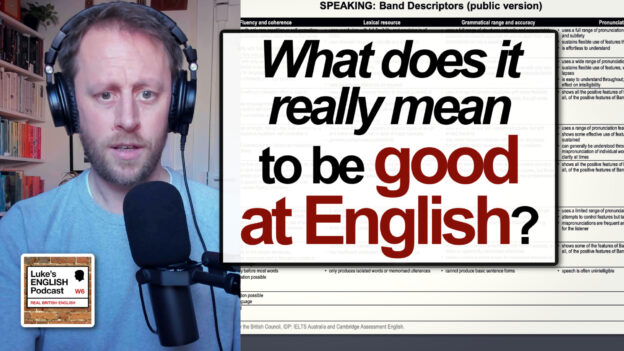
819. What does it really mean to be “good at English”?

How do we know when someone’s English is good? Is it just about having the right accent, or speaking with no errors? In fact, there is a lot more to it than that. IELTS can show us how someone’s level of English is properly assessed by looking at a wide range of skills and sub-skills and there is a lot more to it than making no errors while speaking with a “British accent”. This episode should help you consider your own level of English level, get some perspective on what language competence really means, and hopefully cause people to think twice when making snap judgements about other people’s English.

Small Donate Button[DOWNLOAD AUDIO]

DOWNLOAD THE PDF TRANSCRIPT HERE

Transcript

What does it really mean to be “good at English”? 

  • How do we assess someone’s English level? 
  • How can IELTS help us to understand what “good English” is?
  • Why is all of this important anyway?

Here’s an episode which I hope will be really useful as a way of helping you to understand what it really means to be good at English. 

We’re going to consider some things about

  • how English is assessed (how your English level is judged), 
  • the different skills which are involved in using English, 
  • and what aspects of English are the most important.

I hope this episode gives you a bit more perspective on what it means to have a good level of English.

Also there will be a lot of vocabulary for describing English skills and English levels or assessment in English, and that includes a lot of metalanguage – the language we use for talking about language. So try to notice all that vocabulary too.

Hopefully this episode will help you think about 

  • your level of English, 
  • how to assess a person’s level of English 
  • and also how to talk about both of those things.

It’s important for any language learner to get a sense of what they should be aiming for in their learning, so that they don’t spend their time on the wrong things, and that they have the right things prioritised in their learning.


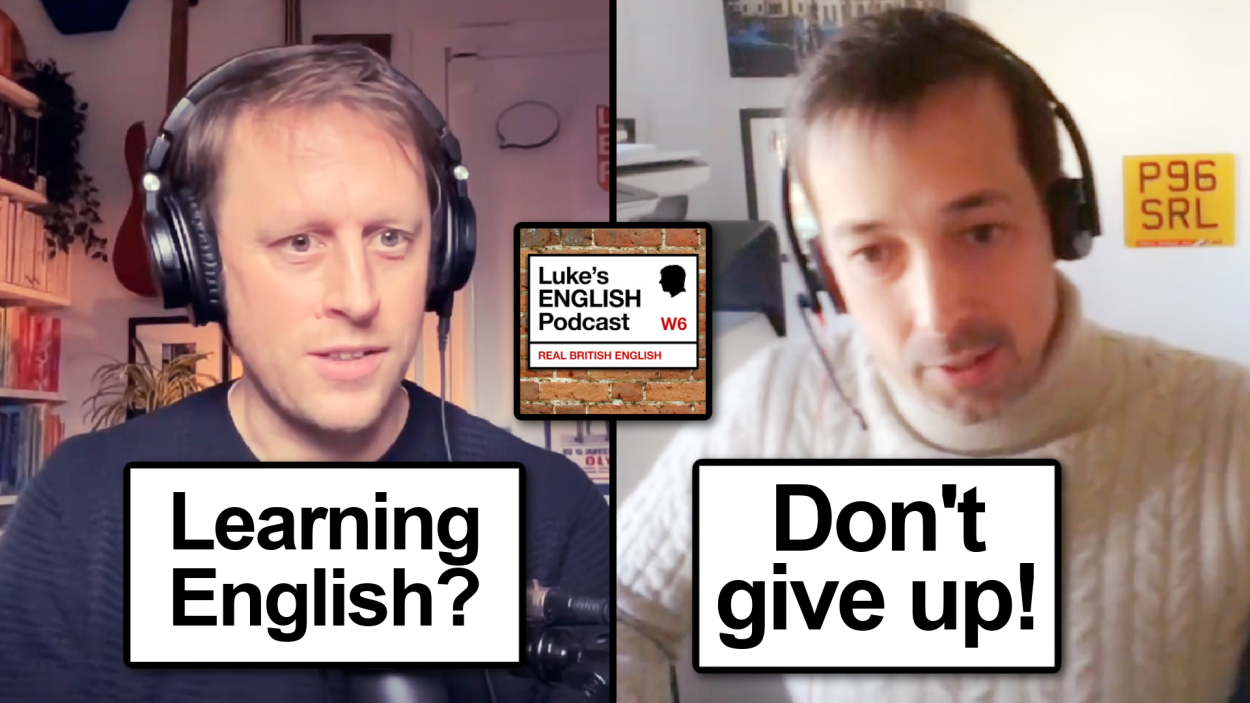
Do you remember the episode I published at the beginning of the year (2023) with Santi from Spain, working in a top job at Oxford University Press? 

806. PERSEVERANCE, POSITIVITY & PRACTICE with Santiago Ruiz de Velasco from Oxford University Press

806. PERSEVERANCE, POSITIVITY & PRACTICE with Santiago Ruiz de Velasco from Oxford University Press

You will find it in the episode archive and if you haven’t heard it, go back and check it out.

This episode follows on from that one. I was inspired to do it after seeing some responses from my audience.

Just as a reminder, Santi learned English mostly as an adult when he moved to London after studying at university in Spain. 

He had some very challenging experiences being immersed in the English language and eventually found his way to a top job in the English teaching industry itself – not as a teacher, but in publishing. He ended up as the Managing Director of English Language Teaching at OUP, and he got to that position despite the fact that his English is not “perfect”. 

I was pleased with that episode because it allows us to use Santi’s personal experience as a way to consider the importance of motivation and attitude in dealing with challenges in learning English (or any language) and also it raised questions about what “good English” really means.

With Santi, “the proof is in the pudding”, which means that we know his English is good because he uses it successfully every day.

Every single day at work he uses English to successfully perform a number of different communication tasks. I expect he writes emails and reports in English, conducts interviews in English, does presentations, has meetings, probably does negotiations, sells products and services in English, and builds relationships with people in English – no doubt both professional relationships but also meaningful personal relationships too. 

I’m assuming a lot of that because I don’t know every single thing he does in his job every day – but I’m pretty sure that he does all of those things. They’re just totally normal communication tasks at work. And it’s not just at work for Santi. I’m sure he also socialises in English. 

So, I think the fact that he does all those things, seemingly successfully, this is proof of his competence in English, right?

I think it would be very hard to be the Managing Director of the ELT Dept of Oxford University Press without those kinds of communication skills in English. 

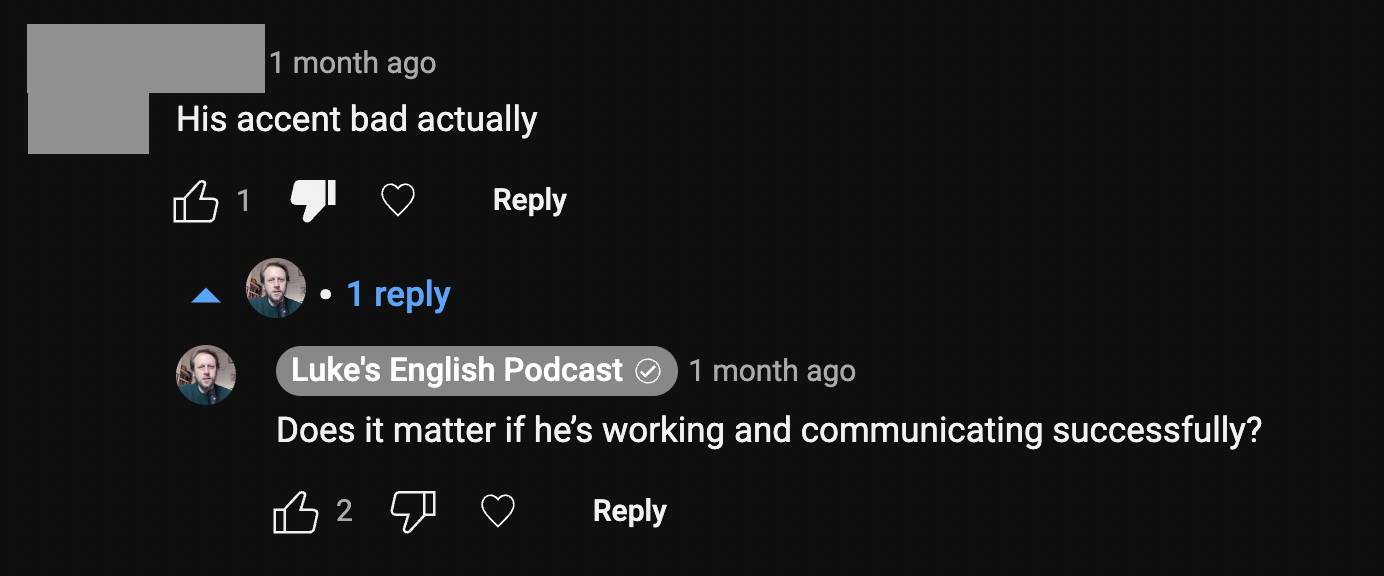
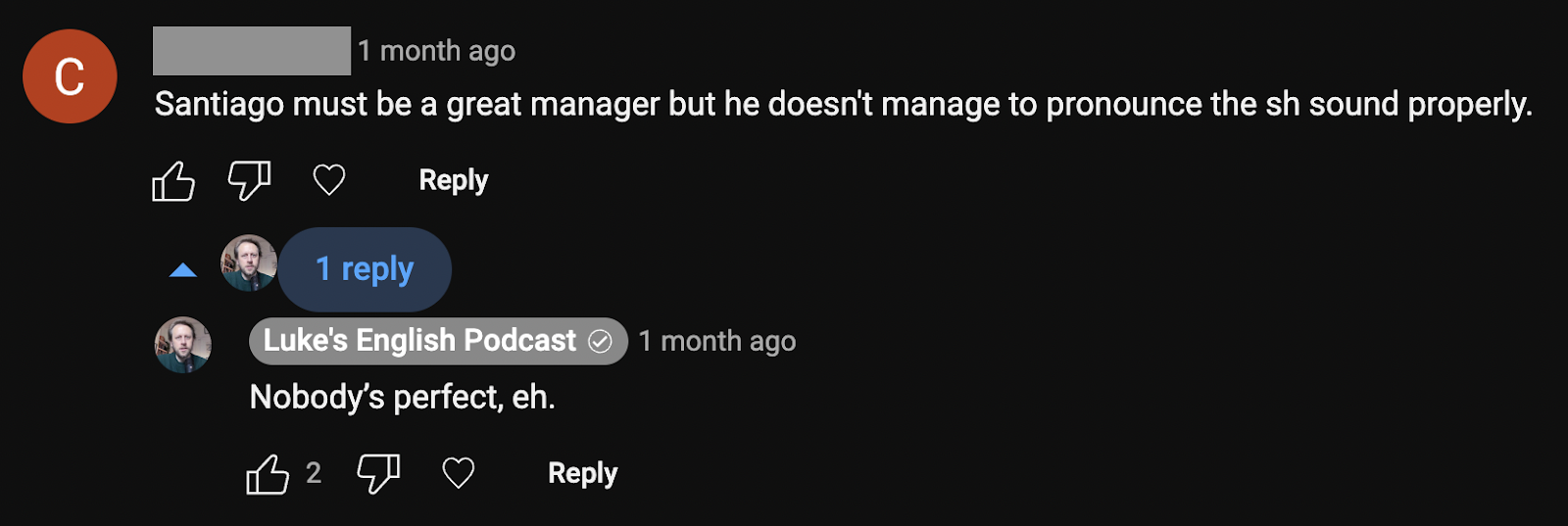
But, as I mentioned, his English is certainly not “perfect” by any means (and he says this himself too), and a number of listeners in the comment section on YouTube pointed this out, saying things like “He clearly has a Spanish accent” or “He made mistakes which made me surprised that he is in that position” and “I expected someone with RP English.” etc. I am paraphrasing there, but that’s the gist of it. 

What does it actually mean to have a “bad accent”?

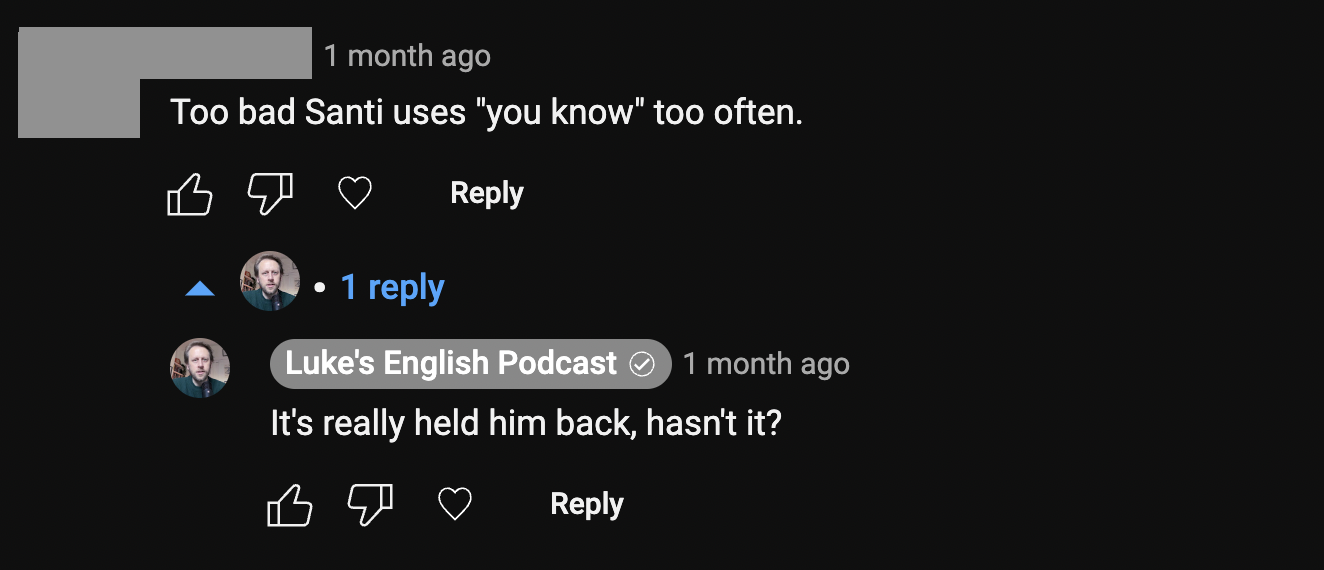
Maybe he could use some different fillers, just to avoid repeating the same thing. But why did this person focus only on that when there were so many other positive things to take away from the episode?

What is wrong with saying “you know” ?

  • It doesn’t stop us understanding him. It doesn’t stop him expressing himself.
  • It’s just an aesthetic issue, not a functional issue.
  • It’s just annoying for some people, but it doesn’t actually change the message or cause anyone misunderstandings. 

Perspective here – it’s not such a big deal, unless you’re really focused on it. Sure, Santi could work on this, but we all have things to work on. 

Fair enough, that one is quite funny.

I shouldn’t focus on the negative comments. The vast majority were positive, I must say. But I notice that whenever I feature someone on this podcast who is not a native speaker, and even some guests who are native speakers but have accents that are not RP, some listeners have to comment or criticise what they are hearing. I don’t think this is really the right attitude to have.

It’s not a competition, is it?

But, the fact that Santi has that job, has achieved that and continues to do that in English is something that can’t be taken away from him. I mean, people can point out errors in his English, but ultimately, the fact remains that he uses English very successfully on a daily basis. That’s important – the fact that he uses English “successully”.

Because this is the point of language. It is functional and it should be judged first and foremost on that – whether it works as a communication tool.

Sure, aesthetics are important too. The absolute best communicators also have English which is a pleasure to listen to, which is easy on the ears and is rich, pleasant and entertaining. But that stuff is also a matter of opinion and taste, and is really just the cherry on the top of the cake most of the time. Why focus on the cherry? You need to have a cake first, before you can have the cherry. You need something for the cherry to go on, right? 

Priorities – focus in the really important things first – the cake – and then work on the aesthetics – the cherry on the top.

I’m getting a bit lost in this metaphor now, but I hope you get what I mean. 

Common attitudes and assumptions about “good English” 

The point is that these comments are indicative of certain attitudes about English proficiency. They show us what a lot of people think makes someone “good at English”, namely:

  • Accuracy (using English without making errors) especially grammatical accuracy is the most important thing and speaking with zero errors is what makes you good at English. No mistakes.
  • All learners of English should have RP as their target in terms of pronunciation, and if you speak with a different accent or with obvious traces of your first language then this is a problem. And hearing someone use English with an accent is somehow “shocking” or even “unpleasant”.
  • You’re good at English if you use complex English, meaning longer words, formal words, idioms and convoluted sentence structure.

So, basically, you need to make no “pronunciation errors” or “grammar mistakes” and use complex “impressive” language.

That short list of assumptions is based on the things I’ve heard and read from learners of English during my teaching career. I’ve met thousands of learners of English and also read thousands of online comments from learners of English too and I often notice those attitudes. 

I suppose it is understandable really, that some people think like that. 

Not everyone has thought about this subject a lot because they don’t work in language teaching, people have been taught that English is all about correct grammar and correct pronunciation, and these things are obvious “low hanging fruit” in terms of English assessment.

It’s not everyone’s job to think about how to assess someone’s language level, and to be honest I only learned about this from doing professional training, reading academic books, teaching IELTS courses and working out the assessment criteria for Cambridge Exams and stuff. 

And we’re going to look at that official assessment criteria for judging someone’s language level later in this episode in order to find out that it’s not just about grammar and pronunciation errors and that there are other important factors. Obviously, being “correct” in pronunciation and grammar are important things, but only to a certain extent.

Like with the example of Santi. I feel like some of those comments are trying to take away Santi’s achievements, but you can’t, can you? 

The fact remains that although he makes a few mistakes in grammar, and clearly has a Spanish accent when he speaks English – despite those things, he is a very successful user of the English language and you can’t take that away from him. So how does he manage it, without being “perfect”?

What makes someone good at English then? What else is important? 

What I’d like to do now is to talk about actually what makes someone good at English and to show that there is a lot more involved than just accuracy (making no errors) and also complexity (using big impressive, rare words that nobody else knows).

Defining what makes someone good at English should be an important thing for us all to consider and remember. 

For you, if you are a learner of English, this is all about how you can get a sense of what you should be focusing on and what you should be trying to achieve. Also it can help you get out of a negative frame of mind when learning English. If you’re afraid that your pronunciation is not perfect or that you know you make errors, it might help to know that those things are not the be-all and end-all in this English speaking game.

Also, if you are a teacher of English, like me, thinking about this can help us to guide our students and provide the right kind of teaching to help them to achieve things in English. 

How do you assess someone’s English level?

Let’s use IELTS as a way of helping us to answer this question. By looking at how IELTS measures someone’s English level, we can work out what “good English” actually means.

What is IELTS?

The International English Language Testing System, is an international standardized test of English language proficiency for non-native English language speakers. It is jointly managed by the British Council, IDP: IELTS Australia and Cambridge Assessment English, and was established in 1989. (Wikipedia)

Basically it is probably the standard international test for assessing someone’s level of English as a foreign or other language. 

Working out someone’s level of English accuractely and reliably is not easy. Sure, I could speak with a learner of English for 10 minutes and get a good idea of their level, but to get a fully detailed assessment including different reading, writing, listening and speaking skills, a longer and more rigorous test is needed.

This is why the IELTS test is quite long and quite complex. It takes a few hours to do the test and it’s divided into lots of different parts. It’s all done in a serious and thorough way.

IELTS is a test that has been developed over a very long time, by experts in English language teaching and testing, based on a lot of academic research and professional experience into how people learn and use the English language. 

IELTS was developed by academics, teachers and examiners from Cambridge University and The British Council. These people know what they’re doing when it comes to finding out someone’s level of English. They want to do it properly, because this is important. 

Universities and employers want to get a reliable sense of the level of English of potential students or employees so they can be sure that those people will be able to use English to study or work successfully. A reliable test is vital for this, and that’s what IELTS is for. 

It might not be a perfect test. There’s probably room for improvement. In fact, it probably could be even longer and even more thorough, but that might just be impractical.

Anyway, let’s look at the way IELTS works, and we’ll see if we can draw from it some conclusions about the whole question of what it means to be good at English.

IELTS is in 4 sections – Speaking, Listening, Reading, Writing.

Already this shows that there are 4 skills involved in someone’s English ability, and of course this reflects the type of things that you might need to do in English.

You have to speak to people, listen to people speaking in various situations, you have to read English in different forms, and you have to be able to write in English. OK. 

So it’s not just speaking skills. That’s just one part of the picture. 

Speaking

Of course speaking is often considered as the most important skill. It’s the obvious skill. This is what we notice in people. As well as being vital for functional social communication, speaking is very closely connected to our identity and the way we express who we are to the world. 

Naturally, it is often the way your English is judged. Because people meet you, talk to you and then immediately get a sense your English level from that conversation. Fair enough. Speaking is important, but in IELTS it is only 25% of the test. It represents 25% of your final IELTS score. And as we will see, speaking can be divided into different sections too – and pronunciation is only one of those sections.

Listening

This is underestimated in terms of its importance. I’ve talked before about how, perhaps surprisingly, we spend more time listening than doing any of the other skills. 

Episode 586. The Importance of Listening | Luke’s ENGLISH Podcast

This YouTube video from a couple of years ago 👇

Also, it is absolutely vital that we understand the people we are talking to. If not, everything breaks down. 

One way that I judge someone’s language level when I’m talking to them, is the amount of effort I have to make for me to be understood by that person. This is a way for me to judge their listening skills in conversation. 

If I just talk normally, without having to adapt my English or pay close attention to make sure the other person is following me, if I can just talk normally and be myself, it means their English is great. 

I have met people who have had good English on paper and who were capable of producing sophisticated spoken English, but they were simply bad at having a conversation because their listening skills were not so great. They didn’t seem to be listening or just did not pick up on a lot of the things I was saying. 

For example, while listening to me talk, they didn’t seem to realise how I felt about certain things we were talking about, they didn’t notice little jokes I was making, they didn’t react to certain points I made and did not respond to my efforts to talk about certain things, and it wasn’t because they were just bad communicators even in their own language. It’s because their listening just wasn’t good enough and they were not able to follow what I was saying, and in fact didn’t even realise it. 

Listening also relates to being able to deal with different accents. English is a diverse language and people speak it slightly differently all over the world, and this is a good thing and a beautiful thing, so being good at English means being able to understand English in all its diversity. 

Only a very small percentage of people speak English like me, with my accent (let’s call it standard modern English RP). If you hear someone from, well, anywhere, and they have an accent which is in any way different from my standard British English, or whatever accent you consider to be neutral, and you don’t understand it then I’m afraid that is not the fault of the accent or the person speaking it. 

It’s because your listening skills are still not good enough. You are still not familiar with spoken English. Don’t feel bad about it though, that’s not the point. 

The point is, listening skills are a huge part of the puzzle. Think of Santi. He described struggling so much every day when working in London as a waiter. He did not understand what people were saying to him. 

People were asking for a coke and he was bring them their coat. His first arrived in London and actually heard real English being spoken and he freaked out. It wasn’t like in the text books at school. 

In London I expect he met various English people from different parts of the country. The English he heard was unrecognisable to him at the beginning, because he simply had never heard it before. 

His English listening skills improved dramatically while living in the UK. When I spoke to him I felt he was completely on my wavelength and I didn’t have to struggle or make a lot of effort to kind of adapt my English or myself during the conversation. I could relax and I felt like he would be able to follow my train of thought. 

A lot of listening is connected to pronunciation. Good listening skills also relate to an ability to understand the way people produce the oral version of English, and this means being familiar with things like connected speech, elision, sentence stress, word stress, weak forms and all of those things. It’s about knowing the oral version of the language, which is often very very different to the written version. This doesn’t just mean knowing it academically (understanding the phonology), but knowing it through familiarity – having heard a lot of English from diverse sources so that you have kind of trained your ears to it, so it’s not a huge shock or surprise when you actually hear it being used in the normal way.

Reading

I don’t have so much to say about this except that reading is not just about knowing the words that you are seeing, and knowing which grammatical forms are being used. It involves being able to identify the bigger picture – what those words and that grammar are really communicating to you. 

  • Can you identify the opinion or attitude of the person who wrote the text? (What they think, or whether they are being serious or humorous in their writing)
  • Can you identify their mood, their intentions, the overall purpose of the writing? 
  • Can you identify what kind of text it is – an article in a newspaper, a business report, an advertisement, a formal email, a personal email, an internal email, an external email, a piece of fiction, a humorous true story, a religious text, an old fashioned piece of writing, something modern? 
  • Are you aware of the different stylistic and linguistic conventions of different types of text? 
  • Are you able to read between the lines? 
  • Can you identify specific information as well as more general things? 

It’s more than just knowing individual words and grammar forms. It’s also about overall text structure, organisation, and tone.

Again, it’s not just about speaking. In the real world, all of these things come into play, all the time. It’s all a mix of dealing with input, understanding it, and responding to it, while managing the pragmatics of communication – what impact language has on other people.

Writing

This relates to reading in the way that’s it’s not just about knowing lots of words or grammar points, but knowing how to put those words and structures together to make a piece of writing that is coherent (easy to understand), cohesive (logical and organised) and which does what it is supposed to do (persuade, inform, request information, entertain, etc). 

With writing, sometimes the whole is greater than the sum of its parts. It’s a bit like cooking a good meal. It’s not just the ingredients and the cooking utensils, it’s about having the overall vision for making a delicious meal and then using those ingredients and utensils to produce the intended result, and deliver it at the right time and have your guests say “Mmm, this is delicious” at the end of the process. Writing is a bit like that. 

In terms of words that you might use in writing (or speaking) it’s not about knowing a lot of words. That helps of course but some people might judge their English by the number of words they know – like, the higher the number, the better they are at English. 

And it’s not about how fancy or obscure those words are. Some people might judge their English by the rarity of the words they know – e.g. knowing some words that even a lot of native English speakers don’t know. That’s not necessarily an indication of being good at English. What’s the use of writing something that most people just can’t understand because you’re using very old or very obscure words? 

It’s not about the number or the value of each word on its own, it is about using the right words, in the right combinations, at the right moments, to achieve the right result. 

It’s no good writing an email to someone and filling it with loads of complex and literary words than nobody really uses on a daily basis. The effect on the reader will be just to confuse them. That’s failing to communicate.

Watch out for those teaching materials, videos, whatever that say things  like “Use these 5 words to get a high score in IELTS”. It’s not just about using certain fancy words. It’s all about whether you are able to achieve certain results in English communication. 

I’ve said it before and I’ll say it again:

English is not just about what you know, it’s about what you can do.

It’s about your ability to complete tasks in English effectively. To understand other people and then have other people understand you. It’s about knowing when to use simple English and when it is appropriate or necessary to use something more complex, or something more specific. Right words, right form, right order, right time.

So I just talked about the 4 skills in English – speaking & listening,  writing & reading. 

Speaking & listening are together because they deal with the oral version of the language. The language in the air.

Reading & writing go together because they deal with the written version of English – the language written down.

Now, because I’m referring to my interview with Santi, which was an oral interview, let’s focus our attention for the rest of this episode on the spoken word, on speaking skills. 

I did say that speaking is only a quarter of the whole picture, but I think for many of you out there, speaking is what you want to focus on, right? 

So let’s consider what makes someone a good speaker of English? 

What I’m going to do now is look at IELTS assessment criteria. 

Assessment criteria means the specific ways in which English is judged. The specific standards by which English is assessed.

How do IELTS examiners judge someone’s level of English?

When you take an IELTS speaking test you will receive a score. 

This score is calculated by the examiner after they have listened to you and then marked you in a few sub-categories. Speaking is broken down into a few sub-categories and you’re given a score for each category, and then those scores are added together and then an average score is worked out. 

What are those categories?

  • Fluency & coherence
  • Lexical resource
  • Grammatical range & accuracy
  • Pronunciation

Each category is defined further and certain criteria or standards are defined which help the examiners decide what score to give in each category. 

In other Cambridge Exams, like FCE and CAE, speaking scores are assessed with similar criteria to IELTS, but there’s also a score for Global Achievement. This is like a score for overall task achievement. 

When you do a speaking test, you’re given a few tasks to do (short interview, having a discussion, doing a short monologue or presentation) and global achievement basically means “did the person manage to complete the task effectively”.

Quote from the CambridgeEnglish website explaining how speaking scores are measured for FCE. https://www.cambridgeenglish.org/images/210434-converting-practice-test-scores-to-cambridge-english-scale-scores.pdf 

Candidate speaking performances are assessed using scales which are linked to the CEFR. The assessor gives 0–5 marks for each of the following criteria: 

Grammar and Vocabulary; 

Discourse Management; 

Pronunciation; 

and Interactive Communication. 

Marks for each of these criteria are doubled. 

The interlocutor gives a mark of 0–5 for Global Achievement. 

This mark is then multiplied by four. 

Basically, this means that “global achievement” is more important than any other single criteria.

What is “global achievement”? For me, this is how well the person succeeded in the communication task. 

Your ability to complete a communication task effectively is more important than just your correct pronunciation or grammar. Having a few errors in your English is not the end of the world and what’s more important is task achievement. And that includes all that stuff about getting things done in English and getting the right result from a bit of speaking. 

For example, did you work well with your speaking partner in order to achieve the task you were doing – maybe to discuss some travel options before deciding together which one was the best, or having to make another joint decision.

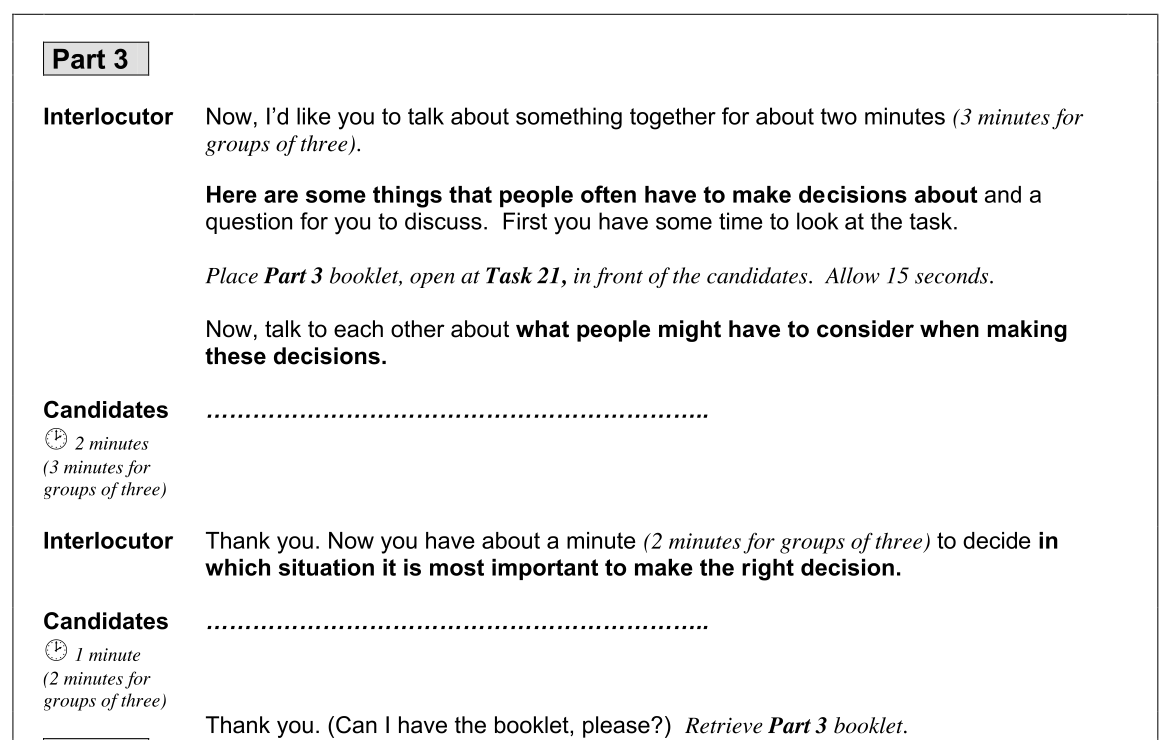
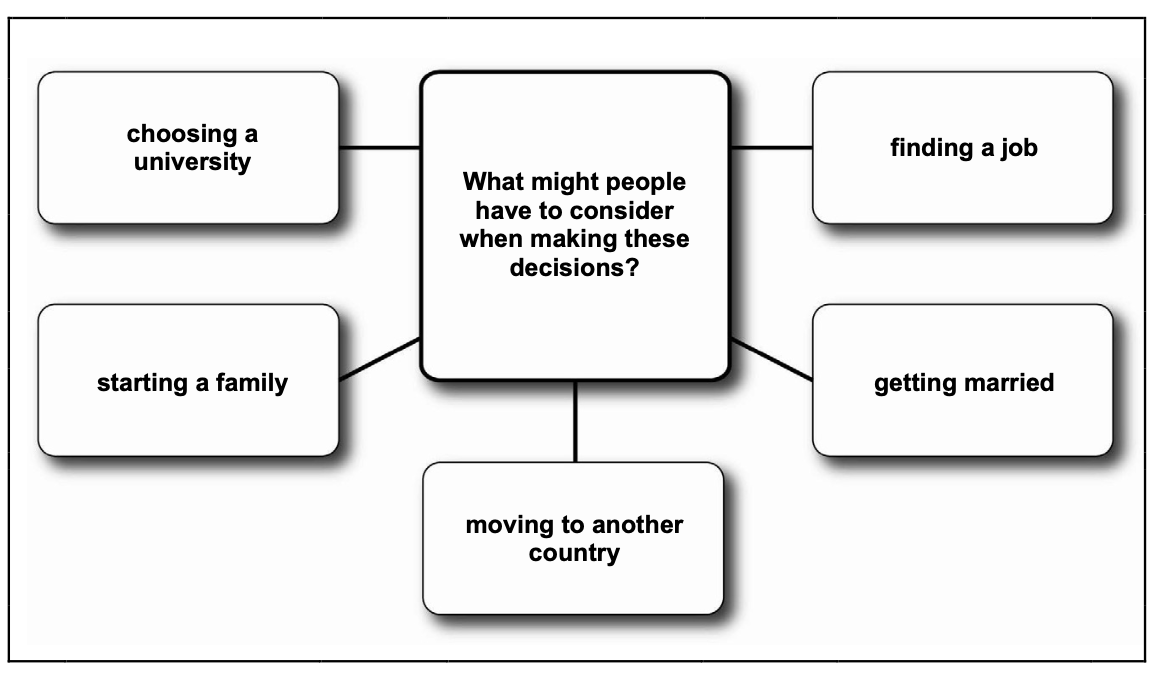
Actually, let’s have a look at a sample part 3 section from a CAE speaking test.

Here you will see extracts from a sample speaking test from this page https://www.cambridgeenglish.org/exams-and-tests/advanced/exam-format/

By the way, CAE is another English test, designed by Cambridge English. If you pass the test, you get a certificate which proves that you have advanced level English at C1 level. 

CAE is similar to IELTS, is based on the same research and conclusions that have been used in creating IELTS, so it can also help us to understand how English is assessed. 

Let’s look at the extracts to see an example of a speaking task that people have to do when taking CAE. In part 3 the examiner is interested in seeing how people use English to achieve something in collaboration with someone else. It’s about interaction and working together for a common goal. Important communication skills, right?

You should see how Global Achievement or Task Achievement is important here. This is about how you were able to use English to complete a communication task and I think that is a really important thing to be included in the exam and for people taking the exam to consider. Remember what language is for – it is for achieving things and completing tasks effectively. 

If you can do that, you’ll get a good score for Global Achievement.

So this means that having good English is not only about the individual words being used, the accuracy of the grammar or the accuracy of the pronunciation. It is about those things, but it is also about whether you organised your ideas correctly and clearly, whether you listened carefully to the other person, understood their intentions and responded with relevance to what they said, and that you were both able to complete the task.  

It’s not about any one single thing, any one single aspect of English. It’s about all of them, in combination. 

Ultimately, communication is a means to an end (a tool for a job). The means (the tool) is the language, but the end result is to actually make an agreement, make someone feel something, make someone understand something, organise something with someone, and successfully complete a specific task.

So, Santi didn’t pronounce some words and sentences “correctly” or in the same way that I would, but in the grand scheme of things, it didn’t matter. 

He might have conjugated some verbs wrongly (like getting a few ED endings wrong, or forgetting 3rd person S or even just using present tenses when he should have used past tenses, sometimes) but in the grand scheme of things, it didn’t matter. 

Now, those things are still important to get right – don’t misunderstand me. I’m not saying that you don’t need to be correct in grammar or pronunciation or that it doesn’t matter which words you’re using. Santi would get more points in an exam if he improved some of those little errors.

Of course those things are important. The point I’m making is that it’s about the bigger picture and there are plenty of other factors involved.

Specific IELTS Speaking Band Descriptors

I’m going to get really specific now. Let’s look at the specific IELTS speaking band descriptors.

What the hell does that mean Luke?

IELTS scores are given in bands. 

Band 0, Band 1, Band 2, Band 3, 4, 5, 6, 7, 8, 9. 

9 is high, 0 is low.

Cambridge English (IELTS.org) publishes a list of “descriptors” for each band score. These describe what the different bands mean in terms of specific speaking skills. This should reveal the ways in which speaking is assessed in IELTS.

You can consider your English as we talk about these “descriptors”.

We’re going to look at them all in a moment, on a PDF from the IELTS website.

First, let’s picture the IELTS speaking test.

Image: https://ielts.com.au/australia/prepare/ielts-preparation-material/speaking 

How do IELTS examiners assess someone’s spoken English?

I’ve done IELTS training before and I’ve done mock IELTS tests quite a lot of times. I’ve also done the same with FCE, CAE, BEC Vantage, BEC Higher etc. They’re similar. 

If I was doing a mock IELTS test with my students and I was the examiner, I would interview the candidate, give them speaking tasks to do and at the same time I would have to work out their score.

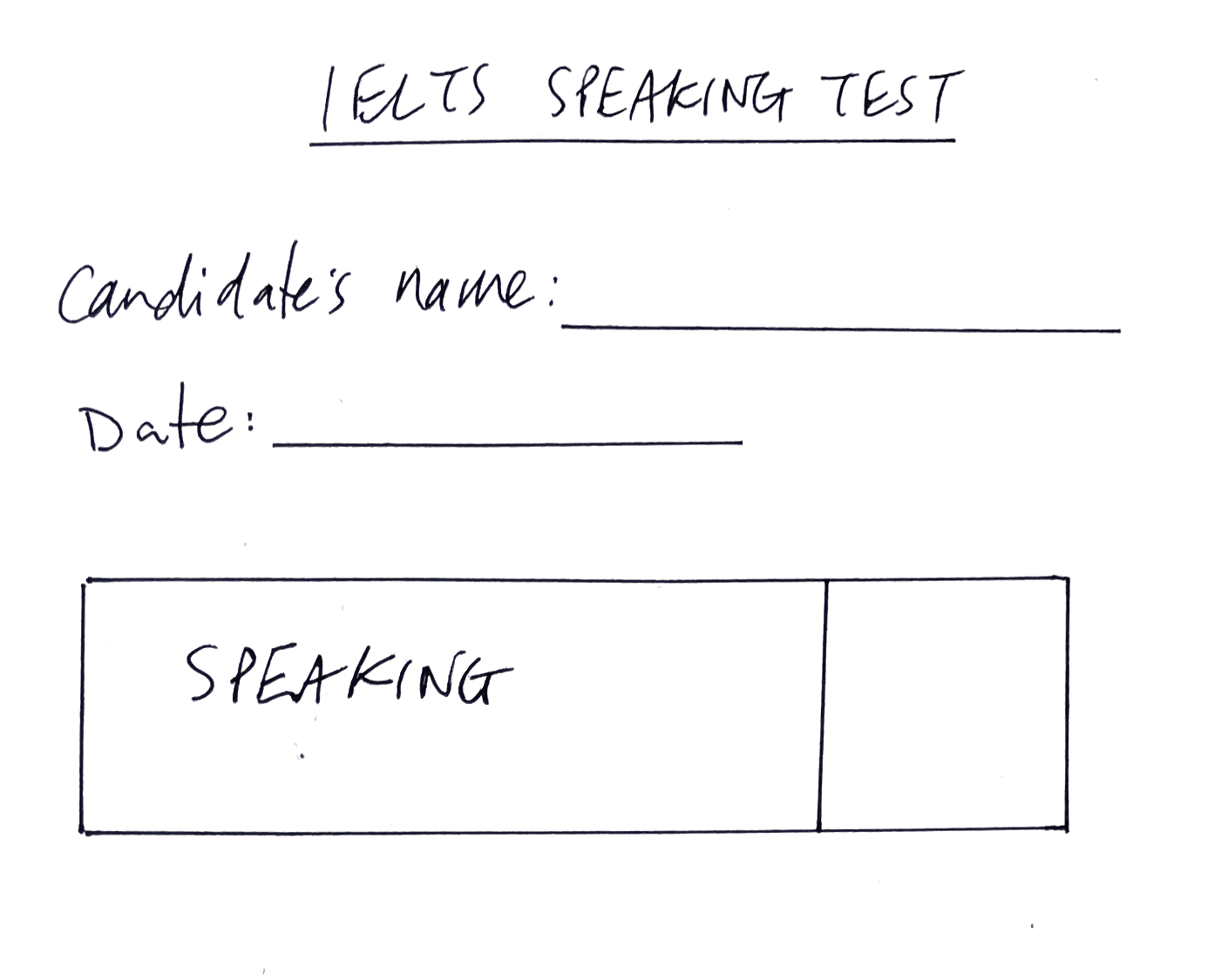
On the desk in front of me I would have a script for me to follow, different tasks and questions for the test and some paper and a pen for writing the person’s score.

But it’s not just a single score for speaking. 

I wouldn’t just have a single category on that paper called “Speaking” with a space for a number.

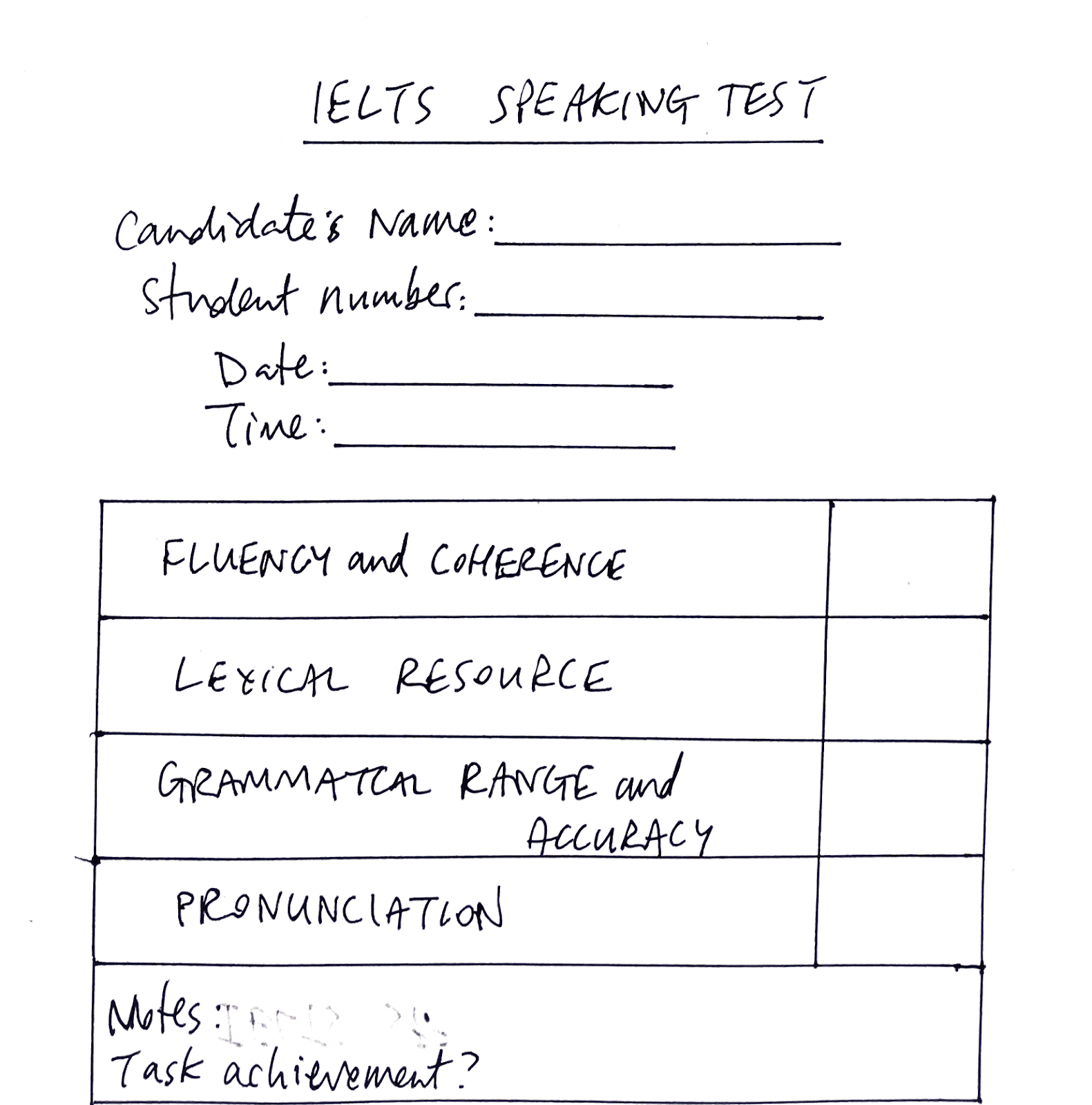
Instead, I would have a piece of paper in front of me with at least 4 sub-categories on it.

✅ 

      Overall score / average: _________

I’d give a score in each category and then work out an average across the 4 categories. 

I’m not an official IELTS examiner, I’m a teacher who is trained to prepare students for IELTS, so that’s just the way I do it. 

But I know for certain that the examiners use at least 4 sub-categories when assessing a candidate’s speaking.

Here are those categories. 

  • Fluency & coherence
  • Lexical resource
  • Grammatical range & accuracy
  • Pronunciation

Note that accuracy is only half of one of those categories.

What do the categories mean?

Let me talk about what those categories actually mean, and then we will look at the descriptions of different scores for each category. What’s the difference between an IELTS 6 and IELTS 7 for example.

This information is from IELTS.org again 👇

Speaking test: How are bandscores awarded for Speaking?.

What is “Fluency & Coherence”?

Fluency and coherence refers to the ability to talk with normal levels of continuity, rate and effort and to link ideas and language together to form coherent, connected speech.

The key indicators of fluency are speech rate and speech continuity.

The key indicators of coherence are logical sequencing of sentences; clear marking of stages in a discussion, narration or argument; and the use of cohesive devices (e.g. connectors, pronouns and conjunctions) within and between sentences.

What is “Lexical Resource”?

Lexical resource refers to the range of vocabulary the test taker can use and the precision with which meanings and attitudes can be expressed.

They key indicators are the variety of words used, the adequacy and appropriacy of the words used and the ability to circumlocute (get around a vocabulary gap by using other words) with or without noticeable hestitation.

What are “Grammatical range and accuracy”?

Grammatical range and accuracy refers to the range and the accurate and appropriate use of the test taker’s grammatical resource.

The key indicators of grammatical range are the length and complexity of the spoken sentences, the appropriate use of subordinate clauses, and the range of sentence structures, especially to move elements around for information focus.

The key indicators of grammatical accuracy are the number of grammatical errors in a given amount of speech and communicative effect of error.

What is “pronunciation”?

Pronunciation refers to the ability to produce comprehensible speech to fulfill the Speaking test requirements.

The key indicators will be the amount of strain caused to the listener, the amount of the speech which is unintelligible and the noticeability of influence from the test taker’s first language.

Now let’s have a look at some of those descriptions from IELTS.org

https://www.ielts.org/-/media/pdfs/speaking-band-descriptors.ashx

Perhaps use my level of French as an example, also Santi’s English.

We could compare the different levels (maybe the difference between 5 and 7) across each sub-category.

Which categories are the most important?

The 4 categories are of equal importance in the exam, I expect, but if I had to choose, I would say that they go in order of importance from left to right, but of course if any one of those categories is significantly weak, they will drag down the overall level. For example, if you are unintelligible in pronunciation, it sort of doesn’t matter how many words you know or if you don’t pause to think.

Grammatical accuracy is mainly significant if errors cause misunderstandings, but I guess errors can give the wrong impression. 

Interestingly, I feel like pronunciation, grammar and lexis all help us to achieve fluency. Fluency is where those three systems combine. Without a wide range of words which we can recall and use instantly, we can’t express ideas quickly, specifically and coherently.

Without grammatical structures, we can’t link ideas together clearly and express complex things without our speech breaking down and falling apart.

Without pronunciation we can’t get our words out fluidly and clearly, with words linked, and yet stressed to give emphasis and impact. 

Assessing Santi’s English (I hope you don’t mind Santi!)

I wonder what score Santi would get if he took an IELTS speaking test. 

I shouldn’t really speculate about that, but I can say that his weak spot is probably pronunciation, (although this is still at a good level because I was able to understand him and after all he is Spanish and so it’s normal that he has a Spanish accent)

and then perhaps grammatical accuracy (he made a few grammar mistakes which probably stuck out because we were looking for them – I bet a lot of people listening were focusing intently on his English and judging him a lot – and he handled that very well), 

but he really makes up for his weak spots by having:

  • Good grammatical range. He was able to employ a range of structures which allowed him to have control over what he was saying and to express some complex ideas.
  • Strong Lexical resource. He was able to find just the right words, he used words which were appropriate for the conversation (switching from bits of slang when it was appropriate, to more formal language to describe his work etc) and generally used some very nice, descriptive, idiomatic and frequently used expressions, phrases and words.
  • Excellent fluency and coherence. He organised his ideas with clarity, he didn’t seem to struggle any more than someone might in their first language, he didn’t pause excessively, he was able to keep going and going, linking one idea to the next.

So there you have it. Some things to think about.

Conclusions

Being good at English is not all about having “a British accent” or never making a grammar mistake. There are plenty of other things involved in being “good at English”.

Of course, it is up to you. If your goal is to have a British accent (which one?) then I’m not going to stop you, but I do want you to put that in perspective and to realise all the many other things which you can focus on.

And finally, at the end here, I just want to give you a message of encouragement, because one of the main lessons learned from my conversation with Santi was that perseverance, positivity and practice are 3 of the most important factors in this game that we call learning English.

So keep your chin up! Keep practising! 

Don’t stop, even if it seems difficult! 

Don’t let your weaknesses stop you! There are other areas where you can be strong.

Don’t worry about achieving perfection! 

Just keep going and do your best and you might find that is enough or more than enough! 

And enjoy it! You only get one life and it’s happening right now, so what are you waiting for – go ahead and use English and make some connections with people. 

Be curious about others, be keen to connect with them and be kind. Be kind and generous with your time and your attention, to other people you meet and talk to, and be kind to yourself as well. 

Don’t judge other people’s English too harshly. It’s not a competition.

I hope you’ve enjoyed this episode.

If you did, and you found it useful – give me a like or a comment or a review.

Have a nice morning, afternoon, evening or night and I will speak to you soon.

816. Kate Billington in the Podcastle

Kate Billington returns to LEP for the third time, to drink tea, talk about my pod-room, learning the bassoon, exam results, learning Chinese, responding to listener comments and talking about her videos on TikTok.

Small Donate Button[DOWNLOAD AUDIO]

Links and things

The British Council on TikTok

https://www.tiktok.com/@britishcouncilenglish?is_from_webapp=1&sender_device=pc

Kate’s video about “It’s raining cats and dogs”

@britishcouncilenglish Replying to @sentimentalbxtch Way ahead of you! #learnontiktok #learnenglish #idioms #edutok #vocabulary #english ♬ original sound – British Council English

@britishcouncilenglish ♬ original sound – British Council English
@britishcouncilenglish Kate’s back with another ‘very funny joke’ (she made me write that…)! Tell us what you think! #britishhumour #britishcomedy #englishteacher #learnenglish #learnontiktok #vocabulary ♬ original sound – British Council English

British Council Mini-English Lesson on For & Since

Previous appearances on LEP

Introduction Transcript

Hello listeners,

Welcome back to Luke’s English Podcast. I hope you are doing fine out there in podcast land.

Kate Billington is back on the podcast today. Of course, you remember her from episodes 689 and 705. 

If you heard those episodes I’m sure you will remember Kate and I know that a lot of you out there will be very happy that she is back again and yes, Kate’s return to this podcast is long overdue. She was a very popular guest when she was on the show before. So it’s great to have her back.

Some of you don’t know Kate because you haven’t heard those episodes but there’s no need for me to introduce her fully now in the intro because I kind of do that again during the conversation, except that Kate is an English teacher from England and we work together at the British Council.

People sometimes ask if Kate has her own podcast or YouTube channel or something, because they want to hear more from her.

Well, recently she started making videos for TikTok. We do talk about this during the episode, but that’s not until the end of the conversation, so I just wanted to give you a heads up about that right now at the start.

Kate is part of a team of teachers making content for the British Council’s channel on TikTok. You’ll see that they are making shorter videos (certainly shorter than mine) about things like British English idioms, culture and other entertaining bits and pieces. So, check it out – @BritishCouncilEnglish on TikTok. The link is on the page for this episode on my website.

So, what you are about to hear is another long and rambling conversation with a guest on my podcast. Hopefully you will stay engaged and entertained throughout while practising your English listening in the process.  

All you have to do as you listen to this is keep up with the changes and tangents, and enjoy this conversational journey into things like how Kate helped me with the shelves in my pod-room, how Kate doesn’t agree with the way I arrange my books on those shelves, how it feels to be filmed while talking (and yes there is a video version of this on YouTube), we talk about Kate’s academic successes and failures (or maybe I should say “failure” because it seems there’s only been one, and I’m still not sure it counts as a failure), the Chinese classes that Kate has been taking recently, quite a lot of stuff about Korea (hello Korean listeners), our blood types and what they mean, how we both feel about getting older, and how we feel about certain other English teaching video content that you might find on TikTok, Instagram or YouTube. All that, and much more, starting… now.

813. Language Learning is a Voyage of Discovery / Steve Kaufmann Interview

Steve Kaufmann is a very prolific language learner. He has learned at least 20 languages to varying degrees during his life. Some of them he learned during his career as an international diplomat and businessman, and others he has learned during his (semi) retirement. In this interview Steve talks about his language learning experiences, methods and motivations. We talk about various metaphors and similes for language learning including ocean voyages 🚢, cows 🐮, skiing ⛷ and cutting grass🏡, and I ask Steve about cross-cultural experiences he has had during his career. There is a video version but only the audio version contains my intro and ending rambles about getting my hair cut and how you need to remember that you’re a baby cow-shark on skis 🐄🦈🎿😅.

Small Donate Button[DOWNLOAD AUDIO]

Thanks again to Steve for the interview! Check out his website here https://www.thelinguist.com/

As a language learner, never forget that you are a baby cow-shark on skis!! 🐮🦈⛷

808. James Harris returns to talk about his book 📖🗣

James Harris is a writer, comedian, English teacher and language learner (French, German, Chinese) from England. In this funny chat, we talk about learning Chinese, being married to a Chinese woman and his semi-autobiographical book, “Midlands” which tells several funny and touching stories about two ex-pats living in Germany; Stuart, who is a stand-up comedian trying to understand the Germans, and Doug who gets involved in a love affair. James reads several passages from the book during the episode.

Small Donate Button[DOWNLOAD AUDIO]

https://youtu.be/xP9dCzNJ93w?si=1Xe2xDKtcBT8ck6O

👉 Get James’ book ⭐️⭐️⭐️⭐️⭐️ https://www.amazon.co.uk/Midlands-James-Harris/dp/B0B38CX11P

👉 Sign up to James’ email newsletter “Stiff Upper Quip” for regular short articles in English & more https://stiffupperquip.substack.com/

👇 Listen to James’ first episode on LEP


Extracts from “Midlands” by James Harris 📖

From Chapter 2

Stuart describes his early days in Germany, learning German.

Then a chance meeting in a pub had earned him an invitation to Berlin. Laura, Danish and short, was staying there for the summer, rummaging around in the archives for information about a particular Jewish family who had gone on to achieve cultural success in post-war Denmark; 

Laura, a snub-nosed Danish girl with glasses who loved Israel and wheat beer. Stuart didn’t care much about her interests but did enjoy spending the days reading on her balcony and socializing with university friends at night; 

by the end of the summer his hair had lengthened and his German increased fifty-fold, meaning he now knew about a hundred words. ‘Hallo!’ he would say, then ‘Weltschmerz’ and following a further pause ‘Auf Wiedersehen,’ saying a final farewell to people he would see again the next day. 

He also hadn’t yet learnt to ask whether something was sugar or salt, leading to an evening eating some very sweet chips. But even speechless he wasn’t, at last, uneasy in Berlin – it seemed to him a gentle city, where the trains slid in and out and the open spaces pacified tourists drunker and rowdier elsewhere. 

It was like the Germans had become one of the peaceful races in Star Trek, the ones introduced by an insert screen of their orderly, verdant planet, Bajorans, say, or some other species permanently threatened by obliteration; and what a change after the tiny cubicles and traffic-jam living of the English, who could only ever be the Borg.

Surrounded by pacifists, Stuart revelled in the license of Englishness, his ability to voice the odd mildly aggressive opinion or wildly over-celebrate during that summer’s football tournament, until England lost. He swam in lakes, and bought a bicycle, and gradually stopped thinking of England and the ashes it had fed him. 

In Oxford, where he had been President of the University sketch revue, people had printed gossip about him in the student newspapers, asked him to leave parties, dealt with him as the man who had committed that deepest and most unforgivable of Oxford crimes: failure. 

He had failed, as a comedian and a young man, and now publicly; his country had rejected him. He had been humiliated in front of an audience of his contemporaries and sent into an internal exile. 

Afterwards, many of these young dilettantes, at the time apparently picturing future lives as bereft of unforeseen distress as possible, lives composed of simply an endless procession of success, successes occurring within a network of contacts which they had built up at University and which would continue to provide them with unstinting support throughout their adult lives, never violating the simple and essential principle that all was permissible as long as it did well – did not want his name on their social CV.


From Chapter 14

Stuart is on-stage doing stand up in Germany.

‘Don’t you sometimes get the feeling,’ said Stuart, years before on the stage in Heidelberg, ‘that if Barack Obama had been German it wouldn’t have been “Yes We Can” but ”Nein das geht nicht”? No you can’t. 

‘Everyone would have been chanting it – No you can’t! No you can’t! Of course in this version Obama would not have been black.’ 

Stuart was closing in on the kill. ‘And this very lack of optimism,’ he said, treading across the stage, limbering, into the really good stuff now, ‘is actually built into the German language itself. 

Like for example, when you’re really happy in English, you say “I’m on Cloud Nine.” But in Germany you say, “I’m on Cloud Seven.”

Does this mean that even in their happiest moments the Germans are two clouds less happy than English-speaking people?’ 

And after developing that bit, which meant moving into a depiction of an exemplary German, Hannes, in his German heaven, with an allotment, board games, juice and an Autobahn heading directly to Mallorca, he noting, somewhat wistfully, the celebratory Anglophones on Cloud Nine who were dancing to ‘Video Killed the Radio Star’, which was an excuse to sing it, following which they – the Anglophones – called down to Cloud Eight “Hey Hannes man! Come and join us here on Cloud Nine” and Hannes replying “No thank you. Everything on Cloud Seven is perfectly satisfactory” then moving on to speculation as to the occupants of the other clouds, the French on Cloud Eight living it up, their motor scooters floating off the cloud and down to Cloud Zero where the Greeks were and below them the Cypriots who’d had to sell the cloud, and were just falling – after all these and other jokes, Stuart had them where he wanted them. 

‘Isn’t it funny that, since the Second World War, the Germans have been like’, change voice, German accent, ‘”We Germans. We have done so many things wrong and there is no way we can ever put them right.” 

And now Greece is like,’ pause, turn of the head, “Well, actually…”’ 

They laughed, and laughed, and laughed. They got it.

👇 Follow James on Twitter

806. PERSEVERANCE, POSITIVITY & PRACTICE with Santiago Ruiz de Velasco from Oxford University Press

Santiago has a top job in the English teaching industry. He is the managing director of English teaching at Oxford University Press. But English is not his first language. He learned it as an adult when he moved to London in his twenties. This conversation explores how he progressed in his English learning and in his career, while dealing with daily challenges and failures in English.

The conclusions are that motivation and positivity are vital, you have to keep going through the difficult times, and you can achieve great things in your career in English even if you’re not perfect. This episode should be a boost for the confidence of all English learners! Keep an open mind, keep your eyes on the prize, keep going and your English WILL improve!

Small Donate Button[DOWNLOAD AUDIO]

The audio version contains extra content, including my thoughts and conclusions after speaking to Santi

Some thoughts about language learning 👇

  • (To borrow a catchphrase from All Ears English Podcast) “It’s about connection not perfection“. 
  • Use English today – what are you waiting for?
  • Learning a language can be painful, but we have to persevere. Keep going through the bad times. Good times are just around the corner.
  • Keep your chin up! 
  • Keep calm and carry on!
  • Perseverance, positivity, practice.
  • Exposure is so important for learning English – reading a lot, listening a lot, socialising a lot in English.
  • Lean into failure, don’t hide from it.
  • But if you do hide from it, that’s ok – you’re only human.
  • English is a broad church – there’s a lot of diversity in it. 
  • Your version of English is part of it too, so don’t worry about your accent too much. Work on it, practice being clear, listen & repeat, but at the same time, keep it real – don’t worry if you don’t sound exactly like me. It hasn’t stopped Santi – he’s a success in English and you can do it too.

That’s it! Thanks for listening!

805. A New Year Ramble 2023 / Learn English with LEP

A rambling episode about making a fresh start in the new year, and some things I just have to tell you about listening to Luke’s English Podcast using a podcast app on your phone + lots of tangents. I hope you enjoy it!

Small Donate Button[DOWNLOAD AUDIO]

Episode notes / Transcript

  • I start reading at 12mins12seconds in the audio version
  • Sometimes I go “off-script” and say things which are not written here. I hope you can follow it all.

HELLO!

If you’re new to this podcast – I’m Luke, I’m an English teacher and comedian from England, and I’ve been doing this podcast for learners of English for about 14 years now.

You can use my podcast to improve your English in various ways, but the main thing is that it can help you do more listening, which is essential for acquiring natural, and instinctive English. What I mean by instinctive English is that you get an instinctive feel for the language, and this is what you can get from simply engaging with English in spoken form or written form and focusing on understanding it. It really helps if the process is fun and so I do try to keep things funny (this isn’t funny though) or just entertaining and interesting as much as possible.

This is episode 805 and it’s called A New Year Ramble 2023.

I am just going to talk to you for at least an hour. Just listen to my voice for the duration of the episode and remember – all the words and sentences I am saying are all going into your brain and a lot of it will stick there! This is perhaps more effective for your English progress than slaving away over a grammar book or staring at word lists. Just listen to me, follow my words, stick with me and hopefully enjoy it all. Let the rest happen naturally.

For this episode I’ve written some notes which I am reading from sometimes, and some stuff is spontaneous.

The main thing in this episode is that I’m just going to have a ramble. That means talking and talking, sometimes going this way sometimes that way, moving from one topic to another and one thought to another without having a very clearly defined structure. As I said, I’m just going to talk to you for a while. Join me!

New Listeners, a Fresh Start & Learning English with LEP in 2023

In January I find that new people start listening (hello!) 

Also people return to the podcast and generally refocus on learning English, turning over a new leaf. 

New Year’s resolutions 

I like to make a fresh start every January and say some things on the podcast to explain what this is, how it works, and how you can learn English from my content. 

This is the 14th time I’ve recorded an new year episode. It’s my 14th January on this show so I have done quite a lot of episodes in the past welcoming new people and talking about how you can learn English with this podcast, and what the aims of this project are. 

So, instead of repeating the same things again, I’ll suggest that you check out some of these episodes. (Pick some episodes to recommend)

Where can I find all your episodes, Luke?

You can always find all my episodes in the archive on my website. If you’re watching on YouTube, not all the episodes are there. Just some.

All rest are in my episode archive on my website including episode titles, numbers, summaries of what’s in each episode and then on each page you’ll find an audio player, a download button and sometimes vocabulary notes, transcripts of some or all of the episode and more things.

www.teacherluke.co.uk/episodes 

Some things you should know about how to listen to LEP 

I’ve noticed from quite a lot of comments and emails recently that people don’t know certain key information about my show.

Let’s just clarify a few things here about this podcast. 

  • Free episodes (Luke’s English Podcast)
  • and premium episodes (Luke’s English Podcast Premium)

Free Episodes

Free episodes are free! You’re listening to a free episode right now! 

If you’re listening using a podcast app on your phone, you might notice some advertising. This helps me to continue doing the podcast and pays for things like rent, internet, food. 

Premium Episodes

Premium episodes are only available if you sign up to LEP Premium for about 4$ a month. This also helps me to pay for things like food, clothes for my daughter, flowers for my wife, and loads of other things. This is how I actually live these days! 

Anyway, premium episodes are for premium subscribers and they’re usually about vocabulary, pronunciation and grammar.

The premium episodes have PDFs.

Some premium subscribers don’t know how to find the PDFs. 

I’ll tell you more about premium a bit later including the best way to listen to premium episodes and how to get the PDFs. 

How to listen to the free episodes

My show has always been primarily an audio podcast which most people listen to using a podcast app on their phone. 

You can also listen to the episodes on my website. 

I publish my episodes on YouTube as well. 

Over the last couple of years I’ve been filming myself with a webcam while recording my episodes and putting those video versions on YouTube. Some of those YouTube videos have sort of gone viral and I’ve ended up being a kind of YouTuber as well, but I still consider this show to be an audio podcast first and foremost.

Sometimes there is more content in the audio versions, for example if I have an interview with a guest, the video version might only contain the conversation, whereas the audio version will probably include an introduction and some talking from me at the end of the episode (perhaps a short ramble or some vocabulary explanations). 

When it’s possible I add some text on the screen of video versions on YouTube so you can read while you listen, but I don’t do that every time. 

Automatic subtitles are available (usually) on my YouTube videos. 

But this show is primarily an audio podcast. This is how I think of it. It’s an audio show which you can listen to in the normal way people listen to podcasts, which means using a podcast app on your phone. 

Now, I’m going to go a bit basic here and explain what a podcast app is. 

Back to basics: What is a podcast app?

The majority of you listening already know all this stuff so I’m just patronising you, but I suppose you could just pay attention to the way I’m describing all of this. How would you explain how to listen to a podcast, to someone who is completely new to the whole thing? Here’s how I would do it.  

For those of you who don’t know, a podcast app is an app you download (free) onto your phone from the App Store (iOS) or Play Store (Android). 

Lots of apps are available as I said. Check your phone. You might already have one. If you’re on iOS, you can look for the one with the purple icon that says Podcasts. Personally I’m not a huge fan of that app, but it will work fine.  

Maybe you don’t have a podcast app on your phone, in which case, download one (PocketCasts!) then just search in the app for Luke’s English Podcast and then subscribe to it. Of course, other podcasts are available but who needs other podcasts I ask you?

New episodes will arrive there every time I publish them and it’s super convenient. You can listen to episodes on headphones (recommended) or just blare them out loud on your phone on the back of the bus or something if you want to annoy everyone around you or perhaps help them learn English too. 

You can listen when your phone is connected to wifi (probably at home or maybe in the office when you should be working) or you can listen when you’re outside using your phone’s data internet connection. 

Podcast apps will also save your place in the episode, if you press stop for some reason. The app will remember where you stopped. Then when you go back to the app later and start listening to that episode again, the app will remember where you stopped and you can carry on listening. Perfect! No need to worry about my episodes being too long! No need to listen to the whole thing in one single sitting.

There are also other advantages to using a podcast app on your phone, including being able to add my premium episodes to the app as well, if you sign up. I’ll explain more about that in a minute. 

A lot of people use Spotify to listen to podcasts. Great! The only problem there is that you can’t add premium episodes to Spotify, because it’s not a “normal podcast app”. 

Don’t use the Luke’s English Podcast App any more

By the way, I am not talking about the LEP App here. A lot of you have downloaded that on your phones. 

It’s listed in the app store as “Luke’s English Podcast App” and it might appear on your phone as simply LEP.

But, don’t use the LEP app any more. It is defunct. New episodes are no longer arriving there and in a few months it will disappear from the App Store completely. So, you can forget about the LEP App now. It’s sad, I know, but it’s not the end of the world because you can continue listening in any other normal podcast app as I’ve said.

How to listen to LEP Premium and how to get the premium PDFs

Right, so let me talk a bit about LEP Premium. This isn’t a promotion by the way, it’s just information which a lot of people don’t know. No pressure to sign up to my premium subscription or anything. It’s totally up to you. Of course I hope you do, but it’s up to you right? 

By the way, premium people – new episodes are coming including some storytime episodes. 

So, I am constantly getting emails from people saying “I have signed up to LEP Premium but how do I listen and how do I get the PDFs?” and I just feel like a surprising number of people out there are somehow missing out on basic information which you just have to know or I might go a bit mad and stick bananas in my ears and then everyone will say “Hey you’ve got bananas in your ears” and I’ll say “What??” and they’ll say “You’ve got bananas in your ears!!!” and I’ll say “What????” and they’ll say “WHY HAVE YOU GOT BANANAS IN YOUR EARS???” and I’ll say “I CAN’T HEAR YOU I’VE GOT BANANAS IN MY EARS!!!”

That’s what will happen if everyone continues not to know certain basic information about my podcast and about how the premium part works. 

So…

Let me explain as quickly and clearly as possible, then we’ll move on to some ramblings about other perhaps more entertaining matters. 

The best way to listen to premium episodes is to add LEP Premium to a podcast app on your phone. 

Let’s say you’re using Apple Podcasts to listen to the normal free episodes of LEP and you’ve decided it’s time to also listen to the premium content to push your English further. Maybe one day you just say to yourself “Hey, I think it’s time to also listen to the premium content to push my English further” but then you think, but what do I do? Where do I go? And crucially – how do I get those precious PDFS???? 

Ok, so let’s say you’ve gone to www.teacherluke.Co.uk/premium on your phone and you’ve signed up to LEP Premium and you are logged into Acast+ (the platform I use for the premium subscription). 

You’ll see that you have the option to “Listen now” or  “Add show to app”. 

If you tap “listen now” you’ll see a list of all the episodes and you can play them, listen to them. But this is not a convenient way to listen. 

You need to tap “add show to app”, so tap that and you can choose the podcast app which you have on your phone and which you use to listen to the free episodes, see? 

Again, let’s say you’re using Apple Podcasts. Let’s use that as an example.

Where it says “Add show to podcast” you then tap “Apple Podcasts” and the Apple Podcasts app will magically open, giving you the option to subscribe to LEP Premium there. Do it! You’ve already paid, you’ve put your card details in and stuff, what are you waiting for. Add LEP Premium to Apple Podcasts! Go for it!

Now you have upgraded your LEP episode list on Apple Podcasts. You will now be able to find the premium episodes in your list. Before it was just the free episodes. Now the list includes the premium episodes too. Celebrate! It’s a miracle!

Spare a thought for LEPsters who can’t sign up to LEP Premium because of government stuff (Give peace a chance)

I think at this point it would be appropriate to spare a thought for those LEPsters who are unable to sign up to LEP Premium on Acast+, probably because of two possibilities  – either Acast has been blocked by your government because they think that LEP and LEP Premium are just far too dangerous for people to listen to, because – heaven forbid, I might talk about things which perhaps directly contradict the version of reality which they are trying to pull over your eyes, OR your credit card will not work for international payments because your country is being sanctioned because your government is being very naughty indeed. In any case, if you can’t access LEP Premium, I am sorry, but have a word with your government OK? But don’t get thrown in jail. I know, that’s easier said than done. I don’t know – I don’t want to casually suggest that you all rise up in some kind of revolution or something, and overthrow the people who run your country, because you simply cannot allow this madness to continue and you simply must be allowed to sign up to LEP Premium on Acast+. This is up to you. I’ll let you weigh up the risks and the potential benefits and so on. Good luck.

OK but let’s say you’ve signed up to LEP Premium and you’ve successfully added the episodes to your podcast app of choice. The premium episodes are now in your list, along with the other episodes. It might not be obvious at first, but they are there, just waiting to be discovered and listened to.

How can you find them? Well, you’ll need to scroll through the list a bit. Just scroll down through the episode list and BINGO you’ll see them. All premium episodes start with P and a number. P42, P41 etc. Some episodes have the word [Premium] at the start. 

Premium episodes P01-P36 were all added in July 2022 and they can be found between free episodes 776 and 777. Scroll down to episode 777 and look under it – see! Loads of premium episodes are there! (if you’ve signed up to the premium subscfiption and added the episodes to your app as I explained before)

ALL THIS STUFF ABOUT PODCAST APPS AND THE PREMIUM EPISODES IS GOING TO STOP IN A COUPLE OF MINUTES I PROMISE!! TRY NOT TO GET IMPATIENT OK??

What about the PDFs for those premium episodes? 

The links for the PDFs can be found in the show notes for each premium Episode. 

Anyway, what are “show notes” for podcast episodes?

In podcast apps, all podcast episodes have some text notes. This is where podcasters can add maybe a summary of the episode or some links to other things online. 

See if you can find the show notes or episode notes for each episode. Go on, have a look right now?

Some of you are saying “Come oooon Luke I know where the show notes are” OK then, find them right now and look at them and then say to yourself “Yes, I know where the show notes are, thank you Luke”

On Apple Podcasts, while you have an episode selected (you’ll see the LEP logo, the name of the episode and a play button) just drag the screen up and the notes will be revealed below. Again, it’s like magic or a miracle or something. An actual miracle. Thanks Jesus!

(one of my new year’s resolutions is to have more FUN in my episodes again, because life is too short)

This is where you will find the links to download the PDF for the episode. 

Tap one of the links, open the PDF and read it while you listen or send it to your computer where you can study it more carefully, annotate it with a pdf reader or even print it on paper in the old fashioned way. Then use a pencil to do the tasks. 

Ok? 

OK!

If you’re not signed up to LEP premium: Hello! That’s fine! 

You don’t have to sign up to the premium service if you don’t want to, can’t afford to or aren’t allowed to due to confusing global events and the actions of powerful men who sit at tables deciding your future. 

You are still a LEPSTER and you can still enjoy all the free episodes and all the rest of it, until of course the thought police completely turn off your access to the internet. Which country are you talking about Luke? Well, whichever country is doing it. 

There are show notes for all the free episodes too. (For many of you I’m teaching grandma how to suck eggs) 

If you’re listening in a podcast app. Have a look – you’ll always find a link to the “episode page”. That’s where you can read any vocab notes, find the associated youTube video (if there is one) and other information that I mention in the episode. 

YouTube Comments / Keeping My Episodes Varied / I’m the boss round here (yes, I am a powerful man who sits at a table and decides YOUR future)

Now we’re talking about YouTube which is another platform where I publish my episodes – either in video format (where you can see me talking, if that’s your cup of tea) or just listen to episodes without video and maybe switch on the automatic subtitles (don’t forget to smash that like button and click the bell icon and all that jazz).

One thing about being on YouTube is that there are more comments. 

This is because it is much easier to comment on YouTube than it is if you are in audioland (listening on a podcast app on your phone, probably). 

On YouTube the comment section is right there, and it is an integral part of the YouTube experience. 

So, people comment a lot more, which is great. It is lovely to get your feedback and it’s encouraging when people respond to what you’re doing. 

Sometimes it is amazing, especially if people write genuinely positive and appreciative things.

It’s mostly great, but it’s sometimes a bit irritating. 

As you know, if you are a human being, the negative things tend to stick with us a bit more than the positive things. 

By and large, my audience (like any audience of learners of English it seems) is incredibly thankful and appreciative, which is lovely. But naturally there are some people who are not so thoughtful and who write comments which probably tell us more about them than they do about the content that they’re commenting on. 

Now, while I do believe it is really important to take criticisms on board, to consider them and to learn from them, some comments are just a bit annoying! 

Which comments?

Well, obviously just abusive or directly rude comments are just the kind of “bird shit on the window of life” but there are some comments which are not exactly abuse, but which just show a certain lack of consideration for the content creator. I’m not going to list all the things that irritate me, because what’s the point, but one thing I have noticed is when I upload an episode, let’s say it’s a story episode, and the comment is “I miss your rambling episodes” or “Please make content about phrasal verbs” or “Please make short videos like “Don’t say please” or “stop saying thank you”.

Or I upload a rambling episode and someone comments “Make more stories, we want stories” or I do an Amber & Paul episode and the comment is “We want a Rick Thompson Report!” You get the idea. 

I do a variety of episodes, and I’ve always tried to keep the episodes varied for the whole time I’ve been doing this podcast, for better or worse. This is because: 

  • You can’t please all the people all the time (You might think that one type of episode is the best, but plenty of others will think that another type of episode is the best – in the end, I decide)
  • Keeping things varied keeps me motivated
  • It’s important for you to hear a variety of things – not just stories, not just teaching phrasal verbs etc, but also conversations, monologues, some easier episodes, some which are more difficult etc
  • I don’t think anyone thinks about this more than I do. I put my experience, my professional knowledge and also my heart and soul into making these episodes. They’re not always exactly perfect, but there is no such thing as “perfect” and it’s a fruitless mission to try and chase it. 

Ah shit I feel like I’m being too negative now, and also overthinking everything. Ah well. 

Is my show blocked in China?

Chinese LEPsters – how do you listen to my podcast? Do you use a VPN? Is my podcast available in Apple Podcasts? Is it available on any other apps? Let me know :)

Happy New Year! LET’S HAVE FUN IN ENGLISH IN 2023! GIVE PEACE A CHANCE!

Leave a comment to let me know you’re not a skeleton 👇

800. [PART 2] EPISODE 800 RAMBLE / LEPSTER Q&A

Celebrating episode 800 by answering a massive list of questions from listeners. This episode covers things like how to improve your speaking when you live in a non-English speaking country, the headphones and microphone I use, my current favourite episode, the afterlife and spirit world, my favourite brands of tea, my favourite video games, being a father and the recent Star Wars series Andor and plenty plenty more. Video version available.

Small Donate Button[DOWNLOAD AUDIO]

A note from Luke (not in the episode)

I recorded parts 1 & 2 on Thursday 8 December. Since then England got knocked out of the World Cup by France (ouch!) and also I got ill with a horrible case of flu which put me in bed for 4 days. I’m still ill, but definitely starting to feel better. I’m going to record the rest of these episodes when I am well again, but time is running out fast before Christmas arrives. I am not sure I will have time to do a World Cup episode, but who cares now that England are out? 😂 (I’m joking – I’d love to talk about the football, but I don’t know if there will be time. We’ll see.) Anyway, enjoy the part 2 of this episode 800 mega-ramble! 🎆🎆🎆

QUESTIONS (Listen or watch the video to hear/see me correcting some errors)

АфтандилAftandil

1 day ago

Hello Luke,

How are you?

I kicked off listening to your podcact because of your Mom.  In one of your first episodes, you were talking about the Beatles. I so much liked her wise answers to your questions, her voice, accent, and most of all her straightforward way of speaking . She’s great!

My question Mr Thomson.

What are  High Hopes in your mind ? I’m now referring to Pink Floyd’s song.

Thank you very much,

Best of luck.

Lobzhanidze Aftandil.


Sirus Asgarov (and Garov is very serious)

10 hours ago

Hi,Luke.Please  add  some  special   videos for IELTS listening multiple questions.There are  different   sounds  and also  so fast  for this  reason  it is  hard to define.

Thanks in Advance


David Alexander

10 hours ago (edited)

Hi Luke ️I have a suggestion for creating a discord server in order to connect LEPsters around the world therefore they would be able to talk and have a chat with each other, what’s your take on this Luke? (anyway you can easily notify LEPsters through discord about contents too and it’s utterly free, that’s awesome isn’t it?) and thanks a lot for your awesome contents, have a blessed day 


Tutor Asim

1 day ago

Hello Luke . Can you make a video about how to be confident on camera? Maybe you could interview some of your YouTuber friends or maybe Paul and Amber , they haven’t been on the podcast for a while have they ?


宁 魏Ning Wei

5 hours ago

Hi Luke~How do we improve our speaking skills if we are not living abroad~I mean English language speaking country~ Do you have any practical suggestions? I feel like my listening is much better than speaking~Your podcast is awesome ~thanks~

4 ways of speaking to yourself

  • Repeat after me, shadowing
  • Just chatting to yourself “I’m going to do this, and that’s a bottle of shampoo with soap all over it’ etc
  • Giving an opinion in response to something
  • Describing past events to practise storytelling

Mosbah Tayeb  • 1 day ago

How are you


Lv Bri  • 10 hours ago

Hi luke, why your headset look so ugly? I don’t mean to be rude, but they seems to be fixed with a plastic bag.


Lv Bri  • 10 hours ago

I was joking haha. A more real question: I am curious about if the podcast is your main job or do you teach in a real school? You are a great teacher and I wish you all the best with the podcast.


Natasha Katina

1 day ago

Hi Luke, thank you for your brilliant podcast. is your daughter friends with Amber’s and Paul‘s children?


Денис Пирог Denis Pirog

1 day ago

Hello, Luke! Which episode do you like the most and why? 


marianavie2012

1 day ago

Hi Luke, what do you like the most about being a podcaster?


Maria K.

1 day ago

Could you perhaps read short stories to repeat more often. I think this is the best way to practice pronunciation. That would be great.


Cristiano Ronaldo

1 day ago (edited)

I have a suggestion for you to make your podcast greater. You should make more episodes about vocabulary, like topic vocabulary, everyday expressions and some difficult grammatical structures, for example: 

I ate anything but an apple 

which means I only ate an apple.

I ate nothing but an apple

[Luke: actually this isn’t correct – listen to the episode to hear my comments]

Berdiyev Azamat from Uzbekistan 


Norridin Abdulkarim

1 day ago

Hey teacher Luke’ How are you? My question is how many Languages do you speak?  Second question Which club  do you support in the premier league?  Thanks an advance!!!


Rome Gracheve

2 days ago

Hello, Luke! My question is, what is the best gift you have ever received?


Mak Rakhimova

1 day ago (edited)

Do you have any movie lists to recommend ? 

Last question : I know you travelled to lots of countries . Haven’t you thought of starting a travelling blog ?


Angela M

1 day ago

I hope you will end episode 800 with a song! 


Mak Rakhimova

1 day ago (edited)

Hello,  Luke. Do you believe in the concept of the After Life ?

Have you ever been interested in the spirit world ?


Andrii Abtseshko

1 day ago

Hello Luke. What kind of dance you will do online on your YouTube channel if England win the Qatar championship ?


Bashiir Ahmed

1 day ago

Teacher luke, good morning, greetings from a small country in the horn of Africa called SOMALIA. my question is, can you connect me to an online English Teacher or School where I can study English. Thank you so much.


KamMouflage

2 days ago

what is your fav British tea brand?


Yang Si

1 day ago

What is the best random conversation you overhead?


TECH STUDIO

1 day ago

Can you describe you as a luckiest person


Steelpiercer

1 day ago

What is your favorite video game?


Stas Miroshnikov

1 day ago

Hi, what was your childhood dream? Do you have any dreams now?


ghada suqr

2 days ago

Please  read about YouTube algorithms  to reach more audience.


AGnieszk rachula

1 day ago

Have you ever been to Poland ?


KamMouflage

2 days ago

why do you wear a headset while recording?


Farhan Ibnu salih

7 hours ago

Hello are you fine


Maria Osipova  • 21 hours ago (edited)

Hi Luke, what is the best thing about being a father?


Hóa học Phương trình  • 6 hours ago

Why i can hear u,but i can’t hear american speak ?


みき  • 5 hours ago

And Can I ask what is the name of the microphone? Your voice is really clear and nice.^^@


Stas Miroshnikov  • 40 minutes ago

Hi again, have you watched new TV Star Wars series Andor? If yes, did you like it and why?


inga nagifka 

 • 1 day ago

Hello, Luke! I’m a new listener of your podcast, but I already like it a LOT! I love your sense of humor! Have you seen the movie Hot Fuzz? What do you think about it? Maybe you can recommend some interesting movies with great British humor? Good luck to you and thank you very much for your excellent job! 


Elena Buzalskaia  • 1 day ago

Hello, Luke! Could detective stories and poetry be more frequent or somehow regular in your podcast? Do you think they are like boosters for vocabulary, or they can make listeners feel a little bit passive? Do you have a special formulae for the  balance between different types of lessons?


Alessandro Clavenna  • 1 day ago

Hi Luke. Have you ever been to Italy.


Aurora Contreras  • 1 day ago

Hi, I’m new a subscriber! Great Podcasts!  I’d like you to dedicate an episode to the MBTI personality test, which is very popular nowadays.Kind Regards! 🇨🇱🇬🇧


Jerry Han  • 1 day ago

Could you please make a new episode about British English? like the tips of sounding more british and the things we have to mind if we wanna master British English. Thank you so much!


Maria Osipova  • 1 day ago

Hi Luke, what is your best life-changing non-fiction book?


Agnieszka Stodulska  • 16 hours ago

Hi Luke, Have you ever been to Poland?

HI Luke, Have you got any pets? Dogs or cats?

Hi Luke, What is your favourite dish? Do you prefer french or english cuisne?

Hi Luke, I like the podcasts with yout brother. Do you plan to organise the meeting with him on you tube? He has a very interesting voice. I’d like to see him :)

Hi Luke, Can you imagine that I need to have contact with your podcast every day? It is like an addiction:) Have you got some patent to be so good?

Hi Luke, What is in the picture on the left in your podroom?. I see a red geometric figure but what does it mean?

PART 3 coming as soon as possible!

800. [PART 1] EPISODE 800 RAMBLE / LEPSTER Q&A

Celebrating episode 800 and responding to lots of questions sent in on social media. Expect questions about my ill-fated music career, grammar, favourite authors, my daughter, life as an English teaching podcaster and plenty more. Video version available.

Small Donate Button[DOWNLOAD AUDIO]

Intro Script & Questions for Part 1

Hello listeners, welcome to episode 800.

Fireworks! BOOM! 🎆🎆🎆

Welcome to episode 800.

Here we are. It’s episode 800. It’s a big occasion but the emphasis is on chill in this episode. We’re just going to chill together and celebrate episode 800. So let’s sit back, relax and enjoy podcasting together. 

This episode might take absolutely ages – I don’t know how long this is going to be, but we’re not going to worry about that, or anything else in this episode. No concerns, no worries. 

For this one I thought I would answer some questions from listeners on social media, YouTube and my website. I recently asked for questions and I got loads. Billions. I got billions of questions. 

I’m going to try and answer them almost all of them in this episode. 

That might be seriously over ambitious and this could end up being the longest episode ever, we’ll see. If I have to divide it into parts, so be it. We’ve had episode 300 part 1 and 2, as well as several episode 666s, we can have episode 800 in a few parts. But in fact that does prove that I’ve already done more than 800 episodes. In fact I reckon it’s over 1000 if you include premium ones, bonus ones, app-only ones, phrasal verb ones. 

In any case, I’m going to go through the questions and try to answer as many as possible. This is bound to take bloody ages. I mean, hours. 

I’ve chosen nearly all the questions which came to me, except for world cup ones because I’ll talk about that in another episode. 

They’re presented here in no particular order, from various social media platforms. 

And I’m going to correct errors if and when I find them. 

So this will be a sort of error correction episode too, I expect.

We will start in a minute, but first I just want to take this moment to celebrate getting to 800 episodes!

What does this really mean to me?

A long term professional project which has been a success and continues to be. No mean feat!

It’s a nice big number

800 is a large amount of anything – name a thing and imagine 800 of it. It’s always a lot!

Satisfying to reach a milestone, but I have my sights on 1000 now.

No need to dwell on it too long…

Thank you for continuing to listen to this podcast, allowing me to keep doing this all these years. 

Recently the podcast hit 100,000,000 downloads since it started.

I love doing this podcast and I hope you love listening to it too.

I love the fact that I can do this – spend most of my working time on making content for learners of English, doing it my own way, being my own boss. It’s all thanks to the podcast, which means it’s all thanks to you, and the way it works is that those people who can afford it can become premium subscribers, which keeps the show completely free for those people who can’t afford it, and I get to keep making the episodes. 

Let’s get on with the listener questions.

By the way, I’ve removed all World Cup questions because I think I’m going to talk about that in a separate episode.

QUESTIONS

FROM LEPSTERS

YouTube

Cyril Alexander

1 day ago (edited)

Hello! Thank you for this lux podcast!

I saw you like playing guitar and maybe you have your own compositions and maybe you have some thoughts about your own rock band. 

Luke, did you ever dream of being a rock star? 

Would you be able to carry the rock star burden?

Played drums in lots of bands

Made music on computer (real instruments)

Made music on synths (Korg)

Play guitar (other people’s songs) and piano (not any more)

Play bass on other people’s songs

Bands

The bold ones were the serious ones


Engshan (English with Zeeshan)

1 day ago

Hey Luke  my name is M Zeeshan i am from Pakistan i’m your big fan so could you explain the difference between these sentences ?

“We had to stay until we had finished our podcast.”, 

“We had to stay until we finished our podcast.” 

Which one is correct?

Sera Bende  • 2 hours ago (edited)

Hi Luke, thanks for this mini episode :) Congratulations on the 800 episodes. My question is if you are considering doing more rambling episodes because they are fun and I think it is an excellent way to learn how to speak naturally and talk about daily life. Looking forward to seeing more rambling episodes.


Mariagrazia Fornarotto

17 hours ago

Hi Luke! It’s Mary from Italy writing..I was just wondering…who is your favourite contemporary English novelist and why? Thanks in advance  for your reply…

Maria

1 day ago

Hello, Luke! Thank you for your podcast Tell us, please, what stories do you tell your daughter? What are they about? Which ones are her favourite? 

Oishi

1 day ago

800 is a long way, congratulations Tr Luke. I would like to suggest that it would be great if you could upload one story telling episode per week (is it too much?) because as a lazy learner, your story telling can carry me to the end of the episode.

Janya Markevich

8 hours ago

Hey Luuuke! I really like what you do and I’m a fan of your sense humor. I was wondering as a kid at school were you this type of guy who bravely says a joke loudly so that the whole class hears and giggles afterwards? 

And do you feel that via humor you make the atmosphere (any place: job, school, family pre Christmas hassle, etc.) more amicable and lighthearted? 

Thank you in advance!))

Maria C

1 day ago (edited)

Hey Luke! Congratulations on the 800 episodes 

My question is if Jerry Seinfeld is one of your favorite comedians and if it was him or another one who inspired you. 

Steve Martin

Jerry Seinfeld

Bill Hicks

Eddie Izzard

Bill Bailey


Serg Boorow

2 days ago

Hey Luke, what’s cracking!?Thanks for your fantastic podcast, IMHO for the time being it’s one of the most fascinating podcasts in terms of immersing in British English/humor (or at least I would like to think like that) that I’ve come across. My question is, do you consider moving to somewhere from Paris in particular and from France in general? Cheers.

Living Italian style with Nina

57 minutes ago

Hi Luke,  thank you for your amazing job on your podcast.  My question is: when will you release another episode of the Rick Thompsom Report?

Antin Kuntin

1 day ago

Hi Luke.

First of all: you are doing a really great job! 

My question is: are you talking normally like in your daily life or slower and clearer than usual so that we can understand?  

Thanks in advance for your answer

Vafa Guliyeva

1 day ago

Hi, Luke! I got 3 questions for you .

In your opinion, approximately how many words do you need to have in your vocabulary to be able to speak like you do in your ramble episodes? and is there an efficient method for determining the amount of vocabulary for a non-native speaker?

https://manylex.com/

How does it work? Read the text on the website.

Native speakers know 20,000 – 30,000 words.

I got about 25,000.

Learners of English who get 10,000 can be near-native.

Aster L.H.

1 day ago

Bravo Luke! Looking forward to your next podcast talking about The FIFA World Cup. 

A question to Luke. How many Asian countries have you been to?

Jakub

1 day ago (edited)

Hello Luke. I really enjoyed your podcasts about comedy TV series, like Alan Partridge. However, I asked you (very politely) quite a long time ago about the possibility of doing an episode (likely more then one) about Peep show. I believe that we could all learn from Peep show loads of useful British expressions/phrases which never occur in textbooks for students. Is there any chance that some comedy episodes are in the pipeline?  Respect and best wishes from Poland 🇵🇱️

Teacher Zdenek

1 day ago

My questions for you: “What’s the hardest thing about doing the podcast?”

Shaping an idea into the finished product. 

Дмитрий Обухов Dmitry Obukhov

19 hours ago (edited)

Hi, Luke! I’m really into your podcasts and watch every single episode no matter what length it is. My favorite videos are about detective and horror quizzes/stories. Are you planning to make a podcast on this topic? If so, I’m looking forward to seeing new episodes soon.

Cristiano Ronaldo

1 day ago (edited)

Hi Luke, how is it going? First of all, thank you for teaching us. My question is : is it possible to speak like you, if I only listen to your podcast, I mean your intonation and your pronunciation. You speak very clearly. I like your speech that is why I usually listen to your podcast

My name is Berdiyev Azamat from Khiva in Uzbekistan

德高望重respected

1 day ago

Hi Luke, I wonder what makes you an English teacher? I am a new listener since maybe 3 months ago, and I enjoy your style a lot. Thanks anyway.

Cecília de Melo

1 day ago

Hi, Luke! Thank you for teaching us. My question is: I don’t have problems to understand you but why is so difficult for me to understand an American talking?

  1. Familiarity
  2. Are you watching TV/Films?
  3. Maybe British English is just better

vvaskey

2 days ago

Hi Luke:) 

My first question is what is the best moment in your childhood?) 

My second question is a bit personal, but anyway how old is your daughter? How is she doing?)

Ramble Message / Episode 800 Plans / World Cup Episodes?

A bonus mini-ramble about my plans for episode 800 (send me your questions) and why I haven’t done any World Cup episodes yet, but you can listen to me talking about it with Zdenek on his podcast (link available).

[DOWNLOAD AUDIO]

LEAVE ME YOUR QUESTIONS FOR EPISODE 800 BELOW!! :)

797. Stephen from SEND7 interviews Luke about LEP

Stephen from SEND7 podcast becomes the host to interview me about how I started LEP, the ins and outs of doing this, plus some advantages and challenges for podcasting to learners of English. Video version available.

Small Donate Button[DOWNLOAD AUDIO]

Video Version (automatic subtitles)

Send 7 Podcast – www.send7.org