Tag Archives: british

377. Holiday in Thailand (Part 1)

This episode contains stories and descriptions of my recent holiday in Thailand. You’ll hear some facts about Thailand, some descriptions of Bangkok and a few stories about funny experiences that happened while we were there. Part 2 is coming soon. More details and transcriptions below. Enjoy!

Small Donate Button[DOWNLOAD]

Transcript

Hello everybody, I’m back from my holiday so here is a brand new episode for you to listen to. If you’re new to Luke’s English Podcast, then “hello” and welcome to the show. I have no idea how you found the podcast. It was probably on the internet, that’s how it normally happens. I doubt that you actually tripped over it in the street or anything. Oops ,what’s that – oh, it’s Luke’s English Podcast. I might as well have a look. You probably found it online, perhaps through iTunes or a friend recommended it to you perhaps. In any case, regardless of how you found me, welcome. My name’s Luke – and this is my podcast. It’s primarily for learners of English although I also have native English speakers listening to this too. In these episodes I talk to you in a personal way, telling stories, sharing some things about my life, discussing different topics, teaching you English and giving you the motivation to improve your English for yourself. I try to keep the podcast varied and I’m willing to talk about pretty much anything at all as long as it’s interesting. I’m an English teacher from the UK. I speak British English – with a standard accent from the South East of England. I’ve been teaching for more than 15 years so I have lots of experience to draw from. I’m also a stand-up comedian which means that when I’m not teaching English or doing the podcast I like to stand up in front of audiences of people and make them laugh with jokes and stories and things. I regularly perform comedy shows in Paris.

One of the principles which underpins what I do in episodes of this podcast is the understanding that simply listening to natural, spontaneous speech is a vital part of the process of learning English to a good standard. Obviously, you have to get an understanding of the grammar rules, develop an extensive set of active vocabulary, practise pronouncing the language and so on, but doing plenty of listening is an essential foundation. I usually recommend that LEP is best enjoyed as part of a balanced study program. For example I suggest that you also do plenty of speaking in order to activate the English that you passively pick up from these episodes. There are lots of ways to improve your English and you can just listen to previous episodes of the podcast to get my advice on that. At the very least, you can just relax and enjoy listening to my words on a regular basis, and I hope that it’s a fun process too. Certainly, I am sure that my podcast can really help all the other aspects of your English, not just your listening. I also believe it’s important to listen to English which is spoken at a pretty natural speed, which is spontaneous (i.e. not just written from a script) and I think you should listen regularly for fairly long periods, long term. Make it a part of your lifestyle to listen regularly and don’t give up.

I want my podcast to help you to do exactly those things, and so I try to make my episodes genuine, personal and humorous. So, if you’re new to the podcast – welcome and thanks for listening. I hope you stick with it. I believe that if you do continue to listen, you’ll see significant results in your English. Check out the episode archive on my website teacherluke.co.uk and you’ll see that you have plenty of other episodes to explore and enjoy.

If you’re not new to the podcast, and you are in fact a long term LEPster then welcome back! How are you? I hope you’re well. Did you have a good August? Have you listened to all the episodes I published before I went away? I hope so.

In any case, here is a new episode of this podcast and it is about my recent holiday in Thailand.

Holiday in Thailand

Yes, we went to Thailand this year and I’m going to tell you about it in this episode. In fact, in this one I’ll talk about these things:

  1. Why we went to Thailand
  2. Where we went in Thailand
  3. The things most people know about Thailand
  4. Some things you might not know about Thailand
  5. A few anecdotes about what we did and saw during the holiday
  6. A few dodgy jokes!
  7. An embarrassing story involving nudity
  8. A sad old memory that came back to me at a specific moment in the trip
  9. A mouse-related update (if you heard the last episode of the podcast, this will make sense to you)

We got back just the other day. I’m still a bit jet-lagged. I woke up at stupid o’clock this morning. My body is still on Thailand time, so at about 5AM my body woke up saying “hey it’s time to get up and go walking around temples in very hot temperatures! We’re on holiday come on!” No doubt I will randomly fall asleep this afternoon when my body decides that it’s bedtime. I have a sun tan – correction, I had a tan, until the flight back. As a very white English man, I have a slightly tricky relationship with sun tans. At the moment I am sporting the typical English man’s tan.

I have no idea how long this episode will be but I can just split it up into different chapters and it’s all good.

You will find some of this episode transcribed on the episode page on my website. Not all of it is transcribed, but a lot of it is, and you can read my notes too, which might be a good way to check out the spelling of any words you hear me use. They might be written on the page. By the way, if you’re just reading this – I strongly recommend that you listen instead of reading. Remember, anything that is written here is supposed to just accompany what I’m saying in the audio recording.

Why did we choose Thailand?

– My wife and I wanted to go somewhere exotic and far away (we want to explore places which are a bit further before we have kids)
– A break and a chance to get away from it all
– Never been before
– We like food !
– It’s quite diverse in terms of the things you can do – city, culture, beaches
– It’s not too expensive

Why didn’t you do an LEP Live event?

It was a holiday – so I was not working. That means I didn’t organise some sort of LEPster meet-up, or live podcasting stand up comedy extravaganza. I didn’t meet up with Olly Richards even though I have since learned that he was out there too learning Thai – no, it was all about walking around sweating, visiting temples, sweating, exploring street food markets, sweating, worrying about food poisoning, sweating, going to the beach and sweating there, learning how to cook local food, eating the local food with lots of chilli, sweating, doing yoga and meditating, drinking water and sweating! Just the average holiday abroad for a British person!

Where did you go?

In a nutshell, here’s where we went.

Bangkok for a few days, then up north to Chiang Mai for a few days, then down south to Koh Samui for a few days and then back to Bangkok for a few days and then home! Boom!

That’s the usual tourist route. It’s Bangkok in the middle, temples, treks into the forest, elephants, night markets and cooking classes in the north, then islands, beaches, diving, snorkelling and full moon parties in the south.

We didn’t go to the islands on the west side like Phuket because of the climate in August.

Also, just before we left and even while we were there, there were some explosions – some bombings, which was a bit worrying. We even considered not going, but then we thought – well, we live in Paris and we’ve got as much chance of being blown up there as in Thailand, so what the hell!

In fact our time was very peaceful.

Usual things people think about Thailand

The most typical clichés or stereotypes about Thailand: Busy, crowded, amazing food – specifically green curry and pad thai noodles, weird sex tourism in Bangkok, ladyboys, bizarre sex shows involving ping pong balls, full moon beach parties, buckets full of ridiculously full cocktails, kickboxing, temples, westerners being locked up in prison for drug possession, scooters, Sagat from Street Fighter 2 (Tiger uppercut), snakes, golden buddha statues, amazingly friendly and smiling people and the film “The Beach” starring Leonardo DiCaprio.

That’s partly true (perhaps for the average western tourist) but obviously it’s not the full picture, especially for the locals.  I will go into more detail about what it’s really like in this episode.

Things you might not know about Thailand

1. Full name of Bangkok. It’s the longest city name in the world. “Krungthepmahanakhon Amonrattanakosin Mahintharayutthaya Mahadilokphop Noppharatratchathaniburirom Udomratchaniwetmahasathan Amonphimanawatansathit Sakkathattiyawitsanukamprasit.”

https://www.youtube.com/watch?v=-OgUiux9QWw

2. Thailand, or “Prathet Thai” means “land of the free”…

3. Thailand has never been colonised by a foreign power, unlike other neighbouring countries which were colonised by European nations like Britain, France and the Netherlands. Thailand had a few wars with Burma, but was never successfully invaded. Well done Thailand.

4. Thailand has more than 1,400 islands. The most famous ones are in the south, and they are beautiful. Probably the most well known is Koh Phi Phi, which is where The Beach was filmed. (By the way, it’s a rubbish film)

5. It’s illegal to leave the house without underwear on. I don’t know how they enforce this law. Are they doing random underpant checks?

6. Thai currency is called the Baht and it’s illegal to step on Thai Baht. Now, you might be thinking – well, I don’t every go around stepping on currency anyway, so that’s not a problem. But the point is that this is because of the high level of respect that the Thai people have for their royal family. Like in the UK, a picture of the monarch appears on every bank note and the image of the monarch cannot be desecrated, in fact it is a crime to disfigure a picture of the king or queen in any way. Thailand is a constitutional monarchy, a bit like the UK, and they hold their king and queen in high esteem. There are lots and lots of images of them all over the country, sometimes you find little shrines in the street devoted to them.

7. The feet are considered to be very unclean (both clinically and spiritually) and so it is very rude to reveal the soles of your feet to anyone. So, don’t sit with your feet facing outwards, or put your feet up on the table like we do in the west sometimes. It’s also rude to point at people with your feet, which is fine because I literally never do that anyway. I’m sure I heard someone do standup about that and I can’t remember who, but it was very funny.

8. Similarly, the head is the highest point on the body and is considered to be sacred, so don’t touch it, slap it, poke it or whatever. In the west you might rub someone on the top of the head as a sign of affection, or whack someone round the back of the head to express annoyance. Don’t do that in Thailand. To be honest, I wasn’t going to do that either. I rarely touch the head of random strangers that I meet in public. I certainly wouldn’t slap the back of the head of someone. E.g. “Waiter, excuse me – we asked for 2 bowls of rice and you gave me one! Can we have another one? Thank you!” SLAP. No.

9. 95% of people are buddhist. It’s quite common to see Buddhist monks walking around. We talked to one of them and I’ll explain what he said later in this episode. Also there are buddha statues everywhere. There are thousands of them. It’s just buddha buddha buddha buddha buddha buddha buddha buddha buddha. Climb to the top of a mountain, there’s a buddha. Inside a cave? Buddha. Under a nice tree? Buddha. Inside this big temple? Buddha. In front of the big buddha statue, lots of other buddhas. In front of them, buddhas. Buddhas everywhere – which is great. They are beautiful, peaceful images and of all the religions I think Buddhism perhaps makes the most sense. Just try to reach a higher level of consciousness. Realise that everything is connected and that there is one universal vibration which passes through the entire universe. Reject selfish and materialistic urges in favour of achieving individual spiritual enlightenment. Fine.

10. It’s a very hot place – especially Bangkok. The hottest time of year is April where temperatures rise to 40 degrees C or more, with high humidity levels too. In August it’s the rainy season but it still gets really hot – it was regularly in the high 30s and with very high levels of humidity. Showers that happen in the evenings are a welcome break from the heat!

Read more about this on ‘the internet’ http://matadornetwork.com/trips/19-things-probably-didnt-know-thailand/

Bangkok

There are lots of stories about it, like the dodgy ping pong shows, the sex tourism and other weird and lewd things, but of course not everywhere is like that. We avoided the dodgy tourist parts such as Patpong, where there are these weird sex shows. Now, while I am quite curious to learn about the bizarre skills that some women have developed – I mean, some of the things are quite impressive. For example, apparently in these shows, some women are able to launch ping pong balls across the room – and not with their hands if you know what I mean, and some of them can even write letters with a paintbrush or pen, again, not with their hands. THat’s actually quite impressive, but I don’t really need to see it, and apparently the people who run the shows are very dodgy indeed and they lure you in with false prices and then when you try to leave they force you to pay a lot of money and it gets pretty ugly, so no thanks. No ping pong shows for us.

A mix between the chaotic and slightly sketchy places like Vietnam, Cambodia, Laos etc and the more modern JPN, particularly parts of this area where we stayed.

The streets are vibrant, chaotic, noisy, smelly, polluted, full of life. Scooters, cars, crossing the road. Nobody walks! Traffic is incredibly busy. There’s an amazing metro system called the sky train. Tuk tuks, taxis and so on.

Lots of street food, with people cooking all sorts of things on little mobile carts – chicken skewers, lots of seafood, noodles, fruits like mango and some things I didn’t recognise. People eat in the street sitting on little plastic chairs.

Incredible Japanese BBQ. Daimasu.

Massages

Onsen experience

Expectations vs reality.
Naked bald midget.
Only had a tiny towel. Not big enough to go around me.
A bunch of other naked guys, including a group of old men in the corner watching. They broke off their conversation to have a look at me when I walked in.
Only foreigner there.
Not normal in my culture.
I felt really embarrassed. Not because of my size – because I have nothing to be ashamed of in that department. Some might say I’m gifted, I would prefer to say I am average for a guy of my height, but I should add that I have massive hands and feet. Just saying. Anyway, I don’t really need to be ashamed of myself but this was very awkward for me but because I’m not used to being seen, and the natural response is to be self-conscious about your size, even in front of other men. You might think it’s not important what other guys think, but I’d never had to rationalise it before and the fact is, is still matters for some reason.
Size is important, even when it’s other guys. I can’t really explain that.
Of course I shouldn’t be bothered by it at all, but I’m English and it’s just part of our culture. First we don’t ever get naked in a public situation, except perhaps at a sports club but then it’s brief.
Also, for some reason it feels like you’re being judged. I did feel judged. I felt incredibly self co anxious.
Maybe I was being a bit paranoid, maybe not, but people weren’t shy about having a look. The old guys stopped their conversation to take a look at me. Others turned their heads etc.
Nerves = natural body response to protect the Crown Jewels.
Stayed in jet bath.
One by one the guys came over to the adjacent bath and had a look at me. Every time I thought “oh for fucks sake!”
I stayed there for 20 minutes not knowing where to look and absolutely boiling!
Tried to make a break for the next nearest bath but it was the cold one – no way.
Went for the soda bath. High CO2 apparently good for me but I thought I was going to die.
Left and got changed.
An absolute fountain of sweat.
Wife waiting for me, totally dry.

The massage was quite brutal, but ultimately nice.

Holiday = sweating, great discomfort, great comfort and relief, good food, discomfort, sweating, relief, sweating etc.

Rude massage joke


Thanks for listening – subscribe to the email list at the top-right of the page. :)

Luke

346. Rambling on a Friday Afternoon / Phrasal Verbs & Idioms / More NY Stories / Politics / Leicester City / Google Adverts

Phrasal Verbs & Idioms / More NY Stories / Politics / Leicester City / Google Adverts
Welcome back to another podcast episode. It’s nice to be back in your headphones or speakers. In the last episode of this podcast I talked to you about some recent bits and pieces such as the ELTon award nomination, my recent trip to New York and some other stuff. I also gave you a language task to keep you on your toes. I’m going to continue along the same lines in this episode and I have a list of things here to talk about and we’re going to continue with the language spotting exercise.

Small Donate Button[DOWNLOAD]
It’s a Friday afternoon, I’ve just seen the latest Marvel movie, the weather is mad, and I’m going to talk to you about various things again but first I’ve got to respond to a couple of comments that have arrived here on my website in just the last hour.

Phrasal Verbs & Idioms Listed Below

But first…

Some comments from listeners

Abensour • 4 minutes ago
Hello Luke, Your podcast is fantastic.
Nevertheless, could you please speak a bit faster. I guess you must lower the pace when you record your podcasts and it would be very interesting to hear you with your natural english speaking pace.

Jeremie • 1 minute ago
By the way, I am a french listener as well! :)

Wesley
Hello Luke and LEP listeners,
It’s with absolute delight that I receive the news that LEP has been nominated for the 2016 ELTons and I genuinely believe other long-term listeners share the same feeling. The British Council and Cambridge English couldn’t have a better candidate for the Digital Innovation category.
One thing that troubled me though was when Luke said it was unlikely that he could win. Luke, I don’t know if you’re being far too English or just trying to be modest but, as I see it, you shouldn’t take this defeatist attitude and underestimate yourself. As you said, LEP is a project you have been working on for over seven years and it keeps getting better as time goes on. Because you’re kind-hearted and keep LEP free, people all over the world listen to you. Your episodes have millions of downloads and are a complete success and, even though you’re up against five other great nominees, I cannot conceive why LEP might not be in the running for the award.
LEP is innovative because it allows learners to listen to genuine English – rambling included – outside a classroom environment. Everyone who has reached a proficient level knows how important being in touch with the language is in order to learn it well. LEP is great because it enables us to hear natural English for pleasure and entertainment or while doing housework, cooking and commuting to college. I am not aware of any other equivalent English teaching resource that suits our busy lives just as well as LEP. I believe any sensible judge on the panel will allow for all those reasons when they vote.
I wish you luck and I’ll keep my fingers crossed.
All the best,
Wesley

Language Task – Spot the Phrasal Verbs & Idioms

So, that language task from the previous episode was to listen out for a few phrasal verbs and idioms that I’d taken randomly from a dictionary and which I tried to insert into my speech, seamlessly. You had to identify the ones I had added. The purpose of that is to encourage you to notice lexical items – to notice vocabulary. It’s a good habit for a learner of English. On one hand just follow what I’m saying and connect with that, but also try to notice features of the language you’re listening to. That’s what I’m encouraging you to do.

I chose 5 phrasal verbs and 5 idioms and I managed to slip in just one of those phrasal verbs and two of the idioms.
Remember what they were?

There was “to come up against” something.
Also, “to be on the edge of your seat”
and “to get your knickers in a twist”

There were also plenty of other bits of vocabulary which just cropped up in the episode, including these ones:
– to listen out for something
– to watch out and look out for something (not too complicated)
– to keep your eyes peeled
– to prick up your ears

So, as we move forwards now, watch out for the 4 remaining phrasal verbs and 3 remaining idioms. I’m not telling you what they are in advance. It’s up to you to identify them. You’ll probably hear a few phrasal verbs and idioms, but which are the ones that I took from the dictionary? When we get to the end of this episode I’ll tell you the phrases, and clarify them for you, because I’m nice.

Keep reading – the phrasal verbs and idioms are listed below.

Topics in Today’s Ramble

In this one I’m going to carry on just talking about various subjects, including a couple of other anecdotes about New York, some comments about politics in the USA and in the UK at the moment, some more rambling about movies, and various other bits and pieces that will crop up as we go along.

I’ve got no idea how long this is going to take of course! I could talk the hind legs off a donkey this afternoon, but as ever I’ll just divide the whole thing into several more episodes if necessary. Ultimately – it’s all spoken English from me to you, so here we go…

Some more anecdotes about the time spent in NYC
– The hasidic jews jamming in the music store

https://www.youtube.com/watch?v=3p9-WuQoGdY

– Jack Whitehall at the Comedy Cellar

– Billy Cobham at the Blue Note

https://www.youtube.com/watch?v=6SgFDrWeJGo

Politics
The American presidential elections – Donald Trump, Bernie Sanders and Hillary Clinton
London Mayor – Sadiq Khan is the new mayor
The EU referendum / Brexit
The Panama papers
These are very important political issues that really deserve to be covered in proper depth, and I plan to do that.
I’m particularly keen to talk about Brexit in one more special Brexit themed episodes.
Leicester City won the Premiership.
Small club, 5000-1 odds of winning. The title has been dominated by the big names. Leicester is in the East Midlands and it’s less famous than a lot of the other big cities in England but this is going to help. All in all it’s just fantastic to see a smaller club win this title. They were absolutely fantastic.

Google Adverts
I bought some new trainers online and now the internet is madly trying to get me to buy them again. WTF?

Movies
I’ve just seen the new Marvel movie and also there’s a new Star Wars film coming this Christmas, but that’s going to come in another episode soon…

The Phrasal Verbs & Idioms – Definitions and Examples

Thank you to a LEPster called Valeriya for writing these vocabulary notes in the comment section for the benefit of all listeners.

Valeriya: I wrote some notes. Hope they will be useful for the LEPstors.

to ease off/up – to gradually stop or become less
e.g. At last the rain began to ease off.
e.g. I am leaving soon, but I am just waiting for the traffic to ease off a bit.

to ease off/up – to start to work less or do things with less energy
e.g. As he got older, he started to ease up a little.

to ease off/up – to start to treat someone less severely
e.g. I wish his supervisor would ease up on him a bit.

to fork out (on something) – spend a lot of money on something, probably spend a lot of money in one go in order to buy something; to spend a bunch of money on something in one purchase
e.g. If you advertise nice guitars to me for a long enough period of time, eventually I will fork out on a new guitar.

to splash out (on something) – spend a lot of money on something; to spend a lot of money on something which you want but do not need
e.g. He splashed out on the best champagne for the party.

to go down with something – you catch an illness, you get sick; you become sick; to start to suffer from an infectious disease
e.g. Half of Martha’s class has gone down with flu.

to come down with something – to get an illness; заболеть чем-либо
I came down with the flu at Christmas.
e.g. You need to eat lots of fresh fruits and vegetables, so you’ve got lots of vitamins, because if you don’t, you might come down with a cold.

to bring the house down – if someone or something brings the house down during a play or show, they make the people watching it laugh or clap very loudly; you make everyone laugh as part of a performance; to put on a really great performance and to be a huge hit; to make a group of people or an audience react in a very enthusiastic way, especially by laughing
e.g. I saw Jack Whitehall at the Comedy Cellar, and he absolutely brought the house down.

to go on the offensive – you begin to take strong action against people who have been attacking you
e.g. The West African forces went on the offensive in response to attacks on them.

to go on the offensive – to begin to attack or criticize someone who you think is attacking you
Under pressure from his critics, the minister decided to go on the offensive.
Luke was going on the offensive about Google’s Advertising.

to go on the defensive – in an attitude or position of defense, as in being ready to reject criticism; you start defending yourself or something
e.g. He’s so sensitive. Whenever you give him any feedback he immediately goes on the defensive.

to take/bring somebody down a peg or two – to do something to show someone that they are not as good as they thought they were; to lower someone’s high opinion of themselves
e.g. He’s one of these super-confident types who really needs to be brought down a peg or two.

to dabble in something – to try an activity but not seriously, just as an experiment to see if you like it. To do something for a short time, or not regularly, in order to see if you like it. To do something sometimes, but not in a fully serious way, only in a casual way.
e.g. He dabbled in left-wing politics at university.

342. Paul’s “La Bise” Video Success / Audition Story (with Amber & Paul)

In this episode I’m joined by podcast pals Amber & Paul and we talk about Paul’s hit youtube video about French kissing habits, his newfound success as a stand-up (he’s the hottest kid in town), some online abuse he’s had and then an anecdote about an audition that we attended recently, which involved a surprising misunderstanding about accents. There’s also a brief language focus on using relative clauses with ‘which’ to extend your sentences when speaking. Enjoy!

Small Donate Button[DOWNLOAD]
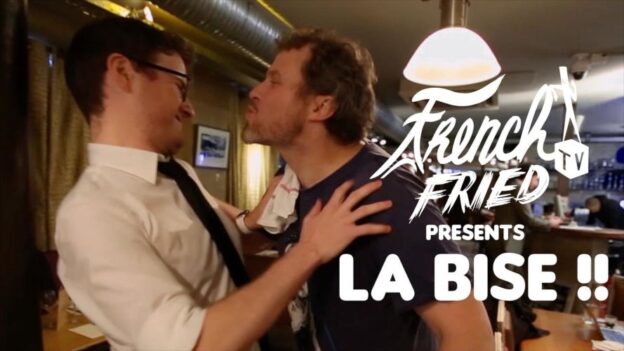
Image: c/o Robert Hoehn French Fried TV

Transcript for the intro and outro to this episode

Intro

Hello, welcome back to the podcast. This is episode 342. First of all I’d like to say thanks if you’ve recently left comments on my website, written positive reviews on iTunes or especially if you’ve sent a donation to the podcast. I appreciate all of those things very very much indeed and I hope that you feel like you’ve invested in this podcast, even in a small way. Every little helps. So thank you very much.

In this episode I’m joined again by podcast pals Amber and Paul

If you are a brand new listener and you don’t know them then here are the basics: Essentially, they’re both from the south-east of England, I know them from the stand-up comedy scene here in Paris and they both have super-powers, yes that’s right – super-powers.

Amber is a voice-over artist, actress and tour guide. She has a little 2-year-old son called Hugo (who has featured on the podcast before, making dinosaur noises in episode 297), and Amber’s super power is that she has loveliest voice in the world. Her voice is so lovely it could melt the heart of even the toughest person – like anyone at all. Even Vladimir Putin or Batman would be reduced to a little puppy when listening to Amber’s voice, right listeners? If Amber’s voice was on Darth Vader’s iPod and he listened to her talking, he would immediately give up his devotion to the dark side and turn into an ewok or something. That’s Amber.

Paul used to work for Apple – the company, not the fruit. It would be weird if he worked for an Apple. Anyway, last year he took the brave decision to quit his job in order to focus on becoming a full-time stand-up comedian, performing both in English and in French. Paul has a weekly one-man show called #franglais which he performs every week and he also performs a two-man comedy show with me every Thursday, and that one’s called “Sorry, we’re English”. He has his own podcast, called “Becoming a Comedian”, which you can find at paultaylorcomedy.com. Paul’s super-power is his infectious laugh, which causes podcast listeners to randomly split their sides in different countries around the world, which is nice. I imagine if he had to do battle with Darth Vader, he’d just laugh in his face and Vader would turn into Jar-Jar Binks or something.

The conversation you’re going to hear in this episode was recorded the other day when we were sitting upstairs on my little terrace enjoying some sunshine. We recorded about 3 episodes-worth of stuff that day. Two in the sunshine and one indoors because after a few hours it went cloudy and then started raining, which is typical for April in this part of the world. You already heard the first part of that conversation in episode 341.

Click here to check out a list of other episodes featuring Amber & Paul

But in this conversation Amber and I talk to Paul about recent success in his stand-up career, there’s a surprise phone call from Robert Hoehn, we talk about some online abuse Paul’s received, and then Paul and I tell Amber about an audition we had for a TV show recently, which involved a bit of a misunderstanding about our British accents.

One thing I just want to let you know right now is that I’m aware that this conversation is quite quick and you might not get absolutely every single word that we say, but that’s fine because as we know, listening to native speakers at natural speed is a valuable thing for you to do even if it’s difficult to understand every little thing. Just try to fill in the blanks, tolerate the stuff you don’t understand, read between the lines and keep going. Listening several times will help, but the main thing is to relax and just enjoy spending 45 minutes in the sunshine with us.

Where were we?

Where were we in the conversation at the end of the last episode?

There was a bit of a cliffhanger of sorts. Paul was about to tell us what happened in January, and it’s something about his progress as a comedian. Let’s get an update on how it’s all going.

A bit of language analysis – Paul’s long sentence – using ‘which’

In just a moment I’m going to start playing our conversation to you and it’ll carry on from where it ended last time.

The first you’re going to hear is me saying to Paul, “Give us an update on what happened in January” and then you’ll hear Paul speaking pretty quickly, and producing perhaps the longest sentence in the history of humanity. Actually, long sentences with lots of additional clauses are pretty common in spoken English, especially in spontaneous talking. In writing I think it’s best to keep your sentences short and clear but in speaking we often find ways to extend our sentences to include new thoughts and to keep the rhythm going, particularly with words like ‘and’ or ‘but’ (simple ways) but also with relative pronouns, particularly ‘which’, which we add to nouns and even whole clauses in order to extend sentences (like I just did there – did you notice?) Check out the way Paul uses ‘which’ to extend his sentences and add ideas, adding fluency to his speech.

Here’s the first sentence you’ll hear from Paul in this episode:
“Yeah, I think the last time we spoke, I don’t know if we talked about it but I was gearing up for the start of my own show, which was like an hour, my first hour-long solo show, which was starting on January 9th and I was excited (and) nervous because I’d never been on-stage for an hour (and) it was going to be cool, whatever, and then during the month of December, Robert Hoehn, who has been on the podcast previously, he runs an English comedy night and he’s, I guess, seen me do comedy for the last three years and he suggested to me that I make a video out of one of my sketches which I’d been doing on stage, which was around the French, their kissing and saying hello and it’s called La Bise, in France.”

Wow. There are a few examples of ‘which’ in there and also a ‘who’, after he mentions Robert Hoehn, who has been on the podcast previously. Also, there’s the phrase “gearing up for” which means “getting ready for”. OK. Now I’ll let you listen to that sentence in full, spoken by Paul.

One question: How many times does he say “which” and what’s the most common word that comes after it?

*Paul’s long sentence*

Answers:
He says ‘which’ four times and it’s most commonly followed by ‘was’ (3 times) and once it’s followed by ‘had been doing’.

This is often how we add information to stories. I mentioned this language point in the photo competition episode too. That’s episode 327. In Paul’s sentence, “which was” comes after a noun every time, but sometimes it comes after a clause. Question: What is the noun or clause that is followed by ‘which’ in these examples?

“He suggested that I make a video of one of my sketches which I’d been doing on stage which was around the French way of saying hello”.

Answer: Both times it’s ‘one of my sketches’

and “So, we sat on the terrace and just talked for about 2 hours, which was nice”.

Answer: it’s the whole clause ‘we sat on the terrace and just talked for about 2 hours’.

So, there was a little bit of language analysis. But that’s enough of that. I will now let you listen to the rest of the conversation properly, and enjoy another chat with podcast pals Amber & Paul, and by the way, just to let you know in advance – there is a little bit of swearing in this conversation.

*conversation starts*

Watch Paul’s Video about “La Bise”

A France24 TV news report about Paul

Outro – Transcript

We will be back, speaking more ‘crapola’ soon, because we’ll be playing the interactive lying game and that should be the next episode of this podcast.

What’s crapola? It’s just another way of saying ‘crap’ or ‘nonsense’. Crap is poo by the way. Crap is a swear word but it’s not as bad as ‘shit’. Crapola is not such a common word – it’s a variation on the word ‘crap’ and it means ‘nonsense’ or ‘stupid talking’.

Accents

Now, at the end there you heard us talking about accents. That was a slightly heated conversation and since this is my podcast I’d like to try and clarify what I was trying to say.

So, first of all we went for the audition and it was nice, but one of the producers said, “Can you speak with less of a British accent?” and we asked, “You mean you want us to use an American accent?” and she said “Not American, just less British. You know, like the way they speak in New York, because they don’t have an American accent in New York” and we were a bit stunned that doesn’t mean anything. So, first of all I think it’s not possible to have no accent. Everyone has an accent, but you might feel like your accent is the normal, standard position for the language and that every other version is an accent. Even accents which are considered to be the neutral forms are still an accent. So it doesn’t make sense to say that you don’t have an accent or that the people of a particular place don’t have an accent. If they pronounce words, using certain sounds, that’s an accent. Some accents are considered the standard forms, and in the UK and in the USA there are, broadly speaking, two standard accents. There’s Received Pronunciation in the UK, which is generally how I speak (although I have inflections from the midlands and the South East, reflecting the places where I grew up) and in the USA there’s an accent called Standard American, which is a kind of regionless accent. So maybe what the girl meant to say was, can you speak with a standard American accent, or a more trans-Atlantic accent? But then she realised that it could be taken as a bit rude, because it’s like she suggested that there was something wrong with our British accents or something. She didn’t mean any offence of course.

Another thing I often read online is the sentence, “There’s no such thing as a British accent”, which is a bit misleading. Generally people write that in response to comments on Youtube or Reddit or something when an American person has said something like “OMG I love the British accent”, or equally “OH my god the British accent sucks” or something. Then someone gets pissed off and writes a response, like “there’s no such thing as a British accent!” But that’s a bit stupid too. If an accent comes from a part of Britain, it’s a British accent. Obviously British accents exist, but the point is there is not just one British accent – there are many accents from different regions and it’s a bit short-sighted to just imagine there is only one “British accent” when in fact it’s so much more diverse than that, and I suppose that comment “There’s no such thing as a British accent” is the British person’s way of expressing annoyance or frustration over the lack of awareness of the diversity of British accents.

In the UK today we are very sensitive to accents, as Amber mentioned in the conversation. There are many many variations on the way people speak, and those variations indicate things like regional origin and social status. We shouldn’t judge people by their accents, but we do. We also are very affectionate about accents and generally very positive about regional accent variations. We love the diversity of accents in our country and generally it is considered inappropriate and snobbish to laugh at an accent or to suggest that there’s something wrong with speaking in a different way. Being snobbish about regional accents is now quite unfashionable in the UK. Regional accents are generally celebrated these days – and when you watch TV, including the BBC news, you’ll hear lots of different accents being spoken by presenters from around the country, because TV viewers appreciate the regional flavours of the different accents.

So, I suppose part of our surprise at the girl at the audition was just about her lack of awareness of accent variation, but also the slightly clumsy way she talked about the whole subject, suggesting that people in New York had no accent, or that our British way of speaking was just a regional variation of an accent that has its neutral base in Manhattan. But, I understand that identifying regional accents can be very hard when you’re not native to that language, so we didn’t take offence at the girl and it was fine, but we did find it amusing and interesting from a linguistic point of view. So, that’s that.

I must do more episodes about different regional accents on this podcast. There is just so much content to cover and it’s really important that you get a sense of the different accent variations. I have dealt with accents before a bit, but there’s so much more to do on that subject. We’ve only really scratched the surface.

Listen to Adam & Joe talking about British and American actors doing different accents, particularly Ray Winstone (UK – London) pretending to be an American in the film Fool’s Gold. 😂

https://www.youtube.com/watch?v=CIxQFUV_AcA

And this one about Leonardo DiCaprio’s Irish accent and how Hollywood helps actors perform in different accents.

Oh, and remember Tracy Goodwin the American voice coach from Episode 20 of Luke’s English Podcast? Here are Adam & Joe talking about that…

Using Apps to listen to this podcast

This is turning into another longish episode. It happens so easily, but you heard Paul earlier talking about the ‘pause’ button. I wonder if you use that, because as I’ve said before – you don’t have to listen to these episodes in one go, you can pause and listen to the rest later. If you’re using podcasting software like an app on your phone, it will remember where you were when you paused, even if you close the app or switch off your phone or computer.

Here are some recommended apps: There’s the standard Apple Podcasts app, which is fine. I use PocketCasts which is available on iPhone and android. You can also get it on your computer. There’s Acast which is good. Also, try the Audioboom app. All of them let you listen via an internet connection (wifi or data) and the also let you download episodes onto your phone so you can listen when you’re not online. All those apps will save your position in an episode so you can listen, pause, listen again, pause, come back later and listen to more etc.

You can still just download the files from the website and put them on your mp3 player – just check if there’s a folder in your player for podcasts because if you use that folder the mp3 player will probably save your position, just like the smartphone apps do.

Thanks for listening – speak to you soon, bye!


325. Catching Up with Oli (Part 1) Past Challenges

Here’s a 2-part episode featuring a conversation with my cousin Oliver in which we talk about first some challenges he faced over the last few years (including dramatic things like a scooter crash, a tropical disease, a burglary and how he completely flooded his own house) and then some more positive things about being a father and predictions for how society will be different in the future. Also, listen for some general news and announcements about Luke’s English Podcast.

Small Donate Button[DOWNLOAD]

Announcements & News

  • I hope you enjoyed the episodes I recorded as a tribute to David Bowie. Unfortunately, so soon after we lost Bowie, the news came that another great person has died – the British actor Alan Rickman, who like Bowie was 69 years old and died from cancer. He’s most famous for playing the part of Severus Snape in the Harry Potter films, and the part of Hans Gruber the bad guy in the film Die Hard with Bruce Willis – both very enjoyable and distinguished performances, but he played many other roles too. Alan Rickman was known for his sardonic humour, his wonderfully rich and unique voice, and for bringing a great amount of weight and humanity as well as humour to his roles. He will be missed too.
  • And, I haven’t even mentioned Lemmy – the lead singer of the group Motorhead, who also died recently. Lemmy played a massive part in the invention of heavy metal music, and was generally a huge personality in the world of British rock. He was on the scene all the way from the 60s until this year when he passed away due to cancer. Lemmy was known for his gravelly voice, his appearance (he looked like a biker dressed in leather with big mutton-chop sideburns and moles on his face – he wasn’t a pretty guy like Bowie by any means), his hard-drinking speed fuelled lifestyle and his bizarre obsession with Nazi regalia – clothing, weapons and so on from the Nazi era. He wasn’t a bad guy, he just liked the designs and imagery from that time – it had nothing to do with the ideology, and at heart he was just committed to playing loud and fast music and living a loud and fast lifestyle – and he will surely go down in history as a true legend of the music world. So, that’s three people, at least. So, can famous British people stop dying please!? If we carry on at this rate there’ll be none left by the end of the year.
  • But let’s not dwell on these dark things any more! I’m glad to present you this episode today because this one is all about the future, and new life because my cousin Oli is going to be a Dad for the first time – his wife is expecting a baby daughter at any time, so let’s look to the future, with new life and positivity and all that stuff! We’ll start that in just a minute, but first – a little bit of admin…
  • The comments issue on the website is fixed. I just needed to do a few updates. You can now post comments on the homepage again. No worries!
  • Email subscribers – are you still receiving emails when I post new episodes? I had a couple of messages from listeners recently who said they hadn’t received emails with new episodes. How about you? If you’re an email subscriber, could you let me know if you received emails for the David Bowie episodes, the episode called With the Thompsons, and the Star Wars spoiler review.
  • Picture comp is finished – so, don’t send me any more photos please! Thank you for the photos I have received in my email account, and, of course, I have loads of pictures. They’ll go up on the website soon and you can pick your favourite. I’m a little bit concerned about how that’s going to work because there are about a billion photos, but I’ll work something out.
  • I’ll be meeting Paul and Amber again soon. Firstly to catch up with them both – because quite a lot has happened since we last spoke on the podcast. Amber went to Costa Rica, and Paul Taylor is now something of a celebrity as his comedy video about kissing in France went super-viral over the last few weeks. His video, “Paul Taylor – La Bise” is about his frustration with the French custom of kissing people when you meet them. It was uploaded onto Robert Hoehn’s YouTube channel French Fried TV on new year’s day and within the space of just a few days it got over 1 million views. He was featured on lots of French websites, radio and TV, and then the video went global on the BBC’s website and more. Paul also has a new solo comedy show every Saturday (as well as the one with me on Thursdays) and it’s completely sold out for the next 10 weeks or something. Wow! Remember when he was on this podcast talking about how he quit his job to do comedy? Remember how difficult it was in Edinburgh? Well, things seem to be working out for him now! Good news!

  • Also, I hope to get Amber and him on this podcast again (if he’ll come on now that he’s such a big celebrity) in order to do that interactive version of the Lying Game – remember that? Listen to “318. The Rematch (Part 2)” to find out the details. Basically, this is a chance for you to get involved in another version of the lying game.  All three of us said some statements, and you now have to write questions in the comments section for episode 318. IN the episode we’ll ask each other your questions, and answer them. Then you can decide if they’re true or lies. Again, listen to 318. The Rematch (Part 2) for all the details (listen until the end).

Introduction to this Episode

As you know at Chrimbo I want back to the UK and stayed with my family, and with my cousin at his home in Bristol. It’s been a while since he was last on the podcast, and quite a lot has changed with him. In our conversation we talk about lots of things and I really think this is an interesting episode, and a very valuable one from a language point of view. The topics we talk about are diverse and quite in-depth and as a result we use lots of different features of grammar and vocabulary. I always encourage you to notice language while listening to native speakers on this podcast, so try to do that in this episode if you can. First we talk about what happened to Oli since the last time he was on the podcast, so watch out for the ways in which we talk about the past – tenses, and other forms. Oli faced a few difficulties and challenges, so watch out for the ways he describes those things. Essentially, he tells me a few anecdotes about some of his difficulties in London, watch out for past tenses and so on. Then we talk about the future, and about various predictions for the next 10-20 years, so naturally you can try to notice the specific language, tenses and modal verbs that we use to describe the future, make predictions and make judgements about the future. As well as that, there’s a lot of vocabulary related to technology, transport and communication.

In my opinion this is a very useful conversation for you to listen to. I loved catching up with Oli and I sincerely hope you enjoy listening to it, and by the way, listen all the way to the end to hear Oli play a bit of guitar – and he’s a really good guitarist.

That’s it!

olipodnew1

324. David Bowie (Part 2)

Hello, welcome to Luke’s English Podcast, which is a  podcast for learners of English around the world. This is part 2 of a special episode about English musician David Bowie who died just a few days ago on 10 January 2016. The aim of this episode is to talk about David Bowie’s significance as an artist, to consider some of the themes of his work and to look at why so many people had such a strong emotional attachment to him. Hopefully after listening to this episode you’ll be better able to have conversations about David Bowie, but also about art and culture in general. You can find almost everything I’m saying transcribed on the page for this episode – see below.

Small Donate Button[DOWNLOAD]
In part 1 I talked about Bowie’s career up until about the year 1975. So let’s carry on in just a moment, but before that I just want to say that since I recorded this episode I’ve realised that there are lots of other things didn’t mention. For example, I could have talked more about his first wife Angie and his second wife Iman. They say that behind every great man there’s a great woman. If that’s true then Bowie must have had two great women in his life – and probably quite a lot of average ones as well I expect… Anyway, joking aside, I’m sure they had big parts to play in his life, and I hope they’re alright. It’s hard for us to lose an artist we love, but I can’t imagine what it’s like for his close family who must have cared about him in so many other ways.

Anyway, let’s get back into this episode and I’ll carry on from where I stopped last time in the mid-70s.

Part 2

It’s hard to explain everything that happened in the 1970s! It was a whirlwind of different things, and incredible music. Everything moved so fast for Bowie during that period, and he was really ahead of everyone else in terms of fashion. Bowie was very ahead of his time.

Around this time he starred in a film called The Man Who Fell To Earth, directed by Nicholas Roeg. In it he plays the character of an alien who lands on earth and attempts to make sense of the place. He was perfect for the part and it is still a mesmerizing performance. He was a great actor. IN the film he’s very thin and his otherworldliness and his vulnerability were perfect for the part of an alien, alone on earth.

If you’ve seen the film “Under the Skin” with Scarlett Johannson, I think it borrowed a lot from “The Man Who Fell To Earth”.


Why was he so thin? Drugs and his excessive lifestyle.
It’s amazing that he survived that period.
You can see him in quite a dark place in the documentary film about him called “Cracked Actor”.
This is partly due to the ravages of his rock and roll lifestyle – touring, performing and being a celebrity can have a weird effect on a person, but add drugs into the mix and things can get seriously out of control.
Bowie took a lot of cocaine in the 70s. http://ultimateclassicrock.com/david-bowie-cocaine/
He did this mainly to help him work, but also because it was fun of course (in the beginning). I think cocaine can give you lots of energy which allows you to keep working much more intensively and for longer periods than people who are not using it, but it comes with a price of course – to your wallet, but to your mental and physical condition. Apparently it is incredibly habit-forming and very difficult to break away from. Ultimately, if you continue to use it then eventually it will use you. “Sometimes you eat the bar, and sometimes the bar eats you.” I don’t know where that quote comes from, but I guess it means that “you might use drugs, but eventually the drugs will use you.” And I don’t know what drugs will use you for… it’s probably best not to let drugs use you or dictate your life. They’ll take you to bad places.

Paranoia, weird eating habits, alcohol, obsessions.
He was incredibly thin and seemed to be quite out of his mind during that period.
Check out some of his interviews and TV appearances, and photos of him at the Grammy Awards with John Lennon and Yoko Ono in 1975. He looks almost like a skeleton.
Grammy Awards in 1975 - from left to right: Bowie, Art Garfunkel, Paul Simon, Yoko Ono, John Lennon

He later described this period as horrible. Imagine being so far out of your mind and yet so lost within yourself that all your demons are made real and are talking to you in persuasive, frightening and seductive voices. Apparently Bowie was so disturbed and paranoid that he could only bear to eat certain foods. Apparently he lived for quite a while just drinking milk and eating green peppers, while snorting cocaine all the time and drinking alcohol. It’s amazing that he survived.

I think his problems at that time were not just drug related, but also identity related. Apparently he had let the Ziggy Stardust persona take over his real life. He wasn’t sure where Ziggy or Aladdin Sane ended and David Bowie began. The lines became blurred. Reality and performance were all messed up, and he lost a sense of who he really was. He must have nearly lost his grip on reality for a while. Again, he was the astronaut spinning into deep space.

Nevertheless, despite the craziness in his personal life at the time, he continued to make some of the best music of his career and it’s all there for us to listen to, like great albums such as Young Americans and Station to Station. Always such fantastic music and well written songs. That’s the bedrock of all of it – he wrote very good songs. He combined appealing and popular music which also contained some very complex and avant-garde elements, like a crazy freeform piano solo here, some very unorthodox string arrangements, some totally distinctive chord changes, and some incredibly versatile singing. Some people say Bowie couldn’t sing, but it’s not true. He had quite a narrow sounding voice, but he used it in a lot of different ways and could sing low or very high. Sometimes he would sing in a kind of cockney accent, and sometimes he’d use a posher, deeper and more distinguished voice.

The Berlin Period
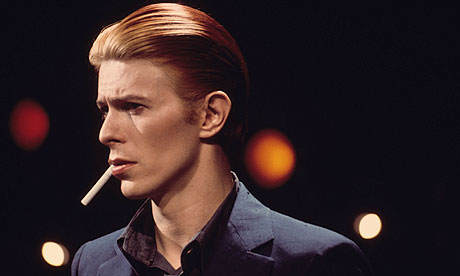
My Dad didn’t have any records by Bowie from 1975 until 1983, so I missed the whole Berlin period, and I still haven’t really explored it, which is, on one hand terrible because how can I be a fan without really knowing those records, but also great because I’m going to explore all those albums now. My uncle sent me 3 CDs not long ago – Low, Lodger and Heroes. I’m going to feast on those LPs. He’s always been good that way, my uncle Nic. Never been on the podcast, but he’s a huge music lover and a massive fan of Bowie. When I was 16 Nic made me a tape. It had Jimi Hendrix, Neil Young, David Bowie and The Clash on it. What an education. My uncle saw Bowie perform live 3 times. At one of those performances it was 1975 or 1976 and he was right at the front of the audience. He actually saw Bowie performing as the Thin White Duke, just a few metres away. It must have been incredible. I’ve been chatting a bit with Nic, and my brother who is also a big fan. Here are some of the things that my Uncle said to me via text just yesterday.

Nic: I feel really very sad about it, more than I can imagine for someone I never actually knew. Except of course I did in a way. Such a soundtrack through my adult life. The highlight for me was being near the front at Wembley Pool for the Thin White Duke, maybe the best concert we ever went to. The greatest artist of my generation.

Saw him three times but The Duke was the best, mainly also because we saw him swept away in the back of a huge black limousine after the gig, this little white genius in the back of this huge black car.

Luke: I’m about to do a podcast about Bowie, but I really don’t know where to start.

Nic: What you have to say is that part of his genius was the utter unpredictable nature. Each successive album was unique and different, you never knew what to expect. But it was always different and fascinating.

Good luck with the podcast I’m sure you’ll manage it but don’t worry if you can’t. Such a huge subject.

Luke Thompson: I’ll do what I can! Didn’t someone once say that art is never finished, it’s just abandoned? I’m not saying my podcast is art or anything, but I think you know what I mean.

Nic: I do. I think you and David would’ve got on really well!

Luke: Oh man, what a thought!

My bro sent me a little voice message. Here it is.
(James’ audio message)

Anyway, back to the Berlin period. I think what happened is that Bowie decided to get out of LA in order to escape all the drugs and madness. He moved to Berlin with Iggy Pop. I think they believed that there would be no drugs in Berlin, but they were wrong – apparently there was lots of heroin. I don’t think Bowie used heroin. Good – that’s the real killer and must be avoided at all costs. His friend Iggy Pop (real name James Osterberg) was a heroin addict, so I think he may have succumbed to it there, I’m not sure. But for Bowie, Berlin was a chance to start piecing his life together again and work on new projects. He also split from his wife Angie during this period. (Yes, during all the madness of the previous few years he had married and had a child, now called Duncan Jones – he’s a filmmaker who did a really great science fiction film called Moon, which is quite reminiscent of Bowie’s song Space Oddity).

Anyway, Berlin was Bowie’s attempt to begin again, and although it must have been a difficult and troubling time for him, it was also an extremely creative period, again. Some say it’s the peak of his career, but David Bowie had so many different peaks. Just pick one.

Berlin and the art scene there influenced him a lot. His records from that period were a collaboration with Brian Eno, and they have a totally different feel to the Thin White Duke period. They’re stark, sparse, quite low-fi, quite gritty, depressing yet with an air of grounded optimism and a sense of rebirth. It’s amazing how he managed to change and find new creativity with each step. I think artists are always struggling to find that inspiration to be creative. You can’t always manufacture the creative urge, it just comes to you and you have to try and put it into music or paint or whatever you’re using. I’m amazed at how Bowie managed to follow his creative muse so consistently and regularly. He was really in touch with something – a creative channel, that most of us don’t have access to. It makes us think that Bowie knew things that the rest of us don’t know. I don’t really understand that, but it’s true of all great artists I think – that they have direct access to something that we don’t, and they are able to put it into their art and then we can have access to it too. I feel like that about The Beatles too.

Song: Ashes to Ashes.
This was made just after the Berlin period and it’s his way of saying goodbye to the 70s. The song is incredible, especially when performed live. It has a really cool funk groove, but it also has some really weird and original chord changes and melodies. For me the lyrics are about him looking at his recent past and putting it behind him. It’s about letting the past be the past and moving on. I really can’t do justice in words to how poignant this song feels for me whenever I listen to it. It just grabs my feelings and throws them around all over the place. I don’t want to sound pretentious, that’s genuinely what the song does to me. I care about it in personal ways that I can’t go into now. I love the strength in the song. That you can move on and change and that you are not defined by your past. That’s incredibly brave and positive.

My Dad had another album – Let’s Dance, released in 1983. Perhaps Bowie’s biggest commercial hit. Produced by Nile Rogers.
On the cover Bowie was dressed as a boxer and is throwing a punch. There are also some diagrams for dance steps. I like the analogy of boxing and music. Dancing can be like fighting, when you dance on your own that is. It can be like sparring with your demons, if you like.
Bowie was still in a suit in this period and had bleached blonde hair. He still looked super cool as always.
The production on the album is absolutely massive. It sounds incredible.
The vinyl was in much better condition.
Maybe my Dad listened to it less (I think having kids and a job took up most of his time) or maybe the technology had improved since then, and vinyl records were just better made.
“Let’s Dance” blew my socks off completely. Still does.
“China Girl” also sounded incredible. The musicianship was so tight. It was produced like an up-front commercial dance album. Apparently Bowie didn’t like it that much. I think it just didn’t match his artistic vision, but I love it – because I love the work of Nile Rogers (think tracks like “Good Times” by Chic or “He’s the greatest dancer” by Sister Sledge, and many other records).
My Dad told me that he thought China girl was a song about heroin. That was really intriguing to me. “How could those romantic lyrics be about drugs?” and also, I was interested to know if Bowie had used heroin, because I know how dangerous that drug is – just watch the film Trainspotting and you’ll know.
It turns out the song was written by Iggy Pop. That explains it. Iggy was the heroin addict.
Listening to it, there’s a lot of pain and despair in the lyrics. Bowie screams in pain, including the line “It’s in the whites of my eyes!” to describe the depth of Iggy’s drug addiction. That’s scary, but it’s a pop song.
In fact, the raw upbeat power of the song overwhelms the dark sentiment of the lyrics. Maybe that’s why Bowie wasn’t so keen on it.

Since listening to that album as a teenager (and throughout my life) I’ve learned that by 1983 Bowie had managed to get clean and had left his drug habit behind. That was always really impressive to me. He always managed to maintain such distinction and class, even when he must have been feeling so terrible sometimes. He really kept it together, but there must have been some pretty dark and difficult times. I respect him for having the strength of mind to stop. Lesser people would have been destroyed by the lifestyle he had. Apparently, to help him stay clean, Bowie had a tattoo on his leg of the serenity prayer, which is the common name for a prayer authored by the American theologian Reinhold Niebuhr (1892–1971). It has been adopted by Alcoholics Anonymous and other twelve-step programs. The best-known form is:

God, grant me the serenity to accept the things I cannot change,
The courage to change the things I can,
And the wisdom to know the difference.

Which means I think – he wanted to remember that he could never go back to using drugs. I think some addicts slip back into using when they think they have the power to stop again, but they have to remember that their drug addiction is something they can’t change. If you believe you can control the addiction, you’re wrong. But you can control yourself by choosing to stay clean.

It’s something like that. But to me it’s impressive that he tattooed that onto his leg. He was really committed and strong-minded.

The 80s were a slightly mixed period artistically for Bowie. I think he probably got his personal life together but his art suffered a bit. Fair enough. I think he deserved to have some happiness and stability for a while and so what if some of his work in the late 80s wasn’t that great.

I remember seeing him again in about 1986 or 1987 when as a family we went to the cinema to watch a film called Labyrinth. David Bowie played the bad guy in the film – called Jareth The Goblin King. Basically it’s a kind of dark fairy tale about a girl who goes on adventure into a maze in order to rescue her baby brother who has been kidnapped by the goblin king. Bowie’s performance is pretty hilarious. He’s dressed up in a very camp outfit with big hair and tights. He sings a couple of songs. I remember being a bit disturbed by the film but I didn’t know why. Watching it back more recently I think I realised what it was – it’s Bowie’s tight trousers. They were… well… a bit too tight. I mean, you could see everything. The film was supposed to be scary and there were a few monsters in it, but really the most frightening monsters were on display under David’s tight pants. If you don’t know what I’m getting at, watch the film and you might see what I mean. I’m not the only one to have made that observation by the way. Apparently it was intentional too. The director wanted to create a villain who was attractive yet dangerous – like a rock star.

Bowie came back again in the 90s with another creative period. He reinvented himself as a kind of godfather of British rock music. He wore an awesome jacket with a union jack on it, and collaborated with drum and bass artists like Goldie.

For me the rest of his career is interesting but not quite as great as his earlier work, in terms of music. But he did lots of TV interviews and live performances and many of them are on YouTube. I like to think of his later period as his interview period, but of course he was involved in loads of other projects. There are plenty of things I’m not mentioning here just because it would be impossible to cover everything. One thing he did was use the internet to share his music, right from the beginning, before most other artists or companies used the internet for publishing. He really had his finger on the pulse. He was always ahead of his time.

His TV interviews on YouTube are great. He was always really interesting to listen to. He was very thoughtful, intelligent and articulate, and funny. He was really witty and had a fantastic sense of humour. That’s perhaps one of the most attractive things about him. He never ever took himself too seriously. He took the art really seriously, but never himself. His attitude was so refreshing. No ego.

He had a characteristic voice and way of speaking. It’s fun to do impressions of him and many comedians have done that over the years. My favourite impressions of Bowie are done by Hugh Cornwell on a TV show called Stella Street, and by Adam & Joe who are both Bowie obsessives, particularly Adam Buxton. They do great Bowie impressions. Check out the page for this episode to see those Bowie impressions and to listen to a long documentary that Adam did about Bowie. It’s brilliant.

Bowie released a few albums during the 2000s that were well received by critics, including Heathen and Reality.

Then he went quiet for a while after having a heart attack. He sort of disappeared from the media, except to help promote his son’s film “Moon”.

Then, more recently he came back with The Next Day, and just a week before his death his final album called Blackstar.

What’s interesting about this last couple of albums is that he seemes to be singing about his career as a whole, revisiting some of the themes, places and images that he created earlier.

What none of us predicted is that his latest album Blackstar is about his mortality. Listening to it now, immediately after his death, the songs and videos take on a much deeper significance. The album is very poignant and moving, and is full of puzzles and enigmas that seem to express his experience of coming to terms with his own death, and then dying, leaving us with a completed body of work. It is the perfect ending to his career.

Just over a week ago Bowie released his new album on his birthday.
Lots of people were talking about it, and Bowie fans were excited as usual to get some more music to explore.
We were all celebrating his return and wishing him a happy birthday.
So when we heard about his death, it came as a painful shock.
It was so unexpected, because we had no warning. We had no idea he was sick. He’d kept it secret.

It might seem like a small thing, but a new album of music from an artist you love can make a difference to your life in subtle ways.
A week before he died, early on a dark Monday morning while eating my corn flakes, I had watched the video to his song Blackstar. I found it to be really strange and quite frightening, yet with an appealing and catching song in the middle of it.
Just like much of Bowie’s best work, it’s both avant-garde and poppy. It’s not easy listening, it’s quite dark and moody, but I like that. Music shouldn’t always be safe. It should be challenging sometimes.
Anyway, the video disturbed me a bit. It was full of nightmarish visions, and seemed to be symbolic of something but I couldn’t put my finger on what it was.
I went to work that day and put it to the back of my mind, deciding to just come back and listen to the whole album at some point later.
Then a week passed and last Sunday evening came around. I couldn’t sleep.
I just couldn’t get to sleep.
That doesn’t always happen to me. Usually I get to sleep quite easily. I love sleeping.
This was one of those nights when I couldn’t rest. My mind was just wide awake and it was racing in lots of different directions at the same time. I ind it very frustrating and annoying, especially if I have work the next day. I just want to sleep but my mind seems to be connected to something and won’t switch off. (perhaps I should have listened to my own sleep episode – or tried the relaxation techniques, but I couldn’t focus)
It was disturbing to be still awake at 4am, just lying there in the darkness, with the stars in the sky outside, just staring into space even though my eyes were closed.

Eventually I dropped off and got a couple of hours of sleep, but I was feeling pretty delicate on Monday morning. You know how it is if you haven’t slept.
I had corn flakes again like normal. I have to get up extra early on Mondays in order to teach. My wife was still sleeping peacefully. Lucky her!
I got to school in the rain.
I was holding it together, getting my lessons prepared and someone came in the room and just said to me “David Bowie’s dead”.
Immediately I just said “WHAT???”
In fact, the news spread around the teachers’ room pretty fast. Usually people are busy getting their lessons planned but everyone just stopped.
It’s hard to comprehend that someone is just not in the world any more.
There’s a period where you can’t come to terms with it.
I felt a bit empty or something.
Then I had to go and teach.
During the classes that morning, when I wasn’t interacting with my students, like when I was getting the CD prepared, or when I turned away from them to write on the board, it came back to me quite quickly, and I got surprisingly emotional and had to try to get control of myself!
Fair enough I hadn’t slept much so I was feeling a bit weird anyway.
But I’m still quite surprised at how moved I was.
It was so unexpected.
It’s like David Bowie himself had punched me in the stomach.
Apparently he used to train as a boxer to keep fit.
Well, apparently he was still pretty fit because laid a combination of punches on me that morning that I didn’t expect.
In those moments when I wasn’t occupied by something else I couldn’t help thinking of the times when David Bowie’s music was in my life. They were all key moments for me somehow. Like being in the car with my Dad, discovering new feelings as a teenager in the corner of the living room, dancing in a nightclub somewhere with girls, doing Bowie impressions with my best friends, singing a Bowie song to try and seduce my girlfriend (it worked – the song? “The Prettiest Star”).
They all struck me, but I wasn’t the only one of course. Millions of people around the world were feeling pretty much the same things as me at that moment.

And later on I thought about that scary video that I’d seen exactly a week before and it made a lot more sense to me.
Bowie knew what he was doing. He new he was sick with cancer and he knew that he was going to die, but he didn’t tell the public. We had no idea. So he decided, probably very quickly, to make this music and throw into it all his feelings and experiences when confronted with his own mortality. Apparently he had 6 heart attacks in the year before his death, while recording the album, but he kept fighting to finish the album. Wow.

Apparently he was very close to the edge during the period when the album was due to be released. But he managed to time it somehow so that he would die a week after his birthday and the release of the album.

Even his death was a flawlessly judged artistic act.

Imagine my sleepless night, the frustration of not sleeping, the weird thoughts and fears that passed through my head in that condition. It was weird but what must it be like to be lying in bed, not waiting for dawn to come, but waiting for the end to arrive? What would you be thinking and feeling? I think Bowie has done a great job of expressing that in this music. It’s scary I know, but it’s powerful, and it’s not just morbid and depressing. There are moments where I feel he’s exstatically happy, looking back on some of the victories and joy he had in his life.

Also, the music is good. It’s got some bubbly electronic sounds and some jazz/funk drumming, and some soulful elements and sweeping string arrangements and saxophone.

But what’s mind-blowing is that Bowie used his death as a way of delivering his art to us. That punch in the stomach is a great way to get someone’s attention. Now he has everyone’s attention and we’re all listening. It’s the perfect exit! He really left with a bang.

Now what we have is a complete body of work with a distinct beginning and end, which makes it all the more powerful. I’m sure that all his best music will stand the test of time. In 100-200 years, if we’re all still here, I think Bowie will still be considered one of the most influential and significant artists of this age.

For me personally, I hope there will be many more moments coming in the future that I can share with David Bowie and his music, like the ones I had in the past.

The man may be gone, but the artist remains – preserved in the music, in the images and in our memories.

Thank you David Bowie.

Here are lots of David Bowie Links and Videos.
Just take your pick and dive in.

Space Oddity studio version with lyrics

Space Oddity live on TV in 1969
https://www.youtube.com/watch?v=dFhKM8AW1Js

Ziggy Stardust sings Starman on BBC Top of the Pops in 1972

David Bowie announces the end of Ziggy Stardust on stage
https://www.youtube.com/watch?v=_-G1Uy0OkCw

Aladdin Sane

Bowie interviewed by Dick Cavett in 1974, clearly under the influence of cocaine

Thin White Duke
https://www.youtube.com/watch?v=Shnrnqx_wsY

https://www.youtube.com/watch?v=G4_0bVgIRjg

Bowie in Berlin
Guardian article http://www.theguardian.com/music/2016/jan/13/david-bowie-berlin-years-heroes-just-a-gigolo

Fascinating interview from 1979

Bowie in 1983 criticises MTV for not playing black music

Bowie talks about acting and touring in 1983
https://www.youtube.com/watch?v=DqiTgApODBk

Nile Rogers describes meeting David Bowie

Bowie – “The Interview Years”

Bowie & Comedy – Ricky Gervais described meeting Bowie

Phil Cornwell on Stella Street (skip to 5:00 for the David Bowie impression)
https://www.youtube.com/watch?v=oIot-vgqJBA

Documentaries

https://www.youtube.com/watch?v=gRiTngOAQps

Adam Buxton’s Audio Bowie Documentary
This is my favourite Bowie tribute.
https://archive.org/details/AdamBuxtonOnDavidBowie31stMarch2013
YouTube version here but with the songs removed
https://www.youtube.com/watch?v=mpCrIZamdQE&spfreload=10

The new tracks – Blackstar (the creepy video I watched on Monday morning while eating corn flakes) and Lazarus

Adam & Joe talk about Bowie and do some impressions
If you watch just one of the videos in this list, please watch this one. Adam & Joe obviously love Bowie very much, and their impressions and improvisations are a lot of fun.

323. David Bowie (Part 1)

This episode is all about the life and work of David Bowie, the English musician who died just a couple of days ago. In the episode you’ll hear me talk about the cultural significance of Bowie as an artist, why he is such a legend of British music, and what his music means to me personally. I hope you can use this episode as a way to learn more about British culture. Almost 100% of the episode is transcribed below.

Small Donate Button[DOWNLOAD]
David Bowie was an English singer, songwriter, record producer, painter and actor. He was a figure in popular music for over five decades, and was considered by people around the world as a cultural innovator, particularly for his work in the 1970s. I am a big David Bowie fan, and in this podcast my aim is to explain to you the appeal and significance of David Bowie as a cultural icon. I’ve had a few messages from listeners over the last couple of days asking me to talk about this subject, and I am very happy to be able to do that on my podcast.

This subject is significant to me personally, and I expect to many of you too, but also it’s a very significant to British culture in general, and I think it’s important to teach you about British culture or English language culture on Luke’s English Podcast, as well as to teach you the language itself, because ultimately, it’s all part of the same thing. The language exists within the culture, or perhaps the culture exists within the language – they are intertwined together in complex ways. So, to learn the language like a native I think it helps to know about the culture of that language too, so you can start thinking in the same way that native users of that language think too. Also, if you ever talk to native speakers of English you need to know the cultural references. For example, at the moment and no doubt for a long time afterwards, people will be talking about David Bowie, his music, his art and its significance. Would you be able to hold down a conversation about Bowie? Hopefully this episode will help you do that.

David Bowie changed our culture, not just in Britain but also around the world. How did he do it? What did he do that was so significant? Why is his death such a big deal? What was his appeal? What do most people know about David Bowie? What did he do during his life? What were the messages he communicated through his art? Why will he be considered one of the greatest artists of our time?

There are so many questions to answer. I don’t have the answers to all of them. Some questions will go unanswered. But there are always more questions than answers, aren’t there?

I think the world still doesn’t fully understand what Bowie was doing or what it was all about – or at least we can’t easily put it into words, but those people who value his work certainly feel a powerful emotional connection to David Bowie and his work. He was an artist, and I suppose part of the work of an artist is to express ideas and feelings in other ways – not using words alone, but using anything else as a way of conveying a message or feeling. David Bowie definitely did that. Not only was he a musician, but he was an artist, maybe one of the greatest artists of our time, and he used everything he could in order to communicate with us – music primarily, but also video, theatre, mime, the internet (he was an early adopter), the media and even his own body, his fame, his image and ultimately his identity itself. He even used his own death as a way of communicating his art to the world.

David Bowie’s whole life turned out to be a work of art itself, and as an artist he used his life to tell a captivating, mysterious and complex story.

Here are the main questions I’m going to try and talk about
Who is* David Bowie? (*was ?)
Why is he significant?
Why is Bowie significant to me personally?

I have to say that this is a really difficult episode for me to do because there’s just so much to cover, and I want to do justice to the subject. I don’t think I can say everything I want to say about Bowie in this episode. I would love you to just listen to his music with an open mind. Listen to the beats, the grooves, the moods and let your imagination do the rest. he was also a great speaker in interviews – he was articulate, charming and very funny too. I’m not going to play you any interview footage or any of his music (except perhaps for a couple of seconds per song) on this podcast. But what I have done is collect some videos and other links for you on the page for this episode and I strongly recommend that you check them out. There are other documentaries, interviews, podcast episodes and music that are really really great and will give you loads more perspective on the subject. So go to the page for this episode and just dive in. Please do watch and listen to Bowie in his own words, and in the words of other people who have talked about him too.

I’ve been a fan of Bowie almost all my life. I grew up with his music and it has been with me at various important emotional moments for me.

When did I first hear Bowie’s music?
In the car as a child.
Night time.
Space Oddity.
The song is fascinating – it tells the story of an astronaut on a space mission. He goes out alone into space and loses touch with the earth. The astronaut is afraid, and it is scary – the idea of being so alone, drifting into the void of space, but also it is full of the wonder of the universe – seeing the earth from a distance, and wondering what it’s all about. The song is deep – as deep as the film 2001 A Space Odyssey, which was a direct influence on Bowie.
Looking back on it now, that car was like a spaceship floating through the dark with my Dad at the controls, the lights of suburban London street lamps passing overhead.
The song is like a metaphor for his career somehow.
The astronaut is Bowie the artist, and the spaceship is his work – the different characters he portrayed and inhabited, the multimedia structure around him that he built during his career – like a cocoon, which he has now departed.
Now, after his death, we have just the cocoon, the spacecraft. His life’s work is left with us.
I’m not sure what I’m saying here. And I’m sounding a bit pretentious I expect.
What I mean is that the image of a man in spaceship travelling through space is a bit like a metaphor for the work of the artist going on a journey. I can’t explain it. IN fact, I don’t quite understand it fully. It’s just beyond my understanding, just out of reach, somewhere in space.
That’s space oddity.

Then, later, at other times in my life, I had other moments with David Bowie’s music.
I gave a Bowie album to my Dad for his birthday in 1987. I remember the front cover of the album. I was 10. Bowie was Blue. It felt important that I was giving the record to my Dad. I think my Mum bought it, and I gave it to him.

Then when I was a teenager I started exploring my parents record collection. I discovered a lot of old music, but it was new to me. In our house the record player and the vinyl records were in the corner of the living room. I remember spending quite a lot of time in that corner, with the headphones on, exploring the music while my family were doing other things.

There was an album called “Changes – One Bowie”, which was a greatest hits compilation. I think it was released in the mid 70s and it had songs from his whole career up to that point. It was music from his psychedelic period, his hippy-in-a-dress period, the Ziggy Stardust period and the thin white duke period. These are all different incarnations of Bowie’s rock star identity.

The album cover to “ChangesOneBowie” – the compilation LP that I found in my parents’ record collection.

There was a photo of Bowie on the front of the album – it was a black and white pic and he looked like a Hollywood star from the classic Hollywood period of the 1930s or 40s. I couldn’t quite date the photo. Normally I’m good at predicting the period in which the picture was taken, or predicting when a record was recorded by listening to it, but this photograph just looked completely timeless. I couldn’t work out when it was taken.

The photo could come from any time and that was pretty fascinating. Also, he just seemed so cool and handsome and I thought – how could I be like him? How can I take some of that style and confidence and attractiveness and apply it to my own life. He seemed to be above everything, but not in a bad way – not in an arrogant way. I thought, how could any girl resist this guy? And that was very exciting for me – because I definitely fancied girls but I just wasn’t confident enough. I had no clue about how to talk to girls, let alone get them to fancy me. What Bowie showed me about that is that you shouldn’t fake it – just be confident, express yourself, let your natural style come out and don’t show any fear and you’ll attract girls. In fact, what was really attractive about Bowie is that he didn’t do things for egotistical reasons – the guy in the photo was distant – he wasn’t looking at the camera, he wasn’t begging for your attention, he was looking off into the middle distance somewhere. His mind was elsewhere. He was occupied by his work and by big ideas. I think Bowie’s enthusiasm and commitment to his work made him as attractive as his looks. But it was his looks too. He was the complete package.

I asked my Mum what she thought of Bowie and she said she just found him weird and a bit creepy. I was a bit disappointed, but I was still convinced that Bowie was the essence of coolness. What I saw in that picture was a lot of what is appealing about Bowie. His good looks and cool style, but also his class, his elegance, mystery and weirdness.
Let me describe the album cover.
You see his face and shoulders. He’s looking to our left, into the distance. It’s a black and white photo. His hair is quite short and is combed back with a slight parting on the side. His finger is resting on his bottom lip as if he’s thinking of something.
After a while I noticed that his eyes were different. The pupil of his left eye in the photo is dilated wide, but the other pupil is normal. I wondered if that was an effect added to the photo, to perhaps hint at the fact that he was high on something. It wasn’t obvious, but it was fascinating. Later I learned that Bowie had 2 different eyes – it looked like they had different colours, and the pupil of one was always larger than the pupil of the other. Apparently he had an accident or a fight over a girl when he was fourteen and got punched. The punch caused damage to a muscle in his eye, and since then one of the eyes always looked different to the other. It was another part of Bowie’s allure – there was just something different about his face.

In the photo he’s thin and has ridiculously high cheekbones and chiseled features, like a Hollywood movie star from the 1940s.
He had classical good looks, but there was something else about him – the lines on his face, the shape of his nose – there was something otherworldly and alien about him, like he might have come from outer space.

Also he has femininity in his features, and I think there’s nothing wrong with being in touch with your feminine side.
His ambiguous gender wasn’t the main thing I liked about him, but for many other teenagers throughout the years – teenagers who struggled with their gender identity, David Bowie was someone who gave them self-esteem and confidence. He showed that if you felt confused about your gender, that it was nothing to be ashamed of and that it didn’t matter, and that you could be whoever you wanted to be, and do it with pride. As a rock star, David Bowie was a huge ego boost to so many fans, and for many reasons. For me Bowie was just cool, confident and he made really great music. His confidence and his style commanded respect.
I grew up a bit when I looked at that album cover.

Then I listened to the record. I took the vinyl out of the sleeve and put it on the record player, with the headphones on. My parents had an old pair of 70s headphones. They were really good quality ones.

The first track was called Changes, released in 1971. There was a scratch on the record and it used to jump quite a lot during the introduction to the song. For years, I only heard the scratched version. The song would skip from the intro to the first verse, and then to the chorus quite quickly. It still sounded good to my ears.

It had a piano riff, chunky sounding drums and a good baseline. It sounded amazing in the headphones. Bowie sang words like
I watch the ripples change their size
But never leave the stream
Of warm impermanence and
So the days float through my eyes
But still the days seem the same
And these children that you spit on
As they try to change their worlds
Are immune to your consultations
They’re quite aware of what they’re going through
Changes

As a 15 or 16-year-old I was quite aware that I was going through changes of my own and at the time I was feeling for the first time that I was actually having more complicated feelings than just “I want to play football” or “Star Wars is cool”. Listening to this song, even though I didn’t completely understand the lyrics, I felt that I was suddenly part of something much larger and deeper, and it felt really cool. What it meant to me at the time was that we go through changes in our lives and we don’t always know why, but they’re significant and meaningful and we should be prepared for them, and others should let us change and we shouldn’t try to hold each other back or tell each other what to do – that we should have respect for each other’s complex worlds. I didn’t really understand it all, but it meant a lot – I just felt it.

Also, as I learned more about David Bowie’s music I knew that he was something of a changeling himself. He went through many image changes during his career, especially in the 70s, and that was and still is fascinating to me. How could someone become all these different people – and still hang onto himself? What was identity all about?

Here’s a ‘brief’ history of David Bowie.
South London in 1947. His real name was David Jones. Another performer had the name Davy Jones so he changed his name. He tried a few others, including Tom Jones and David Cassidy, before sticking with David Bowie. Good judgement. He chose Bowie because it was the name of an American knife and he liked the symbolism of that. The knife.
Grew up in postwar UK – the same generation as the Beatles and so many other great artists of his generation.
The main theme of his childhood seems to be – boredom and dullness. Living in suburbia was dull and everything looked the same. It seems to me, looking back on that period in the 1950s that life was in black and white. Just boring and quiet. The older generation just wanted peace and quiet after the hell of world war 2.
Like his peers he got hooked on American rock and roll and R&B but also plenty of other forms of music. This new music which he heard on the radio must have brought some colour into his life.
America was the place that seemed to be really exciting and interesting.
He got involved in the London music scene but never really found his style or confidence.
There was a boom in youth culture associated with music and fashion. This was the mid-late sixties.
Drugs and psychedelia were involved, amphetamines for energy and probably LSD for its mind expanding qualities.

Bowie recorded Space Oddity and it was released and became a hit, eventually, particularly as it coincided with the NASA moon landing in 1969. Some people thought of Space Oddity as a novelty song – just a funny story about an astronaut going into space. But it was deeper, more meaningful than that. Space Oddity is now a timeless classic that is not just about an astronaut. It’s an existential comment about the human condition. But it’s also a great little pop song that you can hum along to and which gets stuck in your head.

Despite some success with that song he still felt unsure of himself as a performer, and searched for ways to bring new dimensions and confidence to his performance art.

He started taking risks with his performances and was influenced by avant-garde artists and various forms of theatre, like clowning, mime and Japanese kabuki. He brought those influences into his rock and roll shows.
He collaborated with a guitarist called Mick Ronson who perhaps deserves more recognition than he gets. He’s the one who played those amazing riffs on a lot of Bowie’s glam rock classics like Rebel Rebel and Ziggy Stardust.

Bowie also came out as gay/bisexual during that period, but it’s not clear to all of us if he really was gay or if it was all part of some kind of provocative and experimental performance both on and off stage.

Nevertheless, he attracted devoted and passionate fans who loved his daring style and his outrageous performances. Being a David Bowie fan was a statement of liberty and freedom. He made it ok, and maybe even cool, to be androgynous.

Also, his music at the time just kicked arse. His band made really raunchy and catchy glam rock. It was heavy, fast, funky, romantic and glamorous. The confidence and mystery that he exuded on stage was like a gift to his fans, who were empowered by having him as a role model.

He first became really huge as a star when he created the character of Ziggy Stardust in around 1972.
Up until that point Bowie had not really found his feet as a performer. Apparently, when performing as himself he felt shy. It’s hard to imagine, but apparently it’s true. He didn’t really enjoy performing as David Bowie, because he just felt a bit awkward.

So he invented a character, and played him during the performances.
Ziggy Stardust was just a character – like a character in a movie or a play, and Bowie was the actor.
People still refer to Bowie as Ziggy, like it was his nickname. It wasn’t a nickname for Bowie, it was an alter-ego. Ziggy disappeared in the mid 70s.

Becoming Ziggy allowed Bowie to really let go of himself and become a rock god, and his performances as Ziggy were really extravagant, involving big costume changes, make up and all sorts of rude and lewd acts on stage.

Apparently Bowie was Ziggy not only on stage, but also off the stage, in public appearances, interviews and so on.
So, David Bowie was really an actor playing the part of an outrageous rock star. That’s interesting for me because Bowie’s acting performance was not just confined to the stage, it bled out into every aspect of his public life. His fame was his medium. He used that medium, fame, very well, to convey his art to us, even with his death.

It’s as Ziggy Stardust that Bowie became really well-known all over the UK and then in the USA, where he was embraced as a big star by the rock music scene.

Apparently Bowie’s main influences for Ziggy Stardust were on one hand NY based musicians Lou Reed & Iggy Pop, but also mime artists, Japanese kabuki theatre performers. Bowie loved the way Lou Reed managed to combine avant-garde art with pop and rock music. He loved the outrageousness and energy of Iggy Pop and the mystery and magic of the kabuki theatre tradition. All of it combined to create something extraordinary in Ziggy Stardust. These incredibly theatrical live shows, with stomping fast rock music and avant-garde lyrics. He released an album called Ziggy Stardust and the Spiders from Mars. It’s now a classic.

Part of Bowie’s genius was always that he could take very weird and abstract art and bring it to a wide audience via good old-fashioned rock and roll, and pop music. That’s the genius of pop. A pop song is so short, and so simple. Just 3 minutes with a couple of verses, a chorus and a bridge section. Played on the radio for mass appeal, full of catchy melodies and instant appeal. Bowie, like all the other great pop stars, used this medium to deliver some very powerful and clever ideas. Bowie’s pop songs were not just disposable trash. They had deep hidden meanings that are hard to comprehend, but which really stand up under scrutiny. He wasn’t just lucky either, like some artists who make one or maybe two hit records in their career. Bowie had hit songs throughout his career, and his greatest hits albums that you can buy now stretch over 2 or sometimes 3 CD collections. He knew what he was doing and his music is pure pop art.

He was a mainstream pop act, but he was also a radical avant gardist. Using pop to deliver abstract ideas right into people’s every day lives. Usually abstract art is to be found in galleries, and let’s face it, not enough ‘ordinary’ people see it. Through his records and videos and other projects, Bowie brought that stuff right to hearts and minds of a massive audience. IN that way, he’s way more of a successful artist than so many others. People would play his songs on the radio. He appeared on Top of the Pops on BBC1 – a very mainstream show, and he brought into the homes of normal people some of the craziest and most over the top concept art, simultaneously fascinating and frightening the nation. He sang a song called “Star Man” on BBC TV, dressed in a bright green costume, with his hair dyed bright red. Starman seems to be about an alien who wants to come to earth but is frightened of how the humans will receive him. It seemed to many that Bowie was the alien.

What did Ziggy Stardust look like?

I remember watching a movie about a Ziggy Stardust live concert, with my brother…

Ziggy was Bowie’s way to celebrate rock and roll, and comment on all its conventions. Again, he knew what he was doing. He wasn’t just aiming to get as many fans as possible. He wanted his fans to really think about what was going on in the live show, in music and in life in general. He really encouraged his audience to use their own intelligence and to interpret his work in their own way. I feel a great amount of respect from the artist when I listen to the music and watch his performances. I don’t feel like he’s patronising me or being arrogant. I just feel like he’s doing the performance, but that some part of him is completely conscious of what he’s doing objectively and that he has no ego.

Apparently, according to the things I’ve heard and read about him, Bowie was a really nice and down to earth person. In interviews he was always very intelligent, articulate, sweet and funny. Apparently he was also quite a private man. The characters he played in his songs are really different to the character of the artist himself.

Bowie made a few albums using the Ziggy Stardust persona, and toured America, and moved there I think. He recorded a couple of albums as Ziggy, but the character did change bit by bit, with a slightly different look emerging over time. He released a couple of albums with the Ziggy Stardust persona I believe. These are absolute bona fide rock classics. I’m talking about albums like Diamond Dogs.

I think by the mid 70s his life was moving extremely quickly and that’s evident in his music and his image. He went through so many different changes during that period and produced some wildly inventive yet accessible music. Eventually he killed off Ziggy (you can see video footage of him announcing it during a live concert – the audience seem devastated! He says, this is our last live concert, ever – and you hear gasps from people in the audience.
But he didn’t quit of course, he just came back with a new image, a new character.
Aladdin Sane.
He looked a bit like Ziggy, but he was darker and even more mysterious.

Then within just a year or two, Bowie changed again. Ziggy Stardust, then Aladdin Sane, and then a character was eventually called The Thin White Duke. He wore sharp suits and had his hair combed back. He used to walk around with a cane, and sometimes wore a hat. He was extremely debonair and suave looking, yet very thin and bony. Again, his combination of handsomeness, androgyny and alien weirdness gave him an allure and a charisma like nobody else.

At that time he was influenced by the soul and funk musicians of New York in the mid seventies. I can’t really explain all the influences and details of his different clothing choices. Essentially, he had his own style – and it influenced a lot of fashion that followed him. I think he had a huge influence on the styles of the 1980s. A lot of what musicians and fashion designers did the 1980s, Bowie had already done in the 70s. Bowie basically created the 1980s.

I think the Thin White Duke is my favourite Bowie period, although I love all of his changes. He was called that because he was thin (due to his lifestyle), he was white! (obviously – but this was more evident because of the fact that he had started playing soul and funk music, which were associated with a black audience – so compared to many of the black artists in his band and black people in his audiences he looked really white. And he was very pale anyway during that period, so I think he was pretty much the whitest dude on the planet, but playing what was considered to be black music.

And the music is the main thing I like about Bowie during this period. I generally love funk and soul music from the 70s, regardless of who is playing it – whether they’re black or white doesn’t matter much to me, in fact I prefer to have my music in with the full colour spectrum please – black, white, and everything in between – purple, brown, yellow, green, pink – if it’s a colour, I want it in my music! No black and white music please. So, Bowie’s funk period is really great. My favourite album from that time is Young Americans. It’s got tracks like “Young Americans” and “Fame” on it – deeply groovy, tough and yet smooth soulful dance tracks. He collaborated with John Lennon on Fame. Imagine that! A funky dance classic, with John Lennon of the Beatles.

END OF PART 1


CLICK HERE FOR PART 2

Here are lots of David Bowie Links and Videos.
Just take your pick and dive in.

Space Oddity studio version with lyrics

Space Oddity live on TV in 1969
https://www.youtube.com/watch?v=dFhKM8AW1Js

Ziggy Stardust sings Starman on BBC Top of the Pops in 1972

David Bowie announces the end of Ziggy Stardust on stage
https://www.youtube.com/watch?v=_-G1Uy0OkCw

Aladdin Sane

Bowie interviewed by Dick Cavett in 1974, clearly under the influence of cocaine

Thin White Duke
https://www.youtube.com/watch?v=Shnrnqx_wsY

https://www.youtube.com/watch?v=G4_0bVgIRjg

Bowie in Berlin
Guardian article http://www.theguardian.com/music/2016/jan/13/david-bowie-berlin-years-heroes-just-a-gigolo

Fascinating interview from 1979

Bowie in 1983 criticises MTV for not playing black music

Bowie talks about acting and touring in 1983
https://www.youtube.com/watch?v=DqiTgApODBk

Nile Rogers describes meeting David Bowie

Bowie – “The Interview Years”

Bowie & Comedy – Ricky Gervais described meeting Bowie

Phil Cornwell on Stella Street (skip to 5:00 for the David Bowie impression)
https://www.youtube.com/watch?v=oIot-vgqJBA

Documentaries

https://www.youtube.com/watch?v=gRiTngOAQps

Adam Buxton’s Audio Bowie Documentary
This is my favourite Bowie tribute.
https://archive.org/details/AdamBuxtonOnDavidBowie31stMarch2013
YouTube version here but with the songs removed
https://www.youtube.com/watch?v=mpCrIZamdQE&spfreload=10

The new tracks – Blackstar (the creepy video I watched on Monday morning while eating corn flakes) and Lazarus

Adam & Joe talk about Bowie and do some impressions
If you watch just one of the videos in this list, please watch this one. Adam & Joe obviously love Bowie very much, and their impressions and improvisations are a lot of fun.

293. California Road Trip (Part 6) San Francisco / AJ Hoge Interview / UK & US English

Welcome to episode 293, which is in fact part 6 in this mini series based around my recent trip to California. There’s still a lot to talk about, and in this episode I’ll tell you about our time spent in San Francisco and that’s going to include these things – my interview with AJ Hoge the well-known online English teacher, more British and American English, earthquakes, a short biography of Robin Williams, a history of the peace & love movement in San Francisco, more descriptions of our trip down the west coast of California, and some more tips about how to talk to waiters and customer service staff.

Small Donate Button[DOWNLOAD]
It seems pretty obvious to me that this is too much for one episode, so I think there will probably be a part 7 to this series, and after that we’ll return to normal podcasting and English teaching, with perhaps some more UK oriented topics in future episodes, and more episodes featuring authentic unscripted conversations with my friends Amber and Paul.

Video
Here’s a video of the Periscope live feed I did while recording this episode. Watch the video for about 20 minutes of extra video content, and to watch me recording this episode.

AJ Hoge Interview

I think I should start this episode with my interview with AJ Hoge. This took place in San Francisco in the lobby of the hotel where we were staying.

Who is AJ? http://ajhoge.com and http://effortlessenglishclub.com
AJ is an American-born English teacher who started his career as a social worker (what’s a social worker?) before going into English language teaching. He taught English abroad in Thailand, Japan, Korea and other places, and at home in San Francisco before becoming an independent self-employed teacher on the internet. He has created his own online English teaching courses and has written a book about learning English, and he sells all those things on his websites (see links above). He’s also a public speaker who has been booked to do conferences, speeches and presentations about learning English, sometimes to thousands of people at a time. He’s probably the most well-known English teacher on the internet (yes – more well-known than me – he’s good at marketing himself!) and I’m sure that you’ve come across him. I’m very impressed by what he’s achieved as an independent teacher and it was really interesting to meet him and find out about his work. I recorded our conversation and I’m going to play it to you right now.

Unfortunately I had a bit of a technical problem during my meeting with AJ. I was using a new portable audio recorder and for some unknown reason it kept turning itself off during our conversation, which was very frustrating indeed. So unfortunately some parts of our conversation are lost. That explains why the conversation cuts out a couple of times, particularly at the end. Fortunately, the main part of our conversation was recorded, so let’s listen to it now!

Part 1 – You’ll hear an introduction, but then the recorder switched itself off after a couple of minutes, which is why the conversation stops abruptly.

Part 2 – I started again after discovering that the recorder in my hand had in fact switched itself off again. We spoke for another 20 minutes or so and then the recorder switched itself off again! This is why the conversation stops abruptly before I had the chance to say thanks and goodbye to AJ. We plan to stay in touch though, and we might talk again via Skype in a future episode of the podcast.

More British and American English Vocabulary (Part 3) – Clothing
Trousers – Pants Clothing
Nappy – Diaper Babycare
Jumper – Sweater Clothing
Tights – Pantyhose Clothing
Waistcoat – Vest Clothing
Trainers – Sneakers Footwear
Braces – Suspenders Clothing
Dinner Jacket – Tuxedo Clothing
Polo neck (sweater) – Turtleneck Clothing
Wellington Boots (Wellies) – Galoshes Footwear

August 14
Let’s go back to the day we left Yosemite, before I met AJ in San Fransisco. Remember that this is after we had our long hike in the mountains and my wife sprained her ankle and had to use crutches to walk down.

In the morning my wife tentatively tries walking a bit on her ankle and thankfully seems ok after all that rest, and because she managed to keep her weight off it during the rest of trek with the help of the crutches. She’ll be able to rest it even more in the car, and take it easy for the whole day as we won’t do much walking.

We drive out of Yosemite. It’s a bit of a pity to be leaving all these huge rock formations like El Capitan and the Half Dome. We’ve got to know them quite well, and it’s always an exciting surprise to see them through the gaps in the trees. They’re like the big celebrities in this park and whenever you see them they dazzle you with their charisma and charm. As we’re driving out of the valley we stop a few times to just stare up at them for a while, particularly El Capitan, which I think is one of the biggest vertical rock faces in the world. Rock climbers enjoy climbing it, but it can take 4-5 days to go up the whole thing. The climbers actually sleep on ledges on the rock face, or they set up beds which hang from hooks in the rock face. Imagine sleeping on a tiny camping bed, hanging from the cliff, with thousands of feet of air below you. I’d never be able to sleep in those conditions! But it must be an incredibly thrilling way to enjoy the place.

We’re going to miss these mountains and rock formations, but it’s time to drive to our next stop – a place we’re looking forward to very much. San Francisco.

As I outlined in the second part of this series when I talked about California’s history, SF was originally a Spanish settlement for missionaries, but then when gold was discovered at almost exactly the same time that California became part of the United States, the city grew really fast to be a gold rush town, with thousands and thousands of people moving into the area, including many Americans, but also Europeans and Asians. That multicultural mix is still evident today.

SF is also known for its earthquakes. There was a big one in 1906 that destroyed large parts of the city, but it rose again, like a phoenix from the ashes. In fact, the flag for San Francisco shows a picture of a rising phoenix to commemorate the city’s recovery. There have been a few big earthquakes here over the years, including another one in 1989. The city is still expecting another really big earthquake to hit at any time, which is a bit of a worrying thought, and one that I suppose the residents of the city don’t think about too much. Does that idea give San Francisco a kind of laid back and open-minded atmosphere? Possibly. I suppose if you know in the back of your mind that everything could be destroyed any minute by a big earthquake, it makes you a bit more philosophical, or it makes you enjoy every moment while it lasts. That feeling does pervade the place a bit. It’s got a peaceful, meditative and bohemian atmosphere which is really refreshing.

San Francisco is also known for being the focal point of the beatnik and hippie movements of the 1960s. Haight Ashbury in particular is the district that was associated with those movements. More on that later.

Long drive to SF.
First views, Bay Bridge.
Obligatory Wholefoods stop.
Our hotel and the area. Polk Street. Home for the next few days.
We’re staying near a place called “Nob Hill”. In fact our area is known as “tender nob”, which I found particularly funny, because ‘tender’ means soft, and a ‘nob’, well, it’s a bit rude – it’s a willy, a penis… So…

Being in SF was like being back to civilisation, and a really great kind of civilisation. A really bohemian and cool atmosphere, with interesting places, loads of originality, lots of good little shops, cafes and bars with long lists of local beers, coffees, wines and ciders. We pretty instantly fall in love with the whole Russian Hill/Polk Street area. We walk up the street looking for places to have dinner and breakfast the next day.

Bookshops, bars, cafes, the boardgames shop (Sherlock Holmes boardgame) and pizza & beer. Settle in nicely.

August 15
Next day, explore. Russian Hill, Pacific Heights. Those hilly streets and amazing views!

Have breakfast in a place called “Toast” which seems to me like the most American breakfast place ever, and I order a big American breakfast plate loaded with pancakes and fruit, with butter and maple syrup. It’s absolutely delicious, but later that day I feel like my blood-sugar levels are such a mess that I really shouldn’t eat more food like that and decide to try to be more healthy.
Again, I’m reminded of films which are set here, including Dirty Harry and Bullitt.
Beautiful multicolour houses and quirky doorways. Very expensive neighbourhood.
We come across a tribute to Robin Williams outside a house where they filmed Mrs Doubtfire. It’s exactly one year since he died. We hang around there, thinking about Robin Williams.

Who Was Robin Williams, and What Happened to Him?
Let me give you a brief history of the life and death of this great comedian.
Trained at Juilliard School.
Had a particular gift for improvisational comedy.
Became famous in Mork & Mindy.
Also did stand-up.
Had big problems with alcohol and substance addictions, particularly cocaine.
He managed to quit when his first child was born. Lived as a recovering alcoholic.
Went on to do some very popular movies, in both comic and straight roles.
Won an oscar for his role as a psychiatrist in Matt Damon and Ben Affleck’s film Good Will Hunting.
Apparently he was a very sweet, very generous and warm guy, but he was affected by bouts of depression.
As a performer I find him incredibly versatile and animated. His comedy seems almost to be compulsive in its nature. He’s a whirlwind when in front of an audience, full of impressions, different voices and many bizarre tangents which are often dialogues between different characters, all played by him at break-neck speed.
In interviews he seemed to occupy two modes – the first was the extrovert comedian, the other was the sweet and sincere actor. He seemed a bit bipolar. I guess part of his talent was that wildly free sense of instant creativity, but it might have been quite difficult for him to deal with on his own.
He fell off the wagon (began drinking again) in 2006 while filming in Alaska. It’s kind of understandable that he turned to alcohol again considering the circumstances – I mean, he was in Alaska. (just kidding)
He went into Rehab but I think the return to alcohol was a symptom of a difficult time in his life.
He later had heart surgery which involved part of his heart being replaced, and apparently this affected him quite badly as his physical and mental condition seemed to get worse and apparently from that time forwards he suffered from depression, anxiety and paranoia. He was wrongly diagnosed with Parkinson’s too, and given medication and treatment that didn’t help the real condition that he was experiencing, which is called Lewy Body Dementia, a degenerative condition in which nerves cells in the brain are blocked by protein clumps (bodies) that interfere with function. Apparently the Parkinson’s medication made the Lewy Body Dementia worse and may have exacerbated his low state of mind, pushing him to suicide.
He killed himself almost exactly a year ago to the day that we found ourselves at the shrine to his memory on this San Francisco street.

I couldn’t help feeling a bit sad about this because I really enjoyed Robin William’s comedy, but also it’s just such a pity that he had to go through such misery, and that anyone has to go through any kind of misery caused by physical and mental conditions. I hope with more research and the right kinds of treatment, this sort of thing can be prevented in the future.

Anyway, I just wanted to mention Robin Williams there, as a sort of tribute.

SF continued…
Korean Barbecue

End of Part 6 (Oh my goodness, will I ever finish this series!?) Part 7 coming soon…
Robin4

291. California Road Trip (Part 4)  Stars on Hollywood Blvd / Songs & Movies / UK & US English

Hi everyone, here’s part 4 in this road trip mini-series. How are you? Are you keeping up with all these new episodes? I suppose if you’re listening to this it means you are keeping up, but don’t feel rushed. Take your time, listen to them at your leisure, in your own time and at your own speed. I hope you’re finding this series interesting. In this one I’m planning to cover these things: Hollywood Boulevard and celebrity culture, an analysis of the mysterious lyrics to Hotel California by The Eagles, a visit to the extremely wealthy area of Beverley Hills, some more differences between American and British English vocabulary, the church of Scientology and then Yosemite National Park.

Small Donate Button[DOWNLOAD]
Let’s see how much of that I can actually get through in this episode. I expect there will be one or two more in this series before we get back to normal podcasting as usual.

L.A. Continued… Hollywood Boulevard
I can’t remember which day this was as I’m losing track of time, but it doesn’t matter. At some point we took a walk along Hollywood Bld – that’s the one with all the stars on the ground and the names of celebrities. If you make it as a celeb, they put a star on the pavement here and you know you’ve made it because hundreds of tourists walk all over you and spill coke and ketchup on you every day. That’s the American Dream isn’t it.

Walking along Hollywood Blvd, and looking at the stars there, I wondered – how do you actually get your name on a star here? (Not that I want to of course) I just wondered – who decides which names are added and how does it happen? Since then I’ve done a bit of research (I read a TIME article based on an interview with a member of the selection committee – you can read it here: http://newsfeed.time.com/2013/07/16/how-to-get-a-star-on-the-hollywood-walk-of-fame/), and so…

How to get your star on Hollywood Boulevard
Essentially anyone can apply, as long as they have $30,000 dollars to spare, but the application will not be accepted unless it meets these criteria:
1. Do some iconic work in entertainment.
This means that you have to have produced something genuinely notable and celebrated in the entertainment world, like made a popular film, done some great acting on TV or in movies or made some music that’s popular enough to have made you famous. The emphasis is on accomplishing some expertise in the entertainment field, which means that reality TV stars are excluded, because it’s not counted as proper work. So that means no Kardashians. But they do accept animals. In fact several animals have their names embedded into the ground there, including Lassie and even fictional animal characters like Kermit the Frog, Mickey Mouse and Donald Duck. Weird. You also need to have been working for at least 5 years. The main point is that this is a tourist attraction for the entertainment industry, so your name needs to be famous enough to attract tourists to come and see it. Apparently it’s working because the street is jam-packed with tourists and it’s almost impossible to actually walk along the street in some places.
2. Promise that you really want a star.
All applications require a signed statement from the applicant saying that they really want one, and that they will come to an unveiling ceremony if the application is a success. Basically, the star selection committee that is in charge of the process wants to make sure the celebrities are fully prepared to come and promote the addition of their star on the pavement. Again, this is to make sure it gets the proper media coverage, and those tourists keep coming with their dollar bills, their mobile phones and their instagram accounts.
3. Pay $30,000.
That’s how much it costs to enter the application process. Usually it’s not a problem for celebrities to pay this because other people pay on their behalf, for example management companies or other sponsors who have an interest in the person become more and more famous. Half of the fee goes to the Hollywood Historic Trust which maintains the whole street. The rest is used to pay for the paving stone with he star embedded in it, and also the security and photographers at the unveiling ceremony. It seems that people’s desire to be recognised as a famous person is what fuels the economy around here.
4. Impress the selection committee.
It’s a bit like a job interview process I suppose. In your application you need to impress the committee and show them what you’ve achieved in your career, proving that you really are a big star.
5. Choose your spot on the Boulevard.
It is possible to choose where your star is placed. The bigger you are as a celebrity, the more control you have over this. Do you want to be placed in front of McDonald’s or in front of the famous Chinese Theatre Cinema where all the premiers happen? Your power to negotiate this depends on your status in Hollywood. Apparently Clint Eastwood, a high ranking member of the Hollywood establishment, was accepted by the committee years ago but never completed his application, but nevertheless they have kept a space free for his star in a prime location – in front of that famous cinema. That’s how much of a star he really is in Hollywood – they’ve kept the best space free for him. Muhammad Ali didn’t want people walking on his name, so the committee agreed to put his star on the wall – the wall of what? You might ask. Ali’s name is on the wall of the Hollywood and Highland Shopping Centre. I wonder if you can buy a George Foreman grill in that shopping centre.

So that’s how you do it, if you’re interested.

What’s it really like there on Hollywood Boulevard?
Essentially, it’s like a bigger version of Oxford Street. It’s full of cheap attractions and huge crowds of tourists, and it’s a bit tacky. You can’t get much decent food there except burgers and pizza. I don’t recommend it really.
As we walk along the street, squeezing between people, we see names of people. Most of them are dead. There are loads that I’ve never ever heard of.
I’m struck by the thought that fame is fleeting. I mean that it doesn’t last. What’s the attraction of fame? To be so well-known that your name is embedded into the ground or onto a monument so people never forget you. Maybe people are attracted by this because they feel like it’s a way to live forever. But true long lasting fame is only gained by a tiny minority and even then it isn’t immortality it’s just a version of yourself that lives on in popular culture. A ghost.

I’ve said it before and I’ll say it again: L.A. is a mysterious place.
I’ve tried to describe this already in this series. It’s just a general feeling that’s hard to put into words.
There’s a lot of light and dark here. Movie stars shine bright, and there’s so much glamour, but there’s also poverty, homelessness and broken dreams. So many young people have come to L.A. and then ended up corrupted by the place, or hurt by their own idealism and naivety. Some of them died young in tragic circumstances. Think of the girl Peg Entwhistle who jumped off the Hollywood sign in 1932, or young movie stars who died or hurt themselves as the result of a dangerous intake of drugs. River Phoenix for example. He was a fresh faced young movie star and musician, who died from an overdose on the doorstep of the Viper Club, which at the time was owned by Johnny Depp. Why so much oblivion?

Also, so much of the writing, films and music – the really good stuff at least, seems to be essentially about some sense of a loss of innocence, the end of the American dream, the darkness under the surface of American values or dealing with vice – particularly in the form of alcohol and drugs, and the dark side of these things. As if California represents the highest attainment of the American Dream, and is also the place that can turn into a grim and empty wilderness of the soul. Think of the detective stories of Chandler, the songs of The Eagles (not as sunny and nice as you expect) and other bands, the writing of Ginsburg, Bukowski, Burroughs, Kerouac, the comics of R Crumb and so on.

I realise that I’m talking about slightly dark themes here, in what you might have expected to be just a description of a romantic honeymoon. Well, we did have some really nice romantic moments together of course, and there was plenty of sunshine and good times, but as well as that we had a really great time getting to know the place and soaking up the atmosphere of the places we visited and one of my aims in these episodes is to get under the skin of California a bit.

Let’s consider some songs that deal with the things I’ve been talking about.

Songs about California
One example is the song Californication by the Red Hot Chili Peppers. Californication Lyrics here.

Also, we could go back to “Hotel California” and explore the meaning of the song. In fact, let’s do that.

The Eagles – Hotel California – Song Meaning
Click here for the full lyrics to the song: http://www.azlyrics.com/lyrics/eagles/hotelcalifornia.html

There are loads of interpretations of the meaning of this song, including some pretty far out suggestions that it’s about satanism, drug addiction. I think the latter is far more likely than the former but let’s see.

Here is a summary of the song’s meaning – both the narrative of the lyrics and the themes the song explores. In fact, this song seems to sum up pretty well what I’ve been trying to say about LA and the excesses and dark side of the American Dream.

In this part of the podcast I’m going to read from a page on Shmoop.com. Here’s a citation and a link:
Shmoop Editorial Team. (2008, November 11). Hotel California Meaning. Retrieved August 25, 2015 from http://www.shmoop.com/hotel-california-eagles/meaning.html
So, if you want to follow what I’m saying just click the link above.

LA movies
LA Confidential, The Big Lebowski, Beverly Hills Cop, Pulp Fiction. Any film noir like Chinatown or The Big Sleep.

Beverley Hills – this is a really rich town, which is undeniably beautiful and well kept with palm tree lined streets, lovely properties and very smart shopfronts and boutique stores but some parts of it are filled with unbelievably fake looking people with loads of plastic surgery. There are Kim Kardashian clones everywhere with butt implants that mean they can’t walk properly. The streets are full young guys in rented sportscars which self-consciously zoom between sets traffic lights. It’s quite ridiculous and fairly ugly really.

And yes, I did just mention Kim Kardashian.

I always thought I would never mention that family on this podcast because I don’t really like what they do. I mean, I think it’s a bit empty and I don’t know why they’re so popular but if I’m going to talk about celebrity culture in L.A. then how can I do it without mentioning the Kardashians (reluctantly).

Who’s Kim Kardashian?
She’s the daughter of a rich West Coast socialite, and a powerful lawyer. She’s famous for being famous. She’s like Paris Hilton basically. That’s how she first became known in the media, as a friend of Paris Hilton. What a claim to fame! “So what do you do Kim?” “I hang around with someone who doesn’t do anything”. Wow, that’s like being famous for doing even less than nothing! So she’s famous for being friends with someone who’s famous because she’s famous. That’s actually quite impressive. Well done! Maybe that’s the appeal. She makes it look easy. Then in 2003 I think she decided that in order to get even more famous that she would have to actually do something, so she released a sex tape. That’s basically a home made porno. Classy. In my opinion, that may be the quickest and least respectable way to make a name for yourself in Hollywood, but fair play to her – it worked. She then continued to sell off her private life in a reality show called Keeping Up With The Kardashians in which the viewer is invited to follow her and her sisters through their pampered and vacuous every day life.

An example of what happens in a show?
I just had a look on Wikipedia for some show summaries. Here’s what I found from a random entry in series 3 of the show. “Episode 22. Khloé faces pressure about her weight when she decides to do PETA’s “I’d Rather Go Naked Than Wear Fur” campaign. Kris and Kourtney confront Kim about her shopping addiction. Kim gets laser eye surgery after struggling to see herself in a mirror at a dance rehearsal. (I imagine that was a huge crisis – not being able to see herself) Bruce is anxious to talk to Kendall and Kylie about his colonoscopy.”
What’s a colonoscopy? That’s when a doctor inspects your colon by sticking a big camera up your bum. Ok, so you’ve got the general idea.

My problem with the Kardashians is that I don’t get it. I don’t get the appeal. I must be wrong because Kim is one of the most followed people on Twitter and it seems that everyone seems to love her. So, I must be wrong – so if you’re a Kardashian fan, let me know why. I’d love to know the appeal.

Is her reality show popular because we just like to look at the lives of the rich and famous? Is Kim Kardashian a role model? Apparently, for some people she is a woman who has taken careful control of her image and is now rich and successful as a result, like Beyonce or something. But, it helps when you start out rich in the first place, doesn’t it? And at least Beyonce can sing and dance. What can Kim Kardashian do? Well, she can take good selfies. She can use Instagram well. She can market herself well. I suppose that’s it isn’t it.

She married Kanye West, the rapper, which I imagine only happened because Kanye West is not allowed to marry himself. Yes, he loves himself, or that’s what people say anyway. Maybe Kim Kardashian fell in love with him just because she was so impressed by the size of his ego. Surely nobody’s ego is as big as mine, she thought – but then she met Kanye and couldn’t resist his charm, and by that I mean his media status. Good luck to them, I suppose. Maybe I’m being cynical and they just really love each other. Well, if that’s the case – good luck to them! I hope they stay together and prove me wrong, and everyone lives happily ever after.

What do you think? I’d love to know.

More American English & British English
These words are all related to food in some way.
UK word – USA word
Chips – Fries
Crisps – Chips
Biscuit – Cookie
Jelly – Jell-o
Jam – Jelly
Sweets – Candy
Treacle – Molasses
Candy Floss – Cotton Candy
Aubergine – Eggplant
Courgette – Zucchini

ukulele-soprano-debutant“Californication” Lyrics & Chords

http://www.tabs4ukulele.com/bands/red-hot-chili-peppers/californication.html#null

End of part 4. Part 5 coming soon…
Hotel California

290. California Road Trip (Part 3) Venice Beach / UK vs US English – Cars & Driving

Hello, welcome back to the podcast. This is part 3 in what could turn out to be quite a long series about my recent trip around California. Normally I tend to focus on British things in this podcast but every now and then I go travelling somewhere and report back on what happened. This time I went to California on my honeymoon. The itinerary for the trip was to fly to LA, then drive to Yosemite National Park, then across to San Francisco, then down the coast back to LA and then home again. In this series I’m telling you about the trip, but also I’m branching out in order to ramble on about the history and culture of California and some of the differences between British and American English, as well as some other subjects.

Small Donate Button[DOWNLOAD]
At this point in the series I’m still just a few days into the holiday, and there’s plenty more stuff to cover. In this episode I’m hoping to talk about Venice Beach, Baywatch, Segways, the grammar of telling stories and anecdotes in English, some facts about the Hollywood sign, The Red Hot Chili Peppers, British and American English vocabulary related to driving, the dark side of Hollywood and celebrity culture, and an analysis of the lyrics to the song “Hotel California” by The Eagles. That’s a lot of subjects to cover, so I’d better get started right away!

Saturday 8 August
Drove to Venice Beach which is just along from the world famous Baywatch Beach (Santa Monica beach).
Long Boardwalk with lots of shops, cafes and bars.
People performing and busking.
Muscle beach.
Skate park.
Bikes and segways.
The Segway – the most stupid invention of all time?
What we need is some way of propelling us forwards at just a few miles per hour (you mean like walking speed?), but with the ability to go slightly faster (what, like running speed?) facing forwards so we can see where we’re going, with our hands free so we can hold coffee or mobile phones. How on earth can we do it? (How about our legs sir? We could just walk, jog or run.) Don’t be ridiculous!

And the Segway was born – bringing human laziness to new levels. And you thought escalators and moving walkways were bad enough, now the Segway. It’s very hard to look cool or even dignified on one of these things. I imagine there are some people who cruise around on a Segway all day and then go to the gym to run on a treadmill in order to stay fit. Something doesn’t make sense here. OK, so it doesn’t produce harmful emissions, but neither do your legs. Sure, a person can fart – that’s an emission, but you can still fart on a Segway so it’s the same. Maybe it’s for people with mobility issues, but it seems that in order to use a segway you need the full use of your legs in order to stand on it the whole time, and balance properly. Well, I’m sure it must be useful for something – like maybe doing specific jobs, but it seems a bit silly to use one when you can just use your legs to do exactly the same job. It seems like reinventing the wheel to me. (This is a phrase which means doing something unnecessary – like working hard to do something which is already done by something else)

“Introducing a new innovation in green personal transport – legs!”

Went to the beach or sunbathing. Really huge beach covered in pristine bleached sand.
Swam in the sea. Big waves.
Surfers.
There are lifeguards, exactly like in Baywatch but somehow I expected (or hoped) that it would be more like Baywatch there.
Baywatch: A show which I think was ‘single handedly’ responsible for bringing a whole generation of boys into puberty – no pun intended.

But it was pretty normal, compared to the TV show. I mean, the people looked pretty normal. It wasn’t just hundreds of David Hasselhoffs and Pamela Andersons everywhere, except for me and my wife of course.
Shopping in the huge outlet mall. The place looked like Bowser’s castle from Super Mario Bros. Totally fake modern place that was vaguely like a castle and a huge castle courtyard.
Bargains on jeans. 4 items for the price of one pair of jeans back home.
Seemed incredibly luxurious. Big marble toilets with acres of space.
Yamashiro restaurant in the evening for a romantic candlelit dinner with a stunning view of the city. The restaurant was amazing, with Japanese gardens in the middle and lots of sliding doors – like the scenes from Kill Bill.
Amazing views of the city.
Delicious sushi.

STOP! Grammar Time – A Note on the Tenses Used in this Episode
Usually when you’re describing what happened in the past you use past tenses (past simple, past continuous, past perfect) and so on. So far I’ve been using past tenses in this series of episodes when talking about what we did, but as I’m now reading from the notes I made during the trip, I’ve noticed that I wrote it all in present tenses and it feels tempting to slip into the present tense while reading it. Why? This sometimes happens when we tell stories that we want to make engaging, captivating and in-the-moment. Past tenses accurately report past events, but past tenses can be quite remote. They place the action in a finished time period. When people tell long stories, they sometimes slip into present tenses in order to avoid this remoteness, and make the action and events seem more real and captivating.

Also, using present tenses to tell stories and anecdotes is more common in spoken English. In written English it can be frowned upon (some people don’t like it) but the main thing when writing is that you stick to one perspective (either past tenses or present tenses, throughout). For example, a person at a dinner party might begin telling a story about their holiday using past tenses but then might subconsciously switch to present tenses to make the events more immediate, and that’s considered ok. But if a novelist writes a story and some of it is in past tenses, and other bits are in present tenses, it’s usually considered to be sloppy writing unless it is obviously a stylistic choice. What I’m saying is: you might notice some moments where my tenses move from past tenses to present tenses and this is more acceptable in spoken English than in written English. As my podcast is presented to you as primarily a form of natural spoken English, that should account for this.

Past tense version: So we were sitting in the Japanese restaurant and eating sushi, having a lovely romantic evening, when suddenly loads of ninjas dropped down from the ceiling but I wasn’t worried because I’d spent 3 months in the mountains learning the ways of Chinese kung-fu and so I dealt with them all, and went back to the sushi.

Present tense version: So there we are eating our sushi, having a lovely romantic evening when suddenly loads of ninjas drop down from the ceiling but I’m not worried because I’ve spent 3 months in the mountains learning the ways of Chinese kung-fu, so I deal with them all and then go back to the sushi. (The present tense version is more immediate, and more common in spoken English, although it might sound a bit colloquial).

Slipping into present tenses when telling a story is usually a subconscious thing, rather than a planned thing. I think people just end up using present tenses when they’re recounting events as they actually happened. So, let’s see if it happens to me while I continue to tell you this story.

Another point: This habit of slipping into present tenses that I’m talking about… This doesn’t mean that you don’t need to use past tenses. It’s not a loophole which you can use to avoid making sentences with complex past tenses. This is not a way for you to completely avoid having to deal with irregular verbs and past participles and auxiliary verb conjugations and things. No. If you get a grammar test at school about narrative tenses and you use present tenses, you can’t justify it by saying “But sir I was just using present tenses to make the story more immediate!” Sorry, it doesn’t work like that. You still need to master past tenses before you can abandon them in certain cases. You need to know the rules before you can break them. You need to have full control of the language in order to make these subconscious shifts in tone. So, keep studying those past tenses, practising and being mindful of how you’re using them. If you want to listen to a podcast episode about using past tenses (simple, continuous & perfect) to tell stories, check out episode 29 which is called “Mystery Story / Narrative Tenses”. It’s one of the most commonly listened-to episodes of my podcast. It’s got a short story featuring The Doctor from Dr Who, and a full explanation of how to use narrative tenses properly, pronunciation drills and everything. Click here to check it out: www.teacherluke.co.uk/2009/11/12/mystery-story-narrative-tenses/

So, you can study the tenses directly. Alternatively, don’t worry about it too much and just let the words wash over you and focus on the general meaning of what I’m saying to you, and imagine yourself there and just focus on the meaningful content – the more natural and contextualised English you hear the better it is for your acquisition of grammar at an almost subconscious level, creating that sense of instinct for what is correct or incorrect usage.

Anyway, on with the story…

Sunday 9 August
Breakfast and then took a drive up into the hills for a trek. (Am I using present or past tenses? I’ve become self-conscious now, so I’ll probably stick to past tenses, but I’m sure that if I get carried away with the story I’ll end up using present tenses… we’ll see)
The whole time in LA I felt very bizarre deja vu. This was of course because of the films and movies I’d seen, but more specifically because of Grand Theft Auto 5, which is very accurately modelled on LA, down to lots of small details. I felt exactly like I was in GTA5 a lot of the time. It’s an amazing game.
Stopped off at a pharmacy on the way. Vast.
I think you get the idea – everything in the US is big. Big cars, big buildings, big beds, big meals, big people. Although we didn’t see many of these huge, fat Americans that we all hear about. I think that’s because in California people are generally a lot healthier. Still, people in general are larger than in the UK.
Park the car and begin a trek into the hills around the back of the Hollywood sign.
Very dry. In fact the whole state is on high alert for forest fires. There are fires burning in various parts of the state all the time. California has been experiencing a severe drought for years. In LA they redirect water from hundreds of miles away in the Colorado River Basin. The water then gets used by rich people in Beverley Hills to spray in their gardens to keep their lawns green. Again, pretty crazy right? Welcome to Los Angeles.
L.A. is a city with a little mountain range running through the middle of it (Ok they’re hills not mountains) and if you like hiking a bit then it’s worth going up these hills.
We do get amazing views of the city sprawling away on both sides.
Arranged in lines.
Mild hike behind the sign and then down the right hand side.
Views of the sign.
Here are a few quick facts about the Hollywood sign:
– The sign is about 45 feet high and was originally built in 1923 when it was originally put up as an advertisement for a huge real estate company selling top quality real estate in Hollywood. The company was called Hollywoodland. In fact the sign used to say Hollwyoodland, but the ‘land’ part was removed and the sign became an icon of the region of Hollywood, and everything that represents – glamour, movies, fame etc.
– In 1932 a young actress called Peg Entwhistle committed suicide by climbing up the sign and jumping from the letter ‘H’, falling to her death. Apparently she was depressed because she couldn’t make it as an actress in Hollywood. Ironically, her death made her quite famous.
– The sign used to be covered in lightbulbs, which must have looked pretty cool when it was turned on, but the bulbs didn’t last long as they were too expensive.
– The sign was repaired lots of times and almost completely rebuilt in the 40s, but in 1978 it was in such bad condition after the O fell off and tumbled down the hill and also some arsonists set fire to one of the letter Ls. The city decided to repair it and it cost over $250,000 to do that. Who came up with most of the money? Hollywood’s celebrity class. In fact PLayboy owner Hugh Hefner organised a big party at the Playboy Mansion in order to provide the money. Rock star Alice Cooper also provided money to help repair the letter O.
– It was replaced in 1978 and while the work was being done there was no sign there for 3 months.
– The sign is owned and protected by the city of L.A. and there’s quite an advanced security system which monitors the sign 24 hours a day.
In fact you can’t actually get that close to it. There’s a big fence surrounding it, and a big telegraph aerial. You can get around the back, like we did, but you can only really see the letters “HO”. But when you hike around to the front you can see it pretty well, and it looks cool. Again, it’s amazing to actually see something that you’ve seen so many times on television. But it’s not just the power of TV. It is a great location, with some attractive landscape and a really good view of the city below.
We ended up quite far from the car and got lost in the winding streets under the sign. Lots of properties nestled in to the hills. Attractive places and no doubt expensive but not as expensive as other places like Bel Air etx.
No phone reception so kept walking.
Then uber back to the car.

Life in LA is life in a car.

You never drive above about 60mph. I wonder why there are so many powerful sportscars. You never drive over about 50-60 mph. Sums up the place a lot. It’s more about show and image than about practical living – for some people. In fact there are plenty of ordinary people living in LA, who drive ordinary cars, and who do all the ordinary business of life. There also happen to be plenty of rich movie industry people here too, rock stars, and their children. In fact, one of those rock stars is Anthony Keidis from The Red Hot Chili Peppers. He used to live in the Hollywood Hills, and he sang about them too. In fact, I’d now like to recommend another audiobook download for you. So, here’s some more promotion for Audible – that company that provides loads of audiobooks, and they’re giving you the chance to sample their service for 30 days and that includes a free download of any book you like. Here’s another California related book you could get…

Audiobook Download Suggestions
“Scar Tissue” by Anthony Keidis
This is the autobiography of the lead singer of The Red Hot Chili Peppers. The Chili Peppers have an amazing story. They’re from L.A. originally, they’ve been going for about 3 decades, they’ve been through numerous guitarists, ups, downs, deaths and near deaths, epic highs and devastating lows, and yet they’re still going. Anthony himself was a heroin and cocaine addict during much of his career and in this book he tells his own very personal story of growing up in Los Angeles and his experiences of living with his Dad who was basically a drug dealer to the rich and famous. He talks about struggling for years with his experimental band the Chili Peppers – doing intense live performances, sometimes naked on stage, developing their funk-rock sound which ultimately catapulted them onto the world’s stage. You can hear exactly what was like and listen to descriptions of all the complicated things that went along with that stardom. It’s a powerful story, full of sex, drugs and rock and roll but also a genuinely moving and candid account of Anthony’s success, strengths, weaknesses, friendship, personal hardship, the music business, his addiction and his eventual recovery from addiction. The book is an international bestseller and you can download the audiobook version from Audible. Get it free by going to www.audibletrial.com/teacherluke, or click one of the Audible buttons on my website.

American & British English (Part 1) Vocabulary Related to Cars & Driving
*A note on British and American English*
As you are well aware, there are, broadly speaking, two types of English – American English, and good English, I mean British English. (Just joking – I’m not one of those Brits who has a problem with American English) There are other types of English too of course, like English in Australia, South Africa, Ireland, India and so on.

Can Brits and Americans understand each other? Yes, they can – except for some slight misunderstandings sometimes, there’s no problem in understanding each other.

Really the differences are in the accents, vocabulary, spelling, some grammar and the culture or communication style.
There are definitely some differences in vocabulary. Sometimes these cause misunderstandings. E.g. I said “Are you in the queue? ” and the woman just looked at me. Then I worked out the problem and sad “Are you in line?” and bob’s your uncle. The vast majority of the words we use are the same, but there are differences that are worth knowing. These differences may be more obvious when talking about different systems (e.g. our political and legal systems are a bit different so we’ve developed different terms to talk about them) but in general English there is a relatively small group of key words that are different and it’s worth knowing them all. I’m going to go through a lot of those words with you in this series of episodes.

In terms of culture, although we speak the same language, we don’t necessarily think in the same way and this can cause some problems in communication. For example, Brits tend to be more indirect in their use of language as a way of being polite, diplomatic, tactful etc. It can seem to be a more complicated message, but we see it as being more respectful and considerate. We don’t want to seem bossy or aggressive, but the Americans might take it as weak, unclear and even unsincere (not just the Americans) E.g. “I was wondering if you could…” or “I think there might be an issue…” instead of “Could you…?” or “There’s a problem”. I’m not saying all Americans are direct all the time, but in my experience I think there is truth in what I’m saying. If you want more evidence, read this article written by a Brit who’s done a lot of business communication in America http://www.forbes.com/sites/sungardas/2014/08/14/lost-in-translation-overcoming-the-language-barrier-as-a-brit-in-america/ So, there is a bit of a difference in communication style and culture, despite the fact that we speak the same language. The old saying goes “Britain and America are two nations separated by a common language” (which I think was said originally by George Bernard Shaw, an Irish playwright and one of the founders of the LSE – not the London School of English, but the London School of Economics).

Accent or dialect can cause problems, particularly stronger regional accents. To be honest I think this is more of a problem for Americans understanding Brits (and other forms of English like Australians, South Africans, Irish etc) I think the average Brit would probably understand most American dialects and accents, but the average American might have trouble with some local British dialects. For example, in the USA they often require subtitles on TV when someone with a strong non-American accent is speaking (e.g. a local Brit from Liverpool, Glasgow or Newcastle). I’ve seen interviews on US television with actor Colin Farrell that had subtitles to help the Americans to understand what he was saying. He’s Irish and has a fairly strong accent, but it’s not extraordinarily difficult to understand in my opinion but apparently it was necessary to provide subtitles for the American viewers, even though he was speaking English. However, I doubt that a UK audience would need subtitles for an American, even if they have a strong accent from pretty much anywhere in the country. I think this is because in the UK we are exposed to lots of American English from TV and films – even the really colloquial stuff, but British English is comparatively less known in the USA due to lack of exposure.

The Brits and Americans do spell some words differently as I’m sure you’re aware (famous differences are things like colour/color and theatre/theater) and there are some differences in grammatical usage, but that’s less obvious and as a result less problematic.

Anyway, the point is – there are differences between British and American English but the vast majority of the time we can understand each other without any problems at all. If you’re wondering what kind of English you should learn (which you’re probably not wondering to be honest, because if you’re listening to this then you’ve probably decided that you like British English, and you’re right of course – you are wise wise people indeed) But seriously, you can choose to learn British or American English, or a bit of both. In fact, I personally think it’s ok to mix it up a bit as long as people understand what you’re saying.

For your learning of English, I’d say the main things are that you’re able to identify the difference between a British and American accent, and that you know the main differences in vocabulary. For more information about the differences between UK and USA pronunciation, listen to a previous episode I did on this subject – Episode 14 “British and American Pronunciation” https://teacherluke.co.uk/2009/10/19/episode-10-british-and-american-pronunciation/.

The subject of British and American English is really interesting and very relevant so I’d love to come back to it in the future but for now, here are some different British and American words. I’ve chosen ones that are related to driving.

Let’s see how many you know. I’ll define the word first – try to guess it. Did you come up with the British or American version, or both? Let’s see…

British Word – American Word
Petrol – Gas (gasoline)
Petrol/fuel tank – gas tank
Caravan – Trailer
Lorry – Truck
Junction – Intersection
Tyre – Tire
High street – Main street
Windscreen – Windshield
Motorway – Freeway/Highway
Number plate – License plate
Bonnet – Hood
Pavement – Sidewalk
Boot – Trunk

End of part 3. Part 4 coming soon!
California3

266. Telling Jokes in English (Part 3)

This is the third and final episode in this series on jokes. In this one we’re going to consider the psychology of puns, hear an old tape recording of my brother and me telling jokes when we were children, and you’ll also get lots more gags and their explanations.
Small Donate Button
[DOWNLOAD] [PART 1] [PART 2]
The Psychology of Puns
Why do we tell jokes? Is it all just fun, or is there something deeper and more psychological going on here? Let’s listen to a clip.
This is a clip from Tim Vine’s DVD ‘So I Said To This Bloke’ about the psychology of puns. Tim Vine (winner of the joke of the year) talks to a psychologist called Ingrid Collins about why we like puns.
Three questions:
1. Why do we tell puns? (two reasons)
2. What’s the condition she mentioned?
3. Why did the audience laugh a couple of times?

Answers
1. For two reasons. One is for the sheer joy of surprise, silliness and the joy of showing up our language in all its light and shade. Secondly, people use puns because they want to avoid talking about more serious things – emotional issues, fear of intimacy etc.
2. The condition is called paronomasia and a person who suffers from this is a paronomasiac.
3. The audience laughs a couple of times because, of course, Tim Vine makes a couple of jokes. The first one is a joke about the word paronomasiac. Para (like parachute) mosaic (a pattern) – he says; “A paronomsiac – as opposed to someone who like parachutes and strange patterns, a paranomosaic.” This is a made up word, and a pun which he came up with on the spot. The psychologist is not impressed, and just says “yes” – in fact we sense that the psychologist is probably judging him and maybe considers him to have paronomasia. Also: “Black beauty – he’s a dark horse”

Round 2 – yet more bad jokes!
11. What do you call a Saudi Arabian dairy farmer?
A milk sheik

12. Why can’t ants go to church?
Because they’re in sects.

13. Man walks into a bar with a piece of tarmac under one arm and says…
I’ll have a drink please and another one for the road.

14. Two fish in a tank, and one of them said…
How do you drive this thing?

15. Why did the scarecrow win the nobel prize?
He was outstanding in his field.

16. A policeman was standing by the side of a road watching traffic. He saw a bus drive past full of penguins, so he stopped it.
“Why is your bus full of penguins?” he asked the driver. “I found them all by the side of the road, they must have escaped” said the driver. “Well take them to the zoo!” said the policeman. “All right” said the driver, and drove off.
A couple of hours later the policeman saw the bus again, it was still full of penguins and now they were all eating ice-creams. He stopped the bus again and said to the driver – “I thought I told you to take them to the zoo?”
The driver said “I did take them to the zoo, and now we’re going to the swimming pool”.

17. Why don’t cannibals eat clowns?
Because they taste funny.

18. A man walking down the streets sees another man with a very big dog. One man says to the other, “Does your dog bite”, the man replies “No my dog doesn’t” The man pats the dog on the head and it bites his hand off. The man says “I thought you said your dog didn’t bite” and the other man says “Yes. Thats not my dog”.

19. Why do Marxists like to drink fruit infusions?
Because all proper tea is theft!

20. What’s ET short for?
Because he’s got little legs.

My Brother and me telling jokes when we were kids
Here’s an old recording from when I was about 6 years old of my bro and me telling jokes. The jokes are listed below. I was a bit young to be able to tell the jokes properly, and I found it hilarious to get the jokes wrong. Nothing has changed really…


Here are the jokes from the recording
Knock knock
Who’s there?
Doctor
Doctor Who?
That’s right!

Why did the fly fly?
Because the spider spider (because the spider spied her)

Doctor doctor I feel like a pack of cards
Sit down and I’ll deal with you later

Knock knock
Who’s there?
Cows go
Cows go who?
Cows go moo not who!

What did the cat do when it got to the motorway?
Meeeeooow!

– get your (py)jamas on

Louis CK talks about a joke written by his daughter
The point is that he loves his daughter’s joke because it is unexpected, and because he can imagine the situation. It’s a funny situation with no explanatory punchline. Normally this kind of joke has a contrived opening because it is leading to a punchline with a double meaning. His daughter’s joke just has a contrived setup, but no punchline, which is actually more surprising and therefore more satisfying! I’ll let Louis explain it.


Who didn’t let the gorilla into the ballet?
Just the people who were in charge of that decision.
(this is a sort of anti-joke made up by a child who doesn’t really understand the rules of jokes, which makes it funny to Louis)
For more jokes written by kids, click here.

Round 3
21. Did you hear about the ice-cream man? He was found dead in his ice-cream van, covered in chocolate sauce and pieces of hazelnut.
The police said that he had topped himself.

22. What lies on the bottom of the ocean and shakes?
A nervous wreck.

23. Q – what did the grape say when the elephant trod on it?
A – Nothing, it just gave a little wine.

24. A man walks into a bar and is about to order a drink when he notices Van Gogh in the corner. He calls over, “Hey, Van Gogh! Want a drink?” and Van Gogh replies, “No thanks. I’ve got one ‘ere.”

25. There were two cows in a field. One said “moo”, the other one said “I was going to say that!”

26. Patient : “Doctor I keep hearing “The green, green grass of home” in my head. Doctor : “That’s called the Tom Jones Syndrome”
Patient : “Is it common ?”
Doctor : “It’s not unusual”

27. Two aerials met on a roof, fell in love and got married. The ceremony was rubbish but the reception was brilliant.

28. A horse walks in to a bar. The bartender says: “Why the long face?”

29. A bear walks into bar. He goes up to the barman and says “Can I have a pint of beer and … … … and a packet of crisps?”.
The barman says, “yes… but why the big paws?

30. A Buddhist monk walks up to a hot dog vendor and says “Make me one with everything.”
Jokes3PODPIC