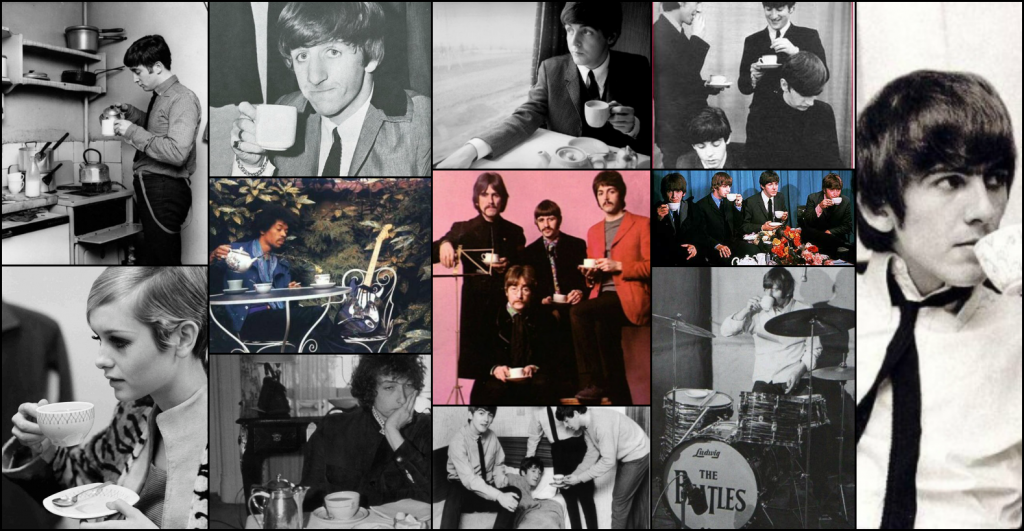
Everything you need to know about the culture of tea-drinking in the UK, including a full guide to how to make a nice cup of tea, English style.
[DOWNLOAD]
In episode 420 I have chosen to talk about my favourite herb, which like millions of other British people, and countless others around the world, I consume on a daily basis. It calms my nerves, it raises my morale, and it helps me to socialise. Queen Victoria famously used it, and the Beatles took it regularly during the recording of their most inspired music and even sang about it in a few of their songs. I’m talking of course, about tea.
As everyone knows, tea is very popular with people all over the UK, from all regions, backgrounds and social classes, whether you’re the Queen herself, or you’re the guy who cleans the road outside her massive house, everyone loves a brew. The British Empire was built on tea, wasn’t it? Goodness knows I’ve made enough references to it in my episodes – I’m even drinking a cup right now. Mmm.
Why an episode all about tea?
I just want to celebrate tea, but also I want to tell you everything I think you need to know about this subject including these things:
– Stereotypes about tea drinking in the UK
– Different ways to make and drink tea – Afternoon tea vs just having a cuppa
– My personal way to make a nice cup of tea
– The history of tea in the UK
– Facts about tea, including its health benefits
– George Orwell’s essay on tea – considered a kind of reliable guide to the ins and outs of the potentially controversial subject of how to make tea.
– References to tea in Beatle music
What are the stereotypes about drinking tea in the UK? Are they true?
Smashing a few stereotypes – let’s talk about how most people drink tea in the UK these days, not how people seem to think we do it (that’s quite hard because it depends who you are).
*Tea is for the upper classes and is a posh affair full of uptight rules – nope, all types of people drink tea and it’s often a very casual and informal moment.
*Drinking tea is a mystical, spiritual kind of experience that takes you on a journey into a colonial dreamland where you have a profound moment of higher understanding while visiting the distant lands full of oriental mystery – nope, we’re not that pretentious about it! It’s just a nice hot drink!
Here’s that annoying advert for Special T with Diane Kruger
https://www.youtube.com/watch?v=iOUh2V3Quvw
*Tea is only drunk at tea time – nope, people drink it at all hours of the day *All British people like tea – not everyone likes it, of course *Tea contains more caffeine than coffee – see below
Does tea contain more caffeine than coffee?
Unmade tea contains more than unmade coffee – but when you brew the tea most of the caffeine is not transferred to the water – it’s discarded with the leaves. With coffee the caffeine is transferred to the water more, so the drink is more caffeinated. https://www.theguardian.com/notesandqueries/query/0,5753,-25502,00.html
What’s your specific method for making a good cup of tea, Luke?
I’ll tell you about 3 typical situations in which make tea, and the different ways I do it.
A quick cuppa when I’m on my own.
Making a pot of tea to share with a couple of friends.
Preparing tea for a special occasion, like when grandparents come to visit.
What are your preferred tea brands?
PG Tips (pyramid bags), Yorkshire Tea (“like tea used to be”), M&S Gold, or fancy brands that you find in Wholefoods or little cafes – never Lipton and not Twinnings either.
Apparently it’s best to use loose leaf tea, but I usually just use tea bags. I use loose leaf tea for making sencha in a Japanese tea-pot.
Why do people drink tea so much in the UK? What’s the history of Britain and tea?
It’s all to do with our colonial past and the East India Trading Company! If you want to know more, just Wikipedia it! https://en.wikipedia.org/wiki/Tea_in_the_United_Kingdom
George Orwell’s well-known essay about how to make a good cup of tea, first published in the Evening Standard in 1946. It’s hard to argue with his approach and the clear and lucid way it is described. http://www.booksatoz.com/witsend/tea/orwell.htm
References to tea in songs by The Beatles
“Without doubt tea was the Beatles’ top tipple of choice! In one 3-month period in 1967 when they were ostensibly at the height of their drug period – they actually recorded no less than five songs referring to this most English of habits! (“Lovely Rita,” “Good Morning, Good Morning,” “A Day In The Life,” “All Together Now” and “It’s All Too Much.”) They actually recorded more overt references to tea than to drugs!” [Martin Lewis, Beatles scholar and humourist]
The Rutles – Wild Tea Parties
Talking with Richard McNeff about making a perfect cup of tea – recorded 6 years ago before I had a tea-pot!
Do you prefer tea or coffee? How do you like to make it?
Here’s the final part in this trilogy of episodes recorded at my parents’ house on Boxing Day. In this one my mum, dad and brother tell us a few more anecdotes about their encounters with some well-known people.
The conversation you’re about to hear was recorded with my family on the same day as the last couple of episodes. It was quite late in the evening, after my uncle and aunt had gone home and after dinner and number drinks had been consumed. Picture a very warm and cosy living room with a wood burning stove going in the background.
After listening to Nic describing his encounters with some famous rock stars earlier in the day, the other members of my family wanted to get in on the action too with their stories about brushing shoulders with the stars. So here are a few other anecdotes from my dad, my brother and my mum.
It turns out that my family have met some genuine legends. I didn’t even realise that a couple of these things had happened. You’ll have to wait and see who they are. But here are some slightly cryptic clues.
Can you guess which people I’m talking about?
One of the UK’s favourite authors who wrote a series of beloved books which have also been made into successful films.
A British comic actor who likes eating ice-creams and fighting zombies, criminals and aliens, in his movies (not real life of course).
A small but very important woman who often appears in public but is also a very private person.
A nonagenarian who once said that he was “the only man in the country not allowed to give his name to his own children.” A nonagenerian is someone in their nineties – also, septuagenarian (70s) and octogenarian (80s).
There are others too, including an American punk rock star with lots of tattoos and muscles, a Shakespearean actor who has become a successful film director and an actor who had a bit part in the British TV series The Office.
I should perhaps remind you of several other anecdotes which you might have heard on this podcast before, which are mentioned in this conversation.
The time my brother ended up lost in Hastings and slept on a stranger’s sofa and woke up to discover the guy sitting in a chair next to him. Was the guy just friendly and welcoming, or slightly creepy? Originally told by my bro in this episode https://teacherluke.co.uk/2016/08/09/372-the-importance-of-anecdotes-in-english-narrative-tenses-four-anecdotes
The time my mum met the King of Tonga. Originally told in this episode too https://teacherluke.co.uk/2016/08/09/372-the-importance-of-anecdotes-in-english-narrative-tenses-four-anecdotes
The time I met comedian Eddie Izzard and was a bit lost for words. I sort of went to pieces a bit and made it really awkward and weird by saying “You’re in my head!” – not the right thing to say at all. Originally told be me in this episode https://teacherluke.co.uk/2014/06/10/184-lukes-d-day-diary-part-2/
Anyway, you can now sit back and enjoy some more time with The Thompsons.
***
Outro Transcript + ad-libs
Funny, isn’t he? My brother. I would like him to be on the podcast more often, if he’s up for it. The thing is that he’s a bit modest really and isn’t the sort of outgoing person who likes to broadcast his thoughts and opinions over the internet, although he obviously should because he’s got a lot to offer. He ought to do a podcast or something like that, right? He does have a YouTube channel but it’s mainly skateboarding. https://www.youtube.com/user/VideoDaze/videos
*All the background music in this episode was also made by James*
The people mentioned in this episode
J.R.R. Tolkien, author of The Lord of the Rings
Nick Frost, actor from the Cornetto Trilogy of films with Edgar Wright and Simon Pegg and other great work too on TV and in films
Here’s part 2 of this episode all about special days and celebrations in the UK throughout the year. Below you will find a transcript and videos.
[DOWNLOAD] May
1st and 29th – Bank holidays. There are two Mondays in May when people have the day off work or school and (if we’re lucky!) spend some time outdoors enjoying the spring sunshine. The first bank holiday in May is known as the May Day holiday and it is vaguely associated with workers rights (like Labour Day) although this is not expressly stated as the purpose of the day. As I said earlier – officially all bank holidays were set up to give workers some time off.
The second May bank Holiday is known as the Spring Bank Holiday or the Late May Bank Holiday and this one is associated with the beginning of Summer. It always lands on the last Monday of May and often there’s good weather. Typically what happens on this day is that people are surprised by the good weather which leads to a feeling of optimism about the coming summer. People say things like “Ah, summer’s going to be great – let’s have barbecues!” and then they wait for summer to arrive and they wait and wait, and it stays cloudy and rainy, and they wait and it rains and they wait all the way until late September before realising that Summer is over and the week of sunshine we had at the beginning was all we were going to get, and then suddenly at the end of September the sun comes back and we have what’s known as an Indian summer – that’s a late summer.
Usually at the end of May we have the F.A. Cup Final – that’s England’s most traditional football cup and it’s pretty special because all the teams in all the leagues get to play each other and the final happens at Wembley Stadium, and it’s usually pretty sunny when it happens.
13th – The Queen’s Official Birthday. Although the Queen’s real birthday is on the 21st of April, it has been a tradition since 1748 to celebrate the king or queen’s birthday in June.
A military parade known as Trooping the Colour is held in London, attended by the Royal Family. I think the reason the monarch’s official birthday is marked in June is simply because there’s a better chance of good weather for the military parade. It’s as simple as that.
19th – Father’s Day. Father’s Day is a day to show appreciation to fathers, grandfathers, stepfathers and fathers-in-law. Many people in the UK give their father a card or gift, have a meal together or go out for drinks. We don’t do it in my family! This is probably because of a feminist idea that men already have plenty of days and blah blah blah.
21st – Summer solstice – midsummer’s eve – the longest night of the year. The ancient monument of Stonehenge in Wiltshire has its true moment in the sun on this day as people celebrate the longest day and shortest night of the year. Stand inside the monument facing northeast, toward a stone outside the circle called the Heel Stone, and you’ll see the sun rise like a blazing fire – a sight that brings in pagans and sun-lovers of all beliefs! In fact, there’s usually some sort of pagan celebration at Stonehenge on this evening. Everywhere else we just enjoy a really long evening, with long shadows and light until about 11pm or more. Summers in the UK are fantastic for long days and despite what I said earlier about barbecues we do have some wonderful weather sometimes, and I have good memories of these never-ending summers with days that just went on forever. Sitting in a pub garden all evening on the 21st is a particular pleasure.
Wed 21st to Sun 25th – Glastonbury Festival
This is the biggest music festival in Europe and is now one of the most important music festivals in the world. Every year about 200,000 people travel to a farm in Glastonbury in the Somerset countryside not far from Stonehenge in the South West of England. It used to be a hippy music festival a bit like Woodstock. These days it’s a place to check out music and all kinds of other performance art, and all the biggest bands of the moment perform there. It tends to be headlined by the biggest names in music. Recently we’ve had groups like The Rolling Stones, Coldplay, Bruce Springsteen, Neil Young, Beyonce and Kanye West headlining the event. The BBC usually cover Glastonbury throughout the festival. In 2017 one of the headliners will be Radiohead. We don’t know who is going to headline on Saturday yet – it might be Guns & Roses, Rihanna, The Stone Roses, The Foo Fighters, Ed Sheeran – the list of speculations goes on.
I’ve never been to Glasto, but I almost always watch it on TV and I have to say it’s often a bit of a disappointing experience, probably due to the poor sound quality you get through recording a live concert and putting it on TV. It completely lacks the power and punch that you get from seeing someone live. It just sounds like you can’t hear the drums properly and it all sounds weak and clinical sounding. There’s nothing like seeing music live and I think to really enjoy Glasto you need to be there, soaking up the atmosphere, up to your knees in muck. I expect it’s not what it used to be.
Here’s a podcast episode about music festivals from the archives https://teacherluke.co.uk/2009/10/20/summer-music-festivals/
26th – Eid. Marking the end of the month-long fast of Ramadan, Eid is widely celebrated by Muslim communities in the UK. Each community usually organises its own events, but there are some large celebrations and feasts in city centres, such as in London and Birmingham. I’ve never been part of an Eid celebration but I remember when I worked in London that a lot of my students fasted during Ramadan, and then disappeared completely during the Eid celebrations! I wonder what it is like to go without food during the daylight hours – it must be pretty hard. I know that fasting is an important part of Islam (one of the 5 pillars of Islam) and it’s all about abstaining from earthly and material pleasures and focusing on prayer and a sort of spiritual detox. It must be a big celebration when it’s over and you can eat during the day again!
July
Monday 3 July – Sunday 16 July – Wimbledon Tennis Championships. Wimbledon, the world’s oldest tennis tournament, is a summer highlight for sports fans. Held at the All England Club in London since 1877, Wimbledon is known for the tennis players’ white dress code and the tradition for spectators to eat strawberries and cream. For me this is usually something you watch in the evenings while eating summer food like a melon or something. It’s also another opportunity to be disappointed by British sportsmen, although Andy Murray did win in 2013 and this year too. Well done Andy.
Also during the summer we have cricket test matches going on. A test match is one game of cricket that happens as part of a test series. So, a series is 5 matches, and the series goes on throughout the summer – it can take a couple of months for a series to be completed. Each test match lasts up to 5 days. The biggest rivalry we have is with Australia and we regularly play a test match series against the Aussies called The Ashes – it’s been going for decades and it’s a big deal if you like cricket. You might think that 5 days is rather long for a game (and yes they pretty much play all day – from about 10AM until the light fails in the evening – they even stop for tea in the afternoon) but it’s really great when there’s a test match going on because you can keep up with it during the day (just quickly check the scores or listen to it on the radio here and there) and then watch the highlights of the day’s play on the telly in the evening. I should do a whole episode about cricket.
August
Edinburgh Festival Fringe. 4-26 August 2017 (5th–29th August 2016). The largest arts festival in the world, ‘the Fringe’ features over 40,000 performances and more than 2,500 shows at 250 venues. Any type of performance may participate, across theatre, comedy, music and dance, and many students visit Edinburgh to put on their own shows. For more, read our Edinburgh Festivals guide.
Notting Hill Carnival. August Bank Holiday Weekend – last weekend of August (27-28th August 2016) Held in west London over a bank holiday weekend, Notting Hill Carnival is Europe’s biggest street festival. Around 1 million people go to see colourful floats and dancers in flamboyant costumes, hear music from salsa to reggae, and taste Caribbean food from street stalls. Bring your party spirit, enough cash and a lot of patience – it can be very crowded.
Check it out – I did a video podcast about Notting Hill Carnival.
September
18-20th Sept 2017 (16th–20th 2016) London Fashion Week. London Fashion Week sets the global fashion agenda, alongside the other big shows in Paris, Milan and New York. These fashion shows during fashion week are mainly for industry insiders, but you can get tickets to London Fashion Weekend for a taste of the fashion show experience. There are two each year – the first London Fashion Week is in February (3rd weekend). Students get involved too, with events including student and graduate showcases and networking opportunities.
October
31st – Halloween. The modern way of celebrating Halloween is based on the Christian feast of All Hallows’ Eve and the Celtic festival of Samhain. Children go trick-or-treating (knocking on neighbours’ doors to ask for sweets) or carve pumpkins, while older students go to parties and Halloween events at pubs, clubs or Students’ Unions. The important thing is to dress up as gruesomely as you dare!
November
All month – Movember. If you’re seeing more moustaches than usual, you’re not imagining it – throughout November, the charity campaign of Movember invites men to grow a moustache and raise awareness of men’s health issues. It’s a bit annoying and I don’t really know why.
5th – Bonfire night. Historically, this marks the anniversary of Guy Fawkes’ plot to blow up the House of Lords and assassinate King James I in 1605 – the failed ‘gunpowder plot’ is remembered in the children’s rhyme ‘Remember, remember the 5th of November; gunpowder, treason and plot’. Today, it is commemorated with spectacular displays of fireworks.
There will be firework displays in most cities, but one of the best places to be is in the medieval town of Lewes, East Sussex – here, the fireworks are accompanied by colourful parades, music, costumes and the traditional ‘guy’, an effigy made of straw or paper to burn on the bonfire.
11th – Remembrance Day. Each year in the UK, 11 November is a memorial day to honour those who lost their lives in battle – especially during World War 1, so many peace campaigners also support the event. The Royal British Legion charity sells paper poppy flowers to raise funds for veterans and their families (the poppy is a symbol of Remembrance Day), and it is customary to observe a two-minute silence at 11am. Around this time it’s common to see people wearing red poppies on their shirt or jacket. In TV studios they have boxes of poppies on hand so that nobody appears on TV without one, which would not be a good idea because it would make you look disrespectful.
30th – St Andrew’s Day (Scotland). Honouring its patron saint, St Andrew’s Day is Scotland’s national day. There are many events across Scotland, including traditional meals, poetry readings, bagpipe music and country dancing. This is a great opportunity to go to a ceilidh – a party with Gaelic folk music and dancing. Fortunately, there is usually a ‘dance caller’ to teach the steps! I’ve never done it, but apparently this is a thing in Scotland!
Thurs Oct 19 2017 – Diwali. Diwali (or Deepavali) is the Festival of Lights for Hindu, Sikh and Jain communities. Cities including Leicester (which hosts one of the biggest Diwali celebrations outside India), London and Nottingham have extravagant street parties with traditional food, music, crafts and dancing – and of course, displays of lights, lanterns, candles and fireworks.
December
Throughout December, there are loads of winter markets and festive visitor attractions across the UK. Look out for events advertised in local magazines like TimeOut!
Winter Wonderland in London’s Hyde Park. In addition to a traditional Christmas market, this huge site features carnival rides, two circuses, an ice skating rink, fake snow and an exhibition of ice sculptures… and enough hot chocolate and mulled wine to keep you warm.
Hogwarts in the Snow, a wintry version of the Harry Potter tour at Warner Bros. Studios in Leavesden (near London). Watch snow fall over the original model of Hogwarts castle, and see the Great Hall set for Christmas dinner.
Birmingham’s Frankfurt Christmas Market, the largest German market outside Germany and Austria, complete with glühwein (mulled wine), wursts (sausages), pretzels and sweet treats. You can also shop for unique gifts from local artists at the Craft Fair.
The winter festival at the Eden Project in Cornwall. Usually an educational ecology park, in December the Eden Project is transformed with Christmas trees, a choir, real reindeer and an ice rink, with ice skating classes for all ages.
Belfast’s Christmas Market. If you’re studying in Northern Ireland, visit the multicultural market outside Belfast’s City Hall for festive food and drink from around the world, crafts, gifts and Christmas decorations.
Pantomimes. The traditional Christmas ‘panto’ is a mix of slapstick comedy and musical theatre, with silly costumes and audience participation. Pantomimes are usually for children, but it’s worth seeing one for a uniquely British experience.
24th–1st Jan – Hanukkah. Jewish communities across the UK will be celebrating Hanukkah (Chanukah), the Festival of Lights. In London, the Menorah in Trafalgar Square is the largest in Europe. It’s usually lit by the Mayor of London on the first day of Hanukkah, at an event with free doughnuts and live music.
25th – Christmas. Most people in the UK celebrate Christmas, even if they are not religious. There will be Christmas trees, presents, carol singing, mulled wine (warm, spiced red wine), mince pies (small pies with a sweet fruit filling) and if it snows, snowmen and snowball fights! The traditional Christmas dinner is a whole roast turkey with roast potatoes, vegetables, gravy and Christmas pudding for dessert.
26th – Boxing Day. The day after Christmas is called Boxing Day, and is a bank holiday in the UK. It’s believed to have been named after the ‘Christmas box’ of money or gifts which employers used to give to servants and tradesmen. Nowadays, there are no particular Boxing Day customs, but most people spend the day with their families, going for a walk, watching sports or eating the Christmas leftovers.
Other festivals
May 4th is unofficially Star Wars day, just because of the date “May the fourth be with you”. I think some Star Wars fans get together and there might be special screenings but as far as I can see it’s just a chance to post something on Facebook wishing everyone a happy Star Wars day.
A listener to this podcast wanted me to mention Sea Odyssey: Giant Spectacular – a kind of street theatre event that happens sometimes in Liverpool. That looks fantastic.
There are many arts festivals too, where you can sample literature, theatre, arts & craft, dance and poetry. Click here to read more about arts festivals http://www.artsfestivals.co.uk/festival-details
Here’s an episode all about special days and celebrations in the British calendar. You’ll hear cultural information about holidays and customs, and some pronunciation work on how to say dates and the months of the year. Transcript and videos below.
This episode is being recorded before Christmas. I’m going to upload it sometime around Boxing Day I think. You’re probably listening during the Christmas period or the new year period. I hope you’re having a lovely time wherever you are and whatever you’re doing.
This episode is all about British festivals and holidays that occur throughout the year. Let’s look ahead to the coming year of 2017 and see what kinds of things Brits will be doing for certain special occasions.
I’m recording this because at some point earlier this year I got a message from a listener challenging me to talk about all the major British festivals and holidays in one episode and I said “challenge accepted”, and so now, finally, here is that episode! I don’t remember your name – I’m sorry! But here it is ok! The thing is – the challenge was to do it all in one episode and I have a feeling this is more than one episode because I’ve got lots of things to say about this!
The UK calendar is absolutely full of festivals of many kinds. In fact, there are festivals and special days in every month of the year. These festivals mark various special occasions connected to the passing of the seasons, important historical or religious events and significant people in the UK.
In this episode let’s explore those main festivals and public holidays, in rather fast style.
I’m from England, so my version might be a bit Anglo-centric, but I have tried to include a variety of festivals and not just the ones that seem significant to me as an individual.
This episode should be a great little journey through the UK calendar, and it should help you learn some more British culture. Also we’re going to look at how to pronounce the months, dates and days in British English.
So, without further ado, let’s get cracking! Here’s our whistle-stop tour of British festivals and holidays.
So, there are public holidays – days of statutory leave – days off given to us by law, and these are generally known as bank holidays, and there are festivals. Not every festival is a holiday.
So, bank holidays and festivals.
Bank Holidays
If you’ve lived in the UK you’ll know that a bank holiday is usually a wonderful, wonderful thing in theory. They usually happen on a Monday and sometimes on other days, but usually on a Monday. So a bank holiday is a long weekend. They’re usually associated with an old religious occasion or some other important reason for the state.
Three of these bank holidays take place in the summer, so everyone imagines they will be out in the garden having a barbecue or in the park having a picnic or something. In reality they probably involve getting caught in the rain in some way, perhaps while attempting to have a barbecue in the garden or picnic in the park or something.
Having our public holidays on Mondays is a great thing though, because it means you get a day off, and a long weekend. Shops and services are sometimes closed, which can be a bit annoying, but less so these days – in fact the shops tend to do quite well on a bank holiday weekend and so they stay open. So it can be a good day to go out shopping.
Banks are closed though, which can be a bit of a pain in the neck if you need to use your day off work to get something done at the bank.
These public holidays are originally called Bank Holidays because in 1871 certain days were designated in law as being days on which no financial transactions should take place, just like on Christmas Day. I suppose this was to give workers a few guaranteed days off a year – so that they didn’t get completely exhausted working in factories every day of the year. These days people have more statutory paid holidays – in fact everyone is entitled to 5.6 weeks of paid holiday per year. That may or may not include the bank holidays – it’s up to the employer. At the last company I worked for in London we had to work on bank holidays, which sucked a lot. While all my other friends were out attempting to have barbecues and getting caught in the rain, I was teaching English. But, it was a good school to work for so they allowed us to take our bank holidays as ‘days in lieu’ – days off which replaced the bank holidays that we worked. I would always take all my days in lieu during quiet periods at the school in December so I could do all my Christmas shopping.
These so-called Bank Holidays are scattered throughout the year, and they’ve been arranged to land on Mondays, corresponding to certain periods or events in the year.
So, instead of having specific dates, our holidays are matched to Mondays in the year, unlike in France where the public holidays always arrive on the same date – even if it’s a Saturday or Sunday (nightmare). Sometimes public holidays in France land on a Tuesday or Thursday and a lot of people ‘do the bridge’ which means that they take the Monday or Friday off as well, and enjoy a massive long weekend. If that happens, it seems the country grinds to a halt because everyone’s gone on holiday for most of the week.
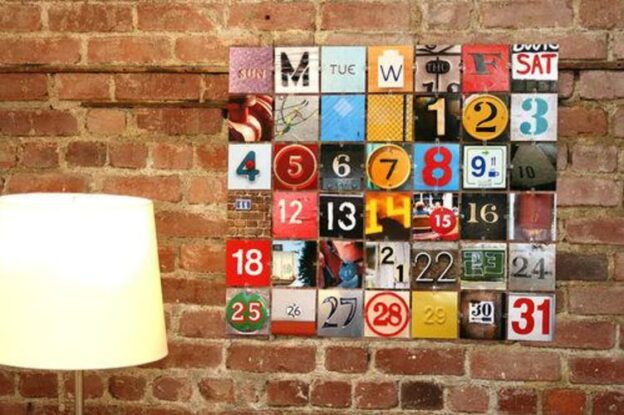
We have 7 bank holidays in the year in the UK. A bank holiday weekend is a truly wonderful thing about life in the UK. It’s a long weekend, and you’re always guaranteed to get it. There are two in May, which makes that month a particularly good one in the UK. It’s normal to celebrate by having a barbecue or a party, or just going out and having fun in the sunshine.
Upcoming bank holidays in England and Wales
2017
2 January – Monday – New Year’s Day (substitute day) (if it falls on a weekend, they give you the next Monday off, which is nice)
14 April – Friday – Good Friday
17 April – Monday – Easter Monday (Easter is a fantastic 4-day weekend)
1 May – Monday – Early May bank holiday (it’s also called May Day and probably originates from Roman celebrations of the beginning of the summer period – in some countries there is Labour Day on 1 May, which celebrates the rights of workers, but we don’t do Labour Day – instead ours is the early May bank holiday – I think this is because the whole concept of bank holidays covers essentially the same purpose as Labour Day)
29 May – Monday – Spring bank holiday (This is also called the late May bank holiday and is connected to Pentecost – in fact it’s the first Monday after Pentecost. What’s Pentecost? It’s the Christian festival celebrating the descent of the Holy Spirit on the disciples of Jesus after his Ascension, held on the seventh Sunday after Easter. So, the first Monday after the seventh Sunday after Easter. Are you following this? Most people just find out from their employer, from the newspapers, friends or from a calendar they probably got for Christmas.
28 August – Monday – Summer bank holiday (Barbecue & disappointment season – it’s there to mark the end of the summer holidays)
25 December – Monday – Christmas Day
26 December – Tuesday – Boxing Day (Again, if Christmas Day or Boxing Day land on a weekend, then they give you the next available days off – like in 2016 when you get a day off on the 27 because 25 landed on a Sunday)
How to say months and dates
In a moment I’m going to go through festivals and days of celebration or commemoration which happen in every month during the year.
Before I do that – let’s look at the pronunciation of the months of the year. I know you did this at school but I’m often surprised at how people still pronounce the months wrong. So just repeat the months of the year with me and think about how you’re saying them. Think about vowel sounds, the number of syllables and which syllable is stressed.
Let’s go. January – February – March – April – May – June – July – August – September – October – November – December
Also, let’s consider the way we say dates in the UK.
Day first and then month.
When we write we just add the number then the month. We add the little ‘th’ ‘rd’ or ‘st’ as well next to the number, but you don’t always have to. So we write 21 December or 21st December.
But when you say a date you have to remember to add the before the number, the ordinal – 1st, 2nd, 3rd, 4th etc and also of.
So it’s the 21stof December.
What’s the date today?
It’s the 21st of December.
In America they don’t know what they’re doing, so they put the month first.
Just joking, it’s fine. For the Americans they start with the month and don’t always include of.
“It’s December 21st” for example.
“What’s the date Mom? It’s December 21st, honey.”
Tell me these dates.
What date is Christmas Eve?
What date is Christmas Day?
What date is New Year’s Eve?
What date is New Year’s Day?
What date is Valentine’s Day?
What date is St Patrick’s Day? (17 March)
What date is your birthday?
What date is the summer solstice?
What date is Halloween?
What date is it today?
Festivals Throughout the Year
The following information is based on an article by the British Council, although I have paraphrased quite a lot and added quite a lot of stuff. Click here to read the full article where you can read more about each festival http://www.educationuk.org/global/articles/festivals-and-holidays/#january
Here’s a list of the festivals and celebrations throughout the year in the UK. This list includes traditional events, sporting events and I’ve also included some major music festivals in the UK – and if you spend some time in the UK I really recommend that you go to a music festival, they’re usually a lot of fun as long as it doesn’t rain!
January
1st – New Year’s Day. On New Year’s Eve (31 December), it is traditional to celebrate midnight with your friends or family and to sing ‘Auld lang syne’, a folk song with words by the Scottish poet Robert Burns, although to be honest I have never ever sung that song in my life! The party can last well into New Year’s Day! Many people make ‘New Year’s resolutions’, promising to achieve a goal or break a bad habit in the coming year. For me, New Year’s Eve is about these things: struggling to plan something to do, going to a house party and getting drunk, going out to a club or something and then having a nightmare getting home (no taxis), freezing cold outside, staying in and drinking wine, watching Jools Holland on the TV, not really wanting to do anything because you’ve already spent the week drinking and eating too much anyway.
In Scotland, the celebration of the new year is called Hogmanay. There are big parties across the country – expect lots of music, dancing, food and fireworks – but Edinburgh hosts some of the biggest.
25th – Burns’ Night (Scotland). This is the birthday of Robert Burns – who is basically the national poet of Scotland. Many Scottish people hold a special supper (dinner) on Burns’ Night, with toasts and readings of his poetry. Men might wear kilts, there may be bagpipe music, and people will almost certainly eat haggis (the traditional Scottish dish of sheeps’ heart, liver and lungs) with neeps (turnips) and tatties (potatoes). Sounds disgusting? It’s actually pretty tasty. I’ve never been to a Burns Night celebration because I’m English and it’s not our thing, but I bet it’s a lot of fun.
28th – Chinese New Year. Outside Asia, the world’s biggest celebration of Chinese New Year is in London – each year there is a parade through Chinatown in the West End, with free performances of music, dance and acrobatics, a feast of food and fireworks. There are many more events around the UK, so find out what’s on in your area – cities including Manchester, Nottingham, Liverpool and Birmingham usually host colourful street parties.
February
28th – Shrove Tuesday or ‘Pancake Day’. Lent is the traditional Christian period of fasting, which lasts for 40 days. Shrove Tuesday is the day before Lent, when households would traditionally use up their eggs, milk and sugar by making pancakes. Nowadays, even if they are not religious, many people still make and eat pancakes on this day.
Some towns in the UK also hold ‘pancake races’, where contestants toss pancakes in a frying pan while running for the finish line. One of the most famous is in Olney, Buckinghamshire, where it’s believed the first Pancake Day race took place in 1445.
I’ve never been to a pancake race. For me pancake day is all about making your own pancakes, probably ruining the first one because you have to burn one before the pan is ready. My favourite pancakes are just covered in nutella. Far too much nutella.
14th – Valentine’s Day. Historically this was the date of the Feast of St Valentine, nowadays this is a celebration of romance. Many people in the UK go out for dinner with their boyfriends or girlfriends, and give them a Valentine’s card, chocolate or flowers. If you’re single, you might receive an anonymous card from a ‘secret admirer’! For single people, Valentine’s Day can be a bit of a nightmare because you see all these smug couples getting together and going on dates. It can make you feel a bit lonely, or you might just reject it completely and do something totally at odds with the day. But couples can also have a slightly difficult time on Valentine’s Day – usually there’s pressure on the man to come up with some special romantic plan, and generally there is a feeling that Valentine’s Day is a sort of manufactured event by companies and marketing people. It’s actually quite unromantic, and some people just shun it completely, but in my experience if your girlfriend or wife says “Oh you don’t need to do anything for Valentine’s Day” then you definitely DO need to do something. Don’t be fooled by what she says. That also includes birthdays and anniversaries.
March
1st – St David’s Day (Wales). St David is the patron saint of Wales, and March 1 is a celebration of Welsh culture. People in Wales might wear a daffodil and eat a soup of seasonal vegetables and lamb or bacon. I’ve never eaten that in my life and to be honest I’d never ever heard of it, because I’m English. Events are held across Wales, including a large parade in Cardiff. As an English guy I’ve never been part of St David’s Day celebrations. All I remember is some people wearing daffodils at school when I was a kid.
17th – St Patrick’s Day (Northern Ireland). The Feast of St Patrick is a national holiday in Ireland, and is now celebrated by Irish communities all around the world. In the UK, there are St Patrick’s Day events in cities including Birmingham, Nottingham, Manchester and London, as well as Belfast. Many people go out with friends, wearing green or a shamrock symbol (the lucky clover) and drinking Guinness, the Irish dark beer. The tradition is to get completely pissed and wear a massive hat shaped like a Guinness glass or shamrock or some weird combination of the two – a shamrock beer glass hat thing that won’t protect your head against a hangover or any other form of brain damage that you might suffer on this evening as a result of alcohol poisoning, accidents, violence, or all three if it’s a really good night.
26th – Mother’s Day (or Mothering Sunday). Mother’s Day is a day to celebrate motherhood, and to thank mothers for everything they do throughout the year. Many people give their mothers a card or gift, treat them to a day out or cook a meal. I usually send a big bunch of flowers to my Mum and try to make her feel special. It’s the least I can do.
April
1st – April Fools’ Day. For one day of the year, it is acceptable – even encouraged – to play tricks, pranks and practical jokes. Even newspapers, TV and radio shows often feature fake stories on April 1. It’s customary to reveal the joke by saying ‘April fool!’ (the person who falls for the joke is the ‘fool’), and you’re supposed to stop playing tricks at midday. Some famous April fool jokes include ones done by the BBC – like in 1957 when a respected news programme called Panorama broadcasted a report about how spaghetti was harvested from trees in Switzerland.
It showed people climbing ladders to pick spaghetti that was hanging from the trees and collect it in baskets. Needless to say, many Brits were fooled by it.
Other tricks are things like, telling your students they have an emergency test that day, or just changing all the clocks in your house so everyone things they’re late. That kind of thing. It’s all harmless fun, until someone has a terrible accident or someone gets very upset and there’s a huge argument resulting in the end of a relationship or someone getting fired from their job. Just harmless fun.
Here’s that 1957 BBC April Fool’s Joke – check out the old-school heightened RP accent!
14th–17th – Easter weekend. Easter is a Christian holiday celebrating the resurrection of Jesus Christ. The date depends on the next full moon after the Vernal equinox (the first day of spring), so the dates change each year. It is always on a Sunday in March or April (called Easter Sunday), and the previous Friday (Good Friday) and following Monday (Easter Monday) are bank holidays. People celebrate Easter in different ways, but many give each other chocolate eggs and eat ‘hot cross buns’ (sweet buns with a cross design), while children decorate eggs or take part in Easter egg hunts. To listen to an episode I’ve already done about this, click here https://teacherluke.co.uk/2009/04/14/episode-2-easter/
23rd – St George’s Day (England). The legend is that St George was a soldier who killed a dragon to rescue a princess in the middle east somewhere. He is now the patron saint of England, and this is England’s national day. Yes, I don’t understand it either really. You might still see St George’s Cross (a red cross on a white background, England’s national flag) or events with morris dancing (an English folk dance), but it is not a bank holiday and most people don’t hold special celebrations. That’s right – we just don’t really care about St George’s Day. In fact, this is quite interesting as you’ll see that English people are quietly a bit modest about their country. We don’t celebrate the national day, we have some negative associations with our flag (although I’m sure plenty of people would disagree with me – I think it’s true), and we’d rather be patriotic about the UK than about England. Honestly, this is because England has done some pretty naughty things in the past like colonising other countries, going on crusades, smashing up towns after football games, invading our neighbouring countries and tying them into a union with us, then dominating that union with our values – unfortunately these are the values that many people associate with the English flag, and we don’t really know how to celebrate our saint’s day. I think, with Scottish Independence, there are moves to reclaim Englishness from the nationalists, and redefine it, but I feel like whenever someone proudly claims they are English and waves the English flag – it just smells of right-wing nationalism, hooliganism, skinheads, violence and stuff like that. Pity really because there shouldn’t be anything wrong with being English any more, especially if Scotland is given its independence. Also, I guess it is hard for many English people to feel a connection to Saint George considering the story is about a guy who probably wasn’t English anyway – it turns out he was actually born in Turkey and became a Roman soldier – and that confuses us. Still, it is about a knight who killed a dragon which sounds pretty cool.
Here’s a version of the story from a website called “Project Britain” which sounds like it was created by a Brexiteer – but then again my podcast is called “Luke’s English Podcast” which could also sound like a nationalistic right-wing podcast run by the English Defence League or something. You’re listening to Luke’s English Podcast and we want England to be back English again! No thanks.
Anyway, here’s a version of the Saint George & The Dragon Story – I have no idea who wrote it or to what extent it is fact checked or even based on anything that actually happened. In fact it reads like pretty much every other fairy tale story of a knight defeating a dragon to rescue a princess. http://projectbritain.com/stgeorge2.html
In this episode we continue to analyse the various British accents that you can hear in the film version of The Lord of the Rings. Let’s consider the accents of some of the main characters, such as Frodo, Sam, Pippin, Merry, Treebeard, Elrond, Boromir, Gandalf, Saruman, Legolas, Gimli and the orcs.
Frodo and Sam at the river (Frodo: English RP, Sam: English West Country)
Merry, Pippin & Treebeard (Merry: mild Manchester – Stockport, Pippin: Glasgow Scottish, Treebeard: old fashioned Scottish? RP with traces of Tolkien’s made-up elvish accent?)
Boromir at the Council of Elrond (Elrond: Heightened RP, Boromir: RP with traces of Yorkshire)
Sean Bean interview with Larry King (Sean Bean: Sheffield in Yorkshire, England / Larry King: Brooklyn NYC)
Gandalf and Saruman (Heightened RP / trained thespian actors at their best!)
Gimli & Legolas (Legolas: Heightened RP, Gimli: Welsh, which sounds Scottish at times)
This episode contains stories and descriptions of my recent holiday in Thailand. You’ll hear some facts about Thailand, some descriptions of Bangkok and a few stories about funny experiences that happened while we were there. Part 2 is coming soon. More details and transcriptions below. Enjoy!
Hello everybody, I’m back from my holiday so here is a brand new episode for you to listen to. If you’re new to Luke’s English Podcast, then “hello” and welcome to the show. I have no idea how you found the podcast. It was probably on the internet, that’s how it normally happens. I doubt that you actually tripped over it in the street or anything. Oops ,what’s that – oh, it’s Luke’s English Podcast. I might as well have a look. You probably found it online, perhaps through iTunes or a friend recommended it to you perhaps. In any case, regardless of how you found me, welcome. My name’s Luke – and this is my podcast. It’s primarily for learners of English although I also have native English speakers listening to this too. In these episodes I talk to you in a personal way, telling stories, sharing some things about my life, discussing different topics, teaching you English and giving you the motivation to improve your English for yourself. I try to keep the podcast varied and I’m willing to talk about pretty much anything at all as long as it’s interesting. I’m an English teacher from the UK. I speak British English – with a standard accent from the South East of England. I’ve been teaching for more than 15 years so I have lots of experience to draw from. I’m also a stand-up comedian which means that when I’m not teaching English or doing the podcast I like to stand up in front of audiences of people and make them laugh with jokes and stories and things. I regularly perform comedy shows in Paris.
One of the principles which underpins what I do in episodes of this podcast is the understanding that simply listening to natural, spontaneous speech is a vital part of the process of learning English to a good standard. Obviously, you have to get an understanding of the grammar rules, develop an extensive set of active vocabulary, practise pronouncing the language and so on, but doing plenty of listening is an essential foundation. I usually recommend that LEP is best enjoyed as part of a balanced study program. For example I suggest that you also do plenty of speaking in order to activate the English that you passively pick up from these episodes. There are lots of ways to improve your English and you can just listen to previous episodes of the podcast to get my advice on that. At the very least, you can just relax and enjoy listening to my words on a regular basis, and I hope that it’s a fun process too. Certainly, I am sure that my podcast can really help all the other aspects of your English, not just your listening. I also believe it’s important to listen to English which is spoken at a pretty natural speed, which is spontaneous (i.e. not just written from a script) and I think you should listen regularly for fairly long periods, long term. Make it a part of your lifestyle to listen regularly and don’t give up.
I want my podcast to help you to do exactly those things, and so I try to make my episodes genuine, personal and humorous. So, if you’re new to the podcast – welcome and thanks for listening. I hope you stick with it. I believe that if you do continue to listen, you’ll see significant results in your English. Check out the episode archive on my website teacherluke.co.uk and you’ll see that you have plenty of other episodes to explore and enjoy.
If you’re not new to the podcast, and you are in fact a long term LEPster then welcome back! How are you? I hope you’re well. Did you have a good August? Have you listened to all the episodes I published before I went away? I hope so.
In any case, here is a new episode of this podcast and it is about my recent holiday in Thailand.
Holiday in Thailand
Yes, we went to Thailand this year and I’m going to tell you about it in this episode. In fact, in this one I’ll talk about these things:
Why we went to Thailand
Where we went in Thailand
The things most people know about Thailand
Some things you might not know about Thailand
A few anecdotes about what we did and saw during the holiday
A few dodgy jokes!
An embarrassing story involving nudity
A sad old memory that came back to me at a specific moment in the trip
A mouse-related update (if you heard the last episode of the podcast, this will make sense to you)
We got back just the other day. I’m still a bit jet-lagged. I woke up at stupid o’clock this morning. My body is still on Thailand time, so at about 5AM my body woke up saying “hey it’s time to get up and go walking around temples in very hot temperatures! We’re on holiday come on!” No doubt I will randomly fall asleep this afternoon when my body decides that it’s bedtime. I have a sun tan – correction, I had a tan, until the flight back. As a very white English man, I have a slightly tricky relationship with sun tans. At the moment I am sporting the typical English man’s tan.
I have no idea how long this episode will be but I can just split it up into different chapters and it’s all good.
You will find some of this episode transcribed on the episode page on my website. Not all of it is transcribed, but a lot of it is, and you can read my notes too, which might be a good way to check out the spelling of any words you hear me use. They might be written on the page. By the way, if you’re just reading this – I strongly recommend that you listen instead of reading. Remember, anything that is written here is supposed to just accompany what I’m saying in the audio recording.
Why did we choose Thailand?
– My wife and I wanted to go somewhere exotic and far away (we want to explore places which are a bit further before we have kids)
– A break and a chance to get away from it all
– Never been before
– We like food !
– It’s quite diverse in terms of the things you can do – city, culture, beaches
– It’s not too expensive
Why didn’t you do an LEP Live event?
It was a holiday – so I was not working. That means I didn’t organise some sort of LEPster meet-up, or live podcasting stand up comedy extravaganza. I didn’t meet up with Olly Richards even though I have since learned that he was out there too learning Thai – no, it was all about walking around sweating, visiting temples, sweating, exploring street food markets, sweating, worrying about food poisoning, sweating, going to the beach and sweating there, learning how to cook local food, eating the local food with lots of chilli, sweating, doing yoga and meditating, drinking water and sweating! Just the average holiday abroad for a British person!
Where did you go?
In a nutshell, here’s where we went.
Bangkok for a few days, then up north to Chiang Mai for a few days, then down south to Koh Samui for a few days and then back to Bangkok for a few days and then home! Boom!
That’s the usual tourist route. It’s Bangkok in the middle, temples, treks into the forest, elephants, night markets and cooking classes in the north, then islands, beaches, diving, snorkelling and full moon parties in the south.
We didn’t go to the islands on the west side like Phuket because of the climate in August.
Also, just before we left and even while we were there, there were some explosions – some bombings, which was a bit worrying. We even considered not going, but then we thought – well, we live in Paris and we’ve got as much chance of being blown up there as in Thailand, so what the hell!
In fact our time was very peaceful.
Usual things people think about Thailand
The most typical clichés or stereotypes about Thailand: Busy, crowded, amazing food – specifically green curry and pad thai noodles, weird sex tourism in Bangkok, ladyboys, bizarre sex shows involving ping pong balls, full moon beach parties, buckets full of ridiculously full cocktails, kickboxing, temples, westerners being locked up in prison for drug possession, scooters, Sagat from Street Fighter 2 (Tiger uppercut), snakes, golden buddha statues, amazingly friendly and smiling people and the film “The Beach” starring Leonardo DiCaprio.
That’s partly true (perhaps for the average western tourist) but obviously it’s not the full picture, especially for the locals. I will go into more detail about what it’s really like in this episode.
Things you might not know about Thailand
1. Full name of Bangkok. It’s the longest city name in the world. “Krungthepmahanakhon Amonrattanakosin Mahintharayutthaya Mahadilokphop Noppharatratchathaniburirom Udomratchaniwetmahasathan Amonphimanawatansathit Sakkathattiyawitsanukamprasit.”
https://www.youtube.com/watch?v=-OgUiux9QWw
2. Thailand, or “Prathet Thai” means “land of the free”…
3. Thailand has never been colonised by a foreign power, unlike other neighbouring countries which were colonised by European nations like Britain, France and the Netherlands. Thailand had a few wars with Burma, but was never successfully invaded. Well done Thailand.
4. Thailand has more than 1,400 islands. The most famous ones are in the south, and they are beautiful. Probably the most well known is Koh Phi Phi, which is where The Beach was filmed. (By the way, it’s a rubbish film)
5. It’s illegal to leave the house without underwear on. I don’t know how they enforce this law. Are they doing random underpant checks?
6. Thai currency is called the Baht and it’s illegal to step on Thai Baht. Now, you might be thinking – well, I don’t every go around stepping on currency anyway, so that’s not a problem. But the point is that this is because of the high level of respect that the Thai people have for their royal family. Like in the UK, a picture of the monarch appears on every bank note and the image of the monarch cannot be desecrated, in fact it is a crime to disfigure a picture of the king or queen in any way. Thailand is a constitutional monarchy, a bit like the UK, and they hold their king and queen in high esteem. There are lots and lots of images of them all over the country, sometimes you find little shrines in the street devoted to them.
7. The feet are considered to be very unclean (both clinically and spiritually) and so it is very rude to reveal the soles of your feet to anyone. So, don’t sit with your feet facing outwards, or put your feet up on the table like we do in the west sometimes. It’s also rude to point at people with your feet, which is fine because I literally never do that anyway. I’m sure I heard someone do standup about that and I can’t remember who, but it was very funny.
8. Similarly, the head is the highest point on the body and is considered to be sacred, so don’t touch it, slap it, poke it or whatever. In the west you might rub someone on the top of the head as a sign of affection, or whack someone round the back of the head to express annoyance. Don’t do that in Thailand. To be honest, I wasn’t going to do that either. I rarely touch the head of random strangers that I meet in public. I certainly wouldn’t slap the back of the head of someone. E.g. “Waiter, excuse me – we asked for 2 bowls of rice and you gave me one! Can we have another one? Thank you!” SLAP. No.
9. 95% of people are buddhist. It’s quite common to see Buddhist monks walking around. We talked to one of them and I’ll explain what he said later in this episode. Also there are buddha statues everywhere. There are thousands of them. It’s just buddha buddha buddha buddha buddha buddha buddha buddha buddha. Climb to the top of a mountain, there’s a buddha. Inside a cave? Buddha. Under a nice tree? Buddha. Inside this big temple? Buddha. In front of the big buddha statue, lots of other buddhas. In front of them, buddhas. Buddhas everywhere – which is great. They are beautiful, peaceful images and of all the religions I think Buddhism perhaps makes the most sense. Just try to reach a higher level of consciousness. Realise that everything is connected and that there is one universal vibration which passes through the entire universe. Reject selfish and materialistic urges in favour of achieving individual spiritual enlightenment. Fine.
10. It’s a very hot place – especially Bangkok. The hottest time of year is April where temperatures rise to 40 degrees C or more, with high humidity levels too. In August it’s the rainy season but it still gets really hot – it was regularly in the high 30s and with very high levels of humidity. Showers that happen in the evenings are a welcome break from the heat!
Read more about this on ‘the internet’ http://matadornetwork.com/trips/19-things-probably-didnt-know-thailand/
Bangkok
There are lots of stories about it, like the dodgy ping pong shows, the sex tourism and other weird and lewd things, but of course not everywhere is like that. We avoided the dodgy tourist parts such as Patpong, where there are these weird sex shows. Now, while I am quite curious to learn about the bizarre skills that some women have developed – I mean, some of the things are quite impressive. For example, apparently in these shows, some women are able to launch ping pong balls across the room – and not with their hands if you know what I mean, and some of them can even write letters with a paintbrush or pen, again, not with their hands. THat’s actually quite impressive, but I don’t really need to see it, and apparently the people who run the shows are very dodgy indeed and they lure you in with false prices and then when you try to leave they force you to pay a lot of money and it gets pretty ugly, so no thanks. No ping pong shows for us.
A mix between the chaotic and slightly sketchy places like Vietnam, Cambodia, Laos etc and the more modern JPN, particularly parts of this area where we stayed.
The streets are vibrant, chaotic, noisy, smelly, polluted, full of life. Scooters, cars, crossing the road. Nobody walks! Traffic is incredibly busy. There’s an amazing metro system called the sky train. Tuk tuks, taxis and so on.
Lots of street food, with people cooking all sorts of things on little mobile carts – chicken skewers, lots of seafood, noodles, fruits like mango and some things I didn’t recognise. People eat in the street sitting on little plastic chairs.
Incredible Japanese BBQ. Daimasu.
Massages
Onsen experience
Expectations vs reality.
Naked bald midget.
Only had a tiny towel. Not big enough to go around me.
A bunch of other naked guys, including a group of old men in the corner watching. They broke off their conversation to have a look at me when I walked in.
Only foreigner there.
Not normal in my culture.
I felt really embarrassed. Not because of my size – because I have nothing to be ashamed of in that department. Some might say I’m gifted, I would prefer to say I am average for a guy of my height, but I should add that I have massive hands and feet. Just saying. Anyway, I don’t really need to be ashamed of myself but this was very awkward for me but because I’m not used to being seen, and the natural response is to be self-conscious about your size, even in front of other men. You might think it’s not important what other guys think, but I’d never had to rationalise it before and the fact is, is still matters for some reason.
Size is important, even when it’s other guys. I can’t really explain that.
Of course I shouldn’t be bothered by it at all, but I’m English and it’s just part of our culture. First we don’t ever get naked in a public situation, except perhaps at a sports club but then it’s brief.
Also, for some reason it feels like you’re being judged. I did feel judged. I felt incredibly self co anxious.
Maybe I was being a bit paranoid, maybe not, but people weren’t shy about having a look. The old guys stopped their conversation to take a look at me. Others turned their heads etc.
Nerves = natural body response to protect the Crown Jewels.
Stayed in jet bath.
One by one the guys came over to the adjacent bath and had a look at me. Every time I thought “oh for fucks sake!”
I stayed there for 20 minutes not knowing where to look and absolutely boiling!
Tried to make a break for the next nearest bath but it was the cold one – no way.
Went for the soda bath. High CO2 apparently good for me but I thought I was going to die.
Left and got changed.
An absolute fountain of sweat.
Wife waiting for me, totally dry.
The massage was quite brutal, but ultimately nice.
Holiday = sweating, great discomfort, great comfort and relief, good food, discomfort, sweating, relief, sweating etc.
Rude massage joke
Thanks for listening – subscribe to the email list at the top-right of the page. :)
Phrasal Verbs & Idioms / More NY Stories / Politics / Leicester City / Google Adverts
Welcome back to another podcast episode. It’s nice to be back in your headphones or speakers. In the last episode of this podcast I talked to you about some recent bits and pieces such as the ELTon award nomination, my recent trip to New York and some other stuff. I also gave you a language task to keep you on your toes. I’m going to continue along the same lines in this episode and I have a list of things here to talk about and we’re going to continue with the language spotting exercise.
[DOWNLOAD]
It’s a Friday afternoon, I’ve just seen the latest Marvel movie, the weather is mad, and I’m going to talk to you about various things again but first I’ve got to respond to a couple of comments that have arrived here on my website in just the last hour.
Phrasal Verbs & Idioms Listed Below
But first…
Some comments from listeners
Abensour • 4 minutes ago Hello Luke, Your podcast is fantastic. Nevertheless, could you please speak a bit faster. I guess you must lower the pace when you record your podcasts and it would be very interesting to hear you with your natural english speaking pace.
Jeremie • 1 minute ago By the way, I am a french listener as well! :)
Wesley Hello Luke and LEP listeners, It’s with absolute delight that I receive the news that LEP has been nominated for the 2016 ELTons and I genuinely believe other long-term listeners share the same feeling. The British Council and Cambridge English couldn’t have a better candidate for the Digital Innovation category. One thing that troubled me though was when Luke said it was unlikely that he could win. Luke, I don’t know if you’re being far too English or just trying to be modest but, as I see it, you shouldn’t take this defeatist attitude and underestimate yourself. As you said, LEP is a project you have been working on for over seven years and it keeps getting better as time goes on. Because you’re kind-hearted and keep LEP free, people all over the world listen to you. Your episodes have millions of downloads and are a complete success and, even though you’re up against five other great nominees, I cannot conceive why LEP might not be in the running for the award. LEP is innovative because it allows learners to listen to genuine English – rambling included – outside a classroom environment. Everyone who has reached a proficient level knows how important being in touch with the language is in order to learn it well. LEP is great because it enables us to hear natural English for pleasure and entertainment or while doing housework, cooking and commuting to college. I am not aware of any other equivalent English teaching resource that suits our busy lives just as well as LEP. I believe any sensible judge on the panel will allow for all those reasons when they vote. I wish you luck and I’ll keep my fingers crossed. All the best, Wesley
Language Task – Spot the Phrasal Verbs & Idioms
So, that language task from the previous episode was to listen out for a few phrasal verbs and idioms that I’d taken randomly from a dictionary and which I tried to insert into my speech, seamlessly. You had to identify the ones I had added. The purpose of that is to encourage you to notice lexical items – to notice vocabulary. It’s a good habit for a learner of English. On one hand just follow what I’m saying and connect with that, but also try to notice features of the language you’re listening to. That’s what I’m encouraging you to do.
I chose 5 phrasal verbs and 5 idioms and I managed to slip in just one of those phrasal verbs and two of the idioms.
Remember what they were?
There was “to come up against” something.
Also, “to be on the edge of your seat”
and “to get your knickers in a twist”
There were also plenty of other bits of vocabulary which just cropped up in the episode, including these ones:
– to listen out for something
– to watch out and look out for something (not too complicated)
– to keep your eyes peeled
– to prick up your ears
So, as we move forwards now, watch out for the 4 remaining phrasal verbs and 3 remaining idioms. I’m not telling you what they are in advance. It’s up to you to identify them. You’ll probably hear a few phrasal verbs and idioms, but which are the ones that I took from the dictionary? When we get to the end of this episode I’ll tell you the phrases, and clarify them for you, because I’m nice.
Keep reading – the phrasal verbs and idioms are listed below.
Topics in Today’s Ramble
In this one I’m going to carry on just talking about various subjects, including a couple of other anecdotes about New York, some comments about politics in the USA and in the UK at the moment, some more rambling about movies, and various other bits and pieces that will crop up as we go along.
I’ve got no idea how long this is going to take of course! I could talk the hind legs off a donkey this afternoon, but as ever I’ll just divide the whole thing into several more episodes if necessary. Ultimately – it’s all spoken English from me to you, so here we go…
Some more anecdotes about the time spent in NYC
– The hasidic jews jamming in the music store
https://www.youtube.com/watch?v=3p9-WuQoGdY
– Jack Whitehall at the Comedy Cellar
– Billy Cobham at the Blue Note
https://www.youtube.com/watch?v=6SgFDrWeJGo
Politics
The American presidential elections – Donald Trump, Bernie Sanders and Hillary Clinton
London Mayor – Sadiq Khan is the new mayor
The EU referendum / Brexit
The Panama papers
These are very important political issues that really deserve to be covered in proper depth, and I plan to do that.
I’m particularly keen to talk about Brexit in one more special Brexit themed episodes.
Leicester City won the Premiership.
Small club, 5000-1 odds of winning. The title has been dominated by the big names. Leicester is in the East Midlands and it’s less famous than a lot of the other big cities in England but this is going to help. All in all it’s just fantastic to see a smaller club win this title. They were absolutely fantastic.
Google Adverts I bought some new trainers online and now the internet is madly trying to get me to buy them again. WTF?
Movies
I’ve just seen the new Marvel movie and also there’s a new Star Wars film coming this Christmas, but that’s going to come in another episode soon…
The Phrasal Verbs & Idioms – Definitions and Examples
Thank you to a LEPster called Valeriya for writing these vocabulary notes in the comment section for the benefit of all listeners.
Valeriya: I wrote some notes. Hope they will be useful for the LEPstors.
to ease off/up – to gradually stop or become less
e.g. At last the rain began to ease off.
e.g. I am leaving soon, but I am just waiting for the traffic to ease off a bit.
to ease off/up – to start to work less or do things with less energy
e.g. As he got older, he started to ease up a little.
to ease off/up – to start to treat someone less severely
e.g. I wish his supervisor would ease up on him a bit.
to fork out (on something) – spend a lot of money on something, probably spend a lot of money in one go in order to buy something; to spend a bunch of money on something in one purchase
e.g. If you advertise nice guitars to me for a long enough period of time, eventually I will fork out on a new guitar.
to splash out (on something) – spend a lot of money on something; to spend a lot of money on something which you want but do not need
e.g. He splashed out on the best champagne for the party.
to go down with something – you catch an illness, you get sick; you become sick; to start to suffer from an infectious disease
e.g. Half of Martha’s class has gone down with flu.
to come down with something – to get an illness; заболеть чем-либо
I came down with the flu at Christmas.
e.g. You need to eat lots of fresh fruits and vegetables, so you’ve got lots of vitamins, because if you don’t, you might come down with a cold.
to bring the house down – if someone or something brings the house down during a play or show, they make the people watching it laugh or clap very loudly; you make everyone laugh as part of a performance; to put on a really great performance and to be a huge hit; to make a group of people or an audience react in a very enthusiastic way, especially by laughing
e.g. I saw Jack Whitehall at the Comedy Cellar, and he absolutely brought the house down.
to go on the offensive – you begin to take strong action against people who have been attacking you
e.g. The West African forces went on the offensive in response to attacks on them.
to go on the offensive – to begin to attack or criticize someone who you think is attacking you
Under pressure from his critics, the minister decided to go on the offensive.
Luke was going on the offensive about Google’s Advertising.
to go on the defensive – in an attitude or position of defense, as in being ready to reject criticism; you start defending yourself or something
e.g. He’s so sensitive. Whenever you give him any feedback he immediately goes on the defensive.
to take/bring somebody down a peg or two – to do something to show someone that they are not as good as they thought they were; to lower someone’s high opinion of themselves
e.g. He’s one of these super-confident types who really needs to be brought down a peg or two.
to dabble in something – to try an activity but not seriously, just as an experiment to see if you like it. To do something for a short time, or not regularly, in order to see if you like it. To do something sometimes, but not in a fully serious way, only in a casual way.
e.g. He dabbled in left-wing politics at university.
In this episode I’m joined by podcast pals Amber & Paul and we talk about Paul’s hit youtube video about French kissing habits, his newfound success as a stand-up (he’s the hottest kid in town), some online abuse he’s had and then an anecdote about an audition that we attended recently, which involved a surprising misunderstanding about accents. There’s also a brief language focus on using relative clauses with ‘which’ to extend your sentences when speaking. Enjoy!
Transcript for the intro and outro to this episode
Intro
Hello, welcome back to the podcast. This is episode 342. First of all I’d like to say thanks if you’ve recently left comments on my website, written positive reviews on iTunes or especially if you’ve sent a donation to the podcast. I appreciate all of those things very very much indeed and I hope that you feel like you’ve invested in this podcast, even in a small way. Every little helps. So thank you very much.
In this episode I’m joined again by podcast pals Amber and Paul
If you are a brand new listener and you don’t know them then here are the basics: Essentially, they’re both from the south-east of England, I know them from the stand-up comedy scene here in Paris and they both have super-powers, yes that’s right – super-powers.
Amber is a voice-over artist, actress and tour guide. She has a little 2-year-old son called Hugo (who has featured on the podcast before, making dinosaur noises in episode 297), and Amber’s super power is that she has loveliest voice in the world. Her voice is so lovely it could melt the heart of even the toughest person – like anyone at all. Even Vladimir Putin or Batman would be reduced to a little puppy when listening to Amber’s voice, right listeners? If Amber’s voice was on Darth Vader’s iPod and he listened to her talking, he would immediately give up his devotion to the dark side and turn into an ewok or something. That’s Amber.
Paul used to work for Apple – the company, not the fruit. It would be weird if he worked for an Apple. Anyway, last year he took the brave decision to quit his job in order to focus on becoming a full-time stand-up comedian, performing both in English and in French. Paul has a weekly one-man show called #franglais which he performs every week and he also performs a two-man comedy show with me every Thursday, and that one’s called “Sorry, we’re English”. He has his own podcast, called “Becoming a Comedian”, which you can find at paultaylorcomedy.com. Paul’s super-power is his infectious laugh, which causes podcast listeners to randomly split their sides in different countries around the world, which is nice. I imagine if he had to do battle with Darth Vader, he’d just laugh in his face and Vader would turn into Jar-Jar Binks or something.
The conversation you’re going to hear in this episode was recorded the other day when we were sitting upstairs on my little terrace enjoying some sunshine. We recorded about 3 episodes-worth of stuff that day. Two in the sunshine and one indoors because after a few hours it went cloudy and then started raining, which is typical for April in this part of the world. You already heard the first part of that conversation in episode 341.
But in this conversation Amber and I talk to Paul about recent success in his stand-up career, there’s a surprise phone call from Robert Hoehn, we talk about some online abuse Paul’s received, and then Paul and I tell Amber about an audition we had for a TV show recently, which involved a bit of a misunderstanding about our British accents.
One thing I just want to let you know right now is that I’m aware that this conversation is quite quick and you might not get absolutely every single word that we say, but that’s fine because as we know, listening to native speakers at natural speed is a valuable thing for you to do even if it’s difficult to understand every little thing. Just try to fill in the blanks, tolerate the stuff you don’t understand, read between the lines and keep going. Listening several times will help, but the main thing is to relax and just enjoy spending 45 minutes in the sunshine with us.
Where were we?
Where were we in the conversation at the end of the last episode?
There was a bit of a cliffhanger of sorts. Paul was about to tell us what happened in January, and it’s something about his progress as a comedian. Let’s get an update on how it’s all going.
A bit of language analysis – Paul’s long sentence – using ‘which’
In just a moment I’m going to start playing our conversation to you and it’ll carry on from where it ended last time.
The first you’re going to hear is me saying to Paul, “Give us an update on what happened in January” and then you’ll hear Paul speaking pretty quickly, and producing perhaps the longest sentence in the history of humanity. Actually, long sentences with lots of additional clauses are pretty common in spoken English, especially in spontaneous talking. In writing I think it’s best to keep your sentences short and clear but in speaking we often find ways to extend our sentences to include new thoughts and to keep the rhythm going, particularly with words like ‘and’ or ‘but’ (simple ways) but also with relative pronouns, particularly ‘which’, which we add to nouns and even whole clauses in order to extend sentences (like I just did there – did you notice?) Check out the way Paul uses ‘which’ to extend his sentences and add ideas, adding fluency to his speech.
Here’s the first sentence you’ll hear from Paul in this episode: “Yeah, I think the last time we spoke, I don’t know if we talked about it but I was gearing up for the start of my own show, which was like an hour, my first hour-long solo show, which was starting on January 9th and I was excited (and) nervous because I’d never been on-stage for an hour (and) it was going to be cool, whatever, and then during the month of December, Robert Hoehn, who has been on the podcast previously, he runs an English comedy night and he’s, I guess, seen me do comedy for the last three years and he suggested to me that I make a video out of one of my sketches which I’d been doing on stage, which was around the French, their kissing and saying hello and it’s called La Bise, in France.”
Wow. There are a few examples of ‘which’ in there and also a ‘who’, after he mentions Robert Hoehn, who has been on the podcast previously. Also, there’s the phrase “gearing up for” which means “getting ready for”. OK. Now I’ll let you listen to that sentence in full, spoken by Paul.
One question: How many times does he say “which” and what’s the most common word that comes after it?
*Paul’s long sentence*
Answers:
He says ‘which’ four times and it’s most commonly followed by ‘was’ (3 times) and once it’s followed by ‘had been doing’.
This is often how we add information to stories. I mentioned this language point in the photo competition episode too. That’s episode 327. In Paul’s sentence, “which was” comes after a noun every time, but sometimes it comes after a clause. Question: What is the noun or clause that is followed by ‘which’ in these examples?
“He suggested that I make a video of one of my sketches which I’d been doing on stage which was around the French way of saying hello”.
Answer: Both times it’s ‘one of my sketches’
and “So, we sat on the terrace and just talked for about 2 hours, which was nice”.
Answer: it’s the whole clause ‘we sat on the terrace and just talked for about 2 hours’.
So, there was a little bit of language analysis. But that’s enough of that. I will now let you listen to the rest of the conversation properly, and enjoy another chat with podcast pals Amber & Paul, and by the way, just to let you know in advance – there is a little bit of swearing in this conversation.
*conversation starts*
Watch Paul’s Video about “La Bise”
A France24 TV news report about Paul
Outro – Transcript
We will be back, speaking more ‘crapola’ soon, because we’ll be playing the interactive lying game and that should be the next episode of this podcast.
What’s crapola? It’s just another way of saying ‘crap’ or ‘nonsense’. Crap is poo by the way. Crap is a swear word but it’s not as bad as ‘shit’. Crapola is not such a common word – it’s a variation on the word ‘crap’ and it means ‘nonsense’ or ‘stupid talking’.
Accents
Now, at the end there you heard us talking about accents. That was a slightly heated conversation and since this is my podcast I’d like to try and clarify what I was trying to say.
So, first of all we went for the audition and it was nice, but one of the producers said, “Can you speak with less of a British accent?” and we asked, “You mean you want us to use an American accent?” and she said “Not American, just less British. You know, like the way they speak in New York, because they don’t have an American accent in New York” and we were a bit stunned that doesn’t mean anything. So, first of all I think it’s not possible to have no accent. Everyone has an accent, but you might feel like your accent is the normal, standard position for the language and that every other version is an accent. Even accents which are considered to be the neutral forms are still an accent. So it doesn’t make sense to say that you don’t have an accent or that the people of a particular place don’t have an accent. If they pronounce words, using certain sounds, that’s an accent. Some accents are considered the standard forms, and in the UK and in the USA there are, broadly speaking, two standard accents. There’s Received Pronunciation in the UK, which is generally how I speak (although I have inflections from the midlands and the South East, reflecting the places where I grew up) and in the USA there’s an accent called Standard American, which is a kind of regionless accent. So maybe what the girl meant to say was, can you speak with a standard American accent, or a more trans-Atlantic accent? But then she realised that it could be taken as a bit rude, because it’s like she suggested that there was something wrong with our British accents or something. She didn’t mean any offence of course.
Another thing I often read online is the sentence, “There’s no such thing as a British accent”, which is a bit misleading. Generally people write that in response to comments on Youtube or Reddit or something when an American person has said something like “OMG I love the British accent”, or equally “OH my god the British accent sucks” or something. Then someone gets pissed off and writes a response, like “there’s no such thing as a British accent!” But that’s a bit stupid too. If an accent comes from a part of Britain, it’s a British accent. Obviously British accents exist, but the point is there is not just one British accent – there are many accents from different regions and it’s a bit short-sighted to just imagine there is only one “British accent” when in fact it’s so much more diverse than that, and I suppose that comment “There’s no such thing as a British accent” is the British person’s way of expressing annoyance or frustration over the lack of awareness of the diversity of British accents.
In the UK today we are very sensitive to accents, as Amber mentioned in the conversation. There are many many variations on the way people speak, and those variations indicate things like regional origin and social status. We shouldn’t judge people by their accents, but we do. We also are very affectionate about accents and generally very positive about regional accent variations. We love the diversity of accents in our country and generally it is considered inappropriate and snobbish to laugh at an accent or to suggest that there’s something wrong with speaking in a different way. Being snobbish about regional accents is now quite unfashionable in the UK. Regional accents are generally celebrated these days – and when you watch TV, including the BBC news, you’ll hear lots of different accents being spoken by presenters from around the country, because TV viewers appreciate the regional flavours of the different accents.
So, I suppose part of our surprise at the girl at the audition was just about her lack of awareness of accent variation, but also the slightly clumsy way she talked about the whole subject, suggesting that people in New York had no accent, or that our British way of speaking was just a regional variation of an accent that has its neutral base in Manhattan. But, I understand that identifying regional accents can be very hard when you’re not native to that language, so we didn’t take offence at the girl and it was fine, but we did find it amusing and interesting from a linguistic point of view. So, that’s that.
I must do more episodes about different regional accents on this podcast. There is just so much content to cover and it’s really important that you get a sense of the different accent variations. I have dealt with accents before a bit, but there’s so much more to do on that subject. We’ve only really scratched the surface.
Listen to Adam & Joe talking about British and American actors doing different accents, particularly Ray Winstone (UK – London) pretending to be an American in the film Fool’s Gold. 😂
https://www.youtube.com/watch?v=CIxQFUV_AcA
And this one about Leonardo DiCaprio’s Irish accent and how Hollywood helps actors perform in different accents.
This is turning into another longish episode. It happens so easily, but you heard Paul earlier talking about the ‘pause’ button. I wonder if you use that, because as I’ve said before – you don’t have to listen to these episodes in one go, you can pause and listen to the rest later. If you’re using podcasting software like an app on your phone, it will remember where you were when you paused, even if you close the app or switch off your phone or computer.
Here are some recommended apps: There’s the standard Apple Podcasts app, which is fine. I use PocketCasts which is available on iPhone and android. You can also get it on your computer. There’s Acast which is good. Also, try the Audioboom app. All of them let you listen via an internet connection (wifi or data) and the also let you download episodes onto your phone so you can listen when you’re not online. All those apps will save your position in an episode so you can listen, pause, listen again, pause, come back later and listen to more etc.
You can still just download the files from the website and put them on your mp3 player – just check if there’s a folder in your player for podcasts because if you use that folder the mp3 player will probably save your position, just like the smartphone apps do.
Here’s a 2-part episode featuring a conversation with my cousin Oliver in which we talk about first some challenges he faced over the last few years (including dramatic things like a scooter crash, a tropical disease, a burglary and how he completely flooded his own house) and then some more positive things about being a father and predictions for how society will be different in the future. Also, listen for some general news and announcements about Luke’s English Podcast.
I hope you enjoyed the episodes I recorded as a tribute to David Bowie. Unfortunately, so soon after we lost Bowie, the news came that another great person has died – the British actor Alan Rickman, who like Bowie was 69 years old and died from cancer. He’s most famous for playing the part of Severus Snape in the Harry Potter films, and the part of Hans Gruber the bad guy in the film Die Hard with Bruce Willis – both very enjoyable and distinguished performances, but he played many other roles too. Alan Rickman was known for his sardonic humour, his wonderfully rich and unique voice, and for bringing a great amount of weight and humanity as well as humour to his roles. He will be missed too.
And, I haven’t even mentioned Lemmy – the lead singer of the group Motorhead, who also died recently. Lemmy played a massive part in the invention of heavy metal music, and was generally a huge personality in the world of British rock. He was on the scene all the way from the 60s until this year when he passed away due to cancer. Lemmy was known for his gravelly voice, his appearance (he looked like a biker dressed in leather with big mutton-chop sideburns and moles on his face – he wasn’t a pretty guy like Bowie by any means), his hard-drinking speed fuelled lifestyle and his bizarre obsession with Nazi regalia – clothing, weapons and so on from the Nazi era. He wasn’t a bad guy, he just liked the designs and imagery from that time – it had nothing to do with the ideology, and at heart he was just committed to playing loud and fast music and living a loud and fast lifestyle – and he will surely go down in history as a true legend of the music world. So, that’s three people, at least. So, can famous British people stop dying please!? If we carry on at this rate there’ll be none left by the end of the year.
But let’s not dwell on these dark things any more! I’m glad to present you this episode today because this one is all about the future, and new life because my cousin Oli is going to be a Dad for the first time – his wife is expecting a baby daughter at any time, so let’s look to the future, with new life and positivity and all that stuff! We’ll start that in just a minute, but first – a little bit of admin…
The comments issue on the website is fixed. I just needed to do a few updates. You can now post comments on the homepage again. No worries!
Email subscribers – are you still receiving emails when I post new episodes? I had a couple of messages from listeners recently who said they hadn’t received emails with new episodes. How about you? If you’re an email subscriber, could you let me know if you received emails for the David Bowie episodes, the episode called With the Thompsons, and the Star Wars spoiler review.
Picture comp is finished – so, don’t send me any more photos please! Thank you for the photos I have received in my email account, and, of course, I have loads of pictures. They’ll go up on the website soon and you can pick your favourite. I’m a little bit concerned about how that’s going to work because there are about a billion photos, but I’ll work something out.
I’ll be meeting Paul and Amber again soon. Firstly to catch up with them both – because quite a lot has happened since we last spoke on the podcast. Amber went to Costa Rica, and Paul Taylor is now something of a celebrity as his comedy video about kissing in France went super-viral over the last few weeks. His video, “Paul Taylor – La Bise” is about his frustration with the French custom of kissing people when you meet them. It was uploaded onto Robert Hoehn’s YouTube channel French Fried TV on new year’s day and within the space of just a few days it got over 1 million views. He was featured on lots of French websites, radio and TV, and then the video went global on the BBC’s website and more. Paul also has a new solo comedy show every Saturday (as well as the one with me on Thursdays) and it’s completely sold out for the next 10 weeks or something. Wow! Remember when he was on this podcast talking about how he quit his job to do comedy? Remember how difficult it was in Edinburgh? Well, things seem to be working out for him now! Good news!
Also, I hope to get Amber and him on this podcast again (if he’ll come on now that he’s such a big celebrity) in order to do that interactive version of the Lying Game – remember that? Listen to “318. The Rematch (Part 2)” to find out the details. Basically, this is a chance for you to get involved in another version of the lying game. All three of us said some statements, and you now have to write questions in the comments section for episode 318. IN the episode we’ll ask each other your questions, and answer them. Then you can decide if they’re true or lies. Again, listen to 318. The Rematch (Part 2) for all the details (listen until the end).
Introduction to this Episode
As you know at Chrimbo I want back to the UK and stayed with my family, and with my cousin at his home in Bristol. It’s been a while since he was last on the podcast, and quite a lot has changed with him. In our conversation we talk about lots of things and I really think this is an interesting episode, and a very valuable one from a language point of view. The topics we talk about are diverse and quite in-depth and as a result we use lots of different features of grammar and vocabulary. I always encourage you to notice language while listening to native speakers on this podcast, so try to do that in this episode if you can. First we talk about what happened to Oli since the last time he was on the podcast, so watch out for the ways in which we talk about the past – tenses, and other forms. Oli faced a few difficulties and challenges, so watch out for the ways he describes those things. Essentially, he tells me a few anecdotes about some of his difficulties in London, watch out for past tenses and so on. Then we talk about the future, and about various predictions for the next 10-20 years, so naturally you can try to notice the specific language, tenses and modal verbs that we use to describe the future, make predictions and make judgements about the future. As well as that, there’s a lot of vocabulary related to technology, transport and communication.
In my opinion this is a very useful conversation for you to listen to. I loved catching up with Oli and I sincerely hope you enjoy listening to it, and by the way, listen all the way to the end to hear Oli play a bit of guitar – and he’s a really good guitarist.
Hello, welcome to Luke’s English Podcast, which is a podcast for learners of English around the world. This is part 2 of a special episode about English musician David Bowie who died just a few days ago on 10 January 2016. The aim of this episode is to talk about David Bowie’s significance as an artist, to consider some of the themes of his work and to look at why so many people had such a strong emotional attachment to him. Hopefully after listening to this episode you’ll be better able to have conversations about David Bowie, but also about art and culture in general. You can find almost everything I’m saying transcribed on the page for this episode – see below.
[DOWNLOAD]
In part 1 I talked about Bowie’s career up until about the year 1975. So let’s carry on in just a moment, but before that I just want to say that since I recorded this episode I’ve realised that there are lots of other things didn’t mention. For example, I could have talked more about his first wife Angie and his second wife Iman. They say that behind every great man there’s a great woman. If that’s true then Bowie must have had two great women in his life – and probably quite a lot of average ones as well I expect… Anyway, joking aside, I’m sure they had big parts to play in his life, and I hope they’re alright. It’s hard for us to lose an artist we love, but I can’t imagine what it’s like for his close family who must have cared about him in so many other ways.
Anyway, let’s get back into this episode and I’ll carry on from where I stopped last time in the mid-70s.
Part 2
It’s hard to explain everything that happened in the 1970s! It was a whirlwind of different things, and incredible music. Everything moved so fast for Bowie during that period, and he was really ahead of everyone else in terms of fashion. Bowie was very ahead of his time.
Around this time he starred in a film called The Man Who Fell To Earth, directed by Nicholas Roeg. In it he plays the character of an alien who lands on earth and attempts to make sense of the place. He was perfect for the part and it is still a mesmerizing performance. He was a great actor. IN the film he’s very thin and his otherworldliness and his vulnerability were perfect for the part of an alien, alone on earth.
If you’ve seen the film “Under the Skin” with Scarlett Johannson, I think it borrowed a lot from “The Man Who Fell To Earth”.
Why was he so thin? Drugs and his excessive lifestyle.
It’s amazing that he survived that period.
You can see him in quite a dark place in the documentary film about him called “Cracked Actor”.
This is partly due to the ravages of his rock and roll lifestyle – touring, performing and being a celebrity can have a weird effect on a person, but add drugs into the mix and things can get seriously out of control.
Bowie took a lot of cocaine in the 70s. http://ultimateclassicrock.com/david-bowie-cocaine/
He did this mainly to help him work, but also because it was fun of course (in the beginning). I think cocaine can give you lots of energy which allows you to keep working much more intensively and for longer periods than people who are not using it, but it comes with a price of course – to your wallet, but to your mental and physical condition. Apparently it is incredibly habit-forming and very difficult to break away from. Ultimately, if you continue to use it then eventually it will use you. “Sometimes you eat the bar, and sometimes the bar eats you.” I don’t know where that quote comes from, but I guess it means that “you might use drugs, but eventually the drugs will use you.” And I don’t know what drugs will use you for… it’s probably best not to let drugs use you or dictate your life. They’ll take you to bad places.
Paranoia, weird eating habits, alcohol, obsessions.
He was incredibly thin and seemed to be quite out of his mind during that period.
Check out some of his interviews and TV appearances, and photos of him at the Grammy Awards with John Lennon and Yoko Ono in 1975. He looks almost like a skeleton.
He later described this period as horrible. Imagine being so far out of your mind and yet so lost within yourself that all your demons are made real and are talking to you in persuasive, frightening and seductive voices. Apparently Bowie was so disturbed and paranoid that he could only bear to eat certain foods. Apparently he lived for quite a while just drinking milk and eating green peppers, while snorting cocaine all the time and drinking alcohol. It’s amazing that he survived.
I think his problems at that time were not just drug related, but also identity related. Apparently he had let the Ziggy Stardust persona take over his real life. He wasn’t sure where Ziggy or Aladdin Sane ended and David Bowie began. The lines became blurred. Reality and performance were all messed up, and he lost a sense of who he really was. He must have nearly lost his grip on reality for a while. Again, he was the astronaut spinning into deep space.
Nevertheless, despite the craziness in his personal life at the time, he continued to make some of the best music of his career and it’s all there for us to listen to, like great albums such as Young Americans and Station to Station. Always such fantastic music and well written songs. That’s the bedrock of all of it – he wrote very good songs. He combined appealing and popular music which also contained some very complex and avant-garde elements, like a crazy freeform piano solo here, some very unorthodox string arrangements, some totally distinctive chord changes, and some incredibly versatile singing. Some people say Bowie couldn’t sing, but it’s not true. He had quite a narrow sounding voice, but he used it in a lot of different ways and could sing low or very high. Sometimes he would sing in a kind of cockney accent, and sometimes he’d use a posher, deeper and more distinguished voice.
The Berlin Period
My Dad didn’t have any records by Bowie from 1975 until 1983, so I missed the whole Berlin period, and I still haven’t really explored it, which is, on one hand terrible because how can I be a fan without really knowing those records, but also great because I’m going to explore all those albums now. My uncle sent me 3 CDs not long ago – Low, Lodger and Heroes. I’m going to feast on those LPs. He’s always been good that way, my uncle Nic. Never been on the podcast, but he’s a huge music lover and a massive fan of Bowie. When I was 16 Nic made me a tape. It had Jimi Hendrix, Neil Young, David Bowie and The Clash on it. What an education. My uncle saw Bowie perform live 3 times. At one of those performances it was 1975 or 1976 and he was right at the front of the audience. He actually saw Bowie performing as the Thin White Duke, just a few metres away. It must have been incredible. I’ve been chatting a bit with Nic, and my brother who is also a big fan. Here are some of the things that my Uncle said to me via text just yesterday.
Nic: I feel really very sad about it, more than I can imagine for someone I never actually knew. Except of course I did in a way. Such a soundtrack through my adult life. The highlight for me was being near the front at Wembley Pool for the Thin White Duke, maybe the best concert we ever went to. The greatest artist of my generation.
Saw him three times but The Duke was the best, mainly also because we saw him swept away in the back of a huge black limousine after the gig, this little white genius in the back of this huge black car.
Luke: I’m about to do a podcast about Bowie, but I really don’t know where to start.
Nic: What you have to say is that part of his genius was the utter unpredictable nature. Each successive album was unique and different, you never knew what to expect. But it was always different and fascinating.
Good luck with the podcast I’m sure you’ll manage it but don’t worry if you can’t. Such a huge subject.
Luke Thompson: I’ll do what I can! Didn’t someone once say that art is never finished, it’s just abandoned? I’m not saying my podcast is art or anything, but I think you know what I mean.
Nic: I do. I think you and David would’ve got on really well!
Luke: Oh man, what a thought!
My bro sent me a little voice message. Here it is.
(James’ audio message)
Anyway, back to the Berlin period. I think what happened is that Bowie decided to get out of LA in order to escape all the drugs and madness. He moved to Berlin with Iggy Pop. I think they believed that there would be no drugs in Berlin, but they were wrong – apparently there was lots of heroin. I don’t think Bowie used heroin. Good – that’s the real killer and must be avoided at all costs. His friend Iggy Pop (real name James Osterberg) was a heroin addict, so I think he may have succumbed to it there, I’m not sure. But for Bowie, Berlin was a chance to start piecing his life together again and work on new projects. He also split from his wife Angie during this period. (Yes, during all the madness of the previous few years he had married and had a child, now called Duncan Jones – he’s a filmmaker who did a really great science fiction film called Moon, which is quite reminiscent of Bowie’s song Space Oddity).
Anyway, Berlin was Bowie’s attempt to begin again, and although it must have been a difficult and troubling time for him, it was also an extremely creative period, again. Some say it’s the peak of his career, but David Bowie had so many different peaks. Just pick one.
Berlin and the art scene there influenced him a lot. His records from that period were a collaboration with Brian Eno, and they have a totally different feel to the Thin White Duke period. They’re stark, sparse, quite low-fi, quite gritty, depressing yet with an air of grounded optimism and a sense of rebirth. It’s amazing how he managed to change and find new creativity with each step. I think artists are always struggling to find that inspiration to be creative. You can’t always manufacture the creative urge, it just comes to you and you have to try and put it into music or paint or whatever you’re using. I’m amazed at how Bowie managed to follow his creative muse so consistently and regularly. He was really in touch with something – a creative channel, that most of us don’t have access to. It makes us think that Bowie knew things that the rest of us don’t know. I don’t really understand that, but it’s true of all great artists I think – that they have direct access to something that we don’t, and they are able to put it into their art and then we can have access to it too. I feel like that about The Beatles too.
Song: Ashes to Ashes.
This was made just after the Berlin period and it’s his way of saying goodbye to the 70s. The song is incredible, especially when performed live. It has a really cool funk groove, but it also has some really weird and original chord changes and melodies. For me the lyrics are about him looking at his recent past and putting it behind him. It’s about letting the past be the past and moving on. I really can’t do justice in words to how poignant this song feels for me whenever I listen to it. It just grabs my feelings and throws them around all over the place. I don’t want to sound pretentious, that’s genuinely what the song does to me. I care about it in personal ways that I can’t go into now. I love the strength in the song. That you can move on and change and that you are not defined by your past. That’s incredibly brave and positive.
My Dad had another album – Let’s Dance, released in 1983. Perhaps Bowie’s biggest commercial hit. Produced by Nile Rogers.
On the cover Bowie was dressed as a boxer and is throwing a punch. There are also some diagrams for dance steps. I like the analogy of boxing and music. Dancing can be like fighting, when you dance on your own that is. It can be like sparring with your demons, if you like.
Bowie was still in a suit in this period and had bleached blonde hair. He still looked super cool as always.
The production on the album is absolutely massive. It sounds incredible.
The vinyl was in much better condition.
Maybe my Dad listened to it less (I think having kids and a job took up most of his time) or maybe the technology had improved since then, and vinyl records were just better made.
“Let’s Dance” blew my socks off completely. Still does.
“China Girl” also sounded incredible. The musicianship was so tight. It was produced like an up-front commercial dance album. Apparently Bowie didn’t like it that much. I think it just didn’t match his artistic vision, but I love it – because I love the work of Nile Rogers (think tracks like “Good Times” by Chic or “He’s the greatest dancer” by Sister Sledge, and many other records).
My Dad told me that he thought China girl was a song about heroin. That was really intriguing to me. “How could those romantic lyrics be about drugs?” and also, I was interested to know if Bowie had used heroin, because I know how dangerous that drug is – just watch the film Trainspotting and you’ll know.
It turns out the song was written by Iggy Pop. That explains it. Iggy was the heroin addict.
Listening to it, there’s a lot of pain and despair in the lyrics. Bowie screams in pain, including the line “It’s in the whites of my eyes!” to describe the depth of Iggy’s drug addiction. That’s scary, but it’s a pop song.
In fact, the raw upbeat power of the song overwhelms the dark sentiment of the lyrics. Maybe that’s why Bowie wasn’t so keen on it.
Since listening to that album as a teenager (and throughout my life) I’ve learned that by 1983 Bowie had managed to get clean and had left his drug habit behind. That was always really impressive to me. He always managed to maintain such distinction and class, even when he must have been feeling so terrible sometimes. He really kept it together, but there must have been some pretty dark and difficult times. I respect him for having the strength of mind to stop. Lesser people would have been destroyed by the lifestyle he had. Apparently, to help him stay clean, Bowie had a tattoo on his leg of the serenity prayer, which is the common name for a prayer authored by the American theologian Reinhold Niebuhr (1892–1971). It has been adopted by Alcoholics Anonymous and other twelve-step programs. The best-known form is:
God, grant me the serenity to accept the things I cannot change,
The courage to change the things I can,
And the wisdom to know the difference.
Which means I think – he wanted to remember that he could never go back to using drugs. I think some addicts slip back into using when they think they have the power to stop again, but they have to remember that their drug addiction is something they can’t change. If you believe you can control the addiction, you’re wrong. But you can control yourself by choosing to stay clean.
It’s something like that. But to me it’s impressive that he tattooed that onto his leg. He was really committed and strong-minded.
The 80s were a slightly mixed period artistically for Bowie. I think he probably got his personal life together but his art suffered a bit. Fair enough. I think he deserved to have some happiness and stability for a while and so what if some of his work in the late 80s wasn’t that great.
I remember seeing him again in about 1986 or 1987 when as a family we went to the cinema to watch a film called Labyrinth. David Bowie played the bad guy in the film – called Jareth The Goblin King. Basically it’s a kind of dark fairy tale about a girl who goes on adventure into a maze in order to rescue her baby brother who has been kidnapped by the goblin king. Bowie’s performance is pretty hilarious. He’s dressed up in a very camp outfit with big hair and tights. He sings a couple of songs. I remember being a bit disturbed by the film but I didn’t know why. Watching it back more recently I think I realised what it was – it’s Bowie’s tight trousers. They were… well… a bit too tight. I mean, you could see everything. The film was supposed to be scary and there were a few monsters in it, but really the most frightening monsters were on display under David’s tight pants. If you don’t know what I’m getting at, watch the film and you might see what I mean. I’m not the only one to have made that observation by the way. Apparently it was intentional too. The director wanted to create a villain who was attractive yet dangerous – like a rock star.
Bowie came back again in the 90s with another creative period. He reinvented himself as a kind of godfather of British rock music. He wore an awesome jacket with a union jack on it, and collaborated with drum and bass artists like Goldie.
For me the rest of his career is interesting but not quite as great as his earlier work, in terms of music. But he did lots of TV interviews and live performances and many of them are on YouTube. I like to think of his later period as his interview period, but of course he was involved in loads of other projects. There are plenty of things I’m not mentioning here just because it would be impossible to cover everything. One thing he did was use the internet to share his music, right from the beginning, before most other artists or companies used the internet for publishing. He really had his finger on the pulse. He was always ahead of his time.
His TV interviews on YouTube are great. He was always really interesting to listen to. He was very thoughtful, intelligent and articulate, and funny. He was really witty and had a fantastic sense of humour. That’s perhaps one of the most attractive things about him. He never ever took himself too seriously. He took the art really seriously, but never himself. His attitude was so refreshing. No ego.
He had a characteristic voice and way of speaking. It’s fun to do impressions of him and many comedians have done that over the years. My favourite impressions of Bowie are done by Hugh Cornwell on a TV show called Stella Street, and by Adam & Joe who are both Bowie obsessives, particularly Adam Buxton. They do great Bowie impressions. Check out the page for this episode to see those Bowie impressions and to listen to a long documentary that Adam did about Bowie. It’s brilliant.
Bowie released a few albums during the 2000s that were well received by critics, including Heathen and Reality.
Then he went quiet for a while after having a heart attack. He sort of disappeared from the media, except to help promote his son’s film “Moon”.
Then, more recently he came back with The Next Day, and just a week before his death his final album called Blackstar.
What’s interesting about this last couple of albums is that he seemes to be singing about his career as a whole, revisiting some of the themes, places and images that he created earlier.
What none of us predicted is that his latest album Blackstar is about his mortality. Listening to it now, immediately after his death, the songs and videos take on a much deeper significance. The album is very poignant and moving, and is full of puzzles and enigmas that seem to express his experience of coming to terms with his own death, and then dying, leaving us with a completed body of work. It is the perfect ending to his career.
Just over a week ago Bowie released his new album on his birthday.
Lots of people were talking about it, and Bowie fans were excited as usual to get some more music to explore.
We were all celebrating his return and wishing him a happy birthday.
So when we heard about his death, it came as a painful shock.
It was so unexpected, because we had no warning. We had no idea he was sick. He’d kept it secret.
It might seem like a small thing, but a new album of music from an artist you love can make a difference to your life in subtle ways.
A week before he died, early on a dark Monday morning while eating my corn flakes, I had watched the video to his song Blackstar. I found it to be really strange and quite frightening, yet with an appealing and catching song in the middle of it.
Just like much of Bowie’s best work, it’s both avant-garde and poppy. It’s not easy listening, it’s quite dark and moody, but I like that. Music shouldn’t always be safe. It should be challenging sometimes.
Anyway, the video disturbed me a bit. It was full of nightmarish visions, and seemed to be symbolic of something but I couldn’t put my finger on what it was.
I went to work that day and put it to the back of my mind, deciding to just come back and listen to the whole album at some point later.
Then a week passed and last Sunday evening came around. I couldn’t sleep.
I just couldn’t get to sleep.
That doesn’t always happen to me. Usually I get to sleep quite easily. I love sleeping.
This was one of those nights when I couldn’t rest. My mind was just wide awake and it was racing in lots of different directions at the same time. I ind it very frustrating and annoying, especially if I have work the next day. I just want to sleep but my mind seems to be connected to something and won’t switch off. (perhaps I should have listened to my own sleep episode – or tried the relaxation techniques, but I couldn’t focus)
It was disturbing to be still awake at 4am, just lying there in the darkness, with the stars in the sky outside, just staring into space even though my eyes were closed.
Eventually I dropped off and got a couple of hours of sleep, but I was feeling pretty delicate on Monday morning. You know how it is if you haven’t slept.
I had corn flakes again like normal. I have to get up extra early on Mondays in order to teach. My wife was still sleeping peacefully. Lucky her!
I got to school in the rain.
I was holding it together, getting my lessons prepared and someone came in the room and just said to me “David Bowie’s dead”.
Immediately I just said “WHAT???”
In fact, the news spread around the teachers’ room pretty fast. Usually people are busy getting their lessons planned but everyone just stopped.
It’s hard to comprehend that someone is just not in the world any more.
There’s a period where you can’t come to terms with it.
I felt a bit empty or something.
Then I had to go and teach.
During the classes that morning, when I wasn’t interacting with my students, like when I was getting the CD prepared, or when I turned away from them to write on the board, it came back to me quite quickly, and I got surprisingly emotional and had to try to get control of myself!
Fair enough I hadn’t slept much so I was feeling a bit weird anyway.
But I’m still quite surprised at how moved I was.
It was so unexpected.
It’s like David Bowie himself had punched me in the stomach.
Apparently he used to train as a boxer to keep fit.
Well, apparently he was still pretty fit because laid a combination of punches on me that morning that I didn’t expect.
In those moments when I wasn’t occupied by something else I couldn’t help thinking of the times when David Bowie’s music was in my life. They were all key moments for me somehow. Like being in the car with my Dad, discovering new feelings as a teenager in the corner of the living room, dancing in a nightclub somewhere with girls, doing Bowie impressions with my best friends, singing a Bowie song to try and seduce my girlfriend (it worked – the song? “The Prettiest Star”).
They all struck me, but I wasn’t the only one of course. Millions of people around the world were feeling pretty much the same things as me at that moment.
And later on I thought about that scary video that I’d seen exactly a week before and it made a lot more sense to me.
Bowie knew what he was doing. He new he was sick with cancer and he knew that he was going to die, but he didn’t tell the public. We had no idea. So he decided, probably very quickly, to make this music and throw into it all his feelings and experiences when confronted with his own mortality. Apparently he had 6 heart attacks in the year before his death, while recording the album, but he kept fighting to finish the album. Wow.
Apparently he was very close to the edge during the period when the album was due to be released. But he managed to time it somehow so that he would die a week after his birthday and the release of the album.
Even his death was a flawlessly judged artistic act.
Imagine my sleepless night, the frustration of not sleeping, the weird thoughts and fears that passed through my head in that condition. It was weird but what must it be like to be lying in bed, not waiting for dawn to come, but waiting for the end to arrive? What would you be thinking and feeling? I think Bowie has done a great job of expressing that in this music. It’s scary I know, but it’s powerful, and it’s not just morbid and depressing. There are moments where I feel he’s exstatically happy, looking back on some of the victories and joy he had in his life.
Also, the music is good. It’s got some bubbly electronic sounds and some jazz/funk drumming, and some soulful elements and sweeping string arrangements and saxophone.
But what’s mind-blowing is that Bowie used his death as a way of delivering his art to us. That punch in the stomach is a great way to get someone’s attention. Now he has everyone’s attention and we’re all listening. It’s the perfect exit! He really left with a bang.
Now what we have is a complete body of work with a distinct beginning and end, which makes it all the more powerful. I’m sure that all his best music will stand the test of time. In 100-200 years, if we’re all still here, I think Bowie will still be considered one of the most influential and significant artists of this age.
For me personally, I hope there will be many more moments coming in the future that I can share with David Bowie and his music, like the ones I had in the past.
The man may be gone, but the artist remains – preserved in the music, in the images and in our memories.
Thank you David Bowie.
Here are lots of David Bowie Links and Videos.
Just take your pick and dive in.
Space Oddity studio version with lyrics
Space Oddity live on TV in 1969
https://www.youtube.com/watch?v=dFhKM8AW1Js
Ziggy Stardust sings Starman on BBC Top of the Pops in 1972
David Bowie announces the end of Ziggy Stardust on stage
https://www.youtube.com/watch?v=_-G1Uy0OkCw
Aladdin Sane
Bowie interviewed by Dick Cavett in 1974, clearly under the influence of cocaine
Thin White Duke
https://www.youtube.com/watch?v=Shnrnqx_wsY
https://www.youtube.com/watch?v=G4_0bVgIRjg
Bowie in Berlin
Guardian article http://www.theguardian.com/music/2016/jan/13/david-bowie-berlin-years-heroes-just-a-gigolo
Fascinating interview from 1979
Bowie in 1983 criticises MTV for not playing black music
Bowie talks about acting and touring in 1983
https://www.youtube.com/watch?v=DqiTgApODBk
Nile Rogers describes meeting David Bowie
Bowie – “The Interview Years”
Bowie & Comedy – Ricky Gervais described meeting Bowie
Phil Cornwell on Stella Street (skip to 5:00 for the David Bowie impression)
https://www.youtube.com/watch?v=oIot-vgqJBA
Documentaries
https://www.youtube.com/watch?v=gRiTngOAQps
Adam Buxton’s Audio Bowie Documentary
This is my favourite Bowie tribute.
https://archive.org/details/AdamBuxtonOnDavidBowie31stMarch2013
YouTube version here but with the songs removed
https://www.youtube.com/watch?v=mpCrIZamdQE&spfreload=10
The new tracks – Blackstar (the creepy video I watched on Monday morning while eating corn flakes) and Lazarus
Adam & Joe talk about Bowie and do some impressions
If you watch just one of the videos in this list, please watch this one. Adam & Joe obviously love Bowie very much, and their impressions and improvisations are a lot of fun.
Cookies on teacherluke.co.uk
Click “Accept All”, to consent to the use of all cookies on this website, or visit "Cookie Settings" to control your consent settings.
This website uses cookies to improve your experience while you navigate through the website. Out of these, the cookies that are categorized as necessary are stored on your browser as they are essential for the working of basic functionalities of the website. We also use third-party cookies that help us analyze and understand how you use this website. These cookies will be stored in your browser only with your consent. You also have the option to opt-out of these cookies. But opting out of some of these cookies may affect your browsing experience.
Necessary cookies are absolutely essential for the website to function properly. These cookies ensure basic functionalities and security features of the website, anonymously.
Cookie
Duration
Description
cookielawinfo-checkbox-analytics
11 months
This cookie is set by GDPR Cookie Consent plugin. The cookie is used to store the user consent for the cookies in the category "Analytics".
cookielawinfo-checkbox-functional
11 months
The cookie is set by GDPR cookie consent to record the user consent for the cookies in the category "Functional".
cookielawinfo-checkbox-necessary
11 months
This cookie is set by GDPR Cookie Consent plugin. The cookies is used to store the user consent for the cookies in the category "Necessary".
cookielawinfo-checkbox-others
11 months
This cookie is set by GDPR Cookie Consent plugin. The cookie is used to store the user consent for the cookies in the category "Other.
cookielawinfo-checkbox-performance
11 months
This cookie is set by GDPR Cookie Consent plugin. The cookie is used to store the user consent for the cookies in the category "Performance".
viewed_cookie_policy
11 months
The cookie is set by the GDPR Cookie Consent plugin and is used to store whether or not user has consented to the use of cookies. It does not store any personal data.
Functional cookies help to perform certain functionalities like sharing the content of the website on social media platforms, collect feedbacks, and other third-party features.
Performance cookies are used to understand and analyze the key performance indexes of the website which helps in delivering a better user experience for the visitors.
Analytical cookies are used to understand how visitors interact with the website. These cookies help provide information on metrics the number of visitors, bounce rate, traffic source, etc.
Advertisement cookies are used to provide visitors with relevant ads and marketing campaigns. These cookies track visitors across websites and collect information to provide customized ads.
 [DOWNLOAD]