Tag Archives: podcast

737. A Summer Ramble 2 (Late August 2021)

I’m back in the podcast-zone after my holiday so I thought I would do another rambling episode before getting down to work on other content to be released soon. Video version also available.

Audio Version

Small Donate Button

[DOWNLOAD AUDIO]

Video Version


Transcript / Notes for this episode

Hello and welcome back to the podcast! 

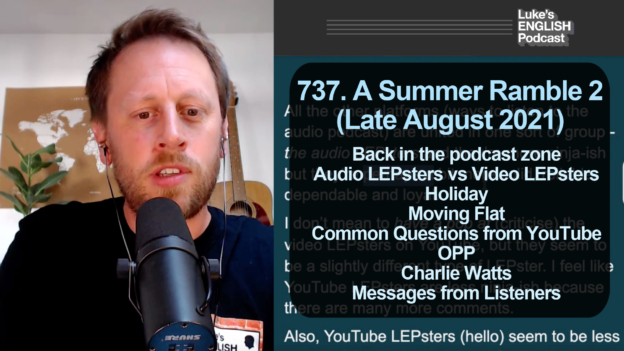
This is episode 735 and it is a rambling episode, which means it’s just me talking to you about various things – including: whatever comes into my head while I’m recording, but specifically this time I’m aiming to talk about 

  • Being back from holiday and getting back into the podcast zone
  • Comments about my audio listeners and my video viewers on YouTube
  • News about moving flat and moving to my new pod room (You can see that the move hasn’t started yet and so the podcast has not been disrupted yet)
  • Some common questions from the YouTube comment section (new listeners)
  • Charlie Watts – the drummer from the Rolling Stones who passed away yesterday
  • A couple of comments from the comment section including one very motivational email I got from a long-term listener
  • Whatever else occurs to me as we record this!

As well as being available as a normal episode of the audio podcast, this is also available on YouTube with some text on the screen – the notes and scripts that I’m reading from, so you can read along with me and spot certain phrases and spelling and so on. 

By the way – you can always pause this and check the screen if you feel you didn’t understand something or you found a new word or phrase. 

I’m reading from a script / notes

In this episode I’m reading from a script which I wrote last night. I don’t normally read from a pre-written script when I do these rambles, but this time is different.

I wrote most of this script last night, when it wasn’t really the right time to do a podcast recording, but I still consider this to be a rambling episode because I just rambled with my fingers last night and now I’m just reading out the text-ramble that I created, so it still counts as rambling as far as I’m concerned, and I of course I can deviate from the script/notes whenever I want.

So stick with me and I hope you enjoy listening to my words as they flow out like endless rain into a paper cup – a cup which you can take and drink from, metaphorically of course. 

Drink my English – that’s what I’m saying. I hope you know what I mean!

In the podcast zone (this is what I wrote last night)

I’m sitting here in front of the computer. My wife is lying across the sofa watching a French TV show on her phone and she’s under a nice sheepskin blanket that we have so she is feeling very cosy. I’ve just made her a cup of mint tea and I’ve tucked her feet into a blanket because I’m such a great guy and a really wonderful husband. 

The child is in bed asleep, and despite the madness that is going in on the world outside, this is a little moment of peace and quiet. 

Now I’m sitting with my computer on my lap, but I’m pretty much in the podcast zone right now – meaning, that I’m thinking of ideas for the podcast, considering what I’ve been doing and what I should do next. I know I should be able to record tomorrow as the little one is going to her French grandparents for a few days and my wife has work to do, so tomorrow is podcast day.

But I’m in the podcast zone now because I’m thinking about podcast ideas and things to record tomorrow. I’m just writing down my thoughts on my computer as they come into my head. I’m trying to write down every thing I’m thinking in order to make sure this is actually a rambling episode. I’m rambling everything down in text form here and I’m trying to make it sound like I am actually speaking normally and not reading from a text. 

What I’ll have to do tomorrow is record this but make it sound like I’m just saying it all off the top of my head. 

Also I might just go off on a tangent at any point and deviate from the script, if something occurs to me. 

In fact, what I’m going to do is, the word-for-word script for this is going to stop soon and I’m going to just write down some basic notes and then expand on them as I talk into the microphone tomorrow (which is actually today – so, tomorrow is now, so, are we in the past, the present or the future? I think I might have just invented time travel. These words are from yesterday, but I’m reading them now and you’re going to listen to them in the future – let’s just say that in podcastland, time is a sort of flexible thing a bit like a jelly or something. 

Yep, in LEPland, time is jelly – which might explain why my episodes are quite long sometimes.

In any case, I would like to record this episode tomorrow as a kind of welcome back before embarking on things like premium content and other episodes I’ve been planning.

I do have other episodes I’d like to do and tbh while I was away on holiday over the last 3 weeks or so I was itching to get back to podcasting. 

I had lots of ideas popping into my head which I couldn’t quite hold onto and as I didn’t get the chance to write them down, they’ve all disappeared into the ether – little ideas, comments, stories that occurred to me at various moments, like when I’m in the shower but which I almost instantly forgot – so I was quite keen to do some recording again after being away just to satisfy the compulsive podcasting side of me. 

The holiday was fantastic and one of the best ones we have had for ages. I’ll tell you about it a bit later in this episode.

Those other episodes I could be doing right now:

P31 parts 4,5,6 

Learn English from my mum as we look at phrases which came up in our conversation in episode 717 – learn them properly with loads of examples and the chance to do plenty of listen and repeat pronunciation work with me so you don’t just learn new language, but learn how to produce it too.

War of the Worlds part 4 (conclusion?)

88 English expressions that will confuse everyone! (remember that? I never finished it)

More stories like The Mountain

Reading from more texts or books

An episode with The Thompsons which I recorded when I was in England

Some invitations to other podcasters/English teachers who have interviewed me recently

Top 10 Jokes from the Edinburgh Fringe 2021

And I have a big list of other ideas which I am slowly working my way through.

But I think before I do those ones and perhaps some others, I’d like to just do this rambling episode with you. 

These rambling episodes are where I just talk to you directly and move from topic to topic almost making it all up as I go along.

So just keep up with me, follow along and let the words flow through you like the force in Star Wars. 

Feel the English, let it flow through you. 

Be the English. 

Imagine blue lazers and Star Wars / The Matrix type stuff. 

Be one with the living English and listen with me as I chat to you about various things.

Audio listeners / Video Viewers (LEP is an audio podcast, with some videos on YouTube)

Most people listening to this – the vast majority listening to my words right now are listening to my podcast on their phone probably with headphones on, using a podcasting app of some sort, probably the native Apple Podcasts app on the iPhone or something like Spotify or another podcasting app, or perhaps you are listening on the LEP App. 

Most people listen to the audio version of this – and I’m saying this now because I’m also recording a video version of this on YouTube and I feel like YouTube is a pretty different audience. 

All the other platforms (ways to listen to the audio podcast) are united in one sort of group – the audio LEPsters and they’re more ninja-ish but they’re perhaps a bit more solid, reliable, dependable and loyal. 

I don’t mean to have a pop at (criticise) the video LEPsters on YouTube, but they seem to be a slightly different type of LEPster. I feel like YouTube LEPsters are less ninja-ish because there are many more comments.

Also, YouTube LEPsters (hello) seem to be less aware of the back catalogue of episodes, and I get a lot of people who have never heard the podcast ever before. (shocking, I know) 

But YouTube has enormous potential to go viral. In fact, in a way it’s like swimming in the deep ocean and you could catch a current and get into the very deep water. 

I mean, most episodes on YouTube get less attention than the audio versions, but then some videos go viral as they get picked up by the algorithm which is responding to the way people interact with your video and I guess that the algorithm sort of picks up on videos which are popular and promote them, as a way to always present the best content on the platform. 

So a couple of my recent videos went a bit viral (not a lot but a bit), which was nice.

So – YouTube LEPsters – here, let me just have a word for a moment. 

Really, this is an audio podcast that also has a youtube channel and recently I’ve been uploading more to it, but really this is still, mainly, an audio show and I have a big archive of audio episodes on my website and in my app. 

Not all the episode are available on YouTube and they’re not all on Apple Podcasts, but they’re all there on my website, with episode pages for each and every single one of them and audio download links. 

Go to my website teacherluke.co.uk (I know it looks like it was made in 2012) and then click EPISODES in the menu, and also in the LEP App you can get every single episode.

Most people listen to my podcast using an app on their phone and they listen when they are probably doing something else, like walking around, driving (please be careful), doing housework, doing exercise or simply breathing. 

So listening to the audio version on your phone seems to be the normal way to do it.

If you listen using a podcast app on your phone, and you need to stop listening for whatever reason, the app will remember where you stopped listening and you can then carry on from that point later. So, you don’t have to listen to an episode in one single go.

The majority of my audience listen to the audio version of this and I’ve been doing the audio podcast for over 12 years now, and I have a big back catalogue of episodes and I have talked about lots of different things over the years including some things that I’m sure you’d like to hear, so check out the episode archive for the older episodes.

LEP App

My app disappeared from the Apple App store for a couple of days (I had a payment issue with Apple) and when it came back all the ratings and reviews had gone (3 years’ worth), which was annoying. Can you do me a favour (no obligation of course) and give the app a rating and a review (if you use it)? 

How was your holiday?

It was great. No need to go into full detail like I have in the past, but basically we got lucky with the weather and had a really lovely time.

What about moving to your new flat and moving to a new pod-room?

Building work is being done in the new flat. I think the downstairs neighbours will want to murder us. 

I probably won’t get the keys to the new pod-room until mid September, and then I’ll move in there. I’ll need to get electricity and internet connected there, and to fit a desk and some shelves, and then it’ll be the official new pod-room.

Common Questions since going viral on YT

I am going to try to answer these questions as quickly and succinctly as possible without rambling at all in fact. So in this rambling episode, here is a section with no rambling. 

I hope that’s clear.

So, this is a rambling episode, with a bit where there’s no rambling.

Anyway – no rambling here, let’s just get straight to the point and keep it simple.

Common Questions from YouTube

Where are you from?

Can you do an episode about ______?

Check the episode archive on my website. There’s a chance I’ve already talked about that.

Go to the archive and do a ctrl+F search for the keywords you’re interested in.

How can I learn English by listening to your podcast?

This can really help you a lot, but it’s not the only thing you should do. 

It’s also important to read a lot (find texts which are not too tricky, use fairly modern English and which you actually want to read) study a bit (use grammar, vocabulary and pronunciation teaching materials of any kind and work with them – it’s not the only thing, but it helps) do lots of speaking if you can (ideally find someone to have meaningful conversations with, perhaps a teacher or language partner who can give you some little corrections and encouragement) and write on a regular basis too (practise writing different types of text or just write a diary every day in which you express your thoughts in English – you’ve got to express yourself in English regularly in order to find your voice).

Learning English is about learning how to do something, not just learning how to understand something, and we generally get better at things by trying to do them again and again. 

So listen and read a lot and try to speak and write a lot too. That’s quite general advice but there it is.

For more specific advice on how to use the podcast to improve your English, you could listen to these episodes

174, 568.

Should I listen to the episodes on order?

It’s up to you really. You can just listen to all the new ones as they come out, but if you really want to learn from me properly then I would suggest listening from episode 1. 

Certainly if you are a lower level learner, the first 50-ish episodes are probably a bit easier to understand and have more specific language-teaching objectives, so it would be good to start with them. 

But equally, if you just find my episodes fun and interesting you can listen to them in any order you like. Be aware though: multi-part episodes should be heard in order, and there might be little private jokes and references from earlier episodes which you might not understand (like the dreaded Russian Joke).

Can you do more story episodes?

Yes, I’m planning to do more stories.

Can you do episodes about grammar, vocabulary and pronunciation?

Consider signing up to LEP Premium for loads of episodes like that.

www.teacherluke.co.uk/premiuminfo   

Can you feature ___(insert name here)___ again? (Check previous episodes)

Check the archive – a lot of my guests have been on the podcast before, especially favourites like Amber & Paul and my family. Check the archive.

Can you do video episodes every time?

Not every time, but I’ll try to do them as often as possible.

Is there a transcript for this episode?

teacherluke.co.uk

Transcripts

Episodes with transcripts

Episode archive and check

Transcript collaboration

YouTube channel – automatic subtitles

Live without subtitles – Learn to hear the spoken version of English without the aid of the written version (Although subtitles and scripts can also be a great resource, and so you should do a bit of both).

Recent appearances on other people’s podcasts

So in the last episode I mentioned:

The Level Up English Podcast

Stories of Language Learners Podcast

Since then I was also on:

English Small World Podcast (by Apex Language Consulting & Training in Taiwan) (2 episodes) apexenglishpodcast.podbean.com

The Clark and Miller English Podcast 

Charlie Watts

The Rolling Stones seem to be missing a drummer and a bass player. I hear Ringo Starr and Paul McCartney are available. Imagine if they formed a Beatles/Stones supergroup at the very end of their careers?

But of course nobody could replace the people who are gone like Charlie Watts and Lennon and Harrison, but still it would be fun for the five remaining guys to get together and perform. 

Actually I think they’d be an amazing band but there would be ego struggles between Jagger and McCartney for stage limelight. 

Paul and Keef are great mates I believe and they used to meet up together when they both stayed in the Caribbean 

and probably have a few cups of tea and have a laugh and tell stories of the old days. 

So they’re pretty tight, and Ringo is friendly with everyone and still drumming. 

The Rolling Beatles

Message from Lio in Brazil

Remember the WISBOLEP competition? That was awesome.

From Lio from Brasil who didn’t make it to the last 16.

Lio appears at about 2:24:00 in the Wisbolep 1 video.

The point is – there were so many people who sent really great recordings and who didn’t get through to the last 16. 

I want to share this because it is a very real example of someone who has connected the learning of English to their personal life in a very human way – which means, making mistakes, acknowledging motivational issues and finally coming to terms with the fact they have to take responsibility for learning and the end result is great. 

This is an excellently written email that obviously just came out of Lio without him planning it and rewriting it. He has done really well with his English, as have so many other LEPsters. This is what he wrote.

…

Lio from Brasil

I had so much fun during this competition, even though I didn’t pass the first round.

Let me tell you something, I’ve been meaning to write it for a long time..:)

You know, I need to be frank, I was sooo happy and keen to participate that, when I recorded my pitch, I wasn’t thinking about “what” I should have said, but only about “how” to say it, (very slowly and clearly). 

My thought was: “I want everyone to understand me”, because I guess that there are different types of lepsters, people who just started and people who have been listening for years…

So I decided to speak that way..,I guess the result was that I made myself sound like a robot 😶

I don’t want to be too hard on myself but knowing that there is always room for progress, helps me on the journey, it tells me that I could be working even harder on my English, while at the same time having fun.

I love this language and when I was younger, it was so frustrating and tiring. You know the vibe because you’re learning French and you need it in one way or another.

As a non native speaker I knew as a child that I HAD to learn English, sooner or later.

It was only 9 years ago that I started to want to learn it…and did I start then? Of course not!!! naaa, too easy!! Let’s just procrastinate for other 5 or 6 years 😜

And so, as the story goes, in 2016 (November, I swear 😂) I started googling “learn English” online, Youtube and other websites…but I wasn’t satisfied, I was looking for something that wasn’t boring or “slow-paced”. 

I desired something interesting and alive, that could help me defeat my tendency to quit learning the language. 

Why? Because English represented this scary monster in my head and I had more worries than solutions at the time. So I felt the need to challenge myself and, as a beginner your podcast seemed quite advanced and not doable, I thought I couldn’t possibly succeed in understanding everything that was being said, episode after episode.

And then, at a certain point, I don’t know when or how, it just “clicked”…I think around episode 60 or 70…I suddenly realized I was understanding everything on the podcast. 

At that point, after years of procrastination, failures and half attempts at learning the language, I felt like: “that’s it! I got it! Finally!” 

Now, let me just tell you that I was aware of how much work I still needed (and need now)..but believe me…I cracked the code, I finally unlocked this thing, I got this! That’s how I felt…

But I need to add that, although I had finally found the resource I was looking for, I wasn’t disciplined enough for self studying and I already knew very good books (Raymond Murphy’s and collegues), but as you said so many times that I couldn’t possibly remember, you need to take responsibility for the learning process.

I really liked episode 686, you and Christian from Canguro English said a very important thing.

Sometimes people think that when one wants to learn a language, he/she simply needs to take lessons from a teacher saying: “Ok, I’m here, just fill me up with English”, so to speak..but if that was the case, how much easier things would be?

There is that film with Keanu Reeves, what was its name? Oh Yeah “Johnny Mnemonic” (1995) in which they put data inside his brain and he has to carry it, as a courier I believe. 

Anyway the point is, it doesn’t work like that, us, learners, we are the ones that need to do the hard work, guided by our teachers, in the lepsters case, by you of course, 😁you’re the one who unlocks all of this.

I followed a lot of advice you gave and let me tell you… thank you, it worked wonders!

So yeah, 80% of what I know comes from here! LEP!

But there is also something I love doing as much as possible, and that’s creating my own learning bubble where I’m immersed in the language, as much as possible. Your podcast is a great way to do that ! You definitely revolutionized my English comprehension, aquisition and assimilation and I’m so thankful for that! Not only the language, but your culture too!

I remember episode 100 of Lep: “Going to the pub”, (wow, so many years ago), that’s how it felt in this journey, sitting in a pub with a friend, chatting about so many things, that was the classroom. And episode 99:” The Rotary Sushi Bar of English”, where you pick up all the different portions of English.

Let’s wrap this up, shall we? :)

Thank you for all of this! I had and I’m having so much fun with Lep and knowing that so many people are part of this community is a strong reminder that in the end we’re all from Lepland, we all share this passion for the language and, as our teacher said many times, it’s all about connection, not perfection! 

P.S. Let me do it at least once …I’m certainly rushing to get to next episode…hehe ;)

Until then…bye bye byee bye bye

All the best,

Lio

HAMAD – STOP LISTENING TO LEP IN THE BATHROOM!

Hi Luke,

Hope you are doing great in these Covid-19 times.

One of your very dedicated listeners is Hamad, my husband, who annoyingly keeps listening to your podcasts in the bathroom, while showering, even when he is changing his clothes!

He keeps waking me up from my sleep during his morning “rituals”, or anytime he goes to the bathroom to do ANYTHING.

Please let him know i sent you this message, and tell him to PLEASE stop listening to your podcasts in the BATHROOM.

Sincerely, a concerned yet disturbed wife, Aysha

Thank you.

Sent from my iPhone
That’s all folks!!!

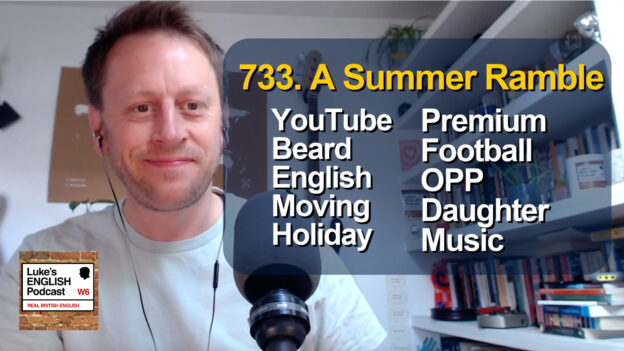
733. A Summer Ramble

A pre-holiday ramble in which I talk about learning English, moving to a new flat, the podcast over the next few months, football, being on Other People’s Podcasts, a recording of my daughter speaking English and a couple of songs. Video version available.

Audio Version

Small Donate Button

[DOWNLOAD AUDIO]

Video Version

Notes

There’s no script for this episode. All I have is a list of one-word prompts to help me remember what I should be saying.

  • YouTube 
  • Beard
  • English
  • Moving
  • Holiday
  • Premium
  • Football
  • OPP
  • Daughter
  • Music

Luke on Other People’s Podcasts

The Level Up English Podcast with Michael Lavers

English 2.0 Podcast with Al Slagle

Glass Onion: On John Lennon by Antony Rotunno

Luke on the Stories of Language Learners Podcast

Luke on other podcasts  (coming soon)

  • English with Rod https://www.youtube.com/user/robuca2011

  • The Clark and Miller Podcast https://www.clarkandmiller.com/english-podcast/

  • 英文小宇宙 by Li Ping Chu & Nan Kun Wu (Translates as English Microcosm) https://apexenglishpodcast.podbean.com/ – a podcast for learners of English based in Taiwan

732. Christian from Canguro English returns

Talking to Christian again about some of the themes and controversial opinions he talks about in his YouTube videos, plus some bits about men wearing thongs on the beach, an obsession with rabbits and if Christian was the Donald Trump of English teaching. Video version available.

Audio Version

Small Donate Button

[DOWNLOAD AUDIO]

Video Version

Introduction Transcript

Hello listeners,

How are you today? You are now listening to episode 732, and in this one I am talking again to Christian Saunders from Canguro English.

This is the second time I’m talking to him on the podcast. I previously interviewed Christian in episode 686 last year and got to know him a bit, but I wanted to talk to him again after having seen some of his most recent videos on YouTube about language and language learning.

In his videos Christian often challenges certain assumptions and myths about language learning, and so I thought it might be interesting to talk to him about those things, so I came up with some questions about language, learning language and teaching English on the internet.

There is a video version of this conversation on my YouTube channel too, so don’t forget to check it out and of course to like and subscribe while you’re there.

There’s no more for me to add here in the introduction. I hope you enjoy this conversation and get some good things from it. Once again, Christian’s YouTube channel is called Canguro English and his website is canguroenglish.com

Let’s get started.


So that was Christian from Canguro English. Thanks again to Christian.

And here we are, at the end of yet another episode. I wonder what you thought of the points which came up in that conversation? Feel free to let us know in the comment section or perhaps under the YouTUbe version of this. Where do you stand on things like comprehensible input, workbooks and clickbait titles? Let us know.

For me, this is one of the last episodes I’m recording before officially starting my summer holiday. As usual I have loads of stuff to record and publish before I go away, and I might end up recording some of it while I am back in the UK. But here’s a little overview of what’s in the pipeline right now.

  • A Summer Ramble
  • War of the Worlds
  • P31

So I have my work cut out.

In terms of holiday – we’re going back to the UK to stay at my parents’ place and we will have to deal with the whole quarantine thing, and the day 2 and day 8 testing process and all that. It’s quite annoying. But after we quarantine we will be going to a posh camp site for some “glamping” and generally spending a couple of weeks in the UK.

Meanwhile our new flat in Paris is being demolished (on the inside) and remade to our specifications. Let’s hope that all goes according to plan.

I’ll talk more about this stuff in that rambling episode which is coming up.

In any case, I will speak to you again soon.

But for now, it’s time to say, good bye bye bye…

731. Beatles Song Lyrics / Idioms & Expressions (with Antony Rotunno)

Learn English with The Beatles as we explore lyrics from Beatles songs and pick out some idioms, descriptive language and other vocabulary for you to learn. Featuring Antony Rotunno from the Glass Onion: On John Lennon podcast.

Small Donate Button

[DOWNLOAD]

Introduction Transcript

Hello everyone,

In this episode you can learn English with The Beatles as we look at specific bits of English which appear in the lyrics of their songs.

I’m joined again by Antony Rotunno from the Glass Onion on John Lennon Podcast. Antony is also an English teacher and something of a John Lennon expert. He is also a musician, and a lot of the credit for this episode goes to him, because he did most of the preparation, going through lyrics of Beatles songs and picking out specific use of English, including certain phrases and idioms.

This is like a quiz actually. Can you name the songs when Antony plays them? 

Can you beat me?

Can you name the songs from the lyrics and from the music?

There are a few references to The Rutles and Neil Innes of course, but for us those songs are all part of The Beatles extended universe.

I’ll chat to you again at the end of the episode and will sum up some of the bits of language that come up, but now let’s get started.


Phrases / Vocabualry

  • Using lots of pronouns, me, you, us, I etc
  • Using more imagery in the lyrics
  • I’m going to love her until the cows come home
  • A chip on my shoulder
  • My heart went boom when I crossed that room
  • Buzz, hum, boom (Onomatopoeia)
  • It won’t be long ‘til I belong to you
  • I don’t know why she’s riding so high
  • To be on your high horse
  • I’ll make a point of taking her away from you
  • I sat on her rug biding my time, drinking her wine
  • This bird has flown
  • Please don’t spoil my day, I’m miles away, and after all, I’m only sleeping
  • If she’s gone I can’t go on, feeling two foot small
  • Feeling 10 foot tall
  • Ouch, you’re breaking my heart
  • To upset the applecart
  • Where there’s a will there’s a way
  • He was like a wolf in sheep’s clothing
  • Or an iron hand in a velvet glove
  • Working like a dog
  • Sleeping like a log
  • Sleeping like a baby
  • If you need a shoulder to cry on
  • To give someone a shoulder to cry on
  • To open up the doors
  • My independence seems to vanish in the haze
  • It was another string to their bow

Colours

  • There is a place, where I can go, when I feel low, when I feel blue
  • To feel blue
  • Everybody’s green because I’m the one who won your love
  • Green = 1. Jealous 2. inexperienced 
  • Oh dear what can I do, baby’s in black and I’m feeling blue

Imagery

  • When the sun shines they slip into the shade, and sip their lemonade
  • With tangerine trees and marmalade skies, cellophane flowers of yellow and green
  • No-one I think is in my tree
  • Nobody is on my wavelength
  • Semolina pilchard climbing up the Eiffel Tower
  • The clouds will be a daisy chain, so let me see you smile again
  • Her hair of floating sky is shimmering, glimmering, in the sun
  • My mother was of the sky, my father was of the earth but I am of the universe and you know what it’s worth
  • Words are flowing out like endless rain into a paper cup
  • Pools of sorrow, waves of joy
  • Don’t need a gun to blow your mind
  • No longer riding on the merry go round, I just had to let it go
  • Mother, you had me, but I never had you

Links to Antony’s Podcasts

Glass Onion: On John Lennon

Film Gold

Life and Life Only

730. Marie Connolly Returns (+ 2 songs)

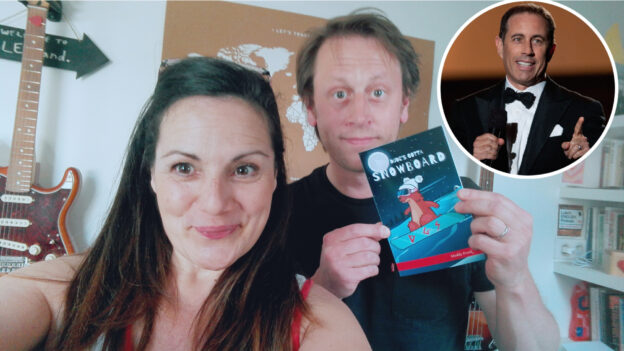
Talking to author Marie Connolly about her new books for children, plus a story about how Jerry Seinfeld came to one of our comedy shows, with two songs on guitar at the end.

Small Donate Button[DOWNLOAD]

Introduction & Ending Transcripts

Hello listeners,

Hello, hello, hello.

How are you doing? How is everything in your particular part of LEPland today as you listen to this? What’s going on? Where are you? How are you? Who are you? How’s your English? OK I hope. 

This podcast is here to help by giving you a source (not sauce) of authentic English to listen to on a regular basis. There are various ways you can use the podcast to improve your English but let’s just keep it simple and say – all you need to do is listen, try to follow what is being said and hopefully enjoy the process, even if it’s a bit difficult to understand every single thing. Sometimes you will find notes and transcripts on the page for each episode on my website. Checking them can also be a good idea.

I have another guest today. Marie Connolly is back on the podcast in this episode. She came over to the flat a few weeks ago to record this conversation.

I know Marie from doing stand up comedy both in London and Paris. Like a lot of my friends she does stand-up, and she has also worked as an English teacher but these days the main thing she does is write – she is mainly a writer now – an author – writing books both for adults and for children.

You might remember Marie from episode 683 in October last year, when she told us some funny stories about moments when French men have flirted with her, and the book that she wrote which contains all those stories. Episode number 683 – that’s the last time Marie was on the show.

But she is back again to tell us about a new series of books she has written, this time for children. So, if you know any kids aged 8 or above, and you want to encourage them to read something fun in English, these books could be a good choice. They are written for people with English as a first language, so they’re not for beginners, but they are fun and if your kids can read English, they might like these stories.

She’s going to tell us about those stories and the process of writing and self-publishing them  but this conversation also contains lots of other stuff too – including different types of extreme sports, the classic old topic of doing comedy to audiences from different countries, an anecdote about the time Jerry Seinfeld came to one of our comedy shows, some comments from listeners in response to Marie’s last apperance, and more stuff for your listening pleasure.

Right then. So let’s now enjoy the company of Marie Connolly once again. I will speak to you a bit more on the other side of this conversation, and here we go…

—–

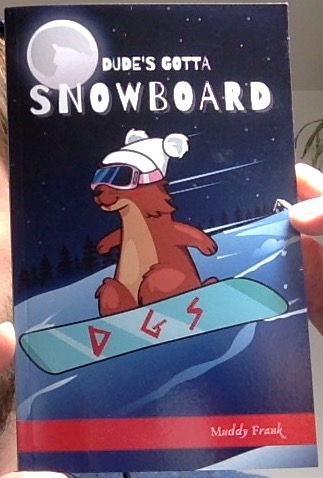
Click here for links for Marie’s books: Dude’s Gotta Snowboard & More

—–

Ending Notes

Thanks again to Marie Connolly there. You can find her books on Amazon – her writing alias is Muddy Frank, and you could search for Dude’s Gotta Snowboard. 

There are also links on the page for this episode on my website.

So thanks again to Marie.

So how’s everything going with you?

I will say that things are pretty busy here, with a lot of work going on and also some fairly complicated general life stuff – basically, we are in the process of moving to a new flat, and if you’ve moved flat or moved house, you’ll know how complex and disruptive that can be. 

Of course, all our possessions will have to be packed in boxes, moved to a completely new place and then unpacked, and that’s after all the decoration and work we’re having done on the new place and all that stuff. I will be leaving my pod room, taking everything down. All the books are coming off the shelves, all my equipment will be boxed up, all the guitars are coming down, everything is moving. 

What is cool is that I am going to have my own dedicated office/recording space/pod-room. 

It’s going to be incredibly small – more of a cupboard than an office, but it will be my HQ for LEP, and it’s not going to be part of our new flat. It’s in a completely different location, but it’s 5 minutes on foot from our new place. Anyway, we have a LOT of stuff to get done and our lives will be kind of turned upside down over the next couple of months, plus we want to do a trip to the UK for a holiday and various other things, so I don’t know how this is going to affect the podcast. I suppose there’s a chance I won’t be able to record, which would be a pity, although I’m sure you’d understand. I would have to publish some premium content though.

Luckily I have a few episodes recorded and edited and ready to be published, and they will continue to arrive over the next few weeks, but meanwhile, things in LEP HQ are a little bit chaotic at the moment. I won’t go into it in further detail at this moment, but as I said I will try to publish a rambling episode with news and comments about what’s going on and maybe I’ll respond to some listener comments and stuff like that soon, ok. In any case, podcasts will be arriving as normal at least for the next 4 or 5 weeks, so everything should be ship shape in podcastland, even if things are a bit crazy behind the scenes. We will see if I can continue to create and publish content during the madness of the next few months.

I said I wouldn’t ramble here. I’ll save it all for a full on rambling episode next time.

In any case, I hope you are well out there in podcastland.

At the end of the episode I thought I would sing a couple of songs which I’ve been playing recently. 

They’re both by Beck.

Song Lyrics

Lost Cause by Beck https://genius.com/Beck-lost-cause-lyrics

Dead Melodies by Beck https://genius.com/Beck-dead-melodies-lyrics

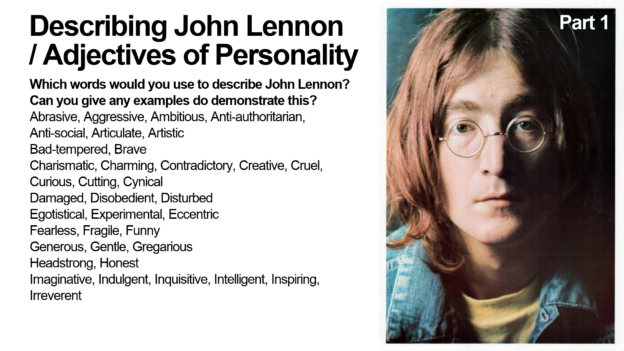
726. Describing John Lennon / Adjectives of Personality A-I (with Antony Rotunno)

Learn useful adjectives for describing personality traits with John Lennon as a case study. Episode 3/5 in my Beatles series, with returning guest Antony Rotunno from the podcast “Glass Onion: On John Lennon”. 

Small Donate Button

[DOWNLOAD]

Introduction Transcript

Hello listeners and welcome back to LEP.

Here is the next episode in my Beatles season, and this is where we look at some language too.

In this episode I’m joined again by Antony Rotunno who is a podcaster and English teacher from England. Antony’s main podcast is called Glass Onion: On John Lennon and as the title suggests it is all about John Lennon, particularly his psychology and his life story. Antony’s other podcasts are called Film Gold, a film review series and Life & Life Only which is about personal development and psychology, so Antony knows a thing or two about psychology and John Lennon, and of course as an English teacher he’s well experienced in helping learners to conquer this language of English.

In this one we’re going through a big list of adjectives which I prepared earlier. All the adjectives are words you could use to describe someone’s personality. We have loads of these adjectives, so Antony and I made a list of words which could be used to describe John Lennon. It’s an ABC in fact. Now we didn’t manage to talk about every single adjective in the list, but we certainly had a good go at them, and what you’re going to get in this episode is a sort of English lesson with John Lennon as a case study.

Here are the adjectives (I’m going to read them out)

  • Consider which ones you know
  • Which ones you use
  • Which ones you don’t know
  • Which ones you don’t use
  • Word stress

Adjectives of Personality

  • Abrasive, Aggressive, Ambitious, Anti-authoritarian, Anti-social, Articulate, Artistic
  • Bad-tempered, Brave
  • Charismatic, Charming, Contradictory, Creative, Cruel, Curious, Cutting, Cynical
  • Damaged, Disobedient, Disturbed
  • Egotistical, Experimental, Eccentric
  • Fearless, Fragile, Funny
  • Generous, Gentle, Gregarious (sometimes!)
  • Headstrong, Honest
  • Imaginative, Indulgent, Inquisitive, Intelligent, Inspiring, Irreverent

I’ll let you discover which ones we actually talk about in detail in this episode. The rest of the list will come up in the next part.

Also, I’ve collected a set of other expressions from this conversation, not using adjectives of personality, but just useful expressions and examples of language you could use, and I’m planning to use that set in an upcoming premium episode.

teacherluke.co.uk/premiuminfo if you want to sign up to LEP Premium to get all the premium content unlocked.

Now, let’s consider John Lennon’s personality, things he did and said in his life and try to work out what kind of person he was, with a few useful adjectives in the process.

Links to Antony’s Podcasts

Glass Onion: On John Lennon

Film Gold

Life and Life Only

Ending Notes

Thank you again to Antony. 

We will be back in the next part of this series. I’m not sure when that’s going to arrive. 

It might be the next episode, or it might arrive in a short while.

Let me know your thoughts in the comment section.

Don’t be a ninja. 

If you were a ninja and then you left 1 comment, and went back to being a ninja, you’re 2nd level ninja now, ok?

1st level ninjas are the ones who never comment

2nd level ninjas are ones that commented and then disappeared

You don’t want to know what makes a 3rd level ninja.

I will speak to you soon but now it’s time to say goodbye…

725. Fun & Games for Learning English with Vickie Kelty

Playing word games with English teacher Vickie Kelty and talking about how to use these games in learning and teaching English.

Small Donate Button

[DOWNLOAD]

Introduction Transcript

Hello listeners,

In this episode I am talking to Vickie Kelty from vickiekelty.com about playing games for learning and teaching English.

Vickie is an English teacher from the USA, currently living in Spain, and she absolutely loves games. She loves playing word games, speaking games, card games, board games. She is nuts about games and she really enjoys using various games in her English lessons.

So in this episode Vickie and I are going to talk about games that you can play that can be a fun way to practise your speaking, or practise different bits of grammar or vocabulary.

You could consider using these games both for learning and teaching English, and Vickie and I are going to be playing the games during this episode, so you’ll hear how they work and you’ll be able to play along too.

The theme for this episode is celebrities, or famous people, so as well as us playing these guessing and describing games, you will hear plenty of celebrity and movie star rambling and gossip too.

Here’s a list of the games we play and mention.

Games to mention

  • Uno
  • Scattergories

Games we played

  • 20 Questions
  • Password
  • Catchphrase
  • Taboo
  • The Lying Game (which is why this episode is so long)

If you want to find out more about Vickie, including some of the online courses she has to offer, just go to vickiekelty.com

OK, so this episode is long so I don’t want to add anything else here, except that I really hope you enjoy this episode and find it fun. I will talk to you again briefly at the end, but now let’s meet Vickie and play some fun games for learning English.

Vickiekelty.com

Ending

Thanks again to Vickie. I hope you enjoyed that one. There were quite a lot of funny moments.

Again, check out www.vickiekelty.com to find more about Vickie’s work.

Consider using some of these games in your speaking practice or in your lessons if you are a teacher. They can be a great way to add some fun and some communicative incentives to your learning or teaching.

There’s nothing more for me to add here, except to say that I will speak to you again on the podcast soon, but for now it’s time to say, goodbye bye bye bye bye.

723. Bahar from Iran 🇮🇷 (WISBOLEP Runner-Up)

This is the final episode in the WISBOLEP competition series, speaking to Bahar from Iran about the 7-step method she used to improve her English and develop a British-sounding accent. Bahar used to be a terrible student who hated English, but then she made a decision to focus on her English in her own way. Listen to her explain how she did it.

Small Donate Button[DOWNLOAD]

Introduction Transcript

Hello listeners, this is the final episode in the WISBOLEP series – Why I Should Be On Luke’s English Podcast. As you probably know, this was a competition I launched last year in which listeners chose other listeners who they would like to be interviewed in an episode of the podcast, and so far we’ve had 5 people, all of whom have managed to improve their English to a proficient level, while living in a non-English speaking environment for the most part, without having English speaking people in their family or close friends. So these have been stories of English learning success, which I seriously hope have been inspiring and interesting for you to listen to.

This conversation is with Bahar from Iran. Bahar actually came 5th in the competition, but she happened to be the last person I interviewed.

As you will hear, Bahar’s English is excellent but that wasn’t always the case. In fact, according to her she used to be a terrible student who hated English and who couldn’t string a sentence together. But now it’s a completely different story. She is proficient in English, she has a lovely clear accent and is confident and talkative, and loves this language. So how did she do it?

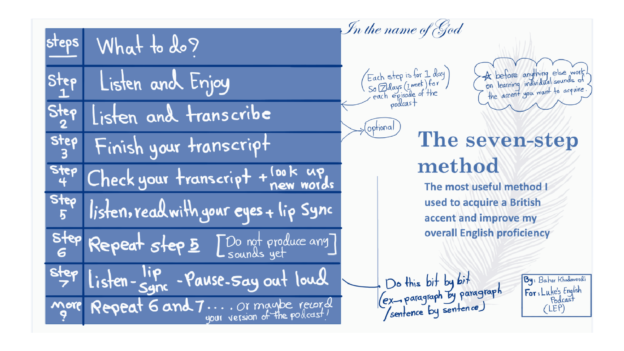
That is the main focus of this episode. Bahar tells us the story of her English journey, and she outlines her 7-step method for improving her English, especially her pronunciation. 

Yes, she has come up with a 7-step method. To be clear, she defined this method in retrospect, meaning that having improved her English to a good level she then looked back at what she had done and consolidated her approach into 7 clear steps, and she’s going to go through the entire thing in this episode.

Now, you can try to follow Bahar’s method, but one of the main points here is that you can actually come up with your own method for improving your English as long as you maintain certain key principles in your learning. 

There’s no need for me to add much more here really, except that you will find links to the various resources Bahar mentions during this conversation. Those are resources that she has found to be especially useful. You’ll find links to those things on the page for this episode on my website.

So now I will let you meet Bahar from Iran, currently living in Italy and here we go.


Ending Transcript

So that was Bahar from Iran. Thanks again to Bahar for her contribution. She definitely put a lot of effort into preparing herself for this conversation, coming up with some clearly defined steps and thinking about how she could go into some specific details about the things that worked for her. So, thanks Bahar for doing that.

You will see the hand drawn infographic that Bahar created to show her 7 steps – you’ll see it on the page for this episode on my website, and as the image for this episode on YouTube.

Perhaps the main point is that you can create your own method for learning English. Just go with whatever works for you. There isn’t one single best approach. You just have to make sure you are working with English on a regular basis, that you do things which bring you some joy (there’s no point slogging away with something that you just don’t like doing), you should attempt to maintain a positive and beneficial cycle in your approach to English, try to find your own personal motivation for learning the language, say to yourself “I’m going to do this and I’m going to do it my way” and then just put the time in. 

Also, don’t underestimate the importance of just spending plenty of time listening and don’t apply too much pressure to yourself. Let it happen naturally and in its own time. I hope my podcast helps to make this easier.

Again, check the page for this episode on my website where you’ll find links to things that Bahar mentioned, including the BBC Sounds of English pronunciation course, British Council Elementary Podcasts and so on.

That’s for this episode. Thank you for listening. Leave your comments and feedback in the comment section and have a fantastic day, night, morning, afternoon or evening and I will speak to you soon.

But now it’s time to say, good bye bye bye bye bye.

Useful Links

The Sounds of English (BBC Pronunciation Course) https://www.bbc.co.uk/learningenglish/oromo/features/the-sounds-of-english

On YouTube https://www.youtube.com/playlist?list=PLD6B222E02447DC07

British Council Podcasts and Listening Resources at Different Levels https://learnenglish.britishcouncil.org/skills/listening

Pearson graded readers https://www.pearson.com/english/catalogue/readers.html

722. Discussing John Lennon with Antony Rotunno

The second in a short series about The Beatles, this one focuses on the life of John Lennon, with an overview of his life story, some thoughts about his psychology and some rambling discussion questions about this iconic British musician, with podcaster, English teacher and musician Antony Rotunno.

Small Donate Button

[DOWNLOAD]

Links to Antony’s Podcasts

Glass Onion: On John Lennon

Film Gold

Life and Life Only

Introduction Transcript

Hello listeners, I hope you’re doing well today and that you are ready for this new episode of my podcast. You join me here in my pod-room as the rain falls down above my head. Conditions are perfect for learning British English. Let’s get started.

This is a continuation of this short series of episodes I’m doing about The Beatles and this one focuses mostly on John Lennon. If you’ve ever wanted to know more about this iconic British musician then this episode is for you. Also, if you’re already a Beatles fan or a John Lennon fan then I’m sure you’ll be glad to hear this conversation too.

My guest for this episode is Antony Rotunno from England and Antony is very knowledgeable about John Lennon and his life. In fact I feel like I couldn’t have found a better person to talk to about this subject.

One of the reasons for that is that Antony is also an English teacher. He’s been teaching English as a foreign language to adults for over 18 years, and for obvious reasons it’s always useful to have a guest who has experience of working with learners of English.

Antony is also a podcaster so he is used to talking to audiences over the internet from his home in England. Antony’s podcast is all about John Lennon.

And he probably knows all there is to know about John Lennon because he’s read everything out there on the subject and for his podcast he has interviewed lots of people connected to Lennon, including authors and people who actually knew John himself – people with first-hand accounts of meeting him.

So Antony really knows a lot about John Lennon.

And we had a really good, really long conversation for this podcast, covering various things like John Lennon’s life story. This is the first part of that conversation.

Let me just explain my reasons for doing this series of episodes about the Beatles. I probably don’t need to explain this, but allow me to give my reasons.

So, this is a 5 part series actually. I published the first part with my mum in episode 717, which was a review of a book about The Beatles, followed by a general Beatles ramble.

The rest of the series will be this conversation I had with Antony divided into 4 parts. But it’s not just going to be us rambling on about Lennon for all that time. I’ve also decided to employ some of Antony’s English teaching skills in order to cover some language too, specifically in parts 3, 4 and 5 of this series as we focus on descriptive adjectives for describing personality traits, and then some analysis of the lyrics from Beatles songs, with various nice phrases and idioms to learn. So there should be plenty of English learning opportunities to take from this whole series.

John Lennon is a hugely significant person in terms of modern history, and of course being English he is very much part of our culture, and as we move forwards in time it seems that the significance of the Beatles and everyone’s interest in them is not waning. If anything, they continue to grow in stature. 

And even if you’re not into the Beatles, hopefully this can be a chance to learn some new things about this band that is held in such high esteem by so many people.

I promise you – I’m willing to say I promise you here, that if you listen to this, you will know more about John Lennon than before you listened to it.

And if you’re wondering when we’re going to get to the music, part 5 will be all about Beatles lyrics and there will be some guitar playing as well.

First we will get to know Antony a bit and ask him about his podcasts, and then you’ll hear him talk about how he got into The Beatles and John Lennon in particular, then Antony is going to give a brief overview of John’s life and career and finally I’m going to ask Antony a few John Lennon discussion questions.

Let’s get started.

Ending Transcript

So that was episode 2 in this 5 part Beatles mini series, all about John Lennon.

Thanks again to Antony for his expertise. 

The other John Lennon episodes will follow over the next few weeks.

Do you feel that you know more about John Lennon than you did before you  listened to this?

I hope so.

I wonder what new things you learned from this. Feel free to leave your comments below.

I won’t say much more here, except that it’s been really interesting to talk to Antony and I look forward to the next few episodes in which we go into teacher mode and look at some descriptive adjectives and then song lyrics.

But that’s it for this episode. Thanks for listening. Be excellent to each other and I will speak to you soon.

718. Michael the Shaman 🇵🇱 (WISBLOEP Runner-Up)

Talking to competition runner-up Michael from Poland about two top English learning tips, scary hitch-hiking stories and the practice of shamanism using psychoactive substances.

Small Donate Button

[DOWNLOAD]

Introduction Transcript

Hello everybody and welcome back to Luke’s English Podcast. How are you today? I hope you’re doing well as you listen to this, wherever you are in the world at this particular moment in time.

This is the 5th in the WISBOLEP competition series – Why I Should Be On Luke’s English Podcast, talking to winners and runner ups from the listener competition I did at the end of last year. 

So far I have spoken to Walaa from Syria, Tasha from China, William from France and Robin from Germany. Now it’s the turn of Michael from Poland, also known as Michael the Shaman (this is the nickname that he often uses, for reasons which will become clear later in this episode). Michael actually came sixth, and Bahar from Iran was fifth, but at the time of recording this I haven’t spoken to Bahar yet. Her interview is coming soon though.

So, let me tell you a little bit about Michael the Shaman, from Poland.

Michael, who for the record is not an English teacher, has a lot to offer both in terms of language-learning tips that have worked for him and some very interesting stories and insights into some pretty deep and fascinating things, and I think this should be a great episode. So, listen closely.

Here’s a quick overview of the things we cover.

First we talk about language learning and those specific tips from Michael. These are resources and approaches that he has used to work on his English, especially his vocabulary and pronunciation, with some success I would say. I won’t go into them now, but pay attention so you can hear him describe these things, how he uses them and how they have helped him make some significant improvements to his English. I will summarise them again at the end and give a few extra comments.

Secondly, Michael tells us some of his hitch-hiking stories. Michael has spent lots of time travelling around in neighbouring countries near Poland and doing it by hitch-hiking, which basically means getting picked up by drivers who are going in the direction he wants to go, and hitching a ride with them as a way of travelling around. Now, this sounds adventurous and possibly a bit risky, because it does involve travelling in the cars of strangers, and Michael has some genuinely frightening and incredible stories of doing this. Again, listen closely to hear the specifics of the edgy situations that Michael has found himself in. 

Then, thirdly we have the topic of shamanism, or being a shaman. Michael is probably better placed to describe this than me, but being a shaman basically refers to the use of certain rituals and practices to enter different states of consciousness, which can lead to new discoveries, new perspectives, new ways of thinking and different ways of seeing the world, or the universe in fact, and our place within it. This is something that Michael has explored and for him it has been very beneficial to his life in various ways. So let’s listen to what Michael has to say about shamanism and the use of psychedelics.

At this point I feel I need to say something about the use of psychedelic substances, which is part of what Michael describes as being a shaman, and we’re talking about using substances that occur in nature, like certain magic mushrooms and ayahuasca as well as the synthetic chemical LSD or acid as it is also known. 

So I would like to just say one or two things about this topic as a sort of disclaimer or preface to our conversation.

First of all, the substances I just mentioned are controlled substances in most countries, which means that they are illegal to some extent. So, we are certainly not suggesting that people go out and start using them. 

By the way, I’m referring to these things here as controlled substances, but in many cases they are also called drugs, and they’re not just prohibited by law, but also in the general culture. For a lot of people drugs are a serious taboo and people often have quite strong and negative feelings towards this subject. I am aware of this, and I hope that you are comfortable listening to us talking about it on this podcast. I think it’s alright, but I am aware that for some people drugs are just not ok, and that’s fine.

I feel it’s necessary to say that in talking about psychedelic drugs here we are not condoning their use in any kind of flippant way, and “condoning” means promoting or supporting something. We take this seriously and as you will hear Michael is very articulate and quite serious about the subject. He’s very well-read and knowledgeable, and we are just talking about his personal experiences and knowledge, which I do think are interesting as well as being new as a subject on this podcast. I’ve never really talked about this kind of thing in depth before on the podcast.

Also I think it’s worth making a distinction between different types of drug or substance.

There are many different types of drug, and they are extremely different to each other. 

People often just say “drugs” without making any distinction between them. They just lump them all together as if they are all the same, basically. But I think it is worth making a distinction. Despite that fact that controlled substances are often grouped together as drugs, they are not really the same as they have very different effects and different levels of risk and we are certainly not talking about things like cocaine, crack cocaine or heroin, which are obviously very dangerous substances and very serious substances. We are not talking about those things here.  

So, I thought it would be worth making that distinction and I’m trying to be responsible about this topic, but I’m also attempting to manage your expectations here because I don’t want you to get the wrong impression or to be shocked or to have a knee-jerk reaction while listening to us mention psychoactive substances in the latter part of this conversation. For many of you, these words are not really necessary, you’re fine with it, but there it is. I felt I should make those points. We’re not promoting any kind of illegal behaviour, we are not talking about those damaging and addictive things that ultimately will destroy a person’s life, instead we are taking what I hope is a more reasonable and rational approach here and discussing the more intellectual and spiritual aspects of shamanism and how certain psychoactive substances are part of that.

Right, now before we get to the talk of psychedelics in the second half of our conversation, you can first hear Michael’s specific language learning tips, which I think are really useful, and then his crazy hitch-hiking stories, which are pretty mind-blowing and entertaining.

Right, no need for me to add anything else here. I really hope you enjoy this conversation. I’ll be recapping and summarising some details later but let’s now meet Michael the Shaman from Poland, another runner up in the WISBOLEP competition. 

Are you ready? Listening carefully? OK, here we go.

Bruce Parry’s short film about Ayahuasca

Ending Transcript

So that was Michael from Poland, and wow, that was awesome stuff, wasn’t it? It got very deep there, and cosmic, didn’t it? I hope you liked it. As usual, I’m very interested to read your responses to the things that Michael said. 

I’m going to sum up some of the things Michael said at the start of the conversation about learning English, because after all that mind-expanding talk of psychedelic trips and also the hitch-hiking stories, it seems like we talked about his language learning methods ages ago, and I think he made some really great recommendations that you could find really useful for your English.

Now, considering Michael’s English again. I think it’s fair to say that it’s good, right? 

I do want to repeat a couple of points.

Don’t compare yourself to others too much

Don’t compare yourself to other people too much. This can lead you to judge yourself a bit harshly, which is totally normal. Whenever we listen to other language learners, the tendency is to either judge their language level, or judge our own level in comparison to theirs, but this isn’t a very healthy thing to do in terms of language learning, and what I’d encourage you to do is only judge yourself by your own success, and rather than comparing yourself to others, try to notice how your English is better than it was before. 

Just compare yourself to yourself at earlier points in your language learning journey. Notice improvements you’ve made, and celebrate them. This is more likely to put you in a better mental space than comparing yourself with others. 

Just think how far you’ve come as a learner of English and take note of your progress. That’s probably healthier than falling into any kind of negative thinking which can happen if we compare ourselves unfavourably to other language learners.

So, try not to judge others too harshly, and don’t compare yourself to others too much. 

And hopefully listening to other language learners can give you some inspiration and some practical ideas which you can use to work on your English in ways you hadn’t considered before. Even little things like changing certain habits can make a big difference to your learning of English. 

And with that in mind, let me quickly just go over the tips Michael had for learning English, which worked for him. Have you tried these things or used these resources?

Michael’s Language Learning Resources

There were two things really:

  • Use English/English dictionaries to expand your vocabulary with correct definitions, examples, phonemic transcriptions and synonyms. My 5 favourites are www.collinsdictionary.com  www.cambridge.dictionary.org  https://www.oxfordlearnersdictionaries.com/ https://www.macmillandictionary.com and Longman Dictionary of Contemporary English https://www.ldoceonline.com/
    I have been planning to do a full episode on using online dictionaries to improve your English (in fact I’ll be touching on this a bit in a couple of upcoming episodes), but I will just say that these dictionaries are fantastic resources not just for getting definitions, but getting synonyms, examples, phonemic transcriptions and more – all of which are really important ways of really getting to know new words. Bookmark the dictionaries, use them all (because they have slightly different examples and details which you can cross reference) and get into the habit of checking words in them and exploring the information they can give you. Never before have we had access to so many wonderful language learning resources, completely free of charge, and at our fingertips at all hours of the day. It’s like living in a massive library. So, use those online dictionaries to explore new words.
  • The second resource Michael mentioned was the website www.dialectsarchive.com  – a website full of voice recordings used by actors and voice coaches trying to learn different accents, and especially the text Comma Gets a Cure, which is designed to reveal a huge variety of pronunciation features in English. You can hear the text being read in different accents, you can shadow the text, repeat it, record yourself repeating it and more. I plan to do some premium episodes using this text and other similar texts too. There is a lot to explore and use there, including some podcast episodes by the creators. www.dialectsarchive.com 

OK, so just two tips there, but they are solid ones.

And returning to the hitch-hiking stories. I just want to sum up the main one, just to be sure you got it. I think it was probably clear, but I want to retell that story just because I think it was such an exciting story, and maybe you didn’t catch the specifics.

Michael’s Hitch-hiking Story – recap

So Michael and his friend Kuba were hitchhiking from Poland to Amsterdam and they got picked up by a couple of very dodgy guys in a van. They didn’t realise it when they first got in the van but these guys were drinking alcohol and smoking some kind of crystal – perhaps crystal meth, like in the TV series Breaking Bad. Meth is a pretty nasty drug.

Michael is an intuitive person and he picked up on a very bad vibe from these guys and became convinced they were planning to do something very nasty with Kuba and him. Like I said, it sounds like something from a horror film. Listening to their comments, watching their demeanour and generally reading between the lines, Michael became convinced these guys were organ traffickers, who are people that kidnap healthy people in order to steal their internal organs and sell them on the black market. Certainly these guys seemed to be very dodgy and probably involved in organised crime.

Michael decided he would subtly let the guys know that he and Kuba were actually not that healthy and therefore their organs were not worth taking, which would convince them to just let them go.

It’s crazy I know, but I kind of know what Michael is talking about when he said he just knew something wasn’t right and that they were in danger. I feel like I’ve been in similar situations before, where you realise that the people you are with are dangerous and up to something, and so you just have to get out. It’s a weird feeling. I can’t remember any specific stories from my own life, but I’ve met guys in pubs before who just seemed dangerous and untrustworthy, even though there were no specific things that would give me that impression. It’s more of a vibe that certain people give off.

Anyway, Michael said that he heard the guys making jokes about stealing their organs, which appeared to be jokes, but there was a sinister undercurrent which suggested that perhaps they were not really joking. Michael’s friend Kuba was not quite as observant maybe and he didn’t seem to realise something was wrong, but anyway Michael sent him text messages to convince him that something wasn’t right. They managed to persuade the drivers to stop the van at a petrol station because Michael needed to be sick or had diarrhea and then they escaped at a petrol station.

They then decided to continue their hitchhiking trip to The Netherlands, but decided they would not accept lifts from any more Polish people, nobody drinking or using drugs and no vans. This is because they didn’t want to risk running into any similar people or perhaps their friends who they suspected were also on the road, but somehow the next car that picked them up, by coincidence maybe, contained the friends of the dodgy guys they had just escaped from. So, it was a case of “out of the frying pan, into the fire”.

Michael said that these other guys seemed more intelligent and perhaps were the bosses of the other two they had met previously, and the only way Michael and Kuba got away without being taken, was because the guys ended up liking them, as they played along with their jokes and generally tried not to antagonise them at all. So, phew! What a lucky escape! 

And Michael said that hitchhiking was not that dangerous! 

Actually I do believe that on balance his experiences of hitch hiking have been much more positive than negative, but what a scary story! And I do believe it is true. I find it very believable. There are dodgy people in the world.

And finally, a few more words on the topic of psychedelics like magic mushrooms.

A final note on Magic Mushrooms

All the things Michael mentioned about Amanita muscaria (Fly Agaric) are definitely worth researching. In his words (from a recent email exchange we had) “I think I talked about maybe 1% of things you can do with this mushroom. I’d like to stress once again that I don’t recommend everybody uses this mushroom. I’m all about education and knowledge. The mushroom can have medical, therapeutic and spiritual effects, but only if one does it correctly. It is not easy to work with this mushroom.

An excellent resource for Amanita muscaria is Amanita Dreamer on YouTube and her website www.AmanitaDreamer.net. Also, a recently published book: ‘Fly Agaric: A compendium of History, Pharmacology, Mythology & Exploration’ by Kevin Feeney is also great.

These resources are essential as there are many dangerous myths regarding Amanita muscaria. Remember, it’s important to make sure that you are fully knowledgeable about this mushroom. You can’t just pick the caps and eat them. 

I think the same goes for all kinds of psychedelic substance that Michael talked about. Please remember that we’re not condoning the use of these things in any kind of casual way. You must be very careful, very well-read and personally very prepared before going any further.

Right then, what did you think of this episode?

Any thoughts on Michael’s language learning resources, his hitchhiking tales or his comments on the use of psychedelics? If you have things to say, just express your thoughts in English, ideally in the comment section on my website.

That’s all from me. Have a good morning, afternoon, evening or night. Be excellent to each other, good luck with your English and do take care.

Speak to you again on the podcast soon, but for now it’s just time to say good bye bye bye bye bye.